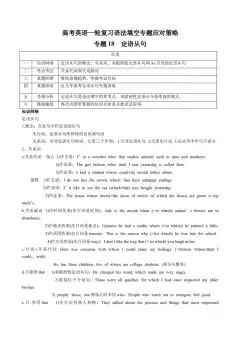
定语从句之全解
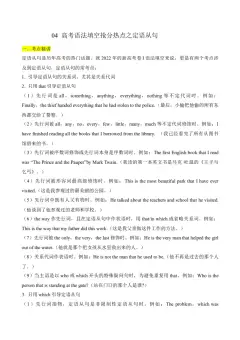
一、什么是定语从句?
定语可以由形容词、名词、代词、分词、不定式以及介词短语等来担任,也可以由一个句子来充当,充当
定语功能的句子称为定语从句。
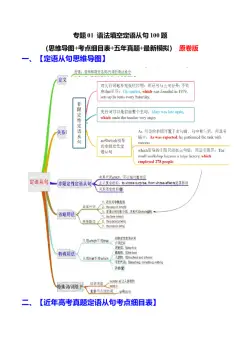
二、定语从句“三要素”:先行词、关系词和定语从句。
1.先行词:被定语从句所修饰的名词或代词被称作先行词。
(1)指人的先行词
(2)指物的先行词
★ 先行词还可以是前面整个句子所叙述的事情。
He has passed the driving test, which surprises all of us. (which替代前面所叙述的事情)
2.关系词:引导定语从句的词被称为关系词。
(1)关系词的作用
①替代前面的先行词;
②连接主句和定语从句;
③在定语从句中作句子成分。
(2)关系词的分类
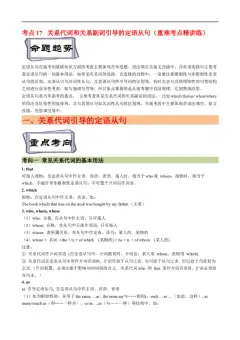
①关系代词:that、which、who、whom、whose和as(单独讲解)
that 指人或物,在从句中作主语、宾语或表语;
which 指物,在从句中作主语、宾语或表语(作宾语时可以省略);
who 指人,在从句中作主语、宾语或表语;
whom 指人,在从句中作宾语;
whose 指人或物,在从句中作定语。
注意:指物时,whose+名词=the+名词+of which或 of which + the+名词
②关系副词: when、where和why
when(=介词+which) 在定语从句中作时间状语,先行词为表示时间的time, day等;
I still remember the day when I first came to Beijing. (when=on which) 我仍然记得我第一次来北京的那
一天。
where(=介词+which) 在定语从句中作地点状语,先行词为表地点的place, spot等;
Can you tell me the office where he works? 你能告诉我他工作的办公室吗?
why (= for which) 在定语从句中作原因状语,先行词只有reason。
I don't want to listen to any reason why you were absent. 我不想听你缺席的任何理由。★ 关系副词 = 相应的介词 + 关系代词
★ where引导的定语从句还可以修饰抽象空间的名词,如 case(情形)、situation、position(位置)、stage (阶
段)、point(地步)等。
What are the situations where body language is the only form of communication?
在哪些情况下身体语言是唯一的沟通方式?(此时where = in which)
③as作关系代词的用法:
as 指人或物在从句中作主语,宾语或表语。
(1) as引导限制性定语从句常用于下列结构:such…as; so…as; the same…as; as…as
a. such...as/ such as 意为“...的那种...,像那样的”。You should read only such books as you can
understand without much difficulty.(as作宾语)你应当只读那些你读起来不太难懂的书。
b. the same...as/the same as意为“与...同样的”We have arrived at the same conclusion as they have.(as
作宾语)我们已得出和他们同样的结论。This is the same watch as I lost. (as作宾语)这同我丢的那块表一
样。(两块手表)
This the same watch that I lost yesterday. 这是我就是我昨天丢失的手表。(这里只有一块手表)
c. as+形+冠+n + as,是 as +形+as的一种变化形式。He is as good as his brother他和他弟弟一样好。
这句话还可以表达为:He is as good a boy as his brother.It’s as pleasant a film as I have ever seen.
(as作宾语)这是一部和我以往看的同样好的电影。
d. so+形+冠+n + as,是 such+冠+形+n …as的一种变化形式。He is such a nice boy. 用so可以表达为:
He is so nice a boy.It was so difficult a problem as no one worked out.这是一道没有人算出来的难题。
★ the same…as指同一类(两个),the same…that指同一个(一个)
I bought the same car as yours.我买的那辆汽车和你的一模一样。
This is the same bag (the very bag) that I lost yesterday.这就是我昨天丢失的那个包
That is the same man that asked for help the day before yesterday.那就是前天来求助的同一个人
★ such…as 和such….that的区别(该用定语从句还是用结果状语从句)
such…as “像……样的”, as引导的是定语从句, as做句子成分;such…that“如此……以至于”,that引
导的是结果状语从句, that不做句子成分。
判断办法:
如果后面成分完整(往往动词后面有宾语,用that来引导结果状语从句;如果后面句子成分不完整(往往
动词后面缺一个宾语,这意味着先行词就是做宾语)用as来引导定语从句。
He is such a lovely boy that we all love him.(成分完整,结果状语从句)译为:他如此可爱,我们都喜
欢他。He is such a lovely boy as we all love .(成分不完整,是定语从句)译为:他是那种我们都喜爱的男孩。
(2)as引导的非限制性定语从句,以及与which的区别
a. 位置不同
as可放在主句后,主句前或主句中间;which只能放在主句后。
b. as起连接作用,表达说话人的观点、看法,并指出主句内容的根据或出处,意为 “正如,正像”;
which相当于并列句,可以用and this来代替,意为“这一点,这件事”。
注意:as常用于下列结构:as we know(众所周知);as everyone knows(众所周知); as is known to
all(众所周知);as we all can see(正如我们都能看到的那样);as is suggested(正如所建议的那样);
as has been reported(正如所报道的那样); as has been said before/above(正如之前所说的);as has
been mentioned above(正如上面所提到的);as is expected(正如所预料的);as is often the case(这
是常有的事)一般不能用which代替as。
As we all know, the earth moves around the sun. 众所周知,地球绕着太阳转。
Fan Zhendong , as is known to all, is an excellent table tennis player.众所周知,樊振东是一名优秀的乒乓球运
动员。
As is often the case, he was a little nervous in front of so many people. 在那么多人面前他有点紧张,这是可以
理解的。
3.定语从句:用来做定语的句子。
(1)限制性定语从句:限制性定语从句紧跟先行词,主句与从句不用逗号分开,对先行词起限定、修饰
作用,从句不可省去,翻译成一个句子。
He is a teacher who works at our school. 他是在我们学校工作的老师。
(2)非限制性定语从句:主句与从句之间有逗号分开,起补充说明作用,如省去,意思仍完整,翻译成
两个句子。
Beijing, which is the capital of China, is a beautiful city with a long history. 北京是中国的首都,是一座
有着悠久历史的美丽城市。
比较:
He has two sons, who work in the same company. 他有两个儿子,他们在同一家公司工作。(He has only
two sons.)
He has two sons who work in the same company. 他有两个在同一家公司工作的儿子。
(Perhaps he has two more sons)
三、介词+关系代词
★该结构的关系代词只有两种即:介词+which(指物);介词+whom(指人)★该结构介词的选用原则:
(1)根据定语从句中谓语动词的习惯搭配
This is the book on which I spent $ 8. 这就是我花了8美元买的那本书。
This is the book for which I paid $ 8. 这就是我花了8美元买的那本书。
(2)根据先行词的搭配习惯
I remember the days during which I lived there. 我记得我住在那里的日子。
I remember the day on which I graduated from university. 我记得我大学毕业的那一天。
(3)根据整个句子所表达的意思来决定
The colorless gas without which we can’t live is called oxygen. 没有它我们就不能生存的无色气体叫做
氧。
(4)英语中为了强调某一名词,不定式前面也可以加上关系代词。
Here is the money with which to buy the piano. 这是买钢琴的钱。
She is the right person on whom to depend. 她是值得信赖的人
(5)关系代词whose也可以在从句中与它所修饰的名词一起作介词宾语。
Mr Liu wants to talk to the students whose homework hasn’t been handed in. 刘老师要跟那些没交作业
的学生谈话。
This is Mr. Smith, in whose factory we work. 这是史密斯先生,我们在他的工厂工作。
(6)“名词/数词/代词+介词+关系代词”结构常见的形式有:
名 词 /one/two/some/none/all/both/several/many/most/a few/a little/the+ 比 较 级 /the+ 最 高 级 … +of +
which/whom。
He has three sons, two of whom are teachers. 他有三个儿子,其中两个是教师。
四、关系代词的特殊用法
★只用that不用which的情况
1、先行词all, much, everything, nothing, something, anything, nothing, none, the one等不定代词时。She
did all that she could to help us. 她尽了她所能帮助我们。
2、先行词被all, every, no, some, little, much, the only, the very, the right,the last等所修饰时。This is
the very book that I want. 这正是我想要的那本书。
3、当先行词是最高级或被形容词最高级修饰时。This is the best book that I have ever read. 这是我读过
的最好的书。
4、当先行词是序数词或被序数词修饰时。This is the first film that I've seen since I came here. 这是我
来这里后看的第一部电影。5、当先行词既指人又指物时。She described in her compositions the people and he places that impressed
her most. 她在她的作品中描述了给她印象最深的人和地方。
★只用which不用that的情况
1、 当介词放在关系代词之前时。The pen with which you write is Jack's. 你用来写字的那支笔是杰克的。
2、 在非限制性定语从句中。These trees,which I planted three years ago,were cut by government. 这
些树是我三年前栽的,被政府砍了。
3、 当关系代词指整个主句的概念时。She lost the game, which depressed her greatly. 她输了比赛,这使
她非常沮丧。
★只用who不用that的情况
1、先行词是one, ones, anybody, all, none, those 等
Those who want to go to the cinema will have to wait at the gate of the school. 那些想去看电影的人必
须在学校门口等候。
2、在非限定性定语从句当中。
Tom, who is my best friend, has gone abroad to study. 汤姆,我最好的朋友,已经出国留学了。
五、几个特殊的先行词
(1)way在定语从句中做状语时的三种引导方式 that / in which / 不填
The way in which / that / 不填 he explains the sentence to us is quite simple. 他向我们解释这个句子的
方式很简单。
比较:The way which /that/不填 he told to us was quite simple. 他告诉我们的方法很简单。
★way在定语中作tell的宾语
(2)先行词time
time表示“次数”时,用关系代词that引导定语从句
This is the first time that the president has visited the country. 这是总统第一次访问这个国家。
time作“一段时间” 讲时,应用关系副词when
This was the time when there were no radios, no telephones or no TV sets. 那是一个没有收音机、没有
电话、没有电视机的时代。
★此时when = during which 在..期间
(3)先行词reason当在定语从句中作状语时用 why/for which
This is the reason why/for which he can not come here. 这就是他不能来这里的原因。
比较:Is this the reason that/which/不填he explained to us for his absence from the conference?这就是
他向我们解释他缺席会议的原因吗?★reason 在定语从句中做explain的宾语
六、定语从句的主谓一致
1、关系代词作从句的主语时,从句中谓语动词的人称和数要与先行词保持一致,先行词如果是整个句子,
定语从句的谓语动词用单数形式。
Great changes have taken place in China, as is known to all. 众所周知,中国发生了巨大的变化。
He has passed the driving test, which surprises all of us. 他通过了驾驶考试,这使我们都感到惊讶。
2、“one of+复数名词”位于关系代词前作先行词时,关系代词在从句中作主语,从句的动词通常用复数。
The Great Wall is one of the world-famous buildings that draw lots of visitor every year.
3、当one前有the, the only, the very等修饰时,从句的谓语动词要用单数。
The Great Wall is the only one of the buildings on the earth that is seen from the moon.
七、定语从句的转化
定语从句可以转换为–ing或-ed形式
The girl (who is) dancing now just returned from Taiwan. 正在跳舞的那个女孩刚从台湾回来。
I love the stories (which were) written by Hemingway. 我喜欢海明威写的故事。
The man (who stands) standing there is my friend. 站在那儿的那个人是我的朋友。
八、定语从句的解题方法
(1)判断从句是否为定语从句 (先行词,关系词,定语从句);
(2)准确判断先行词在定语从句中的成分(主、宾、表、定、状)从而正确选定使用关系代词或关系副词。
注意:
① 关系代词whose的用法:whose在定语从句中做定语。
当先行词是人:whose = the + 名词 + of whom
当先行词是物:whose = the + 名词 + of which
Do you know the boy whose parents / the parents of whom are on holiday? 你认识那个父母在度假的男
孩吗?
I'd like a room whose window / the window of which faces the sea. 我想要一间窗户朝海的房间。
② that引导定语从句,名词性从句 和 强调句型的区别:
定语从句中的that: 关系代词,在后面的定语从句中作句子成分。
名词性从句中的that:从属连词,只起连接主、从句的作用,在从句中不作句子成分。
强调句中的that, 运用于it is/was…that/who..结构;判断标准:去掉强调句型结构,成分仍然完整。
比较:
This is the book that I am looking for. 这就是我正在找的那本书。(that 引导定语从句)
It is at Bashu middle school that I have studied for three years. 我在巴蜀中学学习了三年。
(that和前面的it is构成强调句型)
The fact that he stole the money surprised all of us. 他偷钱的事实使我们大家都感到吃惊。
(that 引导名词性从句--同位语从句)
That he will come to the conference has excited all of us. 他要来参加会议使我们大家都很兴奋。
(that引导名词性从句--主语从句)
We all expect that they win, for members of their team are stronger. 我们都希望他们能赢,因为他们的
队员更强。
(that引导名词性从句--宾语从句)
The reason for your failure is that you lack confidence in yourself. 你失败的原因是你对自己缺乏信心。
(that 引导名词性从句--表语从句)