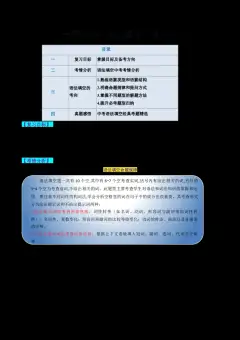
第2 讲 名词性从句2026 年高考英语语法专项突破(全国通
用)
(语法讲义+模拟练习+真题操练)
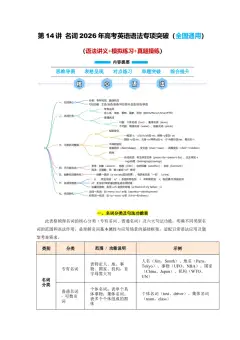
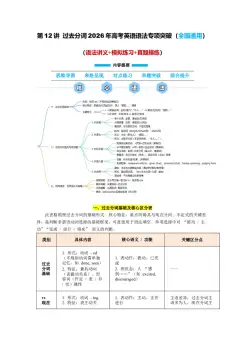
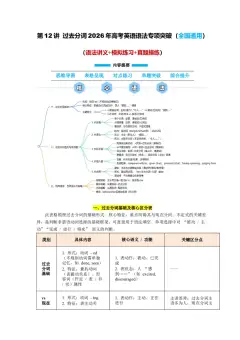
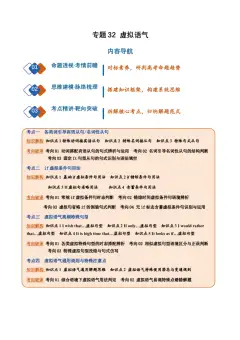
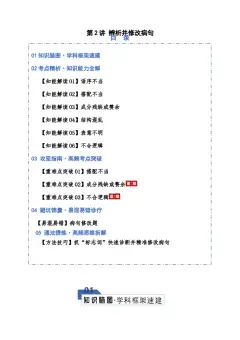
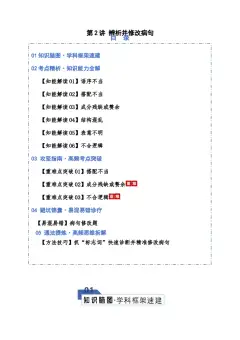
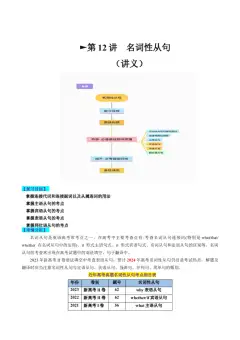
 内容提要
思维导图
表格呈现
对点练习
单题突破
综合提升
一、名词性从句基础框架表
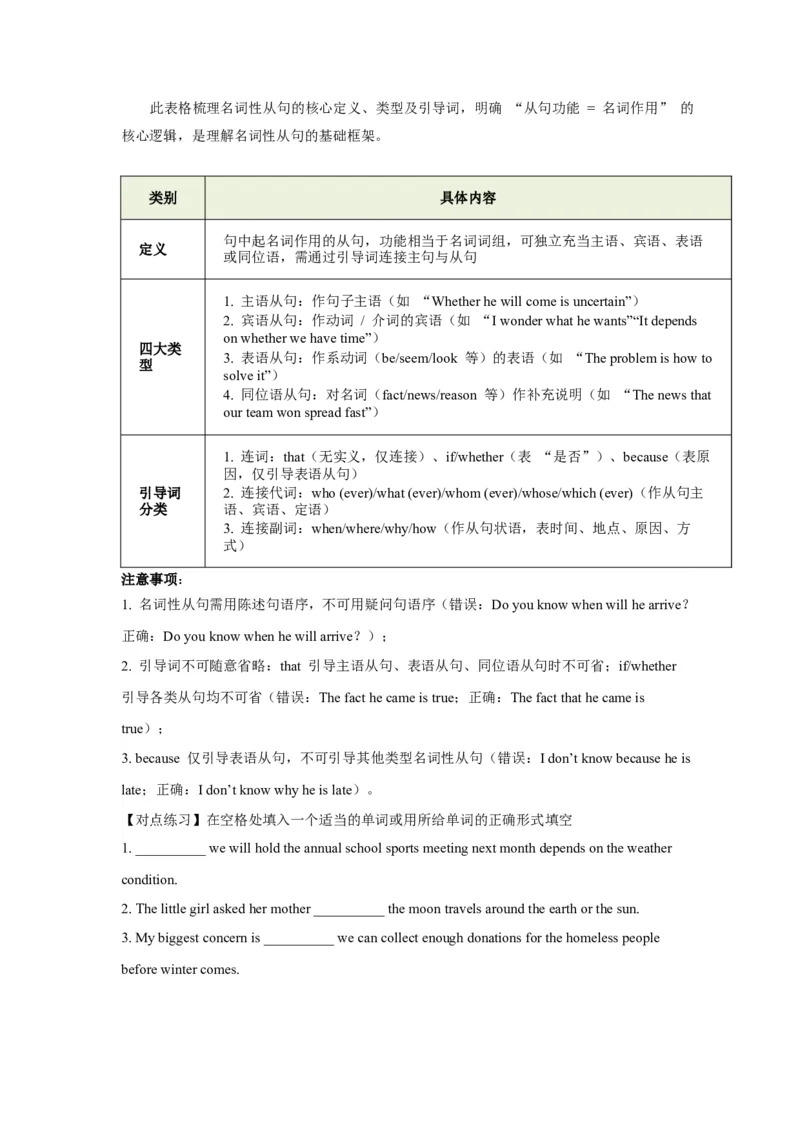
此表格梳理名词性从句的核心定义、类型及引导词,明确 “从句功能 = 名词作用” 的
核心逻辑,是理解名词性从句的基础框架。
类别
具体内容
定义
句中起名词作用的从句,功能相当于名词词组,可独立充当主语、宾语、表语
或同位语,需通过引导词连接主句与从句
四大类
型
1. 主语从句:作句子主语(如 “Whether he will come is uncertain”)
2. 宾语从句:作动词 / 介词的宾语(如 “I wonder what he wants”“It depends
on whether we have time”)
3. 表语从句:作系动词(be/seem/look 等)的表语(如 “The problem is how to
solve it”)
4. 同位语从句:对名词(fact/news/reason 等)作补充说明(如 “The news that
our team won spread fast”)
引导词
分类
1. 连词:that(无实义,仅连接)、if/whether(表 “是否”)、because(表原
因,仅引导表语从句)
2. 连接代词:who (ever)/what (ever)/whom (ever)/whose/which (ever)(作从句主
语、宾语、定语)
3. 连接副词:when/where/why/how(作从句状语,表时间、地点、原因、方
式)
注意事项:
1. 名词性从句需用陈述句语序,不可用疑问句语序(错误:Do you know when will he arrive?
正确:Do you know when he will arrive?);
2. 引导词不可随意省略:that 引导主语从句、表语从句、同位语从句时不可省;if/whether
引导各类从句均不可省(错误:The fact he came is true;正确:The fact that he came is
true);
3. because 仅引导表语从句,不可引导其他类型名词性从句(错误:I don’t know because he is
late;正确:I don’t know why he is late)。
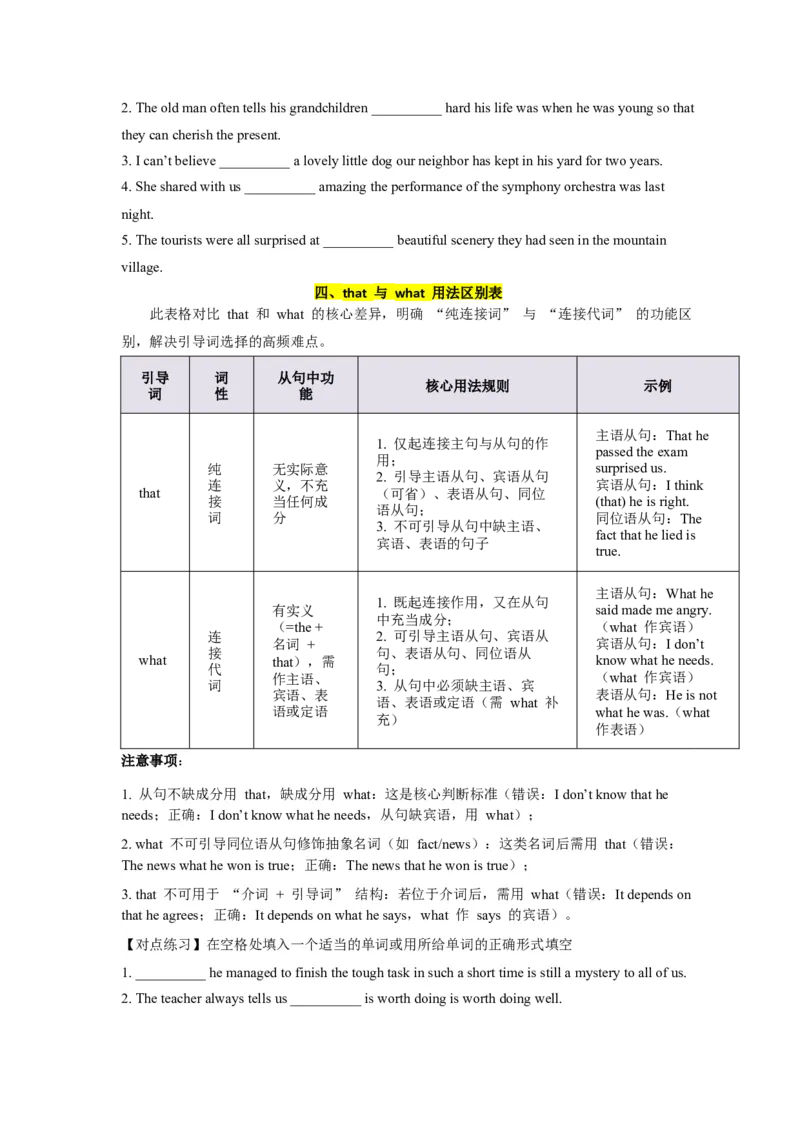
【对点练习】在空格处填入一个适当的单词或用所给单词的正确形式填空
1. __________ we will hold the annual school sports meeting next month depends on the weather
condition.
2. The little girl asked her mother __________ the moon travels around the earth or the sun.
3. My biggest concern is __________ we can collect enough donations for the homeless people
before winter comes.
4. The news __________ our school basketball team won the provincial championship spread
quickly across the campus.
5. He has no idea __________ his father will return from his business trip, so he keeps checking his
phone for messages.
二、if 与 whether 用法区别表
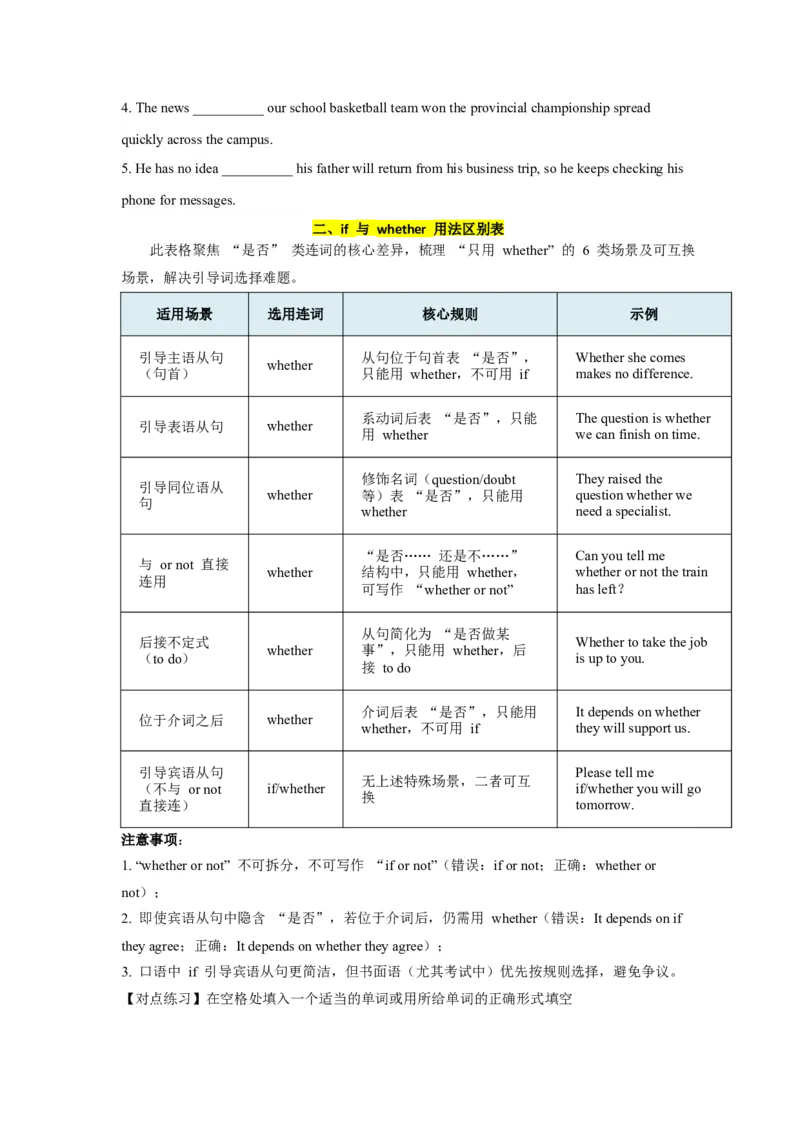
此表格聚焦 “是否” 类连词的核心差异,梳理 “只用 whether” 的 6 类场景及可互换
场景,解决引导词选择难题。
适用场景
选用连词
核心规则
示例
引导主语从句
(句首)
whether
从句位于句首表 “是否”,
只能用 whether,不可用 if
Whether she comes
makes no difference.
引导表语从句
whether
系动词后表 “是否”,只能
用 whether
The question is whether
we can finish on time.
引导同位语从
句
whether
修饰名词(question/doubt
等)表 “是否”,只能用
whether
They raised the
question whether we
need a specialist.
与 or not 直接
连用
whether
“是否…… 还是不……”
结构中,只能用 whether,
可写作 “whether or not”
Can you tell me
whether or not the train
has left?
后接不定式
(to do)
whether
从句简化为 “是否做某
事”,只能用 whether,后
接 to do
Whether to take the job
is up to you.
位于介词之后
whether
介词后表 “是否”,只能用
whether,不可用 if
It depends on whether
they will support us.
引导宾语从句
(不与 or not
直接连)
if/whether
无上述特殊场景,二者可互
换
Please tell me
if/whether you will go
tomorrow.
注意事项:
1. “whether or not” 不可拆分,不可写作 “if or not”(错误:if or not;正确:whether or
not);
2. 即使宾语从句中隐含 “是否”,若位于介词后,仍需用 whether(错误:It depends on if
they agree;正确:It depends on whether they agree);
3. 口语中 if 引导宾语从句更简洁,但书面语(尤其考试中)优先按规则选择,避免争议。
【对点练习】在空格处填入一个适当的单词或用所给单词的正确形式填空
1. It is still under discussion __________ the new traffic regulation will be carried out next month.
2. The interviewer asked the candidate __________ she had any work experience related to the
position she applied for.
3. The problem __________ we should take immediate action to reduce air pollution has been
debated for a long time.
4. They are considering __________ to postpone the meeting until next week due to the sudden
storm.
5. The success of the project depends on __________ we can get enough financial support from the
government.
三、含感叹句的宾语从句用法表
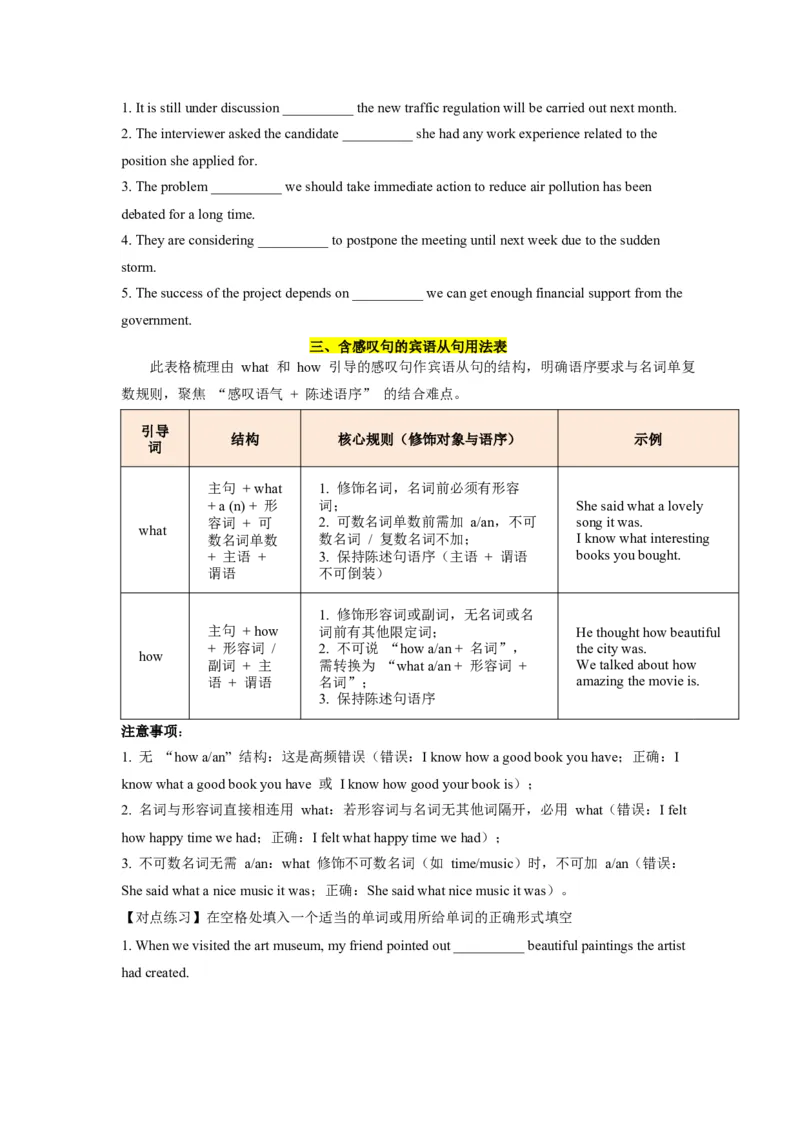
此表格梳理由 what 和 how 引导的感叹句作宾语从句的结构,明确语序要求与名词单复
数规则,聚焦 “感叹语气 + 陈述语序” 的结合难点。
引导
词
结构
核心规则(修饰对象与语序)
示例
what
主句 + what
+ a (n) + 形
容词 + 可
数名词单数
+ 主语 +
谓语
1. 修饰名词,名词前必须有形容
词;
2. 可数名词单数前需加 a/an,不可
数名词 / 复数名词不加;
3. 保持陈述句语序(主语 + 谓语
不可倒装)
She said what a lovely
song it was.
I know what interesting
books you bought.
how
主句 + how
+ 形容词 /
副词 + 主
语 + 谓语
1. 修饰形容词或副词,无名词或名
词前有其他限定词;
2. 不可说 “how a/an + 名词”,
需转换为 “what a/an + 形容词 +
名词”;
3. 保持陈述句语序
He thought how beautiful
the city was.
We talked about how
amazing the movie is.
注意事项:
1. 无 “how a/an” 结构:这是高频错误(错误:I know how a good book you have;正确:I
know what a good book you have 或 I know how good your book is);
2. 名词与形容词直接相连用 what:若形容词与名词无其他词隔开,必用 what(错误:I felt
how happy time we had;正确:I felt what happy time we had);
3. 不可数名词无需 a/an:what 修饰不可数名词(如 time/music)时,不可加 a/an(错误:
She said what a nice music it was;正确:She said what nice music it was)。
【对点练习】在空格处填入一个适当的单词或用所给单词的正确形式填空
1. When we visited the art museum, my friend pointed out __________ beautiful paintings the artist
had created.
2. The old man often tells his grandchildren __________ hard his life was when he was young so that
they can cherish the present.
3. I can’t believe __________ a lovely little dog our neighbor has kept in his yard for two years.
4. She shared with us __________ amazing the performance of the symphony orchestra was last
night.
5. The tourists were all surprised at __________ beautiful scenery they had seen in the mountain
village.
四、that 与 what 用法区别表
此表格对比 that 和 what 的核心差异,明确 “纯连接词” 与 “连接代词” 的功能区
别,解决引导词选择的高频难点。
引导
词
词
性
从句中功
能
核心用法规则
示例
that
纯
连
接
词
无实际意
义,不充
当任何成
分
1. 仅起连接主句与从句的作
用;
2. 引导主语从句、宾语从句
(可省)、表语从句、同位
语从句;
3. 不可引导从句中缺主语、
宾语、表语的句子
主语从句:That he
passed the exam
surprised us.
宾语从句:I think
(that) he is right.
同位语从句:The
fact that he lied is
true.
what
连
接
代
词
有实义
(=the +
名词 +
that),需
作主语、
宾语、表
语或定语
1. 既起连接作用,又在从句
中充当成分;
2. 可引导主语从句、宾语从
句、表语从句、同位语从
句;
3. 从句中必须缺主语、宾
语、表语或定语(需 what 补
充)
主语从句:What he
said made me angry.
(what 作宾语)
宾语从句:I don’t
know what he needs.
(what 作宾语)
表语从句:He is not
what he was.(what
作表语)
注意事项:
1. 从句不缺成分用 that,缺成分用 what:这是核心判断标准(错误:I don’t know that he
needs;正确:I don’t know what he needs,从句缺宾语,用 what);
2. what 不可引导同位语从句修饰抽象名词(如 fact/news):这类名词后需用 that(错误:
The news what he won is true;正确:The news that he won is true);
3. that 不可用于 “介词 + 引导词” 结构:若位于介词后,需用 what(错误:It depends on
that he agrees;正确:It depends on what he says,what 作 says 的宾语)。
【对点练习】在空格处填入一个适当的单词或用所给单词的正确形式填空
1. __________ he managed to finish the tough task in such a short time is still a mystery to all of us.
2. The teacher always tells us __________ is worth doing is worth doing well.
3. The little boy doesn’t understand __________ his parents are so strict with him about his
homework.
4. Our monitor’s suggestion __________ we should organize a volunteer activity to help the elderly
is under discussion.
5. We need to figure out __________ caused the sudden power cut in the downtown area this
morning.
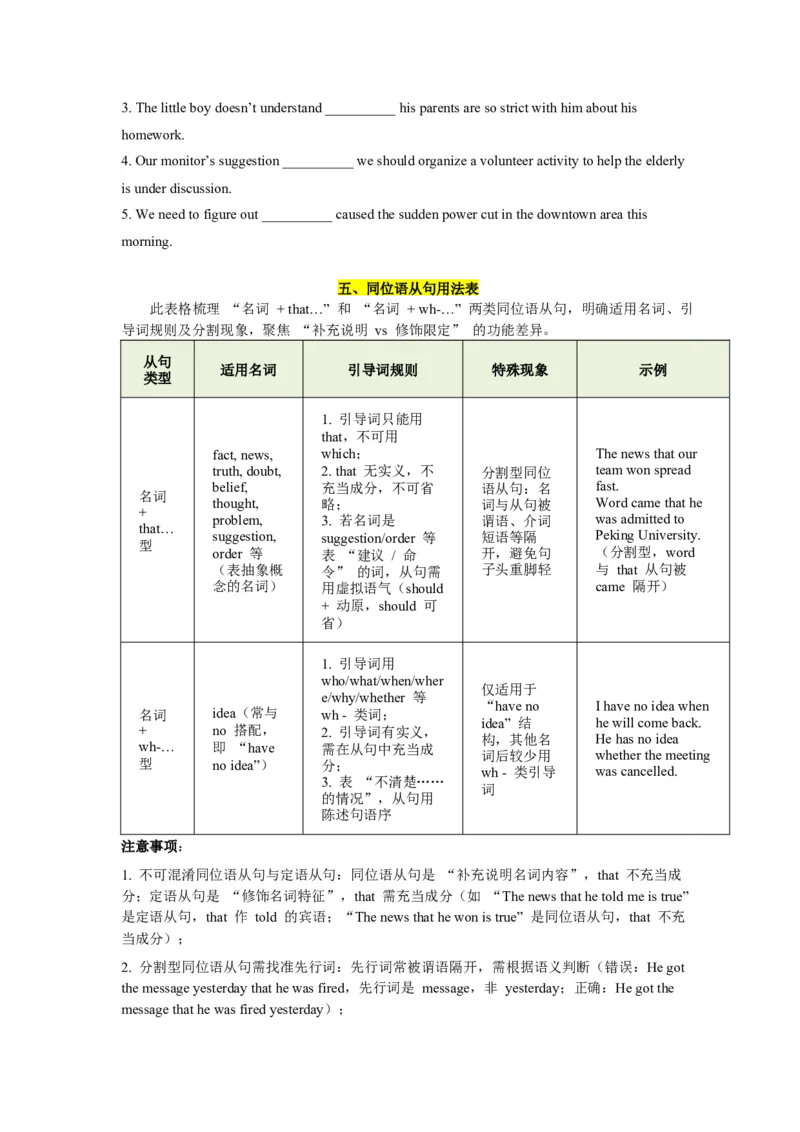
五、同位语从句用法表
此表格梳理 “名词 + that…” 和 “名词 + wh-…” 两类同位语从句,明确适用名词、引
导词规则及分割现象,聚焦 “补充说明 vs 修饰限定” 的功能差异。
从句
类型
适用名词
引导词规则
特殊现象
示例
名词
+
that…
型
fact, news,
truth, doubt,
belief,
thought,
problem,
suggestion,
order 等
(表抽象概
念的名词)
1. 引导词只能用
that,不可用
which;
2. that 无实义,不
充当成分,不可省
略;
3. 若名词是
suggestion/order 等
表 “建议 / 命
令” 的词,从句需
用虚拟语气(should
+ 动原,should 可
省)
分割型同位
语从句:名
词与从句被
谓语、介词
短语等隔
开,避免句
子头重脚轻
The news that our
team won spread
fast.
Word came that he
was admitted to
Peking University.
(分割型,word
与 that 从句被
came 隔开)
名词
+
wh-…
型
idea(常与
no 搭配,
即 “have
no idea”)
1. 引导词用
who/what/when/wher
e/why/whether 等
wh - 类词;
2. 引导词有实义,
需在从句中充当成
分;
3. 表 “不清楚……
的情况”,从句用
陈述句语序
仅适用于
“have no
idea” 结
构,其他名
词后较少用
wh - 类引导
词
I have no idea when
he will come back.
He has no idea
whether the meeting
was cancelled.
注意事项:
1. 不可混淆同位语从句与定语从句:同位语从句是 “补充说明名词内容”,that 不充当成
分;定语从句是 “修饰名词特征”,that 需充当成分(如 “The news that he told me is true”
是定语从句,that 作 told 的宾语;“The news that he won is true” 是同位语从句,that 不充
当成分);
2. 分割型同位语从句需找准先行词:先行词常被谓语隔开,需根据语义判断(错误:He got
the message yesterday that he was fired,先行词是 message,非 yesterday;正确:He got the
message that he was fired yesterday);
3. “have no idea” 后不可用 that:需用 wh - 类词或 whether,表 “不确定”(错误:I have
no idea that he is here;正确:I have no idea if he is here)。
【对点练习】在空格处填入一个适当的单词或用所给单词的正确形式填空
1. The fact __________ more and more young people are interested in traditional Chinese culture
makes us very happy.
2. Word came from the principal’s office __________ our school will hold an English speech contest
next Friday.
3. She has no idea __________ her best friend will come to her birthday party or not, so she is a little
anxious.
4. The suggestion __________ we should set up a study group to help each other with difficult
subjects was welcomed by all students.
5. I have no idea __________ the meeting will be postponed, so I’d better check the notice board
again.
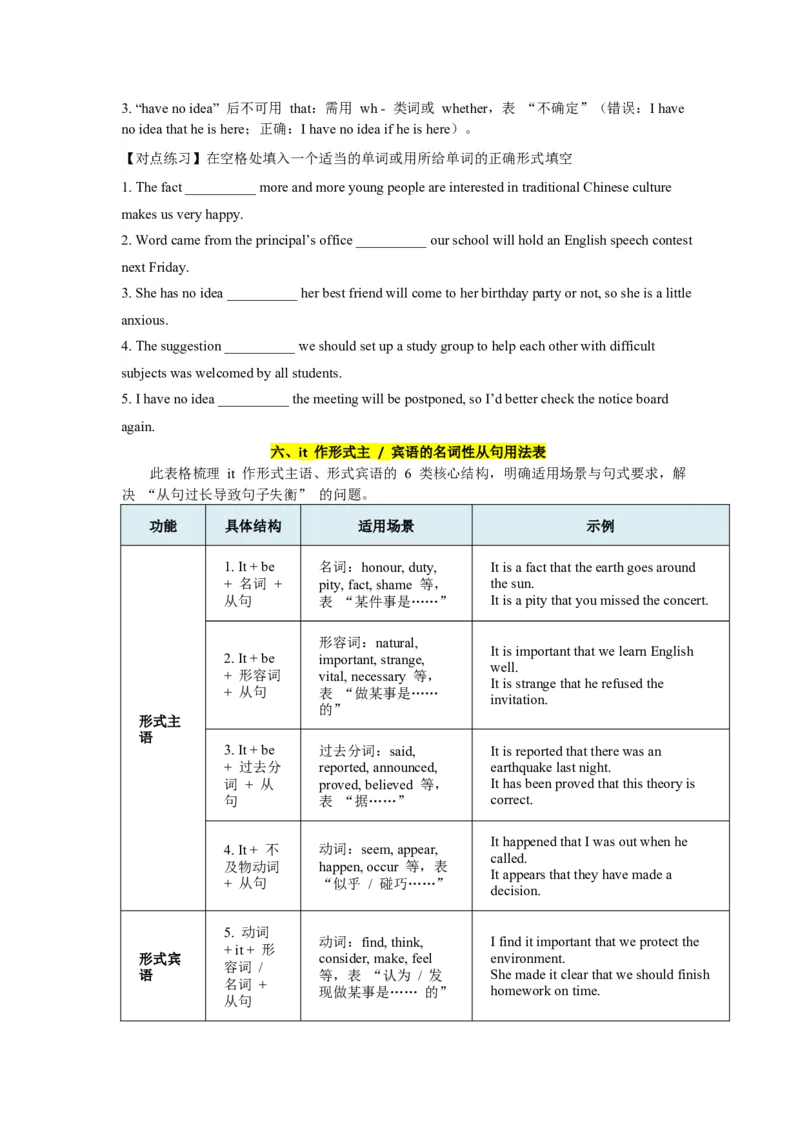
六、it 作形式主 / 宾语的名词性从句用法表
此表格梳理 it 作形式主语、形式宾语的 6 类核心结构,明确适用场景与句式要求,解
决 “从句过长导致句子失衡” 的问题。
功能
具体结构
适用场景
示例
形式主
语
1. It + be
+ 名词 +
从句
名词:honour, duty,
pity, fact, shame 等,
表 “某件事是……”
It is a fact that the earth goes around
the sun.
It is a pity that you missed the concert.
2. It + be
+ 形容词
+ 从句
形容词:natural,
important, strange,
vital, necessary 等,
表 “做某事是……
的”
It is important that we learn English
well.
It is strange that he refused the
invitation.
3. It + be
+ 过去分
词 + 从
句
过去分词:said,
reported, announced,
proved, believed 等,
表 “据……”
It is reported that there was an
earthquake last night.
It has been proved that this theory is
correct.
4. It + 不
及物动词
+ 从句
动词:seem, appear,
happen, occur 等,表
“似乎 / 碰巧……”
It happened that I was out when he
called.
It appears that they have made a
decision.
形式宾
语
5. 动词
+ it + 形
容词 /
名词 +
从句
动词:find, think,
consider, make, feel
等,表 “认为 / 发
现做某事是…… 的”
I find it important that we protect the
environment.
She made it clear that we should finish
homework on time.
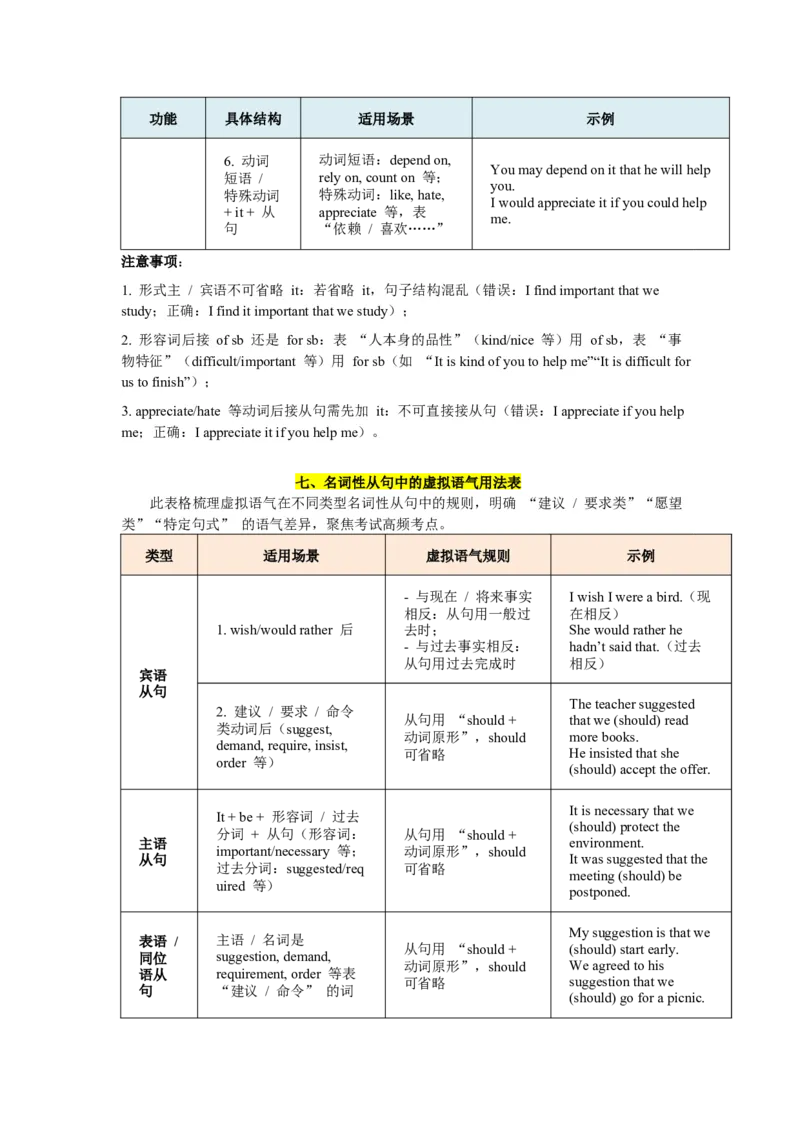
功能
具体结构
适用场景
示例
6. 动词
短语 /
特殊动词
+ it + 从
句
动词短语:depend on,
rely on, count on 等;
特殊动词:like, hate,
appreciate 等,表
“依赖 / 喜欢……”
You may depend on it that he will help
you.
I would appreciate it if you could help
me.
注意事项:
1. 形式主 / 宾语不可省略 it:若省略 it,句子结构混乱(错误:I find important that we
study;正确:I find it important that we study);
2. 形容词后接 of sb 还是 for sb:表 “人本身的品性”(kind/nice 等)用 of sb,表 “事
物特征”(difficult/important 等)用 for sb(如 “It is kind of you to help me”“It is difficult for
us to finish”);
3. appreciate/hate 等动词后接从句需先加 it:不可直接接从句(错误:I appreciate if you help
me;正确:I appreciate it if you help me)。
七、名词性从句中的虚拟语气用法表
此表格梳理虚拟语气在不同类型名词性从句中的规则,明确 “建议 / 要求类”“愿望
类”“特定句式” 的语气差异,聚焦考试高频考点。
类型
适用场景
虚拟语气规则
示例
宾语
从句
1. wish/would rather 后
- 与现在 / 将来事实
相反:从句用一般过
去时;
- 与过去事实相反:
从句用过去完成时
I wish I were a bird.(现
在相反)
She would rather he
hadn’t said that.(过去
相反)
2. 建议 / 要求 / 命令
类动词后(suggest,
demand, require, insist,
order 等)
从句用 “should +
动词原形”,should
可省略
The teacher suggested
that we (should) read
more books.
He insisted that she
(should) accept the offer.
主语
从句
It + be + 形容词 / 过去
分词 + 从句(形容词:
important/necessary 等;
过去分词:suggested/req
uired 等)
从句用 “should +
动词原形”,should
可省略
It is necessary that we
(should) protect the
environment.
It was suggested that the
meeting (should) be
postponed.
表语 /
同位
语从
句
主语 / 名词是
suggestion, demand,
requirement, order 等表
“建议 / 命令” 的词
从句用 “should +
动词原形”,should
可省略
My suggestion is that we
(should) start early.
We agreed to his
suggestion that we
(should) go for a picnic.
类型
适用场景
虚拟语气规则
示例
特殊
句式
It’s (high/about) time +
that 从句
从句用一般过去时或
“should + 动词原
形”,should 不可省
略
It’s high time we went
home.
It’s about time you
should study.
注意事项:
1. insist 表 “坚持认为” 时不用虚拟语气:仅表 “坚持要求” 时用(如 “He insisted he
was right” 表 “坚持认为”,用陈述语气;“He insisted she (should) go” 表 “坚持要求”,
用虚拟语气);
2. wish 后的虚拟语气不可用 would:第一人称 I/we 可用 would,但第二、三人称需用过去
时(错误:I wish you would be here;正确:I wish you were here);
3. “It’s time + that 从句” 中 should 不可省略:这是与其他虚拟句式的区别(错误:It’s time
you study;正确:It’s time you studied 或 It’s time you should study)。
八、wh-ever 类引导词用法表
此表格梳理 4 类 wh-ever 引导词的语义、功能及适用从句类型,明确 “泛指任意”
与 “特定选择” 的差异,解决引导词混淆问题。
引导词
语义
功能
适用从句类型
示例
whatever
无论什么
(强调内
容)
主语、
宾语
主语从句、宾
语从句
What he says cannot change
the fact.(主语从句,作主
语)
She will eat whatever is
available.(宾语从句,作
主语)
whichever
无论哪一
个(强调
选择)
主语、
宾语、
定语
主语从句、宾
语从句(有特
定选择范围)
Whichever of you comes
first will get the prize.(主
语从句,作主语)
You can choose whichever
book you like.(宾语从
句,作定语)
whoever
无论谁
(指人)
主语
主语从句、宾
语从句
Whoever breaks the window
must pay.(主语从句,作
主语)
The coach will select
whoever is suitable.(宾语
从句,作主语)
whomever
无论谁
(指人,
宾格)
宾语
宾语从句(需
作宾语)
We will invite whomever
you recommend.(宾语从
句,作宾语)
He will help whomever he
引导词
语义
功能
适用从句类型
示例
meets.(宾语从句,作宾
语)
注意事项:
1. whoever 与 whomever 的区分:作主语用 whoever,作宾语用 whomever(错误:Whoever
you like can join;正确:Whomever you like can join,此处 like 缺宾语,用 whomever);
2. whichever 需有选择范围:无明确范围时用 whatever(错误:Take whichever you want,无
范围;正确:Take whatever you want);
3. wh-ever 引导名词性从句时无 “让步” 含义:仅表 “泛指任意”,若表 “让步” 需引
导状语从句(如 “Whatever he says, I won’t believe” 是让步状语从句,非名词性从句)。
九、名词性从句中的时态照应表
此表格梳理主句与从句的时态匹配规则,明确 “主现从任”“主过从过” 及 “真理永
一现” 的核心逻辑,避免时态误用。
主句时态
从句时态规则
适用场景
示例
一般现在时
/ 现在完成
时 / 一般将
来时
从句用任意需要的时态
(根据实际语境选择)
主句表现在或
将来,从句不
受时态限制
I think he has finished
homework.(现在完成
时)
I will tell you what I will
do tomorrow.(一般将
来时)
一般过去时
/ 过去进行
时
从句用相应的过去时态
(一般过去时、过去进
行时、过去将来时、过
去完成时)
主句表过去,
从句需体现
“过去的时间
范畴”
She said she would go to
Paris.(过去将来时)
He told me he was
watching TV then.(过
去进行时)
任意时态
从句表客观真理、自然
现象、科学原理时,用
一般现在时
从句内容不受
时间影响,永
恒成立
The teacher said the earth
goes around the sun.(一
般现在时)
Our teacher told us light
travels faster than sound.
(一般现在时)
注意事项:
1. “主过从过” 需避免从句用现在时态:即使从句内容现在仍成立,若主句是过去时,从句
需用过去时(错误:He said he is happy;正确:He said he was happy);
2. 从句表 “计划 / 安排” 时,可用过去将来时:如 “would + 动原”,表 “过去打算做
某事”(如 “She told me she would visit her grandma”);
3. 客观真理需用一般现在时:即使主句是过去时,也不可改为过去时(错误:The teacher
said the earth went around the sun;正确:The teacher said the earth goes around the sun)。
一、语法填空:在空格处填入一个适当的单词或用所给单词的正确形式填空
1.(2025 高三上·宁夏内蒙古·专题练习)That’s            the postal service means to us.
2.(24-25 高三上·江苏盐城·阶段练习)When they closed their League offices, that was a sign
they cared no longer about Mr Wilson’s presence.
3.(24-25 高三上·吉林·阶段练习)Ho Feng- Shan decided to give visas to          applied.
Consequently, he issued thousands of Shanghai visas until he          ( transfer) back to China in
1940.
4.(24-25 高三上·吉林·阶段练习)The decision was made          we should have some
school trips this term.
5.(22-23 高三上·河北衡水·阶段练习)Newspapers seized on the results as proof       global
warming wasn’t really happening.
6.(2025·江苏南京·一模)Jia once explained on her Weibo account: “The film is not related to
weight loss and even has very little connection with boxing. It tells          a kind person finds
herself and learns to love herself.”
7.(25-26 高三上·上海·阶段练习)The manager decided to assign the job to __________ he
believed had a strong sense of duty.
8.(25-26 高三上·四川广元·阶段练习)I doubt         he is qualified for the position he
wants to apply for.
9.(24-25 高三上·吉林·阶段练习)We choose this hotel because the price is down to $ 200, half
of        it used to charge.
10.(24-25 高三上·黑龙江哈尔滨·阶段练习)The power of AI lies exactly in          is often
considered as its weakness.
11.(24-25 高三上·黑龙江·阶段练习)The question        should be employed as the manager
has not been settled.
12.(24-25 高三上·黑龙江·阶段练习)       she will help the boy made me happy.
13.(23-24 高三上·福建厦门·阶段练习)The teacher told her that she should be aware
school life consists of not only sunshine but also hard times and that education shouldn’t
(measure) only by examination results.
14.(23-24 高三上·江苏南京·阶段练习)           bothers many children is that their parents
aren’t fully aware of the importance of their privacy.
15.(22-23 高三上·河南南阳·阶段练习)While making friends, we’re supposed to focus on what
we have in common and set aside            we disagree.
Passage 1
(2024·全国甲卷·高考真题)阅读下面短文, 在空白处填入1 个适当的单词或括号内单词的正
确形式。
Although parks of all sizes and types exist at any level, the national parks, in particular, tend
1               (catch) our attention because of their large size and variety. They are     2

(treasure) of American heritage (遗产). How did the national park system come about? On a cool,
starry night in mid-September 1870, four men relaxed before a campfire along the Firehole River in
3               is now northwestern Wyoming. They     4              (be) part of a 15-
member exploring party that had spent almost five awesome weeks in witness of the natural beauties
there.
What should     5              (do) with such a beautiful place? They wondered out
loud. This area, with     6               (it) unique and breathtaking natural beauty, must be
well preserved     7               all people of the nation to enjoy — as a national park. They
all agreed and vowed (承诺) to promote the idea at the     8               (complete) of their
journey. Their promotional work paid off. Two years later, 18 years before Wyoming became a state,
Yellowstone became the first national park in the United States and the world. Yellowstone was the
9               (large) United States national park — 2.2 million acres — until Wrangell-Saint
Elias in southern Alaska,      10                became a national monument in 1978, took the
honors as a national park in 1980 with 12.3 million acres.
Passage 2
(2024·浙江·高考真题)阅读下面短文, 在空白处填入1 个适当的单词或括号内单词的正确形
式。
The shelves in most supermarkets are full of family-size this and multi-buy that. However, if
you’re shopping for one, buying extra     1               (benefit) from price reductions
doesn’t make sense. Either your shopping is then too heavy to carry home
   2

you can’t use what you’ve bought while it’s still fresh.
Of course, shops are not charities — they price goods in the way     3               will
make them the most money. If most of their customers are happy to buy larger quantities, that’s     4
they’ll promote. But that leaves the solo (单独) customers out of pocket and disappointed.
Many supermarkets are no longer doing “buy one get one free” promotions because of the
5               (criticize) that they lead to waste. Consumers prefer money off individual items.
However, though it’s nice to get a few cents off a pack of sausages, it would help even more if they
could sometimes     6               (offer) in smaller packs. Even the biggest sausage fan
doesn’t want to eat them every day.
If your supermarket sells loose produce, then buying smaller quantities is easier. Over the last
two years, some supermarkets     7               (start) selling chicken or salad in packs     8
(design) with two halves containing separate portions (份). Then, when you use one section,     9
other stays fresh.
Who knows, perhaps some of the more forward-looking     10               (one) may
yet come out with a whole range of “just for you” pack sizes with special offers as well.
Passage 3
(2025·河南信阳·一模)阅读下面材料,在空白处填入一个适当的单词或括号内单词的正确形
式。
Jane Goodall, the world-renowned primatologist ( 灵长类动物学家),
   1

(honor) with numerous international awards throughout her extraordinary career over six decades.
Her groundbreaking research in    2              forests of Tanzania fundamentally reshaped
our understanding of animal intelligence and behavior. Not only did she make the astonishing
discovery     3               chimpanzees use tools-a capability previously believed to be
uniquely human — but she also thoroughly documented their complex social structures and
emotional lives.
When first arriving in Gombe Stream National Park in 1960, the young researcher patiently
earned the animals’ trust by studying their daily routines through quiet observation. Her most
significant finding,     4               challenged established scientific beliefs, was that these
remarkable creatures possessed distinct personalities. Despite facing considerable skepticism from
the scientific community initially, she remained devoted     5               her research with
firm determination, thus     6               (earn) worldwide recognition for her work.
The Jane Goodall Institute, which she founded in 1977, has been


 7

(remarkable) successful in promoting global conservation efforts. Goodall’s lifelong work
demonstrates that     8               (meaning) environmental protection requires genuine
commitment from governments, organizations, and individuals worldwide. Her approach to research,
9             (base) on observation rather than independent experimentation, changed
primatology (灵长类学). Her message of hope and perseverance continues to inspire young     10
(scientist) around the world today.
Passage 4
(2025·浙江·一模)阅读下面材料,在空白处填入适当的内容 (1 个单词)或括号内单词的
正确形式。
The karez is a 2,000-year-old underground water system from Xinjiang, showcasing China’s
brilliant ancient engineering. This smart network of wells and tunnels


 1

(bring) mountain water to deserts without pumps or electricity, which helps turn dry land into green
farms, proving Chinese farmers’     2               (wise) in fighting harsh nature.
The system is made up of three carefully engineered parts: vertical wells
   3

(dig) for maintenance, underground tunnels built with a precise 0.1% slope, and surface canals     4
(deliver) water to farmlands. Believed to have originated during the Han Dynasty, the karez reflects
early Chinese innovation. “It demonstrates     5               our ancestors solved problems
creatively,” notes Dr. Li from the Turpan Museum. Today, around 400 karez systems remain in use,
6               (active) supporting 30% of Turpan’s famous grape farms.
Unlike modern water systems, the karez operates in harmony     7               nature.
“Relying on gravity instead of power, it’s a model of sustainability,” explains farmer Ablimit.
Impressed by its efficiency, UNESCO has recognized its     8               (ecology)
importance since its inclusion in the World Heritage Irrigation Structures list in 2016.
More than just an engineering feat, the karez embodies Chinese philosophy. As visitor Wang
Ying observes, “While ancient civilizations focused on building monuments reaching for the sky, the
Chinese created underground networks designed     9               (support) life.”
Still inspiring modern water management, this ancient system proves sustainable solutions can
stand      10                test of time and that ancient innovations still hold valuable lessons
today.
Passage 5
(2025·贵州遵义·模拟预测)阅读下面短文,在空白处填入1 个适当的单词或括号内单词的正
确形式。
Lunyu, or the Analects of Confucius, is     1               fine example of world
literature and the publication of the Maltese version of the ancient Chinese book would further
enhance cultural exchanges between China and Malta, says Maltese Sinologist and translator of the
book Salvatore Giuffre.
It is the first time that the book, which is a collection of ideas and sayings from the ancient
Chinese philosopher Confucius (551-479 BC),     2               (translate) into Maltese.
    3               made us moved was that Giuffre spent around two years making the
anthology accessible to Maltese readers, especially to young students, by translating it.     4

(current), the Maltese version is available for local readers. The translated version is complete with
an introduction to the life of Confucius, the era he lived in, his teachings and the key concepts, terms,
names and figures     5               (mention) in the book.
Giuffre says he added comments and explanations to make the text


 6

(easy) for Maltese readers to understand. “I tried to keep my Maltese version as understandable as
possible to enable a larger circle of readers to benefit     7               it,” Giuffre says. “I
hope my translation will contribute to the spread of Chinese culture


 8

knowledge of Chinese philosophy in Malta.”
Giuffre notes that Confucius not only teaches people how to become good rulers but also how
to govern a country. The Chinese initiative of building a community with a shared future clearly
expresses the vision of today’s China     9               (promote) a peaceful system of good
global governance.
“Confucius’ idea of good governance would then be taken as a model for world harmony,
10               (cooperate) and governance,” he says.