专题10概要写作-2023届新高考英语写作精讲+解题演示
【典题解读】
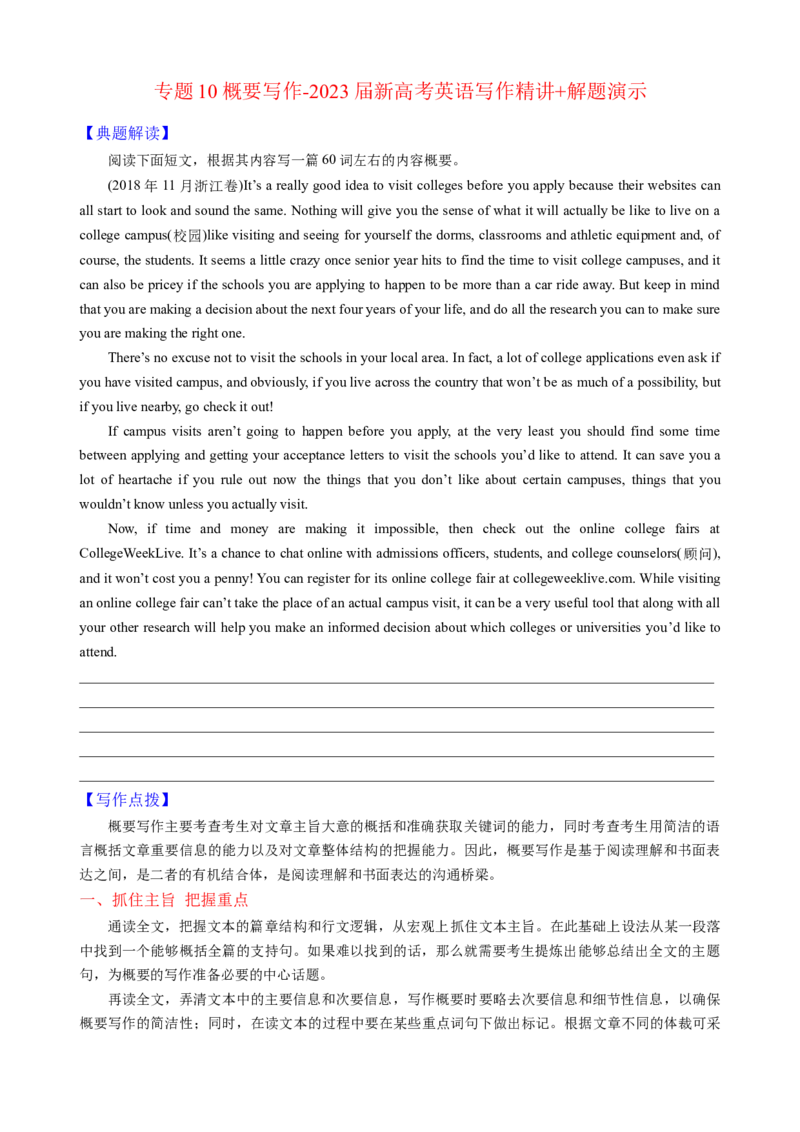
阅读下面短文,根据其内容写一篇60词左右的内容概要。
(2018年11月浙江卷)It’s a really good idea to visit colleges before you apply because their websites can
all start to look and sound the same. Nothing will give you the sense of what it will actually be like to live on a
college campus(校园)like visiting and seeing for yourself the dorms, classrooms and athletic equipment and, of
course, the students. It seems a little crazy once senior year hits to find the time to visit college campuses, and it
can also be pricey if the schools you are applying to happen to be more than a car ride away. But keep in mind
that you are making a decision about the next four years of your life, and do all the research you can to make sure
you are making the right one.
There’s no excuse not to visit the schools in your local area. In fact, a lot of college applications even ask if
you have visited campus, and obviously, if you live across the country that won’t be as much of a possibility, but
if you live nearby, go check it out!
If campus visits aren’t going to happen before you apply, at the very least you should find some time
between applying and getting your acceptance letters to visit the schools you’d like to attend. It can save you a
lot of heartache if you rule out now the things that you don’t like about certain campuses, things that you
wouldn’t know unless you actually visit.
Now, if time and money are making it impossible, then check out the online college fairs at
CollegeWeekLive. It’s a chance to chat online with admissions officers, students, and college counselors(顾问),
and it won’t cost you a penny! You can register for its online college fair at collegeweeklive.com. While visiting
an online college fair can’t take the place of an actual campus visit, it can be a very useful tool that along with all
your other research will help you make an informed decision about which colleges or universities you’d like to
attend.
__________________________________________________________________________________________
__________________________________________________________________________________________
__________________________________________________________________________________________
__________________________________________________________________________________________
__________________________________________________________________________________________
【写作点拨】
概要写作主要考查考生对文章主旨大意的概括和准确获取关键词的能力,同时考查考生用简洁的语
言概括文章重要信息的能力以及对文章整体结构的把握能力。因此,概要写作是基于阅读理解和书面表
达之间,是二者的有机结合体,是阅读理解和书面表达的沟通桥梁。
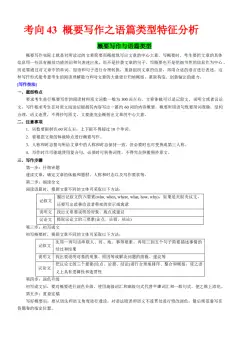
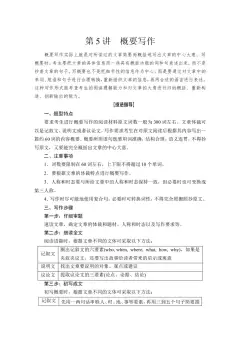
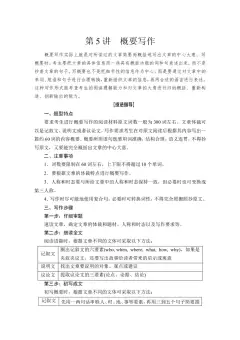
一、抓住主旨 把握重点
通读全文,把握文本的篇章结构和行文逻辑,从宏观上抓住文本主旨。在此基础上设法从某一段落
中找到一个能够概括全篇的支持句。如果难以找到的话,那么就需要考生提炼出能够总结出全文的主题
句,为概要的写作准备必要的中心话题。
再读全文,弄清文本中的主要信息和次要信息,写作概要时要略去次要信息和细节性信息,以确保
概要写作的简洁性;同时,在读文本的过程中要在某些重点词句下做出标记。根据文章不同的体裁可采取以下方法划出相关重点:对于记叙文要圈出记叙文的六要素。如果是夹叙夹议文,还要圈出故事给读
者带来的启示或寓意;对于说明文要找出文章要说明的对象、观点或建议,其中对于说明文类的实验研
究报告(上海高考的热点体裁)要圈出以下几部分组成:研究目的/背景、 研究过程(包括实施者,实验对
象,采用方法,具体步骤)、研究结果、研究意义/应用、研究的不足/局限性;对于议论文要提取议论文
的三要素(论点、论据、结论)。
二、概括段意 整合要点
在抓住主旨,把握重点之后,要根据每段的主题句和重点内容归纳出每段的段落大意;要点来自于
段落大意,而要点全又是评分的重要方面。所以,在概要写作时只有把每段的大意都包括在内才能确保
要点的全面。但是,要点全面并不是把各段的段意简单地相加,而是需要对要表达的内容(即各段段意)
进行梳理,在梳理的基础上进行整合或提炼。
三、转换表达 连句成篇
所谓转换表达就是将整合或提炼出的要点采用各种各样的方式转换表达出来(避免整句照抄原文)。
转换表达的方法(具体例子参看“常用素材”)主要有:同义转换法、正反转换法、词性转换法、句式转
换法。将转换后的要点按照一定的逻辑顺序并使用衔接、过渡词语连句成篇,形成初稿。
四、检查修改 规范誊写
对初稿进行检查和修改。在内容上、语言上以及上下文的连贯性上进行检查:看是否包括了原文的
所有要点,语言词汇的运用是否准确和地道,以及行文是否流畅,词数是否符合题干要求。对初稿进行
修改:纠错和润色:纠正错词和病句,对初稿进行润色升级,使用高级词汇和高级句式代替平庸词汇和
一般句式,使之锦上添花;最后规范誊写上卡:把修改后的续写规范誊写在答题卡上。
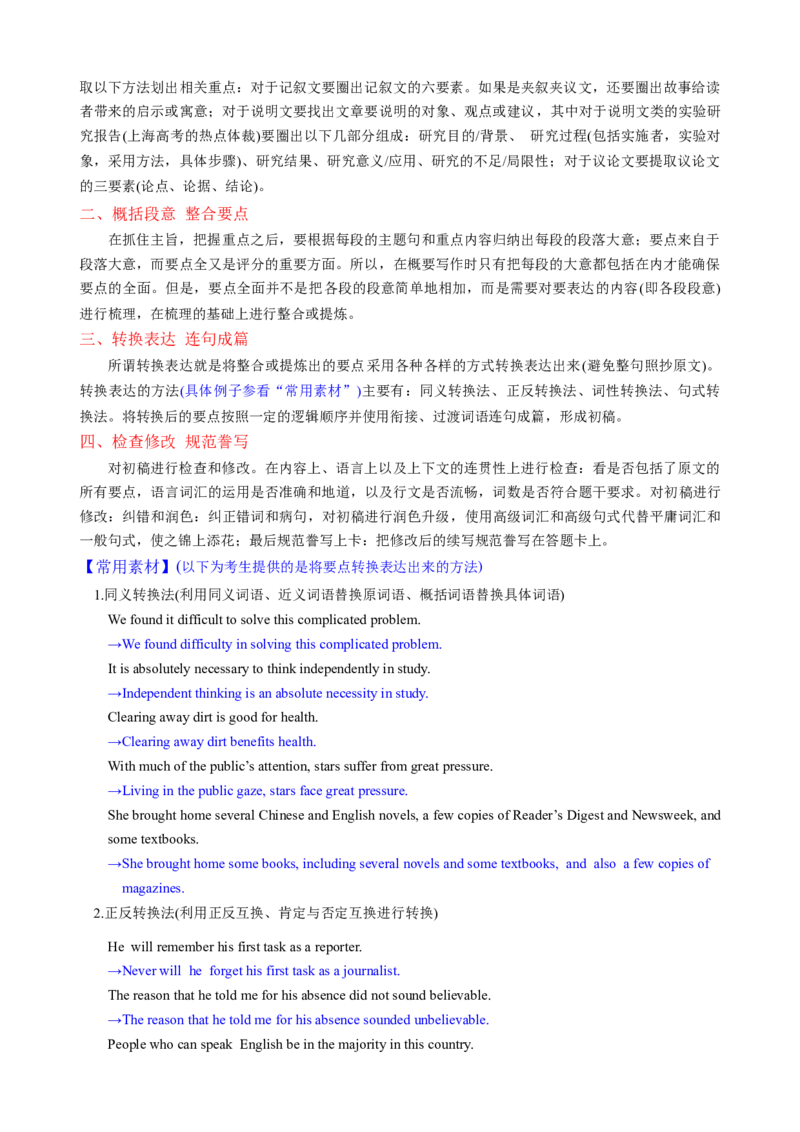
【常用素材】(以下为考生提供的是将要点转换表达出来的方法)
1.同义转换法(利用同义词语、近义词语替换原词语、概括词语替换具体词语)
We found it difficult to solve this complicated problem.
→We found difficulty in solving this complicated problem.
It is absolutely necessary to think independently in study.
→Independent thinking is an absolute necessity in study.
Clearing away dirt is good for health.
→Clearing away dirt benefits health.
With much of the public’s attention, stars suffer from great pressure.
→Living in the public gaze, stars face great pressure.
She brought home several Chinese and English novels, a few copies of Reader’s Digest and Newsweek, and
some textbooks.
→She brought home some books, including several novels and some textbooks, and also a few copies of
magazines.
2.正反转换法(利用正反互换、肯定与否定互换进行转换)
He will remember his first task as a reporter.
→Never will he forget his first task as a journalist.
The reason that he told me for his absence did not sound believable.
→The reason that he told me for his absence sounded unbelievable.
People who can speak English be in the majority in this country.→People who cannot speak English be in the minority in this country.
Compared with that method, this method has more disadvantages.
→Compared with that method, this method has fewer advantages.
I quite agree with you.
→I couldn’t agree with you more.
His hometown is the most beautiful place.
→No place is more beautiful than his hometown.
With advertising, it will be very easy for customers to judge the worth of a product.
→Without advertising, it will be very difficult for customers to judge the worth of a product.
The most important step is to fill in the application form without any false information.
→It’s essential to fill in the application form correctly.
3.词性转换法(利用词性变化进行转换)
He failed to pass the drug test, and the boss had to dismiss him from his job.
→His failure of passing the drug test resulted in his job dismissal.
Your skin will be burnt if you are exposed to the sun too long.
→Too long exposure to the sun will harm your skin.
Reading can not only make you relaxed but also be good for your mind.
→Reading can not only relax your body but also do good to your mind.
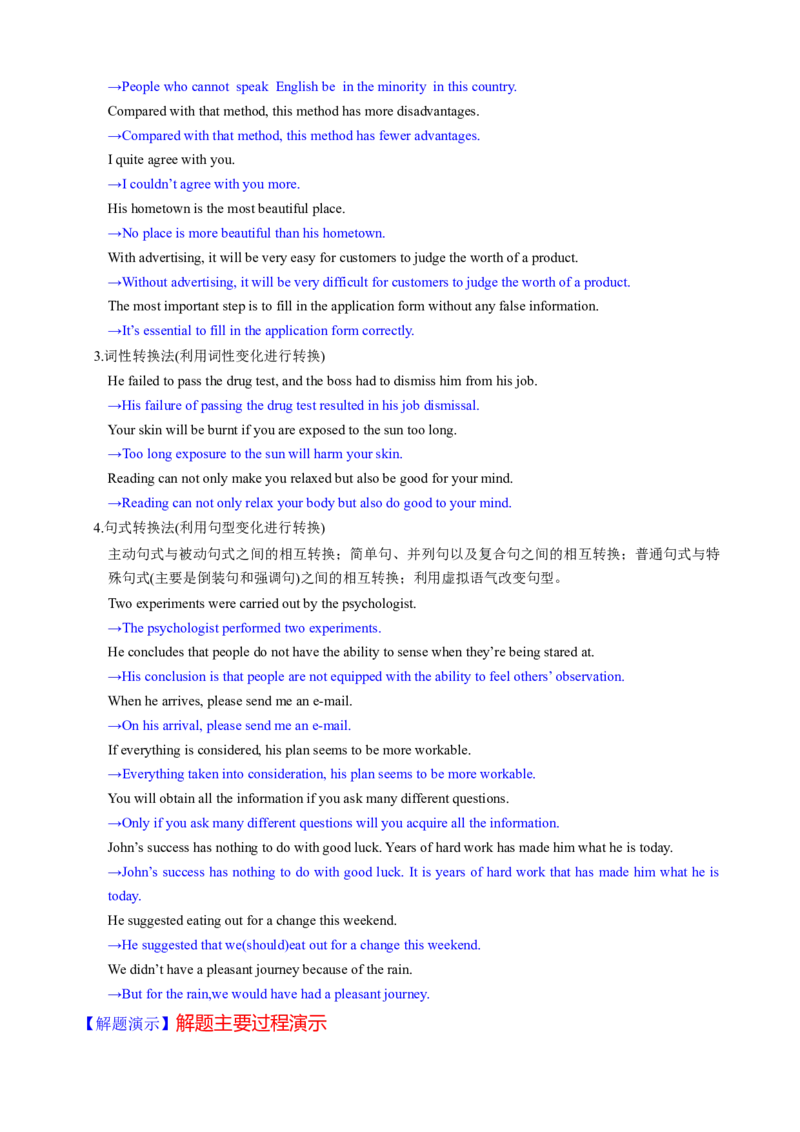
4.句式转换法(利用句型变化进行转换)
主动句式与被动句式之间的相互转换;简单句、并列句以及复合句之间的相互转换;普通句式与特
殊句式(主要是倒装句和强调句)之间的相互转换;利用虚拟语气改变句型。
Two experiments were carried out by the psychologist.
→The psychologist performed two experiments.
He concludes that people do not have the ability to sense when they’re being stared at.
→His conclusion is that people are not equipped with the ability to feel others’ observation.
When he arrives, please send me an e-mail.
→On his arrival, please send me an e-mail.
If everything is considered, his plan seems to be more workable.
→Everything taken into consideration, his plan seems to be more workable.
You will obtain all the information if you ask many different questions.
→Only if you ask many different questions will you acquire all the information.
John’s success has nothing to do with good luck. Years of hard work has made him what he is today.
→John’s success has nothing to do with good luck. It is years of hard work that has made him what he is
today.
He suggested eating out for a change this weekend.
→He suggested that we(should)eat out for a change this weekend.
We didn’t have a pleasant journey because of the rain.
→But for the rain,we would have had a pleasant journey.
【解题演示】解题主要过程演示现以“2019年6月浙江卷”为例演示一下主要解题过程,供考生平时练习时参考。
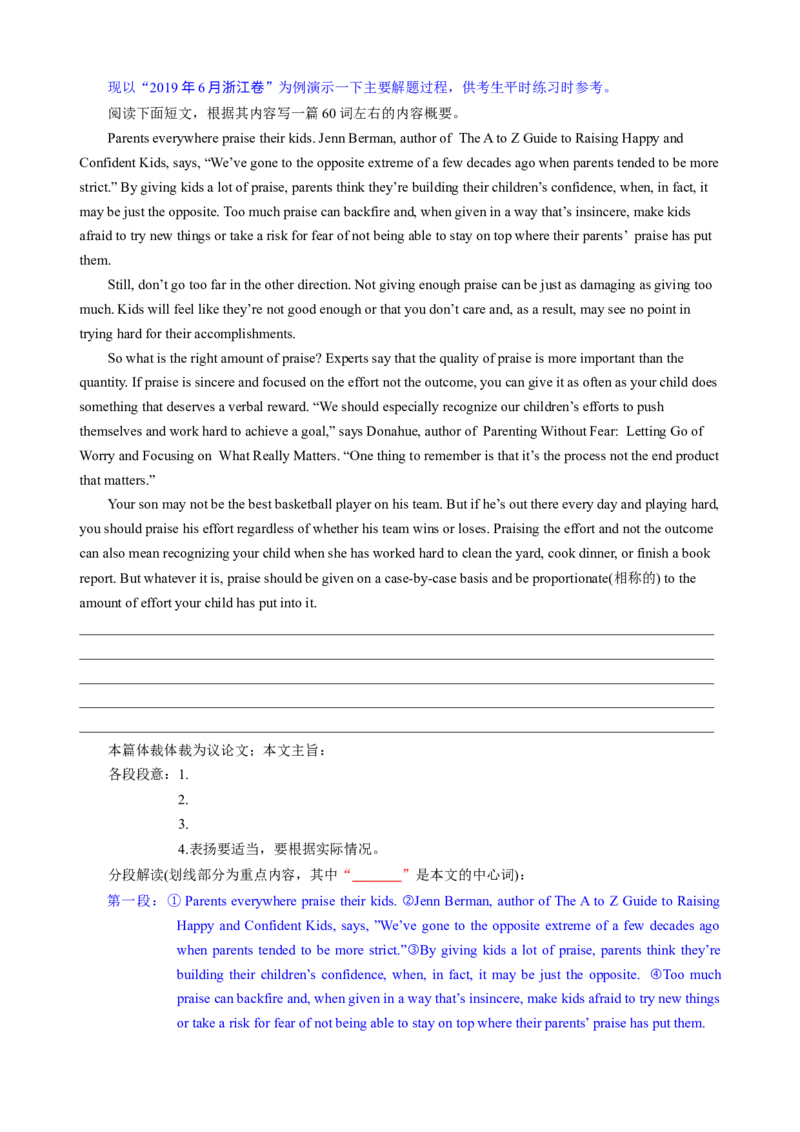
阅读下面短文,根据其内容写一篇60词左右的内容概要。
Parents everywhere praise their kids. Jenn Berman, author of The A to Z Guide to Raising Happy and
Confident Kids, says, “We’ve gone to the opposite extreme of a few decades ago when parents tended to be more
strict.” By giving kids a lot of praise, parents think they’re building their children’s confidence, when, in fact, it
may be just the opposite. Too much praise can backfire and, when given in a way that’s insincere, make kids
afraid to try new things or take a risk for fear of not being able to stay on top where their parents’ praise has put
them.
Still, don’t go too far in the other direction. Not giving enough praise can be just as damaging as giving too
much. Kids will feel like they’re not good enough or that you don’t care and, as a result, may see no point in
trying hard for their accomplishments.
So what is the right amount of praise? Experts say that the quality of praise is more important than the
quantity. If praise is sincere and focused on the effort not the outcome, you can give it as often as your child does
something that deserves a verbal reward. “We should especially recognize our children’s efforts to push
themselves and work hard to achieve a goal,” says Donahue, author of Parenting Without Fear: Letting Go of
Worry and Focusing on What Really Matters. “One thing to remember is that it’s the process not the end product
that matters.”
Your son may not be the best basketball player on his team. But if he’s out there every day and playing hard,
you should praise his effort regardless of whether his team wins or loses. Praising the effort and not the outcome
can also mean recognizing your child when she has worked hard to clean the yard, cook dinner, or finish a book
report. But whatever it is, praise should be given on a case-by-case basis and be proportionate(相称的) to the
amount of effort your child has put into it.
__________________________________________________________________________________________
__________________________________________________________________________________________
__________________________________________________________________________________________
__________________________________________________________________________________________
__________________________________________________________________________________________
本篇体裁体裁为议论文;本文主旨:
各段段意:1.
2.
3.
4.表扬要适当,要根据实际情况。
分段解读(划线部分为重点内容,其中“ ”是本文的中心词):
第一段:①Parents everywhere praise their kids. ②Jenn Berman, author of The A to Z Guide to Raising
Happy and Confident Kids, says, ”We’ve gone to the opposite extreme of a few decades ago
when parents tended to be more strict.”③By giving kids a lot of praise, parents think they’re
building their children’s confidence, when, in fact, it may be just the opposite. ④Too much
praise can backfire and, when given in a way that’s insincere, make kids afraid to try new things
or take a risk for fear of not being able to stay on top where their parents’ praise has put them.句①指出存在的社会现状:
句②对于第一句传达的信息进行了修正:
句③给出了作者的观点:
句④是对第三句话中the opposite
由此,句①与句②可以看作是导入,把句③暂定为主题句,可统领其他几句。
第二段:①Still, don’t go too far in the other direction. ②Not giving enough praise can be just as damaging
as giving too much. ③Kids will feel like they’re not good enough or that you don’t care and, as
a result, may see no point in trying hard for their accomplishments.
句①提出忠告:
句②提出作者观点:
句③说明具体是怎样的害处:
第三段:①So what is the right amount of praise? ②Experts say that the quality of praise is more important
than the quantity. ③If praise is sincere and focused on the effort not the outcome, you can give it
as often as your child does something that deserves a verbal reward. ④“We should especially
recognize our children’s efforts to push themselves and work hard to achieve a goal,” says
Donahue, author of Parenting Without Fear: Letting Go of Worry and Focusing on What Really
Matters. ⑤“One thing to remember is that it’s the process not the end product that matters.”
句①提出问题:
句②专家的观点:
句③提出解决问题的办法:
句④和句⑤得出结论:
第四段:①Your son may not be the best basketball player on his team. ②But if he’s out there every day
and playing hard, you should praise his effort regardless of whether his team wins or loses.
③Praising the effort and not the outcome can also mean recognizing your child when she has
worked hard to clean the yard, cook dinner, or finish a book report. ④But whatever it is, praise
should be given on a case-by-case basis and be proportionate(相称的)to the amount of effort your
child has put into it.
句①②③的举例都是为了
句④提出父母应该怎样表扬:
对上述分析的内容进行整合构建要点:
要点1:
要点2:
要点3:
要点4:
将整合后的要点用自己的话表达出来:
Point 1: .
Point 2:
Point 3:
Point 4:
将以上要点衔接成篇:修改润色后誊写上卡:
【写作实践1】
阅读下面短文,根据其内容写一篇60词左右的内容概要。
(2022春·全国高三专题练)Parents always want the best for their children and giving them; the best
education is always on top of the list. But if you think education is all they need, maybe you should think twice.
Sure, you learn a lot of things in school, but there are important lessons and skills you will need in life that one
can only learn at home. Therefore, teaching the children to do household chores is very helpful in their growth.
Most families nowadays hire housemaids to do the chores, so children don’t get to experience doing it anymore.
But studies argue that it’s still necessary to let children do them.
Helping at home can be a training place for your children to whatever responsibilities they may have in the
future. By doing so, they can learn what might be of their advantage when they grow up. “Performing chores
offers kids a feeling of self-sufficiency, helps them develop a work ethic, is tied to academic success in school,
makes them feel useful and teaches them the importance of helping others and contributing to the greater good.”
Although, most parents can also argue that it is not easy to force their children to do chores. It is a nature for
the children to refuse to do chores when they are told to. But there are ways that can turn household chores into a
more likely activity for the children. First, start them young. This doesn’t mean that you let your children do huge
tasks at an early age. You can gradually increase the level of tasks as they grow old but never ever push them too
hard. Second, appreciate every little achievement. Praise them or give them something. Children love rewards
and it drives them to do better.
Most importantly, let them know that asking them to help-out is not a punishment. Chores should never be
used as a punishment. They might get done in the short term, but the effects won’t last. This approach does not
give the child the feeling of doing something because it is the right thing to do. It only makes them hate chores
and hoping out even more. Chores should be used as a sense of purpose. Explain to them that it is for their
benefit and everything they learn from it is for their advantage.
__________________________________________________________________________________________
__________________________________________________________________________________________
__________________________________________________________________________________________
__________________________________________________________________________________________
__________________________________________________________________________________________【写作实践2】
阅读下面短文,根据其内容写一篇60词左右的内容概要。
(2022春·全国高三专题练)Yesterday Matt was sick. I picked up Archie from the sitter and Eloise from
school and decided to run to Target for a few things. I had hoped to be in and out quickly.
I found a line with just one person ahead of me and began organizing my items on the conveyor. After
placing my items, I looked up to see that the person ahead of me was an elderly woman. She was paying for her
items with change and wanted to purchase each separately. I was frustrated with this woman and the
inconvenience she had placed on me.
But then I watched the young employee with this woman. I watched him help her count her change, ever so
softly taking it from her shaking hands. When she asked if she had enough to buy a reusable bag, he told her she
did and went two lines over to get one for her and then repackaged her items. Never once was this employee
angry. He was nothing but patient and kind.
As I was watching him, I saw that Eloise was too. She was standing next to the woman, watching the
employee count the change. I realized I hadn’t been inconvenienced at all. That my daughter was instead
witnessing kindness and patience and being taught this valuable lesson by a complete stranger.
When the woman was finished, the employee began ringing up my items and thanked me for my patience. I
then thanked him for teaching us patience and kindness by his treatment of that elderly woman. When he was
finished, I pushed my cart through the store trying to find the manager. I wanted her to know of the employee’s
kindness and patience and how much it meant to me. After tracking her down and sharing the story with her, we
left Target with a cart full of consumable items, but what is more, a heart full of gratitude for such an invaluable
lesson.
If you are ever in the Glendale Target, give Ishmael a smile and a nod. The world could use more people
like him.
__________________________________________________________________________________________
__________________________________________________________________________________________
__________________________________________________________________________________________
__________________________________________________________________________________________
__________________________________________________________________________________________
【写作实践3】
阅读下面短文,根据其内容写一篇60词左右的内容概要。
The protection provided by COVID-19 vaccines declines after four to six months, a large United Kingdom
study has found. Researchers from health science company ZOE, a spin-out from King’s College London,
recently have found that a full course of the Pfizer vaccine was 88 percent effective at preventing infection after
one month, and this protection fell to 74 percent after five to six months.
Tim Spector, a professor of genetic epidemiology who led the research, said that the data is broadly
consistent with various other studies on COVID-19 vaccine efficacy over time, including a recent survey from
Oxford University that found protection from the Pfizer and AstraZeneca jabs against the Delta variant weakened
within three months.
However, Simon Clarke, an associate professor in microbiology at Reading University, who was notinvolved in the research, said the claim that protection may dip below 50 percent this year “is not based on any
strong analysis of data” and seems “more like a finger in the air prediction”.
“Immunity is a complex process and we cannot assume people’s immunity will fade at a uniform rate over
time,” Clarke said.
Peter English, a former chairman of the British Medical Association’s Public Health Medicine Committee,
who was not involved in the research, said that the data is limited as it did not provide information about vaccine
efficacy at preventing severe disease.
“There is a world of difference between efficacy against, on the one hand, any infection and on the other
hand, illness severe enough to require hospitalization, critical care, or to cause death,” English said.
Spector said that, in light of the new research, “we urgently need to make plans for vaccine boosters”, or
third shots aimed at combating fading immunity. He told the BBC that these shots should be reserved for certain
groups, and that a widespread booster campaign would be a “huge waste” and “ethically dubious”.
__________________________________________________________________________________________
__________________________________________________________________________________________
__________________________________________________________________________________________
__________________________________________________________________________________________
__________________________________________________________________________________________