Lecture
Lecture 6
6
2020【春】高三目标985班
Part One
Writing
Part Two
Reading
CONTENTS
CONTENTS
Part Three Cloze
Part 1 Writing
by小米粒杨梓艺
I. 题型说明
概要写作题型是基于原文行文逻辑基础上的,对原文要点的提取
和再现。考查要点为:
(1) 对原文要点的理解和呈现;
(2) 所写语段的上下文连续性;
(3) 应用语法结构和词汇的准确性。
概要写作
提供一篇350字以内的文章,要求考生基于该短文写出一篇60
字左右的内容概要。
基于该短文:不可有自己的观点
60字左右:精简至50-80字
内容概要:概括重要内容
I. 题型说明
概要写作
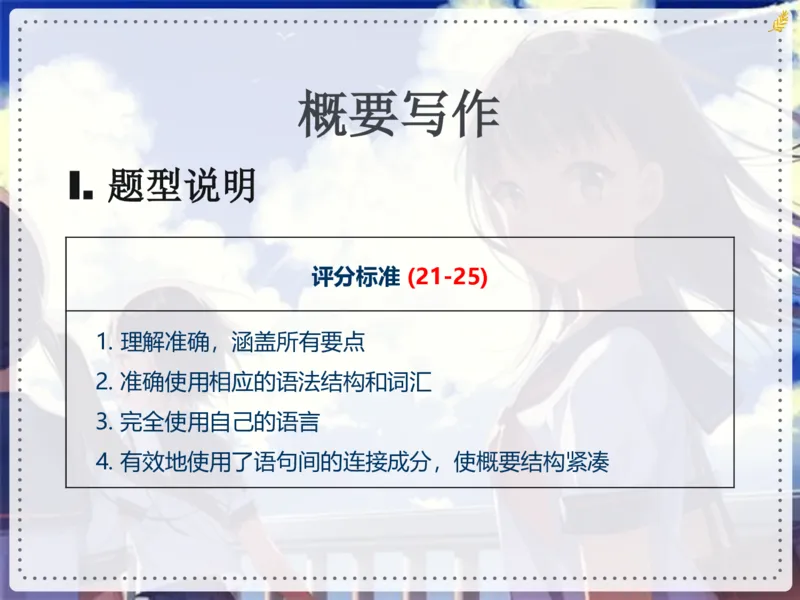
评分标准 (21-25)
1. 理解准确,涵盖所有要点
2. 准确使用相应的语法结构和词汇
3. 完全使用自己的语言
4. 有效地使用了语句间的连接成分,使概要结构紧凑
II. 典例示范
Directions: Read the following passage. Summarize the main idea and the main
point(s) of the passage in no more than 60 words. Use you own words as far as
possible.
(A) When we wake up feeling sleepy and with dark circles under eyes, many of us
often think: “I'm going to go to bed earlier tomorrow!" But however determined we
are, chances are that we don't stick to (坚持) our promise. This behavior is called
"bedtime procrastination (拖延症)”.
(B) According to a study carried out by a group of health psychologists at Utrecht
University in the Netherlands in 2014, bedtime procrastination is a common
problem. In their study, 53 percent of the 2,400 participants said they didn’t follow
their sleep schedule, delaying it at least twice a week.
(C) It's found that they delayed bedtime not because they liked to stay up late, but
they couldn't stop doing other unimportant things, which were keeping them up in
the first place.
(D) "People who generally have trouble resisting temptations (诱惑) and sticking to
their intentions are more likely to delay going to bed." Floor Kroese, a psychologist
at Utrecht University, further explained to HuffPost.
(E) Yet, according to scientists, lack of self-control is not the only thing to blame.
Our body clock also plays an important role when it comes to bedtime. In order to
check the influence of the body clock on sleep, psychologists at Ulm University in
Germany studied the sleep patterns of 108 people in February. It was found that
those who get up late are more likely to postpone (推迟) their bedtime than those
who wake early every morning.
(F) "The intention to go to bed earlier is not enough," Jane Kuhnel, a psychologist at
Ulm University, concluded in Popular Science. "Biological processes need to
support this intention."
(G) People always think that bedtime procrastination isn’t a big problem, but as
Kroese told Popular Science, “the choices we make that affect our sleep could turn
out to be pretty important for our health.”
III. 阅读审题
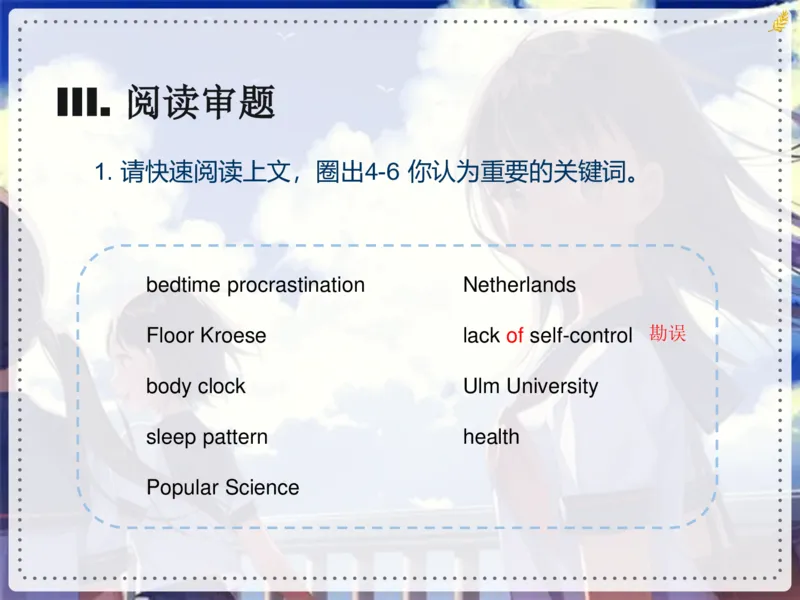
1. 请快速阅读上文,圈出4-6 你认为重要的关键词。
bedtime procrastination
Netherlands
Floor Kroese
lack of self-control
body clock
Ulm University
sleep pattern
health
Popular Science
勘误
III. 阅读审题
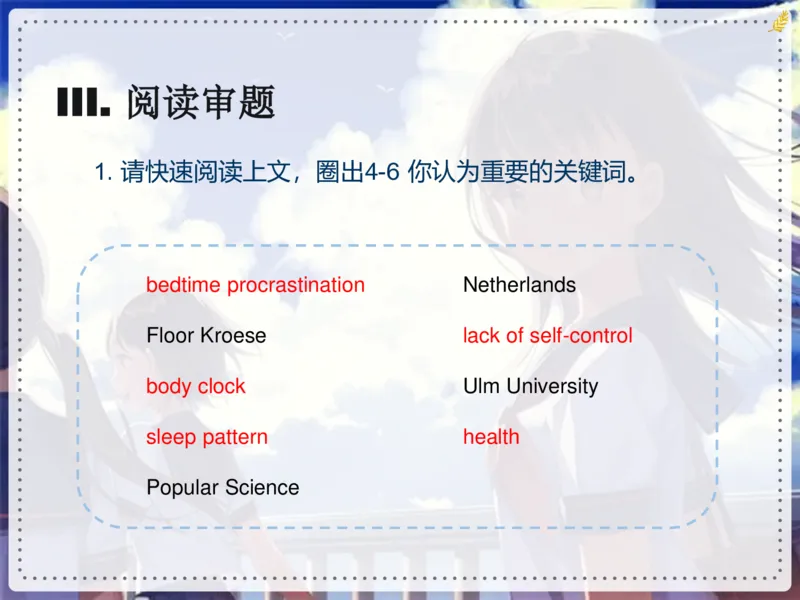
1. 请快速阅读上文,圈出4-6 你认为重要的关键词。
bedtime procrastination
Netherlands
Floor Kroese
lack of self-control
body clock
Ulm University
sleep pattern
health
Popular Science
III. 阅读审题
2. 请再次阅读段 (A) 与段 (B),完成以下填空,每空不超过3个单词。
Paragraph (A) and (B) mentioned a common problem, _____________
_________________, which means not following ___________________
and delaying going to bed.
III. 阅读审题
2. 请再次阅读段 (A) 与段 (B),完成以下填空,每空不超过3个单词。
Paragraph (A) and (B) mentioned a common problem, _____________
_________________, which means not following ___________________
and delaying going to bed.
bedtime
procrastination
sleep schedule
(C) It's found that they delayed bedtime not because they liked to stay up
late, but they couldn't stop doing other unimportant things, which were
keeping them up in the first place.
(D) "People who generally have trouble resisting temptations (诱惑) and
sticking to their intentions are more likely to delay going to bed." Floor
Kroese, a psychologist at Utrecht University, further explained to HuffPost.
III. 阅读审题
3. 请再次阅读段 (C) 至段 (G),完成以下练习。
① 请尝试为剩余段落划分层次。
A B // C D E F G
(E) Yet, according to scientists, lack of self-control is not the only thing to
blame. Our body clock also plays an important role when it comes to
bedtime. In order to check the influence of the body clock on sleep,
psychologists at Ulm University in Germany studied the sleep patterns of
108 people in February. It was found that those who get up late are more
likely to postpone (推迟) their bedtime than those who wake early every
morning.
(F) "The intention to go to bed earlier is not enough," Jane Kuhnel, a
psychologist at Ulm University, concluded in Popular Science. "Biological
processes need to support this intention."
(G) People always think that bedtime procrastination isn’t a big problem,
but as Kroese told Popular Science, “the choices we make that affect our
sleep could turn out to be pretty important for our health.”
z
z
(C) It's found that they delayed bedtime not because they liked to stay up late, but
they couldn't stop doing other unimportant things, which were keeping them up in
the first place.
(D) "People who generally have trouble resisting temptations (诱惑) and sticking to
their intentions are more likely to delay going to bed." Floor Kroese, a psychologist
at Utrecht University, further explained to HuffPost. //
the first reason for delayed bedtime: lack of self-control
III. 阅读审题
3. 请再次阅读段 (C) 至段 (G),完成以下练习。
① 请尝试为剩余段落划分层次。
A B // C D E F G
(E) Yet, according to scientists, lack of self-control is not the only thing to blame.
Our body clock also plays an important role when it comes to bedtime. In order to
check the influence of the body clock on sleep, psychologists at Ulm University in
Germany studied the sleep patterns of 108 people in February. It was found that
those who get up late are more likely to postpone (推迟) their bedtime than those
who wake early every morning.
(F) "The intention to go to bed earlier is not enough," Jane Kuhnel, a psychologist at
Ulm University, concluded in Popular Science. "Biological processes need to
support this intention." //
the second reason for delayed bedtime: the influence of the body
clock
III. 阅读审题
(G) People always think that bedtime procrastination isn’t a big problem, but as
Kroese told Popular Science, “the choices we make that affect our sleep could turn
out to be pretty important for our health.” //
the importance of earlier sleep
III. 阅读审题
A B // C D // E F // G
② 请完成下列结构图。
bedtime procrastination
delaying going to bed
1.
_______________
2. ___________: have trouble
resisting temptations and sticking
to their intentions
the influence of 3. ________: those
who get up late are more likely to
sleep late
solutions
intention and
biological processes
importance
important for our 4.
___________
bedtime procrastination
delaying going to bed
1.
_______________
2. ___________________: have
trouble resisting temptations and
sticking to their intentions
the influence of 3. __________________:
those who get up late are more likely to
sleep late
solutions
intention and
biological processes
importance
important for our 4.
___________
reasons
lack of self-control
the body clock
health
③ 请用上一题得到的结构图,比对
第一题中你圈出的关键词,看看自
己忽略了哪些要点。
IV. 复述要点
MAIN IDEA:
① (现象+定义) Studies carried out by psychologists find a common
problem called “bedtime procrastination”, which means not following the
sleep schedule and delaying sleeping.
② (原因) The reasons for this behavior are lack of self-control and the
influence of body clock on sleep.
③ (对策+重要性) Psychologists think the intention to sleep earlier and
biological processes are important, or your health will be affected.
IV. 同义改写
被动改主动,定语从句改非谓语,同义词替换
① Studies carried out by psychologists find a common problem
called “bedtime procrastination”, which means not following the
sleep schedule and delaying sleeping.
→ According to studies, experts find a behavior called “bedtime
procrastination”, meaning not _________ the sleep schedule and
_________ sleeping.
A. sticking to; putting off
B. sticking to; taking off
C. turning up; looking down
D. turning up; starting off
IV. 同义改写
两句并一句,逻辑突出,适当增减
② The reasons for this behavior are lack of self-control and the
influence of body clock.
→ Two studies carried out by experts find that lack of self-control
and the influence of body clock on sleep _________ “bedtime
procrastination”, the behavior of delaying going to bed.
A. result from
B. are caused by
C. are responsible for
D. are harmful to
IV. 同义改写
两句并一句,逻辑突出,适当增减
③ Psychologists think the intention to sleep earlier and biological
processes are important, or your health will be affected.
→
Considering its ______________________ on health, psychologists
_____________________ us to sleep earlier and keep a healthy
sleep pattern.
effect / impact / influence
advise / urge
改写练习-同义替换
学 而 思 网 校
Vacations are good for us.
Many of us came back from vacations.
The
company’s
promise
to
satisfy
customer’s need is important to its
success in sales promotion.
改写练习-同义替换
学 而 思 网 校
Vacations are good for us.
Vacations benefit us.
Many
of
us
came
back
from
vacations.
Many of us returned home from
vacations.
The company’s promise to satisfy
customer’s need is important to its
success in sales promotion.
The
company’s
commitment
to
customer satisfaction is vital to its
sales promotion.
改写练习-句式转换
学 而 思 网 校
Many of us returned home with a
feeling that our last vacation was not
great.
There is no doubt that the celebrity
spokes people could promote the
sales of a product.
改写练习-句式转换
学 而 思 网 校
Many of us returned home with a feeling
that our last vacation was not great.
Many of us returned home, not feeling
very great.
There
is
no
doubt
that
celebrity
spokespersons can promote the sales of a
product.
Undoubtedly, celebrity spokespersons
can boost the sales of a product.
巩固练习
学 而 思 网 校
Sport tourism
Tourism is the world's largest industry and is predicted to grow well into the years to come. Increasingly, the economic
importance of tourism has been recognized by governments around the world. At the same time, the tourism industry has
become more complicated in its development and marketing new forms of tourism. One of the fastest growing parts of the
tourism industry is travel related to sport and physical activity. A recent survey found that while the traditional beach and sight-
seeing vacations continue to predominate, 22% of those surveyed reported that opportunities to participate in sports were
important when selecting a vacation.
The term sport tourism has been adopted in recent years to describe sport-related leisure travel. It is generally recognized
that there are three broad categories of sport tourism. The first category is watching sporting events or Sports Event Tourism,
including hallmark events such as FIFA World Cup Football Championships, and the Olympic games. Tournaments sponsored
by the Professional Golf Association or the World Tennis Association are also part of the spectator-centered sector of sport
tourism.
The second type of sport tourism, celebrity and nostalgia sport tourism involves visiting famous sports-related attractions.
Visits to the sports halls of fame fall into this category. Another form of celebrity and nostalgia sport tourism that has emerged in
recent years is meeting famous sports personalities. The cruise industry has been experienced in this area. Sports theme cruise
such as "the NBA basketball cruise" arranges for passengers to meet personalities from sports while they are on board.
Active participation is the third category of sport tourism. This is composed of individuals who travel to participate in golf,
skiing, and tennis in particular, although other sports such as fishing, and scuba diving are popular in the US.
巩固练习
学 而 思 网 校
Sport tourism
Tourism is the world‘s largest industry and is predicted to grow well into the years to come. Increasingly, the economic importance of tourism
has been recognized by governments around the world. At the same time, the tourism industry has become more complicated in its development
and marketing new forms of tourism. (总) One of the fastest growing parts of the tourism industry is travel
related to sport and physical activity. A recent survey found that while the traditional beach and sight-seeing vacations
continue to predominate, 22% of those surveyed reported that opportunities to participate in sports were important when selecting a vacation.
The term sport tourism has been adopted in recent years to describe sport-related leisure travel.(总) It is generally
recognized that there are three broad categories of sport tourism. (分1)The first category is
watching sporting events or Sports Event Tourism, including hallmark events such as FIFA World Cup Football
Championships, and the Olympic games. Tournaments sponsored by the Professional Golf Association or the World Tennis Association are also
part of the spectator-centered sector of sport tourism.
(分2)The second type of sport tourism, celebrity and nostalgia sport tourism involves
visiting famous sports-related attractions. Visits to the sports halls of fame fall into this category. Another form of celebrity
and nostalgia sport tourism that has emerged in recent years is meeting famous sports personalities. The cruise industry has been experienced
in this area. Sports theme cruise such as "the NBA basketball cruise" arranges for passengers to meet personalities from sports while they are on
board.
(分3) Active participation is the third category of sport tourism. This is composed of individuals who travel
to participate in golf, skiing, and tennis in particular, although other sports such as fishing, and scuba diving are popular in the US.
巩固练习
学 而 思 网 校
范文:
Sport tourism is growing fast recently, which means a new way of travel
related to sport and physical activity. There are 3 types of sport tourism.
The first type of sport tourism is watching some famous or typical sporting
events. The second one includes paying a visit to famous sites of sports
and meeting celebrities of sports. Besides, participating actively is the third
kind of sport tourism.
类型介绍
议论文是高考书面表达常考体裁,议论文通常分为论点,论据和论
证三部分,通过摆事实,讲道理的方式来表达观点。
近几年高考书面表达中,其主要命题形式是以提纲式和表格式来呈
现写作材料的,写作时常以三段式的形式展开议论。
在高考中常与概括材料结合考察,即先总结材料的主要内容,
再对相关话题表述观点。
任务型写作
江苏任务型写作:提供一篇350词以内的短文,求考生基于该短文写出一
篇30词左右的内容概要。
分两个部分:
1. 概括材料。
2. 表达观点。
概括材料时要注意:
(1)对原文要点的理解和呈现情况;
(2)应用语法结构和词汇的准确性;
(3)上下文的连贯性;
(4)对各要点表达的独立性情况。
总之,要把握主题句和文章结构;提炼关键词;省略细节;减少例子;精
简表达。
议论文写作
表达观点的议论文写作:
观点明确,有理有据,用好论证方法(举例论证;对比论证等)。
开头:可以巧引谚语,引述各方观点,表达自我观点。
正文:阐明理由,论据详实有条理。
结尾:总结观点,呼应主题。
开头表达
巧引谚语:
As the proverb says, …
It goes without saying that...
There is an old saying that…
引出话题:
Recently, the problem of … has aroused people's concern.
Nowadays, … has become a problem we have to face.
引述各方观点:
People's opinions about … vary from person to person.
When it comes to … , some people think (hold the opinion) that … However,
others ....
表达自我观点: As far as I'm concerned, ...;From my point of view, ...
正文表达
阐明理由:
There are several reasons for…, but in general, they come down to three major ones.
This phenomenon exists for a number of reasons.
Generally, the reasons can be listed as follows.
论据详实有条理:
First, … Second, … Third, …
For one thing …,for another…
On the one hand,... on the other hand...
结尾表达
总结观点:
From what has been discussed above, we may safely draw the conclusion that…
The data/statistics/figures lead us to the conclusion that…
Taking all these factors into consideration, we naturally come to the conclusion that…
范文讲解
请阅读下面文字, 并按照要求用英语写一篇150 词左右的文章。
Li Jiang: Have you heard this? A group of exchange students from the UK are visiting our
school next month.
Su Hua: Yes, I have. Some are already recommending the traditional Chinese dress for the
welcome ceremony.
Li Jiang: But it seems people have different opinions.
Su Hua: What do you think?
Li Jiang: I think it's a good idea. It's an opportunity to make the Chinese culture better known
to international students.
Su Hua: I agree. But we don't have to dress that way. That's not our daily style. Besides, it's
not very convenient.
Li Jiang: You see, it's the Chinese culture that the British friends are coming for. Just the right
occasion.
Su Hua: I prefer the school uniform. It's nice. It's also a better display of our school culture.
范文讲解
【写作内容】
1. 用约30 个词概括上述信息的主要内容;
2. 在上述场合,你是否倾向于穿中国传统服装?请说明理由(不少于两点)。
【写作要求】
1. 写作过程中不能直接引用原文语句;
2. 作文中不能出现真实姓名和学校名称;
3. 不必写标题。
【评分标准】
内容完整,语言规范,语篇连贯,词数适当。
范文讲解
请阅读下面文字, 并按照要求用英语写一篇150 词左右的文章。
Li Jiang: Have you heard this? A group of exchange students from the UK are visiting our
school next month.
Su Hua: Yes, I have. Some are already recommending the traditional Chinese dress for the
welcome ceremony.
Li Jiang: But it seems people have different opinions.
Su Hua: What do you think?
Li Jiang: I think it's a good idea. It's an opportunity to make the Chinese culture better known
to international students.
Su Hua: I agree. But we don't have to dress that way. That's not our daily style. Besides, it's
not very convenient.
Li Jiang: You see, it's the Chinese culture that the British friends are coming for. Just the right
occasion.
Su Hua: I prefer the school uniform. It's nice. It's also a better display of our school culture.
归纳Li Jiang的观点和Su Hua的观点
思路点拨
1. 先归纳两人观点
2. 再表达你的观点
3. 并说明原因
需要适当补充细节
可以进行对比论证
范文讲解
范文一
Li Jiang and Su Hua are discussing what to wear when receiving the British students
next month. Li recommends the traditional Chinese dress while Su prefers the school
uniform.
I would be happy to wear traditional Chinese clothes at the welcome ceremony.
Firstly, this is precisely what the British visitors are expecting. They come to learn about
Chinese culture with their own eyes. Their Chinese peers in the typical Chinese dress
would be highly impressive. The school uniforms are fine, but not special enough to give a
unique Chinese flavour. Secondly, the inconvenience is not a problem if our purpose is to
share Chinese culture. It is just the so-called inconvenience that displays the richness,
delicacy and great fascination of Chinese culture with a history of thousands of years.
The traditional Chinese clothes, it seems to me, will make the occasion very Chinese
and inviting to the British guests.
范文讲解
范文二
Li Jiang and Su Hua don't agree on what to wear when greeting the British students.
Li suggests traditional Chinese clothes while Su thinks the school uniforms are more
suitable.
I prefer the school uniform to the traditional Chinese dress at the welcome
ceremony next month. Although the traditional Chinese dress may look more beautiful
and stylish, it is a little bit strange to walk around in it. We feel at ease in our school
uniforms every day. What's more, the traditional Chinese dress can't reflect the unique
culture of our school. From the design and colour of our uniforms, the British friends will
learn more about our school. Besides, the choice of the traditional Chinese dress means
extra money, and extra time, for we have to change it back after the event.
So the school uniforms are a better choice than the traditional Chinese dress for
such an occasion.
巩固练习
请阅读下面短文,并按照要求用英语写一篇150 词左右的文章。
Recently, the State Administration of Cultural Heritage (SACH) issued a guidance to
open cultural heritage buildings to the public, encouraging local governments, cultural
heritage departments and organizations using or managing such buildings to better
bring these buildings' cultural and social value into play, on the precondition of full
protection. The SACH is clear that, no matter what their current conditions are, heritage
buildings should be opened as much as possible.
In the past, due to insufficient preserving technologies and lack of funds, repairing
work was seen as a major hassle, and thus opening the buildings to the public was
difficult. Even famous heritage places like the Palace Museum in Beijing were plagued by
such difficulties.
Today, China has dramatically increased its input into cultural heritage protection,
and archaeological protection technologies are improving. The time is ripe for heritage
buildings to be opened up.
巩固练习
【写作内容】
1. 用约30 个单词写出上文概要;
2. 用约120 个单词就“对公众开放文物建筑”这一话题,阐述你的看法,并用2-3
个理由或论据支撑你的看法。
【写作要求】
1. 写作过程中不能直接引用原文语句;
2. 作文中不能出现真实姓名和学校名称;
3. 不必写标题。
【评分标准】内容完整,语言规范,语篇连贯,词数适当。
________________________________________________________________________
______________________________________________________________________
________________________________________________________________________
______________________________________________________________________
练习点拨
请阅读下面短文,并按照要求用英语写一篇150 词左右的文章。
1. Recently, the State Administration of Cultural Heritage (SACH) issued a guidance to
open cultural heritage buildings to the public, encouraging local governments, cultural
heritage departments and organizations using or managing such buildings to better
bring these buildings' cultural and social value into play, on the precondition of full
protection. The SACH is clear that, no matter what their current conditions are, heritage
buildings should be opened as much as possible.
1. 国家文物局要求开放文化遗产建筑。
练习点拨
2. In the past, due to insufficient preserving technologies and lack of funds, repairing
work was seen as a major hassle, and thus opening the buildings to the public was
difficult. Even famous heritage places like the Palace Museum in Beijing were plagued by
such difficulties.
3. Today, China has dramatically increased its input into cultural heritage protection,
and archaeological protection technologies are improving. The time is ripe for heritage
buildings to be opened up.
2. 在过去,由于保护科技不足和缺乏资金,维修工作是主要困难。
3. 由于文物保护的投入增多,现在开放的时机已经成熟。
练习点拨
抓住段落主旨句,总结文章大意
然而,很多同学写成了这样:
The State Administration of Cultural Heritage (SACH) issued a guidance to open cultural
heritage buildings to the public due to increased input and improved protection
technologies.
参考:With more input into cultural heritage protection, cultural heritage buildings to
the public are encouraged to be opened to the public to better bring these buildings'
cultural and social value into play.
重复度太高
可以做好同义词转换
or主动变被动
练习范文
你对向公众开放文化遗产建筑怎么看?
抓住文化遗产的
文化和社会价值来谈
构思ing
向公众开放文化遗产建筑的意义:
1. 它们具有考古意义。
2. 继承和传播传统文化,促进文化传播。
文化遗产的文化和社会价值:
1. 满足人们的精神生活需求。
2. 造福子孙后代。
写作词汇过关
1. 具有考古和历史价值
be of archaeological and historical significance/value
2. 继承传统文化
inherit traditional culture
3. 促进文化传播
help traditional culture (to) spread
promote cultural transmission
4. 满足公众的精神需求
satisfy people's needs for spiritual life
5. 惠及后代
benefit the future generations
benefit the generations to come
参考范文
With more input into cultural heritage protection, cultural heritage buildings to the
public are encouraged to be opened to the public to better bring these buildings'
cultural and social value into play.
I am in favour of this practice. The value of such buildings mainly lies in two aspects.
First, they are of archaeological significance; second, they inherit and spread traditional
culture and thus promote cultural transmission. If a heritage building is closed, only the
first aspect is made use of.
Only opening heritage buildings can fully display their social value, and to make
them so is the best way for us to show our respect for such buildings. Besides, opening
cultural heritage buildings to the public can best satisfy their demands for spiritual life,
thus benefiting the generations to come.
In short, opening cultural heritage buildings to the public is a win-win situation.
Only in this way can we inherit our cultural heritages better.
Part 2 Reading
by小米粒蒋欣彤
记叙文
方法复习
• 记载和叙述事件由来,
描绘事物和人物情景
状态、过程及发展
• 消息、通讯、传记、
游记、小说、童话、
寓言以及记叙性的散
文等
• 有些会夹杂部分议论
文字
记叙文
• 按照时间、空间、情
感变化等顺序
• 了解六要素5W+1H
(what, who, when,
where, why, how)
叙事顺序
• 以人为主:人物的背
景介绍,发生在人物
身上的事件
• 以事为主:主要事件
的情节随时间和空间
的变换是如何发展
分类
方法复习
题文顺序同步
“寻读法”
“排除法”
易错题型点拨
•题目顺序一般会按照文章的脉络和故事发展的顺
序层层推进,因此在作答细节题时,一般只需要
由前到后完成题目即可。
•抓住题干中的关键词语,然后到文中准确地找到与
之相关的语句,在前后语境中寻找答案
•认真研读题目,在四个选项中,依次证实排除错误
选项
•推理判断题,文中所陈述的往往不是答案。需要根
据语境或者借助生活经验和常理来体会言外之意
•词义猜测题,一般会考查熟词辟义或者超纲词汇或
短语,可借助定义法、构词法、上下文语境和逻辑
关系等方法解题
精讲精练
记叙文
A
【1】When Sarah Hansen first came to Bonnie Schlachte's ballet studio, she
jokingly called herself a "weeblewobble", telling her ballet teacher that when she
tried to walk, she would fall. "She couldn't walk across the room without holding on
to something," recalls Schlachte. "She would immediately fall."
【2】Hansen was only in middle-school, but a progressive neurological disease
was hindering her ability to walk, let alone do ballet. But Hansen had a tenacious
spirit and desperately wanted to learn ballet. Hansen joined in weekly group classes
at Schlachte's ballet studio called Ballet for all Kids, a studio that teaches children
with disabilities. Soon after she began classes and private lessons, her family saw a
vast improvement in her ability to move.
精讲精练
记叙文
【3】She worked tirelessly in the studio, focusing on what her instructor wanted
from her. “At the time, her foot wouldn‘t fully rest on the floor,” explains Schlachte.
“That’s why she couldn‘t stand on her own, there was no support.” Schlachte pushed
her student, explaining to Hansen that her brain has neuroplasticity (可塑性) so
eventually it will receive the message.
【4】As a mom, a classically trained ballerina, and holding a degree in psychology,
Bonnie Schlachte was the perfect person to push Hansen to do her best. Schlachte
put herself through college with dance and theater scholarships. After graduation,
she came across an opportunity with children with developmental disabilities. She fell
in love and chose to focus on jobs in that field.
【5】Years later, Schlachte found herself watching and celebrating Hansen, who
at one point could barely walk, was now moving across the floor on her own two feet.
"One day, her ankle dropped, and she put her whole foot on the ground," says
Schlachte, "I was crying, her mom was crying, it was a great moment."
精讲精练
记叙文
Why did Sarah Hansen call herself a "weeble-wobble"?
A. She met Bonnie Schlachte for the first time.
B. She had great difficulty in walking properly.
C. She could walk very fast carrying something.
D. She would stop herself from falling quickly.
What kind of person was Sarah Hansen?
A. Determined and hard-working.
B. Energetic and confident.
C. Happy and generous.
D. Anxious and careful.
1
2
精讲精练
记叙文
What did Schlachte do to help Hansen walk?
A. She put Hansen's foot fully on the floor.
B. She pushed Hansen in a wheelchair.
C. She asked Hansen to control her brain.
D. She paid the fee for her.
What made Schlachte and Hansen's mother cry?
A. Hansen's degree in psychology.
B. Hansen's dance and theater scholarships.
C. Hansen's opportunity with children.
D. Hansen's improvement in walking.
3
4
精讲精练
记叙文
1. Why did Sarah Hansen call herself a "weeble-wobble"?
A. She met Bonnie Schlachte for the first time.
B. She had great difficulty in walking properly.
C. She could walk very fast carrying something.
D. She would stop herself from falling quickly.
B
【1】When Sarah Hansen first came to Bonnie Schlachte's ballet studio, she
jokingly called herself a "weeblewobble", telling her ballet teacher that when
she tried to walk, she would fall. "She couldn't walk across the room without
holding on to something," recalls Schlachte. "She would immediately fall."
精讲精练
记叙文
2. What kind of person was Sarah Hansen?
A. Determined and hard-working.
B. Energetic and confident.
C. Happy and generous.
D. Anxious and careful.
A
【2】Hansen was only in middle-school, but a progressive neurological
disease was hindering her ability to walk, let alone do ballet. But Hansen had a
tenacious spirit and desperately wanted to learn ballet. Hansen joined in
weekly group classes at Schlachte's ballet studio called Ballet for all Kids, a
studio that teaches children with disabilities.
精讲精练
记叙文
3. What did Schlachte do to help Hansen walk?
A. She put Hansen's foot fully on the floor.
B. She pushed Hansen in a wheelchair.
C. She asked Hansen to control her brain.
D. She paid the fee for her.
C
【3】She worked tirelessly in the studio, focusing on what her instructor
wanted from her. “At the time, her foot wouldn‘t fully rest on the floor,”
explains Schlachte. “That’s why she couldn‘t stand on her own, there was no
support.” Schlachte pushed her student, explaining to Hansen that her brain
has neuroplasticity (可塑性) so eventually it will receive the message.
精讲精练
记叙文
4. What made Schlachte and Hansen's mother cry?
A. Hansen's degree in psychology.
B. Hansen's dance and theater scholarships.
C. Hansen's opportunity with children.
D. Hansen's improvement in walking.
D
【5】Years later, Schlachte found herself watching and celebrating Hansen,
who at one point could barely walk, was now moving across the floor on her
own two feet. "One day, her ankle dropped, and she put her whole foot on the
ground," says Schlachte, "I was crying, her mom was crying, it was a great
moment."
词汇积累
记叙文
1. progressive /prəˈɡresɪv/ adj. 进步的,先进的;稳步的
One prominent symptom of the disease is progressive loss of memory.
Hansen was only in middle-school, but a progressive neurological disease was
hindering her ability to walk, let alone do ballet. But Hansen had a tenacious spirit
and desperately wanted to learn ballet.
拓展
progress
n. 进步;进展;前进 v. 进步;前进
advance
v.&n. 前进;进展;进步;提前
词汇积累
记叙文
2. vast
/vɑːst/ adj. 辽阔的;巨大的
a vast crowd
His business empire was vast.
Hansen joined in weekly group classes at Schlachte's ballet studio called Ballet for
all Kids, a studio that teaches children with disabilities. Soon after she began classes
and private lessons, her family saw a vast improvement in her ability to move.
拓展
broad
adj. 宽阔的;广阔的;广泛的
词汇积累
记叙文
3. instructor
/ɪnˈstrʌktə/ n. 教练;导师
a driving instructor
My instructor and I had a brief disagreement.
拓展
instruct
v. 指示;命令;教授
direct
v. 把……对准;管理;监督;指导
She worked tirelessly in the studio, focusing on what her instructor wanted
from her. "At the time, her foot wouldn't fully rest on the floor," explains Schlachte.
"That's why she couldn't stand on her own, there was no support." Schlachte
pushed her student, explaining to Hansen that her brain has neuroplasticity (可塑
性) so eventually it will receive the message.
词汇积累
记叙文
4. barely /ˈbeəli/ adv. 仅仅,勉强可能;几乎不
She was barely able to stand.
There was barely any smell.
Years later, Schlachte found herself watching and celebrating Hansen, who at
one point could barely walk, was now moving across the floor on her own two feet.
"One day, her ankle dropped, and she put her whole foot on the ground," says
Schlachte, "I was crying, her mom was crying, it was a great moment."
拓展
bare
adj. 裸露的;光秃秃的;无遮盖的
词汇积累
记叙文
5. drop
/drɒp/
v. 落下,掉下;使落下
Be careful not to drop that plate.
Sales are expected to drop off.
拓展
drop out
退学;退出(比赛等)
drop off
中途放/卸下(某人/物)
Years later, Schlachte found herself watching and celebrating Hansen, who at
one point could barely walk, was now moving across the floor on her own two feet.
"One day, her ankle dropped, and she put her whole foot on the ground," says
Schlachte, "I was crying, her mom was crying, it was a great moment."
长难句分析
记叙文
1. When Sarah Hansen first came to Bonnie Schlachte's ballet studio, she jokingly
called herself a "weeblewobble", telling her ballet teacher that when she tried to
walk, she would fall.
长难句分析
记叙文
1. When Sarah Hansen first came to Bonnie Schlachte's ballet studio, she jokingly
called herself a "weeblewobble", telling her ballet teacher that when she tried to
walk, she would fall.
时间状语从句
现在分词作伴随状语
宾语从句
当Sarah Hansen第一次来到Bonnie Schlachte的芭蕾舞工作室时,她开玩笑地称
自己是一个“摇摆不定的人”,并告诉她的芭蕾舞老师,当她试图走路时,
她会摔倒。
长难句分析
记叙文
2. Schlachte pushed her student, explaining to Hansen that her brain has
neuroplasticity (可塑性) so eventually it will receive the message.
长难句分析
记叙文
2. Schlachte pushed her student, explaining to Hansen that her brain has
neuroplasticity (可塑性) so eventually it will receive the message.
现在分词作伴随状语
连词:因此
Schlachte催促她的学生,向汉森解释说,她的大脑具有神经可塑性,所以最
终它会收到信息。
精讲精练
记叙文
B
【1】Back in New York, I am in charge of development for a non-profit
organization called Robin Hood. When I'm not fighting poverty, I'm fighting fires as
the assistant captain of a volunteer fire company. Now in our town, where the
volunteers supplement a highly skilled career staff, you have to get to the fire scene
pretty early to get in on any action.
【2】I remember my first fire. I was the second volunteer on the scene. When I
found the captain, he was having a very engaging conversation with the homeowner,
who was surely having one of the worst days of her life. In the middle of the night,
she was standing outside in the pouring rain, in her pajamas, barefoot, while her
house was in flames.
精讲精练
记叙文
【3】The other volunteer who had arrived just before me was asked to go inside
and save the homeowner's dog. The dog! I was shocked with jealousy. Then the
captain waved me over and said, "Bill, I need you to go into the house and get this
woman a pair of shoes." Not exactly what I was hoping for, but off I went — past the
'real' firefighters, who were pretty much done putting out the fire, into the bedroom
to get a pair of shoes. I knew I was no hero. A few weeks later, the department
received a letter from the homeowner.
【4】The act of kindness she noted above all others: someone had even gotten
her a pair of shoes.
【5】In both my vocation at Robin Hood and my avocation as a volunteer
firefighter, I am witness to acts of generosity and kindness on a monumental scale,
but I'm also witness to acts of grace and courage on an individual basis. Not every day
is going to offer us a chance to save somebody's life, but every day offers us an
opportunity to affect one.
精讲精练
记叙文
What can the author be?
A. A lawyer.
B. A firefighter.
C. A policeman.
D. A manager.
What can we know about the homeowner?
A. She fled in a hurry.
B. She lost all her possessions.
C. Someone set her house on fire.
D. Her family were trapped in fire.
5
6
精讲精练
记叙文
How did the author feel about his assignment?
A. It was satisfying but difficult.
B. It was embarrassing but easy.
C. It was discouraging but urgent.
D. It was disappointing but acceptable.
What is the purpose of the last paragraph?
A. To tell more stories.
B. To encourage small contributions.
C. To express much appreciation.
D. To introduce more details.
7
8
精讲精练
记叙文
5. What can the author be?
A. A lawyer.
B. A firefighter.
C. A policeman.
D. A manager.
D
【1】Back in New York, I am in charge of development for a non-profit
organization called Robin Hood. When I'm not fighting poverty, I'm fighting
fires as the assistant captain of a volunteer fire company.
精讲精练
记叙文
6. What can we know about the homeowner?
A. She fled in a hurry.
B. She lost all her possessions.
C. Someone set her house on fire.
D. Her family were trapped in fire.
A
【2】I remember my first fire. I was the second volunteer on the scene. When I
found the captain, he was having a very engaging conversation with the
homeowner, who was surely having one of the worst days of her life. In the
middle of the night, she was standing outside in the pouring rain, in her pajamas,
barefoot, while her house was in flames.
精讲精练
记叙文
7. How did the author feel about his assignment?
A. It was satisfying but difficult.
B. It was embarrassing but easy.
C. It was discouraging but urgent.
D. It was disappointing but acceptable.
D
【3】The other volunteer who had arrived just before me was asked to go inside
and save the homeowner's dog. The dog! I was shocked with jealousy. Then the
captain waved me over and said, "Bill, I need you to go into the house and get this
woman a pair of shoes." Not exactly what I was hoping for, but off I went — past the
'real' firefighters, who were pretty much done putting out the fire, into the bedroom
to get a pair of shoes. I knew I was no hero. A few weeks later, the department
received a letter from the homeowner.
精讲精练
记叙文
8. What is the purpose of the last paragraph?
A. To tell more stories.
B. To encourage small contributions.
C. To express much appreciation.
D. To introduce more details.
B
【5】In both my vocation at Robin Hood and my avocation as a volunteer
firefighter, I am witness to acts of generosity and kindness on a monumental
scale, but I'm also witness to acts of grace and courage on an individual basis.
Not every day is going to offer us a chance to save somebody's life, but every day
offers us an opportunity to affect one.
词汇积累
记叙文
1. assistant
/əˈsɪstənt/ n. 助理;助手adj. 助理的
a senior research assistant
the assistant manager
When I'm not fighting poverty, I'm fighting fires as the assistant captain of a
volunteer fire company. Now in our town, where the volunteers supplement a
highly skilled career staff, you have to get to the fire scene pretty early to get in
on any action.
拓展
assist
v. 帮助;协助
assistance
n. 帮助
词汇积累
记叙文
2. engage /ɪnˈɡeɪdʒ/ v. 吸引(注意力;兴趣);
聘用;与……建立密切关系
I am currently engaged as a consultant.
It's a movie that engages both the mind and the eye.
I remember my first fire. I was the second volunteer on the scene. When I found
the captain, he was having a very engaging conversation with the homeowner, who
was surely having one of the worst days of her life.
拓展
engaged
adj. 忙于;从事于;已订婚;被占用的
engagement n. 约定;约会
词汇积累
记叙文
In both my vocation at Robin Hood and my avocation as a volunteer firefighter, I
am witness to acts of generosity and kindness on a monumental scale, but I'm also
witness to acts of grace and courage on an individual basis. Not every day is going
to offer us a chance to save somebody's life, but every day offers us an opportunity
to affect one.
3. witness
/ˈwɪtnəs/ n. 目击者;证人;见证
v. 目击;见证;作证
His good health is a witness to the success of the treatment.
Recent years have witnessed a growing social mobility.
拓展
be witness to sth.
目击;看见(某事发生)
词汇积累
记叙文
4. generosity /ˌdʒenəˈrɑːsəti/ n. 慷慨;大方;宽宏大量
I felt guilty saying that, playing on her generosity.
In both my vocation at Robin Hood and my avocation as a volunteer firefighter, I
am witness to acts of generosity and kindness on a monumental scale, but I'm also
witness to acts of grace and courage on an individual basis. Not every day is going
to offer us a chance to save somebody's life, but every day offers us an opportunity
to affect one.
拓展
generous
adj. 慷慨的;大方的
general
adj. 普遍的;正常的;一般的
词汇积累
记叙文
5. affect
/əˈfekt/ v. 影响;侵袭;使悲伤(怜悯)
His opinion will not affect my decision.
Arthritis is a disease which affects people all over the world.
拓展
effect
n. 影响;效应;结果
In both my vocation at Robin Hood and my avocation as a volunteer firefighter, I
am witness to acts of generosity and kindness on a monumental scale, but I'm also
witness to acts of grace and courage on an individual basis. Not every day is going
to offer us a chance to save somebody's life, but every day offers us an opportunity
to affect one.
长难句分析
记叙文
1. When I found the captain, he was having a very engaging conversation with the
homeowner, who was surely having one of the worst days of her life.
长难句分析
记叙文
1. When I found the captain, he was having a very engaging conversation with the
homeowner, who was surely having one of the worst days of her life.
时间状语从句
定语从句
当我找到队长时,他正在和房主进行一次非常深入的谈话,她肯定正在经历
一生中最糟糕的日子之一。
长难句分析
记叙文
2. In both my vocation at Robin Hood and my avocation as a volunteer firefighter, I
am witness to acts of generosity and kindness on a monumental scale, but I'm also
witness to acts of grace and courage on an individual basis.
长难句分析
记叙文
2. In both my vocation at Robin Hood and my avocation as a volunteer firefighter, I
am witness to acts of generosity and kindness on a monumental scale, but I'm also
witness to acts of grace and courage on an individual basis.
连词:但是
介词短语作状语
无论是在Robin Hood的职业生涯,还是作为一名志愿消防员的业余爱好,我都
见证了伟大的慷慨和仁慈行为,但我也见证了个人的优雅和勇气行为。
精讲精练
记叙文
C Tail Spin
【1】Two dolphins race around in a big pool in the Ocean Park. The smaller
dolphin Grace, shows off a few of her tricks, turning around and waving hello to the
crowd. The most amazing thing about her, however, is that she's even swimming at all.
She doesn't have a tail.
【2】Grace lost her tail as a baby when she got caught up in a fish trap. When
the dolphin arrived at the Ocean Park in December 2005, she was fighting for her life.
"Is she going to make it?" Her trainer, Abbey Stone, feared the worst. Grace did make
it — but her tail didn't. She ended up losing her flukes and the lower part of her
peduncle.
【3】Over the past six years, she has learned to swim without her tail. Dolphins
swim by moving their flukes and peduncle up and down. Grace taught herself to
move another way — like a fish! She pushed herself forward through the water by
moving her peduncles from side to side.
精讲精练
记叙文
【4】The movement put harmful pressure on Grace's backbone. So a company
offered to create a man-made tail for her. The tail had to be strong enough to stay on
Grace as she swam but soft enough that it wouldn't hurt her.
【5】The first time Grace wore the artificial tail, she soon shook it off and let it
sink to the bottom of the pool. Now, she is still learning to use the tail. Some days she
wears it for an hour at a time, others not at all. "The new tail isn't necessary for her to
feel comfortable," says Stone, "but it helps to keep that range of motion (动作) and
build muscles (肌肉).“
【6】Now, the dolphin is about to get an even happier ending. This month, Grace
will star in Dolphin Tale, a film that focuses on her rescue and recovery. Her progress
has inspired more than just a new movie. Many people travel from near and far to
meet her. Seeing Grace swim with her man-made tail gives people so much courage.
精讲精练
记叙文
When Grace first arrived at the Ocean Park, her trainer worried about her ____ .
A. physical build
B. potential ability
C. chance of survival
D. adaptation to the surroundings
A man-made tail is created for Grace to ____ .
A. let her recover faster
B. make her comfortable
C. adjust her way of swimming
D. help her perform better tricks
9
10
精讲精练
记叙文
The story of Grace inspires people to ____ .
A. stick to their dreams
B. treat animals friendly
C. treasure what they have
D. face difficulties bravely
11
精讲精练
记叙文
9. When Grace first arrived at the Ocean Park, her trainer worried about her ____ .
A. physical build
B. potential ability
C. chance of survival
D. adaptation to the surroundings
C
【2】Grace lost her tail as a baby when she got caught up in a fish trap. When the
dolphin arrived at the Ocean Park in December 2005, she was fighting for her life.
"Is she going to make it?" Her trainer, Abbey Stone, feared the worst. Grace did
make it — but her tail didn't. She ended up losing her flukes and the lower part of
her peduncle.
精讲精练
记叙文
10. A man-made tail is created for Grace to ____ .
A. let her recover faster
B. make her comfortable
C. adjust her way of swimming
D. help her perform better tricks
C
【3】Over the past six years, she has learned to swim without her tail. Dolphins
swim by moving their flukes and peduncle up and down. Grace taught herself to
move another way — like a fish! She pushed herself forward through the water by
moving her peduncles from side to side.
【4】The movement put harmful pressure on Grace's backbone. So a company
offered to create a man-made tail for her. The tail had to be strong enough to stay
on Grace as she swam but soft enough that it wouldn't hurt her.
精讲精练
记叙文
11. The story of Grace inspires people to ____ .
A. stick to their dreams
B. treat animals friendly
C. treasure what they have
D. face difficulties bravely
D
【6】Now, the dolphin is about to get an even happier ending. This month,
Grace will star in Dolphin Tale, a film that focuses on her rescue and recovery.
Her progress has inspired more than just a new movie. Many people travel
from near and far to meet her. Seeing Grace swim with her man-made tail gives
people so much courage.
词汇积累
记叙文
1. trick
/trɪk/ n. 诡计;花招;把戏 v. 欺骗;欺诈
He amused the kids with some tricks.
I'd been tricked and I felt stupid.
Two dolphins race around in a big pool in the Ocean Park. The smaller
dolphin Grace, shows off a few of her tricks, turning around and waving hello
to the crowd. The most amazing thing about her, however, is that she's even
swimming at all. She doesn't have a tail.
拓展
deceive
v. 欺骗;蒙骗
词汇积累
记叙文
2. rescue /ˈreskjuː/ v. 营救;援救 n. 救援;抢救
She rescued me from an embarrassing situation.
We had given up hope of rescue.
Now, the dolphin is about to get an even happier ending. This month, Grace will
star in Dolphin Tale, a film that focuses on her rescue and recovery. Her progress
has inspired more than just a new movie. Many people travel from near and far to
meet her. Seeing Grace swim with her man-made tail gives people so much courage.
拓展
save
v. 救助,拯救;节约
aid
n. 援助;救援物资;辅助物
词汇积累
记叙文
3. inspire /ɪnˈspaɪə(r)/ v. 激励,鼓舞;赋予灵感;
使产生(情感)
The actors' enthusiasm inspired the kids.
Her work didn't exactly inspire me with confidence.
拓展
inspiration
n. 灵感;鼓舞人心的人(或事物)
motivate
v. 成为……的动机;是……的原因
Now, the dolphin is about to get an even happier ending. This month, Grace will
star in Dolphin Tale, a film that focuses on her rescue and recovery. Her progress
has inspired more than just a new movie. Many people travel from near and far to
meet her. Seeing Grace swim with her man-made tail gives people so much courage.
词汇积累
记叙文
4. survival /səˈvaɪvl/ n. 生存;存活
Exporting is necessary for our economic survival.
拓展
survive
v. 生存;幸存;比……活的时间长
survivor
n. 幸存者
5. adaptation /ˌædæpˈteɪʃn/ n. 改编本;适应
Most living creatures are capable of adaptation when compelled to do so.
This adaptation perfectly captures the spirit of his novel.
拓展
adapt
v. 适应;改编;改写
adjust
v. 适应;习惯
长难句分析
记叙文
1. The smaller dolphin Grace, shows off a few of her tricks, turning around
and waving hello to the crowd.
长难句分析
记叙文
1. The smaller dolphin Grace, shows off a few of her tricks, turning around
and waving hello to the crowd.
现在分词作状语
小一点的海豚Grace,展示了她的一些技巧,转身向人群挥手问好。
长难句分析
记叙文
2. The tail had to be strong enough to stay on Grace as she swam but soft
enough that it wouldn't hurt her.
长难句分析
记叙文
2. The tail had to be strong enough to stay on Grace as she swam but soft
enough that it wouldn't hurt her.
时间状语从句
状语:表目的
连词:但是
在Grace游泳的时候,这条尾巴必须足够有力能留在她身上,但要足够柔软,不
会伤害到她。
【1】Weaving hammocks is an art that takes a sharp eye, a skilled hand and lots of
patience. But in Lenwood Haddock's case, being blind works to his advantage. His
trained, sensitive hands are acutely aware of every step of the process. Since beginning
his craft in 1986, Lenwood has woven about 145, 000 perfect hammocks.
【2】Lenwood lost his sight in 1973, at age 18, during a hunting accident. "My
whole working career has been blind," he says. He first found a job as a woodworker,
but when that organization closed, the North Carolina Division of Services for the Blind
connected him with Hatteras Hammocks. On his first day of work, "I did a total of one
hammock," Lenwood recalls, laughing. "And then I came home and lay down to sleep. I
lift weights, but I wasn't as tough as I thought until I started weaving. It takes a lot of
energy, and you're standing up all day."
【3】In time, however, Lenwood found he had a knack (窍门) for the job. At first
he worked on-site at the company, but after a year Lenwood moved his operation to the
home workshop where he had worked for 10 years during his woodworking days.
实战演练
【4】There, he creates dozens of hammocks each week from ropes in a variety of
sizes. One day, he realized the step counter on his phone recorded him walking eight
miles without ever leaving his shop.
【5】The process of weaving a hammock involves making and catching hundreds of
loops (环). A single missed stitch (织针) creates a hole that can widen and make the
hammock uncomfortable or even dangerous to use. Experienced weavers miss loops
sometimes, but to his company's knowledge, Lenwood has never turned in a hammock
with even one dropped stitch. Lenwood's skilled fingers are quick to catch and fix any
mistakes.
【6】The company has acquired other brands and changed its name to The
Hammock Source. Today, it is the world's largest maker and seller of hammocks, all built
by hand.
【7】However, Lenwood's routine has changed little. He works his fingers back and
forth across the rows, looping the rope and pulling it. With every hammock, Lenwood
presents himself a perfect product. "I'm not sure how sighted people do it," he admits.
实战演练
实战演练
Lenwood stopped doing his first job because ____ .
A. it was for people with good eyesight only
B. the company failed to go on with its business
C. the company didn't produce hammocks
D. he was not skilled at doing woodwork
It can be learned from the passage that Lenwood ____ .
A. has been blind all through his life
B. used to work as a hunter to support his family
C. was born in the 1950s with good eyesight
D. has worked as a hammock weaver for 10 years
1
2
实战演练
What can we learn about Lenwood from the 4th paragraph?
A. He moved very often while he was working on a hammock.
B. He had to make different ropes before he wove a hammock.
C. He had to stay 8 miles away from the worksite to complete it.
D. He needed ropes of about 8 miles long to complete a hammock.
What does the passage mainly talk about?
A. the success of the Hammock Source Company
B. a blind craftsman who makes perfect hammocks
C. how to weave perfect hammocks by hand
D. how to become a successful craftsman
3
4
实战演练
1. Lenwood stopped doing his first job because ____ .
A. it was for people with good eyesight only
B. the company failed to go on with its business
C. the company didn't produce hammocks
D. he was not skilled at doing woodwork
B
【2】Lenwood lost his sight in 1973, at age 18, during a hunting accident. "My
whole working career has been blind," he says. He first found a job as a
woodworker, but when that organization closed, the North Carolina Division of
Services for the Blind connected him with Hatteras Hammocks.
实战演练
2. It can be learned from the passage that Lenwood ____ .
A. has been blind all through his life
B. used to work as a hunter to support his family
C. was born in the 1950s with good eyesight
D. has worked as a hammock weaver for 10 years
C
【2】Lenwood lost his sight in 1973, at age 18, during a hunting accident. “My
whole working career has been blind,” he says. He first found a job as a
woodworker, but when that organization closed, the North Carolina Division of
Services for the Blind connected him with Hatteras Hammocks…
【3】In time, however, Lenwood found he had a knack (窍门) for the job. At first
he worked on-site at the company, but after a year Lenwood moved his operation
to the home workshop where he had worked for 10 years during his woodworking
days.
实战演练
3. What can we learn about Lenwood from the 4th paragraph?
A. He moved very often while he was working on a hammock.
B. He had to make different ropes before he wove a hammock.
C. He had to stay 8 miles away from the worksite to complete it.
D. He needed ropes of about 8 miles long to complete a hammock.
A
【4】There, he creates dozens of hammocks each week from ropes in a variety of
sizes. One day, he realized the step counter on his phone recorded him walking
eight miles without ever leaving his shop.
实战演练
4. What does the passage mainly talk about?
A. the success of the Hammock Source Company
B. a blind craftsman who makes perfect hammocks
C. how to weave perfect hammocks by hand
D. how to become a successful craftsman
B
【1】Weaving hammocks is an art that takes a sharp eye, a skilled hand and lots
of patience. But in Lenwood Haddock's case, being blind works to his advantage.
His trained, sensitive hands are acutely aware of every step of the process. Since
beginning his craft in 1986, Lenwood has woven about 145, 000 perfect
hammocks.
【7】However, Lenwood's routine has changed little. He works his fingers back
and forth across the rows, looping the rope and pulling it. With every hammock,
Lenwood presents himself a perfect product. "I'm not sure how sighted people do
it," he admits.
Part 3 Cloze
by小米粒蒋欣彤
When I was 8 years old, I once decided to run away from home. With my suitcase 36
and some sandwiches in a bag, I started for the front door and said to Mom, “I’m leaving.”
“If you want to 37 , that’s all right,” she said. “But you came into this home without
anything and you can leave the same way.” I 38 my suitcase and sandwiches on the
floor heavily and started for the door again.
“Wait a minute,” Mom said. “I want your 39 back. You didn’t wear anything when you
arrived.” This really angered me. I tore my clothes off—shoes, socks, underwear and
all—and 40 , “Can I go now?” “Yes,” Mom answered, “but once you close that door, don’t
expect to come back.” I was so 41 that I slammed (砰地关上) the door and stepped
out on the front porch.
36. A. packed
B. returned
C. cleaned
D. repaired
37. A. drop out B. go by
C. move around
D. run away
38. A. pressed
B. shook
C. threw
D. pulled
39. A. bag
B. clothes
C. sandwiches
D. suitcase
40. A. explained B. suggested
C. continued
D. shouted
41. A. angry
B. sorry
C. frightened D. ashamed
42 I realized that I was outside, with nothing on. Then I noticed that down the street,
two neighbor girls were walking toward our house. I ran to 43 behind a big tree in our
yard at once. After a while, I was 44 the girls had passed by. I dashed to the front
door and banged on it loudly.
“Who’s there?” I heard. “It’s Billy! Let me in!”
The voice behind the 45 answered, “Billy doesn’t live here anymore.He ran away from
home.” Glancing behind me to see if anyone else was coming, I begged, “Aw, c’mon,
Mom! I’m 46 your son. Let me in!”
The door inched open and Mom’s smiling face appeared. “Did you change your 47
about running away?” she asked.
“What’s for supper?” I answered.
42. A. Certainly B. Naturally
C. Suddenly
D. Possibly
43. A. play
B. bide
C. rest
D. wave
44. A. sure
B. proud
C. eager
D. curious
45. A. house
B. tree
C. door
D. yard
46. A. also
B. still
C. even
D. already
47. A. conclusion
B. promise
C. concern
D. decision
When I was 8 years old, I once decided to run away from home. With my suitcase 36
and some sandwiches in a bag, I started for the front door and said to Mom, “I’m leaving.”
“If you want to 37 , that’s all right,” she said. “But you came into this home without
anything and you can leave the same way.” I 38 my suitcase and sandwiches on the
floor heavily and started for the door again.
“Wait a minute,” Mom said. “I want your 39 back. You didn’t wear anything when you
arrived.” This really angered me. I tore my clothes off—shoes, socks, underwear and
all—and 40 , “Can I go now?” “Yes,” Mom answered, “but once you close that door, don’t
expect to come back.” I was so 41 that I slammed (砰地关上) the door and stepped
out on the front porch.
36. A. packed
B. returned
C. cleaned
D. repaired
37. A. drop out B. go by
C. move around
D. run away
38. A. pressed
B. shook
C. threw
D. pulled
39. A. bag
B. clothes
C. sandwiches
D. suitcase
40. A. explained B. suggested
C. continued
D. shouted
41. A. angry
B. sorry
C. frightened D. ashamed
42 I realized that I was outside, with nothing on. Then I noticed that down the street,
two neighbor girls were walking toward our house. I ran to 43 behind a big tree in our
yard at once. After a while, I was 44 the girls had passed by. I dashed to the front
door and banged on it loudly.
“Who’s there?” I heard. “It’s Billy! Let me in!”
The voice behind the 45 answered, “Billy doesn’t live here anymore.He ran away from
home.” Glancing behind me to see if anyone else was coming, I begged, “Aw, c’mon,
Mom! I’m 46 your son. Let me in!”
The door inched open and Mom’s smiling face appeared. “Did you change your 47
about running away?” she asked.
“What’s for supper?” I answered.
42. A. Certainly B. Naturally
C. Suddenly
D. Possibly
43. A. play
B. bide
C. rest
D. wave
44. A. sure
B. proud
C. eager
D. curious
45. A. house
B. tree
C. door
D. yard
46. A. also
B. still
C. even
D. already
47. A. conclusion
B. promise
C. concern
D. decision
Part One
【斐斐种草时间】
词源网站:http://etymonline.com/
【土豪斐鸡汤时间】选A
All grown-ups were once children... but only few of
them remember it.
所有的大人都曾经是小孩,虽然,只有少数
的人记得。 ——Le Petit Prince《小王子》