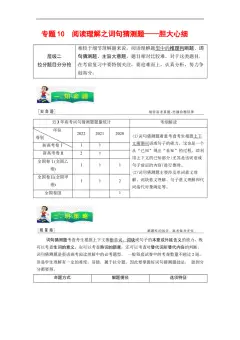
专题 10 词句猜测题
知考法 明考向:
该题型是阅读理解的必考题型。除了直接考查词义猜测外,在阅读理解的文章中,有时会有一些单词或短语
超出了课程标准的范围,这时需要考生根据上下文猜测词义,从而准确理解文章,这是对词义猜测的一种间
接考查。常见的设问方式有:1.What does“...”underlined in paragraph...refer to?2.Which of the lowing can best
replace the underlined word "...” in paragraph.. ? 3. What does the author mean by saying"...”?等。句意猜测题通
常需要考生猜测一个具有概括性的句子的意思,要求考生通过分析上下文语境,用合适的语句进行解释。
做真题 悟技法
(2023·新课标 I , C篇)
The goal of this book is to make the case for digital minimalism, including a detailed exploration of what it
asks and why it works, and then to teach you how to adopt this philosophy if you decide it’s right for you.
To do so, I divided the book into two parts. In part one, I describe the philosophical foundations of digital
minimalism, starting with an examination of the forces that are making so many people’s digital lives increasingly
intolerable, before moving on to a detailed discussion of the digital minimalism philosophy.
Part one concludes by introducing my suggested method for adopting this philosophy: the digital declutter.
This process requires you to step away from optional online activities for thirty days. At the end of the thirty days,
you will then add back a small number of carefully chosen online activities that you believe will provide massive
benefits to the things you value.
In the final chapter of part one, I’ll guide you through carrying out your own digital declutter. In doing so, I’ll
draw on an experiment I ran in 2018 in which over 1,600 people agreed to perform a digital declutter. You’ll hear
these participants’ stories and learn what strategies worked well for them, and what traps they encountered that you
should avoid.
The second part of this book takes a closer look at some ideas that will help you cultivate (培养) a sustainable
digital minimalism lifestyle. In these chapters, I examine issues such as the importance of solitude (独处) and the
necessity of cultivating high-quality leisure to replace the time most now spent on mindless device use. Each
chapter concludes with a collection of practices, which are designed to help you act on the big ideas of the chapter.
You can view these practices as a toolbox meant to aid your efforts to build a minimalist lifestyle that works for
your particular circumstances.
1.What is the book aimed at?A.Teaching critical thinking skills. B.Advocating a simple digital lifestyle.
C.Solving philosophical problems. D.Promoting the use of a digital device.
2.What does the underlined word “declutter” in paragraph 3 mean?
A.Clear-up. B.Add-on. C.Check-in. D.Take-over.
3.What is presented in the final chapter of part one?
A.Theoretical models. B.Statistical methods.
C.Practical examples. D.Historical analyses.
4.What does the author suggest readers do with the practices offered in part two?
A.Use them as needed. B.Recommend them to friends.
C.Evaluate their effects. D.Identify the ideas behind them.
技法点拨: 理关系,定句意
5种语法关系
①标点符号:破折号(一)、冒号(:)、分号(;)后的内容;引号(“”)或括号中的内容
②下定义:be,mean,refer to, be called/named,be defined as,represent,be considered等后面的内容是对前面内
容的注解性说明
③定语从句(尤其注意which/ who后的非限制性定语从句)
④同位语(从句):同位语(从句)是对其前面内容的解释说明
⑤举例常用语:for example,for instance,such as,like,include,including等后的内容
5种逻辑关系
①转折:but,however,otherwise,while,yet
②对比:unlike,in contrast, while,whereas,on the contrary,on the other hand, rather than,instead of
③并列:similarly,like,or,namely,in other words,that is to say,just as,and also,as well as,the same as,as...as
④原因:because,since,because of,due to,thanks to,for,as a result of
⑤结果:so,therefore,so that,so/such... that...,lead to,result in,contribute to
"意义吻合’定句意
一定位 返回原文,定位画线句,利用语法和逻辑关系准确分析原句
二分析 分析理解画线句前后语境,合理推断句意
三归纳 归纳总结,找出与原句意思完全吻合的选项
练模拟 提能力Passage 1
(2024·河北·模拟预测)The sound of people chewing or baby screaming can drive some people into anger,
and scientists have actually discovered the neurological (神经系统的) wiring responsible for this strange condition.
This kind of phenomenon is called misophonia (恐音症). While it’s been recognized as a condition since 2000,
research into its cause has been limited. There are no official criteria and those who experience it often find it
difficult to be taken seriously.
In 2017, a team led by researchers from Newcastle University found evidence of changes to the brain’s frontal
lobe (额叶) that could account for the emotional response triggered by sounds in those with misophonia.
A test group of 20 volunteers listened to neutral, repetitive sounds, such as a boiling kettle; annoying sounds
such as a baby’s cry, and “triggering” sounds, including breathing noises or loud chewing. Their neurological and
physiological responses were compared with those from a control group of 22 volunteers without misophonia.
Neither group reacted much to the neutral or annoying sounds. When it came to the “triggering” sounds,
however, those in the test group experienced significantly increased heart rates and skin conductivity. Brain scans
also revealed a marked difference in the volunteers’ neurology. In those with misophonia, the triggering noises are
correlated with increased activity in various regions of the brain, including the frontal lobe and the anterior insular
cortex (前岛叶皮质 AIC), which is responsible for a bunch of mediation tasks, including managing emotional
experience. While the triggering sounds also sparked a reaction in the AIC of those without misophonia, the fact
that there was no marked increase in the activity of areas such as AIC indicates a higher level of control.
Team leader Sukhbinder Kumar said, “For many people with misophonia, the finding will come as welcome
news, as for the first time, we have demonstrated a difference in brain structure and function in sufferers.” Sadly,
the discovery doesn’t come with an easy fix. It might help the rest of us sympathize, however, and consider
chewing with our mouths closed.
1.What can we learn about misophonia?
A.It’s a condition where people cannot tolerate certain sounds.
B.It’s a psychological condition caused by loud chewing noises.
C.It’s a hearing disability that makes people sensitive to sound.
D.It’s a neurological disorder that affects the frontal lobe.
2.What does the underlined word “triggered” in paragraph 2 probably mean?
A.Controlled. B.Relieved. C.Caused. D.Predicted.
3.What did the study conducted by Newcastle University find?A.Annoying sounds had a greater effect on people with misophonia.
B.Misophonia is caused by a lack of control over one’s emotions.
C.People with misophonia has a lower level of control.
D.AIC has little to do with emotional experience.
4.Which of the following is the best title for the text?
A.When you can’t bear chewing sound, close your mouth
B.How you can fix sound disorder varies with different people.
C.Whether you can control annoying sound depends on your brain
D.If you can’t stand the sound of people chewing, blame your brain
Passage 2
(2024·河北邯郸·二模)The combined quantity of water on Earth has varied over the course of our planet’s
geological history, and it still does.
Today, Earth includes some 1,386 million cubic kilometres of water, a volume that includes water in oceans,
lakes and rivers, plus ground water, vapour in the atmosphere, and the frozen water of glaciers and ice caps. On the
young Earth — some four billion years ago — vast quantities of water were added to the planet by ice-containing
comets (a mass of ice and dust that moves around the sun and looks like a bright star with a tail) that struck us,
eventually making our world a “blue planet”. But such events became increasingly rare in Earth’s more recent
history, and today we are in an age during which Earth is losing water.
The water loss is due to the fact that particles (微粒) sometimes escape Earth’s gravity to travel into space.
This is particularly true of the light hydrogen atoms that form part of water molecules (分子) together with oxygen.
Every time the atmosphere loses hydrogen, we lose one of the building blocks of water. Scientists estimate that
Earth loses about 3kg of hydrogen per second. At this pace, Earth would run out of water in three billion years —
but that assumes that we don’t get any new water supplies.
New water need not come from space — it might come from the inside of the Earth. At depths below 50km,
minerals contain water that is not reckoned within the water cycle. Some of it dates back to Earth’s formation; the
rest is part of slow geological exchange between the planet’s layers. When Earth’s plates sink and melt, deep
minerals can release these bound water molecules so that they can subsequently rise to the surface via volcanic
eruptions, adding to the planet’s overall water resources.
5.How did Earth become a “blue planet” in geological time?
A.By getting water from comets B.By making use of glaciers.C.By releasing its inside water. D.By storing water in the ocean.
6.What is the scientists’ attitude towards the water loss on Earth?
A.Serious. B.Regretful. C.Uncertain. D.Unworried.
7.The underlined word “reckoned” in Paragraph 4 is closest in meaning to “________”.
A.locked B.displayed C.counted D.marked
8.What can be the best title for the text?
A.Where Can Water Be Stored? B.Could Earth Run Out of Water?
C.How Can New Water Be Found? D.Will There Be More Water on Earth?
Passage 3
(2024·江苏南京·一模)Scientists have shown how plants can protect themselves against genetic (基因的)
damage caused by environmental stresses. The growing tips of plant roots and shoots have an in-built mechanism
(机制) that spells cell death if DNA damage is detected, avoiding passing on faulty DNA.
Plants have small populations of stem cells (干细胞) at the tips of their roots and shoots, which enable them to
continuously grow and produce new tissues throughout their lifetime. These stem cells serve as ancestors for plant
tissues and organs. However, any genetic faults present in the stem cells will continue to exist and be passed on
permanently throughout the plant’s life, which could last thousands of years.
Given the critical role of stem cells and their exposure to potentially dangerous environments at the growing
tips of roots and shoots, safeguards are necessary to prevent stem cell faults from becoming fixed. Researchers
Nick Fulcher and Robert Sablowski, funded by the Biotechnology and Biological Sciences Research Council,
aimed to uncover these protective mechanisms. Through experiments involving X-rays and chemicals, they
discovered that stem cells were more sensitive to DNA damage compared to other cells.
When DNA damage occurs, the cells have the capacity to detect it and cause programmed cells to die,
preventing the propagation of the damaged genetic code to the rest of the plant tissues. This process has similarities
to the safeguard mechanism found in animal cells, which has been broadly studied due to its relevance in
preventing cancer.
The identification of a similar protective system in plants is of great interest in the field of plant development.
It also helps scientists develop plants that can better handle environmental stress. So knowledge of how plants deal
with these stresses is of fundamental significance to agricultural science’s response to climate change.
9.What is the function of the in-built mechanism in plants?
A.To produce more roots and shoots. B.To increase the overall lifetime of the plant.C.To enhance plant growth and nutrient intake. D.To stop genetic faults in stem cells passing on.
10.What can we know about stem cells in plants according to the text?
A.They are relatively abundant in quantity.B.They are resistant to environmental stresses.
C.They make quick response to DNA damage. D.They have the ability to repair damaged DNA.
11.What does the underlined word “propagation” in paragraph 4 mean?
A.Spread. B.Change. C.Existence. D.Self-repair.
12.What does the last paragraph focus on?
A.The way of dealing with climate change on the earth.
B.The significance of identifying the protective system in plants.
C.The method of ensuring plant survival under environmental stress.
D.The urgency of developing plants that can handle environmental stress.
Passage 4
(2024·浙江·模拟预测)A relationship between the amount of adult speech children are exposed to and the
concentration of myelin, a substance in the brain, has been found, researchers say.
“I think the take-home message is, absolutely talking to your kids. It’s literally shaping the structure of the
brain,” says the lead author, Prof. John P. Spencer of the University of East Anglia.
The team find, for the 30-month-olds, larger amounts of adult speech are associated with higher quantities of
myelin in language-related pathways in the brain; however, for the 6-month-olds, it goes the opposite way.
While the latter (后者) is unexpected, Spencer points out one possible factor: the brain’s stage of development.
“When babies are six months old, they experience massive growth of new nerve cells,” he says. “So the input
comes in and may help extend the period of brain growth.” “While at 30 months, the brain starts to cut back some
of the cell growth, and form specific connections. That’s where myelin comes in. So now the input starts to help
structure the myelin,” he adds.
The researchers conclude adult speech is significant for both age groups and that the more adult speech
children go through, the more sensitive they will be to language. The next step for them is to figure out whether the
6-month-old babies showing that negative connection will surely turn into 30-month-old kids who show positive
relationship.
Dr. Saloni Krishnan, Reader in cognitive neuroscience (认知神经科学) at Royal Holloway, University of
London, who is not involved in the work, however, notes individual differences in language ability are linked to
genetics. “Children who are exposed to more language at home and have higher myelination will also haveinherited genes (经遗传获得的基因) from parents who are more excellent in languages,” she said. “No final
conclusion could be made before this potential genetic effect are tested. And yet there being currently no standard
around the amount of input children should receive, caregivers should not necessarily feel pressure to talk more to
their children.”
13.Which can replace the underlined words “take-home message” in paragraph 2?
A.Process. B.Reason. C.Point. D.Consequence.
14.What surprises the team?
A.The finding for the 30-month-olds. B.The finding for the 6-month-olds.
C.How the input help nerve cells grow. D.How the input help structure the myelin.
15.What does the researchers think of adult speech?
A.It is positively related to myelin. B.It cuts back some of the cell growth.
C.Its effect varies with the size of brains. D.It is helpful for both groups’ language ability.
16.What might Dr. Saloni Krishnan approve of?
A.The team should do more research. B.Inherited genes decide language ability.
C.Parents must talk more to their kids. D.The concentration of myelin makes no sense.
Passage 5
(2024·山东青岛·一模)An ancient Latin proverb says “Aquila non capit muscas” —cagles don’t hunt flies
—meaning that important ones shouldn’t concern themselves with small, insignificant matters.But the lions in East
Africa should concern themselves with the seemingly insignificant ants, because these ants are changing their
lifestyles.
The story starts with the acacia trees(金合欢树)in an African wildlife area in central KenyaSome of these
acacia trees provide food and shelter for specific ant species, which in turn defend the tree against herbivores(食草
动物).The ants are actively attacking and driving away herbivores that attempt to feed on the tree’s leavesThis is
highly effective; the ants not only physically harm the herbivores but also release chemicals that can deter other
potential attackers.
But these ants are in trouble.Another species called the “big-headed” ant is destroying entire groups of tree-
protecting ants.This, in turn, sets off an entire chain of events that ends up influencing when and how lions can
hunt.
This ant invasion(入侵)affects one thing after the other.It leaves the acacia trees defenseless against herbivores
especially elephants.The elephants come in and eat the acacias at five to seven times the rate observed in uninvadedareas.The lions, while hunting for food, have no more trees to use for hiding.This reduced tree cover makes lions
less successful at hunting and pushes them to find different areas to hunt in.
“These tiny invaders are pulling on the ties that put an African ecosystem together, determining who is eaten
andwhere,” said Todd Palmer, an ecologist from Florida.
The lions, which are already endangered, are managing to cope with this by no longer focusing their attention
on zebras.The zebras, of course, can see them much better on the approach given the lack of cover.Instead, they are
targeting water buffalo.But this also isn’t the end of the story.Who knows what the lions’ changing strategy will
mean for the ecosystem down the line?
17.What does the underlined word “deter” in paragraph 2mean?
A.Direct. B.Discourage. C.Identify. D.Seek.
18.What role do the elephants play in the chain reaction?
A.Cooperating with “big-headed” ants. B.Damaging the hiding place for lions.
C.Protecting the acacias from herbivores. D.Starting off the disturbance of the chain.
19.The author mentions lions, zebras and water buffalo to show that ______.
A.animals fall victim to bigger ones B.the ecology is on the road to recovery
C.animals are corelated in the ecosystem D.species are firmly positioned in the food chain
20.What is the text mainly about?
A.What ecologists find about animals. B.Why African lions are endangered.
C.How tiny ants affect the way lions hunt. D.How the law of the jungle works in Africa.
Passage 6
(2024·山东日照·一模)Sri Nihal Tammana, age 13, of Edison, New Jersey, was named a winner of the
2022 Gloria Barron Prize for Young Heroes. The Barron Prize annually honors 25 outstanding young leaders who
have made a significant positive impact on people, their communities, and the environment.
Nihal founded Recycle My Battery to promote and facilitate the recycling of used batteries. His nonprofit
places free battery recycling bins(箱子)and educates young people and adults about battery recycling. In just three
years he has built a team of more than 250 student volunteers across the globe who have recycled nearly 200,000
batteries and educated millions of people. Nihal learned at age 10 that 15 billion batteries are thrown away each
year and that most end up in landfills(垃圾填埋地)where they pollute groundwater, harm the ecosystem, and can
cause catastrophic fires. Inspired to tackle the problem, he began collecting used batteries from his community. He
put them in free recycling bins at stores like Staples until he was told he was bringing too many and had to stop.Undeterred, he reached out for help from Call2Recycle, the largest battery recycling nonprofit in North
America. Call2Recycle agreed to assist and provided recycling bins for free, which were placed in schools,
libraries, and other public places. Nihal’s organization now operates across the U.S. and is expanding to other
countries including Canada, Switzerland, and India. “Earth gives us so much — oxygen, food, water — everything!
So it’s important that we give something back when we can,” says Nihal.
The Barron Prize was founded in 2001 by author T. A.Barron. “Nothing is more inspiring than stories about
heroic people who have truly made a difference to the world,” says T. A.Barron. “And we need our heroes today
more than ever. Not celebrities, but heroes — people whose character can inspire us all. That is the purpose of the
Barron Prize: to shine the spotlight on these amazing young people so that their stories will inspire others.”
21.What does Recycle My Battery intend to do?
A.Protect the earth from used batteries. B.Promote used batteries across the globe.
C.Make money by collecting used batteries. D.Stop people throwing used batteries away.
22.What does the underlined word “Undeterred” in Paragraph 3 probably mean?
A.Undiscouraged.B.Unprepared. C.Unsurprised. D.Uninterested.
23.How did Call2Recycle help Nihal’s organization?
A.By making it go global. B.By offering free recycling bins.
C.By providing financial support. D.By buying more used batteries.
24.What is the text mainly about?
A.The importance of recycling batteries.
B.The impact of batteries on the environment.
C.The achievements of the Barron Prize winners.
D.The inspiring story of a young environmentalist.