专题 03 写作意图推断题
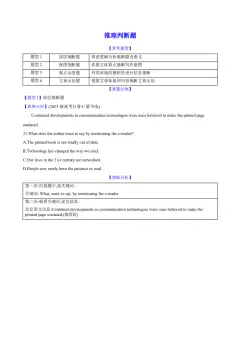
知考法 明考向:
该题型主要考查考生对作者所阐述的内容进行分析和总结的能力,属于深层次理解题。作者在文中一般不直
接陈述自己的意图,而是通过文中所列举的事物、事项使读者感受到其所传递的想法。写作意图文体联系紧
密,考生有时可根据文体特点推测写作意图。
做真题 悟技法
(2023·新课标 I , B篇)
When John Todd was a child, he loved to explore the woods around his house, observing how nature solved
problems. A dirty stream, for example, often became clear after flowing through plants and along rocks where tiny
creatures lived. When he got older, John started to wonder if this process could be used to clean up the messes
people were making.
After studying agriculture, medicine, and fisheries in college, John went back to observing nature and asking
questions. Why can certain plants trap harmful bacteria (细菌)? Which kinds of fish can eat cancer-causing
chemicals? With the right combination of animals and plants, he figured, maybe he could clean up waste the way
nature did. He decided to build what he would later call an eco-machine.
The task John set for himself was to remove harmful substances from some sludge ( 污泥). First, he
constructed a series of clear fiberglass tanks connected to each other. Then he went around to local ponds and
streams and brought back some plants and animals. He placed them in the tanks and waited. Little by little, these
different kinds of life got used to one another and formed their own ecosystem. After a few weeks, John added the
sludge.
He was amazed at the results. The plants and animals in the eco-machine took the sludge as food and began to
eat it! Within weeks, it had all been digested, and all that was left was pure water.
Over the years, John has taken on many big jobs. He developed a greenhouse — like facility that treated
sewage (污水) from 1,600 homes in South Burlington. He also designed an eco-machine to clean canal water in
Fuzhou, a city in southeast China.
“Ecological design” is the name John gives to what he does. “Life on Earth is kind of a box of spare parts for
the inventor,” he says. “You put organisms in new relationships and observe what’s happening. Then you let thesenew systems develop their own ways to self-repair.”
1.What can we learn about John from the first two paragraphs?
A.He was fond of traveling. B.He enjoyed being alone.
C.He had an inquiring mind. D.He longed to be a doctor.
2.Why did John put the sludge into the tanks?
A.To feed the animals. B.To build an ecosystem.
C.To protect the plants. D.To test the eco-machine.
3.What is the author’s purpose in mentioning Fuzhou?
A.To review John’s research plans. B.To show an application of John’s idea.
C.To compare John’s different jobs. D.To erase doubts about John’s invention.
4.What is the basis for John’s work?
A.Nature can repair itself. B.Organisms need water to survive.
C.Life on Earth is diverse. D.Most tiny creatures live in groups.
技法点拨:依文体特点和写作手法推意图
一、看文体类别
1. 故事类
to tell a story/share a(n)... experience/amuse/entertain readers
2. 广告类/应用文
to sell a product/attract visitorspersuade/promote...
3. 科普类说明文
to introduce/explain/inform...
4. 议论文
to argue/prove/analyse/show...
5. 新闻类
to inform/report
二、看写作手法
1. 在文章开头提出问题
to bring in/introduce the topic
2. 介绍与主题有关的事物to bring in/introduce the topic
3. 举例或引用某人的话
to support/show...
练模拟 提能力
Passage 1
(2024·江苏南通·模拟预测)“I am so sorry,” I tearfully said to my principal investigator (PI), explaining I
would not be able to return to work as originally planned. Before I became a parent, I had assumed a baby would fit
right into my academic plans. But now, as the end of my leave approached, I realized I couldn’t simply carry on as I
always had. I was worried this decision might signal the end of my academic career-but I felt I had no other choice.
Thankfully, my PI had more foresight. He told me I didn’t need to resign and that he could offer me a contract
that would allow me to contribute to our project from afar. It proved to be an absolute career lifeline tailored to me.
Then five years after stepping back from academia, I felt ready to re-enter more fully. Because I had been able
to keep my hand in during my time away, the prospect was much less daunting than it would have been otherwise.
I ended up landing a lecturer position that allowed me to slowly ease back in, focusing on teaching and scholarship
with research taking a back seat. And when, 4 years on, a senior lectureship position came up in the very group I
had left a decade earlier, the timing was right. With both of my children in “big school,” I was ready to really put
my foot down on the career accelerator. I got the job.
Now, 6 months into my new role, I am happy to be right where it all began, with involvement in so many
interesting projects. But what truly made the difference for me was the offer of what I needed during that time
away. I hope more institutions and PIs can come up with creative provisions for those in their workforce who don’t
want to give up their careers but want-or-need to take extended periods of leave. And to those who are taking such
breaks, or considering it, know that returning is possible. Above all, on both sides: Please do not discount extended
leavers. We have a lot to offer — if we are given the chance.
1.What can we learn about the author from the first paragraph?
A.She chose to sacrifice her family for her career.
B.Her path to PI began when she became a parent.
C.She struck a balance between work and family.
D.She had intended to stick to her academic plans.
2.What does the underlined word “daunting” in paragraph 2 mean?A.Realistic. B.Scary. C.Unlikely. D.Attractive.
3.What contributed most to her success according to the author?
A.Supportive work environment. B.Academic researches.
C.Involvement in engaging projects. D.Interest in the projects.
4.What’s the author’s purpose of writing the passage?
A.To analyze. B.To entertain. C.To promote. D.To report.
Passage 2
(2024·浙江绍兴·一模)Now, Earth Day is celebrated around the world. We still face many challenges, such
as climate change, plastic pollution, and deforestation. But we can all make a difference.
Her Trees Save Lives
Adeline Tiffanie Suwana was 12 when her family’s home flooded. Indonesia, her island nation, is often hit
hard by floods and other natural disasters.
Adeline learned that mangrove trees play a key role in flood protection and rallied classmates to plant 200
trees during a school break. They started a group called Sahabat Alam or Friends of Nature, which works to
conserve the region’s biodiversity and combat climate change.
Today. Adeline attends university, studying how businesses can help the environment.
Teens’ Two-Fold Invention
EPS—expanded polystyrene foam—is the white, lightweight stuff used to make things like takeout food
containers, foam egg cartons, and packing “peanuts”. But it takes up a lot of space and is difficult to recycle. EPS
breaks into small pieces as it floats down waterways into oceans, harming wildlife along the way.
Eighth-graders Julia Bray, Luke Clay, and Ashton Cofer looked at EPS’s chemical makeup and saw that it was
mostly carbon. That sparked an idea. Could they turn it into activated carbon, a material that filters toxins from
water?
After 50 hours of experiments, including one that accidentally set the family grill fire, they succeeded!
Solar for Her School
When Claire Vlases of Montana was in seventh grade, she learned about plans to expand and modernize her
middle school. Claire asked the school board to add solar panels to the project. The board liked the idea but said it
could contribute just $25,000, one-fifth of the cost. So Claire organized a group of kids and adults who set to work
raising the rest.
They asked for donations, even going door-to-door for them. And they appealed to charitable foundations too.
One even donated half the cost!After two years of hard work, the group paid for the solar panels, which now supply one-fourth of the school’s
electricity needs.
5.What do the three groups of teenagers have in common?
A.They are Earth-helping heroes. B.They are from island countries.
C.They are high school students. D.They are keen on experiments.
6.How much did one of the charitable organizations donate for solar panels?
A.$25,000. B.$50,000. C.$62,500. D.$125,000.
7.What is the purpose of the passage?
A.To give models for colorful school activities.
B.To explore the ways to deal with plastic pollution.
C.To inspire people to act for environmental problems.
D.To display the amazing power of effective cooperation.
Passage 3
(2024·浙江杭州·一模)That dinosaurs ate the mammals (哺乳动物) that ran beneath their feet is not in
doubt. Now an extraordinary fossil newly described in Scientific Reports, unearthed by a team led by Gang Han at
Hainan Vocational University of Science and Technology in China, shows that sometimes the tables were turned.
The fossil -dated to about 125 million years ago, during the Cretaceous period-was formed when a flow of
boiling volcanic mud swallowed two animals seemingly locked in a life-and-death fight. The one on top is a
mammal. This animal is a herbivorous species closely related to the Triceratops (三角恐龙). Animal interactions
such as this are exceptionally cam e in the fossil record.
One possibility is that the mammal was eating something already dead, other than hunting live prey. These
days it is uncommon for small mammals to attack much larger animals. But it is not unheard of. And Dr. Han and
his colleagues point out that those mammals which eat dead bodies typically leave tooth marks all over the bones of
the animals. The dinosaur’s remains show no such marks. There is also a chance the fossil could be a fake. More
and more convincing fake s have emerged, as this one did -though Dr. Han and his colleagues argue that the
complexly connected nature of the skeletons (骨骼) makes that unlikely, too.
Assuming it is genuine, the discovery serves as a reminder that not all dinosaurs were enormous during the
Cretaceous and not all mammals were tiny. From nose to tail, the dinosaur is just 1.2 meters long. The mammal is a
bit under half a meter in length. Despite being half the size, the mammal has one paw firmly wrapped around one of
its prey’s limbs, and another pulling on its jaw. It is biting down on the dinosaur’s chest, and has ripped off two ofits ribs. Before they were interrupted, it seems that the mammal was winning.
8.Which idiom is closest in meaning to underlined part “the tables were turned” in paragraph 1?
A.The fittest survives. B.The hunters become hunted.
C.Fortune always favors the brave. D.The truth will always come to light.
9.Why does the author mention the “tooth mark” in paragraph 3?
A.To prove the fossil was fake. B.To show the forming of the fossil.
C.To illustrate the process of hunting. D.To suggest the dinosaur was hunted alive.
10.What makes Dr. Han think the fossil is genuine?
A.The size of the fossil. B.The absence of fake fossils.
C.The complexity of the skeletons. D.The consistency of the opinions.
11.What is the function of the last paragraph?
A.It offers a cause. B.It highlights a solution.
C.It justifies the conclusion. D.It provides a new discovery.
Passage 4
(2024·福建泉州·二模)3M and Discovery Education announced Sean Jiang from Gilman School as one of
the top ten finalists from across the nation for the 2023 3M Young Scientist Challenge. It’s a competition that
encourages students to identify an everyday problem and submit a video showing the science behind the solution he
or she came up with.
14-year-old Jiang decided to help those who can’t see. Blind people had a hard time navigating (导航) objects
that are medium to far range. So Jiang wanted to design something to give them a heads-up on obstacles (障碍) that
may be incoming.
Jiang’s inspiration came from the powers of the hearing system. “I learned in school that bats and whales are
able to use echolocation (回声定位) to help them navigate and just use their sense of hearing and I also saw on
YouTube some very skilled blind people that use echolocation to help them walk,” said Jiang.
Jiang started with a virtual reality setting and then made it a reality. His creation uses a depth camera that can
detect how close objects are, thus giving enough time to dodge the obstacles. When a blind is walking with the
device, the sensor of the depth camera gathers the information regarding the obstacles’ position and distance. Then
the AI system in it will turn the distance data into musical sound guidance. This could significantly increase the
walking speed of a blind person as well as decrease the number of obstacles they hit.
Some other similar programs were alright at finding objects that were in close range, but Jiang still wanted theblind to experience the world even fuller so they were able to see stuff that was much further away than their circle
of reach.
In October, the top ten finalists will compete in person in Minneapolis for the title of “America’s Top Young
Scientist” and a $25, 000 prize.
12.What can we learn about Jiang from the first two paragraphs?
A.He was the champion of the 2023 3M event.
B.He invented technology to remove road obstacles.
C.He sought to assist the blind in walking smoothly.
D.He developed a new navigation app for his school.
13.Why did Jiang mention “echolocation”?
A.To show the development of technology.
B.To present the difficulties the blind face.
C.To stress the significance of hearing.
D.To explain the inspiration of his invention.
14.What does the underlined word “dodge” mean in paragraph 4?
A.Avoid.
B.Encounter.
C.Challenge.
D.Remove.
15.What is the text mainly about?
A.3M facilities intended for the blind.
B.A teen using sound to help the blind.
C.An invention to cure vision problems.
D.A competition to improve the blind’s life.
Passage 5
(2024·全国·一模)If sales generally feel hard to to resist, the sale in front of Aarron Schurevich was the
ultimate test: new Kia Soul just like the one he’d had and loved, at a dealership he trusted, at a moment when he
really needed a car. And it was priced $4,000 off more than a 20% discount. However, after he sped through
paperwork and drove the car off the lot, the deal turned soul. Schurevich now jokes that he paid a tax for being a
fool.
This big-ticket example shows vividly all the dynamics that play out in a sale. The discount itself oftenregisters as a win, delivering the joy of both getting the product and the reward that we discovered something, and
we’ve earned this extra thing. Thus, spotting something we’d like to buy on sale activates our brain’s reward
system. Then there’s the fight in the brain between what can be described as its emotional and rational( 理性
的)parts. A sale lands like the thumb that tips our mental scale toward buying.
Stores, of course, know all this and try to push our buttons.
Experts say we often subconsciously believe popular things to be more valuable or more rewarding. Plus,
there’s our urge to avoid loses — the fear of missing out (FOMO). So stores appeal to our crowd mentality: It’s
Black Friday, ana everyone’s shopping, buying that thing you’d like. They create urgency: Your favorite car is on
sale today only! And they create scarcity: Shop now while supplies last!
Stores also try various pricing tricks. “How do we make more customers go to the more expensive option? We
add a decoy,” says Savannah Wei Shi, who researches pricing and decision-making. For example, picture s store
shelf where a medium bag of candy sits next to a larger bag of the same candy. The medium-sized bag is much
smaller than the other bag, but only slightly cheaper. It makes the big bag look like the best deal, so shoppers buy
that one-the most expensive option on the shelf.
16.Why is Aarron Schurevich’s story mentioned?
A.To illustrate why we fall for a sale. B.To present how our brains are activated.
C.To stress the importance of rational decision. D.To prove the flexibility of marketing strategies.
17.What can be inferred from paragraph 4?
A.FOMO postpones decisions. B.Sales play on people’s fears.
C.Subconsciousness determines everything. D.Scarcity promotion leads to wise purchases.
18.What marketing technique is used by warning about the limited number of available seats left?
A.Using Pricing tricks. B.Dealing with emergencies.
C.Creating scarcity. D.Appealing to crowd mentality.
19.What does “a decoy” refer to in paragraph 5?
A.A candy. B.A shelf. C.A larger bag. D.A medium bag.