定价:9.40元
物 流 码
批准文号:渝发改价格〔2024〕778号 举报电话:12315
普通高中教科书
英 语
(必修第二册)
主编 杨晓钰
责任编辑:陈 亮 版式设计:陈 亮
责任校对:谢 芳 责任印制:赵 晟
*
重庆大学出版社出版发行
出版人:饶帮华
社址:重庆市沙坪坝区大学城西路21号
邮编:401331
电话:(023)88617190 88617185(中小学)
传真:(023)88617186 88617166
网址:http://www.cqup.com.cn
邮箱:fxk@cqup.com.cn(营销中心)
全国新华书店经销
重庆俊蒲印务有限公司印刷
*
开本:890mm×1240mm 1/16 印张:8.5 字数:367千
2020年8月第1版 2021年7月第2次印刷
ISBN 978-7-5689-2104-6 定价:9.40元
本书如有印刷、装订等质量问题,本社负责调换
版权所有,请勿擅自翻印和用本书
制作各类出版物及配套用书,违者必究
副主编 黄学军 褚修伟
编 者 郑加明 黄 宇 邹凌云
3
To the student
To the student
亲爱的同学,欢迎你随本书一起继续高中阶段的英语学习。我们希望充
满求知欲的你,能喜欢书中所提供的学习材料,喜欢各种鼓励探究和发展思
维、注重学习能力和学习习惯培养的教学设计。
高中英语学习是初中英语学习的延伸,同时也是新的英语学习生活的开
始。在这一阶段,提高基本语言运用能力极其重要,但提高用英语获取信
息、处理信息、分析和解决问题的能力,用英语进行思考和表达的能力,以
及跨文化交际的意识和基本的跨文化交际能力也必不可少;而掌握有效的英
语学习策略,提高自主学习能力,会帮助你更有效地学习,形成具有个性的
学习方法和风格,为将来进一步学习英语和终身发展打下良好基础。
关于本教材的使用,我们有以下建议:
1. 请仔细阅读每个主题前的学习导页,它会帮助你熟悉该部分的主要学
习内容,激发你思考与之相关的问题,为本主题的学习做好必要的准备。
2. 只有充分了解了学习目标,你才能在学习中处于主动地位,发挥主体
作用,才能使自己的“学”与教师的“教”形成协调发展的合力,从而取得
最佳的学习效果。因此,各单元的学习从研读 Looking Ahead 开始,并在每
个单元学习后根据 Self-assessing 帮助自己反思学习效果,调整自己的学习目
标、学习方式和学习进程。
3. Activating and Predicting 旨在最大限度地激活你与所学内容相关的背景
知识,激发你学习的兴趣和动机,为进入下一步学习做好准备。在本板块的
学习中一定要勤于思考,积极参与,勇于表达。
4.“学而不思则罔,思而不学则殆”,没有思考、缺乏创造性的学习
收获甚少。建议你在进行 Reading,Thinking and Analysing 部分课文的学
习时,不要忽略了页边注释和 TIP,一定要边学边思,学思结合,掌握策
略,举一反三,这样你才能真正提高阅读能力,逐渐成长为高效的英语阅
读者。
5. Exploring and Using 将为你轻松化解阅读课文中的语言知识,引导你通
过观察和分析,了解语法形式,理解语法意义,发现语法规则。这将帮助你
1
2
在真实语境中运用所学语言知识来理解和表达意义,加强准确、得体地使用语言的意
识,深化对语言的理解。
6. 在进行了大量的听说和阅读后,你一定记住了许多优美的词句、漂亮的段落,
一定发现了英语文章与汉语文章在风格和组织结构上的异同,也一定跃跃欲试地想用
英语表达自己的所感所想。这的确是一件值得高兴的事!那么,请一定经常读一读、
听一听、说一说、记一记一些好的句子和美文,并认真完成每课的写作任务,这样,
你的英语写作就会不断进步,逐步达到“行文如流水,落笔如有神”的境界。
7. 亲爱的同学,你注意到每个主题后的 Challenging Yourself 了吗?其中的
Recycling Time 帮助你归纳学习策略,进行词汇的分类复习;Word Builder 则提供不同
的猜词策略;Reading Land 鼓励你积极应用学习策略进行阅读课的自主学习。该板块
旨在培养你独立思考与合作学习的能力,养成积极反思的习惯,为终身学习和发展奠
定良好的基础。
8. 每个主题的 Learning Reflectively 板块,鼓励你主动进行自我评价,积极参与同
伴评价,同时虚心听取教师的评价。请相信,不断的反思会帮助你不断进步,不断走
向成熟,逐步成为一个成功的语言学习者。
9. 附录中的 Word Learning Booster 会引导你在学习新词汇的同时,注重对已学词
汇的定期复习,逐步养成良好的词汇学习习惯,记忆词汇也将不再是一件难事。
“学而时习之,不亦说乎?”古人告诉我们,学习要采取积极的态度,既要时
时、处处、事事地“学”,又要时时、处处、事事地“习”;于“学”中积累、丰
富、提高,于“习”中求巩固、受启发、得效益;争取日有所新,日有所获。这样你
的内心就能充满掌握英语学习真谛的愉悦。
我们衷心希望通过本教材的学习,能进一步激发你学习英语的热情和用英语交流
的欲望,最终能用英语了解、学习他国优秀文化,同时向世界介绍祖国灿烂的文化。
作为学习者,获取知识是一种乐趣,不断克服困难、不断创新也是一种乐趣。记
住永远对自己说:“I can do it!”。
愿你快乐地度过英语学习的每一阶段,享受克服困难的快乐,享受创新的快乐,
享受成功的快乐!
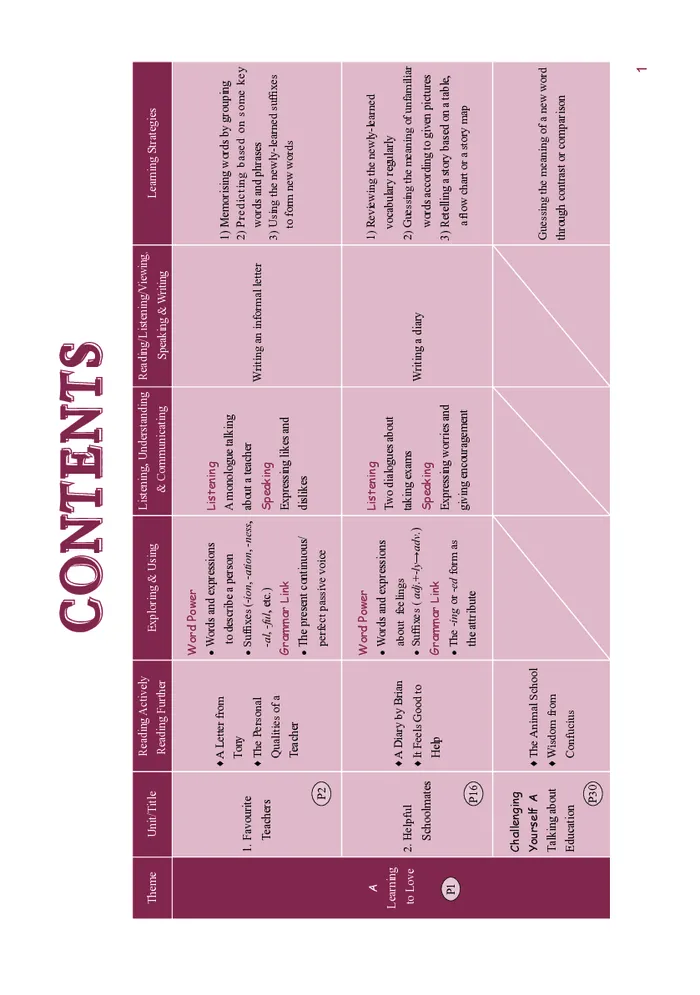
Theme
Unit/Title
Reading Actively
Reading Further
Exploring & Using
Listening, Understanding
& Communicating
Reading/Listening/Viewing,
Speaking & Writing
Learning Strategies
A
Learning
to Love
1. Favourite
Teachers
♦ A Letter from
Tony
♦ �The Personal
Qualities of a
Teacher
Word Power
● �Words and expressions
to describe a person
● Suffixes (-ion, -ation, -ness,
-al, -ful, etc.)
Grammar Link
● The present continuous/
perfect passive voice
Listening
A monologue talking
about a teacher
Speaking
Expressing likes and
dislikes
Writing an informal letter
1) Memorising words by grouping
2) �Predicting based on some key
words and phrases
3) Using the newly-learned suffixes
to form new words
2. Helpful
Schoolmates
♦ �A Diary by Brian
♦ �It Feels Good to
Help
Word Power
● �Words and expressions
about feelings
● Suffixes ( adj.+-ly→adv.)
Grammar Link
● The -ing or -ed form as
the attribute
Listening
Two dialogues about
taking exams
Speaking
Expressing worries and
giving encouragement
Writing a diary
1) �Reviewing the newly-learned
vocabulary regularly
2) �Guessing the meaning of unfamiliar
words according to given pictures
3) Retelling a story based on a table,
a flow chart or a story map
Challenging
Yourself A
Talking about
Education
♦ The Animal School
♦ Wisdom from
Confucius
Guessing the meaning of a new word
through contrast or comparison
P30
P16
P2
P1
1
CONTENTS
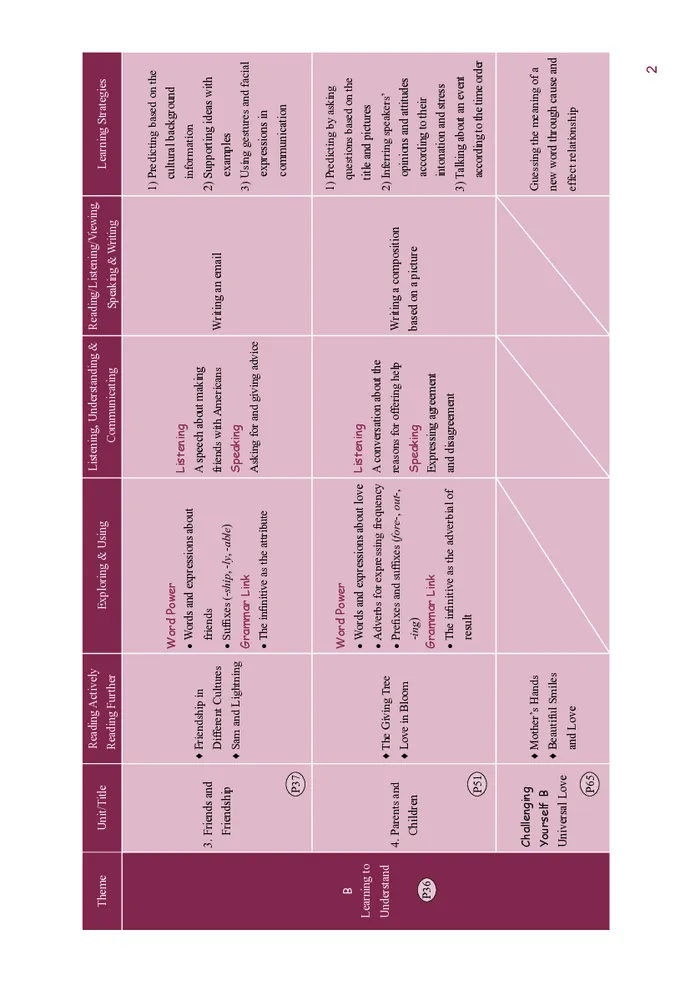
Theme
Unit/Title
Reading Actively
Reading Further
Exploring & Using
Listening, Understanding &
Communicating
Reading/Listening/Viewing,
Speaking & Writing
Learning Strategies
B
Learning to
Understand
3. Friends and
Friendship
♦ Friendship in
Different Cultures
♦ Sam and Lightning
Word Power
● Words and expressions about
friends
● Suffixes (-ship, -ly, -able)
Grammar Link
● The infinitive as the attribute
Listening
A speech about making
friends with Americans
Speaking
Asking for and giving advice
Writing an email
1) �Predicting based on the
cultural background
information
2) Supporting ideas with
examples
3) Using gestures and facial
expressions in
communication
4. Parents and
Children
♦ The Giving Tree
♦ Love in Bloom
Word Power
● �Words and expressions about love
● Adverbs for expressing frequency
● Prefixes and suffixes (fore-, out-,
-ing)
Grammar Link
● The infinitive as the adverbial of
result
Listening
A conversation about the
reasons for offering help
Speaking
Expressing agreement
and disagreement
Writing a composition
based on a picture
1) �Predicting by asking
questions based on the
title and pictures
2) Inferring speakers’
opinions and attitudes
according to their
intonation and stress
3) �Talking about an event
according to the time order
Challenging
Yourself B
Universal Love
♦ Mother’s Hands
♦ Beautiful Smiles
and Love
Guessing the meaning of a
new word through cause and
effect relationship
P37
P36
P51
P65
2
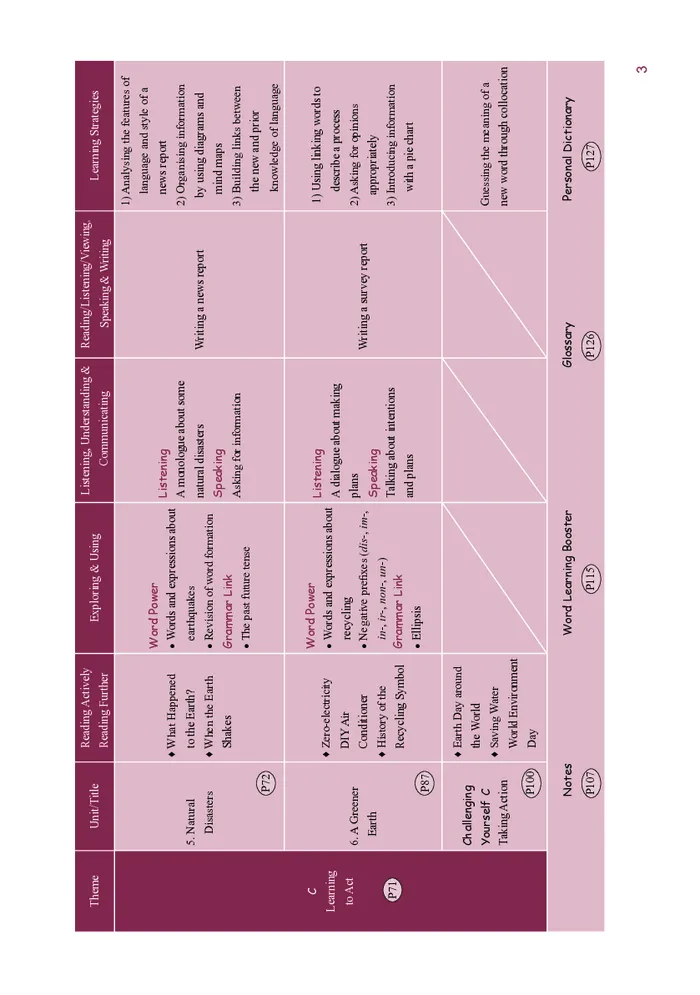
Theme
Unit/Title
Reading Actively
Reading Further
Exploring & Using
Listening, Understanding &
Communicating
Reading/Listening/Viewing,
Speaking & Writing
Learning Strategies
C
Learning
to Act
5. Natural
Disasters
♦ What Happened
to the Earth?
♦ When the Earth
Shakes
Word Power
● �Words and expressions about
earthquakes
● Revision of word formation
Grammar Link
● The past future tense
Listening
A monologue about some
natural disasters
Speaking
Asking for information
Writing a news report
1) �Analysing the features of
language and style of a
news report
2) �Organising information
by using diagrams and
mind maps
3) �Building links between
the new and prior
knowledge of language
6. A Greener
Earth
♦ Zero-electricity
DIY Air
Conditioner
♦ History of the
Recycling Symbol
Word Power
● Words and expressions about
recycling
● Negative prefixes (dis-, im-,
in-, ir-, non-, un-)
Grammar Link
● Ellipsis
Listening
A dialogue about making
plans
Speaking
Talking about intentions
and plans
Writing a survey report
1) �Using linking words to
describe a process
2) Asking for opinions
appropriately
3) �Introducing information
with a pie chart
Challenging
Yourself C
Taking Action
♦ Earth Day around
the World
♦ Saving Water
World Environment
Day
Guessing the meaning of a
new word through collocation
Notes Word Learning Booster Glossary Personal Dictionary
P71
P72
P87
P107
P115
P126
P127
P100
3
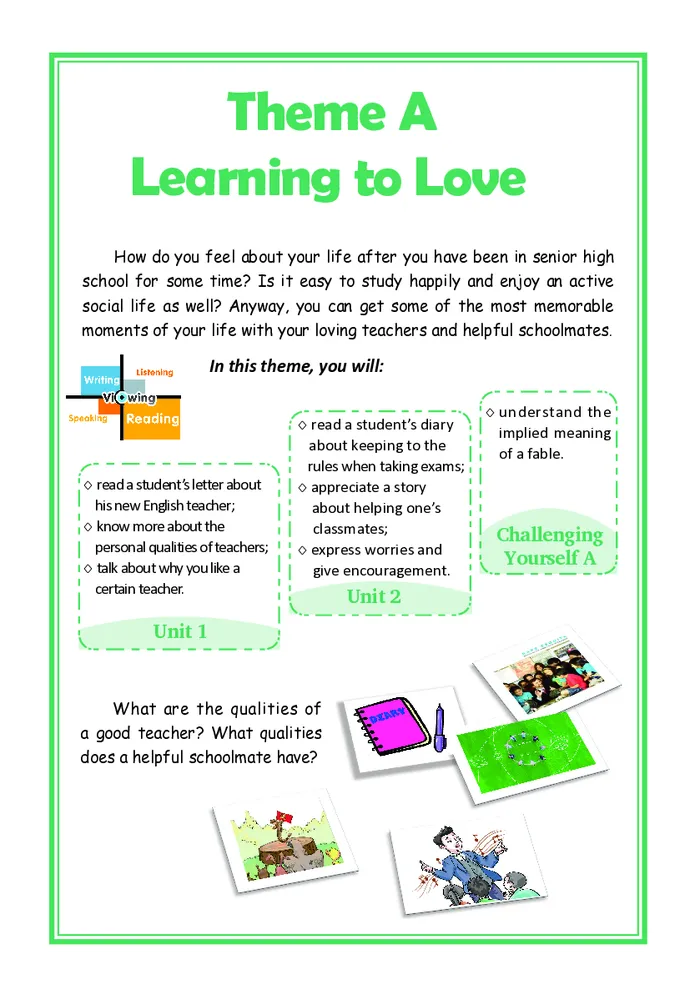
Theme A
Learning to Love
How do you feel about your life after you have been in senior high
school for some time? Is it easy to study happily and enjoy an active
social life as well? Anyway, you can get some of the most memorable
moments of your life with your loving teachers and helpful schoolmates.
What are the qualities of
a good teacher? What qualities
does a helpful schoolmate have?
Unit 1
◊ read a student’s letter about
his new English teacher;
◊know more about the
personal qualities of teachers;
◊talk about why you like a
certain teacher.
Unit 1
◊ read a student’s diary
about keeping to the
rules when taking exams;
◊ appreciate a story
about helping one’s
classmates;
◊ express worries and
give encouragement.
Unit 2
Unit 2
◊ understand the
implied meaning
of a fable.
Challenging
Yourself A
In this theme, you will:
Theme A Learning to Love
Looking Ahead
By the end of this unit, you will be able to:
describe different aspects of your favourite teachers;
form nouns and adjectives by adding suffi xes: -ion, -ation, -ness, -al, -ive, -ful and -able;
use the present continuous/perfect passive voice properly;
express likes and dislikes with supporting information;
write an informal letter to introduce your school life;
talk about the personal qualities of a teacher.
Most human beings are as good as they are because
some unsung teacher was there when needed.
—Peter G. Beidler
Unit 1
Favourite Teachers
Reading Actively
► Activating and Predicting
Group the words in the box according to the headings
below. Check with a partner.
A Appearance:
B Personal quality:
C Professional quality:
D Others:
kind
alive pretty caring humourous good-looking
old funny lively
excellent handsome easy-going
lazy clever able serious beautiful warm-hearted
shy young strict patient traditional ordinary-looking
tidy
silent active confi dent interesting hard-working
2
Grouping words helps
you to organise them in
a logical way.
TIP
Unit 1 Favourite Teachers
3
Now complete the following short passage by using some of the above adjectives to
describe one of your favourite teachers.
One of my favourite teachers is Mr./Mrs./Miss . He/She is a/an (maths/
English/...) teacher. He/She looks . I like/admire him/her very
much because .
Look at the following words and expressions from Tony’s letter and predict his general
impression of his English teacher. Then read the text to check.
► Reading, Thinking and Analysing
A Letter from Tony
November 6, 2018
Dear Robbie,
It’s been a long time since we left our junior high school. How is
everything going?
I do enjoy the new school life here. My new class is made up of 40
students. I’ve met quite a lot of new teachers and schoolmates, and they
are all very kind to me. Do you still remember how I hated English? But
I’m pretty crazy about this subject now. Unbelievable, isn’t it? Well, I
never thought that a teacher would change my attitude towards English
learning, but it just happened.
Mr. Li is our English teacher, and his devotion to teaching has made
a deep impression on me. He always prepares his lessons well before class
and acts out what he wants
to teach in class. While he is
teaching, he uses his arms,
hands and fingers to help
himself in his explanations, and
his face to express feelings.
His speech is musical, for he
always changes the tone of his
voice according to what he is
talking about. He believes that
Do doesn’t show an
action here. It is used
to emphasise the verb
that follows.
Pretty means .
A. nice B. very
enjoy
musical tone
admire
use aids
prepare lessons well
sense of humour in an imaginative way
1) The key words from the text can
help your prediction.
2) Guess the meaning of a coloured
word according to its base form.
TIP
Theme A Learning to Love
4
no class is successful if the students and the teacher can’t share several
chuckles and at least one loud laugh. Through his sense of humour, he
makes learning more enjoyable. Besides, he leads us to learn English
in an imaginative way by using such aids as paintings, recordings,
cartoons and fl ash cards. This morning, he even sang a song in class to
explain a grammatical rule. I really admire him. In addition, he likes to
meet with students outside the classroom to discuss different subjects
in English, ranging from the Internet to pop music. Once he even
challenged one of my classmates to a game of Chinese chess.
Do you like your new teachers there? Please tell me something
about your school life. OK? I’m looking forward to your reply.
Yours,
Tony
Does this subject mean
the same as the subject
in Paragraph 2?
The word chuckle means
in Chinese.
► Comprehending, Integrating and Creating
Choose the main idea for Tony’s letter.
The main idea of the letter is that .
A. Tony likes his new life in senior middle school, especially his new teachers
B. Tony’s attitide to English learning has changed
C. Tony’s English teacher is funny and teaches in an imaginative way
Scan the text and complete the following table with the information from the text. Then
talk about Mr. Li’s devotion to his teaching with two partners.
Mr. Li’s
devotion
to his
teaching
Before class He his lessons well.
In class
He what he wants to teach.
He has a tone of voice according to the content.
He has a sense of .
He teaches the students to think in an way.
He uses special ways to explain .
After class He discusses different with students in English.
He games together with students.
When a statement tells the main idea, it should sum up what the author tells
us about the topic. It shouldn’t be 1) too general or broad, 2) too narrow,
only covering part of the contents.
TIP
Unit 1 Favourite Teachers
5
Read the letter again and decide whether each of the following statements is true (T) or
false (F). Then fi nd out the information from the text to support your ideas.
1) It is unbelievable and impossible that a teacher can change a student’s attitude
towards the subject he teaches.
2) According to Tony, a teacher should have a voice like music.
3) We know from the letter that Mr. Li’s classes must be full of laughter.
4) Tony may think that a teacher’s sense of humour can help to make students’
learning more enjoyable.
5) In Tony’s view, a popular teacher should know about different subjects that
students enjoy.
6) From the letter, we know that Mr. Li is crazy about pop music.
Discuss the following questions in pairs and share your ideas in groups.
1) Why has Tony changed his attitude towards English learning? Do you have any similar
experiences? If so, share them with your classmates.
2) According to Mr. Li, what is a successful class like? Do you agree? Why or why not?
3) How do you understand the sentence “Most human beings are as good as they are
because some unsung teacher was there when needed”?
Work in groups and discuss why Tony likes Mr. Li so much with the help of the diagram.
Your judgements need to be based on some important facts and
information from the reading.
Talking about a teacher
His teaching
methods
His creative ideas about
giving a successful lesson
His personal
qualities
His relationship
with students
TIP
When you talk about a person, you may follow the steps below:
1) decide what aspects you want to talk about;
2) use appropriate adjectives and verbs;
3) use examples to support your ideas.
TIP
Theme A Learning to Love
6
Now think about what type of teacher you like most and then give some suggestions to
your teacher.
The type of teacher I like best is like this: .
The suggestions for my teachers are: .
Exploring and Using
► Word Power
Find the following words in the text and work out their meanings. Then match them with
their explanations.
Now use the appropriate forms of the above words to complete the sentences below.
1) Mr. Li thinks body language can help him during his teaching. He uses body language
as a/an in his teaching.
2) To pass the running test, Jenny got up at 6 a.m. every morning. We really
her determination.
3) It is said that David plays tennis well. I’d like to David to a game
on the court.
4) Miss Moore treats her students as her own children. Her to these
children is plain to see.
5) I am crazy about the science fi ction by Mr. White, a/an writer.
6) She is very beautiful, warm-hearted and hard-working. I think she has many other good
qualities being very beautiful.
7) Bob went to the port again to play this afternoon. His mother wanted him to give a
reasonable for that.
Read the following part from the text and study how it is developed. Then put the letters
in the corresponding boxes and share your ideas with your partner.
1) admire
A. in addition; as well
2) besides
B. something that helps
3) devotion
C. to invite somebody to enter a competition
4) explanation
D. fact or statement given for something
5) imaginative
E. deep and strong love
6) aid
F. to have a high opinion of somebody
7) challenge
G. having or showing new and exciting ideas
Unit 1 Favourite Teachers
7
He believes that no class is successful if the students
and the teacher can’t share several chuckles and at least
one loud laugh. Through his sense of humour, he has
made learning more enjoyable. Besides, he leads us
to learn English in an imaginative way by using such
aids as paintings, recordings, cartoons and flash cards.
This morning, he even sang a song in class to explain a
grammatical rule.
Now write a short paragraph about your teacher by imitating the above paragraph.
Read the TIP fi rst and then complete the table below.
► Grammar Link
The Present Continuous/Perfect Passive Voice
Understanding the meaning
Read the following passage and fi nd out what it is mainly about. Focus on the form and
meaning of each coloured part.
Look at the picture. Do you know who he is? Yes, he is Confucius. He is considered
to be one of China’s greatest thinkers and teachers. Confucius was born in 551 B.C.E.
Noun
Adjective
Suffi x
-ion
-ation
-ness
-al
-ive
-ful
-able
Example
action examination illness
national
active
beautiful
comfortable
Words from
the text
Words
you add
Adding suffixes is a way to form new words. We can add a letter or
letters to the end of a word to change its part of speech.
A Giving supporting examples
B Giving the fi rst example
C Stating an opinion
D Giving the third example
E Giving the second example
F Using double negative to strengthen the idea
TIP
Theme A Learning to Love
8
and lived during the Spring and Autumn Period. During his lifetime, Confucius decided
to devote himself to serving his motherland. He only served the government for four
years because the king didn’t adopt his ideas. However, he was very much respected
by his followers because of his teachings in The Analects of Confucius. Even today,
Confucius is still regarded as a great learner and teacher.
Chinese people have been infl uenced by his spirit and ideas
generation by generation. His ideas are also being learned by
more and more people around the world. We believe that, with
the rise of more Confucius Institutes in the future, his ideas
will be brought to more foreign countries and will be learned
by more teachers and students.
Discovering the rule
Study the blue parts in the above passage and write the corresponding sentences on the
lines below. Then discuss in pairs how the passive voice is formed and why it is used.
Change the two sentences below into the passive voice and refer back to the sentences
with the red parts in Understanding the meaning to check. Then complete the rules
related to them and share your ideas in groups.
A. The present perfect passive voice
Active: His spirit and ideas have infl uenced generations of Chinese people.
Passive:
·Rule·
● Form: +
● Meaning: showing that something has
B. The present continuous passive voice
Active: More and more people around the world are also learning his ideas.
We use the passive voice when
● the agent (the person or thing doing the action) is unknown or not important;
● the agent is not clear from the context;
● we want to avoid mentioning the agent.
TIP
Tense
Passive voice
The simple present
The simple past
The simple future
The basic form of the passive voice:
The meaning of the passive voice:
Unit 1 Favourite Teachers
9
Passive:
·Rule·
● Form: +
● Meaning: showing that something is now.
Applying the rule
Change the following sentences into the passive voice.
1) Well, I never thought that a teacher would change my attitude towards English
learning, but it just happened.
2) Mr. Li is our English teacher, and his devotion to teaching makes a deep impression on
me.
3) His speech is musical, for he always changes the tone of his voice according to what he
is talking about.
4) Through his sense of humour, he has made learning more enjoyable.
5) This morning, he even sang a song in class to explain a grammatical rule.
Use the passive form of each verb in brackets to complete the short passage based on the
text you have learned.
Look at the picture! This is my English teacher, Mr. Li. You know, my attitude
towards English learning (change) by him. Look! A song
(sing) to explain his ideas. All the students
(attract) by him. You know what,
Mr. Li also
(admire) by his students because he likes
to meet with us outside the classroom to
discuss different subjects in English. He is my
favourite teacher, because learning
(make) enjoyable.
When we know and want to mention the “doer” of the action, we use
“by + somebody/something” in the sentence of the passive voice.
TIP
Theme A Learning to Love
10
Describe the following two pictures, using the passive voice properly.
Listening, Understanding and Communicating
Expressing Likes and Dislikes
Look at the picture below and predict what the listening material is about. Then listen
and check your prediction.
The passage is mainly about .
A. how to praise a teacher B. teacher’s patience C. the importance of encouragement
Listen again and fi ll in the blanks according to what you have heard.
1) Our English teacher usually praises and encourages us by saying:
2) What the teacher usually says suggests that .
3) If teachers praise students for their slightest progress, the students will be .
On the contrary, if teachers are in an egg, they will be .
Why do you like your
English teacher?
Because he always
praises us.
Because he often
encourages us.
A. OK. Let’s .
B. Never .
C. There must be .
D. We’ll in the .
E. . Failure is the mother of success.
F. Don’t .
G. I’m you’ll .
Unit 1 Favourite Teachers
11
Read the following sentences aloud and underline the sentence structures you may use to
express likes or dislikes.
What do your teachers usually do in the following situations? Work in groups to talk
about their behaviours and express your likes or dislikes by following the example.
·Example·
Situation: Students are absent-minded in class.
A: I really love my English teacher because he doesn’t lose his temper easily or shout at
us when we don’t concentrate on what he is talking about.
B: Yes. And I do like having his lessons because he always tries to arouse our interest in a
humourous way.
...
Situations:
Reading, Speaking and Writing
Writing an Informal Letter
Imagine that you are Robbie and that you intend to write a reply to Tony. Tick what you
want to write in your reply and add more ideas of your own.
A. Your apology for not writing back sooner.
1) I like his voice very much. It sounds like music when he speaks English.
2) I really enjoy playing chess with my English teacher.
3) I do like having Miss White’s Chinese lessons because of her sweet smiles.
4) I am fond of the English songs he often sings. You know, they are really fantastic.
5) I’m interested in Mrs. Brown’s class because she always avoids making us feel
stupid in class.
1) I don’t like a teacher who usually pulls a long face. It’s really awful.
2) I don’t love teachers who don’t prepare at all before class.
3) I don’t enjoy Mr. White’s lessons because they are a little boring. Sometimes I
even daydream in his class.
4) I hate being asked to recite English texts by the teacher.
5) I dislike teachers who usually treat their students too strictly.
A Students are crazy about computer games.
B Students don’t fi nish their homework.
C Students use smart phones in class.
D Students have no interest in studying.
Theme A Learning to Love
12
B. Your new school life.
C. Your new teacher(s).
D. Your eagerness to hear from him.
More ideas:
Write your fi rst draft including the following words and expressions, and pay attention to
the format of an informal letter.
Do self-editing and then peer-editing.
Write your fi nal draft in your exercise book.
Reading Further
► Getting Ready
Write down as many adjectives as you can to describe a teacher’s personal qualities. Then
share them with your partner.
My words:
My partner’s words:
Guess the meaning of each word in the box according to its suffi x. Then skim the coming
passage to check your prediction.
admire devotion
be impressed by
be crazy about
sense of humour
be patient with
act out
attractive
sympathetic
tolerant
intelligent
patient
In an informal letter,
1) the address is at the top right-hand corner, but it can be left out;
2) the date is beneath the address;
3) “Dear + given name” is used to address the receiver;
4) the language is casual and clear.
TIP
While you are doing the editing, you should assess whether the format, the
punctuation, the spelling, the capital letters, the tenses and the voices are correct.
TIP
Unit 1 Favourite Teachers
13
► Reading
The Personal Qualities of a Teacher
What personal qualities should a teacher have? I think the following would be accepted by
most of us.
To begin with, a teacher should be attractive. This doesn’t mean that the teacher should
be good-looking, because teachers who are not good-looking might also have their personal
charm. Rather, it means that they shouldn’t be boring.
Besides, it is basic for a teacher to be sympathetic—to understand the minds and feelings
of other people. Closely related to this is the ability to be tolerant. Teachers should be tolerant,
not of what is wrong, but of those weaknesses of human beings that cause people, especially
children, to make mistakes.
Thirdly, a teacher should be intelligent. As a teacher, they should always know what is
going to happen in class and thus be prepared to solve problems and answer strange questions.
Sometimes, teachers may even be a bit like actors, so as to make their lessons lively and
interesting.
Moreover, a teacher must sometimes show great patience. This is mainly a matter of self-
training. None of us is born like that. Teaching takes great energy and a teacher should be
patient with students, especially in dealing with so-called “problem students”.
Last but not least, a teacher should have the kind of mind that always wants to go on
learning. Teaching is a job which a teacher will never be perfect in. There is always something
more to learn about it. Generally speaking, there are three main areas of study: the subject
that the teacher is teaching; the methods the teacher is using; and the students whom the
teacher is teaching. Here are the two main rules of education today: education is about the full
development of the student as a whole person, and it needs full and active cooperation between
two parties, the teacher and the student.
► Comprehending
Work in groups to discuss the following questions.
1) The author thinks that most of us would accept his answer to the question—what
personal qualities a teacher should have. Do you accept it? If not, what’s your answer?
2) In your opinion, what does “the personal charm of a teacher” suggest? Have you ever
met such a teacher? If yes, tell your group members some stories about him/her.
3) How do you understand the idea that a teacher should have a mind that always wants
to go on learning? Do you think this is also true for students?
Theme A Learning to Love
14
The last paragraph of the passage is missing. Write a conclusion with two or three
sentences.
First read the following descriptions of some teachers and then note down some key words
to describe their outstanding personalities as teachers. The words below and in Activity 1
on Page 2 may help you.
Mr. Keating is the main character in the movie Dead
Poets Society. He never fails to make every poetry class
interesting and full of laughter. He also encourages his students
to challenge traditional beliefs and stick to what they think is
right.
Words for describing him:
Rafe Esquith, the author of the famous book Teach
like Your Hair’s on Fire, is one of the greatest and most
interesting teachers in the history of America. He devotes
himself to teaching students from poor families. He usually
works 12 hours a day and has high expectations of his
students. He also uses different teaching methods with
individual classes to refl ect the differences in learning styles
among students.
Words for describing him:
In a conclusion paragraph, you should sum up the main points
and leave a final impression on your readers.
TIP
Unit 1 Favourite Teachers
15
The couple, Sun Lina and her husband, were awarded the
title of China’s Most Beautiful Rural Teacher in the 2014 annual
“Touching China” awards ceremony. After they retired as
government offi cials in Beijing, they volunteered to teach in the
rural areas of Guizhou Province for more than ten years.
Words for describing them:
Select one of the above teachers and surf the Internet to fi nd more information about him/
her. Then write a short passage about him/her entitled “My Favourite Teacher”.
Self-assessing
Refl ect on your learning process in this unit. Tick the following statements to assess your
own progress and decide what you still need to work on.
◊ describe different aspects of your favourite
teacher;
◊ form nouns and adjectives by adding suffi xes:
-ion, -ation, -ness, -al, -ive, -ful and -able;
◊ use the present continuous/perfect passive
voice properly;
◊ express likes and dislikes with supporting
information;
◊ write an informal letter to introduce your
school life;
◊ talk about the personal qualities of a teacher.
Agree Somewhat Need more
agree work
□
□
□
□
□
□
□
□
□
□
□
□
□
□
□
□
□
□
You are able to:
Theme A Learning to Love
Looking Ahead
By the end of this unit, you will be able to:
explain the importance of rules and how to follow them;
form adverbs by adding -ly to adjectives;
tell the difference between the -ing and the -ed form as the attribute and use them properly;
talk about worries and give encouragement;
write a diary about an incident;
retell a story and express your pleasure in helping others.
Unit 2
Helpful Schoolmates
With schoolmates at one’s side, life displays its values.
—Anonymous
James
Brian
Mrs. Archer
Reading Actively
► Activating and Predicting
Look at the picture carefully and think about the questions below. Then share your ideas
in groups.
1) Whom do you notice
in the picture?
2) What are they doing
now?
3) What is James trying
to do?
4) What is Brian trying to
do?
16
Unit 2 Helpful Schoolmates
17
Brian wrote a diary about the event. Predict what he mainly wrote about in his diary and
then read the diary below to check.
► Reading, Thinking and Analysing
A Diary by Brian
Nov. 18, Thursday
Sunny
“Keep your eyes on your own paper” is one of the rules that Mrs.
Archer has taught us. It’s a simple rule, but it’s not a rule everybody
chooses to follow.
This morning, I experienced one of the “rule breakers” during an
English exam. I felt somebody was watching me a little too closely. I
turned my head quickly and saw James, who sat right behind me. My
eyes caught his and he whispered, “I hope you studied for this test!”
I gave him a smile and was not sure if he was joking or not. I
returned to my test. This time I leaned a little more closely toward my
paper. “I can’t see!” James whispered.
“What am I going to do?” I thought to myself. Cheating went
against my beliefs. Besides, I’d studied hard for the test. Clearly James
hadn’t. I curled my arm around my answers.
“He’s your friend, and what are friends for?”
“You know it’s wrong.”
I tapped the top of my desk and hoped for an easy way out of this
matter. No easy answer came. I just knew I had to do what I felt was
right, even if it made James mad. So I guarded my paper so that he
couldn’t see my answers.
When the exam ended, I felt it necessary to let James know that
cheating was wrong. And I didn’t want to destroy the friendship. I stood
by the door in silence, waiting for him. When he passed by, my mind
was still searching for the right words.
“Sorry, James, but you know me well enough to know how I feel
about cheating,” I said slowly and gently. “But maybe I could help you
study before the next test.” “OK, Brian,” he smiled slightly, “it might
not be easy, but I’ll give it a try.”
I stood there for a moment and was fi nally able to breathe again. I
felt relieved that my friendship with James hadn’t been destroyed. Mrs.
Archer would be proud.
Paper here means
.
A. newspaper
B. examination paper
Here breaker (break +
-er) means
in Chinese.
What does his refer to?
Lean means .
A. bend B. hope
curl one’ s arm
What does it refer to?
Tap here means .
A.
B. knock gently
Prediction based on pictures and questions will get your mind closer
to the theme of the text and make reading more purposeful.
TIP
Theme A Learning to Love
18
► Comprehending, Integrating and Creating
Read the diary again and complete the table below.
Read the diary carefully and answer the following questions. Then share your ideas with
your partner.
1) How do you understand “It’s a simple rule, but it’s not a rule everybody chooses to follow”?
2) What did James suggest when he said “I hope you studied for this test!”?
3) Who said the following two sentences: “He’s your friend, and what are friends for?”
and “You know it’s wrong”? What do they suggest?
4) Brian said, “Cheating went against my beliefs.” What are his beliefs? Find the facts
from the text to support your answer.
5) Whom would Mrs. Archer be proud of and why?
During the exam
James
Brian
watched Brian
1) turned and saw James, not sure
2) leaned more closely
couldn’t see
1) around
his answers, struggling in his mind
2) tapped the top of his desk to
3) did what he thought was right and
After the exam
understood why Brian did so
and promised to
apologised and explained; offered to help James
Unit 2 Helpful Schoolmates
19
Work in groups to answer the following questions and then role-play the event described
in Brian’s diary.
1) If you are playing the role of Brian, will you deal with the situation in the same way?
If not, what will you do?
2) If you are playing the role of James, will you forgive Brian on the spot? Why or why
not?
Match each of the following statements with its Chinese meaning. Then work in groups to
share your understanding and defi ne the word “rule”.
What is a “rule”?
The defi nition in a dictionary:
Our defi nition:
Work in groups to fi nd out some common examples of students’ breaking rules in your
school and note them down here. State your opinions on them and then work out your
own school rules.
Before your role-play, you may write the scripts. Think:
1) Would you like a narrator to tell the story?
2) What are appropriate lines (words to say) for the role?
1) Every nation has its rules, so does a family.
2) Nothing can be accomplished without norms or
standards.
3) Keep to the rules, and nothing can go wrong.
4) Rules are meant to be followed, not broken.
5) There is no rule without an exception.
A. 没有规矩不成方圆。
B. 国有国法,家有家规。
C. 规则制订出来是让人遵守,
而不是让人违反的。
D. 有规则必有例外。
E. 按规矩办事情就不会出差错。
TIP
Theme A Learning to Love
20
Exploring and Using
► Word Power
Read the text to fi nd out the words according to the given English explanations. Then
write them down on the lines. The fi rst letter of each word has been given.
Now complete the following passage with the words you have written above. Change
their forms if necessary.
How I hate cheating in exams! This morning, however, James tried to copy my
answers during an exam. When he to me I really didn’t know what to
do. If I refused, I was afraid that it might our friendship, but showing
him the answers would go against my . I hesitated, the
top of my desk. Finally, I decided to lean closely towards my desk and curl my arm around
my paper. After the exam, I explained how I felt to James. To my surprise,
James smiled to me to show his understanding. At last, I a
sigh of relief.
Underline the sentence structures in the following sentences from the text and use them to
complete the short passage below.
1) It is a simple rule, but it’s not a rule everybody chooses to follow.
2) Besides, I’d studied hard for the test.
3) I just knew I had to do what I felt was right, even if it made James mad.
4) So I guarded my paper so that he couldn’t see my answers.
5) When the exam ended, I felt it necessary to let James know that cheating was wrong.
1) to hit something quickly and lightly
t
2) to say something quietly and softly
w
3) in a mild and kind manner
g
4) to damage something so badly that it no longer exists
d
5) to a small and slight degree
s
6) to take air into the lungs and send it out again
b
7) something that you think is real and true
b
Keeping to the Rules?
easy to sound and spell the word “rule”, easy to defi ne it.
, it’s hard to follow a rule sometimes. In the past, I was
following a rule, I didn’t know why I should. I just did everything by
the rules I could do it well. However, I was asked whether
I agreed with the idea, “Keep to the rules, and nothing can go wrong”, I
start to think it over.
Unit 2 Helpful Schoolmates
21
Study the examples below and then read the text again to fi nd out all the adverbs formed
in this way. Add more words you have learned.
·Example·
1) I hope to get a quick answer. That is, I hope that you can
answer me quickly.
2) A: Is this your fi nal decision?
B: Yes, I fi nally decided to give up.
► Grammar Link
The -ing or -ed Form as the Attribute
Understanding the meaning
Read the short passage and underline all the -ed adjectives and circle the -ing adjectives.
Then decide what their functions are.
Weiwei is my classmate. She is
friendly and always has a smiling face. She
is helpful, too. Whenever her classmates
have troubles, she will help them. She is
also a hard-working girl. She is fond of
reading and has read at least two hundred
books in the past three years. This is a
surprising fi gure, isn’t it? We have all been
encouraged by her amazing achievement.
Now, we, the encouraged classmates, have
already begun to read a lot.
All of us consider her to be the most knowledgeable person in our school. No matter
what we ask her, she can always give us satisfying answers before our astonished eyes.
Therefore, she is regarded as the “Dictionary Supergirl” in our class.
An attribute (a word/a group of words) usually gives further
information about a noun or a noun phrase.
Words from the diary
Words I have learned before
Adjectives
Adverbs
Adjectives
Adverbs
adj. + -ly = adv.
TIP
TIP
Theme A Learning to Love
22
smile
curl
destroy
lean
disappoint
Discovering the rule
Study the given examples and complete the table below by ticking the correct choices and
fi lling in the blanks.
Study the following examples and complete the rules below.
·Example·
1) No matter what we ask her, she can always give us satisfying answers before our
astonished eyes.
2) Come on! Check whether you have anything missing. We don’t have much time left.
·Rule·
An adjective ending with -ing or -ed used as an attribute can be or
a head noun. But when the head noun is a pronoun such as “anything”,
, the adjective ending with -ing or -ed must be it.
Applying the rule
Complete the following sentences with the appropriate forms of the given verbs, based on
your understanding of Brian’s diary on Page 17.
1) Brian knew that he couldn’t face his teacher if he became a rule breaker.
2) James knew that Brian wouldn’t help him cheat in the exam from Brian’s
body and arm.
3) When the exam ended, Brian was afraid that the friendship between him
and James couldn’t be picked up again.
Example
Rule
-ing
This is a surprising fi gure.
(The fi gure makes us feel
surprised.)
Describe someone or something
that (causes/experiences) a feeling
or reaction.
-ed
Now, the encouraged classmates
have already begun to read a lot.
(Weiwei’s classmates have been
encouraged by her.)
Describe someone who (causes/
experiences) a feeling or reaction.
Notice
An adjective ending with -ing or -ed usually describes
or .
Unit 2 Helpful Schoolmates
23
4) Seeing James’s face, Brian was relieved and promised to help James
study before the next test.
Match each of the following emojis with its meaning in the box. Then work in pairs to act
them out and guess.
A. crying face
B. surprised face
C. sleeping face
D. smiling face
E. disappointed face
F. thinking face
G. lying face
H. confused face
1) 2) 3) 4)
5) 6) 7) 8)
Complete the following passage with the -ing or -ed form of the verbs given below. Some
words can be used twice.
Alice: This is a very TV programme. What do you think?
Jane: To be honest, I’m not in a talk show because some
guests are . I usually feel a little after watching such
a programme.
Alice: Really? What kind of programme do you enjoy?
Jane: I like Birding Adventures. It is a very fascinating programme. You can see both the
scenery of nature and some animals, and, after
watching it, you may fi nd you have really become .
Alice: Well, I guess I will watch it on a/an day.
Listening, Understanding and Communicating
Expressing Worries and Giving Encouragement
Use some of the words given below to share your feelings about a coming exam.
depress
interest
charm
invite
amuse
bore
exhaust
relax
excited
worried
anxious
happy
fearful
angry
afraid
bored
prepared
ready
hopeful
tired
terrible
confi dent
nervous
Theme A Learning to Love
24
You may start your conversation like this:
A: How do you feel when an exam is coming?
B: I usually feel... How about you?
A: ...
Look at the pictures and predict what the two mini-dialogues are about. Then listen to
check, and choose the best answers to complete the following statements.
1) The most probable relationship between the two speakers is .
A. classmates B. student and teacher
C. schoolmates
2) In Picture 1, the two speakers are talking about .
A. diffi cult subjects B. the coming exams C. the past exams
3) They are talking in Picture 2.
A. after a maths exam B. after an English exam C. before the mid-term exams
4) The boy in blue feels in Picture 1 and in Picture 2.
A. confi dent; sad B. worried; sad C. sad; excited
Listen to the two dialogues again and decide whether each of the following statements is
true (T) or false (F). Correct the false one(s).
Dialogue 1
( ) 1) Before the mid-term exams, David gets ready by doing a lot of revision.
( ) 2) Charles thinks mid-term exams are very important.
( ) 3) Charles has to stay up all night studying for a few subjects.
Dialogue 2
( ) 4) Both Charles and David think the maths exam is very diffi cult.
( ) 5) David feels happy because Charles didn’t fi nish the questions in the examination.
( ) 6) They will get the results of the exams next Monday.
Reviewing the newly-learned
vocabulary on a regular basis can
help you use them confi dently.
1
Don’t worry and
try your best.
I’m afraid I need to
stay up late studying
this whole week.
It is very diffi cult.
I didn’t fi nish it.
Cheer up, man!
2
TIP
Unit 2 Helpful Schoolmates
25
Listen for a third time and complete the following sentences from the two dialogues.
Read the following sentences to decide whether they express worries (W) or give
encouragement (E).
( ) 1) I was frightened to death that I would miss the fl ight.
( ) 2) Don’t give up. Let’s try to look on the bright side.
( ) 3) I fi nd the situation very worrying.
( ) 4) I’m very anxious about my mum’s health.
( ) 5) Come on, be a man!
( ) 6) There is no reason to feel discouraged.
Now work in pairs to talk about your worries and try to give encouragement to each other.
Your worries might be:
being unable to remember new words
having diffi culty in fi nishing your homework on time
being poor at spoken English
being poor at a specifi c subject like maths
not knowing how to get along well with your classmates
You may start your conversation like this:
A: What’s wrong, John? You don’t look good.
B: I’m just feeling a bit down, that’s all. Nothing to worry about.
A: What’s the trouble? Can I help?
B: To tell you the truth, I...
A: ...
Expressing worries
Giving encouragement
1) I begin to feel the coming
exams.
1) Don’t worry and .
2) I need to stay up late
studying this whole week.
2) , man!
3) I don’t know if I failed.
3) I’m sure you’ll in tomorrow’s
English exam.
Theme A Learning to Love
26
Reading, Speaking and Writing
Writing a Diary
Read the following passage and tick the best choices to describe the basic features of a
diary.
A diary is a book in which you write about anything you want to note down about
your daily life. While writing a diary, you usually put (the date/the time/the date and
the weather) at the beginning of each entry, that is, the first line. There then follows
an opening paragraph and the body. In the body part, you usually give an account of
an event or state your ideas about a specifi c topic from the (fi rst-person/third-person)
point of view. You often use (short conversational/long formal) sentences and (formal/
informal) vocabulary, including vivid (verbs/adjectives/adverbs) to give detailed
descriptions.
Read Brian’s diary again on Page 17 to fi nd examples to support your choices.
Suppose you are James in Brian’s diary. Answer the following questions.
1) Why didn’t you prepare for the exam?
2) What did you do before the exam?
3) What did you do during the exam?
4) How did you feel when Brian refused to help you in the exam?
5) What did you do after the exam?
Write a diary based on your above answers from James’ point of view.
We had an English exam this morning. I tried to cheat
during the exam because...
Before the exam, I felt...
During the exam, ...
But later, ...
After the exam, ...
Date
Opening
paragraph
Body
Weather
Unit 2 Helpful Schoolmates
27
Read your diary and do self-editing by ticking YES or NO. Then do peer-editing.
Date
□ YES/NO □
Weather
□ YES/NO □
Opening paragraph
□ YES/NO □
Body part
□ YES/NO □
Past tense
□ YES/NO □
Good handwriting
□ YES/NO □
Reading Further
► Getting Ready
Look at the following pictures and guess the meanings of the words and expressions that
you do not know.
Predict what happened according to the above pictures and put them in a reasonable
order. Then read the passage quickly to check your prediction.
► Reading
It Feels Good to Help
I was sleeping soundly last night when I was woken up by someone’s groans. I listened,
and heard that they were from Sam, a student from Africa. I really intended to go on sleeping,
as I suffered from insomnia and had just fallen asleep, but I couldn’t because Sam groaned
louder and louder. It showed he was seriously ill.
At that time, Robbie, a student from Chongqing, also woke up. We found some medicine,
and helped Sam sit up to take it. Robbie and I hoped that this would reduce his pain and get
him through the difficult time. If only the morning could come quickly; everything would
→ → → →
medicine, reduce
checkup, treatment
4
5
ambulance, accompany
groan, seriously ill
tired, but feel great
1
2
3
Looking at the pictures and asking
yourself questions about them will
help you get ready to read.
TIP
Theme A Learning to Love
28
become easier.
Things went against our wishes. Sam’s condition developed from bad to worse. We called
the emergency services, and before long an ambulance stopped in front of our gate. Robbie and
I helped the medical workers get Sam into the vehicle and accompanied him to the hospital.
We helped him go through many checkups. After all kinds of tests, we were relieved
to hear that the final diagnosis was appendicitis. Fortunately, Sam didn’t need an operation
because he was rushed to hospital in time and got timely treatment.
At daybreak, Sam was much better. Having made sure that he was taken good care of in
the hospital, Robbie and I rushed back to prepare for our classes. We were tired, but felt great
for having done something good.
► Comprehending
Complete the following story map by noting down the key words from the passage, and
then work in pairs to retell the story based on the map.
Work in groups to discuss the following questions.
1) Will you give the story-teller the thumbs up? Why or why not?
2) What would you do if you were one of Sam’s roommates?
A story map is a way to show the setting (time and place), characters (who), events
(what happens) and ending. It is also a way to tell the development of a story.
TIP
Ending
Story
Place
Time
Characters
Beginning
Unit 2 Helpful Schoolmates
29
3) Did you ever help someone who needed your help badly? If yes, how did you feel after
helping him/her?
Draw a story map about the most unforgettable help that you have given to others and
then share the story with your classmates.
Self-assessing
Refl ect on your learning process in this unit. Tick the following statements to assess your
own progress and decide what you still need to work on.
◊ be aware of the importance of rules and
solve problems between classmates;
◊ form adverbs by adding -ly to adjectives;
◊ tell the difference between the -ing and
the -ed form as the attribute and use them
properly;
◊ express worries and give encouragement to
others;
◊ write a diary about an incident;
◊ retell a story and express your pleasure
gained from helping others.
Agree Somewhat Need more
agree work
□
□
□
□
□
□
□
□
□
□
□
□
□
□
□
□
□
□
You are able to:
Theme A Learning to Love
Learning Individually
► Recycling Time
List the important vocabulary and learning strategies you have learned in Unit 1 and Unit 2.
Looking Ahead
In Units 1 and 2, we talked about favourite teachers and helpful classmates. Now let‛s
appreciate an interesting fable related to an animal school and complete this self-directed
learning project. In this project you should be able to:
summarise the learning strategies learned in Unit 1 and Unit 2;
guess the meaning of a word by contrast or comparison;
predict the main idea of a story according to the pictures and key words;
understand a fable and infer its implied meaning;
share your ideas about the text actively and cooperatively in class;
refl ect on your own learning in Theme A and think of ways to improve it.
Education is not the learning of facts, but the training of the
mind to think.
—Albert Einstein
Self-directed
Learning Project
Challenging Yourself A
Talking about Education
Learning Strategies
Vocabulary about School Life
Learning Strategies
Vocabulary about School Life
30
Education is not the lear
Education is not the lear
Self-directed
Learning Project
Chall
Chall
Ta
Ta
Challenging Yourself A Talking about Education
31
► Word Builder
Learn to guess the meaning of a new word based on contextual clues by studying the
example.
·Example·
The duck was excellent in swimming, in fact better than her teacher, but she made only a
passing grade in fl ying and was very poor at running.
► Reading Land
Five animals are studying at an animal school. Talk about what they are good/poor at by
using the given expressions and note down your ideas on the lines below.
Duck: Ducks are good at swimming. They can fl y and run a little, but they are poor at
climbing.
Rabbit:
Squirrel:
Eagle:
Eel:
Suppose the fi ve animals have to take all the subjects: running, climbing, swimming and
fl ying. Predict who would get the scholarship according to the pictures. Why? Then skim
the article to check your prediction.
be good at...
do well in...
be poor at...
be excellent in...
can... well/a little
can’t... at all/very well
Expressions like “by contrast”, “unlike”, “but”, “while” and “against” are
often used when making a contrast. Expressions like “in comparison”, “and”,
“similarly” and “the same as” are often used when making a comparison.
TIP
passing?
passing (adj.):
allowing you to
pass (a test)
but
1) excellent
2) better than her
teacher
1) only
2) be poor at
Guessing through
contrast or comparison
Theme A Learning to Love
32
Read the article again and complete the table below.
The Animal School
Once upon a time, a school was set up for animals. Their subjects
consisted of running, climbing, swimming and flying. To make the
school management easier, each of the animals had to take all the
subjects.
The duck was excellent in swimming, in fact better than her
teacher, but she made only a passing grade in flying and was very
poor at running. Because she was slow in running, she had to stay
after school and also gave up swimming in order to practise running.
She went on practising running until her webbed feet were badly
worn. Finally, she didn’t pass the running test and was only average
in swimming. But average was acceptable in the school, so nobody
worried about that except the duck herself.
The rabbit was at the top of the class in running, but felt extremely
nervous in swimming class. Later, he had to leave the school because
again and again he couldn’t pass the swimming exam.
The squirrel was excellent in climbing until he was discouraged
in the fl ying class when his teacher made him start from the ground up
instead of from the tree top down. In the end, he got a “C” in climbing
and a “D” in fl ying.
The eagle was a problem child and was strictly disciplined. In the
climbing class he beat all the others to the top of the tree, but insisted
on using his own way to get
there. Because of this, he also got
a “C” in climbing.
At the end of the year, a
little eel that could swim very
well, and also run, climb and fl y a
little, had the highest average and
got the scholarship.
Natural abilities
Results in testing
The causes
Duck
slow in running
excel lent in swimming
failing in running/average in
swimming/a passing grade in fl ying
badly worn
webbed feet
Rabbit
Squirrel
Eagle
Eel
Do the two words average
mean the same or function
the same?
Imagine what webbed
feet are like.
What does a problem
child mean?
Is discipline a noun or
a verb? What is its
meaning?
What is the basic tense
while the story is told?
Challenging Yourself A Talking about Education
33
1) A fable is a short story, which sometimes has animals as the main
characters and teaches a moral lesson.
2) A moral is a lesson that tells us what is right or wrong.
Read the article and decide whether each of the following statements is true (T) or false (F).
1) The animals could take the subjects they liked in the animal school.
2) The duck didn’t worry about her grade because average was acceptable in
the school.
3) The rabbit left the school because he felt nervous in the running class.
4) The squirrel beat all the others to the top of the tree in the climbing class.
5) The eagle insisted on using his own way to get to the top of the tree.
6) The eel got the scholarship because he got the highest grade in every exam.
Read the article again and answer the following questions.
1) Do you agree that the eel should get the scholarship? Why or why not?
2) In your opinion, what should Senior 1 students learn at school?
3) Do you think the management of your school is the same as that of the animal school?
Give your opinions.
4) What is the moral of this fable?
Suppose you are the head teacher of the animal school. What would you do to ensure the
development of different animals there? Note down your solutions.
► Question Corner
After you fi nish the above activities, do you still have any doubts about the article? Write
them down and turn to your classmates or teacher for help in class.
Learning Cooperatively
Work in groups to exchange your understandings about the fable, and then discuss the
questions in Question Corner. Ask your teacher for help if necessary.
TIP
34
Theme A Learning to Love
Work in groups and fi nish the tasks by following the steps below.
Step 1 Tick the subjects you have been taught in school.
□Chinese
□English
□History
□Politics
□Geography
□Biology
□Maths
□Physics
□Chemistry
□Music
□P.E.
□Art
□IT
□Labour
□Social Studies
Step 2 Talk in groups about the subject(s) you are good at, average in or poor at, using
some of the expressions given.
Step 3 Some schools have a class selection system, permitting students to choose
different subjects (except Chinese, Maths and English) according to their
abilities and interests. Do you think it is good for your self-development or not?
Share your ideas with your group members.
be good at…
be average in…
do well in…
be poor at…
be excellent in…
can… well/a little
can’t… at all/very well
at the top of…
Learning Creatively
Work in groups and discuss what the cartoons convey. Translate the sayings on Page
35 into Chinese and then match them with the corresponding cartoons.
Wisdom from Confucius
A.
B.
C.
Chinese Version:
1)
2)
3)
Challenging Yourself A Talking about Education
35
Learning Reflectively
► Self-reflecting
Refer back to Guiding Page and Looking Ahead in this theme to refl ect on your learning.
I did… well, because I can… An example is…
I still need to work on… because…
My learning targets are… so that I can…
My next steps are to... so that I can…
► Peer-sharing
Work with a partner and fi nish the peer assessment. Then listen to and learn from each
other.
You did really well in…
It may better improve your… if you could…
Next time you could give importance to… because…
► Teacher-responding
Now listen to your teacher for his/her comments and suggestions.
Utilising Resources
Read more fables related to animals and share them with your friends. You may refer to the
articles from Aesop’s Fables in Reading Box.
1) The Master said, “When we see men of worth, we should think of equaling
them; when we see men of a contrary character, we should turn inwards and
examine ourselves.”
2) The Master said, “I am not one who was born in possession of knowledge; I
am one who is fond of antiquity, and earnest in seeking it there.”
3) The Master said, “When I walk along with two others, they may serve me
as my teachers. I will select their good qualities and follow them, their bad
qualities and avoid them.”
Do the following activities.
1) Discuss in groups how you understand each saying.
2) Write a short passage to introduce the old bearded man in the above cartoons, especially his
infl uence on Chinese people.
Theme B
Learning to Understand
Parents are friends that life gives us; friends are people that the
heart chooses. Our relationships with our friends and parents both shape
and refl ect who we are. By learning to be a true friend with them, you can
be a better self.
What makes a true friend?
How do you get along with your
parents? What do you want to
thank them for?
Unit 3
◊ read a story about how
friendship is viewed in
different cultures;
◊ enjoy a story of friendship
between a cat and a dog;
◊ talk about making friends
in China and America.
Unit 3
◊ understand a story about
a giving tree;
◊ appreciate a story about
how a father loves his
daughter in a big way;
◊ talk about how a mother
guides her daughter in
daily life.
Unit 4
Unit 4
◊ find out how a
girl understands
the love of her
mother.
Challenging
Yourself B
In this theme, you will:
Unit 3 Friends and Friendship
Looking Ahead
By the end of this unit, you will be able to:
report on the differences in friendship in different cultures;
enlarge your vocabulary by adding suffi xes: -ship, -ly and -able;
use the infi nitive as the attribute properly in context;
ask for and give advice on making friends;
write an email to give suggestions about making friends;
fi nd out what friendship is in the animal world.
Unit 3
Friends and Friendship
A friend is a single soul in two bodies.
—Anonymous
Reading Actively
► Activating and Predicting
Read the following statements about friendship, guessing the meanings of the coloured words.
Then judge whether they are true (T) or false (F) in Chinese culture.
In Chinese In American
Culture Culture
( ) ( ) 1) Friendship is usually based on common interests.
( ) ( ) 2) Friendship can be close, strong and real, yet fade away in a
short time as things change.
( ) ( ) 3) Friendship often develops quickly, and then changes quickly.
( ) ( ) 4) When a friendship has stopped, neither side feels hurt.
( ) ( ) 5) Friendship is easy to pick up when it stopped.
Predict how Americans view friendship by putting “T” or “F” in the corresponding
brackets above. Then read the text to check your predictions.
37
Theme B Learning to Understand
38
► Reading, Thinking and Analysing
Friendship in Different Cultures
Yash and Steve f irst met in their chemistry class at an American
university. Yash was an international student. He was excited to get to
know an American. He wanted to learn more about American culture and
hoped he and Steve would become good friends. At f irst, Steve seemed
very friendly. He always greeted Yash warmly before class. Sometimes
he offered to study with Yash. He even invited Yash to have lunch with
him. When the term was over, however, Steve seemed distant. The two
former classmates did not see each other very much at school. One
day Yash decided to call Steve. Steve did not seem very interested in
talking to him. Yash was hurt by Steve’s change of attitude. “Steve said
we were friends,” Yash complained, “and I thought friends were friends
forever.”
Yash is a little confused. He is an outsider to American
culture. He does not understand the way Americans view friendship.
Americans use the word “friend” in a very general way. They may
call anyone “friend” who they do things together with. Americans
have school friends, work friends, sports friends... These friendships
are based on common interests. When the shared activity ends,
the friendship may fade. Now, since Steve and Yash are no longer
classmates, their “friendship” has changed. However, in some
cultures friendship means a strong lifelong bond between two
people. In these cultures friendships develop slowly, since they are
built to last. American society is one of rapid change. Studies show
that every year one in f ive American families move. As a result,
American friendships develop quickly, and they may change just as
quickly. People from the United States may at f irst seem friendly. But
American friendliness is not always an offer of long-term friendship.
In the United States, as things change, friendships may fade away
in a short time. Yet, neither side feels hurt by this. Americans may
exchange Christmas greetings for a year or two, perhaps a few letters
for a while—then no more. If the same two persons meet again by
chance, even years later, they pick up the friendship where it stopped
and are delighted.
friendliness (n.) =
friend + -ly + -ness
It means _______ in
Chinese here.
outsider (n.) = out +
sid(e) + -er
It means _______ in
Chinese.
Bond here means
_______.
A. relation B. chain
Distant here means
_______ in Chinese.
Unit 3 Friends and Friendship
39
► Comprehending, Integrating and Creating
Read the text and fi ll in the blanks.
Read the text and fi ll in the blanks with appropriate adjectives and adverbs.
Suppose you are Yash. How would you view friendship?
In my culture,
● friends are close companions.
●
●
●
…
In order to
attract the
readers’ interest
The author fi rst tells us a/an about the
of friendship between Yash, an , and Steve,
Yash’s .
The author tries to illustrate how people from different countries
differently through analysing the
behind this story.
Why?
cultures!
Friends:
who they work with
Friendship: based on
interests
Friendship: develop
and change
At fi rst,
Yash:
Steve:
When the term ended,
Yash:
Steve:
At last,
Yash:
People from different cultures view friendship differently.
Theme B Learning to Understand
40
Work in groups to discuss the following questions.
1) Do you think Yash will understand Steve after reading the text? Why or why not?
2) If you were Yash, what would you do in this case?
3) Do Chinese people and Yash share any common ideas in viewing friendship? Find
some information from the text to support your ideas.
Work out the similarities and differences between Chinese and Americans in viewing
friendship. Then share your ideas in groups.
After class, watch the movie “The Joy Luck Club” and add more ideas in the above diagram.
Exploring and Using
► Word Power
Read the text to circle the words according to the given English explanations. Then write
them on the lines. The fi rst letter of each word has been given.
1) unfriendly; not wanting a close relationship with somebody
d
2) to make somebody feel that they do not understand something
c
3) to say that one is not satisfi ed with something
c
4) to think about somebody or something in a particular way
v
5) something that forms a connection between people
b
Now use the appropriate forms of the words you have written to complete the sentences
below.
1) A between people is a strong feeling of friendship, love, or shared beliefs
and experiences that unites them.
2) He found that her attitude had changed and she had become cold, ice-like and
.
3) A survey showed that people were about what they should eat to stay
healthy.
4) The mother her daughter’s talent with a mixture of pride and worry.
5) Mary was clearly about something, though she said it in a fl at voice.
For Chinese
For Americans
Unit 3 Friends and Friendship
41
Study the analysis of the fi rst part of the paragraph and fi nish analysing the rest. Then
write a short paragraph about your views on friendship.
Study the word formation rules and then complete the following sentences with the words
listed in the Example column.
Word formation
Meaning
Example
n. + -ship → n.
state of being; status
relationship; ownership; membership
n. + -ly → adj.
having the quality of;
happening at regular
periods of time
friendly; yearly
v. + -able → adj.
that can be; f it to be
changeable; acceptable
1) of the club is a great honour.
2) The majority of the industrial countries will have their meeting in
London.
3) It is well known that the weather in Britain is .
4) There was a quarrel about the of the treasure they had found.
5) Robert has a/an relationship with his customers.
6) It was a/an performance, although not the best one.
7) She was a person with wide social .
At first, Steve seemed very friendly. ①He always greeted
Yash warmly before class. ②Sometimes he offered to study
with Yash. ③He even invited Yash to have lunch with him.
When the term was over, however, Steve seemed distant. The
two former classmates did not see each other very much at
school. One day Yash decided to call Steve. Steve did not seem
very interested in talking to him.
the author’s opinion
markers to show the given
facts in a logical way
listing facts
to support
the opinion
given
Theme B Learning to Understand
42
► Grammar Link
The Infinitive as the Attribute
Understanding the meaning
Read the short passage below and underline the infi nitives.
Bob and I are good friends because we share the same wish to become famous
football players. We began to practise playing football six years ago, but it was not easy
to play it well. When we faced diffi culties, we always told each other not to give up. Now
we are senior middle school students, and the time to practise playing is limited because
we have a lot of homework to do. However, we will not miss any chance to practise.
Anyway, we are not the kind of people to give up halfway.
Discovering the rule
Study the above passage and complete the following table. Then check your answers with
a partner’s.
The elements of
the infi nitives
Examples from
the passage
More verbs used
in these structures
Object
verb + to do something
Object
complement
verb + object + to do
something
Study the sentences with coloured parts and then work in groups to find out the
relationship between the nouns or noun phrases and the infi nitives after them.
1) Bob and I are good friends because we share the same wish to become famous
football players. (the same wish: to become famous football players)
2) Because we have a lot of homework to do. (do a lot of homework)
3) We are not people to give up halfway. (People give up halfway.)
4) We will not miss any chance to practise. (the chance: to practise)
1) All the parts in bold share the same structure: noun + the infi nitive.
2) All the infi nitives in the red parts modify the nouns before them.
TIP
Unit 3 Friends and Friendship
43
Applying the rule
Read the text again and underline the sentences with the infi nitives used as objects, object
complements or attributes.
Underline each infi nitive structure in the following sentences and write the corresponding
letter in brackets.
( A ) 1) Dr. Bush wants to have a good sound sleep.
( ) 2) The teacher got them to join us in the discussion.
( ) 3) We have no need to be afraid of failure.
( ) 4) He is always the fi rst to come and the last to leave the classroom.
( ) 5) I found it good to jog every afternoon.
( ) 6) We invited some foreign friends to celebrate the festival.
Complete the following conversation with the appropriate forms of the given words. Each
word may be used more than once.
Leo:
Cindy, you appear unhappy today. What’s wrong with you?
Cindy: I think I don’t know how friends with my Chinese classmates.
Leo:
Don’t worry! I will give you some suggestions you to make friends
with them.
Cindy: Really? Thank you very much.
Leo:
You like , right? You may fi nd a classmate who has the same interest
as you. Then you may ask him or her some interesting places in
this city for you.
Cindy: Sounds interesting! Yes, there are a lot of interesting places here.
Leo:
Then you may invite him or her your tourist guide. And you may
make a plan all the interesting places here.
Cindy: Great! My dream a lot of interesting places here will come true!
Leo:
Gradually, you will become friends. And then his or her friends will become your
friends.
visit
introduce
be
make
travel
help
A. object
B. object complement
C. attribute
Theme B Learning to Understand
44
further one’s study abroad
a few tips
be willing to do something
approach somebody
be embarrassed
open the conversation
Listening, Understanding and Communicating
Asking for and Giving Advice
Predict what the coming speech is about based on the expressions given in the box.
Listen to the speech to check your prediction, and then choose the best answers to the
following questions.
1) What’s the main purpose of the speech?
A. To welcome the new students.
B. To give tips to the new students.
C. To give warnings to the new students.
2) To whom is this speech delivered?
A. The international students attending a university in America.
B. The newcomers to a university.
C. The international students attending a university in China.
Listen again and complete the following chart.
Tip 1
Visit places ___________ enjoy.
Tip 2
Be ___________ to take the f irst step.
Tip 3
Use ___________ to open the conversation.
Tip 4
Show your ___________ in their ___________ or their country.
Tip 5
Invite them to join you ___________________ or just for coffee or for
tea.
Tip 6
Do not ___________ too much at f irst. It will take ___________ to tell.
Unit 3 Friends and Friendship
45
Listen again and decide whether each of the following statements is true (T) or false (F).
Correct the false one(s).
1) When making friends with Americans, you should invite them to parties.
2) You should be willing to take the f irst step so as to make friends with Americans.
3) When you start your conversation, you should talk about something serious.
4) When Americans say “Let’s get together sometime”, they are trying to invite you
to have a get-together.
5) It’s easy to tell whether an American would like to be your friend.
Add more tips for making friends in China, and role-play with your partner based on the
given situation.
·Situation·
A: Allan, an international student from America, is studying in a Chinese high school. He
fi nds it a little hard to make friends with his Chinese classmates.
B: Xiaojing, Allan’s deskmate, is trying to give him some advice.
Tips for making friends in China
● choose a Chinese hobby
● be aware of Chinese cultural customs
● be modest and kind
● accept help from classmates
● develop a taste for Chinese food
● stop complaining
...
Asking for advice
What should I do?
Could you tell me what to do?
Can you give me some advice (tips)?
What would I do if...?
Giving advice
You’d better...
If I were you, I’d...
I think you should (ought to)...
You should...
Theme B Learning to Understand
46
Reading, Speaking and Writing
Writing an Email
Read to understand the diary from Frank, an international student from England.
Oct. 19, Thursday Cloudy
I have been in this new school for quite a few weeks. I feel so lonely here as
a foreigner. I can understand Chinese, yet it seems that I can’t understand Chinese
people very well. I’ve recently come to the realisation that it is actually somewhat
difficult for me to make meaningful friendships with my Chinese schoolmates.
Although my deskmate has given me some advice on making friends here, I still
fi nd it challenging.
What should I do?
Imagine what embarrassing events may have happened when Frank was trying to make
friends with his schoolmates. Then note down the key words and discuss your ideas in
groups.
The embarrassing events:
Work in groups to help Frank to fi nd out the reasons for his diffi culty in making friends
from the angle of Chinese culture. Then note them down while discussing.
The reasons:
Write an email to Frank to help him to analyse the reasons and give your advice.
You may, first, use a story to illustrate what the problem is. Then
analyse it based on how Chinese people view friendship. Finally, you
can give your advice.
TIP
Unit 3 Friends and Friendship
47
Reading Further
► Getting Ready
Look at the following picture and predict what the coming passage entitled “Sam and
Lightning” will be mainly about.
► Reading
Sam and Lightning
Twenty-one years ago, my husband gave me Sam, an eight-week-old dog, to help me ease
the pain of losing my job. Sam and I developed a very special bond over the next fourteen
years. It seemed nothing could ever happen to change that.
Later, when we were in New Jersey, our neighbour, whose cat had recently had kittens,
asked us if we would like one. We were a little worried that Sam would feel angry to have his
place occupied by others, but we decided to risk it and agreed to take a kitten.
We picked a little, grey, playful kitten. She was very active and raced around as if she
were running after imaginary mice and jumped from table to chair in the blink of an eye, so we
named her Lightning.
At f irst, Sam and Lightning were very cautious of each other and kept their distance.
Slowly, however, Lightning started following Sam—up the stairs, down the stairs, into the
kitchen to watch him eat, and into the living room to watch him sleep. As time passed, they
Lightning
Sam
If you want to know what a passage is mainly about, you may make
your prediction based on the title and the given picture, and then ask
yourself as many questions as possible.
TIP
Theme B Learning to Understand
48
were always together. When I played with one, the other joined in. If Sam barked at something,
Lightning ran to see what it was. When I took either one out of the house, the other was always
waiting by the door when we returned. That was the way it was for years.
But one day, without any warning, Sam died of a heart attack at the vet’s and I had to walk
back to our house alone. This time, there was no Sam for Lightning to greet and no way for me
to explain why she would never see her friend again.
In the days that followed, Lightning seemed heartbroken. She could not tell me in words
that she was suffering, but I could see the pain and disappointment in her eyes whenever
anyone opened the front door, and the hope whenever she heard a dog bark.
As the weeks went by, the cat’s sorrow seemed to be lessening. One day as I walked into
our living room, I happened to have a look at the fl oor next to our sofa where we had a statue
of Sam that we had bought a few years before. Lying next to it, one arm wrapped around the
statue’s neck, was Lightning, satisfactorily sleeping with her best friend.
► Comprehending
Read the passage again and complete the table below with details about how the
friendship between Sam and Lightning developed.
Answer the following questions and then work in groups to retell the story about Sam and
Lightning.
1) How did Sam and Lightning come to their home?
Expressions of time
Development of their friendship
Twenty-one years ago
Later
At fi rst
Slowly
As time passed
Unit 3 Friends and Friendship
49
A
B
D
C
2) How did they react to each other at fi rst and then how did their friendship develop?
3) What happened to Lightning after Sam’s death and how was their friendship tested?
Now read the last sentence of the passage and complete the picture on Page 47.
Work in groups to discuss the following questions about friendship based on the given
pictures.
1) What kind of friendship does each picture show?
2) Can you defi ne friendship in your own words now? What is it?
◊ report on the differences in friendship in different
cultures;
◊ enlarge vocabulary by adding suffi xes: -ship, -ly
and -able;
◊ use the infinitive correctly as the attribute in
communication;
◊ ask for and give advice on making friends;
◊ write an email to give suggestions;
◊ retell a story of friendship between animals.
Agree Somewhat Need more
agree work
□
□
□
□
□
□
□
□
□
□
□
□
□
□
□
□
□
□
3) Can you think of a famous saying in Chinese about friendship? Introduce it to your
group members and tell them how you understand it.
4) In your opinion, do we really need friendship? Why or why not?
Self-assessing
Refl ect on your learning process in this unit. Tick the following statements to assess your
own progress and decide what you still need to work on.
You are able to:
Unit 3 Friends and Friendship
Looking Ahead
By the end of this unit, you will be able to:
interpret the implied meaning of the giving tree and offer your comments;
enlarge your vocabulary by adding prefi xes: fore-, out-, or the suffi x: -ing;
use the infi nitive as the adverbial to express the result properly;
express agreement and disagreement with a variety of sentence structures;
write a composition based on personal interpretation of a picture;
understand that love can be passed on.
Reading Actively
► Activating and Predicting
Listen to the fi rst part of a song and discuss in pairs what the song is mainly about and
what the title of the song may be.
Look at the following pictures and arrange them in the proper order according to your
understanding. Then read the text to check it.
C
A
B
Unit 4
Parents and Children
Parents’ love is like a circle. It has no beginning and no ending.
—Anonymous
51
52
Theme B Learning to Understand
The proper order of the pictures is .
E
D
► Reading, Thinking and Analysing
The Giving Tree
A long time ago, there was a
huge apple tree. A little boy loved to
come and play around it every day.
He climbed to the top of the tree, ate
the apples, took a nap in the shade...
He loved the tree and the tree loved to
play with him.
As time went by, the little boy grew
up and no longer played around the tree
every day. One day, the boy came back
to the tree. “Come and play with me,”
the tree said to the boy. “I am no longer
a kid. I don’t play around trees any more,” the boy replied, “I want toys.
I need money to buy them.” “Sorry, I don’t have money, but you can pick
all my apples and sell them. So, you will have money.” The boy was so
excited. He picked all the apples on the tree and left happily. For a long
time, the boy did not come back. The tree was sad.
One day, the boy returned and the tree was so excited. “Come and
play with me,” the tree said. “I don’t have time to play. I have to work
for my family. We need a house for shelter. Can you help me?” “Sorry,
I don’t have a house, but you can chop off my branches to build your
Nap probably means
______.
A. a short sleep
B. a short walk
Chop off means ______.
A. take off
B. cut off
Unit 4 Parents and Children
53
house.” So the boy cut all the branches off the tree and left happily.
The tree was glad to see him happy but again the boy did not come
back for a long time. The tree was again lonely and sad.
One hot summer day, the boy returned and the tree was
delighted. “Come and play with me!” the tree said. “I am sad and
getting old. I want to go sailing to relax. Can you give me a boat?” “Use
my trunk to build your boat. You can sail far away and be happy.” So
the boy cut down the tree trunk to make a boat. He went sailing and
did not show up again for a long time.
Finally, the boy returned after being away for so many years.
“Sorry, my boy, but I don’t have anything for you any more. No more
apples for you...,” the tree said. “I don’t have teeth to bite,” the boy
replied. “No more trunk for you to climb on.” “I am too old for that
now,” the boy said. “I really can’t give you anything. All that’s left
are my dying roots,” the tree said with tears. “I don’t need much
now, just a place to rest. I am tired after all these years,” the boy
replied. “Good! My stump is the best place to lean on and have a rest.
Come, come and sit down with me and rest.” The boy sat down and
the tree was glad and smiled with tears...
This is everyone’s story. The tree is our parents. When we are
young, we love to play with Mum and Dad. When we grow up, we
leave them. Then we only come to them when we need something or
when we are in trouble. No matter what happens, parents will always
be there and do everything they can to make us happy. You may think
the boy in the story is cruel to the tree, but that is how most of us treat
our parents.
Time is too slow for those who wait, too fast for those who fear,
too long for those who feel sad, too short for those who feel happy, but
for those who love, time is endless.
Read aloud the last
two paragraphs with
emotion.
stump [] n. 树桩
Dying means ______
in Chinese.
The root form of dying
is ________.
► Comprehending, Integrating and Creating
Read the text and complete the diagram below. Share your ideas with a partner.
54
Theme B Learning to Understand
Based on the above diagram, discuss the following questions in groups.
1) Can you infer the different stages of the boy’s growth from the above diagram? What
are they?
_____________________________________________________________________
2) Whenever the boy needs something, what does he do? How about the tree? Does he
satisfy the boy’s need each time?
_____________________________________________________________________
3) How do their feelings change in the process? Are they related to each other?
_____________________________________________________________________
Time
Wanting
Giving
Feelings
A long time ago
One day
One hot
summer day
One day
Finally
?
toys
a house
a/an the
a place to the
happy sorry, sad
, sorry
, delighted
sad, happy
sorry,
The boy and the apple tree often together.
They loved to play with each other.
Unit 4 Parents and Children
55
1) From whose point of view is the song written?
2) What does this part of the lyrics suggest?
3) Is the cruelty of children complained about in the song? Why or why not?
4) How do you understand “tears” and “…” in the last sentence of Paragraph 5
now?
5) If your dad or mum sings this song to you, how will you feel?
Work in groups to discuss your views on “wanting and giving”. Then complete the chart
below.
Listen to the song named “The Giving Tree” and complete part of its lyrics. Then discuss
the questions in the box.
If all you wanted was
Why would you
, build a boat and sail away
When I wanted to be was your tree
Settle down, build a/an and make you
Write down some key words and then work in groups to share your stories.
An impressive event happened between my parent(s) and me:
______________________________________________________________________
How it infl uenced me in the course of my growing-up:
______________________________________________________________________
What I would like to say to my parent(s) (thanks or suggestions):
______________________________________________________________________
Wanting Giving
The author’s viewpoint:
giving
Your viewpoint on taking
their relationship
56
Theme B Learning to Understand
Exploring and Using
► Word Power
Read the text to circle the words according to the given English explanations. Then write
them on the lines. The fi rst letter of each word has been given.
1) a dark and cool area under or behind something
s
2) to answer something; to say or do something as an answer
r
3) a building or covered place protecting one from cold or danger
s
4) to say in advance what is likely to happen
f
5) to rest on or against something for support
l
6) having no end; never stopping
e
Now use the appropriate forms of the words you have written to complete the sentences
below.
1) I asked him where to go, but he didn’t ____________.
2) The tired runner ____________ against the fence after the two-hour run.
3) Temperatures in the ____________ are lower than those in the sunshine.
4) The city’s bomb ____________ were being prepared for possible air attacks.
5) The hours of waiting seemed ____________.
6) He ____________ that the average income increase will be about four percent.
Underline the following sentence structures in the text “The Giving Tree” and understand
them fully. Then use them to complete the passage below.
1) not... any more
2) You may think..., but that is how...
3) Time went by, ...
4) no matter...
5) A long time ago, there was...
6) the best place to do something
A Fat Caterpillar’s Dream
a caterpillar. She was always so
hungry that she looked for food every day. She ate and ate.
, and she became so fat. One day, she
suddenly realised that she want to
be so fat . She wanted to become a beautiful
butterfly. She told herself that she wouldn’t change her mind
what happened. her dream was too
distant to realise, she had her dream come true.
She knew that the only thing she should do is to fi nd build a small house
around herself which was called a cocoon. She stayed inside for more than two weeks.
Then she nibbled a hole in the cocoon, pushed her way out and became a beautiful butterfl y.
Unit 4 Parents and Children
57
Word formation
Meaning
Example
fore- + n./v. → n./v.
front part of; do earlier or before
forehead; forecast; foresee
v. + -ing → n.
action of; a production or result of
suffering; hearing; turning
out- + v./n.→v./n./adj. greater; outside; outward
outgrow; outlook; outgoing
Study the word formation rules and then use some of the examples given below to
complete the sentences.
1) From my cabin of the boat I have a pleasant _____________ of the Atlantic Ocean.
2) Take the next _____________ on the right and you will see the bank.
3) He could not _____________ that one day his books would sell by the millions.
4) She is a tall girl and will soon _____________ her mother.
5) The old lady’s _____________ is a little poor.
6) She is very popular among her students because of her _____________ personality.
7) Do you listen to the weather ___________ from the local radio station every morning?
► Grammar Link
The Infinitive as the Adverbial of Result
Understanding the meaning
Read the dialogue, and try to understand the meaning of the coloured parts.
Mum: Jimmy, do you know why I bought this smart phone for you?
Jimmy: You said you bought it for me so as to help with my English study.
Mum: Yes, you can use it to look up new words in an electronic dictionary.
Jimmy: Yes, I know.
Mum: In order to improve your ability in listening comprehension, you can use it to
listen to English news.
Jimmy: Yes, I know.
Mum: Besides, you may use it to extend your English reading.
Jimmy: Yes, I know.
Mum: It seems that you know all but I am very angry with you now.
Jimmy: What have I done to make you so angry?
Mum: Because you always use it to play games.
Jimmy: ...
58
Theme B Learning to Understand
Discovering the rule
Answer the following questions based on the dialogue in Understanding the meaning and
share your ideas with your partner.
1) What do you call the coloured parts?
2) How are they formed?
3) What is the function of the blue parts?
4) Does the part in red function the same?
5) What is the function of the infi nitive in red?
Study more example sentences and put their numbers in the corresponding places in the
table below. Then discuss in groups to work out their meanings.
1) He returned home to learn that his dad had left for Oxford.
2) He went back home, only to fi nd the tree was dying.
3) It’s never too late to learn a new language.
4) I’m not so stupid as to believe him.
5) Your vocabulary is large enough to communicate with a native speaker.
The infinitives in blue are used as adverbials of purpose, while
the infinitive in red is used as an adverbial of result. When the
infinitives are used as the adverbials of result, such verbs as “make”,
“learn”, “see”, “hear”, “find” and “tell” are often used.
Structure
Example
Meaning
the infi nitive
only + the infi nitive
too + adj./adv. + the infi nitive
adj./adv.+ enough + the infi nitive
so + adj./adv.+ as + the infi nitive
TIP
Unit 4 Parents and Children
59
Applying the rule
Read the text “The Giving Tree” again and underline all the sentences with infi nitives used
as adverbials. Then explain whether they are adverbials of purpose or adverbials of result.
Match the two parts of the sentences together and then group them.
Adverbial of purpose:
Adverbial of result:
Complete the following passage by using the appropriate forms of the verbs and verbal
phrases in the box. Then group them by putting the corresponding letters on the lines below.
Yesterday, my family talked a lot after supper 1) how 2) the
problem of wasting water. Everyone knows that we don’t have much water left for us
3) and use on our earth. We don’t expect 4) the coming of such
a day: that is, when we turn on the tap only 5) that there is no water
6) . We fi nd it very wasteful 7) water only once in most
large cities, and then it runs straight into the waste system. However, experts believe that
it is possible 8) the used water to a factory where the water will be purifi ed.
In this way, the water will become pure and clean enough 9) again. In order
10) by ourselves, Mum asked me 11) the dishes in a basin
instead of letting the water 12) ceaselessly.
A. Subject:
B. Object:
C. Object complement:
D. Attribute:
E. Adverbial of purpose:
F. Adverbial of result:
see
fi nd
pipe
use
deal with
take actions
run
discuss
wash
drink
make use of
run out
1) He lifted a rock only
2) I stayed there
3) The water is warm enough
4) She had such a fright as
5) At that moment, he had to shout
6) Jane was so excited as
7) Bob hurried back to the company
8) Many people have gone to the airport
A. to see what would happen.
B. to faint down.
C. to drop it on his own feet.
D. to be unable to speak.
E. to be heard.
F. to be told the conference had been over.
G. to meet the Olympic champion.
H. to swim in.
60
Theme B Learning to Understand
Listening, Understanding and Communicating
Expressing Agreement and Disagreement
Predict what the coming conversation is mainly about based on the sentences from it.
Then listen to check your prediction.
Listen to the conversation again and tick the best choice by making inferences.
1) This conversation takes place _______.
A. at home
B. in a class
C. on the way downtown
2) The speakers are going to _______.
A. do some shopping
B. have a rest
C. meet Aunt Martha
3) The relationship between the two speakers is _______.
A. teacher and student
B. mother and child
C. classmates
4) The attitudes of the two speakers towards what they are going to do are _______.
A. the same
B. different
C. not mentioned
5) At the end of the conversation, the child _______.
A. still objects to doing what they are going to do
B. agrees to do what they are going to do
C. falls into silence and does not say anything any more
Listen to the conversation for a third time and complete the following sentences.
______ 1) I why we have to go all the way downtown just to
meet Aunt Martha.
______ 2) just do it herself?
______ 3) Then, doesn’t she?
______ 4) Yeah, that was ago.
______ 5) That is not a waterfall, ; it’s a fountain.
Follow the speaker to read the above sentences, paying special attention to the intonation
and stressed words. Then judge whether each of them is expressing agreement (A) or
disagreement (D) according to the intonation.
I don’t see why we have to go all the way downtown just to meet Aunt Martha.
I promised her a long time ago that I’d come and help her pick out some things for Jeff.
Couldn’t she just do it herself?
Besides, I know you’ll like it once you get here.
Come on, now.
1) Intonation can indicate the speaker’s attitudes and emotions.
2) The stressed words can help the listener understand better.
TIP
Unit 4 Parents and Children
61
Work in pairs to talk about your opinions on the Chinese saying “子不教,父之过” . The
following sentence structures may help you a lot.
How to express agreement
How to express disagreement
I agree.
I agree with...
That’s (quite) right/true.
You are right. Sure.
That’s what I think, of course.
I suppose you are right.
I don’t think...
I may be wrong, but...
Oh, I don’t know/agree.
Yes, but... I’m afraid I can’t agree with you.
Oh, surely not.
No, I don’t think so.
You may start like this:
A: Hi, Jimmy. Do you know the sentence: if a son is not brought up well, his father is to
blame?
B: Yes. That is meant by the Chinese saying, “子不教,父之过”.
A: ...
Viewing, Speaking and Writing
Writing a Composition Based on a Picture
Study the picture and answer the following questions.
1) What do you see in the picture? Write down some
key words.
2) What might be the relationship between the bird in
the nest and the birds in the sky?
3) What do you think the picture is about?
4) What might be the implication of the picture?
Share the implied meaning of the picture in groups.
Listen carefully and take notes. Then select the most
reasonable one.
Write your composition by following the steps below.
Step 1 Decide upon a title.
Step 2 Describe the picture in detail.
Step 3 Explain the implied meaning.
Step 4 Give your own comments.
Open-ended writing requires you
to write about your understanding
of something, which is open to any
reasonable possibility.
TIP
62
Theme B Learning to Understand
Share your composition in groups and fi nd out the one you like most. Then state your
reasons by referring to the given list.
Reading Further
► Getting Ready
Find out the meaning(s) of the word “bloom” in a dictionary and predict what the
coming passage entitled “Love in Bloom” will be mainly about. Then read to check your
prediction.
► Reading
Love in Bloom
I was nine when my father f irst sent me flowers. I had been taking ballet lessons for
six months, and the school was giving its yearly performance. As an excited member of the
beginners’ chorus group, I was aware of my low status. So it was a surprise to have my name called
out at the end of the show along with the leading dancers, and to f ind my arms full of red roses. I
can still feel myself standing on the stage, and seeing my father’s big smile as he applauded
loudly. Those roses were the f irst of the many bunches that accompanied all the milestones
in my life. Getting all those roses was wonderful, but they brought with them a sense of
confl ict, of being caught between pleasure and embarrassment. I enjoyed them, but I also felt
they were too much for my small accomplishments.
Not for my father. He did everything in a big way. If you sent him to the bakery for a cake,
he came back with three. Once, when Mother told him I needed a new party dress, he brought home
a dozen. His behaviour often left us without money for
other more important things. Sometimes I would be
angry with him, but not for long.
Then came my 16th birthday. It was not a
happy occasion. I was overweight and had no
boyfriend, and my well-meaning parents furthered
my great suffering by giving me a party. As I
entered the dining room, there on the table next to
my cake was a huge bunch of fl owers, bigger than
any before.
• Describing the picture in details
• Making clear the suggested meaning
• Finding out a phenomenon
• Stating the comments on the phenomenon
• Organising the ideas in a logical way • Using English in a fl uent and clear way
Unit 4 Parents and Children
63
______________
______________
______________
______________
I wanted to hide. Now everyone would think my father had sent it because I had no boy-
friend to do it. Sweet 16, and I felt like crying. I probably would have, but my best friend, Phyllis,
whispered, “Hey, you’re lucky to have a father like that.”
As the years passed, other occasions—birthdays, awards, graduations were marked with
Dad’s fl owers. Those fl owers symbolised his pride, and my success. They produced a great
feeling of pleasure in me.
As my fortunes grew, my father’s health became worse, but his gifts of fl owers continued
until he died of a heart attack a few months before his 70th birthday. I covered his coff in with
the largest, reddest roses I could f ind.
Often during the dozen years after his death, I felt an urge to go out and buy a big bunch of
fl owers to f ill the living room, but I never did. I knew it would not be the same.
Then one birthday, the doorbell rang. I was feeling blue because I was alone. My husband
was playing golf, and my two daughters were away. My 13-year-old son, Matt, had run out
earlier with a “See you later”, never mentioning my birthday. So I was surprised to see Matt at
the door. “Forgot my key,” he said, shrugging. “Forgot your birthday too. Well, I hope you like
fl owers, Mum.” He pulled a bunch of daisies from behind his back.
“Oh, Matt,” I cried, hugging him hard. “I love fl owers!”
► Comprehending
Complete the following diagram according to the passage.
What happened How “I” felt
When “I” was 9 years old
When “I” was 16 years old
When “my” father was nearly 70
In the dozen years since “my”
father died
The father is a person who is _______________________________________________.
The daughter is a person who is _____________________________________________.
64
Theme B Learning to Understand
Work in groups to discuss why the author ends the story with the son giving the mother
fl owers on her birthday. Then rewrite the ending in your own way and share it with your
classmates.
Tell your group members how you have ever expressed your love for your parents. Then
give your comments on the examples provided by other group members.
Self-assessing
Refl ect on your learning process in this unit. Tick the following statements to assess your
own progress and decide what you still need to work on.
◊ interpret the story between the tree and the
boy;
◊ use prefi xes like fore-, out-, and the suffi x -ing
to enlarge your vocabulary;
◊ use the infi nitive properly as the adverbial of
result in context;
◊ use various sentence structures to express
agreement and disagreement;
◊ write a composition based on your interpretation
of a picture;
◊ tell a story about the love between a child and
his/her parent(s).
Agree Somewhat Need more
agree work
□
□
□
□
□
□
□
□
□
□
□
□
□
□
□
□
□
□
You are able to:
Then one birthday, ...
Challenging Yourself B Universal Love
Learning Individually
► Recycling Time
Summarise the vocabulary and learning strategies you have learned in Unit 3 and Unit 4.
Looking Ahead
After learning about friendship and the parent-child relationship, you may have understood
more about “love”. This part will give you a chance to use what you have learned to understand
and appreciate a mother‛s love. In this self-directed learning project, you should be able to:
sum up the learning strategies learned in Unit 3 and Unit 4;
guess the meaning of new words by cause and effect;
use the reading skills: predicting and reading for details in order to understand a text;
identify and analyse the structure of a passage;
express your own opinion actively in group discussion.
Who ran to help me when I fell, and would some pretty story tell,
or kiss the place to make it well?
Mother.
—Anonymous
Self-directed
Learning Project
Challenging Yourself B
Universal Love
Learning
Strategies
Vocabulary
about Friends
and Love
Who ran to help me
Who ran to help me
or kiss the place to
or kiss the place to
M h
M h
Self-directed
Learning Project
Chal
Chal
65
66
Theme B Learning to Understand
► Word Builder
Learn to guess the meaning of a new word based on contextual clues by studying the
example.
·Example·
I don’t remember when it fi rst started annoying me—her hands pushing my hair that way,
but it did annoy me, for they felt rough against my young skin.
► Reading Land
Look at the following pictures and work in groups to prepare a story about a daughter
and her mother’s hands.
Now compare your story with the one given below.
come to say good night
feel rough against my young skin
time after time
miss my mum’s hands
with the passing years
the years have passed
countless hours of work
on one Thanksgiving Eve
a new appreciation of her caring hands
Mother’s Hands
Night after night, she came to say good night, even long after my
childhood years. Following her usual custom, she’d lean down and
push my long hair out of the way, and then kiss my forehead.
I don’t remember when it fi rst started annoying me—her hands
pushing my hair that way, but it did annoy me, for they felt rough
against my young skin. Finally, one night, I shouted out at her, “Don’t
do that again—your hands are too rough!” She didn’t say anything in
reply. But never again did my mother end my day with that familiar
expression of her love.
Time after time, with the passing years, my thoughts returned
to that night. I missed my mother’s hands, and missed her goodnight
Do you know the function
of the two dashes?
expression (n.) = express
(v.) + -ion
What does it mean here?
A cause and effect relationship can be recognised by the use of expressions
like “because”, “since”, “for”, “as”, “so”, “as a result”, etc.
TIP
rough?
rough (adj.):
having uneven surface
for
annoy
1) against
2) young skin
Guessing through
cause and effect
Challenging Yourself B Universal Love
67
kiss on my forehead. Sometimes the incident seemed very close,
sometimes far away. But it was always there, in the back of my mind.
Well, the years have passed, and I’m not a little girl any more.
Mum is in her mid-seventies, and those hands I once thought to be
so rough are still doing things for me and my family. She’s been our
doctor, reaching into a medicine box for the cure to calm a young girl’s
stomach or a boy’s injured knee. She cooks the best fried chicken
in the world... Through the years, my mother’s hands have put in
countless hours of work, and most of those hours were before we had
a washing machine!
Now, my own children are grown and gone. Mum no longer
has Dad, and on special occasions, I fi nd myself drawn next door to
spend the night with her. On one late Thanksgiving Eve, as I slept in
the bedroom of my youth, a familiar hand hesitantly stole across my
face to brush the hair from my forehead. Then a kiss, ever so gently,
touched my brow.
In my memory, for the thousandth time, I recalled the night my
young voice complained, “Don’t do that again—your hands are too
rough!” Catching Mum’s hand in mine, I told her how sorry I was for
that night. I thought she’d remember, as I did. But Mum didn’t know
what I was talking about. She had forgotten—and forgiven—long ago.
That night, I fell asleep with a new appreciation of my gentle
mother and her caring hands. And the guilt that I had carried around
for so long was nowhere to be found.
Translate in the back of
my mind into Chinese.
Cure here means .
A. medicine B. solution
Does it really suggest a
thousand times?
appreciation (n.) =
appreciat(e) (v.) + -ion
What does it mean here?
brow
Decide which of the following is the main idea of the article.
A. The description of a mother’s hands at different times.
B. The change in the relationship between a mother and her daughter.
C. A daughter’s new appreciation of a mother’s love.
Read the article again and complete the diagram below.
Part I:
Para. 1-2
Part II:
Para.
Part III:
Para.
The change in
my feelings
I have changed a lot.
The only thing
my mother does
Mother’s has
never changed.
Taking care of me
and my family
When I was a child
When I grew up
When I was a mother
Find the sentences describing the mother’s roles and fi gure out the reasons why the author
felt guilty.
The reasons:
Read the story again and answer the following questions.
1) What is the daughter’s new appreciation of her mother?
2) Does the daughter love her mother all the time? Why or why not?
3) Do you really think the mother forgot what had happened that night? Why or why not?
Think about and note down how your mother and you care for each other. Then share
your story with your group members in class.
► Question Corner
After reading the story and doing the above activities, do you still have any doubts about
the text? Write them down and discuss them with your classmates or teacher in class.
Gentle
mother
1. Following her usual custom, she’d lean down and push my long hair
out of the way, and then kiss my forehead.
2.
Doctor
3.
Cook
4.
Washer
5.
When answering the questions, you should underline
details in the text that support your idea.
TIP
Challenging Yourself B Universal Love
69
Learning Cooperatively
Work in groups to exchange your answers to the questions in Question Corner. Ask your
teacher for help if necessary.
Work in groups to fulfi ll the task by following the steps below.
Step 1 Share the story of your mother’s hands with
your partners.
Step 2 Share the things that your mother has done for you
and the things you have done for her.
Step 3 Discuss how to express love to your mother.
Step 4 Write down the things you’re going to do for her.
Write a summary of the article.
I’m going to tell my mother:
I’m going to do the following
things for my mother:
Learning Creatively
Look at the picture inserted in the article and predict what the title may convey. Then read it
to check your prediction.
Beautiful Smiles and Love
One evening we went out and picked up four
people from the street. One of them was in a most
terrible condition—and I told the Sisters, “You take
care of the other three; I’ll take care of this one
who is in the worst shape.” So I did for her all that
my love could do. I put her in bed, and there was
such a beautiful smile on her face. She took hold
of my hand, and she said only two words: Thank
you—and she died.
I could not help but examine my conscience before her, and I asked what I would say
if I were in her place. And my answer was very simple. I would have tried to draw a little
attention to myself, I would have said I was hungry, that I was dying, I was cold, I was in
pain, or something, but she gave me much more—she gave me her grateful love. And she
died with a smile on her face.
…
And with this Prize of Peace that I have received, I am going to try to make a home for
many people who have no home. I believe that love begins at home, and if we can create a
home for the poor, I think that more and more love will spread. And we will be able through
this understanding love to bring peace to the poor, the poor in our own family fi rst, in our
country and then in the world... When I pick up a hungry person from the street, and I give
him a plate of rice, a piece of bread, I have satisfi ed him, and I have removed his hunger.
70
Theme B Learning to Understand
Learning Reflectively
► Self-reflecting
Refer back to Guiding Page and Looking Ahead in this theme to refl ect on your learning.
I think I worked well in... because I can... Here is an example. …
But I still need support in… because…
My learning targets are… so that I can…
My next steps in learning are… to achieve… because I want to be able to…
► Peer-sharing
Work with a partner and fi nish the peer assessment. Then listen to and learn from each
other.
I like the way you…
It might be better if you could…
The next steps you could work on are…
► Teacher-responding
Now listen to your teacher for his/her comments and suggestions.
Utilising Resources
1. Listen to the song “The Woman in My Life” and understand what the song is about.
2. Read more about mother’s love to better appreciate it. You may refer to Reading Box.
But when a person is shut out, feels unwanted, unloved, terrifi ed, or even thrown out from
society, I think that kind of poverty is so full of hurt and so unbearable... And so let us
always meet each other with a smile, for a smile is the beginning of love, and once we begin
to love each other naturally we want to do something.
Do the following activities.
1) Discuss in groups your understanding of the last sentence in the article.
2) Look at the following pictures and tell your group members what you will do in such
situations and why.
Theme C
Learning to Act
Have you ever experienced an earthquake? A hurricane? Or
any other natural disasters? In fact, we live in the midst of natural
disasters and they often cause severe damage. We need to take
immediate and appropriate action when they happen. Meanwhile, we also
need to make the earth greener to reduce the damage.
What should we do when a
natural disaster strikes? What
can we do to make our planet
greener?
Unit 5
◊read a text about an
earthquake and its
formation;
◊know what you should do
in an earthquake;
◊talk about different
natural disasters.
Unit 5
◊learn to make plastic
bottles into a
zero-electricity air
conditioner;
◊know more about the
recycling symbol;
◊know how to reuse things
creatively to protect the
earth.
Unit 6
Unit 6
Unit 6
Challenging
Yourself C
◊ discover how
people celebrate
Earth Day in
different
countries.
Challenging
Yourself C
In this theme, you will:
Theme C Learning to Act
Reading Actively
► Activating and Predicting
Look at the pictures and match the natural disasters with their corresponding names.
Looking Ahead
By the end of this unit, you will be able to:
discribe earthquakes and introduce other natural disasters;
use compounding, derivation, and conversion to form new words;
make up a story by using the past future tense;
ask for information about natural disasters;
write a news report by following a format;
introduce how to keep safe in an earthquake.
sandstorm
volcano
typhoon
wildfi re
landslide
hurricane
earthquake
fl ood
drought
1
4
2
5
3
6
7
8
9
A wise nation learns more from disasters and errors
than from the normal course of events.
—Anonymous
Unit 5
Natural Disasters
72
Unit 5 Natural Disasters
73
Work in pairs to share your ideas about earthquakes and then note down some key words
on the lines.
The things about earthquakes you
♦ know:
♦ do not know:
♦ want to know:
Tick the things you expect to read in an exposition of a natural disaster. Read to check
your prediction.
□ A story
□ Defi nition
□ Opinions
□ Causes
□ Warnings
□ Researches
□ Places
□ Effects
□ Suggestions
► Reading, Thinking and Analysing
What Happened to the Earth?
An earthquake—an extremely destructive natural disaster—is a
sudden and violent shaking of the ground. Here is a description.
At two minutes to noon, September 1, 1923, the great clock in Tokyo
stopped. Tokyo Bay shook as if a huge carpet had been pulled from
under it. The earthquake came from a trench in the sea at a magnitude
of 8.3 on the Richter scale.
The sea drew back for a few moments. Then, a huge wave swept
across the city. Boats were carried inland, and buildings and people
were pulled out to sea. The shaking of the earth not only took away part
of a hillside, but also brushed trains and stations into the water below.
Large sections of the sea-bed sank by 400 metres; the land rose by 250
metres in some places and sank in others. Three powerful shocks ruined
the cities of Tokyo and Yokohama and, during the next six hours, there
were 171 aftershocks.
destruct (v.): destroy,
cause damage to
Destructive means
in Chinese.
carpet
Guess the meaning of
aftershock.
Theme C Learning to Act
74
Imagine the scene and
guess the meaning of
elegantly.
extraordinary (adj.) =
+
It means .
A. very common
B. very unusual
Overpopulated means
.
So how does an earthquake occur? In simple terms, an
earthquake happens due to the sudden movement of the Earth’s
plates. The pressure of the plates pushing against each other
sometimes builds up to breaking point. When one breaks, the
ground suddenly moves forward, and shock waves from this ground
movement cause the earth to shake, or quake. The ground shakes
violently and huge cracks may appear. An earthquake begins beneath
the ground at the point where the rocks move, and the energy waves
then travel up to the surface.
There are around 500,000 earthquakes each year, while about
100,000 can actually be felt. Most earthquake belts are located along
the edges of the Pacifi c Plate or near mountainous areas such as the
Himalayas.
An earthquake can have damaging effects on our homes,
property, environment, and especially life. The Tokyo earthquake in
1923 killed an extremely large number of people. Yet there were also
some lucky survivors. The most unbelievable was a woman who was
having a bath in her room at the Tokyo Grand Hotel. As the hotel
crashed, she and her bath elegantly fell to the street, leaving both her
and the bathwater unchanged.
It’s an extraordinary event, isn’t it? She’s a terribly lucky dog,
isn’t she? One cannot just rely on luck, however. Experts warn that a
single quake could cause the death of up to 3 million people in some
overpopulated cities. It is therefore necessary to take measures in
advance to reduce the consequences of earthquakes.
► Comprehending, Integrating and Creating
Read the text and put “what”, “why”, “where” and “how” in the circles. Then fi ll in the
diagram below.
Quake here means ,
so earthquake means .
Unit 5 Natural Disasters
75
Exposition is a kind of writing that gives explanations, classifi cations or
instructions. The author often starts with a defi nition, and then gives an
example and explains such aspects as how, where, when and why.
TIP
Read the text again and fi ll in the following table about what happened during the 1923
earthquake in Japan.
Now work in pairs to ask and answer as many questions as possible with the help of the
above diagram and table.
·Example·
Q: What is an earthquake?
A: An earthquake is an extremely destructive natural disaster that is a sudden and violent
shaking of the ground.
Time
Place
Magnitude
on the Richter scale
Damage
Items
Effects
The great clock in Tokyo stopped
The sea
The city
Boats
…
An extraordinary
event
an extremely natural disaster; a/an of the ground
happen the
movement of Earth’s plates
1) the plates
2) the pressure
3)
4)
5)
1) the of the Pacifi c
Plate
2) near areas such as the
Himalayas
An earthquake
Theme C Learning to Act
76
Discuss the following questions in groups.
1) How do you understand “An earthquake can have damaging effects on our homes,
property, environment, and especially life”? Besides the damage mentioned in the text,
what other damage could an earthquake bring?
2) Why are some regions hit frequently by earthquakes?
3) What damage will other natural disasters mentioned in Activating and Predicting cause?
4) In your opinion, are natural disasters happening more frequently in the world today? If
yes, what are the causes?
Work in pairs to decide which of the following strategies have been used by the author.
Then fi nd out examples in the text and share your ideas with other classmates.
Choose a natural disaster that impressed you most and complete the following chart with
key words. Then write a short paragraph to introduce it to your classmates.
Exploring and Using
► Word Power
Find out the synonyms of the following words from the text, and then use their appropriate
forms to complete the sentences below.
happen:
accident:
destroy:
shake:
stress:
caution:
progress:
Strategies
Examples
□ giving examples
□ giving a definition
□ making comparisons and contrasts
□ making classifications
□ analysing processes
□ analysing causes
Disaster
Time
Place
Process
Effects
Implication
Unit 5 Natural Disasters
77
In simple terms, word formation is the creation of a new word. The
most common types are compounding, derivation and conversion.
1) The death of Mr. White was a great to the family.
2) It is important that everyone needs to keep calm in a/an .
3) The experts people of the effects of sandstorms in order
to encourage people to plant more trees.
4) We have made rapid in science and technology in the past decade.
5) The of the water caused the wall of the dam to crack.
6) Earthquakes don’t often in this part of the world.
Match the meanings in the box below with the corresponding sentences from the text.
Then make your own sentences and share them with your partner.
A. Comparing A to B
B. Admitting the fact that..., but...
C. Having a possible impact on something
D. Reaching the conclusion that we need to or have to do something
E. Explaining causes in a simple way
1) Tokyo Bay shook as if a huge carpet had been pulled from under it.
2) In simple terms, an earthquake happens due to the sudden movement of
Earth’s plates.
3) There are around 500,000 earthquakes each year, while about 100,000 can
actually be felt.
4) An earthquake can have damaging effects on our homes, property,
environment, and especially life.
5) It is therefore necessary to take measures in advance to reduce the
consequences of earthquakes.
Read the following sentences from the text and study the formation of the words in bold.
1) An earthquake—an extremely destructive natural disaster—is a sudden and violent
shaking of the ground.
2) The shaking of the earth not only took away part of a hillside, but also brushed trains
and stations into the water below.
3) It is therefore necessary to take measures in advance to reduce the consequences of
earthquakes.
TIP
Theme C Learning to Act
78
Now put the numbered words from the text in the appropriate columns.
► Grammar Link
The Past Future Tense
Understanding the meaning
Look at the pictures and read the dialogue, paying special attention to the coloured parts.
Mary: Hey, John, have you heard about the
earthquake?
John: Oh, yes. It was terrible, wasn’t it?
Mary: Yes, it was. Many buildings fell down and
hundreds of people lost their lives.
John: And the weather reporter said it would rain
tomorrow in the earthquake area.
Mary: That’s really bad news.
John: Hope everything will be better.
Mary: My mother said she was going to donate
some money. And my father said he was
going to do volunteer work there. What
can I do to help?
John: Let’s fi gure out what we can do to help.
Mary: I couldn’t agree with you more.
Discovering the rule
Compare the blue parts in the speech bubbles and the red parts in the dialogue, and then
fi nd out their basic forms.
Compounding
Derivation
Conversion
earthquake,
hillside
extremely, natural, destructive
advance, measure
1) shock
2) description
3) bathwater
4) powerful
5) form
6) forward
7) mountainous
8) wave
9) unchanged
10) disappearance
11) overpopulated
12) aftershock
13) unbelievable
14) brush
15) movement
16) cause
I am going to
do volunteer
work there.
I am going
to donate
some money.
It will rain tomorrow
in the earthquake
area.
in
are
Unit 5 Natural Disasters
79
the indirect speech
the direct speech
the simple future tense
the past future tense
·The basic form·
Study the following examples, and then discuss in groups when the past future tense is
used.
·Example·
1) The weather reporter said, “It will rain tomorrow in the earthquake area.”
The weather reporter said it would rain tomorrow in the earthquake area.
2) My mother said, “I am going to donate some money.”
My mother said she was going to donate some money.
Applying the rule
Read the description of the earthquake in the text again and fi ll in the blanks with the past
future tense.
According to the description of the earthquake, I knew that
after an earthquake struck.
♦ a huge wave would sweep over a city
♦ boats by a huge wave
♦ building and people to sea by a huge wave
♦ part of a hillside by the shaking
♦ large sections of the sea-bed hundreds of metres
♦ aftershocks one after another
Work in groups and talk about what you will do in the future by following the example.
·Example·
Tian Ye:
I will read more books to broaden my horizons.
Yang Yue: Tian Ye said he would read more books to broaden his horizons. I am going
to exercise more to keep in better shape.
The simple future tense
The past future tense
Theme C Learning to Act
80
A
B
C
D
A said...
And I will/am going to...
I will/am going to...
A said... B said...
And I will/am going to...
A said... B said... C said...
And I will/am going to...
Li Xue:
Tian Ye said he would read more books to broaden his horizons. Yang Yue
said she was going to exercise more to keep in better shape. I attempt to
improve my writing so that I can win the composition competition.
Wang Lei: Tian Ye said he would read more books to broaden his horizons. Yang Yue
said she was going to exercise more to keep in better shape. Li Xue said
she attempted to improve her writing so that she could win the composition
competition.
Complete the following story about the little bird in the pictures below. Then share your
story with your classmates.
Tomorrow
Once upon a time, there was a little bird. He did not have a nest...
I will sleep today.
I won’t wait
until tomorrow
again.
I’m going to build
one tomorrow.
I’m not going
to work.
Unit 5 Natural Disasters
81
Listening, Understanding and Communicating
Asking for Information
Predict which three natural disasters will be talked about in the coming monologue
according to the given expressions. Then listen to check your prediction.
A. : violent storms, affect a large part of..., cause a great deal of damage to
landscapes
B. : many bodies of water, fl ow over the banks, displace people, destroy homes
C. : hot liquid, crack in the Earth’s crust, deadly eruption
Listen again and match each of the following features with the corresponding natural
disaster.
( ) 1) Areas with many bodies of water are at a higher risk.
( ) 2) The one that erupts is called an active one.
( ) 3) They are violent storms with extremely strong wind and heavy rain.
( ) 4) It occurs when a large amount of water covers an area which is usually dry.
( ) 5) They are usually found where two plates are pushing against each other or
moving apart.
( ) 6) It can be a result of hurricanes.
( ) 7) It occurs when molten rock reaches the surface through cracks in the Earth’s crust.
( ) 8) The Western Pacifi c is the most active place for them.
( ) 9) It may happen at similar places where earthquakes are found.
( ) 10) They are common in the Pacifi c Ocean.
Listen for a third time and complete the following table with details.
You may fi rst look through the features given and make a prediction.
It can help you focus on the key information more easily while
listening.
Disaster
Hurricane
Flood
Volcano
When
2005
Where
a/an part of the USA
Pakistan
Mount Ontake in
Bad effects
• killed around
people;
• caused damage to roads,
bridges, , and
similar public works
and .
• displaced more than
million people;
• destroyed
million homes;
• left of people
homeless.
• killed at least
people;
• was the
eruption since
.
TIP
Theme C Learning to Act
82
Work in pairs to talk about the three disasters with the help of the information in Activity
3 and the following sentence structures.
You may begin your dialogue like this:
A: Hey, Judy! I missed a lot of information about the 2005 hurricane while listening.
Could you please help me?
B: Sure.
A: Can you tell me what the name of the hurricane is?
B: Yes. It is called Katrina...
...
Listening, Speaking and Writing
Writing a News Report
Listen to a news report and complete the following table.
Asking for Information
1) Can you tell me...?
2) I’d like to know more about...
3) Got any idea about...?
4) Have you heard about/that...?
5) Can you give me any information about...?
6) Do you happen to know anything about...?
Asking for Information
1) Can you tell me...?
2) I’d like to know more about...
3) Got any idea about...?
4) Have you heard about/that...?
5) Can you give me any information about...?
6) Do you happen to know anything about...?
News source
Reporter: Tim from
Date: , 2017
News facts
Event: a/an magnitude earthquake
Place: County Province
Time: p.m.
Relief and rescue work by volunteer taxi drivers:
• offering food and drinks
• moving out
A Damaging Earthquake Hits Southwest China
Unit 5 Natural Disasters
83
What event?
When?
Where?
Who were involved?
What specifi c and important information?
1) headline
2) byline
3) placeline
4) lead
5) body
6) quotation
A. supplying details
B. the reporter’s personal information
C. the opening paragraph, which gives the most
important information and answers most of the fi ve
wh-questions
D. sentences someone actually said to add accuracy or
an “at the scene” feeling
E. where the event happened
F. catching the reader’s attention and summing up the
story
Read the news report, and then match the following elements of a news report to the
defi nitions.
7.0-magnitude quake hits SW China
Headline
Tim from China Daily
Byline
Aug. 9, 2017
CHENGDU—A 7.0-magnitude earthquake hit Jiuzhaigou county in Southwest
China’s Sichuan province at 9:19 p.m. at a depth of 20 kilometres, according to the China
Earthquake Networks Centre.
Relief and rescue work is going on in order. Taxi drivers from the neighbouring
Songpan County have voluntarily driven to the airport and are offering free food and drinks
as well as free taxi rides for passengers and rescue workers.
Tibetan taxi driver Angchuk, 26, is one of the drivers at the airport. “The earthquake
was terrible! Now I am only doing what is needed. We should all do our part after a natural
disaster, shouldn’t we? As a taxi driver, this may be the
only thing I can do now to offer a little help, isn’t it?”
he said.
So far, more than 50,000 tourists, including 126
foreign tourists, have been successfully evacuated from
the county.
Choose an important event which has recently happened in your school and ask yourself
questions according to the checklist in the box and then write down the answers.
Placeline
Quotation
Body
Lead
Theme C Learning to Act
84
Question:
Answer:
...
Write a news report on the event by imitating the format of the example given on Page 83.
Read your draft and revise it according to the following tip. Then report to the whole class.
Reading Further
► Getting Ready
Look at the following pictures and write down what “Drop, Cover, Hold on!” means. Then
read the passage quickly to check your understanding.
► Reading
When the Earth Shakes
Although scientists have been working on it, an earthquake cannot be predicted accurately.
We know earthquakes usually last less than one minute, but the effects are often disastrous. So
it’s quite necessary to know what to do when you actually meet one.
Before an Earthquake
• Identify safe places such as one under a fi rm piece of furniture in your home, or under
a desk in your school so that when the shaking starts, you DROP to the ground, COVER your
head and neck with your arms. If a safer place is nearby, crawl to it and HOLD ON.
• To react quickly, you must often practise how to “Drop, Cover and Hold On!” You may
only have seconds to protect yourself in an earthquake.
• Prepare a survival kit. Store important supplies (e.g. water and medicine) and documents.
During an Earthquake
If you are inside a building:
For the language and style of a news report, the reporter usually uses
1) the third person to give an objective tone;
2) short sentences to inform readers quickly and clearly;
3) the past tense;
4) connectives of sequence;
5) both direct and indirect speech.
1
2
3
TIP
Unit 5 Natural Disasters
85
• Stay where you are until the shaking stops. Do not head for the doorway as this does not
provide protection from falling or fl ying objects, and you may not be able to remain standing.
Do not use the elevator or lift.
• Drop to the ground (before the earthquake drops you)!
• Cover your head and neck with your arms to protect yourself from falling things. Stay
away from glass, windows and anything that could fall.
• Hold on to any strong covering so that you can move with it until the shaking stops.
If you are outside:
When you feel the shaking, move away from buildings, streetlights, trees and electric
wires. Once in the open, “Drop, Cover and Hold On.” Stay there until the shaking stops.
If you are in a moving vehicle when you feel the shaking, stop as quickly and safely as
possible and stay in the vehicle. Avoid stopping near or under buildings, trees, overpasses and
electric wires.
After an Earthquake
• Look around. If there is a clear path to safety, leave the building and go to an open space.
• Once safe, follow local news through radio, TV, social media, and mobile phone texts for
information and instructions from authorities.
• If you are trapped, don’t be panic. Do not move about. Use a cellphone, knock on pipes
or walls, or use a whistle, if you have one.
► Comprehending
Read the part “During an Earthquake” again, and tick the correct one in each pair of the
pictures. Then add more information into the box below.
1) 2)
3) 4)
5)
If you are
What to do
in bed
86
Discuss the following questions in groups.
1) What is the most important rule during an earthquake?
2) What should you do before and after an earthquake? List
more tips besides what the passage has told you.
3) What frightens people most after an earthquake?
4) Do you think the Internet can be helpful in a disaster? If
yes, how? If not, why?
5) Do you really believe that knowing what to do before, during and after an earthquake
may help a lot? If yes, give examples to support it. If not, why?
Do the activity in groups by following the steps below.
Step 1 Identify the best places for you both at home and at school when an earthquake
hits, and discuss why you think they are the best.
Step 2 Then prepare a survival kit, listing what you should put in it.
Step 3 Tell your group members what you will do if an earthquake happens.
Step 4 Let your group members judge whether you have adopted the correct way. If not,
listen to their suggestions.
Step 5 Work together to write out some tips for the class about what to do when an
earthquake strikes.
Name one natural disaster that is common in your area and think what you should do
before, during and after it. Then work in groups to share your ideas.
Self-assessing
Refl ect on your learning process in this unit. Tick the following statements to assess your
own progress and decide what you still need to work on.
◊ talk about natural disasters;
◊ use compounding, derivation and conversion
to enlarge your vocabulary;
◊ make up a story by using the past future tense
properly;
◊ ask for information about natural disasters;
◊ write a news report by following the given
format;
◊ share your ideas about how to keep yourself
safe in an earthquake.
Agree Somewhat Need more
agree work
□
□
□
□
□
□
□
□
□
□
□
□
□
□
□
□
□
□
Theme C Learning to Act
You are able to:
Unit 6 A Greener Earth
Reading Actively
► Activating and Predicting
Look at the picture below and think how these plastic bottles can be reused. Then share
your ideas with a partner.
Think how these bottles have been reused according to the picture and questions below.
Then read the text to check your ideas.
Looking Ahead
By the end of this unit, you will be able to:
talk about protecting the earth through recycling;
enlarge your vocabulary by adding negative prefi xes: dis-, im-, in-, ir-, non- and un-;
identify the omitted parts of sentences and use the ellipsis properly;
ask for and state one’s intentions and plans about protecting the environment;
write a survey report based on data analysis and results;
explain the historical development of the recycling symbol.
Recycle the present, save the future.
—Anonymous
Unit 6
A Greener Earth
87
Your ideas to reuse them through DIY:
1)
2)
3)
...
What is it used for?
When is it used?
Why is it used?
How is it made?
...
88
Theme C Learning to Act
skyrocketing (adj.) =
sky (n.) + rocket (v.)
+ -ing
It means .
A. increasing rapidly
B. very high
Bangladesh
[]: n.
a country in southern
Asia
It is called in
Chinese.
measurement (n.) =
measure (v.) + -ment
It means here.
A. the action of
measuring
B. the size
Space is a here.
A. noun B. verb
It means in
Chinese.
tighten (v.) =
tight (adj.) + -en
It means in
English.
nonstop = non- + stop
It is an here.
A. adj. B. adv.
It means in
English.
Zero-electricity DIY Air Conditioner
Summer is upon us, and complaints about the heat will soon
be common in many places. But few will reach the skyrocketing
temperatures the people of Bangladesh will experience. There, 70
percent of local people live in tin-roofed huts. To make it worse, unlike
people in many other places, air conditioning is simply not an option for
them. The life is unimaginable.
But where there is a will, there is a way. Ashis Paul, a creative
inventor sought long and hard to find a solution to this problem. He
designed a new type of zero-electricity air conditioning system called the
Eco-cooler, one that draws cool air into tin-roofed huts in the absence of
electricity, and it is made from one of the world’s most common waste
items—plastic bottles.
The Eco-cooler is super simple to build:
Step 1 Gather as many used soft-drink and water bottles as
possible. The bigger the size difference between the body and the mouth
of the bottle, the better.
Step 2 Measure the window you want to make the Eco-cooler for.
And cut a strong board in the same size. (It is a good idea to keep at
least half an inch more around all sides.)
Step 3 Cut holes in the board according to the measurement of the
mouth of the bottle. Make sure that the cuts are spaced out according to
the body size of the bottles.
Step 4 Using a pair of scissors, cut the bottle in half—along the
body of the bottle.
Step 5 Cut away the top of the bottle cap. This will help fi x the
bottle into the board.
Step 6 Push the cut bottle from the external of the board, screw
back the cap on the bottle from the inner side and tighten it. Repeat for
the remaining bottles and fi x the Eco-cooler from the outer side of the
window.
The Eco-cooler then works nonstop by catching the wind and
sending it inside the building. Though imperfect and incapable of
making the temperature of a room decrease by as much as an air
conditioner does, it is still a low-cost and environment-friendly solution
for Bangladesh’s poor citizens, and its inventor desires to aid as many
people as possible.
► Reading, Thinking and Analysing
Unit 6 A Greener Earth
89
Yes, the Eco-cooler is obviously not a super high-tech air conditioning
system, and its effect is limited, yet it is still one that can make a difference
and inspire more people to reuse unwanted things creatively.
► Comprehending, Integrating and Creating
Skim the text and choose the best answer.
1) It is a piece of .
A. narration
B. argumentation
C. exposition
2) The main purpose of the writer is .
A. to tell a story about the invention of an Eco-cooler
B. to persuade us to reuse old plastic bottles
C. to introduce the procedures of making an Eco-cooler by using plastic bottles
3) According to the text, the right sequence of the contents is .
A. what makes the idea appear → what the idea is → how to make the idea come true
→ what the signifi cance of the idea is
B. what the problem is → how to solve the problem → what the disadvantages of the
solution are → how effective the solution is
C. what the background is→ what the invention is → what action should be taken →
what the signifi cance of the invention is
Scan the text and fi nish the following diagram.
Then write down the key verbs or verbal phrases under each picture and use them to
retell how to make the Eco-cooler through DIY.
You can make your writing more fluent by using linking words like firstly,
secondly, then, next, afterward, finally, etc., when describing a process.
The are skyrocketing and air conditioning is not a/an .
Waste
Eco-cooler
Step 1 Picture
Step 2 Picture
Step 3 Picture
Step 4 Picture
Step 5 Picture
Step 6 Picture
Problem
Solution
a
new type of
air
conditioning
system
A
D
B
E
C
F
TIP
90
Theme C Learning to Act
Read the fi rst two paragraphs carefully, underline the six pronouns and write down what
each of them refers to. Then discuss in groups how they act as the link to make the text
logical and understandable.
1)
2)
3)
4)
5)
6)
Discuss the following questions in groups and then share your ideas with other groups.
1) In the last paragraph, the writer mentions that the Eco-cooler can make a difference.
How do you understand the phrase “make a difference” here?
2) The writer thinks that the invention of the Eco-cooler may inspire more people to reuse
unwanted things creatively. Do you really think so? Have you been inspired?
3) What can we learn from the inventor of the Eco-cooler?
4) Are you interested in DIY in your daily life? Why or why not?
5) Do you often recycle and reuse things? What do you think encourages recycling and reusing?
Work in groups to classify the following things. Then select one or some recyclable things
to make something useful through DIY.
Now present what you have made to the class and illustrate how to make it step by step.
Exploring and Using
► Word Power
Read the text again and fi nd out the synonyms for the following words. Write them down.
The fi rst letter of each word has been given.
90
One simple way to link sentences in
a paragraph or text is to use pronouns
throughout it. They help to make the
text logical and orderly, and therefore
easy to understand.
paper plates
fastfood wrappers
plastic containers
batteries
envelopes
plastic bottles
newspapers and magazines
metal cans
glass bottles
paper towels
cardboard boxes
TIP
Unit 6 A Greener Earth
91
Now use their appropriate forms to complete the following sentences.
1) We have been long and hard to live a low-carbon life.
2) He is of running a mile within four minutes.
3) In the of sugar, you may use honey instead.
4) Some experts say that plastic money can be a future for us because it is
tougher than paper notes and lighter than coins.
5) The poet was by the golden autumn light in this poem.
6) Designers and engineers together last weekend to answers
to the new problem.
Find the following sentence structures in the text and work out their meanings. Then match
them with their functions.
1) To make it worse, ...
2) Unlike..., ...
3) The adj. + er..., the adj. +er.
4) Though..., it is still...
5) ... is obviously not..., and yet it is one that can...
Use them to make your own sentences and check whether you have used them correctly in
groups.
Study the words in the table below and underline the negative prefi xes. Then add them to
the following words to form new words and put the new ones in the appropriate columns.
o : choice
d : make
g : collect
a : lack
i : encourage
c : invent
s : search
i : unable
A To make a contrast
B To describe something that will become more and more + adj.
C To neglect an unsatisfactory fact
D To add something worse
E To introduce something that contrasts with what has already been mentioned
1) dislike
2) incapable
3) unimaginable
4) imperfect
5) nonstop
92
Theme C Learning to Act
Now use some of the words in the table to complete the paragraph below. Change the
forms if necessary.
Upcycling, also known as creative reuse, is a process of changing waste, useless, or
materials which are to be used as they are into new materials of better
quality or for better environmental value. The idea is still . Here’s an example.
If you feel dissatisfi ed with your old jeans because they became too small, or the style is
now, what do you normally do? Xenia Sidorenko, a Russian in Shanghai can
provide you with a/an solution. She is a designer who upcycles them into
backpacks. So the goal of upcycling is to decrease waste materials by making use of
present ones and thus cutting down on the use of new raw materials.
► Grammar Link
Ellipsis
Understanding the meaning
Read aloud the following dialogue in pairs by playing the roles.
A: Wow, what a hot day (it is)!
B: Yes, it is much hotter today than (it was) yesterday.
A: You see, global warming has brought more and more negative effects on our lives.
B: I also think so.
A: And some people have realised it, but others not (haven’t realised it).
B: So, we should increase public awareness about the need for a greener earth. The more
people have an awareness about protecting the earth, the better (the effect will be).
A: Yes, the fi rst thing (that) we should do is let more people know what global warming
is.
B: And then (let more people know) why it is necessary to slow it down and how (to
slow it down).
Negative prefixes such as dis-, im-, in-, ir-, non- and un- can
be added to adjectives to give the opposite meaning.
countable
likely
fair
polite
proper
wanted
correct
happy
regular
friendly
popular
tidy
lucky
usual
agreeable
possible
comfortable
honest
smoking
verbal
Ellipsis is used to leave some elements out of sentences.
TIP
TIP
Unit 6 A Greener Earth
93
Discovering the rule
Study the dialogue on Page 92 carefully and fi nd out what elements can be omitted. Then
share your fi ndings with your partner.
Work in groups to discuss why ellipsis is used and tick the correct answers.
We use ellipsis because .
□ we want to avoid repetition
□ the word(s) is/are so unnecessary
□ the sentences are too complex
□ we want to make the sentences briefer and clearer
□ the information which the word(s) provide(s) has/have already been mentioned
□ the ideas may be expressed more coherently
Applying the rule
Read the text again and underline each sentence in which ellipsis is used. Then try to add
the elements that have been omitted. An example has been given.
·Example·
( You ) Measure the window you want to make the Eco-cooler for.
Read the sentences below and decide which words have been left out.
1) The good life is one inspired by love and guided by knowledge.
2) Reading makes a full man, conference a ready man, and writing an exact man.
3) Once seen, it can never be forgotten.
4) When in Rome, do as the Romans do.
5) Do one thing at a time, and do it well.
Put the unnecessary words in the following mini-dialogues in brackets.
1) A: Will you join the International Committee of the Red Cross?
B: Yes, I’d like to join the International Committee of the Red Cross.
2) A: Is the result of a match affected by the weather of the day?
B: Yes, the result of a match is affected by the weather of the day.
3) A: Shall we go swimming together this Sunday?
B: Yes, let’s go swimming together this Sunday.
4) A: What happened to Tom?
B: Tom was attacked by a bee while he was picking a fl ower.
5) A: What’s the result of the relay race?
B: John took fi rst place and Jimmy took second place.
The elements which can
be omitted
The examples from the above dialogue
subject + linking verb
it is
94
Theme C Learning to Act
Read to understand the following dialogue with the help of the picture. Then add the
necessary information and role-play it with your partner.
Listening, Understanding and Communicating
Talking about Intentions and Plans
Match the following things with the materials they are possibly made out of. Then predict
what the coming conversation is about.
Listen to check your predictions and then fi ll in the blanks to get the main idea.
In the dialogue, Jack and David, who are most probably , are talking
about making plans to the daily waste instead of just .
Listen again and complete the table with some specifi c information from the dialogue.
p
Mr. Green: Going?
Mr. Smith: Been.
Mr. Green: Any?
Mr. Smith: Some.
Mr. Green: Big?
Mr. Smith: Here. Look.
1) 2) 3) 4) 5)
Waste
How to reuse them
Plastic bags
1) Save the tough and ones for later use.
2) them together with us for shopping.
3) Use them as waste bags.
Shoeboxes
1) Store things lik e chargers, , and snacks.
2) Make the cover into a/an frame.
Plastic bottles
1) Decorate the medium ones to hold .
2) Use the ones to store water.
3) Collect the small ones and them.
Old clothes
Ask to decorate them.
Old postcards
Make them into a beautiful .
A. old clothes B. plastic bags C. postcards D. shoeboxes E. bottles
Unit 6 A Greener Earth
95
Listen for a third time and complete the following sentences that state intentions.
1) Well, throwing them away, because I just don’t use them anymore.
2) But still make some of them useful.
3) save the tough and clean ones for later use.
4) turn the cover into a photo frame.
5) Don’t worry, for the old clothes, ask my mum about what she can do.
Work in groups to talk about your intentions or plans in the following situations.
Remember to use the sentence structures you have got from listening and the ones given
in the table below.
Asking about one’s intentions
Stating one’s intentions
Are you going/planning to...?
What would you like to do?
You will..., won’t you?
Do you have any intention of doing something?
I am (not) going/planning to...
I (don’t) intend to...
Yes, I expect I will...
Yes, my intention is...
Situation 1 You are having a group chat online about the school activity for recycling
things.
Situation 2 The weekend is coming. Plan with your friends to collect rubbish in a city
park near your school.
Reading, Speaking and Writing
Writing a Survey Report
Read the survey report below and sum up the main idea of each paragraph by putting
letters A to D on the corresponding line before it.
A Survey Report on Students’ Knowledge about Waste Classifi cation
At present, society produces a large amount of waste every day, such
as leftover food, waste paper, plastic bottles and batteries. Waste has become a big
headache in almost every city and is becoming a major environmental problem. One of
When you are making plans with someone else, it is polite for you
to ask about the other person’s time and availability.
TIP
96
Theme C Learning to Act
the ways to cope with waste is waste
classifi cation.
In order to know
what knowledge students have about
waste classification, we asked 50
students in our school the question
“Do you have any knowledge about
waste classifi cation?”
The pie chart represents the results from our survey. From the chart, we can
see that the students who have little knowledge about waste classifi cation account for
71%, and 5% of the students even know nothing about it. Although 21% of the students
say they know something about waste classifi cation, only 3% know well about it.
Thus, students should be informed of the benefi ts of waste classifi cation,
which will help to increase their awareness of the importance of having waste classifi ed
and thus do their bit to protect the environment.
Read Paragraph 3 of the above survey report carefully and note down some useful words,
phrases and sentence structures for describing a pie chart. Then work in groups to add
more of your own.
Words, phrases and structures for describing a pie chart:
From the example:
Adding more:
A The purpose of the survey
B The background of the survey
C The implications of the survey
D The specifi c description of the results of the survey
71%
21%
3%
5%
Do you have any knowledge
about waste classifi cation?
Unit 6 A Greener Earth
97
Describe the following pie chart by using some of the words, phrases and sentence
structures you have noted down. Then check your writing with a partner.
Work in groups to do a survey on waste classifi cation in your school and write a report on
it, including drawing and describing your chart(s).
Reading Further
► Getting Ready
Study the following logo and guess what it suggests according to the given words. Then
read the fi rst and last paragraph of the following passage to check your guessing.
► Reading
History of the Recycling Symbol
Nowadays, everyone knows what the recycling symbol means. It is one of the most
recognisable logos ever created, and we owe it all to Gary Anderson. How did the symbol come
about?
Let’s go back to 1970 and the birth of the modern environmental movement. As awareness
of environmental issues increased, the movement gained more and more attention and the fi rst
Earth Day was celebrated on April 22, 1970. In response to the fi rst Earth Day and because
Do you throw waste in the right waste
bins on the street?
While describing a pie chart, 1) always emphasise the largest and smallest
parts; 2) use pie chart language such as account for, represent, etc.
TIP
circle
arrow
triangular
infi nity
represent
symbolise
process
garbage
Sometimes, you can catch the
main idea by reading only the
fi rst and last paragraph.
TIP
98
Theme C Learning to Act
every movement needs a great logo, the Container Corporation of America (CCA) held a
competition to raise awareness about environmental issues.
CCA asked students to present designs that
symbolise the recycling process, and winners were
offered college tuition prizes. At the time, CCA was
the nation’s largest paper recycler and planned to
use the winning design on their recycled paperboard
products. The winning symbol would represent the
process of recycling paper. More than 500 young
students and activists entered designs into the competition. In September 1970, CCA named the
winner as Gary Anderson, a 23-year-old college senior at the University of Southern California.
Gary Anderson grew up in Las Vegas, Nevada in the 1950’s. Like many families at this
time, Gary’s family reused most of what we now consider trash for other purposes. This wasn’t
out of environmental concerns, but out of concern for money. This background was perhaps an
infl uence on Anderson’s continued and growing interest in saving resources.
The simple and clear quality of Gary’s symbol earned him the top prize of a $2,500
tuition scholarship. The three arrows show the idea of turning waste from one product into raw
materials for another product. Now they are often used with the phrase “reduce, reuse, recycle”,
and are applied to everything that is concerned with recycling, recyclable and recycled products
all over the world.
► Comprehending
Complete the sentence below to summarise the theme of the passage by filling in the
blanks.
This is a piece of exposition which mainly tells us some important information
about , including it was born, created it and
what it .
Read the passage again and complete the mind map for the history of the recycling symbol.
Asked students to designs
that symbolise the recycling.
23-year-old Gary Anderson won the
top prize. His family reused most trash
for money.
The birth of the modern environmental :
First Earth Day was celebrated on April 22, 1970.
CCA, the largest paper , held a competition
to raise for environmental issues.
In need of a/an
In to the movement
Unit 6 A Greener Earth
99
Select one of the following logos that are related to making the world green and search
on the Internet for more information about it to answer the following questions.
1) What is the symbol like?
2) What is it composed of ?
3) Why are these things included?
4) What does the symbol mean?
Now set up an environmental protection organisation of your own and design a logo for
it. Then share your ideas in class.
Self-assessing
Refl ect on your learning process in this unit. Tick the following statements to assess your
own progress and decide what you still need to work on.
What it looks like:
What it suggests:
Why you designed it this way:
Draw the logo here.
◊ talk about protecting the earth through recycling;
◊ enlarge your vocabulary by adding negative
prefi xes: dis-, im-, in-, non- and un-;
◊ identify the omitted parts of sentences and use
ellipsis properly;
◊ talk about your intentions and plans in given
situations;
◊ write a survey report based on data analysis
and results;
◊ introduce the history of the recycling symbol.
Agree Somewhat Need more
agree work
□
□
□
□
□
□
□
□
□
□
□
□
□
□
□
□
□
□
You are able to:
Looking Ahead
After you have learned about the different natural disasters and how to protect the
earth, it‛s time for you to learn more about our earth. With the help of the strategies
learned in Unit 5 and Unit 6, you will fi nd it easier to learn by yourself. In this self-directed
learning project, you should be able to:
sum up the strategies learned in Unit 5 and Unit 6;
guess the meaning of a new word by collocation;
predict the general idea of an article by raising questions;
identify the structure and fi nd out the details of the passage by using a mind map;
make a poster about Earth Day;
express your own opinion actively in class and listen to others patiently.
The earth does not belong to man, but man belongs to the earth.
—Anonymous
The earth does not belo
The earth does not belo
Self-directed
Learning Project
Challenging Yourself C
Taking Action
100
Learning Individually
► Recycling Time
Try to list the vocabulary and learning strategies you have learned in Unit 5 and Unit 6.
Learning Strategies
Vocabulary about
Earthquakes and Wastes
Vocabulary about
Earthquakes and Wastes
Learning Strategies
101
Challenging Yourself C Taking Action
► Word Builder
Learn to guess the meaning of a new word based on contextual clues by studying the
example.
·Example·
The fi rst Chinese “World Earth Day” stamp was issued in Beijing in 2005 to encourage the
whole society to treasure resources and protect the Earth.
► Reading Land
Write down some key words under each picture and talk about the events. Then guess
which will be held on Earth Day and read the article to check.
Some other events I know about:
.
Look at the title of the article and raise questions based on the WH-words. Then read and
fi nd answers in the text.
1) 2) 3) 4) 5)
______________?
Why
______________?
What
______________?
When
______________?
How
______________?
Where
Earth Day around the World
As certain words are always used together, you may guess the meaning of
a word according to other words in the collocation.
TIP
issue?
issue (vt.):
put sth. on sale or into
general use
+
issue
stamp
Guessing through
collocation
102
Theme C Learning to Act
Alarming means
here.
Is feature a verb or a
noun here?
Uganda //: n.
a country in East Africa
Earth Day around the World
Earth Day is an annual event celebrated on April 22. Since
it was established in 1970, Earth Day has become a worldwide
movement. Today over 190 countries worldwide take part in Earth
Day celebrations every year. On that day, various events are held to
demonstrate support for environmental protection.
Ringing bells is a traditional way to celebrate Earth Day.
Nowadays, however, countries celebrate the day in various ways with
great fun. Maybe you love to celebrate Earth Day but have always
wondered how other countries do it. Now, check out some of these
fun Earth Day activities from around the world.
Parades are a popular way to celebrate Earth Day, and many
parades include children dressed as trees and fl owers made of recycled
materials. In Tokyo, however, people march in protective suits and
hold signs that say “No Nuclear Power”.
In Hungary, people celebrate Earth Day by riding their bicycles
during the Critical Mass Bicycle Ride. After the race, the cyclists
meet at a park in Budapest where they celebrate with food, drinks and
other fun Earth Day activities. There are many other bike rides held
irregularly around the world as well.
In New York City, the Wildlife Conservation Society’s 96
Elephants campaign showed 96 seconds of video of playful baby
elephants in 2014. While showing the world how baby elephants
should be, the fi lm at the same time reminded them of the alarming
fact—many of these baby elephants will grow up to be killed for their
ivory. The Society says that on average, 96 elephants are killed every
day in Africa.
China created a stamp to remember Earth Day and the planet.
The fi rst Chinese “World Earth Day” stamp was issued in Beijing in
2005 to encourage the whole society to treasure resources and protect
the Earth. The stamp has a face value of 80 fen (10 cents). Its print
features a pair of reaching hands against a white globe surrounded by
blue. Designer Chen Shaohua said that he wished to use the hands to
express human beings’ respect and thanks towards Mother Nature.
In Uganda, the 4-H Million Trees Project is working with school
children to plant over 50,000 trees in honour of Earth Day. Planting
trees has become a common way of celebrating Earth Day for many
other organisations, schools and businesses.
What’s your plan for the next Earth Day?
playful (adj.) = play (v.)
+ -ful
It means here.
A. lively B. lovely
How does the author
begin the article?
Parade means the same
with in this
paragraph.
Critical Mass Bicycle
Ride: a worldwide
bicycle ride activity
Budapest //:
n. the capital and largest
city of Hungary
103
Challenging Yourself C Taking Action
Complete the following table about how people around the world celebrate Earth Day.
Places
Earth Day activities
Tokyo
Hungary
New York City
China
Uganda
Read the article again and compare it with the texts in Units 5 and 6, then answer the
following questions.
1) What’s the type of the text?
2) What are the features of this type of writing?
3) What’s the purpose of this type of writing?
Search for more information about Earth Day, and make a poster to increase people’s
awareness to protect our earth.
What?
When?
Where?
Why?
How?
► Question Corner
After doing the above activities, write down any problems that you haven’t solved
and turn to your classmates or teacher for help in class.
P o s t e r
What is Earth Day?
What is the date?
Call on people to protect
our own earth.
Theme C Learning to Act
104
Learning Cooperatively
Share your poster in groups, and then discuss the questions in Question Corner. Ask your
teacher for help if necessary.
Work in groups to do a survey on students’ awareness of environmental protection in your
class, and write a passage about it.
A Survey about Students’ Awareness of Environmental Protection
You can follow the steps below:
Step 1 Invent some questions about students’ awareness of environmental protection.
Step 2 Give some choices for each question.
Step 3 Design a questionnaire and do a survey.
Step 4 Collect data and analyse it and then illustrate the results with pie charts.
Learning Creatively
Work in pairs to describe the following two pictures and try to understand the messages
they convey. Then read the two passages to check your understanding and then write
down their corresponding titles.
Passage 1
The world is not only hungry, but also thirsty for water. This may seem strange to you,
since nearly 71% of the earth’s surface is covered with water. But about 97% of this huge
105
Challenging Yourself C Taking Action
amount is sea water, or salt water. Man can only drink and use the other 3%—the fresh
water that comes from rivers, lakes, under ground, and other sources. And we cannot even
use all of that, because some of it is in the form of icebergs and glaciers. Even worse, some
of it has been polluted.
However, as things stand today, this small amount of fresh water, which is constantly
being replaced by rainfall, is still enough for us. But our need for water is increasing
rapidly— almost day by day. Only if we take steps to deal with this problem now can we
avoid a severe worldwide water shortage later on. A limited water supply would have a bad
effect on agriculture and industry.
We all have to learn how to stop wasting our precious water. One of the fi rst steps we
should take is to develop ways of reusing it. Experiments have already been done in this
fi eld, but only on a small scale. These systems are as important as the spacecraft for our
future.
Passage 2
World Environment Day (WED) is a day we all need to put in our diaries. It happens
on June 5 every year and should be one of the most important days of the holiday calendar.
WED was created in 1972 by the United Nations General Assembly. The environment
wasn’t such a big issue back then. But it is one of the hottest topics in the world today. WED
helps raise worldwide awareness of the threats to our environment. Many environmental
agencies organise events based on different themes each year. These events encourage both
governments and local communities to work together to tackle environmental problems
from a grass roots level and at a presidential level.
Many people in rich countries are aware of today’s environmental issues. Even though
many of the world’s citizens know the issues, too few people do enough to deal with them.
WED could be the day to start changing our lifestyle forever to reduce our carbon footprint.
Most of us use far too much energy. With a little thought, we could all use less power and
help the environment. WED also needs to make people in poorer countries aware of the
dangers to the environment. The governments of new superpowers need to reduce their
energy consumption, too. Hopefully, World Environment Day will become more celebrated
every year.
Do the following activities.
1) Discuss in groups what you can do to protect our planet and share your ideas with your
classmates.
2) Write down all the things that you can do to save water, and then share them in class.
106
Theme C Learning to Act
Learning Reflectively
► Self-reflecting
Refer back to Guiding Page and Looking Ahead in this theme to refl ect on your learning.
I think I did… really well because I can… For example, …
But I still need to keep trying on… because…
My learning targets are… so that I can…
The plan for my further study is… because I want to be able to…
► Peer-sharing
Work with a partner and finish the peer assessment. Then listen to and learn from
each other.
You have made progress in… for example…
I am afraid you need to make further efforts in…
Your further efforts are to… so that you can…
► Teacher-responding
Now listen to your teacher for his/her comments and suggestions.
Utilising Resources
After class, read the article “Seven Things You Can Do for the Planet This Earth Day” in
Reading Box to know more about Earth Day.
Notes
107
Unit 1 Favourite Teachers
Reading Actively
1. I do enjoy the new school life here. 我确实很喜欢新学校的生活。
do 在这里表示强调,无实际意义。常译为“确实”等。does, did 也有相同的用法。例如:
He does like collecting stamps. 他确实喜欢集邮。
She did see the film. 她确实看过那部电影。
2. But I’m pretty crazy about this subject now. 但我现在对这门学科相当着迷。
pretty 在这里作副词,意为“相当;很”。例如:
Times are pretty good for us now. 现在日子相当好过了。
Reading Further
1. This doesn’t mean that the teacher should be good-looking, because teachers who are not
good-looking might also have their personal charm. Rather, it means that they shouldn’t
be boring. 这并不意味着教师要长得好看,因为相貌不好看的教师也可能有其个人魅力。然而,
他们不应该让人觉得无趣。
It doesn’t mean that... 常用成较固定的句式,表“这不是指……”之意。例如:
It doesn’t mean that you can be absent from school tomorrow.
这不是说你明天可以不来上学。
might是情态动词,在这里表示推测,表“可能”之意。
2. Besides, it is basic for a teacher to be sympathetic—to understand the minds and
feelings of other people. Closely related to this is the ability to be tolerant. Teachers
should be tolerant, not of what is wrong, but of those weaknesses of human beings that
cause people, especially children, to make mistakes.
此外,教师起码要有同情心——能理解他人的内心和感受。与此紧密相关的是一颗宽容的心。不是
宽容错误,而是宽容人性中那些会让人,尤其是孩子,犯错误的弱点。
英语中,破折号常用来表示意义的解释和补充。
Unit 2 Helpful Schoolmates
Reading Actively
1. ... but it’s not a rule everybody chooses to follow. ……但这一规则却不是人人都会遵守。
everybody chooses to follow 这部分是一个定语从句,修饰a rule。
2. I’d studied hard for the test. Clearly James hadn’t.
考前我认真复习了,显然詹姆斯并没有。
Notes
107
Notes
108
这里Clearly James hadn’t 是一个省略句, 省略的是前句中出现过的studied hard for the test。
3.“He’s your friend, and what are friends for?” “他是你的朋友,而朋友的意义何在?”
“You know it’s wrong.” “你知道这么做是错的。”
这两句话是作者的内心独白,表现出了作者当时内心在进行激烈的思想斗争。
4. I tapped the top of my desk and hoped for an easy way out of this matter.
我轻敲着桌面,希望能够找到一个简单的方法来解决这个问题。
Reading Further
1. ... as I suffered from insomnia and had just fallen asleep...
……由于我患有失眠症,并且刚刚才睡着……
这是由连词as引导的状语从句,表示原因。例如:
As he has no car, he can’t get there easily. 由于他没有车,所以去那里不容易。
insomnia [ɒ] n. 失眠;失眠症
2. If only the morning could come quickly, everything would become easier.
要是能马上天亮就好了,那样所有的事情都要好办些。
If only... “要是……就好了”,例如:
If only Robbie could come! 要是罗比能来就好了!
If only后面用虚拟语气,表示与事实相反的愿望。如果是与现在的事实相反,If only后面的句子用
过去时;如果是与过去的事实相反,If only后面的句子使用过去完成时。
If only I were a boy. (说话人是一个女孩, 与现在的事实相反)
If only I had listened to my parents’ advice. (实际情况是说话人并没有听从父母的建议,与过
去的事实相反)
3. Sam’s condition developed from bad to worse. 山姆的病情越来越严重了。
worse是bad的比较级。
Challenging Yourself A Talking about Education
1. To make the school management easier... 为了更容易地管理学校……
这里的不定式用作状语,修饰动作,表示行为的目的。例如:
To avoid being late, we started out early. 为了避免迟到,我们早早地就出发了。
2. She went on practising running until her webbed feet were badly worn.
她坚持练习跑步,直到一双蹼脚都磨烂了。
go on doing something 意为“继续做……”,强调持续不断地做同样一件事;而go on to do
something 则表示做完某事后,继续做另外一件事。
3. ... when his teacher made him start from the ground up instead of from the tree top
down.
……当老师让他从地面往上飞,而不是从树梢上往下飞时。
4. ... he beat all the others to the top of the tree...
beat一词表示“打败;战胜”之意,此句的意思为“他比其他的几位先爬到树梢”。
Unit 3 Friends and Friendship
Reading Actively
1. He does not understand the way Americans view friendship.
Notes
109
他不理解美国人对待友谊的方式。
此句中的 Americans view friendship 充当定语从句,修饰 the way。先行词the way在句中作
状语,关系词不能用how,只能用in which或that(可省略)。
2. Americans use the word “friend” in a very general way.
美国人在使用“朋友”一词时,所指的含义很广泛。
in a very general way 在很广泛的意义上。
3. American society is one of rapid change.
美国社会是个快速变化的社会。
4. In the Unites States, as things change, friendships may fade away in a short time.
在美国,随着情况的变化,友谊可能会很快淡化甚至消失。
as things change 在该句中充当由 as 引导的状语从句。fade away 意为“逐渐消失”。
5. Yet, neither side feels hurt by this.
然而,双方都不会因此而受到伤害。
1)句中的 neither 作形容词,与单数名词或代词连用,意为“(两者)都不……的”。
neither 也可作代词,意为“两者中无一”。例如:Neither of us believes it.
我们俩都不相信。
neither 还可作连词,用于“neither... nor... ”, 意为“既不……也不……”。
例如:Neither Jim nor I have seen the f ilm.
我和吉姆都没看过这部电影。
2)句中的 hurt 是动词 hurt 的过去分词,作表语。
6. If the same two persons meet again by chance, even years later, they pick up the
friendship where it left off and are delighted.
如果两个人又偶然相遇,哪怕是在数年以后,
他们中断的友谊仍可以重新开始,而且两人都会为此感到高兴。
在句中,where it left off 是地点状语从句。
by chance: 偶然地;意外地
pick up: to continue what one once did but stopped doing 继续曾经中断的活动
leave off (doing something): to stop 停止;终止
Reading Further
1. We were a little worried that Sam would feel angry to have his place occupied by
others, but we decided to risk it and agreed to take a kitten.
我们有点担心山姆会因为他的地盘被别人占领而生气,但是我们决定冒个险,同意养一只小猫。
2. She was very active and raced around as if she was running after imaginary mice and
jumped from table to chair in the blink of an eye, so we named her Lightning.
她很活跃,像在追逐想象中的老鼠一样到处乱跑,一眨眼的工夫就从桌子上跳到了椅子上,因此我
们叫她“闪电”。
in the blink of an eye: 一眨眼;一瞬间
3. That was the way it was for years.
那种状况维持了好几年。
that 指猫狗之间建立起的深厚的友情。
4. But one day, without any warning, Sam died of a heart attack at the vet’s and I had to
walk back to our house alone.
然而有一天,在毫无预兆的情况下,山姆在兽医诊所死于心力衰竭。我只能独自走回家。
at the vet’s: 在兽医诊所
5. Lying next to it, one arm wrapped around the statue’s neck, was Lightning, satisfactorily
sleeping with her best friend.
靠着雕像躺着的正是“闪电”,她一只手臂绕着雕像的脖子,心满意足地和她最好的朋友在睡觉呢。
这是个倒装句。正常的语序是 One arm wrapped around the statue’s neck, Lightning was
lying next to it and satisfactorily sleeping with her best friend.
Notes
110
Unit 4 Parents and Children
Reading Actively
1. 本文的原作者是享誉美国文坛的绘本大师Shel Silverstein。他多才多艺,集画家、诗人、剧作家和作
曲家于一身。一九五四年,他以《爱心树》(The Giving Tree)一书轰动文坛,奠定了他在当代美国儿
童文学界的地位。
2. As time went by, the little boy grew up and no longer played around the tree every day.
随着时间的流逝,小男孩长大了,不再每天围着树玩了。
I am no longer a kid. I don’t play around trees any more.
我不再是小孩了,不再围着树玩了。
I don’t have anything for you any more. No more apples for you...
我再没有任何东西给你了,再没有苹果给你了……
No more trunk for you to climb on.
再没有可供你攀爬的树干了。
上述句子中的 no longer 或 not... any longer 和 no more 或 not... any more 都表示“不
再……”的意思。
3. ... but you can pick all my apples and sell them.
但你可以摘下树上所有的苹果去卖。
句中 pick 的意思是“摘”。而第三单元中“We picked a little, gray, playful kitten.”一句中
pick 的意思是“选;选择”。
4. He went sailing and did not show up again for a long time.
他航行去了,很长一段时间没
再露面。
句中的 went sailing 表示“去航行”。在英语中, go + v-ing 表示“去做……事情(多指从事某项
活动)”,类似的有go swimming, go walking, go f ishing, go hunting, go shooting等。
Reading Further
1. As an excited member of the beginners’ chorus group, I was aware of my low status.
I can still feel myself standing on the stage, and seeing my father’s big smile as he
applauded loudly.
以上两句中的 as 用法不同。第一句中的 as 是介词,意为“作为……”,而第二句中as是连词,引导
状语从句,意为“当……时候”。
2. Not for my father. He did everything in a big way.
这是一个省略句,接上文,意思是:我父亲却不这样想。他做什么都大手笔。
3. ... and my well-meaning parents furthered my great suffering by giving me a party.
……我的父母好心地给我举办了一个聚会,反而让我更觉得痛苦。
well-meaning: 心肠好的;好心的
further: vt. 促进;加深;使……更进一步
4. As the years passed, other occasions—birthdays, awards, graduations were marked
with Dad’s flowers.
随着时间流逝,其他的场合——生日、颁奖典礼、毕业典礼等都有爸爸的花儿装扮。
be marked with: 以……为标记;由……点缀
Challenging Yourself B Universal Love
1. Following her usual custom, she’d lean down and push my long hair out of the way, and
then kiss my forehead.
Notes
111
按她的惯例,她会倾下身来,抚开我的长发,然后亲吻我的额头。
following her usual custom此处是-ing分词短语做伴随状语;she’d 是she would的缩写,
would do 表示过去常常做某事,又如:歌曲 Yesterday Once More 中所唱“When I was young I’d
listen to the radio...”。
lean vi. 向前倾,后面可跟副词 down(倾下身来), forward(向前倾), back(向后倾),或介词
on(倚靠)等。
2. But never again did my mother end my day with that familiar expression of her love.
但从此之后,她(母亲)再也没有在一天结束的时候用那种熟悉的方式表达她的爱。
此句中因为作状语的否定副词短语 never again 提前,谓语动词与主语顺序进行了不完全倒装。自
然语序应该是But my mother never again ended my day with that... 在英语中类似的结构性
倒装还有多种情况,在以后的学习中还会不断接触。
Seldom does he go out at weekends. 周末他很少外出。
Never shall I forget it. 我永远不会忘记它。
Little does he care about what others think. 他几乎不在乎其他人的看法。
3. Time after time, with the passing years, my thoughts returned to that night.
在过去的这些年,一次又一次,我总是回忆起那天晚上。
time after time表示一次又一次,重复。类似结构还有:week after week (一周又一周),
day after day (一天又一天),year after year (一年又一年)等。
有时候介词 after 会替换成 by,表示逐渐的变化。比如:step by step (一步一步地),day by
day(一天一天地)等。
4. ..., a familiar hand hesitantly stole across my face to brush the hair from my forehead.
……一只熟悉的手迟疑地划过我的脸庞,抚开我前额的头发。
此句中steal 的意思是to move quietly without anyone noticing you 小心翼翼、悄悄地移动,常
用steal into/across等,例如:
He dressed quietly and stole out of the house. 他悄悄地穿上衣服,溜出了房间。
Unit 5 Natural Disasters
Reading Actively
1. Tokyo Bay shook as if a huge carpet had been pulled from under it.
东京湾摇晃得就好像一块巨大的毯子从其下面被抽掉了一样。
as if 意为“似乎;好像;仿佛”,在此引导方式状语从句,从句使用了过去完成时态表达虚拟语气。
当as if/as though引导的表语从句或状语从句所表达的内容完全与实际情况相反或者纯粹是一种
假设时,通常用虚拟语气。从句中谓语动词的时态比所谈论的时间向前推一步,与现在事实相反用
一般过去时,与过去事实相反用过去完成时。
当as if/as though引导的从句所表达的内容被看作事实或者有可能是真的,通常用陈述语气。
例如:
It looks to me as if the singers are only mouthing the words.
在我看来,这些歌手好像只是在对口型假唱。
2. Large sections of the sea-bed sank by 400 metres; the land rose by 250 metres in some
places and sank in others.
大片大片的海床下沉400米;在一些地方,陆地上升250米,而在其他一些地方则有下沉。
介词by在此用于表示变化或差异的程度。例如:
House prices went up by 20%. 房价上涨了20%。
John broke last year’s world record by 1.5 seconds.
约翰以快了1.5秒的成绩打破了去年的世界纪录。
3. In simple terms, an earthquake happens due to the sudden movement of the Earth’s
Notes
112
plates. 用简单的话来讲,地震是由于地球板块突然剧烈移动而发生的。
terms在此意为“表达方式;措辞;说法”,要用复数形式。in simple terms 意为“用简单的话来
讲”。例如:
I’ll try to explain it in simple terms. 我会尽量用通俗易懂的话来解释。
4. The pressure of the plates pushing against each other sometimes builds up to breaking
point. 板块彼此推挤的持续压力有时会逐渐增强到断点。
build up (to something) 在此意为“增大;增强;加强;积累”。例如:
If you don’t express your feelings, anger can build up.
你如果不把感情表达出来,愤怒的情绪就会越积越多。
The music builds up to an exciting climax. 音乐逐渐达到了激动人心的高潮。
5. She’s a terribly lucky dog, isn’t she? 她真是个幸运儿,不是吗?
lucky dog 常用于诙谐有趣的玩笑话,可译为“幸运儿,幸运的家伙”。例如:
You lucky dog! 你这个幸运的家伙!
Reading Further
1. Although scientists have been working on it, an earthquake cannot be predicted
accurately. 尽管科学家们一直致力于研究地震,但仍不能准确地预测地震。
although 引导的让步状语从句使用了现在完成进行时态。现在完成进行时由“have/has been +
现在分词”构成,表示某动作从过去某一时间开始,一直延续到现在,还会持续下去或刚好结束,
这时强调之前一直在做某事。例如:
He’s very tired. He has been working all morning.
他很累了,干了一上午的活。(动作可能不再继续下去)
I’ve been waiting for an hour and he still hasn’t turned up.
我等了一个钟头,他还没来。(动作可能会继续下去)
2. Stay where you are until the shaking stops. Do not head for the doorway as this does
not provide protection from falling or flying objects, and you may not be able to remain
standing. 待在原地不动直到摇晃停止。不要朝门口跑,因为这不能保护你不被坠落或飞溅的物
体伤害,而且你或许无法保持站立。
1) where 在此引导地点状语从句,修饰谓语动词stay。
2) as 在此引导原因状语从句,意为“因为;由于”。例如:
I went to bed early, as I was very tired. 我睡得早,因为我很累了。
3) remain在此用作连系动词,后接standing作表语,意为“仍然是;依然是;保持不变”。用作连系
动词的remain后可接名词,形容词(含现在分词,过去分词演变而来的形容词)和介词短语作
表语。
3. If you are in a moving vehicle when you feel the shaking, stop as quickly and safely as
possible and stay in the vehicle. 如果当你感到摇晃,而你正在一行驶的车辆上,那就尽可能
快速并安全地停下来,待在车辆内。
as... as possible 意为“尽可能……”,as和as之间的形容词和副词用原级。例如:
Get as much information as possible. 收集尽可能多的信息。
Come as quickly as possible. 尽快来吧。
Unit 6 A Greener Earth
Reading Actively
1. Summer is upon us, and complaints about the heat will soon be common in many places.
Notes
113
夏天即将来临,对高温的报怨很快就会在许多地方出现。
be (almost) upon somebody 意为“即将来临”。例如:
Another couple of weeks and the holidays will be upon us. 再过几周,我们的假期就要开始了。
National Day is almost upon us again. 国庆节又快到了。
2. Ashis Paul, a creative inventor sought long and hard to find a solution to this problem.
一位有创造力的发明家阿西斯·保罗经过长期艰苦的努力找到了解决这个问题的办法。
a creative inventor在此作Ashis Paul的同位语,对Ashis Paul进一步说明。
3. He designed a new type of zero-electricity air conditioning system called the Eco-
cooler, one that draws cool air into tin-roofed huts in the absence of electricity, and it is
made from one of the world’s most common waste items—plastic bottles.
他设计了一种名叫“生态空调器”的新型零电耗空调系统,它可在缺电的情况下把凉爽的空气吸入
盖有锡皮屋顶的棚屋。这种空调系统是用世界上最常见的废品——塑料瓶——制成。
one在这里代替a new type of zero-electricity air conditioning system,在句中作同位语,关
系代词that在此引导定语从句修饰one。例如:
Regular exercise is a good habit, one (that) people can develop at an early age.
经常锻炼是一种好习惯,一种人们在小时候就可以养成的好习惯。
4. The bigger the size difference between the body and the mouth of the bottle, the better.
瓶体和瓶口之间的大小差异越大越好。
该句使用了“the + 比较级,the + 比较级”句型,表示“越……,越……”。前者相当于条件状语从
句,后者是主句。bottle后省略了is,better后省略了it is。例如:
The harder you work, the greater progress you’ll make. 你越努力,进步就越大。
5. Though imperfect and incapable of making the temperature of a room decrease by as
much as an air conditioner does, it is still a low-cost and environment-friendly solution
for Bangladesh’s poor citizens.
尽管它不完美,并且不能像空调那样把房间的温度降得那么低,对孟加拉国的贫困居民来说,它仍
然是一种成本低并且环保的解决办法。
though在此引导让步状语从句,从句中省略了it is。当状语从句的主语和主句的主语相同,且状语从
句中含有be动词时,可同时省略状语从句的主语和be动词。例如:
Her clothes, though old and worn, looked clean and of good quality.
她的衣服虽然很旧,但看上去干干净净,质地很好。(从句省略了they are)
Reading Further
1. It is one of the most recognisable logos ever created, and we owe it all to Gary Anderson.
它是迄今为止创作的最易于识别的标识之一,我们把它全归功于加里·安德森。
ever created为-ed分词短语,在此作后置定语。-ed分词短语作定语要后置。例如:
It is the biggest ship ever built for the country. 它是迄今为止为这个国家建造的最大船只。
Have you read the novel written by Dickens? 你读过狄更斯写的那部小说吗?
2. Like many families during this time, Gary’s family reused most of what we now consider
trash for other purposes.
像当时的许多家庭一样,加里的家庭把大部分我们现在认为是垃圾的东西用于其他用途。
what we now consider trash for other purposes 为宾语从句,作介词of的宾语。例如:
Most of what we call geniuses are successful only because they have made extraordinary
efforts. 大部分我们说的天才人物之所以获得成功,只是因为他们做出了非凡的努力。
3. This wasn’t out of environmental concerns, but out of concern for money.
这不是出于对环境的担忧,而是出于对金钱的考虑。
not... but...意为“不是……而是……”,用于并列两个相同的成分,强调句子第二部分是真实的。
例如:
Notes
114
I am not a somebody, but a nobody. 我不是什么重要人物,而是一个无名之辈。
4. Now they are often used with the phrase “reduce, reuse, recycle”, and are applied to
everything that is concerned with recycling, recyclable, and recycled products all over
the world.
现在它们经常同警句“减少用量、重复使用、回收利用”一起使用,并且在全世界范围内,凡是涉及
回收、可回收和已回收产品的,都会用到它们。
that在句中用作关系代词,引导定语从句修饰everything,并在从句中作主语,不能省略。当定语从
句修饰指代事物的不定代词all, little, much, everything, nothing, anything, none, one时,在
定语从句里充当主语或宾语的关系代词通常用that,不用which。
Challenging Yourself C Taking Action
1. Since it was established in 1970, Earth Day has become a worldwide movement.
自从1970年设立以来,地球日已经成为一个世界性的运动。
since在此用作连词,引导时间状语从句,意为“自从……;从……以来”。例如:
I’ve been very busy since I came back from holiday. 我度假回来后就一直很忙。
2. Ringing bells is a traditional way to celebrate Earth Day.
敲响钟声是庆祝地球日的传统方式。
ringing bells在此是动名词短语,在句中作主语。动名词(短语)作主语是一种常见的语言现象。
例如:Talking to him is talking to a wall. 和他说话等于对牛弹琴。
3. Now, check out some of these fun Earth Day activities from around the world.
现在,看一看来自世界各地一些有趣的地球日活动。
from around the world 为“from + 介词短语”结构,在句中作定语,修饰 Earth Day activities。
一般情况下,介词后接名词性的结构或代词,而from 比较特殊,其后还可以接表示方位的介词短语和副
词。例如:
When I came in, a cat ran out from behind the door. 当我进来的时候,一只猫从门后面跑了出来。
4. Parades are a popular way to celebrate Earth Day, and many parades include children
dressed as trees and flowers made of recycled materials.
游行是一种受欢迎的庆祝地球日的方式。很多游行都有孩子参与,他们打扮成树木和花朵的模样,
而这些树木和花朵装束是用回收材料制成的。
-ed分词短语 dressed as trees在此作后置定语,修饰children,相当于定语从句 who are dressed as
trees。-ed分词短语 made of recycled materials在句中也是作后置定语,修饰 trees and flowers,相
当于定语从句which are made of recycled materials。
5. There are many other bike rides held irregularly around the world as well.
还有很多其他的骑自行车活动不定期地在世界各地举办。
as well 意为“也;还”。例如:
The museum provides hours of fun and a few surprises as well.
在博物馆,人们能高兴地玩上几小时,还可以碰到几件令人惊喜的事。
6. Its print features a pair of reaching hands against a white globe surrounded by blue.
它的印图突出呈现了一双伸出的手,这双手以一个蓝色环绕的白色地球为背景。
against在此意为“以……为背景;以……作衬托”。例如:
His red clothes stood out clearly against the snow. 他的红衣服在白雪中格外显眼。
115
Word Learning Booster
WordsforProduction中的词汇为课标要求掌握的词汇;WordsforRecognition中及带有∗的词汇为只需要理解的词汇;
红色的词汇为根据构词法复习初中所学词汇。
Unit1
ReadingActively
ⅠWordsforProduction
ordinary⁃looking[ˌɔːdnrIˈlʊkI]adj.相貌
平常的
(2)
ordinary[ˈɔːdnrI]adj.普通的
junior[ˈdʒuːnIə]adj.初级的;年少的
(3)
unbelievable[ˌʌnbIˈliːvəbl]adj.令人难以
置信的;非常惊人的
(3)
believe[bIˈliːv]vt.相信;信任
believable[bIˈliːvəbl]adj.可信的
devotion[dIˈvəʊʃn]n.热爱;献身
(3)
devote[dIˈvəʊt]vt.献身;致力;专心
impression[Imˈpreʃn]n.给人的印象
(3)
impress[Imˈpres]vi.给某人留下印象
explanation[ˌekspləˈneIʃn]n.解释;说明
(3)
explain[IkˈspleIn]vt.解释;说明
musical[ˈmjuːzIkl]adj.音乐般的;美妙的;
悦耳的
(3)
music[ˈmjuːzIk]n.音乐
tone[təʊn]n.音;音色;音调
(3)
humour[ˈhjuːmə]n.幽默
(4)
humorous[ˈhjuːmərəs]adj.幽默的;诙谐的
imaginative[IˈmædʒInətIv]adj.富于想象
的;幻想的
(4)
imagine[IˈmædʒIn]vt./vi.想象
aid[eId]n.辅助物
(4)
painting[ˈpeIntI]n.油画;水粉画
(4)
paint[peInt]vt./vi.画;绘画;油漆;涂以颜色
recording[rIˈkɔːdI]n.录音;唱片
(4)
record[rIˈkɔːd]vt.记录;记载
[ˈrekɔːd]n.记录;录音
flash[flæʃ]n.闪烁;闪光
(4)
flashcard
教学用的闪视卡片
admire[ədˈmaIə]vt.钦佩;赞美
(4)
range[reIndʒ]vi.(在……内)变化
(4)
challenge[ˈtʃæləndʒ]vt.挑战;邀请比赛(4)
ⅡWordsforRecognition
good⁃looking[ˌʊdˈlʊkI]adj.好看的;漂
亮的
(2)
easy⁃going[ˌiːzIˈəʊI]adj.随和的;容易
相处的
(2)
warm⁃hearted[ˌwɔːmˈhːtId]adj.热心的
(2)
hard⁃working[ˌhːdˈwɜːkI]adj.勤劳工
作的
(2)
schoolmate[ˈskuːlmeIt]n.同校同学;同窗
(3)
ⅢPhrasesandExpressions
asgoodas
差不多;几乎;与……一样好
(3)
quitealotof
许多
(3)
bekindto
对……友好
(3)
becrazyabout
对……着迷;非常
喜欢……
(3)
makeadeepimpressionon
给……留下深刻
的印象
(3)
changeone’sattitudetowards
改变某人
对……的看法
(3)
actout
把……表演出来
(3)
atleast
至少;起码
(4)
leadsb.todosth.
使……做……
(4)
rangefromto
(范围)从……到…… (4)
can’twaittodosth.
迫不及待想干……(4)
Exploring&Using
a.m.abbr.上午;午前
(6)
116
Word Learning Booster
court[kɔːt]n.球场
(6)
port[pɔːt]n.港口
(6)
passive[ˈpæsIv]adj.被动的
(7)
beconsideredtobe
被认为
(7)
B.C.E.abbr.公元前
(7)
adopt[əˈdɒpt]vt.采取;接受
(8)
TheAnalectsofConfucius
《论语》
(8)
regard[rIˈːd]vt.看待;把……看作
(8)
beregardedas
被看成是
(8)
ConfuciusInstitutes
孔子学院
(8)
Listening,Understanding&Communicating
positive[ˈpɒzətIv]adj.积极的
(10)
failure[ˈfeIljə]n.失败
(10)
wayout
解决之道
(10)
intheend
最后;终于
(10)
aboveall
最重要的
(10)
slightly[ˈslaItlI]adv.轻微地;稍微地
(10)
slight[slaIt]adj.微不足道的;轻微的
greatly[ˈreItlI]adv.很;非常
(10)
contrary[ˈkɒntrərI]n.相反;矛盾
(10)
onthecontrary
正相反
(10)
bone[bəʊn]n.骨头
(10)
discouraged[dIsˈkʌrIdʒd]adj.泄气的;沮
丧的
(10)
discourage[dIsˈkʌrIdʒ]vt.使泄气;使沮丧
climate[ˈklaImət]n.氛围;气候
(10)
Reading,Speaking&Writing
apology[əˈpɒlədʒI]n.道歉
(11)
eagerness[ˈiːənIs]n.渴望
(12)
eager[ˈiːə]adj.渴望的
informal[Inˈfɔːml]adj.非正式的
(12)
ReadingFurther
ⅠWordsforProduction
quality[ˈkwɒlItI]n.性质;特性
(13)
personalquality
个性
sympathetic[ˌsImpəˈetIk]adj.同情的;有
同情心的
(13)
sympathy[ˈsImpəI]n.同情
closely[ˈkləʊzlI]adv.紧密地
(13)
close[kləʊz]adj.(关系)密切的;亲密的
tolerant[ˈtɒlərənt]adj.容忍的;宽大的(13)
tolerate[ˈtɒləreIt]vt.忍受;默许
indeed[Inˈdiːd]adv.的确;真正地
(13)
patience[ˈpeIʃəns]n.耐心;忍耐
(13)
patient[ˈpeIʃnt]adj.有耐心的;能容忍的
energy[ˈenədʒI]n.精力;活力
(13)
cooperation[kəʊˌɒpəˈreIʃn]n.合作;协作
(13)
cooperate[kəʊˈɒpəreIt]vi.合作;配合
sex[seks]n.性别
(13)
rural[ˈrʊərəl]adj.农村的;乡村的
(15)
retired[rIˈtaIəd]adj.退休的
(15)
retire[rIˈtaIə]vt./vi.退休
ⅡWordsforRecognition
charm[tʃːm]n.魅力
(13)
humanbeing[ˈhjuːmənˈbiːI]n.人;人类
(13)
ⅢPhrasesandExpressions
be(closely)relatedto
与……(紧密)
相关
(13)
theabilitytodo/be
……的能力
(13)
betolerantof
……容忍……
(13)
makemistakes
犯错误
(13)
abitof
一点儿……的味道
(13)
actas
充当,担任
(13)
(every)nowandthen
时而;不时
(13)
bebornlike
生来就像……
(13)
bepatientwith
对……有耐心
(13)
lastbutnotleast
最后
(13)
beperfectin
在……方面完美;精通…… (13)
amatterof
……事情
(13)
dealwith
对付;处理
(13)
generallyspeaking
一般而言
(13)
Unit2
ReadingActively
ⅠWordsforProduction
experience[IkˈspIərIəns]n./vt.经历;
体验
(17)
whisper[ˈwIspə]vt.耳语;悄悄说
(17)
cheating[ˈtʃiːtI]n.欺骗;作弊
(17)
cheat[tʃiːt]vt./vi.欺骗;作弊
belief[bIˈliːf]n.相信;信念
(17)
guard[ːd]vt.保卫;n.守卫
(17)
destroy[dIˈstrɔI]vt.破坏
(17)
117
Word Learning Booster
slowly[ˈsləʊlI]adv.慢慢地;迟缓地
(17)
slow[sləʊ]adj.慢的;迟钝的
gently[ˈdʒentlI]adv.温柔地;柔和地;轻
轻地
(17)
gentle[ˈdʒentl]adj.温柔的;柔和的;轻轻的
breathe[briːð]vi.呼吸;呼气;吸气
(17)
breath[bre]n.呼吸;气息
lung[lʌ]n.肺
(17)
exception[Ikˈsepʃn]n.例外
(17)
ⅡWordsforRecognition
tap[tæp]vt.轻拍;轻敲
(17)
lean[liːn]vi.倾斜
(17)
curl[kɜːl]vt.卷;使卷曲
(17)
relieved[rIˈliːvd]adj.宽慰的;放心的
(17)
relieve[rIˈliːv]vt.减轻;解除
relief[rIˈliːf]n.减轻;解除
ⅢPhrasesandExpressions
keepone’seyeson
密切注视……;注
意……
(17)
followarule
遵循原则
(17)
rulebreakers
违反规定的人;违纪者
(17)
thinktooneself
自个儿想;独自思考
(17)
goagainst
违反……;反对……;不利
于……
(17)
awayoutof
摆脱……的方法
(17)
insilence
沉默地;无声地
(17)
foramoment
一会儿
(17)
searchfor
搜寻……;寻找……
(17)
feelrelieved
宽心;释然
(17)
Exploring&Using
function[ˈfʌkʃn]n.功能
(21)
fond[fɒnd]adj.喜欢的
(21)
figure[ˈfIə]n.人物;数字
(21)
achievement[əˈtʃiːvmənt]n.成就
(21)
knowledgeable[ˈnɒlIdʒəbl]adj.知识渊博的
(21)
astonished[əˈstɒnIʃt]adj.吃惊的
(21)
astonish[əˈstɒnIʃ]vt.使惊讶
reaction[rIˈækʃn]n.反应;感应
(22)
adventure[ədˈventʃə]n.冒险
(23)
Listening,Understanding&Communicating
encouragement[InˈkʌrIdʒmənt]n.鼓励
(23)
encourage[InˈkʌrIdʒ]vt.鼓励
courage[ˈkʌrIdʒ]n.勇气;胆量
master[ˈmːstə]vt.掌握;精通
(23)
prepared[prIˈpeəd]adj.有准备的
(23)
feelwellpreparedforsth.
为……做好了
准备
sofar
到目前为止
(23)
cheerup
高兴起来
(24)
stayupallnightstudying
熬夜学习
(24)
acquire[əˈkwaIə]vt.获得;学到
(24)
Reading,Speaking&Writing
entry[ˈentrI]n.条目
(26)
account[əˈkaʊnt]n.记述
(26)
event[Iˈvent]n.事件
(26)
vivid[ˈvIvId]adj.生动的
(26)
ReadingFurther
ⅠWordsforProduction
soundly[ˈsaʊndlI]adv.酣然地
(27)
intend[Inˈtend]vt.打算
(27)
seriously[ˈsIərIəslI]adv.严重地;认真地;
严肃地
(27)
serious[ˈsIərIəs]adj.严肃的;严重的;认
真的
reduce[rIˈdjuːs]vt.减少;缩减
(27)
emergency[IˈmɜːdʒənsI]n.紧急;紧急事件
(28)
ambulance[ˈæmbjʊləns]n.救护车
(28)
vehicle[ˈviːəkl]n.车辆;交通工具
(28)
accompany[əˈkʌmpənI]vt.陪伴;伴随(28)
operation[ˌɒpəˈreIʃn]n.手术
(28)
operate[ˈɒpəreIt]vi.动手术
treatment[ˈtriːtmənt]n.治疗
(28)
treat[triːt]vt.治疗
ⅡWordsforRecognition
groan[rəʊn]n./vi.呻吟
(27)
checkup[ˈtʃekʌp]n.检查
(28)
diagnosis[ˌdaIəˈnəʊsIs]n.诊断
(28)
timely[ˈtaImlI]adj.及时的;适时的
(28)
daybreak[ˈdeIbreIk]n.黎明;破晓
(28)
ⅢPhrasesandExpressions
bewokenupby
被吵醒
(27)
intendtodosth.
打算做某事
(27)
sufferfrom
患……病
(27)
118
Word Learning Booster
fallasleep
入睡;睡着了
(27)
ifonly
但愿
(27)
beforelong
不久以后
(28)
accompanysb.to(aplace)
陪同某人
去……
(28)
gothrough
经历;完成
(28)
allkindsof
各种各样的……
(28)
intime
及时;还早
(28)
getatimelytreatment
得到及时的治疗(28)
atdaybreak
在黎明时分
(28)
preparefor
为……做准备
(28)
ChallengingYourselfA
ⅠWordsforProduction
consist[kənˈsIst]vi.组成
(32)
management[ˈmænIdʒmənt]n.管理
(32)
manage[ˈmænIdʒ]vt.管理
passing[ˈpːsI]adj.及格的
(32)
pass[pːs]vt./vi.及格;通过
acceptable[əkˈseptəbl]adj.可接受的(32)
accept[əkˈsept]vt.接受
extremely[IkˈstriːmlI]adv.极端地;非常地
(32)
extreme[Ikˈstriːm]adj.极端的;极度的
discourage[dIsˈkʌrIdʒ]vt.阻止;使气馁
(32)
eagle[ˈiːl]n.鹰
(32)
strictly[ˈstrIktlI]adv.严格地
(32)
strict[strIkt]adj.严格的
discipline[ˈdIsəplIn]vt.训导;惩罚
(32)
insist[InˈsIst]vi.坚持;极力要求
(32)
scholarship[ˈskɒləʃIp]n.奖学金
(32)
scholar[ˈskɒlə]n.学者;获奖学金的学生
politics[ˈpɒlItIks]n.政治
(34)
biology[baIˈɒlədʒI]n.生物
(34)
IT(InformationTechnology)
信息技术(34)
labour[ˈleIbə]n.劳动
(34)
socialstudies
社会科学课程
(34)
permit[pəˈmIt]vt./vi.许可;允许
(34)
ⅡWordsforRecognition
squirrel[ˈskwIrəl]n.松鼠
(32)
webbed[webd]adj.有蹼的
(32)
worn[wɔːn]adj.磨坏的
(32)
treetop[ˈtriːtɒp]n.树梢
(32)
eel[iːl]n.鳗;鳝鱼
(32)
inpossessionof
拥有
(35)
antiquity[anˈtIkwətI]n.古代
(35)
ⅢPhrasesandExpressions
onceuponatime
从前;很久以前
(32)
setup
建造
(32)
consistof
由……组成;由……构成
(32)
be(very)poorat
在……不擅长;在……
方面(学得;做得)不好
(32)
stayafterschool
放学后留下
(32)
inorderto
为了……
(32)
passatest/exam
测验/考试及格
(32)
atthetopoftheclass
在班上名列前茅(32)
leaveschool
离开学校(退学/毕业)
(32)
insteadof
代替……
(32)
intheend
最后
(32)
insiston
坚持;坚决要求/主张
(32)
becauseof
因为……;由于……
(32)
Unit3
ReadingActively
ⅠWordsforProduction
warmly[ˈwɔːmlI]adv.热情地
(38)
distant[ˈdIstənt]adj.冷漠的;不太友好的
(38)
distance[ˈdIstəns]n.距离
former[ˈfɔːmə]adj.从前的
(38)
complain[kəmˈpleIn]vt.抱怨
(38)
outsider[ˌaʊtˈsaIdə]n.局外人
(38)
view[vjuː]vt.看待;认为
n.观点;意见
(38)
shared[ʃeəd]adj.共享的
(38)
bond[bɒnd]n.联系;维系
(38)
friendliness[ˈfrendlInəs]n.友好
(38)
friendly[ˈfrendlI]adj.友好的
friend[frend]n.朋友
exchange[IksˈtʃeIndʒ]vt.交换
(38)
greeting[ˈriːtI]n.问候
(38)
greet[riːt]vt.欢迎;迎接
ⅡWordsforRecognition
fade[feId]vi.逐渐消失
(38)
119
Word Learning Booster
lifelong[ˈlaIflɒ]adj.长期的;终身的
(38)
long⁃term[ˌlɒˈtɜːm]adj.长期的
(38)
delighted[dIˈlaItId]adj.高兴的
(38)
delight[dIˈlaIt]vt.使高兴
ⅢPhrasesandExpressions
atfirst
首先
(38)
inageneralway
一般地;宽泛地
(38)
baseon/upon
建于……之上
(38)
bebasedon/upon
建于……之上
(38)
nolonger/notanylonger
不再
(38)
outof
从……中
(38)
fadeaway
逐渐消失
(38)
forawhile
一会儿
(38)
bychance
偶然地
(38)
pickup
重新开始;继续
(38)
leaveoff
停止
(38)
bedelightedin/delightin
为……高兴(38)
Exploring&Using
flat[flæt]adj.单调的;平的
(40)
majority[məˈdʒɒrItI]n.多数
(41)
limited[ˈlImItId]adj.有限的
(42)
limit[ˈlImIt]n.限制;界限
Listening,Understanding&Communicating
church[tʃɜːtʃ]n.教堂
(44)
approach[əˈprəʊtʃ]vi.接近;靠近
(44)
embarrass[Imˈbærəs]vt.使尴尬;使难为情
(44)
embarrassed[Imˈbærəst]adj.尴尬的;
难为情的
salary[ˈsælərI]n.薪水;工资
custom[ˈkʌstəm]n.风俗;习惯
(44)
invitation[ˌInvIˈteIʃn]n.邀请
(44)
invite[InˈvaIt]vt.邀请
Reading,Speaking&Writing
realisation(AmE⁃zation)[ˌrIəlaIˈzeIʃn]
n.实现;完成
(46)
somewhat[ˈsʌmwɒt]adv.有点
(46)
illustrate[ˈIləstreIt]vt.举例;说明
(46)
ReadingFurther
ⅠWordsforProduction
lose[luːz]vt.丢失;失去
(47)
loss[lɒs]vt.丢失;失去
imaginary[IˈmædʒInərI]adj.想象中的;
不真实的
(47)
imagine[IˈmædʒIn]vt./vi.想象
imagination[IˌmædʒIˈneIʃn]n.想象
stair[steə]n.楼梯
(47)
bark[bːk]vi.犬叫n.犬吠声;树皮
(48)
warning[ˈwɔːnI]n.警告
(48)
warn[wɔːn]vt.警告vi.发出警告
attack[əˈtæk]n.发作;侵袭
(48)
suffer[ˈsʌfə]vi.受痛苦
(48)
disappointment[ˌdIsəˈpɒIntmənt]n.失
望;沮丧
disappoint[ˌdIsəˈpɒInt]vt.使失望;使沮丧
disappointed[ˌdIsəˈpɒIntId]adj.失望的;
沮丧的
sorrow[ˈsɒrəʊ]n.悲伤
(48)
statue[ˈstætʃuː]n.雕像;塑像
(48)
satisfactorily[ˌsætIsˈfæktərIlI]adv.令
人满意地;令人满足地
(48)
satisfactory[ˌsætIsˈfæktərI]adj.满意的
satisfaction[ˌsætIsˈfækʃn]n.满足;满意
ⅡWordsforRecognition
lightning[ˈlaItnI]n.闪电
(47)
ease[iːz]vt.减轻
playful[ˈpleIfl]adj.好玩的;淘气的
(47)
kitten[ˈkItn]n.小猫
(47)
blink[blIk]n.眨眼
(47)
cautious[ˈkɔːʃəs]adj.小心的;谨慎的(47)
lessen[ˈlesn]vi.减轻;减小
(48)
ⅢPhrasesandExpressions
dueto
由某人/物引起的;由于……
(47)
ina/theblinkofaneye
一眨眼工夫
(47)
barkat
(狗、狼等)向……叫/吠
(48)
dieof
死于……
(48)
sufferfrom
遭受;患……病
(48)
inthedaysthatfollowed
在随后几天里
(48)
astheweekswentby
几周过去了
(48)
Unit4
ReadingActively
ⅠWordsforProduction
branch[brːntʃ]n.树枝;枝干
(52)
120
Word Learning Booster
sail[seIl]vi.启航;航行
(53)
sailor[ˈseIlə]n.海员;水手
trunk[trʌk]n.树干
(53)
bite[baIt]vi.啃咬
(53)
tear[tIə]n.眼泪;泪水
(53)
endless[ˈendləs]adj.无尽的;无穷的
(53)
end[end]vt./vi.结束;终止n.终点
ending[ˈendI]n.结局
ⅡWordsforRecognition
nap[næp]n.午休;午睡
(52)
shelter[ˈʃeltə]n.庇护物;遮蔽物
(52)
lean[liːn]vi.倚靠
(53)
ⅢPhrasesandExpressions
goby
过去;流逝
(52)
growup
成长;长大
(52)
chopoff
砍掉;砍下
(52)
gosailing
去航行
(53)
showup
现身;出现
(53)
sincethen
自那时以来
(53)
leanon/upon
倚;靠
(53)
Exploring&Using
income[ˈInkʌm]n.收入
(56)
Atlantic[ætˈlæntIk]adj.大西洋的
n.大西洋
(57)
extend[Ikˈstend]vt.延伸;扩大
(57)
conference[ˈkɒnfərəns]n.会议
(59)
champion[ˈtʃæmpIən]n.冠军
(59)
expert[ˈekspɜːt]n.专家
(59)
pure[pjʊə]adj.纯洁的
(59)
basin[ˈbeIsn]n.水池;盆地
(59)
ceaselessly[ˈsiːslIslI]adv.不停地
(59)
ceaseless[ˈsiːslIs]adj.不停的
cease[siːs]vt./vi.停止
Listening,Understanding&Communicating
downtown[ˌdaʊnˈtaʊn]adv.市中心
(60)
pickout
选择;挑选
(60)
∗hey[heI]interj.(用于招呼某人)嘿;喂(60)
∗waterfall[ˈwɔːtəfɔːl]n.瀑布
(60)
pond[pɒnd]n.池塘
(60)
fountain[ˈfaʊntən]n.喷泉
(60)
ReadingFurther
ⅠWordsforProduction
ballet[ˈbæleI]n.芭蕾
(62)
yearly[ˈjIəlI]adj.每年的;一年一度的(62)
performance[pəˈfɔːməns]n.表演
(62)
beginner[bIˈInə]n.初学者
begin[bIˈIn]vt./vi.开始
beginning[bIˈInI]n.开始
chorus[ˈkɔːrəs]n.合唱队
(62)
leading[ˈliːdI]adj.领头的;第一的
(62)
lead[liːd]vt.领导;引导
applaud[əˈplɔːd]vi.拍手喝彩
(62)
bunch[bʌntʃ]n.束;捆
(62)
conflict[ˈkɒnflIkt]n.冲突
(62)
embarrassment[Imˈbærəsmənt]n.局促
不安;困窘
(62)
bakery[ˈbeIkərI]n.面包店
(62)
bake[beIk]vt./vi.烘;烤
occasion[əˈkeIʒn]n.时机,机会;场合(62)
award[əˈwɔːd]n.奖品
(63)
graduation[ˌrædʒʊˈeIʃn]n.毕业
(63)
graduate[ˈrædʒʊeIt]vi.毕业
symbolise(AmE⁃ize)[ˈsImbəlaIz]vt.象征
(63)
symbol[ˈsImbl]n.象征
urge[ɜːdʒ]n.强烈的愿望;迫切要求
(63)
vt.力劝
(63)
golf[ɒlf]n.高尔夫
(63)
hug[hʌ]vt.拥抱
(63)
ⅡWordsforRecognition
milestone[ˈmaIlstəʊn]n.里程碑;划时代的
事件
(62)
status[ˈsteItəs]n.身份;地位
(62)
overweight[ˌəʊvəˈweIt]adj.超重的;过重的
(62)
well⁃meaning[ˌwelˈmiːnI]adj.出自善意的;
好心的
(62)
coffin[ˈkɒfIn]n.棺材
(63)
doorbell[ˈdɔːbel]n.门铃
(63)
shrug[ʃrʌ]vi.耸肩
(63)
ⅢPhrasesandExpressions
beawareof
知道……;清楚……
(62)
121
Word Learning Booster
alongwith
与……一道
(62)
beangrywithsb.
对某人生气
(62)
feellikedoingsth.
想要做某事
(63)
coverwith
用……覆盖
(63)
feelblue
心情不好;感到忧伤
(63)
ChallengingYourselfB
ⅠWordsforProduction
childhood[ˈtʃaIldhʊd]n.童年
(66)
child[tʃaIld]n.儿童;孩子
annoy[əˈnɔI]vt.使……烦恼
(66)
incident[ˈInsIdənt]n.事件;插曲
(67)
cure[kjʊə]n.疗法;治疗
(67)
injured[ˈIndʒəd]adj.受伤的
(67)
injure[ˈIndʒə]vt.伤害;损害
fried[fraId]adj.油炸的;油煎的
(67)
fry[fraI]vt./vi.油炸;油煎
countless[ˈkaʊntləs]adj.无数的;数不尽的
(67)
count[kaʊnt]vt.计算;认为n.计数;计算
eve[iːv]n.前夕
(67)
youth[juː]n.青年;青春;年轻
(67)
hesitantly[ˈhezItəntlI]adv.迟疑地;踌躇地
(67)
hesitant[ˈhezItənt]adj.迟疑的;犹豫不定的
hesitate[ˈhezIteIt]vt./vi.踌躇;犹豫
thousandth[ˈaʊzn]adj.千分之一的(67)
thousand[ˈaʊznd]n.一千
forgive[fəˈIv]vi.表示原谅
(67)
guilt[Ilt]n.内疚;犯罪
(67)
nowhere[ˈnəʊweə]adv.无处;哪里都不
(67)
ⅡWordsforRecognition
rough[rʌf]adj.粗糙的
(66)
brow[braʊ]n.额;眉毛
(67)
ⅢPhrasesandExpressions
nightafternight
连夜地;夜复一夜
(66)
longafter
很久以后
(66)
leandown
俯下身来
(66)
pushoutoftheway
把……移开
(66)
shoutout
大叫
(66)
inreply
作为答复;回答
(66)
closeout
结束
(66)
timeaftertime
不断地;屡次
(66)
withthepassingyears
日月如梭;许多年后
(66)
faraway
遥远
(67)
inthebackofmymind
在我的脑海中(67)
notanymore
不再……
(67)
inone’smemory
在……的记忆中
(67)
fallasleep
入睡;睡着
(67)
Unit5
ReadingActively
ⅠWordsforProduction
volcano[vɒlˈkeInəʊ]n.火山
(72)
typhoon[taIˈfuːn]n.台风
(72)
landslide[ˈlændslaId]n.滑坡
(72)
slide[slaId]n./vt./vi.滑动
hurricane[ˈhʌrIkən]n.飓风
(72)
flood[flʌd]n.洪水
(72)
drought[draʊt]n.干旱
(72)
disaster[dIˈzːstə]n.灾难
(73)
bay[beI]n.海湾
(73)
sweep[swiːp]vi.席卷
(73)
section[ˈsekʃn]n.截面;地区
(73)
shock[ʃɒk]n.震动
(73)
ruin[ˈruːIn]vt.毁灭n.废墟
(73)
occur[əˈkɜː]vi.发生;出现
(73)
mass[mæs]n.块;大量
(73)
beneath[bIˈniː]prep.在……之下
(73)
damage[ˈdæmIdʒ]n.损害
(73)
due[djuː]adj.(~to)由于
(74)
pressure[ˈpreʃə]n.压力;压迫
(74)
press[pres]vt.压;接
plate[pleIt]n.板块
(74)
violently[ˈvaIələntlI]adv.猛烈地;激烈地
(74)
violent[ˈvaIələnt]adj.猛烈的;暴力的
violence[ˈvaIələns]n.暴力;猛烈
belt[belt]n.带;地带
(74)
edge[edʒ]n.边缘
(74)
property[ˈprɒpətI]n.财产
(74)
bath[bː]n.沐浴
(74)
crash[kræʃ]vi.坠毁;摔碎
(74)
elegantly[ˈeləəntlI]adv.优美地
(74)
122
Word Learning Booster
elegant[ˈelIənt]adj.优美的
extraordinary[IkˈstrɔːdnrI]adj.非凡的;
特别的
(74)
extra[ˈekstrə]adv.特别地;非常
terribly[ˈterəblI]adv.非常;可怕地
(74)
terrible[ˈterəbl]adj.可怕的
rely[rIˈlaI]vi.(~on)依靠;信赖
(74)
death[de]n.死;死亡
(74)
advance[ədˈvːns]n.前进;发展;进步
(74)
ⅡWordsforRecognition
sandstorm[ˈsændstɔːm]n.沙尘暴
(72)
inland[ˈInlænd]adv.向内陆;n.内陆(73)
aftershock[ˈːftəʃɒk]n.余震
(73)
bathwater[ˈbːwɔːtə]n.洗澡水
(74)
overpopulated[ˌəʊvəˈpɒpjuleItId]adj.人口
过多的
(74)
consequence[ˈkɒnsIkwəns]n.结果;影响
(74)
ⅢPhrasesandExpressions
attwominutestonoon
差两分到正午12点
(73)
asif
好像;仿佛
(73)
pullfromunder
从……下拖回来
(73)
atamagnitudeofontheRichterscale
里
氏……级
(73)
drawback
缩回;后退;收回(诺言等)
(73)
forafewmoments
过了一会儿
(73)
sweepover
猛烈袭击;扫过
(73)
pullout
拔出
(73)
takeawaypartof
带走……的部分
(73)
insimpleterms
简言之
(74)
dueto
由于;应归于
(74)
pushagainsteachother
互相挤压
(74)
atthepoint
在某处
(74)
upto
直到;多达
(74)
mountainousareas
山区
(74)
takeplace
发生
(74)
havedamagingeffectson
产生破坏性的影响
(74)
anextremelylargenumberof
非常多的
(74)
haveabath
洗澡
(74)
relyon
依靠
(74)
takemeasurestodosth.
采取措施做某事
(74)
inadvance
预先;提前
(74)
Exploring&Using
admit[ədˈmIt]vt./vi.承认
(77)
impact[ˈImpækt]n.影响;效果
(77)
donate[dəʊˈneIt]vt.捐赠
(78)
volunteer[ˌvɒlənˈtIə]n.志愿者
(78)
attempt[əˈtempt]n./vt.企图;试图
(80)
composition[ˌkɒmpəˈzIʃn]n.作文
(80)
Listening,Understanding&Communicating
affect[əˈfekt]vt.影响
(81)
landscape[ˈlændskeIp]n.风景;地形
(81)
flow[fləʊ]vi.流动
(81)
liquid[ˈlIkwId]n.液体
(81)
eruption[Iˈrʌpʃn]n.喷发
(81)
erupt[Iˈrʌpt]vt./vi.喷发;爆发
Listening,Speaking&Writing
county[ˈkaʊntI]n.县
(83)
depth[dep]n.深度
(83)
network[ˈnetwɜːk]n.网络;广播网
(83)
net[net]n.网;网络
relief[rIˈliːf]n.救济
(83)
rescue[ˈreskjuː]vt.营救;援助
(83)
rescuer[ˈreskjuːə]n.救助者
inorder
秩序井然
(83)
sofar
到目前为止
(83)
ReadingFurther
ⅠWordsforProduction
predict[prIˈdIkt]vt.预报
(84)
accurately[ˈækjərətlI]adv.精确地;准确地
(84)
disastrous[dIˈzːstrəs]adj.灾难性的
(84)
nearby[ˌnIəˈbaI]adv.在附近
(84)
identify[aIˈdentIfaI]vt.确定;辨别
(84)
furniture[ˈfɜːnItʃə]n.家具
(84)
react[rIˈækt]vi.反应
(84)
kit[kIt]n.工具箱
(84)
store[stɔː]vt.储藏
(84)
supply[səˈplaI]n.供给(品)
(84)
document[ˈdɒkjʊmənt]n.文件
(84)
123
Word Learning Booster
wire[waIə]n.电线
(85)
vehicle[ˈviːIkəl]n.交通工具;车辆
(85)
path[pː]n.道路;路径
(85)
media[ˈmiːdIə]n.(medium的复数)媒体
(85)
authority[ɔːˈɒrətI]n.当局;权威
(85)
trap[træp]vt.使陷入困境
(85)
cellphone[ˈselˌfəʊn]n.手机
(85)
pipe[paIp]n.管道
(85)
ⅡWordsforRecognition
firm[fɜːm]adj.牢固的
(85)
crawl[krɔːl]vi.爬行
(85)
doorway[ˈdɔːweI]n.门口
(85)
elevator[ˈelIveItə]n.电梯;升降机
(85)
lift[lIft]n.电梯
(85)
streetlight[ˈstriːtlaIt]n.街灯;路灯
(85)
overpass[ˈəʊvəpːs]n.天桥
(85)
whistle[ˈwIsl]n.口哨
(85)
ⅢPhrasesandExpressions
workon
从事
(84)
lessthan
少于;不到
(84)
droptotheground
卧倒在地
(84)
survivalkit
救生包
(84)
moveawayfrom
远离
(85)
lookaround
环顾四周
(85)
moveabout
走来走去
(85)
knockon
敲击
(85)
Unit6
ReadingActively
ⅠWordsforProduction
electricity[IˌlekˈtrIsətI]n.电
(88)
electric[IˈlektrIk]adj.用电的
electrical[IˈlektrIkl]adj.与电有关的
complaint[kəmˈpleInt]n.抱怨
(88)
complain[kəmˈpleIn]vt.抱怨
unlike[ˌʌnˈlaIk]prep.与……不同
(88)
simply[ˈsImplI]adv.仅仅;简单地
(88)
simple[ˈsImpl]adj.简单的
option[ˈɒpʃn]n.选择
(88)
unimaginable[ˌʌnIˈmædʒInəbl]adj.不可思
议的;难以想象的
(88)
imagine[IˈmædʒIn]vt.想象;猜想
inventor[Inˈventə]n.发明家
(88)
invent[Inˈvent]vt.发明
invention[Inˈvenʃn]n.发明
seek[siːk]vt.(sought,sought)寻找;追求
(88)
system[ˈsIstəm]n.系统
(88)
draw[drɔː]vt.(drew,drawn)拉;吸(88)
absence[ˈæbsəns]n.缺乏;缺席
(88)
absent[ˈæbsənt]adj.缺席的
item[ˈaItəm]n.条款;项目;一件物品
(88)
plastic[ˈplæstIk]adj.塑料的
(88)
super[ˈsuːpə]adj.特级的;极好的
(88)
measurement[ˈmeʒəmənt]n.测量;尺寸
(88)
measure[ˈmeʒə]vt.测量
external[Ikˈstɜːnl]n.外部adj.外部的
(88)
inner[ˈInə]adj.内部的
(88)
outer[ˈaʊtə]adj.外部的
tighten[ˈtaItn]vt.变紧
(88)
tight[taIt]adj.紧的
remaining[rIˈmeInI]adj.剩下的;剩余的
(88)
remain[rIˈmeIn]vi.保持;剩余
n.剩余物;遗迹
imperfect[ImˈpɜːfIkt]adj.有缺点
(88)
perfect[ˈpɜːfIkt]adj.完美的
incapable[InˈkeIpəbl]adj.无能力的
(88)
capable[ˈkeIpəbl]adj.能干的
decrease[dIˈkriːs]vt.减少;减小
(88)
increase[Inˈkriːs]vt.增加;加大
citizen[ˈsItIzn]n.市民
(88)
desire[dIˈzaIə]vt.想要vi.渴望
(88)
aid[eId]vt.援助;帮助
(88)
obviously[ˈɒbvIəslI]adv.明显地
(89)
reuse[ˌriːˈjuːz]vt.再次使用
(89)
creatively[krIˈeItIvlI]adv.创造性地
(89)
creative[kriːˈeItIv]adj.创造性的
create[kriːˈeIt]vt.创造
procedure[prəˈsiːdʒə]n.步骤;程序
(89)
envelope[ˈenvələʊp]n.信封
(90)
metal[ˈmetl]n.金属
(90)
ⅡWordsforRecognition
DIYabbr.(DoItYourself)自己动手做(88)
124
Word Learning Booster
skyrocketing[ˈskaIˌrɒkItI]adj.飞涨的
(88)
Bangladesh[ˌbːləˈdeʃ]n.孟加拉国
(88)
tin⁃roofed[ˈtInruːft]adj.锡顶的
(88)
hut[hʌt]n.房屋
(88)
cooler[ˈkuːlə]n.降温器
(88)
soft⁃drink[ˌsɒftˈdrIk]n.软饮料
(88)
board[bɔːd]n.木板
(88)
airconditioner[ˈeəkəndIʃənə]n.空调
(设备)
(88)
airconditioning[ˈeəkəndIʃənI]n.空
气调节
nonstop[ˈnɒnˈstɒp]adj.不休息的;直达的
(88)
high⁃tech[ˌhaIˈtek]adj.高科技的
(89)
unwanted[ˌʌnˈwɒntId]adj.不需要的
(89)
ⅢPhrasesandExpressions
complainabout
抱怨;投诉
(88)
tomakeitworse
更糟的是
(88)
Wherethereisawill,thereisaway.
有志者事竟成。
(88)
atypeof
一种
(88)
findasolutionto
找到一个解决……的方法
(88)
intheabsenceof
缺乏……
(88)
bemadefrom
由……制成
(88)
asmanyaspossible
尽可能多的……
(88)
accordingto
根据
(88)
makesure
确保
(88)
spaceout
把……间隔开
(88)
apairof
一对/双
(88)
cutinhalf
切成两半
(88)
cutaway
切掉
(88)
fixinto
固定到……里面
(88)
asmuchas
跟……一样
(88)
makeadifference
有影响;起作用
(89)
inspiretodosth.
激励……做某事
(89)
Exploring&Using
carbon[ˈkːbən]n.碳
(91)
global[ˈləʊbl]adj.全球的
(92)
negative[ˈneətIv]adj.消极的
(92)
committee[kəˈmItI]n.委员会
(93)
relay[ˈriːleI]n.接力赛
(93)
Listening,Understanding&Communicating
throwaway
丢掉
(95)
incase
万一
(95)
takeup
占据(空间)
(95)
∗charger[ˈtʃːdʒə]n.充电器
(95)
charge[tʃːdʒ]vi.充电;要价
snack[snæk]n.小吃;快餐
(95)
∗frame[freIm]n.框架;结构
(95)
decorate[ˈdekəreIt]vt.装饰
(95)
medium[ˈmiːdIəm]adj.中等的n.媒体
(95)
Reading,Speaking&Writing
atpresent
目前;现今
(95)
alargeamountof
大量;许多
(95)
∗leftover[ˈleftəʊvə]adj.残余的;吃剩的(95)
battery[ˈbætrI;⁃tərI]n.电池
(95)
ReadingFurther
ⅠWordsforProduction
nowadays[ˈnaʊədeIz]adv.现今
(97)
recycling[ˌriːˈsaIklI]n.回收
(97)
recycle[ˌriːˈsaIkl]vt./vi.重复利用
recyclable[ˌriːˈsaIkləbl]adj.可回收的
recycled[ˌriːˈsaikld]adj.(经过)回收的
recycler[riːˈsaIklə]n.再循环器
recognisable(AmE⁃izable)[ˈrekənaIzəbl]
adj.可辨认的
(97)
recognise(AmE⁃ize)[ˈrekənaIz]
vt.辨认;识别
environmental[InˌvaIrənˈmentl]adj.环境
的;有关环境的
(97)
environment[InˈvaIrənmənt]n.环境
response[rIˈspɒns]n.响应;回答
(97)
respond[rIˈspɒnd]vi.回答
container[kənˈteInə]n.容器;集装箱
(98)
contain[kənˈteIn]vt.包含;含有
corporation[kɔːpəˈreIʃn]n.公司
(98)
corporate[ˈkɔːpərət]adj.公司的;法人的
present[prIˈzent]vt.呈现
(98)
present[ˈpreznt]n.礼物;adj.现在的
winning[ˈwInI]adj.胜利的;获胜的
(98)
winner[ˈwInə]n.获胜者
125
Word Learning Booster
win[wIn]vi.获胜;成功vt.赢得
senior[ˈsiːnIə]n.大四学生
(98)
continued[kənˈtInjuːd]adj.持续的
(98)
continue[kənˈtInjuː]vt.(使)继续
growing[ˈrəʊI]adj.发展的;成长的(98)
resource[rIˈsɔːs]n.资源
(98)
arrow[ˈærəʊ]n.箭;箭头
(98)
raw[rɔː]adj.未加工的
(98)
rawmaterials
原料
apply[əˈplaI]vt.应用
(98)
ⅡWordsforRecognition
logo[ˈləʊəʊ]n.标志;图形
(97)
paperboard[ˈpeIpəbɔːd]n.纸板;卡纸(98)
tuition[tjʊˈIʃn]n.学费
(98)
activist[ˈæktIvIst]n.积极分子
(98)
trash[træʃ]n.垃圾;废物
(98)
ⅢPhrasesandExpressions
oweitallto
一切都归功于
(97)
comeabout
发生,出现
(97)
gobackto
追溯到
(97)
gainmoreandmoreattention
获得越来越
多的关注
(97)
inresponseto
响应;回答
(97)
holdacompetition
举行一次比赛
(98)
atthetime
在那时
(98)
growup
成长
(98)
notoutof,butoutofconcernfor
不是出
于……,而是出于对……的关心
(98)
turninto
把……变成
(98)
beappliedto
被应用于
(98)
beconcernedwithsth.
与某事物有关
(98)
allovertheworld
全世界
(98)
ChallengingYourselfC
ⅠWordsforProduction
annual[ˈænjuəl]adj.每年的
(102)
celebrate[ˈselIbreIt]vt.庆祝
(102)
celebration[ˌselIˈbreIʃn]n.庆祝活动(102)
demonstrate[ˈdemənstreIt]vt.展示
(102)
march[mːtʃ]vi.游行
(102)
protective[prəˈtektIv]adj.保护的;防护的
(102)
protect[prəˈtekt]vt.保护
protection[prəˈtekʃn]n.保护
nuclear[ˈnjuːklIə]adj.原子能的
(102)
nuclearpower
核能
critical[ˈkrItIkl]adj.临界的;批评的(102)
mass[mæs]n.质量;群众
(102)
cyclist[ˈsaIklIst]n.骑自行车的人
(102)
cycle[ˈsaIkl]vi.骑自行车
conservation[ˌkɒnsəˈveIʃn]n.保护;保存
(102)
campaign[kæmˈpeIn]n.运动;活动
(102)
second[ˈsekənd]n.秒
(102)
alarming[əˈlːmI]adj.令人担忧的(102)
alarm[əˌlːm]n.警报vt.警告
globe[ləʊb]n.地球;球体
(102)
surround[səˈraʊnd]vt.包围
(102)
designer[dIˈzaInə]n.设计者
(102)
design[dIˈzaIn]vt.设计
organisation(AmE⁃ization)
[ˌɔːənaIˈzeIʃn]n.组织
(102)
organise(AmE⁃ize)[ˈɔːənaIz]vt.组织
ⅡWordsforRecognition
worldwide[ˈwɜːldwaId]adj.全世界的(102)
parade[pəˈreId]n.游行
(102)
sign[saIn]n.标志
(102)
CriticalMassBicycleRide
临界质量自行车
集会
(102)
WildlifeConservationSociety
国际野生生物
保护学会
(102)
ivory[ˈaIvərI]n.象牙
(102)
facevalue
面值
(102)
4⁃HMillionTreesProject
4⁃H百万植树
计划
(102)
ⅢPhrasesandExpressions
aroundtheworld
全世界
(102)
takepartin
参加
(102)
invariousways
以不同的方式;以各种各样
的方式
(102)
checkout
核实
(102)
insuits
穿着整套的西服
(102)
remindof
提醒
(102)
expressone’srespectandthankstowards
向……表达敬意和感谢
(102)
workwith
与……合作
(102)
inhonourof
纪念……;向……致敬
(102)
126
The following list of special words from the tips, directions and grammar parts are
helpful for your learning. They are arranged in alphabetic order and their Chinese meanings
are given for your reference.
Glossary
adverbial of purpose
目的状语
adverbial of result
结果状语
agent
施事者
appropriate
恰当的
aware of
意识到
class selection system
选课制度
collocation
搭配
compare
比较(v.)
comparison
比较(n.)
contrast
对比 ( 差异)
defi ne
下定义(v.)
defi nition
定义(n.)
derivation
派生法;派生词
detail
细节;详情
development
故事发展
direct speech
直接引语
double negative
双重否定
draft
草稿
-ed form
-ed 形式
edit
编辑;校订
ellipsis
省略
emoji
表情符号
emphasise
强调(v.)
emphasis
强调(n.)
event
事件
exposition
说明文
fable
寓言
feature
特点
general
宽泛的
heading
标题;类目
illustrate
( 举例) 说明;阐明
imitate
模仿
implied meaning
隐含义
indicate
表明;指示
indirect speech
间接引语
infer
推断(v.)
inference
推断(n.)
infi nitive
不定式
-ing form
-ing 形式
interpretation
解释;理解
intonation
语调
linking word
连接词
lyric
歌词
marker
标记语
mini-dialogue
微对话
modify
修饰
narrator
叙事者
negative prefi x
否定前缀
object complement
宾语补语
omit
省略
open-ended
开放式的
passive voice
被动语态
past future tense
过去将来时
past tense
过去时
phenomenon
现象( 单数形式)
phenomena
现象(复数形式)
pie chart
饼状图
point of view
视角;观点
present continuous tense
现在进行时
present tense
现在时
pronoun
代词
proofread
校阅;核查
respectively
分别地
retell
复述
script
脚本
setting
故事背景
simple future tense
一般将来时
speech bubble
对话泡
story circle
故事接龙
stressed word
重读词
underline
(加)下划线
word formation
构词法
127
Personal Dictionary
根据教育部制订的《普通高中英语课程标准》(2017版)、由重庆大学出版
社组织编写的普通高中教科书《英语》,得到了教育界诸多前辈、专家和学
者的热情帮助和大力支持。在高中英语教科书出版之际,我们衷心感谢从教
材修订工作伊始就一直支持我们的各位前辈、专家和学者,感谢各省市的高
中英语教研员及一线教师,感谢所有对本套教材提出修改意见、提供帮助和
支持的朋友们。
希望教师和同学们在使用本套教材的过程中与我们保持联系,及时反馈
在使用中发现的问题,提出宝贵的意见和建议,以利我们更好地完善教材。
让我们携手同行,为我国高中英语教材建设做出积极的贡献。
联系方式:
电话: 023-88617136
023-88617133
版权所有。未经许可,本书的任何部分
不得以任何方式在世界任何地区以任何
文字翻印、拷贝、仿制或转载。
后 记