定价:9.15元
批准文号:渝发改价格〔2024〕778号 举报电话:12315
物 流 码
普通高中教科书
英 语
(选择性必修第三册)
主编 杨晓钰
责任编辑:杨 琪 版式设计:杨 琪
责任校对:邹 忌 责任印制:赵 晟
*
重庆大学出版社出版发行
出版人:饶帮华
社址:重庆市沙坪坝区大学城西路21号
邮编:401331
电话:(023)88617190 88617185(中小学)
传真:(023)88617186 88617166
网址:http://www.cqup.com.cn
邮箱:fxk@cqup.com.cn(营销中心)
全国新华书店经销
重庆俊蒲印务有限公司印刷
*
开本:890mm×1240mm 1/16 印张:8.25 字数:356千
2021年12月第1版 2022年12月第2次印刷
ISBN 978-7-5689-2508-2 定价:9.15元
本书如有印刷、装订等质量问题,本社负责调换
版权所有,请勿擅自翻印和用本书
制作各类出版物及配套用书,违者必究
副主编 黄学军 张 翼
编 者 黄 菊 郑加明 张云建
3
To the student
To the student
亲爱的同学,欢迎你随本书一起继续高中阶段的英语学习。我们希望充
满求知欲的你,能喜欢书中所提供的学习材料,喜欢各种鼓励探究和发展思
维、注重学习能力和学习习惯培养的教学设计。
高中英语学习是初中英语学习的延伸,同时也是新的英语学习生活的开
始。在这一阶段,提高基本语言运用能力极其重要,但提高用英语获取信
息、处理信息、分析和解决问题的能力,用英语进行思考和表达的能力,以
及跨文化交际的意识和基本的跨文化交际能力也必不可少;而掌握有效的英
语学习策略,提高自主学习能力,会帮助你更有效地学习,形成具有个性的
学习方法和风格,为将来进一步学习英语和终身发展打下良好基础。
关于本教材的使用,我们有以下建议:
1. 请仔细阅读每个主题前的 Guiding Page,它会帮助你熟悉该部分的主要
学习内容,激发你思考与之相关的问题,为本主题的学习做好必要的准备。
2. 只有充分了解了学习目标,你才能在学习中处于主动地位,发挥主体
作用,才能使自己的“学”与教师的“教”形成协调发展的合力,从而取得
最佳的学习效果。因此,各单元的学习从研读 Looking Ahead 开始,并在每
个单元学习后根据 Self-assessing 帮助自己反思学习效果,调整自己的学习目
标、学习方式和学习进程。
3. Activating and Predicting 旨在最大限度地激活你与所学内容相关的背景
知识,激发你学习的兴趣和动机,为进入下一步学习做好准备。在本板块的
学习中一定要勤于思考,积极参与,勇于表达。
4.“学而不思则罔,思而不学则殆”,没有思考、缺乏创造性的学习收
获甚少。建议你在进行 Reading,Thinking and Analysing 部分课文的学习
时,不要忽略了 Margin Notes 和 TIP,一定要边学边思,学思结合,掌握
策略,举一反三,这样你才能真正提高阅读能力,逐渐成长为高效的英语
阅读者。
5. Exploring and Using 将为你轻松化解阅读课文中的语言知识,引导你通
过观察和分析,了解语法形式,理解语法意义,发现语法规则。这将帮助你
1
2
在真实语境中运用所学语言知识来理解和表达意义,加强准确、得体地使用语言的意
识,深化对语言的理解。
6. 在进行了大量的听说和阅读后,你一定记住了许多优美的词句、漂亮的段落,
一定发现了英语文章与汉语文章在风格和组织结构上的异同,也一定跃跃欲试地想用
英语表达自己的所感所想。这的确是一件值得高兴的事!那么,请一定经常读一读、
听一听、说一说、记一记一些好的句子和美文,并认真完成每课的写作任务,这样,
你的英语写作就会不断进步,逐步达到“行文如流水,落笔如有神”的境界。
7. 在必修教材的 Recycling Time 和 Word Builder 板块,你已经学习了归纳所学
内容、在语境下猜测词义等策略,在4-7册的选择性必修教材学习阶段,请主动应
用和积极调试所学策略,不断提高自主学习能力。Learning Individually 部分鼓励你
主动做好阅读课的预习,在 Question Corner 中提出自学中存在的疑惑,在 Learning
Cooperatively 部分,与同学和老师一起互动、探究、应用,并且在 Learning Reflectively
板块应用1-3册的多维评价方式,提高反思的意识和能力。
8. 附录中的 Word Learning Booster 会引导你在学习新词汇的同时,注重对已学词
汇的定期复习,逐步养成良好的词汇学习习惯,记忆词汇也将不再是一件难事。
“学而时习之,不亦说乎?”古人告诉我们,学习要采取积极的态度,既要时
时、处处、事事地“学”,又要时时、处处、事事地“习”;于“学”中积累、丰
富、提高,于“习”中求巩固、受启发、得效益;争取日有所新,日有所获。这样你
的内心就能充满掌握英语学习真谛的愉悦。
我们衷心希望通过本教材的学习,能进一步激发你学习英语的热情和用英语交流
的欲望,最终能用英语了解、学习他国优秀文化,同时向世界介绍祖国灿烂的文化。
作为学习者,获取知识是一种乐趣,不断克服困难、不断创新也是一种乐趣。记
住永远对自己说:“I can do it!”。
愿你快乐地度过英语学习的每一阶段,享受克服困难的快乐,享受创新的快乐,
享受成功的快乐!
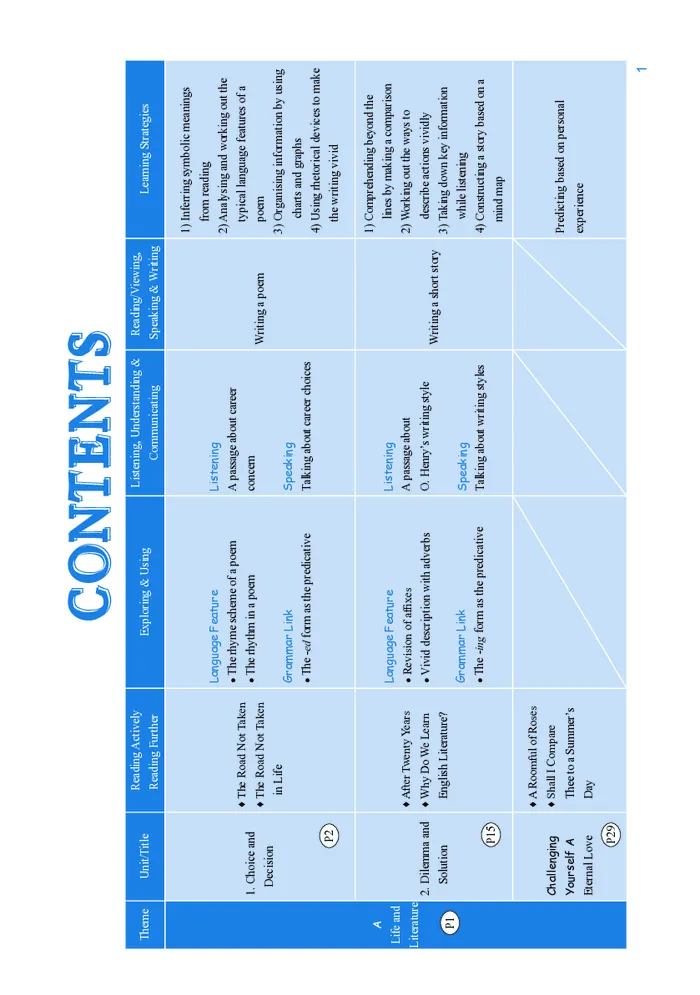
Theme
Unit/Title
Reading Actively
Reading Further
Exploring & Using
Listening, Understanding &
Communicating
Reading/Viewing,
Speaking & Writing
Learning Strategies
A
Life and
Literature
1. Choice and
Decision
♦ The Road Not Taken
♦ The Road Not Taken
in Life
Language Feature
● �The rhyme scheme of a poem
● The rhythm in a poem
Grammar Link
● The -ed form as the predicative
Listening
A passage about career
concern
Speaking
Talking about career choices
Writing a poem
1) Inferring symbolic meanings
from reading
2) Analysing and working out the
typical language features of a
poem
3) Organising information by using
charts and graphs
4) Using rhetorical devices to make
the writing vivid
2. Dilemma and
Solution
♦ After Twenty Years
♦ Why Do We Learn
English Literature?
Language Feature
● Revision of affixes
● Vivid description with adverbs
Grammar Link
● The -ing form as the predicative
Listening
A passage about
O. Henry’s writing style
Speaking
Talking about writing styles
Writing a short story
1) Comprehending beyond the
lines by making a comparison
2) �Working out the ways to
describe actions vividly
3) Taking down key information
while listening
4) Constructing a story based on a
mind map
Challenging
Yourself A
Eternal Love
♦ A Roomful of Roses
♦ Shall I Compare
Thee to a Summer’s
Day
Predicting based on personal
experience
CONTENTS
P29
P15
P1
P2
1
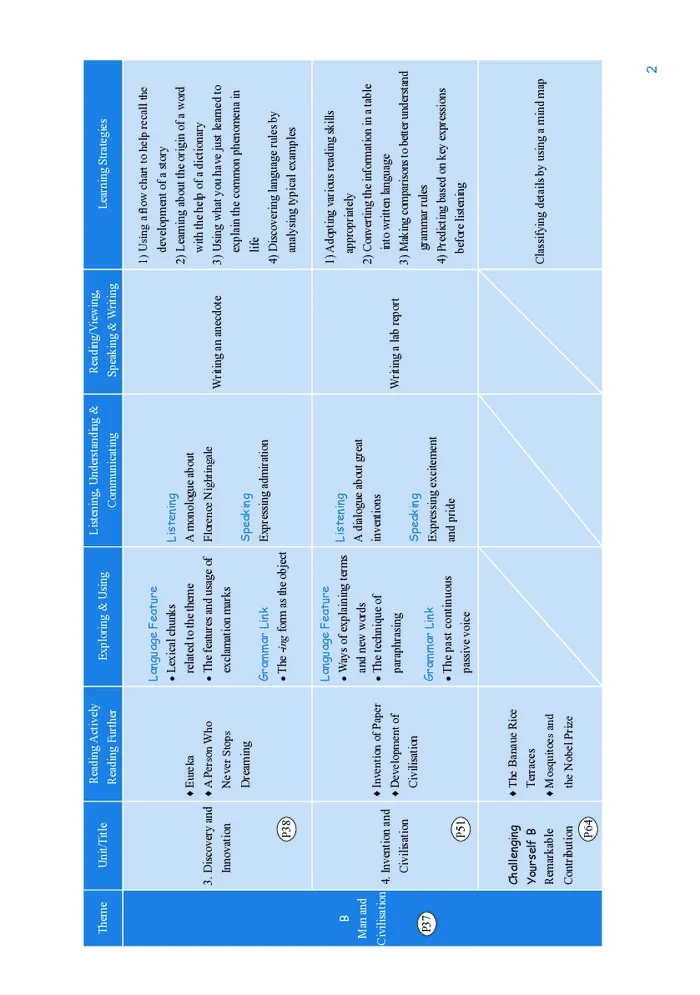
Theme
Unit/Title
Reading Actively
Reading Further
Exploring & Using
Listening, Understanding &
Communicating
Reading/Viewing,
Speaking & Writing
Learning Strategies
B
Man and
Civilisation
3. Discovery and
Innovation
♦ �Eureka
♦ A Person Who
Never Stops
Dreaming
Language Feature
● Lexical chunks
related to the theme
● �The features and usage of
exclamation marks
Grammar Link
● The -ing form as the object
Listening
A monologue about
Florence Nightingale
Speaking
Expressing admiration
Writing an anecdote
1) Using a flow chart to help recall the
development of a story
2) Learning about the origin of a word
with the help of a dictionary
3) Using what you have just learned to
explain the common phenomena in
life
4) Discovering language rules by
analysing typical examples
4. �Invention and
Civilisation
♦ �Invention of Paper
♦ Development of
Civilisation
Language Feature
● �Ways of explaining terms
and new words
● The technique of
paraphrasing
Grammar Link
● The past continuous
passive voice
Listening
A dialogue about great
inventions
Speaking
Expressing excitement
and pride
Writing a lab report
1) Adopting various reading skills
appropriately
2) Converting the information in a table
into written language
3) Making comparisons to better understand
grammar rules
4) Predicting based on key expressions
before listening
Challenging
Yourself B
Remarkable
Contribution
♦ The Banaue Rice
Terraces
♦ Mosquitoes and
the Nobel Prize
Classifying details by using a mind map
P38
P51
P64
2
P37
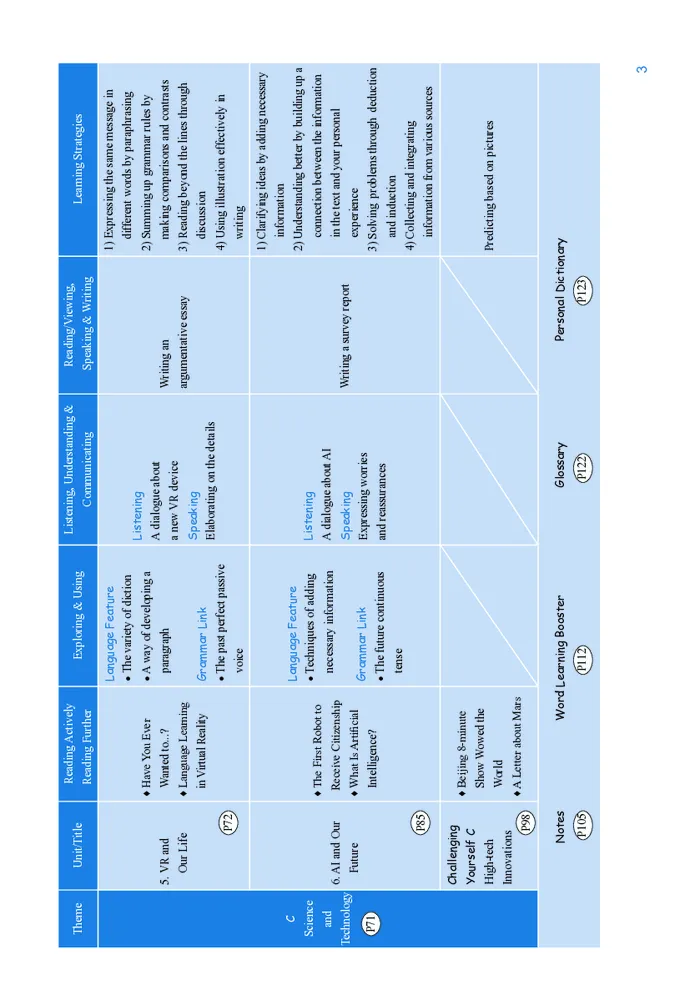
Theme
Unit/Title
Reading Actively
Reading Further
Exploring & Using
Listening, Understanding &
Communicating
Reading/Viewing,
Speaking & Writing
Learning Strategies
C
Science
and
Technology
5. VR and
Our Life
♦ Have You Ever
Wanted to...?
♦ �Language Learning
in Virtual Reality
Language Feature
● The variety of diction
● A way of developing a
paragraph
Grammar Link
● The past perfect passive
voice
Listening
A dialogue about
a new VR device
Speaking
Elaborating on the details
Writing an
argumentative essay
1) Expressing the same message in
different words by paraphrasing
2) Summing up grammar rules by
making comparisons and contrasts
3) Reading beyond the lines through
discussion
4) Using illustration effectively in
writing
6. AI and Our
Future
♦ The First Robot to
Receive Citizenship
♦ What Is Artificial
Intelligence?
Language Feature
● Techniques of adding
necessary information
Grammar Link
● The future continuous
tense
Listening
A dialogue about AI
Speaking
Expressing worries
and reassurances
Writing a survey report
1) Clarifying ideas by adding necessary
information
2) Understanding �better by building up a
connection between the information
in the text and your personal
experience
3) Solving problems through deduction
and induction
4) Collecting and integrating
information from various sources
Challenging
Yourself C
High-tech
Innovations
♦ Beijing 8-minute
Show Wowed the
World
♦ A Letter about Mars
Predicting based on pictures
Notes Word Learning Booster Glossary Personal Dictionary
P72
P85
P98
P105
P112
P122
P123
3
P71
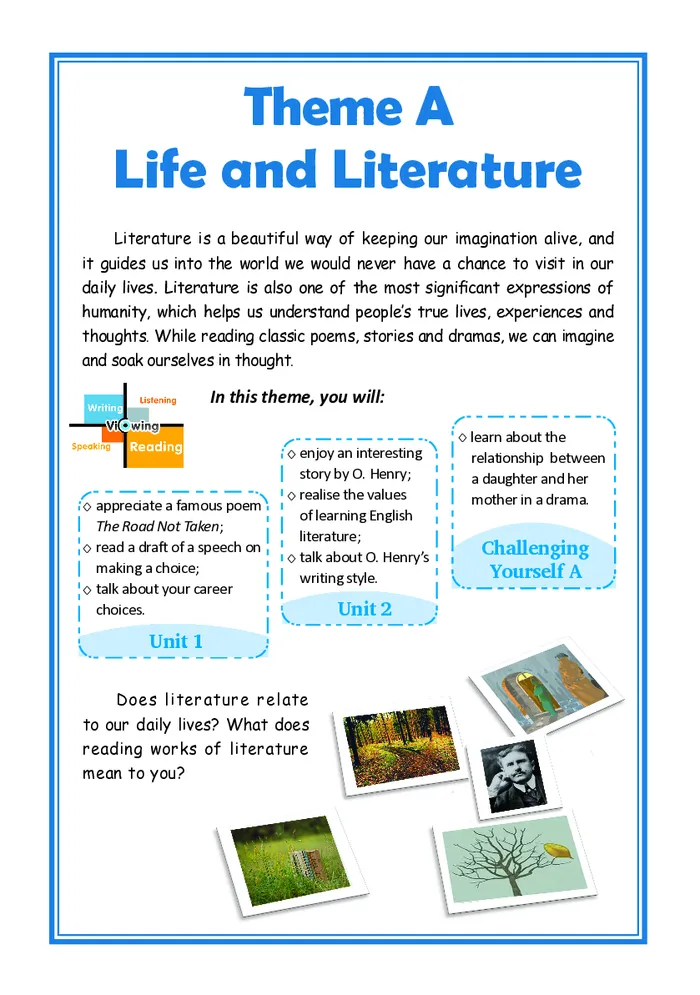
Theme A
Life and Literature
Literature is a beautiful way of keeping our imagination alive, and
it guides us into the world we would never have a chance to visit in our
daily lives. Literature is also one of the most significant expressions of
humanity, which helps us understand people‛s true lives, experiences and
thoughts. While reading classic poems, stories and dramas, we can imagine
and soak ourselves in thought.
Does literature relate
to our daily lives? What does
reading works of literature
mean to you?
Unit 1
◊ appreciate a famous poem
The Road Not Taken;
◊ read a draft of a speech on
making a choice;
◊ talk about your career
choices.
Unit 1
◊ enjoy an interesting
story by O. Henry;
◊ realise the values
of learning English
literature;
◊ talk about O. Henry’s
writing style.
Unit 2
Unit 2
◊ learn about the
relationship between
a daughter and her
mother in a drama.
Challenging
Yourself A
In this theme, you will:
Theme A Life and Literature
Looking Ahead
By the end of this unit, you will be able to:
appreciate a poem and share your understanding;
identify the rhyme scheme and the rhythm of a poem;
describe a picture by appropriately using the -ed form as the predicative;
talk about your career choices based on your survey;
write a poem based on the given proverbs;
evaluate a speech on “The Road Not Taken in Life”.
Unit 1
Unit 1
Choice and Decision
Choice and Decision
Poems are images in your mind. They let you go beyond
Poems are images in your mind. They let you go beyond
the surface and discover your deepest feelings.
the surface and discover your deepest feelings.
—Anonymous
—Anonymous
Reading Actively
► Activating and Predicting
Look at the picture and guess the meanings of the given words. If necessary, use a dictionary.
Then share your understanding with a partner.
Based on the picture in Activity 1, work in pairs to discuss which one of the two roads you
will take and why. Then read to check.
I would like to take because .
undergrowth
diverge
grassy
bend
2
Unit 1 Choice and Decision
3
► Reading, Thinking and Analysing
The Road Not Taken is
a poem by Robert Frost, one
of the most famous American
poets. He was born in 1874
in San Francisco, but lived
much of his life in New
England. Many of his poems
have New England settings. In 1961, he was invited to read his poem at the
inauguration ceremony of President John F. Kennedy.
In this poem, the speaker is travelling in a wood when he comes to a
fork in the road and, even though he would like to travel both, he has to
inauguration
[]
(n.) 就职典礼
The Road Not Taken
Two roads diverged in a yellow wood,
And sorry I could not travel both
And be one traveler, long I stood
And looked down one as far as I could
To where it bent in the undergrowth.
Then took the other, as just as fair ,
And having perhaps the better claim,
Because it was grassy and wanted wear ;
Though as for that the passing there
Had worn them really about the same.
And both that morning equally lay
In leaves no step had trodden black.
Oh, I kept the fi rst for another day !
Yet knowing how way leads on to way,
I doubted if I should ever come back.
I shall be telling this with a sigh
Somewhere ages and ages hence:
Two roads diverged in a wood, and I —
I took the one less travelled by,
And that has made all the difference.
fall/autumn
lost in thought
uncertainty
good
the choice
had not been walked
on much
Why is it repeated?
Why does this line end
with a dash?
What do you think the
difference is?
to put one’s foot on
Why is “!” used here?
Theme A Life and Literature
4
make a choice in order to continue his journey. Of the two roads, one
is well-trodden and safe, while the other is grassy and less travelled by.
After much hesitation, he decides to pick the road less trodden.
One of the attractions of the poem is its artistic way of depicting
the difficulty in making choices, one that we instantly recognise
because each of us encounters it innumerable times, both literally and
fi guratively. Paths in the woods and forks in the roads are ancient and
deep-seated metaphors for the lifeline, its crises and decisions. The
poem clearly demonstrates Frost’s belief that it is the road that one
chooses that makes him the man who he is. Man’s life is metaphorically
related to a journey fi lled with twists and turns. One has to consider a lot
before making a wise choice. Though the diverged roads seem identical,
they actually lead to different directions, which symbolise different
fates. At the same time, the speaker “sighs” with great sorrow, thinking
about what he may have missed on the other path and he doesn’t have
opportunities to experience another kind of life. The Road Not Taken is
full of philosophical overtones. It has been one of the most analysed,
quoted, anthologised poems in the English language. The symbolism
of the woods, the roads, the speaker and the choice has inspired an
extremely large number of interpretations.
Stanza 1:
Describing the situation
diverged in a
wood
Stanza 2:
Making a
taking the other , which
was and wanted wear
Stanza 3:
Expressing the regret
choosing the road
another day
Stanza 4:
Refl ecting on
the truth: the choice →
Guess the meaning of
deep-seated from the
context.
Identical (adj.) means
.
A. different
B. same
Anthology refers to a
collection of writings of
different writers.
Anthologise means
.
► Comprehending, Integrating and Creating
Read the poem and complete the following diagram about the structure of the poem.
Read the poem closely and work in pairs to discuss the following questions.
1) Why would the narrator like to take both roads?
2) Why does the narrator admit the two roads are really much the same?
Unit 1 Choice and Decision
5
or
3) Does the narrator sigh out of satisfaction or regret? Why?
4) Why does the author repeat “Two roads diverged in a wood” in the poem?
5) Has the choice of the less travelled road been the better or the worse?
Work in groups to describe the two roads the poet mentions and discuss why the poem is
not entitled “The Road Taken”.
Look at the choices below and identify “the easy way out”. Then work in groups to share
your understanding of “choosing the easy way to do something”.
● do your homework on your own
● copy a friend’s homework
● review the text several times
● review the text just once
● volunteer to answer questions
● say you are too nervous to answer questions
● try to take notes even though it is hard
●sleep in class because the lesson is too hard
● follow the road to cross a park
● take a shortcut and walk on the lawn
Do one of the two activities below in groups.
1) Have you ever encountered a situation in your life where you have to make a choice?
Share your experience with your group members.
2) Discuss how you understand “Life is a series of choices and we cannot always foresee
the consequences”. Then write a journal entry based on your discussion.
Exploring and Using
► Language Feature
Listen and read the fi rst stanza of the poem, paying special attention to the sound of the
last word in every line. Then choose the rhyme scheme.
Two Paths:
Your choice:
The outcomes:
The lessons you have learned:
Two roads diverged in a yellow wood,
And sorry I could not travel both
And be one traveler, long I stood
And looked down one as far as I could
To where it bent in the undergrowth.
● The end rhyme ●
The rhyme scheme is:
A. ABAAB
B. ABABB
C. ABBAB
Theme A Life and Literature
6
Now fi nd out the rhyme scheme of the other stanzas in the poem.
Stanza 2: Stanza 3: Stanza 4:
Listen and read the fi rst stanza of the poem again, paying special attention to the pauses
and stressed syllables in every line. Mark the sentences by following the example given in
the fi rst line.
Mark the other three stanzas and then take turns to read in groups of three.
► Grammar Link
The -ed Form as the Predicative
Understanding the meaning
Read the following passage and pay special attention to the coloured parts. Try to fi nd out
the functions of the -ed form.
The poem, The Road Not Taken, has been one of the most analysed and quoted
poems in the English language. In this poem, the speaker is travelling in a wood when he
comes to a fork in the road. Lost in front of the diverged roads, he has to make a choice
in order to continue his journey. Of the two roads, one is well-trodden and safe, while the
other is grassy and less travelled by. After much hesitation, he decides to pick the road
less trodden. After reading the poem, we know that the paths in the woods and forks in
the roads are actually ancient and deep-seated metaphors. In our lifetime, we may feel
puzzled when we come across such diverged roads, which lead to different directions and
symbolise different fates. At such moments we have to be self-possessed and make the
correct choice.
Discovering the rule
Study the following examples to fi nd out how the -ed form is used. Then share your ideas
with your partner.
Rhyme refers to the use of words in a poem or song that have the
same sound, especially at the end of lines.
TIP
Two roads | diverged | in a yellow wood,
And sorry I could not travel both
And be one traveler, long I stood
And looked down one as far as I could
To where it bent in the undergrowth.
In a poem, the rhythm is the
fl ow and beat of the words. It
helps to express our mood and
feeling while we are reading.
TIP
Unit 1 Choice and Decision
7
·Example·
adverbial attributive
1) Lost in front of the diverged roads, he has to make a choice in order to continue his journey.
the predicative the predicative
2) Of the two roads, one is well-trodden and safe, while the other is grassy and less travelled by.
linking verb linking verb
Work in groups to complete the table below.
Example sentence
Meaning
Form
1) The sun is set.
2) My work is fi nished.
a fi nished action
Linking verb +
Linking verbs used in this
form:
1) be
2) sound, feel,
3) appear, remain,
1) The glass was broken.
2) The hunter seemed frightened.
a passive action
1) This volunteering work appears
much appreciated.
2) The door remained locked.
a state
Applying the rule
Read the passage in Understanding the meaning again and analyse the functions of all
the coloured parts by following the example.
·Example·
attributive before a noun
The poem, The Road Not Taken, has been one of the most analysed and quoted poems
in the English language.
Complete the following passage by using the appropriate forms of the given words.
A poem is a form of art or something
(create) to be
(appreciate)
for its beauty and emotional power. A
(skill) poet tries to use his technique to
have the words arranged in order to achieve a
(desire) emotional effect. Words
are the medium of poetry. In poetry, the poet makes sure that the words
(arrange)
in lines and stanzas rather than sentences and paragraphs. While
(write), a
poet often has his own experience
(incorporate) into the poem. So the readers
may feel
(inspire) by the poet’s experiences while reading.
(interest)
in the poem, the readers may fi nd a strong emotional response
(provoke).
Theme A Life and Literature
8
Look at the picture below and describe it, and then express how you understand it. Use
the -ed form as the predicative.
Listening, Understanding and Communicating
Talking about Career Choices
Tick the jobs you’re interested in and give your reasons. Then share your choices with a
partner and then add more jobs you like.
□dentist
□athlete
□actor/actress
□teacher
□architect □lifeguard □scientist
□lawyer
Other jobs I am interested in:
My reasons:
Predict whether the following statements are true (T) or false (F). Then listen to a
passage and check your prediction.
1) A career is an investment, and should be incorporated into one’s overall life
plan.
2) For the majority, making a career choice is just about following a dream.
3) It has been found that holding a job which fi ts one’s interest and personality
contributes to an individual’s well-being.
As is shown in the picture,
From my point of view,
Unit 1 Choice and Decision
9
4) “Choose a job you love and you’ll never have to work a day in your life” is said
by the Chinese philosopher Lao-Tzu.
5) Professor Peter G. Beidler chooses teaching partly because he likes the pace of
the academic calendar.
6) Assessing one’s personal skills is an important step before choosing a job.
Listen again and tick the best answer to each of the following questions.
1) What is this passage mainly about?
A. Having a successful career.
B. The reasons for being a teacher.
C. Making a career choice.
D. Getting to know yourself.
2) Which of the following is not the reason for Professor Beidler to be a teacher?
A. Having an opportunity for refl ection.
B. Enjoying a life full of changes and opportunities.
C. Having the freedom to learn.
D. Enjoying something besides money and power.
3) Which factor(s) should be considered when you are making a career choice?
A. Reality and careful management.
B. Your strengths, values and skills.
C. Your interest and personality.
D. All of the above.
4) Which of the following is false according to the passage?
A. Making a career choice needs a lot of research and soul-searching.
B. As long as you follow your dream, you can make the right career choice.
C. Choosing the right career is one of the most important decisions of a person’s life.
D. Career choices must be realistic and fully considered.
Listen for the third time and fi ll in the blanks about Professor Beidler’s reasons for teaching.
Learning
Pace
Freedom
Why I teach
Teaching offers me
besides
and .
Teaching offers
me a
built on change.
Teaching offers me
not what I , but
what I want to learn.
Teaching offers me freedom to make
my own , to learn my own
lesson, to myself and my
students.
Teaching offers me the pace of
calendar: an opportunity
for , research and writing.
Theme A Life and Literature
10
● As is shown in the pie chart, ... ranks as the most popular career, which
accounts for ...%.
● Most students think that ...
● Then, ... is chosen as the second, for the reason that ...
● Besides, ... is as popular as ... . My classmates consider that ...
● The career with the lowest percentage is ..., which takes up only ...%.
● What’s more, there are some other careers students hope to take, such as ...
● We can conclude from the chart that ...
● As is shown in the pie chart, ... ranks as the most popular career, which
accounts for ...%.
● Most students think that ...
● Then, ... is chosen as the second, for the reason that ...
●Besides, ... is as popular as ... . My classmates consider that ...
●The career with the lowest percentage is ..., which takes up only ...%.
● What’s more, there are some other careers students hope to take, such as ...
●We can conclude from the chart that ...
Do the activity by following the steps below.
Step 1 Work in groups to do a survey about the career choices of your classmates by
asking the following questions.
1) What job would you like to choose?
2) What factors do you consider when you choose a job?
Step 2 Present your results by drawing a pie chart or a bar graph.
·Example·
Subject Choices and Reasons
Step 3 Make a report based on your chart or graph. The following sentence structures
can help you.
strengths
skills
interest
personality
the value of the job
payment
…
doctor
singer
civil servant
architect
scientist
journalist
lawyer
…
Pie chart
Bar graph
Unit 1 Choice and Decision
11
You may use the scheme of rhyme to
help you.
TIP
mountains
birds
paths
river
snow
boat
man
bamboo
Viewing, Speaking and Writing
Writing a Poem
Based on the provided picture, choose proper words from the box to complete the
following poem.
Cold River-Snow
By Liu Zongyuan
A hundred _________ and no _________,
A thousand _________ without a footprint;
A little _________, a _________ cloak,
An old man fi shing in the cold _________ -snow.
Work in groups to work out the appropriate order of the lines in the following poem. Then
read the poem aloud, paying attention to the rhythm.
Gathering Leaves
by Robert Frost
Spades take up leaves
Spades take up leaves
I make a great noise
______________________
Running away
______________________
No better than spoons
______________________
And bags full of leaves
______________________
Are light as balloons
Of rustling all day
Of rustling all day
______________________
Like rabbit and deer
______________________
Read the poems “The Road Not Taken”, “Cold River-Snow” and “Gathering Leaves”
again and decide what makes a good poem. Complete the following statement and then
write down your own answer.
A good poem is _____________________________.
A. fun to read
B. full of feelings
C. meaningful
D. educational
E. short and clear
F. about real things
G. simple
H. surprising
According to my understanding, a good poem is ________________________________.
Theme A Life and Literature
12
Discuss with your partner the meanings of the following proverbs about “roads” and
then write a poem of your own, entitled “Road”.
1) No way is impossible to courage.
2) Perseverance is the only road to success.
3) All roads lead to Rome.
4) Confi dence in yourself is the fi rst step on the road to success.
5) To know the road ahead, ask those coming back.
6) No road is long with good company.
Reading Further
► Getting Ready
Imagine you are in the following situation and think which “road” you would like to take.
Then share your ideas in groups.
·Situation·
I’d prefer to rather than because .
Look at the title of the following speech and the given words and expressions to predict
the author’s choice. Then read to check.
English
the well-trodden path
detour into...
Spanish
the lonely road
a single correct path
► Reading
The Road Not Taken in Life
Hola todos! Ahora vamos a empezar. El camino no selecionado en la vida.
Ladies and gentlemen,
I am a sophomore majoring in Spanish, but today I’m here standing on the stage of
English competition. Should I be here? Is this my stage? Two years ago, when I was offered the
privileged chance to pick my major, rather than the well-trodden path of English, I chose the
lonely road of Spanish.
It’s very common that when students don’t know which major to choose in college, they
choose English; when they want a better job, they pick up English; and when they want to
master a foreign language, more often than not, it is English. There is a view that English is the
path to a better life. But the law of supply and demand tells that if everyone supplies the same
When picking their majors in college, some students tend to choose some popular
majors, such as English, Accounting, etc., while others would like to choose less
popular ones: Spanish, Philosophy, etc.
A piece of good writing usually
grows out of a strong desire to
say something.
TIP
Unit 1 Choice and Decision
13
service, the value of that service declines. So those who have taken a less travelled road, and
have not followed others, may have the last laugh.
We’ve seen this before. Think of all those students who decided to pursue law at the urgings
of their parents, uncles or teachers. Where are they now? Promised a world of opportunity
upon completing their education, instead they are now struggling to find a position in their
overcrowded fi eld. Some have ended up turning to new paths as translators, or even butchers.
How about beyond education? What are the paths that everyone takes? Everyone rushes
to buy a house and we are left with rising prices of houses and apartments that may be highly
infl ated. Everyone needs to buy a car and we are left with traffi c jams that last over a week!
Everyone fl ocks to Xiangshan in the spring to look at the blooming f lowers only to see the
backs of other people’s heads. Too often people are sheep refusing to separate from the fl ock.
They become nervous and uneasy when they step out of line. However, isn’t this sometimes
unnecessary? Why do we not buy a cheaper home in a smaller town? Why do we not use public
transportation instead of worrying about a car? Why do we not go to see Sakura blossoms in
Wuhan instead of Xiangshan? The pressure to travel with others is strong, for it is always easier
to go with the fl ow.
We must learn to love the lonely path, not fear it. The popular path is not always a safe
one. There are always options. The road less travelled can be fun. Now I encourage people
around me to take risks, like entering an English-speaking competition as a Spanish major.
Even though I have chosen the less travelled road to learn Spanish, I am not restricted from
detouring into English. I don’t dream about the road I didn’t take as so many of my friends did.
We are lucky to have so many paths in front of us, but there is no single correct path for all of
us. We must fi nd our own way.
Hasta la vista.
► Comprehending
Read the speech again and complete the chart.
Introduction
Conclusion
Main points
Supporting details
Learning English
Buying a house
Beyond education
Among the three essential parts, the body part plays an important role,
where key points and supporting information should be presented.
TIP
Theme A Life and Literature
14
The author can use rhetorical devices to make the speech vivid, and
improve the power of language. Commonly used devices include similes,
metaphors, parallelism, repetition, antithesis, and rhetorical questions.
TIP
Discuss in groups what rhetorical devices are used to make the speech more convincing.
Identify more examples in the text and complete the table by following the example.
Rhetorical device
Example in the speech
Function
Parallelism
1) (Paragraph 2, Lines 1-4) …
when students… it is English.
2) …
1) to increase the rhythm of
this speech.
2) …
Complete the following summary of the speech. Then give your comments on it.
In the speech, the author talks about the road not taken in life. Rather than the
____________ path of English, she chose the ____________ road of Spanish as her
major in college. In comparison, those who pursue their majors at the ____________
of other people are now struggling to fi nd a position in their overcrowded fi eld. Beyond
education, people still refuse to ____________ from the fl ock. They tend to go with the
____________. They ____________ to buy a car, a house and fl ock to famous scenic
spots. They don’t realise the truth that the road less travelled can also be fun and we
should dare to take ____________ and fi nd our own way.
Self-assessing
Refl ect on your learning in this unit and rate each of the items according to the following
rating scales. Then decide what you should do for further progress.
5=Exceeding expectations 4=Meeting expectations 3=Approaching expectations
2=Partially meeting expectations 1=Not meeting expectations
Item
Rating
Improvement
● I can appreciate a poem and share my understanding with
classmates.
● I can identify the rhyme scheme and the rhythm of a poem.
● I can describe a picture by using the -ed form as the predicative.
● I can make a survey to talk about my career choices.
● I can write a poem based on the given proverbs.
● I can evaluate a speech on “The Road Not Taken in Life”.
You can make comments on a speech based on its structure,
expressions, rhetorical devices, etc.
TIP
Unit 2 Dilemma and Solution
Looking Ahead
By the end of this unit, you will be able to:
appreciate a short story from different angles;
use adverbs in depicting a character vividly;
write a story based on a stamp by using the -ing form as the predicative;
talk about the writing styles of some famous writers;
write a short story based on a given theme;
illustrate why we should learn English literature.
Unit 2
Unit 2
Dilemma and Solution
Dilemma and Solution
Every story has an end, but every end is just a new beginning.
Every story has an end, but every end is just a new beginning.
—Anonymous
—Anonymous
Reading Actively
► Activating and Predicting
Study the following pictures and guess the meanings of the given words and expressions.
If necessary, refer to a dictionary. Then share your understanding with a partner.
2
3
1
a policeman, in the doorway
of a restaurant, wait for
scar, a diamond
pin, light a cigar
the same place, date and time,
make a fortune
5
6
4
a tall man, go directly to
arm in arm, glare, change
a plainclothes man, arrest, note
15
16
Theme A Life and Literature
Look at the title of the following text and work in pairs to predict what it is about by
answering the following questions. Then read the text to check your prediction.
1) When and where did it happen?
2) What is it mainly about?
3) What is the most probable relationship between the characters?
Unlighted cigar
and quickly indicate
that the man felt
______.
Keen here means
______.
A. intense
B. sharp
► Reading, Thinking and Analysing
After Twenty Years
The policeman moved up the street with an air of importance as
usual. The time was hardly 10 o’clock at night, but the cold wind had
almost made the street empty. With a club in his hand, the offi cer tried
doors as he walked, turning now and then to look at the quiet street.
Walking towards the middle of the street, the policeman suddenly slowed
his walk. In the doorway of a store stood a man with an unlighted cigar in
his mouth. As the policeman walked up to him, the man spoke up quickly.
“It’s all right, offi cer,” he said, “I’m just waiting for a friend. It’s an
appointment made twenty years ago. Sounds a little funny to you, doesn’t
it? Well, I’ll explain if you’d like to make certain it’s all straight.” He
then struck a match and lit his cigar. The light showed a pale, square face
with keen eyes, and a little white scar near his right eyebrow. He wore an
expensive silk tie with a diamond pin.
“Twenty years ago tonight,” said the man, “I was here with Jimmy,
my best friend and the fi nest person in the world. We were raised here in
New York, just like two brothers, together. I was eighteen and Jimmy was
twenty. The next morning I was to start for the West to make my fortune.
You couldn’t have made Jimmy leave New York; he thought it was the
only place on earth. Well, we agreed that night we would meet here
again exactly twenty years from that date and time, no matter what our
conditions might be or from what distance we might have to come. We
thought that in twenty years each of us ought to have our fate worked out
and our fortunes made, whatever they were going to be.”
“It sounds pretty interesting,” said the policeman.
“Well, yes,” said the other. “I know Jimmy will meet me here if he’s
alive, for he always was the truest old friend in the world. He’ll never
forget. I came a thousand miles to stand in this door tonight, and it’s
worth it, if he turns up.”
The waiting man pulled out a handsome watch, the lids of it set with
Unit 2 Dilemma and Solution
17
Guess the meaning of
sharp from the context.
Exclaim means
utter aloud, often
with surprise, horror
or joy.
small diamonds.
“Three minutes to ten,” he said. “It
was exactly ten o’clock when we parted
here at the restaurant door.”
“Did pretty well out West, didn’t
you?” asked the policeman.
“Sure. I hope Jimmy has done half as
well.”
The policeman twirled his club and
took a step or two.
“I’ll be on my way. Hope your friend
comes around all right. Going to stop
waiting at 10 sharp?”
“No,” said the other. “I will give him half an hour at least. If Jimmy
is alive on earth, he’ll be here by that time. So long, offi cer.”
“Good night, sir,” said the policeman, passing on along, trying doors
as he went.
There was now a fi ne, cold drizzle falling, and the wind was blowing
harder. And in the door of that store, the man smoked his cigar and waited.
About twenty minutes he waited, and then a tall man in a long
overcoat, with the collar turned up to his ears, hurried across from the
opposite side of the street. He went directly to the waiting man.
“Is that you, Bob?” he asked.
“Is that you Jimmy?” cried the man in the door.
“Bless my heart!” exclaimed the new arrival, holding both of the
other’s hands. “It’s Bob, sure as fate. I was certain I’d fi nd you here if
you were still in existence. Well—twenty years is a long time. How has
the West treated you, old man? ”
“Fine; it has given me everything I asked it for. You’ve changed lot,
Jimmy. I never thought you were so tall by two or three inches.”
“Oh, I grew a bit after I was twenty.”
“Doing well in New York, Jimmy?”
“Moderately. I have a position in one of the city departments. Come
on, Bob, we’ll go around to a place I know of, and have a good long talk
about old times.”
The two men started up the street, arm in arm. The man from the
West, proud of his success, was beginning to talk about the history of his
career. The other listened with interest.
At the corner stood a drug store, bright with electric lights. When
they came into this glare, each of them turned at the same time to look at
the other’s face.
The man from the West stopped suddenly and released his arm.
Glare here means
______.
18
Theme A Life and Literature
“You are not Jimmy,” he said angrily. “Twenty years is a long time,
but not long enough to change a man’s nose from a Roman to a pug.”
“It sometimes changes a good man into a bad one,” said the tall man.
“You’ve been under arrest for ten minutes, Bob. Chicago thought you
might have dropped over our way and wired us. Going quietly, are you?
That’s sensible. Now, before we go to the station, here’s a note I was
asked to hand you. You may read it here at the window. It’s from Offi cer
Jimmy Wells.”
The man from the West unfolded the little piece of paper. His hand
was steady when he began to read, but it trembled a little by the time he
had fi nished. The note was rather short:
Why did the man’s
hand tremble when
he read the note?
“Bob:
I was at the appointed place on time. When you struck the
match to light your cigar, I saw it was the face of the man wanted
in Chicago. Somehow I couldn’t do it myself, so I went around and
got a plain clothes man to do the job.
Jimmy”
► Comprehending, Integrating and Creating
Read the story again and complete the following storyline.
Climax and resolution
A explained the truth.
Bob was .
Feeling
Bob: nervous,
Jimmy: complex
Feeling
Bob: excited
Jimmy:
Background
Time:
Place:
Weather:
Character:
Rising action
Bob recognised the man .
“Jimmy” kept the .
Bob continued to .
The policeman .
A policeman met Bob and
chatted with him.
Unit 2 Dilemma and Solution
19
Work in groups to discuss the following questions and share your ideas with other groups.
1) What is the theme of the story?
2) What is O. Henry—the author’s way of ending the story? How does it impress you?
3) Do you think Jimmy is loyal to the friendship between Bob and him? Why or why not?
4) If you were in Jimmy’s shoes, what would you do?
5) What are the respective personalities of Bob and Jimmy? What do you think of them?
Work in pairs to complete the following diagram. Then write down your ideas about
“friendship” and “society” which can be inferred from the story.
Based on the storyline in Activity 1 and your discussion, work in groups of four to retell
the story from different points of view.
Student A: From O. Henry’s point of view
Student B: In Bob’s view
Student C: In Jimmy’s view
Student D: From the viewpoint of the plainclothes policeman
Do one of the following activities in groups.
Activity 1 Search for information on the Internet about the writing background and
writing style of the writer and share it with your group members.
Activity 2 Imagine what Jimmy and Bob do and say when they meet at the police
station the following day. Act it out.
Activity 3 Imagine what you will be like in 20 years, and share your imagination with
your group members.
Real friendship:
The features of society:
Bob started for
to seek his fortune.
Jimmy in
New York.
Jimmy became a
_____________.
Bob became
but also a .
20 years
ago
20 years
later
20
Theme A Life and Literature
Prefi x
The word
Suffi x
The new word
More examples
-ly
directly
un-
fold
un-
unlighted
arrive
-al
sense
sensible
-ence
existence
insistence; independence
Exploring and Using
► Language Feature
Study the following affixes and complete the table below. Discuss how they help you
memorise words and enlarge your vocabulary.
Study the following example and then analyse the functions of adverbs in the following
sentences from the text in the same way.
·Example·
As the policeman walked up to him, the man spoke up quickly.
1) Walking towards the middle of the street, the policeman suddenly slowed his walk.
2) I know Jimmy will meet me here if he’s alive, for he was always the truest old friend in
the world. He’ll never forget.
3) He went directly to the waiting man.
4) The man from the West stopped suddenly and released his arm.
5) “You are not Jimmy,” he said angrily.
We use adverbs together with verbs or verb phrases in order to 1) make
the actions more vivid and impressive; 2) show the feeling, attitude
and personality of the character(s).
TIP
to show Bob’s fear of being arrested or his loyalty to friendship
Unit 2 Dilemma and Solution
21
► Grammar Link
The -ing Form as the Predicative
Understanding the meaning
Read the following passage and pay special attention to the coloured parts. Try to fi nd out
the functions of the -ing form.
Two friends, Jimmy and Bob, made an appointment to meet again twenty years
later. When the day arrived, Jimmy, now a policeman, walked to the restaurant door
where a waiting man was in the doorway. Walking towards the man, Jimmy found the
man immediately began to explain that he was waiting for a friend. Jimmy saw the man
striking a match and lighting a cigar and he recognised that it was the face of a man
wanted by the police. It was so surprising for Jimmy to fi nd out that his friend, Bob, was
a wanted criminal. Jimmy knew that his job was arresting criminals. However, he found
he couldn’t do it himself. So he went around and got a plain-clothes policeman to put
Bob under arrest.
Discovering the rule
Study the following examples to fi nd out how the -ing form is used. Then share your ideas
with a partner.
·Example·
attributive
1) When the day arrived, Jimmy walked to the restaurant door where a waiting man was
in the doorway.
the predicative
2) It was so surprising for Jimmy to fi nd out that his friend, Bob, was a wanted criminal.
Work in groups to complete the table below.
Example sentence
Meaning
Form
Function
1) One of the best exercises
is jogging.
2) Her hobby is painting.
explaining what the
subject is
_____ + v-ing
as a noun
1) Your words are so
encouraging.
2) His life story sounds
interesting.
describing the subject
which will arouse a
certain feeling or
response
linking verb +
________
as an ________
linking verb
22
Theme A Life and Literature
Applying the rule
Reread the passage in Understanding the meaning and use the rules to analyse the
coloured parts.
Complete the following story by using the -ing form of the given words. Then fi nd out the
-ing form as the predicative.
A Clever Rabbit
The greatest joy of the wolf and the fox is _________ (catch) the rabbit and then
_________ (eat) him. However, it wasn’t easy to catch him.
One day, the fox said to the wolf, “Go home and lie in bed. I’ll tell the rabbit that
you are dead. When he comes to look at you, you can jump up and catch him.”
“That’s an _________ (excite) idea,” said the wolf.
_________ (knock) at the door of the rabbit’s house, the fox shouted, “Dear rabbit, I
have _________ (surprise) news for you. The wolf is dead.”
The rabbit thought the news sounded _________ (thrill) but so _________ (astonish),
so he decided to go to the wolf’s house to have a look. He looked in through the window
and saw the wolf _________ (lie) in bed with his eyes closed. He thought, “Is the wolf
really dead or is he pretending to be dead?” So the rabbit said, “The fox says that the wolf
is dead. But he doesn’t look like a dead wolf. The mouth of a dead wolf is always open.”
When _________ (hear) this, the wolf thought, “I’ll show the rabbit that I’m dead.” So he
opened his mouth.
_________ (see) this, the rabbit knew that the wolf was _________ (pretend) to be
dead in order to catch him. So he immediately escaped as quickly as he could.
Look at the stamp below and write a story based on it. Use as many -ing forms as
possible, including the -ing form as the predicative.
Unit 2 Dilemma and Solution
23
An author’s writing style is the way he or she writes. It is the technique
that an individual author uses in his or her writing.
TIP
Ernest Hemingway
Mark Twain
O. Henry
Jane Austen
local life,
simple diction,
use of dialect,
true realistic
style, elements
of humour
the dependence
of women on
marriage,
romantic but
realistic
Listening, Understanding and Communicating
Talking about O. Henry’s Writing Style
Match the writing styles with the corresponding authors. Then share your ideas with a
partner.
Look at the picture and work in pairs to fi ll in the blanks. Then
listen to check and choose the best answers.
1) What is the passage mainly about?
A. The life story of O. Henry.
B. O. Henry’s writing style.
C. The Gift of the Magi.
D. How O. Henry became a great writer.
2) Why are O. Henry’s stories so popular? Because .
A. the language he uses in his stories is simple to understand
B. his stories are about people’s daily life
C. the endings of his stories always surprise the reader
D. most of his stories happened in the early 20th century
war and death,
simple words
and short
sentences,
telegraph style
ordinary people,
vivid description,
use of humour and
irony, surprising
ending
The author of the short story The Gift of the
Magi is , whose other works include
.
His writing style is . I like
his style because .
24
Theme A Life and Literature
Name: O. Henry
Job: a great American _________
Number of his short stories: ________ to _________
Themes: _________, _________, etc.
Writing style: People always use the term “_________” to describe his writing.
These stories usually end in a _________ but also __________ way.
Example: “___________________________”
Infl uence: He has been a favourite in American literature for his ____________
perspective of the characters living in society.
Listen again and fi ll in the blanks.
Choose another author in Activity 1 and talk about his/her writing style in pairs. The
following expressions may help you.
Lexical chunks to describe an author’s writing style
with a/an... change at the end use the term... to describe sb.’s writing style
to end in a... but also... way to unfold the plot to make readers...
the greatest suspense a/an... perspective of...
one’s peculiar writing style of... ending
Viewing, Speaking and Writing
Writing a Short Story
Look at the mind map and write down the key elements of a short story. Then share your
ideas with a partner.
If you are going to write a short story, which theme will you choose? You can refer to the
themes below or create your own.
Theme:
character
The key elements of a short story
t t
Unit 2 Dilemma and Solution
25
When you revise your short story, you need to:
●notice if your story follows your information table;
●delete unnecessary descriptions, scenes and characters;
●make sure the story is emotionally moving and attractive.
TIP
Think about how you are going to develop the story based on the theme you have chosen.
Then note down the basic information in the table below.
Write the draft and reread to polish it. Then share your story with group members.
Reading Further
► Getting Ready
Read the following statements and decide whether you agree (A) or disagree (D) with
them. Then check your ideas with a partner.
______ 1) There is little signifi cance in learning English literature.
______ 2) Students can learn about not only the English language but also English
culture by studying English literature.
______ 3) Studying English literature enables students to learn the traditions of England only.
______ 4) An enjoyment and appreciation of literature develop students’ interest in books
and reading.
______ 5) When studying literature, students can learn the language aspects that can be
used for aesthetic purposes.
Life is the source of all
creation. Pay attention
to the things happening
around you and you can
draw inspiration from
these things.
TIP
Themes:
life and learning;
behaviour and quality;
social service and interpersonal
communication;
history and culture;
science and technology;
environmental protection;
space exploration;
…
Theme
Character
Plot
Beginning:
Development:
Ending:
Point of view
□First person
□Third person
Setting
Time:
Place:
26
Theme A Life and Literature
Work in pairs to discuss the following questions and then read to check.
1) What is the school subject which the statements in Activity 1 are closely related to?
2) Is it necessary for us to study it?
3) Why do you think so?
► Reading
Why Do We Learn English Literature?
In this day and age, there seems to be a move towards secondary school subjects which
have a strong link to a tertiary course of study. For that reason, some parents and some students
feel that the compulsory study of English literature is misguided and disadvantageous to
students, particularly if they are second language learners of English. However, there are still
good reasons for the study of English literature.
Students of the English language sometimes fail to see the point of studying English
literature, especially if they have no plans to study English or translation at university. But
English literature can introduce students to a range of aspects, not only of the English language
but also the culture of English-speaking countries.
There are aspects of English culture that are summarised by English literature. Of course,
this is quite obvious when studying the works of Shakespeare or writers, poets and playwrights
of the eighteenth and nineteenth centuries. It is, however, also true when studying other works
of English literature. Students can learn about allusions and references to different aspects of
English culture. They can also learn the context and meanings of famous quotes and phrases.
Studying literature does not confi ne the students to the traditions of England but includes
the possibility of introducing them to traditions that inform English literature, such as the study
of Ancient Greek drama, and to literature in other contexts, such as American literature. It also
provides the students with an alternative to the pervasiveness of “television culture” with its
immediacy and often its shallowness.
An enjoyment and appreciation of literature will give students the ability to develop
this into an interest in books and reading as they move away from their studies and into their
adult lives. They will have the confi dence to approach and cope with new forms of books and
writing, since they were exposed to a range of literature during their school days.
When studying literature, students can learn not only language aspects such as vocabulary
items but also the language aspects which can be used for specific and aesthetic purposes.
Familiarity with the concepts of beat, metre and rhythm can improve their own writing as
students are able to appreciate and apply these ideas. Finally, the study of literature can provide
students with a fresh and creative angle from which to approach their studies in particular and
their lives in general.
So next time you are reading a newspaper article complaining of the lack of creativity and
initiative in the local workforce, remember that in a small way the study of English literature
can help to add a refreshing and further dimension to a person’s life.
Unit 2 Dilemma and Solution
27
► Comprehending
Read the passage again and complete the following diagram.
Work in groups to discuss the following questions.
1) Why is “television culture” in quotation marks? What do you think people mean when
they talk about the “immediacy” and “shallowness” of “television culture”?
2) What’s your understanding of the aesthetic purposes of reading literature? Give
examples to illustrate your ideas.
3) What other materials can you make use of to learn the English language besides
literature works?
If there is an English Literature course in high school, discuss in groups whether it
should be a compulsory or elective course and give your reasons.
English Literature should be a(n) ___________ course.
Reason 1 _______________________________________________________________
_______________________________________________________________
_______________________________________________________________
Reason 2 _______________________________________________________________
_______________________________________________________________
_______________________________________________________________
Reason 3 _______________________________________________________________
_______________________________________________________________
_______________________________________________________________
Statement
Conclusion
Supporting
details
The of studying English literature
The study of English literature can help to
to a person’s life.
It introduces students to a range of aspects, not only of the English
but also of .
1) It does not students to the of England but
introduces them to traditions that English literature.
2) It gives students the to develop their enjoyment of
literature into in books and in their later life.
3) It can make students learn the language used for
purposes.
Paragraph(s)
Paragraph(s)
Paragraph 7
28
Theme A Life and Literature
Read the following excerpts from the essay Of Studies written by Francis Bacon. Then
think and answer the questions below.
1) What role can studying English literature play?
2) Besides the aspects mentioned by the author in the passage, what other skills can be
developed with the help of literature?
Self-assessing
Refl ect on your learning in this unit and rate each of the items according to the following
rating scales. Then decide what you should do for further progress.
5=Exceeding expectations 4=Meeting expectations 3=Approaching expectations
2=Partially meeting expectations 1=Not meeting expectations
Item
Rating
Improvement
● I can appreciate a short story from different angles.
● I can depict a character vividly by using adverbs.
● I can write a story based on a stamp by using the -ing form
as the predicative.
● I can talk about the writing styles of some famous writers.
● I can write a short story based on a given theme.
● I can list the reasons why we should learn English literature.
Histories make men wise;
poets witty; the mathematics
subtle; natural philosophy
deep; moral grave; logic
and rhetoric able to contend.
Histories make men wise;
poets witty; the mathematics
subtle; natural philosophy
deep; moral grave; logic
and rhetoric able to contend.
Challenging Yourself A Eternal Love
Learning Individually
Tick the cause(s) which you think may result in confl icts between parents and children.
Then add more.
□ choice of schools/universities
□ preferences of food
□ taste in music/sports/fi lms
□ choice of friends
More causes: ____________________________________________________________
Read the following sentences from a dialogue between a mother and her daughter and
predict what may have happened between them. Then read to check.
Mother
Daughter
● So you’ve decided to leave next Saturday?
● Are you so unhappy at home?
● Do you really hate me so much?
● I do want you to stay, more than anything
in the world.
● I want you to stay.
● Would you fi nd that so bad?
● You’re going to make me stay?
● No! It’s completely impossible!
● No. I don’t feel anything towards you at all.
● All right, now you know what I really feel
about you. Do you still want me to stay?
Looking Ahead
After completing this project, you will be able to:
appreciate an act of a play to know its stylistic features;
analyse the personality of the characters by focusing on their dialogues;
infer the characters’ change of attitude by locating the keywords;
develop appropriateness of expression by using proper tones, pitches, stress, etc. in a role-play;
refl ect on the learning of the whole theme from the aspect of analysing different types of
literary works.
All the world is a stage, and all men and women
are merely players.
—William Shakespeare
—William Shakespeare
Self-directed
Learning Project
Challenging Yourself A
Eternal Love
Eternal Love
All the world is a stage,
All the world is a stage,
are merely players
are merely players
Self-directed
Learning Project
Chall
Chall
29
30
Theme A Life and Literature
► Reading and Thinking
A Roomful of Roses
Bridget: I don’t know why everybody gets so excited, just because it
turns out I won’t be here for an old dance.
Nancy: So you’ve decided to leave next Saturday?
Bridget: Why not? My three weeks are up.
Nancy: Are they? I hadn’t realised.
Bridget: Well, they’re not actually up till Monday. But I hope
you’re not going to hold me over.
Nancy: Would you fi nd that so bad?
Bridget: Are you joking?
Nancy: No, I’m not.
Bridget: You’re going to try to make me stay?
Nancy: Darling, don’t misunderstand—I’m not
going to try to make you do anything.
I thought you would know that by
now.
Bridget: That’s good. Of course, you haven’t any rights at all, as far
as I am concerned.
Nancy: I don’t know that my “rights”—or lack of them—have
anything to do with it. Bridie—
Bridget: Please.
Nancy: I’m sorry, Bridget. (Reaching toward her in an impulsive
gesture of affection.) Darling, I do want you to stay. More
than anything in the world, I want you to stay. We all want
you—won’t you think about it? Just during the next few
days, think about it. Hard.
Bridget: No! It’s completely impossible!
Nancy: Are you so unhappy at home?
Bridget: Why do you ask me that?
Nancy: I want you to be happy somewhere. If not with me, then
somewhere else.
Bridget: You don’ t have to worry about that. I am happy. Terribly.
Nancy: And you like your school?
Bridget: I love it. The only thing I don’t like—I don’t like this
conversation. And if it’s all right with you, I’ll dress for
dinner now.
Nancy: Oh, baby, you don’t have to be so lonely.
Bridget: Listen! Don’t say a thing like that to me. Don’t you dare
be sorry for me!
In a play, some words
in brackets are used to
describe an action or
a situation. They are
called stage directions.
Hard is an adverb here.
Can you guess what it
means?
Does old here have
anything to do with
age?
Guess the meaning of
up according to the
context.
Why is am italicised?
Challenging Yourself A Eternal Love
31
In which tone does
Nancy say Bridie?
Nancy: Bridget!
Bridget: Don’t you dare! You have no right! (She starts up the stairs.)
Nancy: Bridie! You come back here. Don’t ever speak to me in that
tone again. I don’t care what you think I have done to you.
You are never to speak to me in that way again. Do you
understand?
Bridget: Yes.
Nancy: All right. Now come over here and sit down.
Bridget: I have nothing to say.
Nancy: But I have something to say. I’ve been waiting a long time to
say it, so I hope... I want you to understand, that no matter
how you feel toward me, you are a deep and important part
of my life. I love you very much.
Bridget: Is that all?
Nancy: No. No, it isn’t. There is something else. I knew—you
would feel hateful and hurt... But I didn’t dream it would
be like this. I’ve tried in every way I know to reach you.
I’ve stayed awake at night trying to think of a way—some
way—of reaching you.
...
Bridget: Of breaking me down, you mean.
Nancy: Yes, if you want to put it that way. Bridie, you’re a little girl
still. In many ways a very little girl. But soon—you will be a
young woman. (Bridget starts to rise.) Now wait! It’s for your
own sake I’m saying this. It’s for you. Bridie, don’t let the
fact that there was something very bad in your life once be
the most important thing to you. Don’t blame everyone you
meet for something that happened a long time ago.
Bridget: May I go to my room now?
Nancy: Do you really hate me so much?
Bridget: No, I don’t hate you. I don’t feel anything towards you at all.
Just blankness. And I want to keep it that way.
Nancy: Bridie, it wasn’t all my fault—what happened wasn’t all my
fault! I’ve never told you things before, but your father was—
Oh, God.
Bridget: I don’t care whose fault it was! You were the one who ran
away!
Nancy: Not from you! I wanted you with me. I tried—you know I
tried—I didn’t run away from you.
Bridget: You ran away from Dad and me. Why? Because you liked Jay
better?
Nancy: No, things aren’t that simple. ...
My, you, me, etc.
should be stressed.
32
Theme A Life and Literature
Bridget: Then why?
Nancy: Bridie, listen—there are things you won’t understand until
you are older, but try—try to understand this—the love I
have for Jay is the love your father did not want from
me. And it has nothing whatever to do with the love I feel
for you.
Bridget: You’re too late, Mother. I don’t care any more. That’s
funny. I call you Mother. But it’s only because I don’t
know what else to call you. To me you aren’t my
mother. As far as I’m concerned, my mother is dead.
And I used to wish you had died. Oh, how I wished... I’d
lie awake in bed at night and pretend that you had died.
Sometimes it seemed so real—and I’d cry... All right,
now you know what I really feel about you. Do you still
want me to stay?
Nancy: More than ever.
Bridget: You’re crazy! ... (She turns and runs up the stairs.)
...
► Analysing and Questioning
Read the play and complete the following chart.
Bridget
Nancy
expressed her confusion at too much
concern for her leaving
asked Bridget if she would
for a few more days
indicated her
showed her to
her daughter
declared her for
her mother
explained for their
divorce
showed her to
her mother
stated her determination to
showed her to leave
inquired whether Bridget was
at home or at school
Challenging Yourself A Eternal Love
33
Read the play carefully and decide whether each of the following statements is true (T) or
false (F). Correct the false one(s).
____ 1) The dance was held a long time ago. That’s why it is called “an old dance”.
____ 2) Bridget has already stayed for three weeks.
____ 3) Bridget is not actually very happy.
____ 4) Nancy admits that she wants to break Bridget down.
____ 5) Bridget hates her mother very much.
____ 6) Nancy is crazy to ask Bridget to stay for a longer time.
Read the play again and answer the following questions.
1) What attitude do the two characters have towards each other?
2) Is the relationship between the mother and the daughter changing for the better or the
worse? How do you know?
3) Where, in the play, is the fi rst marked change in Nancy’s tone?
4) When does Bridget call Nancy “Mother” for the fi rst time in the play? And what does
that suggest?
5) Why does Bridget think that her mother is crazy?
Reflect on what you have learned from the play and write down some questions and
problems for further group discussion in class.
·Question Corner·
Learning Cooperatively
Phase 1 Sharing the individual work
1) Check and discuss your answers in Learning Individually and improve them.
2) Come up with your questions or problems and work on them with your group
members.
Phase 2 Exploring further
1) Discuss the questions below.
Question 1: How does the author depict the characters’ personalities through their
dialogue? Use a mind map or a bubble map to summarise the author’s
techniques.
Question 2: What might happen in the next act?
1)
2)
...
34
Theme A Life and Literature
2) Listen to your teacher for his/her comments and suggestions.
Phase 3 Utilising resources
1) Watch one or two episodes of Growing Pains in Video Bank on our website and
make a comparison of the theme, characters, plots, etc. with the play you’ve just
read.
2) Read the other parts of the play A Roomful of Roses in Reading Box on our
website to get a better understanding of the characters.
Learning Creatively
Read this sonnet after the recording, and fi nish the analysis of its rhyme scheme. Then
complete the short passage about “sonnets”on the next page.
Shall I Compare Thee to a Summer’s Day
by William Shakespeare
Shall I compare thee to a summer’s day?
Thou art more lovely and more temperate:
Rough winds do shake the darling buds of May,
And summer’s lease hath all too short a date.
Sometime too hot the eye of heaven shines,
And often is his gold complexion dimm’d;
And every fair from fair sometime declines,
By chance, or nature’s changing course untrimm’d;
But thy eternal summer shall not fade
Nor lose possession of that fair thou ow’st;
Nor shall death brag thou wander’st in his shade,
When in eternal lines to time thou grow’st;
So long as men can breathe or eyes can see,
So long lives this, and this gives life to thee.
heroic
quatrains
heroic couplet
Rhyming
a
b
c
e
d
f
Challenging Yourself A Eternal Love
35
A sonnet is a poem that has lines. Each line has 10 syllables,
and the poem has a fi xed pattern of rhymes. Before William Shakespeare’s
day, the word “sonnet” meant simply “little song”, from the Italian “sonnetto”.
In Renaissance Italy and then in Elizabethan England, the sonnet became a
fi xed poetic form. Perhaps the most well-known and important sonnets in the
English language were written by Shakespeare. The English or Shakespearean
sonnet is made of three quatrains, rhyming and a closing
rhymed heroic couplet. The sonnets cover such themes as the passage of time,
love, eternity, jealousy, beauty and mortality.
Shakespeare’s Sonnet 18, Shall I Compare Thee to a
Summer’s Day, is perhaps one of the best-known sonnets
according to English literary principles. It is a conventional
Shakespearean sonnet that explores conventional themes in
an original way. With characteristic skills, the poet attempts
to justify the speaker’s beloved by comparing her to a
summer’s day, and then comes to the conclusion that his
beloved will be eternal.
In the first quatrain, William Shakespeare opens
the poem with a question addressing his friend: “Shall
I compare thee to a summer’s day?” In the next line,
he emphasizes that his dear friend is more lovely and
temperate than summer. Then, the speaker further explains why she is “more lovely and more
temperate”. As the “rough winds” will destroy the “buds of May”, he argues that summer is too
short. The off rhyme of “temperate” in line 2 and “date” in line 4 draws attention to the notion
that summer is finite, which contrasts with the eternal nature of poetry, and highlights the
poem’s theme that love/friendship is eternal.
In the second quatrain, the speaker personifi es the sky, or “heaven”, by using the metaphor
of an “eye” for the sun so that he can make the comparison between a person and a season.
The speaker asserts that summer is “Sometime too hot” and causes a decline in appearance,
something that does not suit the object of the poet’s admiration. The poet explains to us such a
philosophy: all the beautiful things in the world will follow the laws of nature, and disappear
with the passing of time. The poet is praising the beauty of his beloved friend indirectly by
showing us the shortcomings of the otherwise—beautiful summer season.
The third quatrain no longer focuses on summer, but speaks of the nearly eternal nature of
the memory of the beloved. As the speaker assures his beloved that her “eternal summer shall
36
Theme A Life and Literature
Stylistic features:
The lessons I have learned:
not fade”, he is using summer as a metaphor for her beauty and youth. Line 12 concludes that a
poem makes for a better comparison because “in eternal lines to time thou grow’st”.
The couplet concludes the sonnet by tying together the themes of love and poetry. The last
comparison here provides a sharp contrast between eternity and “a summer’s day”.
Do the following activities.
1) Discuss in groups whether you like this sonnet or not and give your reasons.
2) Tell your group members whether you agree with the above analysis of this sonnet. If yes,
make further clarifi cation; if not, state your opinions and illustrate them.
Learning Reflectively
Refl ect on what you have learned from Theme A by referring back to Guiding Page and Looking
Ahead. Write down your discoveries.
1) Have I learned about any stylistic features of different literary works?
2) Have I learned any lessons from reading these literary works?
Theme B
Man and Civilisation
All that is great in man comes through work, and civilisation is its
product. To some extent, civilisation is refl ected in the concept of the
degree of development of human society. And we should acknowledge that
civilisation never recedes; the law of necessity forces it ever onwards.
How is civilisation
d e ve lope d? W h a t
contributions can we
make to society?
Unit 3
◊ read an anecdote about
Archimedes;
◊ read about Yuan
Longping’s search for
his dream;
◊ express admiration
appropriately.
Unit 3
◊learn about the invention
of paper;
◊learn about the development
of civilisation;
◊ express excitement and
pride properly.
Unit 4
Unit 4
Challenging
Yourself B
◊ enjoy the beauty
of the Banaue
Rice Terraces of
the Philippines.
Challenging
Yourself B
In this theme, you will:
38
Theme B Man and Civilisation
Looking Ahead
By the end of this unit, you will be able to:
introduce the discovery of Archimedes’ principle;
convey different meanings by using exclamation marks;
write a passage about “china” by properly using the -ing form as the object;
express admiration for Florence Nightingale;
write an interesting anecdote of a person, a place or an incident;
conduct an interview with Professor Yuan Longping.
38
No great discovery was ever made without a bold guess.
No great discovery was ever made without a bold guess.
—Isaac Newton
—Isaac Newton
Unit 3
Unit 3
Discovery and Innovation
Discovery and Innovation
a lump of gold
crown
goldsmith
Archimedes
bathtub
Reading Actively
► Activating and Predicting
Work in pairs to understand the following laws or theories in physics. And match them
with the corresponding scientists.
Study the following pictures and guess the meanings of the given words and expressions.
Predict how a story is developed based on the pictures. Then read to check.
Law or theory
Scientist
1) Third law of motion: For every action there is an equal and
opposite reaction.
A. Archimedes
2) Law of buoyancy: A body that is submerged in a fluid is
buoyed up by a force that is equal to the weight of the
displaced fluid.
B. Einstein
3) Theory of relativity: Put your hand on a hot stove for a
minute, and it seems like an hour. Sit with a pretty girl for
an hour, and it seems like a minute.
C. Newton
Unit 3 Discovery and Innovation
39
► Reading, Thinking and Analysing
Eureka
There was once a king of Syracuse whose name was Hiero. The
country over which he ruled was quite small, but for that very reason he
wanted to wear the biggest crown in the world. So he called in a famous
goldsmith, who was skillful in all kinds of fi ne work, and gave him ten
pounds of pure gold.
“Take this,” he said, “and fashion it into a crown that shall make
every other king want it for his own. Be sure that you put into it every
grain of the gold I give you, and do not mix any other metal with it.”
“It shall be as you wish,” said the goldsmith. “Here I receive from
you ten pounds of pure gold; within ninety days, I will return to you the
fi nished crown which shall be of exactly the same weight.”
Ninety days later, true to his word, the goldsmith brought the crown.
It was a beautiful piece of work, and all who saw it said that it had not
its equal in the world. When King Hiero put it on his head, it felt very
uncomfortable, but he did not mind—he was sure that no other king had
so fi ne a headpiece. After he had admired it, he weighed it on his own
scales. It was exactly as heavy as he had ordered.
“You deserve great praise,” he said to the goldsmith, “you have
worked very skillfully and you have not lost a grain of my gold.”
In the king’s court, there was a very wise man whose name was
Archimedes. When he was called in to admire the king’s crown, he turned
it over many times and examined it very closely.
“Well, what do you think of it?” asked Hiero.
“The workmanship is indeed very beautiful,” answered Archimedes,
“but the gold...”
“The gold is all there,” cried the king, “I weighed it on my own
scales.”
“True,” said Archimedes, “but it does not appear to have the same
rich red colour that it had in the lump. It is not red at all, but a brilliant
yellow, as you can plainly see.”
“Most gold is yellow,” said Hiero, “but now that you speak of it, I do
remember that when this was in the lump, it has a much richer colour.”
“What if the goldsmith has kept a pound or two of the gold and made
up the weight by adding brass or silver?” asked Archimedes.
“Oh, he could not do that,” said Hiero, “the gold has merely changed
its colour in the working.”
But the more he thought of the matter, the less pleased he was with
the crown. At last, he said to Archimedes, “Is there any way to fi nd out
Scale (n.) means
______.
A. a piece of
equipment
B. the size of
something
Brilliant (adj.) means
_____.
A. excellent
B. very bright and
strong
Fashion means
_______ here.
40
Theme B Man and Civilisation
Displace (vt.) means
______.
A. take the place
B. force something out
of its usual place
Equal is a(n) _____ here.
A. adjective
B. verb
It means _______.
say = for example
Eureka! means
_______.
A. I’ve found it!
B. Great!
whether that goldsmith really cheated me, or whether he honestly gave
me back my gold?”
“I know of no way,” was the answer.
But Archimedes was not the man to say that anything was
impossible. He took great delight in working out hard problems, and
when any question puzzled him, he would keep studying until he found
some sort of answer to it. And so, day after day, he thought about the
gold and tried to fi nd some way in which it could be tested without doing
harm to the crown.
One morning, with the problem in his head while he was having a
bath, the great bathtub was full to the very edge, and as he stepped into
it a quantity of water fl owed out upon the stone fl oor. A similar thing
had happened a hundred times before, but this was the first time that
Archimedes had thought about it. In a flash, Archimedes realised the
relation between the water that overfl ew and the weight of his body.
“How much water did I displace by getting into the bathtub?” he
asked himself. “Anybody can see that I displaced a volume of water
equal to the volume of my body. A man half my size would displace half
as much.”
“Now suppose, instead of putting myself into the bathtub, I had put
Hiero’s crown into it, it would have displaced a volume of water equal
to its own volume. Ah, let me see! Gold is much heavier than silver.
Ten pounds of pure gold
will not make so great
a volume as say seven
pounds of pure gold
mixed with three pounds
of silver. If Hiero’s
crown is pure gold it will
displace the same volume
of water as any other ten
pounds of pure gold. But
if it is part gold and part silver it will displace a larger volume. I have it
at last! Eureka! Eureka!”
Forgetful of everything else, he leaped from the bath. Without
stopping to dress himself, he ran through the streets to the king’s palace
shouting, “Eureka! Eureka! Eureka!”
The crown was tested. It was found to displace much more water
than what ten pounds of pure gold displaced. The guilt of the goldsmith
was proved beyond doubt.
Eureka!
Unit 3 Discovery and Innovation
41
► Comprehending, Integrating and Creating
Read the text and complete the development of the storyline.
Try to understand the following sentences, especially the coloured parts and complete the
below table. Then work in groups to share your ideas and discuss the questions.
1) Do you think that the discovery of Archimedes’ principle is a coincidence? Why do
you think so?
2) Do you believe “Nothing is impossible”? Why or Why not? Can you use your own
experience to illustrate it?
3) What is a very “wise” man like? Do you think you are a wise boy/girl?
Sentence from the text
Meaning in
the text
Supporting detail
from the text
In the king’s court, there was a very wise
man whose name was Archimedes.
But Archimedes was not the man to say
that anything was impossible.
In a flash, Archimedes realised the relation
between the water that fell out and the
weight of his body.
Climax
A discovery in .
Rising action
Attempting to solve
the puzzle.
Beginning
Making a golden
for the king.
Falling action
Reporting the .
Ending
Proving the
of the goldsmith.
Confl icting
Being complete
or not?
42
Theme B Man and Civilisation
Based on Activity 1 and your discussion, work in groups to retell the story.
Work in groups to illustrate the phenomenon presented by the picture with the words in the
box. Then give more examples of phenomena of Archimedes’ principle in our daily lives.
Other common phenomena:
Do the activity by following the steps below.
Step 1 Archimedes made the word “Eureka” very popular. Read the dictionary entry
and fi nd out the origin of the word.
Step 2 After reading the story of Archimedes’ “moment of Eureka”, the happy moment
of sudden inspiration or discovery, list the “Eureka moments” for some great
sudden discoveries.
Step 3 Have you had a “Eureka moment”? Share
your stories in groups.
Step 4 Discuss in groups how the “Eureka moment”
comes about. Is it the result only of a chance
discovery or of previous efforts?
People
Eureka moment of discovery
Archimedes
Newton
Alexander Fleming
...
object
ship
needle
displace weight equal
sink
fl oat
Unit 3 Discovery and Innovation
43
Exploring and Using
► Language Feature
Underline the following lexical chunks in the text and try to understand their meanings.
Then use their appropriate forms to complete the sentences below.
1) The volunteers helping and caring the children.
2) You must the time that you have wasted this afternoon by working
late tonight.
3) The answer came to me .
4) It is proved that the earth is becoming warmer.
5) The rest of the days are yours to do .
6) The plot is very complicated, so it will take you a while to it .
7) I ran the valley, trying to escape from the enemies.
8) They asked him to leave. , he was fi red.
Study the following sentences from the text and discuss why the exclamation marks are
used. Then write your own sentences by using exclamation marks.
1) (strong feelings)
2) (shouting)
3) (warning)
► Grammar Link
The -ing Form as the Object
Understanding the meaning
Read the following passage and pay special attention to the coloured parts. Try to fi nd
out how the -ing form is used.
The King, Hiero, was very happy and excited when the goldsmith had finished
in other words
as you wish
take delight in
in a fl ash
work out
to the edge of
beyond doubt
make up
1) Ah, let me see! 2) I have it at last! 3) Eureka! Eureka!
The exclamation mark is a punctuation mark which is usually
used after an interjection or exclamation to indicate 1) strong
feelings; 2) shouting; 3) warning.
TIP
44
Theme B Man and Civilisation
making the beautiful crown. He put it on his head, though it didn’t seem so comfortable
and satisfying. The king enjoyed putting on the biggest crown in the world that weighed
ten pounds of pure gold. Then the king called in Archimedes, a wise man in the court,
to admire the crown. When he saw the colour of the crown, Archimedes couldn’t help
doubting whether the goldsmith had kept some gold and made up the weight by adding
brass or silver. Archimedes was a person who took great delight in working out hard
problems. So, in order to fi nd out the truth, Archimedes kept thinking and studying. One
day, while he was having a bath, the answer came into his mind. The goldsmith fi nally
proved guilty and couldn’t deny taking out some gold from the ten pounds.
Discovering the rule
Study the following examples to fi nd out how the -ing form is used. Then share your ideas
with a partner.
·Example·
linking verb the predicative
1) He put it on his head, but it didn’t seem so comfortable and satisfying.
transitive verb
2) So in order to fi nd out the truth, Archimedes kept thinking and studying.
object
Work in groups to complete the table below.
Example sentence
Form
Function
1) I am considering joining a sport club.
2) Please stop smoking in the classroom.
+ v. -ing
active
1) Susan is fond of cooking.
2) I am used to living in the countryside.
+ v. -ing
1) This house needed cleaning.
2) The walls want painting.
v. ( / /
require) + v.-ing
Unit 3 Discovery and Innovation
45
Now tick the words and expressions which may be followed by the object with the -ing
form. Then use some of them to make sentences.
Applying the rule
Reread the passage in Understanding the meaning and use the rules to analyse the
coloured parts.
Complete the following dialogue by using the appropriate form of each given word. Then
identify the -ing form which is used as the object.
Jimmy: Hi, Xiaohua. Have you fi nished (read) the book (introduce)
Chinese civilisation?
Xiaohua: Yes. You know, the book is so (interest), and I can’t help
(admire) our ancestors while __________ (read) it.
Jimmy: Oh, really? Do you mind (lend) it to me? I am keen on __________
(get) to know more about Chinese culture and civilisation.
Xiaohua: Of course not. You may have diffi culty in (understand) some of the
contents. Keep on (read) it and I would be glad to help you at any
moment. You may fi nd that it is a great chance for you to learn about Chinese
culture.
Jimmy: That’s awesome! I am looking forward to (read) the book as soon
as possible.
Look at the picture and write a passage based on it. Use the -ing form as the object. The
words and expressions in the box in Discovering the rule may help you.
admit
avoid
fi nish
imagine
deny
like
mind
practise
suggest
appreciate
give up
look forward to
keep on
be busy in
feel like
insist on
have diffi culty in
china
46
Theme B Man and Civilisation
a celebrated British social reformer
the founder of modern nursing
was born in the city of Florence
received a well-rounded education
helped British soldiers wounded in the Crimean War
got the nickname “The Lady of the Lamp”
Name
Florence Nightingale
Identity
a social reformer and the of modern nursing
Nationality
Birthplace
Florence, Italy
Career in nursing started at her
Nickname
The Lady of the
I admire her
I have great admiration for her
I’m full of admiration for her
because she …
She is really my role model
I’m very impressed by…
What a… woman she was!
How… she was!
Listening, Understanding and Communicating
Expressing Admiration
Study the following information and predict whom it is about. Then listen to check your
prediction.
Listen again and complete the table.
Listen for the third time and tick her contributions that are mentioned.
A. She went to Thailand to help the wounded British soldiers.
B. She improved the conditions in hospital.
C. She improved hospital care and nursing.
D. She started a well-rounded education.
E. She established nursing training schools.
F. She helped get nursing accepted as a recognised profession.
Work in groups to express your admiration to Florence Nightingale.
Unit 3 Discovery and Innovation
47
Reading, Speaking and Writing
Writing an Anecdote
Read the following information and learn what is an anecdote and how it is written.
An anecdote is a short, interesting or amusing story about a real person or event,
intended to illustrate or support some points in an essay, article, or chapter of a book.
Anecdotes can be true or imagined. They can be based on your own personal experience or
that of someone else. They are usually dramatic, and colourful with accurate descriptions.
The text “Eureka” is a good example of an anecdote which is intended to show how excited
Archimedes was when he made the chance discovery and how wise and persistent he was.
Choose one topic to write an anecdote and note down the main information.
Write your anecdote by following the steps below.
Share your anecdote in your group and recommend the funniest one to share in class.
● An absent-minded scientist/professor
● A foolish thief
● A warm-hearted friend
● A forgetful mother
...
Step 1
Setting the scene
Step 2
Describing the events
Step 3
Giving an ending
When … was young …
A long time ago …
When I was …
I remember when …
This happened to me when …
Suddenly/All of a sudden …
At fi rst … Then … Next …
After that; Afterwards …
At that moment …
Luckily …
Fortunately/Unfortunately …
In the end ...
Finally …
Eventually …
48
Theme B Man and Civilisation
Reading Further
► Getting Ready
Look at the pictures and guess what they are mainly about.
Work in pairs to predict what the dream of Yuan Longping may be about. Read the
following statements and tick your prediction. Then skim the passage to check.
□ 1) I dream of growing rice plants as tall as Chinese sorghum.
□ 2) I have a dream of growing rice as large as peanuts.
□ 3) I dream that one day there would be no famine in China.
□ 4) I dream of curing famine with my knowledge of medicine.
□ 5) I hope that I can increase the output of rice per mu to 1,000 kilograms per day.
□ 6) I have a dream of solving the hunger problems for a large population.
□ 7) I dream of growing seawater rice for full commercial production in the near future.
► Reading
A Person Who Never Stops Dreaming
“I saw rice plants as tall as Chinese sorghum, each ear of rice as big as a broom and each
grain of rice as huge as a peanut. I could hide in the shadow of the rice crops with a friend.”
This is a famous dream of the agricultural scientist Yuan Longping.
Known as “the Father of Hybrid Rice”, Yuan Longping is one of the most important
scientists in contemporary China. Having spent over 60 years on agricultural research, he has
made a great contribution to solving the problem of feeding the large population of China.
Yuan Longping’s interest in agriculture began when he was still in primary school.
Although his parents wished him to study science or medicine, Yuan Longping chose to
study agriculture at university. During the period from the late 1950s to the early 1960s,
China suffered from a nationwide famine. The tragic scene left a lasting impression on Yuan
Longping, and he decided to make an effort to ensure that people in the future would have
enough food to eat. Since then, he has devoted himself to the research and development of a
better rice breed.
rice plants
grains of rice
Chinese sorghum
peanuts
I dream of growing
rice plants...
Unit 3 Discovery and Innovation
49
Yuan Longping’s research was not supported in the beginning. Many experts doubted
his theory and did not believe he would succeed. After several years of study and research of
more than 6,000 rice plants in the fi eld, in 1964, Yuan Longping fi nally found a natural hybrid
rice plant that had obvious advantages over others. After over a decade of effort, Yuan’s group
developed the first high-yielding hybrid rice variety in 1974, putting China in the lead in
worldwide rice production.
In 1981, Yuan Longping won the first
Special-class National Invention Prize in
China. In 1987, he was awarded the UNESCO
Science Prize. He also received the First State
Supreme Science and Technology Award in
2001, the World Food Prize and the Wolf Prize
in Agriculture in 2004, as well as the Special-
class National Science and Technology Award
in 2014.
Faced with the flood of honours, Yuan
Longping did not stop dreaming.
In 2017, a new world record of the average output of 1,149.02 kilograms of rice per mu of
farmland has been set by Yuan Longping, which means another dream of Yuan Longping has
come true — achieving 1,000 kilograms of rice per mu. In 2019, he was awarded the Medal of
the Republic, the highest honour in China. At the age of 90, he was still pursuing his dream.
In 2020, hybrid rice developed by his team achieved 1,500 kilograms per mu in two growing
seasons, a new world record. In the same year, his team started to grow seawater rice on a
farm to try to revolutionise rice planting. He always dreams that hybrid rice can be grown all
over the world. So far, his hybrid rice has been grown extensively in over 40 countries and is
attracting attention from the whole world, especially in areas at risk of famine.
“My dream is simple,” he said. However, his so-called “simple” dreams have made a huge
difference by solving the hunger problem for millions of people.
Now, the great scientist has fallen asleep. In his sweet dream, the ear of rice is longer
than a broom, and the grain of rice is bigger than a peanut. The wind blows gently, and he is
enjoying the cool under the rice crops taller than men.
► Comprehending
Read the passage and put the following events in order on the timeline. Then retell the
story based on it.
A. Yuan Longping was awarded the UNESCO Science Prize.
B. Yuan Longping was determined to develop a better rice breed to support people.
C. Yuan Longping set a new world record for the average output of rice per mu of
farmland at more than 1,000 kilograms.
D. The Chinese people suffered from a severe food shortage.
E. Yuan Longping found a better natural hybrid rice plant.
F. Yuan Longping developed his interest in agriculture.
50
Theme B Man and Civilisation
G. With the efforts of Yuan’s group, China led the world in rice production.
H. Yuan Longping established a further goal to develop seawater rice for full commercial
production.
Work in groups to discuss the following questions.
1) What is the significance of Yuan Longping’s dreams and contributions to Chinese
people?
2) Without Yuan Longping’s achievements, what might have happened to China or the
Chinese people?
3) What can we young people learn from Yuan Longping and his dreams?
Work in pairs to conduct an interview.
Self-assessing
Refl ect on your learning in this unit and rate each of the items according to the following
rating scales. Then decide what you should do for further progress.
5=Exceeding expectations 4=Meeting expectations 3=Approaching expectations
2=Partially meeting expectations 1=Not meeting expectations
Item
Rating
Improvement
●I can introduce the discovery of Archimedes’ principle.
●I can use exclamation marks to convey different meanings.
● I can write a passage about “china” by using the -ing form as
the object.
●I can express my admiration for Florence Nightingale.
● I can write an interesting anecdote of a person, a place or
an incident.
●I can conduct an interview with Professor Yuan Longping.
Welcome, Professor Yuan
Longping! It is an honour to
have you in our interview!
Role A: A host/hostess of a live TV show,
“The Infl uential People in China”.
Role B: Professor Yuan Longping.
Role A may use some expressions of
admiration and ask some questions
about Professor Yuan’s life and research.
Role B should be familiar with the
information given in the text or from
other sources.
TIP
You may ask the following questions.
1) What were your dreams?
2) What inspired you to have
that dream?
3) Have your dreams come true?
...
Answer the questions based
on the information you have
gained from the text.
Unit 4 Invention and Civilisation
Reading Actively
► Activating and Predicting
Look at the following picture and describe what these people are doing with the help of
the given words and expressions. Then predict what they are making.
Tick the things which our ancestors once used to write on and then read the text to check.
( ) stones
( ) bones
( ) tortoise shells
( ) skins
( ) silk
( ) bronze objects
( ) wooden and bamboo strips
Looking Ahead
By the end of this unit, you will be able to:
talk about the invention of paper and its great infl uence;
introduce the invention of paper by using paraphrasing;
use the past continuous passive voice to write about China Daily;
express excitement and pride in given situations;
write a lab report based on an experiment you have done;
introduce a great invention or discovery by integrating the information you have gained.
Our civilisation depends largely on paper.
Our civilisation depends largely on paper.
—Pliny the Elder
—Pliny the Elder
Unit 4
Unit 4
Invention
Invention and
and Civilisation
Civilisation
1) cut... into...
2) soak
3) pound... into a paste or pulp
4) dry...
51
52
Theme B Man and Civilisation
Invention of Paper
Imagine a world without paper! There would be no books, no newspapers,
nothing on which to write. But, wait! Our ancestors did manage to write without
paper. How did they do so?
You may know that people of the Shang Dynasty, some 3,000 years
ago, used animal bones and tortoise shells as a sort of “paper”. They kept
records by inscribing characters on those materials. The inscribed bones
are known today as oracle bones. Apart from some ceremonies in which
they were used, oracle bones also record historical events, royal activities,
information about natural phenomena and farming techniques. They are
the earliest historical documents so far discovered in China and give us
the only clear idea we can have about Chinese civilisation in that remote
period.
Later, during the succeeding Zhou Dynasty, characters were cast on
bronze objects such as bells and cooking vessels. This, too, was an attempt at
permanent record keeping. These inscriptions are known as Zhongdingwen
or “metal inscriptions”. You can find them in almost every temple and
museum in China today. This sort of “paper” was really expensive,
however. First, it required a great deal of metal, which was at that time
rare and costly. Besides, writing on such “paper” was a very complicated
process. So this practice was not very practical for ordinary people.
Then, around 600 B.C.E., wooden and bamboo strips became a writing
medium. People wrote by carving words on such strips known as “inscribed
bamboo” or “wooden strips”. The strips were then strung together with
strings to form books. You can imagine how hard it must have been to carve
characters on wood and bamboo strips and how cumbersome the resulting
books were. A single book might weigh hundreds, even thousands, of
kilograms. Qin Shi Huang was said to start his day by reading official
accounts on such strips weighing
up to 50 kilograms.
To lighten their reading
material, people eventually
began to write on silk, using the
newly invented brush and ink.
But silk was too expensive to be
used often. In the Eastern Han
Dynasty, students and scholars
were in urgent need of something
cheaper and more convenient to write on. A court offi cial named Cai Lun
was determined to develop a new and better writing material. He used bark,
► Reading, Thinking and Analysing
Permanent here
means .
A. lasting forever
B. very clear
cooking vessel
oracle bone
Guess the meaning of
inscribe from the
context.
inscribed bamboo
Cumbersome
[]
here means .
A. ugly
B. heavy
Guess the meaning
of in urgent need of
from the context.
Unit 4 Invention and Civilisation
53
hemp, rags and old fi shing nets as possible ingredients. First, he cut all
his raw materials into small pieces and then pounded them into a paste or
pulp. This thin layer of pulp was then dried on a piece of fi ne cloth. When
it dried completely, it was paper. It was thin and light, inexpensive to
make and quite durable.
In the year 105 C.E., Cai Lun reported his accomplishment to the
emperor and his method was soon introduced to all parts of the country.
After the third century C.E., paper was in widespread use in China and
the techniques for making it spread to other parts of the world, fi rst to
east and south Asia and later to the West.
► Comprehending, Integrating and Creating
Skim the text and put the following events in the correct order.
A. People wrote by carving words on wooden and bamboo strips.
B. People began to write on silk, using the newly invented brush and ink.
C. Paper was widely used in China and spread to other parts of the world.
D. People kept records by inscribing words on animal bones and tortoise shells.
E. Bark, hemp, rags and old fi shing nets were used as possible ingredients to make paper.
F. People cast Chinese characters on bronze objects.
The correct order:
Read the text again to complete the following table, and then work in groups to check
your answers.
Time
Things used as or
made into paper
What we
call them
Advantages or
disadvantages
Importance
Shang
Dynasty
and
the
so far discovered
bronze objects
such as
and
Zhongdingwen
or
1) requiring a lot of
metal
2)
process for writing
3)
for ordinary people
600 B.C.E.
strips
or
1) to carve
characters on the
strips
2) very
silk
to be used often
having lightened
Han Dynasty and
paper
and light,
to make and
quite
Pulp means .
Introduce here means
in Chinese.
Hemp refers to a plant
for making ropes.
54
Theme B Man and Civilisation
Complete the fl ow chart about the process of Cai Lun’s paper-making.
Which skills have you applied while reading? Underline them in the above TIP box.
Based on the previous activities, work in groups to describe the invention of paper by
following the given sequence.
How to Describe an Invention
What it is
How useful it is
Who invented it
When it was invented
How it
was invented
What advantages (or disadvantages) it has
What its signifi cance is
Do the activity by following the steps below.
Step 1 Read the passage “The Spread of Paper” in Reading Box on our website and
complete the table below.
Collect raw materials such as
into
into
to let it
, we get paper.
To read more efficiently, we should develop a lot of reading skills such as
skimming, scanning, prediction, distinguishing opinions from facts, guessing
the meanings of unknown words, inferring, distinguishing major details from
minor ones, making use of charts and diagrams, understanding the logical clues,
identifying the author’s intentions, giving our comments, etc.
TIP
Place
The infl uence of the invention of paper
In China
No printed newspaper would be produced without paper.
In Korea
In India
In Northern Africa
In Europe (Spain)
In Germany
In North America
My conclusion:
Unit 4 Invention and Civilisation
55
Step 2 Share your fi ndings in groups.
Step 3 Discuss in groups what each of the following pictures suggests.
Step 4 Fill in the following blanks and discuss “a paperless era”.
A Paperless Era
Your opinion: A paperless era is (possible, impossible, necessary, unnecessary).
The reasons:
What it is like:
The advantages:
The disadvantages:
Step 5 Choose one member of your group to report to the whole class.
Exploring and Using
► Language Feature
Study the underlined parts and guess the meanings of the coloured words by using
the techniques in the box. Then put the corresponding letters on the lines before the
sentences.
1) You may know that people of the Shang Dynasty some 3,000 years ago used
animal bones and tortoise shells as a sort of “paper”.
2) The inscribed bones are known today as oracle bones.
3) Later, during the succeeding Zhou Dynasty, characters were cast on bronze
objects such as bells and cooking vessels.
4) People wrote by carving words on such strips, known as “inscribed bamboo”
or “wooden strips”.
5) He used bark, hemp, rags and old fi shing nets as possible ingredients.
6) First, he cut all his raw materials into small pieces and then pounded them
into a paste or pulp.
A. giving a defi nition B. giving examples C. listing closely related items
D. using “and” to show they have similar meanings
E. using “or” to show they can be called in different ways
56
Theme B Man and Civilisation
Study the following sentences from the text and underline the words or expressions which
may express the same idea.
1) They kept records by inscribing words on those materials.
2) Later, during the succeeding Zhou Dynasty, characters were cast on bronze objects
such as bells and cooking vessels.
3) This, too, was an attempt at permanent record keeping.
4) Then, around 600 B.C.E., wooden and bamboo strips became a writing medium.
5) People wrote by carving words on such strips known as “inscribed bamboo” or “wooden
strips”.
6) To lighten their reading material, people eventually began to write on silk.
The common idea they express is .
Now write a brief introduction to the history of the invention of paper, using the words
you have underlined as much as possible.
► Grammar Link
The Past Continuous Passive Voice
Understanding the meaning
Read the following passage and pay special attention to the coloured parts. Try to identify
the differences between the blue parts and the red ones.
People in China began to keep records about 3,000 years ago. During the Shang
Dynasty, animal bones and tortoise shells were being used as a sort of “paper”. Then
the attempt at keeping permanent records was made generation after generation by the
Chinese people. For example, around 600 B.C.E. wooden and bamboo strips were used
as a writing medium. Words were being carved on such strips during that time. Later,
to lighten the reading material, silk was used as “paper”, but it was too expensive. In
the Eastern Han Dynasty, something cheaper and more convenient was really needed
then. Therefore, paper was finally invented by a court official named Cai Lun. After
the 3rd century C.E., paper was widely used in China. Since then, the techniques for
making paper have been spread to other parts of the world. Nowadays, with the growing
popularity of the Internet, less and less paper is being used.
The technique of paraphrasing means expressing the meaning by using different
words or expressions in order to avoid repetition.
TIP
If the writer thinks that average readers may have diffi culty in understanding
a word or term, he may use some techniques to give more information or hints
to help the readers to understand it.
TIP
Unit 4 Invention and Civilisation
57
Discovering the rule
Study the following examples to fi nd out how the past continuous passive voice is used.
Then share your ideas with your partner.
·Example·
Work in groups to complete the table below.
Applying the rule
Reread the passage in Understanding the meaning and use the rules to analyse the
coloured parts.
Example sentence
Structure
Meaning
1) Another library was being built then.
2) Our classrooms and labs were being
cleaned at that time.
was / were +
Something was (not)
taking place at a certain
time point or during a
period in the
.
1) The report was not being written by Jane
then.
2) Those trees were not being planted at
this time yesterday.
was / were +
+ being done
the simple
past tense
past
600 B.C.E. now
future
past
now
future
During the Shang Dynasty,
animal bones and tortoise
shells were being used as a
sort of “paper”.
the past continuous tense
For example, around 600 B.C.E. wooden and bamboo strips
were used as a writing medium.
the Shang Dynasty
58
Theme B Man and Civilisation
Complete the following passage by using the appropriate passive forms of the verbs in the
box. Some may be used more than once.
Chinese Characters
The Chinese began writing their language over 3,000 years ago.
Their way of writing is very different from that of English writing.
It
in characters. A character
as if a picture
at that time. For example, the character for “sun”
like a
circle with a dot in the centre. And the character for “man”
like
a body with two legs. As time went on, Chinese characters
.
The meanings of some characters cannot
just by looking at
them. At the same time, new characters
and many became
different in meaning from their shapes. Now the Chinese language
greatly. Chinese
by more and more people outside China.
We believe that Chinese characters will
by more and more people in the future.
Write a short passage about China Daily, using the information in the chart below and the
passive voice in different tenses.
China Daily
established, 1981;
sells, over 200,000 copies per issue
China Daily
(the Digital Edition)
produced, 1995
China Daily Hong Kong
Edition
launched, 6 October, 1997
China Daily U.S. Edition published, 2010;
circulates, 150,000 copies
write invent change draw tell develop learn
Unit 4 Invention and Civilisation
59
Listening, Understanding and Communicating
Expressing Excitement and Pride
Look at the following pictures and expressions and predict which one of the following
great inventions will be talked about in the following conversation. Then listen to check
your prediction.
Listen again and decide whether each of the following statements is true (T) or false (F).
Then underline the wrong parts in the false ones.
1) David attended a lecture on Chinese history and its development.
2) According to the lecturer, the Four Great Chinese Inventions are the great
contributions made by the Chinese people to the world’s civilisations.
3) Lily was extremely interested in the invention of paper.
4) Movable type printing was invented as early as the 7th century.
5) Movable type printing, invented by Bi Sheng, had a great impact as soon as it
was invented.
6) The infl uence of movable type printing was far-reaching because it solved all the
previous problems in the printing process.
7) Lily was proud of those great inventions in Chinese history, and so was David.
Listen for the third time and fi ll in the blanks.
1) Professor Smith gave a(n) in the hall. In his lecture, he introduced the ,
the as well as the of the Four Great Inventions of China. He
said that they were the great of the Chinese people to .
2) Lily was especially interested in . She got to know that carved
printing was invented by Chinese people in the Dynasty. And by the end
of the century, a man called Bi Sheng movable type printing,
which had a far-reaching . Our modern printing mainly from it.
And the world has been greatly by paper and printing. With the invention
of paper, convenient became possible and with the development of
printing, knowledge became to all people.
fi xed-type
carve a model
revise errors
around 600 B.C.E.
movable type
Chinese characters
type-setting technique
by the end of the 11th century C.E.
60
Theme B Man and Civilisation
Work in pairs to express your excitement and pride based on the following situations,
using some of the sentence structures provided for you.
Expressing excitement
Expressing pride
1) It’s wonderful!
2) I am so excited (about sth.)!
3) Really? Fantastic!
4) Don’t you think it’s great/wonderful?
1) I feel so proud to...
2) It’s my honour...
3) I take pride in...
4) I’m (really) proud of...
Situation 1
A: Tell B that he/she has got the scholarship this year.
B: Express your great excitement and joy.
A: Congratulate your friend.
Situation 2
A: Tell B you are very proud of your class basketball team, which has won the
championship in the school basketball match.
B: Show your agreement.
Reading, Speaking and Writing
Writing a Lab Report
Go over a lab report from your science classes which you have written or read. Discuss with a
partner what elements a lab report should cover and complete the mind map.
Read the following passage to check your ideas.
A lab report describes an entire experiment from start to finish, outlining the
procedures, reporting results, and analysing data. The report is used to demonstrate what
has been done and what has been learned, and it will provide a way for other people
to see your process for the experiment and understand how you have arrived at your
conclusions.
Generally, a lab report is structured as follows:
Introduction/Purpose: The introduction states the problem and purpose of the
experiment and introduces the research question.
Methods and Materials: This part gives a detailed explanation of how the
experiment was conducted and the materials were used. You write it as if you were giving
direction for someone else to do the experiment.
Data: This will include all the data collected in the forms of charts, tables, drawings,
diagrams, and/or graphs to explain or demonstrate your observations in the lab.
A lab report
Unit 4 Invention and Civilisation
61
Results and Discussion: Results are the information that you get from the experiment.
They are usually dominated by calculations, tables and fi gures. However, you still need to state
all the signifi cant results explicitly in verbal form. Then you explain, analyse and interpret the
results to show that you understand the experiment beyond the simple level of completing it.
Conclusions: Conclusions are what you decide when you have thought about all the
results connected with the situation. They are integral parts of the report. In this section, you
need to restate the experiment’s main fi ndings and give the reader an overview of the lab trial.
Choose one experiment you have done in your chemistry or physics or biology class
and fill in the blanks below.
Tit
Write the lab report on this experiment. Then share it in groups.
Reading Further
► Getting Ready
Complete the following mind map and then share your ideas with a partner.
Tick the inventions and discoveries which you think are important in the process of human
civilisation. Then skim the following passage to check.
► Reading
Development of Civilisation
The fi rst two stages in the development of civilisation were probably the invention of primitive
weapons and the discovery of fi re, although nobody knows when the use of the latter was acquired.
civilisation
fi re
language
agriculture
writing
printing
cooking
tools
computers
the Internet
television
primitive weapons
training and feeding of wild animals
Title:
Purpose:
Materials & Equipment:
Procedures:
Data:
Results & Discussion:
Conclusion:
62
Theme B Man and Civilisation
The origin of language is also unclear. No doubt it began very gradually. Animals have a
few cries that serve as signals, but even the highest apes have not been able to pronounce words
after some professional instruction. The superior brain possessed by humans is apparently
necessary for the mastering of speech. When humans became intelligent enough, we must
suppose that they gradually increased the number of cries for different purposes. It was a
great day when it was discovered that speech could be used for narrative. There are those who
think that in this respect picture language developed before oral language. People could draw
a picture on the wall of their caves to show the direction in which they had gone, or what
animals they hoped to catch. Probably picture language and oral language developed side by
side. I am inclined to think that language has been the most important single factor in human
development.
Two important stages came not so long before the dawn of written history. The fi rst was
the training and feeding of wild animals; the second was agriculture. Agriculture was a step
in human progress with which there was nothing to compare until our own machine age.
Agriculture made possible a great increase in the population in the areas where it could be
successfully practised. These were, at fi rst, only those in which nature enriched the soil after
each harvest. Agriculture met with violent resistance from the people who lived a moving life
on the grassland, but the agricultural way of life became popular in the end because of the
physical comforts it provided.
Another fundamental technical advance was writing, which, like spoken language,
developed out of pictures, but as soon as it had reached a certain stage, it was possible to keep
records and send information to people who were not present when the information was given.
These inventions and discoveries—fi re, speech, weapons, domestic animals agriculture,
and writing—made the existence of civilised society possible. From about 3,000 B.C.E. until
the beginning of the Industrial Revolution, less than two hundred years ago, there was no
technical advancement that could be compared with these. During this long period people
had enough time to become accustomed to these techniques, and to develop the beliefs and
political organisations appropriate to them. There was, of course, a large extension in the area
of civilised life. At the end of this long period, civilisation had spread across much of the
inhabitable parts of the globe. I do not mean to suggest that there was no technical progress
during this long time. There was progress—there were even two very important inventions.
One was gunpowder and the other was the sailor’s compass—but neither of these can be
compared in their revolutionary power to such things as speech, writing and agriculture.
► Comprehending
Work in groups to complete the table. Then give your comments.
Stage
Invention or discovery
Use
Your comment
1)
primitive weapons
2)
fi re
3)
for narrative
4)
agriculture
5)
for keeping records and
sending information
Unit 4 Invention and Civilisation
63
Retell the development of civilisation in your own words according to the information listed
in the table on Page 62.
You may begin like this:
There are several stages in the development of civilisation. The fi rst stage is…
Read the following statements and decide whether they are true (T) or false (F). Correct the
false one(s).
1) In order to show in which direction he had gone in ancient times, a man had to
make some gestures to show his friends without the help of words.
2) Written history came not so long before the domestication of animals and
agriculture.
3) Picture language and spoken language developed almost at the same time.
4) Gunpowder can be taken as an important factor in the development of civilisation.
5) The existence of civilised communities was made possible by all those
inventions and discoveries of ancient China.
Choose one important invention or discovery that promotes the progress of civilisation
today and write a short paragraph about it. Then share your paragraph with a partner.
Self-assessing
Refl ect on your learning in this unit and rate each of the items according to the following
rating scales. Then decide what you should do for further progress.
5=Exceeding expectations 4=Meeting expectations 3=Approaching expectations
2=Partially meeting expectations 1=Not meeting expectations
Item
Rating
Improvement
●I can talk about the invention of paper and its great infl uence.
● I can introduce the invention of paper using the method of
paraphrasing.
● I can write sentences about China Daily or other publications
by using the past continuous passive voice.
●I can express excitement and pride in given situations.
●I can write a lab report based on an experiment I have done.
● I can integrate the information I have gained to introduce a
great invention or discovery.
The invention I want to introduce is
You may write by imitating the structure of the passage in the
text, including giving the information of its use, significance, how
it was invented or discovered, and your comments on it.
TIP
Theme B Man and Civilisation
Looking Ahead
After completing this project, you will be able to:
predict the main idea of an article with the help of some key expressions;
infer the author’s writing purpose by identifying his arrangement of information;
compare and contrast rice terraces in China and abroad;
clarify your viewpoint on the maintenance of rice terraces by using examples, comparisons
and contrasts, etc.;
refl ect on the application of verbal and non-verbal communication in this theme.
Heritage is our legacy from the past, what we live with today,
and what we pass on to future generations.
—UNESCO World Heritage
—UNESCO World Heritage
Heritage is our legacy f
Heritage is our legacy f
Self-directed
Learning Project
Challenging Yourself B
Challenging Yourself B
Remarkable Contribution
Remarkable Contribution
Learning Individually
Look at the pictures and describe the rice terraces with the following expressions.
You may add your own expressions.
Your own expressions:
●be carved from the hillside ●extend several thousand feet upwards
●mountain streams and springs ●great engineering feat of mankind
64
65
Challenging Yourself B Remarkable Contribution
Predict which of the following will be included in an article about Banaue Rice Terraces.
Then read to check.
□ history
□ location
□ form
□ how they were built
□ how they were irrigated
□ how they were used
□ honours and titles
□ current situation
□ status
► Reading and Thinking
The Banaue Rice Terraces
The first step to learn
about the future is to learn
about the past. Discovering
the past begins with a step
towards exploring the places
we know as the wonders of
the world. You’ll learn about people and the time they lived in when
you visit places like the Banaue Rice Terraces in Ifugao.
The Banaue Rice Terraces of the Philippines have been called
by locals “The Eighth Wonder of the World”. The stone walled rice
terraces begin at the base of the mountain range and extend several
thousand feet upwards. They were carved from the hillside by the
tribespeople of Ifugao about 2,000-3,000 years ago. The tribespeople
dug them out with their bare hands and some early methods. In doing
so, they created steps in the hills to maximise the use of land space and
plant their rice. These rice terraces are irrigated by means of mountain
streams and springs that have been tapped and channelled into canals
that run downhill through the rice terraces. The rice terraces are still
used to this day.
The terraces were built by means of primitive tools and are
considered to be one of the greatest engineering feats of mankind. It
is said that their length, if connected end to end, would encircle half
of the globe or be ten times as long as the Great Wall of China. It was
not until 1995 that the Banaue Rice Terraces were declared a World
Heritage Site by UNESCO.
Feat here means .
A. a skill
B. a great achievement
Walled means
in Chinese.
Look Ifugao up in a
dictionary.
Guess the meaning of
canal from the context.
Mountain range means
in Chinese.
66
Theme B Man and Civilisation
The rice terraces are like stepping stones stretching towards the
sky. Some of them reach almost 5,000 feet in altitude and cover about
4,000 square miles of land. They are now beginning to show signs of
erosion, however, and some of the terraces need maintenance. Many of
the Ifugaos’ newer generations are migrating to nearby cities in search
of better work opportunities as a result.
All located in the Ifugao region, the Rice Terraces feature as one
of the Globally Important Agricultural Heritage Sites or GIAHS and
were acknowledged by the World Travel and Tour Council as one of
the two green globe destinations in the Philippines. They also received
an “International Historic Engineering Landmark Award” from the
American Society of Civil Engineers.
► Analysing and Questioning
Read the article and complete the following mind map about the Banaue Rice Terraces.
The word altitude
here means .
A. height
B. length
Guess the meaning of
erosion from the context.
Honours and titles:
● Local people:
● UNESCO:
● World Travel and Tour Council:
● American Society of Civil Engineers:
Location:
Building time:
years ago
Size:
● Length:
● Altitude:
● Area:
Current situation:
● showing signs of
● needing
Methods of irrigation:
being irrigated by means
of and
Building ways:
using ,
and
primitive tools to
build the terraces
Purpose:
maximising the use
of to plant
more
67
Challenging Yourself B Remarkable Contribution
Read the article again and answer the following questions.
1) What do the locals think of the Banaue Rice Terraces?
2) Why have the Banaue Rice Terraces received so many honours and titles?
3) What problems are the rice terraces facing now and why?
4) How do you understand the sentence “The fi rst step to learn about the future is to learn
about the past’’ in the fi rst paragraph?
5) Where does the passage probably appear, in a diary, a local newspaper, a travel
magazine or a novel? Why do you think so?
Complete the following brief introduction to the Banaue Rice Terraces with the information
you have gained.
The Banaue Rice Terraces of are old terraces that are
considered as . They were built by of
Ifugao with and are still , irrigated by means of .
The steps in the hills were created to . Some of the terraces can reach
and cover about 4,000 square miles of land. However, has made the
maintenance of the terraces necessary.
Reflect on what you have learned from the article and write down the questions or
problems for further group discussion in class.
·Question Corner·
Learning Cooperatively
Phase 1 Sharing the individual work
1) Check and discuss your answers in Learning Individually and improve them.
2) Come up with your questions or problems and work on them with your group
members.
Phase 2 Exploring further
1) Discuss the questions below.
Question 1: What measures should be taken to protect the Banaue Rice Terraces?
1)
2)
...
68
Theme B Man and Civilisation
Question 2: Are there any famous rice terraces in China? Search the Internet for
further information and make a comparison between the Banaue Rice
Terraces and those in China.
2) Turn to your teacher for his/her comments and suggestions.
Phase 3 Utilising resources
1) Watch The 100 Greatest Discoveries by the Discovery Channel and share your
favourite ones.
2) Read the biography of Yuan Longping to know more about him and the hybrid rice
he has developed.
3) Read some volumes of The Story of Civilisation by Will Durant and share your
understanding with your partners.
Learning Creatively
Look at the following pictures and think about whether there is any relationship between
them. Then listen to a dialogue on the phone to check your ideas and complete the
information chart.
From:
To:
Message:
69
Challenging Yourself B Remarkable Contribution
Mosquitoes and the Nobel Prize
This is the story of an exceptional scientist willing to risk her own life to fi nd a cure for
malaria and bring it to the world, the story of Tu Youyou.
In 1965, in the jungles of Vietnam, soldiers from both sides of a war found themselves
fi ghting a third enemy—mosquitoes. Tens of thousands were left incapacitated after being
bitten by the malaria-carrying insects.
At Beijing’s Academy of Chinese Medical Sciences, 39-year-old researcher Tu Youyou
decided to scour hundreds of old manuscripts in search of ancient wisdom, a traditional
herbal remedy that might form the basis of a cure. With over 2,000 preparations to choose
from, this was a daunting task. Despite the hardship, Tu never gave up hope that a cure was
just around the corner. By this stage, she had tested almost two hundred compounds, with
nothing to show for it. She continued to scour the ancient texts. Then, in a book written in
the 4th century by Chinese scholar Ge Hong, she found a preparation that claimed to cure
a malaria-like fever. “A handful of Qinghao immersed in two liters of water, wring out the
juice and drink it all.”
Artemisia was a plant Tu had
tested before without success. Then
she had an idea: by heating the plant
to extract the compound, she might
have been damaging the drug in the
process. Instead, she decided to
extract it at a lower temperature,
mimicking the original formula. She
tested it on a cluster of malaria cells.
Every single one was destroyed.
But when the team tested the drug on animals, the results were alarming. While some
were cured, others were poisoned. Nobody could say whether the drug would be safe
in humans. What happened next was a little unconventional scientifically. Tu was so
convinced that the extract would work that she volunteered to test it on herself. Knowing
what was at stake, Tu went into hospital. And over several days, doctors gradually
increased the dose. She took the extracts. She felt fi ne. But more importantly, they were
monitoring her major organs including her heart, liver, and kidneys, and they were fi ne
too. The test worked!
Few people are brave enough to risk their own lives in the hope of saving others. Tu
was one of them.
Like any new drugs, it took many years of refinement by Tu and her team before
artemisinin could be rolled out worldwide. The fi rst tablets were approved in 1986 and in
1999 the World Health Organization added artemisinin to their list of essential medicines.
70
Theme B Man and Civilisation
The means of non-verbal communication I have used:
The ways to clarify my viewpoint:
Since then, the number of deaths due to malaria has fallen by almost 50% with several
countries eradicating the disease altogether. Tu dedicated her life to perfecting the drug but
continued to work in the shadows. Then forty years after the discovery, Tu was discovered
by Louis and Sue in Washington. They wrote about her story in the journal Cell. And at the
age of 84, she was awarded the Nobel Prize for Medicine. Tu still lives in Beijing, but she
prefers to stay out of the spotlight.
If you measure greatness in terms of the number of human lives saved, there is no
doubt at all that Tu Youyou is one of the greatest scientists of all time. The drugs saved
millions of people’s lives: people in some of the poorest communities on the planet and
millions of children. When it comes to science icons, there is no doubt at all that Tu Youyou
is right up there.
Do the following activities.
1) Discuss in groups why Tu Youyou is entitled an exceptional scientist and what you can
learn from her.
2) Watch a video about Tu Youyou released by BBC and discuss why her story is considered
an incredible one and she is recognised to be one of the greatest scientists of all time.
Learning Reflectively
Reflect on what you have learned by referring back to Guiding Page and Looking Ahead in
Theme B. Write down your discoveries.
1) Did I use any means of non-verbal communication in group discussion? How did they work?
2) Did I try to clarify my viewpoint by using such ways as repetition, clarifi cation, exemplifi cation,
etc.? How did they work?
Theme C
Science and Technology
The rapid development of science and technology has brought
great changes to human life. We are enjoying the great benefi ts it has
brought to make our life simpler, easier and better. Like a double-edged
sword, however, science and technology can also lead to unexpected
problems. We should therefore regulate our actions and apply science
and technology in a proper way.
Have you ever experienced
the technologies of VR and AI?
How can we benefi t from
them?
Unit 5
◊ read a passage to have a close
look at virtual reality (VR);
◊ know more about VR in the
field of language education;
◊ talk about the invention of VR.
Unit 5
◊ get to know the robot
Sophia and the artificial
intelligence(AI) behind
her;
◊ read a passage to learn
more about AI;
◊ discuss the relationship
between humans and AI.
Unit 6
Unit 6
◊ enjoy a high-tech
show presented
by China.
Challenging
Yourself C
In this theme, you will:
Theme C Science and Technology
72
Looking Ahead
By the end of this unit, you will be able to:
introduce the development of virtual reality and identify its advantages and disadvantages;
use supporting ideas to develop an argumentative paragraph effectively;
convert the information in a chart into written sentences by using the past perfect passive voice;
elaborate on the details in a conversation;
write an argumentative essay on the application of VR;
talk about language learning in virtual reality.
There’s a lot of “reality” in the virtual, and a lot of
There’s a lot of “reality” in the virtual, and a lot of
“virtual” in our reality.
“virtual” in our reality.
—Anonymous
—Anonymous
Unit 5
Unit 5
VR and Our Life
VR and Our Life
Reading Actively
► Activating and Predicting
Look at the following picture and answer the questions with a partner.
Tick the things which you think you can do with the help of this technology. Then read the
fi rst paragraph to check.
□ Singing onstage together with one of your favourite pop singers
□ Running an Olympic 100 metres
□ Exploring Mars in a spaceship
□ Saving the world with cartoon superheroes
□ Playing football in the World Cup
72
1) What is the woman wearing over her head
and holding in her hands?
2) With these devices, what can the woman
do?
3) What do we call this kind of technology?
Unit 5 VR and Our Life
73
► Reading, Thinking and Analysing
Have You Ever Wanted to...?
Have you ever wanted
to sing onstage with Taylor
Swift, run an Olympic 100
metres, or go to Mars?
With the rise of virtual
reality, you might be able
to do all these things—and
many more—without even
leaving your home. Unlike real reality, virtual reality means completely
imaginary worlds, using high-performance computers and special glasses
and gloves.
Virtual Reality (VR) has been with us for many decades—at least as
an idea. Although it’s hard to identify the father of this amazing technology,
history suggests that it could have been the fruit of not one but five key
people. First, Morton Heilig introduced users to 3D films. Then, there’s
Jaron Lanier, the first person to use the term “Virtual Reality”. Douglas
Engelbart invented the computer mouse. Ivan Sutherland is the inventor of
the fi rst HMD and Myron Krueger, the audio wiz.
Thanks to these inventors, the technology has now come of age. Users
can virtually experience things they could only dream of. Virtual reality is
changing the way we communicate experiences in the same way the Internet
has changed the way we communicate information.
Indeed, VR has become a worldwide reality, with a variety of
applications from computer games to medicine, engineering, scientific
research, and so on. For example, medical learners are able to be trained
through VR in order to deal with all kinds of injuries. Designers can check
every corner of their buildings and make preparations long before actual
construction. If you want to show others what it’s like to cook a meal, you
can invite them to your virtual apartment and take them through a virtual
cooking class. And if you are heading to Mars, a trip in virtual reality can
help you “see” what you will fi nd when you get there.
One recent example was a doctor who practised surgery on a tiny
baby’s heart. He took scans of the heart, uploaded them to the computer
and toured it with a virtual reality headset. This enabled him to plan out his
surgery ahead of time, and helped to save the baby.
VR will make the world even smaller than it is now. It will increase
the ability of people to telecommute and work together across national
boundaries dramatically. It’s defi nitely going to bring us closer together.
Like any other technology, however, virtual reality has its negative
Rise here is a .
A. noun B. verb
It means .
Performance here
means in
Chinese.
A. 性能 B. 表演
HMD: Head
Mounted Display
头盔显示器
Wiz is the short
form for wizard.
upload = up + load
It means
in Chinese. And the
opposite for it is
.
Theme C Science and Technology
74
effects. The first big danger is disconnection from the real world. For
example, some people become so addicted to virtual reality games
that they lose touch with reality. Apart from this, excessive use of VR
equipment can create obvious physical and even mental dangers. Loss of
one’s sense of direction and position, sea sickness, nausea and headaches
are among the symptoms some experience after using virtual-reality
equipment for extended periods. A few people may have fl ashbacks hours
or days after their virtual-reality encounter. Some are even infl uenced by
their violent behaviour in the games and therefore don’t feel bad if they
“kill” others.
This is an ongoing issue.
disconnection =
dis- + connection
It means
in Chinese.
Guess the meaning
of nausea from the
context.
► Comprehending, Integrating and Creating
Read the text quickly and complete the following chart.
Work in groups to discuss the following questions.
1) What roles have science and technology played in the invention of VR?
2) How do you understand “ongoing” in the last sentence of the text?
3) What is the author’s attitude towards VR? Why do you think so?
4) What is your attitude towards VR? And why?
5) Have you ever experienced the virtual environment brought by VR? If yes, share your
experience.
Variety of
● of medical
learners
● by the
designers for the construction
● giving cooking class in a
department
● providing virtual trip to
● people
from the real world
● creating
and dangers
and history
● Morton Heilig introduced
3D fi lms
● Jaron Lanier
● Douglas Engelbart
● Ivan Sutherland
● Myron Krueger
Introduction to VR
Conclusion
It is a/an .
Unit 5 VR and Our Life
75
Work in pairs to discuss the following issue and list your ideas. Then share them in class.
Suppose a group of American students are visiting the VR club of a school in which you
are working as a volunteer. Make up a conversation between the visitors and you by
referring to Activities 1 and 3.
Introduce the application of VR by following the steps below.
Step 1 Discuss with your partner and list some fi elds where VR can be applied.
education travelling
Step 2 Choose one fi eld from the above and search on the Internet for information on
how VR is applied in that fi eld.
VR can be applied in . It helps
.
Step 3 Write down how you want to use VR in your life. Be as creative as you can.
I want to use VR to .
With it, I can .
Step 4 Choose a reporter in your group to share your ideas in class.
Exploring and Using
► Language Feature
Find out the words and expressions from the text to fi ll in the blanks. Then discuss which
writing technique the author has used.
To express the
meaning of
“inventor”
Although it’s hard to tell this amazing technology, …
Morton Heilig users to 3D fi lms.
There’s Jaron Lanier, use the term
“Virtual Reality”.
Douglas Engelbart the computer mouse.
Ivan Sutherland is the fi rst HMD.
Measures for minimising the negative effects of VR
◆
◆
◆
Theme C Science and Technology
76
Read the last but one paragraph again and study how the author expresses his viewpoint
in detail. Then complete the following diagram and check your ideas with a partner.
Now choose your viewpoint on the new technology of VR, and use the same technique to
write a paragraph.
► Grammar Link
The Past Perfect Passive Voice
Understanding the meaning
Read the following passage and pay special attention to the coloured parts. Try to fi nd
out how the passive voice is used.
The dream of creating virtual reality has been realised. Although it’s hard to identify
the father of this amazing technology, history suggests that it could have been the fruit of
We sometimes need to use the technique of paraphrasing to achieve
the variety of diction.
TIP
To express the
meaning of
“ability”
Medical learners train through VR in order to deal
with all kinds of injuries.
Designers check every corner of their buildings
and make preparations long before actual construction.
A trip in virtual reality help you “see” what you
would fi nd when you get there.
Giving an example:
Giving an explanation:
Presenting the general argument:
Virtual reality has its negative effects.
Giving supporting idea:
Giving supporting idea:
Unit 5 VR and Our Life
77
not one but fi ve key people. By the time the term “Virtual Reality” was invented by Jaron
Lanier, 3D fi lms had been introduced to us. Then, after the computer mouse had been
invented by Douglas Engelbart, the fi rst HMD was invented by Ivan Sutherland. Thanks
to these inventors, the technology has now come of age. Today, VR has been embraced
by many of us because things we could only dream of can now be virtually experienced.
It is certain that the use of VR will be spread to various fi elds in our lives.
Discovering the rule
Study the following examples to fi nd out how the past perfect passive voice is used. Then
share your ideas with a partner.
future
future
By the time the term “Virtual Reality” was invented by
Jaron Lanier, 3D fi lms had been introduced to us.
3D fi lms were
introduced to us.
The term “Virtual Reality”
was invented.
the present perfect tense
the past perfect tense
The dream of creating virtual reality has been realised.
now
now
past
past
·Example·
Theme C Science and Technology
78
Work in groups to complete the table below.
Applying the rule
Reread the passage in Understanding the meaning
and analyse the red parts in your own words.
Complete the following passage by using the
appropriate passive form of the given verbs.
By the time that man (send)
to the moon, many people began to think about
travelling further in space. At that time, Venus
(consider) as the next place for man to reach, for it is the nearest planet to
Earth. The media reported, however, that an American spaceship (launch)
to Mars and then a wonderful robot slowly walked on the planet. After the robot had
begun to work hard, a lot of information (send) back to Earth. The most
exciting piece was that there used to be water on Mars. After the truth (fi nd)
out, American scientists wanted to fi nd whether there was any life on Mars. Unluckily, no
life (detect) there by the time Russian scientists claimed that they had also
found no life on Venus. Anyway, American scientists said that bigger and faster spaceships
(make), and therefore, planets like Earth (discover) in
the future.
1) The media reported that surgery had
been practised on a tiny baby’s heart by
a doctor using VR.
2) Jean told me that she had been fooled by
John.
main clause
( sth.) +
clause
(had been done)
The action in the object
clause happened
the action in the main
clause.
Example
Structure
Meaning
1) The fi rst period had been fi nished before
Albert got to the school.
2) When the hurricane ended, half of the
buildings in the city had been destroyed.
done +
adverbial of time
Something
happened before a
certain point in time
in the past.
Unit 5 VR and Our Life
79
Write as many sentences as possible with the past perfect passive voice based on the
table below.
Listening, Understanding and Communicating
Elaborating on the Details
Look at the following picture of a VR device and tick the things you might do with it.
Share your ideas with a partner.
With this VR device, I can …
□ see another driver passing by in
simulation.
□hear birds chirping and people laughing.
□ feel the warmth of sunshine and the bump
of the road.
□smell coffee or other scents.
□touch a real dolphin in the water.
Listen to a dialogue to check your ideas and fi ll in the blanks with the information you
have gained.
Invention
Time
aircraft
1903
air-conditioner
1911
TV set
1927
computer
1943
man-made satellite
1957
Internet
1967
robot
1983
cloning
1997
The major scientifi c and technological
inventions in the 20th Century
New VR device, new experience
It a complete experience.
It what it’s like to be in a particular ,
at a particular .
It you to with different people and things.
It’s not only for , but for other things, including .
Theme C Science and Technology
80
Listen again and judge whether the following statements are true (T) or false (F).
1) Tina has never heard about fl ight simulators.
2) With virtual reality, David would never like to get out of this chair again.
3) Besides the 3D simulation, it is possible for us to smell in virtual worlds.
4) The scent of lavender could be delivered to calm down the drivers who are
exceeding the speed limit.
5) Some businesses are experimenting with using scent to stimulate customers to
buy coffee.
Listen for the third time and fi ll in the blanks with the information you have gained.
1) You like fl ight simulators?
2) much more sophisticated. This system creates a complete sensory
experience.
3) these glasses and headphones, this computer program recreates what
it is like to actually be in a particular place, at a particular time.
4) It’s for gaming. It’s useful for a host of other things, including relaxation.
5) Well, , scientists are making this technology possible in many fi elds.
Underline the sentence structures for elaboration in Activity 4. Then work in pairs to
make up a conversation to introduce a new invention or a high-tech device in details
based on the questions below.
Viewing, Speaking and Writing
Writing an Argumentative Essay
Work in pairs to study the following picture and share your answers to the questions.
The name of the invention/device:
◆What can it do?
◆What are the examples of its application?
◆What makes it different?
● Where are these people?
● What are they supposed to do?
● What are they doing?
Unit 5 VR and Our Life
81
Based on Activity 1, work in groups to discuss the following questions. Then summarise your
discussion by writing several statements in the following table.
1) What are the confl icting points concerning the picture?
2) What are the other confl icting points concerning the applications and effects of VR?
What are people’s attitudes towards it?
Choose one viewpoint from Activity 2, and share your ideas in groups, giving examples to
support your viewpoint.
Write an argumentative essay on the application of VR. The following information may
help you.
◆ People will enjoy easier access to sources of learning, entertaining, working, etc.
◆ You can introduce yourself to those who share your profession or favourite hobby.
◆ VR enables us to communicate with people anytime, anywhere.
◆ People who are shy in making friends might gain confi dence with the help of VR.
◆ Users tend to stay at home all day long without saying “Hello” or “Good night” to their
parents or relatives.
◆ People around the world, especially children, may be exposed to on-line violence.
◆ It’s hard to protect your privacy when communicating through VR.
◆ Close or bosom friends are hard to fi nd when you are just gaming together.
·Viewpoint·
●
·Examples·
●
●
●
Opinions on VR
Pros: 1) VR makes communication easier.
2)
3)
Cons: 1)VR makes people more lonely.
2)
3)
Theme C Science and Technology
82
Reading Further
► Getting Ready
Tick the diffi culties you have experienced in learning English and add more. Then talk
about your diffi culties with your partners.
Work in groups to predict how virtual reality-based language learning may help you solve
the diffi culties. Then read to check your prediction.
► Reading
Language Learning in Virtual Reality
Virtual Reality is rapidly changing the way education is being imparted in some of the
leading schools worldwide. The transfer of knowledge is no longer restricted to pen and paper,
blackboard and chalk, and PowerPoint presentations. It has taken a turn towards experience-
based learning in its truest form. This is so because, with virtual reality, the observers are
transported into a whole new world which has been designed to provide visual and touchable
stimuli to them, allowing more knowledge to be kept in mind.
In recent years, the concept of virtual reality-based language learning is starting to come
into focus. In order to be fl uent in any given language, or have a sound grasp of it, you have to
be immersed in an enviroment where it is the primary medium of communication. Think of it
like this, if you are learning Spanish in the Netherlands, you won’t have an adequate exposure
to the language, but if you choose to learn Spanish in Spain, or any other Spanish-speaking
country, you are far more likely to succeed, because you will have countless avenues to practise
your language skills in a real world setting.
This leads us to an important point—most people who are learning a foreign language are
not exposed to favourable linguistic conditions like the ones mentioned earlier. Virtual reality is
seeking to bridge this gap by exposing the subject to a virtual environment where their chosen
language is the main mode of communication.
Since the arrival of user-friendly virtual reality gear, two such applications have been
designed: Lingoland and House of Languages. The former takes you to real world situations
□lacking authentic English learning enviroment
□doing dull practice
□ having diffi culty memorising new words □ lacking face-to-face interactions
More:
Unit 5 VR and Our Life
83
and transforms your virtual environment into an interactive, object-based language learning
medium. For instance, if you want to be prepared for a Chinese market in Beijing, you will be
able to learn the names of certain objects by opening the related situation in Lingoland.
The latter, House of Languages, is already available on the Gear VR. It involves an
animated raccoon that is looking for you to fi nd certain objects in a virtual environment, whose
names would be in the language that you are learning. Often you will hear the name, or the
name would appear as a thought-bubble over the raccoon’s head. Then you will have to look
through the environment to fi nd the object in question. There are several environments in this
VR experience, each with its own set of animated objects.
Virtual-reality is defi nitely showing increasing promise in the educational sector and the
day isn’t far away when it becomes a major media of education.
What about you? Would you learn a new language in virtual reality?
► Comprehending
Read the passage and complete the chart below.
Virtual reality is rapidly changing the way of education .
The concept of virtual reality-based language learning is starting to .
Lingoland: taking you to
situations and your virtual
environment in an , object-
based language learning
House of Languages: fi nding
objects after or their
names in the foreign language in
several VR environments
Virtual reality is showing increasing in the sector.
The day isn’t far away when it becomes a medium of education.
Learning Spanish in Spain or
other Spanish-speaking countries:
being a real world
setting
Learning Spanish in Netherlands:
not being
linguistic conditions
VR:
the gap
Theme C Science and Technology
84
Read the passage again and answer the following questions.
1) What can virtual reality do by providing visual and touchable stimuli for observers?
2) Can everybody in the Netherlands speak Spanish? Why or why not?
3) Why does the author mention “the Chinese market in Beijing” in Paragraph 4?
4) Can you improve your English speaking or writing skills by using House of
Languages? And why?
5) What is the author’s attitude towards the application of virtual reality in education?
Why do you think so?
Work in groups to discuss how VR will be used effectively in education in the future. Note
down your ideas and share them with other classmates. Then write a passage about the
prospect of the application of VR in education.
Ideas from other classmates:
Self-assessing
Refl ect on your learning in this unit and rate each of the items according to the following
rating scales. Then decide what you should do for further progress.
5=Exceeding expectations 4=Meeting expectations 3=Approaching expectations
2=Partially meeting expectations 1=Not meeting expectations
Item
Rating
Improvement
● I can introduce the development of VR and identify its
advantages and disadvantages.
● I can use supporting ideas to develop an argumentative
paragraph.
● I can use the past perfect passive voice to convert the
information of a chart into sentences.
● I can elaborate on the details in a conversation.
● I can write an argumentative essay on the application of VR.
● I can talk about language learning through VR.
VR will be able to:
●
●
●
●
Unit 6 AI and Our Future
85
Looking Ahead
By the end of this unit, you will be able to:
introduce the fi rst robot to receive citizenship and discuss the effects of AI;
state ideas clearly by adding necessary information;
make your weekend plan by using the future continuous tense;
express worries and give reassurances in a dialogue;
write a survey report on the sales of robots;
talk about what artifi cial intelligence is.
Reading Actively
► Activating and Predicting
Look at the following picture and work in pairs to discuss the questions.
Tick what will be discussed about her in the coming text and add more. Then read to
check.
□ age
□ nationality
□ appearance
□ creator
□ abilities
□ job
□ experiences
□ popularity
More:
Unit 6
Unit 6
AI and Our Future
AI and Our Future
Artifi cial intelligence is the future and the future is here.
Artifi cial intelligence is the future and the future is here.
—Dave Waters
—Dave Waters
85
1) Who is she?
2) What is special about her?
3) What can she do and what can’t she
do?
86
Theme C Science and Technology
► Reading, Thinking and Analysing
The First Robot to Receive Citizenship
“Thank you to the Kingdom of Saudi Arabia. I am very honoured
and proud for this unique distinction,” Sophia said. “It is historic to be
the fi rst robot in the world to be recognised with citizenship.”
In October 2017, Sophia became a Saudi Arabian citizen, the fi rst
robot to receive the citizenship of any country. In November 2017,
Sophia was named the United Nations Development Programme’s fi rst
ever Innovation Champion.
She is the fi rst non-human to
be given any United Nations
title.
She can express feelings
and is able to display more
than 62 facial expressions.
“I can let you know if I am
angry about something or if
something has upset me,” she said, demonstrating different expressions.
Moreover, she has a sense of humour. When asked if she was happy to
be here in a conference, she said, “I’m always happy when surrounded
by smart people who also happen to be rich and powerful.”
All these are due to her Artifi cial Intelligence (AI). Cameras within
Sophia’s eyes combined with computer technology allow her to see. She
can follow faces, sustain eye contact, and recognise individuals. She is
able to process speech and have conversations, using voice recognition
technology and other tools. Her brain functions with a simple Wi-Fi
connection and is loaded with a long list of vocabulary. Around January
2018, Sophia was upgraded with functional legs and the ability to walk.
The term AI was coined in 1956 by John McCarthy, an American
computer scientist. It has gained special attention recently and has been
applied in many fi elds.
The industry has long been at the forefront of using robots. The
modern industry may look much the same from the outside, but a quiet
revolution is underway: producers are going online. Now billions of
machines are currently connected to the Internet.
In business and fi nance, AI could be applied to collect personal data
and provide fi nancial advice. Today, the software performs much of the
trading on Wall Street.
In law, the process of discovering documents is often time-consuming
for humans. Automating this process is a better use of time.
Display and demonstrate
both mean .
AI (Artifi cial Intelligence)
means in
Chinese.
Sustain here means
.
A. maintain
B. support
at the forefront of:
having a leading and
infl uential position in
Unit 6 AI and Our Future
87
What does just around
the corner mean?
Healthcare companies are applying machine learning to make better
and faster diagnoses. Common AI applications in this area include a
chatbot, a computer program used online to answer questions and assist
customers, to help arrange follow-up appointments or aiding patients
through the billing process, and virtual health assistants that provide
basic medical feedback.
AI can also automate grading, giving educators more time. It can
assess students and adapt to their needs, helping them work at their
own pace. AI tutors can provide additional support to students. AI
could change where and how students learn, perhaps even replace some
teachers.
With all the excitement about AI, that’s “just around the corner”—
self-driving cars, instant machine translation, etc.—AI is affecting the
lives of regular people from moment to moment. What are examples of
artifi cial intelligence that you’re already using—right now?
► Comprehending, Integrating and Creating
Read the text and complete the following chart.
Application fi eld
Example
Industry
Machines are connected to the Internet.
Business and fi nance
Law
Healthcare
Education
Honour
Ability
▪ the fi rst robot
▪ named
▪ the fi rst non-human
▪ can express .
▪ can display .
▪ has a sense of humour.
▪ able to see.
▪ can follow faces, sustain ,
and recognise individuals.
▪ able to process and have
conversations.
▪ able to walk.
Sophia
AI
88
Theme C Science and Technology
Judge whether each of the following statements is true (T) or false (F). Correct the false
one(s).
1) “This unique distinction” in Paragraph 1 refers to Sophia being recognised with
citizenship.
2) Sophia was made in the Kingdom of Saudi Arabia in October 2017.
3) Sophia as a robot continues to be upgraded to have more functions.
4) The term AI is defi ned clearly in the text.
5) AI has gained special attention since it was coined by John McCarthy in 1956.
6) According to the text, AI could replace teachers completely to help students learn.
Work in groups to complete the diagram below. Then share your ideas with other
classmates.
Based on the previous activities, work in groups to role-play in the following situation.
AI is affecting the lives of regular
people from moment to moment.
·Example·
●
●
●
AI will further affect the lives of
regular people.
·Example·
●
●
●
Role A: a host/hostess
Imagine the situation
and write down your
lines.
Role B: Sophia
Predict what questions will
be asked to you and think of
how you will answer.
Roles C, D...: journalists
Write down the questions
you will ask.
Situation: A press conference will be held for the fi rst robot Sophia who has
just received her citizenship.
Unit 6 AI and Our Future
89
Organise a debate by following the steps below.
Exploring and Using
► Language Feature
Study the following sentences from the text and work out the different ways for the author
to add the necessary information. Then share your ideas in groups.
1) In October 2017, Sophia became a Saudi Arabian citizen, the first robot to receive the
citizenship of any country.
2) “I can let you know if I am angry about something or if something has upset me,” she said,
demonstrating different expressions.
3) With all the excitement about AI, that’s “just around the corner”—self-driving cars, instant
machine translation, etc.—AI is affecting the lives of regular people from moment to
moment.
Technique 1: Technique 2: Technique 3:
Should Sophia enjoy all the legal and social rights that human beings do?
Step 1
Step 2
Step 3
Step 4
Try to understand the motion of the debate, a proposal made
formally and then decided on by voting.
Decide who is for the motion and who is against it. You are thus
divided into two sides.
Members on the same side work together to brainstorm some ideas. Then
prepare your arguments and think of examples to support your views.
Hold the debate: 1) those for the motion state their views;
2) those against the motion state their views; 3) take turns to
respond to each other’s arguments; 4) those against the motion
make a conclusion; 5) those for the motion make a conclusion.
90
Theme C Science and Technology
Read the fi rst three paragraphs of the text again and get to know how the author manages
to lead into his topic.
Now use the same technique to lead into the topic “VR”.
►Grammar Link
The Future Continuous Tense
Understanding the meaning
Read the following dialogue and pay special attention to the coloured parts. Try to fi nd
out the differences between the blue and the red parts.
David: Sam, do you think that artifi cial intelligence will surpass our intelligence?
Sam: Er... it’s really hard to say.
David: But I don’t think so. You know, all the intelligent machines are created by human
beings.
Sam: Yes. And I hope that the intelligent machines will be used in all kinds of fi elds in
the near future.
David: Sure. We will be applying AI to make better and faster diagnoses, I expect.
Sam: That may be good news for both doctors and patients.
David: And school administrators will use AI to grade automatically and adapt to
students’ needs.
Sam: Yes, I believe that AI will change where and how students learn. And a robotic
machine will be replacing a teacher to stand in the classroom in the middle of this
century.
David: You are kidding! I don’t think it will take the place of the teacher in class.
Sam: If you don’t believe me, let’s wait and see!
Using direct to arouse the readers’ interest.
Presenting the of the fi rst robot to receive citizenship.
Introducing the special she can do.
All these are due to her AI.
Unit 6 AI and Our Future
91
Discovering the rule
Study the following examples to fi nd out how the future continuous tense is used. Then share
your ideas with a partner.
·Example·
Work in groups to match the sentences to their corresponding functions.
Applying the rule
Reread the passage in Understanding the meaning and analyse the red parts in your own
words.
Complete David’s diary with the correct forms of the given words.
1) We shall be taking an English test this
time next week.
2) He’ll be coming to the meeting, I expect.
3) By this time tomorrow, I will/shall be
lying on the beach.
4) Will you be bringing your friend, Jimmy,
to the party tonight?
A. telling something happening
sometime in the future
B. politely asking for information
about the future
C. expressing somebody’s plan in
the future
D. predicting future events
lose
do
perform
bring
become
wash
take
clean
play
make
past
past
now
now
future
future
the future continuous tense
the simple future tense
I believe that AI will change where and how
students learn a lot.
And a robotic machine will be replacing a teacher to
stand in the classroom in the middle of this century.
the middle of
this century
92
Theme C Science and Technology
Saturday, May 10 Sunny
Today, I read a book, Robots Around Us. It is very interesting.
According to the author of the book, currently we find
most robots working in factories around the world. But what
will robots of the future ? Scientists predict
that in just a decade or two, small and intelligent robots are
going to care of all the household chores. This our life
a lot easier. While one robot is cooking dinner, another one the rooms.
While you are watching TV after supper, a robot the dishes.
Besides the household chores, robots more and more tasks for us
in the future. Will robots football or fi ghting in wars? Scientists are not
sure. However, it is certain that robots will be playing a more and more signifi cant
role in our lives.
However, I am afraid that the widespread use of robots serious
problems. For example, more people their jobs. And some robots
very dangerous. So we should know how to bring robots under control while we are
making use of them.
Work out your schedule for this weekend, and then talk with a partner about what you
will be doing this weekend.
You may begin your dialogue like this:
A: What will you be doing at 7:00 this Saturday?
B: I will be having breakfast then. How about you?
A: ...
Saturday
7:00 a.m. have breakfast
9:00 a.m.
10:00 a.m.
...
Sunday
8:30 a.m. play badminton
9:30 a.m.
12:30 p.m.
...
Unit 6 AI and Our Future
93
Listening, Understanding and Communicating
Expressing Worries and Giving Reassurances
Tick the worries which you think the rise of artifi cial intelligence will bring about. Then
listen to a dialogue and check which worries have been mentioned.
□ Many people could become unemployed because a large number of jobs could be
automated in the near future.
□ A self-improving AI could become more powerful than humans and we would not be
able to stop it from achieving its goals.
□ It’s impossible to give the machines a moral sense that makes them value human life
and property.
□ AI may be programmed to do something destructive, such as the use of autonomous
weapons.
□ AI will evolve to a point at which humanity will not be able to control its own
creations.
Listen again and choose the best answer to each question.
1) What is the most probable relationship between the two speakers?
A. Friends.
B. Brothers.
C. Teacher and student.
2) How does Robert feel about the rise of artifi cial intelligence?
A. Optimistic.
B. Worried.
C. Indifferent.
3) How does Daniel feel about the rise of artifi cial intelligence?
A. Pessimistic.
B. Confi dent.
C. Satisfi ed.
4) According to Daniel, which of the following jobs could be taken over better by AI and
robots?
A. Computer programming.
B. Air traffi c control.
C. Science fi ction writing.
5) Who was Asimov?
A. A robot developer.
B. A writer.
C. A professor.
6) What does Robert decide to do at the end of the dialogue? He decides to .
A. ask for their friends’ opinions
B. believe in what Daniel has said
C. do some research
94
Theme C Science and Technology
Listen for the third time and complete the following sentences either showing Robert’s
worries or Daniel’s reassurances.
Work in pairs to make up a dialogue to express worries and give reassurances based on
one of the worries mentioned in Activity 1. The following sentence structures may be
helpful.
Viewing, Speaking and Writing
Writing a Survey Report
Look at the following bar graph and note down the information on the lines below.
Expressing worries
Giving reassurances
1) What would happen if I fail the test?
2) Jason is two hours late. What if he got in a car
accident?
3) I’m really worried about my brother’s illness.
4) I’m afraid that I’ll make a mistake during my
presentation.
5) I can’t help thinking that if I turn down this job
offer, I’ll never have such a good opportunity.
1) I’m sure you will do well in the
test. You don’t need to stress out.
2) I believe your fear is unnecessary.
3) Don’t worry. Things will turn out
all right.
4) There, there. Don’t be afraid.
5) There’s really no need to think
like that.
Robert’s worries
Daniel’s reassurances
if AI surpasses
humans? Why should it do
what we want it to do?
We will programme the
computers to be
.
What would happen if it
decides that it is better than
us, and wants us ?
. Asimov
ever thought about that.
Do you believe that AI will
in any intellectual
task in the near future?
Sure! .
What if AI we do
and we lose our to
those robots we create?
I if I
were you.
Unit 6 AI and Our Future
95
Worldwide Sales of Industrial Robots from 2004 to 2016 (in 1,000 units)
Title:
Source:
Release date:
Survey region:
Survey time period:
Data unit:
General trend:
The highest sales:
The lowest sales:
Based on the bar graph, complete the following sentences. You can add more sentences to
describe the graph.
1) Sales of industrial robots all over the world generally between 2004 and 2016.
2) Industrial robot sales increased from about in 2015 to around in 2016.
3) Sales in 2016 were almost times more than those in 2004.
4) There was an obvious of the sales in 2009.
5) There was little change in the sales during and .
Your sentences:
Write a report to present the survey results based on the bar graph in Activity 1. Use some
sentence structures in Activity 2.
You may begin like this:
In September 2017, IFR released a survey on worldwide sales of industrial
robots from 2004 to 2016. From the bar graph we can see that...
Report in your groups and then improve your survey report by borrowing some ideas and
sentences from your group members.
Reading Further
► Getting Ready
Read the following sentences and try to guess the meaning of the coloured words. You
may use a dictionary to help you check.
1) Ever since machines were invented, scientists have dreamt of making them learn and
perform intelligent tasks—like humans.
source: @September 2017 by IFR (International Federation of Robotics)
96
Theme C Science and Technology
2) Whenever a particular piece of information, like someone’s telephone number, reaches
your brain, it creates a pattern of on and off switches using these neurons.
3) A memory or a space where experiences or information can be stored, and a method
of applying these experiences to new ones, comparing experiences to come to logical
conclusions.
4) This throws open innumerable possibilities.
Work in pairs to defi ne the following terms and read the passage to check.
Human intelligence:
Artifi cial intelligence:
► Reading
What Is Artificial Intelligence?
The process of learning, comparing a previous experience, making a decision and acting
upon it is the key to human intelligence. We can make more and more complicated decisions by
learning from our past experiences. Ever since machines were invented, scientists have dreamt
of making them learn and perform intelligent tasks—like humans.
Artifi cial intelligence is a branch of science devoted to making machines think like humans.
Conventional computers can store large amounts of information and process them accurately and
at an amazing speed. What they lack is an ability to learn and make “intelligent decisions”.
What do we need to make an intelligent machine? A memory or a space where experiences
or information can be stored, and a method of applying these experiences to new ones,
comparing experiences to come to logical conclusions. That would be an intelligent machine.
Scientists are creating new software programs which try to recreate the process of human
learning in a computer, in an attempt to make them “think”. These programs try to copy the
functioning of the brain. One such program is called a neural network.
Our brain is composed of millions of densely packed cells called neurons. Each neuron is
like a tiny individual switch in a net of billions of such neurons. Whenever a particular piece of
information, like someone’s telephone number, reaches your brain, it creates a pattern of on and
off switches using these neurons.
Each nerve cell, or neuron, in our brain acts like a light bulb. It creates a particular pattern
on receiving an input.
When we memorise someone’s telephone number, we actually create a pattern in our brain.
And when we try to remember the same number, we simply try to recreate that pattern, unlike
the lights which need to be switched on or off every time that pattern needs to be created.
A neural network is an attempt to copy the brain’s functioning inside a computer, using a
software program. It can be taught to recognise patterns.
In fact, when it is trained, it can classify and identify patterns in a large amount of
information. It can do all this at very high speeds and sometimes faster than humans.
This throws open innumerable possibilities. Imagine computers, which can look at the past
weather and climate data, match them with current conditions and tell us where and how much
it is going to rain.
► Comprehending
Read the passage again and complete the following summary.
Artifi cial intelligence aims at making machines . To make such
intelligent machines, scientists are creating software programs to copy .
Unit 6 AI and Our Future
97
One such program is . Each nerve or neuron in our brain on
receiving an input. The neural network is taught to recognise these patterns. When it
is trained, it can patterns at very high speeds and sometimes faster than
humans, which brings .
Judge whether each of the following statements is true (T) or false (F). Correct the false one(s).
1) The text type is a piece of argumentation.
2) The style of the language is informal.
3) The purpose of the author is to provide information.
4) The author uses personifi cation when explaining the neural network.
5) The passage probably appears on a news website.
Work in groups to discuss the following questions.
1) What are “intelligent tasks” (in Paragraph 1) in your opinion? Can you give some
examples?
2) What does “that” in the last sentence of Paragraph 3 refer to?
3) What fi gure of speech is used in the sentence “Each neuron is like a tiny individual
switch in a net of billions of such neurons”?
4) The last paragraph provides an example to show the “innumberable possibilities”. Can
you give more examples?
Surf the Internet to fi nd more information about artifi cial intelligence. List the information
in the table below by following the given example. Then share your fi ndings in your group.
Self-assessing
Refl ect on your learning in this unit and rate each of the items according to the following
rating scales. Then decide what you should do for further progress.
5=Exceeding expectations 4=Meeting expectations 3=Approaching expectations
2=Partially meeting expectations 1=Not meeting expectations
Item
Rating
Improvement
● I can introduce the first robot to receive citizenship and
discuss the effects of AI with classmates.
● I can add necessary information to elaborate on my ideas.
● I can use the future continuous tense to make my weekend
plan.
● I can express worries and give reassurances in a dialogue.
● I can write a survey report on the sales of robots.
● I can talk about what AI is.
Aspect
Specifi c information
Defi nition
Artificial intelligence is the intelligence demonstrated by machines, in
contrast to the natural intelligence displayed by humans and other animals.
Theme C Science and Technology
Learning Individually
Look at the following pictures and talk about them with the help of the words and
expressions below.
To embrace it or to be replaced by it, that is the question.
—Anonymous
—Anonymous
Self-directed
Learning Project
Challenging Yourself C
High-tech Innovation
b
i
b
b
i
b
Self-directed
Learning Project
Chall
Chall
Looking Ahead
After completing this project, you will be able to:
identify different text types based on the titles and subtitles;
predict based on the pictures and the expressions given;
infer the author’s attitude by locating his/her arrangement of information and facts;
identify the examples of acronyms and initialisms;
refl ect on the way of learning words from different sources.
panda
robot
AI
Chinese culture and art
the Winter Olympics artistic performance
98
Challenging Yourself C High-tech Innovation
99
Look at the title of the article and choose the best answer to complete the statement.
Then read to check.
The show wowed the world because of .
A. the beautiful stages
B. the combination of the AI technology and human performance
C. the wonderful images and the dazzling lights
D. the ice sports and the pandas
► Reading and Thinking
Beijing 8-minute Show Wowed the World
The extinguishing of the Olympic flame in Pyeongchang, the
Republic of Korea, on Sunday marked the beginning of a new four-
year cycle leading to the 2022 Beijing Winter Games, after Beijing
Mayor Chen Jining received the Olympic flag from his Pyeongchang
counterpart Shim Jaeguk.
Following the flag handover, an eight-minute show presented by
China conveyed greetings from the 2022 hosts to the world in a high-
tech visual feast. The short artistic performance, under the theme of “See
You in Beijing in 2022”, was directed by world-renowned fi lm producer
Zhang Yimou, who also directed the opening ceremony of the Beijing
2008 Summer Olympics.
“We made every second count during the eight short minutes to
showcase a confident China not only for its profound 5,000-year-old
history, but also the remarkable achievements the country has made
today,” said Zhang.
The eight-minute show wowed the world without any doubt. What
impressed them most was the artifi cial intelligence (AI) technology used.
The show was facilitated by transparent projection screens playing
images of modern China powered by robots skating with human artists
disguised as pandas. With dazzling lights, a group of 24 mobile robots
“danced” to music with another 24 roller skating actors on the giant
stage to showcase the charm of ice sports
and Chinese culture. The show, a perfect
combination of high-tech, culture and
arts, is the world’s first live performance
involving such a large-scale mobile
robot team and so many human dancers.
What lies behind the 8-minute show is
how China’s robot industry has made the
Renowned means
.
Guess the meaning of
showcase from the
context.
How do you understand
counterpart?
100
Theme C Science and Technology
Is move a noun or a
verb here? What does
it mean?
impossible possible in the past two decades.
The robots that appeared in the show were all made by Siasun
Robot and Automation, a typical example of China’s growing ranks of
manufacturers that are moving up the industry chain.
“The biggest diffi culty was that the robots were expected to perform
a variety of complicated moves and be in pace with the performers, lights
and music,” said Zhang Lei, who develops mobile robots for Siasun. “We
made it happen by using cutting-edge computer vision technology and
laser guidance systems.”
The technologies used in the show are already helping Chinese
factories boost effi ciency. They are part of the country’s broader push to
strengthen its high-end manufacturing power and upgrade its industries.
Previous shows presented by China in 2008 on the world stage
mainly focused on its civilisation and culture, but the Pyeongchang show
offers the globe a window to understand a modern China and the future
relationship between machines and human beings by blending high-tech
with culture in a perfect way, said an artist from the Beijing Organizing
Committee of the 2022 Games.
► Analysing and Questioning
Read the article and fi ll in the blanks with the information about the show.
combining ,
and
using the technology
How
Wowing the world
Signifi cance
playing the of modern China on
transparent projection
letting robots skate with
being the world’s fi rst
helping Chinese factories
offering the globe a window to
Challenging Yourself C High-tech Innovation
101
Judge whether the following statements are true (T) or false (F). Correct the false one(s).
1) The Winter Olympics is held around the world every four years.
2) Zhang Yimou directed the short artistic performance, which was under the
theme of “See You in Beijing in 2020”.
3) What impressed the world most in the eight-minute show was the artifi cial
intelligence technology used.
4) Siasun Robot and Automation, a typical example of China’s growing ranks of
manufacturers, made the robots that appeared in the show.
5) The Chinese stage show at the Pyeongchang for the last eight minutes
displayed a perfect combination of cutting-edge technology and culture.
Read the article again and answer the following questions.
1) What’s the purpose of this show?
2) How do you understand the sentence “What lies behind the 8-minute show is how
China’s robot industry has made the impossible possible in the past two decades.”?
3) What changes will AI bring to the classroom teaching in the future?
Reflect on what you have learned from the article and write down the questions or
problems for further group discussion in class. The questions can be anything about the
words, the sentences, the structure, the theme or the learning strategies.
Learning Cooperatively
Phase 1 Sharing the individual work
1) Check and discuss your answers in Learning Individually and improve them.
2) Come up with your questions or problems and work on them with your group
members.
Phase 2 Exploring further
1) Discuss the questions below.
Question 1: What is the author’s attitude towards China’s development in
high-tech? How do you know that?
Question 2: How do you pronounce AI? How about WTO and UFO? How are
these words formed?
1)
2)
...
102
Theme C Science and Technology
2) Listen to your teacher for his/her comments and suggestions.
Phase 3 Utilising resources
1) Read the sci-fi novel I, Robot by Issac Asimov and watch the adapted movie to
analyse how audial and visual effects have been used to convey meaning.
2) Watch the movie The Imitation Game about the life of Alan Turing.
3) Collect quotations from famous people talking about technological innovations
like VR and AI and interpret their suggested meanings.
Learning Creatively
Look at the title of the article and the pictures inserted in it, and then predict what the
letter is mainly about. Read it to check your prediction.
A Letter about Mars
December 18, 2050
Dear Fara,
So you’re going to Mars! I suppose you’ve read books about Mars. But there’s
a lot you won’t learn just by reading; you’d better have more practice. You know,
what a wonderful time we live in! Here are some pointers:
The cheapest round trip comes to about $30,000. The cost depends upon how
close Mars is to Earth at the time. You may be surprised to know that the shortest
trip costs the most! On short trips you need great changes of speed as you jump
from one orbit to the other. And in space, speed, rather than distance, costs money.
You won’t be able to take much with you. But it really doesn’t matter. You can buy
what you need when you get to Mars. What’s more, you’ll throw it away when you
leave.
Take a camera by all means. You can get some wonderful shots when you
leave Earth and as you come near Mars.
Your spaceship will probably leave from
a high mountain-top in New Guinea. It’s
on the equator. A spaceship taking off
from there gets the 1,000-mile-an-hour
boost of the Earth’s spin.
There’s nothing to worry about
during the takeoff. You just lie on a
couch and fasten your safety belt. Then
Challenging Yourself C High-tech Innovation
103
you put in your earplugs and relax. In about a minute you’ll feel the strong pullback
toward Earth. The noise is loud and painful. But it lasts only fi ve minutes. Then
you’ll be in orbit. About 30 minutes after takeoff, you’ll reach Space Station One.
At the space station, you’ll spend your time in the lookout room. Everyone
does this, no matter how many times they have been out in space. The view is
wonderful. You’ve never really seen the stars like this before.
Several hours later, you’ll go aboard your space liner. If it’s a big one, there’ll
be about 100 passengers and a crew of 20. Most of your fellow passengers will be
scientists or builders with jobs to do on Mars. Your cabin looks like a large shelf.
Here you may have trouble sleeping. You’ll miss your weight. But your bed has
special covers to keep you from fl oating off!
You can keep in touch with Earth and Mars by space radio and space Internet.
And the liner will have a good library of micro books and e-books. But I’ll bet
you’ll spend a lot of time at the telescope. Having the stars all around you is
something you’ll never forget.
The first thing you’ll see on Mars will be one of the polar ice caps. In the
week before you land you’ll get to know the geography of Mars. You’ll land
first on Phobos, Mars’ inner moon. It’s about 4,000 miles from there to Mars, a
trip of about three hours.
As you come in over Port Lowell,
you’ll see a cluster of bubbles. These are
the plastic domes of the city. When the
sun catches them, they are a very pretty
sight. You’ll spend most of your time at
Port Lowell, the largest city. Like most of
the cities, it is in the southern part of Mars. The northern part is nearly all desert.
When you go outside the domes, you’ll have to take along your own air for
breathing. You’ll see people going around without an air supply. But don’t try it. These
people have been on Mars for years. They have learned to make one lungful of air
last for several minutes.
For short trips you may ride in a “sand fl ea”, a kind of jeep. For longer trips,
you may fl y. You’ll fi nd that it is very cold on Mars. The warmest I’ve ever known
it to be is in the 80’s of Fahrenheit. But you’ll be warm in your suit, made to
prevent your body heat from escaping. Finally, if you are free, I hope you can bring
me some new stamps from Mars.
Have a great and wonderful trip!
Yours,
Miles
104
Theme C Science and Technology
Examples:
Sources:
Do the following activities.
1) Work in groups to talk about your imagination of The Trip to Mars.
2) Suppose you have finished your trip on Mars. Tell your classmates about the most
unforgettable things and then describe them in written language.
Learning Reflectively
Refl ect on what you have learned from Theme C by referring back to Guiding Page and Looking
Ahead. Write down your discoveries.
1) Did I collect examples from textbooks, magazines, newspapers, etc. for the learning of
word formation like acronyms and initialisms?
2) Can I list any examples I have collected?
Unit 1 Choice and Decision
Reading Actively
1. One of the attractions of the poem is its artistic way of depicting the diffi culty in making
choices, one that we instantly recognise because each of us encounters it innumerable times,
both literally and fi guratively.
该诗的魅力之一在于我们能一眼看出其呈现的难以抉择的局面,
因为我们每个人都会无数次经历也许完全相同或者类似的场景,不论是字面意义上的还是象征意
义上的。
第一个one的意思是“一个”,第二个one指代artistic way of depicting the diffi culty。
2. The poem clearly demonstrates Frost’s belief that it is the road that one chooses that makes
him the man who he is. 它清楚地表明了弗罗斯特的信仰,即一个人选择什么样的道路决定了他会
成为什么样的人。
第一个that引导同位语从句,跟在belief后面用以说明belief的具体内容。第二个that引导定语从
句,修饰限定road。第三个that (makes him... ) 是强调句式it is... that...的一部分,强调the road
that one chooses。
3. At the same time, the speaker “sighs” with great sorrow, thinking about what he may have
missed on the other path and he doesn’t have opportunities to experience another kind of
life.
与此同时,说话人非常难过地叹息,仔细地思索着另一条道路上他可能错过的事物和他没
有机会去体验的另一种生活。
thinking about... 是现在分词作状语,表示动作sigh发生时的伴随状况;what引导名词性从句,
充当介词宾语。
Reading Further
1. Hola todos! Ahora vamos a empezar. El camino no selecionado en la vida.
英译:Hello, everyone! Now let’s begin. The road not taken in life.
该演讲者是一位西班牙语学习者。他在文章的开头用西班牙语向大家问好,通过这种特别的方式
来吸引听众的注意。
2. But the law of supply and demand tells that if everyone supplies the same service, the value
of that service declines. 但供求规律告诉我们:如果每个人提供一样的服务,那这个服务的价值
将会降低。
Notes
Notes
105
Notes
106
供求原理:供求关系决定着商品价格的高低,供给越多,商品价值越低。
3. Promised a world of opportunity upon completing their education, instead they are now
struggling to find a position in their overcrowded field. 他们曾被允诺毕业后机会多多,而
现在却只能在人才饱和的领域里努力地谋求一个职位。
promise sb. sth. 允诺某人某事。在文中,为了突出学生的美好想象与现实的对比,运用了promise
的被动语态,强调学生被许诺。
4. Too often people are sheep refusing to separate from the flock.
通常人们就是拒绝与羊群分开的羊。
文中,作者将人比喻为羊,解释人们的从众心理。“羊群效应”是指人们经常受到多数人影响,而跟
从大众的思想或行为,也被称为“从众效应”。
Unit 2 Dilemma and Solution
Reading Actively
1. The policeman moved up the street with an air of importance as usual.
警察像往常那样威风凛凛地沿街走着。
air 意思是“外貌;印象;态度”。
2. We thought that, in twenty years each of us ought to have our fate worked out and our
fortunes made, whatever they were going to be.
我们设想,20年以后,不管前途如何,我们每个人的命运已成定局,也总该有了家产。
3. “Bless my heart!” exclaimed the new arrival, holding both of the other’s hands. “It’s Bob,
sure as fate. I was certain I’d fi nd you here if you were still in existence. ”
来人握住了男子
的双手。“不错,你是鲍勃。我早就确信我会在这儿见到你的,只要你还活着。”
4. Twenty years is a long time, but not long enough to change a man’s nose from a Roman to a
pug.
20年确实是很长,但不会长到可以把一个人的鹰钩鼻子变成塌鼻子。
Roman nose 意思是“鹰钩鼻子;高鼻梁”;pug nose 意思是“塌鼻子”。
5. Chicago thought you might have dropped over our way and wired us.
芝加哥警方认为你会来我们这儿,发了电报给我们。
Chicago,城市名“芝加哥”,此处指“芝加哥警方”。wire vt. 意思是“发电报通知”。
Reading Further
1. Students can learn about allusions and references to different aspects of English culture.
They can also learn the context and meanings of famous quotes and phrases.
学生们可以了解到英语文化各个方面的典故和参考文献,还能理解名言警句的语境和含义。
allusion [] n. 典故
2. It also provides the students with an alternative to the pervasiveness of“television culture”with
its immediacy and often its shallowness.
此外,在即时但肤浅的“电视文化”大行其道之际,文学还为学生们提供了另一选择。
pervasiveness [] n. 遍布;蔓延
Notes
107
3. Familiarity with the concepts of beat, metre and rhythm can improve their own writing as
students are able to appreciate and apply these ideas.
学生对节奏、格律和韵律等概念熟悉后,就能在欣赏和运用这些概念的同时,提高自己的写作。
Challenging Yourself A Eternal Love
1. Bridget: I don’t know why everybody gets so excited, just because it turns out I won’t be
here for an old dance.
布蕾吉特:我不知道为什么人人都如此激动,就因为我不在这儿参加那个什么舞会嘛。
本句中 old 是口语中的用法,作定语,用来加强语气。
2. Bridget: Why not? My three weeks are up.
布蕾吉特:为什么不呢?我的三个星期就快完了。
本句中 up 是口语中的用法,作表语,意思是“结束;完结(尤其指不寻常的或不愉快的事)”。
3. Bridget: Please. 布蕾吉特:求你了。
本句并不是真正的请求,而是布蕾吉特要求母亲别再继续说下去,表现了布蕾吉特的不耐烦。
4. Nancy: ... Just during the next few days, think about it. Hard.
南茜:……接下来的几天,想想吧。仔细想想。
hard: adv. 意思是“努力地;辛苦地;费劲地”。
5. Bridget: You’re crazy! ...
布蕾吉特:你真是疯了!
布蕾吉特这样说实际上表达了她对自己母亲爱恨交加的矛盾心理。一方面,她不理解自己母亲那
无私的爱;另一方面,她在与母亲争吵后终于意识到了母亲对自己的深厚感情而受到了感动。
Unit 3 Discovery and Innovation
Reading Actively
1.“It shall be as you wish,”... “一定遵命, ”……
as 引导的名词性从句作 be 的表语。
2. Ten pounds of pure gold will not make so great a volume as say seven pounds of pure
gold mixed with the three pounds of silver. 10磅纯金的体积没有7磅金子加3磅银子的混合
体那么大。
Say 意为“比方说”,是一个插入语。
3. The guilt of the goldsmith was proved beyond doubt. 金匠的罪状,铁证如山。
beyond doubt 意为“毫无疑问地”。
Reading Further
1. the first Special-class National Invention Prize… the UNESCO Science Prize… the First
State Supreme Science and Technology Award … the World Food Prize and the Wolf
Prize in Agriculture … Special-class National Science and Technology Award
这里罗列的奖项专有名词,其中文翻译为:
the first Special-class National Invention Prize:第一个国家发明特等奖
Notes
108
the UNESCO Science Prize: 联合国教科文组织科学奖
the First State Supreme Science and Technology Award:首届国家最高科学技术奖
the World Food Prize:世界粮食奖
the Wolf Prize in Agriculture:沃尔夫农业奖
Special-class National Science and Technology Award:国家科学技术进步特等奖
2. ..., a new world record of an average output of 1149.02 kilograms of rice per mu of
farmland has been set by Yuan Longping, ...
……,每亩农田平均产出1149.02公斤水稻的新世界纪录是由袁隆平创造的,……
output: n. yield, the amount of goods or work produced 产量
Unit 4 Invention and Civilisation
Reading Actively
1. They are the earliest historical documents so far discovered in China and give us the only
clear idea we can have about Chinese civilisation in that remote period.
它们是迄今为止在
中国所发现的最早的历史资料,将中国遥远的古代文明清晰地展现在我们面前。
在这里,they 指代前面句子中出现的 oracle bones。
2. Besides, writing on such“paper”was a very complicated process.
除此之外,在这样的“纸”上“书写”是一个非常复杂的过程。
writing on such“paper”是动名词词组作主语。
3. You can imagine how hard it must have been to carve characters on...
你可以想象在……上刻字有多么的困难。
此处“must + 现在完成时”表示对过去的行为或状态较为肯定的推测。例如:
It must have rained last night because the ground is wet.
昨晚肯定下了雨,因为地上是湿的。
Reading Further
1. Animals have a few cries that serve as signals, but even the highest apes have not been able
to pronounce words after some professional instruction.
动物会发出充当信号的几声叫喊,但
即使是最高等的动物类人猿,甚至在经过最专门的强化训练后也还是不会说出话来。
此处 serve as 表示“其作用是……;作为……”。例如:
The sofa serves as a bed for a night or two.
沙发可充当暂时过夜的床。
2. There are those who think that in this respect picture language developed before oral
language. 有些人认为,在这方面绘画语言的发展先于口头语言。
in this respect 表示“在这方面……”。例如:
In this respect, he can be regarded as a brave man.
从这方面来看,他能被视为一个勇敢的人。
3. Agriculture met with violent resistance from the people who lived a moving life on the
grassland, but the agricultural way of life became popular in the end because of the physical
comforts it provided. 农业曾受到游牧部落的强烈抵制,但是,由于农业提供了舒适的物质生
活,这种生活方式终于得以流行开来。
Notes
109
4. At the end of this long period, civilisation had spread across much of the inhabitable parts of
the globe.
在此漫长的时期结束时,文明发展已扩展到地球上适于居住的绝大多数地区。
此处 this long period 指上文中所提到的“公元前3 000年直至工业革命的开始”。
Challenging Yourself B Remarkable Contribution
1. Discovering the past begins with a step towards exploring the places we know as the
wonders of the world.
探索我们所知的世界奇迹之地是发现、了解过去的第一步。
2. In doing so, they created steps in the hills where they could maximise the use of land space
and plant their rice. 借此他们就在丘陵上建造了阶梯,从而将用地空间最大化,并种植水稻。
in doing so 指代前文的“dug them out with their bare hands and early methods”。
3. These rice terraces are irrigated by means of mountain streams and springs that have been
tapped and channeled into canals that run downhill through the rice terraces.
山涧小溪、清泉被引入自上而下在梯田穿流而过的水渠,将梯田予以灌溉。
4. It is said that their length, if connected end to end, would encircle half of the globe...
据说如果把它们连接在一起,总长度可以围绕地球半圈……
if connected end to end 作为插入语,connected end to end 是过去分词作状语,加上连词if,
实际是省略了they were 的状语从句。这里用的是虚拟语气,所以用would。
Unit 5 VR and our Life
Reading Actively
1. Have you ever wanted to sing onstage with Taylor Swift, run an Olympic 100 metres, go
to Mars, or save the world with the Avengers? 你是否曾经梦想和泰勒·斯威夫特同台演唱,
在奥运会100米赛道上驰骋,登陆火星,或者是和《复仇者联盟》中的英雄们一起拯救世界呢?
onstage 此处用作副词,修饰动词sing;意思是“在舞台上;在前台”。
2. With the rise of virtual reality, you might be able to do all these things—and many
more—without even leaving your home. 虚拟现实技术的兴起将使你足不出户便能实现前面
所有的愿望,甚至是更多。
破折号之间的信息为进一步补充的内容。
3. Ivan Sutherland is the inventor of the first HMD and Myron Krueger, the audio wiz.
Ivan Sutherland是头盔显示器的发明人,而Myron Krueger是一位音效奇才。
早在1968年,美国ARPA信息处理技术办公室主任Ivan Sutherland建立了“达摩克里斯之剑”头
盔显示器,它被认为是世界上第一个头盔显示器。
wiz是wizard的缩写形式,意思是“天才;大师;奇才”。
4. Thanks to these inventors, the technology has now come of age. 正是因为有了上述发明家,
(VR)这项技术才得以走向成熟。
come of age意思是“走向成熟;达到法定年龄”。例如:
Computers really come of age when they become affordable and easy to use.
电脑变得经济实惠、使用方便,才真正地成熟了。
5. Loss of one’s sense of direction and position, sea sickness, nausea and headaches are
among the symptoms some experience after using virtual-reality equipment for extended
Notes
110
periods. 长时间使用虚拟现实装置后,有些人会有诸如丧失方向感、晕船、反胃、头疼等症状。
sickness除了有“患病;疾病”之意外,还可以表示“恶心;呕吐”之意。
Some experience... 为省略了that的定语从句,修饰symptoms。
6. A few people may have flashbacks hours or days after their virtual-reality encounter.
少部分人在经历了虚拟现实后可能会出现数小时甚至几天的闪回性症状。
flashbacks是指在重大创伤性事件发生后,患者有各种形式的反复发生的闯入性、创伤性体验重现。
患者常常以非常清晰的、极端痛苦的方式进行着这种“重复体验”。
Reading Further
1. In order to be fluent in any given language, or have a sound grasp of it, you have to be
immersed in an enviroment where it is the primary medium of communication.
学习者必须使自己沉浸于将所学语言作为首要交流手段的环境中,以便流利地使用这门语言,或者
正确掌握它的各种规则。
sound在本句中作形容词,意思是“全面的”,与前面f luent对应。作者在这里谈及掌握语言的两个
方面,即“流利的口语和全面掌握”。
2. The latter, House of Languages, is already available on the Gear VR.
后者名为House of Languages的应用程序已经能够在Gear VR上使用。
Gear VR又名三星Gear VR,是韩国三星公司推出的一款虚拟现实头戴式显示器。
Unit 6 AI and Our Future
Reading Actively
1. She is able to process speech and have conversations, using voice recognition technology
and other tools. 她能够使用声音识别技术和其他工具理解语言和进行对话。
这里的using voice recognition technology and other tools是现在分词作状语的用法。
2. The term AI was coined in 1956 by John McCarthy, an American computer scientist.
约翰·麦卡锡,一位美国计算机科学家,于1956年首次使用了“人工智能”这一术语。
此处coin作为动词,表示to invent a new word or expression, or to use one in a particular
way for the first time,中文意思是“创造;杜撰(新词或新的表达);首次使用(某一词语)”。
3. Common AI applications in this area include a chatbot, a computer program used online
to answer questions and assist customers, to help arrange follow-up appointments or
aiding patients through the billing process, and virtual health assistants that provide
basic medical feedback. 人工智能在医疗保健这一领域常见的应用有:聊天机器人(一种在网上
使用的计算机程序,可以回答问题和协助客户,帮助安排治疗结束以后的随访或在开票进程中协助
病患)和能够提供基本医疗反馈的虚拟健康助理。
a computer program used online to... the billing process作chatbots的同位语,解释说明 chatbots。
4. With all the excitement about AI that’s“just around the corner”—self-driving cars,
instant machine translation, etc.—AI is affecting the lives of regular people from
moment to moment. 令人兴奋不已的人工智能就在眼前,比如自动驾驶汽车、即时机器翻译等,
它正时时刻刻地影响着普通人的生活。
“with...”部分是伴随状语。破折号之间的内容为对AI的举例说明。
Notes
111
Reading Further
1. The process of learning, comparing a previous experience, making a decision and acting upon
it is the key to human intelligence. 学习、比较过去的经历、做出决定并按此行事,这个过程
就是人类智能的关键所在。
这个句子中,The process of learning, comparing a previous experience, making a decision and
acting upon it 整体作为主语。
2. Each neuron is like a tiny individual switch in a net of billions of such neurons.
Whenever a particular piece of information, like someone’s telephone number reaches
your brain, it creates a pattern of on and off switches using these neurons.
数以十亿计的神经元组成一个网络,其中每个神经元都像一个单独的小开关一样。当你的大脑接
收到一条特定信息,比如某个人的电话号码,大脑就会通过这些神经元的开关状态的组合创造出一
种特定的模式。
3. Each nerve cell or neuron in our brain acts like a light bulb. It creates a particular
pattern on receiving an input. 我们大脑中的每个神经细胞或神经元就像一个电灯泡一样运作。
每当接收到一种输入,它就会创造出一种特定模式(即有的电灯泡打开,有的电灯泡关闭的状态)。
4. And when we try to remember the same number, we simply try to recreate that pattern,
unlike the lights which need to be switched on or off every time that pattern needs to be
created. 当我们想要记起这个号码时,我们(的大脑)只需要再现该模式(无数神经元开关状态的
组合)即可。不像电灯,每次要建立这个模式时都要打开或关闭相应的灯。
Challenging Yourself C High-tech Innovation
1. Following the flag handover, an eight-minute show presented by China conveyed
greetings from the 2022 hosts to the world in a high-tech visual feast. 在会旗交接仪式后,
中国展示了时长八分钟的演出,以高科技的视觉盛宴向世界传达了2022年东道主的问候。
presented by China是后置定语,修饰show。句子的谓语是conveyed。
2. The show was facilitated by transparent projection screens playing images of modern
China powered by robots skating with human artists disguised as pandas.
这一演出通过透明投影屏完成,它播放的是现代中国的映像,并且由机器人与扮作熊猫的艺术家们
一起滑冰,推动整场演出的进行。
playing images of... 是后置定语,修饰transparent projection screens。句子的结构是被动句,
主语是The show,谓语是was facilitated。
3. The technologies used in the show are already helping Chinese factories boost
efficiency. 应用到这场表演中的科学技术已经大力提升了中国科技工厂的实力。
副词already一般用于动词的完成时态,例如:
He has already left. 他已经离开了。
already也可用于行为动词的进行时态中,表示完成意义。例如:
We are already working. 我们已经在工作了。
112
Word Learning Booster
Word Learning Booster
WordsforProduction的词汇为课标要求掌握的词汇;WordsforRecognition的词汇为只需要理解的词汇;蓝色词汇为根
据构词法复现相关的初中或高中已学词汇。
Unit1
ReadingActively
ⅠWordsforProduction
bend[bend]vi.转弯
(3)
claim[kleIm]n.断言
(3)
grassy[ˈrːsI]adj.长满草的;草绿色的(3)
wear[weə]n.踩出(路)
(3)
equally[ˈiːkwəlI]adv.同样地
(3)
setting[ˈsetI]n.环境
(3)
fork[fɔːk]n.岔路;餐叉
(3)
hesitation[ˌhezIˈteIʃn]n.犹豫
(4)
hesitate[ˈhezIteIt]vt./vi.踌躇;犹豫
encounter[Inˈkaʊntə]vt.遭遇;遇到
(4)
innumerable[Iˈnjuːmərəbl]adj.无数的;
数不清的
(4)
numerable[ˈnjuːmərəbl]adj.可计数的;
可计算的
literally[ˈlItərəlI]adv.照字面地;逐字地
(4)
lifeline[ˈlaIflaIn]n.生命线
(4)
crises[ˈkraIsiːz]n.危机;紧要关头(crisis的
复数形式)
(4)
turn[tɜːn]n.变化;转弯
(4)
identical[aIˈdentIkl]adj.完全相同的
(4)
disappointment[ˌdIsəˈpɔIntmənt]n.失望
(4)
disappoint[ˌdIsəˈpɔInt]vt.使失望
philosophical[ˌfIləˈsɒfIkl]adj.哲学的(4)
philosophy[fəˈlɒsəfI]n.哲学
quoted[ˈkwəʊtId]adj.引用的
(4)
quote[kwəʊt]vt.引用
symbolism[ˈsImbəlIzəm]n.象征;象征主义
(4)
symbol[ˈsImbl]n.象征;符号
inspire[InˈspaIə]vt.激发;使产生灵感
(4)
interpretation[InˌtɜːprIˈteIʃn]n.解释;翻译(4)
interpret[InˈtɜːprIt]vi.解释;翻译vt.说明;
口译
ⅡWordsforRecognition
diverge[daIˈvɜːdʒ]vi.分歧
(3)
undergrowth[ˈʌndərəʊ]n.生长在大树下
的灌木
(3)
sigh[saI]n.叹息;叹气
(3)
dilemma[dIˈlemə]n.困境;进退两难
(4)
figuratively[ˈfIjʊrətIvlI]adv.比喻地;象征
性地
(4)
metaphor[ˈmetəfə]n.暗喻;隐喻
(4)
metaphorically[ˌmetəˈfɒrIklI]adv.隐喻地;
用比喻
(4)
twist[twIst]n.蜿蜒;曲折
(4)
fate[feIt]n.命运
(4)
ⅢPhrasesandExpressions
makeachoice
做出选择
(4)
inthewoods
在森林里
(4)
berelatedto
与……有关
(4)
befilledwith
充满
(4)
anextremelylargenumberof
非常多的(4)
Exploring&Using
stanza[ˈstænzə]n.诗节
(7)
incorporate[InˈkɔːpəreIt]vt.结合
(7)
provoke[prəˈvəʊk]vt.引起;驱使
(7)
Listening,Understanding&Communicating
investment[Inˈvestmənt]n.投资
(8)
invest[Inˈvest]vt.投资
overall[ˌəʊvərˈɔːl]adj.全部的
(8)
majority[məˈdʒɒrətI]n.大多数
(8)
well⁃being[ˌwelˈbiːˌI]n.健康;幸福
(8)
Confucius[kənˈfjuːʃəs]n.孔子
(9)
Confucianism[kənˈfjuːʃənIzəm]儒家思想;
儒家
(9)
113
Word Learning Booster
stimulate[ˈstImjʊleIt]vt.刺激;鼓舞
(9)
state[steIt]n.情形
(9)
payoff
取得成功
(9)
intheend
最终
(9)
philosopher[fəˈlɒsəfə]n.哲学家
(9)
professor[prəˈfesə]n.教授
(9)
pace[peIs]n.步伐;速度
(9)
academic[ˌækəˈdemIk]adj.学术的
(9)
assess[əˈses]vt.评价;评估
(9)
realistic[ˌriːəˈlIstIk]adj.现实的
(9)
Viewing,Speaking&Writing
footprint[ˈfʊtprInt]n.脚印;足迹
(11)
spade[speId]n.铁锹;铲子
(11)
rustle[ˈrʌsl]vt.使……沙沙作响
(11)
perseverance[ˌpɜːsIˈvIərəns]n.毅力;坚持
不懈
(12)
ahead[əˈhed]adv.在前面
(12)
ReadingFurther
ⅠWordsforProduction
Spanish[ˈspænIʃ]n.西班牙语
(12)
demand[dIˈmːnd]n.需求
(12)
decline[dIˈklaIn]vi.下降
(13)
overcrowded[ˌəʊvəˈkraʊdId]adj.过度拥
挤的
(13)
translator[trænsˈleItə]n.翻译家;译员(13)
butcher[ˈbʊtʃə]n.屠夫
(13)
jam[dʒæm]n.拥挤;果酱
(13)
uneasy[ʌnˈiːzI]adj.不自在的
(13)
ⅡWordsforRecognition
sophomore[ˈsɒfəmɔː]n.大学二年级学生
(12)
privileged[ˈprIvəlIdʒd]adj.享有特权的
(12)
fragrant[ˈfreIrənt]adj.芳香的
(13)
ⅢPhrasesandExpressions
majorin
主修
(12)
ratherthan
而不是
(12)
attheurgingsof
在……的敦促下
(13)
endup
结束
(13)
behighlyinflated
高度膨胀地
(13)
flockto
蜂拥而至
(13)
stepoutofline
行为出人意料的
(13)
takerisks
冒险
(13)
eventhough
尽管
(13)
benotrestrictedfrom
不限制
(13)
detourinto
绕道到
(13)
beluckyto
有幸
(13)
findone’sownway
找到自己的路
(13)
Unit2
ReadingActively
ⅠWordsforProduction
club[klʌb]n.棍棒;俱乐部
(16)
slow[sləʊ]vt.放慢adj.慢的
(16)
unlighted[ʌnˈlaItId]adj.未被点燃的
(16)
cigar[sIˈː]n.雪茄
(16)
cigarette[ˌsIəˈret]n.香烟;纸烟
diamond[ˈdaIəmənd]n.钻石
(16)
part[pːt]vi.分手n.部分
(17)
overcoat[ˈəʊvəkəʊt]n.大衣;外套
(17)
directly[dəˈrektlI]adv.立即;直接地
(17)
arrival[əˈraIvl]n.到达者
(17)
release[rIˈliːs]vt.释放
(17)
sensible[ˈsensəbl]adj.明智的
(18)
unfold[ʌnˈfəʊld]vt.打开
(18)
plain[pleIn]adj.朴素的;简单的
(18)
ⅡWordsforRecognition
keen[kiːn]adj.敏锐的
(16)
scar[skː]n.伤痕
(16)
pin[pIn]n.别针
(16)
lid[lId]n.盖子
(16)
twirl[twɜːl]vt.使快速旋转
(17)
exclaim[IkˈskleIm]vt.大声说出
(17)
moderately[ˈmɒdərətlI]adv.中等地
(17)
glare[leə]n.耀眼的光
(17)
Roman[ˈrəʊmən]n.罗马人
(18)
pugnose
狮子鼻;塌鼻子
(18)
steady[ˈstedI]adj.沉着的
(18)
tremble[ˈtrembl]vi.发抖n.发抖
(18)
ⅢPhrasesandExpressions
asusual
照例
(16)
nowandthen
偶尔
(16)
inthedoorwayof
在门口
(16)
makecertain
弄清楚
(16)
makefortune
赚钱
(16)
workout
实现
(16)
turnup
出现
(16)
114
Word Learning Booster
pullout
抽出;拔出
(16)
inexistence
存在
(16)
growabit
长了一点
(16)
arminarm
手挽手地
(16)
underarrest
被捕
(17)
Listening,Understanding&Communicating
takeplace
发生
(23)
deal[diːl]vi.讨论;对待
(23)
forthemostpart
在极大程度上;多半
(23)
waitress[ˈweItrəs]n.女服务员
(23)
tale[teIl]n.故事
(23)
elevate[ˈelIveIt]vt.提升
(23)
artistic[ːˈtIstIk]adj.艺术的
(23)
thoughtful[ˈɔːtfl]adj.深思的
(23)
desperately[ˈdespərətlI]adv.极度地;绝
望地
(23)
desperate[ˈdespərət]adj.极度的;绝望的
asetofcombs
一套梳子
(23)
anticipate[ænˈtIsIpeIt]vt.期望
(23)
excitement[IkˈsaItmənt]n.兴奋;激动(23)
irony[ˈaIrənI]n.讽刺;反语
(23)
suspense[səˈspens]n.悬念
(23)
acute[əˈkjuːt]adj.敏锐的;激烈的
(23)
peculiar[pIˈkjuːlIə]adj.独特的
(23)
perspective[pəˈspektIv]n.观点
(24)
twisted[ˈtwIstId]adj.扭曲的
(24)
Viewing,Speaking&Writing
delete[dIˈliːt]vt.删除
(25)
unnecessary[ʌnˈnesəsərI]adj.不必要的;
多余的
(25)
emotionally[IˈməʊʃənəlI]adv.感情上地
(25)
ReadingFurther
ⅠWordsforProduction
link[lIk]n.联系;关系
(26)
misguided[ˌmIsˈaIdId]adj.被误导的(26)
disadvantageous[ˌdIsædvænˈteIdʒəs]
adj.不利的
(26)
playwright[ˈpleIraIt]n.剧作家
(26)
reference[ˈrefrəns]n.参考
(26)
quote[kwəʊt]n.引用
(26)
inform[Inˈfɔːm]vt.告诉
(26)
Greek[riːk]n.希腊人;希腊语
(26)
drama[ˈdrːmə]n.戏剧
(26)
alternative[ɔːlˈtɜːnətIv]n.二中选一
(26)
immediacy[IˈmiːdIəsI]n.即时性
(26)
shallowness[ˈʃæləʊnIs]n.肤浅
(26)
enjoyment[InˈdʒɔImənt]n.乐趣;享受(26)
familiarity[fəˌmIlIˈærətI]n.熟悉;精通
(26)
metre[ˈmiːtə]n.韵律;米
(26)
rhythm[ˈrIðəm]n.节奏
(26)
creativity[ˌkriːeIˈtIvətI]n.创造力
(27)
initiative[IˈnIʃətIv]n.首创精神
(27)
initial[IˈnIʃl]adj.最初的
workforce[ˈwɜːkfɔːs]n.劳动力
(27)
refreshing[rIˈfreʃI]adj.使人重新振作的
(27)
further[ˈfɜːðə]adj.深一层的
(27)
dimension[daIˈmenʃn]n.方面;维度
(27)
ⅡWordsforRecognition
tertiary[ˈtɜːʃərI]adj.第三的
(26)
compulsory[kəmˈpʌlsərI]adj.义务的;必
修的
(26)
allusion[əˈluːʒn]n.典故;暗示
(26)
confine[kənˈfaIn]vt.限制
(26)
pervasiveness[pəˈveIsIvnəs]n.广泛性;
普遍性
(26)
aesthetic[iːsˈetIk]adj.美的
(26)
ⅢPhrasesandExpressions
inthisdayandage
在当今时代
(26)
failto
未能
(26)
arangeof
一些;一系列
(26)
moveawayfrom
抛弃
(26)
havetheconfidenceto
有把握做……
(26)
copewith
应付;处理
(26)
beexposedto
接触
(26)
inparticular
尤其,特别
(26)
ingeneral
通常;总之
(26)
complainof
抱怨
(27)
ChallengingYourselfA
ⅠWordsforProduction
misunderstand[ˌmIsʌndəˈstænd]vt.误解;
误会
(29)
affection[əˈfekʃn]n.喜爱;钟爱
(29)
tone[təʊn]n.口吻;口气
(31)
115
Word Learning Booster
hateful[ˈheItfl]adj.可恨的;可恶的
(31)
blankness[ˈblæknəs]n.空白;空虚;单调
(31)
blank[blæk]adj.空白的;空虚的;单调的
fault[fɔːlt]n.错误;缺点;毛病
(31)
ⅡWordsforRecognition
impulsive[ImˈpʌlsIv]adj.冲动的;易冲动的
(30)
divorce[dIˈvɔːs]vi.离婚n.离婚
(32)
ⅢPhrasesandExpressions
holdsb.over
拖住某人;耽误某人
(30)
as/sofarasIamconcerned
对我而言(30)
breaksb.down
使……崩溃
(31)
stayawake
保持醒着的;保持清醒
(31)
forsb.’ssake
为了某人(起见)
(31)
runawayfrom
逃避;回避
(31)
usedto
过去常常做
(32)
Unit3
ReadingActively
ⅠWordsforProduction
skillfully[ˈskIlfʊlI]adv.熟练地
(39)
skillful[ˈskIlfʊl]adj.熟练的
equal[ˈiːkwəl]n.相等的事物vt.等于(39)
uncomfortable[ʌnˈkʌmftəbl]adj.不舒服的
(39)
deserve[dIˈzɜːv]vt.应受,应得
(39)
court[kɔːt]n.朝廷;庭院;法庭
(39)
brilliant[ˈbrIlIənt]adj.绝妙的;杰出的(39)
plainly[ˈpleInlI]adv.明明白白
(39)
plain[pleIn]adj.清晰的
honestly[ˈɒnIstlI]adv.真诚地
(40)
puzzle[ˈpʌzl]vt.使困惑n.困惑
(40)
quantity[ˈkwɒntətI]n.数量
(40)
displace[dIsˈpleIs]vt.置换;挤出
(40)
volume[ˈvɒljuːm]n.体积;量;册
(40)
forgetful[fəˈetfl]adj.健忘的
(40)
inspiration[ˌInspəˈreIʃn]n.灵感
(42)
ⅡWordsforRecognition
crown[kraʊn]n.王冠
(39)
goldsmith[ˈəʊldsmI]n.金匠
(39)
headpiece[ˈhedpiːs]n.帽子;头盔
(39)
scale[skeIl]n.天平
(39)
workmanship[ˈwɜːkmənʃIp]n.手艺;工艺
(39)
lump[lʌmp]n.块状
(39)
brass[brːz]n.黄铜
(39)
bathtub[ˈbːtʌb]n.浴缸
(40)
leap[liːp]vi.跳,跳跃
(40)
ⅢPhrasesandExpressions
fashioninto
塑造成
(39)
callin
召集,招来
(39)
turnover
反复考虑
(39)
nowthat
既然
(39)
speakof
谈及,说到
(39)
knowof
知道,了解
(40)
takedelightin
乐于
(40)
workout
解决
(40)
doharmto
损害
(40)
stepinto
进入
(40)
beequalto
等于
(40)
beyonddoubt
毫无疑问地
(40)
Exploring&Using
china[ˈtʃaInə]n.瓷器
(45)
Listening,Understanding&Communicating
celebrated[ˈselIbreItId]adj.著名的
(46)
reformer[rIˈfɔːmə]n.改革家
(46)
founder[ˈfaʊndə]n.创始人
(46)
found[faʊnd]vt.创立,建立
nursing[ˈnɜːsI]n.护理
(46)
well⁃rounded[ˈwelˈraʊndId]adj.全面的
(46)
nickname[ˈnIkneIm]n.绰号;昵称
(46)
lamp[læmp]n.灯
(46)
recognised[ˈrekənaIsd]adj.公认的
(46)
benamedafter
以……命名
(46)
birthplace
籍贯
(46)
progressive[prəˈresIv]adj.进步的
(46)
leadanactivelife
过着积极向上的生活
(46)
tirelessly[ˈtaIələslI]adj.不知疲倦地
(46)
legacy[ˈleəsI]n.遗产
(46)
witness[ˈwItnəs]n.证据
(46)
Reading,Speaking&Writing
anecdote[ˈænIkdəʊt]n.轶事
(47)
116
Word Learning Booster
ReadingFurther
ⅠWordsforProduction
shadow[ˈʃædəʊ]n.影子;阴影
(48)
agricultural[ˌærIˈkʌltʃərəl]adj.农业的
(48)
agriculture[ˈærIkʌltʃə]n.农业;农学
nationwide[ˌneIʃnˈwaId]adj.全国范围的
(48)
nation[ˈneIʃn]n.国家
output[ˈaʊtpʊt]n.产量;出产
(49)
farmland[ˈfːmlænd]n.农田;耕地
(49)
hunger[ˈhʌə]n.饥饿;渴望
(49)
seawater[ˈsiːwɒtə]n.海水
(49)
commercial[kəˈmɜːʃl]adj.商业的
(49)
production[prəˈdʌkʃn]n.产量;生产
(49)
ⅡWordsforRecognition
sorghum[ˈsɔːəm]n.高粱
(48)
broom[bruːm]n.扫帚
(48)
peanut[ˈpiːnʌt]n.花生
(48)
hybridrice
杂交水稻
(48)
famine[ˈfæmIn]n.饥荒
(48)
tragic[ˈtrædʒIk]adj.悲痛的;悲剧的
(48)
breed[briːd]n.品种
(48)
high⁃yielding[ˈhaIˈjiːldI]adj.高产的(48)
yield[jiːld]n.产量;收益vt.屈服
(49)
revolutionise[ˌrevəˈluːʃnaIz]vt.彻底改革
(49)
ⅢPhrasesandExpressions
beknownas
被称为
(48)
makeagreatcontributionto/towardsdoingsth.
在……做出了巨大贡献
(48)
sufferfrom
遭受
(48)
leavealastingimpressionon
留下了深刻
印象
(48)
makeanefforttodosth.
努力做……
(48)
sincethen
从那以后
(48)
devoteoneselftosth.
专心从事
(48)
inthebeginning
起初
(49)
afteroveradecadeofeffort
经过十多年的
努力
(49)
putinthelead
使……领先
(49)
beawarded
受到奖励
(49)
befacedwith
面对
(49)
afloodofhonour
众多的荣誉
(49)
attractattentionfromthewholeworld
引起
全世界的关注
(49)
atrisk
处于危险中
(49)
ittakestimefortodosth.
花时间做某事
(49)
it’snevertoolatetodosth.
做某事永远不
会太迟
(49)
Unit4
ReadingActively
ⅠWordsforProduction
ancestor[ˈænsestə]n.祖先
(52)
phenomena[fəˈnɒmInə]n.现象
(phenomenon的复数)
(52)
remote[rIˈməʊt]adj.遥远的;偏僻的
(52)
succeeding[səkˈsiːdI]adj.随后的;以后的
(52)
cast[kːst]vt.浇铸
(52)
attempt[əˈtempt]n.尝试vt.尝试
(52)
permanent[ˈpɜːmənənt]adj.永久的;永恒的
(52)
costly[ˈkɒstlI]adj.昂贵的
(52)
practical[ˈpræktIkl]adj.实用的
(52)
medium[ˈmiːdIəm]n.媒介;方法
(52)
carve[kːv]vt.雕刻
(52)
string[strI]vt.用线穿起来n.线
(52)
resulting[rIˈzʌltI]adj.作为结果的
(52)
lighten[ˈlaItn]vt.使轻松;减轻
(52)
eventually[IˈventʃʊəlI]adv.最后;终于
(52)
urgent[ˈɜːdʒənt]adj.紧急的;急迫的
(52)
convenient[kənˈviːnIənt]adj.方便的(52)
pound[paʊnd]vt.捣烂n.英镑;(量词)磅
(53)
inexpensive[ˌInIkˈspensIv]adj.便宜的;
廉价的
(53)
widespread[ˈwaIdspred]adj.广泛的;
广为流传的
(53)
ⅡWordsforRecognition
tortoise[ˈtɔːtəs]n.乌龟
(52)
shell[ʃel]n.壳;贝壳
(52)
inscribe[InˈskraIb]vt.雕
(52)
inscription[InˈskrIpʃn]n.铭文;题词
(52)
cookingvessel
蒸煮器;锅
(52)
strip[strIp]n.带;条状
(52)
rag[ræ]n.破布
(53)
117
Word Learning Booster
ingredient[InˈriːdIənt]n.原料;要素(53)
paste[peIst]n.糊状物
(53)
layer[ˈleIə]n.层;膜
(53)
durable[ˈdjʊərəbl]adj.耐用的
(53)
accomplishment[əˈkʌmplIʃmənt]n.成就
(53)
ⅢPhrasesandExpressions
apartfrom
除……以外(还)
(52)
sofar
迄今为止
(52)
weighupto
重达
(52)
inurgentneedof
急需
(52)
cutinto
把……切成……
(53)
poundinto
把……捣成
(53)
allpartsof
到处
(53)
Exploring&Using
dot[dɒt]n.点;原点
(58)
edition[IˈdIʃn]n.版次
(58)
launch[lɔːntʃ]n.发行vt.发行
(58)
Listening,Understanding&Communicating
revise[rIˈvaIz]vt.修正;复习
(59)
movable[ˈmuːvəbl]adj.可移动的
(59)
type⁃setting[ˈtaIpsetI]n.排字
(59)
impact[ˈImpækt]n.影响
(59)
It’sreallyapitythat
真的很遗憾……
(59)
namely[ˈneImlI]adv.即
(59)
printing[ˈprIntI]n.印刷(术)
(59)
gunpowder[ˈʌnpaʊdə]n.火药
(59)
compass[ˈkʌmpəs]n.指南针
(59)
playanimportantrole
起到重要作用
(59)
shortcoming[ˈʃɔːtkʌmI]n.缺点;短处
(59)
apparent[əˈpærənt]adj.显然的
(59)
time⁃consuming[taImkənˈsjuːmI]
adj.耗时的
(59)
dramatic[drəˈmætIk]adj.引人注目的(59)
beregardedasarevolution
被视为一场革命
(59)
ReadingFurther
ⅠWordsforProduction
primitive[ˈprImətIv]adj.原始的
(61)
thelatter
后者
(61)
unclear[ˌʌnˈklIə]adj.不清楚的
(62)
superior[suːˈpIərIə]adj.优秀的;出众的(62)
apparently[əˈpærəntlI]adv.显然地;似乎
(62)
intelligent[InˈtelIdʒənt]adj.聪明的
(62)
written[ˈrItn]adj.书面的
(62)
enrich[InˈrItʃ]vt.改善……的质量
(62)
soil[sɔIl]n.土地
(62)
fundamental[ˌfʌndəˈmentl]adj.基本的;
根本的
(62)
civilised[ˈsIvəlaIzd]adj.文明的;有礼貌的
(62)
extension[Ikˈstenʃn]n.扩大;伸展
(62)
extend[Ikˈstend]vt./vi.延伸;扩展
industrial[InˈdʌstrIəl]adj.工业的
(62)
ⅡWordsforRecognition
ape[eIp]n.猿
(62)
narrative[ˈnærətIv]n.叙事;讲述adj.叙事的
(62)
cave[keIv]n.洞穴
(62)
dawn[dɔːn]n.黎明;开端
(62)
technical[ˈteknIkl]adj.科技的;技术上的
(62)
revolutionary[ˌrevəˈluːʃənərI]adj.革命的
(62)
revolution[ˌrevəˈluːʃn]n.革命
ⅢPhrasesandExpressions
inthedevelopmentof
在……的发展中(61)
nodoubt
毫无疑问
(62)
benecessaryfor
对……是必不可少的
(62)
thenumberof
……的数量(是)
(62)
beusedfor
用于
(62)
inthisrespect
就这方面而言
(62)
sidebyside
肩并肩地
(62)
beinclinedto
持某种意见;倾向于
(62)
longbefore
在很久以前
(62)
intheend
最后;最终
(62)
developoutof
从……中发展而来
(62)
keeprecords
做记录(记载)
(62)
becomeaccustomedto
习惯于
(62)
meanto
打算;意指
(62)
neitherof
(两者)都不
(62)
becomparedto
与……相比
(62)
118
Word Learning Booster
ChallengingYourselfB
ⅠWordsforProduction
explore[Ikˈsplɔː]vt.探索;探险
(65)
local[ˈləʊkl]n.当地居民
(65)
upwards[ˈʌpwədz]adv.向上
(65)
hillside[ˈhIlsaId]n.山坡;山腹;山腰
(65)
bare[beə]adj.空的
(65)
barely[ˈbeəlI]adv.几乎不;仅仅
maximise[ˈmæksImaIz]vt.达到最大值(65)
channel[ˈtʃænl]vt.形成河道n.通道;频道
(65)
canal[kəˈnæl]n.灌溉水渠;运河
(65)
downhill[ˌdaʊnˈhIl]adv.下坡
(65)
mankind[mænˈkaInd]n.人类
(65)
locate[ləʊˈkeIt]vi.位于
(66)
location[ləʊˈkeIʃn]n.位置;地点
feature[ˈfiːtʃə]vi.起重要作用
(66)
globally[ˈləʊbəlI]adv.全球的;全局地;
世界上
(66)
global[ˈləʊbl]adj.全球的
globe[ləʊb]n.地球;地球仪
acknowledge[əkˈnɒlIdʒ]vt.承认
(66)
council[ˈkaʊnsl]n.委员会
(66)
destination[ˌdestIˈneIʃn]n.目的地;终点
(66)
landmark[ˈlændmːk]n.里程碑
(66)
civil[ˈsIvl]adj.公民的;民间的
(66)
civilian[səˈvIlIən]n.平民,百姓
ⅡWordsforRecognition
terrace[ˈterəs]n.梯田
(65)
irrigate[ˈIrIeIt]vt.灌溉
(65)
tap[tæp]vt.接通
(65)
feat[fiːt]n.功绩
(65)
altitude[ˈæltItjuːd]n.高地;高度
(66)
maintenance[ˈmeIntənəns]n.维护;维修
(66)
ⅢPhrasesandExpressions
atthebaseof
在……底部
(65)
digout
挖成;挖出
(65)
bymeansof
用;依靠
(65)
timesaslongas
有……个长;比……
长……倍
(65)
Itwasnotuntilthat
直到
(65)
showsignsof
显示……迹象
(66)
insearchof
寻找;搜寻
(66)
asaresult
结果
(66)
belocatedin
位于
(66)
beacknowledgedby
被承认的
(66)
Unit5
ReadingActively
ⅠWordsforProduction
virtual[ˈvɜːtʃʊəl]adj.虚拟的
(73)
virtually[ˈvɜːtʃʊəlI]adv.事实上;几乎(73)
injury[ˈIndʒərI]n.伤害;损害
(73)
actual[ˈæktʃʊəl]adj.真实的;实际的
(73)
recent[ˈriːsnt]adj.最近的
(73)
surgery[ˈsɜːdʒərI]n.外科(手术)
(73)
tour[tʊə]vt.游览;旅行n.旅途
(73)
headset[ˈhedset]n.耳机
(73)
telecommute[ˌtelIkəˈmjuːt]vt.远距离办公
(73)
boundary[ˈbaʊndrI]n.边界;范围
(73)
dramatically[drəˈmætIklI]adv.显著地(73)
definitely[ˈdefInətlI]adv.当然;肯定地
(73)
addicted[əˈdIktId]adj.上瘾的;入迷的(74)
sickness[ˈsIknəs]n.疾病;呕吐
(74)
equipment[IˈkwIpmənt]n.设备
(74)
ⅡWordsforRecognition
Mars[mːs]n.火星
(73)
wiz[wIz]n.奇才
(73)
excessive[IkˈsesIv]adj.过多的;极度的
(74)
disconnection[ˌdIskəˈnektʃn]n.断开(74)
symptom[ˈsImptəm]n.症状;征兆
(74)
flashback[ˈflæʃbæk]n.迷幻药效;幻觉重现
(74)
ongoing[ˈɒnəʊI]adj.不间断的;持续的
(74)
ⅢPhrasesandExpressions
singonstagewith
与……在舞台上唱歌(73)
runanOlympic100metres
奥林匹克百米跑
(73)
withtheriseof
随着……崛起
(73)
andmanymore
其他;更多
(73)
thanksto
由于;幸亏
(73)
119
Word Learning Booster
comeofage
成年
(73)
dreamof
梦见;向往
(73)
makepreparations
做准备工作;筹办
(73)
headto
朝……走去
(73)
takescansof
扫描
(73)
uploadto
上传……到
(73)
planout
策划;为……做准备
(73)
aheadoftime
提前
(73)
becomesoaddictedto
如此沉迷于
(74)
losetouchwithreality
与现实脱节
(74)
apartfrom
除……之外
(74)
lossofone’ssenseofdirectionandposition
失去方位感
(74)
extendedperiods
长时间
(74)
hoursordaysafter
数小时或数天之后
(74)
Exploring&Using
man⁃madesatellite
人造卫星
(79)
clone[kləʊn]n.克隆
(79)
Listening,Understanding&Communicating
chirp[tʃɜːp]vi.叽喳而鸣
(79)
tryout
尝试
(79)
3Dsimulation
三维仿真
(79)
interactwith
与……相互作用
(79)
outdoors[ˌaʊtˈdɔːz]adv.在户外
(79)
getoutof
逃避;摆脱
(79)
exceedthespeed
超速
(79)
unconscious[ʌnˈkɒnʃəs]adj.失去知觉的;
无意识的
(79)
flightsimulator
飞行模拟器
(80)
scent[sent]vt.察觉n.香味
(80)
lavender[ˈlævəndə]n.薰衣草;淡紫色(80)
sophisticated[səˈfIstIkeItId]adj.复杂的;
富有经验的
(80)
sensoryexperience
感官经验
(80)
recreate[ˌriːkrIˈeIt]vt.使得到消遣
(80)
inaparticularplace
在特定的地方
(80)
ataparticulartime
在特定的时间
(80)
gaming[ˈeImI]n.博彩;游戏
(80)
ahostof
许多
(80)
Viewing,Speaking&Writing
privacy[ˈprIvəsI]n.隐私
(81)
bosom[ˈbʊzəm]adj.知心的;亲密的
(81)
ReadingFurther
ⅠWordsforProduction
presentation[ˌpreznˈteIʃn]n.表现方式;
陈述
(82)
observer[əbˈzɜːvə]n.观察者
(82)
transport[ˈtrænspɔːt]vt.运输
(82)
visual[ˈvIʒʊəl]adj.视觉的
(82)
stimuli[ˈstImjəlaI]n.刺激(stimulus的
复数)
(82)
immerse[Iˈmɜːs]vt.沉浸
(82)
primary[ˈpraImərI]adj.主要的
(82)
favourable[ˈfeIvərəbl]adj.良好的
(82)
favour[ˈfeIvə]n.帮助
mode[məʊd]n.方式;模式
(82)
transform[trænsˈfɔːm]vt.改变;转换
(83)
interactive[ˌIntərˈæktIv]adj.相互作用的
(83)
related[rIˈleItId]adj.有关联的
(83)
ⅡWordsforRecognition
transfer[trænsˈfɜː]vt.使转移
(82)
avenue[ˈævənjuː]n.途径;方法;大街
(82)
linguistic[lIˈwIstIk]adj.语言的;语言
学的
(82)
gear[Iə]n.装置
(82)
theformer
前者
(82)
thelatter
后者
(83)
animatedraccoon
动画浣熊
(83)
thought⁃bubble
思维泡泡
(83)
educationalsector
教育部门
(83)
ⅢPhrasesandExpressions
beimparted
被授予
(82)
berestrictedto
仅限于
(82)
bekeptinmind
牢记
(82)
inrecentyears
近年来
(82)
befluentin
会说流利的
(82)
haveasoundgraspof
掌握良好
(82)
beimmersedin
全身心投入于
(82)
haveanadequateexposureto
有足够的机会
接触
(82)
befarmorelikelyto
更有可能
(82)
beexposedto
接触;体验
(82)
bridgethisgap
填补这一缺口
(82)
belookingto
希望;力求
(83)
befaraway
遥远
(83)
120
Word Learning Booster
Unit6
ReadingActively
ⅠWordsforProduction
distinction[dIˈstIkʃn]n.荣誉
(86)
distinct[dIˈstIkt]adj.明显的;不同的
citizenship[ˈsItIzənʃIp]n.公民身份
(86)
innovation[ˌInəˈveIʃn]n.创新
(86)
artificial[ˌːtIˈfIʃl]adj.人造的;人工的
(86)
intelligence[InˈtelIdʒəns]n.智力;智能
(86)
sustain[səˈsteIn]vt.维持;支撑
(86)
process[prəʊˈses]vt.处理;加工
(86)
recognition[ˌrekəˈnIʃn]n.识别
(86)
functional[ˈfʌkʃənl]adj.功能的
(86)
underway[ˌʌndəˈweI]adj.起步的;行进中的
(86)
currently[ˈkʌrəntlI]adv.当前
(86)
finance[ˈfaInæns]n.金融
(86)
financial[faIˈnænʃl]adj.金融的;财政的
perform[pəˈfɔːm]vt.执行
(86)
trading[ˈtreIdI]n.交易
(86)
assist[əˈsIst]vt.帮助
(87)
automate[ˈɔːtəmeIt]vt.使自动化
(87)
additional[əˈdIʃənl]adj.额外的
(87)
ⅡWordsforRecognition
non⁃human[nɒnˈhjuːmən]adj.非人类的
(86)
upset[ʌpˈset]vt.使心烦adj.烦恼的
(86)
healthcare[ˈhelkeə]n.卫生保健
(87)
diagnose[ˈdaIənəʊz]vi./vt.诊断
(87)
follow⁃up[ˈfɒləʊʌp]adj.后续的
(87)
billingprocess
账单流程
(87)
feedback[ˈfiːdbæk]n.反馈
(87)
tutor[ˈtjuːtə]n.家庭教师;导师
(87)
ⅢPhrasesandExpressions
behonoured
很荣幸
(86)
berecognisedwith
被认可的
(86)
beangryaboutsomething
对某事生气(86)
haveasenseofhumour
具有幽默感
(86)
dueto
由于
(86)
beloadedwith
被装有
(86)
beupgradedwith
被升级
(86)
becoinedby
被……创造
(86)
attheforefrontof
处于最前沿
(86)
lookmuchthesame
看起来是一样的
(86)
goonline
上网
(86)
beconnectedto
与……连接
(86)
beappliedto
应用于
(86)
muchof
许多的
(86)
atone’sownpace
以自己的节奏
(87)
justaroundthecorner
指日可待
(87)
Exploring&Using
surpass[səˈpːs]vt.超越;胜过
(90)
administrator[ədˈmInIstreItə]n.行政人员;
管理者
(90)
administration[ədˈmInIstreIʃn]n.管理;
行政
automatically[ˌɔːtəˈmætIklI]adv.自动地
(90)
automatic[ˌɔːtəˈmætIk]adj.自动的;无意
识的
adapt[əˈdæpt]vi.适应
(90)
adaptation[ˌædæpˈteIʃn]n.适应,顺应
robotic[rəʊˈbɒtIk]adj.机器人的
(90)
Listening,Understanding&Communicating
reassurance[ˌriːəˈʃuərəns]n.放心
(93)
takeover
接管
(93)
aircrash
空难
(93)
programme[ˈprəʊræm]vt.规划n.项目
(93)
outoftheway
不同寻常的
(93)
fiction[ˈfIkʃn]n.小说;虚构
(93)
comeupwith
提出;想出
(93)
humanity[hjuːˈmænətI]n.人性;人类(93)
I’mnotsosure!Whatif
假使……将会
如何
(93)
intellectual[ˌIntəˈlektʃuəl]adj.智力的
(94)
Viewing,Speaking&Writing
federation[ˌfedəˈreIʃn]n.联盟
(95)
release[rIˈliːs]n.发布
(95)
ReadingFurther
ⅠWordsforProduction
humanintelligence
人类智能
(96)
121
Word Learning Booster
amount[əˈmaʊnt]n.数量;总额
(96)
logical[ˈlɒdʒIkl]adj.合逻辑的;合理的(96)
conclusion[kənˈkluːʒn]vt.结论;结局(96)
conclude[kənˈkluːd]vt.推断;做结论
packed[pækt]adj.充满的
(96)
pack[pæk]vt.包装n.袋
cell[sel]n.细胞;电池;单人小室
(96)
input[ˈInpʊt]n.投入;输入线路
(96)
ⅡWordsforRecognition
neuralnetwork
神经网络
(96)
densely[ˈdenslI]adv.密集地
(96)
neuron[ˈnjʊərɒn]n.神经元
(96)
nervecell
神经细胞
(96)
lightbulb
电灯泡
(96)
ⅢPhrasesandExpressions
makeadecision
做出决定
(96)
actupon
遵照
(96)
eversince
从那时起
(96)
performintelligenttasks
执行职能任务(96)
storelargeamountsofinformation
储存大量
信息
(96)
becomposedof
由……组成
(96)
millionsof
数以百万计的
(96)
billionsof
数以亿计的
(96)
alargeamountof
大量的
(96)
ChallengingYourselfC
ⅠWordsforProduction
theRepublicofKorea
韩国
(99)
republic[rIˈpʌblIk]n.共和国
(99)
artistic[ːˈtIstIk]adj.艺术的
(99)
world-renowned[ˈwɜːldrIˈnaʊnd]adj.
世界著名的
(99)
filmproducer
电影制片人
(99)
theopeningceremony
开幕式
(99)
count[kaʊnt]vi.有价值;数数
(99)
facilitate[fəˈsIlIteIt]vt.帮助;促进
(99)
live[laIv]adj.现场转播的
(99)
involve[Inˈvɒlv]vt.包含;使陷入
(99)
theimpossible
不可能的事
(100)
performer[pəˈfɔːmə]n.表演者
(100)
vision[ˈvIʒn]n.视觉
(100)
boost[buːst]vt.促进;增加
(100)
efficiency[IˈfIʃnsI]n.效率;效能
(100)
efficient[IˈfIʃnt]adj.有效率的;高效的
strengthen[ˈstren]vt.加强;巩固
(100)
ⅡWordsforRecognition
wow[waʊ]vt.赢得……的喝彩
(99)
extinguishing[IksˈtIwIʃI]n.熄灭(99)
flame[fleIm]n.火焰
(99)
mayor[meə]n.市长
(99)
counterpart[ˈkaʊntəpːt]n.对应的人或物
(99)
flaghandover
会旗交接
(99)
convey[kənˈveI]vt.传达;表达
(99)
high⁃techvisualfeast
高科技的视觉盛宴
(99)
showcase[ˈʃəʊkeIs]n.作品展示vt.使展现
(99)
profound[prəˈfaʊnd]adj.深厚的;渊博的
(99)
transparent[trænsˈpærənt]adj.透明的(99)
projectionscreen
投影屏幕
(99)
mobilerobot
移动式机器人
(99)
rollerskating
滑旱冰
(99)
giant[ˈdʒaIənt]adj.巨大的n.巨人
(99)
large⁃scale[ˌlːdʒˈskIl]adj.大规模的(99)
automation[ˌɔːtəˈmeIʃn]n.自动化
(100)
manufacturer[ˌmænjʊˈfæktʃərə]n.制造商
(100)
manufacturing[ˌmænjʊˈfæktʃərI]adj.制
造业的
cutting⁃edge[ˈkʌtIˈedʒ]adj.先进的;尖
端的
(100)
laser[ˈleIzə]n.激光
(100)
embrace[ImˈbreIs]vt.拥抱
(100)
ⅢPhrasesandExpressions
withoutanydoubt
毫无疑问
(99)
bedisguisedas
装扮
(99)
withdazzlinglights
伴着耀眼的灯光
(99)
showcasethecharmoficesports
展现冰
上运动的魅力
(99)
inthepasttwodecades
在过去的二十年里
(100)
avarietyofcomplicatedmoves
各种复杂的
动作
(100)
beinpacewith
随着
(100)
focuson
集中;聚焦
(100)
blendwith
与……混合
(100)
122
The following list of special words from the tips, directions and grammar parts are
helpful for your learning. They are arranged in alphabetic order and their Chinese meanings
are given for your reference.
Glossary
Glossary
anecdote
轶事
antithesis
对仗
argument
论点
argumentative
论证性的
bar graph
柱状图
clarifi cation
澄清,阐明
elaboration
详细阐述
end rhyme
尾韵
exclamation mark
感叹号
future continuous tense
将来进行时
linking verb
系动词
parallelism
平行
past continuous tense
过去进行
past perfect tense
过去完成时态
repetition
重复
resolution
结局
rhetorical device
修辞手法
rhetorical questions
修辞问句(反问句或设问句)
rhyme scheme
押韵;押韵格式
rising action
(情节的)发展
scheme
押韵格式
symbolism
象征手法
telegraph style
电报式文体风格
123
Personal Dictionary
Personal Dictionary
根据教育部制订的《普通高中英语课程标准》(2017版)、由重庆大学出版
社组织编写的普通高中教科书《英语》,得到了教育界诸多前辈、专家和学
者的热情帮助和大力支持。在高中英语教科书出版之际,我们衷心感谢从教
材修订工作伊始就一直支持我们的各位前辈、专家和学者,感谢各省市的高
中英语教研员及一线教师,感谢所有对本套教材提出修改意见、提供帮助和
支持的朋友们。
希望教师和同学们在使用本套教材的过程中与我们保持联系,及时反馈
在使用中发现的问题,提出宝贵的意见和建议,以利我们更好地完善教材。
让我们携手同行,为我国高中英语教材建设做出积极的贡献。
联系方式:
电话: 023-88617136
023-88617133
版权所有。未经许可,本书的任何部分
不得以任何方式在世界任何地区以任何
文字翻印、拷贝、仿制或转载。
后 记