2013 年 6 月六级考试阅读真题(第一套)
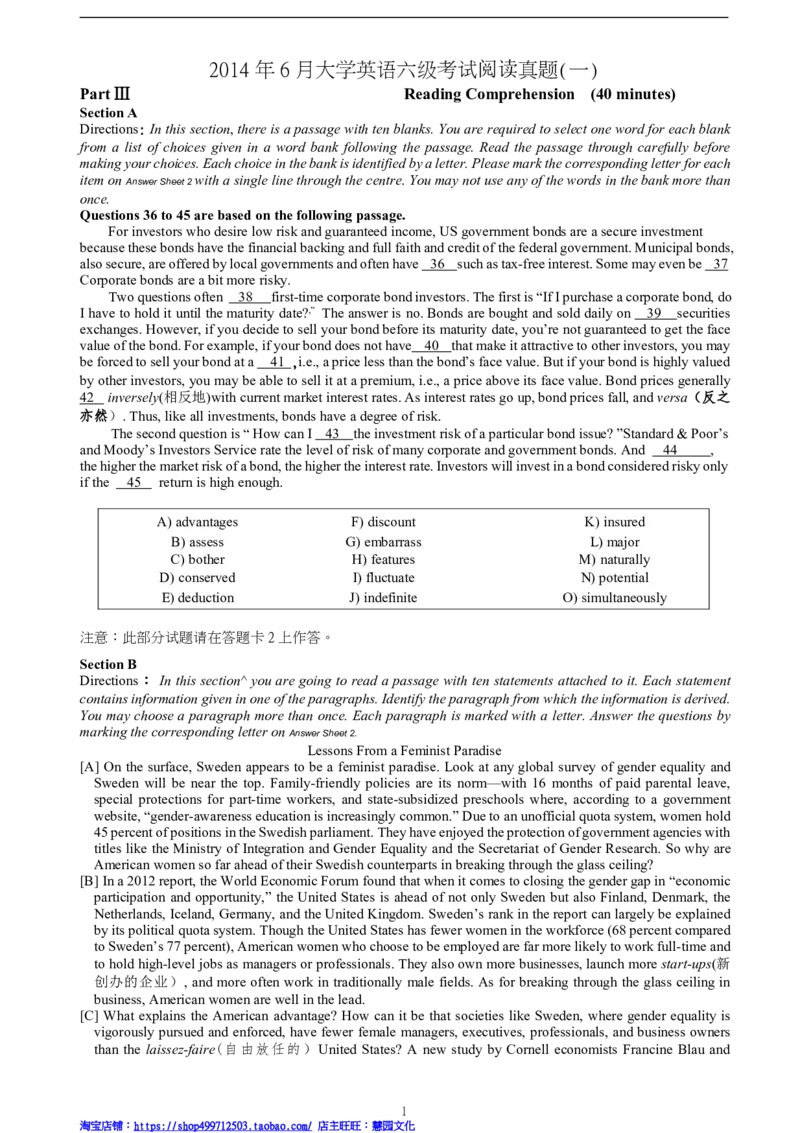
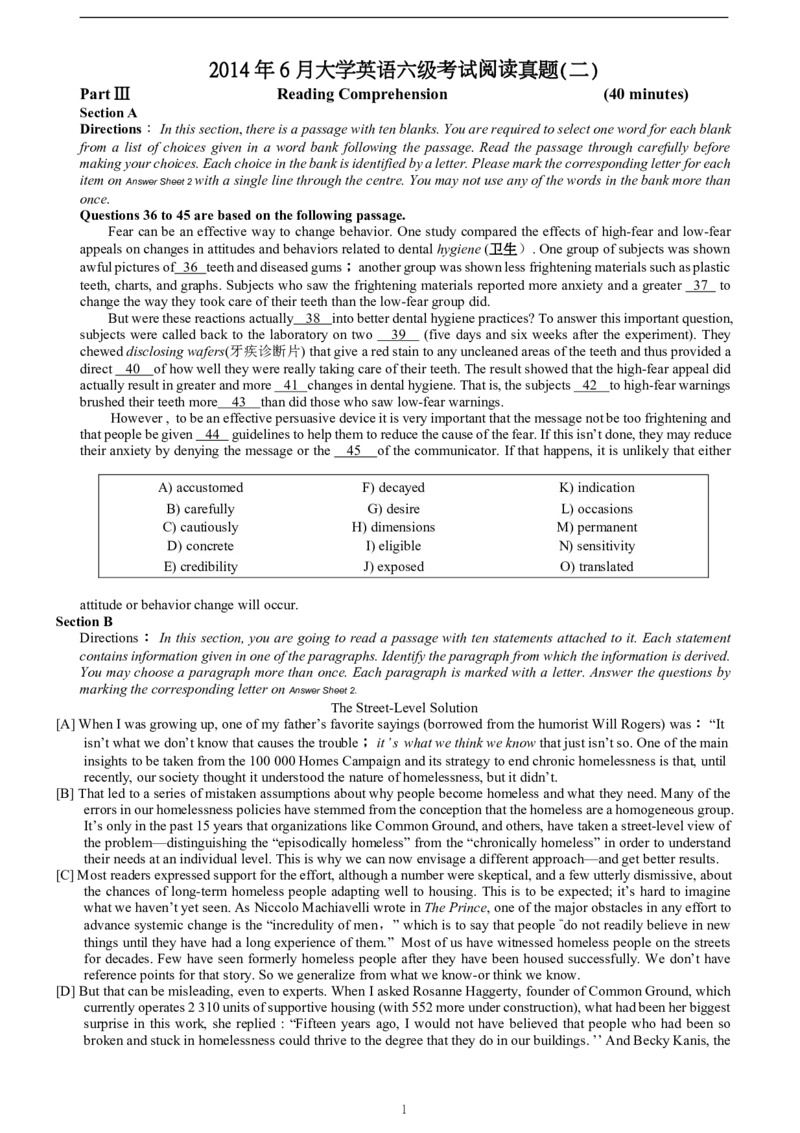
Part Ⅲ Reading Comprehension
SectionA
Directions:Inthissection, thereisapassagewithtenblanks. Youarerequired toselect oneword
fareach blankfromalistof choices given inawordbankfollowing thepassage. Read thepassage
throughcarefully beforemaking your choices. Each choice in thebankis identified byaletter.
PleasemarkthecorrespondingletterforeachitemonAnswerSheet2withasinglelinethroughthe
centre. You maynot use anyof thewordsin thebank morethan once.
Questions36to 45are basedon thefollowing passage.
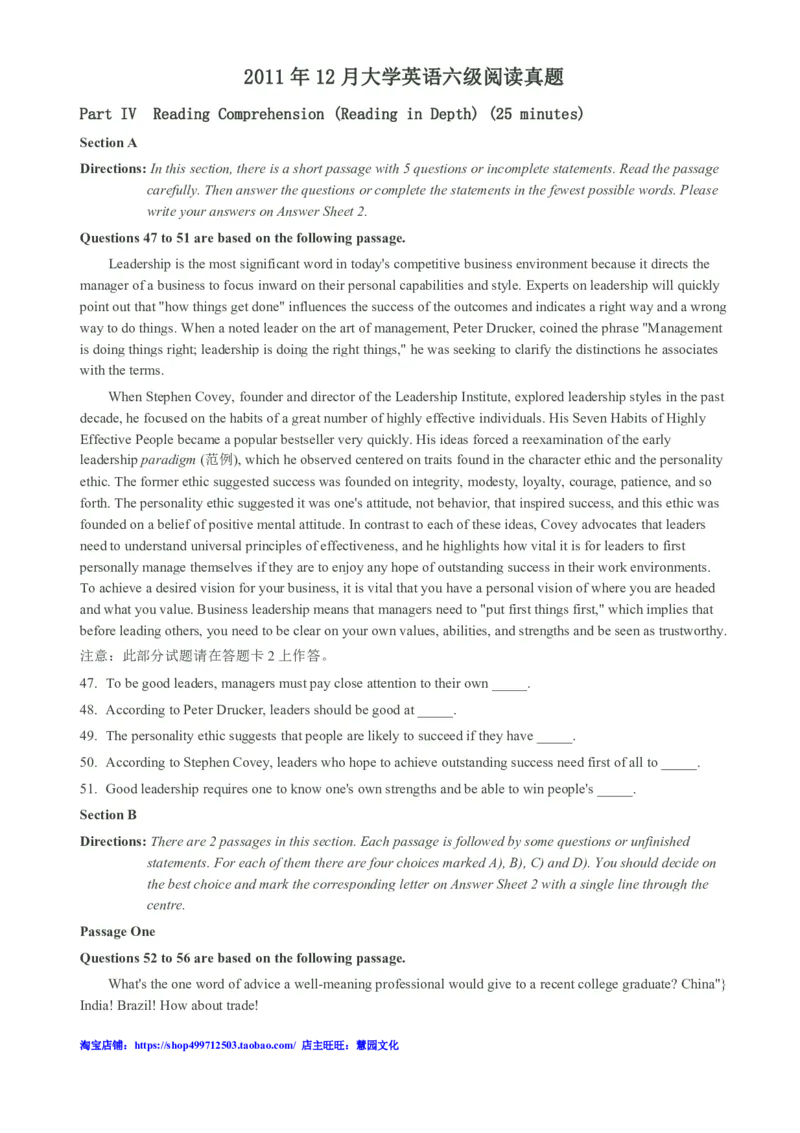
Mostexperts in sleep behaviour agree that there is virtually an epidemic ofsleepiness inthe
nation.“Ican’t think ofa 36 study that hasn’t found Americans getting less sleep than they ought
to,” says DrDavid.
Thebeginningofoursleep-deficitcrisiscanbe 37 totheinventionofthelightbulbacentury
ago.Fromdiaryentriesandotherpersonalaccountsfromthe18thand19thcenturies,sleepscientists
havereached the 38 that theaverage person used to sleep about 9.5hours anight. By the1950s
and1960s,thatsleep schedulehadbeen reduced 39 tobetween 7.5and 8hours, andmostpeople
had to wake toan alarm clock. “Peoplecheat ontheir sleep, and they don’t realisethey’re doing it,”
saysDrDavid.“Theythinkthey’reokaybecausetheycangetbyon6.5hours,whentheyreallyneed
7.5, 8orevenmore to feel 40 vigorous.”
Perhaps themost merciless robber of sleep, researchers say, is the 41 ofthe day. Whenever
pressures from work, family, friends and communitymount,many peopleconsider sleep theleast
expensiveitem ontheagenda. “In oursociety, you’re considered 42 ifyou say you only need 5.5
hours’sleep. If you say you’vegot toget 8.5hours, people thinkyou lack driveandambition.”To
assess the 43 ofsleep deficit, researchers have putsubjects through aset ofpsychological and
performancetestsrequiring them,forinstance, toadd columnsofnumbersor 44 apassagereadto
themonlyminutesearlier.“We’vefoundthatifyou’resleep-deprived,performancesuffers,”saysDr
David. “Short-term memory is 45 ,so are abilities to makedecisions and to concentrate.”
A)ideally I) conclusion
B) dynamic J)drastic
C)currently K)expectations
D)single L) dramatically
E)startlingly M) recur
F)complexity N) consequences
H)traced O) impaired
I)recall
SectionB
Directions:In thissection, you aregoing toread apassagewithten statements attached to it.Each
statement contains informationgiven in one ofthe paragraphs.Identify theparagraph fromwhich
theinformationisderived.Youmaychooseaparagraphmorethanonce.Eachparagraphismarked
with aletter. Answer thequestions bymarking the corresponding letter onAnswer Sheet 2.
Welcome, Freshmen. Havean iPod.
[A]Taking a step that many professors may view as abit counterproductive, somecolleges and
universitiesare dolingout AppleiPhones andInternet-capable iPodstotheirstudents. The
always-on Internet devices raise somenovel possibilities, liketracking where students gather
together. With far less controversy, colleges could send messages about cancelled classes,
delayed buses, campus crises orjustthe cafeteria menu.
[B]Whileschoolsemphasiseitsusefulness—onlineresearchinclassandinstantpollingofstudents,
forexample一abig partoftheattraction is,undoubtedly, thattheiPhoneiscool andahitwith
students.Beingequipped withoneofthemostrecentcutting-edgeIT productscouldjusthelpa
collegeoruniversity foster acutting-edge reputation.
[C]Applestands to win as well, hooking more young consumers with decades of technology
1
淘宝店铺:https://shop499712503.taobao.com/ 店主旺旺:慧园文化purchasesaheadofthem.Thelonelosers,somefear,couldbeprofessors.Studentsalreadyhave
laptopsand cell phones, of course, but thenewest devices can take class distractions toa new
level. They practically beg a user toignore thelong-suffering professor struggling to pass on
accumulated wisdomfrom thefront ofthe room 一aprospect that teachers findmost irritating
and students viewas, well, inevitable.
[D]“Whenitgetsalittleboring,Imightpullitout,”acknowledgedNaomiPugh,afirst-yearstudent
atFreed-HardemanUniversityinHenderson,Tenn.,referringtohernewiPodTouch,whichcan
connecttotheInternetoveracampuswirelessnetwork.Shespeculatedthatprofessorsmighttry
even hardertomake classes interesting iftheywere to compete with thedevices.
[E]Expertsseeamovementtowardtheuseofmobiletechnologyineducation,thoughtheysayitisin
itsinfancy as professors try tocome upwithuseful applications. Providingpowerful hand-held
devicesissuretofueldebates overtheroleoftechnologyinhighereducation.“Wethinkthisis
theway thefuture is going towork”said Kyle Dickson, co-director ofresearch and themobile
learning initiativeat AbileneChristian University in Texas, which has bought more than 600
iPhonesand 300iPods for studentsentering thisfall.
[F] Although plentyof studentstake theirlaptops to class, they don’t takethem everywhere and
would prefersomething lighter. AbileneChristian settled onthedevices after surveying
studentsand findingthat they didnot likehauling around theirlaptops, butthat most ofthem
always carried acell phone, DrDickson said.
[G]It is not clear howmany colleges and universitiesplan togive outiPhones andiPods thisfall;
officialsatApplewere unwillingtotalkaboutthesubjectandsaidthattheywouldnotleak any
institution’splans.“Wecan’tannounceotherpeople’snews,”saidGregJoswiak,vicepresident
ofiPodand iPhonemarketing at Apple. He also said that hecould not discuss discounts to
universitiesfor bulk purchases.
[H]Atleastfourinstitutions—theUniversityofMaryland,OklahomaChristianUniversity,Abilene
ChristianandFreed-Hardeman一haveannouncedthattheywillgivethedevicestosomeorall
oftheirstudentsthisfall.Otheruniversitiesareexploringtheiroptions.StanfordUniversityhas
hired astudent-run company to design applications likea campus map and directory for the
iPhone.It is considering whether toissueiPhones but not sureit’s necessary, notingthat more
than 700iPhoneswere registered ontheuniversity’s network last year. At theMassachusetts
InstituteofTechnology, iPhones might already havebeen everywhere, if AT&T, thewireless
carrieroffering the iPhonein theUnited States, had amore reliablenetwork, said Andrew Yu,
mobiledevices platform project manager at MIT. “Wewould haveprobably gone ahead with
this,maybejust getting athousand iPhones and giving them out,”Mr.Yu said.
[I] The University ofMaryland at College Park is proceeding cautiously, giving theiPhoneoriPod
Touchto150students,saidJeffreyHuskamp,vicepresidentandchiefinformationofficeratthe
university.“Wedon’tthinkthatwehavealltheanswers,”Mr.Huskampsaid.Byobservinghow
studentsusethe gadgets, he said, “We’re trying toget answers from thestudents.”
[J]At each college, thestudents who choose to get aniPhonemustpay formobilephoneservice.
Thoseservice contracts includeunlimited data use. Both theiPhones and theiPod Touch
devices can connect to theInternet through campus wireless networks. Withthe iPhone,those
networks may provide faster connectionsand longer battery lifethanAT&T’sdata network.
Many cell phones allow users, tosurftheWeb, but only somenewer ones are capable of
wireless connection to thelocal area computernetwork.
[K]University officials saythat they have noplans totrack theirstudents (and Applesaid it would
notbe possibleunless students give their permission). They say that they are drawn tothe
prospect oflearning applications outsidetheclassroom, though such lesson plans have yet to
surface.
[L] “My colleagues and Iare studying somethingcalled augmented reality (a field ofcomputer
researchdealingwiththecombinationofreal-worldandvirtualreality)”saidChristopherDede,
professor inlearning technologies at Harvard University. “Alien Contact,”for example, isan
exercisedeveloped for middle-school studentswho usehand-held devices that can determine
theirlocation. As they walk around a playground orother area, text, video oraudio pops upat
2various pointstohelp them try to figure out whyaliens were intheschoolyard.
[M]“Youcanimaginesimilarkindsofinteractiveactivitiesalonghistoricallines,”likefollowingthe
Freedom Trail in Boston, Professor Dede said. “It’s important that wedoresearch so that we
knowhowwell something likethisworks.”
[N]Therushtodistributethedevicesworriessomeprofessors,whosaythatstudentsarelesslikelyto
participatein class if they are multi-tasking. “I’m not someonewho’s anti-technology, but I’m
always worried that technology becomes an endin and ofitself, and itreplaces teaching orit
replaces analysis,”said EllenMillender, associate professor ofclassics at Reed Collegein
Portland,Ore. (Sheadded that shehoped tobuyan iPhonefor herself onceprices fall.)Robert
Summers,whohastaughtatCornellLawSchoolforabout40years,announcedthisweek —in
adetailed, footnoted memorandum — that hewould ban laptop computers from hisclass on
contract law. “Iwould ban that tooif Iknew thestudents were using itinclass,” Professor
Summers said of theiPhone, after thedevice and its capabilities were explained to him.“What
wewant to encourage in thesestudents is anactive intellectual experience, in which they
develop thewide range ofcomplex reasoning abilities required ofgood lawyers.”
[O]The experience at DukeUniversity may ease someconcerns. Afew years ago, Duke began
giving iPodsto students withthe ideathat theymight usethem torecord lectures (these older
modelscould not access theInternet). “Wehad assumed that thebiggest focus ofthesedevices
wouldbeconsumingthecontent,”saidTracyFuthey,vicepresidentforinformationtechnology
andchiefinformationofficeratDuke.Butthatisnotallthatthestudentsdid.Theybeganusing
theiPodsto createtheirown “content”,making audiorecordings ofthemselves and presenting
them.The students turned what could havebeen a passiveinteraction into an active one, Ms
Futhey said.
46.UniversityofficialsclaimthattheydoleoutiPhonesandiPodssoastofacilitatestudents’learning
outsideof class.
47.Intheauthor’sview,beingequippedwithITproductsmayhelpcollegesanduniversitiesbuildan
innovativeimage.
48.ProfessorRobert Summers at Cornell Law School banned laptop computers from his class
because hethinks qualified lawyers need to possess abroad array ofcomplex reasoning abilities.
49.NaomiPughatFreed-HardemanUniversityspeculatedthatprofessorswouldhavetoworkharder
toenliven theirclasses.
50. TheUniversity ofMaryland at College Park is proceeding withcaution concerning theuseof
iPhonesand iPods.
51. Many professors thinkthat giving out AppleiPhones orInternet-capable iPodsto students may
notbenefit educationas intended.
52.TheexperienceatDukeUniversitymayeasesomeconcernsbecausethestudentshaveusediPods
foractive interaction.
53. EllenMillender at Reed CollegeinPortland is concerned that technology will taketheplace of
teaching oranalysis.
54. ThedistributionofiPhones among students has raised concerns that they will further distract
studentsfrom class participation.
55. Experts likeDrKyle Dickson at Abilene ChristianUniversity think that mobiletechnology will
bemorewidely used in education.
SectionC
Directions:There are2passages in thissection. Each passage isfollowedby somequestions or
unfinishedstatements.ForeachofthemtherearefourchoicesmarkedA),B),C)andD).Youshould
decideonthe best choice andmarkthecorresponding letter onAnswer Sheet2with asingleline
throughthecentre.
Passage One
Questions56to 60are basedon thefollowing passage.
In 2011,many shoppers chose toavoid thefrantic crowds and dotheir holiday shoppingfrom
thecomfort oftheir computer. Sales at onlineretailers gained bymore than 15%, making itthe
biggest season ever. But people are also returning thosepurchases at record rates, up8% from last
3
淘宝店铺:https://shop499712503.taobao.com/ 店主旺旺:慧园文化year.
Whatwent wrong? Is thelingering shadowof theglobal financial crisis making itharderto
accept extravagant indulgences? Or that peopleshop more impulsively —andtherefore makebad
decisions—whenonline?Botharguments areplausible. However, thereis athirdfactor:aquestion
oftouch.Wecan lovethelookbut,inanonlineenvironment,wecannot feelthequalityofatexture,
theshapeof thefit, thefall ofa fold or,for that matter, theweight ofan earring. And physically
interacting with an object makes you more committed to your purchase.
Whenmymostrecent bookBrandwashed was released, Iteamed upwith alocal bookstoreto
conduct an experiment about the differences between theonlineand offline shopping experience. I
carefullyinstructed agroup ofvolunteers topromotemybookin twodifferent ways. Thefirst was a
fairly hands-off approach. Whenever a customer would inquireabout mybook,the volunteerwould
takehim overto theshelfand pointtoit. Out of20such requests, six customers proceeded with the
purchase.
Thesecond optionalso involved going over to theshelfbut, thistime, removing thebookand
thensubtlyholdingontoitforjustanextramomentbeforeplacingitinthecustomer’shands.Ofthe
20peoplewhowerehandedthebook,13endedupbuyingit.Justphysicallypassingthebookshowed
abig difference in sales. Why? We feel something similartoa sense ofownership whenwe hold
things in ourhand. That’s why we establish orreestablish connection bygreeting strangers and
friendswithahandshake.Inthiscase,havingtothenletgoofthebookafterholdingitmightgenerate
asubtlesenseof loss,and motivate usto make thepurchaseeven more.
Arecentstudyalsorevealedthepoweroftouch,inthiscasewhenitcametoconventionalmail.
Adeeper and longer-lasting impression ofa messagewas formed when delivered in aletter, as
opposedtoreceivingthesamemessageonline.Brainimagingshowedthat,ontouchingthepaper,the
emotionalcentre of thebrain was activated, thus forming astronger bond.Thestudy also indicated
thatonce touch becomes part of theprocess, it could translate intoa senseofpossession. This sense
ofownership is simplynot part oftheequation in theonlineshopping experience.
56. Whydopeopleprefer shoppingonlineaccording to theauthor?
A)It is morecomfortable and convenient.
B) It saves them alot ofmoney and time.
C)It offers them alot moreoptionsand bargains.
D)It gives them more timeto think about theirpurchase.
57.Whydomorecustomers return their purchases bought online?
A)They regretted indulging in costly items intherecession.
B) They changed theirmind bythetimethegoods were delivered.
C)They had nochance to touch them when shopping online.
D)They later foundthequality of goods below theirexpectations.
58.Whatis thepurposeof theauthor’s experiment?
A)Totest his hypothesis about onlineshopping.
B) Tofind outpeople’s reaction to his recent book.
C)Tofind ways to increase thesaleofhis new book.
D)Totry different approaches to sales promotion.
59. Howmight people feel after lettinggo ofsomething they held?
A)Asense ofdisappointment. C)Asubtleloss of interest.
B) Moremotivated to ownit. D)Less sensitivetoitstexture.
60.Whatdoes brain imaging ina recent studyreveal?
A)Conventional letters contain subtlemessages.
B) Alack oftouch isthe chief obstacleto e-commerce.
C)Emaillacks thepotential toactivate thebrain.
D)Physical touchhelps form a sense ofpossession.
Passage Two
Questions61to 65are basedon thefollowing passage.
Apparently everyone knows that global warming only makes climate moreextreme. A hot,dry
summerhastriggeredanotherfloodofsuchclaims.And,whilemanyinterestsareatwork,oneofthe
4players that benefits themostfrom thisstory are the media: thenotionof “extreme”climate simply
makes formore compelling news.
ConsiderPaul Krugman, writing breathlessly inTheNew YorkTimes about the“rising
incidence ofextremeevents”.Heclaims that global warming caused thecurrent drought in
America’s Midwest, and that supposedly record-high corn prices could cause aglobal food crisis.
But theUnited Nations climate panel’s latestassessment tells usprecisely theopposite: For
“North America, there is mediumconfidence that there has beenan overall slight tendency towards
less dryness”.Moreover, thereis noway that Krugman could haveidentified this drought as being
causedbyglobalwarming withoutatimemachine:Climatemodelsestimatethatsuchdetectionwill
bepossibleby2048,at theearliest.
And, fortunately, this year’s drought appears unlikely tocause a foodcrisis, as global rice and
wheat supplies remain plentiful. Moreover, Krugman overlooks inflation:Prices haveincreased,
six-foldsince1969,so,whilecornfutures(期货)didsetarecordofabout$8perbushel(蒲式耳)
inlate July, theinflation-adjusted priceof corn was higher throughout most ofthe1970s, reaching
$16 in1974.
Finally,Krugman convenientlyforgetsthatconcernsaboutglobalwarmingarethemainreason
thatcom prices have skyrocketed since 2005.Nowadays 40percent of com grown in theUnited
Statesisusedtoproduceethanol(乙醇),whichdoesabsolutelynothingfortheclimate,butcertainly
distortstheprice ofcom —at the expenseofmany of theworlds poorest people.
Bill McKibben similarly worries inTheGuardian about the Midwest drought andcom prices.
HeconfidentlytellsusthatragingwildfiresfromNewMexicoandColoradotoSiberiaare“exactly”
what theearly stages ofglobal warming look like.
In fact, thelatest overview ofglobal wildfire incidence suggests that fireintensity has declined
overthepast 70years and is nowcloseto its preindustrial level.
Whenwell-meaningcampaignerswantustopayattentiontoglobalwarming,theyoftenendup
pitchingbeyondthefacts.And,whilethismayseemjustifiedbyanoblegoal,such“policybypanic”
tactics rarely work, and often backfire.
Rememberhow, in thewake of HurricaneKatrina in 2005,A1 Gore claimed that we were in
storeforevermoredestructivehurricanes?Sincethen,hurricaneincidencehasdroppedoffthecharts.
Exaggerated claims merely fuel publicdistrust and disengagement.
That isunfortunate, because global warming is areal problem, and we doneedto address it.
61.In what way dothemediabenefit from extremeweather?
A)They can attract people’s attention totheir reports.
B) They can choosefrom agreater variety of topics.
C)They can makethemselves betterknown.
D)They can give voice todifferent views.
62.Whatis theauthor’s comment onKrugman’s claim about thecurrent drought in America’s
Midwest?
A)Atimemachine isneeded totestify to itstruth.
B) It is based onan erroneous climate model.
C)It will eventually get proofin 2048.
D)There is nowayto prove itsvalidity.
63.Whatis thechief reason forthe risein com prices according to theauthor?
A)Demand forfood has been risinginthedeveloping countries.
B) Aconsiderable portion ofcom is usedto produce green fuel.
C)Climatechange has caused com yields to drop markedly.
D)Inflation rates have been skyrocketing since the1970s.
64.Whatdoes theauthor say about global wildfire incidence over thepast 70years?
A)It has got worse with therisein extremeweathers.
B) It signals theearly stages ofglobal warming.
C)It has droppedgreatly.
D)It is related to drought.
5
淘宝店铺:https://shop499712503.taobao.com/ 店主旺旺:慧园文化65. Whatdoes theauthor think oftheexaggerated claims in themediaabout global warming?
A)They are strategies to raise publicawareness.
B) They doadisservice to addressing theproblem.
C)They aggravatepublicdistrust about science.
D)They create confusion about climate change.
6