
































文档内容
英语六级·长篇阅读·真题
2015.06-2023.12目录
2023年12月大学英语六级长篇阅读第1套…………………………………………………1
2023年12月大学英语六级长篇阅读第2套…………………………………………………3
2023年12月大学英语六级长篇阅读第3套…………………………………………………5
2023年06月大学英语六级长篇阅读第1套…………………………………………………7
2023年06月大学英语六级长篇阅读第2套…………………………………………………9
2023年06月大学英语六级长篇阅读第3套………………………………………………11
2023年03月大学英语六级长篇阅读全1套………………………………………………13
2022年12月大学英语六级长篇阅读第1套………………………………………………15
2022年12月大学英语六级长篇阅读第2套………………………………………………17
2022年12月大学英语六级长篇阅读第3套………………………………………………19
2022年09月大学英语六级长篇阅读全1套………………………………………………21
2022年06月大学英语六级长篇阅读第1套………………………………………………23
2022年06月大学英语六级长篇阅读第2 套…………………………………………………25
2021年12月大学英语六级长篇阅读第1套………………………………………………27
2021年12月大学英语六级长篇阅读第2套………………………………………………29
2021年12月大学英语六级长篇阅读第3套………………………………………………31
2021年06月大学英语六级长篇阅读第1套………………………………………………33
2021年06月大学英语六级长篇阅读第2套………………………………………………35
2021年06月大学英语六级长篇阅读第3套………………………………………………37
2020年12月大学英语六级长篇阅读第1套………………………………………………39
2020年12月大学英语六级长篇阅读第2套………………………………………………41
2020年12月大学英语六级长篇阅读第3套………………………………………………43
2020年09月大学英语六级长篇阅读第1套………………………………………………45
2020年09月大学英语六级长篇阅读第2套………………………………………………47
2020年07月大学英语六级长篇阅读全1套………………………………………………49
2019年12月大学英语六级长篇阅读第1套………………………………………………51
2019年12月大学英语六级长篇阅读第2套………………………………………………53
2019年12月大学英语六级长篇阅读第3套………………………………………………55
2019年06月大学英语六级长篇阅读第1套………………………………………………57
2019年06月大学英语六级长篇阅读第2套………………………………………………59
2019年06月大学英语六级长篇阅读第3套………………………………………………61
2018年12月大学英语六级长篇阅读第1套………………………………………………63
2018年12月大学英语六级长篇阅读第2套…………………………………………………65
2018年12月大学英语六级长篇阅读第3套………………………………………………67
2018年06月大学英语六级长篇阅读第1套………………………………………………69
2018年06月大学英语六级长篇阅读第2套………………………………………………71
2018年06月大学英语六级长篇阅读第3套………………………………………………73
2017年12月大学英语六级长篇阅读第1套…………………………………………………752017年12月大学英语六级长篇阅读第2套…………………………………………………77
2017年12月大学英语六级长篇阅读第3套………………………………………………79
2017年06月大学英语六级长篇阅读第1套………………………………………………81
2017年06月大学英语六级长篇阅读第2套………………………………………………83
2017年06月大学英语六级长篇阅读第3套………………………………………………85
2016年12月大学英语六级长篇阅读第1套………………………………………………87
2016年12月大学英语六级长篇阅读第2套………………………………………………89
2016年12月大学英语六级长篇阅读第3套………………………………………………91
2016年06月大学英语六级长篇阅读第1套……………………………………………93
2016年06月大学英语六级长篇阅读第2套………………………………………………95
2016年06月大学英语六级长篇阅读第3套………………………………………………97
2015年12月大学英语六级长篇阅读第1套………………………………………………99
2015年12月大学英语六级长篇阅读第2套……………………………………………101
2015年12月大学英语六级长篇阅读第3套………………………………………………103
2015年06月大学英语六级长篇阅读第1套……………………………………………105
2015年06月大学英语六级长篇阅读第2套……………………………………………107
2015年06月大学英语六级长篇阅读第3套……………………………………………109
淘宝店铺:一次过考研 温馨提示:2022年6月、2020年9月六级考试实考2套长篇
阅读;2023年3月、2022年9月、2020年7月实考1套。另:本资料排版已设计好,若打
印,请将封皮页一并打印,使文章与选项同一视野,刷题无需翻页;同时文本内容支持
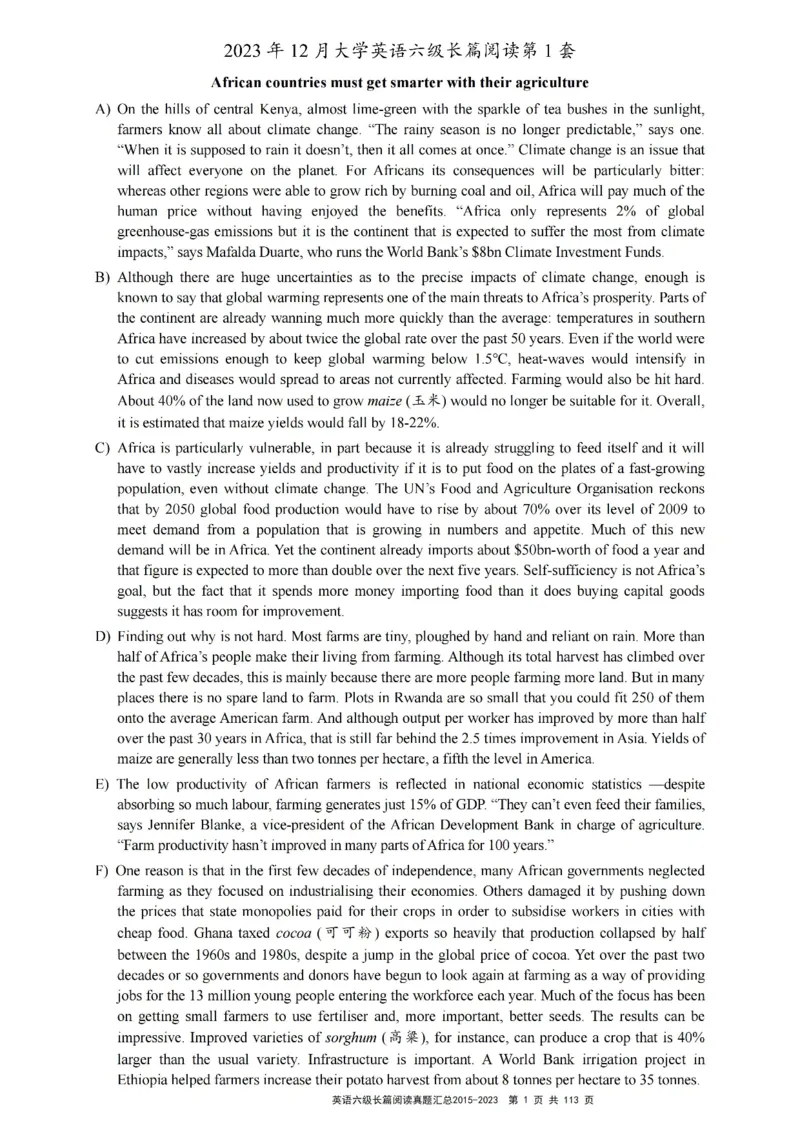
复制、划线查词,文字高亮,可用于电子笔记!2023年12月大学英语六级长篇阅读第1套
African countries must get smarter with their agriculture
A) On the hills of central Kenya, almost lime-green with the sparkle of tea bushes in the sunlight,
farmers know all about climate change."The rainy season is no longer predictable,"says one.
“When it is supposed to rain it doesn't, then it all comes at once.” Climate change is an issue that
will affect everyone on the planet. For Africans its consequences will be particularly bitter:
whereas other regions were able to grow rich by burning coal and oil, Africa will pay much of the
human price without having enjoyed the benefits."Africa only represents 2of global
greenhouse-gas emissions but it is the continent that is expected to suffer the most from climate
impacts,"says Mafalda Duarte, who runs the World Bank's $8bn Climate Investment Funds.
B)Although there are huge uncertainties as to the precise impacts of climate change, enough is
known to say that global warming represents one of the main threats to Africa's prosperity. Parts of
the continent are already wanning much more quickly than the average: temperatures in southern
Africa have increased by about twice the global rate over the past 50 years. Even if the world were
to cut emissions enough to keep global warming below 1.5℃, heat-waves would intensify in
Africa and diseases would spread to areas not currently affected. Farming would also be hit hard.
About 40of the land now used to grow maize(玉米) would no longer be suitable for it. Overall,
it is estimated that maize yields would fall by 18-22%.
C)Africa is particularly vulnerable, in part because it is already struggling to feed itself and it will
have to vastly increase yields and productivity if it is to put food on the plates of a fast-growing
population, even without climate change. The UN's Food and Agriculture Organisation reckons
that by 2050 global food production would have to rise by about 70over its level of 2009 to
meet demand from a population that is growing in numbers and appetite. Much of this new
demand will be in Africa. Yet the continent already imports about $50bn-worth of food a year and
that figure is expected to more than double over the next five years. Self-sufficiency is not Africa's
goal, but the fact that it spends more money importing food than it does buying capital goods
suggests it has room for improvement.
D) Finding out why is not hard. Most farms are tiny, ploughed by hand and reliant on rain. More than
half of Africa's people make their living from farming. Although its total harvest has climbed over
the past few decades, this is mainly because there are more people farming more land. But in many
places there is no spare land to farm. Plots in Rwanda are so small that you could fit 250 of them
onto the average American farm. And although output per worker has improved by more than half
over the past 30 years in Africa, that is still far behind the 2.5 times improvement in Asia. Yields of
maize are generally less than two tonnes per hectare, a fifth the level in America.
E)The low productivity of African farmers is reflected in national economic statistics —despite
absorbing so much labour, farming generates just 15of GDP“They can't even feed their families,
says Jennifer Blanke,a vice-president of the African Development Bank in charge of agriculture.
“Farm productivity hasn't improved in many parts of Africa for 100 years.”
F)One reason is that in the first few decades of independence, many African govermments neglected
farming as they focused on industrialising their economies. Others damaged it by pushing down
the prices that state monopolies paid for their crops in order to subsidise workers in cities with
cheap food. Ghana taxed cocoa(可可粉)exports so heavily that production collapsed by half
between the 1960s and 1980s, despite a jump in the global price of cocoa. Yet over the past two
decades or so governments and donors have begun to look again at farming as a way of providing
jobs for the 13 million young people entering the workforce each year. Much of the focus has been
on getting small farmers to use fertiliser and, more important, better seeds. The results can be
impressive. Improved varieties of sorghum(高梁), for instance, can produce a crop that is 40%
larger than the usual variety. Infrastructure is important.A World Bank irrigation project in
Ethiopia helped farmers increase their potato harvest from about 8 tonnes per hectare to 35 tonnes.
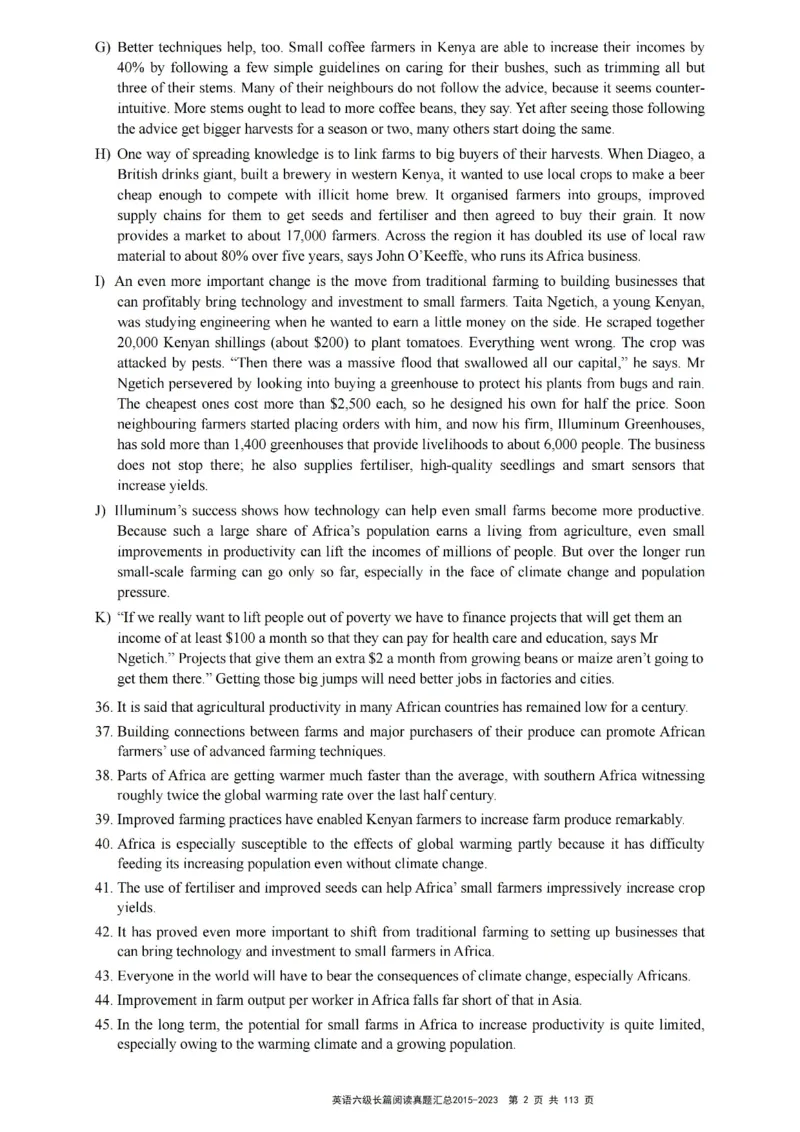
英语六级长篇阅读真题汇总2015-2023 第 1 页 共 113 页G) Better techniques help, too. Small coffee farmers in Kenya are able to increase their incomes by
40y following a few simple guidelines on caring for their bushes, such as trimming all but
three of their stems. Many of their neighbours do not follow the advice, because it seems counter-
intuitive. More stems ought to lead to more coffee beans, they say. Yet after seeing those following
the advice get bigger harvests for a season or two, many others start doing the same.
H) One way of spreading knowledge is to link farms to big buyers of their harvests. When Diageo, a
British drinks giant, built a brewery in western Kenya, it wanted to use local crops to make a beer
cheap enough to compete with illicit home brew. It organised farmers into groups, improved
supply chains for them to get seeds and fertiliser and then agreed to buy their grain. It now
provides a market to about 17,000 farmers. Across the region it has doubled its use of local raw
material to about 80over five years, says John O'Keeffe, who runs its Africa business.
I) An even more important change is the move from traditional farming to building businesses that
can profitably bring technology and investment to small farmers. Taita Ngetich, a young Kenyan,
was studying engineering when he wanted to earn a little money on the side. He scraped together
20,000 Kenyan shillings(about $200) to plant tomatoes. Everything went wrong. The crop was
attacked by pests.“Then there was a massive flood that swallowed all our capital,” he says. Mr
Ngetich persevered by looking into buying a greenhouse to protect his plants from bugs and rain.
The cheapest ones cost more than $2,500 each, so he designed his own for half the price. Soon
neighbouring farmers started placing orders with him, and now his firm, Illuminum Greenhouses,
has sold more than 1,400 greenhouses that provide livelihoods to about 6,000 people. The business
does not stop there; he also supplies fertiliser, high-quality seedlings and smart sensors that
increase yields.
J)Illuminum's success shows how technology can help even small farms become more productive.
Because such a large share of Africa's population earns a living from agriculture, even small
improvements in productivity can lift the incomes of millions of people. But over the longer run
small-scale farming can go only so far, especially in the face of climate change and population
pressure.
K)“If we really want to lift people out of poverty we have to finance projects that will get them an
income of at least $100 a month so that they can pay for health care and education, says Mr
Ngetich.” Projects that give them an extra $2 a month from growing beans or maize aren't going to
get them there.” Getting those big jumps will need better jobs in factories and cities.
36. It is said that agricultural productivity in many African countries has remained low for a century.
37. Building connections between farms and major purchasers of their produce can promote African
farmers' use of advanced farming techniques.
38.Parts of Africa are getting warmer much faster than the average, with southern Africa witnessing
roughly twice the global warming rate over the last half century.
39. Improved farming practices have enabled Kenyan farmers to increase farm produce remarkably.
40.Africa is especially susceptible to the effects of global warming partly because it has difficulty
feeding its increasing population even without climate change.
41. The use of fertiliser and improved seeds can help Africa'small farmers impressively increase crop
yields
42. It has proved even more important to shift from traditional farming to setting up businesses that
can bring technology and investment to small farmers in Africa.
43. Everyone in the world will have to bear the consequences of climate change, especially Africans.
44.Improvement in farm output per worker in Africa falls far short of that in Asia.
45.In the long term, the potential for small farms in Africa to increase productivity is quite limited,
especially owing to the warming climate and a growing population.
英语六级长篇阅读真题汇总2015-2023 第 2 页 共 113 页2023年12月大学英语六级长篇阅读第2套
Treasure Fever
A)Most visitors come to Cape Canaveral, on the northeast coast of Florida, for the tourist attractions.
It's home to the second-busiest cruise ship port in the world and is a gateway to the cosmos. Nearly
1.5 million visitors flock here every year to watch rockets, spacecraft, and satellites blast off into the
solar system from Kennedy Space Center Visitor Complex. Nearly 64 kilometers of undeveloped
beach and 648 square kilometers of protected refuge fan out from the cape's sandy shores.
B) Yet some of Cape Canaveral's most legendary attractions lie unseen, wedged under the sea's
surface in mud and sand, for this part of the world has a reputation as a deadly ship trap. Over the
centuries, dozens of majestic Old World sailing ships smashed and sank on this irregular stretch of
windy Florida coast. They were vessels built for war and commerce, crossing the globe carrying
everything from coins to cannons, boxes of silver and gold, chests of jewels and porcelain, and
pearls from the Caribbean.
C)Cape Canaveral contains one of the greatest concentrations of colonial shipwrecks in the world. In
recent years, advances in radar, diving, detection equipment, computers, and GPS have
transformed the hunt. The naked eye might see a pile of rocks, but technology can reveal the
precious arifacts(人工制品)that lie hidden on the ocean floor.
D)As technology renders the seabed more accessible, the hunt for treasure-filled ships has drawn a
fresh tide of salvors(打捞人员)and their investors—as well as marine archaeologists (考古学家)
wanting to bring to light the lost relics. But of late, when salvors have found vessels, their rights
have been challenged in court. The big question: who should have control of these treasures?
E) High-stakes fights over shipwrecks pit archaeologists against treasure hunters in a vicious cycle of
accusations. Archaeologists regard themselves as protectors of history, and they see salvors as
careless destroyers. Salvors feel they do the hard work of searching for ships, only to have them
stolen from under them when discovered. This kind of clash inevitably takes place on a grand scale.
Aside from the salvors, their investors, and the maritime archaeologists who serve as expert
witnesses, the battles sweep in local and international governments and organizations like
UNESCO that work to protect under-water heritage. The court cases that ensue stretch on for years.
Are finders keepers, or do the ships belong to the countries that made them and sent them sailing
centuries ago? Where once salvors and archaeologists worked side by side, now they belong to
opposing, and equally contemptuous, tribes.
F)Nearly three million vessels lie wrecked on the Earth's ocean floor—from old canoes to the
Titanic—and likely less than one percent have been explored. Some—like an ancient Roman ship
found off Antikythera,Greece,dated between 70 and 60 BC and carrying astonishingly
sophisticated gears and dials for navigating by the sun-are critical to a new understanding of our
past. No wonder there is an eternal stirring among everybody from salvors to scholars to find them.
G) In May 2016,a salvor named Bobby Pritchett, president of Global Marine Exploration (GME) in
Tampa, Florida, announced that he had discovered scattered remains of a ship buried a kilometer
off Cape Canaveral. Over the prior three years, he and his crew had obtained 14 state permits to
survey a nearly 260-square-kilometer area off the cape; they worked 250 days a year, backed by
investor funds of, he claims, US $4 million. It was hard work. Crew members were up at dawn,
dragging sensors from their expedition vessels back and forth, day in and day out, year after year,
to detect metal of any kind. Using computer technology, Pritchett and his crew created intricate,
color-coded maps marked with the GPS coordinates of thousands of finds, all invisible under a
meter of sand.
H)One day in 2015, the magnetometer(磁力计) picked up metal that turned out to be an iron cannon;
when the divers blew the sand away, they also discovered a more precious bronze cannon with
markings indicating French royalty and, not far off, a famous marble column carved with the coat
of arms of France, known from historical paintings. The discovery was cause for celebration. The
artifacts indicated the divers had likely found the wreck of La Trinite, a 16th-century French vessel
英语六级长篇阅读真题汇总2015-2023 第3 页 共 113 页that had been at the center of a bloody battle between France and Spain that changed the fate of the
United States of America.
I) And then the legal storm began, with GME and Pritchett pitted against Florida and France. The
Sunken Military Craft Act of 2004,a US federal act, protects any vessel that was on a military
mission, allowing the originating country to claim their ship even centuries later. In 2018, two long
years afier Pritchetfs discovery, the federal district court ruled in favor of France. For Pritchett, the
decision was devastating. Millions of dollars of investor funding and years of labor were lost.
J) But this is far from the first time a salvor has lost all rights to a discovery. In 2012, for instance,
Spain won a five-year legal battle against Odyssey Marine Exploration, which had hauled 594,000
gold and silver coins from a Spanish wreck off the coast of Portugal across the Atlantic to the
United States.“Treasure hunters can be naive,”says attorney David Concannon, who has had
several maritime archaeologists as clients and represented two sides in the battles over the Titanic
for 20 years.“Many treasure hunters don't understand they are going to have to fight for their
rights against a government that has an endless supply of money for legal battles that treasure
hunters are likely to lose.”
K)Putting an inflated price on artifacts rather than viewing them as cultural and historical treasures
that transcend any price is what irritates many archaeologists. For the archaeologist, everything in
a wreck matters—hair, fabric, a fragment of a newspaper, rat bones—all things speak volumes.
Archaeologists don't want artifacts ending up in a private collection instead of taking humanity on
a journey of understanding.
L) George Bass is one of the pioneers of under-water archaeology, and a researcher at Texas A&M
University. He has testified in court against treasure hunters, but says archaeology is not without
its own serious problems. He believes archacologists need to do a better job themselves instead of
routinely criticizing treasure hunters."Archaeology has a terrible reputation for not publishing
enough on its excavations(发掘)and finds," he says.Gathering data, unearthing and meticulously
preserving and examining finds, verifying identity and origin, piecing together the larger story, and
writing and publishing a comprehensive paper or book can take decades. A bit cynically, Bass
describes colleagues who never published because they waited so long they became ill or died.
Who is more at fault, Bass asks, the professional archaeologist who carefully excavates a site and
never publishes on it or the treasure hunter who locates a submerged wreck, salvages part,
conserves part, and publishes a book on the operation?
M)Pritchett concedes that his find deserves careful excavation and preservation.“I think what I found
should go in a museum," he says.“But I also think I should get paid for what I found.” Indeed, it's
a bit of a mystery why govermments, archaeologists, and treasure hunters can't work together—and
why salvors aren't at least given a substantial finder's fee before the original owner takes
possession of the vessel and its artifacts.
36.Exploration of shipwrecks on the sea floor is crucial in updating our understanding of humanity's
past.
37. Quite a number of majestic ships sailing from Europe to America were wrecked off the Florida
coast over the centuries.
38.Pritchett suffered a heavy loss when a US district court ruled against him.
39.Recently, people who found treasures in shipwrecks have been sued over their rights to own them.
40.Pritchett claims he got support of millions of dollars from investors for his shipwreck exploration.
41.One pioneer marine scientist thinks archaeologists should make greater efforts to publish their
findings
42. With technological advancement in recent years, salvors now can detect the invaluable man-made
objects lying buried under the sea.
43. According to a lawyer, many treasure hunters are susceptible to loss because they are unaware they
face a financially stronger opponent in court.
44. Salvors of treasures in sunken ships and marine archaeologists are now hostile to each other.
45.Archaeologists want to see artifacts help humans understand their past instead of being sold to
private collectors at an outrageous price.
英语六级长篇阅读真题汇总2015-2023 第 4 页 共 113 页2023年12月大学英语六级长篇阅读第3套
Can Learning a Foreign Language Prevent Dementia?
A)You may have heard that learning another language is one method for preventing or at least
postponing the onset of dementia. Dementia refers to the loss of cognitive abilities, and one of its
most common forms is Alcheimer's disease(阿尔茨海默氏病).At this time, the causes of the
disease are not well understood, and consequently, there are no proven steps that people can take
to prevent it. Nonetheless, some researchers have suggested that learning a foreign language might
help delay the onset of dementia.
B) To explore this possibility more deeply, let's look at some of the common misconceptions about
dementia and the aging brain. First of all, dementia is not an inevitable part of the normal aging
process. Most older adults do not develop Alzheimer's disease or other forms of dementia. It is
also important to remember that dementia is not the same thing as normal forgetfulness. At any
age, we might experience difficulty finding the exact word we want or have trouble remembering
the name of the person we just met. People with dementia have more serious problems, like feeling
confused or getting lost in a familiar place. Think of it this way: If you forget where you parked
your car at the mall, that's normal; if you forget how to drive a car, that may be a signal that
something more serious is going on.
C) The idea that dementia can be prevented is based on the comparison of the brain to a muscle. When
people talk about the brain, they sometimes say things like "It is important to exercise your brain"
or“To stay mentally fit, you have to give your brain a workout.”Although these are colorful
analogies, in reality the brain is not a muscle. Unlike muscles, the brain is always active and works
even during periods of rest and sleep. In addition, although some muscle cells have a lifespan of
only a few days, brain cells last a lifetime. Not only that, but it has been shown that new brain cells
are being created throughout one's lifespan.
D) While it makes for a colorful analogy, comparing the brain to a muscle is inaccurate and
misleading. So, if the brain is not a muscle, can it still be exercised? Once again, researchers don't
know for sure. There are now many computer, online, and mobile device applications that claim to
be able to “train your brain,” and they typically tap into a variety of cognitive abilities. However,
research suggests that although this type of training may improve one's abilities at the tasks
themselves, they don't seem to improve other abilities. In other words, practicing a letter-detection
task will, over time, improve your letter-detection skills, but it will not necessarily enhance your
other perceptual abilities.
E)However, there is some reason to believe that learning languages might be different. The best
evidence that foreign language learning confers cognitive benefits comes from research with those
who are already bilingual(双语的).Bilingualism most commonly occurs when children are
exposed to two languages, either in the home(mom speaks Dutch, dad speaks Spanish) or more
formally in early schooling. But bilingualism certainly occurs in adulthood as well.
F)Bilingualism and multilingualism are actually more common than you might think. In fact, it has
been estimated that there are fewer monolingual speakers in the world than bilinguals and
multilinguals. Although in many countries most inhabitants share just one language,other
countries have several official languages. Switzerland, for example, has four official languages:
German, French, Italian, and Romansh. Throughout large parts of Africa, Arabic, Swahili, French,
and English are often known and used by individuals who speak a different, native language in
their home than they do in the marketplace. So bilingualism and multilingualism are to be found
throughout the world. And with regard to cognitive abilities, the research on those who speak more
than one language paints an encouraging picture.
G)For one thing, bilinguals are better at multitasking. One explanation of this superiority is that
speakers of two languages are continually inhibiting one of their languages, and this process of
inhibition confers general cognitive benefits to other activities. In fact, bilingual individuals
outperform their monolingual counterparts on a variety of cognitive tasks, such as following
complex instructions, and switching to new instructions. For the sake of completeness, it should be
英语六级长篇阅读真题汇总2015-2023 第5页 共 113 页noted that the advantages of being bilingual are not universal across all cognitive domains.
Bilingual individuals have been shown to have smaller vocabularies and to take longer in
retrieving words from memory when compared to monolinguals. In the long run, however, the
cognitive and linguistic advantages of being bilingual far outweigh these two drawbacks.
H)If the benefits of being bilingual spill over to other aspects of cognition, then we would expect to see
a lower incidence of Alzheimer's disease in bilinguals than in monolinguals, or at least a later onset
of Alzheimer's for bilinguals. In fact, there is evidence to support this claim. The psychologist Ellen
Bialystok and her colleagues obtained the histories of 184 individuals who had made use of a
memory clinic in Toronto. For those who showed signs of dementia, the monolinguals in the sample
had an average age of 71.4 years at time of onset. The bilinguals, in contrast, received their diagnosis
at 75.5 years, on average. In a study of this sort, a difference of four years is highly significant, and
could not be explained by other systematic differences between the two groups. For example, the
monolinguals reported, on average, a year and a half more schooling than their bilingual counterparts,
so the effect was clearly not due to formal education.
I) A separate study, conducted in India, found strikingly similar results: bilingual patients developed
symptoms of dementia 4.5 years later than monolinguals, even after other potential factors, such as
gender and occupation, were controlled for. In addition, researchers have reported other positive
effects of bilingualism for cognitive abilities in later life, even when the person acquired the
language in adulthood. Crucially, Bialystok suggested that the positive benefits of being bilingual
were only found in those who used both languages all the time.
J) But encouraging as these kinds of studies are, they still have not established exactly how or why
differences between bilinguals and monolinguals exist. Because these studies looked back at the
histories of people who were already bilingual, the results can only say that a difference between
the two groups was found, but not why that difference occurred. Further research is needed to
determine what caused the differences in age of onset between the two groups.
K)Other studies of successful aging suggest that being connected to one's community and having
plenty of social interaction is also important in delaying or even preventing the onset of dementia.
Once again, however, the results are far less clear than the popular media might lead you to believe.
Older individuals who lead active social lives are,almost by definition, healthier than their
counterparts who rarely leave their homes or interact with others. So we can't really say whether
being socially active prevents the onset of dementia, or if people who don't have dementia are
more likely to be socially active.
L) But even if studying a foreign language is not a magical cure-all, there is one thing it will do: It
will make you a better speaker of a foreign language. Doing that confers a whole host of
advantages we do know about.
36.Research indicates that brain training is likely to boost one's ability at specific tasks, but not one's
other cognitive abilities.
37. According to estimates, the number of people who speak two languages or more is greater than
those who speak one language only.
38.For the time being, we do not know what causes people to lose their cognitive abilities, or what we
can do to prevent it.
39.It is hard to determine whether people who are free from dementia tend to have more social
activities, or more social activities keep people away from dementia.
40.There is evidence that learning foreign languages might be beneficial to boosting one's cognitive
abilities.
41. It was suggested that only those who always spoke two languages could benefit from bilingualism.
42.The brain is different from muscles in that it keeps working even when the body is at rest.
43. People who speak two languages do better at a number of cognitive tasks than those who speak
only one language.
44. Dementia is different from being merely forgetful and entails more serious trouble.
45. It is claimed that more monolinguals suffer from Alzheimer's disease than bilinguals.
英语六级长篇阅读真题汇总2015-2023 第 6 页 共 113 页2023年06月大学英语六级长篇阅读第1套
The lifesaving power of gratitude
A)Gratitude may be more beneficial than we commonly suppose. One recent study asked participants
to write a note of thanks to someone and then estimate how surprised and happy the recipient
would feel—an impact that they consistently underestimated. Another study assessed the health
benefits of writing thank-you notes. The researchers found that writing as few as three weekly
thank-you notes over the course of three weeks improved life satisfaction, increased happy feelings
and reduced symptoms of depression.
B)While this research into gratitude is relatively new, the principles involved are anything but.
Students of mine in a political philosophy course at Indiana University are reading Daniel Defoe's
300-year-old Robinson Crusoe, often regarded as the first novel published in English. Lefi alone
on an unknown island with no apparent prospect of rescue or escape, Crusoe has much to lament
(悲叹).But instead of giving in to despair, he makes a list of things for which he is grateful,
including the fact that he is the sole survivor from the shipwreck(海难)and has been able to
salvage many useful items from the wreckage.
C)Defoe's masterpiece, which is often ranked as one of the world's greatest novels, provides a
portrait of gratitude in action that is as timely and relevant today as it has ever been. It is also one
with which contemporary psychology and medicine are just beginning to catch up. Simply put, for
most of us, it is far more helpful to focus on the things in life for which we can express gratitude
than those that incline us toward resentment and lamentation.
D)When we focus on the things we regret, such as failed relationships, family disputes, and setbacks
in career and finance, we tend to become more regretful. Conversely, when we focus on the things
we are grateful for, a greater sense of happiness tends to spread through our lives. And while no
one would argue for cultivating a false sense of blessedness, there is mounting evidence that
counting our blessings is one of the best habits we can develop to promote mental and physical
health.
E)Gratitude has long enjoyed a privileged position in many of the world's cultural traditions. For
example, some ancient Western philosophers counsel gratitude that is both enduring and complete,
and some Eastern thinkers portray it as not merely an attitude but a virtue to be put into practice.
F)Recent scientific studies support these ancient teachings. Individuals who regularly engage in
gratitude exercises, such as counting their blessings or expressing gratitude to others, exhibit
increased satisfaction with relationships and fewer symptoms of physical illness. And the benefits
are not only psychological and physical. They may also be moral—those who practice gratitude
also view their lives less materialistically and suffer from less envy.
G)There are multiple explanations for such benefits of gratefulness. One is the fact that expressing
gratitude encourages others to continue being generous, thus promoting a virtuous cycle of
goodness in relationships. Similarly, grateful people may be more likely to reciprocate (回报) with
acts of kindness of their own. Broadly speaking, a community in which people feel grateful to one
another is likely to be a more pleasant place to live than one characterized by mutual suspicion and
resentment. The beneficial effects of gratitude may extend even further. For example, when many
people feel good about what someone else has done for them, they experience a sense of being
lifted up, with a corresponding enhancement of their regard for humanity. Some are inspired to
attempt to become better people themselves, doing more to help bring out the best in others and
bringing more goodness into the world around them.
H) Gratitude also tends to strengthen a sense of connection with others.When people want to do good
things that inspire gratitude, the level of dedication in relationships tends to grow and relationships
seem to last longer. And when people feel more connected, they are mote likely to choose to spend
their time with one another and demonstrate their feelings of affection in daily acts.
英语六级长篇阅读真题汇总2015-2023 第 7页 共 113 页I) Of course, acts of kindness can also foster discomfort. For example, if people feel they ate not
worthy of kindness or suspect that some ulterior(别有用心的)motive lies behind it, the benefits
of gratitude will not be realized. Likewise, receiving a kindness can give rise to a sense of
indebtedness, leaving beneficiaries feeling that they must now pay back whatever good they have
received. Gratitude can flourish only if people are secure enough in themselves and sufficiently
trusting to allow it to do so. Another obstacle to gratitude is often called a sense of entitlement.
Instead of experiencing a benefaction(善行)as a good turn, people sometimes regard it as a mere
payment of what they ate owed, for which no one deserves any moral credit.
J) There are a number of practical steps anyone can take to promote a sense of gratitude. One is
simply spending time on a regular basis thinking about someone who has made a difference, or
perhaps writing a thank-you note or expressing such gratitude in person. Others are found in
ancient religious disciplines, such as reflecting on benefactions received from another person or
actually praying for the health and happiness of a benefactor. In addition to benefactions received,
it is also possible to focus on opportunities to do good oneself, whether those acted on in the past
or hoped for in the future. Some people are most grateful not for what others have done for them
but for chances they enjoyed to help others. In regularly reflecting on the things in his life he is
grateful for, Defoe's Crusoe believes that he becomes a far better person than he would have been
had he remained in the society from which he originally set out on his voyage.
K)Reflecting on generosity and gratitude, the great basketball coach John Wooden once offered two
counsels to his players and students. First, he said, "It is impossible to have a perfect day unless
you have done something for someone who will never be able to repay you.”In saying this,
Wooden sought to promote purely generous acts, as opposed to those performed with an
expectation of reward. Second, he said,“Give thanks for your blessings every day.”
L)Some faith traditions incorporate such practices into the rhythm of daily life. For example,
adherents of some religions offer prayers of thanksgiving every morning before rising and every
night before lying down to sleep. Others offer thanks throughout the day, such as before meals.
Other less frequent special events, such as births, deaths and marriages, may also be heralded by
such prayers.
M)When Defoe depicted Robinson Crusoe making thanksgiving a daily part of his island life, he was
anticipating findings in social science and medicine that would not appear for hundreds of years.
Yet he was also reflecting the wisdom of religious and philosophical traditions that extend back
thousands of years. Gratitude is one of the healthiest and most nourishing of all states of mind, and
those who adopt it as a habit are enriching not only their own lives but also the lives of those
around them.
36.It does us far more good to focus on things we can be grateful for than what makes us sad and
resentful.
37. The beneficial impacts of gratitude can extend from individuals to their community and to the
wider society.
38.The participants in a recent study repeatedly underestimated the positive effect on those who
received thank-you notes.
39.Good deeds can sometimes make people feel uncomfortable.
40.People who regularly express gratitude can benefit in moral terms.
41. A basketball coach advocated performing generous acts without expecting anything in return
42. More and more evidence shows it makes us mentally and physically healthier to routinely count
our blessings.
43. Of all states of mind, feeling grateful is considered one of the most healthy and beneficial.
44.The principles underlying the research into gratitude are nothing new at all.
45.Gratitude is likely to enhance one's sense of being connected with other people.
英语六级长篇阅读真题汇总2015-2023 第 8 页 共 113 页2023年06月大学英语六级长篇阅读第2套
The problem with being perfect
A)When psychologist Jessica Pryor lived near an internationally renowned university, she once saw a
student walking into a library holding a sleeping bag and a coffee maker. She has heard of
graduate students spending 12 to 18 hours at a time in the lab. Their schedules are meant to be
literally punishing: If they are scientists-in-training, they won't allow themselves to watch Netflix
until their experiments start generating results.“Relationships become estranged(疏远的)
people stop inviting them to social gatherings or dinner parties, which leads them to spend even
more time in the lab,” Pryor told me.
B) Along with other therapists, Pryor, who is now with the Family Institute at Northwestern
University, is trying to sound the alarm about a tendency among young adults and college students
to strive for perfection in their work—sometimes at any cost. Though it is often portrayed as a
positive trait, Pryor and others say extreme perfectionism can lead to depression, anxiety, and even
Suicide
C)What's more, perfectionism seems to be on the rise. In a study of thousands of American,
Canadian, and British college students published earlier this year, Thomas Curran of the
University of Bath and Andrew Hill of York St. John University found that today's college
students report higher levels of perfectionism than college students did during the 1990s or early
2000s. They measured three types of perfectionism: self-oriented, or a desire to be perfect; socially
prescribed, or a desire to live up to others' expectations; and other-oriented, or holding others to
unrealistic standards. From 1989 to 2016, they found, self-oriented perfectionism scores increased
by 10 percent, socially prescribed scores rose by 33 percent, and other-oriented perfectionism
increased by 16 percent.
D)A person living with an other-oriented perfectionist might feel criticized by the perfectionist
spouse for not doing household chores exactly the "right" way."One of the most common things
couples argue about is the proper way of loading the dishwasher," says Amy Bach, a psychologist
in Providence, Rhode Island.
E) Curran describes socially prescribed perfectionism as “My self-esteem is contingent on what other
people think.” His study didn't examine the causal reasons for its rise, but he assumes that the rise
of both standardized testing and social media might play a role. These days, LinkedIn alerts us
when our rival gets a new job, and Instagram can let us know how well"liked" our lives are
compared with a friend's. In an opinion piece earlier this year, Curran and Hill argue that society
has also become more dog-eat-dog.“Over the last 50 years, public interest and civic responsibility
have been progressively eroded," they write,"replaced by a focus on self-interest and competition
in a supposedly free and open marketplace.” We strive for perfection, it seems, because we feel we
must in order to get ahead. Michael Brustein, a clinical psychologist in Manhattan, says when he
first began practicing in 2007, he was surprised by how prevalent perfectionism was among his
clients,despite how little his graduate training had focused on the phenomenon. He sees
perfectionism in, among others, clients who are entrepreneurs, artists, and tech employees."You're
in New York because you're ambitious, you have this need to strive,"he says.“But then your
whole identity gets wrapped into a goal."
F)Perfectionism can, of course, be a positive force. Think of professional athletes, who train
aggressively for ever-higher levels of competition. In well-adjusted perfectionism, someone who
doesn't get the gold is able to forget the setback and move on. In maladaptive(不当的)
perfectionism, meanwhile, people make an archive of all their failures. They revisit these archives
constantly, thinking, as Pryor puts it,"I need to make myself feel terrible so I don't do this again."
Then they double down,"raising the expectation bar even higher, which increases the likelihood of
defeat, which makes you self-critical, so you raise the bar higher, work even harder," she says.
Next comes failure, shame, and pushing yourself even harder toward even higher and more
英语六级长篇阅读真题汇总2015-2023 第9页 共 113 页impossible goals. Meeting them becomes an "all or nothing" premise. Pryor offered this example:
“Even if I'm an incredible attorney, if I don't make partner in the same pacing as one of my
colleagues, clearly that means I'm a failure.”
G) Brustein says his perfectionist clients tend to devalue their accomplishments, so that every time a
goal is achieved, the high lasts only a short time, like "a gas tank with a hole in it." If the boss says
you did a great job, it's because he doesn't know anything. If the audience likes your work, that's
because it's too stupid to know what good art actually is. But, therapists say, there are also
different ways perfectionism manifests. Some perfectionists are always pushing themselves
forward. But others actually fall behind on work, unable to complete assignments unless they are,
well, perfect. Or they might handicap their performance ahead of time. They're the ones partying
until 2 a.m.the night before the final, so that when the grade C rolls in, there's a ready excuse.
H)While educators and parents have successfully convinced students of the need to be high
performing and diligent, the experts told me,they haven't adequately prepared them for the
inevitability of failure. Instead of praises like"You're so smart," parents and educators should say
things like"You really stuck with it," Pryor says, to emphasize the value of perseverance over
intrinsic talent. Pryor notes that many of her clients are wary she'll“turn them into some
degenerate couch potato and teach them to be okay with it." Instead, she tries to help them think
through the parts of their perfectionism they'd like to keep, and to lose the parts that are ruining
their lives.
I)Bach, who sees many students from Brown University, says some of them don't even go out on
weekends, let alone weekdays. She tells them,"Aim high, but get comfortable with good enough."
When they don't get some award, she encourages them to remember that “one outcome is not a
basis for a broad conclusion about the person's intelligence, qualifications, or potential for the
future.”
J) The treatment for perfectionism might be as simple as having patients keep logs of things they can
be proud of, or having them behave imperfectly in small ways, just to see how it feels."We might
have them hang the towels crooked(不正的)or wear some clothing inside out,"says Martin
Antony, a professor in the department of psychology at Ryerson University in Toronto.
K)Brustein likes to get his perfectionist clients to create values that are important to them, then try to
shift their focus to living according to those values rather than achieving specific goals. It's a play
on the“You really stuck with it" message for kids. In other words, it isn't about doing a headstand
in yoga class; it's about going to yoga class in the first place, because you like to be the kind of
person who takes care of herself. But he warns that some people go into therapy expecting too
much—an instant transformation of themselves from a pathological(病态的)perfectionist to a
(still high-achieving) non-perfectionist. They try to be perfect, in other words, at no longer being
perfect
36.Socially prescribed perfectionism is described as one's self-esteem depending on other people's
opinion.
37. Jessica Pryor has learned that some graduate students work such long hours in the lab that they
have little time for entertainment or socializing.
38.The author believes perfectionism may sometimes be constructive.
39. It is found that perfectionism is getting more and more prevalent among college students.
40.Some experts suggest parents and educators should prepare students for failures.
41. Some therapists warn that young adults tend to pursue perfection in their work.
42. Psychologist Amy Bach encourages her students to aim high but be content with something less
than perfect.
43.A clinical psychologist finds perfectionism is widespread among his clients.
44. In trying to overcome perfectionism, some people are still pursuing perfection.
45.In pursuing perfection, some perfectionists fail to complete their tasks on time.
英语六级长篇阅读真题汇总2015-2023 第10 页 共113 页2023年06月大学英语六级长篇阅读第3套
Why we need tiny colleges
A)We're experiencing the rebirth of smallness. Farmers markets, tiny homes, and brew pubs all
exemplify our love of smallness. So do charter schools, coffee shops, and local bookstores. Small
is often(but not always) more affordable, healthier, and sustainable, but its finest characteristic,
the one that turns charm into love, is that going small allows us to be more fully who we are.
B)In higher education the trend is mostly in the opposite direction: Universities with 20,000 or
30,000 students are considered“mid-sized". The nation's largest university, Arizona State
University, has 80,000 students on campus and aims to enroll another 100,000 students online. At
the other end of the spectrum is a handful of colleges that have fewer than a hundred students on
campus and no online courses: colleges such as Sterling College, Thomas More College of Liberal
Arts, and Deep Springs College. These colleges are so small that they can only be called “tiny.”
C) Tiny colleges focus not just on a young person's intellect, but on the young person as a whole.
Equally important, tiny colleges ask,"How can education contribute to human flourishing and the
well-being of the world?” And they shape a college experience to address that question. They
replace concerns about institutional growth with attention to the growth of students as fully
developed participants in their communities.
D) I've had the privilege of teaching at three different institutions of higher learning during my
career—a small liberal arts college and two mid-sized public universities. I've also been
profoundly disappointed in each of these institutions, and in many of my colleagues, especially
when it comes to helping students and preparing them for the many responsibilities of adulthood.
Administrators focus on the business of running a university, and most faculty focus on their
scholarship and teaching their discipline. Little deliberate attention is given to how students mature
as individuals and social beings.
E)Having just retired from teaching at a public university, I'm now returning to my hometown of
Flagstaff, Arizona, to establish a tiny college—Flagstaff College. I'm convinced that there's a need
for another type of education, one devoted to helping students come into their own and into this
beautiful and troubled world. Young people need an education that will provide them with
meaning, hope, courage, and passion, as well as information and skills. Large institutions, I believe,
are particularly ill-suited to this type of education.
F)There's no "best of" list when it comes to tiny colleges, at least not yet. But around the country
people are creating new colleges that provide an alternative to small liberal arts colleges, large
public universities, and online education.
G)With only 26 students, Deep Springs is the smallest college in the country and, quite likely, the
most atypical (非典型的).Located on a working cattle ranch on the Califormia-Nevada border,
Deep Springs is a private, residential, two-year college for men, committed to educating students
for “a life of service to humanity.” Founded by the electricity tycoon(大亨)L. L. Nunn in 1917,
Deep Springs'"curriculum"revolves around academics, labor, and self-governance. In addition to
their courses, students are charged with running the 155-acre ranch and overseeing the functioning
of the college. Students chair both the admissions and the curriculum committees.
H)“Living in close community with one's teachers and fellow students, and being forced to take on
adult responsibilities, makes for one's growth as a person,"says William Hunt, who graduated last
year.“To exist for very long in a community like that, you have to get over the question of
whether you're sufficiently talented or principled and get started worrying about how you can
stretch yourself and your peers, how much you can manage to learn with them.”
I) Sterling College, in Craftsbury Common, Vermont, is also very small—fewer than 100 students.
Unlike Deep Springs, Sterling focuses its curriculum on environmental and social justice issues,
but like Deep Springs it places a high value on personal responsibility and manual labor.
According to its catalog, a college education at Sterling combines "rigorous academics, roll-up-
your-sleeves challenges, and good old hard work."
英语六级长篇阅读真题汇总2015-2023 第11 页 共113 页J) The average tuition at a small liberal-arts college is $30,000 to $40,000 a year, not including the
cost of living on campus, as compared to $8,000 to $10,000 a year for tuition alone at a public
university. Of the tiny colleges, only Deep Springs doesn't charge tuition or room and board;
students pay only for books and the cost of traveling to and from college, If tiny schools are to
become a player on the higher education scene, they will need to find a way to be truly affordable.
K)Doing so may not be that difficult so long as they do not pattern themselves too closely on existing
norms. We've come to believe that a good college should have many academic programs and
excellent facilities,posh(豪华的)dorms,an array of athletic programs, and a world-class student
activity center. Imagine a good college without a climbing wall! We also have accepted the idea
that college presidents, and their many vice-presidents, should be paid like their counterparts in the
business world and that higher education requires an elaborate, up-to-date technology
infrastructure. All of this drives up the cost of education.
L) The "trick"to making tiny colleges affordable, if that's the right word, is simplicity. At its core,
education is a human-to-human interaction. Reflecting on his own college education, President
Garfield once commented that an ideal college would consist of nothing more than the legendary
teacher Mark Hopkins on one end of a log and a student on the other. The economics of a tiny
college, in other words, might be similar to that of a tiny house. Because it is small, a tiny house
costs less to build and less to furnish, insure, and maintain. But the economic benefits of a small
house don't end there. Tiny homes discourage homeowners from buying stuff that they really
don't need, because there's no place to put it.
M)I'm a late convert to the idea of tiny colleges, and I fully understand the need for many diverse
types of educational institutions. Academic research and job training are important, but tiny
colleges aren't suited for either. The educational needs of a complex society are themselves
complex, and no single model car meet all of these needs. But I'm now convinced there's an
educational need that's now going almost completely unmet: namely, the need to help young
people transition into adulthood. Tiny colleges can do this better than any other type of educational
institution.
N) The ultimate justification for a tiny college is the conviction that each of us comes into our full
humanity by close interaction with those who know and care for us, and that one of the basic
purposes of higher education is social. Although we give lip service to the idea that a college
education will make us better people, when all's said and done, we think of higher education
primarily in economic terms. We've come to think of higher education as a means to make a
living rather than make a life. We've also come to see higher education as a private good rather
than a public one.Tiny colleges are not the answer to all of our educational requirements, but
they're an answer to one of our most basic educational necessities: the need to produce thoughtful,
engaged, and compassionate human beings.
36. One tiny American college situated on a cattle farm is devoted to educating students to serve
mankind throughout their lives.
37. Much to the author's disappointment, the three institutions of higher learning where she taught
largely ignore students' growth as social beings.
38.Tiny colleges must be made affordable in order to play a role in higher education.
39.According to a recent graduate from a tiny college, living together with faculty and fellow students
is conducive to a student's growth as a person.
40.Rather than going small, most American universities are trying to go big.
41. In a certain tiny college, rigorous academic work and traditional manual labor are integrated.
42.Tiny colleges focus on educating students to become well-rounded citizens instead of seeking their
own expansion.
43. The essence of education lies in the interaction between people.
44.After her retirement, the author has decided to set up a tiny college in her hometown.
45.Tiny colleges are justified as it is believed that our growth into full humanity comes through
interaction with People near and dear to us.
英语六级长篇阅读真题汇总2015-2023 第 12 页 共 113 页2023年03月大学英语六级长篇阅读全1套
San Francisco Has Become One Huge Metaphor for Economic Inequality in America
A)The fog still chills the morning air and the cable cars still climb halfway to the stars. Yet on the
ground, the Bay area has changed greatly since singer Tony Bennett left his heart here. Silicon
Valley and the tech industry have led the region into a period of unprecedented wealth and
innovation.But existing political and land limits have caused an alarming housing crisis and
astronomical rise in social and economic difference.
B)While the residents of most cities display pride and support for their home industries, drastic
market distortions in the San Francisco Bay Area have created boiling resentment in the region
towards the tech industry. A vocal minority is even calling on officials to punish those who are
benefitting from the economic and housing boom. If this boom and its consequences are not
resolved,a drastic increase in social and economic difference may have a profound impact on
the region for generations. A history and analysis of this transformation may hold invaluable
insights about the opportunities. Perils of tech cities are currently being cultivated across the US,
and indeed around the world.
C)According to a recent study, San Francisco ranks first in California for economic difference.
The average income of the top 1of households in the city averages $3.6 million. This is 44
times the average income of those at the bottom, which stands at $81,094. The top 1of the
San Francisco peninsula's share of total income now extends to 30.8of the region's income.
This was a dramatic jump from 1989, where it stood at 15.8%.
D)The region's economy has been fundamentally transformed by the technology industry springing
from Silicon Valley. Policies pushed by Mayor Ed Lee provided tax breaks for tech companies
to set up shop along the city's long-neglected Mid-Market area. The city is now home to
Twitter,Uber, Airbnb, Pinterest, Dropbox and others. In short, the Bay Area has become a
global magnet for those with specialized skills, which has in turn helped fuel economic
enthusiasm, and this economic growth has reduced unemployment to 3.4?an admirable feat.
E) In spite of all that, the strength of the recent job growth, combined with policies that have
traditionally limited housing development in the city and throughout the peninsula, did not help
ease the affordability crisis. In 2015 alone, the Bay Area added 64,000 in jobs. In the same year,
only 5,000 new homes were built.
F)With the average house in the city costing over $1.25 million and average flat prices over $1.11
million, the minimum qualifying income to purchase a house has increased to $254,000.
Considering that the average household income in the city currently stands at around $80,000, it is
not an exaggeration to say that the dream of home ownership is now beyond the grasp of the
vast majority of today's people who rent.
G) For generations, the stability and prosperity of the American middle class has been anchored by
home ownership. Studies have consistently shown that the value of land has overtaken overall
income growth, thus providing a huge advantage to property owners as a vehicle of wealth
building. When home prices soar above the reach of most households, the gap between the rich
and the poor dramatically increases.
H)If contributing factors leading to housing becoming less than affordable are not resolved over
multiple generations, a small elite will control a vast share of the country's total wealth. The
result? A society where the threat of class warfare would loom large. A society's level of
happiness is tied less to measures of quantitative wealth and more to measures of qualitative
wealth. This means that how a person judges their security in comparison to their neighbors'
has more of an impact on their happiness than their objective standard of living. At the same time,
when a system no longer provides opportunities for the majority to participate in wealth building,
it not only robs those who are excluded from opportunities, but also deprives them of their
dignity.
I) San Francisco and the Bay Area have long been committed to values which embrace
inclusion and rejection of mainstream culture.To see these values coming apart so publicly adds
insult to injury for a region once defined by its progressive social fabric. In the face of resentment,
英语六级长篇阅读真题汇总2015-2023 第13 页 共113 页it is human to want revenge.But deteriorating policies such as heavily taxing technology
companies or real estate developers are not likely to shift the balance.
J) The housing crisis is caused by two primary factors: the growing desirability of the Bay Area as a
place to live due to its excellent economy, and our limited housing stock. Although the city is
experiencing an unprecedented boom in new housing, more units are sorely needed.Protection
policies were originally designed to suppress bad development and boost historic preservation in
our urban areas. Now, too many developers are experiencing excessive delays.Meanwhile, there
are the land limitations of the Bay Area to consider. The region is surrounded by water and
mountains. Local governments need to aid development as well. This means increasing
housing density throughout the region and building upwards while streamlining the approval
process.
K)Real estate alone will not solve the problem, of course. Transportation, too, needs to be updated
and infrastructure extended to link distant regions to Silicon Valley and the city. We need to
build an effective high-speed commuting system linking the high-priced and crowded Bay Area
with the low-priced and low-density Central Valley. This would dramatically reduce travel
times. And based on the operating speeds of hovering trains used in countries such as Japan or
Spain, high-speed rail could shorten the time to travel between San Francisco and California's
capital, Sacramento, or from Stockton to San Jose, to under 30 minutes. This system would bring
once distant regions within reasonable commute to heavy job centers. The city also needs to
update existing transportation routes combined with smart home-building policies that
dramatically increase housing density in areas surrounding high-speed rail stations. By doing so,
we will be able to build affordable housing within acceptable commuting distances for a
significant bulk of the workforce.
L)Our threatening housing crisis forces the difficult question of what type of society we would
like to be. Will it be one where the elite command the vast bulk of wealth and regional
culture is defined by an aggressive business world? We were recently treated to a taste of the
latter, when local tech employee Justin Keller wrote an open letter to the city complaining
about having to see homeless people on his way to work.
M) It doesn't have to be this way. But solutions need to be implemented now, before angry crowds
grow from a nuisance to serious concern. It may take less than you might think. And in fact, the
solutions to our housing crisis are already fairly clear. We need to increase the density of
housing units. We need to use existing technology to shorten travel times and break the land
limits. There is a way to solve complex social and economic problems without abandoning
social responsibility. This is the Bay Area's opportunity to prove that it can innovate more than just
technology
36. The higher rate of employment, combined with limited housing supply, did not make it any easier
to buy a house.
37. One way to deal with the housing crisis is for the government to simplify approval procedures for
housing projects.
38.Residents of the San Francisco Bay Area strongly resent the tech industry because of the economic
inequality it has contributed to.
39. The fast rise in the prices of land and houses increases the economic inequality among people.
40.San Francisco city government offered tax benefits to attract tech companies to establish
operations in a less developed area.
41. Innovative solutions to social and economic problems should be introduced before it is too late.
42. When people compare their own living standard with others', it has a greater impact on their sense
of contentment.
43. San Francisco has been found to have the biggest income gap in California between the rich and
the poor.
44.Improved transport networks connecting the city to distant outlying areas will also help solve the
housing crisis.
45.Average incomes in the Bay Area make it virtually impossible for most tenant families to buy a
home
英语六级长篇阅读真题汇总2015-2023 第14 页 共113 页2022年12月大学英语六级长篇阅读第1套
This man is running 7 marathons on 7 continents in 7 days
A)Michael Wardian pushed forward into the penetrating arctic(北极的)wind, fighting the urge to
speed up. Too much effort and he'd begin to sweat, which, he was told, would only increase the
risk of hypothermia (体温过低).
B)At the 2014 North Pole Marathon, the temperature dipped to minus-22 degrees F, with a wind chill
that made it feel even colder. Along the route, armed guards wandered the large sheets of floating
ice to minimize the risk of polar bear attacks.
C)“I like to do stuff that scares me,”Wardian said. With ice frozen to his beard, Wardian crossed the
finish line that April afternoon in a winning time of 4 hours 7 minutes and 40 seconds, almost two
hours slower than his personal best over 26.2 miles. The race for Wardian, however, was less
about the result than overcoming his aversion to the cold.
D)In a few days, Wardian will once again compete in an unfamiliar territory and below-freezing
temperatures. He will line up Monday in Antarctica(南极) for the first leg of the World Marathon
Challenge—joining 32 other adventure seekers on an unusual journey where participants travel
through different time zones and climates to run seven marathons on seven continents in seven
days.
E)An elite ultra-runner, Wardian has his sights on breaking the event's record average marathon time
of 3:32:25 set last January by U.S. Marine Corps captain Daniel Cartica. Wardian, a 42-year-old
Arlington resident, is a record-breaking racer, known in the ultra-running community for seeking
tough courses and setting world records. Last year, he ran 1,254.65 miles in 47 races. The World
Marathon Challenge, like most of Wardian's running goals, will be about pushing his limits.“I
love diverse and unique challenges," he said.“I'm definitely interested in seeing what I can handle
and what my body can accept. That drives me.”
F)Something about the way Richard Donovan carried himself appealed to Wardian. Perhaps it was
the sense of adventure Donovan displayed when they first met at the 2010 50K Championships in
Galway, Ireland, where Donovan was the race director. The two hit it off, and soon Wardian was
participating in Donovan's events. It was at the North Pole Marathon, a race that Donovan
organizes, that Wardian first heard about the Irishman's plan for the World Marathon Challenge-a
challenge that Donovan himself completed in 2009 and 2012.“I knew that many people had a goal
of running seven marathons on seven continents during any time period,” Donovan, 50, said.“I
felt the natural extension to this idea would be to try to achieve it within a seven-day period."
G)Wardian started saving for the trip in 2014, connecting with sponsors and getting approval from
his wife, Jennifer, before committing. Registration for the event costs 36,000 euros, which covers
international charter flights to each of the seven marathon locations: Union Glacier(Antarctica),
Punta Arenas, Chile(South America), Miami(North America), Madrid(Europe), Marrakesh,
Morocco(Africa), Dubai(Asia) and Sydney(Australia). The challenge is a test of both physical
strength and mental fitness. Sleeping on a crammed plane, adjusting to different time zones and
finding food to eat (Wardian is a vegetarian) would make it an exhausting trip over a month, let
alone a week."The key to a race like this is getting comfortable being uncomfortable," said Becca
Pizzi, last year's women's champion."The highs of the race are incredibly high, and the lows
incredibly low.”
H) Since turning it into an organized event in 2015, Donovan has attracted a variety of runners. This
year's challenge will feature a far more elite field, which includes Ryan Hall, America's fastest
marathon runner. Despite his proven track record, Hall said he has no time goals and that he still
suffers from the same fatigue issues that forced him to leave the professional ranks in 2015. Hall
plans to run with his friend, Pastor Matthew Barnett of The Dream Center in Los Angeles—one of
英语六级长篇阅读真题汇总2015-2023 第 15 页 共 113 页the six American men who will be competing.“I don't expect to run a step with Mike, but I will be
excited to see how he does," said the 34-year-old Hall, who began weight-lifting after retiring. "IfI
finish within an hour of him in each marathon, I'd be surprised.”
I)Instead,43-year-old Petr Vabrousek, an elite Czech Ironman champion, is expected to be
Wardian's closest challenger. To others on the trip, simply finishing will be its own reward. Sinead
Kane of Ireland is aiming to become the first blind person to complete the challenge. And Beth
Ann Telford, a 47-year-old federal government worker from Fairfax and the only American female
in this year's mix, is using the event as a platform to raise money for cancer research. It's a cause
with a personal connection to Telford, who was diagnosed with brain cancer in 2004.“Doing
something like this is definitely the hardest challenge that I've ever done except for the
chemotherapy and brain surgery,"she said."It's going to raise awareness ... I just wanted to do
something that is epic and this certainly is right up there.”Wardian, too, hopes his involvement
will give him a platform to promote a cause. He recently became an ambassador for the United
Nations Women's HeForShe initiative to fight inequalities faced by women and girls worldwide.
J) On a chilly December afternoon, Wardian wove through Washington's crowded sidewalks on the
way home from his full-time job as an international ship broker. His elastic, 6-foot frame bounced
gently and efficiently off the ground with each step of the hilly six-mile trip back to Arlington.
This is a daily routine during the week for Wardian, who started racing professionally in 2003 and
runs seven days a week, often multiple times a day. When he travels, he prefers to explore new
places on his feet.
K) But in some ways, Wardian still has trouble thinking of himself as a runner. For the majority of his
childhood, Wardian devoted his energy to becoming a Division I lacrosse(长曲棍球)player-a
dream he realized when he was recruited to play at Michigan State University."Once he decides to
do something, he just works at it until he does it," Michael's younger sister, Mariele, said.“Once
he decides to do it, it's usually something that's going to happen. He's always been like that. He's
a very motivated individual.”
L) It was only a year or so ago that Wardian realized that he had been a runner longer than a lacrosse
player. It was not until he ran in the 2004 U.S. Olympic Marathon Trials-the first of three for
Wardian-that he felt that he was a legitimate runner. Now more than 10 years and numerous ultra-
marathon national titles and world records later, he embraces that identity. Wardian wants to see
how far his legs can take him, one epic challenge at a time.“I want to always keep doing things
that are exciting, adventurous, different and most importantly, probably things I'm not the best at,"
Wardian said,“because if you're not seeking things out that are challenging and difficult for you,
then you're not growing… So I hope maybe people see what I do, and say, 'Okay, I want to do
something different or try something new…. I'm going to do something that scares me.'That's
what I'm hoping people will take from it."
36.Wardian regards the various extraordinary challenges as a test of his physical endurance.
37. Wardian hopes his participation in the seven-day marathon series will contribute to a worthy cause.
38.Wardian is going to join over thirty other runners in a week-long marathon series.
39.Over-exertion in extreme cold can lower one's body temperature to a dangerous point.
40.Wardian was very much impressed by a race director's sense of adventure.
41. Once Wardian sets his mind on something, he is determined to make it happen.
42.One top American marathoner quit his running career because of his physical condition.
43. To many of the week-long marathon participants, completing the race will be a success in itself.
44. For Wardian, the marathon in the Arctic was more about how to triumph over the extreme cold.
45.To participate in the seven-day marathon series, Wardian had to raise a lot of money and have his
wife's support.
英语六级长篇阅读真题汇总2015-2023 第 16 页 共 113 页2022年12月大学英语六级长篇阅读第2套
Fear of Nature: An Emerging Threat to Conservation
A)What do we lose when natural spaces and species disappear? Increasingly, research has shown that
as species and ecosystems vanish, it also chips away at our ability to preserve what remains—
because we no longer understand what we're losing.
B) You probably see it all the time. The neighbor who puts pesticides on his lawn rather than deal
with annoying bees. The politician who votes against wildlife protection because she's never seen
a wolf in the wild. The corporation that wants to bulldo-e(用推土机推平)the habitat of a rare
frog
C)At best this can be termed "the extinction of experience," where our cultural and natural histories
fade from our memories and therefore our reality. At its worst it becomes something even more
concerning:“biophobia,” the fear of living things and a complete aversion to nature.
D)This isn't the fiction of living in a cold, empty dystopia(绝望的世界).Sadly, it's becoming a way
of life for too many people—especially children. A recent study in Japan paints a striking portrait
of this problem.A survey of more than 5,300 school children in the Tochigi Prefecture examined
their perception of 14 local insect species and one spider. The results? A collective “ew!” Most of
the students saw the species as things to dislike or fear, or even as sources of danger. The less
experience the students had with nature, the more negative their feelings.
E) The results were published earlier this year in the journal Biological Conservation. Lead researcher
Masashi Soga with the University of Tokyo says the study stemmed from observations about
today's nature-deficient children.“Humans inherently avoid dangerous organisms such as bees,
but children these days avoid even harmless insects such as butterflies and dragonflies(蜻蜓),” he
says.“I have long wondered why so many of today's children react like this.”
F)Although the children's reactions were somewhat expected, the new study did contain an
unexpected finding: Many of the surveyed children revealed that their parents also expressed fear
or disgust of the same animals. In fact these parental emotions were strong enough to overwhelm
any positive experiences the children might have gained from direct experiences in nature. As
Soga and his coauthors wrote in their paper,“Our results suggest that there is likely a feedback
loop in which an increase in people who have negative attitudes towards nature in one generation
will lead to a further increase in people with similar attitudes in the next generation."
G)And that's possibly the greater threat posed by extinction of experience. Soga suggests the
generational loss—condition previously dubbed environmental generational amnesia(遗忘)一
could chip away at our societal ability to preserve what we're losing."I believe that increased
biophobia is a major, but invisible, threat to global biodiversity,"Soga says.“As the number of
children who have biophobia increases, public interest and support for biodiversity conservation
will gradually decline. Although many conservation biologists still consider that preventing the
loss of wildlife habitat is the most important way to conserve biodiversity, I think preventing
increased biophobia is also important for conservation.”
H)What's to be done about this? The paper makes several recommendations, the most obvious of
which is that children should experience nature more often. The authors also suggest establishing
policies to guide these natural experiences and increasing educational programs about the natural
world
I) Helping parents to see species around them in a new light would make a difference, too. And, of
course, maintaining support for preserving the wild spaces where these "scary" creatures live is the
most important thing of all. That's a point reinforced by another recent study, which found that
wild spaces located within urban areas—and the plants and animals that thrive in them-are
particularly important for human health and well-being.
J)Published in the journal Frontiers in Sustainable Cities, the study examined attitudes toward
Discovery Park, the heavily forested 534-acre public park in Seattle, Washington. It found that the
public had the most appreciation for—and gained the most value from—the wildest parts of the
park.“I have seen whales, seals, fish, eagles, shorebirds and many other sea creatures in their
natural habitat,” one survey participant wrote.“Coming here with people has allowed me to
connect and talk with them about conversation that simply does not happen in everyday life,"
英语六级长篇阅读真题汇总2015-2023 第 17 页 共 113 页wrote another.
K)The participants reported that their most valuable experiences in the park included encountering
wildlife, walking through open spaces, exploring the beach and finding beautiful views."We saw
that a large majority of participants' interactions, especially their most meaningful interactions,
depended on Discovery Park's relative wildness,"says lead author Elizabeth Lev, a master's
student in the University of Washington's Human Interaction with Nature Lab. This is only
possible because the park is relatively wild. After all, you can't enjoy watching birds if there are
no birds to follow, gaze at the sunset if it's obscured by skyscrapers; or stop and smell the flowers
if they don't have room to grow.
L)And yet even this long-protected space could someday become less hospitable to nature. Over the
past few years a lot of people and organizations have suggested developing parts of Discovery
Park or the neighboring area. Most recently a plan proposed building 34 acres of much-needed
affordable housing and parking spaces adjacent to the park, bringing with them noise, traffic and
pollution.
M) If anything like that happened, both the park and the people of Seattle could lose something vital.
And that would continue the trend of chipping away at Seattle's—and the world's-natural spaces,
leaving just tiny pocket parks and green-but-empty spaces that offer little real value to wildlife,
plants or people.
N)“It is true that any interaction with nature is better than none, but I don't want people to be
satisfied with any small bit of grass and trees,”Lev says.“We have been in this cycle of
environmental generational amnesia for a long time, where the baseline keeps shifting and we
don't even realize what we're losing until it's gone. If we can get people to understand how much
meaning and value can come from having more experiences with more wild forms of nature, then
maybe we can stop this cycle and move toward conserving and restoring what we have left."
O) Building this understanding in an ever-more fearful and disconnected world may be the biggest
challenge. Peter Kahn, the senior author of Lev's paper and the director of the Human Interaction
with Nature lab, made several suggestions for bridging this gap in this 2011 book, Technological
Nature. They echo the recommendation about getting children into nature, but also include telling
stories of how things used to be, imagining what things might be like in the future, and developing
a common language about nature,“a way of speaking about wild and domestic interaction patterns,
and the meaningful, deep and often joyful feelings that they generate.”
P)No matter what techniques we use, this growing field of research illustrates that saving nature
requires encouraging people to experience it more often and more deeply. That calls for additional
research-Lev and her coauthors have published a toolkit that other municipalities can follow to
study the value of their own wild spaces—and clear communication of the results.“If we can
continue to show people the benefits of these wild spaces," Lev says,"maybe people will begin to
see more value in keeping these areas undeveloped—for the sake of our mutual benefit."
36.A new study found parents' aversion to certain animals would pass on to their children.
37. The disappearance of species and ecological systems erodes our ability to keep what is left.
38.A study showed that the wildest areas of Discovery Park appealed most to the public.
39.The fear of living organisms is becoming more worrisome.
40.Preventing the increase in children's fear of living creatures is also important for conserving
biodiversity.
41. Research shows that more and deeper experience people have with nature will help save it.
42.Though humans naturally tend to avoid dangerous animals, today's children try to stay away from
even harmless ones.
43. Development in and around Discovery Park could cause heavy losses to the park and the local
residents.
44.A large survey of school children found that their negative feelings grew as their experience with
nature diminished.
45. Elizabeth Lev believes increased contact with more wildlife helps conserve biodiversity.
英语六级长篇阅读真题汇总2015-2023 第18 页 共113 页2022年12月大学英语六级长篇阅读第3套
Classical music aims to evolve, build audiences without alienating old guard
A)In 1913, classical music sparked a riot in Paris. Igor Stravinsky was introducing his revolutionary
“Rite of Spring” ballet to the world, with its discordant melodies and unorthodox choreography
(编舞),and the purists in the crowd expressed their disapproval loud and clear. It might have been
classical music's version of the time Bob Dylan went electric at the Newport Folk Festival.“The
noise, fighting, and shouting in the audience got so loud,” NPR's music reporter Miles Hoffiman
said of the Stravinsky debut, "that the choreographer had to shout out the numbers to the dancers
so that they knew what they were supposed to do.”
B) It's difficult to imagine a similar disturbance occurring today within America's sacred symphony
halls. In fact, it's hard to picture any kind of disruptive activity at all (unless someone's cell phone
happens to go off, and then you'd better watch your back). A mannerly aura(氛围)hangs over
most classical proceedings, and many of the genre's biggest supporters would have it no other way.
C)Today, Western audiences for classical music and opera and ballet are almost always well dressed,
older, respectful, achingly silent and often very wealthy(one has to be able to afford most tickets).
But as many of America's most storied"highbrow”(高雅的) institutions struggle financially—the
Philadelphia Orchestra's much-publicized rebound from bankruptey is just one recent example—
classical music fans and theorists are wondering how the medium can weave itself into the 21st
century's cultural fabric without sacrificing its integrity.
D) For example, should we feel OK"clapping" during classical music events, even if nobody else is?
Why shouldn't we cheer for something great, like we do at a rock concert? The Huffington Post
recently ran a Great Debate on this issue and many commenters came out on the side of silence.
“There is no more rewarding experience in life than being part of an audience where everybody is
leaning forward in silence, thoroughly carried away by a great performance of a masterpiece," one
commenter wrote.“Why is it so difficult for folks to develop an appreciation and understanding
for the mannerisms and traditions of classical music?" asked another.
E)The truth is that classical music audiences weren't always so polite. Robert Greenberg, an award-
winning composer, said that when Beethoven first performed his 7th Symphony, audiences forced
the orchestra to perform encores(重演)of certain movements immediately,applauding wildly.
And in the last few decades, he said, many audiences at opera performances have abandoned
pretenses, yelling"Bravo"when they feel like it.
F)“I don't think there's anything wrong with an audience showing their enthusiasm for a proper
moment by applauding, showing their joy," Greenberg said, noting that the stuffiness in concert
halls is “one aspect of contemporary concert etiquette" he doesn't understand.”Instead of waiting
half an hour to show enthusiasm, why not show it every eight or nine minutes?"
G) Until the rules about behavior and clothing change, it's hard to imagine multitudes of young
people filling concert halls on their own accord. They're probably more likely to head to Central
Park to watch a free performance with a bottle of wine and their friends."I think anyone should be
able to come into a performance dressed any way they like, and be comfortable any way they like,
sitting in that seat ready to enjoy themselves," Greenberg said.“Because it's enjoyable."
H)Greenberg stressed that he doesn't want people to start respecting the music less, and he's not
suggesting that we“dumb down” the experience. Rather, it's about opening up "access.” When
operas first instituted subtitles(字幕)during shows, he said, many purists didn't like the idea,
believing that the audience should instead study the works before attending. But now it's
commonplace to find titles on the seatback in front of you—choose a language, sit back, and
understand what's going on.
I) Allison Vulgamore, president of the Philadelphia Orchestra, is certainly looking to the future. She
says certain “classics concerts” dedicated to the old masters will always exist, but not every
program has to feature Beethoven and Brahms—or even a stage and seats.“We're trying to
introduce different kinds of concerts in different ways," she said. "We are an interactive society
now, where people like to learn."
J)As the Philadelphia Orchestra rebounds from its financial straits, it is also aiming to experiment,
without alienating the loyalists. Vulgamore pointed to Cirque de la Symphonie, a recent offering in
英语六级长篇阅读真题汇总2015-2023 第 19 页 共 113 页whichjugglers(玩杂耍的人)and acrobats(杂技演员) interacted with musicians. An upcoming
collaboration with New York City's Ridge Theatre, meanwhile, will feature a“suspended dance
installation”and other theatrical elements occurring in conjunction with an orchestral piece.
K)The orchestra also continues to offer $25 annual memberships to Philadelphia students, who can
buy rush tickets to every concert on the schedule.“Students line up for the concerts they want, and
we get roughly 300 or 350 kids a night coming to these. They take any of the open seats available,
5 minutes before the concert starts,” Vulgamore said.“It's like the running of the bulls, that energy
when the doors open.”
L)Greenberg thinks that youthful energy needs to be harvested. Conductors don't have to be arrogant
and untouchable—they can be accessible. Perhaps there could even be a "bit of humor" about them,
he suggested, and an abandoning of pretension within the high-art institutions themselves.“On one
hand, these organizations are all saying the same thing: we want more general audiences, to break
down cultural barriers," he said.“But then they come up with some very snooty(目中无人的)
thing that makes you crazy.”
M) John Terauds, a critic who has covered Toronto's classical music scene extensively, also wants to
do away with the stuffiness. He suggested that the warmer an audience is, the better the musicians
themselves will respond."But the producer or organizer has to let everyone know it's OK," he said.
“It's OK to enjoy yourself.” At the Toronto Symphony Orchestra, for example, conductor Peter
Oundjian often stops between pieces, taking a moment to talk about the composer or the music in a
very amiable way. And some nights, Terauds said,“at least a third” of the audience consists of
students who have purchased cheaper tickets. On these nights, the energy of the room drastically
shifts. It becomes a less intimidating place.
N)Back in February, Terauds wrote on his blog about how going to classical performances can be
intimidating. Certain people“think they have to dress up," he wrote."They think they have to
know something about the music before they go. And, I'm sure, sitting in a seat, trembling in fear
that this might be the wrong time to applaud, is also one of the factors.”
O)Everyone in the classical world agrees on the need for increased "accessibility," but achieving it is
often easier said than done. Nowadays, there are unknown, unorthodox opera singers wowing(博
得……的喝彩) viewers on TV programs like“America's Got Talent"and "The Voice”. What can
higher institutions do with any of that? And if they appeal to these outlets, do they risk
compromising the integrity or the intelligence of the music?
P)Vulgamore seems to understand this. She thinks an organization can have it both ways, claiming
the new while keeping the old. And as she reorganizes the Philadelphia Orchestra, she will attempt
to do just that.“The world's most respected musicians brought together as an orchestra will always
exist,“ she said.“But it's essential that we be willing to experiment and fail.”
36. It was not a rare occurrence that audiences behaved wildly while listening to classical music.
37. Some high-art institutions don't actually mean it when they say they want more general audiences.
38.The theatre was in chaos when an unconventional ballet was first put on stage in the capital of
France
39.According to one critic, the audience's warm response would encourage the musicians to do a
better job.
40.Many commenters argued for the audience enjoying classical music quietly.
41. What appears on the seatback screen makes it unnecessary for the audience to study the works
beforehand.
42. It is generally accepted that there should be no disturbance from the audience during classical
music performance.
43. Higher institutions will be concerned about compromising the integrity of classical music if they
have to resort to the television medium.
44. Heavily discounted rush tickets help attract many young students to attend classical concerts.
45.The formalities of high-art theatres can intimidate some people attending a performance.
英语六级长篇阅读真题汇总2015-2023 第 20 页 共113 页2022年09月大学英语六级长篇阅读全1套
Is computer coding a foreign language?
A)As computer coding has become an increasingly sought-after skill, more K-12 schools are working
it into their curriculums. Some states have considered allowing students to forgo(放弃)foreign
language for coding classes, despite opposition from educators.
B)There's a debate over whether it's appropriate to teach coding in elementary schools, with fierce
opinions on each side. When it comes to allowing coding to fill foreign language requirements,
though, most educators agree: Coding should be added to curriculums, but not at the expense of
foreign language classes.
C)The idea is that computer programming is a language, allowing people to communicate with
machines and programs. It's the language of the 21st century and more valuable than a natural
language, some advocates argue. The computer science field is growing faster than schools can
keep up because of budget constraints and a lack of skills training for teachers.
D)According to the 2016 U.S. News/Raytheon STEM Index, computer science jobs have helped
boost wages in the U.S., and computer-related jobs hold the top seven positions in STEM fields for
highest number of workers. Foreign language interest, on the other hand, is declining for the first
time since 1995. The number of higher education language enrollments declined between 2009 and
2013 by more than 111,000 spots, according to the Modern Language Association of America.
E)“I think the opportunity to give people a choice is important,” says Florida state Senator Jeremy
Ring, who introduced a bill last year that would allow Florida students to choose between foreign
language and coding classes for the purpose of university admissions requirements,“I think if
you're going to give two years of language in high school, you might as well do computer coding."
F)The Florida bill died this year after passing 35:5 in the state Senate when the full Legislature failed
to take action. It would have been the first state to try this initiative. Ring says that although he
will be out of office, an identical bill will be reintroduced within the next year by others on his
behalf.“In the speech I gave on the Senate floor, I said,'We can be the first state to do this, or we
can be the 50th state to do it. It's our choice. It's going to happen," Ring says.
G)A Kentucky bill similar to the one in Florida was met with complaints from educators, and was
then amended to promote computer science education initiatives with no mention of foreign
language requirements. Instead, the state will provide support for higher quality certified teachers
for programming classes. Under the Washington bill, public universities would accept two years of
computer science classes in place of two years of foreign language for admission purposes. A
report detailing the opinions of state university officials is due to the Legislature by November
2017.
H)Texas passed a bill in 2013 that allows students to substitute computer coding only after they have
attempted and performed poorly in a foreign language class. Srini Mandyam, CTO and co-founder
of kid-friendly instructional coding company Tynker, believes allowing students to forgo foreign
language because they struggle with it is unproductive because every subject, whether art, math or
language, is a significant contribution to a well-rounded existence.“Many students don't fare well
with algebra but we never discuss eliminating it or… say chemistry is now counted as an algebra
class,”he said via email. “We teach algebra because it's important and we should teach foreign
language and coding for the same reason. Exposure to a wide breadth of subjects and material
results in well-rounded students who are able to make informed decisions.… about what they want
to pursue.”
I) Computer science courses already fulfill a math or science high school graduation requirement in
28 states and the District of Columbia, up from only 12 states in 2013. And while advocates of the
bills say they should count as foreign language instead, opponents stress the importance of
balancing computer and foreign language skills.
J) Studies show that bilingualism(双语)correlates with cognitive development, intelligence, memory
and problem solving abilities, according to the American Council on the Teaching of Foreign
Languages.A 2007 study showed that foreign language students outperformed their non-foreign
language peers on standardized tests after only two to three years of study. And while a 2014
英语六级长篇阅读真题汇总2015-2023 第 21 页 共 113 页report from German and American universities suggests that programmers are using language(but
not mathematical) regions of the brain when understanding code, critics remain wary. They say
that regardless of cognitive functions, being monolingual is a disadvantage in the increasingly
international economy, even if English has become the de facto(事实上的)language of business.
K)“Our world is shrinking but its problems are really growing,” says ACTFL National Language
Teacher of the Year Ted Zarrow, who teaches high school Latin in Westwood, Massachusetts, and
has also studied Spanish, French, German, Italian and Greek.“We need to find a way to put
ourselves at the global table and to treat each other with mutual respect. And learning languages
allows us to do that because language is not part of culture, language is culture.”
L) Even with the benefits and skill sets languages provide, recruiters and employers value computer
skills more. According to the National Association of Colleges and Employers' 2016 report, study
abroad and foreign language fluency were not very influential in the employee hiring processes,
but 55 percent of employers looked for computer skills on applicants' resumes. However, although
2016 computer science graduates can expect to make the second highest starting salary compared
with other jobs this year, the Bureau of Labor predicts the demand for computer programmers will
decrease 8 percent or by 26,500 jobs by 2024.
M) Ring says foreign language skills are important, but expresses doubt that school districts could
work both coding and language into their curriculum in a significant way because they lack the
time in the school day."Nothing against language," he says."I just think it's something you have
to start early and not just have something that you do for a couple of years in high school," he says.
N) Zarrow agrees that foreign language education should begin earlier, but says it is possible to work
both computer programming and foreign language learning into schools evenly. He suggests an
immersive, dual language program where students spend half the day in English and half the day
in another language, as several schools around the country have successfully implemented."The
study of language fosters a respect for diversity, a respect for ethnicity and really a respect for
language,” Zarrow says.
O) Though the benefits of computer programming skills are vast, foreign language and coding experts
agree that computer science should be negotiated into curriculums rather than replacing foreign
language outright. Mandyam says the two skill sets are essential but unrelated.“Coding is an
incredibly important 21st century skill for our kids to learn, and that's why we spend so much time
trying to teach it,” Mandyam says via email.“But I believe it is the same as or even really
comparable to learning a foreign language. It would be a shame to lose something so important for
the sake of adding something else, even something as important as coding. Clearly, education
leaders must figure out a way to teach both.”
36.Employers attach more importance to applicants' computer skills than their language competence.
37. One U.S. state senator proposed that high school students be allowed to study either foreign
language or computer coding.
38.Learning languages broadens students' international perspective and nurtures mutual respect
among peoples, according to a high school language teacher.
39. One U.S.state will see to it that programming classes are taught by quality teachers.
40.Statistics show while computer-related jobs have been on the rise, foreign languages have become
less appealing to American students since mid-1990s.
41. All school subjects are said to be essential to students' well-rounded development.
42. There is consensus among most educators that coding should be taught in schools but should not
replace foreign language.
43. One study showed that foreign language learning improved students' academic performance.
44. Being short of funding and qualified teachers, schools lag behind the fast developing computer
science field.
45.A distinguished high school language teacher also believes it is advisable to start learning a foreign
language at an earlier age.
英语六级长篇阅读真题汇总2015-2023 第 22 页 共 113 页2022年06月大学英语六级长篇阅读第1套
The Doctor Will Skype You Now
A)Fazila is a young woman that has been dealing with eczema(湿疹), a common skin condition, for
the past five years, but never got it treated. The nearest hospital is an hour away, by boat and bus,
and her skin condition didn't seem serious enough to make the trek, so she ignored it—until a new
technology brought the doctor to her. Fazila lives on one of the remote river islands in northern
Bangladesh. These islands are low-lying, temporary sand islands that are continuously formed and
destroyed through sand buildup and erosion. They are home to over six million people, who face
repeated displacement from flooding and erosion—which may be getting worse because of climate
change—and a range of health risks, including poor nutrition, malaria(疟疾)and other water-
borne diseases.
B)The most dangerous thing for these remote island dwellers is land erosion. The second is lack of
access to medical supplies and doctors. There are no doctors within miles, and while child
mortality and maternal death have gone down in the rest of the country, this is not the case for the
islands. The medical situation is so bad that it really takes away from the quality of their life. Yet
for many island inhabitants—some of Bangladesh's poorest—paying for health care is a costly
ordeal. Victims of erosion lose their houses, agricultural land and jobs as farmers, fishermen and
day laborers. Though government hospitals are free, many people hesitate to go, citing long
commutes, endless lines and questionable diagnoses. For convenience's sake, one-third of rural
households visit unqualified village doctors, who rely on unscientific methods of treatment,
according to a 2016 study in the peer-reviewed journal Global Health Action.
C) On the islands, there's even a colloquial (口头的) expression for the idea of making medical care
your lowest priority:It's known as"rog pushai rakha"in Bengali, which roughly translates to
“stockpiling their diseases”—waiting to seek medical attention until a condition becomes
extremely serious. Now, a new virtual medical service called Teledaktar (TD) is trying to make
health care more easily accessible. Every week, TD's medical operators travel to the islands by
boat,carrying a laptop,a portable printer for prescriptions and tools to run basic medical
screenings such as blood pressure, blood sugar, body temperature and weight. They choose an area
of the island with the best Internet reception and set up a makeshifi(临时凑合的)medical center
which consists of plastic stools and small tables borrowed from the locals' homes, a tent in case of
rain and a sheet that is strung up to give the patients privacy during their session.
D)Launched in October 2018, TD has eight centers in towns and villages across rural Bangladesh
and on three islands. It is funded by a nonprofit organization founded by Bangladeshi
entrepreneurs, finance and technology professionals. Inside the center, the laptop screen lights up
to reveal Dr. Tina Mustahid, TD's head physician, live-streamed(网络直播)from the capital city
of Dhaka for free remote medical consultations. Affectionately called Doctor Apa—“older sister”
in Bengali—by her patients, she is one of three volunteer doctors at TD.
E)“I diagnose them through conversation," says Dr. Mustahid."Sometimes it's really obvious things
that local doctors don't have the patience to talk through with their patients. For example, a
common complaint mothers come in with is that their children refuse to eat their meals. The
mothers are concerned they are dealing with indigestion, but it's because they are feeding the
children packaged chips which are cheap and convenient. I tell them it is ruining their appetite and
ask them to cut back on unhealthy snacks.”Dr. Mustahid says building awareness about health and
nutrition is important for island patients who are cut off from mainland resources.
F)Even off the islands, Bangladesh faces a critical deficit of health services. The country has half the
doctors-per-person ratio recommended by the World Health Organization: roughly one doctor per
2,000 people,instead of one doctor per 1,000 people. And of those physicians, many are
concentrated in cities:70of the country's population live in rural areas, yet less than 20of
health workers practice there. Over 70of TD's 3,000 patients are female, in part because many
are not comfortable speaking with local doctors who tend to be male. The rural women are mostly
英语六级长篇阅读真题汇总2015-2023 第 23 页 共 113 页not literate or confident enough to travel on their own to the nearest town to visit medical facilities.
Many have spent their entire lives rebuilding their homes when the islands flood. Early marriage
and young motherhood, which are prevalent in these parts of Bangladesh, also contribute to the
early onset of health problems.
G)For most TD patients on the islands, Dr. Mustahid is the first big-city doctor that they've ever
consulted. TD doctors are not meant to treat serious illnesses or conditions that require a doctor to
be physically present, such as pregnancy. But they can write prescriptions, diagnose common
ailments—including digestive issues, joint pain, skin diseases, fever and the common cold—and
refer patients to doctors at local hospitals. The visit is also an opportunity for the patients,
especially women, to air their concerns about aging, motherhood and reproductive health
according to Dr. Mustahid. The doctors also offer health, dietary and lifestyle advice where
necessary, including insight on everything from recognizing posmatal(产后的)depression to
daily exercise. Dr. Mustahid regularly recommends her patients to take a daily thirty-minute
morning walk before the sun gets too intense.
H) After a few sessions about general health issues Fazila finally opened up about something else that
was bothering her: her persistent skin condition. It can get expensive to travel to the doctor, so
usually the women living on the islands describe their illness to their husbands. The husbands then
go to the pharmacy, try to describe the issue and return home with some random medicines.
Nothing worked for Fazila until she started seeing Dr. Apa.
I) Other nonprofits are also starting to provide health services on the islands. A local non-
governmental organization called Friendship operates floating boat hospitals that provide health
services to islands all over Bangladesh, docking at each for two months at a time. Friendship also
runs satellite clinics in which one doctor and one clinic aide who are residents of the community
disperse health and hygiene information.
J) TD still has a few major challenges. Many residents complain the medicines they are prescribed
are sometimes unaffordable, but the govermment isn't doing enough for them. Patients often ask
why the medicine isn't free along with the consultation from the doctors. The organizations are
linked to local pharmacies and offer discounts to the patients and make sure to prescribe the most
cost-effective brands, but still many residents can't afford even that.
K)Nevertheless, TD's remote consultations seem to be popular. Of 3,000 patients, at least 200 have
returned for follow-ups, according to TD. The reason, explains one resident, might be the simple
gesture of treating the island inhabitants with respect.“Dr. Apa is patient,” he says,“At
government hospitals, the doctors treat us very badly, but here they listen to us, I can repeat myself
many times and no one gets annoyed."
36.Some children on the remote islands won't eat their meals because they are fed cheap junk food.
37. Unlike other parts of Bangladesh, the number of women who die from giving birth remains high
on the river islands.
38.One big problem many islanders have is that they can't afford the prescribed medicines, even with
discounts offered.
39. TD is a virtual medical service financially supported by one of the nation's nonprofit organizations.
40.TD doctors are welcome to the islanders because they treat the sick with respect and patience.
41. Women islanders tend to have health problems early partly because they get married and give birth
early.
42. TD doctors make weekly visits to the remote islands to provide services at a temporary medical
center.
43. TD doctors provide the islanders with online diagnoses and treatments for common diseases.
44. The residents of the river islands have to keep moving their homes because of floods and land
erosions.
45. Women islanders usually rely on their husbands to get some medicines for them without diagnoses
and prescriptions.
英语六级长篇阅读真题汇总2015-2023 第 24页 共 113 页2022年06月大学英语六级长篇阅读第2套
Saving Our Planet
A)In the long view, the human relationship with forests has been one of brutal destruction, but even it
carries elements of slow hope. In the Middle Ages, there was no shortage of timber in most parts
of the world, and few saw cutting down forests as a problem. Yet in 1548 the people of Venice
estimated that an important timber supply would last only 30 years at their current rate of usage—
but different forest management would make it possible to meet the demand for many centuries to
come. The idea of preserving resources came out of a concern for the future: a fear of using up
resources faster than they could be replenished (补充).
B)Economic interests were at the core of this understanding of trees and forests. It would take more
than three centuries before scientists began to understand that timber production is not the only,
and possibly not the most important, function of forests. The late 19th and early 20th century saw
an increasing recognition that forests serve as habitats for countless animal and plant species that
all rely on each other. They take over protective functions against soil erosion and landslides (塌
方); they make a significant contribution to the water balance as they prevent surface runoff, they
filter dirt particles, greenhouse gases and radioactive substances from the air, they produce oxygen;
they provide spaces for recreation and they preserve historic and prehistoric remains. As a result,
forests around the world have been set aside as parks or wilderness areas.
C)Recent years have seen a big change in our view of forests. Peter Wohlleben's book The Hidden
Life of Trees (2015), an international bestseller, suggests that trees can warn each other of danger
through a“wood wide web” of roots and fungi(真菌). They support each other through sharing of
nutrients and information, and they even keep ancient stumps alive by feeding them solutions of
sugars. Such insights have made us aware of deep ecological relationships between humans and
the more-than-human world.
D) Awareness of ecologies is a recent phenomenon. It was not until the 1940s that the concept of the
“environment” embracing all living and nonliving things developed. In the 1970s, the term
“environment” gained currency, becoming widely adopted in the English and Romance languages,
and as“Umwelf”("surrounding world") in German. The emergence of the idea led to the rise of
environmental agencies, regulations and environmental studies, and to environmental science as
new, integrated academic disciplines. It was in 1956 that the very first bachelor of science in
environmental studies was awarded, at the State University of New York College of Forestry at
Syracuse. Since the 1970s—with the rise of“environmentalism”—environmental studies
programmes have sprung up at hundreds of universities. There is(slow) hope in the fact that
scholars from many different disciplines have adopted the term"environment" over the past
decades. They are exploring intricate connections within and between complex ecologies, as well
as the impact that human environment-making(through techno-industrial, economic and other
manipulative developments) has had on the biosphere.
E) The rise of the idea of the environment and a scholarly understanding of ecological processes has
influenced new technologies and also politics. We have come to ask questions about vulnerability
and risk,world ecologies, and the relationship between nature and power. The search for an
adequate response to climate change occupies centre stage in international diplomacy.
F)Social and environmental activists, scientists and indigenous groups have called the Paris
Agreement of the United Nations Climate Change Conference in December 2015 insufficient,
weak, or compromised. To some extent, they are right: climate change has already destroyed tens
of thousands of livelihoods, and the situation will worsen in the near future for millions of mostly
poorer people, who will join the ranks of those who have already been displaced by climate change
and extreme weather events. But the Paris Conference nevertheless marked a historic step toward
the recognition of the need for action on climate change, the cutting of carbon emissions, and
world cooperation. There were 195 nations that came to the table in Paris and agreed to limits on
emissions. Historically, nothing comparable had happened prior to this. Before the 20th century, a
handful of scientists had been interested in the theoretical relationship between greenhouse gases
and climate change, but only the empirical evidence accumulated since the late 20th century
established a clear connection between the burning of fossil fuels and a vastly accelerated rise in
英语六级长篇阅读真题汇总2015-2023 第 25 页 共 113 页global temperatures.
G) The current crisis is not the first that humans have encountered, and a look at the struggles with
pollution in recent history reveals transformations that once seemed unimaginable. The“London
fog" that came to define the capital through British novels and thrillers is in reality smog or smoke,
a legacy of industrialisation. After a century of ignorance, London was hit by the Great Smog of
December 1952—the worst air-pollution event in the history of the United Kingdom which caused
the deaths of approximately 12,000 people. Shortly thereafter, public initiatives and political
campaigns led to strict regulations and new laws, including the Clean Air Act(1956). Today,
London has effectively reduced traffic emissions through the introduction of a Congestion Charge
Zone in 2003, and an Ultra Low Emission Zone in 2019.
H) Scientific evidence that we are living in an era of climate change, resource exhaustion and
potential ecological disaster is overwhelming. How do we motivate a public exhausted by never-
ending scenarios of doom and disaster, when the challenges seem so huge and so impossible to
solve? Statistics about extinction and the gloom of decline will not in themselves get us out of our
often self-created ecological traps: instead, they are more likely to result in paralysis and inaction.
I) We need stories and histories of change and transformation: ecological stories that make us
confront the fact that human power is potentially destructive, and that the survival of our species
on this planet depends on the preservation of soil and water, and the habitats and ecological
systems.
J) It is time that we showed successes and accelerations in ecological awareness, action and
restoration: stories that include past successes and future visions about the rise of urban gardening
and of renaturalised riverscapes, of successful protests against polluted air and water, of the rise of
regional markets and slow food, and the planting of trees around the globe, of initiatives and
enterprises that work towards ecological restoration. The reality of ecological curses seems far
greater than the power of the hopes left at the bottom of Pandora's box. But if we believe that
nothing can be changed, then we are giving up our opportunity to act.
K)Today's saving powers will not come from a deus ex machina(解围之神).In an ever-more
complex and synthetic world, our saving powers won't come from a single source, and certainly
not from a too-big-to-fail approach or from those who have been drawn into the whirlpool of our
age of speed. Hope can work as a wakeup call. It acknowledges setbacks. The concept of slow
hope suggests that we can't expect things to change overnight. If the ever-faster exhaustion of
natural resources(in ecological terms) and the“shrinking of the present”(in social terms) are
urgent problems of humans, then cutting down on exhaustive practices and working towards a
“stretching of the present” will be ways to move forward.
36. Climate change has wrought havoc on the lives of tens of thousands of people.
37. It took scientists a long time to realise that the function of forests goes far beyond providing
humans with timber.
38.There is abundant evidence that we are now facing a possible ecological disaster.
39. Environmental science became academic disciplines only some sixty years ago.
40.Things cannot change overnight, but reducing the consumption of natural resources will help solve
the ecological crisis.
41. Human perception of forests has undergone a tremendous change in the past years.
42. Recent history shows reduction of pollution, once seemingly impossible,can actually be
accomplished.
43.People began to consider preserving natural resources when they feared they would have nothing
to use in the future.
44. If we doubt our ability to reverse ecological deterioration, we are throwing away the chance to take
action.
45. How to respond effectively to climate change has become the focus of international diplomacy.
英语六级长篇阅读真题汇总2015-2023 第 26 页 共113 页2021年12月大学英语六级长篇阅读第1套
No one in fashion is surprised that Burberry burntf28 million of stock
A) Last week, Burberry's annual report revealed that f28.6 million worth of stock was burnt last year.
The news has left investors and consumers outraged but comes as little surprise to those in the
fashion industry
B) The practice of destroying unsold stock, and even rolls of unused fabric, is commonplace for luxury
labels. Becoming too widely available at a cheaper price through discount stores discourages full-
price sales. Sending products for recycling leaves them vulnerable to being stolen and sold on the
black market. Jasmine Bina, CEO of brand strategy agency Concept Bureau explains,“Typically,
luxury brands rally around exclusivity to protect their business interests, namely intellectual
property and preservation of brand equity(资产)."She stated she had heard rumors of stock
burning but not specific cases until this week.
C) Another reason for the commonplace practice is a financial incentive for brands exporting goods to
America. United States Customs states that if imported merchandise is unused and destroyed under
their supervision, 99of the duties, taxes or fees paid on the merchandise may be recovered. It is
incredibly difficult to calculate how much dead stock currently goes to waste. While there are
incentives to do it, there's no legal obligation to report it.
D) A source, who chose to remain anonymous, shared her experience working in a Burberry store in
New York in October 2016.“My job was to toss items in boxes so they could be sent to be burned.
It was killing me inside because all that leather and fur went to waste and animals had died for
nothing. I couldn't stay there any longer, their business practices threw me off the roof” In May
this year, Burberry announced it was taking fur out of its catwalk shows and reviewing its use
elsewhere in the business.“Even though we asked the management, they refused to give us
detailed answers as to why they would do this with their collection," continued the source, who left
her role within two weeks. She has since worked with another high-profile, luxury label.
E) In an online forum post, which asked if it's true that Louis Vuitton burned its bags, Ahmed
Bouchfaa, who claimed to work for Louis Vuitton, responded that the brand holds sales of old
stock for staff members twice a year. Items which have still not sold after several sales are
destroyed.“Louis Vuitton doesn't have public sales. They either sell a product at a given price or
discontinue it. This is to make sure that everybody pays the same price for an item," he says. He
goes on to disclose the strict guidelines around the employee sales:“You may buy gifts for
someone, but they track each item, and if your gift ends up online they know who to ask." One
investor commenting on the Burberry figures was reportedly outraged that the unsold goods were
not even offered to investors before they were destroyed.
F)Richemont, who owns several luxury brands, hit the headlines in May for taking back f437 million
of watches for destruction in the last two years to avoid marked-down prices. It's not just luxury
brands either. In October last year, a Danish TV show exposed H&M for burning 12 tonnes of
unsold clothing since 2013. In a statement, the high street retailer defended itself by saying that the
burnt clothing had failed safety tests:"The products to which the media are referring have been
tested in external laboratories. The test results show that one of the products is mold infested and
the other product contains levels of lead that are too high. Those products have rightly been
stopped in accordance with our safety routines.”In March, a report revealed that H&M was
struggling with $4.3 billion worth of unsold stock. The brand told The New York Times that the
plan was to reduce prices to move the stock, arguably encouraging consumers to buy and throw
away with little thought.
G) Over-production is perhaps the biggest concern for Burberry. While there has been much outrage at
the elitist connotation of burning goods rather than making them affordable, executives at the
British fashion house are no doubt struggling to defend how they miscalculated production. The
waste has been put down to burning old cosmetic stock to make way for their new beauty range.
However, while the value of destroyed stock is up from f26.9 million last year, it's an even more
significant increase from 2016's figure of f18.8 million, highlighting that this is an ongoing issue.
英语六级长篇阅读真题汇总2015-2023 第 27 页 共 113 页H) In September 2016, Burberry switched to a "see now, buy now" catwalk show format. The move
was a switch to leverage on the coverage of their fashion week show to make stock available
immediately to consumers. This is opposed to the traditional format of presenting to the industry,
taking orders for production and becoming available in six months, time. While Burberry
announced“record-breaking” online reach and engagement, there has been little evidence to
suggest that the strategy has had a significant effect on sales, particularly as the hype (炒作)slows
across the season. In February they made adjustments to the format, dropping some catwalk
items immediately and promising that others would launch in the coming months.
I) In a statement, Burberry denied that switching to "see now, buy now" has had an impact on waste.
A Burberry spokesperson further said,“On the occasions when disposal of products is necessary,
we do so in a responsible manner. We are always seeking ways to reduce and revalue our waste.
This is a core part of our strategy and we have forged partnerships and committed support to
innovative organizations to help reach this goal."
J) One such partnership is with Elvis & Kresse, an accessories brand working with reclaimed
materials. Co-founder Kresse Wesling said,“Late last year we launched an ambitious five-year
partnership with the Burberry Foundation. The main aim of this is to scale our leather rescue
project, starting with off-cuts from the production of Burberry leather goods. We are working
tirelessly to expand our solutions and would love to welcome anyone to our workshop to come and
see what we are doing.” At the moment, the partnership only addresses waste at the production
stage and not unsold goods.
K)While these are honorable schemes, it makes it harder for Burberry to defend these latest figures.
Fifteen years ago, Burberry was at crisis point as their signature check pattern was widely imitated
by cheap, imitation brands. It deterred luxury consumers who found their expensive clothing more
closely associated with working-class youth culture than a prestigious heritage fashion house. In
the year 2004, at the height of over-exposure of the Burberry check, the brand's turnover was
E715.5 million. Under Christopher Bailey as creative director they turned the brand around and
this past year revenue hit f2.73 billion.
L)Bina believes that brands need to readdress their exclusivity tactic.“Exclusivity is starting to be
challenged," she says,"I think that goes hand in hand with how luxury itself is being challenged.
Access to fashion, and the brands who police it, are becoming less and less relevant. Things like
health, enlightenment, and social and environmental responsibility are the new luxuries. These all
come from within, not without. That's the challenge that traditional luxury brands will have to
contend with in the mid-to long-term future."
36. Burberry's executives are trying hard to attribute their practice of destroying old products to
miscalculated production.
37.Selling products at a discount will do greater harm to luxury brands than destroying them.
38.Imitated Burberry products discouraged luxury consumers from buying its genuine products.
39.Staff members of a luxury brand may buy its old stock at cheaper prices, but they are not allowed
to resell them.
40.In future traditional luxury brands will have to adapt their business strategies to the changing
concepts of luxury.
41. One luxury brand employee quit her job because she simply couldn't bear to see the destruction of
unsold products.
42. Destroying old stock is a practice not just of luxury brands but of less prestigious fashion brands.
43. Burberry is working with a partner to make full use of leather materials to reduce waste.
44.Burberry's plan to destroy its unsold products worth millions of dollars aroused public indignation.
45.Burberry's change of marketing strategy to make a product available as soon as consumers see it
on the fashion show did not turn out to be as effective as expected.
英语六级长篇阅读真题汇总2015-2023 第 28 页 共113 页2021年12月大学英语六级长篇阅读第2套
Do music lessons really make children smarter?
A)A recent analysis found that most research mischaracterizes the relationship between music and
skills enhancement.
B)In 2004,a paper appeared in the journal Psychological Science, titled “”Music Lessons Enhance
IQ.”The author, composer and psychologist Glenn Schellenberg had conducted an experiment
with 144 children randomly assigned to four groups: one learned the keyboard for a year, one took
singing lessons, one joined an acting class, and a control group had no extracurricular training. The
IQ of the children in the two musical groups rose by an average of seven points in the course of a
year, those in the other two groups gained an average of 4.3 points.
C)Schellenberg had long been skeptical of the science supporting claims that music education
enhances children's abstract reasoning, math, or language skills. If children who play the piano are
smarter, he says, it doesn't necessarily mean they are smarter because they play the piano.It could
be that the youngsters who play the piano also happen to be more ambitious or better at focusing
on a task. Correlation, after all, does not prove causation.
D) The 2004 paper was specifically designed to address those concerns. And as a passionate musician,
Schellenberg was delighted when he turned up credible evidence that music has transfer effects on
general intelligence. But nearly a decade later, in 2013, the Education Endowment Foundation
funded a bigger study with more than 900 students. That study failed to confirm Schellenberg's
findings, producing no evidence that music lessons improved math and literacy skills.
E)Schellenberg took that news in stride while continuing to cast a skeptical eye on the research in his
field. Recently, he decided to formally investigate just how often his fellow researchers in
psychology and neuroscience make what he believes are erroneous—or at least premature—causal
connections between music and intelligence. His results, published in May, suggest that many of
his peers do just that.
F)For his recent study, Schellenberg asked two research assistants to look for correlational studies on
the effects of music education. They found a total of 114 papers published since 2000. To assess
whether the authors claimed any causation, researchers then looked for telltale verbs in each
paper's title and abstract, verbs like“enhance,”“promote,”"facilitate,”and“strengthen.”The
papers were categorized as neuroscience if the study employed a brain imaging method like
magnetic resonance, or if the study appeared in a journal that had “brain,”“neuroscience,” or a
related term in its title. Otherwise the papers were categorized as psychology. Schellenberg didn't
tell his assistants what exactly he was trying to prove.
G)After computing their assessments, Schellenberg concluded that the majority of the articles
erroneously claimed that music training had a causal effect. The overselling, he also found, was
more prevalent among neuroscience studies, three quarters of which mischaracterized a mere
association between music training and skills enhancement as a cause-and-effect relationship. This
may come as a surprise to some. Psychologists have been battling charges that they don't do "real"
science for some time—in large part because many findings from classic experiments have proved
unreproducible. Neuroscientists, on the other hand, armed with brain scans and EEGs(脑电图),
have not been subject to the same degree of critique.
H) To argue for a cause-and-effect relationship, scientists must attempt to explain why and how a
connection could occur. When it comes to transfer effects of music, scientists frequently point to
brain plasticity—the fact that the brain changes according to how we use it. When a child learns to
play the violin, for example, several studies have shown that the brain region responsible for the
fine motor skills of the left hand's fingers is likely to grow. And many experiments have shown
that musical training improves certain hearing capabilities, like filtering voices from background
noise or distinguishing the difference between the consonants (辅音)'b' and'g’.
I) But Schellenberg remains highly critical of how the concept of plasticity has been applied in his
field.“Plasticity has become an industry of its own,” he wrote in his May paper. Practice does
change the brain, he allows, but what is questionable is the assertion that these changes affect other
brain regions, such as those responsible for spatial reasoning or math problems.
J)Neuropsychologist Lutz Jancke agrees.“Most of these studies don't allow for causal inferences,”
he said. For over two decades, Jancke has researched the effects of music lessons, and like
Schellenberg, he believes that the only way to truly understand their effects is to run longitudinal
studies. In such studies, researchers would need to follow groups of children with and without
英语六级长篇阅读真题汇总2015-2023 第 29 页 共 113 页music lessons over a long period of time—even if the assignments are not completely random.
Then they could compare outcomes for each group.
K)Some researchers are starting to do just that. The neuroscientist Peter Schneider from Heidelberg
University in Germany, for example, has been following a group of children for ten years now.
Some of them were handed musical instruments and given lessons through a school-based program
in the Ruhr region of Germany called Jedem Kind ein Instrument, or“an instrument for every
child,”which was carried out with government funding.Among these children, Schneider has
found that those who were enthusiastic about music and who practiced voluntarily showed
improvements in hearing ability, as well as in more general competencies, such as the ability to
concentrate.
L) To establish whether effects such as improved concentration are caused by music participation
itself, and not by investing time in an extracurricular activity of any kind, Assal Habibi, a
psychology professor at the University of Southern California, is conducting a five-year
longitudinal study with children from low-income communities in Los Angeles. The youngsters
fall into three groups: those who take after-school music, those who do after-school sports, and
those with no structured after-school program at all. After two years, Habibi and her colleagues
reported seeing structural changes in the brains of the musically trained children, both locally and
in the pathways connecting different parts of the brain.
M)That may seem compelling, but Habibi's children were not selected randomly. Did the children
who were drawn to music perhaps have something in them from the start that made them different
but eluded the brain scanners?“As somebody who started taking piano lessons at the age of five
and got up every morning at seven to practice, that experience changed me and made me part of
who I am today,”Schellenberg said."The question is whether those kinds of experiences do so
systematically across individuals and create exactly the same changes. And I think that is that huge
leap of faith”
N)Did he have a hidden talent that others didn't have? Or more endurance than his peers? Music
researchers tend, like Schellenberg, to be musicians themselves, and as he noted in his recent paper,
“the idea of positive cognitive and neural side effects from music training(and other pleasurable
activities) is inherently appealing."He also admits that if he had children of his own, he would
encourage them to take music lessons and go to university.“I would think that it makes them
better people, more critical, just wiser in general," he said.
O) But those convictions should be checked at the entrance to the lab, he added. Otherwise, the work
becomes religion or faith.“You have to let go of your faith if you want to be a scientist.”
36.Glenn Schellenberg's latest research suggests many psychologists and neuroscientists wrongly
believe in the causal relationship between music and IQ.
37. The belief in the positive effects of music training appeals to many researchers who are musicians
themselves.
38.Glenn Schellenberg was doubtful about the claim that music education helps enhance children's
intelligence.
39. Glenn Schellenberg came to the conclusion that most of the papers assessed made the wrong claim
regarding music's effect on intelligence.
40.You must abandon your unverified beliefs before you become a scientist.
41. Lots of experiments have demonstrated that people with music training can better differentiate
certain sounds.
42. Glenn Schellenberg's findings at the beginning of this century were not supported by a larger
study carried out some ten years later.
43. One researcher shares Glenn Schellenberg' view that it is necessary to conduct long-term
developmental studies to understand the effects of music training.
44.Glenn Schellenberg's research assistants had no idea what he was trying to prove in his new study.
45.Glenn Schellenberg admits that practice can change certain areas of the brain but doubts that the
change can affect other areas.
英语六级长篇阅读真题汇总2015-2023 第30页 共113 页2021年12月大学英语六级长篇阅读第3套
Why facts don't change our minds
A) The economist J.K. Galbraith once wrote,“Faced with a choice between changing one's mind and
proving there is no need to do so, almost everyone gets busy with the proof."
B) Leo Tolstoy was even bolder:"The most difficult subjects can be explained to the most slow-witted
man if he has not formed any idea of them already; but the simplest thing cannot be made clear to
the most intelligent man if he is firmly persuaded that he knows already, without a shadow of a
doubt, what is laid before him.”
C) What's going on here? Why don't facts change our minds? And why would someone continue to
believe a false or inaccurate idea anyway? How do such behaviors serve us? Humans need a
reasonably accurate view of the world in order to survive. If your model of reality is wildly
different from the actual world, then you struggle to take effective actions each day. However,
truth and accuracy are not the only things that matter to the human mind. Humans also seem to
have a deep desire to belong.
D) In Atomic Habits, I wrote,“Humans are herd animals. We want to fit in, to bond with others, and
to earn the respect and approval of our peers. Such inclinations are essential to our survival. For
most of our evolutionary history, our ancestors lived in tribes. Becoming separated from the
tribe—or worse, being cast out—was a death sentence.”
E)Understanding the truth of a situation is important, but so is remaining part of a tribe. While these
two desires often work well together, they occasionally come into conflict. In many circumstances,
social connection is actually more helpful to your daily life than understanding the truth of a
particular fact or idea. The Harvard psychologist Steven Pinker put it this way,“People are
embraced or condemned according to their beliefs, so one function of the mind may be to hold
beliefs that bring the belief- holder the greatest number of allies, protectors, or disciples(信徒),
rather than beliefs that are most likely to be true."
F)We don't always believe things because they are correct. Sometimes we believe things because
they make us look good to the people we care about. I thought Kevin Simler put it well when he
wrote,"If a brain anticipates that it will be rewarded for adopting a particular belief, it's perfectly
happy to do so,and doesn't much care where the reward comes from- whether it's pragmatic (实用
主义的)(better outcomes resulting from better decisions), social(better treatment from one's
peers), or some mix of the two.”
G) False beliefs can be useful in a social sense even if they are not useful in a factual sense. For lack of
a better phrase, we might call this approach "factually false, but socially accurate." When we have
to choose between the two, people often select friends and family over facts. This insight not only
explains why we might hold our tongue at a dinner party or look the other way when our parents
say something offensive, but also reveals a better way to change the minds of others.
H) Convincing someone to change their mind is really the process of convincing them to change their
tribe. If they abandon their beliefs, they run the risk of losing social ties. You can't expect
someone to change their mind if you take away their community too. You have to give them
somewhere to go. Nobody wants their worldview torn apart if loneliness is the outcome.
I) The way to change people's minds is to become friends with them, to integrate them into your
tribe, to bring them into your circle. Now, they can change their beliefs without the risk of being
abandoned socially.
J)Perhaps it is not difference, but distance, that breeds tribalism and hostility. As proximity increases,
so does understanding. I am reminded of Abraham Lincoln's quote,“I don't like that man. I must
get to know him better."
K)Facts don't change our minds. Friendship does. Years ago, Ben Casnocha mentioned an idea to me
that I haven't been able to shake: The people who are most likely to change our minds are the ones
英语六级长篇阅读真题汇总2015-2023 第 31 页 共113 页we agree with on 98 percent of topics. If someone you know, like, and trust believes a radical idea,
you are more likely to give it merit, weight, or consideration. You already agree with them in most
areas of life. Maybe you should change your mind on this one too. But if someone wildly different
than you proposes the same radical idea, well, it's easy to dismiss them as nuts.
L) One way to visualize this distinction is by mapping beliefs on a spectrum. If you divide this
spectrum into 10 units and you find yourself at Position 7, then there is little sense in trying to
convince someone at Position 1. The gap is too wide. When you're at Position 7, your time is
better spent connecting with people who are at Positions 6 and 8, gradually pulling them in your
direction.
M) The most heated arguments often occur between people on opposite ends of the spectrum, but the
most frequent learning occurs from people who are nearby. The closer you are to someone, the
more likely it becomes that the one or two beliefs you don't share will bleed over into your own
mind and shape your thinking. The further away an idea is from your current position, the more
likely you are to reject it outright.When it comes to changing people's minds, it is very difficult to
jump from one side to another. You can't jump down the spectrum. You have to slide down it.
N) Any idea that is sufficiently different from your current worldview will feel threatening. And the
best place to ponder a threatening idea is in a non-threatening environment. As a result, books are
often a better vehicle for transforming beliefs than conversations or debates. In conversation,
people have to carefully consider their status and appearance. They want to save face and avoid
looking stupid. When confronted with an uncomfortable set of facts, the tendency is often to
double down on their current position rather than publicly admit to being wrong. Books resolve
this tension. With a book, the conversation takes place inside someone's head and without the risk
of being judged by others. It's easier to be open-minded when you aren't feeling defensive.
O)There is another reason bad ideas continue to live on, which is that people continue to talk about
them.Silence is death for any idea. An idea that is never spoken or written down dies with the
person who conceived it. Ideas can only be remembered when they are repeated. They can only be
believed when they are repeated. I have already pointed out that people repeat ideas to signal they
are part of the same social group. But here's a crucial point most people miss: People also repeat
bad ideas when they complain about them. Before you can criticize an idea, you have to reference
that idea. You end up repeating the ideas you're hoping people will forget—but, of course, people
can't forget them because you keep talking about them. The more you repeat a bad idea, the more
likely people are to believe it.
P)Let's call this phenomenon Clear's Law of Recurrence: The number of people who believe an idea
is directly proportional to the number of times it has been repeated during the last year—even if
the idea is false.
36.According to the author, humans can hardly survive if separated from their community.
37.People often accept false beliefs because they prioritize social bonds rather than facts.
38.Most often people learn from those close to them.
39. Sometimes people adopt certain beliefs in order to leave a favorable impression on those dear to them.
40.Compared with face-to-face communication, books often provide a better medium for changing
people's beliefs
41.On many occasions in daily life, people benefit more from their social bonds than from knowing
the truth.
42. If you want to change somebody's beliefs, you should first establish social connection with them.
43.Humans cannot survive without a fair knowledge of the actual world.
44.Repetition of bad ideas increases their chances of being accepted.
45.Nobody is willing to give up their beliefs at the risk of getting isolated.
英语六级长篇阅读真题汇总2015-2023 第 32 页 共113 页2021年06月大学英语六级长篇阅读第1套
How Marconi Gave Us the Wireless World
A)A hundred years before iconic figures like Bill Gates and Steve Jobs permeated our lives, an
Irish-Italian inventor laid the foundation of the communication explosion of the 21st century.
Guglielmo Marconi was arguably the first truly global figure in modern communication. Not only
was he the first to communicate globally, he was the first to think globally about communication.
Marconi may not have been the greatest inventor of his time, but more than anyone else, he
brought about a fundamental shift in the way we communicate.
B)Today's globally networked media and communication system has its origins in the 19th century,
when, for the first time, messages were sent electronically across great distances. The telegraph,
the telephone, and radio were the obvious predecessors of the Internet, iPods, and mobile phones.
What made the link from then to now was the development of wireless communication. Marconi
was the first to develop and perfect this system, using the recently-discovered “air waves” that
make up the electromagnetic spectrum.
C)Between 1896, when he applied for his first patent in England at the age of 22, and his death in
Italy in 1937, Marconi was at the center of every major innovation in electronic communication.
He was also a skilled and sophisticated organizer, an entrepreneurial innovator, who mastered the
use of corporate strategy, media relations, government lobbying, international diplomacy, patents,
and prosecution. Marconi was really interested in only one thing: the extension of mobile, personal,
long-distance communication to the ends of the earth (and beyond, if we can believe some reports).
Some like to refer to him as a genius, but if there was any genius to Marconi it was this vision.
D)In 1901 he succeeded in signaling across the Atlantic, from the west coast of England to
Newfoundland in the USA, despite the claims of science that it could not be done. In 1924 he
convinced the British government to encircle the world with a chain of wireless stations using the
latest technology that he had devised, shortwave radio. There are some who say Marconi lost his
edge when commercial broadcasting came along; he didn't see that radio could or should be used
to frivolous(无聊的)ends. In one of his last public speeches, a radio broadcast to the United
States in March 1937, he deplored that broadcasting had become a one-way means of
communication and foresaw it moving in another direction, toward communication as a means of
exchange. That was visionary genius.
E) Marconi's career was devoted to making wireless communication happen cheaply, efficiently,
Smoothly, and with an elegance that would appear to be intuitive and uncomplicated to the
user—user-friendly, if you will. There is a direct connection from Marconi to today's social media,
search engines, and program streaming that can best be summed up by an admittedly provocative
exclamation: the 20th century did not exist. In a sense, Marconi's vision jumped from his time to
our own.
F)Marconi invented the idea of global communication—or,more straightforwardly,globally
networked, mobile, wireless communication. Initially, this was wireless Morse code telegraphy
(电报通讯),the principal communication technology of his day. Marconi was the first to develop
a practical method for wireless telegraphy using radio waves. He borrowed technical details from
many sources, but what set him apart was a self-confident vision of the power of communication
technology on the one hand, and, on the other, of the steps that needed to be taken to consolidate
his own position as a player in that field. Tracing Marconi's lifeline leads us into the story of
modern communication itself. There were other important figures, but Marconi towered over them
all in reach, power, and influence, as well as in the grip he had on the popular imagination of his
time. Marconi was quite simply the central figure in the emergence of a modern understanding of
communication.
G)In his lifetime, Marconi foresaw the development of television and the fax machine, GPS, radar,
and the portable hand-held telephone. Two months before he died,newspapers were reporting that
he was working on a“death ray,” and that he had "killed a rat with an intricate device at a distance
英语六级长篇阅读真题汇总2015-2023 第 33页 共 113 页of three feet.” By then, anything Marconi said or did was newsworthy. Stock prices rose or sank
according to his pronouncements. If Marconi said he thought it might rain, there was likely to be a
run on umbrellas.
H)Marconi's biography is also a story about choices and the motivations behind them. At one level,
Marconi could be fiercely autonomous and independent of the constraints of his own social class.
On another scale, he was a perpetual outsider. Wherever he went, he was never "of" the group; he
was always the “other,” considered foreign in Britain, British in Italy, and “not American” in the
United States. At the same time, he also suffered tremendously from a need for acceptance that
drove, and sometimes stained, every one of his relationships.
I) Marconi placed a permanent stamp on the way we live. He was the first person to imagine a
practical application for the wireless spectrum, and to develop it successfully into a global
communication system—in both terms of the word; that is, worldwide and all-inclusive. He was
able to do this because of a combination of factors—most important, timing and opportunity—but
the single-mindedness and determination with which he carried out his self-imposed mission was
fundamentally character-based; millions of Marconi's contemporaries had the same class, gender,
race, and colonial privilege as he,but only a handful did anything with it. Marconi needed to
achieve the goal that was set in his mind as an adolescent; by the time he reached adulthood, he
understood, intuitively,that in order to have an impact he had to both develop an independent
economic base and align himself with political power. Disciplined, uncritical loyalty to political
power became his compass for the choices he had to make.
J) At the same time,Marconi was uncompromisingly independent intellectually. Shortly after
Marconi's death, the nuclear physicist Enrico Fermi—soon to be the developer of the Manhattan
Project—wrote that Marconi proved that theory and experimentation were complementary features
of progress.“Experience can rarely, unless guided by a theoretical concept, arrive at results of any
great significance…on the other hand, an excessive trust in theoretical conviction would have
prevented Marconi from persisting in experiments which were destined to bring about a revolution
in the technique of radio-communications.”In other words, Marconi had the advantage of not
being burdened by preconceived assumptions.
K)The most controversial aspect of Marconi's life—and the reason why there has been no satisfying
biography of Marconi until now—was his uncritical embrace of Benito Mussolini. At first this was
not problematic for him. But as the regressive (倒退的) nature of Mussolini's regime became clear,
he began to suffer a crisis of conscience.However, after a lifetime of moving within the circles of
power, he was unable to break with authority, and served Mussolini faithfully(as president of
Italy's national research council and royal academy, as well as a member of the Fascist Grand
Council) until the day he died—conveniently—in 1937, shortly before he would have had to take a
stand in the conflict that consumed a world that he had, in part, created.
36. Marconi was central to our present-day understanding of communication.
37.As an adult, Marconi had an intuition that he had to be loyal to politicians in order to be influential.
38.Marconi disapproved of the use of wireless communication for commercial broadcasting.
39. Marconi's example demonstrates that theoretical concepts and experiments complement each other
in making progress in science and technology.
40.Marconi's real interest lay in the development of worldwide wireless communication.
41. Marconi spent his whole life making wireless communication simple to use.
42.Because of his long-time connection with people in power,Marconi was unable to cut himself
off from the fascist regime in Italy.
43. In his later years, Marconi exerted a tremendous influence on all aspects of people's life.
44.What connected the 19th century and our present time was the development of wireless
communication.
45. Despite his autonomy, Marconi felt alienated and suffered from a lack of acceptance.
英语六级长篇阅读真题汇总2015-2023 第34 页 共 113 页2021年06月大学英语六级长篇阅读第2套
France's beloved cathedral only minutes away from complete destruction
A)Notre Dame Cathedral in the heart of Paris was within“15 to 30 minutes” of complete destruction
as firefighters battled to stop flames reaching its bell towers on Monday evening, French
authorities have revealed. A greater disaster was averted by members of the Paris fire brigade, who
risked their lives to remain inside the burning monument to create a wall of water between the
raging fire and the two towers on the west of the building.
B)The revelation of how close France came to losing its most famous cathedral emerged as police
investigators questioned workers involved in the restoration of the monument to try to establish the
cause of the devastating blaze.Paris prosecutor Remy Heitz said that an initial fire alert was
sounded at 6:20 pm on Monday evening but no fire was found.The second alert was sounded at
6:43 pm, and the blaze was discovered on the roof.
C)More than E650 million was raised in a few hours on Tuesday as French business leaders and
global corporations announced they would donate to a restoration campaign launched by the
president, Emmanuel Macron. But as the emergency services picked through the burnt debris, a
row was resurfacing over accusations that the beloved cathedral, immortalised in Victor Hugo's
novel, was already crumbling before the fire,
D)The cathedral is owned by the French state and has been at the centre of a years-long dispute over
who should finance restoration work of the collapsing staircases, crumbling statues and cracked
walls. Jean-Michel Leniaud, the president of the scientific council at the National Heritage Institute,
said:“What happened was bound to happen. The lack of adequate maintenance and daily attention
to such a majestic building is the cause of this catastrophe."After the blaze was declared
completely extinguished, 15 hours after it started, the junior interior minister, Laurent Nunez, said
the structure had been saved but remained vulnerable. He praised the actions of the firefighters but
admitted the fate of the cathedral had been uncertain.“They saved the main structure, but it all
came down to 15—30 minutes,” Nunez said.
E)In a surprise televised address on Tuesday evening, Macron said he wanted to see the cathedral
rebuilt within five years.“The fire at Notre Dame reminds us that we will always have challenges
to overcome,”Macron said,“Notre Dame is our history, our literature, the centre of our life. It is
the standard by which we measure our distances. It's so many books, so many paintings. It's the
cathedral of every French person, even those who have never visited it. This history is ours and so
we will rebuild Notre Dame. It is what the French people expect; it is what our history deserves. It
is our deep destiny. We will rebuild Notre Dame so it is even more beautiful than before. I want it
done in the next five years. We can do it. After the time of testing comes a time of reflection and
then of action.”
F)The fire, which had started at the base of the 93-metre spire(尖塔)at about 6:40 pm on Monday,
spread through the cathedral's roof, made up of hundreds of oak beams, some dating back to the
13th century. These beams, known as la foret( the forest) because of their density, formed the
cross-shaped roof that ran the length of the central part of the cathedral. As hundreds of tourists
and Parisians stood and watched the flames leaping from the roof, there was shock and tears as the
cathedral spire caught fire, burned and then collapsed into itself.
G)A collection of dramatic videos and photos quickly spread across social media, showing the
horrifying destruction, and attracting emotional responses from people all over the world. Indeed,
within minutes the fire occupied headlines of every major global newspaper and television
network. This is not surprising given Notre Dame Cathedral, meaning "Our Lady", is one of the
most recognised symbols of the city of Paris attracting millions of tourists every year.
H)While the world looked on, the 500 firefighters at the scene then battled to prevent the flames from
reaching the two main towers, where the cathedral bells hang. If the wooden frame of the towers
had caught fire, it could have sent the bells—the largest of which, the Emmanuel Bell, weighs 13
tons—crashing down, potentially causing the collapse of both towers. Police and fire services will
英语六级长篇阅读真题汇总2015-2023 第35 页 共113 页spend the next 48 hours assessing the "security and safety" of the 850-year-old structure. Nunez
said:“We have identified vulnerabilities throughout the structure, all of which still need securing.”
As a result, residents of five buildings around the northern side of the cathedral were being
temporarily evacuated, he added. Architects have identified three main holes in the structure, in the
locations of the spire, the main hall and the upper rooms to the north of the central aisle. Most of
the wooden roof beams have been burned, and parts of the concrete holding up the roof have
collapsed.
I) The interior minister, Christophe Castaner, visited the cathedral on Tuesday afternoon to see the
extent of the devastation. Ash covered the marble diamond-patterned floor and floated in large
pools of grey water from the fire hoses. Behind a heap of blackened oak beams that lay piled up
where they had fallen, daylight from vast holes in the cathedral roof lit a golden cross over a statue
by Nicolas Coustou, which appeared to have escaped damage. Preliminary inspections also
suggested the three ornate(装饰华丽的) stained glass “rose”windows appeared to have survived
the fire, officials said. However, fire officers have said a complete inventory of the damage will
not be possible until the cathedral structure has been deemed safe.
J) The culture minister, Franck Riester, said religious relics saved from the cathedral were being
securely held at the Hotel de Ville, and works of art that sustained smoke damage were being taken
to the Louvre, the world's largest art museum, where they would be dried out, repaired and stored.
Sixteen copper statues that decorated the spire had been removed for restoration only a few days
before the fire. Relics at the top of the spire are believed lost as the spire was destroyed. As well as
damage from the heat, which firefighters said reached more than 800 ℃, experts also need to
assess damage from the vast quantities of water firefighters poured into the cathedral. One casualty
of this was The Great Organ constructed in the 1730s, which was said to have escaped the flames
but been significantly damaged by water.
K)French political commentators noted the devastating fire had succeeded where Macron had failed
in uniting the country.But criticism over the original state of the building is likely to intensify
overcoming days. Leniaud told La Croix newspaper:“This is not about looking for people to
blame. The responsibility is collective because this is the most loved monument in the
country.”Alexandre Gady, an art historian, agreed. "We've been saying for years that the budget
for maintaining historic monuments is too low,"Gady said. The Paris prosecutor's office has
opened an inquiry into"involuntary destruction by fire", indicating they believe the cause of the
blaze was accidental rather than criminal.
36.The total amount of damage to Notre Dame Cathedral can be assessed only when its structure is
considered safe
37.Once again people began to argue whether Notre Dame Cathedral was going to collapse even
without the fire.
38. The Notre Dame Cathedral catastrophe was said to have helped unite the French nation.
39.The roof of Notre Dame Cathedral was built with large numbers of densely laid-out wood beams.
40.Renovation workers of Notre Dame Cathedral were questioned to find out the cause of the
accident.
41.Had the bell towers' wooden frames burned down, the heavy bells would have crashed down.
42. The timely action of the firefighters prevented the fire from reaching the Cathedral's bell towers.
43.Apart from the fire, the water used to extinguish it also caused a lot of damage to Notre Dame
Cathedral.
44. There has been argument over the years as to who should pay for the restoration of Notre Dame
Cathedral.
45. News of the Notre Dame Cathedral catastrophe instantly caught media attention throughout the
world
英语六级长篇阅读真题汇总2015-2023 第36 页 共113 页2021年06月大学英语六级长篇阅读第3套
What Are the Ethics of CGI Actors-And Will They Replace Real Ones?
A)Digital humans are coming to a screen near you. As computer-generated imagery(CGl) has
become cheaper and more sophisticated, the film industry can now convincingly recreate people
on screen—even actors who have been dead for decades. The technology's ability to effectively
keep celebrities alive beyond the grave is raising questions about public legacies and image rights.
B)Late in 2019,it was announced that US actor James Dean, who died in 1955, will star in a
Vietnam War film scheduled for release later this year. In the film, which will be called Finding
Jach, Dean will be recreated on screen with CGl based on old footage (影片镜头)and photographs,
with another actor voicing him. The news was met with excitement by those keen to see Dean
digitally brought back to life for only his fourth film, but it also drew sharp criticism."This is
puppeteering the dead for their fame alone,” actress Zelda Williams wrote on Twitter."It sets such
an awful precedent for the future of performance."Her father, Robin Williams, who died in 2014,
was keen to avoid the same fate. Before his death, he filed a deed protecting the use of his image
until 2039, preventing others from recreating him using CGl to appear in a film.TV show or as a
hologram(全息影像).
C)The James Dean film is a way to keep the actor's image relevant for younger generations, says
Mark Roesler of CMG Worldwide, the firm that represents Dean's estate.“I think this is the
beginning of an entire wave," says Travis Cloyd, CEO of Worldwide XR, one of the companies
behind the digital recreation of Dean."Moving into the future, we want James Dean to be brought
into different gaming environments, or different virtual reality environments, or augmented reality
environments," he says.
D)Other actors have been revived, with the permission of their estates, for advertising purposes: for
example, a 2011 advertisement for Dior featured contemporary actress Charlize Theron alongside
iconic 20th-century stars Marilyn Monroe,Grace Kelly and Marlene Dietrich. Later, Audrey
Hepburn was digitally recreated for a chocolate commercial in 2013. In the same year, a CGl
Bruce Lee appeared in a Chinese-language ad for a whisky brand, which offended many fans
because Lee was widely known not to drink alcohol at all."In the last five years, it's become more
affordable and more achievable in a whole movie,"says Tim Webber at UK visual effects firm
Framestore, the company behind the Hepburn chocolate ad. Framestore used body doubles with
resemblance to Hepburn's facial structure and body shape as a framework for manual animation.
The process was extremely difficult and expensive, says Webber, but the technology has moved on.
E)Now, a person can be animated from scratch.“If they're alive today,you can put them in scanning
rigs, you can get every detail of their body analysed very carefully and that makes it much easier,
whereas working from available photographs is tricky,"says Webber, who won an Academy
Award for his visual effects work on the 2013 film Grawity."I also see a lot of actors today who
will have the desire to take advantage of this technology: to have their likeness captured and stored
for future content," says Cloyd.“They foresee this being something that could give their estates
and give their families the ability to make money from their likeness when they're gone."
F)A hidden hazard of digitally recreating a deceased (已故的) celebrity is the risk of damaging their
legacy."We have to respect the security and the integrity of rights holders," says John Canning at
Digital Domain, a US firm that created a hologram of rapper(说唱艺人)Tupac Shakur, which
appeared at the Coachella music festival in 2012,15 years after his death.
G)Legally, a person's rights to control the commercial use of their name and image beyondtheir
death differ between and even within countries.In certain US states, for example, these rights are
treated similarly to property rights, and are transferable to a person's heirs. In California, under the
Celebrities Rights Act, the personality rights for a celebrity last for 70 years after their death.
“We've got a societal debate going on about access to our public commons, as it were, about
英语六级长篇阅读真题汇总2015-2023 第37 页 共113 页famous faces,”says Lilian Edwards at Newcastle University, UK. Should the public be allowed to
use or reproduce images of famous people, given how iconic they are? And what is in the best
interest of a deceased person's legacy may conflict with the desires of their family or the public,
says Edwards
H)A recreation, however lifelike, will never be indistinguishable from a real actor, says Webber.
“When we are bringing someone back, representing someone who is no longer alive on the screen,
what we are doing is extremely sophisticated digital make-up," he says.“A performance is a lot
more than a physical resemblance.”
I) As it becomes easier to digitally recreate celebrities and to entirely manufacture on-screen
identities, could this kind of technology put actors out of jobs?“I think actors are worried about
this,”says Edwards."But I think it will take a very long time."This is partly because of the risk
that viewers find virtual humans scary. Edwards cites widespread backlash to the digital recreation
of Carrie Fisher as a young Princess Leia in Rogue One,a trick later repeated in the recent Star
Wars: The Rise of Shywalker, which was filmed after Fisher's death in 2016."People didn't like
it,”she says.“ They discovered the uncanny valley(诡异谷),”
J) This refers to the idea that when objects trying to resemble humans aren't quite perfect, they can
make viewers feel uneasy because they fall somewhere between obviously non-human and fully
human.“That's always a danger when you're doing anything human or human-like,” says Webber.
“There are a thousand things that could go wrong with a computer-generated facial performance,
and any one of those could make it fall into the uncanny valley," he says."Your brain just knows
there's something wrong.”The problem often arises around the eyes or mouth, says Webber.
“They're the areas that you look at when you're talking to someone.”
K)An unfamiliar digital human that has been created through CGI will also face the same challenge
as an unknown actor: they don't have the appeal of an established name."You have to spend
substantial capital in creating awareness around their likeness and making sure people are familiar
with who they are," says Cloyd. This is now starting to happen.“The way you pre-sell a movie in a
foreign market is based on relevant talent," he says."I think we're a long way away from having
virtual beings that have the ability to pre-sell content.”
L)Webber expects that we will see more digital humans on screen.“It's happening because it can
happen,"he says. Referring to a line from Jurassic Parh(侏罗纪公园), he adds:“People are too
busy thinking about what they can do to think about whether they should do it."
36.There is an ongoing debate among the public as to whether the images of deceased celebrities
should be recreated.
37. The CGl technology allows the image of the deceased James Dean to be presented to young
people in new settings.
38.It is very likely that the CGl-recreated image of a deceased celebrity will fail to match the real
actor especially in facial expressions.
39.The use of digital technology can bring images of deceased celebrities back to the screen.
40.Recreating a deceased famous actor or actress may violate their legitimate rights.
41. More CGl-recreated images of deceased celebrities are expected to appear on screen.
42. The image of James Dean will be recreated on screen with his voice dubbed by someone else.
43. However advanced the CGl technology is, the recreated image will differ in a way from the real
actor.
44.A lot of actors today are likely to make use of the CGI technology to have their images stored for
the benefit of their families.
45.Some actors are concerned that they may lose jobs because of the CGl technology.
英语六级长篇阅读真题汇总2015-2023 第38 页 共113 页2020年12月大学英语六级长篇阅读第1套
The Challenges for Artificial Intelligence in Agriculture
A)A group of corn farmers stands huddled around an agronomist (农学家) and his computer on the
side of an irrigation machine in central South Africa. The agronomist has just flown over the field
with a hybrid unmanned aerial vehicle(UAV)that takes off and lands using propellers yet
maintains distance and speed for scanning vast hectares of land through the use of its fixed wings.
B)The UAV is fitted with a four spectral band precision sensor that conducts onboard processing
immediately after the flight, allowing farmers and field staff to address, almost immediately, any
crop abnormalities that the sensor may have recorded, making the data collection truly real-time.
C)In this instance, the farmers and agronomist are looking to specialized software to give them an
accurate plant population count. It's been 10 days since the corn emerged and the farmer wants to
determine if there are any parts of the field that require replanting due to a lack of emergence or
wind damage, which can be severe in the early stages of the summer rainy season.
D) At this growth stage of the plant's development, the farmer has another 10 days to conduct any
replanting before the majority of his fertilizer and chemical applications need to occur. Once these
have been applied, it becomes economically unviable to take corrective action, making any further
collected data historical and useful only to inform future practices for the season to come.
E)The software completes its processing in under 15 minutes producing a plant population count map.
It's difficult to grasp just how impressive this is, without understanding that just over a year ago it
would have taken three to five days to process the exact same data set, illustrating the
advancements that have been achieved in precision agriculture and remote sensing in recent years.
With the software having been developed in the United States on the same variety of crops in
seemingly similar conditions, the agronomist feels confident that the software will produce a near
accurate result.
F)As the map appears on the screen, the agronomist's face begins to drop. Having walked through
the planted rows before the flight to gain a physical understanding of the situation on the ground,
he knows the instant he sees the data on his screen that the plant count is not correct, and so do the
farmers, even with their limited understanding of how to read remote sensing maps.
G)Hypothetically, it is possible for machines to learn to solve any problem on earth relating to the
physical interaction of all things within a defined or contained environment by using artificial
intelligence and machine learning.
H)Remote sensors enable algorithms (算法) to interpret a field's environment as statistical data that
can be understood and useful to farmers for decision-making. Algorithms process the data,
adapting and learning based on the data received. The more inputs and statistical information
collected, the better the algorithm will be at predicting a range of outcomes. And the aim is that
farmers can use this artificial intelligence to achieve their goal of a better harvest through making
better decisions in the field.
I) In 2011,IBM,through its R&D Headquarters in Haifa, Israel, launched an agricultural cloud-
computing project. The project, in collaboration with a number of specialized IT and agricultural
partners, had one goal in mind—to take a variety of academic and physical data sources from an
agricultural environment and turn these into automatic predictive solutions for farmers that would
assist them in making real-time decisions in the field.
J) Interviews with some of the IBM project team members at the time revealed that the team believed
it was entirely possible to“algorithm”agriculture,meaning that algorithms could solve any
problem in the world. Earlier that year, IBM's cognitive learning system, Watson, competed in the
game Jeopardy against former winners Brad Rutter and Ken Jennings with astonishing results.
Several years later, Watson went on to produce ground-breaking achievements in the field of
medicine.
K)So why did the project have such success in medicine but not agriculture? Because it is one of the
most difficult fields to contain for the purpose of statistical quantification. Even within a single
field, conditions are always changing from one section to the next. There's unpredictable weather,
changes in soil quality, and the ever-present possibility that pests and diseases may pay a visit.
Growers may feel their prospects are good for an upcoming harvest, but until that day arrives, the
outcome will always be uncertain.
英语六级长篇阅读真题汇总2015-2023 第 39 页 共 113 页L)By comparison, our bodies are a contained environment. Agriculture takes place in nature, among
ecosystems of interacting organisms and activity, and crop production takes place within that
ecosystem environment. But these ecosystems are not contained. They are subject to climatic
occurrences such as weather systems, which impact upon hemispheres as a whole, and from
continent to continent. Therefore, understanding how to manage an agricultural environment
means taking literally many hundreds if not thousands of factors into account.
M)What may occur with the same seed and fertilizer program in the United States' Midwest region is
almost certainly unrelated to what may occur with the same seed and fertilizer program in
Australia or South Africa. A few factors that could impact on variation would typically include the
measurement of rain per unit of a crop planted, soil type,patterns of soil degradation, daylight
hours, temperature and so forth.
N)So the problem with deploying machine learning and artificial intelligence in agriculture is not that
scientists lack the capacity to develop programs and protocols to begin to address the biggest of
growers'concerns; the problem is that in most cases, no two environments will be exactly alike,
which makes the testing, validation and successful rollout of such technologies much more laborious
than in most other industries.
O)Practically, to say that Al and Machine Learning can be developed to solve all problems related
to our physical environment is to basically say that we have a complete understanding of all aspects
of the interaction of physical or material activity on the planet. After all, it is only through
our understanding of "the nature of things" that protocols and processes are designed for the rational
capabilities of cognitive systems to take place.And, although Al and Machine Learning are teaching
us many things about how to understand our environment, we are still far from being able to
predict critical outcomes in fields like agriculture purely through the cognitive ability of machines.
P)Backed by the venture capital community, which is now investing billions of dollars in the sector,
most agricultural technology startups today are pushed to complete development as quickly as
possible and then encouraged to flood the market as quickly as possible with their products.
Q)This usually results in a failure of a product, which leads to skepticism from the market and
delivers a blow to the integrity of Machine Learning technology. In most cases, the problem is not
that the technology does not work, the problem is that industry has not taken the time to respect
that agriculture is one of the most uncontained environments to manage. For technology to truly
make an impact on agriculture, more effort, skills, and funding is needed to test these technologies
in farmers’ fields.
R)There is huge potential for artificial intelligence and machine learning to revolutionize agriculture
by integrating these technologies into critical markets on a global scale. Only then can it make a
difference to the grower, where it really counts.
36. Farmers will not profit from replanting once they have applied most of the fertilizer and other
chemicals to their fields.
37.Agriculture differs from the medical science of the human body in that its environment is not a
contained one.
38. The agronomist is sure that he will obtain a near accurate count of plant population with his software.
39.The application of artificial intelligence to agriculture is much more challenging than to most other
industries.
40.Even the farmers know the data provided by the UAV is not correct.
41. The pressure for quick results leads to product failure, which, in turn, arouses doubts about the
applicability of Al technology to agriculture.
42. Remote sensors are aimed to help farmers improve decision-making to increase yields.
43. The farmer expects the software to tell him whether he will have to replant any parts of his farm
fields.
44. Agriculture proves very difficult to quantify because of the constantly changing conditions involved.
45.The same seed and fertilizer program may yield completely different outcomes in different places
英语六级长篇阅读真题汇总2015-2023 第40 页 共 113 页2020年12月大学英语六级长篇阅读第2套
Slow Hope
A)Our world is full of—mostly untold—stories of slow hope, driven by the idea that change is
possible. They are 'slow' in their unfolding, and they are slow because they come with setbacks.
B)At the beginning of time—so goes the myth—humans suffered, shivering in the cold and dark
until the titan(巨人)Prometheus stole fire from the gods. Just as in the myth, technology—first
fire and stone tools, and later farming, the steam engine and industry, fossil fuels, chemicals and
nuclear power—has allowed us to alter and control the natural world. The myth also reminds us
that these advances have come at a price: as a punishment for Prometheus' crime, the gods created
Pandora, and they gave her a box filled with evils and curses. When Pandora's box was opened, it
unleashed swarms of diseases and disasters upon humankind.
C)Today we can no longer ignore the ecological curses that we have released in our search for
warmth and comfort. In engineering and exploiting and transforming our habitat, we have opened
tens of thousands of Pandora's boxes. In recent decades, environmental threats have expanded
beyond regional boundaries to have global reach and, most hauntingly, are multiplying at a
dizzying rate.On a regular basis, we are reminded that we are running out of time. Year after year,
faster and faster, consumption outpaces the biological capacity of our planet. Stories of accelerated
catastrophe multiply. We fear the breakdown of the electric grid, the end of non-renewable
resources, the expansion of deserts, the loss of islands, and the pollution of our air and water.
D)Acceleration is the signature of our time. Populations and economic activity grew slowly for much of
human history. For thousands of years and well into early modern times, world economies saw no
growth at all, but from around the mid-19th century and again, in particular, since the mid-20th, the
real GDP has increased at an enormous speed, and so has human consumption. In the Middle Ages,
households in Central Europe might have owned fewer than 30 objects on average; in 1900, this
number had increased to 400,and in 2020 to 15,000. The acceleration of human production,
consumption and travel has changed the animate and inanimate spheres. It has echoed through
natural processes on which humans depend. Species extinction, deforestation, damming of rivers,
occurrence of floods, the depletion of ozone, the degradation of ocean systems and many other areas
are all experiencing acceleration. If represented graphically, the curve for all these changes looks
rather like that well-known hockey stick: with little change over millennia(数千年)and a dramatic
upswing over the past decades.
E)Some of today's narratives about the future seem to suggest that we too, like Prometheus, will be
saved by a new Hercules, a divine engineer, someone who will mastermind, manoeuvre and
manipulate our planet. They suggest that geoengineering,cold fusion or faster-than-light
spaceships might transcend once and for all the terrestrial constraints of rising temperatures, lack
of energy, scarcity of food, lack of space,mountains of waste, polluted water—you name it.
F)Yet, if we envisage our salvation to come from a deus ex machina(解围之神),from a divine
engineer or a tech solutionist who will miraculously conjure up a new source of energy or another
cure-all with revolutionary potency, we might be looking in the wrong place. The fact that we now
imagine our planet as a whole does not mean that the rescue' of our planet will come with one big
global stroke of genius and technology. It will more likely come by many small acts. Global
heating and environmental degradation are not technological problems. They are highly political
issues that are informed by powerful interests. Moreover, if history is a guide, then we can assume
that any major transformations will once again be followed by a huge set of unintended
consequences. So what do we do?
G)This much is clear: we need to find ways that help us flatten the hockey-stick curves that reflect
our ever-faster pace of ecological destruction and social acceleration. If we acknowledge that
human manipulation of the Earth has been a destructive force, we can also imagine that human
endeavours can help us build a less destructive world in the centuries to come. We might keep
making mistakes. But we will also keep learning from our mistakes.
H)To counter the fears of disaster, we need to identify stories, visions and actions that work quietly
towards a more hopeful future. Instead of one big narrative, a story of unexpected rescue
英语六级长篇阅读真题汇总2015-2023 第 41 页 共 113 页by a larger-than-life hero, we need multiple stories: we need stories, not only of what Rob Nixon
of Princeton University has called the 'slow violence' of environmental degradation(that is, the
damage that is often invisible at first and develops slowly and gradually), but also stories of what
I call 'slow hope'.
I) We need an acknowledgement of our present ecological plight but also a language of positive
change, visions of a better future. In The Principle of Hope(1954-1959), Ernst Bloch, one of the
leading philosophers of the future, wrote that 'the most tragic form of loss…is the loss of the
capacity to imagine that things could be different'.We need to identify visions and paths that will
help us imagine a different, more just and more ecological world. Hope, for Bloch, has its starting
point in fear, in uncertainty, and in crisis: it is a creative force that goes hand in hand with utopian
(乌托邦的)'wishful images'. It can be found in cultural products of the past—in fairy tales, in
fiction, in architecture, in music, in the movies—in products of the human mind that contain "the
outlines of a better world'. What makes us 'authentic' as humans are visions of our 'potential'. In
other words: living in hope makes us human.
J) The power of small, grassroots movements to make changes that spread beyond their place of
origin can be seen with the Slow Food movement, which began in Italy in the 1980s. The rise of
fast-food restaurants after the Second World War produced a society full of cheap, industrially
made foodstuffs. Under the leadership of Carlo Petrini, the Slow Food movement began in
Piedmont, a region of Italy with a long history of poverty, violence and resistance to oppression.
The movement transformed it into a region hospitable to traditional food cultures—based on native
plants and breeds of animals. Today, Slow Food operates in more than 160 countries, poor and rich.
It has given rise to thousands of projects around the globe, representing democratic politics, food
sovereignty, biodiversity and sustainable agriculture.
K)The unscrupulous(无所顾忌的)commodification of food and the destruction of foodstuffs will
continue to devastate soils, livelihoods and ecologies. Slow Food cannot undo the irresistible
developments of the global food economy, but it can upset its theorists, it can'speak differently',
and it can allow people and their local food traditions and environments to flourish. Even in the
United States—the fast-food nation—small farms and urban gardens are on the rise. The US
Department of Agriculture provides an Urban Agriculture Toolkit and, according to a recent report,
American millennials(千禧一代)are changing their diets. In 2017, 6 per cent of US consumers
claimed to be strictly vegetarian, up from 1 per cent in 2014. As more people realise that 'eating is
an agricultural act',as the US poet and environmental activist Wendell Berry put it in 1989, slow
hope advances.
36. It seems some people today dream that a cutting-edge new technology might save them from the
present ecological disaster.
37.According to one great thinker, it is most unfortunate if we lose the ability to think differently.
38.Urgent attention should be paid to the ecological problems we have created in our pursuit of a
comfortable life.
39.Even in the fast-food nation America, the number of vegetarians is on the rise.
40.The deterioration of the ecological system is accelerating because of the dramatic increase of
human production and consumption.
41. It is obvious that solutions must be found to curb the fast worsening environment and social
acceleration
42. Many people believe changing the world is possible, though it may take time and involve setbacks.
43.It might be wrong to expect that our world would be saved at one stroke with some miraculous
technology.
44. It is human nature to cherish hopes for a better world.
45.Technology has given us humans the power to change the natural world, but we have paid a price
for the change.
英语六级长篇阅读真题汇总2015-2023 第 42 页 共113 页2020年12月大学英语六级长篇阅读第3套
Why Lifelong Learning Is the International Passport to Success
A)Picture yourself at a college graduation day, with a fresh cohort(一群)of students about to set sail
for new horizons. What are they thinking while they throw their caps in the air? What is it with this
thin sheet of paper that makes it so precious? It's not only the proof of acquired knowledge but
plays into the reputation game of where you were trained. Being a graduate from Harvard Law
School carries that extra glamour, doesn't it? Yet take a closer look, and the diploma is the perfect
ending to the modern tragedy of education.
B)Why? Because universities and curricula are designed along the three unities of French classical
tragedy: time, action, and place. Students meet at the university campus (unity of place) for classes
(unity of action) during their 20s(unity of time). This classical model has traditionally produced
prestigious universities, but it is now challenged by the digitalisation of society—which allows
everybody who is connected to the internet to access learning—and by the need to acquire skills in
step with a fast-changing world. Universities must realise that learning in your 20s won't be
enough. If technological diffusion and implementation develop faster, workers will have to
constantly refresh their skills.
C)The university model needs to evolve. It must equip students with the right skills and knowledge
to compete in a world'where value will be derived largely from human interaction and the ability
to invent and interpret things that machines cannot',as the English futurist Richard Watson
puts it. By teaching foundational knowledge and up-to-date skills, universities will provide
students with the future-proof skills of lifelong learning, not just get them 'job-ready'.
D)Some universities already play a critical role in lifelong learning as they want to keep the value of
their diplomas. This new role comes with a huge set of challenges, and needs largely to be
invented. One way to start this transformation process could be to go beyond the 'five-year
diploma model' to adapt curricula to lifelong learning. We call this model the lifelong passport.
E)The Bachelor's degree could be your passport to lifelong learning. For the first few years, students
would'learn to learn' and get endowed with reasoning skills that remain with them for the rest of
their lives. For instance, physics allows you to observe and rationalise the world, but also to
integrate observations into models and, sometimes, models into theories or laws that can be used to
make predictions. Mathematics is the language used to formulate the laws of physics or economy,
and to make rigorous computations that turn into predictions. These two disciplines naturally form
the foundational pillars of education in technical universities.
F)Recent advances in computational methods and data science push us into rethinking science and
engineering. Computers increasingly become prineipal actors in leveraging data to formulate
questions, which requires radically new ways of reasoning. Therefore, a new discipline blending
computer science, programming, statistics and machine learning should be added to the traditional
foundational topics of mathematics and physics. These three pillars would allow you to keep
learning complex technical subjects all your life because numeracy(计算)is the foundation upon
which everything else is eventually built.
G)According to this new model, the Master of Science (MSc) would become the first stamp in the
lifelong learning journey. The MSc curriculum should prepare students for their professional
career by allowing them to focus on acquiring practical skills through projects.
H)Those projects are then interwoven with fast-paced technical modules(模块)learned 'on-the-fly
and 'at will' depending on the nature of the project. If, for instance, your project is developing an
integrated circuit, you will have to take a module on advanced concepts in microelectronics.
The most critical skills will be developed before the project even starts, in the form of boot camps
(短期强化训练),while the rest can be fostered along with the project, putting them to immediate
use and thus providing a rich learning context.
I) In addition to technical capabilities, the very nature of projects develops social and entrepreneurial
skills, such as design thinking, initiative taking, team leading, activity reporting or resource
planning. Not only will those skills be actually integrated into the curriculum but they will be very
important to have in the future because they are difficult to automate.
J) After the MSc diploma is earned, there would be many more stamps of lifelong learning over the
years. If universities decide to engage in this learning model, they will have to cope with many
英语六级长篇阅读真题汇总2015-2023 第 43 页 共 113 页organisational challenges that might shake their unity of place and action. First, the number of
students would be unpredictable. If all of a university's alumni(往届毕业生)were to become
students again, the student body would be much bigger than it is now, and it could become
unsustainable for the campus in terms of both size and resources. Second, freshly graduated
students would mix with professionally experienced ones. This would change the classroom
dynamics, perhaps for the best. Project-based learning with a mixed team reflects the reality of
the professional world and could therefore be a better preparation for it.
K)Sound like science fiction? In many countries, part-time studying is not exceptional: on average
across OECD countries, part-time students in 2016 represented 20 per cent of enrolment in tertiary
education. In many countries, this share is higher and can exceed 40 per cent in Australia,
New Zealand and Sweden.
L)If lifelong learning were to become a priority and the new norm, diplomas, just like passports,
could be revalidated periodically. A time-determined revalidation would ease administration for
everybody. Universities as well as employers and employees would know when they have to
retrain. For instance, graduates from the year 2000 would have to come back in 2005.
M) This could fix the main organisational challenges for the university, but not for the learners, due to
lack of time, family obligations or funds.Here, online learning might be an option because it
allows you to save your 'travel time', but it has its limits. So far, none of the major employers
associated with online learning platforms such as Coursera and Udacity has committed to hire or
even interview graduates of their new online programmes.
N)Even if time were not an issue, who will pay for lifelong learning? That's the eternal debate:
should it be the learner's responsibility, that of his employer, or of the state? For example, in
Massachusetts, the healthcare professions require continuing education credits, which are carefully
evidenced and documented. Yet the same state's lawyers don't require continuing legal education,
although most lawyers do participate in it informally. One explanation is that technology is less of
a factor in law than it is in healthcare.
O)Europe has many scenarios, but the French and Swiss ones are interesting to compare. In France,
every individual has a right to lifelong learning organised via a personal learning account that is
credited as you work. In Switzerland, lifelong learning is a personal responsibility and not a
government one. However, employers and the state encourage continuing education either by
funding parts of it or by allowing employees to attend it.
P)Universities have a fundamental role to play in this journey, and higher education is in for a
change. Just like classical theatre, the old university model produced talent and value for society,
We are not advocating its abolition but rather calling for the adaptation of its characteristics to
meet the needs of today.
36. Students should develop the key skills before they start a project.
37.By acquiring reasoning skills in the first few years of college, students can lay a foundation for
lifelong learning
38.The easy access to learning and rapid technological changes have brought the traditional model of
education under challenge.
39. Unbelievable as it may seem, part-time students constitute a considerable portion of the student
body in many universities across the world.
40.Some social and managerial skills, which are not easily automated, will be of great importance to
students' future careers.
41. A new model of college education should provide students with the knowledge and skills that will
make them more inventive and capable of lifelong learning.
42. A mixed student body may change the classroom dynamics and benefit learning.
43.The question of who will bear the cost of lifelong learning is a topic of constant debate.
44. To the traditional subjects of math and physics should be added a new discipline which combines
computer science with statistics and other components.
45.Students who are burdened with family duties might choose to take online courses.
英语六级长篇阅读真题汇总2015-2023 第44 页 共113 页2020年09月大学英语六级长篇阅读第1套
Six Potential Brain Benefits of Bilingual Education
A)Brains, brains, brains. People are fascinated by brain research. And yet it can be hard to point to
places where our education system is really making use of the latest neuroscience(神经科学)
findings. But there is one happy link where research is meeting practice: bilingual (双语的)
education.“In the last 20 years or so, there's been a virtual explosion of research on bilingualism,”
says Judith Kroll, a professor at the University of California, Riverside.
B)Again and again, researchers have found,“bilingualism is an experience that shapes our brain for
life,” in the words of Gigi Luk, an associate professor at Harvard's Graduate School of Education.
At the same time, one of the hottest trends in public schooling is what's often called dual-language
or two-way immersion programs.
C)Traditional programs for English-language learners, or ELLs, focus on assimilating students into
English as quickly as possible. Dual-language classrooms, by contrast, provide instruction across
subjects to both English natives and English learners, in both English and a target language. The
goal is functional bilingualism and biliteracy for all students by middle school. New York City,
North Carolina, Delaware, Utah, Oregon and Washington state are among the places expanding
dual-language classrooms.
D)The trend flies in the face of some of the culture wars of two decades ago, when advocates insisted
on“English first” education. Most famously, California passed Proposition 227 in 1998. It was
intended to sharply reduce the amount of time that English-language learners spent in bilingual
settings. Proposition 58, passed by California voters on November 8, largely reversed that decision,
paving the way for a huge expansion of bilingual education in the state that has the largest
population of English-language learners.
E)Some of the insistence on English-first was founded on research produced decades ago, in which
bilingual students underperformed monolingual(单语的)English speakers and had lower IQ
scores. Today's scholars, like Ellen Bialystok at York University in Toronto, say that research was
“deeply flawed.”“Earlier research looked at socially disadvantaged groups,”agrees Antonella
Sorace at the University of Edinburgh in Scotland.“This has been completely contradicted by
recent research" that compares groups more similar to each other.
F)So what does recent research say about the potential benefits of bilingual education? It turns out
that, in many ways, the real trick to speaking two languages consists in managing not to speak one
of those languages at a given moment—which is fundamentally a feat of paying attention.
Saying "Goodbye" to mom and then "Guten tag" to your teacher, or managing to ask for a crayola
roja instead of a red crayon(蜡笔),requires skills called“inhibition”and“task switching.”
These skills are subsets of an ability called executive function.
G)People who speak two languages often outperform monolinguals on general measures of executive
function.“Bilinguals can pay focused attention without being distracted and also improve in the
ability to switch from one task to another," says Sorace.
H)Do these same advantages benefit a child who begins learning a second language in kindergarten
instead of as a baby? We don't yet know. Patterns of language learning and language use are
complex. But Gigi Luk at Harvard cites at least one brain-imaging study on adolescents that shows
similar changes in brain structure when compared with those who are bilingual from birth, even
when they didn't begin practicing a second language in earnest before late childhood.
I) Young children being raised bilingual have to follow social cues to figure out which language to
use with which person and in what setting. As a result, says Sorace, bilingual children as young as
age 3 have demonstrated a head start on tests of perspective-taking and theory of mind—both of
which are fundamental social and emotional skills.
J) About 10 percent of students in the Portland, Oregon public schools are assigned by lottery to
dual-language classrooms that offer instruction in Spanish, Japanese or Mandarin, alongside
English.Jennifer Steele at American University conducted a four-year, randomized trial and found
that these dual-language students outperformed their peers in English-reading skills by a full
school-year's worth of learning by the end of middle school. Because the effects are found in
reading, not in math or science where there were few differences, Steele suggests that learning two
languages makes students more aware of how language works in general,
K)The research of Gigi Luk at Harvard offers a slightly different explanation. She has recently done a
英语六级长篇阅读真题汇总2015-2023 第 45 页 共 113 页small study looking at a group of 100 fourth-graders in Massachusetts who had similar reading
scores on a standard test, but very different language experiences. Some were foreign-language
dominant and others were English natives. Here's what's interesting. The students who were
dominant in a foreign language weren't yet comfortably bilingual; they were just starting to learn
English. Therefore, by definition, they had a much weaker English vocabulary than the native
speakers. Yet they were just as good at interpreting a text.“This is very surprising,”Luk
says."You would expect the reading comprehension performance to mirror the vocabulary—it's a
cornerstone of comprehension.”
L) How did the foreign-language dominant speakers manage this feat? Well, Luk found, they also
scored higher on tests of executive functioning.So, even though they didn't have huge mental
dictionaries to draw on, they may have been great puzzle-solvers, taking into account higher-level
concepts such as whether a single sentence made sense within an overall storyline. They got to the
same results as the monolinguals, by a different path.
M)American public school classrooms as a whole are becoming more segregated by race and class.
Dual-language programs can be an exception. Because they are composed of native English
speakers deliberately placed together with recent immigrants, they tend to be more ethnically and
economically balanced. And there is some evidence that this helps kids of all backgrounds gain
comfort with diversity and different cultures.
N)Several of the researchers also pointed out that, in bilingual education, non-English-dominant
students and their families tend to feel that their home language is heard and valued,
compared with a classroom where the home language is left at the door in favor of English.
This can improve students' sense of belonging and increase parents' involvement in their
children's education, including behaviors like reading to children.“Many parents fear their
language is an obstacle, a problem, and if they abandon it their child will integrate better," says
Antonella Sorace of the University of Edinburgh.“We tell them they're not doing their child a
favor by giving up their language.”
O) One theme that was striking in speaking to all these researchers was just how strongly
they advocated for dual-language classrooms. Thomas and Collier have advised many school
systems on how to expand their dual-language programs, and Sorace runs "Bilingualism Matters."
an international network of researchers who promote bilingual education projects. This type
of advocacy among scientists is unusual; even more so because the"bilingual advantage
hypothesis" is being challenged once again.
P)A review of studies published last year found that cognitive advantages failed to appear in
83 percent of published studies, though in a separate analysis, the sum of effects was still
significantly positive. One potential explanation offered by the researchers is that advantages
that are measurable in the very young and very old tend to fade when testing young adults at the
peak of their cognitive powers. And, they countered that no negative effects of bilingual education
have been found. So, even if the advantages are small, they are still worth it. Not to mention one
obvious, outstanding fact:“Bilingual children can speak two languages!”
36.A study found that there are similar changes in brain structure between those who are bilingual
from birth and those who start learning a second language later.
37. Unlike traditional monolingual programs, bilingual classrooms aim at developing students'ability
to use two languages by middle school.
38.A study showed that dual-language students did significantly better than their peers in reading
English texts.
39.About twenty years ago, bilingual practice was strongly discouraged, especially in California.
40.Ethnically and economically balanced bilingual classrooms are found to be helpful for kids to get
used to social and cultural diversity.
41. Researchers now claim that earlier research on bilingual education was seriously flawed.
42.According to a researcher, dual-language experiences exert a lifelong influence on one's brain.
43. Advocates of bilingual education argued that it produces positive effects though they may be limited.
44.Bilingual speakers often do better than monolinguals in completing certain tasks because they can
concentrate better on what they are doing.
45.When their native language is used, parents can become more involved in their children's education.
英语六级长篇阅读真题汇总2015-2023 第 46 页 共 113 页2020年09月大学英语六级长篇阅读第2套
How Telemedicine Is Transforming Healtheare
A)After years of big promises, telemedicine is finally living up to its potential. Driven by faster
internet connections, ubiquitous(无处不在的)smartphones and changing insurance standards,
more health providers are turning to electronic communications to do their jobs—and it's
dramatically changing the delivery of healthcare.
B)Doctors are linking up with patients by phone, email and webcam(网络摄像头).They're also
consulting with each other electronically—sometimes to make split-second decisions on heart
attacks and strokes. Patients, meanwhile, are using new devices to relay their blood pressure,
heart rate and other vital signs to their doctors so they can manage chronic conditions at home.
Telemedicine also allows for better care in places where medical expertise is hard to come by.
Five to 10 times a day, Doctors Without Borders relays questions about tough cases from its
physicians in Niger, South Sudan and elsewhere to its network of 280 experts around the world,
and back again via internet.
C)As a measure of how rapidly telemedicine is spreading, consider: More than 15 million Americans
received some kind of medical care remotely last year, according to the American Telemedicine
Association, a trade group, which expects those numbers to grow by 30this year.
D)None of this is to say that telemedicine has found its way into all comers of medicine.
A recent survey of 500 tech-savvy(精通技术的)consumers found that 39hadn't heard
of telemedicine, and of those who haven't used it, 42said they preferred in-person doctor visits.
In a poll of 1,500 family physicians, only 15had used it in their practices—but 90said they
would if it were appropriately reimbursed (补偿).
E)What's more, for all the rapid growth, significant questions and challenges remain. Rules defining
and regulating telemedicine differ widely from state to state. Physicians groups are issuing
different guidelines about what care they consider appropriate to deliver and in what form.
F)Some critics also question whether the quality of care is keeping up with the rapid expansion of
telemedicine. And there's the question of what services physicians should be paid for: Insurance
coverage varies from health plan to health plan, and a big federal plan covers only a narrow range
of services. Telemedicine's future will depend on how—and whether—regulators, providers,
payers and patients can address these challenges. Here's a closer look at some of these issues:
G)Do patients trade quality for convenience? The fastest-growing services in telemedicine connect
consumers with clinicians they've never met for a phone, video or email visit—on-demand, 24/7.
Typically, these are for nonemergency issues such as colds, flu, ear-aches and skin rashes, and they
cost around $45, compared with approximately $100 at a doctor's office,$160 at an urgent-care
clinic or $750 and up at an emergency room.
H)Many health plans and employers have rushed to offer the services and promote them as a
convenient way for plan members to get medical care without leaving home or work. Nearly three-
quarters of large employers will offer virtual doctor visits as a benefit to employees this year, up
from 48last year. Web companies such as Tel a doc and American Well are expected to host
some 1.2 million such virtual doctor visits this year, up 20rom last year, according to the
American Telemedicine Association.
I) But crities worry that such services maybe sacrificing quality for convenience. Consulting a
random doctor patients will never meet, they say, further fragments the health-care system,
and even minor issues such as upper respiratory(上呼吸道的)infections can't be thoroughly
evaluated by a doctor who can't listen to your heart or feel your swollen glands. In a recent study,
researchers posing as patients with skin problems sought help from 16 telemedicine sites—with
unsettling results. In 62 encounters, fewer than one-third disclosed clinicians' credential or let
patients choose; only 32iscussed potential side effects of prescribed medications. Several sites
misdiagnosed serious conditions, largely because they failed to ask basic follow-up questions,
the researchers said.“Telemedicine holds enormous promise, but these sites are just not ready for
prime time," says Jack Res neck, the study's lead author.
J) The American Telemedicine Association and other organizations have started accreditation
(鉴定)programs to identify top-quality telemedicine sites. The American Medical Association this
month approved new ethical guidelines for telemedicine, calling for participating doctors
to recognize the limitations of such services and ensure that they have sufficient information to
make clinical recommendations.
英语六级长篇阅读真题汇总2015-2023 第 47 页 共 113 页K)Who pays for the services? While employers and health plans have been eager to cover virtual
urgent-care visits, insurers have been far less willing to pay for telemedicine when doctors
use phone,email or video to consult with existing patients about continuing issues.“It's very hard
to get paid unless you physically see the patient,"says Peter Rasmussen, medical director
of distance health at the Cleveland Clinic. Some 32 states have passed“parity”(等同的)
laws requiring private insurers to reimburse doctors for services delivered remotely if the same
service would be covered in person, though not necessarily at the same rate or frequency.
Medicare lags further behind. The federal health plan for the elderly covers a small number of
telemedicine services—only for beneficiaries in rural areas and only when the services are
received in a hospital, doctor's office or clinic.
L)Bills to expand Medicare coverage of telemedicine have bipartisan(两党的)support in Congress.
Opponents worry that such expansion would be costly for taxpayers, but advocates say it would
save money in the long run.
M)Experts say more hospitals are likely to invest in telemedicine systems as they move away
from fee-for-service payments and into managed-care-type contracts that give them a set fee to
provide care for patients and allow them to keep any savings they achieve.
N) Is the state-by-state regulatory system outdated? Historically, regulation of medicine has been left
to individual states. But some industry members contend that having 50 different sets of rules,
licensing fees and even definitions of“medical practice” makes less sense in the era of
telemedicine and is hampering its growth. Currently, doctors must have a valid license in the state
where the patient is located to provide medical care, which means virtual-visit companies can
match users only with locally licensed clinicians. It also causes administrative hassles(麻烦)
for world-class medical centers that attract patients from across the country. At the Mayo
Clinic, doctors who treat out-of-state patients can follow up with them via phone, email or web
chats when they return home, but they can only discuss the conditions they treated in person.
“If the patient wants to talk about a new problem, the doctor has to be licensed in that state to
discuss it. If not, the patient should talk to his primary-care physician about it," says Steve Ommen,
who runs Mayo's Connected Care program.
O)To date, 17 states have joined a compact that will allow a doctor licensed in one member state
to quickly obtain a license in another. While welcoming the move, some telemedicine advocates
would prefer states to automatically honor one another's licenses, as they do with drivers'
licenses. But states aren't likely to surrender control of medical practice, and most are considering
new regulations. This year, more than 200 telemedicine-related bills have been introduced in
42 states, many regarding what services Medicaid will cover and whether payers should
reimburse for remote patient monitoring“A lot of states are still trying to define telemedicine,”
says Lisa Robbin, chief advocacy officer for the Federation of State Medical Boards.
36.An overwhelming majority of family physicians are willing to use telemedicine if they are duly paid.
37. Many employers are eager to provide telemedicine service as a benefit to their employees because
of its convenience.
38.Different states have markedly different regulations for telemedicine.
39.With telemedicine, patients in regions short of professional medical service are able to receive
better medical care.
40.Unlike employers and health plans, insurers have been rather reluctant to pay for some
telemedicine services.
41. Some supporters of telemedicine hope states will accept each other's medical practice licenses as
valid
42. The fastest growing area for telemedicine services is for lesser health problems.
43. As telemedicine spreads quickly, some of its opponents doubt whether its service quality can be
guaranteed.
44. The results obtained by researchers who pretended to be patients seeking help from telemedicine
providers are disturbing.
45.Some people argue that the fact that different states have different regulations concerning medical
services hinders the development of telemedicine.
英语六级长篇阅读真题汇总2015-2023 第 48 页 共 113 页2020年07月大学英语六级长篇阅读全1套
Children Understand Far More About Other Minds Than Long Believed
A)Until a few decades ago, scholars believed that young children know very little, if anything, about
what others are thinking.Swiss psychologist Jean Piaget, who is credited with founding the
scientific study of children's thinking, was convinced that preschool children cannot consider what
goes on in the minds of others. The interviews and experiments he conducted with kids in the
middle of the 20th century suggested that they were trapped in their subjective viewpoints,
incapable of imagining what others think, feel or believe.
B)Much of the subsequent research on early childhood thinking was highly influenced by Piaget's
ideas. Scholars sought to refine his theory and empirically confirm his views. But it became
increasingly clear that Piaget seemed to have gravely underestimated the intellectual powers of
very young kids before they can make themselves understood by speech. Researchers began to
devise ever more ingenious ways of figuring out what goes on in the minds of babies, and the
resulting picture of their abilities shows subtle variations. Consequently, the old view of children's
egocentric(自我中心的)nature and intellectual weaknesses has increasingly fallen out of favor
and become replaced by a more generous position that sees a budding sense not only of the
physical world but also of other minds, even in the"youngest young."
C)Historically, children didn't receive much respect for their mental powers. Piaget not only
believed that children were"egocentric" in the sense that they were unable to differentiate
between their own viewpoint and that of others; he was also convinced that their thinking was
characterized by systematic errors and confusions. When playing with others, they don't cooperate
because they do not realize there are different roles and perspectives. He was convinced that
children literally cannot “get their act together”:instead of playing cooperatively and truly
together, they play side by side, with little regard for others. And when speaking with others,
a young child supposedly cannot consider the listener's viewpoint but "talks to himself without
listening to others.”
D)Piaget and his followers maintained that children go through something like a dark age of
intellectual development before slowly and gradually becoming enlightened by reason and
rationality as they reach school age. Alongside this enlightenment develops an ever growing
understanding of other persons, including their attitudes and views of the world.
E)Today, a very different picture of children's mental development emerges. Psychologists
continually reveal new insights into the depth of young children's knowledge of the world,
including their understanding of other minds. Recent studies suggest that even infants are sensitive
to others' perspectives and beliefs.
F)Part of the motivation to revise some of Piaget's conclusions stemmed from an ideological shift
about the origin of human knowledge that occurred in the second half of the 20th century.
It became increasingly unpopular to assume that a basic understanding of the world can be built
entirely from experience. This was in part prompted by theorist Noam Chomsky, who argued that
something as complex as the rules of grammar cannot be picked up from exposure to speech,
but is supplied by an inborn“language faculty.” Others followed suit and defined further
“core areas” in which knowledge allegedly cannot be pieced together from experience but must
be possessed at birth. One such area is our knowledge of others' minds. Some even argue
that a basic knowledge of others' minds is not only possessed by human infants, but must be
evolutionarily old and hence shared by our nearest living relatives, the great apes.
G)To prove that infants know more in this realm than had been acknowledged, researchers needed
to come up with innovative ways of showing it. A big part of why we now recognize so much
more of kids' intellectual capacities is the development of much more sensitive research tools
than Piaget had at his disposal.
H)Instead of engaging babies in dialog or having them execute complex motor tasks, the newer
methods capitalize on behaviors that have a firm place in infants' natural behavior repertoire:
looking, listening,sucking, making facial expressions,gestures and simple manual actions.
The idea of focusing on these "small behaviors" is that they give kids the chance to demonstrate
their knowledge implicitly and spontaneously without having to respond to questions or
instructions. For example, children might look longer at an event that they did not expect to
happen, or they might show facial expressions indicating that they have sympathetic concern for
英语六级长篇阅读真题汇总2015-2023 第 49 页 共 113 页others. When researchers measure these less demanding, and often involuntary, behaviors, they
can detect a sensitivity to others'mental states at a much younger age than with the more taxing
methods that Piaget and his followers deployed.
I)In the 1980s, these kinds of implicit measures became customary in developmental psychology.
But it took a while longer before these tools were employed to measure children's grasp of the
mental lives of others.
J)In a set of experiments, my colleagues at the University of Southern California and I found
evidence that babies can even anticipate how others will feel when their expectations are
disappointed. We acted out several puppet(木偶)shows in front of two-year-old children.
In these puppet shows, a protagonist(Cookie Monster) left his precious belongings (cookies) on
stage and later returned to fetch them. What the protagonist did not know was that an
antagonist had come and messed with his possessions. The children had witnessed these acts and
attentively watched the protagonist return. We recorded children's facial and bodily expressions.
Children bit their lips, wrinkled their nose or wiggled(扭动)in their chair when the protagonist
came back, as if they anticipated the bewilderment and disappointment he was about to experience.
Importantly, children showed no such reactions and remained calm when the protagonist had seen
the events himself and thus knew what to expect. Our study reveals that by the tender age of two,
kids not only track what others believe or expect, they can even foresee how others will feel when
they discover reality.
K)Studies like this reveal that there is much more going on in small kids' and even infants' minds
than was previously believed. With the explicit measures used by Piaget and successors, these
deeper layers of kids' understanding cannot be accessed. The new investigative tools demonstrate
that kids know more than they can say: when we scratch beneath the surface, we find an emerging
understanding of relations and perspectives that Piaget probably did not dream of.
L)Despite these obvious advances in the study of young children's thinking, it would be a grave
mistake to dismiss the careful and systematic analyses compiled by Piaget and others before the
new tests dominated the scene because the original methods revealed essential facts about how
children think that the new methods cannot uncover.
M)There's no consensus in today's science community about how much we can infer from a look,
a facial expression or a hand gesture. These behaviors clearly indicate a curiosity about what goes
on in the mind of others, and probably a set of early intuitions coupled with a willingness to learn
more. They pave the way to richer and more explicit forms of understanding of the minds of others.
But they can in no way replace the child's growing ability to articulate and refine her
understanding of how people behave and why.
36. Piaget believed that small children could not collaborate with others while playing
37. The author and his colleagues' study shows two-year-olds may be able to predict other people's
feelings
38.In the latter half of the last century, fewer and fewer people believed the basis for our
understanding of the world is wholly empirical.
39. Research conducted by Jean Piaget in the last century suggested babies were insensitive to others'
thinking
40.Our improved understanding of babies' intellectual power is attributable to better research tools.
41.It has been found in recent research that even small babies are sensitive to other people's points of
view.
42. Scientists are still debating what inference can be drawn from certain physical expressions of a
child.
43. The newer research methods focus on infants' simple behaviors instead of requiring them to
answer questions.
44.With the progress in psychology, the traditional view of children's self-centered nature and limited
thinking abilities has become less and less influential.
45.Even though marked advances have been made, it is wrong to dismiss Piaget's fundamental
contributions to the study of kids' cognitive abilities.
英语六级长篇阅读真题汇总2015-2023 第50页 共 113 页2019年12月大学英语六级长篇阅读第1套
Increased Screen Time and Wellbeing Decline in Youth
A)Have young people never had it so good? Or do they face more challenges than any previous
generation? Our current era in the West is one of high wealth. This means minors enjoy material
benefits and legal protections that would have been the envy of those living in the past. But there is
an increasing suspicion that all is not well for our youth. And one of the most popular explanations,
among some experts and the popular media, is that excessive "screen time" is to blame.(This
refers to all the attention young people devote to their phones, tablets and laptops.) However, this
is a contentious theory and such claims have been treated skeptically by some scholars based on
their reading of the relevant data.
B) Now a new study has provided another contribution to the debate, uncovering strong evidence that
adolescent wellbeing in the United States really is experiencing a decline and arguing that the most
likely cause is the electronic riches we have given them. The background to this is that from the
1960s into the early 2000s, measures of average wellbeing went up in the US. This was especially
true for younger people. It reflected the fact that these decades saw a climb in general standards of
living and avoidance of mass societal traumas like full-scale war or economic deprivation.
However, the“screen time”hypothesis, advanced by researchers such as Jean Twenge, is that
electronic devices and excessive time spent online may have reversed these trends in recent years,
causing problems for young people's psychological health.
C) To investigate, Twenge and her colleagues dived into the" Monitoring the Future" dataset based
on annual surveys of American school students from grades 8,10, and 12 that started in 1991.
In total, 1.1 million young people answered various questions related to their wellbeing. Twenge's
team's analysis of the answers confirmed the earlier, well-established wellbeing climb, with scores
rising across the 1990s, and into the later 2000s. This was found across measures like self-esteem,
life satisfaction, happiness and satisfaction with individual domains like job, neighborhood,
or friends. But around 2012 these measures started to decline. This continued through 2016, the
most recent year for which data is available.
D)Twenge and her colleagues wanted to understand why this change in average wellbeing occurred.
However, it is very hard to demonstrate causes using non-experimental data such as this. In fact,
when Twenge previously used this data to suggest a screen time effect, some commentators were
quick to raise this problem. They argued that her causal-sounding claims rested on correlational
data, and that she had not adequately accounted for other potential causal factors. This time around,
Twenge and her team make a point of saying that they are not trying to establish causes as such,
but that they are assessing the plausibility of potential causes.
E)First, they explain that if a given variable is playing a role in affecting wellbeing, then we should
expect any change in that variable to correlate with the observed changes in wellbeing. If not, it is
not plausible that the variable is a causal factor. So the researchers looked at time spent in a
number of activities that could plausibly be driving the wellbeing decline. Less sport, and fewer
meetings with peers correlated with lower wellbeing, as did less time reading print media
(newspapers) and, surprisingly, less time doing homework.(This last finding would appear to
contradict another popular hypothesis that it is our burdening of students with assignments that is
causing all the problems.) In addition, more TV watching and more electronic communication both
correlated with lower wellbeing.All these effects held true for measures of happiness, life
satisfaction and self-esteem, with the effects stronger in the 8th and 10th-graders.
F)Next, Twenge's team dug a little deeper into the data on screen time. They found that adolescents
who spent a very small amount of time on digital devices—a couple of hours a week—had the
highest wellbeing. Their wellbeing was even higher than those who never used such devices.
However, higher doses of screen time were clearly associated with lower happiness. Those
spending 10-19 hours per week on their devices were 41 percent more likely to be unhappy than
lower-frequency users. Those who used such devices 40 hours a week or more(one in ten
teenagers) were twice as likely to be unhappy. The data was slightly complicated by the fact that
there was a tendency for kids who were social in the real world to also use more online
英语六级长篇阅读真题汇总2015-2023 第 51 页 共 113 页communication, but by bracketing out different cases it became clear that the real-world sociality
component correlated with greater wellbeing, whereas greater time on screens or online only
correlated with poorer wellbeing.
G)So far, so plausible. But the next question is, are the drops in average wellbeing happening at the
same time as trends toward increased electronic device usage? It looks like it-after all, 2012 was
the tipping point when more than half of Americans began owning smartphones. Twenge and her
colleagues also found that across the key years of 2013-16, wellbeing was indeed lowest in years
where adolescents spent more time online, on social media, and reading news online, and when
more youth in the United States had smartphones. And in a second analysis, they found that where
technology went, dips in wellbeing followed. For instance, years with a larger increase in online
usage were followed by years with lower wellbeing, rather than the other way around. This does
not prove causality, but is consistent with it. Meanwhile, TV use did not show this tracking. TV
might make you less happy, but this is not what seems to be driving the recent declines in young
people's average happiness.
H)A similar but reversed pattern was found for the activities associated with greater wellbeing.
For example, years when people spent more time with friends were better years for wellbeing
(and followed by better years). Sadly, the data also showed face-to-face socializing and sports
activity had declined over the period covered by the survey.
I)There is another explanation that Twenge and her colleagues wanted to address: the impact of the
great recession of 2007-2009,which hit a great number of American families and might be
affecting adolescents. The dataset they used did not include economic data, so instead the
researchers looked at whether the 2013-16 wellbeing decline was tracking economic indicators.
They found some evidence that some crude measures, like income inequality, correlated with
changes in wellbeing, but economic measures with a more direct impact, like family income and
unemployment rates (which put families into difficulties), had no relationship with wellbeing. The
researchers also note that the recession hit some years before we see the beginning of the
wellbeing drop, and before the steepest wellbeing decline, which occured in 2013.
J) The researchers conclude that electronic communication was the only adolescent activity
that increased at the same time psychological wellbeing declined. I suspect that some experts
in the field will be keen to address alternative explanations, such as unassessed variables playing a
role in the wellbeing decline. But the new work does go further than previous research and
suggests that screen time should still be considered a potential barrier to young people's
flourishing
36.The year when most Americans began using smartphones was identified as a turning point in
young Americans'level of happiness.
37. Scores in various wellbeing measures began to go downward among young Americans in recent years.
38. Unfortunately,activities involving direct contact with people, which contributed to better
wellbeing, were found to be on the decline.
39. In response to past critics, Twenge and her co-researchers stress they are not trying to prove that
the use of digital devices reduces young people's wellbeing.
40.In the last few decades of the 20th century, living standards went up and economic depressions
were largely averted in the US.
41. Contrary to popular belief, doing homework might add to students' wellbeing.
42. The author believes the researchers' new study has gone a step further regarding the impact of
screen time on wellbeing.
43.The researchers found that extended screen time makes young people less happy.
44. Data reveals that economic inequality rather than family income might affect people's wellbeing
45. Too much screen time is widely believed to be the cause of unhappiness among today's young people.
英语六级长篇阅读真题汇总2015-2023 第52 页 共 113 页2019年12月大学英语六级长篇阅读第2套
How Much Protein Do You Really Need?
A)The marketing is tempting: Get stronger muscles and healthier bodies with minimal effort by
adding protein powder to your morning shake or juice drink. Or grab a protein bar at lunch or for a
quick snack. Today, you can find protein supplements everywhere-online or at the pharmacy,
grocery store or health food store. They come in powders, pills and bars. With more than $12
billion in sales this year, the industry is booming and, according to the market research company,
Grand View Research, is on track to sell billions more by 2025. But do we really need all this
supplemental protein? It depends. There are pros, cons and some other things to consider.
B)For starters, protein is critical for every cell in our body. It helps build nails, hair, bones and
muscles. It can also help you feel fuller longer than eating foods without protein. And, unlike
nutrients that are found only in a few foods, protein is present in all foods."The typical American
diet is a lot higher in protein than a lot of us think,"says registered dietitian Angela Pipitone.
“It's in foods many of us expect, such as beef, chicken and other types of meat and dairy. But it's
also in foods that may not come immediately to mind like vegetables, fruit, beans and grains."
C)The U.S.government's recommended daily allowance(RDA) for the average adult is 50 to 60
grams of protein a day. This may sound like a lot, but Pipitone says:"We get bits of protein here
and there and that really adds up throughout the day."Take, for example, breakfast. If you eat two
eggs topped with a little bit of cheese and an orange on the side, you already have 22 grams of
protein. Each egg gives you 7 grams, the cheese gives you about 6 grams and the orange—about 2
grams. Add a lunch of chicken, rice and broccoli(西兰花),and you are already over the
recommended 50 grams.“You can get enough protein and meet the RDA before you even get to
dinner,”says Pipitone.
D) So if it's so easy to get your protein in food, why add more in the form of powders, snack bars or a
boost at your local juice bar? No need to, says Pipitone, because, in fact, most of us already get
enough protein in our diet.“Whole foods are always the best option rather than adding
supplements,"she says, noting the FDA does not regulate supplements as rigorously as foods or
drugs. So there could be less protein, more sugar and some additives you wouldn't expect, such as
caffeine (咖啡因).
E)If you are considering a supplement, read the list of ingredients, she says, although this is not
always reliable.“I've seen very expensive protein supplements that claim to be high quality but
they might not really be beneficial for the average healthy adult," she says.“It could just be a
waste of money."
F)But there are certain situations that do warrant extra protein.“Anytime you're repairing or building
muscle,”Pipitone says, such as if you're an extreme endurance athlete, training for a marathon, or
you're a body builder. If you're moderately exercising for 150 minutes a week, as the Centers for
Disease Control and Prevention recommends, or less than that, you're probably not an extreme
athlete.Extreme athletes expend lots of energy breaking down and repairing and building muscles.
Protein can give them the edge they need to speed that process.
G)Vegans can benefit from protein supplements since they do not eat animal-based protein sources
like meat, dairy or eggs. And, for someone always on-the-go who may not have time for a meal,
a protein snack bar can be a good option for occasional meal replacement. Also, individuals
recovering from surgery or an injury can also benefit from extra protein.So, too, can older people.
At around age 60,“muscles really start to break down,” says Kathryn Starr, an aging researcher,
“and because of that, the protein needs of an older adult actually increase.”
H)In fact, along with her colleague Connie Bales, Starr recently conducted a small study that found
英语六级长篇阅读真题汇总2015-2023 第 53 页 共 113 页that adding extra protein foods to the diet of obese older individuals who were trying to lose
weight strengthened their muscles. Participants in the study were separated into two groups—one
group was asked to eat 30 grams of protein per meal in the form of whole foods. That meant they
were eating 90 grams of protein a day. The other group—the control group—was put on a typical
low-calorie diet with about 50 to 60 grams of protein a day. After six months, researchers found
the high protein group had significantly improved their muscle function—almost twice as much as
the control group.“They were able to walk faster, had improved balance, and were also able to get
up out of a chair faster than the control group,”Starr says. All 67 participants were over 60 years
of age, and both groups lost about the same amount of weight.
I) Starr is now looking into whether high-protein diets also improve the quality of the muscle itself in
seniors. She's using CT scans to measure muscle size and fat, and comparing seniors on a high-
protein diet to those on regular diets. She says her findings should be available in a couple of
months
J) In the meantime, 70-year-old Corliss Keith, who was in the high protein group in Starr's latest
study, says she feels a big difference.“I feel excellent," she says.“I feel like I have a different
body, I have more energy, I'm stronger." She says she is able to take Zumba exercise classes three
times a week, work out on the treadmill (跑步机), and take long, brisk walks. Keith also lost more
than 15 pounds."I'm a fashionable person, so now I'm back in my 3-inch heels," she says.
K)As people age, Starr says muscle strength is key to helping them stay strong and continue living on
their own in their own home.“I feel very much alive now," says Keith,"I feel like I could stay by
myself until I'm 100.”
L)But can people overdo protein? Pipitone says you do have to be careful. Other researchers say too
much protein can cause cramps(痉孪), headaches, and fatigue. Dehydration(脱水) is also a risk
when you eat too much protein. Pipitone says if you increase protein, you also have to increase
your fluid intake."I always tell people to make sure they're drinking enough fluids," which for the
average person is 60 to 70 ounces a day, which translates into eight 8-ounce glasses of water or
liquid per day.
M)There have been some indications that extra protein makes the kidneys work harder, which could
be problematic for individuals with a history of kidney disease and for them, the supplements may
increase the risk of kidney stones, she says.
N)Bottom line, if you think you need more protein in your diet, consider these questions: Are you an
extreme athlete; are you recovering from injury or surgery; or are you 60 years or older? If so,
adding high protein foods like eggs and meat products to your diet can be beneficial. And, if
you're not sure, it is always a good idea to check with your primary care provider.
36. It is quite easy for one to take in the recommended amount of protein.
37. Pipitone claims that healthy adults need not spend money on protein supplements.
38.The protein supplement business is found to be thriving.
39. Protein can speed the repairing of damaged muscles.
40.Protein supplements may overburden some internal organ, thus leading to its malfunctioning.
41. Older adults need to take in more protein to keep their muscles strong.
42. Protein is found in more foods than people might realize.
43. Additional protein was found to help strengthen the muscles of overweight seniors seeking weight
loss.
44. Pipitone believes that whole foods provide the best source of protein.
45.People are advised to drink more liquid when they take in more protein.
英语六级长篇阅读真题汇总2015-2023 第54 页 共 113 页2019年12月大学英语六级长篇阅读第3套
Why More Farmers Are Making The Switch to Grass-Fed Meat and Dairy
A)Though he didn't come from a farming family, from a young age Tim Joseph was fascinated by
the idea of living off the land. Reading magazines like The Stockman Grass Farmer and Graze, he
got hooked on the idea of grass-fed agriculture. The idea that all energy and wealth comes from the
sun really intrigued him. He thought the shorter the distance between the sun and the end product,
the higher the profit to the farmer.
B)Joseph wanted to put this theory to the test. In 2009, he and his wife Laura launched Maple Hill
Creamery,an organic, all grass-fed yogurt company in northern New York. He quickly learned
what the market has demonstrated: Demand for grass-fed products currently exceeds supply.
Grass-fed beef is enjoying a 25-30nnual growth rate. Sales of grass-fed yogurt and kefir(发酵
乳饮品), on the other hand, have in the last year increased by over 38?This is in comparison
with a drop of just under 1in the total yogurt and kefir market, according to natural and organic
market research company SPINS. Joseph's top priority became getting his hands on enough grass-
fed milk to keep customers satisfied, since his own 64-cow herd wasn't going to suffice.
C)His first partnership was with Paul and Phyllis Amburgh, owners of the Dharma Lea farm in New
York. The Amburghs, too, were true believers in grass-fed. In addition to supplying milk from
their own 85-head herd, they began to help other farmers in the area convert from conventional to
certified organic and grass-fed in order to enter the Maple Hill supply chain. Since 2010,
the couple has helped 125 small dairy farms convert to grass-fed, with more than 80of those
farms coming on board during the last two years.
D)All this conversion has helped Maple Hill grow 40-50very year since it began, with no end in
sight. Joseph has learned that a farmer has to have a certain mindset to successfully convert. But
convincing open-minded dairy people is actually not that hard, when you look at the economics.
Grass-fed milk can fetch up 2.5 times the price of conventional milk. Another factor is the squeeze
that conventional dairy farmers have felt as the price of grain they feed their cows has gone up,
tightening their profit margins. By replacing expensive grain feed with regenerative management
practices, grass-fed farmers are insulated from jumps in the price of feed. hese practices include
grazing animals on grasses grown from the pastureland's natural seed bank, and fertilized by the
cows' own fertilizer.
E)Champions of this type of regenerative grazing also point to its animal welfare, climate and health
benefits: Grass-fed animals live longer out of confinement. Grazing herds stimulate microbial (微
生物的) activity in the soil, helping to capture water and separate carbon. And grass-fed dairy and
meat have been shown to be higher in certain nutrients and healthy fats.
F)In the grass fed system, farmers are also not subject to the wildly fluctuating milk prices of the
international commodity market. The unpredictability of global demand and the lag-time it takes to
add more cows to a herd to meet demand can result in events like the recent cheese surplus. Going
grass-fed is a safe refuge, a way for family-scale farms to stay viable. Usually a farmer will get to
the point where financially, what they're doing is not working. That's when they call Maple Hill.
If the farm is well managed and has enough land, and the desire to convert is sincere, a relationship
can begin. Through regular regional educational meetings, a large annual meeting, individual farm
visits and thousands of phone calls, the Amburghs pass on the principles of pasture management.
Maple Hill signs a contract pledging to buy the farmer's milk at a guaranteed base price, plus
quality premiums and incentives for higher protein, butter-fat and other solids.
G)While Maple Hill's conversion program is unusually hands-on and comprehensive, it's just one of
a growing number of businesses committed to slowly changing the way America farms. Joseph
calls sharing his knowledge network through peer-to-peer learning a core piece of the company's
culture. Last summer, Massachusetts grass-fed beef advocate John Smith launched Big Picture
Beef, a network of small grass-fed beef farms in New England and New York that is projected to
bring to market 2,500 head of cattle from 125 producers this year. Early indications are that Smith
英语六级长篇阅读真题汇总2015-2023 第 55 页 共 113 页will have no shortage of farm members. Since he began to informally announce the network at
farming conferences and on social media, he's received a steady stream of inquiries from
interested farmers.
H) Smith says he'll provide services ranging from formal seminars to on-farm workshops on holistic
(整体的)management, to one-on-one hand-holding and an almost 24/7 phone hotline for farmers
who are converting. In exchange, he guarantees an above-market price for each animal and a calf-
to-customer electronic ear tag ID system like that used in the European Union.
I) Though advocates portray grass fed products as a win-win situation for all, they do have
downsides. Price, for one, is an issue. Joseph says his products are priced 10-20bove organic
versions, but depending on the product chosen, compared to non-organic conventional yogurt,
consumers could pay a premium of 30-50or more for grass-fed. As for the meat, Smith says his
grass-fed hamburger will be priced 20-25over the conventional alternative. But a look at the
prices on online grocer Fresh Direct suggests a grass-fed premium of anywhere from 35-60%.
J) And not every farmer has the option of going grass-fed. For both beef and dairy production it
requires, at least in the beginning, more pastureland. Grass-fed beef production tends to be more
labor-intensive as well. But Smith counters that if you factor in the hidden cost of government corn
subsidies, environment degradation, and decreased human heath and animal welfare, grass-fed is
the more cost-effective model.“The sun provides the lowest cost of production and the cheapest
meat,” he says.
K)Another grass-fed booster spurring farmers to convert is EPIC, which makes meat-based protein
bars. Founders Taylor Collins and his wife, Katie Forrest, used to be endurance athletes; now
they're advocates of grass-fed meat. Soon after launching EPIC's most successful product-the
Bison Bacon Cranberry Bar-Collins and Forrest found they'd exhausted their sources for bison(北
美野牛)raised exclusively on pasture. When they started researching the supply chain, they
learned that only 2-3of all bison is actually grass-fed. The rest is feed-lot confined and fed grain
and corn.
L)But after General Mills bought EPIC in 2016, Collins and Forrest suddenly had the resources they
needed to expand their supply chain. So the company teamed up with Wisconsin-based rancher
Northstar Bison. EPIC fronted the money for the purchase of $ 2.5 million worth of young bison
that will be raised according to its grass-fed protocols, with a guaranteed purchase price. The
message to young people who might not otherwise be able to afford to break into the business is,
“‘You can purchase this $3 million piece of land here, because I'm guaranteeing you today you'll
have 1,000 bison on it.' We're bringing new blood into the old, conventional farming ecosystem,
which is really cool to see," Collins explains.
36.Farmers going grass-fed are not affected by the ever-changing milk prices of the global market.
37.Over the years, Tim Joseph's partners have helped many dairy farmers to switch to grass-fed.
38.One advocate believes that many other benefits should be taken into consideration when we assess
the cost-effectiveness of grass-fed farming.
39.Many dairy farmers were persuaded to switch to grass-fed when they saw its advantage in terms of
profits.
40.Tim Joseph's grass-fed program is only one example of how American farming practice is
changing.
41. Tim Joseph was fascinated by the notion that sunlight brings energy and wealth to mankind.
42.One problem with grass-fed products is that they are usually more expensive than conventional
ones.
43. Grass fed products have proved to be healthier and more nutritious.
44.When Tim Joseph started his business, he found grass-fed products fell short of demand.
45.A snack bar producer discovered that the supply of purely grass-fed bison meat was scarce.
英语六级长篇阅读真题汇总2015-2023 第56 页 共113 页2019年06月大学英语六级长篇阅读第1套
The Best Retailers Combine Bricks and Clicks
A)Retail profits are falling sharply. Stores are closing. Malls are emptying. The depressing stories
just keep coming.Reading the earnings announcements of large retail stores like Macy's,
Nordstrom, and Target is about as uplifting as a tour of an intensive care unit. The Internet is
apparently taking down yet another industry. Brick and mortar stores (实体店)seem to be going
the way of the yellow pages. Sure enough, the Census Bureau just released data showing that
online retail sales surged 15.2 percent between the first quarter of 2015 and the first quarter of
2016.
B)But before you dump all of your retail stocks, there are more facts you should consider. Looking
only at that 15.2 percent “surge” would be misleading. It was an increase that was on a small base
of 6.9 percent. Even when a tiny number grows by a large percentage terms, it is often still tiny.
C)More than 20 years after the Internet was opened to commerce, the Census Bureau tells us that
brick and mortar sales accounted for 92.3 percent of retail sales in the first quarter of 2016. Their
data show that only 0.8 percent of retail sales shifted from oflline to online between the beginning
of 2015 and 2016.
D)So, despite all the talk about drone(无人机)deliveries to your doorstep, all the retail executives
expressing anxiety over consumers going online, and even a Presidential candidate exclaiming that
Amazon has a"huge antitrust problem," the Census data suggest that physical retail is thriving. Of
course, the closed stores, depressed executives, and sinking stocks suggest otherwise. What's the
real story?
E)Many firms operating brick and mortar stores are in trouble. The retail industry is getting
reinvented, as we describe in our new book Matchmakers. It's standing in the path of what
Schumpeter called a gale(大风)of creative destruction. That storm has been brewing for some
time, and as it has reached gale force, most large retailers are searching for a response. As the CFO
of Macy's put it recently,"We're frankly scratching our heads."
F)But it's not happening as experts predicted. In the peak of the dot. com bubble, brick-and-mortar
retail was one of those industries the internet was going to kill-and quickly. The dot.com bust
discredited most predictions of that sort. And in the years that followed, conventional retailers'
confidence in the future increased as Census continued to report weak online sales. And then the
gale hit
G) It is becoming increasingly clear that retail reinvention isn't a simple battle to the death between
bricks and clicks. It is about devising retail models that work for people who are making
increasing use of a growing array of internet-connected tools to change how they search, shop,
and buy. Creative retailers are using the new technologies to innovate just about everything stores
do from managing inventory, to marketing, to getting paid.
H)More than drones dropping a new supply of underwear on your doorstep, Apple's massively
successful brick-and-mortar-and-glass retail stores and Amazon's small steps in the same direction
are what should keep old-fashioned retailers awake at night. Not to mention the large number of
creative new retailers, like Bonobos, that are blending online and offline experiences in creative
ways.
I) Retail reinvention is not a simple process, and it's also not happening on what used to be called
“Internet Time.”Some internet-driven changes have happened quickly,of course. Craigslist
quickly overtook newspaper classified ads and turned newspaper economics upside down. But
many widely anticipated changes weren't quick, and some haven't really started. With the benefit
of hindsight(后见之明),it looks like the Intermet will transform the economy at something like
the pace of other great inventions like electricity. B2B commerce, for example, didn't move
mainly online by 2005 as many had predicted in 2000, nor even by 2016,but that doesn't mean it
won't do so over the next few decades.
J)But the gale is still blowing. The sudden decline in foot traffic in recent years, even though it
英语六级长篇阅读真题汇总2015-2023 第 57 页 共 113 页hasn't been accompanied by a massive decline in physical sales, is a critical warning. People can
shop more efficiently online and therefore don't need to go to as many stores to find what they
want. There's a surplus of physical shopping space for the crowds, which is one reason why stores
are downsizing and closing.
K)The rise of the mobile phone has recently added a new level of complexity to the process of retail
reinvention. Even five years ago most people faced a choice. Sit at your computer, probably at
home or at the office, search and browse, and buy. Or head out to the mall, or Main Street, look
and shop, and buy. Now, just about everyone has a smartphone, connected to the internet almost
everywhere almost all the time. Even when a retailer gets a customer to walk in the store, she can
easily see if there's a better deal online or at another store nearby.
L)So far, the main thing many large retailers have done in response to all this is to open online stores,
so people will come to them directly rather than to Amazon and its smaller online rivals.Many are
having the same problem that newspapers have had. Even if they get online traffic, they struggle to
make enough money online to compensate for what they are losing offline.
M)A few seem to be making this work. Among large traditional retailers, Walmart recently reported
the best results, leading its stock price to surge, while Macy's, Target, and Nordstrom's dropped.
Yet Walmart's year-over-year online sales only grew 7 percent, leading its CEO to lament (哀叹),
“Growth here is too slow.” Part of the problem is that almost two decades after Amazon filed the
one-click patent, the online retail shopping and buying experience is filled with frictions. A recent
study graded more than 600 internet retailers on how easy it was for consumers to shop, buy, and
pay. Almost half of the sites didn't get a passing grade and only 18 percent got an A or B.
N)The turmoil on the ground in physical retail is hard to square with the Census data. Unfortunately,
part of the explanation is that the Census retail data are unreliable. Our deep 100k into those data
and their preparation revealed serious problems. It seems likely that Census simply misclassifies a
large chunk of online sales. It is certain that the Census procedures, which lump the online sales
of major traditional retailers like Walmart in with"non-store retailers" like food trucks, can mask
major changes in individual retail categories. The bureau could easily present their data in more
useful ways, but they have chosen not to.
O) Despite the turmoil, brick and mortar won't disappear any time soon. The big questions are which,
if any, of the large traditional retailers will still be on the scene in a decade or two because they
have successfully reinvented themselves, which new players will operate busy stores on Main
Streets and maybe even in shopping malls, and how the shopping and buying experience will have
changed in each retail category. Investors shouldn't write off brick and mortar. Whether they
should bet on the traditional players who run those stores now is another matter.
36.Although online retailing has existed for some twenty years, nearly half of the internet retailers
still fail to receive satisfactory feedback from consumers, according to a recent survey.
37. Innovative retailers integrate internet technologies with conventional retailing to create new retail
models.
38.Despite what the Census data suggest, the value of physical retail's stocks has been dropping.
39. Internet-driven changes in the retail industry didn't take place as quickly as widely anticipated.
40.Statistics indicate that brick and mortar sales still made up the lion's share of the retail business.
41.Companies that successfully combine online and offline business models may prove to be a big
concern for traditional retailers.
42.Brick and mortar retailers' faith in their business was strengthened when the dot.com bubble burst.
43. Despite the tremendous challenges from online retailing, traditional retailing will be here to stay
for quite some time.
44. With the rise of online commerce, physical retail stores are likely to suffer the same fate as the
yellow pages.
45.The wide use of smartphones has made it more complex for traditional retailers to reinvent their
business.
英语六级长篇阅读真题汇总2015-2023 第58 页 共 113 页2019年06月大学英语六级长篇阅读第2套
Companies Are Working with Consumers to Reduce Waste
A) As consumers, we are very wasteful. Annually, the world generates 1.3 billion tons of solid waste.
This is expected to go up to 2.2 billion by 2025. The developed countries are responsible for 44%
of waste, and in the U.S.alone, the average person throws away their body weight in rubbish every
month
B) Conventional wisdom would seem to suggest that companies have no incentive to lengthen the life
cycle of their products and reduce the revenue they would get from selling new goods. Yet, more
and more businesses are thinking about how to reduce consumer waste. This is partly driven by the
rising price of raw materials and metals. It is also partly due to both consumers and companies
becoming more aware of the need to protect our environment.
C) When choosing what products to buy and which brands to buy from, more and more consumers are
looking into sustainability. This is opposed to just price and performance they were concerned
about in the past. In a survey of 54 of the world's leading brands, almost all of them reported that
consumers are showing increasing care about sustainable lifestyles. At the same time, surveys on
consumers in the U.S. and the U.K. show that they also care about minimizing energy use and
reducing waste.
D)For the most part, consumers control what happens to a product. But some companies are realizing
that placing the burden of recycling entirely on the consumer is not an effective strategy, especially
when tossing something away seems like the easiest and most convenient option.
E)Some retailers and manufacturers in the clothing, footwear, and electronics industries have
launched environmental programs. They want to make their customers interested in preserving
their products and preventing things that still have value from going to the garbage dump. By
offering services to help expand the longevity of their products, they're promising quality and
durability to consumers, and receiving the reputational gains for being environmentally friendly.
F)For example, the Swedish jeans company Nudie Jeans offers free repair at twenty of their shops.
Instead of discarding their old worn-out jeans, customers bring them in to be renewed. The
company even provides mail-order repair kits and online videos, so that customers can learn how
to fix a pair of jeans at home. Their philosophy is that extending the life of a pair of jeans is not
only great for the environment, but allows the consumer to get more value out of their product.
When customers do want to toss their pair, they can give them back to the store, which will
repurpose and resell them. Another clothing company, Patagonia, a high-end outdoor clothing
store, follows the same principle. It has partnered with DIY website iFixit to teach consumers how
to repair their clothing, such as waterproof outerwear, at home. The company also offers a repair
program for their customers for a modest fee. Currently, Patagonia repairs about 40,000 garments
a year in their Reno, Nevada, service center. According to the company's CEO, Rose Marcario,
this is about building a company that cares about the environment. At the same time, offering
repair supports the perceived quality of its products.
G)In Brazil, the multinational corporation Adidas has been running a shoe-recycling program
called "Sustainable Footprint"since 2012. Customers can bring shoes of any brand into an
Adidasstore to be shredded and turned into altemative fuels for energy creation instead of being
burned as trash. They are used to fuel cement ovens. To motivate visitors to bring in more old
shoes, Adidas Brazil promotes the program in stores by showing videos to educate customers, and
it even offers a discount each time a customer brings in an old pair of shoes. This boosts the
reputation and image of Adidas by making people more aware of the company's values.
H)Enormous opportunities also lie with e-waste. It is estimated that in 2014 the world produced some
42 million metric tons of e-waste (discarded electrical and electronic equipment and its parts) with
North America and Europe accounting for 8 and 12 million metric tons respectively. The materials
from e-waste include iron, copper, gold, silver, and aluminum—materials that could be reused,
resold, salvaged, or recycled. Together, the value of these metals is estimated to be about $52
billion. Electronics giants like Best Buy and Samsung have provided e-waste take-back programs
英语六级长篇阅读真题汇总2015-2023 第 59 页 共 113 页over the past few years, which aim to refurbish(翻新)old electronic components and parts into
new products
I) For other companies interested in reducing waste, helping the environment, and providing the
sustainable lifestyles that consumers seek, here are some first steps for building a relationship with
customers that focuses on recycling and restoring value to products:
J) Find partners. If you are a manufacturer who relies on outside distributors, then retailers are the
ideal partner for collecting old products. Power tool maker DeWalt partners with companies, such
as Lowes and Napa Auto Parts, to collect old tools at their stores for recycling. The partnership
benefits both sides by allowing unconventional partners (for example, two companies from two
different industries) to work together on a specific aspect of the value chain, like, in this example,
an engine firm with an accessory one.
K)Create incentives. Environmental conscientiousness isn't always enough to make customers
recycle old goods. For instance, DeWalt discovered that many contractors were holding on to their
old tools, even if they no longer worked, because they were expensive purchases and it was hard to
justify bringing them in to recycle. By offering instant discounts worth as much as $100, DeWalt
launched a trade-in program to encourage people to bring back tools. As a result, DeWalt now
reuses those materials to create new products.
L) Start with a trial program, and expect to change the details as you go. Any take-back program will
likely change over time, depending on what works for your customers and company goals. Maybe
you see low customer participation at first, or conversely, so much success that the cost of
recycling becomes too high. Best Buy, for instance, has been bearing the lion's share of e-waste
volume since two of its largest competitors,Amazon and Wal-mart, do not have their own
recycling programs. Since the launch of its program, Best Buy changed its policy to add a $25 fee
for recycling old televisions in order to keep the program going.
M)Build a culture of collective values with customers. A stronger relationship between the
retailer/producer and the consumer isn't just about financial incentives. By creating more
awareness around your efforts to reduce waste, and by developing a culture of responsibility,
repair, and reuse, you can build customer loyalty based on shared values and responsibilities.
N)These examples are just the tip of the iceberg, but they demonstrate how helping customers get
more use of their materials can transform value chains and operations. Reducing waste by
incorporating used materials into production can cut costs and decrease the price of procurement
(采购): less to be procured from the outside and more to be re-utilized from the inside.
O)Companies play a big role in creating a circular economy, in which value is generating less from
extracting new resources and more from getting better use out of the resources we already have-
but they must also get customers engaged in the process.
36.Some companies believe that products' prolonged lifespan benefits both the environment and
customers.
37.A survey shows shoppers today are getting more concerned about energy conservation and
environmental protection when deciding what to buy.
38.Companies can build customer loyalty by creating a positive culture of environmental awareness.
39.When companies launch environmental programs, they will have their brand reputation enhanced.
40.One multinational company offers discounts to customers who bring in old footwear to be used as
fuel.
41. Recycling used products can help manufacturers reduce production costs.
42. Electronic products contain valuable metals that could be recovered.
43. It seems commonly believed that companies are not motivated to prolong their products' lifespan.
44. It is advisable for companies to partner with each other in product recycling.
45.Some businesses have begun to realize it may not be effective to let consumers take full
responsibility for recycling.
英语六级长篇阅读真题汇总2015-2023 第 60页 共 113 页2019年06月大学英语六级长篇阅读第3套
The future of personal satellite technology is here - are we ready for it?
A)Satellites used to be the exclusive playthings of rich governments and wealthy corporations. But
increasingly, as space becomes more democratized, they are coming within reach of ordinary
people. Just like drones(无人机)before them, miniature satellites are beginning to fundamentally
transform our conceptions of who gets to do what up above our heads.
B) As a recent report from the National Academy of Sciences highlights,these satellites hold
tremendous potential for making satellite-based science more accessible than ever before.
However, as the cost of getting your own satellite in orbit drops sharply, the risks of
irresponsible use grow. The question here is no longer “Can we?” but “Should we?” What are the
potential downsides of having a slice of space densely populated by equipment built by people not
traditionally labeled as“professionals”? And what would the responsible and beneficial
development and use of this technology actually look like? Some of the answers may come from a
nonprofit organization that has been building and launching amateur satellites for nearly 50 years.
C)Having your personal satellite launched into orbit might sound like an idea straight out of science
fiction. But over the past few decades a unique class of satellites has been created that fits the bill:
CubeSats. The "Cube" here simply refers to the satellite's shape. The most common CubeSat is a
10cm cube, so small that a single CubeSat could easily be mistaken for a paperweight on your desk.
These mini-satellites can fit in a launch vehicle's formerly"wasted space.” Multiples can be
deployed in combination for more complex missions than could be achieved by one CubeSat alone.
D)Within their compact bodies these minute satellites are able to house sensors and communications
receivers/transmitters that enable operators to study Earth from space, as well as space around
Earth. They're primarily designed for Low Earth Orbit (LEO)—an easily accessible region of
space from around 200 to 800 miles above Earth, where human-tended missions like the Hubble
Space Telescope and the International Space Station (ISS) hang out. But they can attain more
distant orbits; NASA plans for most of its future Earth-escaping payloads (to the moon and Mars
especially) to carry CubeSats.
E)Because they're so small and light, it costs much less to get a CubeSat into Earth's orbit
than a traditional communications or GPS satellite. For instance, a research group here at Arizona
State University recently claimed their developmental small CubeSats could cost as little as
$3,000 to put in orbit. This decrease in cost allows researchers, hobbyists and even elementary
school groups to put simple instruments into LEO or even having them deployed from the ISS.
F)The first CubeSat was created in the early 2000s, as a way of enabling Stanford graduate students
to design, build, test and operate a spacecraft with similar capabilities to the USSR's Sputnik
(前苏联的人造卫星).Since then, NASA, the National Reconnaissance Office and even Boeing
have all launched and operated CubeSats. There are more than 130 currently in operation. The
NASA Educational Launch of Nano Satellite program, which offers free launches for educational
groups and science missions, is now open to U.S, nonprofit corporations as well. Clearly, satellites
are not just for rocket scientists anymore.
G)The National Academy of Sciences report emphasizes CubeSats' importance in scientific
discovery and the training of future space scientists and engineers. Yet it also acknowledges that
widespread deployment of LEO CubeSats isn't risk-free. The greatest concern the authors raise is
space debris- pieces of “junk”that orbit the earth, with the potential to cause serious damage if
they collide with operational units, including the ISS.
H)Currently, there aren't many CubeSats and they're tracked closely. Yet as LEO opens up to more
amateur satellites, they may pose an increasing threat. As the report authors point out, even near-
misses might lead to the“creation of a burdensome regulatory framework and affect the future
disposition of science CubeSats.”
I) CubeSat researchers suggest that now's the time to ponder unexpected and unintended possible
consequences of more people than ever having access to their own small slice of space. In an era
when you can simply buy a CubeSat kit off the shelf, how can we trust the satellites over our heads
英语六级长篇阅读真题汇总2015-2023 第 61 页 共 113 页were developed with good intentions by people who knew what they were doing? Some"expert
amateurs” in the satellite game could provide some inspiration for how to proceed responsibly.
J)In 1969, the Radio Amateur Satellite Corporation(AMSAT) was created in order to foster ham
radio enthusiasts'(业余无线电爱好者)participation in space research and communication. It
continued the efforts, begun in 1961, by Project OSCAR-a U.S.-based group that built and
launched the very first nongovernmental satellite just four years after Sputnik. As an organization
of volunteers, AMSAT was putting“amateur”satellites in orbit decades before the current
CubeSat craze. And over time, its members have learned a thing or two about responsibility. Here,
open-source development has been a central principle.Within the organization, AMSAT has a
philosophy of open sourcing everything-making technical data on all aspects of their satellites
fully available to everyone in the organization, and when possible, the public. According to a
member of the team responsible for FOX 1-A, AMSAT's first CubeSat, this means that there's no
way to sneak something like explosives or an energy emitter into an amateur satellite when
everyone has access to the designs and implementation.
K)However, they're more cautious about sharing information with nonmembers, as the organization
guards against others developing the ability to hijack and take control of their satellites. This form
of“self-governance” is possible within long-standing amateur organizations that, over time, are
able to build a sense of responsibility to community members, as well as society in general. But
what happens when new players emerge, who don't have deep roots within the existing culture?
L)Hobbyists and students are gaining access to technologies without being part of a long-standing
amateur establishment. They're still constrained by funders, launch providers and a series of
regulations—all of which rein in what CubeSat developers can and cannot do. But there's a danger
they're ill-equipped to think through potential unintended consequences. What these unintended
consequences might be is admittedly far from clear. Yet we know innovators can be remarkably
creative with taking technologies in unexpected directions. Think of something as seemingly
benign as the cellphone—we have microfinance and text-based social networking at one end of the
spectrum,and improvised(临时制作的)explosive devices at the other.
M)This is where a culture of social responsibility around CubeSats becomes important- not simply to
ensure that physical risks are minimized, but to engage with a much larger community in
anticipating and managing less obvious consequences of the technology. This is not an easy task.
Yet the evidence from AMSAT and other areas of technology development suggests that
responsible amateur communities can and do emerge around novel technologies. The challenge
here, of course, is ensuring that what an amateur community considers to be responsible, actually
is. Here's where there needs to be a much wider public conversation that extends beyond
government agencies and scientific communities to include students, hobbyists, and anyone who
may potentially stand to be affected by the use of CubeSat technology.
36. Given the easier accessibility to space, it is time to think about how to prevent misuse of satellites.
37. A group of mini-satellites can work together to accomplish more complex tasks.
38.The greater accessibility of mini-satellites increases the risks of their irresponsible use.
39. Even school pupils can have their CubeSats put in orbit owing to the lowered launching cost.
40.AMSAT is careful about sharing information with outsiders to prevent hijacking of their satellites.
41.NASA offers to launch CubeSats free of charge for educational and research purposes.
42. Even with constraints, it is possible for some creative developers to take the CubeSat technology
in directions that result in harmful outcomes.
43. While making significant contributions to space science, CubeSats may pose hazards to other
space vehicles
44. Mini-satellites enable operators to study Earth from LEO and space around it.
45.AMSAT operates on the principle of having all its technical data accessible to its members,
preventing the abuse of amateur satellites.
英语六级长篇阅读真题汇总2015-2023 第62 页 共113 页2018年12月大学英语六级长篇阅读第1套
Do Parents Invade Children's Privacy When They Post Photos Online?
A)When Katlyn Burbidge's son was 6 years old, he was performing some ridiculous song and dance
typical of a first-grader. But after she snapped a photo and started using her phone, he asked her a
serious question:“Are you going to post that online?”She laughed and answered,“Yes, I think I
will."What he said next stopped her.“Can you not?”
B)That's when it dawned on her: She had been posting photos of him online without asking his
permission.“We're big advocates of bodily autonomy and not forcing him to hug or kiss people
unless he wants to, but it never occurred to me that I should ask his permission to post photos of
him online,”says Burbidge, a mom of two in Wakefield, Massachusetts."Now when I post a
photo of him online, I show him the photo and get his okay."
C)When her 8-month-old is 3 or 4 years old, she plans to start asking him in an age-appropriate way,
“Do you want other people to see this?”That's precisely the approach that two researchers
advocated before a room of pediatricians(儿科医生)last week at the American Academy of
Pediatrics meeting, when they discussed the 21st century challenge of "sharenting," a new term for
parents' online sharing about their children.“As advocates of children's rights, we believe that
children should have a voice about what information is shared about them if possible," says Stacey
Steinberg, a legal skills professor at the University of Florida Levin College of Law in Gainesville.
D)Whether it's ensuring that your child isn't bullied over something you post, that their identity isn't
digitally “kidnapped", or that their photos don't end up on a half dozen child pornography(色情)
sites, as one Australian mom discovered, parents and pediatricians are increasingly aware of the
importance of protecting children's digital presence. Steinberg and Bahareh Keith, an assistant
professor of pediatrics at the University of Florida College of Medicine, say most children will
likely never experience problems related to what their parents share, but a tension still exists
between parents' rights to share their experiences and their children's rights to privacy.
E)“We're in no way trying to silence parents'voices,"Steinberg says."At the same time, we
recognize that children might have an interest in entering adulthood free to create their own digital
footprint." They cited a study presented earlier this year of 249 pairs of parents and their children
in which twice as many children as parents wanted rules on what parents could share.“The parents
said,‘We don't need rules—we're fine,' and the children said, 'Our parents need rules,'" Keith
says.“The children wanted autonomy about this issue and were worried about their parents sharing
information about them.”
F)Although the American Academy of Pediatrics offers guidelines recommending that parents model
appropriate social media use for their children, it does not explicitly discuss oversharing by parents.
“I think this is a very legitimate concern, and I appreciate their drawing our attention to it,” David
Hill, a father of five, says. He sees a role for pediatricians to talk with parents about this, but
believes the messaging must extend far beyond pediatricians' offices.“I look forward to seeing
researchers expand our understanding of the issue so we can translate it into effective education
and policy," he says.
G)There's been little research on the topic, Steinberg wrote in a law article about this issue.
While states could pass laws related to sharing information about children online, Steinberg feels
parents themselves are generally best suited to make these decisions for their families.“While we
didn't want to create any unnecessary panic, we did find some concerns that were troublesome,
and we thought that parents or at least physicians should be aware of those potential risks,"
Steinberg says. They include photos repurposed for inappropriate or illegal means, identity theft,
embarrassment, bullying by peers or digital kidnapping.
H)But that's the negative side, with risks that must be balanced against the benefits of sharing.
Steinberg pointed out that parental sharing on social media helps build communities, connect
spread-out families, provide support and raise awareness around important social issues for which
parents might be their child's only voice.
I)A C.S. Mott survey found among the 56 percent of mothers and 34 percent of fathers who
英语六级长篇阅读真题汇总2015-2023 第 63 页 共 113 页discussed parenting on social media, 72 percent of them said sharing made them feel less alone,
and nearly as many said sharing helped them worry less and gave them advice from other parents.
The most common topics they discussed included kids'sleep, nutrition, discipline, behavior
problems and day care and preschool.
J)“There's this peer-to-peer nature of health care these days with a profound opportunity for parents
to learn helpful tips, safety and prevention efforts, pro-vaccine messages and all kinds of other
messages from other parents in their social communities," says Wendy Sue Swanson, a
pediatrician and executive director of digital health at Seattle Children's Hospital, where she blogs
about her own parenting journey to help other parents."They're getting nurtured by people they've
already selected that they trust," she says.
K)“How do we weigh the risks, how do we think about the benefits, and how do we alleviate the
risks?”she says.“Those are the questions we need to ask ourselves, and everyone can have a
different answer.”
L)Some parents find the best route for them is not to share at all. Bridget O'Hanlon and her husband,
who live in Cleveland, decided before their daughter was born that they would not post her photos
online. When a few family members did post pictures, O'Hanlon and her husband made their
wishes clear.“It's been hard not to share pictures of her because people always want to know how
babies and toddlers(学走路的孩子)are doing and to see pictures, but we made the decision to
have social media while she did not,”O°Hanlon said. Similarly, Alison Jamison of New York
decided with her husband that their child had a right to their own online identity. They did use an
invitation-only photo sharing platform so that friends and family, including those far away, could
see the photos, but they stood firm, simply refusing to put their child's photos on other social
media platforms.
M)“For most families, it's a journey. Sometimes it goes wrong, but most of the time it doesn't,” says
Swanson, who recommends starting to ask children permission to post narratives or photos around
ages 6 to 8.“We'll learn more and more what our tolerance is. We can ask our kids to help us learn
as a society what's okay and what's not."
N)Indeed, that learning process goes both ways. Bria Dunham,a mother in Somerville,
Massachusetts, was so excited to watch a moment of brotherly bonding while her first-grader and
baby took a bath together that she snapped a few photos. But when she considered posting them
online, she took the perspective of her son: How would he feel if his classmates' parents saw
photos of him chest-up in the bathtub?"It made me think about how I am teaching him to have
ownership of his own body and how what is shared today endures into the future," Dunham says.
“So I kept the pictures to myself and accepted this as one more step in supporting his increasing
autonomy.”
36.Steinberg argued parental sharing online can be beneficial.
37. According to an expert, when children reach school age, they can help their parents learn what can
and cannot be done.
38.One mother refrained from posting her son's photos online when she considered the matter from
her son's perspective.
39. According to a study, more children than parents think there should be rules on parents' sharing.
40.Katlyn Burbidge had never realized she had to ask her son's approval to put his photos online
41. A mother decided not to post her son's photo online when he asked her not to.
42.A woman pediatrician tries to help other parents by sharing her own parenting experience.
43. There are people who decide simply not to share their children's photos online.
44. Parents and physicians should realize sharing information online about children may involve risks.
45.Parents who share their parenting experiences may find themselves intruding into their children's
privacy.
英语六级长篇阅读真题汇总2015-2023 第64 页 共113 页2018年12月大学英语六级长篇阅读第2套
A Pioneering Woman of Science Re-emerges after 300 Years
A)Maria Sibylla Merian, like many European women of the 17th century, stayed busy managing a
household and rearing children. But on top of that, Merian, a German-born woman who lived in
the Netherlands, also managed a successful career as an artist, botanist, naturalist and entomologist
(昆虫学家)
B)“She was a scientist on the level with a lot of people we spend a lot of time talking about,” said
Kay Etheridge,a biologist at Gettysburg College in Pennsylvania who has been studying the
scientific history of Merian's work.“She didn't do as much to change biology as Charles Darwin,
but she was significant.”
C)At a time when natural history was a valuable tool for discovery, Merian discovered facts about
plants and insects that were not previously known. Her observations helped dismiss the popular
belief that insects spontaneously emerged from mud. The knowledge she collected over decades
didn't just satisfy those curious about nature, but also provided valuable insights into medicine and
science. She was the first to bring together insects and their habitats, including food they ate, into a
single ecological composition.
D)After years of pleasing a fascinated audience across Europe with books of detailed descriptions
and life-size paintings of familiar insects, in 1699 she sailed with her daughter nearly 5,000 miles
from the Netherlands to South America to study insects in the jungles of what is now known as
Suriname. She was 52 years old. The result was her masterpiece, Metamorphosis Insectorum
Surinamensium.
E)In her work, she revealed a side of nature so exotic, dramatic and valuable to Europeans of the
time that she received much acclaim. But a century later, her findings came under scientific
criticism.Shoddy(粗糙的)reproductions of her work along with setbacks to women's roles in
18th- and 19th-century Europe resulted in her efforts being largely forgotten."It was kind of
stunning when she sort of dropped off into oblivion(遗忘),” said Dr. Etheridge.“Victorians started
putting women in a box, and they're still trying to crawl out of it"
F)Today, the pioneering woman of the sciences has re-emerged. In recent years, feminists, historians
and artists have all praised Merian's tenacity(坚韧), talent and inspirational artistic compositions.
And now biologists like Dr. Etheridge are digging into the scientific texts that accompanied her art.
Three hundred years after her death, Merian will be celebrated at an international symposium in
Amsterdam this June.
G)And last month, Metamorphosis Insectorum Surinamensium was republished. It contains 60 plates
(插图)and original descriptions, along with stories about Merian's life and updated scientific
descriptions. Before writing Metamorphosis, Merian spent decades documenting European plants
and insects that she published in a series of books. She began in her 20s, making textless,
decorative paintings of flowers with insects."Then she got really serious,"Dr. Etheridge said.
Merian started raising insects at home, mostly butterflies and caterpillars."She would sit up all
night until they came out of the pupa(蛹)so she could draw them," she said.
H) The results of her decades' worth of careful observations were detailed paintings and descriptions
of European insects, followed by unconventional visuals and stories of insects and animals from a
land that most at the time could only imagine. It's possible Merian used a magnifying glass to
capture the detail of the split tongues of sphinx moths (斯芬克斯飞蛾)depicted in the painting.
She wrote that the two tongues combine to form one tube for drinking nectar(花蜜).Some
criticized this detail later, saying there was just one tongue, but Merian wasn't wrong. She may
have observed the adult moth just as it emerged from its pupa. For a brief moment during that
stage of its life cycle, the tongue consists of two tiny half-tubes before merging into one.
I) It may not have been ladylike to depict a giant spider devouring a hummingbird, but when Merian
did it at the turn of the 18th century, surprisingly, nobody objected. Dr. Etheridge called it
revolutionary. The image, which also contained novel descriptions of ants, fascinated a European
audience that was more concerned with the exotic story unfolding before them than the gender of
英语六级长篇阅读真题汇总2015-2023 第65 页 共113 页the person who painted it.
J)“All of these things shook up their nice, neat little view,” Dr. Etheridge said. But later, people of
the Victorian era thought differently. Her work had been reproduced, sometimes incorrectly. A few
observations were deemed impossible.“She'd been called a silly woman for saying that a spider
could eat a bird,” Dr. Etheridge said. But Henry Walter Bates, a friend of Charles Darwin,
observed it and put it in book in 1863, proving Merian was correct.
K)In the same plate, Merian depicted and described leaf-cutter ants for the first time.“In America
there are large ants which can eat whole trees bare as a broom handle in a single night," she wrote
in the description. Merian noted how the ants took the leaves below ground to their young. And
she wouldn't have known this at the time, but the ants use the leaves to farm fungi(菌类)
underground to feed their developing babies.
L)Merian was correct about the giant bird-eating spiders, ants building bridges with their bodies and
other details. But in the same drawing, she incorrectly lumped together army and leaf-cutter ants.
And instead of showing just the typical pair of eggs in a hummingbird nest, she painted four. She
made other mistakes in Metamorphosis Insectorum Surinamensium as well: not every caterpillar
and butterfly matched.
M)Perhaps one explanation for her mistakes is that she cut short her Suriname trip after getting sick,
and completed the book at home in Amsterdam. And errors are common among some of history's
most-celebrated scientific minds, too.“These errors no more invalidate Ms. Merian's work than do
well-known misconceptions published by Charles Darwin or Isaac Newton," Dr. Etheridge wrote
in a paper that argued that too many have wrongly focused on the mistakes of her work.
N)Merian's paintings inspired artists and ecologists. In an 1801 drawing from his book, General
Zoology Amphibia,George Shaw, an English botanist and zoologist, credited Merian for
describing a frog in the account of her South American expedition, and named the young tree frog
after her in his portrayal of it. It wouldn't be fair to give Merian all the credit. She received
assistance naming plants,making sketches and referencing the work of others. Her daughters
helped her color her drawings.
O)Merian also made note of the help she received from the natives of Suriname, as well as slaves or
servants that assisted her. In some instances she wrote moving passages that included her helpers
in descriptions. As she wrote in her description of the peacock flower,"The Indians, who are not
treated well by their Dutch masters, use the seeds to abort their children, so that they will not
become slaves like themselves. The black slaves from Guinea and Angola have demanded to be
well treated, threatening to refuse to have children. In fact, they sometimes take their own lives
because they are treated so badly, and because they believe they will be born again, free and living
in their own land. They told me this themselves.”
P)Londa Schiebinger, a professor of the history of science at Stanford University, called this passage
rather astonishing. It's particularly striking centuries later when these issues are still prominent in
public discussions about social justice and women's rights.“She was ahead of her time,”
Dr. Etheridge said.
36. Merian was the first scientist to study a type of American ant.
37. The European audience was more interested in Merian's drawings than her gender.
38.Merian's masterpiece came under attack a century after its publication.
39.Merian's mistakes in her drawings may be attributed to her shortened stay in South America.
40.Merian often sat up the whole night through to observe and draw insects.
41, Merian acknowledged the help she got from natives of South America.
42.Merian contributed greatly to people's better understanding of medicine and science.
43.Merian occasionally made mistakes in her drawings of insects and birds.
44.Now, Marian's role as a female forerunner in sciences has been re-established.
45.Merian made a long voyage to South America to study jungle insects over three centuries ago.
英语六级长篇阅读真题汇总2015-2023 第66 页 共113 页2018年12月大学英语六级长篇阅读第3套
Resilience Is About How You Recharge, Not How You Endure
A)As constant travelers and parents of a 2-year-old, we sometimes fantasize about how much work
we can do when one of us gets on a plane, undistracted by phones, friends, or movies. We race to
get all our ground work done: packing, going through security, doing a last-minute work call,
calling each other, then boarding the plane. Then, when we try to have that amazing work session
in flight, we get nothing done. Even worse, after refreshing our email or reading the same studies
over and over, we are too exhausted when we land to soldier on with(继续处理) the emails that
have inevitably still piled up.
B)Why should flying deplete us? We're just sitting there doing nothing. Why can't we be tougher-
more resilient (有复原力的)and determined in our work so we can accomplish all of the goals we
set for ourselves? Based on our current research, we have come to realize that the problem is not
our hectic schedule or the plane travel itself, the problem comes from a misconception of what it
means to be resilient, and the resulting impact of overworking.
C)We often take a militaristic,“tough” approach to resilience and determination like a Marine
pulling himself through the mud, a boxer going one more round, or a football player picking
himself up off the ground for one more play. We believe that the longer we tough it out, the
tougher we are, and therefore the more successful we will be. However, this entire conception is
scientifically inaccurate,
D)The very lack of a recovery period is dramatically holding back our collective ability to be resilient
and successful. Research has found that there is a direct correlation between lack of recovery and
increased incidence of health and safety problems. And lack of recovery—whether by disrupting
sleep with thoughts of work or having continuous cognitive arousal by watching our phones—is
costing our companies $62 billion a year in lost productivity.
E) And just because work stops, it doesn't mean we are recovering. We“stop" work sometimes at 5
pm, but then we spend the night wrestling with solutions to work problems, talking about our work
over dinner, and falling asleep thinking about how much work we'll do tomorrow. In a study just
released, researchers from Norway found that 7.8of Norwegians have become workaholics (工
作狂). The scientists cite a definition of “workaholism”as“being overly concerned about work,
driven by an uncontrollable work motivation, and investing so much time and effort in work that it
impairs other important life areas.”
F)We believe that the number of people who fit that definition includes the majority of American
workers, which prompted us to begin a study of workaholism in the U.S. Our study will use a large
corporate dataset from a major medical company to examine how technology extends our working
hours and thus interferes with necessary cognitive recovery, resulting in huge health care costs and
turnover costs for employers.
G)The misconception of resilience is often bred from an early age. Parents trying to teach their
children resilience might celebrate a high school student staying up until 3 am to finish a science
fair project. What a distortion of resilience! A resilient child is a well-rested one. When an
exhausted student goes to school, he risks hurting everyone on the road with his impaired driving,
he doesn't have the cognitive resources to do well on his English test; he has lower self-control
with his friends; and at home, he is moody with his parents. Overwork and exhaustion are the
opposite of resilience and the bad habits we acquire when we're young only magnify when we hit
the workforce.
H) As Jim Loehr and Tony Schwartz have written, if you have too much time in the performance zone,
you need more time in the recovery zone, otherwise you risk burnout. Gathering your resources to
try hard”requires burning energy in order to overcome your currently low arousal level. It also
worsens exhaustion. Thus the more imbalanced we become due to overworking, the more value
英语六级长篇阅读真题汇总2015-2023 第 67 页 共 113 页there is in activities that allow us to return to a state of balance. The value of a recovery period
rises in proportion to the amount of work required of us.
I) So how do we recover and build resilience? Most people assume that if you stop doing a task like
answering emails or writing a paper, your brain will naturally recover, so that when you start again
later in the day or the next morning, you'll have your energy back. But surely everyone reading
this has had times when you lie in bed for hours, unable to fall asleep because your brain is
thinking about work. If you lie in bed for eight hours, you may have rested, but you can still feel
exhausted the next day. That's because rest and recovery are not the same thing.
J) If you're trying to build resilience at work, you need adequate internal and external recovery
periods. As researchers Zijlstra, Cropley and Rydstedt write in their 2014 paper:“Internal recovery
refers to the shorter periods of relaxation that take place within the frames of the work day or the
work setting in the form of short scheduled or unscheduled breaks, by shifting attention or
changing to other work tasks when the mental or physical resources required for the initial task are
temporarily depleted or exhausted. External recovery refers to actions that take place outside of
work—e g. in the free time between the work days, and during weekends, holidays or vacations."
If after work you lie around on your bed and get irritated by political commentary on your phone
or get stressed thinking about decisions about how to renovate your home, your brain has not
received a break from high mental arousal states. Our brains need a rest as much as our bodies do.
K)If you really want to build resilience, you can start by strategically stopping. Give yourself the
resources to be tough by creating internal and external recovery periods. Amy Blankson describes
how to strategically stop during the day by using technology to control overworking. She suggests
downloading the Instant or Moment apps to see how many times you turn on your phone each day.
You can also use apps like Oftime or Unplugged to create tech free zones by strategically
scheduling automatic airplane modes. The average person turns on their phone 150 times every
day. If every distraction took only 1 minute, that would account for 2.5 hours a day.
L)In addition, you can take a cognitive break every 90 minutes to charge your batteries. Try to not
have lunch at your desk, but instead spend time outside or with your friends—not talking about
work. Take all of your paid time off, which not only gives you recovery periods, but raises your
productivity and likelihood of promotion.
M)As for us, we've started using our plane time as a work-free zone, and thus time to dip into the
recovery phase. The results have been fantastic. We are usually tired already by the time we get on
a plane, and the crowded space and unstable internet connection make work more challenging.
Now, instead of swimming upstream, we relax, sleep, watch movies, or listen to music. And when
we get off the plane, instead of being depleted, we feel recovered and ready to return to the
performance zone.
36. It has been found that inadequate recovery often leads to poor health and accidents.
37.Mental relaxation is much needed, just as physical relaxation is.
38.Adequate rest not only helps one recover, but also increases one's work efficiency.
39.The author always has a hectic time before taking a flight.
40.Recovery may not take place even if one seems to have stopped working.
41. It is advised that technology be used to prevent people from overworking.
42.Contrary to popular belief, rest does not equal recovery.
43. The author has come to see that this problem results from a misunderstanding of the meaning of
resilience.
44.People's distorted view about resilience may have developed from their upbringing.
45.People tend to think the more determined they are, the greater their success will be.
英语六级长篇阅读真题汇总2015-2023 第68 页 共113 页2018年06月大学英语六级长篇阅读第1套
Peer Pressure Has a Positive Side
A)Parents of teenagers often view their children's friends with something like suspicion. They worry
that the adolescent peer group has the power to push its members into behavior that is foolish and
even dangerous. Such wariness is well founded: statistics show, for example, that a teenage driver
with a same-age passenger in the car is at higher risk of a fatal crash than an adolescent driving
alone or with an adult.
B)In a 2005 study, psychologist Laurence Steinberg of Temple University and his co-author,
psychologist Margo Gardner, then at Temple, divided 306 people into three age groups: young
adolescents, with a mean age of 14; older adolescents, with a mean age of 19; and adults, aged 24
and older. Subjects played a computerized driving game in which the player must avoid crashing
into a wall that materializes, without warning, on the roadway. Steinberg and Gardner randomly
assigned some participants to play alone or with two same-age peers looking on.
C) Older adolescents scored about 50 percent higher on an index of risky driving when their peers
were in the room—and the driving of early adolescents was fully twice as reckless when other
young teens were around. In contrast, adults behaved in similar ways regardless of whether they
were on their own or observed by others.“The presence of peers makes adolescents and youth, but
not adults, more likely to take risks," Steinberg and Gardner concluded.
D)Yet in the years following the publication of this study, Steinberg began to believe that this
interpretation did not capture the whole picture. As he and other researchers examined the question
of why teens were more apt to take risks in the company of other teenagers, they came to suspect
that a crowd's influence need not always be negative. Now some experts are proposing that we
should take advantage of the teen brain's keen sensitivity to the presence of friends and leverage it
to improve education.
E)In a 2011 study, Steinberg and his colleagues turned to functional MRI (磁共振) to investigate how
the presence of peers affects the activity in the adolescent brain. They scanned the brains of 40 teens
and adults who were playing a virtual driving game designed to test whether players would brake at a
yellow light or speed on through the crossroad.
F)The brains of teenagers, but not adults, showed greater activity in two regions associated with
rewards when they were being observed by same-age peers than when alone. In other words,
rewards are more intense for teens when they are with peers, which motivates them to pursue
higher-risk experiences that might bring a big payoff (such as the thrill of just making the light
before it turns red). But Steinberg suspected this tendency could also have its advantages. In his
latest experiment, published online in August, Steinberg and his colleagues used a computerized
version of a card game called the lowa Gambling Task to investigate how the presence of peers
affects the way young people gather and apply information.
G) The results:Teens who played the lowa Gambling Task under the eyes of fellow adolescents
engaged in more exploratory behavior, learned faster from both positive and negative outcomes,
and achieved better performance on the task than those who played in solitude."What our study
suggests is that teenagers learn more quickly and more effectively when their peers are present
than when they're on their own," Steinberg says. And this finding could have important
implications for how we think about educating adolescents.
H)Matthew D.Lieberman, a social cognitive neuroscientist at the University of California, Los
Angeles, and author of the 2013 book Social: Why Our Brains Are Wired to Connect, suspects that
the human brain is especially skillful at learning socially significant information. He points to a
classic 2004 study in which psychologists at Dartmouth College and Harvard University used
functional MRI to track brain activity in 17 young men as they listened to descriptions of people
while concentrating on either socially relevant cues (for example, trying to form an impression of a
person based on the description) or more socially neutral information(such as noting the order of
details in the description). The descriptions were the same in each condition, but people could better
英语六级长篇阅读真题汇总2015-2023 第 69页 共 113 页remember these statements when given a social motivation.
I) The study also found that when subjects thought about and later recalled descriptions in terms of
their informational content, regions associated with factual memory, such as the medial temporal
lobe, became active. But thinking about or remembering descriptions in terms of their social
meaning activated the dorsomedial prefrontal cortex—part of the brain's social network—even as
traditional memory regions registered low levels of activity. More recently, as he reported in a
2012 review, Lieberman has discovered that this region may be part of a distinct network involved
in socially motivated learning and memory. Such findings, he says, suggest that "this network can
be called on to process and store the kind of information taught in school—potentially giving
students access to a range of untapped mental powers."
J) If humans are generally geared to recall details about one another, this pattern is probably even
more powerful among teenagers who are very attentive to social details: who is in, who is out, who
likes whom, who is mad at whom. Their desire for social drama is not—or not only—a way of
distracting themselves from their schoolwork or of driving adults crazy. It is actually a
neurological(神经的)sensitivity,initiated by hormonal changes. Evolutionarily speaking, people
in this age group are at a stage in which they can prepare to find a mate and start their own family
while separating from parents and striking out on their own. To do this successfully, their brain
prompts them to think and even obsess about others.
K)Yet our schools focus primarily on students as individual entities. What would happen if educators
instead took advantage of the fact that teens are powerfully compelled to think in social terms? In
Social, Lieberman lays out a number of ways to do so. History and English could be presented
through the lens of the psychological drives of the people involved. One could therefore present
Napoleon in terms of his desire to impress or Churchill in terms of his lonely gloom. Less
inherently interpersonal subjects, such as math, could acquire a social aspect through team
problem solving and peer tutoring. Research shows that when we absorb information in order to
teach it to someone else, we learn it more accurately and deeply, perhaps in part because we are
engaging our social cognition.
L)And although anxious parents may not welcome the notion, educators could turn adolescent
recklessness to academic ends.“Risk taking in an educational context is a vital skill that enables
progress and creativity," wrote Sarah-Jayne Blakemore, a cognitive neuroscientist at University
College London, in a review published last year. Yet, she noted, many young people are especially
unwilling to take risks at school—afraid that one low test score or poor grade could cost them a
spot at a selective university. We should assure such students that risk, and even peer pressure, can
be a good thing—as long as it happens in the classroom and not in the car.
36. It is thought probable that the human brain is particularly good at picking up socially important
information.
37.It can be concluded from experiments that the presence of peers increases risk-taking by
adolescents and youth.
38.Students should be told that risk-taking in the classroom can be something positive.
39.The urge of finding a mate and getting married accounts for adolescents' greater attention to social
interactions.
40.According to Steinberg, the presence of peers increases the speed and effectiveness of teenagers'
learning.
41. Teenagers' parents are often concerned about negative peer influence.
42. Activating the brain's social network involved in socially motivated learning and memory may
allow students to tap unused mental powers.
43. The presence of peers intensifies the feeling of rewards in teens' brains.
44.When we absorb information for the purpose of imparting it to others, we do so with greater
accuracy and depth.
45.Some experts are suggesting that we turn peer influence to good use in education.
英语六级长篇阅读真题汇总2015-2023 第70页 共 113 页2018年06月大学英语六级长篇阅读第2套
Grow Plants Without Water
A)Ever since humanity began to farm our own food, we've faced the unpredictable rain that is
both friend and enemy. It comes and goes without much warning, and a field of lush(茂盛的)
leafy greens one year can dry up and blow away the next. Food security and fortunes depend on
sufficient rain, and nowhere more so than in Africa, where 96of farmland depends on
rain instead of the irrigation common in more-developed places. It has consequences:
South Africa's ongoing drought—the worst in three decades—will cost it at least a quarter of its
corn crop this year.
B)Biologist Jill Farrant of the University of Cape Town in South Africa says that nature has plenty of
answers for people who want to grow crops in places with unpredictable rainfall. She is hard
at work finding a way to take traits from rare wild plants that adapt to extreme dry weather and use
them in food crops. As the earth's climate changes and rainfall becomes even less predictable
in some places, those answers will grow even more valuable.“The type of farming I'm aiming
for is literally so that people can survive as it's going to get more and more dry," Farrant says.
C)Extreme conditions produce extremely tough plants. In the rusty red deserts of South Africa,
steep-sided rocky hills called inselbergs rear up from the plains like the bones of the earth.
The hills are remnants of an earlier geological era, scraped bare of most soil and exposed to the
elements. Yet on these and similar formations in deserts around the world, a few fierce plants have
adapted to endure under ever-changing conditions.
D)Farrant calls them resurrection plants(复苏植物). During months without water under a harsh
sun, they wither, shrink and contract until they look like a pile of dead gray leaves. But rainfall can
revive them in a matter of hours. Her time-lapse(间歇性拍摄的)videos of the revivals look like
someone playing a tape of the plant's death in reverse.
E)The big difference between“drought-tolerant” plants and these tough plants:metabolism. Many
different kinds of plants have developed tactics to weather dry spells. Some plants store reserves of
water to see them through a drought; others send roots deep down to subsurface water supplies.
But once these plants use up their stored reserve or tap out the underground supply, they cease
growing and start to die. They may be able to handle a drought of some length, and many people
use the term“drought tolerant” to describe such plants, but they never actually stop needing to
consume water, so Farrant prefers to call them drought resistant.
F)Resurrection plants, defined as those capable of recovering from holding less than 0.1 grams of
water per gram of dry mass, are different. They lack water-storing structures, and their existence
on rock faces prevents them from tapping groundwater, so they have instead developed the ability
to change their metabolism .When they detect an extended dry period, they divert their
metabolisms, producing sugars and certain stress-associated proteins and other materials in their
tissues. As the plant dries, these resources take on first the properties of honey, then rubber, and
finally enter a glass-like state that is "the most stable state that the plant can maintain,"Farrant
says. That slows the plant's metabolism and protects its dried-out tissues. The plants also change
shape,shrinking to minimize the surface area through which their remaining water might
evaporate. They can recover from months and years without water, depending on the species.
G)What else can do this dry-out-and-revive trick? Seeds-almost all of them. At the start of her career,
Farrant studied.“recalcitrant seeds(执拗性种子),”such as avocados, coffee and lychee. While
tasty, such seeds are delicate—they cannot bud and grow if they dry out (as you may know if
you've ever tried to grow a tree from an avocado pit). In the seed world, that makes them rare,
because most seeds from flowering plants are quite robust. Most seeds can wait out the dry,
unwelcoming seasons until conditions are right and they sprout(发芽).Yet once they start growing,
such plants seem not to retain the ability to hit the pause button on metabolism in their stems or
leaves.
英语六级长篇阅读真题汇总2015-2023 第 71 页 共113 页H) After completing her Ph. D. on seeds, Farrant began investigating whether it might be possible to
isolate the properties that make most seeds so resilient(迅速恢复活力的) and transfer them to
other plant tissues. What Farrant and others have found over the past two decades is that there are
many genes involved in resurrection plants' response to dryness. Many of them are the same that
regulate how seeds become dryness-tolerant while still attached to their parent plants. Now they
are trying to figure out what molecular signaling processes activate those seed-building genes in
resurrection plants—and how to reproduce them in crops.“Most genes are regulated by a master
set of genes,” Farrant says.“We're looking at gene promoters and what would be their master
switch.”
I) Once Farrant and her colleagues feel they have a better sense of which switches to throw, they will
have to find the best way to do so in useful crops."I'm trying three methods of breeding," Farrant
says: conventional, genetic modification and gene editing. She says she is aware that plenty of
people do not want to eat genetically modified crops, but she is pushing ahead with every available
tool until one works. Farmers and consumers alike can choose whether or not to use whichever
version prevails:“I'm giving people an option.”
J)Farrant and others in the resurrection business got together last year to discuss the best species of
resurrection plant to use as a lab model. Just like medical researchers use rats to test ideas for
human medical treatments, botanists use plants that are relatively easy to grow in a lab or
greenhouse setting to test their ideas for related species. The Queensland rock violet is one of the
best studied resurrection plants so far, with a draft genome(基因图谱)published last year by a
Chinese team. Also last year, Farrant and colleagues published a detailed molecular study of
another candidate,Xerophyta viscosa, a tough-as-nail south African plant with lily-like flowers,
and she says that a genome is on the way. One or both of these models will help researchers test
their ideas — so far mostly done in the lab— on test plots.
K)Understanding the basic science first is key. There are good reasons why crop plants do not use
dryness defenses already. For instance, there's a high energy cost in switching from a regular
metabolism to an almost-no-water metabolism. It will also be necessary to understand what sort of
yield farmers might expect and to establish the plant's safety." The yield is never going to be
high,”Farrant says, so these plants will be targeted not at Iowa farmers trying to squeeze more
cash out of high-yield fields, but subsistence farmers who need help to survive a drought like the
present one in South Africa.“My vision is for the subsistence farmer,”Farrant says.“ I'm
targeting crops that are of African value.”
36. There are a couple of plants tough and adaptable enough to survive on bare rocky hills and in
deserts.
37.Farrant is trying to isolate genes in resurrection plants and reproduce them in crops.
38.Farmers in South Africa are more at the mercy of nature, especially inconsistent rainfall.
39.Resurrection crops are most likely to be the choice of subsistence farmers.
40.Even though many plants have developed various tactics to cope with dry weather, they cannot
survive a prolonged drought.
41.Despite consumer resistance, researchers are pushing ahead with genetic modification of crops.
42.Most seeds can pull through dry spells and begin growing when conditions are ripe, but once this
process starts, it cannot be held back.
43.Farrant is working hard to cultivate food crops that can survive extreme dryness by studying the
traits of rare wild plants.
44.By adjusting their metabolism, resurrection plants can recover from an extended period of drought.
45.Resurrection plants can come back to life in a short time after a rainfall.
英语六级长篇阅读真题汇总2015-2023 第 72 页 共113 页2018年06月大学英语六级长篇阅读第3套
In the real world, nobody cares that you went to an Ivy League school
A)As a high school junior, everything in my life revolved around getting into the right college. I
diligently attended my SAT, ACT, and Advanced Placement test preparation courses. I juggled(尽
力应付)cross- country and track schedules, newspaper staff, and my church's youth group and
drama team. I didn't drink, party, or even do much dating. The right college, I thought, was one
with prestige, one with a name. It didn't have to be the Ivy League, but it needed to be a“top
school.”
B)Looking back now, nine years later, I can't remember exactly what it was about these universities
that made them seem so much better. Was it a curriculum that appeared more rigorous, perhaps?
Or an alumni network that I hoped would open doors down the line? Maybe.“I do think there are
advantages to schools with more recognition," notes Marybeth Gasman, a professor of higher
education at the University of Pennsylvania.“I don't necessarily think that's a reason to go to
one.”
C)In reflection, my firm belief in the power of the brand was naive, not to mention a bit snobby. I
quickly passed over state schools and southern schools, believing their curriculums to be
automatically inferior to northeastern or western counterparts. Instead, I dreamed of living in New
York City and my parents obliged me with a visit to New York University's(NYU) campus.
During the tour, tuition fees were discussed.( NYU is consistently ranked one of the country's
most expensive schools, with room and board costs totaling upwards of $64,000 a year.) Up until
then, I hadn't truly realized just how expensive an education can be. Over the next few months, I
realized not only could I not afford my dream school, I couldn't even afford the ones where I'd
been accepted. City University of New York(CUNY), Rutgers University, and Indiana University
were out of reach as were Mississippi State and the University of Alabama, where I would have to
pay out-of-state fees. Further complicating my college search was a flourishing track career—1
wanted to keep running but my times weren't quite fast enough to secure a scholarship.
D)And so, at 11 pm on the night of Georgia State University's(GSU) midnight deadline, I applied
online. Rated No.466 overall on Forbes' Lists Top Colleges, No. 183 in Research Universities, and
No.108 in the South, I can't say it was my top choice. Still, the track coach had offered me a
walk-on spot, and I actually found the urban Atlanta campus a decent consolation prize after New
York City
E)While it may have been practical, it wasn't prestigious, But here's the thing: I loved my “lower-
tier”(低层次的)university.(l use the term“low-tier” cautiously, because GSU is a well-regarded
research institution that attracts high quality professors and faculty from all over the country.) We
are taught to believe that only by going to the best schools and getting the best grades can we
escape the rat race and build a better future. But what if lower-tier colleges and universities were
the ticket to escaping the rat race? After all, where else can you leave school with a decent
degree—but without a lifetime of debt ?
F)My school didn't come pre-packaged like the more popular options, so we were left to take care of
ourselves, figuring out city life and trying to complete degree programs that no one was
championing for us to succeed in.What I'm saying is, lloved my university because it taught us all
to be resourceful and we could make what we wanted out of it.
G) I was lucky enough to have my tuition covered by a lottery-funded scholarship called HOPE
(Helping Outstanding Pupils Educationally). When I started college, the HOPE scholarship was
funded by the state of Georgia and offered to graduating high school seniors with a GPA of 3.0 or
higher. Living costs and books I paid for with money earned during high school, supplemented by
a small college fund my deceased grandfather left for me and a modest savings account my parents
created when I was born.
H)So what about all that name recognition? Sure, many of my colleagues and competitors have more
glamorous alma maters(母校) than I do.As a journalist, I have competed against NYU, Columbia,
英语六级长篇阅读真题汇总2015-2023 第73 页 共 113 页and Northeastern graduates for jobs. And yet, not a single interviewer has ever asked me about my
educational background. In fact, almost every interview I've ever had was due to a connection一
one that I've gained through pure determination, not a school brand.
I) According to The Boston Globe, students who earned their bachelor's in 2012 have an average
monthly loan payment of $312, which is one-third more than those who graduated in 2004.
Ultimately, that's the thing universities don't want to admit. Private universities are money-making
institutions. If you can afford to buy prestige, that's your choice. For the rest of us, however, our
hearty lower-tiered universities are just fine, thank you.
J) Wealthy universities talk up the benefits their name will give graduates: namely, strong alumni
networks, star faculty, and a resume boost. But you needn't attend an Ivy League school to reap
those rewards. Ludacris and the former CEO of Bank of America Ken Lewis are alumni of my
college, as well as VICE's first female editor-in-chief, Ellis Jones. Successful people tend to be
successful no matter where they go to school, and lower-tier schools can have alumni networks
just as strong as their big name counterparts. In fact, lower-tier school alumni networks are
arguably stronger, because fellow alumni recognize that you didn't necessarily have an easy path
to follow. They might be more willing to offer career help, because your less famous school
denotes that, like them, you are also full of energy and perseverance.
K)The Washington Post reported on a recent study by Princeton economists, in which college
graduates who applied to the most selective schools in the 12th grade were compared to those who
applied to slightly less selective schools. They found that students with more potential earned more
as adults, and the reverse held true as well, no matter where they went to school.
L) Likewise, star faculty are not always found where you'd expect. Big name schools are not
necessarily the best places for professors;plus, many professors split teaching time between
multiple colleges and/or universities. This means, for instance, a CUNY student could reasonably
expect to receive the same quality of instruction from a prestigious professor as they would if they
were enrolled in the same class at NYU.
M) It's possible that some hiring managers may be drawn to candidates with a particular educational
résumé, but it's no guarantee. According to a 2012 survey described in The Atlantic, college
reputation ranked lowest in relative importance of attributes in evaluating graduates for hire,
beaten out by top factors like internships, employment during college, college major, volunteer
experience, and extracurriculars.
N)Maybe students who choose less prestigious universities are bound to succeed because they are
determined to. I tend to think so. In any case, if I could do it again, I'd still make the same choice.
Today I'm debt-free, resourceful—and I understand that even the shiniest packaging can't predict
what you'll find on the inside.
36.Modest institutions can also have successful graduates and strong alumni networks.
37. The money the author made in high school helped pay for her living expenses and books at college.
38.The author came to see how costly college education could be when she was trying to choose a
university to attend.
39.A recent study found that a graduate's salary is determined by their potential, not the university
they attended.
40.The author cannot recall for sure what made certain top universities appear a lot better.
41. None of the author's job interviewers cared which college she went to.
42. The author thinks she did the right thing in choosing a less prestigious university.
43. In order to be admitted to a prestigious university, the author took part in various extracurricular
activities and attended test preparation courses.
44. The author liked her university which was not prestigious but less expensive.
45.Colleges are reluctant to admit that graduates today are in heavier debt.
英语六级长篇阅读真题汇总2015-2023 第 74 页 共 113 页2017年12月大学英语六级长篇阅读第1套
Who's Really Addicting You to Technology?
A)“Nearly everyone I know is addicted in some measure to the Internet,” wrote Tony Schwartz in
The New York Times. It's a common complaint these days. A steady stream of similar headlines
accuse the Net and its offspring apps, social media sites and online games of addicting us to
distraction.
B)There's little doubt that nearly everyone who comes in contact with the Net has difficulty
disconnecting. Many of us, like Schwartz, struggle to stay focused on tasks that require more
concentration than it takes to post a status update. As one person ironically put it in the comments
section of Schwartz's online article,“As I was reading this very excellent article,I stopped at least
half a dozen times to cheek my email.”
C)There's something different about this technology: it is both invasive and persuasive. But who's at
fault for its overuse? To find solutions, it's important to understand what we're dealing with. There
are four parties conspiring to keep you connected: the tech, your boss, your friends and you.
D)The technologies themselves, and their makers, are the easiest suspects to blame for our
diminishing attention spans. Nicholas Carr, author of The Shallows: What the Internet Is Doing to
Our Brains, wrote,“The net is designed to be an interruption system, a machine geared to dividing
attention.”
E) Online services like Facebook, Twitter and the like, are called out as masters of manipulation-
making products so good that people can't stop using them. After studying these products for
several years, I wrote a book about how they do it. I learned it all starts with the business model.
Since these services rely on advertising revenue, the more frequently you use them, the more
money they make. It's no wonder these companies employ teams of people focused on engineering
their services to be as engaging as possible. These products aren't habit-forming by chance; it's by
design. They have an incentive to keep us hooked.
F)However, as good as these services are, there are simple steps we can take to keep them at bay. For
example, we can change how often we receive the distracting notifications that trigger our urge to
check. According to Adam Marchick, CEO of mobile marketing company Kahuna, less than 15
percent of smartphone users ever bother to adjust their notification setting—meaning the
remaining 85 percent of us default to the app makers' every preset trigger. Google and Apple have
made it far too difficult to adjust these settings so it's up to us to take steps to ensure we set these
triggers to suit our own needs, not the needs of the app makers'.
G)While companies like Facebook harvest attention to generate revenue from advertisers, other
technologies have no such agenda. Take email, for example. This system couldn't care less how
often you use it. Yet to many, email is the most habit-forming medium of all. We check email at
all hours of the day—we're obsessed, But why? Because that's what the boss wants. For almost all
white-collar jobs, email is the primary tool of corporate communication. A slow response to a
message could hurt not only your reputation but also your livelihood.
H)Your friends are also responsible for the addiction. Think about this familiar scene. People
gathered around a table, enjoying food and each other's company. There's laughter and a bit of
kidding. Then, during an interval in the conversation, someone takes out their phone to check who
knows what. Barely anyone notices and no one says a thing.
I) Now, imagine the same dinner, but instead of checking their phone, the person belches (打嗝)
loudly. Everyone notices. Unless the meal takes place in a beer house, this is considered bad
manners. The impolite act violates the basic rules of etiquette. One has to wonder. why don't we
apply the same social norms to checking phones during meals, meetings and conversations as we
do to other antisocial behaviors? Somehow, we accept it and say nothing when someone offends.
J) The reality is, taking one's phone out at the wrong time is worse than belching because, unlike
other minor offense, checking tech is contagious. Once one person looks at their phone, other
people feel compelled to do the same, starting a chain reaction. The more people are on their
英语六级长篇阅读真题汇总2015-2023 第 75 页 共 113 页phones, the fewer people are talking until finally you're the only one left not reading email or
checking Twitter. From a societal perspective, phone checking is less like belching in public and
more like another bad habit. Our phones are like cigarettes-something to do when we're anxious,
bored or when our fingers need something to toy with. Seeing others enjoy a smoke, or sneak a
quick glance, is too tempting to resist and soon everyone is doing it.
K)The technology, your boss, and your friends, all influence how often you find yourself using (or
overusing) these gadgets. But there's still someone who deserves scrutiny—the person holding the
phone.
L)I have a confession. Even though I study habit-forming technology for a living, disconnecting is
not easy for me.I'm online far more than I'd like. Like Schwartz and so many others, I often find
myself distracted and off task. I wanted to know why so I began self-monitoring to try to
understand my behavior. That's when I discovered an uncomfortable truth. I use technology as an
escape. When I'm doing something I'd rather not do, or when I'm someplace I'd rather not be,I
use my phone to port myself elsewhere. I found that this ability to instantly shift my attention was
often a good thing, like when passing time on public transportation. But frequently my tech use
was not so benign. When I faced difficult work, like thinking through an article idea or editing the
same draft for the hundredth time, for example, a more sinister screen would draw me in.I could
easily escape discomfort, temporarily, by answering emails or browsing the web under the
pretense of so-called "research."Though I desperately wanted to lay blame elsewhere, I finally had
to admit that my bad habits had less to do with new-agetechnology and more to do with old-
fashioned procrastination(拖延).
M) It's easy to blame technology for being so distracting, but distraction is nothing new. Aristotle and
Socrates debated the nature of "akrasia"—our tendency to do things against our interests. If we're
honest with ourselves, tech is just another way to occupy our time and minds. If we weren't on our
devices, we'd likely do something similarly unproductive.
N)Personal technology is indeed more engaging than ever, and there's no doubt companies are
engineering their products and services to be more compelling and attractive. But would we want it
any other way? The intended result of making something better is that people use it more. That's
not necessarily a problem, that's progress.
O)These improvements don't mean we shouldn't attempt to control our use of technology. In order
to make sure it doesn't control us, we should come to terms with the fact that it's more than the
technology itself that's responsible for our habits. Our workplace culture, social norms and
individual behaviors all play a part. To put technology in its place, we must be conscious not only
of how technology is changing, but also of how it is changing us.
36.Online services are so designed that the more they are used, the more profit they generate.
37. The author admits using technology as an escape from the task at hand.
38.Checking phones at dinners is now accepted as normal but not belching.
39. To make proper use of technology, we should not only increase our awareness of how it is
changing but also how it is impacting us.
40.Most of us find it hard to focus on our immediate tasks because of Internet distractions.
41. When one person starts checking their phone, the others will follow suit.
42. The great majority of smartphone users don't take the trouble to adjust their settings to suit their
own purposes.
43. The Internet is regarded by some as designed to distract our attention.
44. The author attributes his tech addiction chiefly to his habit of putting off doing what he should do
right away.
45.White-collar workers check email round the clock because it is required by their employers.
英语六级长篇阅读真题汇总2015-2023 第76 页 共113 页2017年12月大学英语六级长篇阅读第2套
Data sharing: An open mind on open data
A)It is a movement building steady momentum: a call to make research data, software code
and experimental methods publicly available and transparent.A spirit of openness is gaining
acceptance in the science community, and is the only way, say advocates, to address a 'crisis' in
science whereby too few findings are successfully reproduced. Furthermore, they say, it is the best
way for researchers to gather the range of observations that are necessary to speed up discoveries or
to identify large-scale trends.
B)The open-data shift poses a confusing problem for junior researchers. On the one hand, the drive
to share is gathering official steam. Since 2013, global scientific bodies have begun to back
policies that support increased public access to research. On the other hand, scientists disagree
about how much and when they should share data, and they debate whether sharing it is more
likely to accelerate science and make it more robust, or to introduce vulnerabilities and problems.
As more jourmals and funders adopt data-sharing requirements, and as a growing number of
enthusiasts call for more openness, junior researchers must find their place between adopters and
those who continue to hold out, even as they strive to launch their own careers.
C) One key challenge facing young scientists is how to be open without becoming scientifically
vulnerable. They must determine the risk of jeopardizing a job offer or a collaboration proposal
from those who are wary of-or unfamiliar with-open science. And they must learn how to
capitalize on the movement's benefits, such as opportunities for more citations and a way to build
a reputation without the need for conventional metrics, such as publication in high-impact journals.
D)Some fields have embraced open data more than others. Researchers in psychology, a field
rocked by findings of irreproducibility in the past few years, have been especially vocal supporters
of the drive for more-open science. A few psychology journals have created incentives to increase
interest in reproducible science—for example, by affixing anopen-data'badge to articles
that clearly state where data are available. According to social psychologist Brian Nosek, executive
director of the Center for Open Science, the average data-sharing rate for the journal Psychological
Science, which uses the badges, increased tenfold to 38rom 2013 to 2015.
E)Funders,too,are increasingly adopting an open-data policy. Several strongly encourage, and
some require,a data-management plan that makes data available .The US National Science
Foundation is among these. Some philanthropic(慈善的)funders, including the Bill &Melinda
Gates Foundation in Seattle,Washington, and the Wellcome Trust in London, also mandate open
data from their grant recipients.
F)But many young researchers, especially those who have not been mentored in open science, are
uncertain about whether to share or to stay private. Graduate students and postdocs, who often are
working on their lab head's grant, may have no choice if their supervisor or another senior
colleague opposes sharing.
G)Some fear that the potential impact of sharing is too high, especially at the early stages of a career.
“Everybody has a scary story about someone getting scooped(被抢先),”says New York
University astronomer David Hogg. Those fears may be a factor in a lingering hesitation to share
data even when publishing in journals that mandate it.
H)Researchers at small labs or at insitutions focused on teaching arguably have the most to lose
when sharing hard-won data.“With my institution and teaching load, I don't have postdocs and
grad students," says Terry McGlynn, a tropical biologist at California State University, Dominguez
Hills.“The stakes are higher for me to share data because it's a bigger fraction of what's happening
in my lab.”
I) Researchers also point to the time sink that is involved in preparing data for others to view.
Once the data and associated materials appear in a repository(存储库),answering questions and
handling complaints can take many hours.
J) The time investment can present other problems. In some cases, says data scientist Karthik Ram, it
may be difficult for junior researchers to embrace openness when senior colleagues—many of
whom head selection and promotion committee—might ridicule what they may view as misplaced
英语六级长篇阅读真题汇总2015-2023 第 77 页 共 113 页energies.“I've heard this recently-that embracing the idea of open data and code makes traditional
academics uncomfortable,”says Ram.“The concern seems to be that open advocates don't spend
their time being as productive as possible.”
K)An open-science stance can also add complexity to a collaboration. Kate Ratliff, who studies
social attitudes at the University of Florida, Gainesville, says that it can seem as if there are two
camps in a field-those who care about open science and those who don't.“There's a new area to
navigate—'Are you cool with the fact that I'll want to make the data open?'—when talking with
somebody about an interesting research idea," she says.
L)Despite complications and concerns, the upsides of sharing can be significant. For example,
when information is uploaded to a repository, a digital object identifier(DOl) is assigned.
Scientists can use a DOI to publish each step of the research life cycle, not just the final paper.
In so doing, they can potentially get three citations- one each for the data and software, in addition
to the paper itself. And although some say that citations for software or data have little currency
in academia, they can have other benefits.
M)Many advocates think that transparent data procedures with a date and time stamp will
protect scientists from being scooped.“This is the sweet spot between sharing and getting credit
for it, while discouraging plagiarism(剽 窃),”says Ivo Grigorov, a project coordinator at
the National Institute of Aquatic Resources Research Secretariat in Charlottenlund, Denmark.
Hogg says that scooping is less of a problem than many think."The two cases I'm familiar with
didn't involve open data or code,” he says.
N)Open science also offers junior researchers the chance to level the playing field by gaining
better access to crucial data. Ross Mounce, a postdoc studying evolutionary biology at the
University of Cambridge,UK, is a vocal champion of open science, partly because his
fossil-based research depends on access to others'data. He says that more openness in science
could help to discourage what some perceive as a common practice of shutting out early-career
scientists' requests for data.
O)Communication also helps for those who worry about jeopardizing a collaboration, he says,
Concerns about open science should be discussed at the outset of a study.“Whenever you start a
project with someone, you have to establish a clear understanding of expectations for who owns
the data, at what point they go public and who can do what with them," he says.
P)In the end, sharing data, software and materials with colleagues can help an early-career
researcher to gain recognition—a crucial component of success."The thing you are searching
for is reputation,”says Titus Brown, a genomics(基因组学)researcher at the University of
California, Davis.“To get grants and jobs, you have to be relevant and achieve some level of
public recognition. Anything you do that advances your presence—especially in a larger sphere,
outside the communities you know—is a net win."
36.Astronomer David Hogg doesn't think scooping is as serious a problem as generally thought.
37. Some researchers are hesitant to make their data public for fear that others might publish
something similar before them.
38.Some psychology joumals have offered incentives to encourage authors to share their data.
39.There is a growing demand in the science community that research data be open to the public.
40.Sharing data offers early-career researchers the chance to build a certain level of reputation.
41.Data sharing enables scientists to publish each step of their research work, thus leading to more
citations.
42. Scientists hold different opinions about the extent and timing of data sharing.
43.Potential problems related to data sharing should be made known to and discussed by all
participants at the beginning of a joint research project.
44.Sharing data and handling data-related issues can be time-consuming.
45.Junior researchers may have no say when it comes to sharing data.
英语六级长篇阅读真题汇总2015-2023 第78页 共113 页2017年12月大学英语六级长篇阅读第3套
Apple's Stance Highlights a More Confrontational Tech Industry
A) The battle between Apple and law enforcement officials over unlocking a terrorist's smartphone
is the culmination of a slow turning of the tables between the technology industry and the United
States government.
B) After revelations by the former National Security Agency contractor Edward J. Snowden in
2013 that the government both cozied up to(讨好) certain tech companies and hacked into others
to gain access to private data on an enormous scale, tech giants began to recognize the United
States government as a hostile actor. But if the confrontation has crystallized in this latest battle,
it may already be heading toward a predictable conclusion: In the long run, the tech companies are
destined to emerge victorious.
C)It may not seem that way at the moment. On the one side,you have the United States
government's mighty legal and security apparatus fighting for data of the most sympathetic sort:
the secrets buried in a dead mass murderer's phone. The action stems from a federal court order
issued on Tuesday requiring Apple to help the Federal Bureau of Investigation (FBI) to unlock
an iPhone used by one of the two attackers who killed 14 people in San Bernardino, California,
in December.
D)In the other corner is the world's most valuable company, whose chief executive, Timothy Cook,
has said he will appeal the court's order. Apple argues that it is fighting to preserve a principle
that most of us who are addicted to our smartphones can defend: Weaken a single iPhone
so that its contents can be viewed by the American government and you risk weakening all iPhones
for any government intruder, anywhere.
E)There will probably be months of legal confrontation, and it is not at all clear which side will
prevail in court, nor in the battle for public opinion and legislative favor. Yet underlying all of this
is a simple dynamic: Apple, Google, Facebook and other companies hold most of the cards in this
confrontation. They have our data, and their businesses depend on the global public's collective
belief that they will do everything they can to protect that data.
F)Any crack in that front could be fatal for tech companies that must operate worldwide. If Apple
is forced to open up an iPhone for an American law enforcement investigation, what is to prevent
t from doing so for a request from the Russians or the Iranians? If Apple is forced to write
code that lets the FBI get into the iPhone 5c used by Syed Rizwan Farook, the male attacker
in the San Bernardino attack, who would be responsible if some hacker got hold of that code and
broke into its other devices?
G)Apple's stance on these issues emerged post-Snowden, when the company started putting in
place a series of technologies that, by default, make use of encryption(加密)to limit access
to people's data. More than that, Apple - and, in different ways, other tech companies, including
Google, Facebook, Twitter and Microsoft - have made their opposition to the government's claims
a point of corporate pride.
H)Apple's emerging global brand is privacy; it has staked its corporate reputation, not to mention the
investment of considerable technical and financial resources, on limiting the sort of mass
surveillance that was uncovered by Mr. Snowden. So now, for many cases involving
governmental intrusions into data,once-lonely privacy advocates find themselves fighting
alongside the most powerful company in the world.
I)“A comparison point is in the 1990s battles over encryption,” said Kurt Opsahl, general counsel
of the Electronic Frontier Foundation, a privacy watchdog group.“Then you had a few companies
involved, but not one of the largest companies in the world coming out with a lengthy and
impassioned post, like we saw yesterday from Timothy Cook. Its profile has really been raised."
J)Apple and other tech companies hold another ace: the technical means to keep making their
devices more and more inaccessible. Note that Apple's public opposition to the government's
request is itself a hindrance to mass government intrusion.And to get at the contents of
英语六级长篇阅读真题汇总2015-2023 第 79 页 共 113 页a single iPhone, the government says it needs a court order and Apple's help to write new code; in
earlier versions of the iPhone, ones that were created before Apple found religion on(热衷于)
privacy, the FBI might have been able to break into the device by itself.
K)You can expect that noose(束缚)to continue to tighten. Experts said that whether or not Apple
loses this specifie case, measures that it could put into place in the future will almost certainly be
able to further limit the government's reach.
L)That is not to say that the outcome of the San Bernardino case is insignificant. As Apple
and several security experts have argued, an order compelling Apple to write software that
gives the FBI access to the iPhone in question would establish an unsettling precedent. The order
essentially asks Apple to hack its own devices, and once it is in place, the precedent could be used
to justify law enforcement efforts to get around encryption technologies in other investigations far
removed from national security threats.
M) Once armed with a method for gaining access to iPhones, the government could ask to use it
proactively(先发制人地), before a suspected terrorist attack-leaving Apple in a bind as to whether
to comply or risk an attack and suffer a public-relations nightmare.“This is a brand-new move in
the war against encryption,”Mr. Opsahl said.“We have had plenty of debates in Congress and the
media over whether the government should have a backdoor, and this is an end run(迂回战术)
around that—here they come with an order to create that backdoor”
N)Yet it is worth noting that even if Apple ultimately loses this case, it has plenty of technical means
to close a backdoor over time."If they are anywhere near worth their salt as engineers, I bet they
are rethinking their threat model as we speak,"said Jonathan Zdziarski, a digital expert who
studies the iPhone and its vulnerabilities.
O)One relatively simple fix, Mr. Zdziarski said, would be for Apple to modify future versions
of the iPhone to require a user to enter a passcode before the phone will accept the sort of
modified operating system that the FBI wants Apple to create. That way, Apple could not
unilaterally introduce a code that weakens the iPhone—a user would have to consent to it.
P)“Nothing is 100 percent hacker-proof,"Mr. Zdziarski said, but he pointed out that the judge's
order in this case required Apple to provide“reasonable security assistance” to unlock
Mr. Farook's phone.If Apple alters the security model of future iPhones so that even its own
engineers'“reasonable assistance" will not be able to crack a given device when compelled by the
government, a precedent set in this case might lose its lasting force. In other words, even if the
FBI wins this case, in the long run, it loses.
36. It is a popular belief that tech companies are committed to protecting their customers' private data.
37.The US government believes that its access to people's iPhones could be used to prevent
terrorist attacks.
38.A federal court asked Apple to help the FBI access data in a terrorist's iPhone.
39.Privacy advocates now have Apple fighting alongside them against government access to personal
data.
40.Snowden revealed that the American government had tried hard to access private data on a
massive scale.
41. The FBI might have been able to access private data in earlier iPhones without Apple's help.
42.After the Snowden incident, Apple made clear its position to counter govermment intrusion into
personal data by means of encryption.
43.According to one digital expert, no iPhone can be entirely free from hacking.
44. Timothy Cook's long web post has helped enhance Apple's image.
45.Apple's CEO has decided to appeal the federal court's order to unlock a user's iPhone.
英语六级长篇阅读真题汇总2015-2023 第80页 共113 页2017年06月大学英语六级长篇阅读第1套
The Price of Oil and the Price of Carbon
A)Fossil fuel prices are likely to stay"low for long."Notwithstanding important recent progress
in developing renewable fuel sources, low fossil fuel prices could discourage further innovation in,
and adoption of, cleaner energy technologies.The result would be higher emissions of carbon
dioxide and other greenhouse gases.
B)Policymakers should not allow low energy prices to derail the clean energy transition.
Action to restore appropriate price incentives, notably through corrective carbon pricing,
is urgently needed to lower the risk of irreversible and potentially devastating effects of climate
change.That approach also offers fiscal benefits.
C) Oil prices have dropped by over 60since June 2014.A commonly held view in the oil industry
is that “the best cure for low oil prices is low oil prices.”The reasoning behind this saying
is that low oil prices discourage investment in new production capacity, eventually shifting the oil
supply curve backward and bringing prices back up as existing oil fields—which can be tapped
at relatively low marginal cost—are depleted. In fact, in line with past experience,
capital expenditure in the oil sector has dropped sharply in many producing countries, including
the United States. The dynamic adjustment to low oil prices may, however, be different this time
around
D) Oil prices are expected to remain lower for longer. The advent of new technologies has added
about 4.2 million barrels per day to the crude oil market, contributing to a global over-supply.
In addition, other factors are putting downward pressure on oil prices: change in the strategic
behavior of the Organization of Petroleum Exporting Countries, the projected increase in
Iranian exports, the scaling-down of global demand(especially from emerging markets), the
long-term drop in petroleum consumption in the United States, and some displacement of oil
by substitutes. These likely persistent forces, like the growth of shale(页岩)oil, point to a
“low for long” scenario. Futures markets, which show only a modest recovery of prices to around
$60 a barrel by 2019, support this view.
E) Natural gas and coal—also fossil fuels—have similarly seen price declines that look to be
long-lived. Coal and natural gas are mainly used for electricity generation, whereas oil is used
mostly to power transportation, yet the prices of all these energy sources are linked.
The North American shale gas boom has resulted in record low prices there. The recent discovery
of the giant Zohr gas field off the Egyptian coast will eventually have impact on pricing in the
Mediterranean region and Europe, and there is significant development potential in many other
places, notably Argentina. Coal prices also are low, owing to over-supply and the scaling-down
of demand, especially from China, which burns half of the world's coal.
F)Technological innovations have unleashed the power of renewables such as wind, hydro, solar, and
geothermal(地 热). Even Africa and the Middle East, home to economies that are heavily
dependent on fossil fuel exports, have enormous potential to develop renewables. For example, the
United Arab Emirates has endorsed an ambitious target to draw 24of its primary energy
consumption from renewable sources by 2021.
G)Progress in the development of renewables could be fragile, however, if fossil fuel prices remain
low for long. Renewables account for only a small share of global primary energy consumption,
which is still dominated by fossil fuels—30ach for coal and oil,25or natural gas.
But renewable energy will have to displace fossil fuels to a much greater extent in the future to
avoid unacceptable climate risks.
H) Unfortunately, the current low prices for oil, gas, and coal may provide little incentive for research
to find even cheaper substitutes for those fuels. There is strong evidence that both innovation
and adoption of cleaner technology are strongly encouraged by higher fossil fuel prices. The same
is true for new technologies for alleviating fossil fuel emissions.
I) The current low fossil fuel price environment will thus certainly delay the energy transition from
fossil fuel to clean energy sources.Unless renewables become cheap enough that substantial carbon
deposits are left underground for a very long time, if not forever, the planet will likely be exposed
to potentially catastrophic climate risks.
J) Some climate impacts may already be discernible.For example, the United Nations Children's
英语六级长篇阅读真题汇总2015-2023 第 81 页 共 113 页Fund estimates that some 11 million children in Africa face hunger, disease, and water shortages
as a result of the strongest El Nino(厄尔尼诺)weather phenomenon in decades. Many scientists
believe that El Nino events, caused by warming in the Pacific, are becoming more intense as a
result of climate change.
K)Nations from around the world have gathered in Paris for the United Nations Climate
Change Conference,COP 21, with the goal of a universal and potentially legally-binding
agreement on reducing greenhouse gas emissions. We need very broad participation to fully
address the global tragedy that results when countries fail to take into account the negative impact
of their carbon emissions on the rest of the world. Moreover, non-participation by nations,
if sufficiently widespread, can undermine the political will of participating countries to act.
L)The nations participating at COP 21 are focusing on quantitative emissions-reduction commitments.
Economic reasoning shows that the least expensive way for each country is to put a price on
carbon emissions. The reason is that when carbon is priced, those emissions reductions that are
least costly to implement will happen first. The International Monetary Fund calculates that
countries can generate substantial fiscal revenues by eliminating fossil fuel subsidies and levying
carbon charges that capture the domestic damage caused by emissions. A tax on upstream carbon
sources is one easy way to put a price on carbon emissions, although some countries may wish to
use other methods, such as emissions trading schemes. In order to maximize global welfare,
every country's carbon pricing should reflect not only the purely domestic damage from emissions,
but also the damage to foreign countries.
M) Setting the right carbon price will therefore efficiently align the costs paid by carbon users with
the true social opportunity cost of using carbon. By raising relative demand for clean
energy sources, a carbon price would also help align the market return to clean-energy innovation
with its social return, spurring the refinement of existing technologies and the development
of new ones. And it would raise the demand for technologies such as carbon capture and
storage, spurring their further development. If not corrected by the appropriate carbon price,
low fossil fuel prices are not accurately signaling to markets the true social profitability of clean
energy. While alternative estimates of the damage from carbon emissions differ, and it's especially
hard to reckon the likely costs of possible catastrophic climate events, most estimates suggest
substantial negative effects.
N)Direct subsidies to research and development have been adopted by some governments but are
a poor substitute for a carbon price: they do only part of the job, leaving in place market
incentives to over-use fossil fuels and thereby add to the stock of atmospheric greenhouse gases
without regard to the collateral (附带的)costs.
O)The hope is that the success of COP 21 opens the door to future international agreement on carbon
prices. Agreement on an international carbon-price floor would be a good starting point in that
process. Failure to address comprehensively the problem of greenhouse gas emissions, however,
exposes all generations, present and future, to incalculable risks.
36.A number of factors are driving down the global oil prices not just for now but in the foreseeable
future.
37. Pricing carbon proves the most economical way to reduce greenhouse gas emissions.
38. It is estimated that extreme weather conditions have endangered the lives of millions of African
children.
39. The prices of coal are low as a result of over-supply and decreasing demand.
40.Higher fossil fuel prices prove to be conducive to innovation and application of cleaner technology.
41. If fossil fuel prices remain low for a long time, it may lead to higher emissions of greenhouse gases.
42. Fossil fuels remain the major source of primary energy consumption in today's world.
43. Even major fossil fuel exporting countries have great potential to develop renewable energies.
44. Greenhouse gas emissions, if not properly dealt with, will pose endless risks for mankind.
45.It is urgent for governments to increase the cost of using fossil fuels to an appropriate level to
lessen the catastrophic effects of climate change.
英语六级长篇阅读真题汇总2015-2023 第 82 页 共113 页2017年06月大学英语六级长篇阅读第2套
Elite Math Competitions Struggle to Diversify Their Talent Pool
A) Interest in elite high school math competitions has grown in recent years, and in light of last
summer's U.S. win at the International Math Olympiad (IMO)—the first for an American team in
more than two decades—the trend is likely to continue.
B)But will such contests, which are overwhelmingly dominated by Asian and white students from
middle-class and affluent families, become any more diverse? Many social and cultural factors
play roles in determining which promising students get on the path toward international math
recognition. But efforts are in place to expose more black, Hispanic, and low-income students to
advanced math, in the hope that the demographic pool of high-level contenders will eventually
begin to shift and become less exclusive.
C)“The challenge is if certain types of people are doing something, it's difficult for other people to
break into it," said Po-Shen Loh, the head coach of last year's winning U.S. Math Olympiad team.
Participation grows through friends and networks and if "you realize that's how they're growing,
you can start to take action" and bring in other students, he said.
D)Most of the training for advanced-math competitions happens outside the confines of the normal
school day. Students attend after-school clubs, summer camps,online forums and classes,
and university-based "math circles," to prepare for the competitions.
E)One of the largest feeders for high school math competitions-including those that eventually
lead to the IMO—is a middle school program called Math Counts. About 100,000 students around
the country participate in the program's competition series, which culminates in a national
game-show-style contest held each May. The most recent one took place last week in Washington,
D.C. Students join a team through their schools, which provide a volunteer coach and pay a
nominal fee to send students to regional and state competitions. The 224 students who make
it to the national competition get an all-expenses-paid trip.
F)Nearly all members of last year's winning U.S. IMO team took part in Math Counts as middle
school students, as did Loh, the coach.“Middle school is an important age because students have
enough math capability to solve advanced problems, but they haven't really decided what they
want to do with their lives," said Loh.“They often get hooked then."
G)Another influential feeder for advanced-math students is an online school called Art of
Problem Solving, which began about 13 years ago and now has 15,000 users. Students use forums
to chat, play games, and solve problems together at no cost, or they can pay a few hundred dollars
to take courses with trained teachers. According to Richard Rusczyk, the company founder,
the six U.S. team members who competed at the IMO last year collectively took more than 40
courses on the site. Parents of advanced- math students and Math Counts coaches say the children
are on the website constantly.
H)There are also dozens of summer camps—many attached to universities—that aim to prepare elite
math students. Some are pricey—a three-week intensive program can cost $4,500 or more—but
most offer scholarships. The Math Olympiad Summer Training Program is a three-week math
camp held by the Mathematical Association of America that leads straight to the international
championship and is free for those who make it. Only about 50 students are invited based on
their performance on written tests and at the USA Math Olympiad.
I) Students in university towns may also have access to another lever for involvement in accelerated
math:math circles. In these groups, which came out of an Eastern European tradition of
developing young talent, professors teach promising K-12 students advanced mathematics
for several hours after school or on weekends. The Los Angeles Math Circle, held at the University
of Califormia, Los Angeles, began in 2007 with 20 students and now has more than 250.
“These math circles cost nothing, or they're very cheap for students to get involved in, but you
have to know about them,"said Rusczyk."Most people would love to get students from more
underserved populations, but they just can't get them in the door. Part of it is communication;
part of it is transportation.”
英语六级长篇阅读真题汇总2015-2023 第 83 页 共113 页J)It's no secret in the advanced-math community that diversity is a problem. According to Mark Saul,
the director of competitions for the Mathematical Association of America, not a single
African-American or Hispanic student—and only a handful of girls—has ever made it to the Math
Olympiad team in its 50 years of existence. Many schools simply don't prioritize academic
competitions.“Do you know who we have to beat?" asked Saul."The football team, the basketball
team—that's our competition for resources, student time,attention, school dollars, parent efforts,
school enthusiasm.”
K)Teachers in low-income urban and rural areas with no history of participating in math
competitions may not know about advanced-math opportunities like Math Counts—and those who
do may not have support or feel trained to lead them.
L)But there are initiatives in place to try to get more underrepresented students involved in
accelerated math. A New York City-based nonprofit called Bridge to Enter Mathematics runs
a residential summer program aimed at getting underserved students, mostly black and Hispanic,
working toward math and science careers. The summer after 7th grade, students spend three weeks
on a college campus studying advanced math for seven hours a day. Over the next five years,
the group helps the students get into other elite summer math programs, high-performing high
schools, and eventually college. About 250 students so far have gone through the program, which
receives funding from the Jack Kent Cooke Foundation.
M)“If you look at a lot of low-income communities in the United States, there are programs that are
serving them, but they're primarily centered around'Let's get these kids'grades up,'and not
around'Let's get these kids access to the same kinds of opportunities as more-affluent kids,'"
said Daniel Zaharopol, the founder and executive director of the program.“We're trying to create
that pathway.”Students apply to the program directly through their schools."We want to reach
parents who are not plugged into the system," said Zaharopol.
N)In the past few years, Math Counts added two new middle school programs to try to diversify its
participant pool—the National Math Club and the Math Video Challenge. Schools or teachers who
sign up for the National Math Club receive a kit full of activities and resources, but there's no
special teacher training and no competition attached.
O)The Math Video Challenge is a competition, but a collaborative one. Teams of four students make
a video illustrating a math problem and its real-world application. After the high-pressure
Countdown round at this year's national Math Counts competition, in which the top 12 students
went head to head solving complex problems in rapid fire, the finalists for the Math Video
Challenge took the stage to show their videos. The demographics of that group looked quite
different from those in the competition round—of the 16 video finalists, 13 were girls and eight
were African-American students. The video challenge does not put individual students on the hot
seat—so it's less intimidating by design. It also adds the element of artistic creativity to attract a
new pool of students who may not see themselves as"math people."
36.Middle school is a crucial period when students may become keenly interested in advanced
mathematics.
37. Elite high school math competitions are attracting more interest throughout the United States.
38.Math circles provide students with access to advanced-math training by university professors.
39.Students may take advantage of online resources to learn to solve math problems.
40.The summer program run by a nonprofit organization has helped many underservedstudents
learn advanced math.
41. Winners of local contests will participate in the national math competition for free.
42. Many schools don't place academic competitions at the top of their priority list.
43. Contestants of elite high school math competitions are mostly Asian and white students from well-
off families.
44. Some math training programs primarily focus on raising students' math scores.
45. Some intensive summer programs are very expensive but most of them providescholarships.
英语六级长篇阅读真题汇总2015-2023 第 84 页 共113 页2017年06月大学英语六级长篇阅读第3套
Rich Children and Poor Ones Are Raised Very Differently
A) The lives of children from rich and poor American families look more different than ever before.
B)Well-off families are ruled by calendars, with children enrolled in ballet, soccer and after-school
programs, according to a new Pew Research Center survey. There are usually two parents, who
spend a lot of time reading to children and worrying about their anxiety levels and hectic schedules.
C)In poor families, meanwhile, children tend to spend their time at home or with extended family.
They are more likely to grow up in neighborhoods that their parents say aren't great for raising
children, and their parents worry about them getting shot, beaten up or in trouble with the law.
D)The class differences in child rearing are growing—a symptom of widening inequality with
far-reaching consequences. Different upbringings set children on different paths and can deepen
socioeconomic divisions, especially because education is strongly linked to earnings. Children
grow up learning the skills to succeed in their socioeconomic stratum(阶层), but not necessarily
others.
E)“Early childhood experiences can be very consequential for children's long-term social,
emotional and cognitive development," said Sean Reardon, professor of poverty and inequality in
education at Stanford University.“And because those influence educational success and later
earnings, early childhood experiences cast a lifelong shadow." The cycle continues: Poorer parents
have less time and fewer resources to invest in their children, which can leave children less
prepared for school and work, which leads to lower earnings.
F)American parents want similar things for their children, the Pew report and past research have
found:for them to be healthy and happy, honest and ethical, caring and compassionate. There is no
best parenting style or philosophy, researchers say, and across income groups, 92of parents say
they are doing a good job at raising their children. Yet they are doing it quite differently. Middle-
class and higher-income parents see their children as projects in need of careful cultivation, says
Annette Lareau, whose groundbreaking research on the topic was published in her book Unequal
Childhoods: Class, Race and Family Life. They try to develop their skills through close
supervision and organized activities, and teach children to question authority figures and navigate
elite institutions.
G)Working-class parents, meanwhile, believe their children will naturally thrive, and give them far
greater independence and time for free play. They are taught to be compliant and respectful to
adults. There are benefits to both approaches. Working-class children are happier, more
independent, complain less and are closer to family members, Ms. Lareau found. Higher-income
children are more likely to declare boredom and expect their parents to solve their problems. Yet
later on, the more affluent children end up in college and on the way to the middle class, while
working-class children tend to struggle. Children from higher-income families are likely to have
the skills to navigate bureaucracies and succeed in schools and workplaces, Ms. Lareau said.
H)“Do all parents want the most success for their children? Absolutely," she said.“Do some
strategies give children more advantages than others in institutions? Probably they do. Will parents
be damaging children if they have one fewer organized activity? No, I really doubt it."
l) Social scientists say the differences arise in part because low-income parents have less money to
spend on music class or preschool, and less flexible schedules to take children to museums or
attend school events. Extracurricular activities reflect the differences in child rearing in the Pew
survey, which was of a nationally representative sample of 1,807 parents. Of families earning more
than $75,000 a year, 84say their children have participated in organized sports over the past year,
64have done volunteer work and 62have taken lessons in music, dance or art. Of families
earning less than $30,000, 59of children have done sports, 37have volunteered and 41have
taken arts classes.
J) Especially in affluent families, children start young. Nearly half of high-earning, college-graduate
parents enrolled their children in arts classes before they were 5, compared with one-fifth of
low-income,less-educated parents. Nonetheless,20of well-off parents say their children's
schedules are too hectic, compared with 8of poorer parents.
K)Another example is reading aloud, which studies have shown gives children bigger vocabularies
and better reading comprehension in school. 71of parents with a college degree say they do it
英语六级长篇阅读真题汇总2015-2023 第 85 页 共 113 页every day, compared with 33of those with a high school diploma or less. White parents are
more likely than others to read to their children daily, as are married parents. Most affluent parents
enroll their children in preschool or day care, while low-income parents are more likely to depend
on family members. Discipline techniques vary by education level: 8of those with a
postgraduate degree say they often beat their children, compared with 22of those with a high
school degree or less.
L)The survey also probed attitudes and anxieties. Interestingly, parents'attitudes toward education
do not seem to reflect their own educational background as much as a belief in the importance of
education for upward mobility. Most American parents say they are not concerned about their
children's grades as long as they work hard. But 50of poor parents say it is extremely important
to them that their children earn a college degree, compared with 39of wealthier parents.
M)Less-educated parents, and poorer and black and Latino parents are more likely to believe that
there is no such thing as too much involvement in a child's education. Parents who are white,
wealthy or college- educated say too much involvement can be bad. Parental anxieties reflect their
circumstances. High- earning parents are much more likely to say they live in a good
neighborhood for raising children. While bullying is parents' greatest concern over all, nearly half
of low-income parents worry their child will get shot, compared with one-fifth of high-income
parents. They are more worried about their children being depressed or anxious.
N)In the Pew survey, middle-class families earning between $30,000 and $75,000 a year fell right
between working-class and high-earning parents on issues like the quality of their neighborhood
for raising children, participation in extracurricular activities and involvement in their children's
education.
O) Children were not always raised so differently. The achievement gap between children from high-
and low-income families is 30-40larger among children born in 2001 than those born 25 years
earlier, according to Mr. Reardon's research. People used to live near people of different income
levels; neighborhoods are now more segregated by income. More than a quarter of children live in
single-parent households—a historic high, according to Pew—and these children are three times as
likely to live in poverty as those who live with married parents. Meanwhile, growing income
inequality has coincided with the increasing importance of a college degree for earning a middle-
class wage
P)Yet there are recent signs that the gap could be starting to shrink. In the past decade, even as
income inequality has grown, some of the socioeconomic differences in parenting, like reading to
children and going to libraries, have narrowed.
Q)Public policies aimed at young children have helped, including public preschool programs and
reading initiatives. Addressing differences in the earliest years, it seems, could reduce inequality in
the next generation.
36.Working-class parents teach their children to be obedient and show respect to adults.
37. American parents, whether rich or poor, have similar expectations of their children despite
different ways of parenting.
38.While rich parents are more concerned with their children's psychological well-being, poor
parents are more worried about their children's safety.
39.The increasing differences in child rearing between rich and poor families reflect growing social
inequality.
40.Parenting approaches of working-class and affluent families both have advantages.
41.Higher-income families and working-class families now tend to live in different neighborhoods.
42.Physical punishment is used much less by well-educated parents.
43.Ms.Lareau doesn't believe participating in fewer after-class activities will negatively affect
children's development.
44.Wealthy parents are concerned about their children's mental health and busy schedules.
45.Some socioeconomic differences in child rearing have shrunk in the past ten years.
英语六级长篇阅读真题汇总2015-2023 第 86 页 共 113 页2016年12月大学英语六级长篇阅读第1套
Are We in an Innovation Lull?
A)Scan the highlights of this year's Consumer Electronics Show(CES), and you may get a slight
feeling of having seen them before. Many of the coolest gadgets this year are the same as the
coolest gadgets last year—or the year before, even. The booths are still exciting, and the demos are
still just as crazy. It is still easy to be dazzled by the display of drones(无人机),3D printers,
virtual reality goggles(眼镜) and more“smart” devices than you could ever hope to catalog. Upon
reflection, however, it is equally easy to feel like you have seen it all before. And it is hard not to
think: Are we in an innovation lull (间歌期)?
B) In some ways, the answer is yes. For years, smartphones, televisions, tablets, laptops and desktops
have made up a huge part of the market and driven innovation. But now these segments are
looking at slower growth curves—or shrinking markets in some cases—as consumers are not as
eager to spend money on new gadgets. Meanwhile,emerging technologies—the drones,3D
printers and smart-home devices of the world — now seem a bit too old to be called "the next big
thing.”
C) Basically the tech industry seems to be in an awkward period now.“There is not any one-hit
wonder, and there will not be one for years to come,"said Gary Shapiro, president and chief
executive of the Consumer Technology Association(CTA). In his eyes, however, that doesn't
necessarily mean that innovation has stopped. It has just grown up a little.“Many industries are
going out of infancy and becoming adolescents," Shapiro said.
D) For instance, new technologies that are building upon existing technology have not found their
footing well enough to appeal to a mass audience, because, in many cases, they need to work
effectively with other devices to realize their full appeal. Take the evolution of the smart home, for
example. Companies are pushing it hard but make it almost overwhelming even to dip a toe in the
water for the average consumer, because there are so many compatibility issues to think about. No
average person wants to figure out whether their favorite calendar software works with their fridge
or whether their washing machine and tablet get along. Having to install a different app for each
smart appliance in your home is annoying, it would be nicer if you could manage everything
together. And while you may forgive your smartphone an occasional fault, you probably have less
patience for error messages from your door lock.
E)Companies are promoting their own standards, and the market has not had time to choose a winner
yet as this is still very new. Companies that have long focused on hardware now have to think of
ecosystems instead to give consumers practical solutions to their everyday problems.“The
dialogue is changing from what is technologically possible to what is technologically meaningful,"
said economist Shawn DuBravac. DuBravac works for CTA—which puts on the show each year
—and said that this shift to a search for solutions has been noticeable as he researched his
predictions for 2016.
F)“So much of what CES has been about is the cool. It is about the flashiness and the gadgets,” said
John Curran, managing director of research at Accenture.“ But over the last couple of years, and
in this one in particular, we are starting to see companies shift from what is the largest screen size,
the smallest form factor or the shiniest object and more into what all of these devices do that is
practical in a consumer's life.”Even the technology press conferences, which have been high-
profile in the past and reached a level of drama and theatrics fitting for a Las Vegas stage, have a
different bent to them. Rather than just dazzling with a high cool factor, there is a focus on the
practical. Fitbit, for example, released its first smartwatch Monday, selling with a clear purpose—
to improve your fitness—and promoting it as a"tool, not a toy." Not only that, it supports a
number of platforms: Apple's iOS, Google's Android and Microsoft's Windows phone.
G) That seems to be what consumers are demanding, after all. Consumers are becoming increasingly
英语六级长篇阅读真题汇总2015-2023 第87 页 共113 页bored with what companies have to offer: A survey of 28,000 consumers in 28 countries released
by Accenture found consumers are not as excited about technology as they once were. For
example, when asked whether they would buy a new smartphone this year, only 48 percent said
yes—a six-point drop from 2015,
H) And when it comes to the hyper-connected super-smart world that technology firms are painting
for us, it seems that consumers are growing more uneasy about handing over the massive amounts
of consumer data needed to provide the personalized, customized solutions that companies need to
improve their services. That could be another explanation for why companies seem to be
strengthening their talk of the practicality of their devices.
I) Companies have already won part of the battle, having driven tech into every part of our lives,
tracking our steps and our very heartbeats. Yet the persistent question of "Why do I need that?"-
or,perhaps more tellingly,"Why do you need to know that?"—dogs the steps of many new
ventures. Only 13 percent of respondents said that they were interested in buying a smartwatch in
2016,for example—an increase of just one percent from the previous year despite a year of high-
profile launches. That is bad news for any firm that may hope that smartwatches can make up
ground for maturing smartphone and tablet markets. And the survey found flat demand for fitness
monitors, smart thermostats(恒温器)and connected home cameras, as well.
J) According to the survey, that lack of enthusiasm could stem from concerns about privacy and
security. Even among people who have bought connected devices of some kind, 37 percent said
that they are going to be more cautious about using these devices and services in the future. A full
18 percent have even returned devices until they feel they can get safer guarantees against having
their sensitive information hacked.
K)That, too, explains the heavy Washington presence at this year's show, as these new technologies
intrude upon heavily regulated areas. In addition to many senior officials from the Federal Trade
and Federal Communications commissions, this year's list of policy makers also includes
appearances from Transportation Secretary Anthony Foxx, to talk about smart cities, and Federal
Aviation Administration Administrator Michael Huerta, to talk about drones.
L)Curran, the Accenture analyst, said that increased government interest in the show makes sense as
technology becomes a larger part of our lives.“There is an incompatibility in the rate at which
these are advancing relative to the way we're digesting it," he said."Technology is becoming
bigger and more aspirational, and penetrating almost every aspect of our lives. We have to
understand and think about the implications, and balance these great innovations with the potential
downsides they naturally carry with them."
36.Consumers are often hesitant to try smart-home devices because they are worried about
compatibility problems.
37. This year's electronics show featured the presence of many officials from the federal government.
38.The market demand for electronic devices is now either declining or not growing as fast as before.
39.One analyst suggests it is necessary to accept both the positive and negative aspects of innovative
products.
40.The Consumer Electronics Show in recent years has begun to focus more on the practical value
than the showiness of electronic devices.
41. Fewer innovative products were found at this year's electronic products show.
42.Consumers are becoming more worried about giving personal information to tech companies to get
customized products and services.
43. The Consumer Technology Association is the sponsor of the annual Consumer Electronics Show.
44. Many consumers wonder about the necessity of having their fitness monitored.
45.The electronic industry is maturing even though no wonder products hit the market.
英语六级长篇阅读真题汇总2015-2023 第 88 页 共 113 页2016年12月大学英语六级长篇阅读第2套
The American Workplace Is Broken. Here's How We Can Start Fixing It.
A)Americans are working longer and harder hours than ever before.83of workers say they're stressed
about their jobs, nearly 50say work-related stress is interfering with their sleep, and 60use their
smartphones to check in with work outside of normal working hours. No wonder only 13of
employees worldwide feel engaged in their occupation.
B)Glimmers(少许)of hope, however, are beginning to emerge in this bruising environment: Americans
are becoming aware of the toll their jobs take on them, and employers are exploring ways to alleviate
the harmful effects of stress and overwork. Yet much more work remains to be done. To call stress an
epidemic isn't exaggeration. The 83of American employees who are stressed about their jobs—up
from 73just a year before—say that poor compensation and an unreasonable workload are their
number-one sources of stress. And if you suspected that the workplace had gotten more stressful than it
was just a few decades ago, you're right. Stress levels increased 18or women and 24or men from
1983 to 2009.Stress is also starting earlier in life, with some data suggesting that today's teens are even
more stressed than adults.
C)Stress is taking a significant toll on our health, and the collective public health cost may be enormous.
Occupational stress increases the risk of heart attack and diabetes, accelerates the aging process,
decreases longevity, and contributes to depression and anxiety, among numerous other negative health
outcomes. Overall, stress-related health problems account for up to 90of hospital visits, many of
them preventable. Your job is "literally killing you," as The Washington Post put it. It's also hurting our
relationships. Working parents say they feel stressed, tired, rushed and short on quality time with their
children, friends and partners.
D)Seven in 10 workers say they struggle to maintain work-life balance. As technology(and with it,
work emails) seeps(渗入)into every aspect of our lives, work-life balance has become an almost
meaningless term. Add a rapidly changing economy and an uncertain future to this 24/7 connectivity,
and you've got a recipe for overwork, according to Phyllis Moen.“There's rising work demand coupled
with the insecurity of mergers, takeovers, downsizing and other factors," Moen said.“Part of the work-
life issue has to talk about uncertainty about the future.”
E) These factors have converged to create an increasingly impossible situation with many employees
overworking to the point of burnout. It's not only unsustainable for workers, but also for the companies
that employ them. Science has shown a clear correlation between high stress levels in workers and
absenteeism(旷工),reduced productivity,disengagement and high turnover. Too many workplace
policies effectively prohibit employees from developing a healthy work-life balance by barring them
from taking time off, even when they need it most.
F)The U.S. trails far behind every wealthy nation and many developing ones that have family-friendly
work policies including paid parental leave, paid sick days and breast-feeding support, according to a
2007 study. The U.S. is also the only advanced economy that does not guarantee workers paid
vacation time, and it's one of only two countries in the world that does not offer guaranteed paid
maternity leave. But even when employees are given paid time off, workplace norms and
expectations that pressure them to overwork often prevent them from taking it Fulltime employees
who do have paid vacation days only use half of them on average.
G)Our modern workplaces also operate based on outdated time constraints. The practice of
clocking in for an eight-hour workday is a leftover from the days of the Industrial Revolution, as
reflected in the then-popular saying,"Eight hours labor, eight hours recreation, eight hours rest."
H) We've held on to this workday structure—but thanks to our digital devices, many employees never
really clock out. Today, the average American spends 8.8 hours at work daily, and the majority of
working professionals spend additional hours checking in with work during evenings, weekends
and even vacations. The problem isn't the technology itself, but that the technology is being used
to create more flexibility for the employer rather than the employee. In a competitive work
environment, employers are able to use technology to demand more from their employees rather
than motivating workers with flexibility that benefits them.
I) In a study published last year, psychologists coined the term"workplace telepressure"to describe
an employee's urge to immediately respond to emails and engage in obsessive thoughts about
returning an email to one's boss, colleagues or clients. The researchers found that telepressure is
英语六级长篇阅读真题汇总2015-2023 第 89 页 共 113 页a major cause of stress at work, which over time contributes to physical and mental burnout. Of the
300 employees participating in the study, those who experienced high levels of telepressure were
more likely to agree with statements assessing burnout, like "I've no energy for going to work in
the morning," and to report feeling fatigued and unfocused. Telepressure was also correlated with
sleeping poorly and missing work.
J) Harvard Business School professor Leslie Perlow explains that when people feel the pressure to be
always“on,”they find ways to accommodate that pressure, including altering their schedules,
work habits and interactions with family and friends. Perlow calls this vicious cycle the "cycle of
responsiveness": Once bosses and colleagues experience an employee's increased responsiveness,
they increase their demands on the employee's time. And because a failure to accept these
increased demands indicates a lack of commitment to one's work, the employee complies.
K)To address skyrocketing employee stress levels, many companies have implemented workplace
wellness programs, partnering with health care providers that have created programs to promote
employee health and well-being. Some research does suggest that these programs hold promise. A
study of employees at health insurance provider Aetna revealed that roughly one quarter of those
taking in-office yoga and mindfulness classes reported a 28reduction in their stress levels and a
20improvement in sleep quality. These less-stressed workers gained an average of 62 minutes
per week of productivity. While yoga and meditation(静思)are scientifically proven to reduce
stress levels, these programs do little to target the root causes of burnout and disengagement. The
conditions creating the stress are long hours, unrealistic demands and deadlines, and work-life
conflict
L)Moen and her colleagues may have found the solution. In a 2011 study, she investigated the effects
of implementing a Results Only Work Environment (ROWE) on the productivity and well-being
of employees at Best Buy's corporate headquarters.
M) For the study, 325 employees spent six months taking part in ROWE, while a control group of 334
employees continued with their normal workflow. The ROWE participants were allowed to freely
determine when, where and how they worked—the only thing that mattered was that they got the
job done. The results were striking. After six months, the employees who participated in ROWE
reported reduced work-family conflict and a better sense of control of their time, and they were
getting a full hour of extra sleep each night. The employees were less likely to leave their jobs,
resulting in reduced turnover. It's important to note that the increased flexibility didn't encourage
them to work around the clock"They didn't work anywhere and all the time—they were better
able to manage their work,” Moen said.“Flexibility and control is key,” she continued.
36. Workplace norms pressure employees to overwork, deterring them from taking paid time off.
37. The overwhelming majority of employees attribute their stress mainly to low pay and an excessive
workload.
38.According to Moen, flexibility gives employees better control over their work and time.
39.Flexibility resulting from the use of digital devices benefits employers instead of employees
40.Research finds that if employees suffer from high stress, they will be less motivated, less
productive and more likely to quit.
41.In-office wellness programs may help reduce stress levels, but they are hardly an ultimate solution
to the problem.
42. Health problems caused by stress in the workplace result in huge public health expenses.
43. If employees respond quickly to their job assignments, the employer is likely to demand more
from them
44.With technology everywhere in our life, it has become virtually impossible for most workers to
keep a balance between work and life.
45.In America today, even teenagers suffer from stress, and their problem is even more serious than
grown-ups’
英语六级长篇阅读真题汇总2015-2023 第90 页 共113 页2016年12月大学英语六级长篇阅读第3套
Countries Rush for Upper Hand in Antarctica
A)On a glacier-filled island with fjords(峡湾)and elephant seals, Russia has built Antarctica's
first Orthodox church on a hill overlooking its research base. Less than an hour away by
snowmobile, Chinese labourers have updated the Great Wall Station, a vital part of China's plan
to operate five bases on Antarctica, complete with an indoor badminton court and sleeping quarters
for 150 people. Not to be outdone, India's futuristic new Bharathi base, built on stilts(桩子)using
134 interlocking shipping containers, resembles a spaceship. Turkey and Iran have announced
plans to build bases, too.
B)More than a century has passed since explorers raced to plant their flags at the bottom of the world,
and for decades to come this continent is supposed to be protected as a scientific preserve, shielded
from intrusions like military activities and mining. But an array of countries are rushing to assert
greater influence here, with an eye not just towards the day those protective treaties expire, but
also for the strategic and commercial opportunities that already exist.
C)The newer players are stepping into what they view as a treasure house of resources. Some of the
ventures focus on the Antarctic resources that are already up for grabs, like abundant sea life.
South Korea, which operates state-of-the-art bases here, is increasing its fishing of krill (磷虾),
found in abundance in the Southern Ocean, while Russia recently frustrated efforts to create one of
the world's largest ocean sanctuaries here.
D)Some scientists are examining the potential for harvesting icebergs from Antarctica, which is
estimated to have the biggest reserves of fresh water on the planet. Nations are also pressing ahead
with space research and satellite projects to expand their global navigation abilities.
E)Building on a Soviet-era foothold, Russia is expanding its monitoring stations for Glonass,
its version of the Global Positioning System(GPS).At least three Russian stations are already
operating in Antarctica, part of its effort to challenge the dominance of the American GPS,
and new stations are planned for sites like the Russian base, in the shadow of the Orthodox Church
of the Holy Trinity.
F)Elsewhere in Antarctica, Russian researchers boast of their recent discovery of a freshwater
reserve the size of Lake Ontario after drilling through miles of solid ice.“You can see that
we're here to stay," said Vladimir Cheberdak, 57, chief of the Bellingshausen Station, as he sipped
tea under a portrait of Fabian Gottlieb von Bellingshausen, a high-ranking officer in the Imperial
Russian Navy who explored the Antarctic coast in 1820.
G) Antarctica's mineral, oil and gas wealth are a longer-term prize. The treaty banning mining here,
shielding coveted(令人垂涎的) reserves of iron ore, coal and chromium, comes up for review in
2048.Researchers recently found kimberlite(金伯利岩)deposits hinting at the existence of
diamonds. And while assessments vary widely, geologists estimate that Antarctica holds at least
36 billion barrels of oil and natural gas.
H)Beyond the Antarctic treaties, huge obstacles persist to tapping these resources, like drifting
icebergs that could jeopardise offshore platforms. Then there is Antarctica's remoteness, with
some mineral deposits found in windswept locations on a continent that is larger than Europe and
where winter temperatures hover around minus 55 degrees Celsius.
I) But advances in technology might make Antarctica a lot more accessible three decades from now.
And even before then, scholars warn, the demand for resources in an energy-hungry world could
raise pressure to renegotiate Antarctica's treaties, possibly allowing more commercial endeavours
here well before the prohibitions against them expire. The research stations on King George Island
offer a glimpse into the long game on this ice-blanketed continent as nations assert themselves,
eroding the sway long held by countries like the United States, Britain, Australia and New Zealand.
J) Being stationed in Antarctica involves adapting to life on the planet's driest, windiest and coldest
continent, yet each nation manages to make itself at home. Bearded Russian priests offer regular
services at the Orthodox church for the 16 or so Russian speakers who spend the winter at the base,
largely polar scientists in fields like glaciology and meteorology. Their number climbs to about 40
in the warmer summer months. China has arguably the fastest-growing operations in Antarctica.
It opened its fourth station last year and is pressing ahead with plans to build a fifth. It is building
its second ice-breaking ship and setting up research drilling operations on an ice dome 13,422
feet above sea level that is one of the planet's coldest places. Chinese officials say the expansion
英语六级长篇阅读真题汇总2015-2023 第91 页 共113 页in Antarctica prioritises scientific research, but they also acknowledge that concerns about
"resource security"influence their moves.
K)China's newly renovated Great Wall Station on King George Island makes the Russian and
Chilean bases here seem outdated.“ We do weather monitoring here and other research,”
Ning Xu, 53, the chief of the Chinese base, said over tea during a fierce blizzard (暴风雪) in late
November. The large base he leads resembles a snowed-in college campus on holiday break, with
the capacity to sleep more than 10 times the 13 people who were staying on through the Antarctic
winter. Yong Yu, a Chinese microbiologist, showed off the spacious building, with empty desks
under an illustrated timeline detailing the rapid growth of China's Antarctic operations since the
1980s.“ We now feel equipped to grow,” he said.
L)As some countries expand operations in Antarctica, the United States maintains three year-round
stations on the continent with more than 1,000 people during the southern hemisphere's summer,
including those at the Amundsen-Scott station, built in 1956 at an elevation of 9,301 feet on
a plateau at the South Pole. But US researchers quietly complain about budget restraints and
having far fewer icebreakers than Russia, limiting the reach of the United States in Antarctica.
M) Scholars warn that Antarctica's political drift could blur the distinction between military
and civilian activities long before the continent's treaties come up for renegotiation, especially
in parts of Antarctica that are ideal for intercepting(拦截)signals from satellites or retasking
satellite systems, potentially enhancing global electronic intelligence operations.
N)Some countries have had a hard time here. Brazil opened a research station in 1984,but
it was largely destroyed by a fire that killed two members of the navy in 2012, the same year
that a diesel-laden Brazilian barge sank near the base. As if that were not enough, a Brazilian
C-130 Hercules military transport plane has remained stranded near the runway of Chile's air base
here since it crash-landed in 2014.
O) However, Brazil's stretch of misfortune has created opportunities for China, with a Chinese
company winning the $ 100 million contract in 2015 to rebuild the Brazilian station.
P)Amid all the changes, Antarctica maintains its allure. South Korea opened its second Antarctic
research base in 2014, describing it as a way to test robots developed by Korean researchers for
use in extreme conditions. With Russia's help, Belarus is preparing to build its first Antarctic base.
Colombia said this year that it planned to join other South American nations with bases in
Antarctica.
Q)“The old days of the Antarctic being dominated by the interests and wishes of white men from
European, Australasian and North American states are over," said Klaus Dodds, a politics scholar
at the University of London who specialises in Antarctica.“The reality is that Antarctica is
geopolitically contested.
36.According to Chinese officials, their activities in Antarctica lay greater emphasis on scientific
research.
37. Efforts to create one of the world's largest ocean sanctuaries failed because of Russia's obstruction.
38.With several monitoring stations operating in Antarctica, Russia is trying hard to counter
America's dominance in the field of worldwide navigational facilities.
39.According to geologists' estimates, Antarctica has enormous reserves of oil and natural gas.
40.It is estimated that Antarctica boasts of the richest reserves of fresh water on earth.
41. The demand for energy resources may compel renegotiation of Antarctica's treaties before their
expiration.
42. Many countries are racing against each other to increase their business and strategic influence on
Antarctica.
43. Antarctica's harsh natural conditions constitute huge obstacles to the exploitation of its resources.
44,With competition from many countries, Antarctica is no longer dominated by the traditional white
nations.
45.American scientists complain about lack of sufficient money and equipment for their expansion in
Antarctica.
英语六级长篇阅读真题汇总2015-2023 第92 页 共113 页2016年06月大学英语六级长篇阅读第1套
Can Societies be rich and green?
A)“If our economies are to flourish, if global poverty is to be eliminated and if the well-being of the
world's people enhanced—not just in this generation but in succeeding generations—we must
make sure we take care of the natural environment and resources on which our economic activity
depends.”That statement comes not, as you might imagine, from a stereotypical tree-hugging,
save-the-world greenie (环保主义者), but from Gordon Brown, a politician with a reputation for
rigour, thoroughness and above all, caution.
B)A surprising thing for the man who runs one of the world's most powerful economies to say?
Perhaps; though in the run-up to the five-year review of the millennium(千年的)Goals, he is far
from alone. The roots of his speech, given in March at the roundtable meeting of environment and
energy ministers from the G20 group of nations, stretch back to 1972, and the United Nations
Conference on the Human Environment in Stockholm.
C)“The protection and improvement of the human environment is a major issue which affects the
well-being of peoples and economic development throughout the world," read the final declaration
from this gathering, the first of a sequence which would lead to the Rio de Janeiro Earth Summit in
1992 and the World Development Summit in Johannesburg three years ago,
D)Hunt through the reports prepared by UN agencies and development groups—many for
conferences such as this year's Millennium Goals review—and you will find that the linkage
between environmental protection and economic progress is a common thread.
E) Managing ecosystems sustainably is more profitable than exploiting them,according to the
Millennium Ecosystem Assessment. But finding hard evidence to support the thesis is not so easy.
Thoughts turn first to some sort of global statistic, some indicator which would rate the wealth of
nations in both economic and environmental terms and show a relationship between the two.
F)If such an indicator exists, it is well hidden. And on reflection, this is not surprising, the single
word“environment”has so many dimensions, and there are so many other factors affecting
wealth—such as the oil deposits—that teasing out a simple economy-environment relationship
would be almost impossible.
G) The Millennium Ecosystem Assessment, a vast four-year global study which reported its initial
conclusions earlier this year, found reasons to believe that managing ecosystems sustainably-
working with nature rather than against it—might be less profitable in the short term, but certainly
brings long-term rewards.
H) And the World Resources Institute (WRI) in its World Resources 2005 report, issued at the end of
August,produced several such examples from Africa and Asia; it also demonstrated that
environmental degradation affects the poor more than the rich, as poorer people derive a much
higher proportion of their income directly from the natural resources around them.
I) But there are also many examples of growing wealth by trashing the environment, in rich and poor
parts of the world alike,whether through unregulated mineral extraction, drastic water use for
agriculture, slash-and-burn farming, or fossil-fuel-gue=ling(大量消耗)transport. Of course,
such growth may not persist in the long term—which is what Mr, Brown and the Stockholm
declaration were both attempting to point out. Perhaps the best example of boom growth and bust
decline is the Grand Banks fishery. For almost five centuries a very large supply of cod (鳕鱼)
provided abundant raw material for an industry which at its peak employed about 40,000 people,
sustaining entire communities in Newfoundland. Then,abruptly, the cod population collapsed.
There were no longer enough fish in the sea for the stock to maintain itself, let alone an industry.
More than a decade later, there was no sign of the ecosystem re-building itself. It had,
apparently, been fished out of existence; and the once mighty Newfoundland fleet now gropes
about frantically for crab on the sea floor.
J)There is a view that modern humans are inevitably sowing the seed of a global Grand Banks-style
disaster. The idea is that we are taking more out of what you might call the planet's environmental
bank balance than it can sustain; we are living beyond our ecological means. One recent study
attempted to calculate the extent of this "ecological overshoot of the human economy", and found
英语六级长篇阅读真题汇总2015-2023 第 93 页 共 113 页that we are using 1.2 Earth's-worth of environmental goods and services—the implication being
that at some point the debt will be called in, and all those services—the things which the planet
does for us for free—will grind to a halt.
K)Whether this is right, and if so where and when the ecological axe will fall, is hard to determine
with any precision—which is why governments and financial institutions are only beginning to
bring such risks into their economic calculations. It is also the reason why development agencies
are not united in their view of environmental issues; while some, like the WRI, maintain that
environmental progress needs to go hand-in-hand with economic development, others argue that
the priority is to build a thriving economy, and then use the wealth created to tackle environmental
degradation.
L)This view assumes that rich societies will invest in environmental care. But is this right? Do things
get better or worse as we get richer? Here the Stockholm declaration is ambiguous.
“In the developing countries,” it says,"most of the environmental problems are caused by
under-development.”So it is saying that economic development should make for a cleaner world?
Not necessarily.“In the industrialised countries, environmental problems are generally related to
industrialisation and technological development,” it continues. In other words, poor and rich both
over-exploit the natural world, but for different reasons. It's simply not true that economic growth
will surely make our world cleaner.
M)Clearly, richer societies are able to provide environmental improvements which lie well beyond
the reach of poorer communities. Citizens of wealthy nations demand national parks, clean rivers,
clean air and poison-free food. They also, however, use far more natural resources—fuel, water
(all those baths and golf courses) and building materials.
N) A case can be made that rich nations export environmental problems, the most graphic example
being climate change. As a country's wealth grows, so do its greenhouse gas emissions. The
figures available will not be completely accurate. Measuring emissions is not a precise science,
particularly when it comes to issues surrounding land use; not all nations have released
up-to-date data, and in any case, emissions from some sectors such as aviation are not included in
national statistics. But the data is exact enough for a clear trend to be easily discernible.
As countries become richer, they produce more greenhouse gases; and the impact of those gases
will fall primarily in poor parts of the world.
O)Wealth is not, of course, the only factor involved. The average Norwegian is better off than the
average US citizen, but contributes about half as much to climate change. But could Norway
keep its standard of living and yet cut its emissions to Moroccan or even Ethiopian levels?
That question, repeated across a dozen environmental issues and across our diverse planet, is what
will ultimately determine whether the human race is living beyond its ecological means as it
pursues economic revival.
36. Examples show that both rich and poor countries exploited the environment for economic progress.
37. Environmental protection and improvement benefit people all over the world.
38. It is not necessarily true that economic growth will make our world cleaner.
39 The common theme of the UN reports is the relation between environmental protection and
economic growth.
40.Development agencies disagree regarding how to tackle environment issues while ensuring
economic progress.
41. It is difficult to find solid evidence to prove environmental friendliness generates more profits than
exploiting the natural environment.
42. Sustainable management of ecosystems will prove rewarding in the long run.
43.A politician noted for being cautious asserts that sustainable human development depends on the
natural environment.
44. Poor countries will have to bear the cost for rich nations' economic development.
45.One recent study warns us of the danger of the exhaustion of natural resources on Earth.
英语六级长篇阅读真题汇总2015-2023 第 94 页 共 113 页2016年06月大学英语六级长篇阅读第2套
The Changing Generation
A) It turns out today's teenagers aren't so scary after all. Results of USA WEEKEND's Teens &
Parents survey reveal a generation of young people who get along well with their parents and
approve of the way they're being raised. They think of their parents with affection and respect.
They speak with Mom or Dad when they have a problem. Most feel that their parents understand
them, and they believe their family is the No. 1 priority in their parents' lives. Many even think
their parents are cool! Although more than a third have an object in their rooms they would like to
keep secret from their parents, rarely is it anything more alarming than a diary or off-color (低俗的)
book or CD.
B)Such results may seem surprising against the background of shocking incidents that color the way
the mass media portray the young. In October 2000, the same month the survey was taken, the
Washington-based Center for Media and Public Affairs wrote in its publication Media Monitor
that, in a recent month of TV news coverage of American youth, just 2of teens were shown at
home, and just 1were portrayed in a work setting. In contrast, the criminal justice system
accounted for nearly one out of every five visual backgrounds. No wonder parents worry their own
kids might spin out of control once they hit the turbulent waters of adolescence.
C)The overall facts ought to reassure us. The survey shows us that today's teens are affectionate,
sensible and far happier than the angry and tortured souls that have been painted for us by
stereotypes. From other sources, we also know teenage crime, drug abuse and premarital sex are in
general decline. We,of course, need to pay attention to youngsters who are filled with discontent
and hostility, but we should not allow these extreme cases to distort our view of most young
people
D)My own research at the Stanford Center on Adolescence uses in-depth interviews with small
samples of youngsters rather than large-scale surveys. Still, in my studies and others I have read, I
find the same patterns as in USA WEEKEND'S survey. Today's teenagers admire their parents
and welcome parental guidance about important matters such as career choice—though certainly
not Mom and Dad's advice on matters of personal taste, such as music or fashion. When we ask
teens to choose a hero, they usually select an older family member rather than a remote public
figure. Most teens say they enjoy the company of both parents and friends.
E) Contrary to some stereotypes, most adolescents believe they must be tolerant of differences among
individuals (though they do not always find this easy in the cliquish(拉帮结派的)environment of
high school).Many of them volunteer for community service with disadvantaged people. One
prevalent quality we have found in teens'statements about themselves, their friends and their
families is a strikingly positive emotional tone. By and large, these are very nice kids, and as the
band The Who used to sing,“ The kids are alright.”
F)How much is today's spirit of harmony a change from our more turbulent past? A mere generation
ago,parent-child relations were described as "the generation gap".Yet even then reports of
widespread youth rebellion were overdone: Most kids in the '60s and ’70s shared their parents'
basic values. Still, it is true that American families are growing closer at the dawn of this new
millennium(千年).Perhaps there is less to fight about, with the country in a period of tranquility
and the dangers of drug abuse and other unwholesome behavior well known. Perhaps in the face of
impersonal and intimidating globalization, a young person's family feels more like a friendly
haven than an oppressive trap. And perhaps parents are acting more like parents than in the recent
past. Within just the past five years, I have noticed parents returning to a belief that teenagers need
the guidance of elders rather than the liberal,"anything goes" mode of child-rearing that became
popular in the second half of the 20th century.
G) But missing from all these data is the sense that today's young care very much about their country,
about the broader civic and political environment, or about the future of their society. They seem
英语六级长篇阅读真题汇总2015-2023 第 95 页 共 113 页to be turning inward-generally in a pro-social manner, certainly with positive benefits for intimate
relationships, but too often at the expense of a connection with the present and future world
beyond, including the society they will one day inherit.
H) Recently, we examined more than 400 essays on the“ laws of life ”that teens from two
communities had written as part of an educational program initiated by the John Templeton
Foundation in Radnor, Pa. In those essays, and in follow-up interviews with a few of the teenagers,
we found lots of insight, positive feeling and inspirational thinking. But we also found little
interest in civic life beyond the tight circles of their family and immediate friends.
I) For example, only one boy said he would like to be president when he grows up. When I was in
high school, dozens in my class alone would have answered differently. In fact, other recent
studies have found there has never been a time in American history when so small a proportion of
young people have sought or accepted leadership roles in local civic organizations. It is also
troubling that voting rates among our youngest eligible voters—18-to 24-year-olds-are way
down: Little more than one in four now go to the polls, even in national elections, compared with
almost twice that many when 18-year-olds were first given the vote.
J) In our interviews, many students viewed politics with suspicion and distaste."Most politicians are
kind of crooked(不诚实的),”one student declared. Another, discussing national politics, said,“I
feel like one person can't do that much, and I get the impression most people don't think a group
of people can do that much.” Asked what they would like to change in the world, the students
mentioned only personal concerns such as slowing down the pace of life, gaining good friends,
becoming more spiritual, becoming either more materially successful or less materially oriented
(depending on the student's values), and being more respectful of the Earth, animals and other
people. One boy said,“I'd rather be concentrating on artistic efforts than saving the world or
something.”
K) It is fine and healthy for teens to cultivate their personal interests, and it is good news when young
people enjoy harmonious relations with their family and friends. But there is also a place in a
young life for noble purposes that include a dedication to the broader society, a love of country and
an aspiration to make their own leadership contributions.
L) In the past, the young have eagerly participated in national service and civic affairs, often with lots
of energy and idealism. If this is not happening today, we should ask why. Our society needs the
full participation of its younger citizens if it is to continue to thrive. We know the promise is
there—this is a well-grounded, talented, warm-hearted group of youngsters. We have everything to
gain by encouraging them to explore the world beyond their immediate experience and to prepare
themselves for their turn at shaping that world.
36. Not many young people eligible for voting are interested in local or national elections these days
37.Parents are concerned that their children may get involved in criminal offences once they reach
their teens.
38.Even during the turbulent years of last century, youth rebellion was often exaggerated in the media.
39. Teenagers of today often turn to their parents for advice on such important matters as career choice.
40.The incidence of teenage crime and misbehavior is decreasing nowadays.
41. Young people should have lofty ideals in life and strive to be leaders.
42. Some young people like to keep something to themselves and don't want their parents to know
about it.
43. It is beneficial to encourage young people to explore the broader word and get ready to make it a
better place.
44. Many teenagers now offer to render service to the needy.
45. Interviews with students find many of them are only concerned about personal matters.
英语六级长篇阅读真题汇总2015-2023 第96 页 共113 页2016年06月大学英语六级长篇阅读第3套
Reform and Medical Costs
A)Americans are deeply concerned about the relentless rise in health care costs and health insurance
premiums. They need to know if reform will help solve the problem. The answer is that no one has
an easy fix for rising medical costs. The fundamental fix—reshaping how care is delivered and
how doctors are paid in a wasteful, abnormal system—is likely to be achieved only through trial
and error and incremental (渐进的)gains.
B)The good news is that a bill just approved by the House and a bill approved by theSenate Finance
Committee would implement or test many reforms that should help slow the rise in medical costs
over the long term. As a report in The New England Journal of Medicine concluded,“Pretty much
every proposed innovation found in the health policy literature these days is contained in these
measures.”
C)Medical spending, which typically rises faster than wages and the overall economy, is propelled
by two things: the high prices charged for medical services in this country and the volume of
unnecessary care delivered by doctors and hospitals, which often perform a lot more tests and
treatments than a patient really needs.
D)Here are some of the important proposals in the House and Senate bills to try to address those
problems, and why it is hard to know how well they will work.
E) Both bills would reduce the rate of growth in annual Medicare payments to hospitals, nursing
homes and other providers by amounts comparable to the productivity savings routinely made in
other industries with the help of new technologies and new ways to organize work. This proposal
could save Medicare more than $ 100 billion over the next decade. If private plans demanded
similar productivity savings from providers, and refused to let providers shift additional costs to
them,the savings could be much larger. Critics say Congress will give in to lobbyists and let
inefficient providers off the hook(放过). That is far less likely to happen if Congress also adopts
strong“ pay-go”rules requiring that any increase in payments to providers be offset by new taxes
or budget cuts.
F)The Senate Finance bill would impose an excise tax(消费税)on health insurance plans that cost
more than $ 8,000 for an individual or $ 21,000 for a family. It would most likely cause insurers to
redesign plans to fall beneath the threshold. Enrollees would have to pay more money for many
services out of their own pockets, and that would encourage them to think twice about whether an
expensive or redundant test was worth it. Economists project that most employers would shift
money from expensive health benefits into wages, The House bill has no similar tax. The final
legislation should.
G)Any doctor who has wrestled with multiple forms from different insurers, or patients who have
tried to understand their own parade of statements, know that simplification ought to save money.
When the health insurance industry was still cooperating in reform efforts, its trade group offered
to provide standardized forms for automated processing. It estimated that step would save
hundreds of billions of dollars over the next decade. The bills would lock that pledge into law.
H) The stimulus package provided money to convert the inefficient, paper-driven medical system to
electronic records that can be easily viewed and transmitted. This requires open investments to
help doctors convert. In time it should help restrain costs by eliminating redundant tests,
preventing drug interactions, and helping doctors find the best treatments.
I) Virtually all experts agree that the fee-for-service system—doctors are rewarded for the quantity
of care rather than its quality or effectiveness—is a primary reason that the cost of care is so high.
Most agree that the solution is to push doctors to accept fixed payments to care for a particular
illness or for a patient's needs over a year. No one knows how to make that happen quickly.
The bills in both houses would start pilot projects within Medicare. They include such measures as
accountable care organizations to take charge of a patient's needs with an eye on both cost
and quality,and chronic disease management to make sure the seriously ill, who are responsible
for the bulk of all health care costs, are treated properly. For the most part, these experiments rely
on incentive payments to get doctors to try them.
英语六级长篇阅读真题汇总2015-2023 第97 页 共113 页G) Testing innovations do no good unless the good experiments are identified and expanded and the
bad ones are dropped. The Senate bill would create an independent commission to monitor the
pilot programs and recommend changes in Medicare's payment policies to urge providers to adopt
reforms that work. The changes would have to be approved or rejected as a whole by Congress,
making it hard for narrow-interest lobbies to bend lawmakers to their will.
K)The bills in both chambers would create health insurance exchanges on which small businesses
and individuals could choose from an array of private plans and possibly a public option. All the
plans would have to provide standard benefit packages that would be easy to compare. To get
access to millions of new customers, insurers would have a strong incentive to lower their prices,
perhaps by accepting slimmer profit margins or demanding better deals from providers.
L)The final legislation might throw a public plan into the competition, but thanks to the fierce
opposition of the insurance industry and Republican critics, it might not save much money. The
one in the House bill would have to negotiate rates with providers, rather than using Medicare
rates, as many reformers wanted.
M) The president's stimulus package is pumping money into research to compare how well various
treatments work. Is surgery, radiation or careful monitoring best for prostate(前列腺)cancer?
Is the latest and most expensive cholesterol-lowering drug any better than its common competitors?
The pending bills would spend additional money to accelerate this effort.
N)Critics have charged that this sensible idea would lead to rationing of care.(That would be true
only if you believed that patients should have an unrestrained right to treatments proven to be
inferior.) As a result, the bills do not require, as they should, that the results of these studies be
used to set payment rates in Medicare.
O)Congress needs to find the courage to allow Medicare to pay preferentially for treatments proven
to be superior. Sometimes the best treatment might be the most expensive. But overall, we suspect
that spending would come down through elimination of a lot of unnecessary or even dangerous
tests and treatments.
P)The House bill would authorize the secretary of health and human services to negotiate drug
prices in Medicare and Medicaid. Some authoritative analysts doubt that the secretary would get
better deals than private insurers already get. We believe negotiation could work. It does in other
countries
Q) Missing from these bills is any serious attempt to rein in malpractice costs. Malpractice awards do
drive up insurance premiums for doctors in high-risk specialties, and there is some evidence that
doctors engage in“defensive medicine” by performing tests and treatments primarily to prove they
are not negligent should they get sued.
36.With a tax imposed on expensive health insurance plans, most employers will likely transfer
money from health expenses into wages.
37. Changes in policy would be approved or rejected as a whole so that lobbyists would find it hard to
influence lawmakers.
38.It is not easy to curb the rising medical costs in America.
39.Standardization of forms for automatic processing will save a lot of medical expenses.
40 Republicans and the insurance industry are strongly opposed to the creation of a public insurance
plan.
41. Conversion of paper to electronic medical records will help eliminate redundant tests and prevent
drug interactions.
42. The high cost of medical services and unnecessary tests and treatments have driven up medical
expenses.
43. One main factor that has driven up medical expenses is that doctors are compensated for the
amount of care rather than its effect.
44.Contrary to analysts' doubts, the author believes drug prices may be lowered through negotiation.
45.Fair competition might create a strong incentive for insurers to charge less.
英语六级长篇阅读真题汇总2015-2023 第98 页 共113 页2015年12月大学英语六级长篇阅读第1套
The Impossibility of Rapid Energy Transitions
A)Politicians are fond of promising rapid energy transitions. Whether it is a transition from imported
to domestic oil or from coal-powered electricity production to natural-gas power plants, politicians
love to talk big Unfortunately for them(and often the taxpayers), our energy systems are a bit like
an aircraft carrier: they are unbelievably expensive, they're built to last for a very long time, they
have a huge amount of inertia(meaning it takes a lot of energy to set them moving), and they have
a lot of momentum once they are set in motion. No matter how hard you try, you can't turn
something that large on a dime(10美分硬币),or even a few thousand dimes.
B)In physics, moving objects have two characteristics relevant to understanding the dynamics of
energy systems: inertia and momentum.Inertia is the resistance of objects to efforts to change their
state of motion. If you try to push a boulder(大圆石), it pushes you back. Once you have started
the boulder rolling, it develops momentum, which is defined by its mass and velocity. Momentum
is said to be“conserved,” that is, once you build it up, it has to go somewhere. So a heavy object,
like a football player moving at a high speed, has a lot of momentum—that is, once he is moving,
it is hard to change his state of motion. If you want to change his course, you have only a few
choices: you can stop him, transferring (possibly painfully) some of his kinetic energy(动能)to
your own body, or you can approach alongside and slowly apply pressure to gradually alter his
course.
C)But there are other kinds of momentum as well. After all, we don't speak only of objects or people
as having momentum; we speak of entire systems having momentum. Whether it's a sports team or
a presidential campaign, everybody relishes having the big momentum, because it makes them
harder to stop or change direction.
D)One kind of momentum is technological momentum.When a technology is deployed, its impacts
reach far beyond itself. Consider the incandescent(白炽灯的)bulb, an object currently hated by
many environmentalists and energy-efficiency advocates. The incandescent light bulb, invented by
Thomas Edison, which came to be the symbol of inspiration, has been developed into hundreds, if
not thousands, of forms. Today, a visit to a lighting store reveals a stunning array of choices. There
are standard-shaped bulbs, flame-shaped bulbs, colored globe-shaped bulbs, and more. It is quite
easy, with all that choice, to change a light bulb,
E)But the momentum of incandescent lighting does not stop there. All of those specialized bulbs led
to the building of specialized light fixtures, from the desk lamp you study by, to the ugly but
beloved hand-painted Chinese lamp you inherited from your grandmother, to the ceiling fixture in
your closet, to the light in your oven or refrigerator, and to the light that the dentist points at you. It
is easy to change a light bulb, sure, but it is harder to change the bulb and its fixture.
F)And there is more to the story, because not only are the devices that house incandescent bulbs
shaped to their underlying characteristics, but rooms and entire buildings have been designed in
accordance with how incandescent lighting reflects off walls and windows.
G) As lighting expert Howard Brandston points out,"Generally, there are no bad light sources, only
bad applications.”There are some very commendable characteristics of the CFL(compact
fluorescent (荧光的) light bulb), yet the selection of any light source remains inseparable from the
luminaire(照明装置) that houses it, along with the space in which both are installed, and lighting
requirements that need to be satisfied. The lamp, the fixture, and the room, all three must work in
concert and for the true benefits of end-users. If the CFL should be used for lighting a particular
space, or an object within that space, the fixture must be designed to work with that lamp, and that
fixture with the room. It is a symbiotic (共生的) relationship.A CFL cannot be simply installed in
英语六级长篇阅读真题汇总2015-2023 第 99 页 共 113 页an incandescent fixture and then expected to produce a visual appearance that is more than washed
out, foggy, and dim. The whole fixture must be replaced—light source and luminaire—and this is
never an inexpensive proposition.
H)And Brandston knows a thing or two about lighting, being the man who illuminated the Statue of
Liberty.
I) Another type of momentum we have to think about when planning for changes in our energy
systems is labor-pool momentum. It is one thing to say that we are going to shift 30 percent of
our electricity supply from, say, coal to nuclear power in 20 years. But it is another thing to have
a supply of trained talent that could let you carry out this promise. That is because the engineers,
designers, regulators, operators, and all of the other skilled people needed for the new energy
industry are specialists who have to be trained first (or retrained, if they are the ones being laid off
in some related industry), and education, like any other complicated endeavor, takes time. And not
only do our prospective new energy workers have to be trained, they have to be trained in the
right sequence. One needs the designers, and perhaps the regulators, before the builders and
operators, and each group of workers in training has to know there is work waiting beyond
graduation. In some cases, colleges and universities might have to change their training programs,
adding another layer of difficulty.
J) By far the biggest type of momentum that comes into play when it comes to changing our energy
systems is economic momentum. The major components of our energy systems, such as fuel
production, refining, electrical generation and distribution, are costly installations that have
lengthy life spans. They have to operate for long periods of time before the costs of development
have been recovered. When investors put up money to build, say, a nuclear power plant, they
expect to earn that money back over the planned life of the plant, which is typically between 40
and 60 years. Some coal power plants in the United States have operated for more than 70 years!
The oldest continuously operated commercial hydro-electric plant in the United States is on New
York's Hudson River, and it went into commercial service in 1898.
K)As Vaclav Smil points out,“All the forecasts, plans, and anticipations cited above have failed so
miserably because their authors and promoters thought the transitions they hoped to implement
would proceed unlike all previous energy transitions, and that their progress could be accelerated
in an unprecedented manner.”
L)When you hear people speaking of making a rapid transition toward any type of energy, whether it
is a switch from coal to nuclear power, or a switch from gasoline-powered cars to electric cars, or
even a switch from an incandescent to a fluorescent light, understanding energy system inertia and
momentum can help you decide whether their plans are feasible.
36.Not only moving objects and people but all systems have momentum.
37.Changing the current energy system requires the systematic training of professionals and skilled
labor.
38.Changing a light bulb is easier than changing the fixture housing it.
39.Efforts to accelerate the current energy transitions didn't succeed as expected.
40.To change the light source is costly because you have to change the whole fixture.
41. Energy systems, like an aircraft carrier set in motion, have huge momentum.
42.The problem with lighting, if it arises, often doesn't lie in light sources but in their applications.
43.The biggest obstacle to energy transition is that the present energy system is too expensive to
replace.
44. The application of a technology can impact areas beyond itself.
45.Physical characteristics of moving objects help explain the dynamics of energy systems
英语六级长篇阅读真题汇总2015-2023 第 100页 共 113 页2015年12月大学英语六级长篇阅读第2套
First-Generation College-Goers: Unprepared and Behind
Kids who are the first in their families to brave the world of higher education come on campus with
little academic know-how and are much more likely than their peers to drop out before graduation.
A)When Nijay Williams entered college last fall as a first-generation student and Jamaican
immigrant, he was academically unprepared for the rigors of higher education. Like many
first-generation students, he enrolled in a medium-sized state university many of his high school
peers were also attending, received a Pell Grant, and took out some small federal loans to cover
other costs. Given the high price of room and board and the closeness of the school to his family,
he chose to live at home and worked between 30 and 40 hours a week while taking a full class
schedule.
B)What Nijay didn't realize about his school—Tennessee State University—was its frighteningly
low graduation rate: a mere 29 percent for its first-generation students. At the end of his first
year, Nijay lost his Pell Grant of over $ 5,000 after narrowly missing the 2.0 GPA cut-off,
making it impossible for him to continue paying for school.
C)Nijay represents a large and growing group of Americans: first-generation college students who
enter school unprepared or behind. To make matters worse, these schools are ill-equipped to
graduate these students—young adults who face specific challenges and obstacles. They typically
carry financial burdens that outweigh those of their peers, are more likely to work while attending
school, and often require significant academic remediation (补习).
D)Matt Rubinoff directs I'm First, a nonprofit organization launched last October to reach out to this
specific population of students. He hopes to distribute this information and help prospective
college- goers find the best post-secondary fit. And while Rubinoff believes there are a good
number of four-year schools that truly care about these students and set aside significant resources
and programs for them, he says that number isn't high enough.
E)“It's not only the selective and elite institutions that provide those opportunities for a small subset
of this population,” Rubinoff said, adding that a majority of first-generation undergraduates tend
toward options such as online programs, two-year colleges, and commuter state schools.
“Unfortunately, there tends to be a lack of information and support to help students think bigger
and broader.”
F)Despite this problem,many students are still drawn to these institutions-and two-year schools
in particular. As a former high school teacher, I saw students choose familiar, cheaper options year
after year. Instead of skipping out on higher education altogether, they chose community colleges
or state schools with low bars for admittance.
G)“They underestimate themselves when selecting a university,” said Dave Jarrat, a marketing
executive for Inside Track, a for-profit organization that specializes in coaching low-income
students and supporting colleges in order to help students thrive."The reality of it is that a lot
of low-income kids could be going to elite universities on a full ride scholarship and don't even
realize it.”
H)“Many students are coming from a situation where no one around them has the experience of
successfully completing higher education, so they are coming in questioning themselves and their
college worthiness,”Jarrat continued. That helps explain why, as I'm First's Rubinoff indicated,
the schools to which these students end up resorting can end up being some of the poorest matches
for them.The University of Tennessee in Knoxville offers one example of this dilemma. A
flagship university in the South, the school graduates just 16 percent of its first-generation students,
despite its overall graduation rate of 71 percent. Located only a few hours apart, The University of
Tennessee and Tennessee State are worth comparing. Tennessee State's overall graduation rate is a
tiny 39 percent, but at least it has a smaller gap between the outcomes for first-generation students
and those of their peers.
I) Still, the University of Tennessee deserves credit for being transparent. Many large institutions
keep this kind of data secret—or at least make it incredibly difficult to find. The University of
North Carolina at Chapel Hill, for instance, admits only that the graduation rate for its first-
generation pupils is“much lower” than the percentage of all students who graduate within four
years (81 percent).
英语六级长篇阅读真题汇总2015-2023 第101页 共 113 页J) It is actually quite difficult to find reliable statistics on the issue for many schools. Higher
education institutions are, under federal law, required to report graduation rates, but these reports
typically only include Pell recipient numbers—not necessarily rates specific to first-generation
students. Other initiatives fail to break down the data, too. Imagine how intimidating it can be for
prospective students unfamiliar with the complexities of higher education to navigate this kind of
information and then identify which schools are the best fit.
K)It was this lack of information that prompted the launch of I'm First in 2013, originally as an arm
of its umbrella organization, the Center For Student Opportunity.“If we can help to direct students
to more of these types of campuses and help students to understand them to be realistic and
accessible places, have them apply to these schools at greater frequency and ultimately get in and
enroll, we are going to raise the success rate," Rubinoff said, citing a variety of colleges ranging
from large state institutions to smaller private schools.
L)Chelsea Jones, who now directs student programming at I'm First, was a first-generation college
student at Howard. Like other students new to the intimidating higher-education world, she often
struggled on her path to college,“There wasn't really a college-bound culture at my high school,”
she said.“I wanted to go to college but I didn't really know the process.” Jones became involved
with a college-access program through Princeton University in high school. Now, she attributes
much of her understanding of college to that:“But once I got to campus, it was a completely
different ball game that no one really prepared me for.”
M) She was fortunate, though. Howard, a well-regarded historically black college, had an array of
resources for its first-generation students, including matching kids with counselors, connecting
first-generation students to one another, and TRIO, a national program that supported 200 students
on Howard's campus. Still, Jones represents a small percentage of first-generation students who
are able to gain entry into more elite universities, which are often known for robust financial
aid packages and remarkably high graduation rates for first-generation students.(Harvard, for
example, boasts a six-year graduation rate for underrepresented minority groups of 98 percent.)
N)Christian Vazquez, a first-generation Yale graduate, is another exception, his success story setting
him far apart from students such as Nijay.“There is a lot of support at Yale, to an extent,
after a while, there is too much support," he said, half-joking about the countless resources
available at the school. Students are placed in small groups with counselors(trained seniors on
campus); they have access to cultural and ethnic affinity(联系)groups, tutoring centers and also
have a summer orientation specifically for first-generation students(the latter being one of the
most common programs for students).
O)“Our support structure was more like:‘You are going to get through Yale; you are going to do
well,""he said, hinting at mentors(导师),staff, and professors who all provided significant
support for students who lacked confidence about "belonging" at such a top institution.
36.Many first-generation college-goers have doubts about their abilities to get a college degree.
37.First-generation college students tend to have much heavier financial burdens than their peers.
38.The graduation rate of first-generation students at Nijay's university was incredibly low.
39.Some top institutions like Yale seem to provide first-generation students with more support than
they actually need.
40.On entering college, Nijay Williams had no idea how challenging college education was.
41. Many universities simply refuse to release their exact graduation rates for first-generation students.
42. According to a marketing executive, many students from low-income families don't know they
could have a chance of going to an elite university.
43. Some elite universities attach great importance to building up the first-generation students, self-
confidence.
44.I'm First distributes information to help first-generation college-goers find schools that are most
suitable for them.
45.Elite universities tend to graduate first-generation students at a higher rate.
英语六级长篇阅读真题汇总2015-2023 第 102 页 共 113 页2015年12月大学英语六级长篇阅读第3套
Climate change may be real, but it's still not easy being green
How do we convince our inner caveman to be greener? We ask some outstanding social scientists.
A)The road to climate hell is paved with our good intentions. Politicians may tackle polluters while
scientists do battle with carbon emissions. But the most pervasive problem is less obvious: our
own behaviour. We get distracted before we can turn down the heating. We break our promise not
to fly after hearing about a neighbour's trip to India. Ultimately, we can't be bothered to change
our attitude. Fortunately for the planet, social science and behavioural economics may be able to
do that for us.
B) Despite mournful polar bears and charts showing carbon emissions soaring, most people find it
hard to believe that global warming will affect them personally. Recent polls by the Pew Research
Centre in Washington, DC, found that 75-80 percent of participants regarded climate change as an
important issue. But respondents ranked it last on a list of priorities.
C)This inconsistency largely stems from a feeling of powerlessness.“When we can't actually
remove the source of our fear, we tend to adapt psychologically by adopting a range of defense
mechanisms,”says Tom Crompton, change strategist for the environmental organization World
Wide Fund for Nature.
D)Part of the fault lies with our inner caveman. Evolution has programmed humans to pay most
attention to issues that will have an immediate impact.“We worry most about now because
if we don't survive for the next minute, we're not going to be around in ten years' time," says
Professor Elke Weber of the Centre for Research on Environmental Decisions at Columbia
University in New York. If the Thames were lapping around Big Ben, Londoners would face up to
the problem of emissions pretty quickly. But in practice,our brain discounts the risks—and
benefits—associated with issues that lie some way ahead.
E) Matthew Rush worth, of the Department of Experimental Psychology at the University of Oxford,
sees this in his lab every day.“One of the ways in which all agents seem to make decisions is that
they assign a lower weighting to outcomes that are going to be further away in the future," he says.
“This is a very sensible way for an animal to make decisions in the wild and would have been very
helpful for humans for thousands of years.”
F)Not any longer. By the time we wake up to the threat posed by climate change, it could well be too
late. And if we're not going to make rational decisions about the future, others may have to help us
to do so.
G)Few political libraries are without a copy of Nudge: Improving Decisions About Health, Wealth
and Happiness, by Richard Thaler and Cass Sunstein. They argue that governments should
persuade us into making better decisions—such as saving more in our pension plans—by changing
the default options. Professor Weber believes that environmental policy can make use of similar
tactics. If, for example, building codes included green construction guidelines, most developers
would be too lazy to challenge them.
H)Defaults are certainly part of the solution. But social scientists are most concerned about crafting
messages that exploit our group mentality (心态)."We need to understand what motivates people,
what it is that allows them to make change," says Professor Neil Adger, of the Tyndall Centre for
Climate Change Research in Norwich."It is actually about what their peers think of them, what
their social norms are, what is seen as desirable in society." In other words, our inner caveman is
continually looking over his shoulder to see what the rest of the tribe are up to.
I) The passive attitude we have to climate change as individuals can be altered by counting us in-
and measuring us against—our peer group.“Social norms are primitive and elemental,” says
Dr. Robert Cialdini, author of Influence:The Psychology of Persuasion.“Birds flock together, fish
school together, cattle herd together… just perceiving norms is enough to cause people to adjust
their behavior in the direction of the crowd.
I) These norms can take us beyond good intentions. Cialdini conducted a study in San Diego in
which coat hangers bearing messages about saving energy were hung on people's doors. Some
of the messages mentioned the environment, some financial savings, others social responsibility.
But it was the ones that mentioned the actions of neighbours that drove down power use.
K)Other studies show that simply providing the facility for people to compare their energy use with
英语六级长篇阅读真题汇总2015-2023 第 103 页 共 113 页the local average is enough to cause them to modify their behaviour. The Conservatives plan to
adopt this strategy by making utility companies print the average local electricity and gas usage on
people's bills.
L)Social science can also teach politicians how to avoid our collective capacity for self-destructive
behaviour. Environmental campaigns that tell us how many people drive SUVs unvittingly (不经
意地)imply that this behaviour is widespread and thus permissible. Cialdini recommends some
careful framing of the message.“Instead of normalising the undesirable behaviour, the message
needs to marginalise it, for example, by stating that if even one person buys yet another SUV, it
reduces our ability to be energy-independent.”
M) Tapping into how we already see ourselves is crucial. The most successful environmental strategy
will marry the green message to our own sense of identity. Take your average trade union member,
chances are they will be politically motivated and be used to collective action—much like Erica
Gregory. A retired member of the Public and Commercial Services Union, she is setting up one of
1,100 action groups with the support of Climate Solidarity, a two-year environmental campaign
aimed at trade unionists.
N)Erica is proof that a great-grandmother can help to lead the revolution if you get the psychology
right—in this case, by matching her enthusiasm for the environment with a fondness for organising
groups.“I think it's a terrific idea," she says of the campaign.“The union backing it makes
members think there must be something in it.” She is expecting up to 20 people at the first meeting
she has called, at her local pub in the Cornish village of Polperro.
O) Nick Perks, project director for Climate Solidarity, believes this sort of activity is where the future
of environmental action lies.“Using existing civil society structures or networks is a more
effective way of creating change… and obviously trade unions are one of the biggest civil society
networks in the UK,”he says. The“Love Food,Hate Waste”campaign entered into a
collaboration last year with another such network—the Women's Institute. Londoner Rachel
Taylor joined the campaign with the aim of making new friends. A year on, the meetings have
made lasting changes to what she throws away in her kitchen."It's always more of an incentive if
you're doing it with other people,"she says.“It motivates you more if you know that you've got to
provide feedback to a group.”
P)The power of such simple psychology in fighting climate change is attracting attention across the
political establishment. In the US, the House of Representatives Science Committee has approved
a bill allocating $ 10 million a year to studying energy-related behaviour. In the UK, new studies
are in development and social scientists are regularly spotted in British government offices. With
the help of psychologists, there is fresh hope that we might go green after all.
36.When people find they are powerless to change a situation, they tend to live with it.
37. To be effective, environmental messages should be carefully framed.
38.It is the government's responsibility to persuade people into making environment-friendly
decisions
39. Politicians are beginning to realise the importance of enlisting psychologist's help in fighting
climate change.
40.To find effective solutions to climate change, it is necessary to understand what motivates people
to make change.
41. In their evolution, humans have learned to pay attention to the most urgent issues instead of long-
term concerns.
42. One study shows that our neighbours' actions are influential in changing our behaviour,
43. Despite clear signs of global warming, it is not easy for most people to believe climate change will
affect their own lives.
44.We should take our future into consideration in making decisions concerning climate change
before it is too late.
45. Existing social networks can be more effective in creating change in people's behaviour.
英语六级长篇阅读真题汇总2015-2023 第 104 页 共 113 页2015年06月大学英语六级长篇阅读第1套
Why the Mona Lisa Stands Out
A) Have you ever fallen for a novel and been amazed not to find it on lists of great books? Or walked
around a sculpture renowned as a classic, struggling to see what the fuss is about? If so, you've
probably pondered the question a psychologist, James Cutting, asked himself: How does a work of
art come to be considered great?
B)The intuitive answer is that some works of art are just great: of intrinsically superior quality. The
paintings that win prime spots in galleries, get taught in classes and reproduced in books are the
ones that have proved their artistic value over time. If you can't see they're superior, that's your
problem. It's an intimidatingly neat explanation.But some social scientists have been asking
awkward questions of it, raising the possibility that artistic canons(名作目录) are little more than
fossilised historical accidents.
C)Cutting, a professor at Cornell University, wondered if a psychological mechanism known as the
“mere-exposure effect” played a role in deciding which paintings rise to the top of the cultural
league. Cutting designed an experiment to test his hunch(直觉). Over a lecture course he regularly
showed undergraduates works of impressionism for two seconds at a time. Some of the paintings
were canonical, included in art-history books. Others were lesser known but of comparable quality.
These were exposed four times as often. Afterwards, the students preferred them to the canonical
works, while a control group of students liked the canonical ones best. Cutting's students had
grown to like those paintings more simply because they had seen them more.
D)Cutting believes his experiment offers a clue as to how canons are formed. He points out that the
most reproduced works of impressionism today tend to have been bought by five or six wealthy
and influential collectors in the late 19th century. The preferences of these men bestowed (给予)
prestige on certain works, which made the works more likely to be hung in galleries and printed in
collections. The fame passed down the years, gaining momentum from mere exposure as it did so.
The more people were exposed to, the more they liked it, and the more they liked it, the more it
appeared in books, on posters and in big exhibitions. Meanwhile, academics and critics created
sophisticated justifications for its preeminence(卓越). After all, it's not just the masses who tend
to rate what they see more often more highly. As contemporary artists like Warhol and Damien
Hirst have grasped, critics' praise is deeply entwined(交织)with publicity."Scholars", Cutting
argues,"are no different from the public in the effects of mere exposure."
E)The process described by Cutting evokes a principle that the sociologist Duncan Watts calls
“cumulative advantage”; once a thing becomes popular, it will tend to become more popular still.
A few years ago, Watts, who is employed by Microsoft to study the dynamics of social networks,
had a similar experience to Cutting's in another Paris museum. After queuing to see the “Mona
Lisa"in its climate- controlled bulletproof box at the Louvre, he came away puzzled: why was it
considered so superior to the three other Leonardos in the previous chamber, to which nobody
seemed to be paying the slightest attention?
F)When Watts looked into the history of "the greatest painting of all time", he discovered that, for
most of its life, the “Mona Lisa” remained in relative obscurity. In the 1850s, Leonardo da Vinci
was considered no match for giants of Renaissance art like Titian and Raphael, whose works were
worth almost ten times as much as the“Mona Lisa”. It was only in the 20th century that
Leonardo's portrait of his patron's wife rocketed to the number-one spot. What propelled it there
wasn't a scholarly re- evaluation, but a theft.
G)In 1911 a maintenance worker at the Louvre walked out of the museum with the "Mona Lisa"
hidden under his smock(工作服). Parisians were shocked at the theft of a painting to which, until
then, they had paid little attention. When the museum reopened, people queued to see the gap
where the “Mona Lisa” had once hung in a way they had never done for the painting itself. From
英语六级长篇阅读真题汇总2015-2023 第 105 页 共 113 页then on, the “Mona Lisa” came to represent Western culture itself
H)Although many have tried, it does seem improbable that the painting's unique status can be
attributed entirely to the quality of its brushstrokes. It has been said that the subject's eyes follow
the viewer around the room. But as the painting's biographer, Donald Sassoon, dryly notes,“In
reality the effect can be obtained from any portrait.”Duncan Watts proposes that the "Mona Lisa"
is merely an extreme example of a general rule. Paintings, poems and pop songs are buoyed (使浮
起)or sunk by random events or preferences that turn into waves of influence, passing down the
generations
I)“Saying that cultural objects have value,” Brian Eno once wrote,"is like saying that telephones
have conversations."Nearly all the cultural objects we consume arrive wrapped in inherited
opinion; our preferences are always, to some extent, someone else's. Visitors to the “Mona Lisa”
know they are about to visit the greatest work of art ever and come away appropriately
impressed—or let down. An audience at a performance of"Hamlet" know it is regarded as a work
of genius, so that is what they mostly see. Watts even calls the preeminence of Shakespeare a
“historical accident”,
J) Although the rigid high-low distinction fell apart in the 1960s, we still use culture as a badge of
identity. Today's fashion for eclecticism(折衷主义)—"I love Bach, Abba and Jay Z”—is, Shamus
Khan, a Columbia University psychologist, argues, a new way for the middle class to distinguish
themselves from what they perceive to be the narrow tastes of those beneath them in the social
hierarchy
K)The intrinsic quality of a work of art is starting to seem like its least important attribute. But
perhaps it's more significant than our social scientists allow. First of all, a work needs a certain
quality to be eligible to be swept to the top of the pile. The "Mona Lisa" may not be a worthy
world champion, but it was in the Louvre in the first place, and not by accident. Secondly, some
stuff is simply better than other stuff. Read“Hamlet” after reading even the greatest of
Shakespeare's contemporaries, and the difference may strike you as unarguable.
L)A study in the British Journal of Aesthetics suggests that the exposure effect doesn't work the same
way on everything, and points to a different conclusion about how canons are formed. The social
scientists are right to say that we should be a little sceptical of greatness, and that we should
always look in the next room. Great art and mediocrity(平庸)can get confused, even by experts.
But that's why we need to see, and read, as much as we can. The more we're exposed to the good
and the bad, the better we are at telling the difference. The eclecticists have it.
36.According to Duncan Watts, the superiority of the "Mona Lisa" to Leonardo's other works resulted
from the cumulative advantage.
37. Some social scientists have raised doubts about the intrinsic value of certain works of art.
38.It is often random events or preferences that determine the fate of a piece of art.
39. In his experiment, Cutting found that his subjects liked lesser known works better than canonical
works because of more exposure.
40.The author thinks the greatness of an art work still lies in its intrinsic value.
41.It is true of critics as well as ordinary people that the popularity of artistic works is closely
associated with publicity.
42. We need to expose ourselves to more art and literature in order to tell the superior from the inferior.
43. A study of the history of the greatest paintings suggests even a great work of art could experience
years of neglect.
44. Culture is still used as a mark to distinguish one social class from another.
45. Opinions about and preferences for cultural objects are often inheritable.
英语六级长篇阅读真题汇总2015-2023 第 106 页 共 113 页2015年06月大学英语六级长篇阅读第2套
Inequality Is Not Inevitable
A) An dangerous trend has developed over this past third of a century. A country that experienced
shared growth after World Warllbegan to tear apart, so much so that when the Great Recession
hit in late 2007, one could no longer ignore the division that had come to define the American
economic landscape. How did this "shining city on a hill" become the advanced country with the
greatest level of inequality?
B) Over the past year and a half, The Great Divide, a series in The New York Times, has presented a
wide range of examples that undermine the notion that there are any truly fundamental laws of
capitalism. The dynamics of the imperial capitalism of the 19th century needn't apply in the
democracies of the 21st. We don't need to have this much inequality in America.
C)Our current brand of capitalism is a fake capitalism. For proof of this go back to our response to
the Great Recession, where we socialized losses, even as we privatized gains. Perfect competition
should drive profits to zero, at least theoretically, but we have monopolies making persistently high
profits. C. E. O.s enjoy incomes that are on average 295 times that of the typical worker, a much
higher ratio than in the past, without any evidence of a proportionate increase in productivity.
D) If it is not the cruel laws of economics that have led to America's great divide, what is it? The
straightforward answer: our policies and our politics. People get tired of hearing about
Scandinavian success stories, but the fact of the matter is that Sweden, Finland and Norway have
all succeeded in having about as much or faster growth in per capita(人均的)incomes than the
United States and with far greater equality.
E)So why has America chosen these inequality-enhancing policies? Part of the answer is that as
World War II faded into memory, so too did the solidarity it had created. As America triumphed in
the Cold War, there didn't seem to be a real competitor to our economic model. Without this
international competition, we no longer had to show that our system could deliver for most of our
citizens.
F)Ideology and interests combined viciously. Some drew the wrong lesson from the collapse of the
Soviet system in 1991. The pendulum swung from much too much government there to much too
little here. Corporate interests argued for getting rid of regulations, even when those regulations
had done so much to protect and improve our environment, our safety, our health and the economy
itself.
G)But this ideology was hypocritical(虚伪的).The bankers, among the strongest advocates of
laisse-faire(自由放任的)economics, were only too willing to accept hundreds of billions of
dollars from the government in the aid programs that have been a recurring feature of the global
economy since the beginning of the Thatcher-Reagan era of "free" markets and deregulation.
H) The American political system is overrun by money. Economic inequality translates into political
inequality, and political inequality yields increasing economic inequality. So corporate welfare
increases as we reduce welfare for the poor. Congress maintains subsidies for rich farmers as we
cut back on nutritional support for the needy, Drug companies have been given hundreds
of billions of dollars as we limit Medicaid benefits. The banks that brought on the global financial
crisis got billions while a tiny bit went to the homeowners and victims of the same banks'
predatory(掠夺性的)lending practices. This last decision was particularly foolish. There were
alternatives to throwing money at the banks and hoping it would circulate through increased
lending
I) Our divisions are deep. Economic and geographic segregation have immunized those at the top
from the problems of those down below. Like the kings of ancient times, they have come to
perceive their privileged positions essentially as a natural right.
J) Our economy, our democracy and our society have paid for these gross inequalities. The true test
of an economy is not how much wealth its princes can accumulate in tax havens(庇护所), but
how well off the typical citizen is. But average incomes are lower than they were a quarter-century
ago. Growth has gone to the very, very top, whose share has almost increased four times since
英语六级长篇阅读真题汇总2015-2023 第107页 共 113 页1980.Money that was meant to have trickled (流淌) down has instead evaporated in the agreeable
climate of the Cayman Islands.
K)With almost a quarter of American children younger than 5 living in poverty, and with America
doing so little for its poor, the deprivations of one generation are being visited upon the next.
Of course, no country has ever come close to providing complete equality of opportunity. But why
is America one of the advanced countries where the life prospects of the young are most sharply
determined by the income and education of their parents?
L)Among the most bitter stories in The Great Divide were those that portrayed the frustrations of the
young, who long to enter our shrinking middle class. Soaring tuitions and declining incomes have
resulted in larger debt burdens. Those with only a high school diploma have seen their incomes
decline by 13 percent over the past 35 years.
M)Where justice is concerned, there is also a huge divide. In the eyes of the rest of the world and a
significant part of its own population, mass imprisonment has come to define America—a country,
it bears repeating, with about 5 percent of the world's population but around a fourth of the world's
prisoners.
N)Justice has become a commodity, affordable to only a few. While Wall Street executives used their
expensive lawyers to ensure that their ranks were not held accountable for the misdeeds that the
crisis in 2008 so graphically revealed, the banks abused our legal system to foreclose (取消赎回权)
on mortgages and eject tenants, some of whom did not even owe money.
O) More than a half-century ago, America led the way in advocating for the Universal Declaration of
Human Rights, adopted by the United Nations in 1948. Today, access to health care is among the
most universally accepted rights,at least in the advanced countries. America, despite the
implementation of the Affordable Care Act, is the exception. In the relief that many felt when the
Supreme Court did not overturn the Affordable Care Act, the implications of the decision for
Medicaid were not fully appreciated. Obamacare's objective—to ensure that all Americans have
access to health care—has been blocked: 24 states have not implemented the expanded Medicaid
program, which was the means by which Obamacare was supposed to deliver on its promise to
some of the poorest.
P)We need not just a new war on poverty but a war to protect the middle class. Solutions to these
problems do not have to be novel. Far from it. Making markets act like markets would be a good
place to start. We must end the rent-seeking society we have gravitated toward, in which the
wealthy obtain profits by manipulating the system.
Q)The problem of inequality is not so much a matter of technical economics. It's really a problem of
practical politics. Inequality is not just about the top marginal tax rate but also about our children's
access to food and the right to justice for all. If we spent more on education, health and
infrastructure(基础设施),we would strengthen our economy, now and in the future.
36. In theory, free competition is supposed to reduce the margin of profits to the minimum.
37.The United States is now characterized by a great division between the rich and the poor.
38.America lacked the incentive to care for the majority of its citizens as it found no rival for its
economic model.
39. The wealthy top have come to take privileges for granted.
40.Many examples show the basic laws of imperial capitalism no longer apply in present-day America.
41. The author suggests a return to the true spirit of the market.
42.A quarter of the world's prisoner population is in America
43. Government regulation in America went from one extreme to the other in the past two decades.
44. Justice has become so expensive that only a small number of people like corporate executives can
afford it.
45. No country in the world so far has been able to provide completely equal opportunities for all.
英语六级长篇阅读真题汇总2015-2023 第 108 页 共 113 页2015年06月大学英语六级长篇阅读第3套
Plastic Surgery
A better credit card is the solution to ever larger hack attacks.
A) A thin magnetic stripe(magstripe) is all that stands between your credit-card information and the
bad guys. And they've been working hard to break in. That's why 2014 is shaping up as a major
showdown: banks, law enforcement and technology companies are all trying to stop a network of
hackers who are succeeding in stealing account numbers, names, email addresses and other crucial
data used in identity theft. More than 100 million accounts at Target, Neiman Marcus and Michaels
stores were affected in some way during the most recent attacks, starting last November.
B)Swipe(刷卡)is the operative word: cards are increasingly vulnerable to attacks when you make
purchases in a store. In several recent incidents, hackers have been able to obtain massive
information of credit,-debit-(借记)or prepaid-card numbers using malware,i.e. malicious
software, inserted secretly into the retailers' point-of-sale system—the checkout registers. Hackers
then sold the data to a second group of criminals operating in shadowy corners of the web. Not
long after, the stolen data was showing up on fake cards and being used for online purchases.
C)The solution could cost as little as $2 extra for every piece of plastic issued. The fix is a security
technology used heavily outside the U.S. While American credit cards use the 40-year-old
magstripe technology to process transactions, much of the rest of the world uses smarter cards with
a technology called EMV(short for Europay, MasterCard, Visa) that employs a chip embedded in
the card plus a customer PIN(personal identification number) to authenticate(验 证)every
transaction on the spot. If a purchaser fails to punch in the correct PIN at the checkout, the
transaction gets rejected. (Online purchases can be made by setting up a separate transaction code.
D)Why haven't big banks adopted the more secure technology? When it comes to mailing out new
credit cards, it's all about relative costs, says David Robertson, who runs the Nilson Report, an
industry newsletter.“The cost of the card, putting the sticker on it, coding the account number and
expiration date, embossing(凸印)it, the small envelope—all put together, you're in the dollar
range.”A chip- and-PIN card currently costs closer to $3, says Robertson, because of the price of
chips.(Once large issuers convert together, the chip costs should drop.)
E)Multiply $3 by the more than 5 billion magstripe credit and prepaid cards in circulation in the U.S.
Then consider that there's an estimated $12.4 billion in card fraud on a global basis, says
Robertson. With 44of that in the U.S.,American credit-card fraud amounts to about $5.5 billion
annually. Card issuers have so far calculated that absorbing the liability for even big hacks like the
Target one is still cheaper than replacing all that plastic.
F)That leaves American retailers pretty much alone the world over in relying on magstripe
technology to charge purchases—and leaves consumers vulnerable. Each magstripe has three
tracks of information, explains payments security expert Jeremy Gumbley, the chief technology
officer of Credit Call, an electronic-payments company. The first and third are used by the bank
or card issuer. Your vital account information lives on the second track, which hackers try to
capture.“Malware is scanning through the memory in real time and looking for data,” he says.
“It creates a text file that gets stolen.”
G)Chip-and-PIN cards, by contrast, make fake cards or skimming impossible because the
information that gets scanned is encrypted(加密). The historical reason the U.S. has stuck with
magstripe, ironically enough, is once superior technology. Our cheap, ultra-reliable wired networks
made credit- card authentication over the phone frictionless. In France, card companies created
EMV in part because the telephone monopoly was so maddeningly inefficient and expensive. The
EMV solution allowed transactions to be verified locally and securely.
H)Some big banks, like Wells Fargo, are now offering to convert your magstripe card to a chip-and-
PIN model.(It's actually a hybrid(混合体)that will still have a magstripe, since most U.S.
merchants don't have EMV terminals.) Should you take them up on it? If you travel internationally,
the answer is yes.
I) Keep in mind, too, that credit cards typically have better liability protection than debit cards. If
英语六级长篇阅读真题汇总2015-2023 第109 页 共 113 页someone uses your credit card fraudulenth(欺诈性的), it's the issuer or merchant, not you, that
takes the hit. Debit cards have different liability limits depending on the bank and the events
surrounding any fraud.“If it's available, the logical thing is to get a chip-and-PIN card from your
bank,”says Eric Adamowsky, a co-founder of Credit CardInsider.com.“I would use credit cards
over debit cards because of liability issues." Cash still works pretty well too.
J) Retailers and banks stand to benefit from the lower fraud levels of chip-and-PIN cards but have
been reluctant for years to invest in the new infrastructure(基础设施) needed for the technology,
especially if consumers don't have access to it. It's a chicken-and-egg problem: no one wants to
spend the money on upgraded point-of-sale systems that can read the chip cards if shoppers aren't
carrying them—yet there's little point in consumers' carrying the fancy plastic if stores aren't
equipped to use them.(An earlier effort by Target to move to chip and PIN never gained progress.)
According to Gumbley, there's a“you-first mentality. The logjam(僵局) has to be broken.”
K)JPMorgan Chase CEO Jamie Dimon recently expressed his willingness to do so, noting that banks
and merchants have spent the past decade suing each other over interchange fees—the percentage
of the transaction price they keep—rather than deal with the growing hacking problem. Chase
offers a chip- enabled card under its own brand and several others for travel-related companies
such as British Airways and Ritz-Carlton.
L)The Target and Neiman hacks have also changed the cost calculation: although retailers have been
reluctant to spend the S6.75 billion that Capgemini consultants estimate it will take to convert all
their registers to be chip-and-PIN-compatible, the potential liability they now face is dramatically
greater. Target has been hit with class actions from hacked consumers."It's the ultimate
nightmare,"a retail executive from a well-known chain admitted to TIME.
M)The card-payment companies MasterCard and Visa are pushing hard for change. The two firms
have warned all parties in the transaction chain—merchant, network, bank—that if they don't
become EMV-compliant by October 2015, the party that is least compliant will bear the fraud risk.
N)In the meantime, app-equipped smartphones and digital wallets—all of which can use EMV
technology—are beginning to make inroads(侵袭)on cards and cash. PayPal, for instance, is
testing an app that lets you use your mobile phone to pay on the fly at local merchants—without
surrendering any card information to them. And further down the road is biometric authentication,
which could be encrypted with, say, a fingerprint.
O)Credit and debit cards, though, are going to be with us for the foreseeable future, and so are
hackers, if we stick with magstripe technology. "It seems crazy to me," says Gumbley, who is
English,"that a cutting-edge-technology country is depending on a 40-year-old technology."
That's why it may be up to consumers to move the needle on chip and PIN. Says Robertson:
“When you get the consumer into a position of worry and inconvenience, that's where the rubber
hits the road.”
36. It is best to use an EMV card for international travel.
37.Personal information on credit and debit cards is increasingly vulnerable to hacking.
38.The French card companies adopted EMV technology partly because of inefficient telephone
service.
39.While many countries use the smarter EMV cards, the U.S. still clings to its old magstripe
technology.
40.Attempts are being made to prevent hackers from carrying out identity theft.
41. Credit cards are much safer to use than debit cards.
42. Big banks have been reluctant to switch to more secure technology because of the higher costs
involved.
43. The potential liability for retailers using magstripe is far more costly than upgrading their registers.
44. The use of magstripe cards by American retailers leaves consumers exposed to the risks of losing
account information.
45.Consumers will be a driving force behind the conversion from magstripe to EMV technology.
英语六级长篇阅读真题汇总2015-2023 第 110 页 共 113 页