专题 16 UNIT2 TRAVELLING AROUND(语法“现在进行时
态表将来”、旅游计划写作)
目录
语法聚焦:“将来时”的表达法
语法速记:语法知识点梳理,查漏补缺
写作强化:关于旅游计划的电子邮件
学以致用:提升专练,全面突破
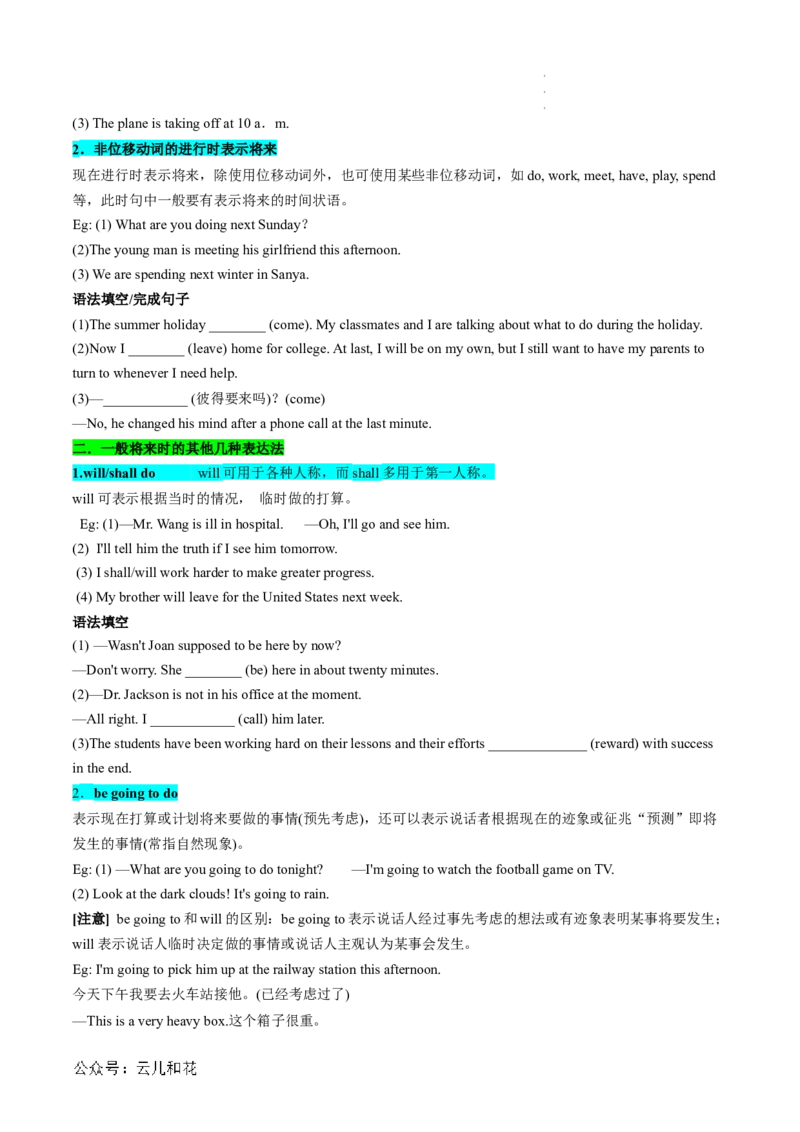
“将来时”的表达法
一.现在进行时表示将来的用法
1.位移动词的进行时表示将来
现在进行时表示将来,主要用于表示按计划或安排将要进行的动作,常有“意图,安排,打算”的含
义。这种用法通常要带一个表示将来的时间状语。有些用法的动词多是位移动词,如arrive, come, go,
leave, return, start, take off, fly等。
Eg: (1)They are coming here this afternoon.
(2)She is leaving tomorrow and you had better see her off.
学科网(北京)股份有限公司(3) The plane is taking off at 10 a.m.
2.非位移动词的进行时表示将来
现在进行时表示将来,除使用位移动词外,也可使用某些非位移动词,如do, work, meet, have, play, spend
等,此时句中一般要有表示将来的时间状语。
Eg: (1) What are you doing next Sunday?
(2)The young man is meeting his girlfriend this afternoon.
(3) We are spending next winter in Sanya.
语法填空/完成句子
(1)The summer holiday ________ (come). My classmates and I are talking about what to do during the holiday.
(2)Now I ________ (leave) home for college. At last, I will be on my own, but I still want to have my parents to
turn to whenever I need help.
(3)—____________ (彼得要来吗)?(come)
—No, he changed his mind after a phone call at the last minute.
二.一般将来时的其他几种表达法
1.will/shall do will可用于各种人称,而shall多用于第一人称。
will可表示根据当时的情况, 临时做的打算。
Eg: (1)—Mr. Wang is ill in hospital. —Oh, I'll go and see him.
(2) I'll tell him the truth if I see him tomorrow.
(3) I shall/will work harder to make greater progress.
(4) My brother will leave for the United States next week.
语法填空
(1) —Wasn't Joan supposed to be here by now?
—Don't worry. She ________ (be) here in about twenty minutes.
(2)—Dr. Jackson is not in his office at the moment.
—All right. I ____________ (call) him later.
(3)The students have been working hard on their lessons and their efforts ______________ (reward) with success
in the end.
2.be going to do
表示现在打算或计划将来要做的事情(预先考虑),还可以表示说话者根据现在的迹象或征兆“预测”即将
发生的事情(常指自然现象)。
Eg: (1) —What are you going to do tonight? —I'm going to watch the football game on TV.
(2) Look at the dark clouds! It's going to rain.
[注意] be going to和will的区别:be going to表示说话人经过事先考虑的想法或有迹象表明某事将要发生;
will表示说话人临时决定做的事情或说话人主观认为某事会发生。
Eg: I'm going to pick him up at the railway station this afternoon.
今天下午我要去火车站接他。(已经考虑过了)
—This is a very heavy box.这个箱子很重。
学科网(北京)股份有限公司—I'll help you carry it.我来帮你搬。(临时作出的决定)
单项填空
—I ________ see the doctor at 10:00. I've made an appointment (预约).
—You don't have to. You ________ be all right soon if you take the medicine.
A.am going to; will B.will; am going to C.would; are going to D.am to; would
3.be to do(不定式作表语)
表示预先安排好的计划或约定(受别人的指令或安排将要做);表示决定会发生的事情;表示说话人的意志、
意图、职责、命令、义务等。
Eg: (1)The meeting is to take place next Monday.
(2)His continuous effort is to make him a successful man.
(3)You're to be back by 9 o'clock.
4.be about to do
表示正要做某事,指眼前的将来,不能和表示将来的时间状语连用。常用于be about to do... when...句型,
意为“正要做……,这时……”。
Eg:I was about to go to bed when the telephone rang.
[注意] be about to do不与具体的表示将来的时间状语连用。
节目将在10分钟之后开演。
【误】The programme is about to begin in ten minutes.
【正】The programme is to begin in ten minutes.
5.一般现在时表示将来,有两种情况:
(1)常用于表示按计划、按规定或是按时刻表将进行的未来动作,仅限于一些位移动词,如go, come, leave,
start, arrive, return, begin等。
Eg: The train leaves at six tomorrow morning.
—When does the bus start? —It starts in ten minutes.
(2)用于时间和条件状语从句中。
Eg: We are going fishing if it doesn't rain tomorrow.
单项填空/语法填空
(1)A Midsummer Night's Dream ________ at the Theatre Royal on 19th June, and then tours throughout Scotland.
A.opens B.is opened C.will open D.will be opened
(2)You'd better write down her phone number before you ______ (forget) it.
(3)They often get up early and water the vegetables together... When summer ________ (come), they will invite
their students to pick the fresh vegetables!
一、现在进行时表示将来的练习
1.My uncle __________________(come)back from abroad next week. 我叔叔下周要从国外回来了。
学科网(北京)股份有限公司2.—Hurry up! The movie_________________. 快点,电影就要开始了。
—Don’t worry. There is still a little time left. 不用担心,还有一点时间。
3.Ladies and gentlemen, please fasten your seat belts. The plane_________________________.女士们,先生们,
请系好安全带。飞机就要起飞了。
4.We _______________(have) a few guests over tomorrow.明天有几位客人要来。
5.Food supplies in the flood-stricken area________________. We must act immediately before there’s none left.灾
区的食物快要吃完了,在吃完之前,我们必须立刻行动。
二、一般将来时的其他几种表达法的练习
1.With the development of science and technology, robot cooks _____________(appear) in our families in the
future. 随着科技的发展,未来机器人厨师会出现在家庭中。
2.— Just a minute. I ________________(check) it for you. 请稍等,我现在就帮你看一下。
—Ann is in hospital. 安住院了。
—Oh, really? I didn’t know. I ______________(go) and visit her. 真的吗?我不知道啊,我要去探望她。
3.Look at the dark clouds. _________________________. 看这乌云,要下雨了。
4.Oh , it's 8:20. I________________ late for my class. 现在是8点20分。我上课要迟到了。
5.The examination is __________ ____________ _____________next week. (take place)
6.如果你想要成功,比必须努力工作。
我们就要出发了。
7.We will go for a picnic if it _____________ _________________(rain) this Sunday.
如果本周日不下雨,我们将去野餐。
8.The students ________ __________ ___________(meet) at the school gate tomorrow.
明天学生们将在学校大门口集会。
9.Please tell him the news as soon as he ______(arrive). 他一来,你就告诉他这个消息。
三、用所给单词正确形式填空
1. —Is everybody here?—No. The speaker _________ (come)soon.
2. The weather _________ (get) warmer and warmer.
3. I _________ (write) a new book these days.
4. The girl ____ always ________(leave) things about.
5. —I’m going to the to study law.—How long _______ you _______ (stay)there?
6. What will you want to be when you ______ (grow) up?
7. Look at the lightning. It_________ (rain).
8. Our English teacher _________ (leave )Shanghai in a few days.
9. —Jim is in town for a few days.
—Really? Great! I _________ (give) him a call. Is he staying at his Aunt Rosa’s?
10.Don’t make noises. Father ________ (listen)to the news.
四、按照要求翻译下列句子。
你要在北京待多久? (用现在进行时表示)
学科网(北京)股份有限公司________________________________________________________________________
今天下午我要去看牙医。(用现在进行时表示)
________________________________________________________________________
我将更加努力以取得更大的进步。(shall/will do ; make progress)
________________________________________________________________________
你今天晚上打算做什么?(be going to do)
________________________________________________________________________
你必须九点以前回来。(be to do; back)
________________________________________________________________________
我正要上床睡觉,这时电话响了。(be about to do; ring)
________________________________________________________________________
火车明天早上六点开。(一般现在时表将来)
________________________________________________________________________
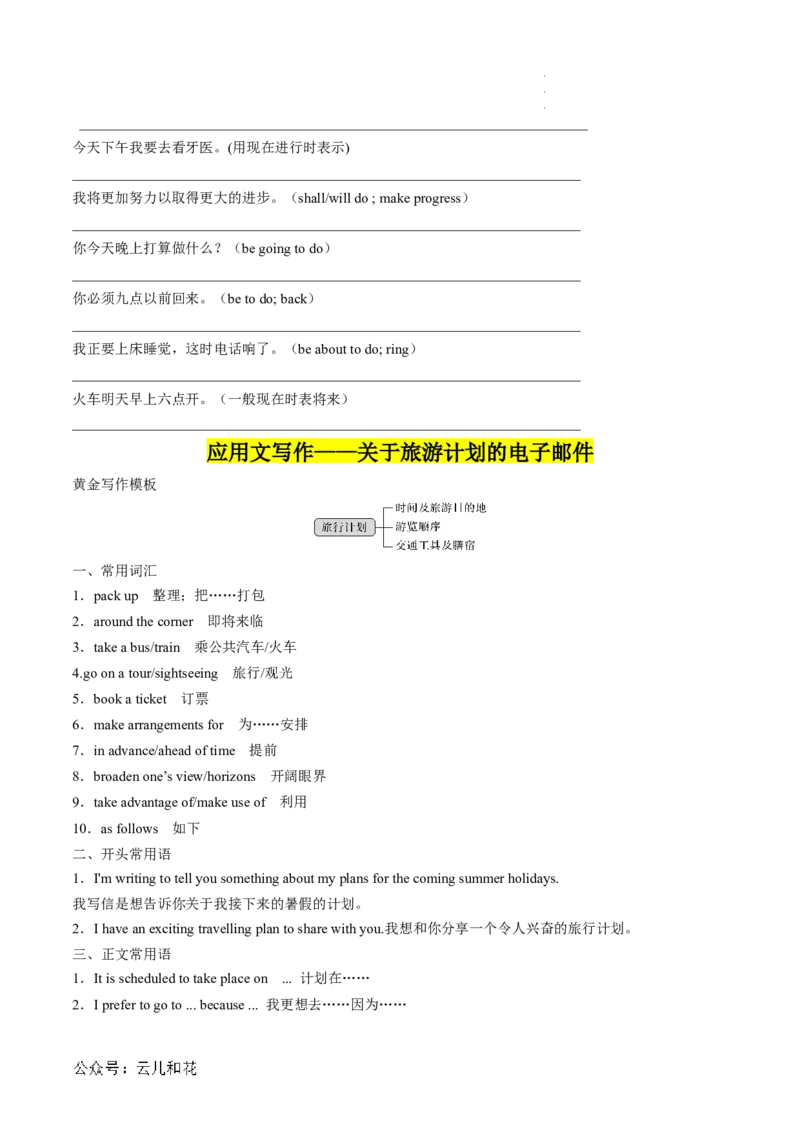
应用文写作——关于旅游计划的电子邮件
黄金写作模板
一、常用词汇
1.pack up 整理;把……打包
2.around the corner 即将来临
3.take a bus/train 乘公共汽车/火车
4.go on a tour/sightseeing 旅行/观光
5.book a ticket 订票
6.make arrangements for 为……安排
7.in advance/ahead of time 提前
8.broaden one’s view/horizons 开阔眼界
9.take advantage of/make use of 利用
10.as follows 如下
二、开头常用语
1.I'm writing to tell you something about my plans for the coming summer holidays.
我写信是想告诉你关于我接下来的暑假的计划。
2.I have an exciting travelling plan to share with you.我想和你分享一个令人兴奋的旅行计划。
三、正文常用语
1.It is scheduled to take place on ... 计划在……
2.I prefer to go to ... because ... 我更想去……因为……
学科网(北京)股份有限公司3.First, I'm going to ... 首先,我打算……
4.I plan to go to ... 我计划去……
5.The trip will last X days.旅行将持续X天。
6.The X-day trip costs about ... 为期X天的旅行大概花费……
7.I think this trip sounds really exciting.我觉得这次旅行听起来很让人兴奋。
四、结尾常用语
1.Looking forward to hearing from you.期待收到你的来信。
2.Looking forward to your early reply.期待你尽快回复。
3.Do you have any advice?你有什么建议吗?
4.Would you like to join me?你想和我一起去吗?
5.We will have a great time. 我们会玩得很开心。
假定你是李华,你打算和妈妈一起去度假。请给你的英国笔友 John写一封电子邮件,告诉他你们的度
假方案并征求意见。内容包括:
1.出行时间;
2.目的地及选择此处的原因;
3.拟定的活动安排;
4.费用问题。
注意:1.词数80左右;
2.可以适当增加细节,以使行文连贯。
一
假定你是李华,受你的邀请,你的英国笔友Tony在即将来临的暑假要来你所在城市大连游玩,请你根
据下列提示信息拟一份旅游计划,以便朋友到来时做到各方面有条不紊。
1.去机场接机;
2.游玩大连市区;
学科网(北京)股份有限公司3.去海滩看海,等等。
要求:1.可以适当添加信息,以使行文连贯;
2.词数80左右。
【学生习作】
[点评] 1.①②句可合为一
Travelling to Dalian
句。
①Summer holiday is coming. ②I have a good plan for
2.③句可改为含非谓语动词
it. My best friend Tony who is from Britain will spend the
的句子。
holiday with me. Tony is 17 years old and he likes China
very much. ③One week ago,I wrote him a letter and
3.④⑤句可省略主语合为一
句话。
invited him to come to Dalian for the holiday.To my joy,
Tony has accepted my invitation and will fly to Dalian next
week. I will go to the airport to pick him up.④Then I'll show
him around the city.⑤We'll go to the beach to watch the sea
first.At last, we'll visit some interesting places. Tony will
【升格作文】
二
假定你是李华,你打算和妈妈一起去度假。请给你的英国笔友 John写一封电子邮件,告诉他你们的度
假方案并征求意见。内容包括:
学科网(北京)股份有限公司1.出行时间;
2.目的地及选择此处的原因;
3.拟定的活动安排;
4.费用问题。
注意:1.词数80左右;
2.可以适当增加细节,以使行文连贯。
三
假定你是李华,计划寒假期间去新西兰(New Zealand)旅行。请你用英语给你的新西兰朋友Jack写一封
电子邮件询问一些信息,内容包括:
1.著名旅游景点信息;
2.当地特色(如小吃、节日等);
3.注意事项。
注意:1.词数80左右;
2.可以适当增加细节,以使行文连贯。
[精彩范文]
课外拓展阅读
阅读下面材料,在空白处填入适当的内容(1个单词)或括号内单词的正确形式。
A trip to China with the kids could be a test to your nerves, but also __1__ wonderful experience. This is an
ancient civilization which is growing __2__ great speed into the 21st century, meanwhile holding onto the old
学科网(北京)股份有限公司traditions and way of life.
As you travel from area to area, a sea of contrasts is __3__ makes it so fascinating. You can find an old
fisherman on his bamboo boat __4__ (answer) his mobile phone, and modernity and old traditions existing side by
side. The only constant thing in China is “change”.
At first it might seem challenging. But you will find the people helpful, __5__ (especial) if you are traveling
with children. Chinese love children, the more the __6__ (happy).
But as far as children __7__ (be) concerned, this isn't a light-hearted (轻松愉快的) trip to Disneyworld.
What if they get sick? Will the kids like the food? Is __8__ (pollute) really that bad? Will they be __9__ (bore)?
Just relax. You can depend on it that you'll end up with plenty of priceless __10__ (memory) of the country.
1.________ 2.________ 3.________ 4.________5.________ 6.________ 7.________ 8.________
9.________ 10.________
学科网(北京)股份有限公司