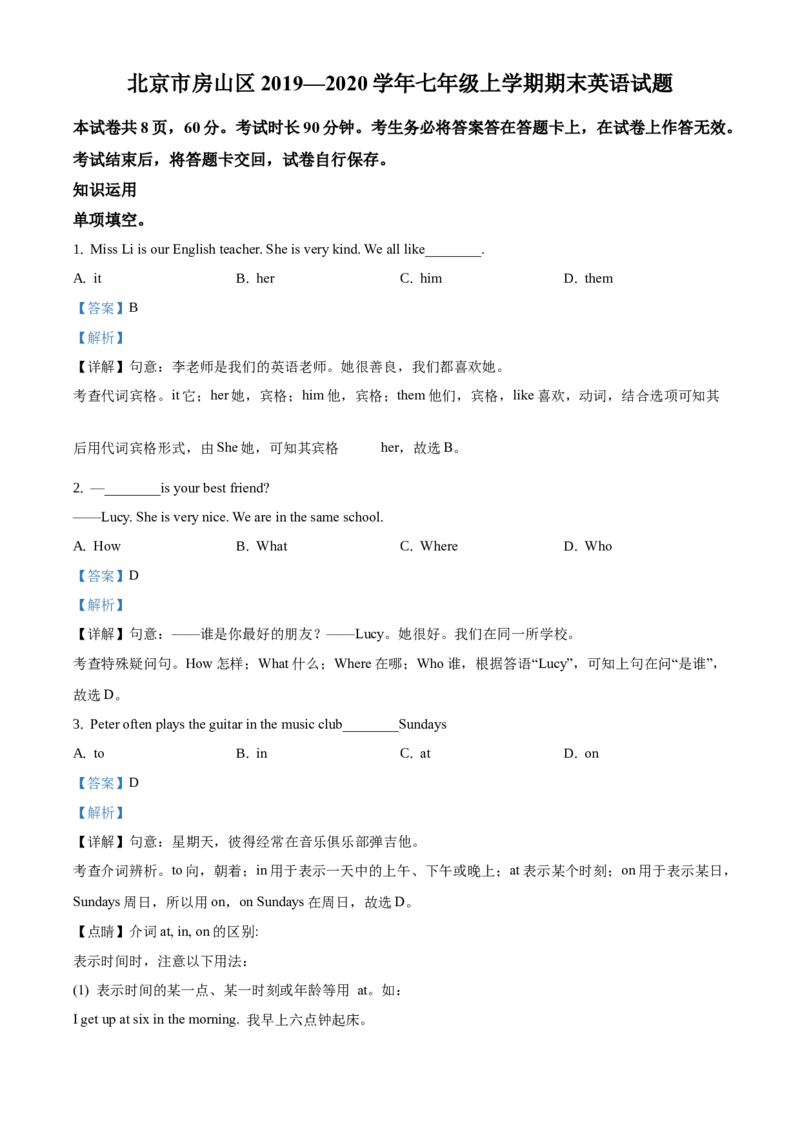
北京市房山区 2019-2020 学年九年级上学期期末英语试题
知识运用
单项填空
从下面各题所给的A、B、C、D四个选项中,选择可以填入空白处的最佳选项。
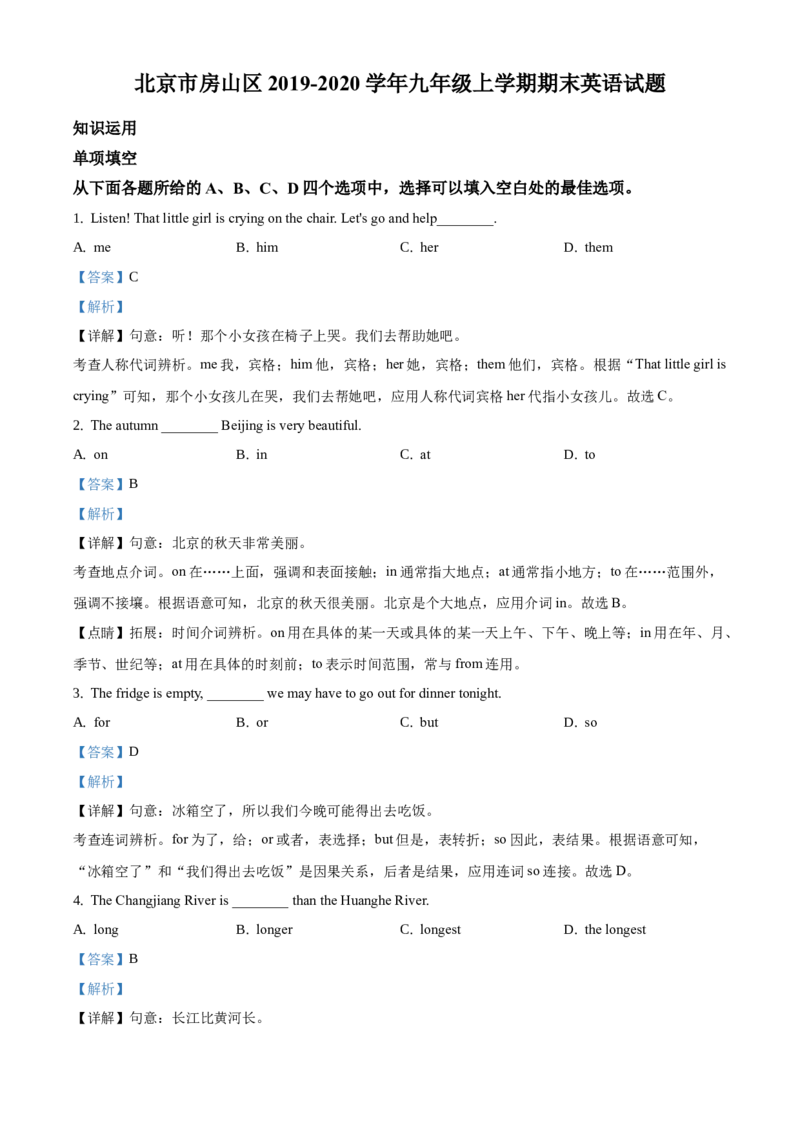
1. Listen! That little girl is crying on the chair. Let's go and help________.
A. me B. him C. her D. them
【答案】C
【解析】
【详解】句意:听!那个小女孩在椅子上哭。我们去帮助她吧。
考查人称代词辨析。me我,宾格;him他,宾格;her她,宾格;them他们,宾格。根据“That little girl is
crying”可知,那个小女孩儿在哭,我们去帮她吧,应用人称代词宾格her代指小女孩儿。故选C。
2. The autumn ________ Beijing is very beautiful.
A. on B. in C. at D. to
【答案】B
【解析】
【详解】句意:北京的秋天非常美丽。
考查地点介词。on在……上面,强调和表面接触;in通常指大地点;at通常指小地方;to在……范围外,
强调不接壤。根据语意可知,北京的秋天很美丽。北京是个大地点,应用介词in。故选B。
【点睛】拓展:时间介词辨析。on用在具体的某一天或具体的某一天上午、下午、晚上等;in用在年、月、
季节、世纪等;at用在具体的时刻前;to表示时间范围,常与from连用。
3. The fridge is empty, ________ we may have to go out for dinner tonight.
A. for B. or C. but D. so
【答案】D
【解析】
【详解】句意:冰箱空了,所以我们今晚可能得出去吃饭。
考查连词辨析。for为了,给;or或者,表选择;but但是,表转折;so因此,表结果。根据语意可知,
“冰箱空了”和“我们得出去吃饭”是因果关系,后者是结果,应用连词so连接。故选D。
4. The Changjiang River is ________ than the Huanghe River.
A. long B. longer C. longest D. the longest
【答案】B
【解析】
【详解】句意:长江比黄河长。考查形容词比较级。long原形;longer较长的;longest最长的;the longest最长的,用在最高级。根据关键
词“than”可知,本句为比较级句式,应用“long”的比较级形式“longer”来表示长江比黄河长。故选
B。
【点睛】拓展:英语最高级前不用the的几种情况。(1)形容词最高级前加the,副词最高级前不加the。
(2)形容词最高级作表语时,有时可以省略the。(3)最高级形容词作表语,副词作状语时,没和别人
比较时不用加the。(4)最高级前已有名词所有格或物主代词时,不加the。(5)有时most表示“非常”,
而不是最高级,不用the。
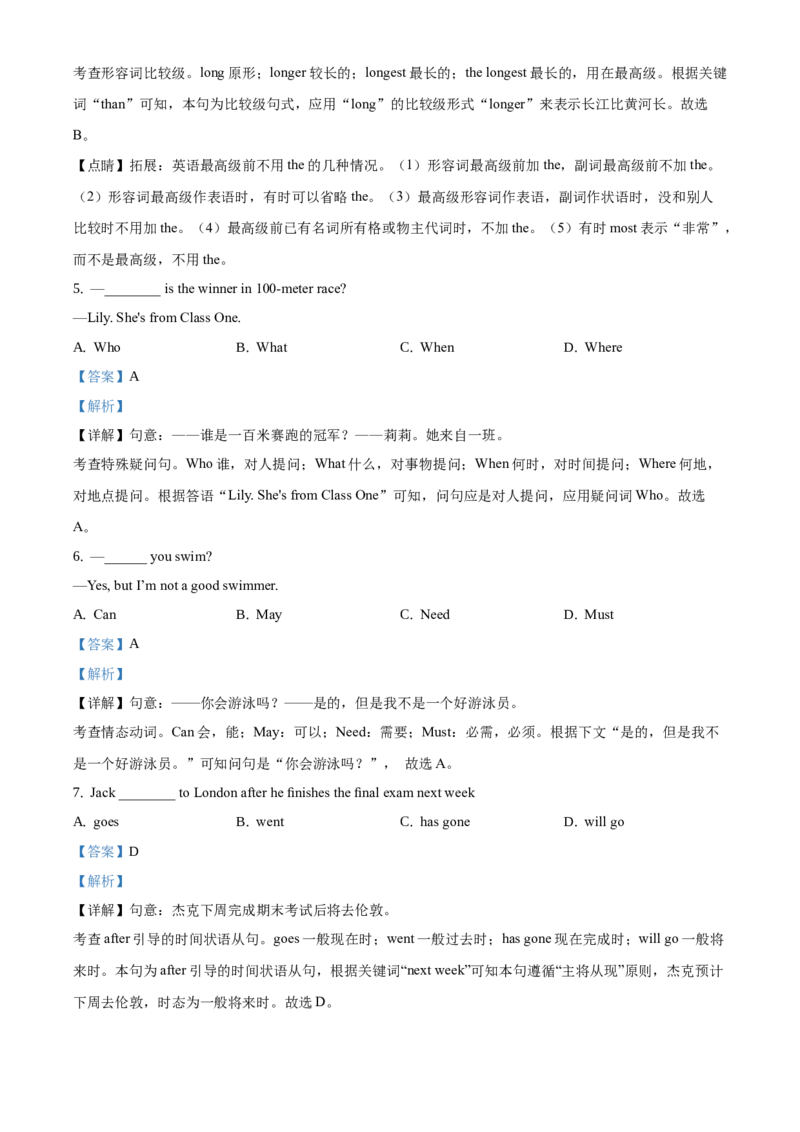
5. —________ is the winner in 100-meter race?
—Lily. She's from Class One.
A. Who B. What C. When D. Where
【答案】A
【解析】
【详解】句意:——谁是一百米赛跑的冠军?——莉莉。她来自一班。
考查特殊疑问句。Who谁,对人提问;What什么,对事物提问;When何时,对时间提问;Where何地,
对地点提问。根据答语“Lily. She's from Class One”可知,问句应是对人提问,应用疑问词Who。故选
A。
6. —______ you swim?
—Yes, but I’m not a good swimmer.
A. Can B. May C. Need D. Must
【答案】A
【解析】
【详解】句意:——你会游泳吗?——是的,但是我不是一个好游泳员。
考查情态动词。Can会,能;May:可以;Need:需要;Must:必需,必须。根据下文“是的,但是我不
是一个好游泳员。”可知问句是“你会游泳吗?”, 故选A。
.
7. Jack ________ to London after he finishes the final exam next week
A. goes B. went C. has gone D. will go
【答案】D
【解析】
【详解】句意:杰克下周完成期末考试后将去伦敦。
考查after引导的时间状语从句。goes一般现在时;went一般过去时;has gone现在完成时;will go一般将
来时。本句为after引导的时间状语从句,根据关键词“next week”可知本句遵循“主将从现”原则,杰克预计
下周去伦敦,时态为一般将来时。故选D。8. —May I speak to Mrs. Smith?
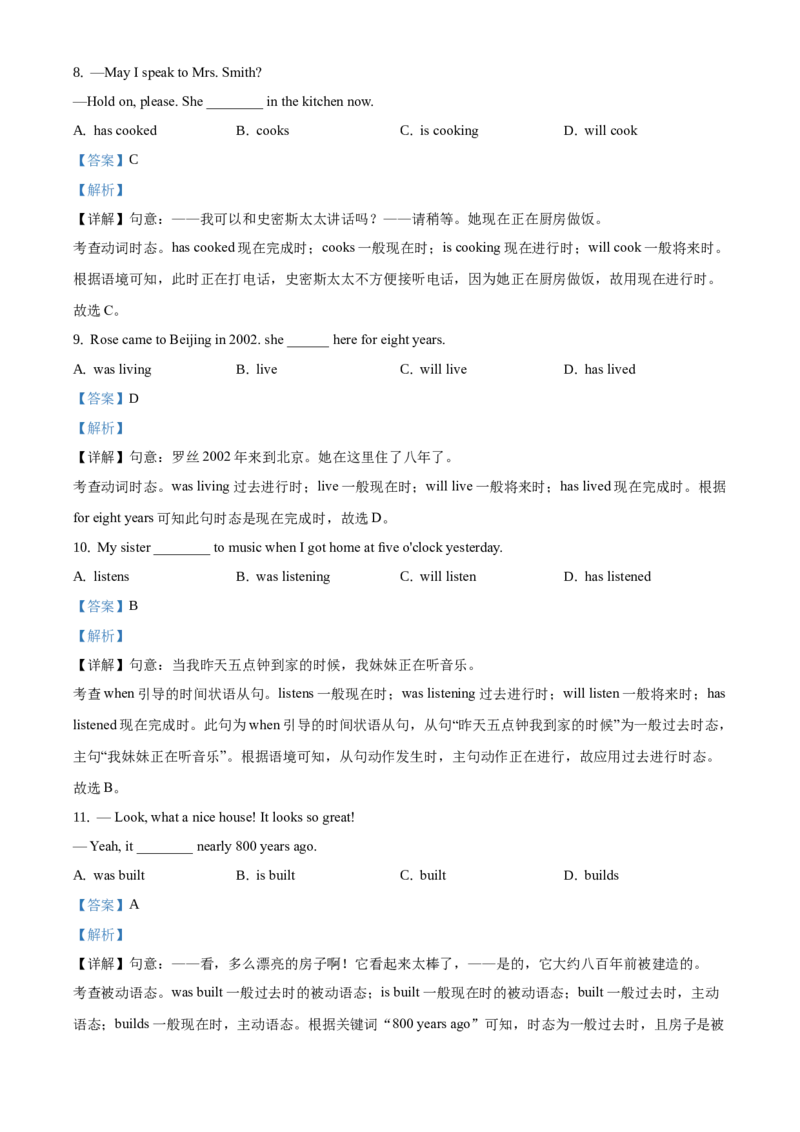
—Hold on, please. She ________ in the kitchen now.
A. has cooked B. cooks C. is cooking D. will cook
【答案】C
【解析】
【详解】句意:——我可以和史密斯太太讲话吗?——请稍等。她现在正在厨房做饭。
考查动词时态。has cooked现在完成时;cooks一般现在时;is cooking现在进行时;will cook一般将来时。
根据语境可知,此时正在打电话,史密斯太太不方便接听电话,因为她正在厨房做饭,故用现在进行时。
故选C。
9. Rose came to Beijing in 2002. she ______ here for eight years.
A. was living B. live C. will live D. has lived
【答案】D
【解析】
【详解】句意:罗丝2002年来到北京。她在这里住了八年了。
考查动词时态。was living过去进行时;live一般现在时;will live一般将来时;has lived现在完成时。根据
for eight years可知此句时态是现在完成时,故选D。
10. My sister ________ to music when I got home at five o'clock yesterday.
A. listens B. was listening C. will listen D. has listened
【答案】B
【解析】
【详解】句意:当我昨天五点钟到家的时候,我妹妹正在听音乐。
考查when引导的时间状语从句。listens一般现在时;was listening过去进行时;will listen一般将来时;has
listened现在完成时。此句为when引导的时间状语从句,从句“昨天五点钟我到家的时候”为一般过去时态,
主句“我妹妹正在听音乐”。根据语境可知,从句动作发生时,主句动作正在进行,故应用过去进行时态。
故选B。
11. — Look, what a nice house! It looks so great!
— Yeah, it ________ nearly 800 years ago.
A. was built B. is built C. built D. builds
【答案】A
【解析】
【详解】句意:——看,多么漂亮的房子啊!它看起来太棒了,——是的,它大约八百年前被建造的。
考查被动语态。was built一般过去时的被动语态;is built一般现在时的被动语态;built一般过去时,主动
语态;builds一般现在时,主动语态。根据关键词“800 years ago”可知,时态为一般过去时,且房子是被建造的,应用被动语态。故选A。
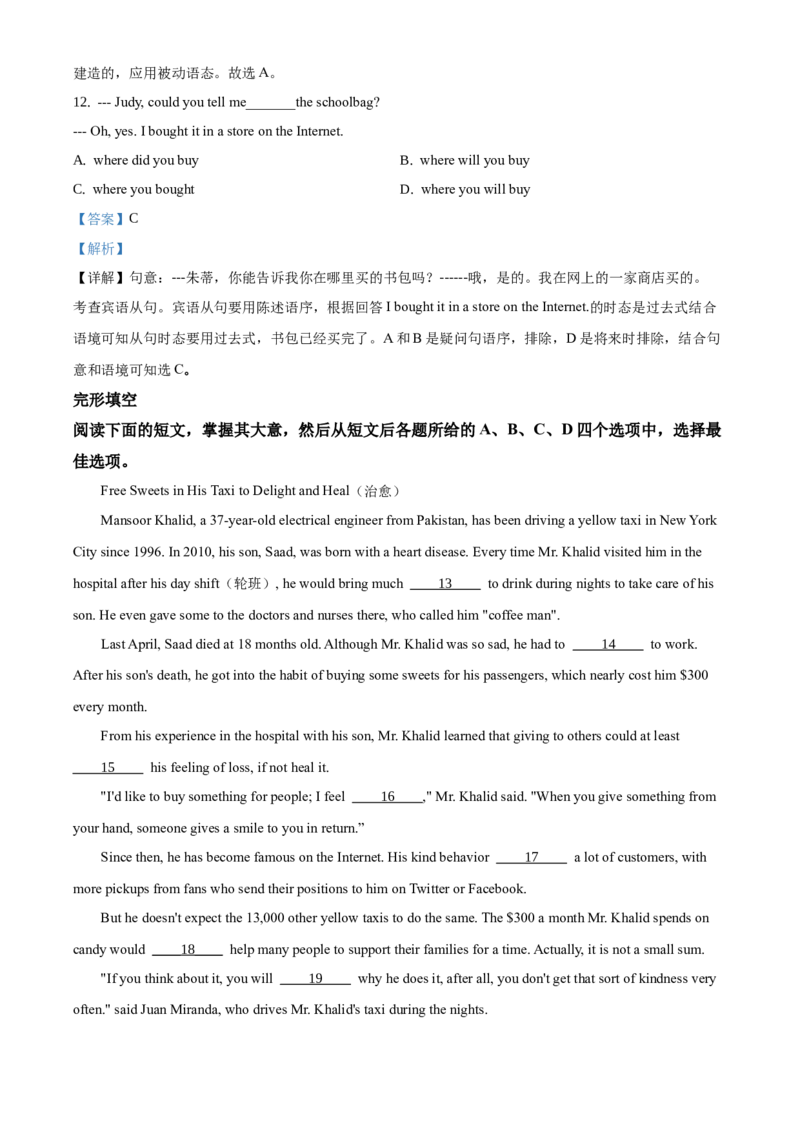
12. --- Judy, could you tell me_______the schoolbag?
--- Oh, yes. I bought it in a store on the Internet.
A. where did you buy B. where will you buy
C. where you bought D. where you will buy
【答案】C
【解析】
【详解】句意:---朱蒂,你能告诉我你在哪里买的书包吗?------哦,是的。我在网上的一家商店买的。
考查宾语从句。宾语从句要用陈述语序,根据回答I bought it in a store on the Internet.的时态是过去式结合
语境可知从句时态要用过去式,书包已经买完了。A和B是疑问句语序,排除,D是将来时排除,结合句
意和语境可知选C。
完形填空
阅读下面的短文,掌握其大意,然后从短文后各题所给的A、B、C、D四个选项中,选择最
佳选项。
Free Sweets in His Taxi to Delight and Heal(治愈)
Mansoor Khalid, a 37-year-old electrical engineer from Pakistan, has been driving a yellow taxi in New York
City since 1996. In 2010, his son, Saad, was born with a heart disease. Every time Mr. Khalid visited him in the
hospital after his day shift(轮班), he would bring much ____13____ to drink during nights to take care of his
son. He even gave some to the doctors and nurses there, who called him "coffee man".
Last April, Saad died at 18 months old. Although Mr. Khalid was so sad, he had to ____14____ to work.
After his son's death, he got into the habit of buying some sweets for his passengers, which nearly cost him $300
every month.
From his experience in the hospital with his son, Mr. Khalid learned that giving to others could at least
____15____ his feeling of loss, if not heal it.
"I'd like to buy something for people; I feel ____16____," Mr. Khalid said. "When you give something from
your hand, someone gives a smile to you in return.”
Since then, he has become famous on the Internet. His kind behavior ____17____ a lot of customers, with
more pickups from fans who send their positions to him on Twitter or Facebook.
But he doesn't expect the 13,000 other yellow taxis to do the same. The $300 a month Mr. Khalid spends on
candy would ____18____ help many people to support their families for a time. Actually, it is not a small sum.
"If you think about it, you will ____19____ why he does it, after all, you don't get that sort of kindness very
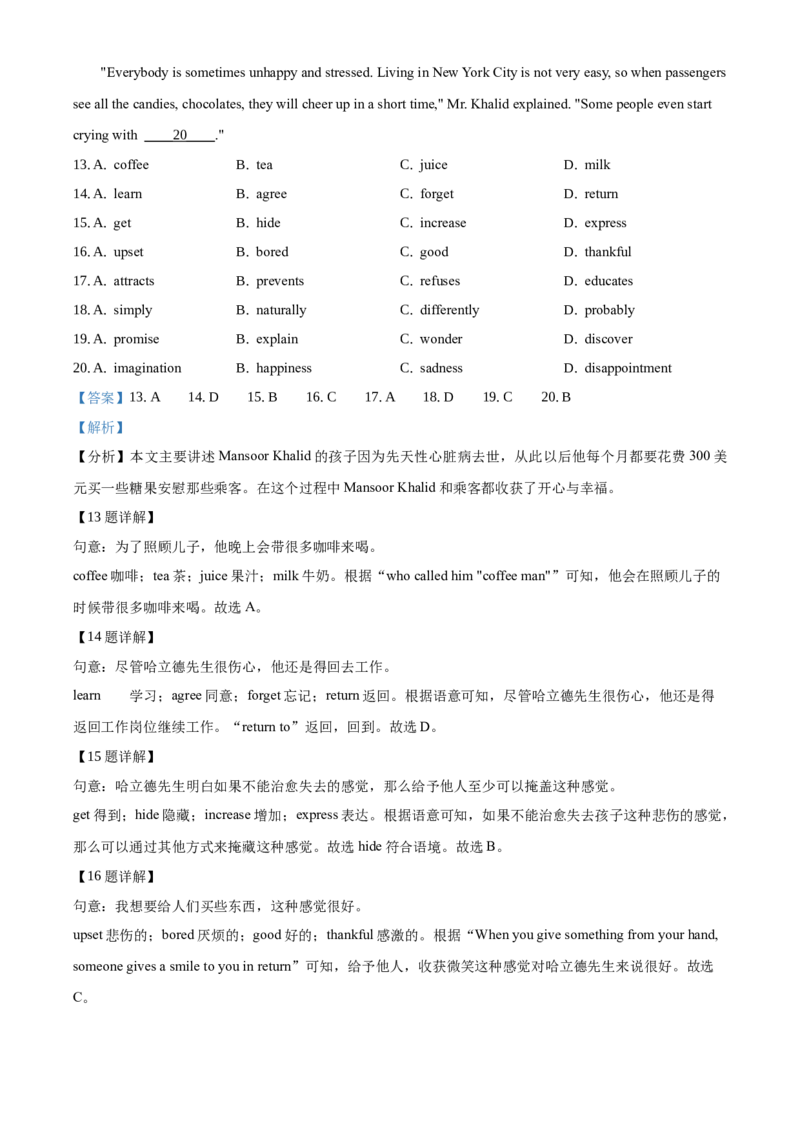
often." said Juan Miranda, who drives Mr. Khalid's taxi during the nights."Everybody is sometimes unhappy and stressed. Living in New York City is not very easy, so when passengers
see all the candies, chocolates, they will cheer up in a short time," Mr. Khalid explained. "Some people even start
crying with ____20____."
13. A. coffee B. tea C. juice D. milk
14. A. learn B. agree C. forget D. return
15. A. get B. hide C. increase D. express
16. A. upset B. bored C. good D. thankful
17. A. attracts B. prevents C. refuses D. educates
18. A. simply B. naturally C. differently D. probably
19. A. promise B. explain C. wonder D. discover
20. A. imagination B. happiness C. sadness D. disappointment
【答案】13. A 14. D 15. B 16. C 17. A 18. D 19. C 20. B
【解析】
【分析】本文主要讲述Mansoor Khalid的孩子因为先天性心脏病去世,从此以后他每个月都要花费300美
元买一些糖果安慰那些乘客。在这个过程中Mansoor Khalid和乘客都收获了开心与幸福。
【13题详解】
句意:为了照顾儿子,他晚上会带很多咖啡来喝。
coffee咖啡;tea茶;juice果汁;milk牛奶。根据“who called him "coffee man"”可知,他会在照顾儿子的
时候带很多咖啡来喝。故选A。
【14题详解】
句意:尽管哈立德先生很伤心,他还是得回去工作。
learn 学习;agree同意;forget忘记;return返回。根据语意可知,尽管哈立德先生很伤心,他还是得
返回工作岗位继续工作。“return to”返回,回到。故选D。
【15题详解】
句意:哈立德先生明白如果不能治愈失去的感觉,那么给予他人至少可以掩盖这种感觉。
get得到;hide隐藏;increase增加;express表达。根据语意可知,如果不能治愈失去孩子这种悲伤的感觉,
那么可以通过其他方式来掩藏这种感觉。故选hide符合语境。故选B。
【16题详解】
句意:我想要给人们买些东西,这种感觉很好。
upset悲伤的;bored厌烦的;good好的;thankful感激的。根据“When you give something from your hand,
someone gives a smile to you in return”可知,给予他人,收获微笑这种感觉对哈立德先生来说很好。故选
C。【17题详解】
句意:他 的善举吸引了很多顾客。
attracts吸引;prevents阻止;refuses拒绝;educates教育。根据“with more pickups from fans who send their
positions to him on Twitter or Facebook”可知,哈立德先生的善举吸引了很多的顾客。故选A。
【18题详解】
句意:哈立德每月花在糖果上的300美元可能会帮助很多人暂时养家糊口。
simply简单地;naturally自然地;differently不同地;probably可能地。根据“Actually, it is not a small
sum”可知,哈立德先生没有买糖果的钱是一笔不小的数目,可能够许多人维持生活。故选probably符合
语境。故选D。
【19题详解】
句意:如果你想一想,你会想他为什么这么做,毕竟你不经常得到那种好意。
promise承诺;explain解释;wonder猜想,想知道;discover发现。根据语意可知,因为我们并不经常得到
这样的善意,所以不免会想知道哈立德先生为什么会这么做。故选C。
【20题详解】
句意:有些人甚至开始幸福地哭了。
imagination想象;happiness幸福;sadness悲伤;disappointment失望。根据“Everybody is sometimes
unhappy and stressed…they will cheer up in a short time”可知,在纽约生活的人们并不容易,所以当他们乘
车的时候看到了糖果巧克力肯定会感到非常开心幸福。故选B。
阅读理解
阅读选择
阅读短文,根据短文内容,从短文后各题所给的A、B、C、D四个选项中,选择最佳选项。
A
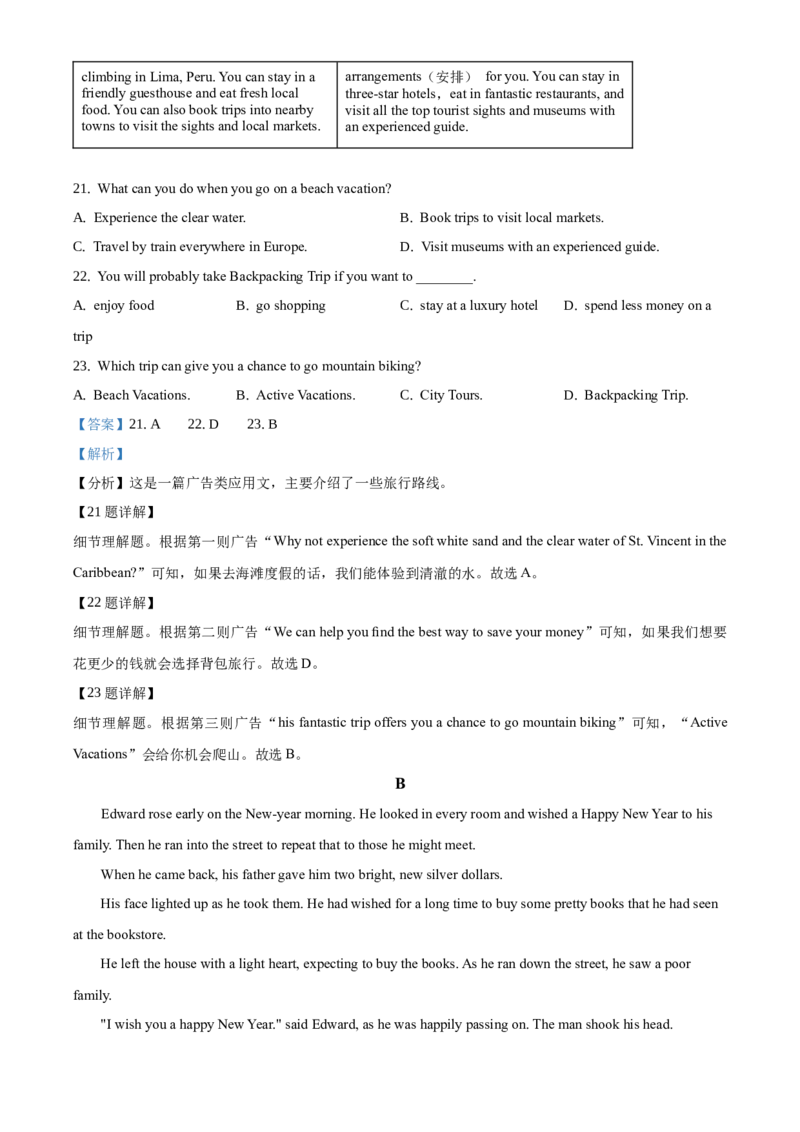
Find your perfect trip. Book or buy today for big savings!
Backpacking Trip
Beach Vacations
If you like to stay in youth hotels(青年旅社)
If you want a beach vacation, we can offer
or bed & breakfasts on a backpacking trip, we
you a choice of some of the beautiful
can plan your trip and book all your
beaches in the world. Why not experience
transportation and accommodations(食宿).
the soft white sand and the clear water of
With an Inter Rail card, you can travel cheaply
St. Vincent in the Caribbean? The beaches
by train everywhere in Europe. In America, you
are perfect, the water is warm, and you can
can travel by bus, by plane, or by train. We can
relax at your luxury(豪华)hotel.
help you find the best way to save your money.
Active Vacations City Tours
If you want to be active when you are on Interested in a tour of some great cities? Try our
vacation, then try an active vacation. This Europe Tour! It includes two nights in Rome,
fantastic trip offers you a chance to go Venice, Lucerne, Paris, and London. You can
mountain biking,hiking(远足), and travel by plane and by bus,and we make all theclimbing in Lima, Peru. You can stay in a arrangements(安排) for you. You can stay in
friendly guesthouse and eat fresh local three-star hotels,eat in fantastic restaurants, and
food. You can also book trips into nearby visit all the top tourist sights and museums with
towns to visit the sights and local markets. an experienced guide.
21. What can you do when you go on a beach vacation?
A. Experience the clear water. B. Book trips to visit local markets.
C. Travel by train everywhere in Europe. D. Visit museums with an experienced guide.
22. You will probably take Backpacking Trip if you want to ________.
A. enjoy food B. go shopping C. stay at a luxury hotel D. spend less money on a
trip
23. Which trip can give you a chance to go mountain biking?
A. Beach Vacations. B. Active Vacations. C. City Tours. D. Backpacking Trip.
【答案】21. A 22. D 23. B
【解析】
【分析】这是一篇广告类应用文,主要介绍了一些旅行路线。
【21题详解】
细节理解题。根据第一则广告“Why not experience the soft white sand and the clear water of St. Vincent in the
Caribbean?”可知,如果去海滩度假的话,我们能体验到清澈的水。故选A。
【22题详解】
细节理解题。根据第二则广告“We can help you find the best way to save your money”可知,如果我们想要
花更少的钱就会选择背包旅行。故选D。
【23题详解】
细节理解题。根据第三则广告“his fantastic trip offers you a chance to go mountain biking”可知,“Active
Vacations”会给你机会爬山。故选B。
B
Edward rose early on the New-year morning. He looked in every room and wished a Happy New Year to his
family. Then he ran into the street to repeat that to those he might meet.
When he came back, his father gave him two bright, new silver dollars.
His face lighted up as he took them. He had wished for a long time to buy some pretty books that he had seen
at the bookstore.
He left the house with a light heart, expecting to buy the books. As he ran down the street, he saw a poor
family.
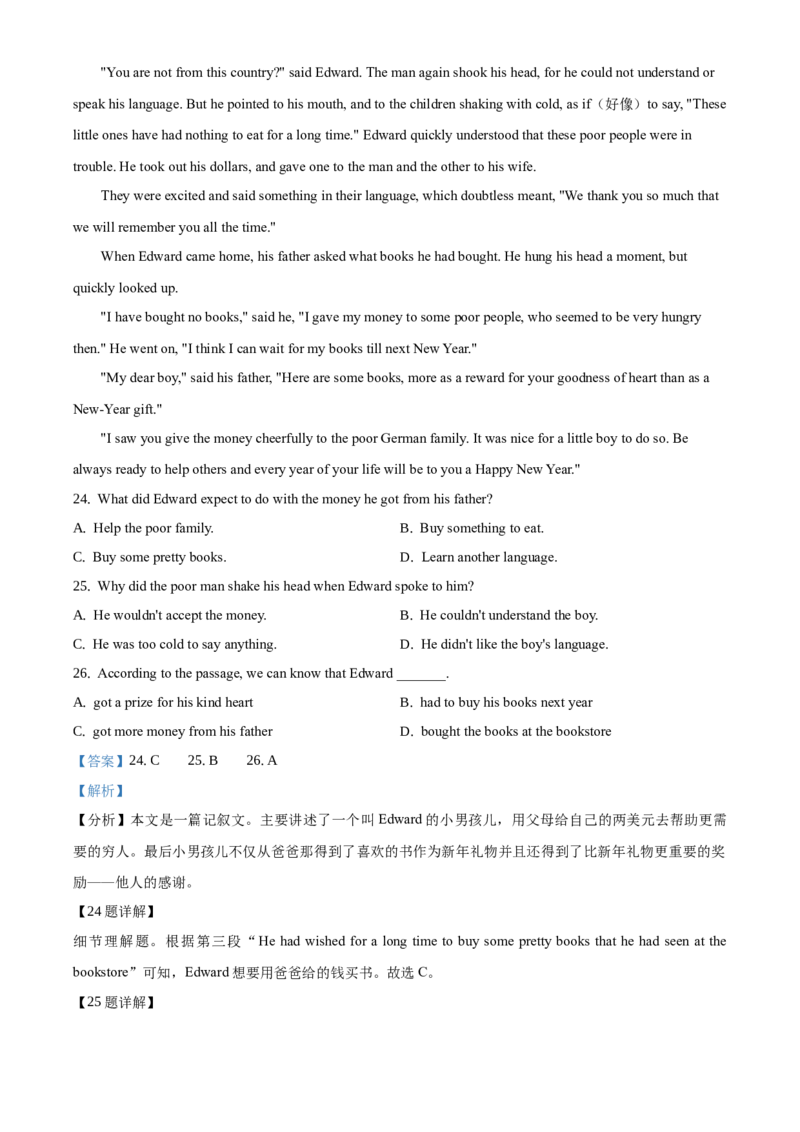
"I wish you a happy New Year." said Edward, as he was happily passing on. The man shook his head."You are not from this country?" said Edward. The man again shook his head, for he could not understand or
speak his language. But he pointed to his mouth, and to the children shaking with cold, as if(好像)to say, "These
little ones have had nothing to eat for a long time." Edward quickly understood that these poor people were in
trouble. He took out his dollars, and gave one to the man and the other to his wife.
They were excited and said something in their language, which doubtless meant, "We thank you so much that
we will remember you all the time."
When Edward came home, his father asked what books he had bought. He hung his head a moment, but
quickly looked up.
"I have bought no books," said he, "I gave my money to some poor people, who seemed to be very hungry
then." He went on, "I think I can wait for my books till next New Year."
"My dear boy," said his father, "Here are some books, more as a reward for your goodness of heart than as a
New-Year gift."
"I saw you give the money cheerfully to the poor German family. It was nice for a little boy to do so. Be
always ready to help others and every year of your life will be to you a Happy New Year."
24. What did Edward expect to do with the money he got from his father?
A. Help the poor family. B. Buy something to eat.
C. Buy some pretty books. D. Learn another language.
25. Why did the poor man shake his head when Edward spoke to him?
A. He wouldn't accept the money. B. He couldn't understand the boy.
C. He was too cold to say anything. D. He didn't like the boy's language.
26. According to the passage, we can know that Edward _______.
A. got a prize for his kind heart B. had to buy his books next year
C. got more money from his father D. bought the books at the bookstore
【答案】24. C 25. B 26. A
【解析】
【分析】本文是一篇记叙文。主要讲述了一个叫Edward的小男孩儿,用父母给自己的两美元去帮助更需
要的穷人。最后小男孩儿不仅从爸爸那得到了喜欢的书作为新年礼物并且还得到了比新年礼物更重要的奖
励——他人的感谢。
【24题详解】
细节理解题。根据第三段“He had wished for a long time to buy some pretty books that he had seen at the
bookstore”可知,Edward想要用爸爸给的钱买书。故选C。
【25题详解】细节理解题。根据第六段“for he could not understand or speak his language”可知,因为这个穷人听不懂
Edward的话,所以对Edward摇头。故选B。
【26题详解】
细节理解题。根据第十段“Here are some books, more as a reward for your goodness of heart than as a New-Year
gift."”可知,Edward从爸爸那得到了对自己善良的心灵的奖励。故选A。
C
Parents of very young children know this:You catch your child in the act of stealing the cookie—the
evidence(证据)of candy written on his or her face. However, the kid often gives a denial, "I didn't do it!"
Learning to tell the truth, even at the risk of punishment, is an important part of moral(道德)development,
and new research suggests it can take seven or more years for kids to get there.
Early in 2017 Professor Craig E. Smith published a study. He and his workmates chose 48 children between
four and nine years of age. They told the kids a story about a boy or girl doing something wrong,such as taking a
classmate's toy or candy, and then either lying about the wrongdoing to a parent or confessing(承认错误) it. In
each case, they asked the children, "How would the child feel? How would the mother feel?"
The children's answers were generally divided according to age, which is in agreement with the above
research, showing a gradual growth of moral understanding in early childhood. More of the four-to-five-year-olds
thought the child in the story would feel better keeping the stolen candy, lying and getting unpunished. They
imagined the parent in the study would be angry with the child who confessed. However, the seven-to-nine-year-
olds were more likely to think the child would feel better confessing the wrongdoing and that the parent would have
positive(积极的) feelings towards a confessor.
,
Smith says "Kids of all ages who expect that a parent would feel happy about a child's confession are
more likely to tell the truth rather than lie. Reward the honesty even if you feel you must punish the wrong action."
He adds, what parents can learn from these studies is to listen calmly without getting angry right away when their
child confesses.
Allowing children to make mistakes is one of the greatest challenges of parenting. It is easier when they are
young. The potential(潜在的) mistakes carry greater risks, and part of being a parent is reducing risk for our
children.
27. What does the expression "gives a denial," in Paragraph 1 mean?
A. refuses to tell the truth B. decides to blame the parent
C. prepares to accept the truth D. begins to shout at the parent
28. What did Smith and his workmates find in their study?
A. Kids of all ages are more likely to tell the truth rather than lie.B. Younger children would feel better confessing the wrongdoing.
C. Older kids thought parents would be angry with their confessions.
D. Older kids are more likely to confess to an act than younger children.
29. What can we learn from the passage?
A. It's easy for kids to confess their mistakes.
B. Parents should at once punish the kids who lied.
C. It takes time for children to learn to tell the truth.
D. Parents should never get angry after kids' confessions.
30. What is the passage mainly about?
A. Why children like telling lies when they are young.
B. How children feel when they confess their mistakes.
.
C. Why parents must punish their children's wrong actions
D. How parents should treat their children when they make mistakes.
【答案】27. A 28. D 29. C 30. D
【解析】
【分析】本文是一篇议论文。主要介绍了当小孩子犯了错误时该诚实还是说谎,家长应该以什么样的态度
对待孩子,并且给了父母几条建议。
【27题详解】
词句猜测题。根据第一段可知,“however”然而,表转折。意思是说,即使你抓到了孩子偷吃糖果的证
据,孩子们还是会说他们没有偷吃糖果。所以“gives a denial”的意思是拒绝说出真相。故选A。
【28题详解】
细节理解题。根据第四段“showing a gradual growth of moral understanding in early childhood”以及段落大
意可知,大一点的孩子比小一点的孩子更容易承认自己错误的行为。故选D。
【29题详解】
细节理解题。根据第二段“Learning to tell the truth…it can take seven or more years for kids to get there”可知,
学会讲真话是道德发展的重要组成部分,孩子们要花上七年甚至更长的时间才能学会。故选C。
【30题详解】
主旨大意题。根据文章最后一句“The potential mistakes carry greater risks, and part of being a parent is reducing
risk for our children”及全文大意可知,本文主要讲述的是父母在孩子犯错误时,应该以怎样的态度对待孩
子。故选D。
D
I read somewhere that we spend a full third of our lives waiting. But where are we doing all of this waiting,and what does it mean to an impatient society like ours? To understand the subject, let's take a look at three kinds of
"waits".
The very typical form of waiting is the Watched-Pot Wait. It is without doubt the most boring of all. Take
filling up the kitchen sink(洗碗池)as an example. There is completely nothing you can do while this is going on
but keep both eyes fixed on the sink until it's full. During these waits, the brain flies away from the body and has
your head in the clouds until the water runs out of the sink and onto your socks. This kind of wait makes the waiter
helpless and mindless.
A cousin to the Watched-Pot Wait is the Forced Wait. This one requires the waiter to do in a controlled way
and follow the directions. Properly preparing noodle soup required a Forced Wait. Directions are very clear. "Bring
three cups of water to boil, add mix, cook it slowly for three minutes, stop heating, let stand five minutes." I have
my doubts that anyone has actually followed the directions strictly. After all, Forced Waiting requires patience.
Perhaps the most powerful kind of waiting is the Lucky-Break Wait. This kind of wait is unusual in that it is
for the most part voluntary(自愿的). Unlike the Forced Wait, which is also voluntary, waiting for your lucky
break does not necessarily mean that it will happen.
Turning one's life into a waiting game requires trust and hope, and is strictly for the optimists(乐观主义者)
among us. On the surface it seems as ridiculous(荒谬的)as following the directions on soup mixes, but the
Lucky-Break Wait well serves those who are willing to do it. As long as one doesn't come to pass on it, wishing for
a few good things to happen never hurts anybody.
We certainly do spend a lot of our time waiting. The next time you're standing at the sink waiting for it to fill
while cooking noodle soup that you'll have to eat until a large bag of cash falls out of the sky, be confident and
patient. Good things come to those who wait, better things come to those who wait longer. You're probably just as
busy as the next guy.
31. What is the difference between the Forced Wait and the Watched-Pot Wait?
A. The Watched-Pot Wait connects body and brain. B. The Forced Wait requires some self-control.
C. The Watched-Pot Wait needs directions. D. The Forced Wait makes people active.
32. The writer probably agrees that _________.
A. The Lucky-Break Wait doesn't give people faith and hope.
B. Everyone really follows the directions during the Forced Wait.
C. The Lucky-Break Wait doesn't always bring the expected result.
D. The waiter doesn't need to do anything during the Watched-Pot Wait.
33. What is the writer's main purpose in writing this passage?
A. To question about people's behaviors of waiting.B. To show why people are impatient while waiting.
C. To help people know their feelings while waiting.
D. To advise us not to lose heart while we're waiting.
【答案】31. B 32. C 33. D
【解析】
【分析】本文是一篇议论文。主要讲述我们一生中大约有三分之一的时间在等待,文章主要介绍了三种等
待类型,同时告诉我们不要在等待中失去信心。
【31题详解】
细节理解题。根据第三段“A cousin to the Watched-Pot Wait is the Forced Wait. This one requires the waiter to
do in a controlled way and follow the directions”可知,强迫等待与关注式等待的区别是强迫等待需要一些自
制力。故选B。
【32题详解】
细节理解题。根据第四段“Unlike the Forced Wait, which is also voluntary, waiting for your lucky break does not
necessarily mean that it will happen”可知,幸运的等待并不总是带来预期的结果。故选C。
【33题详解】
主旨大意题。根据文章最后一段“Good things come to those who wait, better things come to those who wait
longer. You're probably just as busy as the next guy”可知,作者写这篇文章的目的是不要在等待中失去信心,
好运自然向你走来。故选D。
阅读回答
阅读短文,根据短文内容回答问题。
Every month we look at a different artist. We think Haroshi is super cool—he makes sculptures from
skateboards.
Haroshi is in his late 30s. He's a skateboarder but he also makes things from wood. He began skateboarding
when he was 15 years old and he loved it. He used to skate every day. Now, if you know anything aboutskateboarding, you'll know that skateboards don't last forever because they break. Haroshi didn't throw his out but
he collected them. Over time he built up a big collection and at the same time he learnt about all the different types
of skateboards. Surprisingly, not all skateboards are of the same shape and actually they are often built in different
ways. By the time he was 25, he had a lot of collections of old skateboards.
He decided he had to do something with them so he started to cut them up. As he was doing that, he noticed
some interesting patterns(图案)in the wood. He then cut more and fixed them on top of each other. The first
thing he created from the wood was a piece of jewelry. He created something new from something old.
Today, however, he is known for his large 3D wooden sculptures. His ideas generally come from
skateboarding culture, from skateboarding cats to cool trainers, but also everyday topics such as hurting yourself,
getting better, being crazy about something and growing up. All skateboarders will understand these. Haroshi has
made over 40 pieces and each piece takes a very long time. There is no doubt that he is very talented. But he had no
formal art training. He taught himself.
Haroshi held an exhibition(展览)in London last month. As we entered the first room, we saw a huge bird
that covered one wall. There was also a sculpture called Ordinary Life. It looked like a broken leg—a very common
problem, of course. It's unbelievable to think that these sculptures are all made from broken skateboards. But there's
something else that is really interesting about Haroshi's works. In the twelfth century, Unkei, a sculptor, placed a
glass ball in each of his works to show the heart of the piece. Haroshi also places something inside his sculptures—
a piece of broken skateboard. In this way, he gives his sculptures life. We think that is just amazing!
34. When did Haroshi begin skateboarding?
_____________________________________________________________________
35. What was the first thing Haroshi created from the wood?
_____________________________________________________________________
36. How many pieces of sculptures has Haroshi made?
_____________________________________________________________________
37. What kind of person is Haroshi according to the passage?
_____________________________________________________________________
38. What is the last paragraph mainly about?
______________________________________________________________________
【答案】34. When he was15 years old. /At the age of 15.
35. (A piece of ) jewelry.
36. Over 40.
37. Talented /creative/clever/patient/hardworking/excellent/…38. Haroshi’s sculpture works in his exhibition in London.
【解析】
【分析】本文是一篇记叙文。主要讲述了Haroshi通过利用一些收集来的旧滑板制作出了伟大的艺术品,
从旧事物中创造出了新事物,说明了创造力的巨大作用。
【34题详解】
根据第二段“He began skateboarding when he was 15 years old and he loved it”可知,Haroshi15岁的时候开
始玩滑板。故答案为When he was15 years old. /At the age of 15.
【35题详解】
根据第三段“The first thing he created from the wood was a piece of jewelry”可知,Haroshi用木头做的第一
件东西是珠宝。故答案为(A piece of ) jewelry.
【36题详解】
根据第四段“Haroshi has made over 40 pieces and each piece takes a very long time”可知,Haroshi已经制作
了40多件雕塑品。故答案为Over 40.
【37题详解】
的
根据全文可知,Haroshi利用破旧 滑板制作了很多优秀的雕塑艺术品,并且每一个作品都花费他很长
时间,足以证明Haroshi是一个天才的、富有创造力的、聪明的、耐心的、勤奋的、优秀的……的人。故
答案为Talented /creative/clever/patient/hardworking/excellent/…
【38题详解】
根据最后一段大意可知,最后一段主要讲述的是Haroshi的雕塑作品在伦敦的展览。故答案为Haroshi’s
sculpture works in his exhibition in London.
书面表达
文段表达
从下面两个题目中任选一题,根据中文和英文提示,完成一篇不少于40词的文段写作。文中
已给出内容不计入总词数。所给提示词语仅供选用。请不要写出你的校名和姓名。
题目①
39. 假如你是李华,你的英国笔友Mike看到了中国国庆阅兵(National Day Parade)的画面,给你发邮
件询问今年国庆的相关事情。请你用英语写一封电子邮件,告诉他中国国庆节的日期,今年你在国庆节期
间做了什么,以及你的感受。
提示词语:October 1, make posters, Tian'anmen Square, watch on TV, proud
提示问题:●When is Chinese National Day?●What did you do during the holiday?
●How did you feel?
Dear Mike.
I'm glad to tell you something about Chinese National
Day.___________________________________
If there is anything more that I can help with, please let me know.
Yours,
Li Hua
【答案】例文
Dear Mike,
I'm glad to tell you something about Chinese National Day. It is on October 1st. This year I did a lot of things
to celebrate it. My parents and I made posters about our great country and put them up on the walls. We also
watched National Day Parade on TV and I knew more about our great country. What’s more, we went to the
Tian’anmen Square to watch national flag-raising. I was very proud of my country.
If there is anything more that I can help with, please let me know.
Yours,
Li Hua
【解析】
【详解】题干解读:本文是一篇书信类作文。这是李华给英国笔友迈克写的一封电子邮件。根据题目要求
可知要用第一人称,时态以一般过去时为主。主要介绍李华在国庆节期间做了什么以及有什么样的感受。
例文点评:文章紧扣题目要求,叙述了国庆期间李华做的事情以及他的具体感受,条理清晰,面面俱到。
文章以第一人称进行叙述,时态主要为一般过去时,生动再现了国庆那天的场景。
高分亮点:
短语:be glad to;put up;what’s more;be proud of。
句型:if引导的条件状语从句。
【点睛】英语作文写作时一要正确审题,纲举目张。审题是写好文章的第一步,常见的有提纲、图片、
表格、关键词或引言等形式,虽形式各异,但只有正确审题,才能纲举目张。比如本题就是书信类的
文章,按题目要求写全要点。二要准确用词,言表意达。遣词造句要准确;人称、主要时态要固定;
避免使用自己无把握的词;注意文采和逻辑结构。本文就是以第一人称进行阐述,且开头、正文、结
尾条理清楚,逻辑严谨。
题目②40. 今年9月,中国女排再次获得世界杯冠军。在一场场振奋人心的胜利背后,体现的正是国人引以
为傲的永不言弃的女排精神。
某英文网站正在开展以“Never Give Up”为主题的征文活动。请你用英语给报社写一篇征文,谈谈你人
生中坚韧不拔克服困难的一次经历,主要内容包括:你遇到了什么困难,你是如何克服的,以及你的感受。
提示词语:change, try, overcome(克服) the difficulty, never give up, happy
提示问题:●What difficulty did you have?
●What did you do to overcome the difficulty?
●How did you feel?
I still remember that unforgettable experience._____________________________
【答案】例文
Never Give Up
I still remember that unforgettable experience. I was not good at math and I even wanted to give up once. But I
didn’t want my parents and my teacher to feel angry with me. So I decided to change it. I kept doing Math exercises
every day. When I had problems, I asked my classmates or teachers for help. I became better and better and my
parents and teachers were glad to see my improvement. I felt very happy.
【解析】
【详解】题干解读:这是一篇话题作文,主要以“Never Give Up”为主题写一篇文章讲述人生中坚韧不拔
克服困难的一次经历,内容要求包括你遇到了什么困难,你是如何克服的,以及你的感受。文章要求以一
般过去时进行叙述,且以第一人称为主。
例文点评:文章从三个方面:遇到的困难,如何克服困难,自己的感受,来开展这篇文章,紧扣文章题目
要求,再现了“我”克服困难的一次经历。文章时态以一般过去时,第一人称我进行叙述,逻辑清晰,语
句通顺。
高分亮点:
短语:be good at;give up;decide to do sth;keep doing sth;be glad to。
句型:that引导的宾语从句:when引导的时间状语从句。