文档文本内容
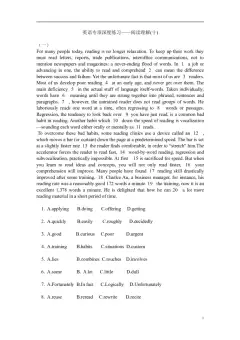
英语专项深度练习——阅读理解(四)
It is fashionable nowadays to talk about “Englishes”—surely one of the least attractive
of recent coinages. But it is an indication that the great community of users of English are
now conscious of the fact that they do not all have exactly the same accent, or habit of
grammar and idiom, or vocabulary. They have a choice, and they intend to use it. How does
Britain stand in this comparison? What is the role of the British Council, and other
British educational interests? How does a major initiative like the Cobuild project further
the image of Britain abroad? Born with English
In Britain on the whole we do not have much of a choice. We can take steps to modify our
language a little, and there are some famous recent examples of the perils attending that
policy. But by and large we just use the language that somehow emerges in early development
and usually seems adequate for our daily communication needs.
We should never forget what an asset it is to us all that this language is English. Everyone
who has English as a birthright has an inbuilt (固有的) advantage in international
communication. Not only are we spared the trouble and expense of mastering the language
later on, we also have access to a mastery of it which is of such high quality that few
foreigners ever reach the same level.
Such an asset beats North Sea Oil hands down. It must be worth billions of pounds a year and
it is renewed solely by the operation of normal social processes. Only English
There are some disadvantages which must at least be mentioned. We in Britain are in danger
of turning this asset into arrogance, insularity and complacency. Since there is no
commercial pressure on us to learn any particular foreign language, we tend as a nation to
be very bad learners of other languages.。 This cuts us off from the ability to appreciate
fully the culture of others, and denies us the ability to make the wonderful outward
gesture of using someone else’s own language. Both personally and commercially, most
British people do not know what they are missing, and our competitors are well able to take
advantage of this weakness.
Busy and important people nowadays travel a lot and find themselves frequently attending
meetings and giving talks, which have to be in English although everyone else shares a
common language. It would improve the situation if on each occasion the unfortunate
monolingual were to give a simple and sincere apology. The old adage (格言) » that if you
just speak English loudly enough everyone will understand, is truer than ever before, but
is getting less and less effective.
In practical terms, of course, the person restricted to English could not be expected to
speak all sorts of other languages, and this is an inhibiting factor— anyone else knows
exactly which language is best worth investing in. But we native speakers of English should
always be kept conscious of the fact that we frequently force our friends, customers and
colleagues into a disadvantageous position. Which English?The English language has been so successfully exported round the world that the native
speakers no longer have control over it. They are now in a snow minority, for a start, and
today’s learners of English are not learning it particularly to talk to Englishmen, but
also to talk to each other. The very features that distinguish native speakers disqualify
them from key discussions like “Which is the best English?”
There are a lot of good models of English available. As well as British English there is
American English, the other world-wide model,。 with Canadian, Australian, New Zealand
and South African English also available as prominent models.
And what about the English which is established as a second language in many Commonwealth
countries? Indian English, West African English, West Indian English, Singaporean
English and others have adapted to local circumstances over many years and are in the
process of being re-exported. Because they are used in the everyday lives of millions of
non-native speakers, they have features which could make them very attractive as practical
alternatives to a native speaker variety. When native speaking teachers are not welcome
politically in a country, for example, there will be found plenty of well-qualified and
experienced colleagues from such countries.
Further, we are witness at the present time to the development of English as an additional
language in a number of communities which have a common language already and which are under
no political pressure to adopt English. People from Scandinavia, West Germany and Holland,
for instance, have English available as a matter of course. Their way of teaching it is
moving from the concerns of access to a foreign culture—the great literature etc. —to the
priorities of a working language in a community—how to get things done. Gradually, for
international matters, it will be more sensible to use English rather than translate.
English language films will not be dubbed (配音) or subtitled any more. English language
journalism will be edited and read by foreign communities, and gradually written by them
also.
Very soon there will be powerful new models of English offered to the world—models which
can claim to have arisen without the attentions of native speakers, to have none of the
mystique, and yet to be usable as the principal language of external and public affairs.
These models will derive authority from an impressive group of scholars and administrators
who must never be overlooked—the thousands of experts on English and the teaching of it who
are not themselves native speakers. In Practice
Practicality is a key feature of anyone’s choice of a language model. Quite apart from the
various reasons advanced above, the learner may in an actual situation have a very
restricted choice of language models, in the available teachers and in access to materials.
Recorded material and radio and television transmissions offer alternatives, but they may
confuse as much as extend the choice available to the learner.
Teachers and learners just have to make the best of what is available to them at the time
and in the place where they are working. The sustained efforts of authors, scholars andpublishers are key factors in the strong presence of British English abroad, and in the
maintenance of that presence.
Pronunciation is a good case with which to illustrate this point. Throughout the world,
learners of British English are aiming at a pronunciation that few of their teachers use—
the Received Pronunciation (RP) associated with the public schools. The reason is that RP
is the variety of English which is best documented and most readily available in teaching
materials. Because of its origins, it is unassailable as a model and contributes to the
elitist atmosphere of the British variety of English.
But if we put these compelling arguments to one side, and view it dispassionately, RP is
not a very useful model of pronunciation. It has some very complex sound combinations,
particularly diphthongs, and it is not very closely related to the spelling system. Unlike
other varieties, RP speakers make much the same noise saying poor, paw, pour, and pore,
and do not distinguish between ion and iron. So it is not the linguistic features of RP that
give it such an appeal, but its social status and, above all, its availability in the
classroom.
1. GA (general American pronunciation) is becoming more and more popular with British
youth.
2. British native speakers are ignorant of cultures in other countries.
3. The English language is diverse in grammar, vocabulary, or pronunciation.
4. English is learned to communicate with native speakers.
5. RP is appealing in that its status is peculiar.
6. It is not troublesome at all to substitute qualified English teachers for native speaking
teachers.
7. Choice of a language model is determined by its popularity.
8. Native speakers of English have an innate advantage in______communication.
9. Competitors of English speakers may well take advantage of the weakness—most British
people do not know______.
10. New models of English are likely to emerge without the ______.
答案:1. NG 2. N 3. Y 4. N 5. Y 6. Y 7. N
8. international 9. what they are missing 10. attentions of native speakersAre some people born clever, and others born stupid? Or is intelligence developed by our
environment and our experiences? Strangely enough, the answer to both these questions is
yes. To some extent our intelligence is given us at birth, and no amount of special
education can make a genius out of a child born with low intelligence. On the other hand, a
child who lives in a boring environment will develop his intelligence less than one who
lives in rich and varied surroundings. Thus the limits of a person‘s intelligence are fixed
at birth, but whether or not he reaches those limits will depend on his environment. This
view, now held by most experts, can be supported in a number of ways.
It is easy to show that intelligence is to some extent something we are born with. The
closer the blood relationship between two people, the closer they are likely to be in
intelligence. Thus if we take two unrelated people at random(任意的) from the population,
it is likely that their degrees of intelligence will be completely different. If on the
other hand we take two identical (完全相同的) twins they will very likely be as
intelligent as each other. Relations like brothers and sisters, parents and children,
usually have similar intelligence, and this clearly suggests that intelligence depends on
birth.
Imagine now that we take two identical twins and put them in different environments. We
might send one, for example, to a university and the other to a factory where the work is
boring. We would soon find differences in intelligence developing, and this indicates that
environment as well as birth plays
a part. This conclusion is also suggested by the fact that people who live in close contact
with each other, but who are not related at all, are likely to have similar degrees of
intelligence.
26. Which of these sentences best describes the writer’s point in Paragraph 1?
A. To some extent, intelligence is given at birth.
B. Intelligence is developed by the environment.
C. Some people are born clever and others born stupid.
D. Intelligence is fixed at birth, but is developed by the environment.
27. It is suggested in this passage that_______.
A. unrelated people are not likely to have different intelligence
B. close relations usually have similar intelligenceC. the closer the blood relationship between people, the more different they are likely to
be in intelligence
D. people who live in close contact with each other are not likely to have similar degrees
of intelligence
28. Brothers and sisters are likely to_______.
A. have similar intelligence B. have different intelligence
C. go to the same university D. go to the same factory
29. In Paragraph 1, the word “surroundings” means_______.
A. intelligence B. life
C. environments D. housing
30. The best title for this article would be_______.
A. On Intelligence
B. What Intelligence Means
C. We Are Born with Intelligence
D. Environment Plays a Part in Developing Intelligence
答案:26. D 27. B 28. A 29. C 30. A
Homing pigeons are placed in a training program from about the time they are twenty-eight
days of age. They are taught to enter the cage through a trap and to exercise above and
around the loft(鸽棚) , and gradually they are taken away for short distances in willow
baskets and released. They are then expected to find their way home in the shortest possible
time.
In their training flights or in actual races, the birds are taken to prearranged distant
points and released to find their way back to their own lofts. Once the birds are
liberated, their owners, who are standing by at the home lofts, anxiously watch the sky
for the return of their entries. Since time is of the essence, the speed with which the
birds can be induced to enter the loft trap may make the difference between gaining a win or
a second place.
The head of a homing pigeon is comparatively small, but its brain is one quarter larger
than that of the ordinary pigeon. The homing pigeon is very intelligent and will persevereto the point of stubbornness; some have been known to fly a hundred miles off course to
avoid a storm.
Some homing pigeon experts claim that this bird is gifted with a form of built-in radar that
helps it find its own loft after hours of flight, for hidden under the head feathers are
two very sensitive ears, while the sharp, prominent eyes can see great distances in
daytime.
Why do homing pigeons fly home? They are not unique in this inherent skill; it is found in
most migratory birds, in bees, ants, toads, and even turtles, which have been known to
travel hundreds of miles to return to their homes. But in the animal world, the homing
pigeon alone can be trusted with its freedom and trained to carry out the missions that
people demand.
1. This passage is mainly about_______.
A. homing pigeons and their training
B. how to buy a homing pigeon
C. protection of homing pigeons against the threat of extinction
D. liberation of homing pigeons
2. According to the passage, what happens to homing pigeons when they are about a month
old?
A. They are kept in a trap.
B. They enter their first race.
C. They begin a training program.
D. They get their wings clipped and marked.
3. According to the passage, the difference between a homing pigeon and an ordinary one
is_______.
A. the span of the wings B. the shape of the eyes
C. the texture of the feathers D. the size of the brain
4. The author mentions all of the following attributes that enable a homing pigeon to
return home EXCEPT_______.A. instinct B. air sacs
C. sensitive ears D. good eyes
5. Why does the author mention bees, ants, toads, and turtles in the last paragraph?
A. To describe some unusual kinds of pets.
B. To measure distances traveled by various animals.
C. To compare their home-finding abilities with those of homing pigeons.
D. To interest the reader in learning about other animals.
答案:1. A 2. C 3. D 4. B 5. C
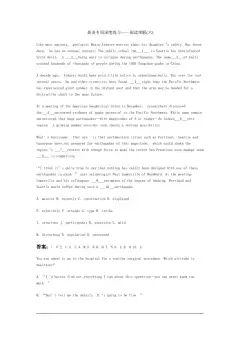
The difference between a liquid and a gas is obvious under the conditions of temperature and
pressure commonly found at the surface of the Earth. A liquid can be kept in an open
container and fill it to the level of a free surface. A gas forms no free surface but tends
to diffuse throughout the__1__available; it must therefore be kept in a closed container or
held by a gravitational field, as in the__2__of a planet‘s atmosphere. The distinction was
a __3__feature of early theories describing the phases of matter. In the nineteenth
century, for example, one theory maintained that a liquid could be “dissolved” in a
vapor without losing its identity, and another theory__4 __that the two phases are made up
of different kinds of molecules. The theories now prevailing take a quite different approach
by emphasizing what liquids and gases have in __5 __They are both forms of matter that have
no __6 __structure, and they both flow readily.
The fundamental similarity of liquids and gases becomes clearly apparent when the
temperature and pressure are __7__somewhat. Suppose a closed container __8__filled with a
liquid is heated. The liquid expands, or in other words becomes less dense; some of it
evaporates. In contrast, the vapor above the liquid surface becomes denser as the
evaporated molecules are __9__to it. The combination of temperature and pressure at which
the densities become __10__is called the critical point.
A. added B. case C. prominent D. held
E. equal F. partially G. example H. previous
I. space J, lifted K. permanent L. particularly
M. extended N. raised 0. common
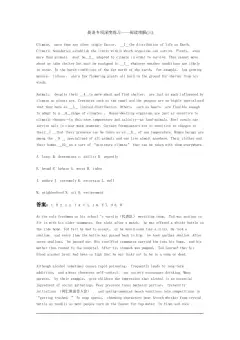
答案:I. I 2. B 3. C 4. D 5. O 6. K 7. N 8. F 9. A 10. EYou have probably heard it said that if you put a horsehair in a container of rainwater and
place it in the sunshine, a snake will develop. It is hard to convince people even today
that this is not true, yet it is not difficult to get a horsehair and some rainwater to try
the experiment. Since very early times men have believed that living things could come from
non-living things. Some people thought that frogs and toads developed from the mud of
ponds, rats from the river Nile, and insects from dew or from rotting waste. Vergil wrote
that slime begat(产生) frogs. Centuries later, other men wrote that water produced fishes
and that mice came from old rags. This notion that living things can come from lifeless
matter is known as the theory of “spontaneous generation. ” Today we know that living
things can come only from living things. Redi, in the seventeenth century, was the first
to experiment to prove that insects do not originate from rotting matter. From his
experiment, Redi concluded that maggots appear in decaying meat simply because the eggs of
flies hatch there, and not from “spontaneous generation”。
At the time of Leeuwenhoek the microscope was not well developed, but with it he discovered
bacteria. The study of these tiny forms of life which looked like specks(小污点) to him
was not practical until more than 150 years later, when microscopes were much improved.
However, the discovery led some medical men at the time to think that contagious diseases
were due to germs passed from the sick to the well.
Dr. Edward Jenner, a young English physician, overheard a milkmaid say that she was not
afraid of smallpox because she had just recovered from an attack of cowpox. This gave Jenner
the clue, and in 1796 he proved that a person vaccinated with cowpox germs is quite certain
to escape from getting smallpox. At this time smallpox was so common that about only one
person in a hundred escaped.
In Aristotle’s days, it was the common belief that air caused foods to spoil. People
believed that this was true until the seventeenth century. In 180‘0, Napoleon offered a
prize for the successful invention of a container which would keep foods from spoiling in
war times. The prize was won by Francois Appert, who had worked all his life on this
problem. He packed foods in glass or china jars, poured in enough water to cover the food,
corked and sealed them, then placed the jars in a container of water which was gradually
heated to the boiling point. He thought, however, that it was air that caused the foods to
spoil. It was not until fifty years later that Louis Pasteur proved that it was not air that
spoiled foods, but tiny living organisms that float about in the air. The first tin-can
container was made in 1807 by Peter Durand. The canning industry in the United States began
in 1819 when salmon, lobster, and oysters were first canned.
The idea that germs cause disease did not have many followers when it was first suggested.
Interest began to be shown again when Bassi, in 1837, showed that a silkworm disease was
transmitted to healthy worms by the passing of tiny “glittering particles. ” Later, Henle
said that “catching” diseases were caused by germs.
About 1850, Louis Pasteur began experimenting with tiny living organisms and was able to
discover many important things. He proved that yeast plants cause substances to ferment,that bacteria cause milk to sour, and that floating particles in the air contain living
germs which cause spoiling and decay.
Soon after Pasteur had announced these discoveries, Joseph Lister proved that wounds were
poisoned by germs from the air or from the surgeon’s instruments used during operations. He
proved that if the instruments were perfectly clean or sterile and if antiseptic (防腐剂)
dressings were used on wounds to prevent the entrance of germs, wounds would heal without
decay or blood poisoning. The first antiseptic Lister used was carbolic acid(石炭酸)。 The
wards in the Glasgow infirmary of which Lister had charge were especially affected by
gangrene (坏蛆)。 In a short time they became the healthiest of any known, because he
applied his knowledge of antiseptics to the healing of wounds. With some improvements,
Lister‘s methods are used today.
Major Laveran was the first to discover that a certain germ was always present in the blood
of patients who had malaria. Eight years later, in 1888, Major Ross proved that he found a
similar germ in the body of the Anopheles mosquito. Then, by other experiments, it was
shown that the germs that cause malaria can be transmitted only by the bite of the mosquito.
To prove this, two physicians in London permitted themselves to be bitten by mosquitoes
which had previously bitten malarial patients in Italy and ten were shipped in a box to
London. In eighteen days after being bitten by these mosquitoes, both physicians developed
malarial fever. Soon it was proved that the germs of yellow fever were carried by the Aedes
mosquito.
About this time there were many dogs with rabies in Paris, and Pasteur set about to show
how to inoculate for hydrophobia, the disease which is caused by the bite of a mad dog. He
had done many experiments but had not yet tried his success with a human being, when a boy
who had been bitten by a mad dog was brought to Pasteur’s laboratory by his parents.
Pasteur‘s work was still being criticized by many, and he hesitated to inoculate the boy.
The parents pleaded, and Pasteur agreed, if the boy would be left under his care. The
inoculation on the boy with hydrophobia germs was successful, and Pasteur’s fame spread
rapidly. Three years later, the first Pasteur Institute for the treatment of rabies was
established in Paris. Thousands of cases were successfully treated here, and here also Roux
discovered the antitoxin for diphtheria.
The modern scientific method of dealing with diseases was developed by Pasteur. Many people
still doubted things which he had proved, but which were contrary to what they had always
believed and to what they wanted to believe. He decided to put on a public demonstration. He
would try to prove that he could successfully vaccinate sheep against anthrax, a disease
which was causing great losses of flocks in France. Even at that time, people said a farmer
was being punished by God if his sheep died. The experiment was begun on May 5,1882, near
Melun, France. Pasteur‘s reputation depended on the result. A large crowd of farmers,
doctors, and curious onlookers gathered for the event. Most of them did not believe he
would succeed. Of the fifty sheep used in experiment, Pasteur inoculated twenty-five with
his protective vaccine, while the other twenty-five were not vaccinated. On May 31, he
gave all fifty sheep a strong inoculation of anthrax poison and predicted that by June fifthall the unprotected sheep would be dead and all the protected ones alive. On June second,
he went to the farm where the experiment had been performed and found that twenty-two of the
unprotected sheep were already dead and the other three were dying. All the animals which
had been vaccinated were in perfect health. Those who had doubted him were now convinced,
and he was praised all over France. From this time on, his methods were adopted everywhere.
1. The passage gives a general description of progress made in discovery of the cause and
prevention of certain diseases.
2. Centuries ago, it was believed that non-living things could develop into living things.
3. Dr Jenner experimented to show that milkmaids were immune to smallpox.
4. Francois Appert heated the water in a container to the boiling point to stop the food
from spoiling.
5. Louis Pasteur was the first to prove that diseases were transmitted by germs.
6. Joseph Lister set up the first wards in Glasgow where antiseptic dressings were employed.
7. Two physicians in London agreed to be bitten by the Aedes mosquito to demonstrate how the
germs of yellow fever were carried.
8. In Pasteur’s experiment, _______sheep died because they were not inoculated.
9. In_______, Louis Pasteur proved that it was living organisms floating about in the air
that spoiled foods.
10. Cases of rabies can be successfully treated only by_______.
答案:I. Y 2. Y 3. N 4. Y 5. Y 6. NG 7. N 8. 25 9. 1850 10. inoculation