文档文本内容
The sixth period(第六课时)
Part B Let’s check & Let’s wrap it up
▶ 教学内容与目标
课时教学内容 课时教学目标
Let’s check 完成Let’s check板块的听力练习,考查学生对本单元所学内容的掌
握情况。
学会从图片信息中推测考查点,做到有目的、有针对性地去听录
音,听后完成任务。
培养学生良好的听力习惯,以持续提高学生的听力水平。
Let’s wrap it up 能够写出Let’s wrap it up板块形容词的比较级形式,总结并掌握形
容词比较级的变化规律。
启发学生的思维,引导学生自主学习,培养学生的英语学习策略。
▶ 教学重点
1. 检测学生的学习成果。
2. 掌握本板块形容词的比较级形式及其变化规律,并能灵活运用。
▶ 教学难点
将本单元的词汇、句型运用到实际情景中。
▶ 教学准备
1. 预习《状元大课堂》《创优作业100分》《状元作业本》中本课时的相关内容。
2. PPT课件、课文音频、视频、实物、教学卡片等。
▶ 教学过程
Step 1: Warm-up & Revision & Lead-in①
1. Greetings.
2. Enjoy a song—My small cat. (出示课件)
T:It’s a nice song. Do you like it?Ss:Yes,it is very beautiful.
3. Lead-in.
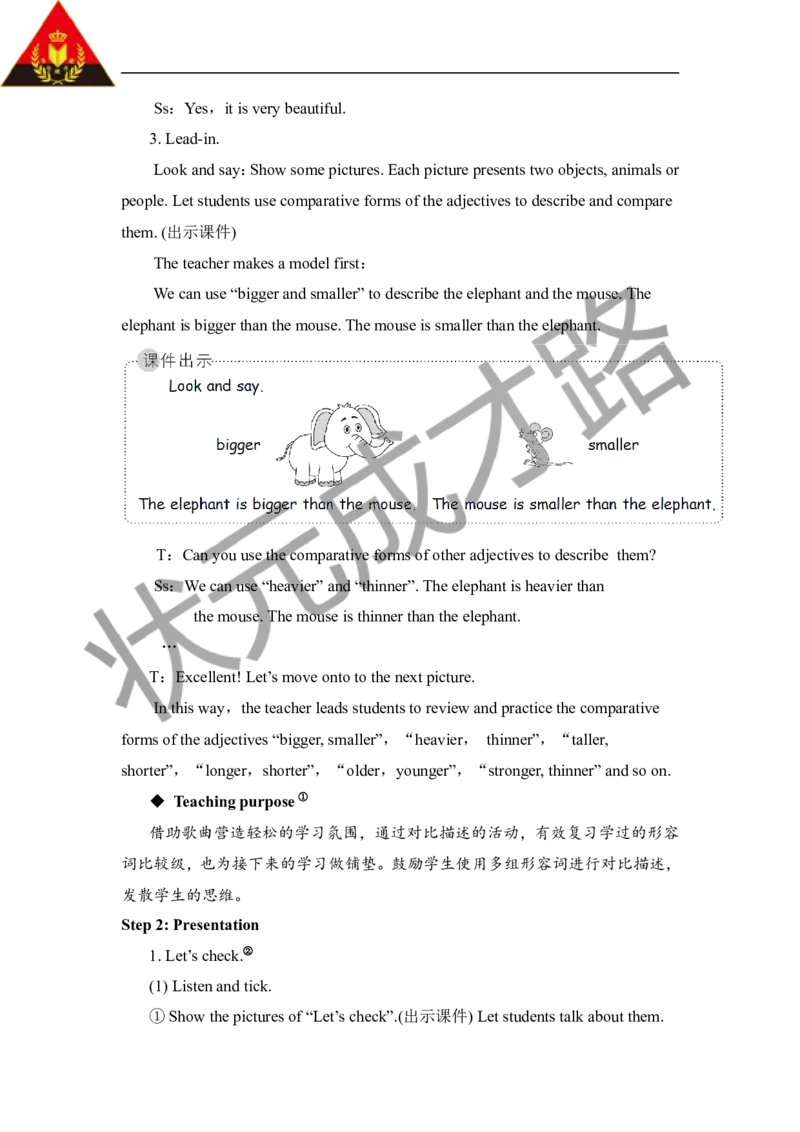
Look and say:Show some pictures. Each picture presents two objects, animals or
people. Let students use comparative forms of the adjectives to describe and compare
them. (出示课件)
The teacher makes a model first:
We can use “bigger and smaller” to describe the elephant and the mouse. The
elephant is bigger than the mouse. The mouse is smaller than the elephant.
T:Can you use the comparative forms of other adjectives to describe them?
Ss:We can use “heavier” and “thinner”. The elephant is heavier than
the mouse. The mouse is thinner than the elephant.
…
T:Excellent! Let’s move onto to the next picture.
In this way,the teacher leads students to review and practice the comparative
forms of the adjectives “bigger, smaller”,“heavier, thinner”,“taller,
shorter”,“longer,shorter”,“older,younger”,“stronger, thinner” and so on.
◆ Teaching purpose①
借助歌曲营造轻松的学习氛围,通过对比描述的活动,有效复习学过的形容
词比较级,也为接下来的学习做铺垫。鼓励学生使用多组形容词进行对比描述,
发散学生的思维。
Step 2: Presentation
1. Let’s check.②
(1) Listen and tick.
①Show the pictures of “Let’s check”.(出示课件) Let students talk about them.T:What are the pictures about? What are the differences between the two
pictures?
Students freely talk about the pictures for several seconds.
②Play the recording.(课件出示:Let’s check板块的音频) Students listen and
tick the right pictures.
③Check the answers together.(课件出示:Let’s check板块第一部分的答案)
Ask some students to choose pictures and talk about the reason why they choose.
(2) Listen again and write the answers to the questions.
①Play the recording again.(出示课件)Let students pay attention to the questions
in the recording. Write down the answers in the book.
②Check the answers together. (课件出示:Let’s check板块第二部分的答案)
Ask students to check the spellings of the words.
③Present the listening materials to help students train their listening skills. (课件
出示:Let’s check板块的听力材料)
◆ Teaching purpose②
培养学生听听力之前先预测听力内容的习惯,帮助学生培养一定的听力技巧
注重学生学习策略的培养。
2. Let’s wrap it up.③
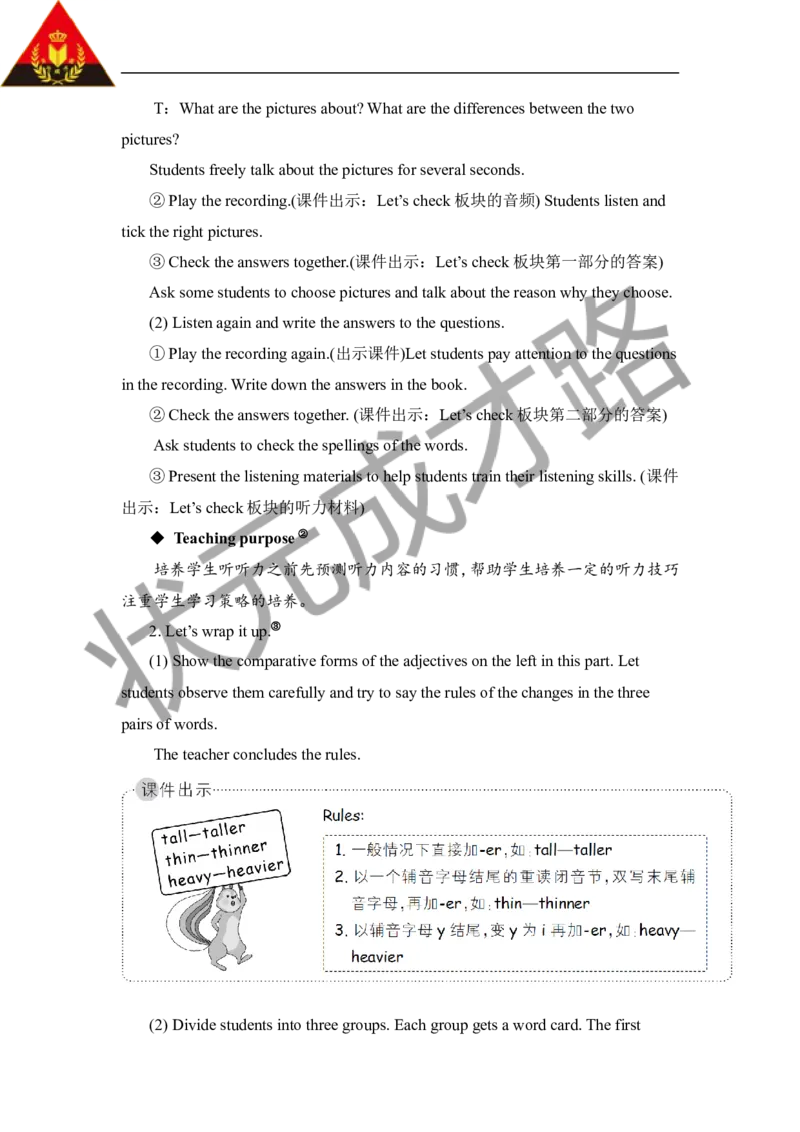
(1) Show the comparative forms of the adjectives on the left in this part. Let
students observe them carefully and try to say the rules of the changes in the three
pairs of words.
The teacher concludes the rules.
(2) Divide students into three groups. Each group gets a word card. The firstgroup is “tall—taller” group. The second group is “thin—thinner” group. The third
group is “heavy—heavier” group.
Give each group a bag. All the words on the right in “Let’s wrap it up” are in it.
Let the three groups PK and find the words belonging to their group as quickly as
possible.
(3) Groups show their words one by one and try to explain the reasons. All the
students check whether the groups express correctly.
(4)After the PK,ask students to write down the comparative forms in the book.
Then check the answers together. (课件出示:答案图片)
◆ Teaching purpose③
鼓励学生自己观察单词变化并总结规律,培养学生自主学习的能力。PK活
动活跃课堂气氛,培养学生的小组合作能力。在竞赛中加深对形容词比较级变化
规律的理解。
Step 3: Consolidation & Extension④
“Story time—A goalkeeper wanted!”
1. The teacher talks about something about football and the goalkeeper with
students freely.
Show a picture of a goalkeeper. (出示课件)
T:The goalkeeper is important in a football team. Today we have a story about a
football goalkeeper.
2. Show the six pictures in this part one by one. Let students observe and guess
the main idea of this story. (出示课件)
T:An animal football team wants a goalkeeper. Zebra,Deer, Giraffe and Dog
want to have a try.
Let’s go and see what’s happening.
3. The teacher asks some questions:
(1) Who wants to be the goalkeeper?
(2) Deer and Giraffe can’t be the goalkeeper. Why?
(3) Who becomes the goalkeeper at last? Why?
Play the cartoon of the story. Then let students try to answer the questions.4. Let students watch the cartoon again, then practice reading the story in groups.
5. Role-play.
6. T:How to be a good goalkeeper?
Students talk freely about it.
◆ Teaching purpose④
通过趣味故事,引导复习巩固本单元所学的语言知识,并增加语言的输入。
拓展学生关于足球的认识。
▶ 板书设计
▶ 作业设计
1. Read “Story time” to your parents.
2. Do the exercises. (见“状元成才路”系列丛书《创优作业100分》或《状元
作业本》对应课时作业)
▶ 教学反思
1. 整个教学设计侧重于培养学生自主学习的能力,发散学生的思维,拓展学
生的课外知识。
2. 通过分层次教学,先预测,然后提出问题,再解决问题,层层递进。这样的
教学方式也遵循了学生的学习规律——由浅入深地学习知识。
3. PK活动的设计,不仅活跃了课堂氛围,增强了学生的小组合作意识,也在
一定程度上帮助突破了本课的重难点,达到了深入浅出的效果。
4. 实施单元的整体教学,把握单元教学目标的整体性,挖掘单元教学的整体
性,设计单元的整体性,充分体现了新课程教学理念。▶ Teaching Contents & Teaching Aims
Let’s check
Examine students’ mastery of the contents of this unit by completing the listening
exercises of “Let’s check”.
Learn to guess the test points from the pictures. Do a purposeful and targeted
listening. Complete the tasks after listening.
Develop students’ good listening habits and continuously improve students’
listening level.
Let’s wrap it up
Be able to write the comparative forms of the adjectives in this part. Summarize
the changing rules of the comparative forms of the adjectives.
Try to inspire students’ thinking. Lead students to study independently. Cultivate
students’ English learning strategies.
▶ Teaching Priorities
Test students’ learning achievements.
Master the comparative forms of the adjectives in this part and the changing
rules. And apply them flexibly.
▶ Teaching Difficulties
Apply the vocabulary and sentence structures of this unit to real situations.
▶ Teaching Procedures
Teaching Stages Teacher’s Activities Students’ Activities Teaching Purposes
Warm-up 1. Greetings. 1. Greetings. Create a relaxing learning
atmosphere. Review the
& 2. Play a song—My 2. Enjoy the song.
words learned before,
small cat.
Revision 3. Look and say. which also paves the way
3. Lead-in. for the following learning.
&
Cultivate students’
Lead-in divergent thinking.
Presentation 1. Let’s check. (1) Listen and tick. Develop the habit of
predicting the listening
(1) Listen and tick. ①Talk about the pictures
content before listening.
of “Let’s check” before①Show the pictures listening. Help students cultivate
of “Let’s check”. certain listening skills and
②Listen and tick the right
learning strategies.
②Play the recording pictures.
of this part.
③Check the answers
③Check the answers together.
together.
(2) Listen again and write.
(2) Listen again and
①Listen again and write
write.
the answers to the
①Play the recording questions.
again.
②Check the answers
②Check the answers together.
together.
③Train listening skills.
③Present the
listening materials.
2. Let’s wrap it up. (1) Observe the words Cultivate students’ ability
carefully and try to say of independent learning.
(1) Show the
the rules of the changes The PK activity enlivens
comparative forms
in the three pairs of the class and cultivates
of the adjectives on
words. students’ teamwork ability.
the left in this part.
In the competition, deepen
Conclude the rules. (2) Complete the PK task.
students’ understanding of
(2) Divide students (3) Groups show their the changing rules of the
into three groups to words. comparative forms of the
PK. adjectives.
(4) Write down the ten
(3) Show time. words’ comparative
forms in the book. Then
(4) Ask students to
check the answers
write down the ten
together.
words’ comparative
forms. Then check
the answers
together.
Consolidation “Story time —A 1. Freely talk about Help students review and
goalkeeper wanted!” something about football reinforce the language
&
and the goalkeeper. points learned in this unit
1. Free talk.
Extension by reading the interesting
2. Observe the pictures and
2. Show the six story. Add language input.
guess the main idea of
pictures in this part Expand students’
this story.
one by one. understanding of football.
3. Watch the cartoon of the
3. Ask some questions
story. Then try to answer
and play the cartoon
the questions.
of the story.
4. Practice reading the
4. Play the cartoon
story in groups.
again.5. Lead students to act 5. Act out the story.
out the story.
6. Free talk.
6. Free talk.
Homework 1. Read “Story time” to your parents.
2. Do the exercises.