The sixth period(第六课时)
Part B Read and write & Let’s check & Let’s wrap it up
& Part C Story time
教学内容
▶
Read and write ·在图片的帮助下读懂吴斌斌和机器人的对话,完成判断信息正误的活动
·根据提供的信息模仿对话、补全新的对话
Let’s check ·听前通过看图及题目要求熟悉听的任务,听时注意听关键词句,养成良好的听的习惯
·读懂、理解阅读活动Read and circle的三个问句,并根据自己的实际情况回答问题
Let’s wrap it up ·了解有些单词的构成是有一定规律的,在学习中注意及时发现、总结规律,利用规律记忆单
词
Story time ·在图片的帮助下理解故事内容,复习巩固有关一个星期七天名称的单词及句型,增加语言
的输入
教学重点
▶
1学生能够读懂Read and write板块的对话,并完成相应的任务。
2学生能够听懂Let’s check板块的录音,并完成标号任务。
3学生能够完成Let’s wrap it up板块的内容,初步了解简单的构词法。
教学难点
▶
学生能够给他人的日常活动提供有益的建议。
教学准备
▶
1. 预习《状元大课堂》《创优作业100分》《状元作业本》中本课时的相关内容。
2. PPT课件、课文录音、视频、卡片等。
教学过程
▶
Step 1: Warm-up & Revision & Lead-in①
Teaching purpose①
1. Greetings.
通过几个游戏让学生复
2. Play a game: I do and you say.
习之前所学的单词、词组和
句型,不仅活跃课堂气氛,
也为后面的学习奠定一定的 3
基础。The teacher does some actions. Students try to say the
corresponding phrases, such as play football, read books, watch TV, do
homework, wash my clothes and so on.
3. Play a game: The turntable game.
Show a turntable on the PPT. It has the names of seven days in a
week on it. Before the teacher rotates the turntable, students guess what
day it will be. Then the teacher clicks the mouse to let the turntable
rotate. (出示课件,注意星期五被最后转出来) When the turntable stops
rotating, the teacher asks and students answer according to the day
which the pointer points to like this:
T: What day is it? Ss: It is Tuesday.
T: What do you have on Tuesdays? /Do you play football on
Tuesdays?
Ss: I have…on Tuesdays./Yes, I do./No, I don’t.
In this way, help students review the seven words about the seven
days in a week and the key sentence patterns in this unit. When the
pointer points to the word “Friday”, the teacher asks, “What do you
have on Fridays?” Students answer the question. Then the teacher keeps
asking: What about Wu Binbin? What does he have on Fridays?
Step 2: Presentation②
“Read and write”
Teaching purpose②
1. Predict the main idea of the dialogue.
通过从阅读中获取的
Show the two pictures above the dialogue in “Read and write” on 信息,完成相应的练习,引
the PPT. (出示课件) Let students observe the pictures and guess: How 导学生对吴斌斌的日常活动
does Wu Binbin look? What does Wu Binbin have on Fridays? 给出自己的建议。培养学生
从阅读中获取信息并进行分
Encourage them to express their opinions.
析的能力。帮助学生对所学
2. Fast reading.
的知识进行巩固和提升。角
Play the recording of “Read and write”. (出示课件) Ask students to
色扮演的活动满足学生自我
listen and check their answers. Lead students to say the sentences: Wu 表现的愿望,也可以训练他
Binbin has PE on Fridays. He looks tired. 们的口语。
T: I like PE. Look at me. I can run very fast. I can jump. I can play
football.
Do the actions of running, jumping and playing football. Then act
like feeling very tired and say, “Oh, I like playing sports. I like running,
jumping and playing football. We can play sports in PE class. But now
I’m tired.” Help students understand the meanings of “play sports” and
“tired”.
The teacher asks, “Does Wu Binbin like sports?” Ask students to
read the dialogue quickly and answer the question. Then the teacher
asks, “Do you like sports?” Students may answer, “Yes, I do.” or “No, I
don’t.”
4T: I’m glad that most of you like sports./I’m sorry that most of you
don’t like sports. Playing sports can make us strong. You should play
sports every day.
Explain the meanings of “should” and “every day” simply.
3. Careful reading.
(1)Ask students to read the dialogue carefully for the second time
and try to answer the question: What does Wu Binbin do on the
weekend? (课件出示:此问句) Ask students to underline the related
sentences in their books.
Check several students’ work. Then show the correct answer on the
PPT. (出示课件) Lead students to read the question and the answer
once.
(2)Show the chart below on the PPT.
Ask students to count the number of “watch TV” and “read books”
in the chart.
T: How many “watch TV”? Ss: Five.
T: How many “read books”? Ss: Two.
Use the mathematical formula “five>two” to help students
understand “often>sometimes”. Then ask students to talk about their
weekend activities by answering the following questions: What do you
often do? What do you sometimes do?
(3)Tick or cross.
Show the task of “Tick or cross” on the PPT. (出示课件) Ask
students to read the dialogue again and try to complete the task “Tick or
cross”.
Check the answers together. Lead students to find out the mistakes
in the wrong sentences and correct them. (出示课件)
Ask students to say something about Wu Binbin’s activities in his
daily life freely and try to give some advice to him. The teacher can
make a model like this: I don’t often watch TV on the weekend. I
sometimes watch TV. I often read books and play sports. I think he
should read more books.
Ask several students to stand up and express their opinions.
T: You have different opinions. And some of you give good advice
to Wu Binbin. Robin gives advice to Wu Binbin, too. Let’s go and have a
look.
(4)Read the schedule.
5①Show the “new schedule” on the PPT. (出示课件) Ask students
to read Robin’s words together and observe the new schedule carefully.
The teacher asks and students answer like this: —What does Wu Binbin
do on Mondays/Tuesdays/…? —He…on Mondays/Tuesdays/…
② Let students observe the new schedule, complete the dialogue
between Wu Binbin and Sarah and write the answers in their books. Ask
several pairs of students to stand up and read out the dialogue according
to their answers. The others should listen carefully and try to find out the
mistakes.
Show the answers. (出示课件) Ask students to check their answers.
Pay attention to their spellings and correct the mistakes.
4. Role-play.
(1)Ask students to read the dialogue between Wu Binbin and Robin
in pairs.
(2)Ask some pairs to stand up and role-play the dialogue.
(3)Choose the best pair. Give each of them a blank class schedule
as awards.
Step 3: Practice③
1. Let’s check.
Teaching purpose③
(1)Show the content of “Listen and number” on the PPT. (出示课
通过听力练习,不仅训
件) Ask students to observe the charts and try to describe them like
练学生的听力,也巩固单元
these: 的重点句型。在介绍例词的
S1: I have English on Mondays, Wednesdays and Fridays. 基础上,让学生及时发现、
S2: I have art on Mondays and Thursdays. 总结规律,并利用规律记忆
单词。
S3: I have maths on Wednesdays.
S4: I often play football on the weekend.
(2)Play the recording. (出示课件) Students listen carefully and
number the pictures. Ask students to stand up and say their answers.
(3)Play the recording again. (出示课件) Check the answers.
(4)Show the listening material and the answers on the PPT. (出示课
件) Students try to read.
(5)The teacher asks and students answer by using the sentence
patterns “—Do you often … on the weekend? —Yes, I do./No, I don’t.”
Then Let students work in pairs and ask and answer with each other.
Show the three questions in “Read and circle” on the PPT.(出示课
件)Ask students to read these sentences and circle “Yes.” or “No.”
according to their real situations.
2. Let’s wrap it up.
(1)Show the structures “Mon + day=Monday; bed + room=
bedroom” on the PPT. ( 出示课件 ) Ask students to observe them
carefully. Then show the seven words of a week on the PPT. (出示课件)
Write them down on the blackboard. Colour the “day” red.
6Lead students to realize the formation rule of these words. These
words are syntheses of two words. “Monday” is a compound word
composed of “Mon” and “day”. “ Bedroom” is a compound word
composed of “bed” and “room”.
(2)Take out some word cards, such as bath, bed, room, class. Let
students make the right combinations, such as bathroom, bedroom,
classroom.
(3)Let students complete the task in “Let’s wrap it up”. Show the
answers on the PPT. Check the answers together. (出示课件)
(4)Present more words on the PPT, such as note, black, police, board,
book, foot, man, ball and so on. Let students make the right
combinations, such as notebook, blackboard, policeman, football. (出示
课件)
Step 4: Consolidation & Extension④
“Story time”
1. Ask questions.
Teaching purpose④
Show the pictures of “Story time” on the PPT. (出示课件) Ask
帮助学生在图片的帮助
three questions: ① What does Zoom need to do? ② What does Zoom
下理解故事内容,复习巩固
need? ③Why do Zoom and Zip need these things? 有关一周七天名称的单词及
2. Observe and discuss the questions. 句型,增加学生语言的输入。
3. Predict the main idea.
Play the cartoon. (出示课件) Let students watch the cartoon and
predict the main idea of the story.
4. Learn Picture 1.
Play the recording. First, play the recording of the first picture. (出
示 课 件 ) Students listen and read the dialogue. Lead students to
understand the meanings of the words and the phrases “new school year”
“need” “do some shopping” “help” with the help of pictures.
5. Learn Pictures 2~5.
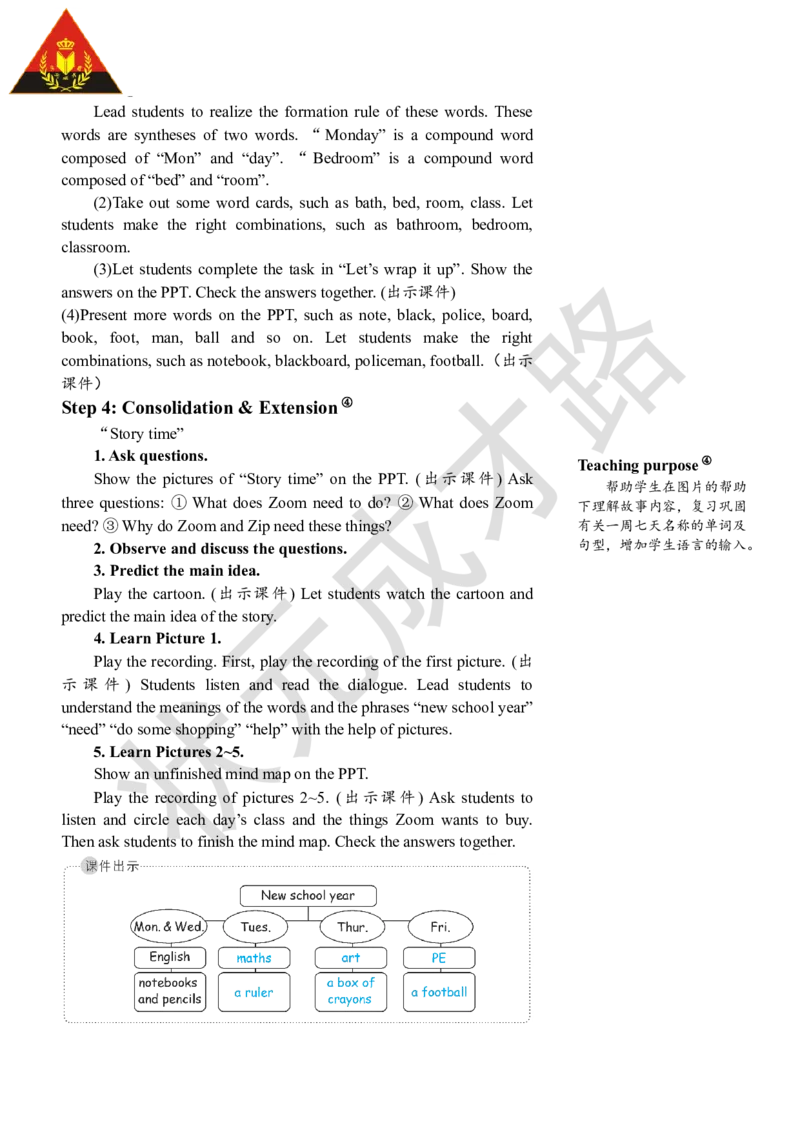
Show an unfinished mind map on the PPT.
Play the recording of pictures 2~5. (出示课件) Ask students to
listen and circle each day’s class and the things Zoom wants to buy.
Then ask students to finish the mind map. Check the answers together.
76. Ask and answer.
After listening, the teacher asks and students answer by using the
sentence patterns: —What do they have on Mondays /Tuesdays /… /
Fridays? —They have…on Mondays/Tuesdays/…/Fridays.
7. Learn Picture 6.
The teacher asks: Can they buy all the things they need? Ask
students to observe the last picture and read the dialogue in it. Lead
students to understand the meaning of the sentences “We don’t have
enough money.” and “I’ll put back the football.” Find out the answer:
No, they can’t.
8. Read and role-play.
Let students read the story after the recording. Then ask students to
role-play the story.
板书设计
▶
作业设计
▶
1. Review the key words, phrases and sentence patterns in this unit.
2. Do the exercises. (见“状元成才路”系列丛书《创优作业100分》或《状元作业本》对应课
时作业)
教学反思
▶
1. 本节课的重点是阅读和练习,很好地抓住并落实了课堂重点,围绕阅读和练习来展开教学
2. 本节课环节较多,但是多而不乱,各环节紧密相扣,帮助学生从听、说、读、写等多种形式的
操练中复习知识,取得了很好的教学效果。
3. 构词法的讲解不多,旨在引导学生自己发现、总结规律。让学生在大量的实践中感悟、掌握
构词法要领,并利用规律记忆单词。
4. 板书设计清晰明了,一目了然,起到了很好的辅助作用。
8▶Teaching Contents
Read and write
·Understand the dialogue with the help of the pictures, and complete the activity of judging whether
the information is right or wrong.
·Imitate the dialogue and complete the new dialogue according to the information provided.
Let’s check
·Observe the pictures and read the questions before listening to get familiar with the tasks of
listening, pay attention to the key words while listening, and form good listening habits.
·Read and understand the three questions in“Read and circle”and answer the questions
according
to actual situations.
Let’s wrap it up
·Understand that the formation of some words conforms to certain rules. Find and summarize the
rules and use the rules to remember words.
Story time
·Understand the story with the help of the pictures, review and consolidate the words and the
sentence patterns related to the seven days in a week, and increase the input of language.
▶Teaching Priorities
·Be able to understand the dialogue of “Read and write” and complete the exercises.
·Be able to understand the recording of “Let’s check” and complete the numbering task.
·Be able to finish the exercise of“Let’s wrap it up”and have a preliminary understanding of
simple word formation.
▶Teaching Difficulties
·Be able to give helpful advice to others about their daily activities.
▶Teaching Procedures
Teaching Teacher’s Activities Students’ Activities Teaching Purposes
Stages
Warm-up 1. Greetings. 1. Greetings. Lead students to review
& 2. Play a game: I do and you say. Do 2. Play the game: I do the words, the phrases
Revision some actions. and you say. Guess the and the sentence
& 3. Play a game: The turntable game. phrases. patterns learned before
Lead-in Help students review the seven 3. Play the game: The by several games.
words about the seven days in a turntable game. Enliven class
week and the key sentence Answer the teacher’s atmosphere and build a
patterns in this unit. Show the questions to review the certain foundation for
picture of “Let’s talk” on page 48 knowledge. the next study.
on the PPT.
9(续表)
Teaching
Teacher’ s Activities Students’ Activities Teaching Purposes
Stages
Presentation “Read and write” Predict the main idea of Lead students to
1. Predict the main idea of the the dialogue. complete the exercises
dialogue. and give suggestions
Give questions and encourage about Wu Binbin’s
students to guess and express daily activities through
opinions. the information
2. Fast reading. Listen and check the obtained from the
Play the recording. Explain answers. Read quickly and passage. Cultivate
the new words and phrases answer the question. Learn students’ abilities to
simply. the words and the phrases. obtain information from
3. Careful reading. (1)Read and answer. reading. Consolidate
(1)Ask students to read the (2)Learn the words “often” and strengthen the
dialogue and answer a and “sometimes”. knowledge they have
question. (3)Complete the exercise learned. Role-playing
(2)Teach the words “often” and of “Tick or cross”. Say satisfies students’
“sometimes”. something about Wu desire to express
(3)Lead students to complete the Binbin’s activities in his themselves and also
exercise of “Tick or cross”. daily life. trains their oral English.
Ask students to say something (4)Answer the questions
about Wu Binbin’s activities about the new schedule.
in his daily life. Complete the dialogue
(4)Read the schedule. between Wu Binbin and
Ask some questions about the Sarah.
new schedule.
Lead students to look at the
schedule and complete the
dialogue.
4. Role-play. (1)Read the dialogue
(1)Ask students to read the between Wu Binbin and
dialogue between Wu Binbin Robin in pairs.
and Robin in pairs. (2)Role-play the dialogue.
(2)Ask some pairs to role-play (3)Choose the best pair.
the dialogue.
(3)Choose the best pair.
10(续表)
Teaching
Teacher’ s Activities Students’ Activities Teaching Purposes
Stages
Practice 1. Let’s check. (1)Describe the pictures. Train students’ listening
(1)Show the content of “Listen and (2)Listen and number the abilities and consolidate
number”. pictures. the key sentence
(2)Play the recording. (3)Listen again and patterns of this unit
(3)Play the recording again and check the answers. through the listening
check the answers. (4)Read the listening exercise. On the basis
(4)Show the listening material. material. of introducing example
(5)Ask questions by using the key (5)Answer the questions. words, let students find
sentence pattern. Read the questions and summarize the rule
and circle “Yes.” or in time, and use the rule
“No.” to remember the words.
2. Let’s wrap it up. (1)Realize the formation
(1)Show the structures and the rules of these words.
words. (2)Make the right
(2)Take out some word cards. Let combinations.
students make the right (3)Complete the task in
combinations. “Let’s wrap it up”
(3)Check the answers. and check the answers.
(4)Present more words. (4)Make the right
combinations.
Consolidation “Story time” 1. Read the three Help students review
& 1. Ask questions. questions. and consolidate the
Extension 2. Observe and discuss the 2. Observe and discuss words and the sentence
questions. the questions. patterns related to the
Let students observe and discuss. 3. Watch the cartoon and seven days in a week
3. Predict the main idea. Play the predict the main idea with the help of
cartoon. of the story. pictures. Increase the
4. Learn Picture 1. 4. Learn Picture 1. And input of students’
Lead students to understand the learn some words and language.
meanings of some words and phrases.
phrases. 5. Learn Pictures 2~5.
5. Learn Pictures 2~5. Finish the mind map.
6. Ask and answer. 6. Answer the teacher’s
Ask by using the sentence pattern. questions.
7. Learn Picture 6. 7. Learn Picture 6 and
Teach the last picture. read the dialogue.
8. Read and role-play. 8. Read and role-play the
Play the recording. story.
11Homework
1. Review the key words, phrases and sentence patterns in this unit.
2. Do the exercises.
1213