2025 秋人教英语四年级上册 讲义
知识讲解
(一)家庭成员职业类
1. doctor /ˈdɒktə(r)/:医生,负责看病治疗病人 。My mother is a doctor.(我妈妈是一
名医生。)
2. farmer /ˈfɑːmə(r)/:农民,从事农业生产,种植农作物或饲养家畜 。My grandpa is a
farmer. Heworksonthefarm.(我的爷爷是农民,他在农场工作。)
3. nurse /ˈnɜːs/:护士,协助医生照顾病人 。The nurse takesgood care of the patients.
(护士把病人照顾得很好。)
4. worker /ˈwɜːkə(r)/:工人,包含多种类型,如 factory worker(工厂工人) 、office
worker(办公室职员)。Myfatheris afactoryworker.(我爸爸是一名工厂工人。)
5. cook /ˈkʊk/:厨师,擅长烹饪美食 ;也可作动词,意为 “烹饪” 。The cook makes
deliciousfood.(这位厨师做的食物很美味。)Icancook eggs.(我会煮鸡蛋。)
(二)家庭活动及状态类
1. busy /ˈbɪzi/:忙碌的,be busy doing sth. 表示 “忙于做某事” 。My mother is busy
cookingdinner.(我妈妈正忙着做晚饭。)
2. tired /ˈtaɪəd/:疲倦的,形容人感到劳累 。I'm tired after a long day atschool.(在学
校度过漫长的一天后,我很累。)
3. chore /ˈtʃɔː(r)/:家庭杂务,常用复数形式 chores ,do some chores(做家务) 。I
oftendo somechoresonweekends.(我周末经常做家务。)
4. clean /ˈkliːn/:作动词时,意为 “打扫;清理” ;作形容词时,意为 “干净的” 。I clean
myroomeveryweek.(我每周打扫我的房间。)Theroomisclean.(房间很干净。)
5. room /ˈruːm/:房间,如 bedroom(卧室) 、living room(客厅) 。I sleep in my
bedroom.(我在我的卧室睡觉。)
6. also /ˈɔːlsəʊ/:也,用于句中,位于 be 动词、助动词或情态动词之后,实义动词之
前。I likeapples.I alsolikebananas.(我喜欢苹果,我也喜欢香蕉。)
7. look after :照顾,照料,相当于takecareof 。I canlookafter mylittle sister.(我能
照顾我的小妹妹。)
8. sweep /ˈswiːp/:扫,sweep the floor(扫地) 。I sweep the floor every day.(我每
天扫地。)
9. floor /ˈflɔː(r)/:地板;地面。Thereis aballonthefloor.(地板上有一个球。)
第1页共7页2025 秋人教英语四年级上册 讲义
10.together /ˈtəɡeðə(r)/:在一起;共同 。We play together after school.(放学后我们
一起玩。)
11.fun /ˈfʌn/:享乐;乐趣 ,have fun(玩得开心) ,相当于 have a good time 。We
havefunattheparty.(我们在聚会上玩得很开心。)
12.helpful /ˈhelpfl/:有帮助的;有用的 ,be helpful to sb.(对某人有帮助) 。The
bookishelpfulto me.(这本书对我有帮助。)
13.child /ˈtʃaɪld/(复数 children /ˈtʃɪldrən/):儿童;小孩 。There are many children in
thepark.(公园里有很多小孩。)
(一)询问职业:What'syour mother's/father's... job?(你的妈妈/ 爸爸…… 是做什么工作的?)
1. 回答:She's/He'sa...(她/他是一名……)。例如:
2. What'syour mother'sjob?(你妈妈是做什么工作的?)
3. She'sa nurse.(她是一名护士。)
(二)询问某人是否能做某事及回答:Canyou/she/he/we...?(你/ 她/ 他/ 我们能……吗?)
1. 肯定回答:Yes,I/she/he/wecan. + 具体能做的事.(是的,我/ 她/他/ 我们能……)
2. 否定回答:No,I/she/he/wecan't.(不,我 /她/ 他/我们不能。)例如:
3. Canyoucleanyour room?(你能打扫你的房间吗?)
4. Yes, I can. I can clean my room every day.(是的,我能。我每天都能打扫我的房
间。)
(三)描述家庭活动:I/We...(我/我们……),后接动词短语描述家庭活动。
1. Ilook after mysister.(我照顾我的妹妹。)
2. Wecook together.(我们一起做饭。)
(四)提出帮助家人的建议:Mum and Dad are busy and tired. What can we do for them?
(爸爸妈妈又忙又累。我们能为他们做些什么?)
1. 回答:Wecan...(我们可以……)。例如:
2. Wecan dosomechores.(我们可以做一些家务活。)
3. Icancleantheroom.(我会打扫房间。)
字母组合“ch”发/tʃ/音:发音时,舌尖抵住上齿龈后部,形成阻碍,气流冲破阻碍,摩擦
成音,声带不振动 。常见单词有:teacher(教师)/ˈtiːtʃə(r)/、China(中国)
/ˈtʃaɪnə/、chair(椅子)/ˈtʃeə(r)/、lunch(午餐)/ˈlʌntʃ/、chicken(鸡肉;小鸡)
第2页共7页2025 秋人教英语四年级上册 讲义
/ˈtʃɪkɪn/。可以通过朗读含有“ch”的单词和句子,如“MygrandpateachesChinese.
Hemakesgreatchairs.”来加深对该发音的记忆。
(一)一般现在时的运用(表示能力):在描述某人会做或不会做某事时,使用一般现在时 。当
主语是第一人称(I/we)、第二人称(you)或复数时,动词用原形;当主语是第三人称单数
(he/she/it 或单个人名、单个事物等)时,动词要变成第三人称单数形式(一般在词尾加 -s,以
-s、-x、-sh、-ch、-o结尾的动词加-es)。例如:
1. Icancook.(我会做饭。)
2. Hecanplaysfootball.(错误表达)应改为:Hecanplayfootball.(他会踢足球。)
(二)情态动词 的用法
can
1. 表示能力,意为“能;会”,后面接动词原形。例如:Icansing.(我会唱歌。)
2. 变一般疑问句时,把 can 提到句首,句末用问号 。肯定回答用 “Yes, 主语 + can.”,否
定回答用“No,主语+ can't.” 。例如:
3. Canyouswim?(你会游泳吗?)
4. Yes,I can.(是的,我会。)/ No, I can't.(不,我不会。)
5. 变否定句时,在 can 后面加 not,可缩写为 can't 。例如:I can't play basketball.(我
不会打篮球。)
第3页共7页2025 秋人教英语四年级上册 讲义
配套练习
(一)选择题(20 道)
1. —What'syour father'sjob?
—He's______factoryworker.
A. a B.anC. the
2. Mymotherisa ______. Sheworksina hospital.
A. doctor B.teacher C. farmer
3. —Canyouhelpyour motherwith thehousework?
—Yes,I______.
A. canB.do C. am
4. Ioften______ my roomonweekends.
A. cleanB.cleansC. cleaning
5. Mysistercan______ thefloor.
A. sweepB.sweepsC. sweeping
6. Therearemany______ inthepark.
A. child B.childrenC. childs
7. Myparentsarevery ______. Theyhavenotimeto playwith me.
A. busyB.tired C. happy
8. Weoftenhave______ athome.
A. funB. funnyC. funs
9. Mygrandpais a______. Hegrowsmanyvegetables.
A. farmer B.doctor C. nurse
10.—Whatcanyour brother do?
—Hecan______ basketball.
A. playB. playsC.playing
11.Mymotherisa cook.Shecan______delicious food.
A. cookB. cooksC. cooking
第4页共7页2025 秋人教英语四年级上册 讲义
12.I'mhelpfulathome.I oftenhelpmy mother______ somechores.
A. do B.doesC.doing
13.Myfather isa ______. Hedrivesa buseveryday.
A. driver B.workerC. teacher
14.Mysisteris onlyfiveyearsold,butshecan______ herself.
A. lookafterB. lookatC. lookfor
15.Thereis aball______ thefloor.
A. inB.onC. under
16.Mymotherisa nurse.Sheoftenhelps______people.
A. illB. sick C. good
17.Myfamily often______ togetheronweekends.
A. playB. playsC.playing
18.Myfather is______andhewantsto sleep.
A. busyB.tired C. happy
19.Mymotherisa teacher. She______ Englishina school.
A. teachB.teachesC. teaching
20.I'ma ______. I canhelpmyparentsathome.
A. helpfulchild B. helpchild C.helpingchild
二、完型填空(20 道)
I have a happy 1 . There are three people in my family, my father, my
mother and 2 . My father is a 3 . He works in a hospital. He likes 4 his
patients(病人). My mother is a teacher. She 5 English in a school. She is very
kind 6 her students. I'm a student. I 7 in a primary school. I often 8 my
parents at home. I can 9 my room and 10 the floor. Sometimes I 11 for
my family. My parents 12 me very much. We often 13 together
and 14 fun. My father likes 15 TV. My mother likes reading books. I like
第5页共7页2025 秋人教英语四年级上册 讲义
16 games. On weekends, we often go to the park. We 17 a good time
there. We love each 18 . I'm 19 to have such a happy family. I hope(希望)
everyone has a happy family 20 me.
1. A. homeB.familyC. house
2. A. meB.I C. my
3. A. doctor B.teacher C. nurse
4. A. helpB.helpsC. helping
5. A. teachB.teachesC. teaching
6. A. atB.to C. in
7. A. studyB. studiesC.studying
8. A. helpsB.helpingC. help
9. A. cleaningB.clean C.cleans
10.A. sweepsB.sweepC. sweeping
11.A. cookB. cooksC. cooking
12.A. lovesB.loveC. loving
13.A. playB. playsC.playing
14.A. hasB. haveC.having
15.A. watchB. watchingC. watches
16.A. playB. playsC.playing
17.A. haveB. hasC.having
18.A. otherB. othersC. another
19.A. happyB.sadC. angry
20.A. likeB. likesC. liking
第6页共7页2025 秋人教英语四年级上册 讲义
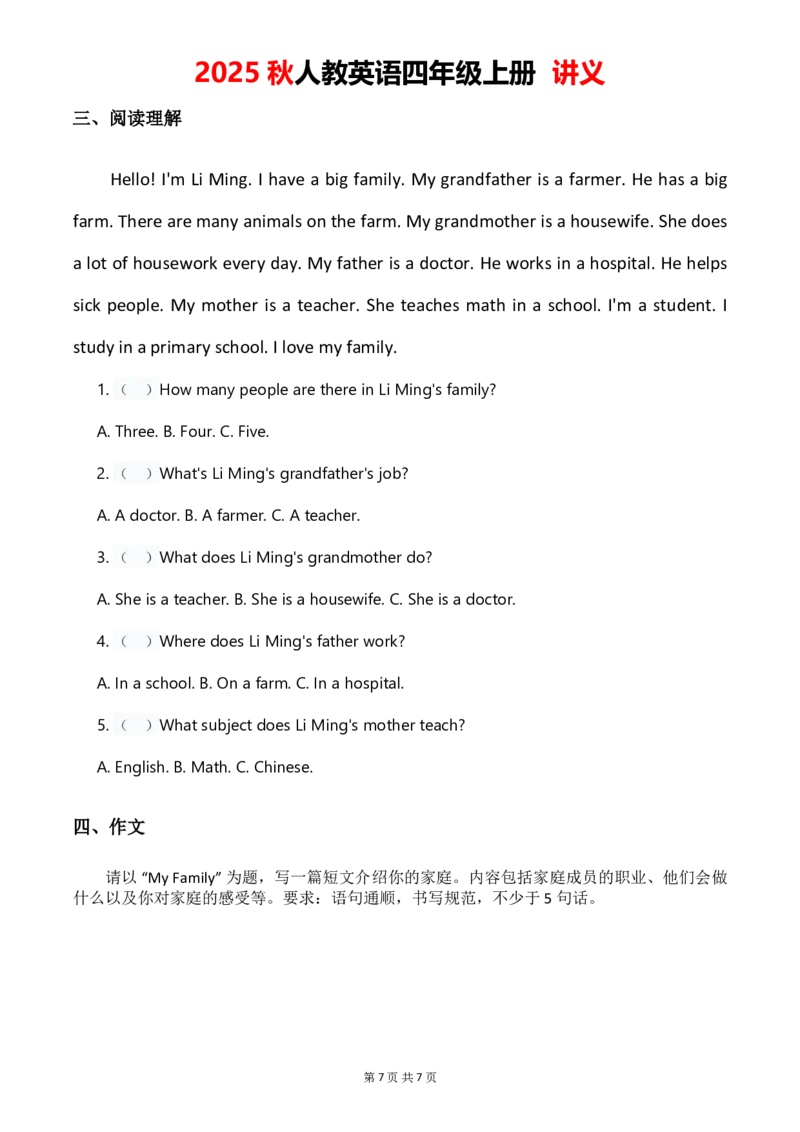
三、阅读理解
Hello! I'm Li Ming. I have a big family. My grandfather is a farmer. He has a big
farm. There are many animals on the farm. My grandmother is a housewife. She does
a lot of housework every day. My father is a doctor. He works in a hospital. He helps
sick people. My mother is a teacher. She teaches math in a school. I'm a student. I
study in a primary school. I love my family.
1. ( )How many people are there in Li Ming's family?
A. Three. B. Four. C. Five.
2. ( )What's Li Ming's grandfather's job?
A. A doctor. B. A farmer. C. A teacher.
3. ( )What does Li Ming's grandmother do?
A. She is a teacher. B. She is a housewife. C. She is a doctor.
4. ( )Where does Li Ming's father work?
A. In a school. B. On a farm. C. In a hospital.
5. ( )What subject does Li Ming's mother teach?
A. English. B. Math. C. Chinese.
四、作文
请以“MyFamily”为题,写一篇短文介绍你的家庭。内容包括家庭成员的职业、他们会做
什么以及你对家庭的感受等。要求:语句通顺,书写规范,不少于5句话。
第7页共7页2025 秋人教英语四年级上册 讲义
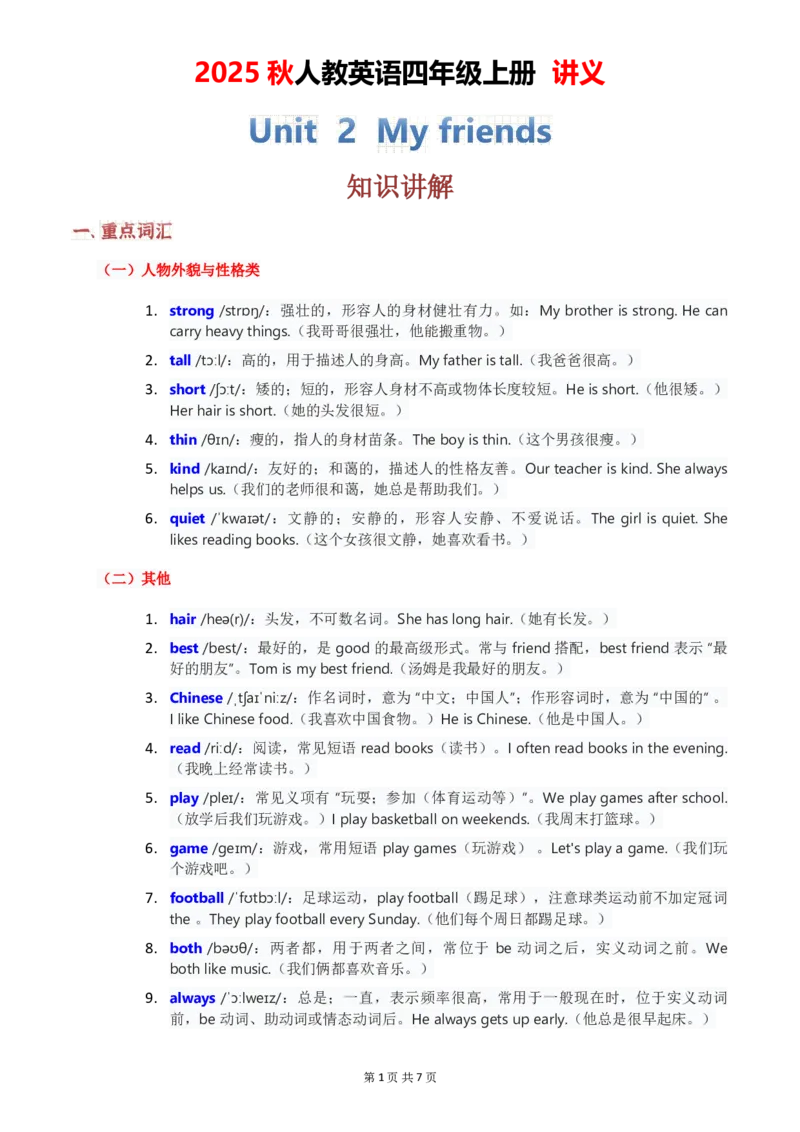
知识讲解
(一)人物外貌与性格类
1. strong /strɒŋ/:强壮的,形容人的身材健壮有力。如:My brother is strong. He can
carryheavythings.(我哥哥很强壮,他能搬重物。)
2. tall/tɔːl/:高的,用于描述人的身高。Myfather istall.(我爸爸很高。)
3. short /ʃɔːt/:矮的;短的,形容人身材不高或物体长度较短。Heisshort.(他很矮。)
Her hairis short.(她的头发很短。)
4. thin/θɪn/:瘦的,指人的身材苗条。Theboyisthin.(这个男孩很瘦。)
5. kind /kaɪnd/:友好的;和蔼的,描述人的性格友善。Our teacher is kind. She always
helpsus.(我们的老师很和蔼,她总是帮助我们。)
6. quiet /ˈkwaɪət/:文静的;安静的,形容人安静、不爱说话。The girl is quiet. She
likesreadingbooks.(这个女孩很文静,她喜欢看书。)
(二)其他
1. hair/heə(r)/:头发,不可数名词。Shehaslonghair.(她有长发。)
2. best /best/:最好的,是good的最高级形式。常与 friend搭配,bestfriend表示 “最
好的朋友”。Tomis mybestfriend.(汤姆是我最好的朋友。)
3. Chinese /ˌtʃaɪˈniːz/:作名词时,意为“中文;中国人”;作形容词时,意为“中国的” 。
IlikeChinesefood.(我喜欢中国食物。)HeisChinese.(他是中国人。)
4. read/riːd/:阅读,常见短语 readbooks(读书)。I oftenread booksin theevening.
(我晚上经常读书。)
5. play /pleɪ/:常见义项有 “玩耍;参加(体育运动等)”。We play games after school.
(放学后我们玩游戏。)Iplay basketballonweekends.(我周末打篮球。)
6. game /ɡeɪm/:游戏,常用短语 play games(玩游戏) 。Let's play a game.(我们玩
个游戏吧。)
7. football/ˈfʊtbɔːl/:足球运动,play football(踢足球),注意球类运动前不加定冠词
the。They playfootballeverySunday.(他们每个周日都踢足球。)
8. both /bəʊθ/:两者都,用于两者之间,常位于 be 动词之后,实义动词之前。We
bothlikemusic.(我们俩都喜欢音乐。)
9. always /ˈɔːlweɪz/:总是;一直,表示频率很高,常用于一般现在时,位于实义动词
前,be动词、助动词或情态动词后。Healwaysgetsupearly.(他总是很早起床。)
第1页共7页2025 秋人教英语四年级上册 讲义
10.basketball /ˈbɑːskɪtbɔːl/:篮球运动,play basketball(打篮球)。I play basketball
withmy friends.(我和朋友们一起打篮球。)
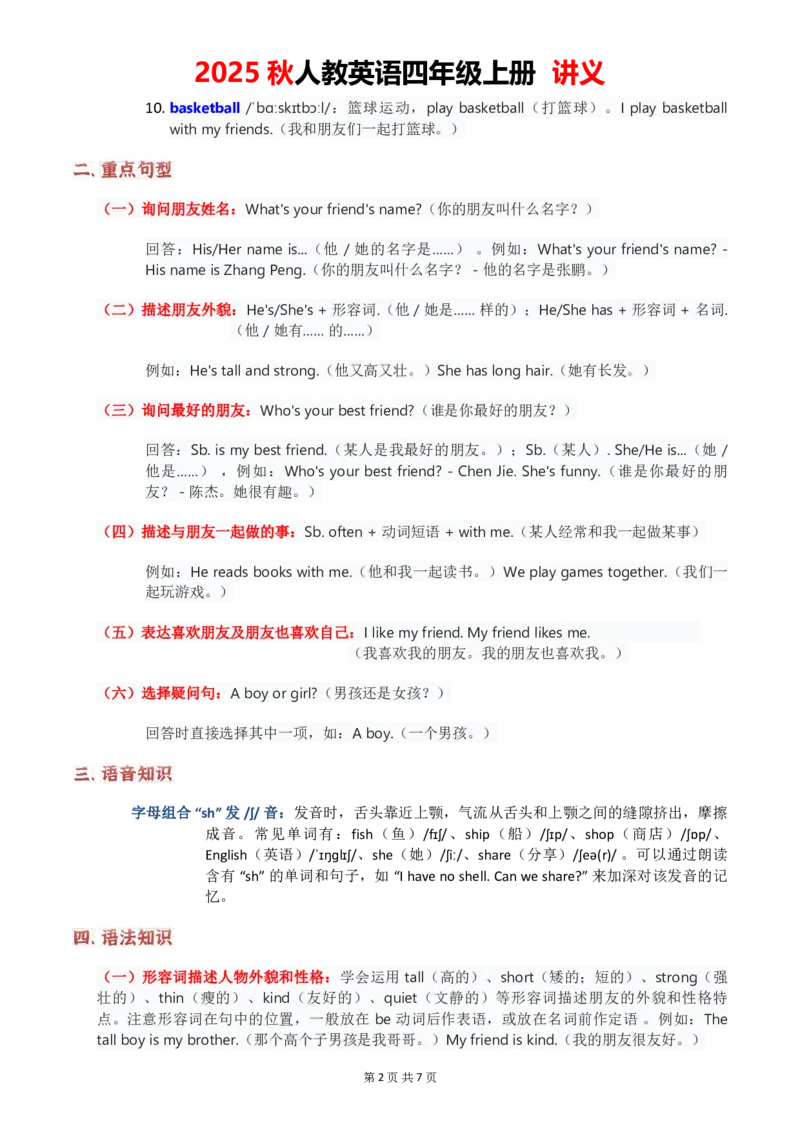
(一)询问朋友姓名:What'syour friend'sname?(你的朋友叫什么名字?)
回答:His/Her name is...(他 / 她的名字是……) 。例如:What's your friend's name? -
HisnameisZhangPeng.(你的朋友叫什么名字?- 他的名字是张鹏。)
(二)描述朋友外貌:He's/She's+ 形容词.(他 / 她是…… 样的);He/Shehas + 形容词+ 名词.
(他/ 她有……的……)
例如:He'stallandstrong.(他又高又壮。)Shehaslonghair.(她有长发。)
(三)询问最好的朋友:Who'syour bestfriend?(谁是你最好的朋友?)
回答:Sb. is my best friend.(某人是我最好的朋友。);Sb.(某人). She/He is...(她 /
他是……) ,例如:Who's your best friend? - Chen Jie. She's funny.(谁是你最好的朋
友?- 陈杰。她很有趣。)
(四)描述与朋友一起做的事:Sb. often+ 动词短语+ withme.(某人经常和我一起做某事)
例如:He reads books with me.(他和我一起读书。)We play games together.(我们一
起玩游戏。)
(五)表达喜欢朋友及朋友也喜欢自己:Ilikemy friend.Myfriendlikesme.
(我喜欢我的朋友。我的朋友也喜欢我。)
(六)选择疑问句:Aboyor girl?(男孩还是女孩?)
回答时直接选择其中一项,如:Aboy.(一个男孩。)
字母组合“sh”发/ʃ/音:发音时,舌头靠近上颚,气流从舌头和上颚之间的缝隙挤出,摩擦
成音。常见单词有:fish(鱼)/fɪʃ/、ship(船)/ʃɪp/、shop(商店)/ʃɒp/、
English(英语)/ˈɪŋɡlɪʃ/、she(她)/ʃiː/、share(分享)/ʃeə(r)/。可以通过朗读
含有“sh”的单词和句子,如“Ihavenoshell.Canweshare?”来加深对该发音的记
忆。
(一)形容词描述人物外貌和性格:学会运用 tall(高的)、short(矮的;短的)、strong(强
壮的)、thin(瘦的)、kind(友好的)、quiet(文静的)等形容词描述朋友的外貌和性格特
点。注意形容词在句中的位置,一般放在 be 动词后作表语,或放在名词前作定语 。例如:The
tallboyismy brother.(那个高个子男孩是我哥哥。)Myfriendis kind.(我的朋友很友好。)
第2页共7页2025 秋人教英语四年级上册 讲义
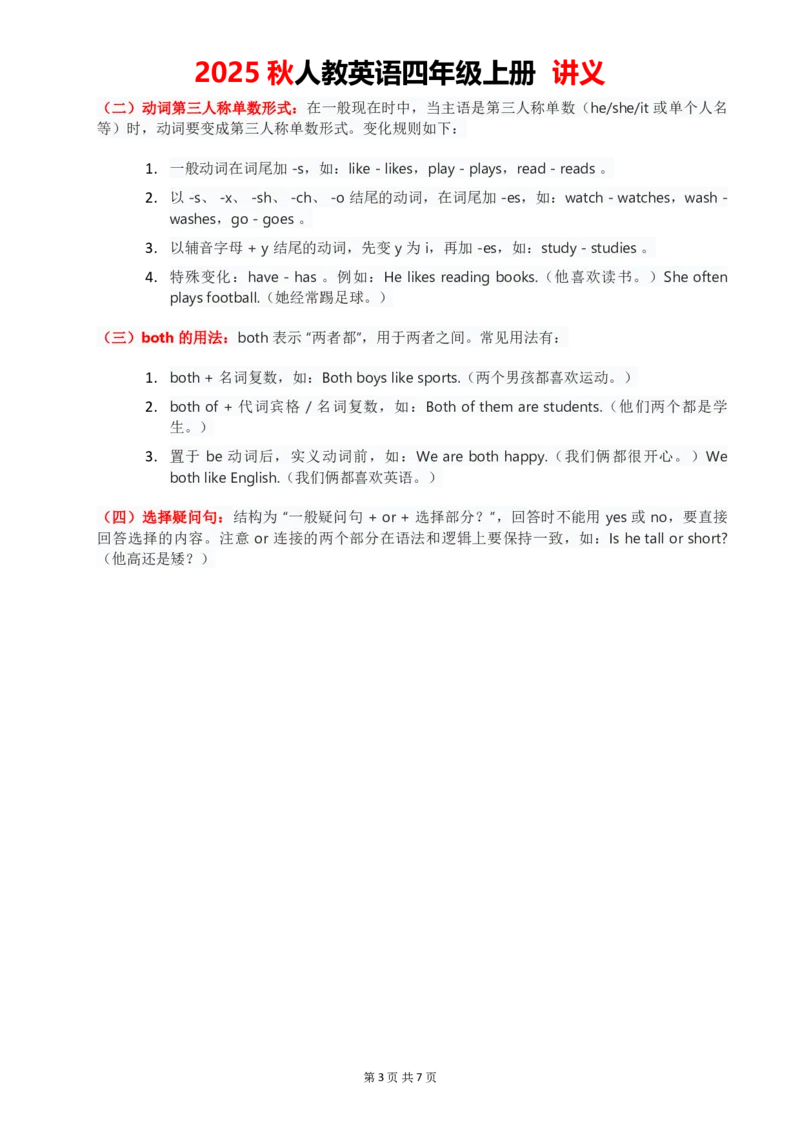
(二)动词第三人称单数形式:在一般现在时中,当主语是第三人称单数(he/she/it 或单个人名
等)时,动词要变成第三人称单数形式。变化规则如下:
1. 一般动词在词尾加-s,如:like- likes,play- plays,read- reads。
2. 以-s、-x、-sh、-ch、-o结尾的动词,在词尾加 -es,如:watch - watches,wash-
washes,go - goes。
3. 以辅音字母+ y结尾的动词,先变y为i,再加-es,如:study- studies。
4. 特殊变化:have - has 。例如:He likes reading books.(他喜欢读书。)She often
playsfootball.(她经常踢足球。)
(三)
both
的用法:both表示“两者都”,用于两者之间。常见用法有:
1. both+ 名词复数,如:Bothboyslikesports.(两个男孩都喜欢运动。)
2. both of + 代词宾格 / 名词复数,如:Both of them are students.(他们两个都是学
生。)
3. 置于 be 动词后,实义动词前,如:We are both happy.(我们俩都很开心。)We
bothlikeEnglish.(我们俩都喜欢英语。)
(四)选择疑问句:结构为 “一般疑问句 + or + 选择部分?”,回答时不能用 yes 或 no,要直接
回答选择的内容。注意 or 连接的两个部分在语法和逻辑上要保持一致,如:Is he tall or short?
(他高还是矮?)
第3页共7页2025 秋人教英语四年级上册 讲义
配套练习
一、选择题(20 道)
1. Myfriendis ______.He canplaybasketballwell.
A. strongB. thinC. short
2. —What'syour friend'sname?
—______nameis Sarah.
A. SheB. Her C. Hers
3. Mybestfriend______longhair.
A. haveB. hasC.is
4. He'stall______strong.
A. butB.andC. or
5. —Who'syour bestfriend?
—______
A. Sheis tall. B.ChenJie. C. Shelikesreading.
6. Weoften______gamestogether.
A. playB. playsC.playing
7. Myfriendlikes______books.
A. readB.readsC. reading
8. ______your friendaboyor a girl?
A. IsB. AreC.Am
9. MyfriendandI______ likemusic.
A. bothB.allC. too
10.Shealways______ mewithmy English.
A. helpB.helpsC. helping
11.Ilikesports.Myfriendlikessports,______.
A. tooB. also C.either
12.Mybestfriendisvery ______. Sheoftenmakesmelaugh.
A. kindB. funnyC. quiet
13.______is myfriend.He'sfromChina.
A. HisB. HimC. He
14.Myfriend______ footballafterschool.
A. playB. playsC.playing
第4页共7页2025 秋人教英语四年级上册 讲义
15.We______ likeanimalbooks.
A. bothB.allC. every
16.Myfriendhas______eyes.
A. bigB. biggerC. biggest
17.Mybestfriendoften______ pictureswith me.
A. drawB.drawsC. drawing
18.Ihavea friend.______nameisJohn.
A. HeB. HisC.Him
19.Myfriendis goodat______basketball.
A. playB. playsC.playing
20.She's______ andkind.
A. friendB. friendlyC. friends
(二)完型填空(20 道)
I have a good 1 . Her name is Liu Ying. She is 2 . She has 3 hair. She
is 4 and kind. We are in the 5 class. We often 6 together.
We like 7 books. We both like 8 . She often 9 me with my Chinese.
And I often help her 10 her English. We also like 11 games. On weekends,
we often 12 football. She 13 football very well. She 14 likes singing.
She often 15 songs after school. We 16 each other. We are 17 best
friends. We always 18 happy together. I'm 19 to have such a good friend. I
hope our 20 will lastforever(永远).
1. A. friendB. friendsC.sister
2. A. tallB. shortC. BothAandB
3. A. longB.shortC.Either Aor B
4. A. friendlyB. friendC. friends
5. A. sameB. differentC. another
6. A. playsB.play C.playing
7. A. readB.readsC. reading
8. A. animalB. animalsC. ananimal
第5页共7页2025 秋人教英语四年级上册 讲义
9. A. helpB.helpsC. helping
10.A. withB. forC. at
11.A. playB. playsC.playing
12.A. playB. playsC.playing
13.A. playB. playsC.playing
14.A. tooB. also C.either
15.A. singB.sings C.singing
16.A. likeB. likesC. liking
17.A. eachotherB. eachothersC. eachother's
18.A. areB. isC. am
19.A. happyB.sadC. angry
20.A. friendB. friendlyC. friendship
(三)阅读理解
I'm Tom. I have two good friends. They are Lily and Lucy. Lily is tall and thin. She
has long hair. She is very kind. She often helps others. She likes reading books. She
often reads books in the library. Lucy is short and quiet. She has short hair. She is
good at drawing. She often draws pictures after school. Lily and Lucy are twins. They
both like music. They often listen to music together. They are my good friends. I like
them very much.
1. ( )HowmanygoodfriendsdoesTomhave?
A. One. B.Two. C. Three.
2. ( )WhatdoesLily look like?
A. Sheis tallandthinwithlong hair.B. Sheisshortandquietwith shorthair.C. Sheistalland
strongwith shorthair.
3. ( )WhatdoesLucy likedoing?
A. Readingbooks. B. Drawingpictures. C. Listeningto music.
4. ( )AreLily andLucy twins?
A. Yes,they are.B. No,theyaren't. C.Wedon'tknow.
5. ( )Whatdo Lily andLucy bothlike?
A. Readingbooks. B. Drawingpictures. C. Music.
第6页共7页2025 秋人教英语四年级上册 讲义
四、作文
请以“MyFriend”为题,写一篇短文介绍你的朋友。内容包括朋友的外貌、性格、爱好以及你们
经常一起做的事情等。要求:语句通顺,书写规范,不少于5句话。
第7页共7页2025 秋人教英语四年级上册 讲义
知识讲解
(一)场所类
1. playground (操场):孩子们进行体育活动和玩耍的地方,如:We play football on
theplayground.(我们在操场上踢足球。)
2. park (公园):人们休闲散步、游玩的场所,There is a park near my home.(我家附
近有一个公园。)
3. hospital (医院):看病就医的地方,My mother works in a hospital.(我妈妈在医院
工作。)
4. shop (商店):可购买各种物品,Igo to theshopto buysomefood.(我去商店买些
食物。)
5. toilet (厕所;卫生间):方便人们解决生理需求的地方。
6. busstop (公交车站):人们等公交车的地方,I wait for the bus atthe busstop.(我
在公交车站等车。)
7. library (图书馆):人们阅读和借阅书籍的地方,I often read books in the library.
(我经常在图书馆看书。)
(二)活动及其他类
1. sport (体育运动):常见短语do sports(做运动),Weshoulddo sportseveryday.
(我们应该每天做运动。)
2. walk (散步;行走):作名词时常见短语 take a walk(散步);作动词时表示走路的
动作,I walkto schooleveryday.(我每天步行去上学。)
3. take (与名词连用,表示举动、动作等;带走;运走):常见短语 take a walk(散
步)、take photos(拍照),Please take this book to your sister.(请把这本书带给
你妹妹。)
4. buy (购买):常见短语 buy sth. for sb.(给某人买某物),I want to buy a gift for
my mother.(我想给妈妈买个礼物。)
5. story (故事):常见短语 tell a story(讲故事)、read a story(读故事),My
mother oftentells mestoriesbeforeIgo to bed.(妈妈在我睡觉前常给我讲故事。)
6. photo (照片):常见短语 take photos(拍照),We took many photos during the
trip.(我们在旅行中拍了很多照片。)
7. favourite (最喜欢的):常用来表达个人喜好,My favourite colour is blue.(我最喜
欢的颜色是蓝色。)
8. place (地方;场所):Thisisa beautifulplace.(这是一个美丽的地方。)
第1页共7页2025 秋人教英语四年级上册 讲义
(一)
There be
句型:表示 “某地有某物”,be 动词的形式根据后面名词的单复数来确定。如果
名词是单数或不可数名词,be动词用is;如果名词是复数,be动词用are。
1. Thereis aplayground.(有一个操场。)
2. Therearemanypeople.(有很多人。)
(二)描述在社区的活动:I/Weoften+ 动词短语+ 地点.(我/ 我们经常在某地做某事)
1. Ioftendo sportsontheplayground.(我经常在操场上做运动。)
2. Weoftentakea walk inthepark.(我们经常在公园里散步。)
(三)表达喜欢某个地方及原因:My favourite place in my community is...(在我的社区里我最
喜欢的地方是……)+ 原因(Thereare.../Ican...等)
1. My favourite place in my community is the library. There are so many interesting
books.(我社区里最喜欢的地方是图书馆,那里有很多有趣的书。)
字母组合 “ck”发 /k/音:发音时,舌后部抵住软腭,憋住气,然后突然分开,让气
流冲出,读音轻短。常见单词有 duck(鸭子)、black(黑色的)、sock
(短袜)、back(后面;背部)、tick(标记号;滴答声)等。
(一) 句型的运用
There be
1. 肯定句结构:There be + 某物 / 人 + 地点状语。例如:There is a book on the desk.
(桌子上有一本书。)Therearesomeflowersinthegarden.(花园里有一些花。)
2. 一般疑问句结构:Be+ there + 某物 / 人 + 地点状语?肯定回答:Yes, there is/are. 否
定回答:No, thereisn't/aren't. 例如:Is therea park nearyour home?- Yes, thereis. /
No, there isn't.(你家附近有公园吗? - 是的,有。/ 不,没有。)Are thereany birds
in the tree? - Yes, there are. / No, there aren't.(树上有鸟吗? - 是的,有。/ 不,没
有。)
3. 特殊疑问句结构:特殊疑问词 + be + there + 地点状语?例如:What's there in the
room?(房间里有什么?)How many people are there in your family?(你家有几口
人?)
(二)一般现在时的用法:表示经常性、习惯性的动作或存在的状态。当主语是第一人称
(I/we)、第二人称(you)或复数时,动词用原形;当主语是第三人称单数(he/she/it 或单个
人名、单个事物等)时,动词要变成第三人称单数形式(一般在词尾加 -s,以 -s、 -x、 -sh、 -
ch、-o结尾的动词加-es)。
第2页共7页2025 秋人教英语四年级上册 讲义
1. Ioftenplay games.(我经常玩游戏。)
2. Heoftenreadsbooks.(他经常读书。)
第3页共7页2025 秋人教英语四年级上册 讲义
配套练习
(一)选择题(20 道)
1. There______ ahospitalinmy community.
A. isB.areC. be
2. Ioftengo to the______ to buythings.
A. parkB. shopC. library
3. Myfavouriteplaceis the______. Ican readmanybooksthere.
A. libraryB. hospitalC. playground
4. Therearesomeducks______thepark.
A. inB.onC. at
5. Let's______andseethenewpark.
A. go B.goesC.going
6. Myfather often______ awalk afterdinner.
A. takeB. takesC. taking
7. There______ manybooksinthelibrary.
A. isB.areC. have
8. Iliketo do sports______ theplayground.
A. inB.onC. at
9. Wecan ______inthepark.
A. playfootballB. seeadoctor C. buybooks
10.The______isa placefor peopleto readbooks.
A. libraryB. shopC. hospital
11.Thereis ashop______thepark.
A. nearB. infrontC. under
12.Mymotheroften______ thingsfromtheshop.
A. buyB. buysC.buying
13.Iwantto ______somephotosinthe park.
A. takeB. takesC. taking
14.Thereis a______ nearmy home.Ioftenplaythere.
A. playgroundB. hospitalC.library
15.______is yourfavouriteplacein thecommunity?
A. WhatB. WhereC. Who
第4页共7页2025 秋人教英语四年级上册 讲义
16.Weoften______in thelibrary.
A. playgamesB. readbooksC.fly akite
17.The______isa placeto waitfor thebus.
A. busstopB. shopC. park
18.There______ agymandtwo shopsinour community.
A. isB.areC. be
19.Ilikethepark______ therearemanyflowers.
A. becauseB. so C.but
20.Myfather goestowork ______bus.
A. byB. takeC. on
(二)、完型填空(20 道)
I live in a nice community. There 1 a big park near my home. I often go
there 2 my parents on weekends. We can see 3 flowers and trees in the
park. There is a 4 in the park. We can 5 in it. My father likes 6 photos
of the flowers. My mother likes 7 a walk. I like 8 football with my friends.
There 9 a library next to the park. I often go there to 10 books. There are
also some 11 in the community. We can buy many things there.
My 12 place in the community is the park 13 I can have a lot of fun
there. There are always 14 people in the park. Some are 15 , some are
playing games and some aretalking. We all like our community.
1. A. isB.areC. be
2. A. andB.withC. for
3. A. muchB. manyC. a lot
4. A. lakeB. hospitalC.shop
5. A. swimB. swimingC. swimming
6. A. takeB. takesC. taking
7. A. takeB. takesC. taking
8. A. playB. playsC.playing
第5页共7页2025 秋人教英语四年级上册 讲义
9. A. isB.areC. be
10.A. readB.readsC. reading
11.A. shopB. shopsC. hospital
12.A. favouriteB. likeC. love
13.A. becauseB. so C.but
14.A. a lotofB. lotofC. a lotsof
15.A. runB.runsC.running
16.A. playB. playsC.playing
17.A. haveB. hasC.having
18.A. otherB. othersC. another
19.A. sadB. happyC. angry
20.A. likeB. likesC. liking
(三)、阅读理解
I'm Tom. I live in a community. There is a big supermarket in my community. We
can buy food, clothes and many other things there. There is a library near the
supermarket. I often go there to read books. There are many interesting books in it.
There is also a park in my community. It's very beautiful. There are many trees and
flowers in the park. I like to play in the park with my friends. We can play football, fly
a kite and have a picnic there. There is a hospital in my community, too. My mother
works in the hospital. She is a doctor. I love my community.
1. ( )What'sinTom'scommunity?
A. Asupermarket. B.Alibrary. C.BothA andB.
2. ( )WheredoesTomoftengoto readbooks?
A. To thesupermarket.B. Tothe library. C.To thepark.
3. ( )WhatcanTomandhisfriendsdo inthepark?
A. Play basketball.B. Flya kite. C. Goshopping.
4. ( )WhatdoesTom'smother do?
A. Sheis anurse. B.Sheisa doctor. C.Sheisa teacher.
第6页共7页2025 秋人教英语四年级上册 讲义
5. ( )DoesTomlovehiscommunity?
A. Yes,hedoes. B.No,hedoesn't. C. Wedon'tknow.
(四)、作文
请以“MyCommunity”为题,写一篇短文介绍你的社区。内容包括社区里有什么场所,你
在社区里经常做什么等。要求:语句通顺,书写规范,不少于5句话。
第7页共7页2025 秋人教英语四年级上册 讲义
知识讲解
(一)场所类
1. playground (操场):孩子们进行体育活动和玩耍的地方,如:We play football on
theplayground.(我们在操场上踢足球。)
2. park (公园):人们休闲散步、游玩的场所,There is a park near my home.(我家附
近有一个公园。)
3. hospital (医院):看病就医的地方,My mother works in a hospital.(我妈妈在医院
工作。)
4. shop (商店):可购买各种物品,Igo to theshopto buysomefood.(我去商店买些
食物。)
5. toilet (厕所;卫生间):方便人们解决生理需求的地方。
6. busstop (公交车站):人们等公交车的地方,I wait for the bus atthe busstop.(我
在公交车站等车。)
7. library (图书馆):人们阅读和借阅书籍的地方,I often read books in the library.
(我经常在图书馆看书。)
(二)活动及其他类
1. sport (体育运动):常见短语do sports(做运动),Weshoulddo sportseveryday.
(我们应该每天做运动。)
2. walk (散步;行走):作名词时常见短语 take a walk(散步);作动词时表示走路的
动作,I walkto schooleveryday.(我每天步行去上学。)
3. take (与名词连用,表示举动、动作等;带走;运走):常见短语 take a walk(散
步)、take photos(拍照),Please take this book to your sister.(请把这本书带给
你妹妹。)
4. buy (购买):常见短语 buy sth. for sb.(给某人买某物),I want to buy a gift for
my mother.(我想给妈妈买个礼物。)
5. story (故事):常见短语 tell a story(讲故事)、read a story(读故事),My
mother oftentells mestoriesbeforeIgo to bed.(妈妈在我睡觉前常给我讲故事。)
6. photo (照片):常见短语 take photos(拍照),We took many photos during the
trip.(我们在旅行中拍了很多照片。)
7. favourite (最喜欢的):常用来表达个人喜好,My favourite colour is blue.(我最喜
欢的颜色是蓝色。)
8. place (地方;场所):Thisisa beautifulplace.(这是一个美丽的地方。)
第1页共7页2025 秋人教英语四年级上册 讲义
(一)
There be
句型:表示 “某地有某物”,be 动词的形式根据后面名词的单复数来确定。如果
名词是单数或不可数名词,be动词用is;如果名词是复数,be动词用are。
1. Thereis aplayground.(有一个操场。)
2. Therearemanypeople.(有很多人。)
(二)描述在社区的活动:I/Weoften+ 动词短语+ 地点.(我/ 我们经常在某地做某事)
1. Ioftendo sportsontheplayground.(我经常在操场上做运动。)
2. Weoftentakea walk inthepark.(我们经常在公园里散步。)
(三)表达喜欢某个地方及原因:My favourite place in my community is...(在我的社区里我最
喜欢的地方是……)+ 原因(Thereare.../Ican...等)
1. My favourite place in my community is the library. There are so many interesting
books.(我社区里最喜欢的地方是图书馆,那里有很多有趣的书。)
字母组合 “ck”发 /k/音:发音时,舌后部抵住软腭,憋住气,然后突然分开,让气
流冲出,读音轻短。常见单词有 duck(鸭子)、black(黑色的)、sock
(短袜)、back(后面;背部)、tick(标记号;滴答声)等。
(一) 句型的运用
There be
1. 肯定句结构:There be + 某物 / 人 + 地点状语。例如:There is a book on the desk.
(桌子上有一本书。)Therearesomeflowersinthegarden.(花园里有一些花。)
2. 一般疑问句结构:Be+ there + 某物 / 人 + 地点状语?肯定回答:Yes, there is/are. 否
定回答:No, thereisn't/aren't. 例如:Is therea park nearyour home?- Yes, thereis. /
No, there isn't.(你家附近有公园吗? - 是的,有。/ 不,没有。)Are thereany birds
in the tree? - Yes, there are. / No, there aren't.(树上有鸟吗? - 是的,有。/ 不,没
有。)
3. 特殊疑问句结构:特殊疑问词 + be + there + 地点状语?例如:What's there in the
room?(房间里有什么?)How many people are there in your family?(你家有几口
人?)
(二)一般现在时的用法:表示经常性、习惯性的动作或存在的状态。当主语是第一人称
(I/we)、第二人称(you)或复数时,动词用原形;当主语是第三人称单数(he/she/it 或单个
人名、单个事物等)时,动词要变成第三人称单数形式(一般在词尾加 -s,以 -s、 -x、 -sh、 -
ch、-o结尾的动词加-es)。
第2页共7页2025 秋人教英语四年级上册 讲义
1. Ioftenplay games.(我经常玩游戏。)
2. Heoftenreadsbooks.(他经常读书。)
第3页共7页2025 秋人教英语四年级上册 讲义
配套练习
(一)选择题(20 道)
1. There______ ahospitalinmy community.
A. isB.areC. be
2. Ioftengo to the______ to buythings.
A. parkB. shopC. library
3. Myfavouriteplaceis the______. Ican readmanybooksthere.
A. libraryB. hospitalC. playground
4. Therearesomeducks______thepark.
A. inB.onC. at
5. Let's______andseethenewpark.
A. go B.goesC.going
6. Myfather often______ awalk afterdinner.
A. takeB. takesC. taking
7. There______ manybooksinthelibrary.
A. isB.areC. have
8. Iliketo do sports______ theplayground.
A. inB.onC. at
9. Wecan ______inthepark.
A. playfootballB. seeadoctor C. buybooks
10.The______isa placefor peopleto readbooks.
A. libraryB. shopC. hospital
11.Thereis ashop______thepark.
A. nearB. infrontC. under
12.Mymotheroften______ thingsfromtheshop.
A. buyB. buysC.buying
13.Iwantto ______somephotosinthe park.
A. takeB. takesC. taking
14.Thereis a______ nearmy home.Ioftenplaythere.
A. playgroundB. hospitalC.library
15.______is yourfavouriteplacein thecommunity?
A. WhatB. WhereC. Who
第4页共7页2025 秋人教英语四年级上册 讲义
16.Weoften______in thelibrary.
A. playgamesB. readbooksC.fly akite
17.The______isa placeto waitfor thebus.
A. busstopB. shopC. park
18.There______ agymandtwo shopsinour community.
A. isB.areC. be
19.Ilikethepark______ therearemanyflowers.
A. becauseB. so C.but
20.Myfather goestowork ______bus.
A. byB. takeC. on
(二)、完型填空(20 道)
I live in a nice community. There 1 a big park near my home. I often go
there 2 my parents on weekends. We can see 3 flowers and trees in the
park. There is a 4 in the park. We can 5 in it. My father likes 6 photos
of the flowers. My mother likes 7 a walk. I like 8 football with my friends.
There 9 a library next to the park. I often go there to 10 books. There are
also some 11 in the community. We can buy many things there.
My 12 place in the community is the park 13 I can have a lot of fun
there. There are always 14 people in the park. Some are 15 , some are
playing games and some aretalking. We all like our community.
1. A. isB.areC. be
2. A. andB.withC. for
3. A. muchB. manyC. a lot
4. A. lakeB. hospitalC.shop
5. A. swimB. swimingC. swimming
6. A. takeB. takesC. taking
7. A. takeB. takesC. taking
8. A. playB. playsC.playing
第5页共7页2025 秋人教英语四年级上册 讲义
9. A. isB.areC. be
10.A. readB.readsC. reading
11.A. shopB. shopsC. hospital
12.A. favouriteB. likeC. love
13.A. becauseB. so C.but
14.A. a lotofB. lotofC. a lotsof
15.A. runB.runsC.running
16.A. playB. playsC.playing
17.A. haveB. hasC.having
18.A. otherB. othersC. another
19.A. sadB. happyC. angry
20.A. likeB. likesC. liking
(三)、阅读理解
I'm Tom. I live in a community. There is a big supermarket in my community. We
can buy food, clothes and many other things there. There is a library near the
supermarket. I often go there to read books. There are many interesting books in it.
There is also a park in my community. It's very beautiful. There are many trees and
flowers in the park. I like to play in the park with my friends. We can play football, fly
a kite and have a picnic there. There is a hospital in my community, too. My mother
works in the hospital. She is a doctor. I love my community.
1. ( )What'sinTom'scommunity?
A. Asupermarket. B.Alibrary. C.BothA andB.
2. ( )WheredoesTomoftengoto readbooks?
A. To thesupermarket.B. Tothe library. C.To thepark.
3. ( )WhatcanTomandhisfriendsdo inthepark?
A. Play basketball.B. Flya kite. C. Goshopping.
4. ( )WhatdoesTom'smother do?
A. Sheis anurse. B.Sheisa doctor. C.Sheisa teacher.
第6页共7页2025 秋人教英语四年级上册 讲义
5. ( )DoesTomlovehiscommunity?
A. Yes,hedoes. B.No,hedoesn't. C. Wedon'tknow.
(四)、作文
请以“MyCommunity”为题,写一篇短文介绍你的社区。内容包括社区里有什么场所,你
在社区里经常做什么等。要求:语句通顺,书写规范,不少于5句话。
第7页共7页2025 秋人教英语四年级上册 讲义
知识讲解
(一)社区职业类
1. firefighter /ˈfaɪəfaɪtə(r)/:消防员,负责灭火和救援工作。例如:My uncle is a
firefighter.(我的叔叔是一名消防员。)
2. cook/kʊk/:厨师,从事烹饪工作,制作食物。Thecook makesdeliciousfood.(这位
厨师做的食物很美味。)
3. driver/ˈdraɪvə(r)/:司机,驾驶各种车辆。Myfatherisa busdriver.(我的爸爸是一名
公交车司机。)
4. cleaner/ˈkliːnə(r)/:清洁工,负责打扫卫生,保持环境整洁。Cleaners getup early to
cleanthestreets.(清洁工们很早起床打扫街道。)
5. police officer /pəˈliːs ɒfɪsə(r)/:警察,维护社会治安,保障人们的安全。A police
officerhelpstheoldmancrosstheroad.(一名警察帮助老人过马路。)
6. delivery worker /ˈdelɪvəri ˈwɜːkə(r)/:快递员,负责投递包裹和信件。The delivery
workerbringsmea package.(快递员给我送来了一个包裹。)
(二)其他
1. busy/ˈbɪzi/:忙碌的,形容人或事物处于繁忙的状态。Mymother is alwaysbusy with
housework.(我的妈妈总是忙于家务。)
2. tired /ˈtaɪəd/:疲倦的,描述人感到劳累、疲惫。I'm tired after a long day of study.
(经过一整天的学习,我很累。)
3. chore /ˈtʃɔː(r)/:家庭杂务,如打扫、洗碗等。I oftendo somechoresat home.(我经
常在家做一些家务。)
4. also/ˈɔːlsəʊ/:也,用于句中,通常位于 be 动词、助动词或情态动词之后,实义动词
之前。IlikeEnglish. Ialso likemath.(我喜欢英语,我也喜欢数学。)
5. help /ˈhelp/:帮助,常见短语 help sb. with sth.(在某事上帮助某人),help sb. do
sth.(帮助某人做某事)。He often helps me with my homework.(他经常帮我做作
业。)
6. those /ˈðəʊz/:那些,是 that 的复数形式,用于指代远处的复数人或物。Those are
mybooks.(那些是我的书。)
7. old /ˈəʊld/:年纪大的;老的;旧的,可用于形容人或物。My grandfather is old.(我
的爷爷年纪大了。)Thisisanoldbook.(这是一本旧书。)
第1页共7页2025 秋人教英语四年级上册 讲义
8. tell /ˈtel/:讲述;告诉,常见短语 tell a story(讲故事),tell sb. sth.(告诉某人某
事),tell sb. to do sth.(告诉某人做某事)。My mother often tells me stories.(我
妈妈经常给我讲故事。)
9. everyone /ˈevriwʌn/:每人;人人;所有人,作主语时,谓语动词用单数形式。
Everyonelikesmusic.(每个人都喜欢音乐。)
10.Mrs /ˈmɪsɪz/:太太;夫人,用于已婚女性的姓氏或姓名前。Mrs Smith(史密斯夫
人)
11.volunteer /ˈvɒlənˈtɪə(r)/:志愿者,自愿为他人或社会提供帮助的人。I want to be a
volunteer.(我想成为一名志愿者。)
(一)询问职业:What's your father's/mother's/...job?(你的爸爸 / 妈妈 /…… 是做什么工作
的?)
1. 回答:He's/She's a...(他 / 她是一名……) 。例如:What's your father's job? - He's a
driver.(你爸爸是做什么工作的? -他是一名司机。)
(二)描述他人职业及帮助行为:Sb. is a... He/She often helps...(某人是一名…… 他 / 她经常帮
助……)
1. Our neighbour is a firefighter. He often helps people.(我们的邻居是一名消防员。他
经常帮助人们。)
(三)现在进行时描述正在进行的动作:Sb. is+ 动词- ing形式+其他.(某人正在做某事)
1. ChenJieismakingthebed.(陈杰正在铺床。)
(四)询问正在做的事情:Whatareyou/theydoing?(你/ 他们正在做什么?)
1. 回答:I'm/They're + 动词 - ing 形式.(我 / 他们正在……) 。例如:What are they
doing?-They'recleaningtheroom.(他们正在做什么?- 他们正在打扫房间。)
(五)表达自己是社区志愿者及活动内容:Weare community volunteers.We often...(我们是社
区志愿者。我们经常……)
1. We are community volunteers. We often help children and old people.(我们是社区
志愿者。我们经常帮助儿童和老人。)
字母组合 “ph”发 /f/音:例如:photo/ˈfəʊtəʊ/(照片)、phone /fəʊn/(电话)、elephant
/ˈelɪfənt/(大象)。发音时,上齿轻触下唇,气流从唇齿间挤出,摩擦成音。可以
通过朗读包含 “ph” 的单词和句子,如 “Philiphas aphone.Hetakes photos withhis
phone.”,来加深对该发音的记忆。
第2页共7页2025 秋人教英语四年级上册 讲义
(一)一般现在时中动词第三人称单数形式:在一般现在时的句子中,如果主语是第三人称单数
(he/she/it或单个人名、单个事物等),动词要变成第三人称单数形式。变化规则如下:
1. 一般动词在词尾加-s,如:help- helps,play- plays,read- reads。
2. 以-s、-x、-sh、-ch、-o结尾的动词,在词尾加 -es,如:watch - watches,wash-
washes,go - goes。
3. 以辅音字母 + y 结尾的动词,先变 y 为 i,再加 -es,如:study - studies 。例如:He
often helps others.(他经常帮助别人。)She goes to school by bike.(她骑自行车去
上学。)
(二)现在进行时:表示现在正在进行的动作或存在的状态,其结构为 “be 动词(am/is/are) +
动词的现在分词形式(动词 - ing)” 。be 动词的选择要根据主语来确定:I 用 am,you 用 are,
he/she/it等第三人称单数用is。动词变现在分词的规则如下:
1. 一般情况下,直接在动词后加-ing,如:clean- cleaning,play- playing。
2. 以不发音的字母 e 结尾的动词,去掉 e 再加 - ing,如:make - making,write -
writing。
3. 以重读闭音节结尾,且末尾只有一个辅音字母的动词,双写末尾辅音字母再加 - ing,
如:run - running,swim - swimming 。例如:I am reading a book.(我正在读一本
书。)Theyareplayingfootball.(他们正在踢足球。)
第3页共7页2025 秋人教英语四年级上册 讲义
配套练习
(一)选择题(20 道)
1. Myneighbourisa ______. Heoftenhelpsputoutfires.
A. firefighterB. cookC. driver
2. —What'syour mother'sjob?
—She's______cook.
A. a B.anC. the
3. Myfather isa driver. He______ a busevery day.
A. driveB.drivesC. driving
4. The______cleansthestreetseverymorning.
A. cleaner B.police officer C. delivery worker
5. —Whatarethey doing?
—They______theroom.
A. cleanB.arecleaningC. cleaning
6. Icanhelpmy mother______ somechores.
A. do B.doesC.doing
7. Mysisteris ______now. Sheis makinga cake.
A. busyB.tired C. happy
8. Myfriendoften______storiesto us.
A. tellB. tellsC. telling
9. Everyone______to behealthy.
A. wantB.wantsC. wanting
10.Look!Thoseboys ______football.
A. playB. areplayingC. plays
11.Thepoliceofficer ______theoldmancrossthe roadnow.
A. helpsB.helpingC. ishelping
12.Iwantto bea ______andhelppeople.
A. volunteerB. teacher C.doctor
13.Wearecommunityvolunteers. Weoftenhelp______.
A. child B.childrenC. childs
14.Myuncleisa ______. Hedeliverspackageseveryday.
A. deliveryworker B.cleaner C. cook
第4页共7页2025 秋人教英语四年级上册 讲义
15.______is yourfather'sjob?
A. WhatB. WhoC. Where
16.Thestudentsare______booksinthe library.
A. readB.readsC. reading
17.Mymotheroften______ mewithmy English.
A. helpB.helpsC. helping
18.Wecan't playfootballnowbecauseit's ______.
A. rainB.rainyC. rains
19.Sheis ______oldwoman.Sheneedsourhelp.
A. a B.anC. the
20.Thechildrenare______inthepark. Theyarehavingagoodtime.
A. playB. playsC.playing
二、完型填空(20 道)
I live in a nice community. There are many 1 people in my community. My
neighbour is a 2 . He often helps people. He 3 fires and saves people. Liu Jia's
father is a school bus 4 . He takes us to school every day. That's an important
5 . My mother is a 6 . She works in a restaurant. She can 7 delicious food.
On weekends, I often 8 as a volunteer in the community. I help 9 people.
Look! Those students are 10 , too. Chen Jie is 11 the bed for the old people.
Binbin and John are 12 old songs. Zhang Peng is 13 funny stories. Everyone is
so 14 . We love the people here. We love our 15 .
There are also many 16 in our community. They help make our community
17 . The 18 cleans the streets. The 19 delivers packages.
And the 20 helps keep the community safe. We all work together to make
our community a better place.
1. A. helpfulB. helpC. helps
2. A. firefighterB. cookC. driver
第5页共7页2025 秋人教英语四年级上册 讲义
3. A. putsoutB.putoutC. puttingout
4. A. driver B.cleaner C. policeofficer
5. A. jobB.work C.jobs
6. A. cookB. teacher C.nurse
7. A. cookB. cooksC. cooking
8. A. workB. worksC. working
9. A. oldB.youngC. tall
10.A. volunteersB. volunteerC. volunteering
11.A. makeB. makesC.making
12.A. singB.sings C.singing
13.A. tellB. tellsC. telling
14.A. happyB.sadC. angry
15.A. communityB. schoolC. family
16.A. jobsB.workersC. works
17.A. goodB.badC.dirty
18.A. cleaner B.driver C. cook
19.A. deliveryworker B.policeofficer C. teacher
20.A. policeofficer B.cook C. cleaner
三、阅读理解
I'm Tom. There are many people in my community. My neighbour, Mr Smith, is a
firefighter. He is very brave. He often helps people in danger. Liu Mei's mother is a
nurse. She works in a hospital. She takes good care of the patients.
There is a small park in our community. People often go there. Some children play
games there. Some old people take a walk there. On weekends, many students
become volunteers. They help clean the park. They also help the old people carry
things.
I'm a student. I often help my neighbours. I help the old man next door water
第6页共7页2025 秋人教英语四年级上册 讲义
the flowers. I like my community. Everyone is friendly and helpful.
1. ( )WhatdoesMr Smithdo?
A. Heisa nurse.B. Heisa firefighter.C. Heisa teacher.
2. ( )WheredoesLiuMei'smother work?
A. Ina school. B.In ahospital. C.In a restaurant.
3. ( )Whatdo childrendo inthepark?
A. Theytakea walk. B.They playgames.C. Theycleanthe park.
4. ( )Whatdo studentsdo onweekends?
A. Theyplaygames. B.They helpcleantheparkandhelp theold. C. Theygo to thehospital.
5. ( )WhatdoesTomdo to helphisneighbour?
A. He helps the old man carry things. B. He helps the old man water the flowers. C. He helps
theoldmanclean thehouse.
四、作文
请以“MyCommunity”为题,写一篇短文介绍你的社区。内容包括社区里有哪些人,他们
的工作是什么,你在社区里经常做什么等。要求:语句通顺,书写规范,不少于5句话。
第7页共7页2025 秋人教英语四年级上册 讲义
知识讲解
(一)天气类
1. weather /ˈweðə(r)/:天气,用于询问和描述天气状况。例如:What's the weather
liketoday?(今天天气怎么样?)
2. sunny /ˈsʌni/:阳光充足的;晴朗的,描述天气晴朗,阳光明媚。It's sunny today.
Let'sgo fora picnic.(今天天气晴朗,我们去野餐吧。)
3. hot /ˈhɒt/:热的;炎热的,形容天气炎热。It's too hotinsummer.(夏天太热了。)
4. windy /ˈwɪndi/:多风的;有风的,描述有风的天气。It's windy outside. Don't forget
your hat.(外面风很大,别忘了戴帽子。)
5. cloudy /ˈklaʊdi/:多云的,指天空云层较多的天气。It's cloudy today. It might rain.
(今天多云,可能会下雨。)
6. rainy /ˈreɪni/:阴雨的;多雨的,描述下雨的天气。I don't like rainy days.(我不喜欢
下雨天。)
7. cool /ˈkuːl/:凉爽的;凉快的,形容天气舒适,不炎热。Autumn is cool.(秋天很凉
爽。)
8. warm/ˈwɔːm/:温暖的;暖和的,描述天气温和,不冷不热。It'swarm inspring.(春
天很温暖。)
9. tomorrow /təˈmɒrəʊ/:明天,常与一般将来时连用。I will go shopping tomorrow.
(我明天要去购物。)
10.snowy /ˈsnəʊi/:多雪的;下雪的,用于描述下雪的天气或积雪的状态。It's snowy in
winter.(冬天多雪。)
(二)活动类
1. film /ˈfɪlm/:电影,常见短语 see a film(看电影)。Let's see a film this weekend.
(这个周末我们去看电影吧。)
2. fly /ˈflaɪ/:飞;放飞;驾驶(飞机等) ,常见短语 flya kite(放风筝)。We canfly a
kiteona windy day.(我们可以在有风的日子放风筝。)
3. kite /ˈkaɪt/:风筝,常与 fly 搭配,fly a kite(放风筝)。I have a beautiful kite.(我
有一个漂亮的风筝。)
4. snowman /ˈsnəʊmæn/:雪人,复数形式为 snowmen,常见短语 make a snowman
(堆雪人)。Wemakea snowmaninthesnow.(我们在雪地里堆雪人。)
第1页共7页2025 秋人教英语四年级上册 讲义
5. swim /ˈswɪm/:游泳,现在分词形式为 swimming,常见短语 go swimming(去游
泳)。Iliketo go swimminginsummer.(我喜欢在夏天去游泳。)
(三)其他
1. speak /ˈspiːk/:说话;讲话;发言,常见短语 speak English(说英语)。He can
speakEnglishwell.(他英语说得很好。)
2. degree/ˈdɪɡriː/:度;度数,用于表示温度。It's 25degreestoday.(今天25度。)
3. rain/ˈreɪn/:名词,雨;动词,下雨。作名词时,如:Thereisa lotofraininsummer.
(夏天雨水很多。)作动词时,如:It'srainingnow.(现在正在下雨。)
4. closed /ˈkləʊzd/:关闭的;封闭的,表示物体处于关闭的状态。The shop is closed.
(商店关门了。)
5. their /ˈðeə(r)/:形容词性物主代词,他们的;她们的;它们的,后接名词。This is
their classroom.(这是他们的教室。)
6. Sydney/ˈsɪdni/:悉尼(澳大利亚城市),常出现在询问该地天气的语境中。
(一)询问天气状况:What's the weather like + 地点(today/tomorrow)?(某地今天 / 明天天
气怎么样?)
1. 回答:It's + 描述天气的形容词.(天气是…… 的) 。例如:What's the weather like in
Beijingtoday?-It's sunny.(北京今天天气怎么样?- 天气晴朗。)
(二)描述天气及温度:It's+ 描述天气的形容词+ and+ 温度.(天气…… 且温度是……)
1. It'scoolandsunny. It's onlytwo degrees.(天气凉爽且晴朗,只有两度。)
(三)描述不同天气下的活动:On+ 描述天气的形容词+ days, we can+ 动词短语.(在…… 天气
的日子里,我们可以……)
1. Onsunnydays, wecanplaybasketball.(在晴天,我们可以打篮球。)
2. Onsnowydays, wecanmakeasnowman.(在雪天,我们可以堆雪人。)
(四)表达不能做某事及原因:We can't + 动词短语 + 地点. Because it's + 描述天气的形容词.
(我们不能在某地做某事,因为天气……)
1. We can't play football in the park. Because it's rainy.(我们不能在公园踢足球,因为
下雨了。)
(五)询问他人在某地的情况及活动:How about...? What can...do there?(…… 怎么样?…… 在
那里能做什么?)
第2页共7页2025 秋人教英语四年级上册 讲义
1. How about Sydney? Whatcan John'sfather do there?(悉尼怎么样?约翰的爸爸在那
里能做什么?)
2. 回答:It's + 描述天气的形容词. He can + 动词短语.(那里天气…… 他可以……) ,
如:It's hot and sunny. He can swim in the pool.(那里天气炎热且晴朗,他可以在泳
池里游泳。)
字母组合“th”常见发音有两种:清辅音/θ/和浊辅音/ð/。发/θ/音时,舌尖轻触上齿背,气流
从舌尖和上齿之间的缝隙挤出,声带不振动,如:thin(瘦的)/θɪn/、three(三)
/θriː/、thank(谢谢)/θæŋk/;发/ð/音时,发音位置与/θ/相同,但声带振动,如:
they(他们)/ðeɪ/、them(他们(宾格))/ðəm/、this(这个)/ðɪs/。可通过朗读
含有“th”的单词和句子,如“It'swarmagain.I'mthirstyandhungry.”来加深对这两种
发音的区分和记忆。
(一)一般现在时描述天气和日常活动:在描述当前的天气情况和日常在不同天气下进行的活动
时,常用一般现在时。例如:It's sunny today. We oftenplay outside.(今天天气晴朗。我们经常
在外面玩。)
(二)不同天气描述词汇的运用:熟练掌握描述天气的形容词(sunny、hot、windy 等)在句子
中的用法,注意它们与 be 动词的搭配以及在描述天气状况和相关活动时的表达。例如:It's
windy.Wecanflya kite.(有风,我们可以放风筝。)
(三)现在进行时表示当前正在进行的与天气相关的活动:当描述当前正在进行的与天气相关的
动作时,使用现在进行时。例如:It's raining now. We are staying at home.(现在正在下雨,我
们正待在家里。)
(四)复习巩固一般现在时与现在进行时的区别:一般现在时表示经常性、习惯性的动作或客观
事实;现在进行时表示现在正在进行的动作。例如:I often play football.(我经常踢足球,一般
现在时,表示习惯)I'm playing football now.(我现在正在踢足球,现在进行时,表示正在发生
的动作)
第3页共7页2025 秋人教英语四年级上册 讲义
知识讲解
(一)选择题(20 道)
1. —What'sthe weatherliketoday?
—It's______. Let'sgo to thepark.
A. rainyB.sunnyC. snowy
2. It'svery______ insummer. Wecanswimin thepool.
A. hotB.coldC. cool
3. —Isitwindy today?
—Yes,itis. Wecan______.
A. flya kiteB.makeasnowmanC.seea film
4. It's______ outside.Pleasetakeanumbrella.
A. sunnyB.rainyC. cloudy
5. What'stheweather like______Beijing?
A. inB.onC. at
6. It's30degreestoday. It'svery______.
A. coldB. hotC. cool
7. —Canweplayfootballin thepark?
—No, wecan't. Becauseit's______.
A. sunnyB.windy C. rainy
8. ______theweather likeinSydney?
A. WhatB. What'sC. How's
9. On______days, wecanmakea snowman.
A. sunnyB.snowyC. windy
10.It'swarmand______today. Wecan flya kite.
A. sunnyB.windy C. rainy
11.Myfather often______ afilmonweekends.
A. seeB.seesC. seeing
12.It'scoldoutside. Weshould______warmclothes.
A. wear B.wearsC.wearing
13.—Whatareyoudoing?
—I'm______ akite.
A. flyB. fliesC. flying
第4页共7页2025 秋人教英语四年级上册 讲义
14.It'ssnowy.Thechildren are______a snowman.
A. makeB. makesC.making
15.Theweatheris______ today. Wecango swimming.
A. hotB.coldC. cool
16.—What'stheweatherlike tomorrow?
—It's______andsunny.
A. coldB. warmC. rainy
17.Wecan't playbasketballoutside.It's ______now.
A. rainB.rainsC.raining
18.It's______ inwinter. Wecango skiing.
A. snowyB. sunnyC. windy
19.Myfriendsliketo ______onsunnydays.
A. playgamesB. playsgamesC. playinggames
20.Whatcanwedo ______ arainyday?
A. inB.onC. at
(二)完型填空(20 道)
I like different 1 of weather. In spring, it's usually 2 . I can 3 flowers.
In summer, it's very 4 . I can 5 in the pool. In autumn, it's 6 . I can fly a
kite. In winter, it's 7 . I can make a snowman.
Today is 8 . I want to go to the park. I can 9 football there. But my
mother says it's going to 10 . So we have to stay at home. We can 11 TV. My
sister is 12 a book. My father is 13 computer games. I'm 14 my
homework. It's a 15 day, but we can still have fun at home.
On 16 days, my family often goes to the beach. We can 17 in the sea.
My father likes to 18 a sunbath. My mother likes to 19 shells. I like to
20 sandcastles. We all enjoy ourselves.
1. A. kindB. kindsC. akind
2. A. warmB.hotC. cold
3. A. lookB. lookatC. see
第5页共7页2025 秋人教英语四年级上册 讲义
4. A. coolB.cold C.hot
5. A. swimB. swimmingC. swims
6. A. windyB. rainyC. snowy
7. A. sunnyB.snowyC. cloudy
8. A. sunnyB.rainyC. snowy
9. A. playB. playsC.playing
10.A. rainB.rainyC. rains
11.A. watchB. watchesC. watching
12.A. readB.readsC. reading
13.A. playB. playsC.playing
14.A. do B.doesC.doing
15.A. sunnyB.rainyC. good
16.A. sunnyB.rainyC. snowy
17.A. swimB. swimmingC. swims
18.A. takeB. takesC. taking
19.A. collect B.collects C. collecting
20.A. makeB. makesC.making
(三)阅读理解
I'm Lily. I live in Beijing. Today is Saturday. The weather is sunny and warm. I'm
very happy because I can go to the park with my parents. In the park, there are many
people. Some are flying kites. Some are playing games. Some are taking a walk.
My father likes reading books. He is sitting on the bench and reading a book. My
mother likes taking pictures. She is taking pictures of the flowers. I like playing games.
I'm playing hide - and - seek with my friends.
We have a great time in the park. But the weather report says it's going to be
rainy tomorrow. So we have to stay at home. We can watch TV and read books. I
hope it will be sunny again soon.
第6页共7页2025 秋人教英语四年级上册 讲义
1. ( )What'stheweatherlike todayinBeijing?
A. It's sunnyandhot.B. It's sunnyandwarm. C. It'srainyandcold.
2. ( )Whataresomepeopledoingin thepark?
A. Theyaresleeping. B.They areflyingkitesandplayinggames. C.Theyarehavinga party.
3. ( )WhatdoesLily'sfather likedoing?
A. Helikestakingpictures. B. Helikesplayinggames. C.He likesreadingbooks.
4. ( )WhatisLily doinginthepark?
A. Sheis takingpictures. B. Sheisreadinga book. C. Sheisplayinghide- and- seek.
5. ( )Whatwill Lily andher familydo tomorrow?
A. Theywill go to thepark. B.Theywill watchTVandreadbooks. C.They will goshopping.
(四)作文
请以 “The Weather andMyActivities” 为题,写一篇短文。描述不同天气下你喜欢做的活
动,以及今天的天气和你正在做的事情。要求:语句通顺,书写规范,不少于5句话。
第7页共7页2025 秋人教英语四年级上册 讲义
知识讲解
(一)衣物类
1. sweater /ˈswetə(r)/:毛衣,用于保暖,通常在天冷时穿着。如:I put on my sweater
becauseit'scold.(我穿上毛衣,因为天气冷。)
2. sock /ˈsɒk/:短袜,常以复数形式 socks 出现。These socks are very soft.(这些袜子
很柔软。)
3. shirt /ˈʃɜːt/:衬衫,一般指男士衬衫,女士衬衫常用 blouse 。My father has a white
shirt.(我爸爸有一件白色衬衫。)
4. coat /ˈkəʊt/:大衣;外套,在寒冷天气穿着。Put on your coat before you go out.
(出门前穿上你的外套。)
5. dress /ˈdres/:连衣裙,是女士服装。She looks beautiful in that dress.(她穿那条连
衣裙看起来很漂亮。)
6. glove /ˈɡlʌv/:手套,常用复数形式 gloves ,用于保暖或保护手部。I need a pair of
glovesinwinter.(冬天我需要一副手套。)
(二)季节与天气相关类
1. season /ˈsiːzn/:季节,一年有四个季节,即 spring(春天)、summer(夏天)、
autumn(秋天)/fall(美式英语)、winter(冬天) 。There are four seasons in a
year.(一年有四个季节。)
2. spring /ˈsprɪŋ/:春天,万物复苏的季节。In spring, the flowers bloom.(春天,花儿
盛开。)
3. summer /ˈsʌmə(r)/:夏天,天气炎热。I like swimming in summer.(我喜欢在夏天游
泳。)
4. autumn /ˈɔːtəm/:秋天,树叶变黄飘落,美式英语常用 fall 。The leaves turn yellow
in autumn.(秋天树叶变黄。)
5. winter /ˈwɪntə(r)/:冬天,天气寒冷,可能会下雪。It often snows in winter.(冬天经
常下雪。)
6. snow /ˈsnəʊ/:雪;下雪,作名词表示雪,作动词表示下雪的动作。We play in the
snow in winter.(我们冬天在雪地里玩耍。)It snows a lot in this area.(这个地区下
雪很多。)
7. get /ˈɡet/:常见义项有 “(使)达到,处于”“得到”“变得” 等 ,在本单元中 get
together 表示 “聚会” 。We get together with our family on weekends.(我们周末和
家人聚在一起。)
8. leaf /ˈliːf/:叶,复数形式为 leaves 。The leaves fall from the trees in autumn.(秋天
树叶从树上掉落。)
9. T - shirt /ˈtiː ʃɜːt/:T 恤衫,夏天常见的服装。I like wearing T - shirts in summer.(我
夏天喜欢穿T恤衫。)
第1页共7页2025 秋人教英语四年级上册 讲义
10.fall /ˈfɔːl/:落下;掉落;秋天(美式英语) 。作动词时,如:Leaves fall from the
treesinautumn.(秋天树叶从树上掉落。)作名词时,等同于autumn。
(三)疑问词及其他
1. whose /ˈhuːz/:谁的,用于询问物品所属关系。Whose book is this?(这是谁的
书?)
2. mine /ˈmaɪn/:我的,名词性物主代词,相当于 “my + 名词” 。This book is mine.
(这本书是我的。)
3. which /ˈwɪtʃ/:哪一个;哪一些,用于在多个事物中进行选择。Which season do you
like?(你喜欢哪个季节?)
4. why /ˈwaɪ/:为什么,用于询问原因。Why do you like summer?(你为什么喜欢夏
天?)
(一)询问衣物所属:Whose+ 名词+isthis/arethese?(这/ 这些是谁的……?)
1. 回答:It's/They're + 名词性物主代词 / 名词所有格.(它是 / 它们是…… 的) 。例如:
Whose sweater is this? - It's my father's.(这是谁的毛衣? - 是我爸爸的。)Whose
socksarethese?- They'remine.(这些是谁的袜子? -是我的。)
(二)请求穿衣物:CanI wear...?(我可以穿……吗?)
1. 回答:Yes, you can. / No, you can't.(是的,你可以。/ 不,你不可以。) 。例如:
Can I wear this new shirt today? - Yes, you can.(我今天可以穿这件新衬衫吗? - 是
的,你可以。)
(三)询问喜欢的季节及回答:Whichseasondo youlike?(你喜欢哪个季节?)
1. 回答:I like + 季节名称. Because...(我喜欢…… 季节。因为……) 。例如:Which
season do you like? - I like winter. Because I can make a snowman.(你喜欢哪个季
节?- 我喜欢冬天。因为我可以堆雪人。)
(四)描述不同季节的穿着和活动:In + 季节名称,we wear... We can...(在…… 季节,我们
穿……我们可以……)
1. In summer, we wear shorts and T - shirts. We can swim.(在夏天,我们穿短裤和 T 恤
衫。我们可以游泳。)
2. In winter, we wear warm coats and gloves. We can make a snowman.(在冬天,我们
穿暖和的外套和手套。我们可以堆雪人。)
字母组合“wh”有两种常见发音:在大多数情况下发/w/音,如:what(什么)/wɒt/、where(哪
里)/weə(r)/、which(哪一个)/wɪtʃ/;在字母 o 前发 /h/音,如:who(谁)/huː/、
whose(谁的)/huːz/、whom(谁,who的宾格)/huːm/。发音时,发/w/音双唇收圆
并突出,舌头后缩,气流从口腔吹出,声带振动;发/h/音气流通过声门摩擦发出,声
带不振动。通过朗读含有 “wh”的单词和句子,如 “Whatdoyouwearinthesnow?Who
cantellme?”来加深对其发音的记忆。
第2页共7页2025 秋人教英语四年级上册 讲义
(一)名词性物主代词:名词性物主代词(如 mine、yours、his、hers、theirs 等)相当于 “形容
词性物主代词 + 名词”,用于避免重复提及前面已出现的名词。使用时后面不再接名词。例如:
Thisismybook. Thatoneisyours.(这是我的书。那本是你的。)
(二)物主代词的选择:注意区分形容词性物主代词和名词性物主代词。形容词性物主代词(如
my、your、his、her、their 等)后必须接名词,用来修饰名词;名词性物主代词则独立使用,本
身就代表了 “形容词性物主代词 + 名词” 的含义。例如:my book(我的书,my 是形容词性物主
代词);mine(我的,名词性物主代词,相当于my book)。
(三)一般现在时描述季节特点和活动:使用一般现在时描述不同季节通常的天气状况、人们的
穿着和常进行的活动。例如:It's hot in summer. We often go swimming.(夏天很热,我们经常
去游泳。)
第3页共7页2025 秋人教英语四年级上册 讲义
配套练习
(一)选择题(20 道)
1. —Whose______isthis?
—It'smysister's.
A. sock B.socksC.a sock
2. It'scoldoutside. Youshouldwear a ______.
A. T- shirtB.coatC. dress
3. —CanIwear mynew dresstoday?
—______. It'sverycold.
A. Yes,youcanB. No,youcan'tC. Yes, Ican
4. ______seasondo youlikebest?
A. WhatB. WhichC.Whose
5. Inwinter, we often______a snowman.
A. makeB. makesC.making
6. —Whoseshoesarethese?
—They're______.
A. myB. mineC.me
7. Ilikesummer ______I cangoswimming.
A. becauseB. so C.but
8. Theleaves______ fromthetreesinautumn.
A. fallB.fallsC. falling
9. Inspring, wecan______flowers.
A. seeB.seesC. seeing
10.______do youwear insummer?
A. WhatB. WhichC.Whose
11.Mymother'sdress______verybeautiful.
A. isB.areC. am
12.Weusually ______inwinter.
A. go swimmingB.fly a kiteC.makea snowman
13.______seasonisveryhot.
A. SpringB.SummerC. Winter
14.Ihavea pairof ______.
A. gloveB.glovesC. aglove
第4页共7页2025 秋人教英语四年级上册 讲义
15.—______isyour favouriteseason?
—Spring.
A. WhyB.WhichC. What's
16.It'swarminspring. Wecan______football.
A. playB. playsC.playing
17.______oftengettogetherwith myfamilyinautumn.
A. IB. MyC. Me
18.She______ a reddresstoday.
A. wear B.wearsC.wearing
19.Inautumn,the ______turnyellow.
A. leaf B.leavesC.leafs
20.Ilikewinter ______I canplay inthesnow.
A. becauseB. so C.but
(二)完型填空(20 道)
There arefour 1 in a year. They are spring, summer, autumn and 2 .
In 3 , it's warm. The flowers come out. We can 4 kites. In summer, it's
5 . We can wear 6 and T - shirts. We can 7 in the pool. In autumn, it's
cool. The 8 turn yellow. We can 9 apples. In winter, it's cold. We can wear
warm 10 . We can 11 a snowman.
Today is 12 . I want to wear my new 13 . But my mother says it's too
cold. I have to wear a 14 . I don't like winter 15 I can't wear my beautiful
dresses. 16 I like it because I can play with snow. My sister 17 winter, too.
She often 18 snowmen with me. We always 19 a good time. We like
different seasons 20 different reasons.
1. A. seasonB. seasonsC. a season
2. A. springB.summer C. winter
3. A. springB.summer C. autumn
4. A. flyB. fliesC. flying
第5页共7页2025 秋人教英语四年级上册 讲义
5. A. coldB. hotC. cool
6. A. sweater B.sweatersC.shorts
7. A. swimB. swimmingC. swims
8. A. leaf B.leavesC.leafs
9. A. pick B.picks C.picking
10.A. clothesB. clothC.clothing
11.A. makesB. makeC.making
12.A. winter B. summerC. spring
13.A. dressB. coatC. sweater
14.A. T- shirtB.coatC. shorts
15.A. becauseB. so C.but
16.A. AndB. ButC. Or
17.A. likeB. likesC. liking
18.A. makeB. makesC.making
19.A. haveB. hasC.having
20.A. forB. withC. at
(三)阅读理解
Hello! I'm Lucy. I like all the seasons. In spring, it's warm and windy. I can fly a
kite and plant trees. In summer, it's hot. I can swim in the lake. I can wear my
beautiful dresses. In autumn, it's cool. The leaves are colorful. I can pick apples and
go hiking. In winter, it's cold and snowy. I can make a snowman and skate. I like to
play with snow.
I have a friend. Her name is Lily. She likes summer best. She likes swimming and
eating ice - cream. She doesn't like winter because it's too cold. But I think winter is a
great season. We often play together in different seasons.
1. ( )HowmanyseasonsdoesLucy like?
A. One. B.Two. C. Four.
第6页共7页2025 秋人教英语四年级上册 讲义
2. ( )WhatcanLucy do inspring?
A. She can swim and fly a kite. B. She can fly a kite and plant trees. C. She can make a
snowman.
3. ( )WhydoesLily likesummer?
A. Because she can wear beautiful dresses. B. Because she can swim and eat ice - cream. C.
Becauseshecanpick apples.
4. ( )Whydoesn'tLily likewinter?
A. Becauseshecan'tplaywith snow.B. Becauseshecan'tswim. C. Becauseit's too cold.
5. ( )Whatdo LucyandLily oftendo?
A. They often play together in different seasons. B. They often make a snowman in summer.
C. Theyoftengo hikinginwinter.
(四)作文
请以 “MyFavourite Season” 为题,写一篇短文。介绍你最喜欢的季节,包括这个季节的
天气、你喜欢穿的衣服以及喜欢做的活动等。要求:语句通顺,书写规范,不少于5句话。
第7页共7页