【一轮复习讲义】2024年高考英语高频考点题型归纳与方法总结(新高考通用)
第 04 讲 代词、介词、冠词(精讲)
题型目录一览
人称代词和物主代词
指示代词
不定代词
反身代词
介词
介词词组
冠词用法
一、知识点梳理
人称代词和物主代词
1. 人称代词
英语中人称代词(Personal Pronoun)意为用于直接指代人或者事物的代词,属于代词范畴,就像汉语中的
“你”、“我”、“他”。常用的英语人称代词有:I、you、he、she、it(主格)。人称代词在句中作不
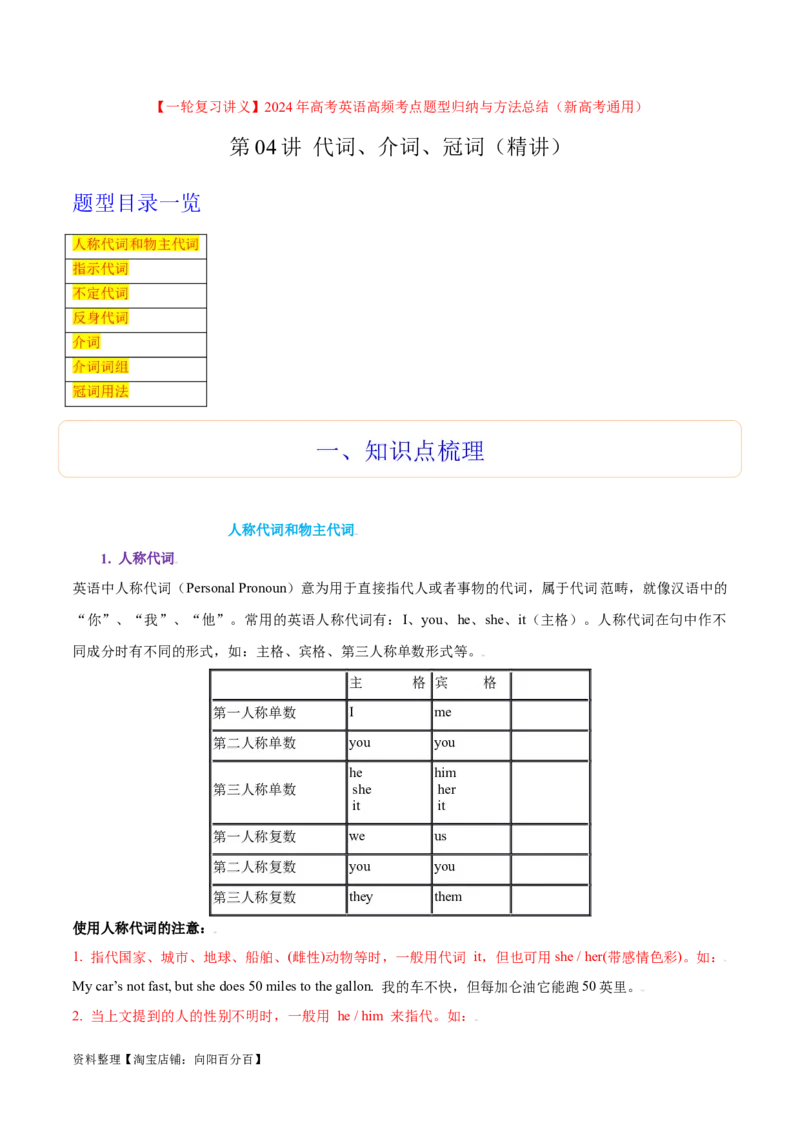
同成分时有不同的形式,如:主格、宾格、第三人称单数形式等。
主 格 宾 格
第一人称单数 I me
第二人称单数 you you
he him
第三人称单数 she her
it it
第一人称复数 we us
第二人称复数 you you
第三人称复数 they them
使用人称代词的注意:
1. 指代国家、城市、地球、船舶、(雌性)动物等时,一般用代词 it,但也可用she / her(带感情色彩)。如:
My car’s not fast, but she does 50 miles to the gallon. 我的车不快,但每加仑油它能跑50英里。
2. 当上文提到的人的性别不明时,一般用 he / him 来指代。如:
资料整理【淘宝店铺:向阳百分百】Whoever told you that, he was lying. 无论谁对你那样说,他都在说谎。
If a person had so much money, he would do it in another way. 要是一个人有那么多钱,他就会用另外一种方
法做这事。
说明:对于 anybody, everybody, nobody, anyone, someone, everyone, no one 这类性别不明的不定代词,它们
可用单数 he, him 指代,也可用复数 they, them指代,用单数较正式,用复数较口语化。如:
If anybody [anyone] comes, ask him [them] to wait. 要是有人来,让他等着。
3. 代词we, you, they 有时可用于泛指一般人。如:
We ought to obey the law. 大家都应遵守法律。
1. 物主代词
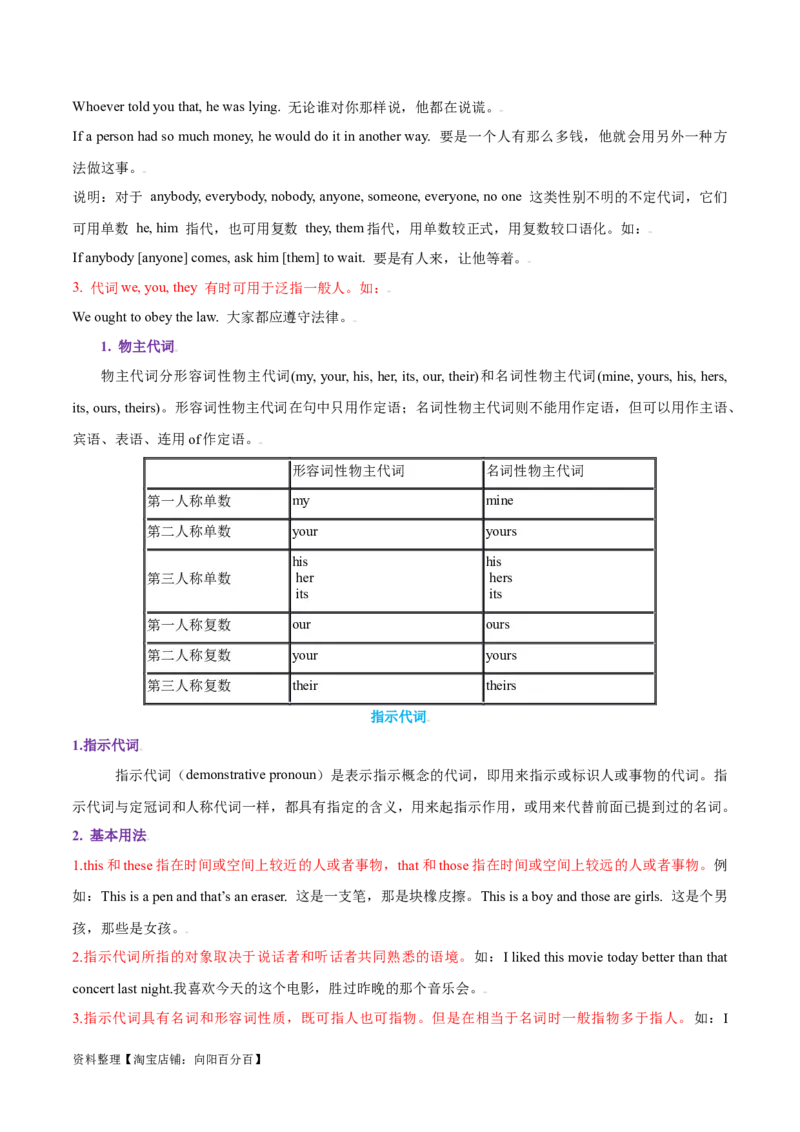
物主代词分形容词性物主代词(my, your, his, her, its, our, their)和名词性物主代词(mine, yours, his, hers,
its, ours, theirs)。形容词性物主代词在句中只用作定语;名词性物主代词则不能用作定语,但可以用作主语、
宾语、表语、连用of作定语。
形容词性物主代词 名词性物主代词
第一人称单数 my mine
第二人称单数 your yours
his his
第三人称单数 her hers
its its
第一人称复数 our ours
第二人称复数 your yours
第三人称复数 their theirs
指示代词
1.指示代词
指示代词(demonstrative pronoun)是表示指示概念的代词,即用来指示或标识人或事物的代词。指
示代词与定冠词和人称代词一样,都具有指定的含义,用来起指示作用,或用来代替前面已提到过的名词。
2. 基本用法
1.this和these指在时间或空间上较近的人或者事物,that和those指在时间或空间上较远的人或者事物。例
如:This is a pen and that’s an eraser. 这是一支笔,那是块橡皮擦。This is a boy and those are girls. 这是个男
孩,那些是女孩。
2.指示代词所指的对象取决于说话者和听话者共同熟悉的语境。如:I liked this movie today better than that
concert last night.我喜欢今天的这个电影,胜过昨晚的那个音乐会。
3.指示代词具有名词和形容词性质,既可指人也可指物。但是在相当于名词时一般指物多于指人。如:I
资料整理【淘宝店铺:向阳百分百】found this wallet. I found this.我找到了这只皮夹子。我找到了这个。(this 等于 this wallet)Is she going to
marry that man?她打算跟那人结婚吗?(that man不得用that代替,否则有轻蔑之意)
4.相当于名词的指示代词在句中作主语时,则指物指人均可。如:What are these? 这些是什么?(指物)
This is Bill. Is that George? 我是比尔。你是乔治吗?(电话用语)(指人)
5.打电话过程中,介绍自己时通常用this指代“我”,不用代词I;询问对方时用that指代“你”,不用代
词you。例如:----Hello. This is Mary. Who’s that? 喂,我是玛丽。你是谁?----This is Tom. 我是汤姆。
6.当指示代词所指的事物已确定时,后面的指示代词则用it或they代替。如:This (suit) is expensive, isn't it?
这套衣服昂贵,不是吗?"Are those yours?" "Yes, they are." “那些是你的吗?”“是的,它们是我的。”
3. 注意
1、指示代词在作主语时可指物也可指人,但作其他句子成分时只能指物,不能指人,例如:
(对)That is my teacher. 那是我的老师。( that作主语,指人)
(对)He is going to marry this girl. 他要和这个姑娘结婚。(this作限定词)
(错)He is going to marry this. (this作宾语时不能指人)
(对)I bought this. 我买这个。(this指物,可作宾语)
2、That和those可作定语从句的先行词,但this和 these不能,同时,在作先行词时,只有those可指人,
试比较:
(对) He admired that which looked beautiful. 他赞赏外表漂亮的东西。
(对) He admired those who looked beautiful. 他赞赏那些外表漂亮的人。(those指人)
(错) He admired that who danced well. (that作宾语时不能指人)
(对) He admired those who danced well. 他赞赏跳舞好的人。(those指人)
(对) He admired those which looked beautiful. 他赞赏那些外表漂亮的东西。(those指物)
3、在回答指示代词作主语的特殊问句时,如果指示代词指人,其回答中的主语仍可以用相应的指示代词,
也可以用it或者they;但指事物时,只能用it或者they。 例如:
Who’s that? That’s/It’s Liu Dehua.那是谁?那是刘德华。
What are those? They are basketballs. 那些是什么?那些是篮球。
4、在回答指示代词作主语的一般疑问句时,不管指示代词指人还是指物,答语中都用it或they。例如:
Is this a ruler? Yes, it is.
Are those your friends? No, they aren’t.
5、为避免重复,有时可用 that 或 those 来代替前面已提到过的人或事物;用 this 或 these 来代替下文
中将要提过的人或事物。例如:
She’s very friendly, and that is why we all love her. 她很友善,这就是我们都喜欢她的原因。
资料整理【淘宝店铺:向阳百分百】You needn’t do this — It’s pretty easy. 你不必做这事,那相当容易。
6、向别人介绍某个人时,要说“ This is ….”,而不说“ That is ….”,也不能说“ He is ….”或“ She is
….”。介绍两个人时,先用“ This is ….”介绍一个人,然后用“ That is ….”介绍另一个人。如:
This is Li Ming. Li Ming, this is Wei Hua. 这是李明。李明,这是魏华。
This is my brother and that is my sister. 这是我哥哥,那是我妹妹。
7、one,that 和it的区别:
one表示泛指,that和it 表示特指。that与所指名词为同类,但不是同一个,而it 与所指名词为同一个。
I can't find my hat. I think I must buy one. (不定)
我找不到我的帽子了。我想我该去买一顶。
The hat you bought is bigger than that I bought. (同类但不同个)
你买的那顶帽子比我买的大。
I can't find my hat. I don' t know where I put it. ( 同一物)
我找不到我的帽子。我不知道我把它放在哪了。
不定代词
1. 不定代词
不定代词,是英语语法术语,在句中可以作主语、宾语、表语、定语和状语。不定代词是不指明代替
任何特定名词或形容词的代词。
类别 例词
代替可数名词 one, each, (a) few, many, both, another, either, neither
代替不可数名词 much, (a) little
既可代替可数名词,也可代替不可数
none, any, other, all, some
名词
anyone, anybody, anything, someone, somebody, something,
复合不定代词
everyone, everybody, everything
2. 易混淆的不定代词
1.some类不定代词与any类不定代词
(1)some类不定代词多用于肯定句中;any类 的多用于疑问句、否定句和条件状语从句中。如:
Raise your hands if you have any questions.
如果你们有问题,请举手。
(2)但在表示客气的请求或不表示怀疑或希望对方给予肯定回答的疑问句中,要用 some类的不定代词。如:
资料整理【淘宝店铺:向阳百分百】Would you like something to drink?
你要喝点什么吗?
(3)any类的不定代词用在肯定句中,表示“任何(一个);任何事情;无论什么”。如:
She promised that she could do anything for you.
她许诺能为你做任何事情。
2. all, both, neither, none
(1)all指三者或三者以上“都”,both指两者“都”。如:
①Both (of) his hands were wounded.
他的两只手都受伤了。
②All (of) his fingers were wounded.
他的手指都受伤了。(多于两个手指)
(2)neither表示“两个都不”,常和of连用,放在带有冠词、物主代词或指示代词的复数名词之前,作主语
时,谓语动词可以用单数或复数;none表示三个或三个以上“都不”,可用于人,也可用于物,后可接of
短语,与复数名词、代词或单数集合名词连用作主语,指人时,谓语动词用单、复数皆可;指物时,只用
第三人称单数形式。如:
①Neither of the twins is/are correct.
那两个双胞胎都不正确。
②None of us has/have ever been to the Great Wall.
我们没有人去过长城。
3. any, either, each, every
(1)any一般用于否定句、疑问句和条件句。用在肯定句中,以加强语气,表示“任一”的概念;也可以用
来修饰可数名词单数,表示三者或三者以上中的“任何一个”。如:
He has a better knowledge of physics than any one of us.
他掌握的物理知识比我们任何一个的都好。
以any开头的句子不可以用not来表示否定。如“Any child can’t do that.”应改为:No child can do that.
(2)either作代词,表示两者中的任何一个。如:
I’m afraid that either of them will not agree to this arrangement.
我担心他们两人中有一个会不同意这样的安排。
(3)each指两个或两个以上的人或物中的“每个”,侧重指个体,each作代词时常与of短语连用;every指
三个或三个以上的人或物中的“每个”,有“所有,无一例外”的含义,相当于all,不能用作代词。试比
资料整理【淘宝店铺:向阳百分百】较:
①Each of us has his own likes and dislikes.
我们各有各的好恶。
②We want every child to succeed.
我们希望每个孩子都成功。
4. no,none, nothing, nobody
(1)no不能单独使用,相当于not a(any)或not at all,作定语修饰可数名词或不可数名词。如:
You have no sympathy for the sufferings of others.
你对别人的痛苦没有同情心。
(2)none既可以指人,也可以指物,侧重指三者或三者以上的人或物,用于回答how many/much引导的疑问
句,可与介词of连用。如:
①None of the books is suitable for the young.
这些书没有一本适合年轻人读。
②—How many people are there in the room?
屋内有多少人?
—None.没人。
(3)nobody指人,用于回答wh o引导的疑问句;nothing指物,用于回答what引导的疑问句。如:
①—Who is in the room?谁在屋内?
—Nobody.没有人。
②Nothing is too difficult if you put your heart into it.
世上无难事,只怕有心人。
(3)nobody指人,用于回答who引导的疑问句;nothing指物,用于回答what引导的疑问句。如:
①—Who is in the room?谁在屋内?
—Nobody.没有人。
②Nothing is too difficult if you put your heart into it.
世上无难事,只怕有心人。
5.another, other, others, more
(1)another既可以单独使用,也可以用于单数名词前,泛指三者或三者以上中的“另外某一个人或物”。还
可以用“another+数量词+复数名词”,表示“再,又”。如:
①Was there another way out?
还有别的路可以出去吗?
②We’d better wait another five minutes.
资料整理【淘宝店铺:向阳百分百】我们最好再等五分钟。
表示“另外一个学生”只能用another student,不能说成another one student。
(2)other不能单独使用,应用于复数名词前,表示另外的某些人或物,也可以用在some,any,no之后,或
具体数词之后,再接名词,构成“不定代词或具体数词+other+名词”;接单数名词,还可以用在冠词
the后,特指两个人或物中的另外一个(可以省略为the other),或特指另外的某些人或物(可以省略为the
others),others泛指“其他的(事物),别人”。如:
①One remained and the other went away.
一个留下了,另一个走了。
②We should learn to treat others as equals.
我们应该学会平等待人。
注意在固定结构中的理解。another day改天;the other day几天前。
(3)more既可修饰可数名词,又可修饰不可数名词。一般放在some,any,much,many等不定代词及具体
数词之后,构成“不定代词或具体数词+more+名词”。如:
We need a few more.我们还需要几个。
如果后面没有名词,我们一般使用“不定代词或具体数词+others”或“不定代词或具体数词+more”。
6.something,anything,everything,nothing
(1)something一般用于肯定句中,也可以用于表示邀请、征询意见的委婉问句中。如:
Could you do something for me?
请为我做点事好吗?
(2)anything用在否定句、疑问句或条件句中。如:
There isn’t anything inside.
里面什么也没有。
(3)everything意为“一切事物”,可用于肯定句或疑问句中。用于否定句时,表示部分否定,全部否定要
用nothing或not anything。如:
①I hope everything goes well.
我希望一切顺利。
②Money isn’t everything.
金钱并非是万能的。
(4)nothing表示“什么也没有”,常用于陈述句,表示否定意义,不能与否定词连用。如:
He said nothing when he heard the news.
他听到这个消息时,什么都没有说。
资料整理【淘宝店铺:向阳百分百】(1)somebody/someone,anybody/anyone,everybody/ everyone,nobody/no one的用法同上。
(2)复合不定代词作主语时谓语动词用单数;被形容词或其他的定语修饰时,定语要后置。
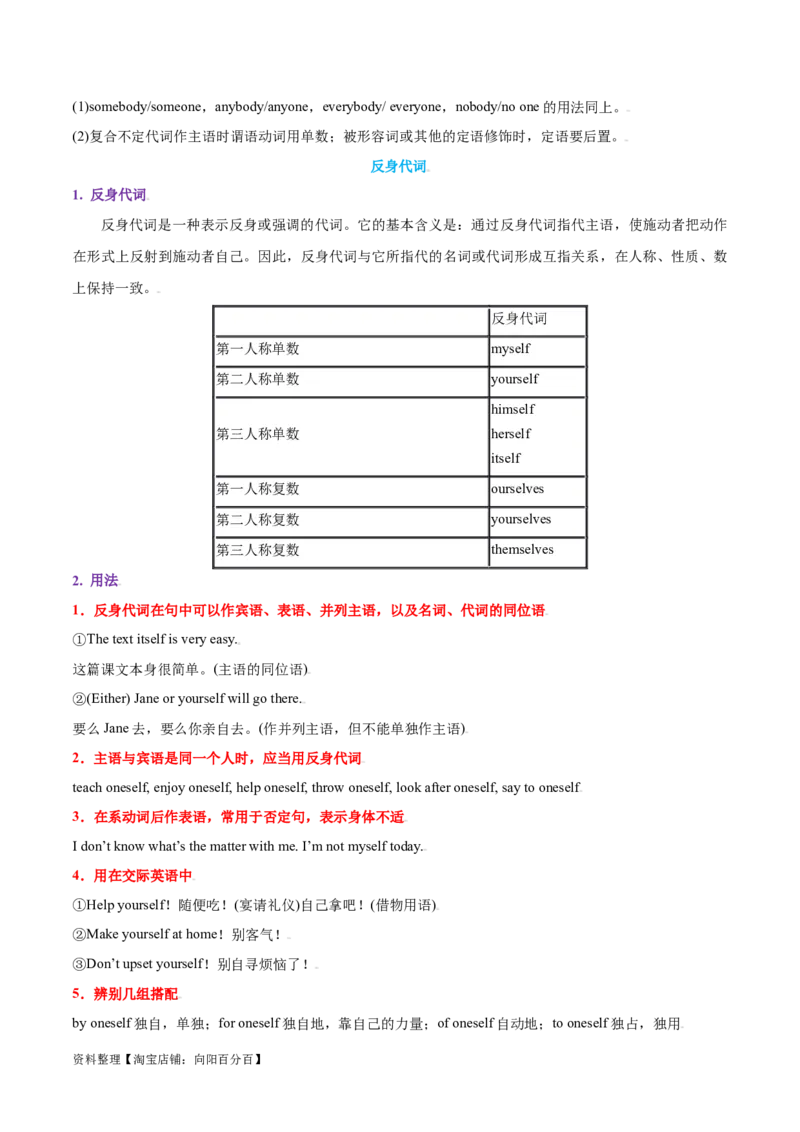
反身代词
1. 反身代词
反身代词是一种表示反身或强调的代词。它的基本含义是:通过反身代词指代主语,使施动者把动作
在形式上反射到施动者自己。因此,反身代词与它所指代的名词或代词形成互指关系,在人称、性质、数
上保持一致。
反身代词
第一人称单数 myself
第二人称单数 yourself
himself
第三人称单数 herself
itself
第一人称复数 ourselves
第二人称复数 yourselves
第三人称复数 themselves
2. 用法
1.反身代词在句中可以作宾语、表语、并列主语,以及名词、代词的同位语
①The text itself is very easy.
这篇课文本身很简单。(主语的同位语)
②(Either) Jane or yourself will go there.
要么Jane去,要么你亲自去。(作并列主语,但不能单独作主语)
2.主语与宾语是同一个人时,应当用反身代词
teach oneself, enjoy oneself, help oneself, throw oneself, look after oneself, say to oneself
3.在系动词后作表语,常用于否定句,表示身体不适
I don’t know what’s the matter with me. I’m not myself today.
4.用在交际英语中
①Help yourself!随便吃!(宴请礼仪)自己拿吧!(借物用语)
②Make yourself at home!别客气!
③Don’t upset yourself!别自寻烦恼了!
5.辨别几组搭配
by oneself独自,单独;for oneself独自地,靠自己的力量;of oneself自动地;to oneself独占,独用
资料整理【淘宝店铺:向阳百分百】介词
1.介词
介词,表示名词、代词等与句中其它词的关系,在句中不能单独作句子成分。介词后面一般有名词、
代词或相当于名词的其他词类、短语或从句作它的宾语,表示与其他成分的关系。
介词和它的宾语构成介词词组,在句中作状语,表语,补语,定语或介词宾语。同时介词的用法也很灵活,
同一个介词可以表达多种意义,介词可以分为时间介词、地点介词、方式介词、原因介词、数量介词和其
他介词。
2.易混淆的介词
1.over,above,on,beyond表示“在……上”
(1)over一般表示“在……的正上方”“在……垂直上方”,其反义词是under;over还可表示在被覆盖在
物体的上面。如:
①He held a large umbrella over the girl.
他给女孩打着一把大伞。
②He put his hand over her mouth to stop her screaming.
他伸手捂住她的嘴,不让她叫喊。
over还可表示“超过”,多用于年龄、时间、距离。如:
She stayed in London over a month.
她在伦敦呆了一个多月。
还可表示“在……期间”,相当于during,while doing。
①The English language has changed over hundreds of years.
英语发生变化有几百年了。
②They were having a pleasant chat over a cup of coffee.
他们边喝咖啡边愉快地聊天。
(2)above一般表示“在……的上方”,只说明物体间的上下关系,可能垂直,也可能不垂直。如:
A fly was flying above the table.一只苍蝇正在餐桌上飞。
另外,above还可指在数量、重量、价格、费用等方面超过或高于规定的数量或一般标准。如:
The shelf should be six feet above the level of the floor.
书架应离地面六英尺。
(3)on一般表示“在……上面”,通常指与物体的表面有接触。
There is a picture on the wall.墙上有张图。
当表示“陷入其中”时,我们也要用介词in,尽管汉语表示“在……上”。如:
①There is a window in the wall.墙上有扇窗户 。
资料整理【淘宝店铺:向阳百分百】②There is a well in the ground.地上有口井。
(4)beyond一般指超过界限、范围、限度等。如:
①I’m curious to know what there is beyond the sea.
我非常想知道大洋彼岸有什么。
②Why he did it is beyond my comprehension.
我不能理解他为什么做这件事。
③The situation was getting beyond his control.
他无法控制局势。
2.across,through,over,past都可表示“通过”
(1)across指在某一空间内从一端到另一端的表面穿过。如:
①They sailed across the ocean.他们扬帆横渡大洋。
②A plane flew across the sky.一架飞机从空中飞过。
(2)through指从人群或物体中间穿过,也可用于抽象意义上的通过:如:
Cars are not allowed to go through the city centre.
禁止汽车在市中心穿行。
(3)over是相对于位置的高低而言,强调“翻越”,也常表示跨过一段距离。如:
The man jumped over the wall and disappeared among the crowd.
那人翻过墙消失在人群中。
(4)past表示“从……旁经过”,表示动作发生 在某物旁边。如:
We walked past the shop this afternoon.
我们今天下午路过那家商店。
3.at,in,on均可表示时间
(1)表示确切的时间用at,在非正式英语里,在(at)what time这一短语以及用于句首的其他表示时间的短语
中,通常可以省略at。
(2)表示一天的上午、下午、晚上用 in,即:in the morning,in the afternoon,in the evening,但也有at
night(在夜里),at dawn(在黎明),at noon(在中午),at midnight(在午夜)。如专指某一天的上(下)午、晚上,
或要对某一天上(下)午、晚上加以描述,就用on,而不用in。如:on the evening of May 1(在5月1日的晚
上)。
(3)谈到具体的某一天,用on,在星期几前面,on可以省略(尤其在美语中)。如:
①I met him on a cold day.xk/w
我在一个寒冷的日子里见到了他。
资料整理【淘宝店铺:向阳百分百】②I’m seeing her(on)Sunday morning.
星期天上午我要和她见面。
(4)周末和节日
表示周末用at the weekend(英)或on the weekend(美);泛指圣诞节、复活节、感恩节时,都用at。但如果说
假日中的某一天,就要用on。如:on Easter Monday复活节后的星期一。
(5)说到星期、月、季、年、世纪等较长时间时,要用 in。如:in a week在一周内;in May在五月;in 2004
在2004年;in the 18th century在18世纪;in the fall/autumn在秋天。
4.by,with,in,through都可表示“工具、手段和方法”
(1)by表示“乘……(交通工具)”,也指“通过……(方法)”。表示方式,指抽象的或无形的手段时,其宾语
一般是抽象名词或动名词;指具体的手段时,其宾语通常是表示身体某个部位、交通工具或通讯工具等的
名词,且名词前不用冠词。如:
①You can make the cake by mixing eggs and flour.
把鸡蛋与面粉混合,你就可以做出那种蛋糕。
②Can I reach you by telephone?
我可以用电话和你联系吗?
(2)with表示“用……工具/手段”,一般接具体的手段或工具,不能接动名词。如:
He sharpened his pencil with a knife.他用小刀削铅笔。
(3)in表示用的方法、工具、材料等。如:
①Please write in ink,not in pencil.
请用墨水写,不要用铅笔写。
②I paid the bill in cash.我用现金付账。
表示“用容器(之类的工具)”时,用in。如:
They carried earth in basket.
他们用篮子提土。
(4)through表示“通过……途径/方式/方法”,一般是指具体的或有形的手段,其宾语往往是具体的人或事
物。如:
①We arranged our holiday through an agent.
我们通过一个经纪人来安排我们的假日。
②He got the chance through being a scientist.
由于是个科学家,他得到了这次机会。
5.to,at,for,toward(s)都表示方向,“到……,向……,朝……”
资料整理【淘宝店铺:向阳百分百】(1)toward(s)强调动作的方向;to则兼指“到达”的含义,强调结果。如:
①I saw her walking toward (s) the cinema.
我见她朝电影院走去。
②I saw her walking to the cinema.
我见她正朝电影院走去。
(2)for常用在leave,start,set out,set off,head,sail的后面,表示要去的目的地。如:
They are leaving for New York next week.
他们下周去纽约。
(3)at常和throw,shout,shoot等动词连用,表示目标。常常含有仇恨的感情色彩。而to与这些词连用时,
仅仅表示方向。如:
①It’s not polite to shout at people.
朝人大声喊叫是不礼貌的。
②When I came to the dog,it came at me,I rushed away with fear.
当我走向这条狗时,它向我扑来,我吓得拔腿就跑。
6.besides,except,except for,but都可表示“除……之外”
(1)besides与except
besides表示“除了……之外(尚有)(宾语包括在内)”,表示肯定;另外,它还可以作副词,有“再说”的意
思,表示语气的递进。except表示“除了……之外(宾语不包括在内)”,含有否定含义。如:
①There are four persons besides Tom to do the work,the four of whom are expert at it.
算汤姆在内有四个人做这项工作。他们四个在这方面都在行。
②There are four persons except Tom to do the work,four of whom are expert at it.
不算汤姆,他们有四个人做这个工作。他们当中的四个在这方面都在行。
③Who else do you need to help you besides me?
除了我以外,你还需要谁帮忙?
④Sorry,I can’t go with you tonight.It’s dark,besides, it’s raining heavily.
对不起,我今晚不能和你一起去。天很黑,再说,还下着大雨。
(2)except,except for与except thatclause
它们都有“除了……”的意思,区别在于:
except前后陈述的是同一类的东西。
except for前后所陈述的不属同类,表示引述一个相反细节,对上一陈述起到修正说明的作用,except for
后接名词和代词。
except thatclause也是表示引述一个相反细节,对上一陈述起到修正说明的作用,后接宾语从句(注意宾语从
资料整理【淘宝店铺:向阳百分百】句的连接词的正确使用)。如:
①There is nothing except a desk in the classroom.
教室里只有一张课桌。(desk和nothing属于同一类)
②We enjoyed the party except for the loud music.
除了音乐嘈杂了点,我们在聚会上玩得很开心。(the loud music和the party不属于同类)
③Your composition is good except for some spelling mistakes.=Your composition is good except that there are
some spelling mistakes.
除了几个拼写错误之外,你的作文很好。
④He goes to the library every day except when he is not well.
他除了身体不舒服以外,每天都去图书馆。
(3)but作为介词和except同义,通常用在no以及由no组成的合成词或表示否定意义的词后面,而except
不受此限制。如:
①Nobody else but/except me could solve the word puzzle.
除了我,谁都不会解这个字谜。
②I had no choice but to wait.
我除了等待之外别无选择。
(4)but for表示“要不是……”,用于虚拟语气。except for只起修正作用。如:
But for your timely help, I couldn’t have finished the work on time. I can’t thank you too much.
要不是你及时的帮助,我就不能按时完成这项工作。我对你感激不尽。
7.due to, owing to, on account of, thanks to
这几个短语都可以作“由于,因为”解,是表原因的介词短语。
(1)due to...有三个用法:作定语、表语和状语;作状语时可放在句首或句尾。如:
①The mistake due to carelessness is serious.
由于粗心大意所造成的这个错误是严重的。
②Due to driving at high speed the accidents were common.
由于高速驾驶,交通事故很常见。
③His illness is due to bad food.
他生病的原因是吃了劣质食物。
(2)owing to...可作状语、定语和表语。作状语时修饰整个句子,一般应和句子的其他成分隔开,可放在句
首、句中或句尾。如:
①The service is poor owing to a shortage of staff.
服务之所以差是因为工作人员不足。
资料整理【淘宝店铺:向阳百分百】②She is now, owing to bad health, not so active in the activity.
由于身体不好,她现在在活动中表现得没有那么活跃了。
(3)on account of...可作状语和表语。作状语时修饰全句,应和句子的其他成分隔开,但有时也可不隔开。如:
①He resigned on account of age.
他由于年迈而辞职。
②That was on account of lack of experience.
那是由于缺乏经验所致。
(4)thanks to...只作状语,比较正式,有感谢的含义,作“多亏”解,但有时也含有贬义。如:
Thanks to your help, we were successful.
多亏你的帮助,我们才得以成功。
介词词组辨析
1.常见的复合介词
according to根据,按照,取决于
as a result of由于……的结果
as far as就……而论
at the mercy of受……支配
at the sight of一看到
by means of用,依靠,借助于
by way of取道于……;途经(=via)
by the way of用……的方法
because of因为,由于
due to因为
in addition to除了……之外(还有)
in advance of在……前面;比……先进
in celebration of为庆祝……
in case of假设,万一
in search of寻求;试图发现
in place of代替
in need of需要
in charge of对……负责;主管
in the charge of由……负责(表被动意义)
in spite of尽管;即使;虽然;不管
资料整理【淘宝店铺:向阳百分百】in time of在……时刻
in a state of处于……状况中
in course of在进行中
in the course of在……期间
in favour of赞同;有利于
in honor of向……表示敬意,为纪念……
in memory of为纪念……
instead of代替;而不是
on account of因为;由于
owing to因为
thanks to因为;多亏
under the name of以……的名义
under the condition that在……条件下
under the control of在……支配下
with no relation to与……无关
with the view of为了;以……为目的
within the reach of在……力所能及的范围内
2.固定搭配
1.名词与介词的固定搭配
要求用to的名词:key,answer,visit,apology,introduction
要求用in的名词:interest,satisfaction,expert
要求用on的名词:mercy,congratulation
要求用其他介词的名词:prize(for),respect(for),victory(over),struggle(with)
2.形容词与介词的固定搭配
要求用at的形容词:angry,good,bad,surprised,excited,puzzled,frightened
要求用of的形容词:afraid,sure,certain,full,tired,fond,proud,worthy
要求用with的形容词:angry,strict,busy,popular
要求用in的形容词:weak,strict,rich, interested,successful,slow xk.w
要求用to的形容词:next,good,polite,kind,cruel,rude,known,married,close,similar,due
要求用for的形容词:sorry,famous,fit,unfit,eager,anxious,hungry
要求用from的形容词:far,different,free,safe,absent,tired
要求用about的形容词:sorry,worried,anxious,careful,sure,certain
资料整理【淘宝店铺:向阳百分百】冠词
一、 冠词的泛指与特指
1. 泛指:首次提到的、不限定的人或事物;
a/an +单数名词: A horse is enough. (表数量)
a/an +单数名词:A horse is a large four-legged animal. (强调类别中的任何一个特点)
the +单数名词:I think the most useful animal is the horse. (强调整个类别)
零冠词+复数名词/不可数名词:Horses are useful animals. (强调类别中的许多个体)
2. 特指:上文已经提到的人或事物,也可以指说话双方心目中默认的特定的人或事物;the +
单数名词/复数名词/不可数名词
二、 不定冠词
1. 表示one, the same 或every的意思。
例:They are of an age. (=the same)
I will return in a day or two. (=one)
2. 含有不定冠词的常考短语
have a cold make a living in a hurry
感冒 谋生
have a good time go on a diet for a while
玩得高兴 节食 暂时,一时
have a gift for as a result in a word
有…的天赋 因此 总之
have a word with as a rule once in a while
与…谈话 通常,照例 偶尔
at a blow as a matter of fact at a loss
一下子 事实上 困惑,不知所措
have/take a rest after a while all of a sudden
休息 一会儿后 突然
have a holiday in a sense a matter of…
度假 在某种意义上 …的问题
get a lift/ride in a moment have a history of…
搭便车 一会儿 有…的历史
资料整理【淘宝店铺:向阳百分百】三、 定冠词
1. 用在表示特指的人或物的名词前。
例:The book on the desk is mine.
Would you mind turning down the radio a little? The baby is sleeping.
2. 用在姓氏复数前,表示一家人或夫妇二人。
例:The Greens are at table.
The Chens are going to move to Langfang.
3. 用在年代、朝代名词及逢十的数词(表某个年代)前,或用在表示方位的名词前。
例:the Tang Dynasty; the Spring and Autumn Period; in the 1990s; the south
4. 用 在 表 度 量 单 位 的 名 词 前 , 表 示 “ 每 一 ” : by the
hour/day/week/month/year/dozen/yard/ton/kilo,但是,size/weight/time这类名词跟by连用不加定冠词。
例:We got paid by the month.
Meat is sold by weight.
5. “the + 形容词或分词”有时也可表示类指。
例:
the wounded 伤员 the deaf 聋子
the dying 垂死之人 the old 老人
the unknown 未知的事物 the dead 死者
the young 年轻人 the living 生者
6. “动词+sb.+介词+the+身体某一部位”结构中的the,不可以用物主名词代替。
例:take sb. by the arm.
be red in the face; be lame in the right leg; be blind in the left eye.
7. 用在某些固定结构中。
In the end On the right/left The other day
最后,终于 在右/左面 几天前
In the daytime At the moment On the radio/phone
在白天 此刻
资料整理【淘宝店铺:向阳百分百】通过无线电/电话
In the habit of At the same time On the spot
习惯于 同时 在现场,立即,当场
In the distance For the time being To tell you the truth
在远处 暂时 说实话
Make the most/best of In the public eye Go to the cinema
充分利用 广为人知的 去看电影
In the way By the way Not in the least
挡路 顺便说,附带地说说 一点也不
On the whole On the way For the most part
总之 在路上 通常,多半
四、 零冠词
1. 不可数名词、复数名词表泛指,用零冠词。
My father went to his doctor for advice about his heart trouble.
2. 名词前已有this, that, my, your, some, each等指示代词、形容词性物主代词、限定词以及名词
所有格等限定时不再使用冠词。
She is not my type of woman.
His heart was beating wildly with fear.
He went to some place in France.
Each student must hand in his exercise book.
3. 零冠词用法口诀:月、季、星期、节假、洲、称呼、头衔、职务前;三餐、球类、惯用语;
学科、棋类名词前。
A year can be divided into four seasons—spring, summer, autumn and winter.
He has no lessons on Sundays.
Mr. Smith is chairman of the meeting.
注意:
Autumn is the harvest season.
The organization was founded in the spring of 2010.
4. 高考中常见的纯不可数名词:luggage, baggage, furniture, health, weather, fun, space, advice,
资料整理【淘宝店铺:向阳百分百】progress, information, news, luck, wealth等,不能与不定冠词a/an连用。
5. “零冠词+单数名词+as/though+主语+谓语+主句”,意为“虽然……,但是……”。
Hero as he is, he has some shortcoming.
题型分类精讲
题型一 代词
【典例1】
As the song goes, this long and winding road “will never disappear”, and it will always stick in the visitor’s
memory. It sure does in ____64____(I).While you’re in China, Mount Huangshan is a must to visit!
【答案】64. mine
【解析】64.考查代词。句意:正如歌中所唱,这条漫长而曲折的道路“永远不会消失”,它将永远留
在游客的记忆中。对我来说确实如此。根据前一句“it will always stick in the visitor's memory”可知,本句为
does指代前一句的stick,本句缺乏宾语,应用名词性物主代词mine指代my memory。故填mine。
【典例2】
Ecotourism has ___63___(it)origin with the environmental movement of the 1970s. It was not widely
accepted as a travel concept __until__ the late 1980s. During that time, increasing environmental awareness made
it desirable.
【答案】63. its
【解析】考查代词。句意:生态旅游起源于20世纪70年代的环境运动。根据空格后名词origin可知,
此处形容词性物主代词来修饰名词origin。故填its。
【题型训练】
1.Data about the moon’s composition, such as how much ice and other treasures it contains, could help China
decide whether 70 (it) plans for a future lunar (月球的) base are practical.
【答案】its
【解析】考查代词。句意同上。根据空后的名词plans可知,此处应使用形容词性物主代词its,故填
its。
2.A study shows the students who are engaged in after-school activities are happier than _________who are not.
资料整理【淘宝店铺:向阳百分百】A. ones B. those
C. these D. them
【答案】B
【解析】考查代词。句意:一项研究表明,参加课外活动的学生比不参加课外活动的学生更开心。空
格处代词与the students是对应关系,可以用the ones或者those替代。“them”指代的是前边提到的复数名
词,不能与the students形成对应关系。“these”一般不用定语从句修饰。故选B。
3.As well as looking at exhibits, visitors can play with computer simulations (模拟) and imagine 42 .
(they) living at a different time in history or 43 ( walking ) (walk)through a rainforest.
【答案】themselves
【解析】考查反身代词。句意:除了观赏展品,游客还可以玩电脑模拟游戏,想象自己生活在一个不
同的历史时期,或者漫步在热带雨林中。此处指代visitors,意为“他们自己”,应使用反身代词。故填
themselves。
4. As the busiest woman in the village, Huang Wenxiu made ________ her duty to look after all the other people’s
affairs in that village.
A. this B. that C. it D. one
【答案】C
【解析】考查代词it和代词辨析。句意:作为村里最忙的妇女,她认为照料其他人的事是她的职责。当不
定式作宾语,同时又有自己的补足语时,常常用形式宾语it代替不定式,而把真正的宾语不定式后移。常
用结构为:make/feel/find...+it+宾补(n./adj.)+to do sth.。分析句子可知,空格处是宾语,代替真正的宾语
“ to look after all the other people’s affairs in that village”,用形式宾语it。this这个;that那个;one一个。
故选C。
5. The doctor considered ________ a good idea for the businessman to take a holiday.
A. this B. that C. one D. it
D
【解析】考查代词。句意:这个医生认为这个商人去度假是个好主意。分析句子结构可知,本句含有“动
词(consider)+it+宾补+(for sb.) to do sth.”结构, it是形式宾语,(for sb.) to do sth.是真正宾语。this这个;
that那个;one一个。故选 D。
6. —My ruler is broken. Can I borrow______?
—Of course. Here it is.
A. his B. hers C. mine D. yours
D
资料整理【淘宝店铺:向阳百分百】【解析】考查代词。句意:——我的尺子坏了。我能借你的吗?——当然,给你。A. his他的;B. hers她
的;C. mine我的;D. yours你的。此处作宾语,表示“你的尺子”应用名词性物主代词yours。故选D。
7. I think ______ necessary that we drink plenty of water every day.
A. what B. that C. this D. it
D
【解析】考查it用法。句意:我认为我们每天喝大量的水是必要的。此处为“think it+形容词+that从句”
结构,it作形式宾语,that从句为真正宾语。故选D。
8. My brother once gave me a toy bird, ________ designed to balance on the edge of a bowl of water and
repeatedly dunk its head in the water.
A. which B. what C. it D. one
【答案】D
【解析】考查代词。句意:我哥哥曾经给过我一只玩具鸟,它被设计成能在一碗水的边缘保持平衡,并反
复把它的头浸入水中。空格后designed为过去分词,即非谓语动词,所以此处不能用连词,排除选项 A和
选项B。one代指“a+名词”,所以代指“a toy bird”应用one。此处用过去分词designed作one的后置定语。
故选D。
9. The step you have taken is ________ much risk.
A. one of B. the one of
C. the one D. that one
【答案】B
【解析】考查“介词 of+ 抽象名词”和代词的用法。句意:你所采取的步骤风险很大。空中所填的 the
one代替前面的 the step。“be + of+ 抽象名词”结构表示“具有某方面的特征”。故选B。
10. My brother rather than my parents is fond of new energy vehicles. ________of us have a positive attitude to this
trend.
A. Both B. All C. Not all D. Not any
【答案】C
【解析】考查代词词义辨析。句意:我哥哥而不是我父母喜欢新能源汽车。并非所有人都对这一趋势持积
极态度。A. Both两者都;B. All三者及以上都;C. Not all并非所有;D. Not any都不是。根据“My brother
rather than my parents”可知此处表示“并不是所有人”,故选C。
题型二 介词
【典例1】
2.Modem methods ___63___ tracking polar bear populations have been employed only since the mid-1980s,
资料整理【淘宝店铺:向阳百分百】and are expensive to perform (perform) consistently over a large area.
【答案】of/for
【解析】考查介词用法。此处tracking polar bear populations作Modern methods的定语,用of 连接,
“methods of doing sth.”,意为“……的方法”,构成固定结构。或者意为“对于跟踪北极熊的方法”用
for。故填of/for。
【典例2】
3.We were first greeted with the barking by a pack ___63___ dogs,seven to be exact.
【答案】of
【解析】考查介词。“a pack of”意为“一群”。故填of。
【题型训练】
1. (2021·浙江卷)Beautifully restored(修复)to its 1860 appearance, the house was Abraham and Mary
Lincoln's home for 17 years. In 1844 they bought it ___37___ $1,200 and some land from Charles Dresser, who
performed their marriage ceremony in 1842.
………
【答案】37. for
【解析】37.考查介词。句意:1844年,他们以1200美元的价格从查尔斯·德莱瑟手中买下了这座房子
和一些土地,查尔斯·德莱瑟在1842年举行了他们的婚礼。结合句意可知,此处考查固定短语 buy sth. for
+价格,意为“以……价格买某物”。故填for。
2.(2021年全国乙卷)阅读下面短文,在空白处填入1个适当的单词或括号内单词的正确形式。
Due to __the__ growing popularity of environmentally-related and adventure travel, various types ___66___
trips are now being classified as ecotourism. Actually, a true eco-friendly trip must meet the following principles:
【答案】66. of
【解析】【66题】考查介词。句意:由于与环境相关的探险旅行越来越受欢迎,各种各样的旅行现在
被归类为生态旅游。various types of 为固定搭配表示“各种各样的”,所以空格处应填of。故填of。
3.(2020·新课标I卷)The far side of the moon is of particular interest to scientists because it has a lot of
deep craters (环形山), more so 65 the familiar near side.
【答案】than
【解析】考查介词。句意:因为它比熟悉的一面有更多的深环形山。根据空前的比较级more so可知,
此处填介词than,表示“比……更”。故填than。
4. I was searching ___67___ these three western lowland gorillas I'd been observing.
【答案】 for
资料整理【淘宝店铺:向阳百分百】【解析】考查动词短语搭配。search for是固定搭配,表示“寻找”,表示“我”在寻找“我”研究的
三只西部低地大猩猩。
5.(2020·新课标II卷)Oranges: Orange trees are more 64 decoration; they are a symbol of good
fortune and wealth.
【答案】than
【解析】句意:桔子树不仅仅是装饰品;more than不仅仅,不只是。故填than。
6. 1When you drive through the Redwood Forests in California, you will be _____ trees that are over 1,000
years old.
A. among B. against C. behind D. below
【答案】A
【解析】句意:当你开车穿过加州的红木森林时,你将会位于超过百年历史的树木之间。 be among
位于之间; be against 反对; be behind 在后面; be below在之下。根据句意,故选A。
7.(2020·新课标III卷)The artist was finally humbled (谦卑) by the greatest artist 70 . earth, Mother
Nature.
【答案】on
【解析】考查介词。句意:这位艺术家最终被世界上最伟大的艺术家——大自然母亲所折服。结合句
意表示“在世界上”短语为on earth。故填on。
8.Many people who live along the coast make a living _______ fishing industry.
A. at B. in C. on D. by
【答案】B
【解析】许多住在海边上的人都是靠渔业来谋生的。此处用介词in,不用by,因为by后面通常接做什么
事情来谋生,此处是指在捕鱼这个行业里,在这个行业里谋生,用in,故选B。
9.Museums must compete 45 people’s spare time and money with other amusements.
【答案】for
【解析】考查介词。句意:博物馆必须和其他娱乐活动竞争人们的业余时间和金钱。此处是固定短
语:compete for,意为“为了……竞争”。故填for。
10.Some time after 10,000 BC,people made the first real attempt to control the world they lived 56 . ,
through agriculture.56.
【答案】in
【解析】考查介词。句意:公元前10000年以后,人们第一次真正尝试通过农业来控制他们所居住的
世界。分析可知,“they lived _____”应是之前名词the world 的定语从句,定语从句引导词被省略,可推
资料整理【淘宝店铺:向阳百分百】知先行词应是在从句中作宾语,即:they lived in the world. live in+名词,意为“居住在某地”。故填in。
题型二 介词短语
【典例1】
1.Favorable policies are ___________ to encourage employees' professional development.
A. in effect B. in command C. in turn D. in shape
【答案】A
【解析】考查介词短语。句意:好的制度政策实际上都会激发员工的专业水平的提升。A. in effect实
际上;B. in command指挥;C. in turn轮流,依次;D. in shape在外形上,处于良好的状态。故选A。
2.Bob thought he couldn't go to the party because he had to write a report, but he went ___________.
A. at first B. after all
C. above all D. at random
【答案】B
【解析】句意:鲍勃认为他不能去参加聚会,因为他不得不写一份报告,但它毕竟还是去了。at first
首先;after all毕竟,终究;above all首先;at random随便地。根据前面的转折连词可知,与前面的情况相
反,所以选B。
3.China’s soft power grows _______ the increasing appreciation and understanding of China globally.
A. in line with B. in reply to
C. in return for D. in honour of
【答案】A
【解析】考查介词短语词义辨析及语境理解。句意:中国的软实力增长与日俱增全球对中国的赏识和
理解相一致。A. in line with按照;与...一致;B. in reply to答复;C. in return for作为 ... 的报酬;D. in
honour of为纪念。故选A。
4.Determining where we are _______ our surroundings remains an essential skill for our survival.
A. in contrast to B. in defense of C. in face of D. in relation to
【答案】D
【解析】考查介词短语的辨析。A. in contrast to对比,截然不同;B. in defense of为……辩护;C. in
face of面对;D. in relation to与……有关。句意:根据周围的环境辨别方位仍然是我们生存的一项极其重
要的技能。
5.Taking on this challenge will bring you _____ someone who shares your interests.
A. in exchange for B. in answer to C. in contact with D. in memory of
【答案】C
【解析】考查介词短语辨析。句意:接受这个挑战会让你和你有共同兴趣的人接触。A. in exchange for
资料整理【淘宝店铺:向阳百分百】作为交换;B. in answer to回答;C. in contact with接触,与……有联系;D. in memory of纪念。根据空后
someone who shares your interests及常识可知,此处指“和与你有共同兴趣的人接触”。故选C。
6.For my fifth birthday, my mother baked me a cake ______ a monkey.
A.in the shape of B.beyond the reach of
C.at the mercy of D.on the side of
【答案】A
【解析】考查介词短语辨析。句意:我五岁生日的时候,妈妈给我烤了一个猴子形状的蛋糕。A. in the
shape of呈……形状;B. beyond the reach of超出……的能力之外C. at the mercy of 受……的支配;D. on the
side of拥护……,站在……的一边。蛋糕是猴子“形状”的。故选A。
选D。
题型三 冠词
【典例1】
A child born in the US today has _________very realistic chance of living beyond 100 and needs to plan
accordingly.
答案:a
解析:考查冠词。句意:今天在美国出生的孩子有非常现实的机会活到 100岁以上,因此需要做出相应的
计划。chance为可数名词,此处表示泛指应用不定冠词,且very为辅音音素开头的单词,故填a。
【典例2】
4.While you’re in China, Mount Huangshan is must to visit!
答案:a
解析:句意为:你在中国的时候,一定要去黄山!泛指一件必须的事情,所以用不定冠词,故填a.
【题型训练】
1.Covering an area about three times __________ size of Yellowstone National Park, the GPNP will be one of the
first national parks in the country.
答案:the
解析:考查冠词。句意:该公园占地面积约为黄石国家公园的三倍,将成为中国首批国家公园之一。本句
的结构为:倍数+ the size of +比较成份。故填the。
2. ___________ Brown family live in an apartment building outside Toronto.
答案:The
解析:考查冠词。句意:布朗一家住在多伦多郊外的一栋公寓楼里。根据句子结构,设空处要填写冠词与
Brown family 构成名词短语作主语。the+姓氏,意为“某某一家人”,the符合句意。同时该单词置于句首,
资料整理【淘宝店铺:向阳百分百】首字母应该大写。故填The。
3.Cobb, for her party, started to ask conference organizers who invited her to speak if she could do so remotely;
about three-quarters of ___________ time, they agreed.
答案:the
解析: 考查冠词。句意:对于她的出席,Cobb开始询问邀请她的组织者是否可以远程进行。大约有四分
之三的时间,他们同意了。此处特指Cobb询问的时间范围内,故填the。
4.____________ Lincolns enlarged the house to a full two stories in 1856 to meet the needs of their growing
family.
答案:The
解析:考查冠词。句意:林肯夫妇在1856年把房子扩大到了整整两层,以满足他们日益增长的家庭的需要。
根据句意可知,此处意为“林肯一家”;根据设空后的Lincolns可知,此处考查“the+姓氏复数”,表示
夫妇俩,或者一家人。设空处位于句首,所以首字母要大写。故填The。
5.The plum trees are ___________ first to flower even as the snow is melting(融化).
答案:the
解析:考查冠词。句意:雪还在融化时,梅花是第一个开花的。这里表示特指,所以序数词first前要加定
冠词the。故填the。
6.Then,with ___________ rise of science,changes began.
答案:the
解析:考查定冠词。句意:随着科学的崛起,事情发生了变化。with the rise of 译为“随着......的崛起”是
固定短语。故填the。
7. All these changes will lead to______stronger and more powerful China,______country that can surprise and
enrich our planet.
A. a; a B. a; the C. the; a D. the; the
答案:A
【解析】考查冠词。句意:这些变化将导致一个更强大、更有力的中国,一个能够给我们的星球带来惊喜
和丰富的国家。根据句意可知,第一空泛指“一个更强大、更有力的中国”,应用不定冠词;第二空是
China的同位语,泛指“一个……的国家”,也应用不定冠词。故选A。
8. The two rooms are of ________ size, but another room is three times ________ size of them.
A. the; a B. a; the C. a; a D. the; the
答案:B
【解析】考查冠词。句意:这两个房间大小相同,但另一个房间是它们的三倍大。第一空处使用固定搭配,
资料整理【淘宝店铺:向阳百分百】“Sb./Sth. be of +a +表示种类、数量、度量等的抽象名词”表示(人或物)“具有某种共同特征”,该名
词前常用不定冠词修饰;第二空处使用固定句型“A + be +倍数 + the + 表示度量等的抽象名词+ of+ B”,
用来表示“A是B的……倍”,该句型中在名词前常用定冠词the。综上,故选B。
9. What _______________ pity that you couldn’t be there to receive _______________ prize.
A. the; a B. a; the C. a; a D. a; /
答案:B
【解析】考查冠词。句意:你没能到那儿领奖,真遗憾。空格一涉及固定句型“What a pity +that从句”,
意为“……真遗憾”,故空格一应填不定冠词a。根据句意可知,空格二特指“你应该领取的奖品”,故
空格二应填定冠词the,表示特指。故选B项。
10. The student, who gave his life to save a child, was ______ honor to our school. A memorial is held here every
year in ______ honor of him.
A. an; the B. an; / C. the; the D. a;/
答案:B
【解析】考查冠词。句意:那个为了救一个孩子而献出生命的学生,是我们学校的光荣。这里每年都会举
行追悼会纪念他。固定短语 in honor of,意为“为了纪念......”,所以第二空不用冠词。据此可排除选项
A、选项C;另honor为元音开头,所以第一空要用an;表示“一个(件)引以为荣的(事/人)”。故选B。
资料整理【淘宝店铺:向阳百分百】资料整理【淘宝店铺:向阳百分百】资料整理【淘宝店铺:向阳百分百】资料整理【淘宝店铺:向阳百分百】