Unit 1 语法篇
__________________________________________________________________________________
__________________________________________________________________________________
熟练掌握本章重点语法知识。
知识点讲解:
.--------How do you learn English? —I learn by studying with a group.
1.“by+doing形式”表示方式、方法
语法结构 by+doing形式,“通过做...的方式” I learn Chinese by listening to
tapes。
提问方式 How do you...?或How can I...?这类句 -How can I turn on the light?
型 -By turning this button.
2.拓展:介词by的其他用法:
1)by+交通工具,“乘/坐...” by bus
2)by+地点,“在...的旁边;靠近...” by the lake
3)by+时间,“截止到...;不迟于...” by ten
【by短语】
by the way 顺便问一下 by accident= by chance 偶然地
by mistake 错误地 one by one 一个接一个
step by step 一步一步地 by the time 到……为止
by oneself 独自地 by hand 用手
by the end of 到….... 末尾
3.辨析by、with、in,“用”
by 侧重“用”某种手段、交通工具、传递方式或媒介等
with 侧重“用”有形工具、材料、内容等
in 侧重“用”语言、语调、笔墨、颜色等
Eg. We’ll be traveling by car.
He broke the window with a stone.
Please answer the question in English.
.It’s too hard to understand spoken English.
1.[辨析] “It's+adj. (+for/of sb.)+to do sth.”句型中用for和of的区别
It's+adj.+of sb.+to do sth. It's+adj.+for sb.+to do sth.
形容词一般为表示性格,品德,心智形容词一般为表示事物的特征、特点或客观形式的形容词,如
能力,或主观感情、态度的形容词,easy,hard,difficult, interesting,impossible等。如 good, kind, nice , clever, foolish
等。
可改为“Sb. is+adj. to do sth.”结
不能改为“Sb. is+adj. to do sth.”结构。
构。
.But I was afraid to ask questions because my pronunciation was very bad.
(1)be afraid of sth/doing sth 害怕做某事【担心(出现某种不良后果)】
(2)be afraid to do sth 害怕去做…【“怕” 或 “不敢”去做某事】
(3)be afraid +that 恐怕…【用于礼貌地表达可能令人不愉快的消息】
【记】The girl was afraid to go across the bridge, for she was afraid of falling down from it.
..I fell in love with this exciting and funny movie!
1.fell in love with
【拓展】fall → fell→ fallen v 落下
(1) 不及物v , “落下,跌落 fall into 跌进……
(2) 系动词 “变成 fall asleep 入睡 fall ill 生病
(3) n, “秋天” = autumn
【短语】:fall into 落入 fall off 跌落 fall down 倒下
fall behind 落后 fall asleep 入睡 fall in love with 爱上
2.excite→ exciting/excited 兴奋的
be excited about对…感到兴奋
【拓展】
interest→interesting/interested 有趣的 be interested in 对…感兴趣
relax →relaxed /relaxing 令人放松的 be relaxed about 对……感到放松
bore → bored/boring adj. 令人厌烦的
【注】 以—ing结尾的adj. 常用来作定语或表语,修饰物。
以—ed结尾的adj.用来表示情绪,常做表语,修饰人
1. Don’t talk ______. Your grandmother is sleeping now.
A. hardly B. aloud
C. loudly D. hard
2. Books are our good friends because ______ we read, _____our future will be.
A. more; better
B. the more; the better
C. most; best
D. the most; the best
3. You can improve your English ______ practicing more.
A. by B. with
C. of D. in
4. —What are we going to do after school?
—What about ______ basketball?
A. play B. to play
C. playing D. played
5. He came late to school and was afraid ______ by the teacher.
A. to see B. to be seenC. of seeing D. of being seen
基础演练
一、用所给单词的适当形式填空
1.Do you learn English by_____(watch) English language videos?
2.It’s too hard_____(understand) the voice.
3.What about_____(read) the text aloud?
4.Have you ever_____(study) with a group?
5.They are studying the____(pronounce) of English.
6.She looks _____(worry) . She can’t get the pronunciation right.
7.You need to practice____(say) “th” in front of a mirror.
8.Why don’t you _____(listen) to English songs and repeat the difficult words.
9.I often make____(mistake)in grammar.
10.I hear this dictionary is very_____(help) for us students.
11.The _____(good) way to learn English is to use it.
12.A good language _____(learn) should have lots of practice.
13.She spoke too___(quick) , I couldn’t hear you clearly.
巩固提高
根据汉语意思完成句子
1. 现在你们知道学习一门外语是多么重要。
Now you see how important it is _________ _________ a foreign language.
2. 如果你想快速地读一篇文章,就不要一个单词一个单词地读。
If you want to read a passage quickly, don't read it _________ _________ _________.
3. 当这个年轻男子第一次见到这位漂亮的姑娘时就爱上了她。
When the young man met the beautiful girl for the first time, he _________ _________
_________ _________ her
4. 她通常是通过听磁带来学习英语单词的。
She usually learns English words _________ _________ _________ the tapes.
5. 我们明天去不去野餐取决于天气。
_________ _________ _________ we are going to have a picnic tomorrow _________ _________
the weather.
一. 选择填空。
1. We found ______ difficult to learn English well in such a short time.
A. it B. this
C. one D. that
2. Have you _____ studied with a group? www.
A. yet B. already
C. ever D. always
3. ---Have you read these books? ---Yes, I _____ it three years ago.
A. have done B. have readC. readed D. read
4. ______is really hard _______them to climb Mount Qomolangma.
A. This; to B. It; for
C. This ;for D. It; to
5. _________you read, __________you’ll be. www.
A. More, faster B. The most, the fastest
C. The more, the faster D. Most , fastest
6. I ______English for about six years and I really love it.
A. learn B. learnt
C. have been learning D. am learning
7. On her way home Lucy saw a thief _______in a shop. She stopped_______110 at once.
A. steal; call B. to steal; call
C. stealing; to call D. stealing; calling
8. A young man is practicing _____English with Mr. King on the train.
A. to speak B. saying
C. to say D. speaking
9. ---How do you study______ a test? ---I study _____ working_____ a group.
A. for, in, with B. for, by, at
C. for, by, with D. of, in, by
10. We ______the party with a beautiful song.
A. ended up B. end up
C. is ended up D. ending up
11. Have you come up whit any idea to ______the air pollution?
A. deal to B. deal with
C. work on D. work with
12. ---You look sad, Kate. ---Yeah, I have made _____ mistakes in my report
A. a little B. little
C. a few D. few
13. — I wonder if I can learn English well.
— . All things are difficult before they are easy.
A. I am afraid so B. You’re slow
C. It takes time D. It’s a piece of cake
14. When we meet some new words, we'd better ______ in a dictionary
A. look out them B. look them at
C. look them up D. look up them
15. The best method _____ is _____ it.
A. learning language; to use B. to learn a language; by using
C. learning English; using D. to learn English; to use
16. I’m afraid _____ that you have made ____ grammar of this sentence.
A. to say; a mistake B. saying; mistakes in
C. to say; a mistake in D. saying; mistakes to
17. ---I don't have a partner to practise English with. ---Maybe you should _____ an English club.
A. have B. take
C. join D. make
18. I don’t know _____ next.
A. how to do B. what to doC. what can I do D. how I can do
19. —How will you tell your friend the news?
— sending him a short message.
A. As B. By
C. With D. On
20. ---How do you study for tests?
---I work ________ my friends.
A. with B. by
C. in D. for
二. 完型。
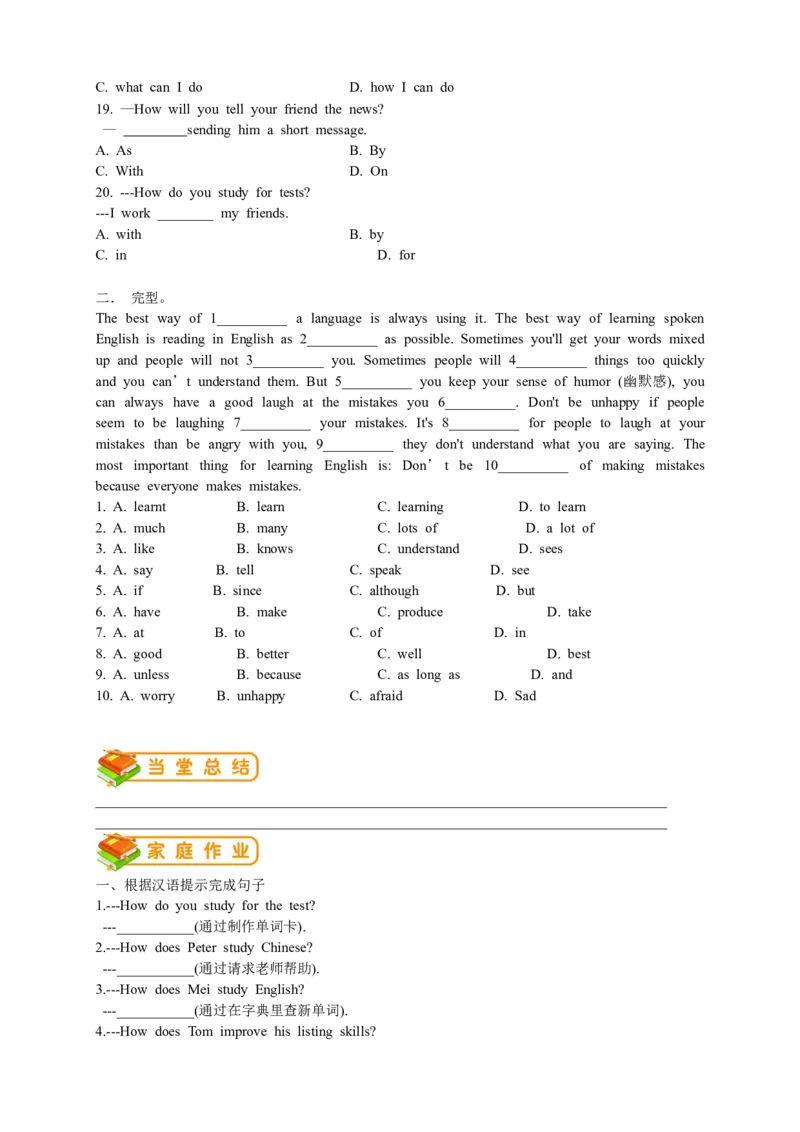
The best way of 1__________ a language is always using it. The best way of learning spoken
English is reading in English as 2__________ as possible. Sometimes you'll get your words mixed
up and people will not 3__________ you. Sometimes people will 4__________ things too quickly
and you can’t understand them. But 5__________ you keep your sense of humor (幽默感), you
can always have a good laugh at the mistakes you 6__________. Don't be unhappy if people
seem to be laughing 7__________ your mistakes. It's 8__________ for people to laugh at your
mistakes than be angry with you, 9__________ they don't understand what you are saying. The
most important thing for learning English is: Don’t be 10__________ of making mistakes
because everyone makes mistakes.
1. A. learnt B. learn C. learning D. to learn
2. A. much B. many C. lots of D. a lot of
3. A. like B. knows C. understand D. sees
4. A. say B. tell C. speak D. see
5. A. if B. since C. although D. but
6. A. have B. make C. produce D. take
7. A. at B. to C. of D. in
8. A. good B. better C. well D. best
9. A. unless B. because C. as long as D. and
10. A. worry B. unhappy C. afraid D. Sad
_________________________________________________________________________________
_________________________________________________________________________________
一、根据汉语提示完成句子
1.---How do you study for the test?
---___________(通过制作单词卡).
2.---How does Peter study Chinese?
---___________(通过请求老师帮助).
3.---How does Mei study English?
---___________(通过在字典里查新单词).
4.---How does Tom improve his listing skills?---____________(通过听磁带).
5.---How are you going to study to improve your spoken English?
---I’m going to study ___________(通过和朋友练习对话以及大声读练习发音)in class.
二. 阅读理解。
(人教版九年级上期中测试题)
A
If you go into the forest with friends, stay with them. If you don't, you may get lost, this is
what you should do. Sit down and stay where you are. Don't try to find your friends-let them
find you instead. You can help them find you by staying in one place. There is another way to
help your friends or other people to find you. You can shout or whistle (吹口哨) three times.
Stop. Then shout or whistle three times again. Any signal (信号) given three times is a call for
help.
Keep up shouting or whistling. Always three times together. When people hear you, they will
know that you are not just making a noise for fun. They will let you know that they have heard
your signal. They give you two shouts,two whistles or two gun-shots(枪声). When a signal is
given twice, it is an answer to a call for help.
If you don't think that you will get help before night comes, try to make a little house with
branches (树枝), make yourself a bed with leaves and grass.
When you need some water, you have to leave your little branch house to look for it. Don't
just walk away. Pick off small branches and drop (扔下) them as you walk in order to go back
again easily. When you are lost,the most important thing to do is to stay in one place.
1. If you get lost in the forest, you should _________.
A. Stay where you are and give signals three times.
B. walk around the forest and shout so that your friends could hear you.
C. try to find your friends as soon as possible
D. try to get out of the forest and shout for help
2.If you want to let people believe that you are not just making noise for fun, you should
_____________.
A. tell people that you are lost
B. keep up shouting or whistling
C. shout at the top of your voice
D. shout or whistle three times
3.When you hear two shouts, or whistles, or gunshots, __________.
A. you should shout more loudly
B. you can whistle three times
C. it is an answer to your call for help
D. you should try to run to them
4.When you want to leave your place to get drinking water, you should ________.
A. just go to the river
B. find some glasses or bottles before you go
C. make a fire so that you can have some tea
D. leave marks so that you can find your way back
B
During the last winter holiday, I went to China with my parents. The five-day trip left me with a
deep impression.As the capital of China, Beijing is a very beautiful city with fresh air and clean streets which
make the travelers feel very pleasant. To my surprise, many people there were learning English.
Later I was told that they did so because Beijing would hold the 29th Olympic Games and they
wanted most foreigners to understand them. They strictly kept the traffic rules. When there was a
red light, no one was seen crossing the street.
Of all the places I visited, I liked the Summer Palace best. To our surprise, although it was
winter when we were there, we still saw green trees and many fresh flowers. The whole park was
very beautiful.
We visited a new modern football field. We were told the buildings where the Olympic Games
would be held were even better than that. I also enjoyed skiing in Xiangshan. Skiing is an
interesting and exciting sport liked by many people.
In my eyes, China is a nice place and Chinese people are very kind. In Beijing Station, there
were so many people, and most of them were going home to spend the Spring Festival—the most
important Chinese festival, with their families. Passengers helped each other carry luggage (行李),
and they were very kind to foreigners. We were given a card by the hotel we stayed at, on
which was the address of the hotel. With the card we never got lost in the city.
The five days passed quickly, but the trip left me a lot of sweet memories.
5. From the passage, we know the Summer Palace ________.
A. has flowers only in summer
B. is worth visiting all the year round
C. is a place where people visit only in summer
D. is a place where many people ski in winter
6. The writer enjoyed _______ in Xiangshan.
A. skating
B. swimming
C. skiing
D. board-skating
7. The five-day trip of Beijing was ________.
A. on New Year’s Day
B. after the Spring Festival
C. on the Mid-Autumn Day
D. before the Spring Festival
8. The foreigners were given a card each by the hotel ________.
A. so that they could easily find their hotel
B. in order to go shopping
C. so they could get something freely from the hotel
D. as the New Year’s gift
9. In the writer’s eyes, Chinese people ________.
A. are kind B. are helpful
C. strictly keep the traffic rules D. All of the above.
三、任务型阅读
Children are amazing! They ①pick up languages so naturally and easily. Have you ever wondered
why? It's not because they have great natural language abilities. ② In fact, studies show that an
adult's potential (潜能) to learn language is as good as a child's.So why do children still seem to acquire languages more quickly than the rest of us? It's
because of the way they learn. Children learn by simply doing what comes naturally-they listen,
copy and communicate. Let's take a closer look at how children acquire languages. Perhaps we
can discover a better, more "natural" way to learn English.
Children don't practice grammar skills, but use languages to talk about things that interest
them. This helps them learn to express themselves. They don't worry about inadequate (不足的)
vocabulary or poor grammar. They find ways to express themselves, and they do it successfully.
Students should pay more attention to genuine communication. Look for chances to talk with
people in English. If you can't find a foreigner to talk to, talk with other English students instead.
Start an English discussion group and chat about music, movies or whatever interests you.
__________________________(不要担心犯错误。) The aim is to learn how to communicate
easily and comfortably. Remember that you can communicate successfully even with a small
vocabulary.
Trust your own natural ability to learn English. You've got more potential than you probably
realize!
根据短文内容完成下列任务。
任务一:在文中找出①处划线短语的同义词。
1. ______________________________________________________
任务二:将文中②处划线句子翻译成汉语。
2. ______________________________________________________
任务三:阅读短文,回答下列问题。
3. Do children worry about poor grammar when they learn to express themselves?
______________________________________________________
4. As a student, how should you learn languages according to the passage (短文)?
________________________________________________________
任务四:把文中括号内的汉语句子译成英语。
5. ________________________________________________________
课程顾问签字: 教学主管签字:www.3abeike.com
(按住Ctrl键点击该链接即可)