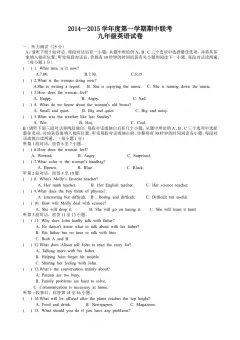
杭州市清河中学2014-2015 学年第一学期初三年级期中考试
英语试卷
考生须知:
1.本试卷分试题卷和答题卷两部分。满分120 分,考试时间 100 分钟。
2.答题前,必须在答题卷的密封区内填写校名、班级、学号、姓名、试场号、座位号。
3.所有答案都必须做在答题卷标定的位置上,务必注意试题序号和答题序号相对应。
4.考试结束后,只需上交答题卷。
英语 试题卷
I.听力部分(25 分)
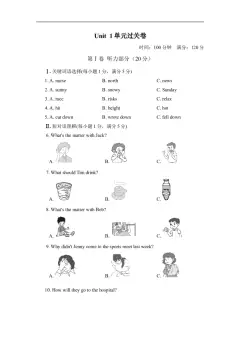
一、听短对话,回答问题(共5 小题,计5 分)
听下面5 段对话。每段对话后有一个小题,从题中所给的A、B、C 三个选项中选出最佳选项,
并标在试题的相应位置。听完每段对话后,你都有10 秒钟的时间来回答有关小题和阅读下
一小题。每段对话仅读一遍。
1.
Where is Alice now?
A. At home
B. At the supermarket C. At school
2.
Who has got longer hair?
A. Sam
B. Tom
C. Tina
3.
How is the weather today?
A. Windy
B. Rainy
C. Sunny
4.
What would the woman like to eat?
A. The beef noodle
B .the vegetable noodles
C. The tomato noodles
5.
When did the woman become an art teacher?
A.In 2004
B. In 2006
C. In 2008
二、听较长对话,回答问题(共6 小题,计12 分)
听下面一段对话,回答第6 至8 三个小题。现在,你有15 秒的时间阅读这三个小题。
6. How many hours does the woman probably spend on the Internet a week?
A. About 2 or 3hours B. About 3 or 4 hours C. About 3 or 5 hours
7. What does the woman like to do ?
A. To surf the Internet
B. To read e-mail C. To write letters in ink
8. What do we know about the woman?
A. She’s too busy to send any e-mail
B. She gets some information on the Internet.
C. She is looking through books in the library
听下面一段对话,回答第9 至11 三个小题。现在,你有15 秒的时间阅读这三个小题。
9. What does the woman want to buy ?
A. A brown skirt
B. A V-neck T-shirt
C. A T-shirt with pockets.
10. What size does the woman wear?
A. 32 B.33
C.34
11. What does the woman think of the yellow T-shirt?
A. The color doesn’t match B. The size is too large. C. The price is reasonable.
三、听独白,回答问题(共4 小题,计5 分)
听下面一段独白。听独白前,你有20 秒钟的时间阅读有关材料和4 个小题。听完独白后,你
有20 秒钟的时间来选择有关选项。独白连读两遍。
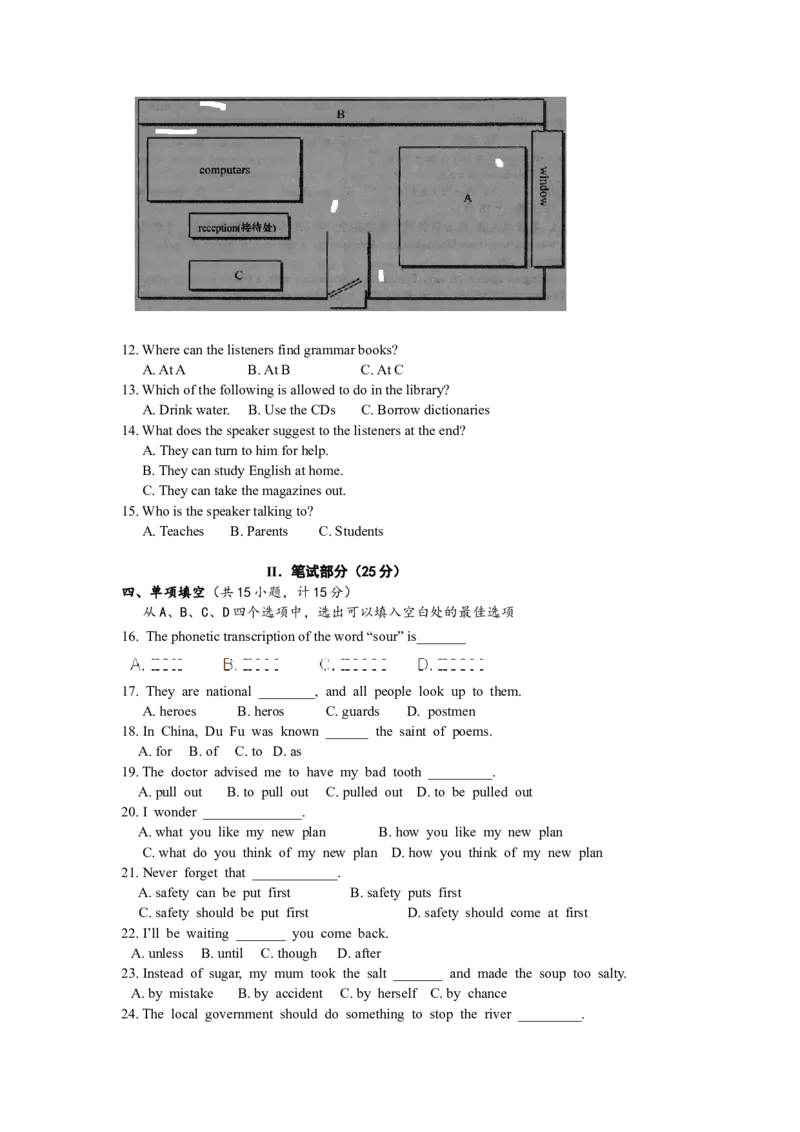
12. Where can the listeners find grammar books?
A. At A
B. At B
C. At C
13. Which of the following is allowed to do in the library?
A. Drink water. B. Use the CDs C. Borrow dictionaries
14. What does the speaker suggest to the listeners at the end?
A. They can turn to him for help.
B. They can study English at home.
C. They can take the magazines out.
15. Who is the speaker talking to?
A. Teaches B. Parents C. Students
II.笔试部分(25 分)
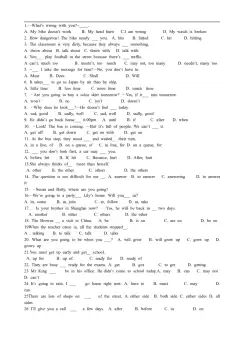
四、单项填空(共15 小题,计15 分)
从A、B、C、D 四个选项中,选出可以填入空白处的最佳选项
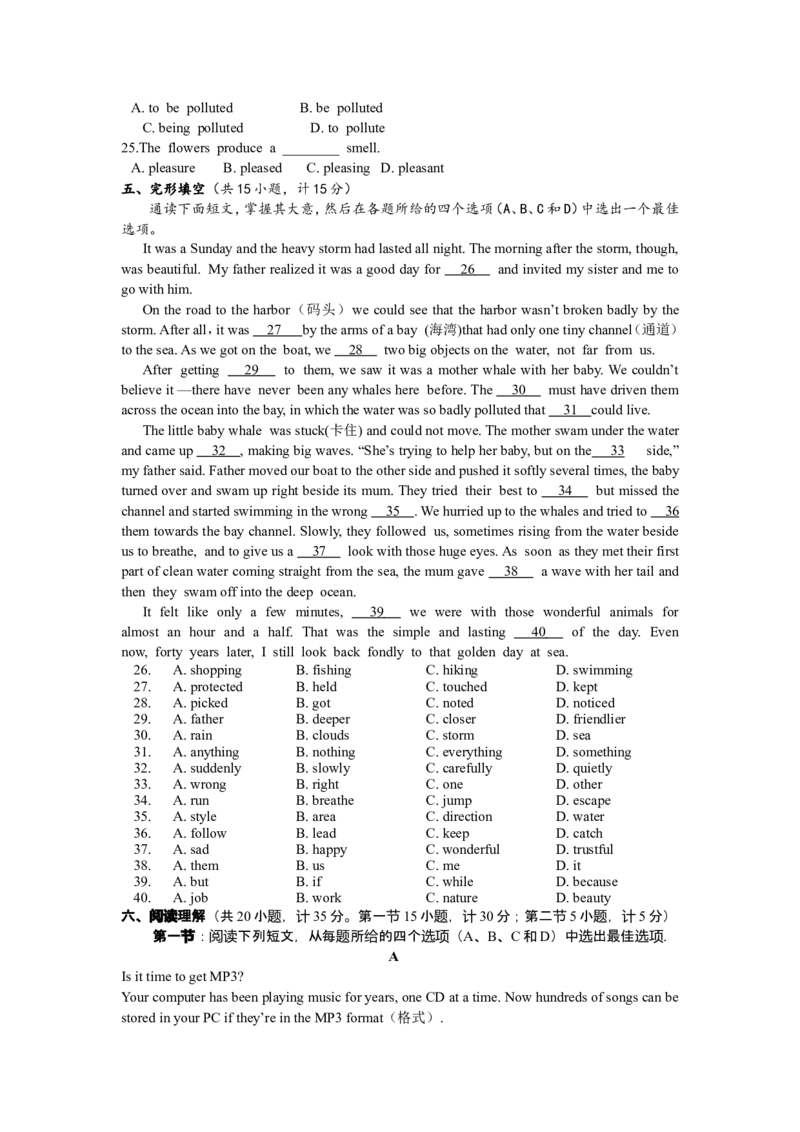
16. The phonetic transcription of the word “sour” is_______
17. They are national ________, and all people look up to them.
A. heroes B. heros C. guards D. postmen
18. In China, Du Fu was known ______ the saint of poems.
A. for B. of C. to D. as
19. The doctor advised me to have my bad tooth _________.
A. pull out B. to pull out C. pulled out D. to be pulled out
20. I wonder ______________.
A. what you like my new plan B. how you like my new plan
C. what do you think of my new plan D. how you think of my new plan
21. Never forget that ____________.
A. safety can be put first B. safety puts first
C. safety should be put first D. safety should come at first
22. I’ll be waiting _______ you come back.
A. unless B. until C. though D. after
23. Instead of sugar, my mum took the salt _______ and made the soup too salty.
A. by mistake B. by accident C. by herself C. by chance
24. The local government should do something to stop the river _________.
A. to be polluted B. be polluted
C. being polluted D. to pollute
25.The flowers produce a ________ smell.
A. pleasure B. pleased C. pleasing D. pleasant
五、完形填空(共15 小题,计15 分)
通读下面短文,掌握其大意,然后在各题所给的四个选项(A、B、C 和D)中选出一个最佳
选项。
It was a Sunday and the heavy storm had lasted all night. The morning after the storm, though,
was beautiful. My father realized it was a good day for
26
and invited my sister and me to
go with him.
On the road to the harbor(码头)we could see that the harbor wasn’t broken badly by the
storm. After all,it was
27
by the arms of a bay (海湾)that had only one tiny channel(通道)
to the sea. As we got on the boat, we
28
two big objects on the water, not far from us.
After getting
29
to them, we saw it was a mother whale with her baby. We couldn’t
believe it —there have never been any whales here before. The
30
must have driven them
across the ocean into the bay, in which the water was so badly polluted that
31
could live.
The little baby whale was stuck(卡住) and could not move. The mother swam under the water
and came up
32
, making big waves. “She’s trying to help her baby, but on the
33
side,”
my father said. Father moved our boat to the other side and pushed it softly several times, the baby
turned over and swam up right beside its mum. They tried their best to
34
but missed the
channel and started swimming in the wrong
35
. We hurried up to the whales and tried to
36
them towards the bay channel. Slowly, they followed us, sometimes rising from the water beside
us to breathe, and to give us a
37
look with those huge eyes. As soon as they met their first
part of clean water coming straight from the sea, the mum gave
38
a wave with her tail and
then they swam off into the deep ocean.
It felt like only a few minutes,
39
we were with those wonderful animals for
almost an hour and a half. That was the simple and lasting
40
of the day. Even
now, forty years later, I still look back fondly to that golden day at sea.
26.
A. shopping
B. fishing
C. hiking
D. swimming
27.
A. protected
B. held
C. touched
D. kept
28.
A. picked
B. got
C. noted
D. noticed
29.
A. father
B. deeper
C. closer
D. friendlier
30.
A. rain
B. clouds
C. storm
D. sea
31.
A. anything
B. nothing
C. everything
D. something
32.
A. suddenly
B. slowly
C. carefully
D. quietly
33.
A. wrong
B. right
C. one
D. other
34.
A. run
B. breathe
C. jump
D. escape
35.
A. style
B. area
C. direction
D. water
36.
A. follow
B. lead
C. keep
D. catch
37.
A. sad
B. happy
C. wonderful
D. trustful
38.
A. them
B. us
C. me
D. it
39.
A. but
B. if
C. while
D. because
40.
A. job
B. work
C. nature
D. beauty
六、
理解
阅读
(共20 小
,
题
计35 分。第一节15 小
,
题
计30 分;第二节5 小
,
题
计5 分)
第一节:
下列短文,从每
所
的四个
(
阅读
题
给
选项
A、B、C 和D)中
出最佳
选
选项.
A
Is it time to get MP3?
Your computer has been playing music for years, one CD at a time. Now hundreds of songs can be
stored in your PC if they’re in the MP3 format(格式).
What is it?
MP3 compressed(压缩)music into small computer files. You may download MP3 music
several ways: Music can be downloaded from websites that have turned wide music libraries
into MP3. Once MP3 music is on your PC’s hard drive, you can play it through your
computer’s speakers, “burn” it onto blank CDs or swap(交换)MP3 files with friends using e-
mail.
How much?
Software needed to play and turn MP3 music is often free. Compact portable MP3 players
start at around $ 40 and can hold hundreds of songs. A blank CD on which you can record
music costs about a dollar.
Advantages(优点)
MP3 turns your home PC into a jukebox(自动唱机). Small MP3 players are the size of a
deck of cards, making it easy to take hundreds of songs with you.
Disadvantages
You may find that some websites only allow you to listen but you can’t download music.
Others let you download music but can’t be copied to MP3 players. And a growing number of
new CDs make it impossible to copy songs to a computer.
41. How can you get MP3 music?
A. By turning your home PC into a jukebox.
B. By taking your own music or songs with you.
C. By copying songs to a PC through the speakers.
D. By downloading from websites, which have turned music libraries into MP3.
42. What is the closest meaning of the underlined word “burn”?
A. Copy.
B. Play.
C. Store.
D. Change.
43. Which is NOT true according to the passage?
A. Software needed to play and turn MP3 music is often free.
B. MP3 music can be “burned” onto blank CDs or he swapped with friends by e-mail.
C. MP3 music can be taken along while traveling.
D. A growing number of new CDs make it possible to copy songs to a computer.
44. How much will you pay for a compact portable MP3 player?
A. Free. B. At least 10 dollars. C. About forty dollars.
D. About a dollar.
45. How many disadvantages of MP3 can we see from the passage?
A. 2
B. 3
C. 4
D. 5
B
Qin Si: China is such a large country with so many farmers whose children may not know what a
"hamburger" is, and they won't be able to finish their homework. People should think
carefully before publishing these books.
Li Jing: I don't think it matters if the textbooks are mainly about city life. But I think teachers
should tell students about city life or let them see some pictures before classes.
Kong Xiaotian: I think writing textbooks is the same as creating art and music. It should come
from real life. China is a big farming country where most people are farmers. The
writers should visit poor villages and experience real life there. Then they will write
better textbooks.
Guo Jin: We should think again before writing the textbooks. We should consider the students in
the countryside. The aim of teaching is to educate everyone around the country. So the
contents of the textbooks must be common enough for everyone to understand.
Wang Sichen: We should tell country children about newly appearing things. Life in the city is
quite different from that in the country. So we should help them experience modern life
and catch up with the changing world.
Zhao Yan (teacher): It is not enough for rural children to learn from texts only about city life. Our
books should have more things that country students are familiar with, such as stories
about farms or in fields. It is unfair to center on city life, because life is made up of
many parts. Departments concerned (有关部门) should pay more attention to students'
lives in the country when writing their textbooks.
46. Which of the following persons agree the textbooks shouldn’t center on city life only?
A. Qin Si, Li Jing, Kong Xiaotian B. Li Jing, Wang Sichen, Zhao Yan
C. Qin Si, Kong Xiaotian, Guo Jin D. Kong Xiaotian, Guo Jin, Wang Sichen
47. What can be good textbooks according to the passage?
A. Books that are about city life
B. Books about newly appearing things
C. Books for rural children
D. Books written by the writers who experience real life
48. The underlined word “contests” probably means .
A. 内容 B. 难度 C. 体裁 D. 编写
49. Besides country life, what is also important to rural students?
A. City life B. Newly appearing things C. Farms and fields D. Pictures
50. Which of the following can best describe the passage?
A. Textbooks should focus more on rural students’ lives.
B. Help children experience modern life.
C. Excuse me, what is a hamburger?
D. Attention should be paid to students’ lives.
C
We know the famous ones—the Thomas Edison and the Alexander Graham Bells —but what
about the less famous inventors? What about the people who invented the traffic light and the
windshield wiper(雨刮器)? Shouldn’t we know who they are?
Joan Mclean thinks so. In fact, Mclean, a professor of physics at Mountain University in
Range, feels so strongly about this matter that she’s developed a course on the topic. In addition to
learning “who” invented “what”, however, Mclean also likes her students to learn the answers to
the “why” and ”how” questions. According to Mclean,” When students learn the answers to these
questions, they are better prepared to realize chances for inventing and more likely encouraged to
give inventing a try.”
So, just what is the story behind the windshield wiper? Well, Mary Anderson came up with the
idea in 1902 after a visit to New York City. The day was cold and stormy, but Anderson still
wanted to see the sights, so she jumped into a streetcar. Noticing that the driver was struggling to
see through the snow covering the windshield, she found herself wondering why there couldn’t be
a built-in tool for cleaning the window. Still wondering about this when she returned home,
Anderson started thinking out solutions. One of her ideas, a lever(操作杆)on the inside of a car
that would control an arm on the outside, became the first windshield wiper.
Countless inventions make today’s life convenient. It’s hard to imagine driving without
Garrett A Morgan’s traffic light. It’s also impossible to picture a world without Katherine J.
Blodgett’s new idea that makes glass invisible ( 看不见), Can you picture life without clear
windows and eyeglasses?
51. By mentioning “traffic light” and “windshield wiper”, the author wants to tell us that
countless inventions are .
A. useful, because their inventors are famous
B. useful, though their inventors are less famous
C. not useful, because their inventors are less famous
D. not useful, though their inventors are famous
52. Professor Joan McLean’s course aims to(目的是)_____.
A. add color and joy to students’ school life
B. remind students of the windshield wiper’s invention
C. finish his teaching task by Mountain University
D. prepare students to try their own invention
53. The windshield wiper was _________.
A. invented by Anderson by mistake
B. invented by Anderson by accident
C. invented by Anderson after his experience in a storm
D. invented by Anderson after hearing the suggestion of a driver
54. Thanks to ______, those who can’t see well are able to read conveniently.
A. Katherine J. Blodgett B. Garrett A Morgan
C. Mary Anderson D. Alexander Graham Bells
55. Which of the following can best serve as the title of this passage?
A. How to Help Students to Sell Their Inventions to Producers?
B. How to Design a Built-in tool for Cleaning the Window?
C. Shouldn’t We Know Who Invented the Windshield Wiper?
D. Shouldn’t We Learn Invention Courses in Universities?
第二节:阅读56-60 题的信息,选择与之相对应的最佳标题。
56.Now colleges and universities have become a big market for many banks. As a result,
some students even have two or three credit cards.
57.Though the Spring Festivals is still months away, the railway station in Guangzhou is
already crowded with migrant workers waiting for trains home.
58.It’s reported that 110,000 people lose their lives in traffic accidents in China each year.
Drivers are mainly at fault: They drive after drinking, carry more goods than allowed
and break the traffic rules.
59.A recent survey in Shanghai shows, 33% of the high school students were not sure
whether to give seats to the old and weak and almost 17% said they wouldn’t. Why
does this happen?
60.Not long ago, a team of tourists was shocked and disappointed to see the dry
riverbed(河床) of Lijiang River in Guilin.
A. A New Market of Credit Cards B. Thinking Behind a Survey
C. The Reasons of Traffic Accidents D. The World Cup in South Africa
E. Droughts in South China F. Migrant Workers on the Way Home
七、
填空
词语
(共10 小
,
题
计10 分)
用方框中所
的适当形式填空,使短文通
、正确、
(每个
限用一次)。
给单词
顺
连贯
单词
"Dreams may be more important than sleep. We all need to dream," some scientists say.
Dreams take up about one 61
of our sleeping time. People have several dreams each
way because hard we idea into feel quarter quick long
night. Dreams are like short films. They are usually in color. Some are like old films. They come
to 62 over and over again. That may be
63
the dreamer is worrying about something.
Dreaming may be a 64
of trying to find an answer.
Some people get new 65
about their work from dreams. They may have been thinking
about their work all day. These thoughts can be carried over
66
dreams.
Sometimes we wake up with a good 67 from a dream. But often we can't remember the
dream. Dreams can disappear 68 from memory.
Too much dreaming can be harmful. The more we sleep, the 69 we dream. The mind is
__
70
at work when we dream. That is why we may have a long sleep and still wake up tired.
八、
拼写
单词
(共10 小
,
题
计10 分)
根据下列句子及所
首字母,写出各
的完全形式(每空限填一
)。
给
单词
词
71. In Hong Kong, smoking is not a________ in public.
72. It’s against the law to driver with a driver’s l________.
73. He shared the apple with me by d________ it into two halves.
74. This packing bag is made of a environment-friendly m________.
75. English is w_______ spoken around the world.
76. –Read us the new words, please. –Sorry, but I can’t p________ some of them.
77. Nearly 70 percent of the earth’s s________ is covered by water.
78. The new p_______ of Company Apple is Iphone 6.
79. In western countries, people use f_______ and knives instead of chopsticks.
80. The box is l________. Please open it with the key.
九、
面表达
书
(共1 小
,
题
计15 分)
假如你的房间有点乱,妈妈要你整理你房间的东西,你把你如何放置你房间物品的想法及
原因说给你妈妈听,根据表格中的提示,写出你的想法,并补充其它二方面的想法。
字数要求:80 字,开头已给单词不计。
物品
如何放置
原因说明
backpack
be hung on the wall
won’t take up much room
football
be put under the bed
won’t run everywhere
textbooks
be placed on the desk
use it every day
pictures
… …
… …
… …
… …
… …
This is my plan for tidying my room. __________________________________________
__________________________________________________________________________
__________________________________________________________________________
__________________________________________________________________________
__________________________________________________________________________
__________________________________________________________________________
英语听力材料
英语听力测试现在开始。做题时,先将答案标在试卷上。录音内容结束后,你将有一分钟
的时间将试卷上的答案转涂到答题纸上。
一、听短对话,回答问题。
听下面5 段对话,每段对话后有一个小题,从题中所给的A、B、C 三个选项中选出最佳
选项,并标在试题的相应位置。听完每段对话后,你都有10 秒钟的时间来回答有关小题和阅
读下一小题。每段对话仅读一遍。
(Text 1)
M: Hello. Is Alice at home?
W: No, she isn't. She's at the supermarket.
M: All right. Please tell her to come to school this afternoon.
(停顿00'10'' ; 停顿时间打点)
(Text 2)
M: Look, Tina. Is that Sam?
W: No, that's Tom. Sam has longer hair than Tom.
M: Yes, and Tom is calmer than Sam.
(停顿00'10'' ; 停顿时间打点)
(Text 3)
M: What a fine day and beautiful sunshine!
W: Yes. Yesterday it was just raining.
M: Well, sunshine always comes after rain.
(停顿00'10'' ; 停顿时间打点)
(Text 4)
M: What would you like, madam?
W: I'm not sure yet. Are there any vegetables in the beef noodles?
M: Yes, there are some tomatoes.
W: OK, I'd like the beef noodles, please.
(停顿00'10'' ; 停顿时间打点)
(Text 5)
M: Mary, could you tell me something about yourself?
W: Yes, I left college when I was 23. Two years later, I became an art teacher.
M: That was in the year of 2006 when you graduated from college.
W: That's right.
(停顿00'05''; 停顿时间打点)
二、听较长对话,回答问题。
听下面两段较长对话。每段对话后有几个小题,从题中所给的A、B、C 三个选项中选出
最佳选项。听每段对话前,你有时间阅读各小题,每小题5 秒钟;听完后,各小题给出5 秒钟
的作答时间。每段对话读两遍。
(停2 秒)
听下面一段对话,回答第6 至第8 三个小题。现在,你有15 秒钟的时间阅读这三个小题。
(停15 秒)
M: Susan, do you surf the Web much?
W: Well, to tell the truth, I don't really have time to surf the Web. I suppose I log on a couple of
times a week, about two or three hours.
M: So, what do you do on the Internet when you log on?
W: Well, I do a little e-mail. I only get about three or four e-mails a week. In fact, I prefer writing
real letters, with pen and paper.
M: Yeah, I'm the same way. Anything else you do on the Internet?
W: Well, sometimes I look up information I need for my job, saving a lot of time looking through
books in the library.
M: Yes, it sure does. Well, thanks for talking with me, Susan.
W: My pleasure.
(停2 秒,然后重复,后再停15 秒)
听下面一段对话,回答第9 至第11 三个小题。现在,你有15 秒钟的时间阅读这三个小题。
(停15 秒)
M: Good afternoon. May I help you, madam?
W: Yes, thank you. I'd like to buy a T-shirt.
M: What land of T-shirt do you want?
W: I need something to go with my brown skirt.
M: Here's a pretty green one. Maybe it can go with your skirt.
W: But it has pockets. I'd like a V-neck T-shirt without pockets. Do you have any?
M: Yes, but we only have this kind of T-shirt in yellow. What size do you wear?
W: Thirty-three. Do you have that one in my size?
M: Yes, here it is and it costs 29 pounds.
W: Sounds reasonable. I'll take it. (停2 秒,然后重复,后再停15 秒)
三、听独白,回答问题。
听下面一段独白,听独白前,你有20 秒钟的时间阅读四个小题。听完独白后,你有20 秒
钟的时间来选择有关选项。独白连读两遍。
Hello, come in everybody. OK, I just want to show you round the library today so you know
where everything is.
OK, on the back wall there are all the grammar books and dictionaries so you can use those to
help you with your homework. Also I know sometimes it's hard to study at home, so next to the
window are all the desks where you can work quietly. You mustn't talk here and you're not
allowed to bring food or drink in when you're studying. Then you can see we have several
computers for you to use near reception here. Now don't be worried if you're not sure how to use
them. We can help you — it's very easy and it means you can use all the CDs we have to help you
with learning.
Now just by the door we have English magazines for you to read. Please don't take them out of
the library but they are useful as they have lots of articles you may be interested in and it's
important you read as much as you can in English.
Now do you just want to have a look round and come and ask me any questions if you need to
know anything?
(停2 秒,然后重复,停20 秒)
听力测试到此结束,请同学们把答案转涂到答题纸上,然后接着做笔试题目。
。
参考答案
一、听短对话,回答问题
1-5. B A C A C
二、听较长对话,回答问题
6-11. A C B B B C
三、听独白,回答问题
12-15. B B A C
四、单项填空
16-20 C A D C B 21-25 C B A C D
五、完形填空
26-30 B A D C C 31-35 B A A D C 36-40 B D B A D
六、
理解
阅读
41-45 D A D C B 46-50 C D A B A 51-55 B D C A C 56-60 A F C B E
七、
填空
词语
61. quarter 62. us 63. because 64. way 65. ideas
66. into 67. feeling 68. quickly 69. longer 70. hard
八、
拼写
单词
71. allowed 72. license 73. dividing 74. material 75. widely
76. pronounce 77. surface 78. product 79. forks 80. locked
九、
面表达
书
略