自然探索73 个
清单09 自然探索和创新发展
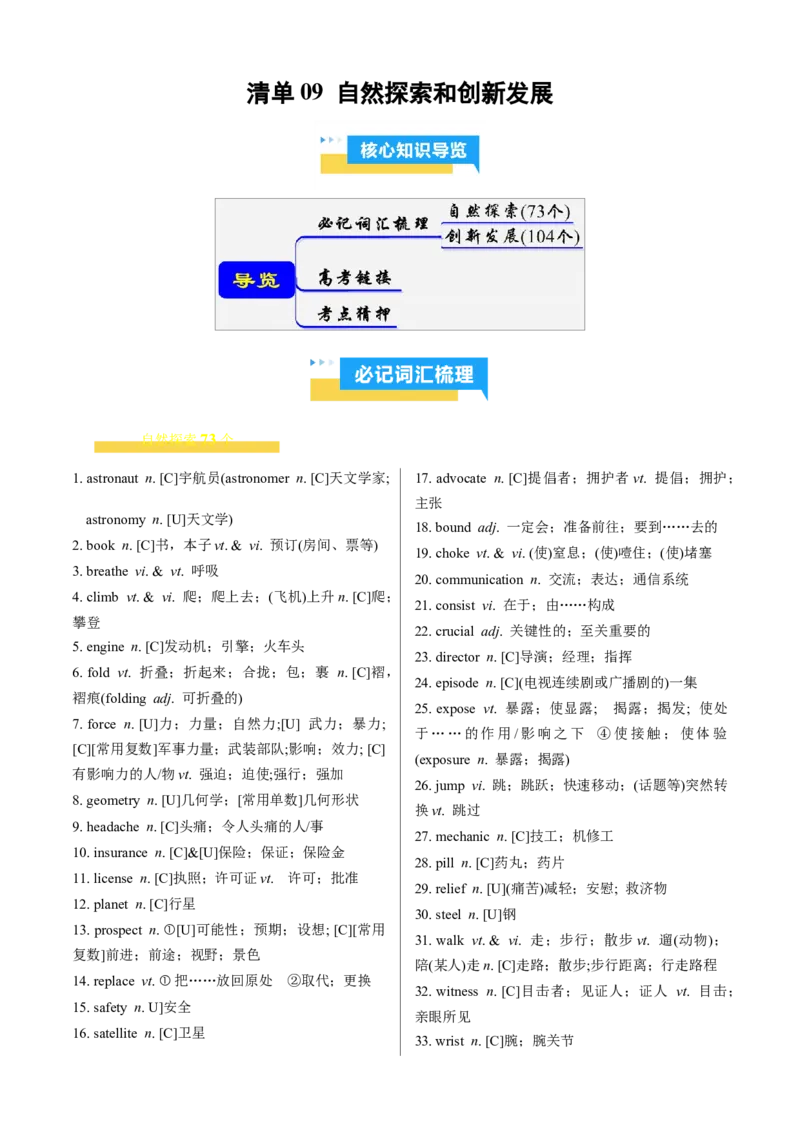
1. astronaut n. [C]宇航员(astronomer n. [C]天文学家;

astronomy n. [U]天文学)
2. book n. [C]书,本子vt. & vi. 预订(房间、票等)
3. breathe vi. & vt. 呼吸
4. climb vt. & vi. 爬;爬上去;(飞机)上升n. [C]爬;
攀登
5. engine n. [C]发动机;引擎;火车头
6. fold vt. 折叠;折起来;合拢;包;裹 n. [C]褶,
褶痕(folding adj. 可折叠的)
7. force n. [U]力;力量;自然力;[U] 武力;暴力;
[C][常用复数]军事力量;武装部队;影响;效力; [C]
有影响力的人/物vt. 强迫;迫使;强行;强加
8. geometry n. [U]几何学;[常用单数]几何形状
9. headache n. [C]头痛;令人头痛的人/事
10. insurance n. [C]&[U]保险;保证;保险金
11. license n. [C]执照;许可证vt.  许可;批准
12. planet n. [C]行星
13. prospect n.
[U]
①
可能性;预期;设想; [C][常用
复数]前进;前途;视野;景色
14. replace vt. ①把……放回原处 ②取代;更换
15. safety n. U]安全
16. satellite n. [C]卫星
17. advocate n. [C]提倡者;拥护者vt. 提倡;拥护;
主张
18. bound adj. 一定会;准备前往;要到……去的
19. choke vt. & vi. (使)窒息;(使)噎住;(使)堵塞
20. communication n. 交流;表达;通信系统
21. consist vi. 在于;由……构成
22. crucial adj. 关键性的;至关重要的
23. director n. [C]导演;经理;指挥
24. episode n. [C](电视连续剧或广播剧的)一集
25. expose vt. 暴露;使显露; 揭露;揭发; 使处
于… … 的作用/ 影响之下 ④使接触;使体验
(exposure n. 暴露;揭露)
26. jump vi. 跳;跳跃;快速移动;(话题等)突然转
换vt. 跳过
27. mechanic n. [C]技工;机修工
28. pill n. [C]药丸;药片
29. relief n. [U](痛苦)减轻;安慰; 救济物
30. steel n. [U]钢
31. walk vt. & vi. 走;步行;散步vt. 遛(动物);
陪(某人)走n. [C]走路;散步;步行距离;行走路程
32. witness n. [C]目击者;见证人;证人 vt. 目击;
亲眼所见
33. wrist n. [C]腕;腕关节
创新发展104 个
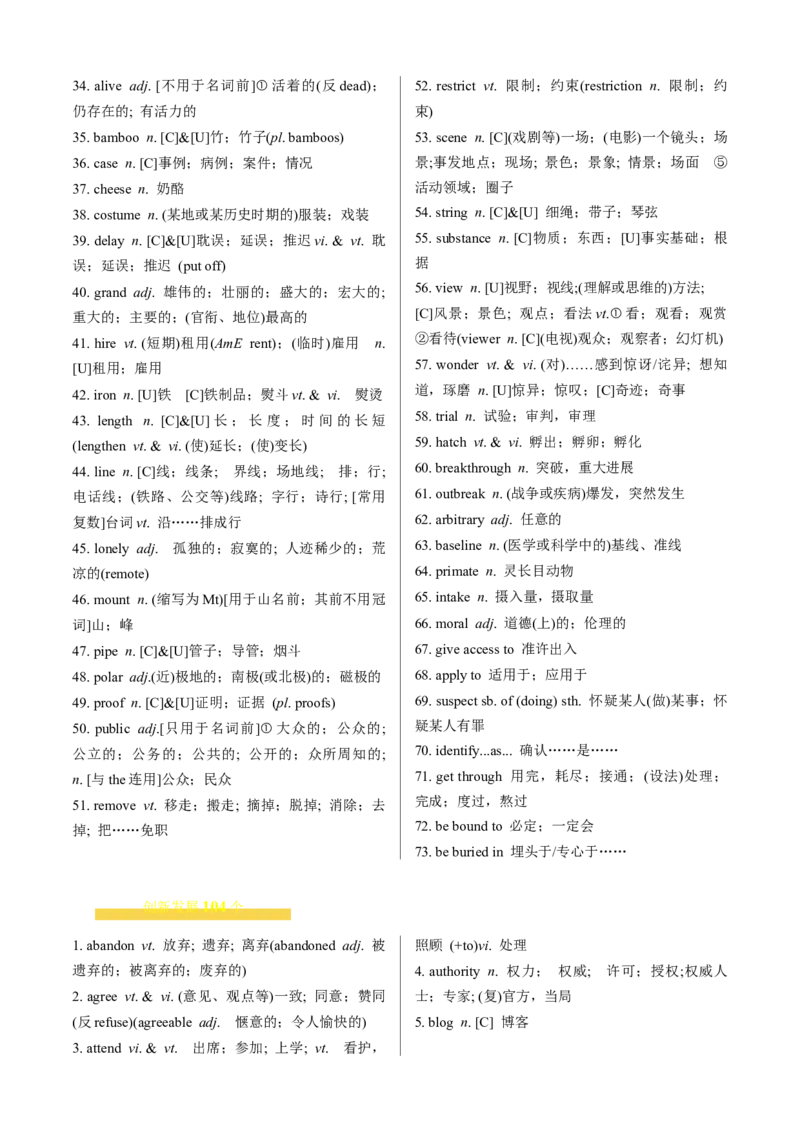
34. alive adj. [不用于名词前]①活着的(反dead);
仍存在的; 有活力的
35. bamboo n. [C]&[U]竹;竹子(pl. bamboos)
36. case n. [C]事例;病例;案件;情况
37. cheese n. 奶酪
38. costume n. (某地或某历史时期的)服装;戏装
39. delay n. [C]&[U]耽误;延误;推迟vi. & vt. 耽
误;延误;推迟 (put off)
40. grand adj. 雄伟的;壮丽的;盛大的;宏大的;
重大的;主要的;(官衔、地位)最高的
41. hire vt. (短期)租用(AmE rent);(临时)雇用 n.
[U]租用;雇用
42. iron n. [U]铁 [C]铁制品;熨斗vt. & vi.  熨烫
43. length n. [C]&[U] 长;长度;时间的长短
(lengthen vt. & vi. (使)延长;(使)变长)
44. line n. [C]线;线条; 界线;场地线; 排;行;
电话线;(铁路、公交等)线路; 字行;诗行; [常用
复数]台词vt. 沿……排成行
45. lonely adj. 孤独的;寂寞的; 人迹稀少的;荒
凉的(remote)
46. mount n. (缩写为Mt)[用于山名前;其前不用冠
词]山;峰
47. pipe n. [C]&[U]管子;导管;烟斗
48. polar adj.(近)极地的;南极(或北极)的;磁极的
49. proof n. [C]&[U]证明;证据 (pl. proofs)
50. public adj.[只用于名词前]①大众的;公众的;
公立的;公务的;公共的; 公开的;众所周知的;
n. [与the 连用]公众;民众
51. remove vt. 移走;搬走; 摘掉;脱掉; 消除;去
掉; 把……免职
52. restrict vt. 限制;约束(restriction n. 限制;约
束)
53. scene n. [C](戏剧等)一场;(电影)一个镜头;场
景;事发地点;现场; 景色;景象; 情景;场面 ⑤
活动领域;圈子
54. string n. [C]&[U] 细绳;带子;琴弦
55. substance n. [C]物质;东西;[U]事实基础;根
据
56. view n. [U]视野;视线;(理解或思维的)方法;
[C]风景;景色; 观点;看法vt.①看;观看;观赏
②看待(viewer n. [C](电视)观众;观察者;幻灯机)
57. wonder vt. & vi. (对)……感到惊讶/诧异; 想知
道,琢磨 n. [U]惊异;惊叹;[C]奇迹;奇事
58. trial n. 试验;审判,审理
59. hatch vt. & vi. 孵出;孵卵;孵化
60. breakthrough n. 突破,重大进展
61. outbreak n. (战争或疾病)爆发,突然发生
62. arbitrary adj. 任意的
63. baseline n. (医学或科学中的)基线、准线
64. primate n. 灵长目动物
65. intake n. 摄入量,摄取量
66. moral adj. 道德(上)的;伦理的
67. give access to 准许出入
68. apply to 适用于;应用于
69. suspect sb. of (doing) sth. 怀疑某人(做)某事;怀
疑某人有罪
70. identify...as... 确认……是……
71. get through 用完,耗尽;接通;(设法)处理;
完成;度过,熬过
72. be bound to 必定;一定会
73. be buried in 埋头于/专心于……
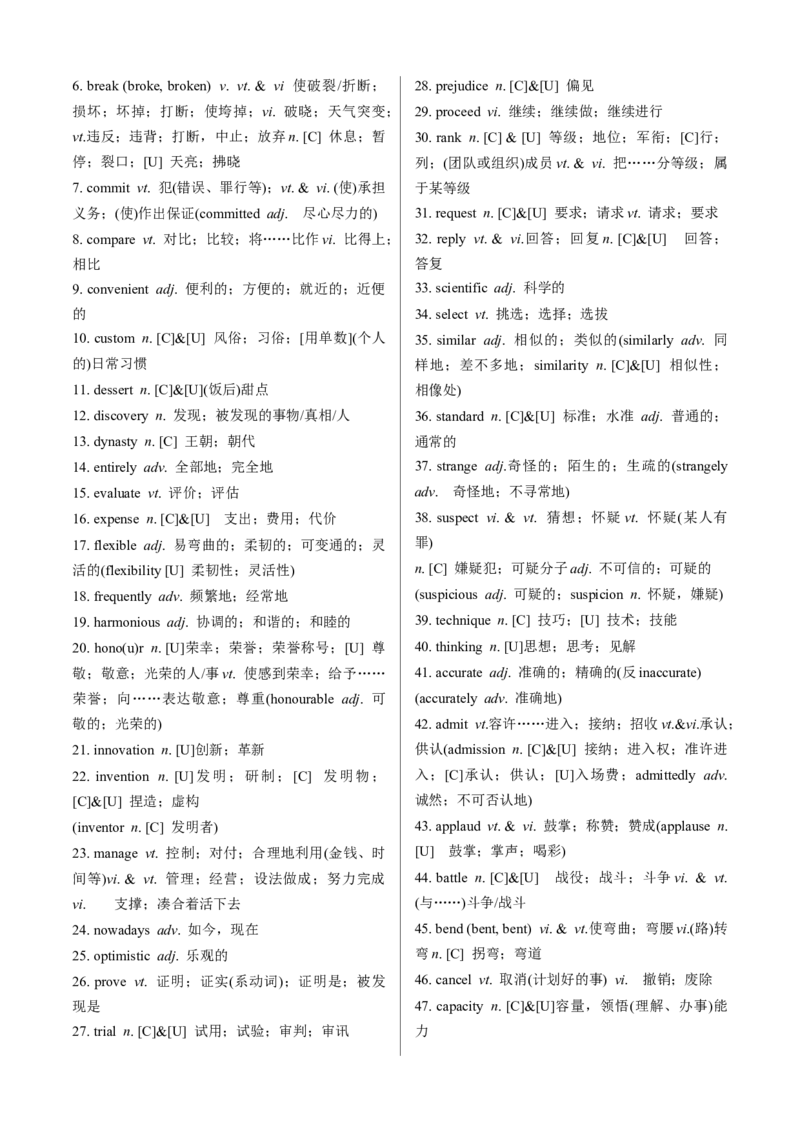
1. abandon vt. 放弃; 遗弃; 离弃(abandoned adj. 被
遗弃的;被离弃的;废弃的)
2. agree vt. & vi. (意见、观点等)一致; 同意;赞同
(反refuse)(agreeable adj.  惬意的;令人愉快的)
3. attend vi. & vt.  出席;参加; 上学; vt.  看护,
照顾 (+to)vi. 处理
4. authority n. 权力; 权威; 许可;授权;权威人
士;专家; (复)官方,当局
5. blog n. [C] 博客
6. break (broke, broken) v. vt. & vi 使破裂/折断;
损坏;坏掉;打断;使垮掉;vi. 破晓;天气突变;
vt.违反;违背;打断,中止;放弃n. [C] 休息;暂
停;裂口;[U] 天亮;拂晓
7. commit vt. 犯(错误、罪行等);vt. & vi. (使)承担
义务;(使)作出保证(committed adj.  尽心尽力的)
8. compare vt. 对比;比较;将……比作vi. 比得上;
相比
9. convenient adj. 便利的;方便的;就近的;近便
的
10. custom n. [C]&[U] 风俗;习俗;[用单数](个人
的)日常习惯
11. dessert n. [C]&[U](饭后)甜点
12. discovery n. 发现;被发现的事物/真相/人
13. dynasty n. [C] 王朝;朝代
14. entirely adv. 全部地;完全地
15. evaluate vt. 评价;评估
16. expense n. [C]&[U]  支出;费用;代价
17. flexible adj. 易弯曲的;柔韧的;可变通的;灵
活的(flexibility [U] 柔韧性;灵活性)
18. frequently adv. 频繁地;经常地
19. harmonious adj. 协调的;和谐的;和睦的
20. hono(u)r n. [U]荣幸;荣誉;荣誉称号;[U] 尊
敬;敬意;光荣的人/事vt. 使感到荣幸;给予……
荣誉;向……表达敬意;尊重(honourable adj. 可
敬的;光荣的)
21. innovation n. [U]创新;革新
22. invention n. [U]发明;研制;[C] 发明物;
[C]&[U] 捏造;虚构
(inventor n. [C] 发明者)
23. manage vt. 控制;对付;合理地利用(金钱、时
间等)vi. & vt. 管理;经营;设法做成;努力完成
vi.  支撑;凑合着活下去
24. nowadays adv. 如今,现在
25. optimistic adj. 乐观的
26. prove vt. 证明;证实(系动词);证明是;被发
现是
27. trial n. [C]&[U] 试用;试验;审判;审讯
28. prejudice n. [C]&[U] 偏见
29. proceed vi. 继续;继续做;继续进行
30. rank n. [C] & [U] 等级;地位;军衔;[C]行;
列;(团队或组织)成员vt. & vi. 把……分等级;属
于某等级
31. request n. [C]&[U] 要求;请求vt. 请求;要求
32. reply vt. & vi.回答;回复n. [C]&[U]  回答;
答复
33. scientific adj. 科学的
34. select vt. 挑选;选择;选拔
35. similar adj. 相似的;类似的(similarly adv. 同
样地;差不多地;similarity n. [C]&[U] 相似性;
相像处)
36. standard n. [C]&[U] 标准;水准 adj. 普通的;
通常的
37. strange adj.奇怪的;陌生的;生疏的(strangely
adv.  奇怪地;不寻常地)
38. suspect vi. & vt. 猜想;怀疑vt. 怀疑(某人有
罪)
n. [C] 嫌疑犯;可疑分子adj. 不可信的;可疑的
(suspicious adj. 可疑的;suspicion n. 怀疑,嫌疑)
39. technique n. [C] 技巧;[U] 技术;技能
40. thinking n. [U]思想;思考;见解
41. accurate adj. 准确的;精确的(反inaccurate)
(accurately adv. 准确地)
42. admit vt.容许……进入;接纳;招收vt.&vi.承认;
供认(admission n. [C]&[U] 接纳;进入权;准许进
入;[C]承认;供认;[U]入场费;admittedly adv.
诚然;不可否认地)
43. applaud vt. & vi. 鼓掌;称赞;赞成(applause n.
[U]  鼓掌;掌声;喝彩)
44. battle n. [C]&[U]  战役;战斗;斗争vi. & vt.
(与……)斗争/战斗
45. bend (bent, bent) vi. & vt.使弯曲;弯腰vi.(路)转
弯n. [C] 拐弯;弯道
46. cancel vt. 取消(计划好的事) vi.  撤销;废除
47. capacity n. [C]&[U]容量,领悟(理解、办事)能
力
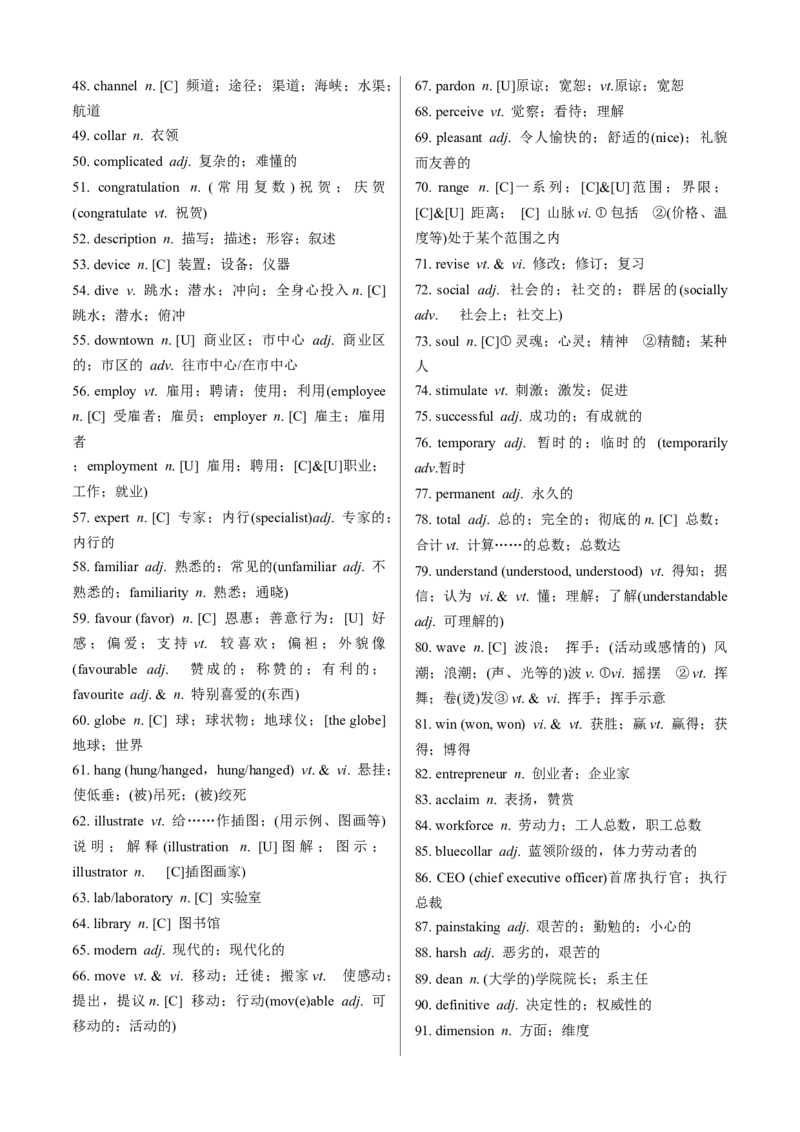
48. channel n. [C] 频道;途径;渠道;海峡;水渠;
航道
49. collar n. 衣领
50. complicated adj. 复杂的;难懂的
51. congratulation n. ( 常用复数) 祝贺;庆贺
(congratulate vt. 祝贺)
52. description n. 描写;描述;形容;叙述
53. device n. [C] 装置;设备;仪器
54. dive v. 跳水;潜水;冲向;全身心投入n. [C]
跳水;潜水;俯冲
55. downtown n. [U] 商业区;市中心 adj. 商业区
的;市区的 adv. 往市中心/在市中心
56. employ vt. 雇用;聘请;使用;利用(employee
n. [C] 受雇者;雇员;employer n. [C] 雇主;雇用
者
;employment n. [U] 雇用;聘用;[C]&[U]职业;
工作;就业)
57. expert n. [C] 专家;内行(specialist)adj. 专家的;
内行的
58. familiar adj. 熟悉的;常见的(unfamiliar adj. 不
熟悉的;familiarity n. 熟悉;通晓)
59. favour (favor) n. [C] 恩惠;善意行为;[U] 好
感;偏爱;支持vt. 较喜欢;偏袒;外貌像
(favourable adj.  赞成的;称赞的;有利的;
favourite adj. & n. 特别喜爱的(东西)
60. globe n. [C] 球;球状物;地球仪;[the globe]
地球;世界
61. hang (hung/hanged,hung/hanged) vt. & vi. 悬挂;
使低垂;(被)吊死;(被)绞死
62. illustrate vt. 给……作插图;(用示例、图画等)
说明;解释(illustration n. [U] 图解;图示;
illustrator n.   [C]插图画家)
63. lab/laboratory n. [C] 实验室
64. library n. [C] 图书馆
65. modern adj. 现代的;现代化的
66. move vt. & vi. 移动;迁徙;搬家vt.  使感动;
提出,提议n. [C] 移动;行动(mov(e)able adj. 可
移动的;活动的)
67. pardon n. [U]原谅;宽恕;vt.原谅;宽恕
68. perceive vt. 觉察;看待;理解
69. pleasant adj. 令人愉快的;舒适的(nice);礼貌
而友善的
70. range n. [C] 一系列;[C]&[U] 范围;界限;
[C]&[U] 距离; [C] 山脉vi. ①包括 ②(价格、温
度等)处于某个范围之内
71. revise vt. & vi. 修改;修订;复习
72. social adj. 社会的;社交的;群居的(socially
adv.   社会上;社交上)
73. soul n. [C]①灵魂;心灵;精神 ②精髓;某种
人
74. stimulate vt. 刺激;激发;促进
75. successful adj. 成功的;有成就的
76. temporary adj. 暂时的;临时的 (temporarily
adv.暂时
77. permanent adj. 永久的
78. total adj. 总的;完全的;彻底的n. [C] 总数;
合计vt. 计算……的总数;总数达
79. understand (understood, understood) vt. 得知;据
信;认为 vi. & vt. 懂;理解;了解(understandable
adj. 可理解的)
80. wave n. [C] 波浪; 挥手;(活动或感情的) 风
潮;浪潮;(声、光等的)波v. ①vi. 摇摆 ②vt. 挥
舞;卷(烫)发③vt. & vi. 挥手;挥手示意
81. win (won, won) vi. & vt. 获胜;赢vt. 赢得;获
得;博得
82. entrepreneur n. 创业者;企业家
83. acclaim n. 表扬,赞赏
84. workforce n. 劳动力;工人总数,职工总数
85. bluecollar adj. 蓝领阶级的,体力劳动者的
86. CEO (chief executive officer)首席执行官;执行
总裁
87. painstaking adj. 艰苦的;勤勉的;小心的
88. harsh adj. 恶劣的,艰苦的
89. dean n. (大学的)学院院长;系主任
90. definitive adj. 决定性的;权威性的
91. dimension n. 方面;维度
92. disposal n. 去除;(企业、财产等的)变卖,让与
93. dissolve v. 溶解;解散
94. restoration n. (旧建筑或旧家具等的)修复,整修
95. dividend n. 红利;股息
96. earn a living 谋生
97. set up 建立;创建;装配好;安排;策划
98. over and over again 反复;多次
99. get used to doing sth. 习惯于做某事
100. be eager to do sth. 渴望做某事
101. be supposed to 应该
102. break new ground 开辟新的领域;有新发现
103. by trial and error 反复试验(以得出最佳结果)
104. swing into action 立即行动起来;马上大干起来
(2025 年普通高等学校招生全国统一考试(新高考Ⅱ卷)阅读七选五英语真题)
Unexpected Benefits of Volunteering as a Family
Are you looking for a way to bring your family together? Hoping to find a hobby that can be shared by both
the little ones and adults?    36    You may know the “feel-good” emotions that come with helping others, but
there are even more unexpected ways volunteering will positively affect the whole family.
●You'll feel like you have more time.
People often feel they are too busy to volunteer. Yet, research has found that giving your time to community
causes actually makes you feel like you have more of it.    37
●You can live longer if you volunteer regularly.
    38    Washington University found that adults 55 and older who volunteered had better memory and
maintained overall health longer than others their age. Volunteers are also more likely to look after their own health
and are more focused on adding physical activity into their lives.
●   39
Volunteering during teenage years has been linked to some major positive effects such as improved grades
and increased self-confidence. These effects aren't just short-term but have been proved to affect a teen's well-being
in the years to come.
●You'll have more time with family.
Families who volunteer together have the unique experience of working toward a common goal.    40
Everyone brings something unique to the table and can connect with each other in a new way. And, there are tasks
for every age and ability, so all your children can feel proud of their work.
A. Helping the community lowers rates of depression.
B. Volunteering as a family may be just the thing you need.
C. Volunteering has a lifelong effect on kids and teenagers.
D. Volunteering can be the first step in breaking down prejudice.
E. For adults, volunteering can provide significant physical health benefits.
F. You may even learn that your kid has a talent you didn't know about before.
G. Volunteering makes you feel capable and inspires you to make the most of each day.
重点单词
1. ________ n. 情绪
2. ________ v. 维持,保持
3. ________ adj. 全面的
4. ________ n. 比率
5. ________ n. 偏见
6. ________ adj. 能干的
7. ________________集中于,聚焦于
8. ________________与.....有关
9. bring sth. to the table________________
10. break down________________
11. ________________充分利用
熟词生义
cause 熟义:v. 引起;文章义: n. ________
派生词
1. improve v. 提高→________ adj. 有改进的
2. low adj. 低的→________ v. 降低
3. depress v. 使抑郁→________ n. 抑郁(症)
合成词
1. feel+ good= feel-good adj. ________
2. self+ confidence=self-confidence n. ________
3. short+ term= short-term adj. ________
4. well+ being =well-being n. ________
5. life+ long= lifelong adj. ________
长难句分析
1. You may know the “feel - good” emotions that come with helping others, but there are even more unexpected
ways volunteering will positively affect the whole family.
分析:这是一个并列复合句,由but 连接两个分句。前一个分句中,You 是主语,may know 是谓语,the
“feel - good” emotions 是宾语,that come with helping others 是________从句,修饰先行词emotions;后一个
分句中,there are 是存在句结构,even more unexpected ways 是主语,volunteering will positively affect the
whole family 是省略了关系副词in which 的________从句,修饰ways。
翻译:你可能知道帮助他人会带来那种“感觉良好”的情绪,但志愿服务还有更多意想不到的方式会对整
个家庭产生积极影响。
2. Washington University found that adults 55 and older who volunteered had better memory and maintained
overall health longer than others their age.
分析:这是一个主从复合句。Washington University 是主语,found 是谓语,that 引导________作found 的宾
语。在宾语从句中,adults 55 and older 是主语,who volunteered 是________从句,修饰adults,had better
memory and maintained overall health 是并列谓语,longer than others their age 是________。
翻译:华盛顿大学发现,55 岁及以上的志愿者比同龄人拥有更好的记忆力,且能更长时间地保持整体健康。
一. 阅读理解
A
(2026 届山东济宁市下学期高考模拟考试(一模)We’ve all seen this happen in a science-fiction movie: The
super heroes jump into a shaky spaceship and escape the bad guys by flying through the asteroid( 小行星) belt,
where huge rocks fall and spin so close that the crew has to duck and dive to avoid being broken into pieces. It’s
exciting, but it’s wrong: In our solar system, the odds are pretty good that you could stand on the surface of an
asteroid and not even be able to see another.
Yet they do interact if given enough time. Even in the main asteroid belt between the orbits of Mars and
Jupiter, crashes are ineluctable. And when two space rocks go “crash” in the main belt, big impacts blow lots of
asteroid fragments(碎片) out into space.
In many cases, these fragments stay on much the same orbital path as the parent asteroid, although they
gradually separate from it because of slight speed differences. After thousands of years, some fragments might be
clear across the Sun, but their distance from the Sun and the shape and direction of their orbits remain similar. Such
conserved features are collectively called an asteroid’s orbital elements. The groupings sharing orbital elements are
identified as “families”, which are named after the largest asteroid in the group.
Studying asteroids by focusing on their families can help us make a good guess about what properties a
newly-found one has if it belongs to a better-studied family. Care must be taken, though. Some very large asteroids
have differentiated materials in the center and on the surface, so confirming those guesses usually requires taking
spectra, the time-consuming process of breaking an object’s incoming light into individual colors to reveal its
composition.
It’s more than a mere academic exercise to find this particular branch of an asteroid family tree: Some
asteroids are potentially risky, meaning they could crash with Earth some time in the distant future. If we know how
they find their way to the inner solar system from the main belt to pose threats in the first place, we can defend our
planet from future worrisome asteroids.
1. What is the author’s view on the scene in the sci-fi movie?
A. It goes against the established facts.
B. It overstates the super heroes’ role.
C. It downplays the special visual effects.
D. It fuels people’s interest in the asteroid.
2. Which is closest in meaning to the underlined word “ineluctable” in paragraph 2?
A. Unavoidable.
B. Uncommon.
C. Incredible.
D. Invisible.
3. What is paragraph 3 mainly about?
A. The definition of orbital elements.
B. The formation of asteroid families.
C. The naming rule of asteroid groups.
D. The moving pattern of asteroid fragments.
4. What can be inferred about the study of asteroid family?
A. It is a high-risk practice.
B. It is built on assumptions.
C. Its value can’t be overstated.
D. Its coverage needs to be expanded.
B
(2026 届四川部分学校高三下学期3 月综合素质模拟预测英语试题)A satellite recently launched into
space by a SpaceX rocket marks a crucial step toward tracking wildlife in unprecedented detail. Project ICARUS
(International Cooperation for Animal Research Using Space) will monitor thousands of animals, from mammals to
insects, in real time. The November launch is a test phase. A second satellite will be launched in March 2026, with
plans for more launches down the line.
Scientists working on the project say it will not only provide them with more information about animals’
movements, but also how these movements can help predict everything from the weather to disease spread. “I think
we need a new Earth observation system for life itself,” says Martin Wikelski, director at the Max Planck Institute
of Animal Behavior in Germany and a National Geographic Explorer.
Wikelski is excited to find answers to the lengthy list of questions that have long vexed him, such as: What
happened to the three billion songbirds that seem to have gone missing in North America? And what can animals
sense that alerts them to an oncoming disaster?
During this new satellite’s test period, Wikelski and his team will make sure the satellite orbits in a viable
path around the Earth and maintains an effective connection with computers on the ground. “It’s almost like a line
scanner. It goes pole to pole, scanning every corner of the earth roughly within a day,” says Wikelski.
The solar-powered devices worn by animals, which feed data to Project Icarus, weigh around three to four
grams, with a one-gram device — the weight of a paperclip — in development. In addition to logging an animal’s
GPS coordinates, the tags can also monitor their health by sensing body temperature and their environmental
conditions such as humidity, air pressure, and acceleration.
And when we see how valuable animals are to so many of Earth’s systems, Wikelski hopes we’ll be
motivated to better protect them, saying, “If people understand how important animals are, then they will have a
new appreciation for them.”
5. How many satellites were sent up in the November launch?
A. One.
B. Two.
C. Three.
D. More than three.
6. What does the underlined word “vexed” mean in Paragraph 3?
A. Inspired.
B. Relaxed.
C. Confused.
D. Astonished.
7. How could Wikelski and his colleagues find the answers to the lengthy list of questions?
A. By scanning every corner of the Earth.
B. By putting one-gram devices on animals.
C. With the help of the test results of the satellites.
D. Based on the data from the satellites and the tags on the animals.
8. Why is project ICARUS developed according to Wikelski?
A. To protect animals.
B. To assess the value of animals.
C. To accomplish research.
D. To appreciate the lives on Earth.
二. 阅读理解七选五
(2026 届河北保定市唐县第一中学高三下学期一模英语试题)After nearly 50 years working in
neuropsychology(神经心理学) and education, I’ve come to one clear conclusion: the way we educate children no
longer matches the world they’re growing up in. Our current model is a holdover from the Industrial Age. It was
built to serve a society that no longer exists.     1     Classrooms run on lectures, memorization, and testing,
while the real world demands flexibility, problem-solving, and creativity.
It’s been my experience that this outdated “outside-in” approach — where information is poured into
students and success is measured by test scores — doesn’t prepare children for the real world.     2     That’s
why we must turn education inside out. Inside-out education isn’t about getting rid of all content. It’s about
prioritizing how students think, learn, and grow over what they can memorize. It shifts the focus from teaching
content to teaching the learner.
    3     It includes skills like attention control, planning, working memory, and self-regulation. But most
schools don’t teach these skills and assume students already have them. Inside-out education does. It also
emphasizes resilience(复原力)— the ability to adapt, recover, and keep going after setbacks. I’ve seen time and
time again how resilience turns challenges into growth. However, students only develop it when it’s safe to fail and
try again.     4
When we turn the classroom inside out, we redefine the teacher’s job. Teachers stop being the only source of
knowledge.     5     Their goal is not to push information but to awaken curiosity, ask better questions, and
build relationships. It’s been my experience that students grow when they feel connected to their teachers and that
connection fuels motivation.
A. Yet today that system still dominates.
B. Therefore, we must overturn the system.
C. They become guides and learning coaches.
D. Inside-out classrooms create that condition.
E. But essential life skills are ignored in school.
F. We’re training kids to be good at school, not at life.
G. Much of my work focuses on the brain’s management system.
三. 完形填空
(2026 届山西晋城市高三下学期3 月联考英语试题)At Cornell University, a course called Shelter Dog
Training lets students work hands-on with rescued dogs.
Bambi, a midsize pit bull-type dog, spent her first years at Animal Care and Protection. Now, she starts a new
1    at Cornell University. Eva Giguere, a junior from South Carolina, was    2    to work with her.
“When I first met Bambi, she was shy,” Eva    3   . “It seemed that to her, everything was    4    — the
sights, sounds, and attention. However, within just a week and a half, she has    5    so much. Her training is
progressing well.” Eva taught her basic commands while guiding her to    6    the busy campus.
Eva had always wanted to    7    animals. She heard about the hardships animals could face and was     8
to take action to ease their traumas(痛苦). “This course gives me the    9    to make a real difference,” she said.
Through this experience, students    10    not only knowledge of animal welfare but also practical methods
for training dogs. They were also    11    for documenting the dogs’ progress, taking photos and making videos
and attended adoption events to    12    the animals to potential adopter.
For Bambi, the change was    13  . She gradually became more confident, playful and responsive.
Meanwhile, Eva,    14    saw the impact of her care on Bambi and deeply felt the    15    that comes from
helping a rescued dog live a better life.
1. A. test
B. chapter
C. challenge
D. experiment
2. A. assigned
B. hired
C. urged
D. warned
3. A. complained
B. argued
C. recalled
D. regretted
4. A. familiar
B. peaceful
C. limited
D. novel
5. A. struggled
B. helped
C. grown
D. proven
6. A. adapt to
B. escape from
C. check up
D. head for
7. A. observe
B. accept
C. feed
D. assist
8. A. hesitant
B. surprised
C. determined
D. confident
9. A. decision
B. chance
C. right
D. commitment
10. A. acquired
B. demanded
C. displayed
D. expected
11. A. grateful
B. famous
C. incompetent
D. responsible
12. A. return
B. lend
C. donate
D. introduce
13. A. avoidable
B. massive
C. unnecessary
D. invisible
14. A. clearly
B. accidentally
C. temporarily
D. hardly
15. A. weight
B. forgiveness
C. satisfaction
D. patience
四. 语法填空
(2026 年江西南昌市高三年级下学期三月测试(一模)英语试题)During the 15th Five-Year Plan period
(2026-2030), the National Space Science Center of the Chinese Academy of Sciences (CAS) will launch a series of
scientific satellite missions, focusing on major frontiers like     1    origin of the universe and the start of life,
officials said at a press conference held on Monday about the latest achievements of China’s space science pilot
program.
Key missions include the Hongmeng Program, Kuafu-2, an exoplanet( 外行星) survey satellite, and an
upgraded X-ray space observatory. The Hongmeng Program,     2    (comprise) of 10 satellites forming a radio
telescope array(阵列) that will go to the moon’s far side, is designed to capture faint cosmic(宇宙的) signals. The
Kuafu-2,     3     stares directly at the sun, will be the first in the world     4    (orbit) above the sun’s
polar regions.
Since 2011, China’s space science pilot program     5   (launch) eight satellites, including Wukong and
Micius, achieving many original     6    (discovery) — some are China’s firsts, and even world firsts. As
China’s pilot program to support space science     7    (systematic), it has pushed China’s space research from
“following others”     8     “keeping pace” and even “leading” in some fields.
Meanwhile, the program has also actively pursued comprehensive, multi-level international cooperation,
pioneering new models of global partnership, according to officials from the National Space Science Center. By
establishing international scientific teams and     9   (promote) data sharing, China continues to enhance the
global influence and    10   (efficient) of its scientific satellites.
五. 读后续写
(2026 届江西五色十校(老九校协作体)高三下学期第二次联考英语试题)When Monty was a boy, his
father worked as a horse trainer, moving from stable to stable with their simple belongings. With no fixed home,
Monty’s schooling was frequently interrupted, and he could hardly make close friends or settle down. Though the
unstable life brought him loneliness, it never killed his glowing dream deep in his heart: to own a beautiful horse
ranch of his own.
One day in his senior year, his teacher assigned a paper titled My Future Dream. Monty regarded it as a
precious chance to show his long-held wish. After school, he buried himself in writing with great enthusiasm. In
seven detailed pages, he described a 200-acre ranch with green paddocks, tidy stables and a comfortable house. He
even drew a careful floor plan with a ruler, his eyes shining with hope and strong determination.
Two days later, the paper was returned, and a huge red “F” shocked him deeply. His heart sank, and his
hands trembled with disappointment and pain. He went to his teacher immediately, asking why he got such a low
grade. “This dream is unrealistic for you,” the teacher said coldly. “You have no money, no resources and no family
support. You must rewrite it with a more practical goal, or the grade will remain the same.”
With a heavy heart, Monty turned to his father for advice. He expected his father to make the decision for
him, but his father just patted his shoulder gently and said, “This choice is too important to make for you. You have
to decide on your own.”
Monty fell into deep thought. He sat quietly in his room, holding the paper with the red “F” and staring at his
carefully drawn dream plan, lost in a difficult struggle between doubt and faith in his heart.
注意:1. 续写词数应为150 个左右;2. 请按如下格式在答题纸的相应位置作答。
Paragraph 1: After struggling with himself for a long time, Monty made a firm decision.
____________________________________________________________________________________________
____________________________________________________________________________________________
____________________________________________________________________________________________
____________________________________________________________________________________________
____________________________________________________________________________________________
Paragraph 2: Years later, Monty’s dream finally came true.
____________________________________________________________________________________________
____________________________________________________________________________________________
____________________________________________________________________________________________
____________________________________________________________________________________________
____________________________________________________________________________________________