2026 年高考第一次模拟考试
高三英语·全解全析
(考试时间:120 分钟 试卷满分:150 分)
注意事项:
1.答卷前,考生务必将自己的姓名、准考证号等填写在答题卡和试卷指定位置上。
2.回答选择题时,选出每小题答案后,用铅笔把答题卡上对应题目的答案标号涂黑。如需改动,用
橡皮擦干净后,再选涂其他答案标号。回答非选择题时,将答案写在答题卡上。写在本试卷上无效。
3.考试结束后,将本试卷和答题卡一并交回。
第一部分 听力(共两节,满分 30 分)
做题时,先将答案标在试卷上。录音内容结束后,你将有两分钟的时间将试卷上的答案转涂到答题卡
上。
第一节(共5 小题;每小题1.5 分,满分7.5 分)
听下面5 段对话。每段对话后有一个小题,从题中所给的A、B、C 三个选项中选出最佳选项。听完每
段对话后,你都有10 秒钟的时间来回答有关小题和阅读下一小题。每段对话仅读一遍。
1.How will the speakers probably get to the lab?
A.By bus.
B.By subway.
C.By bike.
【答案】C
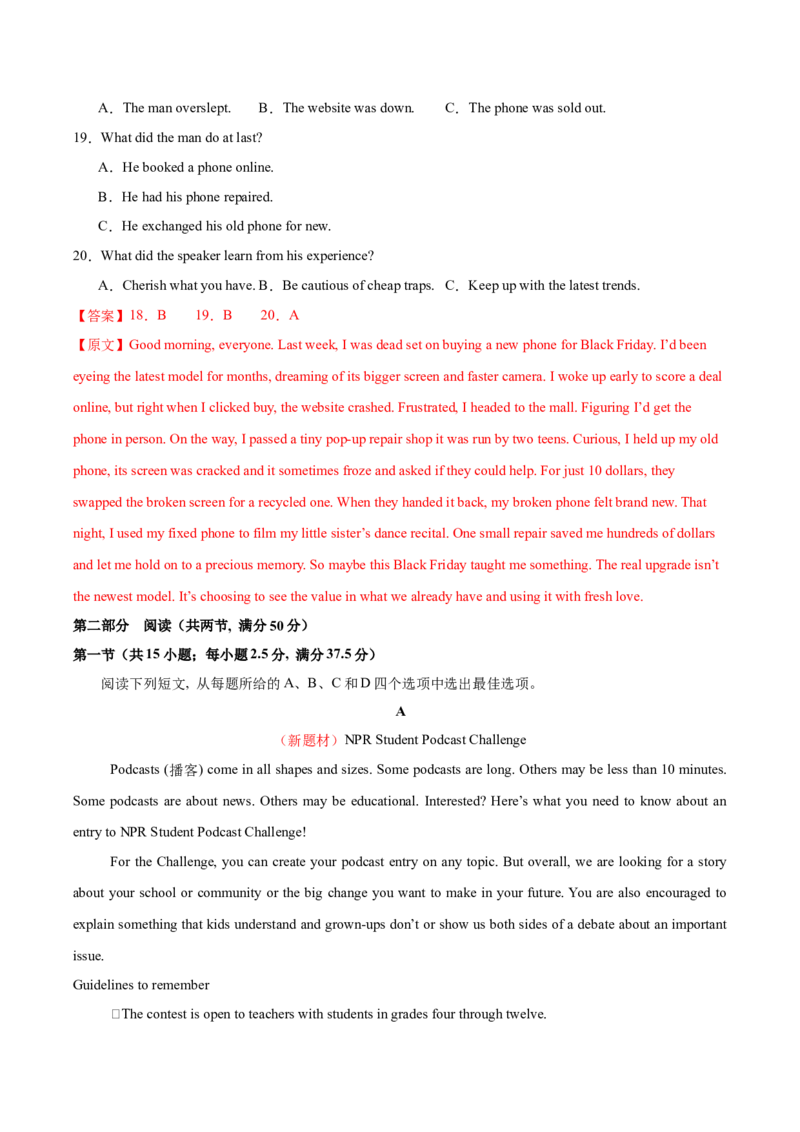
【原文】W: The bus is stuck again. We’ll be late for the club meeting.
M: Let’s take the shared bikes. It’s only eight minutes to the lab.
W: Good idea. I still have two free ride tickets.
2.How does the woman find the rule now?
A.Helpful.
B.Strict.
C.Unfair.
【答案】A
【原文】W: My parents set a 10 p.m. phone limit. I thought it was too strict.
M: Did it help?
W: Actually yes. I fell asleep faster and my scores went up.
3.What are the speakers mainly talking about?
A.Smart shopping.
B.Digital receipt.
C.Data analysis.
【答案】A
【原文】W: I tried an AI powered store yesterday. You scan the phone at the gate, grab what you need and just
walk out no queues.
M: The convenience is great, and the receipt appears in the app within seconds.
W: True, but I’m worried about my data. Every item is tied to my account.
4.Where does the conversation probably take place?
A.At an airport.
B.In a library.
C.In a gallery.
【答案】C
【原文】W: Heads up, the East Wing is closed for maintenance.
M: That’s the Impressionists, right?
W: Yeah, we’ll do sculpture and the photography rooms instead.
5.What are the speakers probably working on?
A.A poster contest.
B.A recycling drive.
C.A book fair.
【答案】B
【原文】M: We collected 18 kilos of paper last week, not bad.
W: Better, but the goal was 25. Let’s place a collection box outside the lecture hall.
M: Smart. I’ll make a poster that says one sheet helps.
第二节(共15 小题;每小题1.5 分,满分22.5 分)
听下面5 段对话或独白。每段对话或独白后有几个小题,从题中所给的A、B、C 三个选项中选出最佳
选项。听每段对话或独白前,你将有时间阅读各个小题,每小题5 秒钟;听完后,各小题将给出5 秒钟的
作答时间。每段对话或独白读两遍。
听第6 段材料,回答第6、7 题。
6.What was the trouble with the man?
A.He was tricked.
B.His car broke down.
C.He got caught in the rain.
7.What is the woman doing?
A.Offering advice.
B.Making complaints.
C.Expressing regret.
【答案】6.B 7.A
【原文】W: Hey Tom. You look a bit down. What’s up?
M: Oh, it’s just my car. It’s broken down again. It’s like a headache.
W: Really? Maybe it’s time to say goodbye to it. You know, when it rains it pours.
M: Yeah, you’re right. I guess I’ve had enough of its tricks. I’ll have to look for a new one.
W: Good luck with that. And remember a new broom sweeps clean.
听第7 段材料,回答第8 至10 题。
8.What does the woman think of the concert?
A.Moving.
B.Deafening.
C.Amazing.
9.What impressed the woman at the concert?
A.The stage setting.
B.The guitar performance.
C.The audience engagement.
10.What do we know about the man?
A.He missed the concert. B.He dislikes rock music.
C.He couldn’t afford the ticket.
【答案】8.C 9.B 10.A
【原文】M: Hi Lisa. I heard you went to a concert last night. How was it?
W: Oh. The band was really on fire like someone replaced their Red Bull with rocket fuel. Their performance was
out of this world.
M: That’s great. What kind of music did they play?
W: Mostly rock and roll. The lead singer had an incredible voice, and the guitar solos were just mind blowing.
M: I’m so jealous. I wish I could have gone too.
W: Well, they’re going to have another concert next month. You should definitely go. Though last time, the ticket
cost me an entire month’s salary.
M: I think it is worth it. Do you know where they’ll be playing?
W: At the city concert hall, but the tickets might be sold out quickly, so you’d better hurry.
听第8 段材料,回答第11 至13 题。
11.What is the club mainly about?
A.Playing action-movie heroes.
B.Climbing towering mountains.
C.Running and jumping over barriers.
12.What concern does the woman express?
A.Possible injuries.
B.Equipment shortage.
C.High membership fees.
13.How does the man ensure safety during training?
A.By reducing training hours.
B.By wearing safety equipment.
C.By seeking professional guidance.
【答案】11.C 12.A 13.C
【原文】W: Hey Tom. I heard you joined a crazy sports club. What on earth is it?
M: Hahaha. It’s a parkour club, you know running, jumping over barriers. It’s like being a real-life action hero.
W: Sounds cool, but what if you Superman dive straight into a brick wall and redecorate the sidewalk with your
face?
M: Well... sometimes it is dangerous, but with proper training, it’s not that bad. We have a professional coach. He
makes sure we do it safely, and the feeling of flying over those barriers is just amazing.
W: I can’t imagine. How often do you practice?
M: Twice a week, every Tuesday and Friday after school. It really helps me relax after a long day of study.
听第9 段材料,回答第14 至17 题。
14.What problem does the woman have?
A.The food has gone bad. B.The order is delayed.
C.The app doesn’t work.
15.What causes the problem?
A.The driver is lost.
B.The fridge is dead.
C.The lift is busy.
16.How does the man try to solve the problem?
A.Report the app.
B.Get the food downstairs.
C.Call the delivery rider.
17.What does the man mean at last?
A.Change to another store.
B.Tip extra for fast delivery.
C.Place an order earlier next time.
【答案】14.B 15.C 16.C 17.B
【原文】W: Where’s my burger? The app says delivered, but my stomach says liar. I’ve been staring at the door
like a dog waiting for a treat.
M: Chill. It’s probably stuck in the lift again, the lift thinks it’s a fridge. It is slower than a snail on a rainy day,
especially around dinner time.
W: That lift eats more food than I do. It should pay rent.
M: Remember last week when the pizza rode up and down like a VIP with a free ticket.
W: Yes, extra tour. Cold cheese, no tip!
M: I’ll call the rider. He is probably chatting with the guard about the weather.
W: Tell him I’m hungry enough to eat my own shoe, socks included.
M: He’s on his way. He says he took a selfie with the doorbell and smiled wide.
W: Great. My dinner’s now insta-famous, and I bet it is proud of itself.
M: And let’s be real. Next time we tip extra and beg for rocket delivery so they run up the stairs instead. No more
lift chaos.
听第10 段材料,回答第18 至20 题。
18.What happened on Black Friday?
A.The man overslept.
B.The website was down.
C.The phone was sold out.
19.What did the man do at last?
A.He booked a phone online.
B.He had his phone repaired.
C.He exchanged his old phone for new.
20.What did the speaker learn from his experience?
A.Cherish what you have. B.Be cautious of cheap traps. C.Keep up with the latest trends.
【答案】18.B 19.B 20.A
【原文】Good morning, everyone. Last week, I was dead set on buying a new phone for Black Friday. I’d been
eyeing the latest model for months, dreaming of its bigger screen and faster camera. I woke up early to score a deal
online, but right when I clicked buy, the website crashed. Frustrated, I headed to the mall. Figuring I’d get the
phone in person. On the way, I passed a tiny pop-up repair shop it was run by two teens. Curious, I held up my old
phone, its screen was cracked and it sometimes froze and asked if they could help. For just 10 dollars, they
swapped the broken screen for a recycled one. When they handed it back, my broken phone felt brand new. That
night, I used my fixed phone to film my little sister’s dance recital. One small repair saved me hundreds of dollars
and let me hold on to a precious memory. So maybe this Black Friday taught me something. The real upgrade isn’t
the newest model. It’s choosing to see the value in what we already have and using it with fresh love.
第二部分 阅读(共两节, 满分50 分)
第一节(共15 小题;每小题2.5 分, 满分37.5 分)
阅读下列短文, 从每题所给的A、B、C 和D 四个选项中选出最佳选项。
A
(新题材)NPR Student Podcast Challenge
Podcasts (播客) come in all shapes and sizes. Some podcasts are long. Others may be less than 10 minutes.
Some podcasts are about news. Others may be educational. Interested? Here’s what you need to know about an
entry to NPR Student Podcast Challenge!
For the Challenge, you can create your podcast entry on any topic. But overall, we are looking for a story
about your school or community or the big change you want to make in your future. You are also encouraged to
explain something that kids understand and grown-ups don’t or show us both sides of a debate about an important
issue.
Guidelines to remember
The contest is open to teachers with students in grades four through twelve.
Podcasts must be between three and eight minutes long.
Entries can include original music.
Students may work with a class or an extracurricular (课外的) group to make their podcasts.
The submission period runs from Jan. 6, 2026, to May 2, 2026.
Our judges will use the following criteria to narrow down and choose the winners in our three age groups —
4th grade, middle (5th grade through 8th grade) and high school (9th grade through 12th grade).
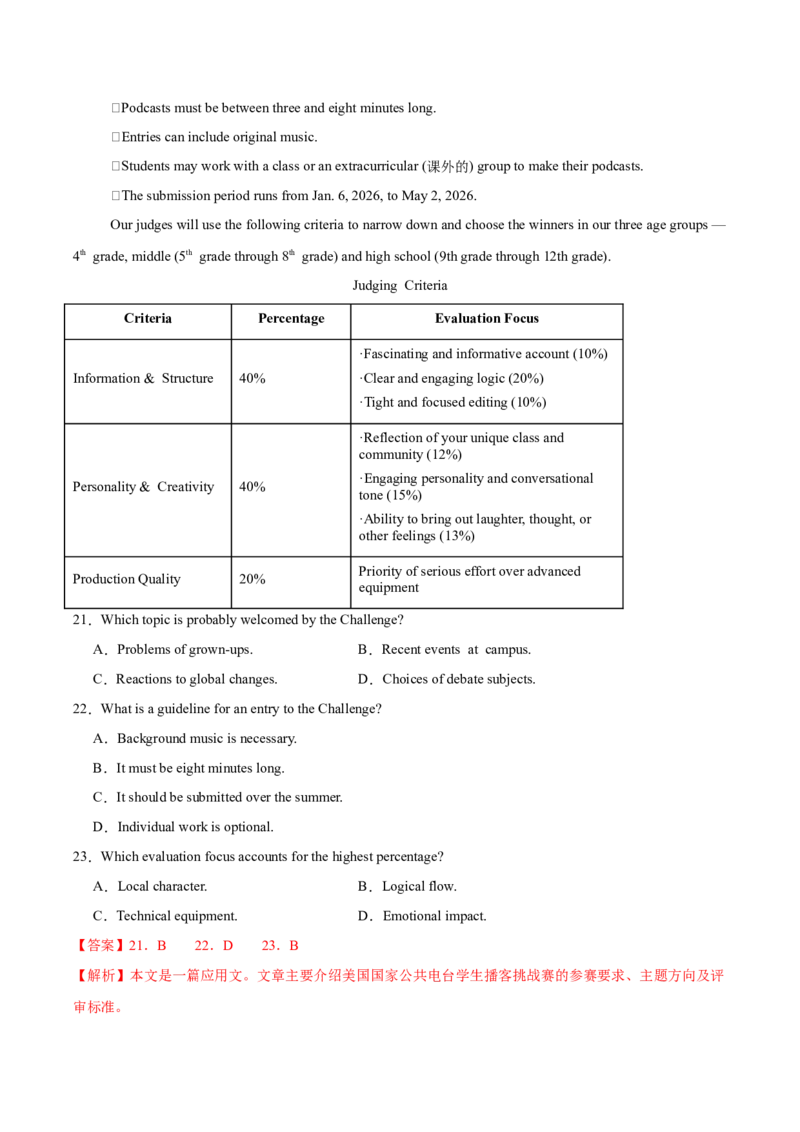
Judging Criteria
Criteria
Percentage
Evaluation Focus
Information & Structure
40%
·Fascinating and informative account (10%)
·Clear and engaging logic (20%)
·Tight and focused editing (10%)
Personality & Creativity
40%
·Reflection of your unique class and
community (12%)
·Engaging personality and conversational
tone (15%)
·Ability to bring out laughter, thought, or
other feelings (13%)
Production Quality
20%
Priority of serious effort over advanced
equipment
21.Which topic is probably welcomed by the Challenge?
A.Problems of grown-ups.
B.Recent events at campus.
C.Reactions to global changes.
D.Choices of debate subjects.
22.What is a guideline for an entry to the Challenge?
A.Background music is necessary.
B.It must be eight minutes long.
C.It should be submitted over the summer.
D.Individual work is optional.
23.Which evaluation focus accounts for the highest percentage?
A.Local character.
B.Logical flow.
C.Technical equipment.
D.Emotional impact.
【答案】21.B 22.D 23.B
【解析】本文是一篇应用文。文章主要介绍美国国家公共电台学生播客挑战赛的参赛要求、主题方向及评
审标准。
21.推理判断题。根据第二段中的“But overall, we are looking for a story about your school or community or
the big change you want to make in your future. (但总的来说,我们希望看到的是关于你的学校或社区,或是
你希望在未来做出的重大改变的故事。)”可知,和校园相关的主题会受到挑战赛的欢迎。
22.细节理解题。根据Guidelines to remember 部分中的“Students may work with a class or an extracurricular
(课外的) group to make their podcasts. (学生可以与班级或课外小组合作制作播客。)”可知,学生既可以组队
参赛,也可以选择独立制作,个人参赛是被允许的。
23.细节理解题。根据Judging Criteria 表格中的信息“Clear and engaging logic (20%) (清晰且引人入胜的逻
辑占比20%)”,对比其他评审维度占比:内容与信息10%、剪辑10%、班级社区特色12%、风格语调
15%、情感共鸣13%、制作质量20%(侧重努力程度而非设备),其中清晰且引人入胜的逻辑对应的占比
在单个细分项中最高。
B
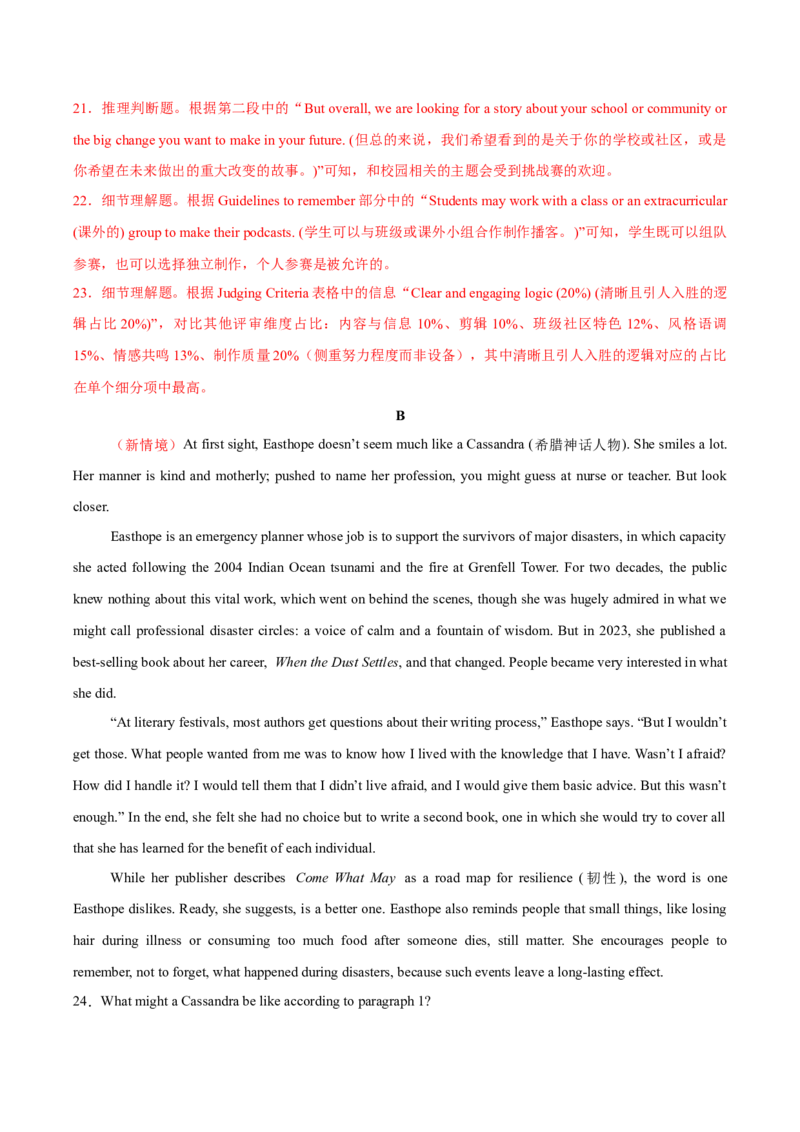
(新情境)At first sight, Easthope doesn’t seem much like a Cassandra (希腊神话人物). She smiles a lot.
Her manner is kind and motherly; pushed to name her profession, you might guess at nurse or teacher. But look
closer.
Easthope is an emergency planner whose job is to support the survivors of major disasters, in which capacity
she acted following the 2004 Indian Ocean tsunami and the fire at Grenfell Tower. For two decades, the public
knew nothing about this vital work, which went on behind the scenes, though she was hugely admired in what we
might call professional disaster circles: a voice of calm and a fountain of wisdom. But in 2023, she published a
best-selling book about her career, When the Dust Settles, and that changed. People became very interested in what
she did.
“At literary festivals, most authors get questions about their writing process,” Easthope says. “But I wouldn’t
get those. What people wanted from me was to know how I lived with the knowledge that I have. Wasn’t I afraid?
How did I handle it? I would tell them that I didn’t live afraid, and I would give them basic advice. But this wasn’t
enough.” In the end, she felt she had no choice but to write a second book, one in which she would try to cover all
that she has learned for the benefit of each individual.
While her publisher describes Come What May as a road map for resilience ( 韧性), the word is one
Easthope dislikes. Ready, she suggests, is a better one. Easthope also reminds people that small things, like losing
hair during illness or consuming too much food after someone dies, still matter. She encourages people to
remember, not to forget, what happened during disasters, because such events leave a long-lasting effect.
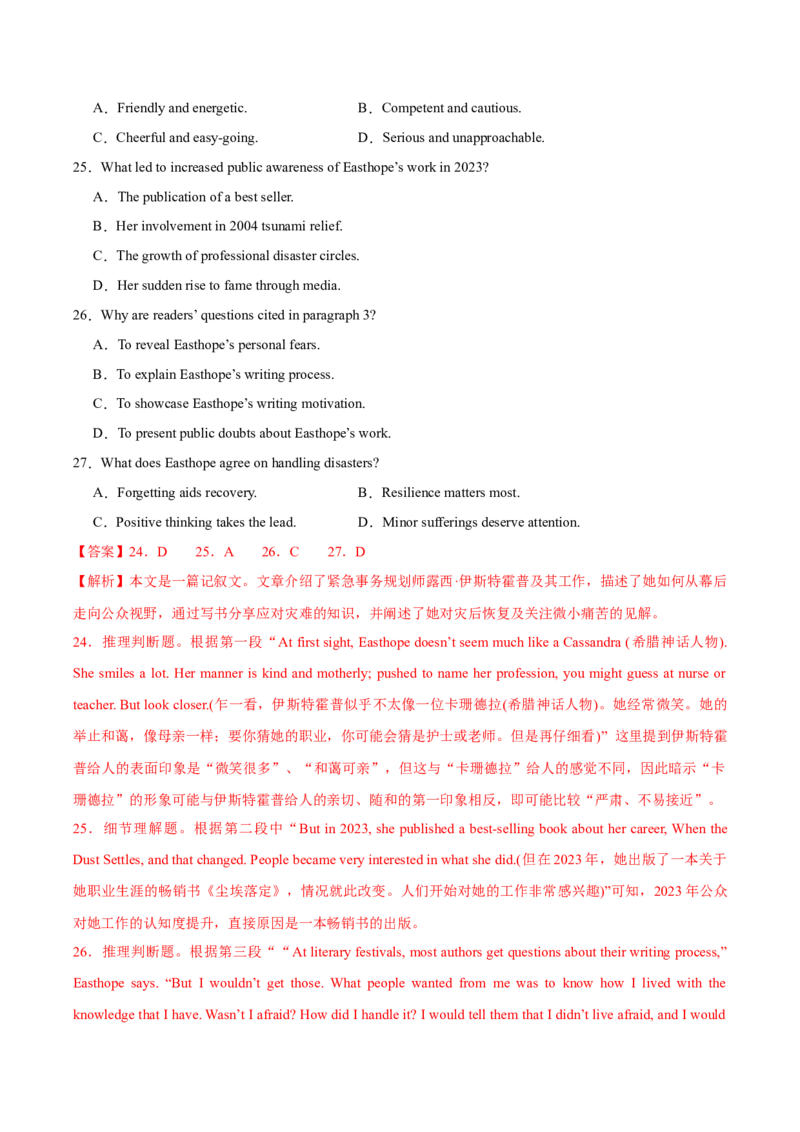
24.What might a Cassandra be like according to paragraph 1?
A.Friendly and energetic.
B.Competent and cautious.
C.Cheerful and easy-going.
D.Serious and unapproachable.
25.What led to increased public awareness of Easthope’s work in 2023?
A.The publication of a best seller.
B.Her involvement in 2004 tsunami relief.
C.The growth of professional disaster circles.
D.Her sudden rise to fame through media.
26.Why are readers’ questions cited in paragraph 3?
A.To reveal Easthope’s personal fears.
B.To explain Easthope’s writing process.
C.To showcase Easthope’s writing motivation.
D.To present public doubts about Easthope’s work.
27.What does Easthope agree on handling disasters?
A.Forgetting aids recovery.
B.Resilience matters most.
C.Positive thinking takes the lead.
D.Minor sufferings deserve attention.
【答案】24.D 25.A 26.C 27.D
【解析】本文是一篇记叙文。文章介绍了紧急事务规划师露西·伊斯特霍普及其工作,描述了她如何从幕后
走向公众视野,通过写书分享应对灾难的知识,并阐述了她对灾后恢复及关注微小痛苦的见解。
24.推理判断题。根据第一段“At first sight, Easthope doesn’t seem much like a Cassandra (希腊神话人物).
She smiles a lot. Her manner is kind and motherly; pushed to name her profession, you might guess at nurse or
teacher. But look closer.(乍一看,伊斯特霍普似乎不太像一位卡珊德拉(希腊神话人物)。她经常微笑。她的
举止和蔼,像母亲一样;要你猜她的职业,你可能会猜是护士或老师。但是再仔细看)” 这里提到伊斯特霍
普给人的表面印象是“微笑很多”、“和蔼可亲”,但这与“卡珊德拉”给人的感觉不同,因此暗示“卡
珊德拉”的形象可能与伊斯特霍普给人的亲切、随和的第一印象相反,即可能比较“严肃、不易接近”。
25.细节理解题。根据第二段中“But in 2023, she published a best-selling book about her career, When the
Dust Settles, and that changed. People became very interested in what she did.(但在2023 年,她出版了一本关于
她职业生涯的畅销书《尘埃落定》,情况就此改变。人们开始对她的工作非常感兴趣)”可知,2023 年公众
对她工作的认知度提升,直接原因是一本畅销书的出版。
26.推理判断题。根据第三段““At literary festivals, most authors get questions about their writing process,”
Easthope says. “But I wouldn’t get those. What people wanted from me was to know how I lived with the
knowledge that I have. Wasn’t I afraid? How did I handle it? I would tell them that I didn’t live afraid, and I would
give them basic advice. But this wasn’t enough.” In the end, she felt she had no choice but to write a second book,
one in which she would try to cover all that she has learned for the benefit of each individual.(“在文学节上,大多
数作者会被问到关于写作过程的问题,”伊斯特霍普说,“但我不会被问这些。人们想从我这里知道的
是,我如何带着我所掌握的知识生活。我不害怕吗?我是如何应对的?我会告诉他们我并非活在恐惧中,
并给他们一些基本的建议。但这还不够。”最终,她感到别无选择,只能再写一本书,一本试图总结她所
学到的一切、以惠及每个人的书)”可推知, 引用读者的提问,是为了说明公众的关注点与常规作者不同,
他们迫切想了解伊斯特霍普如何处理她所知的灾难知识,这种强烈的需求最终促使她产生了写作第二本书
的动机。
27.细节理解题。根据最后一段中“Easthope also reminds people that small things, like losing hair during
illness or consuming too much food after someone dies, still matter.(伊斯特霍普还提醒人们,小事也很重要,
比如生病时脱发,或有人在去世后暴饮暴食)”可知,伊斯特霍普认为,灾难中的微小痛苦或细节也值得关
注
C
(社会热点)For over two thousand years, scientists and philosophers have been puzzled by a simple
question: how can plants, without eyes, grow toward light? While animals use eyes to detect the direction of light,
plants seem to have no such organ. So how do they do it?
Early Greek thinkers believed plants could sense and react to their environment — almost like animals. But
Aristotle later argued that plants were passive, unable to perceive or respond to the world around them. His view
influenced Western thought for centuries.
However, a team of European researchers has now uncovered the secret. They focused on Arabidopsis, a
small weed commonly used in plant genetics. Using advanced imaging techniques such as confocal microscopy, the
scientists measured how light passes through the plant’s stem. Their results, published in a recent study, showed
that the air channels between the plant’s cells scatter the light, bending it significantly as it travels through the
tissue. Once researcher noted, “It’s like the plant has thousands of tiny lenses.” This scattering creates subtle
differences in light intensity across the stem, allowing the plant to pinpoint the light’s direction accurately.
In other words, the plant doesn’t need eyes. Instead, it uses its entire body to sense light. This clever
mechanism lets seedlings “see” where the light is coming from and adjust their growth toward it.
The findings not only solve an ancient mystery but also challenge Aristotle’s idea that plants are passive. It
turns out that plants have evolved a sophisticated way to perceive their environment — without the need for
complex organs like eyes. They are far more active and adaptive than we once thought.
This research opens new questions for plant biologists. How are these air channels formed? How exactly do
plants process the light information? Understanding these mechanisms could help us learn more about how plants
interact with the world — and perhaps even inspire new technologies in light sensing and robotics.
28.How does the author introduce the topic in the first paragraph?
A.By making a comparison.
B.By presenting a puzzle.
C.By stating a phenomenon.
D.By quoting a philosopher.
29.What is the key finding of the European researchers’ study?
A.Plant cells contain special proteins that respond to light.
B.Arabidopsis has a unique genetic structure for light sensing.
C.Light intensity varies significantly in different plant tissues.
D.Plants use air channels as tiny lenses to detect light direction.
30.What is the significance of the research findings?
A.They explain the formation of air channels.
B.They reveal plants’ passive growth pattern.
C.They challenge traditional views of plants.
D.They confirm Aristotle’s theory about plants.
31.What might be the future impact of this research?
A.Faster plant growth.
B.Better light sensors.
C.Stronger leaf formation.
D.More robot production.
【答案】28.B 29.D 30.C 31.B
【解析】这是一篇说明文。介绍了植物向光生长的古老谜题,阐述了研究意义与未来影响。
28.细节理解题。根据第一段首句“For over two thousand years, scientists and philosophers have been puzzled
by a simple question: how can plants, without eyes, grow toward light? (两千多年来,科学家和哲学家一直被一
个简单的问题困扰:没有眼睛的植物,是如何向光生长的?)”可知,文章开篇即提出一个困扰科学家和哲
学家两千多年的简单问题:“植物没有眼睛,如何向光生长? ”,以此引出主题。这种方式是通过呈现一个
长期存在的谜题来吸引读者兴趣。
29.细节理解题。根据第三段“the air channels between the plant’s cells scatter the light (植物细胞间的气隙会
散射光线)”以及““It’s like the plant has thousands of tiny lenses.” This scattering creates subtle differences in
light intensity across the stem, allowing the plant to pinpoint the light’s direction accurately. (“这就像植物有数千
个微型透镜。”这种散射让茎部的光强产生细微差异,使植物能精准定位光的方向)”可知,研究的核心发
现是植物利用细胞间气隙作为微型透镜来探测光的方向。
30 .细节理解题。根据倒数第二段“ The findings not only solve an ancient mystery but also challenge
Aristotle’s idea that plants are passive. (这些发现不仅解开了古老谜题,还挑战了亚里士多德认为植物是被动
的观点)”可知,该研究的意义在于挑战了关于植物的传统认知。故选C 项。
31.细节理解题。根据最后一段“Understanding these mechanisms could help us learn more about how plants
interact with the world — and perhaps even inspire new technologies in light sensing and robotics. (了解这些机制
能帮助我们更深入了解植物与世界的互动方式,甚至可能启发光传感和机器人领域的新技术)”可知,该研
究未来可能推动更好的光传感器的研发。
D
(社会热点)You wake up, brush your teeth, make coffee, check your phone, and drive to work. How much
of that morning routine did you actually think about? According to new research, the answer might surprise you:
almost none of it.
Scientists tracked 105 people for a week and discovered something remarkable about human behavior: about
9 out of 10 daily actions happen automatically, without conscious thought. The research, conducted by behavioral
scientists from universities in the United States, Australia, and the United Kingdom, used real-time tracking to
capture exactly how much of everyday life operates on “autopilot.” Participants received text prompts (提示) six
times daily over seven days, asking them to report what they were doing and how automatic vs intentional their
actions felt.
The results show that 88% of daily behaviors were “habitually done”, meaning people performed them with
little conscious control. Meanwhile, 65% of behaviors were “habitually triggered ( 引发)” by environmental cues
rather than intentional decision-making.
Lead researcher Amanda Rebar, a professor at the University of South Carolina, explains that“People like to
think of themselves as rational (理性的) decision makers, who think carefully about what to do before they do it.
However, much of our repeated behavior is generated automatically by habit.”
The findings can be helpful for anyone trying to change their behavior, from breaking bad habits to building
good ones. Since most behaviors already operate automatically, the key may be redirecting existing habit patterns
rather than fighting them entirely. The study suggests we should make better use of the brain’s natural tendency
toward automation. For positive changes like exercise or healthy eating, the goal becomes creating the right
environmental cues and contexts to trigger desired behaviors automatically.
The research team recommends that behavior change programs “include strategies to encourage habit
formation for new, wanted behaviors, while seeking to get rid of unwanted habits that may block change.”
32.How was the study conducted?
A.By interviewing 105 people once.
B.By analyzing past behavior records.
C.By tracking behaviors in universities.
D.By observing participants for a week.
33.What is the main characteristic of habits according to the study?
A.Thoughtful.
B.Intentional.
C.Unconscious.
D.Changeable.
34.What does Amanda Rebar imply?
A.People act after careful thinking.
B.Habits drive most repeated actions.
C.People are rational decision-makers.
D.Repeated behaviors need much thought.
35.What is the best title for the passage?
A.Habits: Intentional Daily Actions
B.Habits: Barriers to rational Decisions
C.How Most of Daily Life runs on “Auto-pilot” D.How to Track Daily Automatic Behaviors
【答案】32.D 33.C 34.B 35.C
【解析】这是一篇说明文。一项研究表明人类88%的日常行为是无意识的习惯性行为,该发现为人们培养
好习惯、改掉坏习惯提供了方法指导。
32.细节理解题。根据第二段“Scientists tracked 105 people for a week and discovered something remarkable
about human behavior: about 9 out of 10 daily actions happen automatically, without conscious thought. The
research, conducted by behavioral scientists from universities in the United States, Australia, and the United
Kingdom, used real-time tracking to capture exactly how much of everyday life operates on “autopilot.” (科学家对
105 人进行了为期一周的追踪调查,发现了一个关于人类行为的惊人现象:一个人每天约90%的行为都是
无意识下的自发举动。这项由美国、澳大利亚和英国多所大学的行为科学家开展的研究,借助实时追踪技
术,精准揭示了日常生活中有多大比例的行为是在“自动模式”下进行的。)”可知,该研究是通过对参与
者进行为期一周的观察开展的。
33.细节理解题。根据第二段“Scientists tracked 105 people for a week and discovered something remarkable
about human behavior: about 9 out of 10 daily actions happen automatically, without conscious thought. (科学家对
105 人进行了为期一周的追踪研究,发现了一个关于人类行为的惊人结论:人每天约 90% 的行为都是无
意识的自发举动。)”以及第三段“The results show that 88% of daily behaviors were “habitually done”, meaning
people performed them with little conscious control. (结果显示,88% 的日常行为是“习惯性行为”,这意味
着人们在进行这些行为时几乎没有意识控制。)”可知,习惯的主要特征是无意识性。
34.推理判断题。根据第四段 Lead researcher Amanda Rebar 的表述“People like to think of themselves as
rational (理性的) decision makers, who think carefully about what to do before they do it. However, much of our
repeated behavior is generated automatically by habit. (人们往往认为自己是理性的决策者,在做事前会仔细思
考。然而,我们的大部分重复行为都是由习惯自动引发的。)”可知,Amanda Rebar 暗示习惯驱动了大部分
重复行为。
35.主旨大意题。根据文章第一段“You wake up, brush your teeth, make coffee, check your phone, and drive
to work. How much of that morning routine did you actually think about? According to new research, the answer
might surprise you: almost none of it. (你起床、刷牙、煮咖啡、查看手机,然后开车去上班。在这套晨间流
程中,你真正用心思考过的环节有多少?一项新研究给出的答案或许会让你大吃一惊:几乎全程都没
有。)”以及下文可知,文章开篇以日常行为引入话题,随后介绍了一项关于人类日常行为“自动模式”的
研究,揭示大部分日常行为由习惯驱动、无需意识参与的特点,还提及该研究对改变行为的指导意义,所
以C 项How Most of Daily Life runs on “Auto-pilot” (大多数日常生活是如何在“自动模式”上运行的)符合
语境。故选C 项。
Body language refers to the nonverbal signals that people use to communicate. They can impact how people judge
you in the workplace. Becoming aware of the body language you use when communicating can help you ensure
your message is being delivered effectively. Here are some steps you can take to improve your body language.
第二节(共5 小题;每小题2. 5 分, 满分12. 5 分)
阅读下面短文, 从短文后的选项中选出可以填入空白处的最佳选项。选项中有两项为多余选项。
Body language refers to the nonverbal signals that people use to communicate.
36
They
can impact how people judge you in the workplace. Becoming aware of the body language you use when
communicating can help you ensure your message is being delivered effectively. Here are some steps you
can take to improve your body language.
Make eye contact
It’s important to make eye contact with the person you’re speaking to.
3 7
A simple strategy to
ensure you’re maintaining the right amount of eye contact is to look into the person’s eyes long enough to take note
of their eye color before looking away. This strategy ensures you make proper eye contact for a length of time that’s
natural and comfortable to both parties.
Relax your shoulders
One step you can take to improve your body language is to relax your shoulders, allowing them to drop to a
comfortable height. Shoulders that are too high can make you look nervous.
3 8
Be aware of where they
are currently sitting and allow them to drop to a natural position.
Nod from time to time
Nodding is a good way to show the person you’re speaking with that you’re listening and engaged in what
they’re saying.
3 9
Also, it makes them know that you agree with or are interested in the message they’re
sharing, which can help to increase their confidence.
Smile from the bottom of your heart
Smile when you’re first introduced to someone and throughout the conversation, when appropriate. Be aware
of your facial expressions throughout the course of the conversation, as an expressionless face can often appear as
an angry expression.
4 0
A.A sincere smile can brighten up the darkest day.
B.However, it’s important to avoid making too much.
C.Body language can be confusing in different cultures.
D.They include things like gestures, tone of voice, and eye contact.
E.It’s a good way to encourage them to continue what they’re saying.
F.Similarly, ones that are too low can give the impression that you’re sad.
G.Turning up the corners of your mouth slightly can give you a calm and pleasant look.
【答案】36.D 37.B 38.F 39.E 40.G
【解析】本文是一篇说明文。文章介绍了肢体语言的定义及改善肢体语言的四个具体方法。
36.上文“Body language refers to the nonverbal signals that people use to communicate. (肢体语言是指人们用
来交流的非语言信号)”介绍了肢体语言的定义,空处需具体说明非语言信号包含的内容。D 选项“它们包
括手势、语调、眼神交流等”,其中“They”指代上文的“nonverbal signals”,且列举的内容符合非语言信
号的范畴,承接上文逻辑。
37.上文“It’s important to make eye contact with the person you’re speaking to. (和与你说话的人进行眼神交
流很重要)”强调了眼神交流的重要性,空处需补充眼神交流的注意事项。B 选项“然而,重要的是要避免
过度眼神交流”,用“However”形成转折,既不否定前文的重要性,又指出合理的边界,符合“保持适当
眼神交流”的后续说明逻辑。
38.上文“Shoulders that are too high can make you look nervous. (肩膀太高会让你看起来很紧张)”说明了肩
膀过高的问题,空处需对应说明肩膀过低的情况。F 选项“同样,肩膀太低会给人留下你很难过的印象”,
“Similarly”表示与上文情况类似,进一步说明肩膀位置不合适(太低)带来的问题,符合语境。故选F。
39.上文“Nodding is a good way to show the person you’re speaking with that you’ re listening and engaged in
what they’re saying. (点头是向与你交谈的人表明你在倾听并参与他们所说内容的好方法)”介绍了点头的作
用,空处需进一步说明其效果。E 选项“这是鼓励他们继续说下去的好方法”承接上文,进一步阐述点头
带来的积极影响,即鼓励对方继续说,符合语境。
40.上文“Smile when you’re first introduced to someone and throughout the conversation, when appropriate. Be
aware of your facial expressions throughout the course of the conversation, as an expressionless face can often
appear as an angry expression. (当你第一次被介绍给某人时,以及在交谈过程中,在适当的时候微笑。在整
个交谈过程中注意你的面部表情,因为面无表情往往会让人觉得你在生气)”强调了微笑以及注意面部表情
的重要性,空处需给出具体建议及效果。G 选项“微微扬起嘴角可以让你看起来平静而愉快”具体说明了
如何通过面部表情来展现好的状态,符合语境。
第三部分 语言运用(共两节,满分30 分)
第一节(共15 小题,每小题1 分,满分15 分)
阅读下面短文, 从每题所给的A、B、C 和D 四个选项中选出可以填入空白处的最佳选项。
One day, my friend Jack and I wandered into a stationery store. Jack immediately grabbed one press-type
pen. Eager and
4 1
, he pressed the top repeatedly — until, with a pop, its tiny
4 2
inside flew
out, bouncing across the floor, and disappeared.
We
4 3
everywhere for the spring, but in vain. Jack’s face turned red with
4 4
as the
shopkeeper walked over. “I’m sorry, but you’ll have to pay for the
4 5
pen,” she said. Jack paid for it
reluctantly. Just then, his eyes landed on a shiny star-patterned pen in the showcase—one he’d been
4 6
for. “But I don’t have enough left,” he muttered sadly.
“Tim, would you like to lend me the money? I’ll pay you back next week, I promise” he begged. I nodded
and
4 7
the cost for him. But weeks passed, and Jack never mentioned it.
4 8
crept into my
mind: Was he avoiding it on purpose? Did he not value our friendship enough to
4 9
? I told my dad about
it. He patted my shoulder
5 0
and said, “Misunderstandings happen when we stay
5 1
.
Next time, just ask him
5 2
.” So at the store again, I took a deep breath and said, “Hey, remember that
star pen? Did you
5 3
to forget to pay me back?” “Oh my gosh I totally forgot! It
5 4
my
mind, I’m so sorry.” He apologized, quickly giving me back the money.
Overthinking only makes things worse. Open and honest
5 5
is the easiest way to clear up
misunderstandings and it can save friendship from unnecessary tension.
41.A.curious
B.committed
C.determined
D.awkward
42.A.showcase
B.spring
C.store
D.star
43.A.searched
B.wandered
C.paused
D.traveled
44.A.relaxation
B.delight
C.relief
D.embarrassment
45.A.deserted
B.priceless
C.broken
D.fashionable
46.A.applying
B.accounting
C.preparing
D.longing
47.A.reduced
B.weighed
C.covered
D.estimated
48.A.Guilt
B.Doubts
C.Warmth
D.Memories
49.A.keep his word B.break his promise
C.achieve his dream
D.boost his confidence
50.A.angrily
B.gently
C.reluctantly
D.absently
51.A.silent
B.calm
C.occupied
D.focused
52.A.distantly
B.impatiently
C.hesitantly
D.directly
53.A.manage
B.refuse
C.attempt
D.happen
54.A.struck
B.slipped
C.changed
D.crossed
55.A.explanation
B.apology
C.communication
D.complaint
【答案】41.A 42.B 43.A 44.D 45.C 46.D 47.C 48.B 49.A
50.B 51.A 52.D 53.D 54.B 55.C
【解析】本文是一篇记叙文。主要讲述了作者与朋友杰克在文具店发生的一次小意外的故事和从中得到的
启示。
41.考查形容词词义辨析。句意:杰克急切又好奇,反复按压笔的顶部——直到“砰”的一声,里面小小
的弹簧弹了出来,蹦到地上,消失不见了。A. curious 好奇的;B. committed 忠诚的;C. determined 坚定的;
D. awkward 尴尬的。根据本句中的“Eager”和“pressed the top repeatedly”可知,杰克拿到一支按压式笔,
很迫切地想要试一试并反复按压,表现出他对此感到好奇。
42.考查名词词义辨析。句意:杰克急切又好奇,反复按压笔的顶部——直到“砰”的一声,里面小小的
弹簧弹了出来,蹦到地上,消失不见了。A. showcase 陈列柜;B. spring 弹簧;C. store 商店;D. star 星星。
根据前文“Jack immediately grabbed one press-type pen.”及本句中的“he pressed the top repeatedly”,“with
a pop”可知,杰克反复按动这支按压式笔的顶端,致使内部有零件弹出并弹跳,结合常识可知,按压式笔
内部通常有弹簧装置。且后文“We everywhere for the spring, but in vain.”也提到他们到处找这个弹簧,也
印证了丢失的是弹簧。
43.考查动词词义辨析。句意:我们到处寻找那个弹簧,但没找到。A. searched 搜寻;B. wandered 闲逛;
C. paused 暂停;D. traveled 旅行。根据后文““I’m sorry, but you’ll have to pay for the ____5____ pen,” she
said.”可知,店主要求他们以购买的方式赔偿这支笔,应是他们到搜寻弹出的弹簧,但没有找到。search
everywhere for sth.为常用短语,意为“到处寻找某物”。
44.考查名词词义辨析。句意:当店主走过来时,杰克的脸因尴尬而变红了。A. relaxation 放松;B. delight
高兴;C. relief 宽慰;D. embarrassment 尴尬。根据前文“We everywhere for the spring, but in vain.”可知,此
处情境是杰克弄坏了店里的笔,且找不到丢失的零件,面对店主时理应感到难为情或尴尬。
45.考查形容词词义辨析。句意:“对不起,你得为这支坏了的笔付钱,”她说。A. deserted 被遗弃的;
B. priceless 无价的;C. broken 坏了的;D. fashionable 时尚的。根据前文“Eager and , he pressed the top
repeatedly — until, with a pop, its tiny inside flew out, bouncing across the floor, and disappeared. We everywhere
for the spring, but in vain.”可知,杰克反复按压导致笔内部零件弹出丢失,笔已无法正常使用,所以是“坏
了的”。店主让他赔偿的正是这支被他弄坏的笔。
46.考查动词词义辨析。句意:就在这时,他的目光落在了陈列柜里一支闪闪发光的星星图案笔上——那
是他一直以来渴望拥有的。A. applying 申请;B. accounting 解释;C. preparing 准备;D. longing 渴望。根据
后文““But I don’t have enough left,” he muttered sadly. “Tim, would you like to lend me the money? I’ll pay
you back next week, I promise” he begged.”杰克企求作者借钱给他的行为可知,他非常想要那支笔。long for
意为“渴望”。
47.考查动词词义辨析。句意:我点点头,为他支付了那笔费用。A. reduced 减少;B. weighed 称重;C.
covered 支付;D. estimated 估计。根据本句中的“I nodded”可知,作者同意借钱给杰克买笔,所以此处是
作者“支付”了买笔的钱。cover the cost 意为“支付费用”。
48.考查名词词义辨析。句意:怀疑开始在我脑海中滋生:他是故意回避吗?A. Guilt 内疚;B. Doubts 怀
疑;C. Warmth 温暖;D. Memories 回忆。根据后文两个问句“Was he avoiding it on purpose? Did he not
value our friendship enough to ?”可知,作者对杰克迟迟不还钱的行为产生了疑虑和猜测。
49.考查动词短语辨析。句意:他是不是不够重视我们的友谊,以至于不信守承诺?A. keep his word 信守
诺言;B. break his promise 违背承诺;C. achieve his dream 实现梦想;D. boost his confidence 增强信心。根
据前文““Tim, would you like to lend me the money? I’ll pay you back next week, I promise” he begged.”可知,
杰克曾承诺会还买笔的钱,但几周过去却只字未提,作者因此应是怀疑他是否会“信守承诺”。
50.考查副词词义辨析。句意:他轻轻拍了拍我的肩膀说:“当我们保持沉默时,误会就会产生。” A.
angrily 生气地;B. gently 轻柔地;C. reluctantly 不情愿地;D. absently 心不在焉地。此处是父亲在安慰作者
并给出建议,且父亲说的话是理智平和的劝导,父亲的动作应是温和的。
51.考查形容词词义辨析。句意:他轻轻拍了拍我的肩膀说:“当我们保持沉默时,误会就会产生。”A.
silent 沉默的;B. calm 平静的;C. occupied 忙碌的;D. focused 专注的。根据前文作者的心中的疑问“crept
into my mind: Was he avoiding it on purpose? Did he not value our friendship enough to ?”以及后文“Next time,
just ask him .”父亲鼓励作者开口主动沟通可知,此处父亲的意思是的如果保持沉默,就会发生误会。
52.考查副词词义辨析。句意:下次,直接问他。A. distantly 疏远地;B. impatiently 不耐烦地;C.
hesitantly 犹豫地;D. directly 直接地。父亲建议化解误会的方式是不要沉默猜疑,而是“直接”开口询问。
且根据后文“So at the store again, I took a deep breath and said, “Hey, remember that star pen? Did you to forget
to pay me back?””可知,作者也确实采取了直接询问的方式。
53.考查动词词义辨析。句意:你是不是碰巧忘了还我钱?A. manage 设法;B. refuse 拒绝;C. attempt 试
图;D. happen 碰巧。作者按照父亲的建议,采取了一种相对委婉直接的问法。“Did you happen to...?”是一
种礼貌的询问方式,意为“你是不是碰巧……?”,给朋友留有余地。故选D 项。
54.考查动词词义辨析。句意:“我完全没记着这事儿,真对不起。”A. struck 打击;B. slipped 滑走,溜
走;C. changed 改变;D. crossed 穿过。根据前文“Oh my gosh I totally forgot!”可知,杰克把这件事忘记了,
且slip one’s mind 是固定搭配,意为“忘了,忘记”。
55.考查名词词义辨析。句意:坦诚开放的交流是消除误会最简单的方法,它能让友谊免于不必要的紧张。
A. explanation 解释;B. apology 道歉;C. communication 交流;D. complaint 抱怨。全文核心是作者通过主
动与朋友“沟通”化解了因借钱未还引起的误会。文章最后一句点明主旨,强调坦诚沟通的重要性。
第二节(共10 小题;每小题1.5 分 ,满分15 分)
阅读下面短文,在空白处填入1 个适当的单词或括号内单词的正确形式。
(新题材)A 50-minute drive northwest of downtown, Beijing, a village pops up. It
5 6
(house) a
shadow puppetry troupe (皮影戏剧团) and Beijing Long zaitian Shadow Puppet Theater.
Shadow puppetry is seen
5 7
the prequel ( 先行篇) to film and animation in China. Besides
performances
5 8
(create) by light and shadow, performers must master a
5 9
(vary) skill set as the
plays combine painting, carving, opera and literature. But due to low revenue and a small market, young people are
unwilling
6 0
(learn) shadow puppetry.
6 1
, this particular troupe stands out from the crowd. The average performer age is only 25.
Moreover, of the 300 performers
6 2
has trained over the years, many are under 1.4 m in
6 3
(high).
In 2021, the team created Winter Olympics-themed shadow puppets. The troupe also staged different plays
6 4
(introduce) ice and snow sports through fairy tales.
“
6 5
(fortunate), we have these people. They have been devoted to the inheritance of shadow
puppetry for over a decade,”said Wang Xi, inheritor of Beijing Western School Shadow Puppetry.=
【答案】56.houses 57.as 58.created 59.various/varied 60.to learn 61.However
62.it 63.height 64.introducing 65.Fortunately
【解析】本文是一篇说明文。讲述了中国民间古老的传统艺术——皮影戏。
56.考查时态。句意:这里有皮影戏剧团和北京龙在天皮影戏剧院。分析句子成分可知,空格处是本句的
谓语动词;house,实义动词,意为“给……提供住所”;又根据前句可知,此句用一般现在时,故填
houses。
57.考查介词。句意:皮影戏在中国被视为电影和动画的前传。see...as...意为“把……看作”,是固定搭
配。
58.考查非谓语动词。句意:除了由光影创造的表演,演员必须掌握各种技能,因为戏剧结合了绘画、雕
刻、歌剧和文学。分析句子成分可知,空格处是作名词performances 的后置定语,且与动词create 成被动
关系。
59.考查形容词。句意:除了由光影创造的表演,演员必须掌握各种技能,因为戏剧结合了绘画、雕刻、
歌剧和文学。分析句子可知,空格处是用来形容名词skill;vary 动词,意为“变化”,various/varied 为形容
词,意为“各种各样的”。
60.考查非谓语动词。句意:但由于皮影戏收入低,市场小,年轻人不愿意学习皮影戏。be unwilling to do
sth.意为“不愿意做某事”。
61.考查副词。句意:然而,这个特殊的剧团在人群中脱颖而出。演员的平均年龄只有25 岁。根据句意可
知,上文讲年轻人不愿意学习皮影戏。后文讲这个剧团的平均年龄是25 岁,前后句意思相反,且用副词连
接。
62.考查代词。句意:此外,在多年来训练的300 名表演者中,许多人的身高不到1.4 米。分析句子成分
可知,空格处引导的句子是定语从句,修饰先行词performers,空格处是定语从句的主语,指代上文中的
troupe。
63.考查名词。句意:此外,在多年来训练的300 名表演者中,许多人的身高不到1.4 米。分析句子可
知,介词后接名词;height,名词,意为“高度”。
64.考查非谓语动词。句意:剧团还上演了不同的戏剧,通过童话故事介绍冰雪运动。分析句子可知,空
格处是非谓语作后置定语修饰名词plays 且呈主动关系。
65.考查副词。句意:幸运地是,我们有这些人。根据句意可知,空格处用副词。
第四部分 写作(共两节, 满分40 分)
第一节(满分15 分)
近日,一些学校开始尝试使用AI 辅助心理咨询。你校英文报就此现象开展征文活动,请你写一篇短
文投稿,内容包括:
1. 你的观点;
2. 你的理由。
注意:
1. 写作词数应为80 左右;
2. 请按如下格式在答题纸的相应位置作答。
My Views on AI-Driven Mental Health Support at Campus
____________________________________________________________________________________________
____________________________________________________________________________________________
【参考范文】
My Views on AI-Driven Mental Health Support at Campus
I firmly support AI-driven mental health support in schools. It offers unique advantages that complement
traditional counseling.
Firstly, AI provides 24/7 access, allowing students to seek help anonymously anytime, especially when they
feel hesitant to talk to humans. Secondly, AI analyzes data objectively to spot emotional trends early, helping
prevent crises. Moreover, it reduces counselors’ workload, enabling them to focus on severe cases.
With proper guidance, AI can be a valuable tool for students’ mental well-being.
【写作解析】本篇书面表达属于应用文。要求考生以“ My Views on AI-Driven Mental Health Support at
Campus”为题目写一篇短文投稿。
1.词汇积累
宝贵的:valuable→precious
专注:focus on→concentrate on
减少:reduce→cut down
提供:offer→provide
2.句式拓展
合并句子
原句:I firmly support AI-driven mental health support in schools. It offers unique advantages that complement
traditional counseling.
拓展句:I firmly support AI-driven mental health support in schools because it offers unique advantages that
complement traditional counseling.
【高分句型1】It offers unique advantages that complement traditional counseling.(运用了that 引导定语从
句)
【高分句型2】Firstly, AI provides 24/7 access, allowing students to seek help anonymously anytime, especially
when they feel hesitant to talk to humans.(运用了when 引导时间状语从句)
第二节(满分25 分)
阅读下面材料,根据其内容和所给段落开头语续写两段,使之构成一篇完整的短文。
With three little babies, I never took a break, completely ignoring any self-care. When I was too tired to
make myself dinner, I’d just eat the kids’ leftover cereal ( 麦片粥). I thought this was a great plan to lose some
weight and called it the “Cereal for Diet.” Back then,I knew nothing about nutrition. Of course, the Cereal for Diet
failed, as did all my other attempts.
One day, after cleaning up all the mess my kids had made, I went out for a walk. I passed a gym. I looked
away.Healthy people went there, but this was not me. While turning away,I saw an ad for a six-month fitness
challenge. I continued my fast walk in the opposite direction, but that sign just stayed on my mind.
I still remember what finally motivated me to sign up for the challenge. It was a ten-minute period in which
my son threw his spaghetti plate straight up, sending noodles and sauce flying everywhere. As soon as my husband
got home,I said, “You’re in charge.”
I made a beeline for the gym, marched straight in and said, “Fix me.” And I was assigned a young and fit
trainer, Emily. She asked what my goals were for the six-month challenge. At that moment, I was speechless.
Noticing my embarrassment, Emily just handed me the heaviest weights I had in my life and said, “Okay, so in six
months you will compete in a body-building show.” I tried explaining, “No, I don’t want to do a show. That sounds
scary.” She ignored my fear, and we jumped into strict workouts and nutrition planning.
Over the next six months, Emily forced me to focus on myself — my wants and my needs. I learned to see
food as strength and sweat as progress. I learned how to fuel my body instead of starving it, balancing proteins,
carbs, and fats. Emily pushed me past my limits, correcting my form, timing my breaks, and cheering me on when I
wanted to quit. I improved every day in the gym.
注意:1. 续写词数应为150 左右;
2. 请按如下格式在答题卡的相应位置作答。
One day, Emily handed me an application form.
____________________________________________________________________________________________
____________________________________________________________________________________________
Soon, I jumped into weeks of preparation.
____________________________________________________________________________________________
____________________________________________________________________________________________
【参考范文】
One day, Emily handed me an application form. “You’re ready,” she said with a confident smile. It was for a
local body-building show, the very thing I’d once feared. My heart raced as I looked at the form, but then I thought
of all the progress I'd made. I took a deep breath and filled it out, determined to face my fear. I knew this was a
chance to prove to myself that I could achieve something I never thought possible.
Soon, I jumped into weeks of preparation. Every day, I spent hours in the gym, following Emily’s strict
workout plan. I also paid close attention to my diet, making sure I got the right nutrients. As the show day drew
near, I felt a mix of excitement and nervousness. But with Emily’s constant encouragement and support, I felt more
and more confident. Finally, the big day arrived, and I stepped onto the stage, ready to show the world what I’d
accomplished.
【写作解析】本文以人物为线索展开,主要讲述了作者作为三个孩子的妈妈,一直忽视自我照顾,减肥尝
试均失败。一次看到健身房广告后,在孩子调皮的刺激下决定报名参加健身挑战,在教练艾米丽的严格训
练和营养规划下,作者逐渐进步并克服恐惧,并报名参加健美比赛,最终迎来比赛日的故事。
1.段落续写
①由第一段首句内容“一天,艾米丽递给我一张申请表。”可知,第一段可描写作者面对申请表时的心理
活动,最终决定报名参加比赛。
②由第二段首句内容“很快,我投入到了数周的准备工作中。”可知,第二段可描写作者为比赛所做的准
备,以及比赛当天作者的表现。
2.续写线索:收到申请表——犹豫——决定报名——准备比赛——比赛当天——展示成果
3.词汇激活
行为类
①深呼吸:take a deep breath/breathe deeply
②关注:pay attention to/focus on/concentrate on
③确保:make sure/ensure/guarantee
情绪类
①紧张:nervousness/anxiety
②自信的:confident/self-assured
【高分句型1】My heart raced as I looked at the form, but then I thought of all the progress I’d made.(运用了as
引导的时间状语从句,that 或which 引导的限定性定语从句,that 或which 被省略)
【高分句型2】Finally, the big day arrived, and I stepped onto the stage, ready to show the world what I’d
accomplished.(运用了what 引导的宾语从句)