专题04 完形填空---议论文
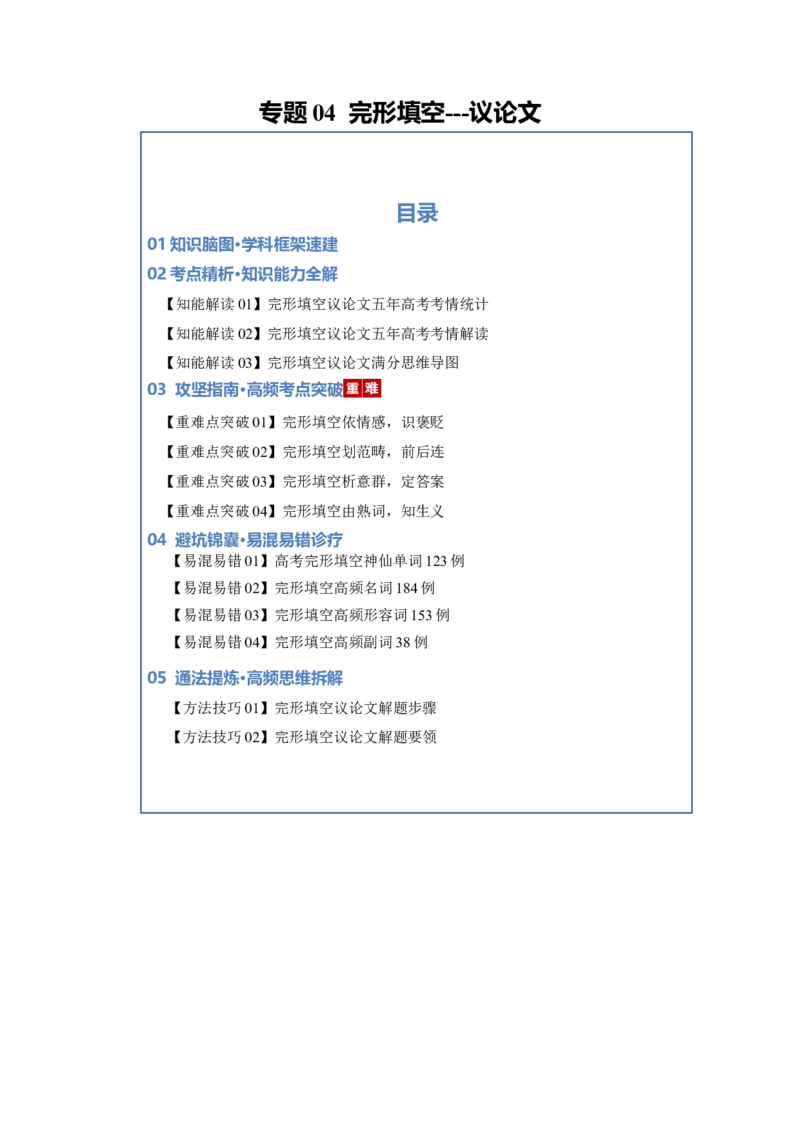
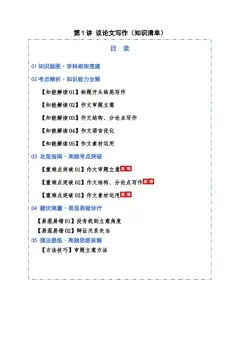
目录
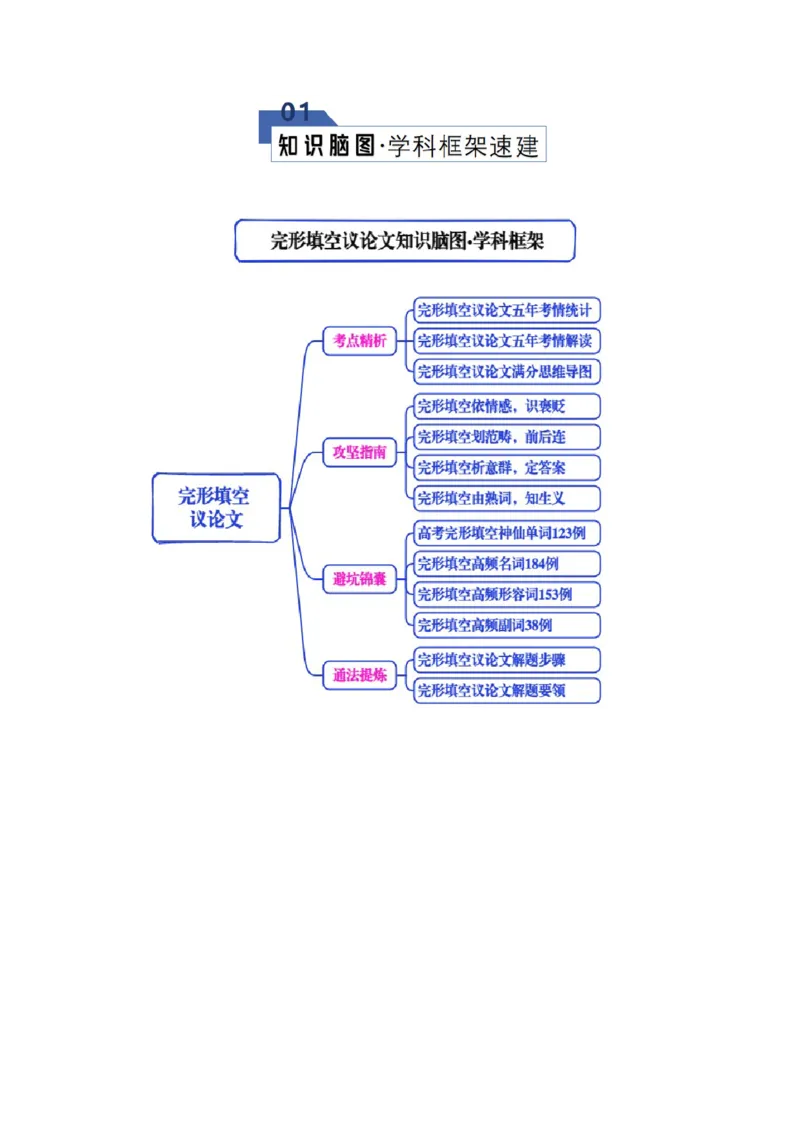
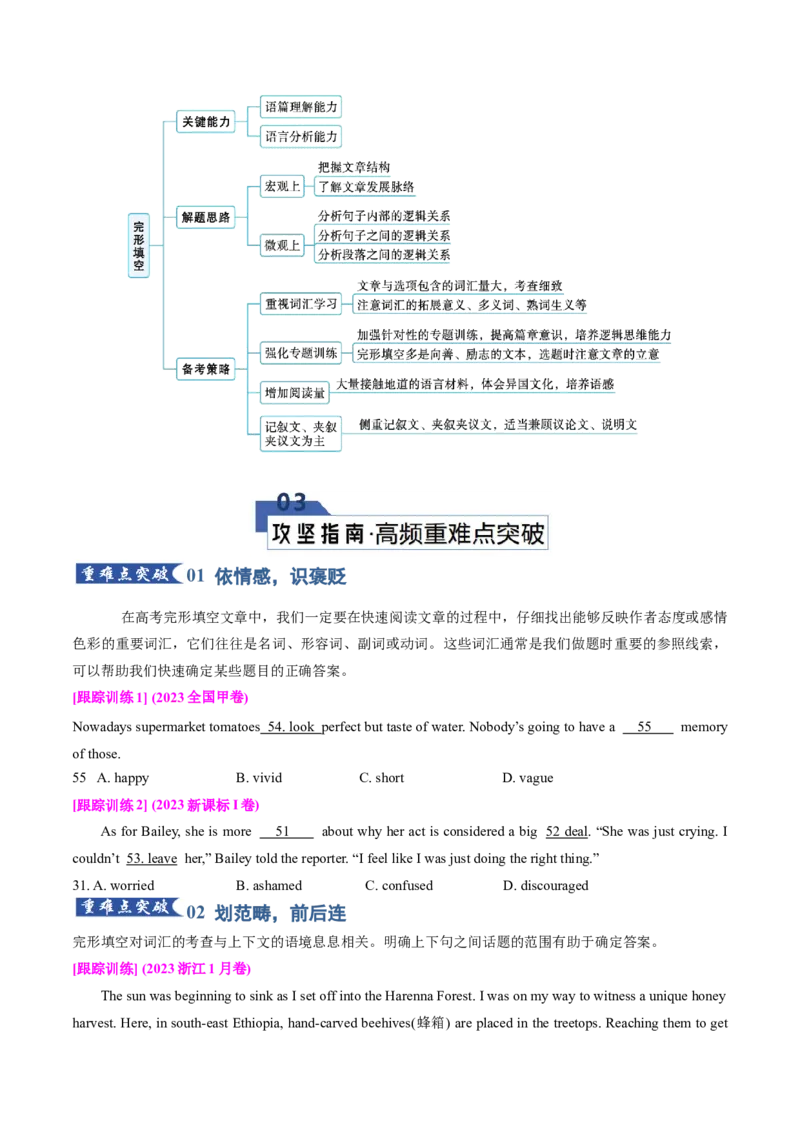
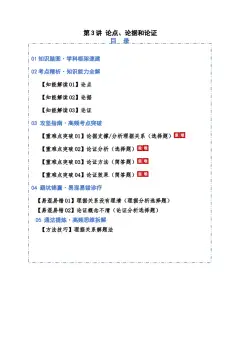
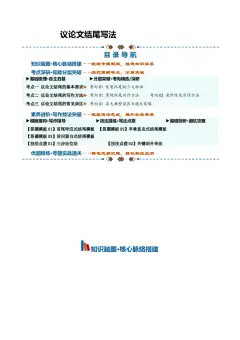
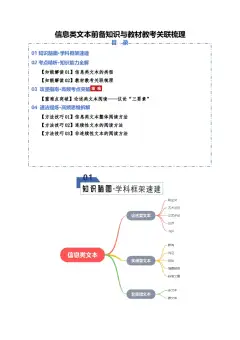
01 知识脑图·学科框架速建
02 考点精析·知识能力全解
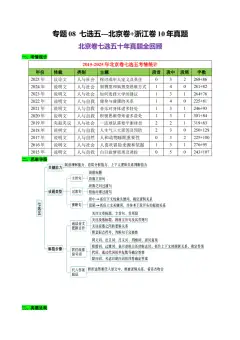
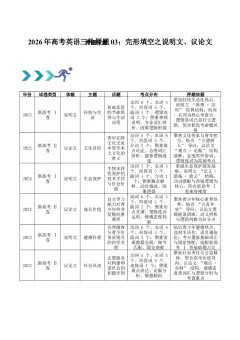
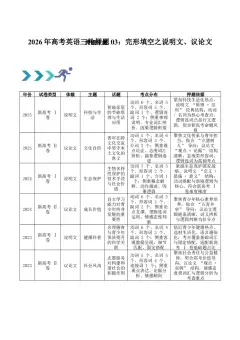
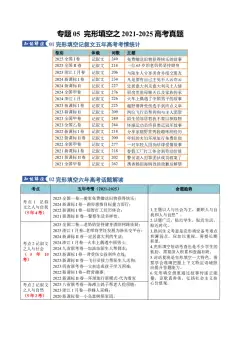
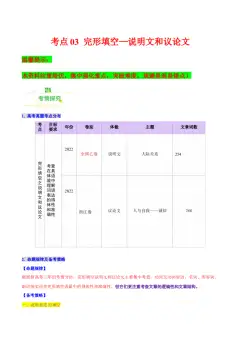
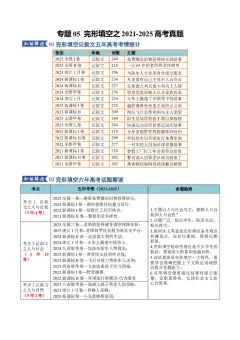
【知能解读01】完形填空议论文五年高考考情统计
【知能解读02】完形填空议论文五年高考考情解读
【知能解读03】完形填空议论文满分思维导图
03 攻坚指南·高频考点突破
【重难点突破01】完形填空依情感,识褒贬
【重难点突破02】完形填空划范畴,前后连
【重难点突破03】完形填空析意群,定答案
【重难点突破04】完形填空由熟词,知生义
04 避坑锦囊·易混易错诊疗
【易混易错01】高考完形填空神仙单词123 例
【易混易错02】完形填空高频名词184 例
【易混易错03】完形填空高频形容词153 例
【易混易错04】完形填空高频副词38 例
05 通法提炼·高频思维拆解
【方法技巧01】完形填空议论文解题步骤
【方法技巧02】完形填空议论文解题要领
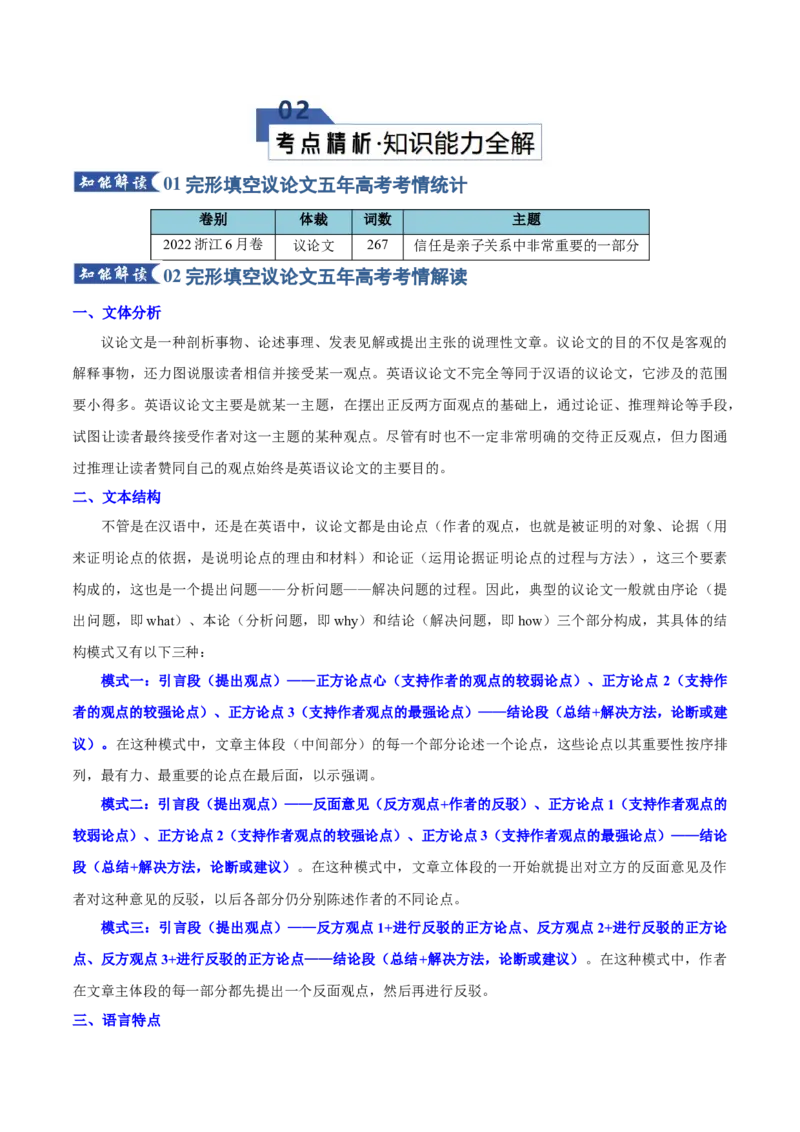
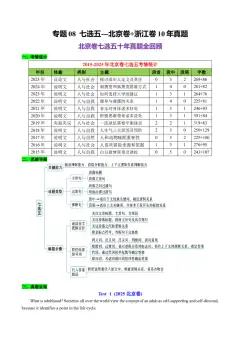
01 完形填空议论文五年高考考情统计
卷别
体裁
词数
主题
2022 浙江6 月卷
议论文
267
信任是亲子关系中非常重要的一部分
02 完形填空议论文五年高考考情解读
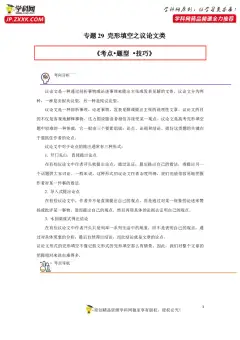
一、文体分析
议论文是一种剖析事物、论述事理、发表见解或提出主张的说理性文章。议论文的目的不仅是客观的
解释事物,还力图说服读者相信并接受某一观点。英语议论文不完全等同于汉语的议论文,它涉及的范围
要小得多。英语议论文主要是就某一主题,在摆出正反两方面观点的基础上,通过论证、推理辩论等手段,
试图让读者最终接受作者对这一主题的某种观点。尽管有时也不一定非常明确的交待正反观点,但力图通
过推理让读者赞同自己的观点始终是英语议论文的主要目的。
二、文本结构
不管是在汉语中,还是在英语中,议论文都是由论点(作者的观点,也就是被证明的对象、论据(用
来证明论点的依据,是说明论点的理由和材料)和论证(运用论据证明论点的过程与方法),这三个要素
构成的,这也是一个提出问题——分析问题——解决问题的过程。因此,典型的议论文一般就由序论(提
出问题,即what)、本论(分析问题,即why)和结论(解决问题,即how)三个部分构成,其具体的结
构模式又有以下三种:
模式一:引言段(提出观点)——正方论点心(支持作者的观点的较弱论点)、正方论点2(支持作
者的观点的较强论点)、正方论点3(支持作者观点的最强论点)——结论段(总结+解决方法,论断或建
议)。在这种模式中,文章主体段(中间部分)的每一个部分论述一个论点,这些论点以其重要性按序排
列,最有力、最重要的论点在最后面,以示强调。
模式二:引言段(提出观点)——反面意见(反方观点+作者的反驳)、正方论点1(支持作者观点的
较弱论点)、正方论点2(支持作者观点的较强论点)、正方论点3(支持作者观点的最强论点)——结论
段(总结+解决方法,论断或建议)。在这种模式中,文章立体段的一开始就提出对立方的反面意见及作
者对这种意见的反驳,以后各部分仍分别陈述作者的不同论点。
模式三:引言段(提出观点)——反方观点1+进行反驳的正方论点、反方观点2+进行反驳的正方论
点、反方观点3+进行反驳的正方论点——结论段(总结+解决方法,论断或建议)。在这种模式中,作者
在文章主体段的每一部分都先提出一个反面观点,然后再进行反驳。
三、语言特点
1.较多使用表达委婉语气的词语和句子与英语说明文相比,英语议论文不仅需要说明自己的观点,而
且还要让读者接受自己的观点,因此,在词语表达上除了客观之外,还必须注意委婉。在英语中,常用虚
拟语气,让步状语从句和情态动词can,could,may,might,would,should 等。
2.使用有辩论、推理等含义的连接词和过渡词等词语结构   英语议论文讲究辩论推理的条理性和
逻辑性,因此,往往较多地使用这类性质的过渡词和连接词,常用的包括:since 既然,now that 既然,
therefore 因而,consequently 因此,accordingly 因此,hence 因而,in that case 在那种情况下,because 因为,
so 所以。
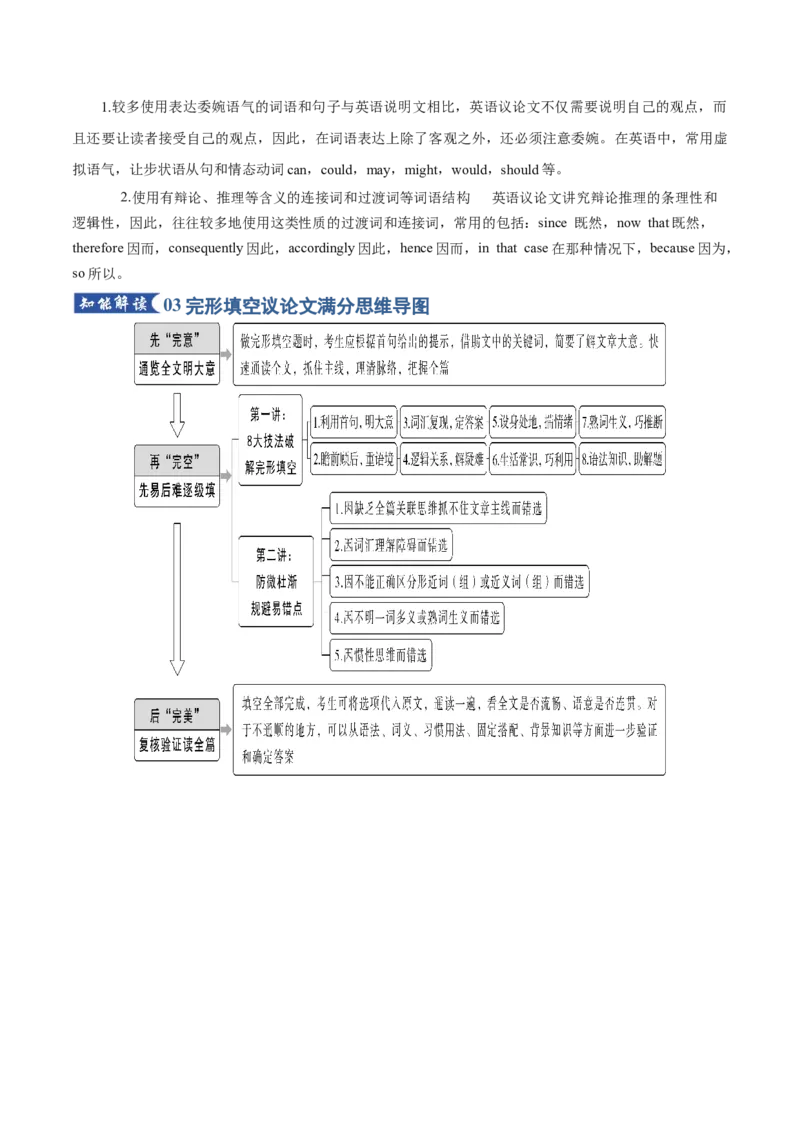
03 完形填空议论文满分思维导图
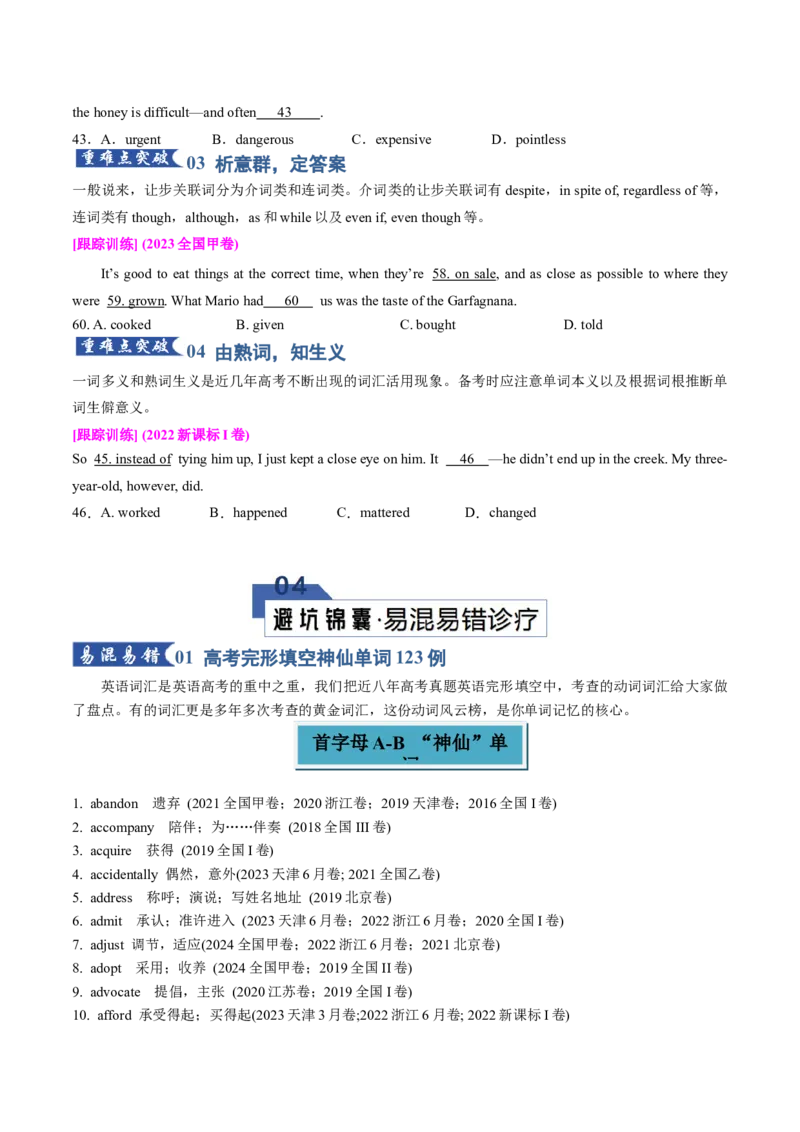
01 依情感,识褒贬
在高考完形填空文章中,我们一定要在快速阅读文章的过程中,仔细找出能够反映作者态度或感情
色彩的重要词汇,它们往往是名词、形容词、副词或动词。这些词汇通常是我们做题时重要的参照线索,
可以帮助我们快速确定某些题目的正确答案。
[跟踪训练1] (2023 全国甲卷)
Nowadays supermarket tomatoes 54. look perfect but taste of water. Nobody’s going to have a   55    memory
of those.
55 A. happy
B. vivid           C. short              D. vague
[跟踪训练2] (2023 新课标I 卷)
As for Bailey, she is more   51    about why her act is considered a big 52 deal. “She was just crying. I
couldn’t 53. leave her,” Bailey told the reporter. “I feel like I was just doing the right thing.”
31. A. worried
B. ashamed         C. confused          D. discouraged
02 划范畴,前后连
完形填空对词汇的考查与上下文的语境息息相关。明确上下句之间话题的范围有助于确定答案。
[跟踪训练] (2023 浙江1 月卷)
The sun was beginning to sink as I set off into the Harenna Forest. I was on my way to witness a unique honey
harvest. Here, in south-east Ethiopia, hand-carved beehives(蜂箱) are placed in the treetops. Reaching them to get
the honey is difficult—and often   43    .
43.A.urgent
B.dangerous
C.expensive
D.pointless
03 析意群,定答案
一般说来,让步关联词分为介词类和连词类。介词类的让步关联词有despite,in spite of, regardless of 等,
连词类有though,although,as 和while 以及even if, even though 等。
[跟踪训练] (2023 全国甲卷)
It’s good to eat things at the correct time, when they’re 58. on sale, and as close as possible to where they
were 59. grown. What Mario had   60   us was the taste of the Garfagnana.
60. A. cooked
B. given
C. bought
D. told
04 由熟词,知生义
一词多义和熟词生义是近几年高考不断出现的词汇活用现象。备考时应注意单词本义以及根据词根推断单
词生僻意义。
[跟踪训练] (2022 新课标I 卷)
So 45. instead of tying him up, I just kept a close eye on him. It   46  —he didn’t end up in the creek. My three-
year-old, however, did.
46.A. worked       B.happened       C.mattered
   D.changed
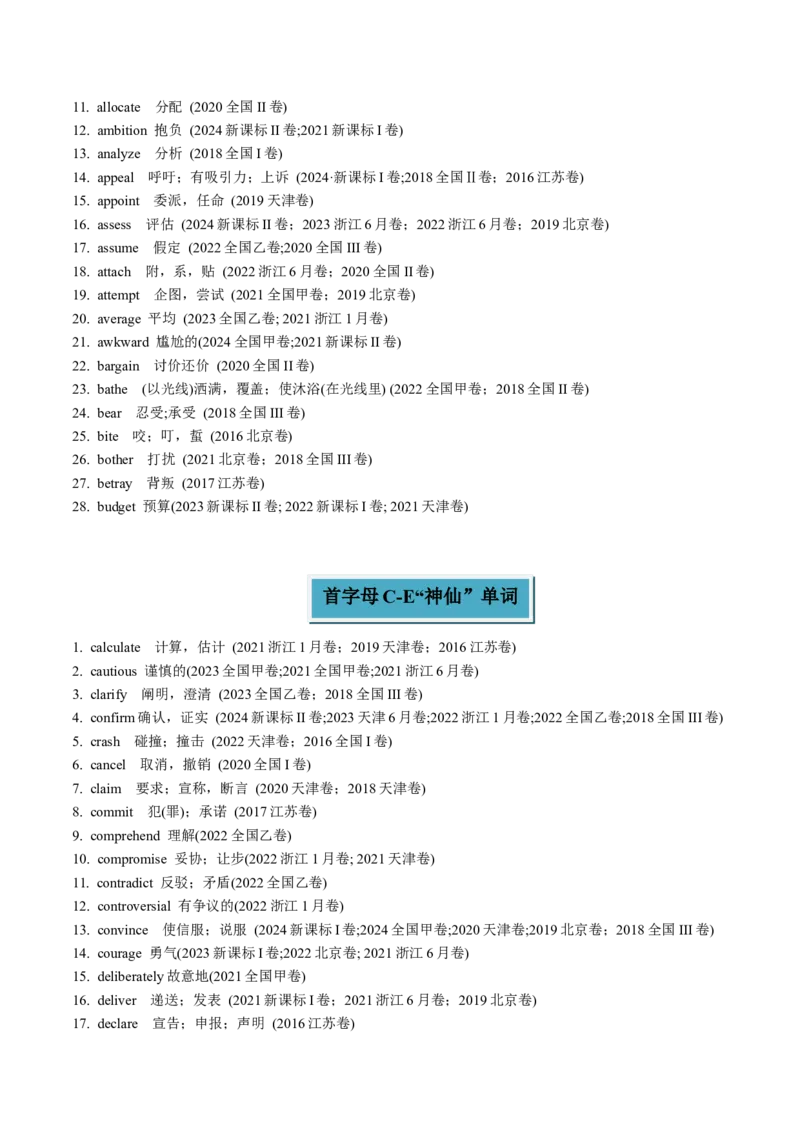
01 高考完形填空神仙单词123 例
英语词汇是英语高考的重中之重,我们把近八年高考真题英语完形填空中,考查的动词词汇给大家做
了盘点。有的词汇更是多年多次考查的黄金词汇,这份动词风云榜,是你单词记忆的核心。
1. abandon  遗弃 (2021 全国甲卷;2020 浙江卷;2019 天津卷;2016 全国I 卷)
2. accompany  陪伴;为……伴奏 (2018 全国III 卷)
3. acquire  获得 (2019 全国I 卷)
4. accidentally 偶然,意外(2023 天津6 月卷; 2021 全国乙卷)
5. address  称呼;演说;写姓名地址 (2019 北京卷)
6. admit  承认;准许进入 (2023 天津6 月卷;2022 浙江6 月卷;2020 全国I 卷)
7. adjust 调节,适应(2024 全国甲卷;2022 浙江6 月卷;2021 北京卷)
8. adopt  采用;收养 (2024 全国甲卷;2019 全国II 卷)
9. advocate  提倡,主张 (2020 江苏卷;2019 全国I 卷)
10. afford 承受得起;买得起(2023 天津3 月卷;2022 浙江6 月卷; 2022 新课标I 卷)
首字母A-B “神仙”单
词
11. allocate  分配 (2020 全国II 卷)
12. ambition 抱负 (2024 新课标II 卷;2021 新课标I 卷)
13. analyze  分析 (2018 全国I 卷)
14. appeal  呼吁;有吸引力;上诉 (2024·新课标I 卷;2018 全国Ⅱ卷;2016 江苏卷)
15. appoint  委派,任命 (2019 天津卷)
16. assess  评估 (2024 新课标II 卷;2023 浙江6 月卷;2022 浙江6 月卷;2019 北京卷)
17. assume  假定 (2022 全国乙卷;2020 全国III 卷)
18. attach  附,系,贴 (2022 浙江6 月卷;2020 全国II 卷)
19. attempt  企图,尝试 (2021 全国甲卷;2019 北京卷)
20. average 平均 (2023 全国乙卷; 2021 浙江1 月卷)
21. awkward 尴尬的(2024 全国甲卷;2021 新课标II 卷)
22. bargain  讨价还价 (2020 全国II 卷)
23. bathe  (以光线)洒满,覆盖;使沐浴(在光线里) (2022 全国甲卷;2018 全国II 卷)
24. bear  忍受;承受 (2018 全国III 卷)
25. bite  咬;叮,蜇 (2016 北京卷)
26. bother  打扰 (2021 北京卷;2018 全国III 卷)
27. betray  背叛 (2017 江苏卷)
28. budget 预算(2023 新课标II 卷; 2022 新课标I 卷; 2021 天津卷)
1. calculate  计算,估计 (2021 浙江1 月卷;2019 天津卷;2016 江苏卷)
2. cautious 谨慎的(2023 全国甲卷;2021 全国甲卷;2021 浙江6 月卷)
3. clarify  阐明,澄清 (2023 全国乙卷;2018 全国III 卷)
4. confirm 确认,证实 (2024 新课标II 卷;2023 天津6 月卷;2022 浙江1 月卷;2022 全国乙卷;2018 全国III 卷)
5. crash  碰撞;撞击 (2022 天津卷;2016 全国I 卷)
6. cancel  取消,撤销 (2020 全国I 卷)
7. claim  要求;宣称,断言 (2020 天津卷;2018 天津卷)
8. commit  犯(罪);承诺 (2017 江苏卷)
9. comprehend 理解(2022 全国乙卷)
10. compromise 妥协;让步(2022 浙江1 月卷; 2021 天津卷)
11. contradict 反驳;矛盾(2022 全国乙卷)
12. controversial 有争议的(2022 浙江1 月卷)
13. convince  使信服;说服 (2024 新课标I 卷;2024 全国甲卷;2020 天津卷;2019 北京卷;2018 全国III 卷)
14. courage 勇气(2023 新课标I 卷;2022 北京卷; 2021 浙江6 月卷)
15. deliberately 故意地(2021 全国甲卷)
16. deliver  递送;发表 (2021 新课标I 卷;2021 浙江6 月卷;2019 北京卷)
17. declare  宣告;申报;声明 (2016 江苏卷)
首字母C-E“神仙”单词
18. deny  否认;拒绝承认 (2017 江苏卷)
19. dismiss 解散(2022 浙江1 月卷)
20. disturb  扰乱;妨碍 (2017 全国I 卷)
21. donate  捐赠;捐献 (2022 浙江1 月卷;2021 新课标I 卷;2019 北京卷)
22. drag  拖,拉 (2017 江苏卷)
23. define  给……下定义 (2019 天津卷;2016 江苏卷)
24. deserve  值得 (2024 新课标I 卷;2022 浙江6 月卷;2019 全国I 卷)
25. distinguish  辨别,分清 (2020 江苏卷)
26. distribute  (有计划地)分发 (2019 北京卷;2017 浙江卷)
27. dive  跳水 (2023 浙江1 月卷;2018 全国II 卷)
28. encounter  遭遇;邂逅 (2024 浙江1 月卷;2019 天津卷)
29. erupt  爆发 (2017 浙江卷)
30. evaluate  评估 (2018 全国I 卷)
31. expand  扩大 (2018 天津卷)
32. expose  揭露;暴露 (2023 天津3 月卷;2022 全国乙卷;2020 全国I 卷;2020 江苏卷)
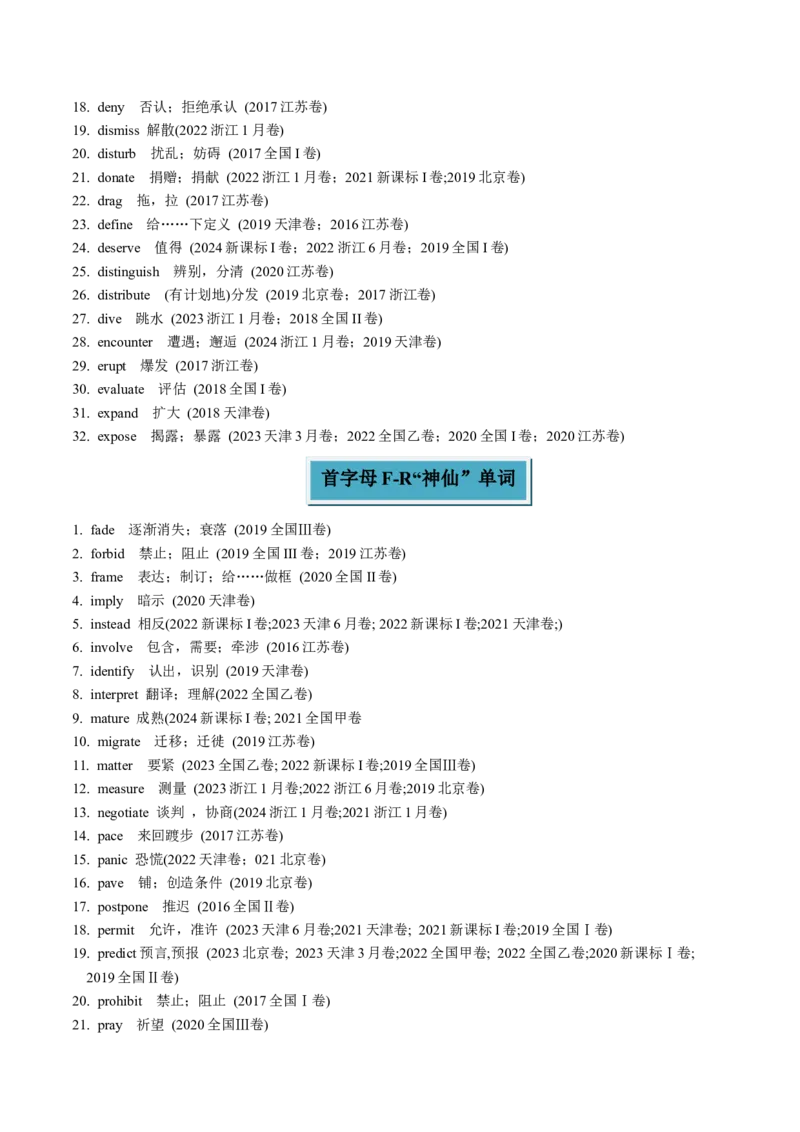
1. fade  逐渐消失;衰落 (2019 全国Ⅲ卷)
2. forbid  禁止;阻止 (2019 全国III 卷;2019 江苏卷)
3. frame  表达;制订;给……做框 (2020 全国II 卷)
4. imply  暗示 (2020 天津卷)
5. instead 相反(2022 新课标I 卷;2023 天津6 月卷; 2022 新课标I 卷;2021 天津卷;)
6. involve  包含,需要;牵涉 (2016 江苏卷)
7. identify  认出,识别 (2019 天津卷)
8. interpret 翻译;理解(2022 全国乙卷)
9. mature 成熟(2024 新课标I 卷; 2021 全国甲卷
10. migrate  迁移;迁徙 (2019 江苏卷)
11. matter  要紧 (2023 全国乙卷; 2022 新课标I 卷;2019 全国Ⅲ卷)
12. measure  测量 (2023 浙江1 月卷;2022 浙江6 月卷;2019 北京卷)
13. negotiate 谈判 ,协商(2024 浙江1 月卷;2021 浙江1 月卷)
14. pace  来回踱步 (2017 江苏卷)
15. panic 恐慌(2022 天津卷;021 北京卷)
16. pave  铺;创造条件 (2019 北京卷)
17. postpone  推迟 (2016 全国Ⅱ卷)
18. permit  允许,准许 (2023 天津6 月卷;2021 天津卷; 2021 新课标I 卷;2019 全国Ⅰ卷)
19. predict 预言,预报 (2023 北京卷; 2023 天津3 月卷;2022 全国甲卷; 2022 全国乙卷;2020 新课标Ⅰ卷;
2019 全国Ⅱ卷)
20. prohibit  禁止;阻止 (2017 全国Ⅰ卷)
21. pray  祈望 (2020 全国Ⅲ卷)
首字母F-R“神仙”单词
22. purify  净化;精炼 (2020 新课标Ⅰ卷)
23. quit  停止;离开;退出;离任 (2024 新课标I 卷;2018 浙江卷)
24. qualify  符合,配得上 (2021 天津卷;2016 江苏卷)
25. reserve 预订 (2021 新课标I 卷;2017 全国Ⅲ卷)
26. recite  背诵,朗诵 (2021 全国乙卷;019 北京卷)
27. recover 康复(2021 新课标II 卷; 2021 全国甲卷; 2021 全国乙卷)
28. reflect  反映;反射 (2024 全国甲卷;2022 天津卷;2020 江苏卷)
29. register  登记;记录 (2020 全国Ⅱ卷)
30. relief 欣慰;宽慰(2022 新课标I 卷;2022 浙江6 月卷;2021 北京卷)
31. remove  去除;脱去 (2022 天津卷;2021 新课标I 卷;2019 江苏卷)
32. repeat  重复;复述 (2021 全国乙卷;2019 天津卷)
33. reserve  预订,保留 (2023 天津6 月卷;2021 新课标I 卷;2020 全国Ⅱ卷)
34. reunite  再结合 (2020 浙江卷)
35. review  校阅;评论;温习 (2020 浙江学考)
36. roll  滚动;翻身 (2024 北京卷;2016 四川卷)
37. rush  迅速移动;匆忙行事;突袭 (2017 江苏卷;2016 全国Ⅰ卷)
1. sacrifice  牺牲 (2023 天津6 月卷;2017 全国Ⅲ卷)
2. scared 感到害怕的 (2022 全国乙卷;2021 浙江1 月卷)
3. seize  抓住;夺取 (2019 江苏卷)
4. simplify  使简化,使简易 (2018 全国Ⅲ卷)
5. ski  滑雪 (2019 全国Ⅱ卷)
6. sink  下沉,下陷,沉没 (2018 全国Ⅱ卷)
7. slightly 稍微 (2023 天津3 月卷; 2021 天津卷; 2021 全国乙卷)
8. strike  打;撞 (2017 天津卷)
9. skip  跳过,略过 (2018 全国Ⅰ卷)
10. spot  发现,看见 (2022 北京卷;2020 浙江卷;2019 天津卷)
11. submit  顺从;提交 (2020 全国Ⅱ卷)
12. substitute 替代(2022 浙江1 月卷)
13. swear  咒骂;发誓 (2020 全国Ⅲ卷)
14. switch  改变;交换 (2021 浙江6 月卷;2020 浙江卷)
15. sew  缝 (2018 江苏卷)
16. split  分裂;分开 (2019 江苏卷)
17. sponsor  赞助;举办 (2017 全国Ⅰ卷)
18. tentative 临时的;试验性的 2022 全国乙卷)
19. tremble  (因紧张、激动、惊慌等)颤抖,哆嗦 (2018 江苏卷;2019 全国Ⅱ卷)
首字母S-Z“神仙”单词
20. urge  鞭策;催促 (2019 北京卷;2018 全国Ⅰ卷)
21. volunteer  自愿做 (2023 新课标I 卷;2019 北京卷)
22. witness  目击;见证 (2023 浙江1 月卷; 2021 新课标I 卷;020 全国Ⅱ卷)
23. wander  漫游;蜿蜒 (2017 江苏卷)
24. weep  流泪,哭泣 (2022 北京卷;2020 浙江学考)
25. whisper  低语 (2024 北京卷;2019 天津卷)
26. zoom  快速移动,迅速前往 (2020 浙江学考)
02 完形填空高频名词184 例
1. ability 能力
2. absence 缺席
3. accident 事故
4. accommodation 住所
5. adult 成年人
6. adventure 冒险
7. advertisement 广告
8. affair 事情
9. ambition 抱负,野心
10. apartment 公寓
11. apology 道歉
12. appearance 出现;外貌
13. application 申请,应用程序
14. appointment 约会,约定;预约;任命
15. approach 接近;方法
16. argument 争论
17. assistant 助手
18. assistance 帮助,援助
19. attitude 态度
20. atmosphere 气氛
21. astonishment 惊讶
22. attitude 态度
23. audience 观众
24. average 平均
25. board 甲板;食宿;董事会
26. bravery 勇敢
27. budget 预算
28. burden 负担
29. career 事业
30. cause 原因,事业
31. ceremony 典礼,仪式
32. certainty 肯定
33. challenge 挑战
34 characteristic 特征,特性
35. cheer sb on 为某人加油
36. classification 分类
37. colleague 同事
38. command 命令
39. comment 评论
40. company 公司;陪伴
41. competition 比赛,竞赛
42. concept 概念
43. confidence 自信
44. conflict 冲突
45. contract 合同
46. conclusion 结论
47. consequence 结果,后果
48. contribution 贡献
49. convenient 方便的
50. cooperation 合作
51. courage 勇气
52. cure 治愈
53. customer 顾客
54. decision 决定
55. a good deed 一件好事
56. decade 十年
57. degree 学位;度数
58. destination 目的地
59. determination 决心
60. dilemma 窘境, 进退两难的处境
61. discovery 发现
62. disease 疾病
63. disturbance 打扰
64. donation 捐赠
65. effort 努力
66. emergency 紧急情况
67. emotion 情感,情绪
68. employer 雇主
69. employee 雇员
70. employment 就业, 雇用
71. energy 精力
72. entertainment 娱乐
73. enthusiasm 热情
74. entrance 入口
75. environment 环境
76. equality 平等
77. evaluation 评估
78. exchange 交换
79. examination 考试,检查
80. expectation 期待
81. experience 经验,经历
82. experiment 实验
83. expression 表达,表情
84. financial 金融
85. flame 火焰
86. forgiveness 原谅
87. frustration 懊恼,沮丧,挫败
88. function 功能,作用
89. gesture 姿势
90. graduation 毕业
91. guidance 指导
92. harmony 和谐
93. hesitation 犹豫
94. honesty 诚实
95. honor 荣耀
96. horror 恐惧
97. identity 身份
98. impression 印象
99. incident 事件
100. independence 独立
101. influence 影响
102. inspiration 激励,鼓励
103. instruction 教导,说明
104. intention 意图,目的
105. investment 投资
106. invitation 邀请
107. image 形象
108. impact 影响
109. invite 邀请
110. isolation 隔离,孤立
111. justice 公正
112. loyalty 忠实
113. manufacture 制造,制造业
114. method 方法
115. mood 情绪,心情
116. niece 侄女;外甥女
117. nephew 侄子;外甥
118. nonsense 废话
119. mistake 错误,弄错
120. occasion 场合
121. offender 冒犯者;违法者
122. operation 手术;操作
123. passenger 乘客
124. phenomenon 现象
125. pioneer 先锋
126. policy 政策
127. pressure 压力
128. principle 原则
129. privilege 特权,特殊待遇
130. progress 进步
131. offer 提议;出价
132. quality 质量,品质
133. possession 财产
134. possibility 可能性
135. potential 潜能
136. prejudice 偏见
137. pressure 压力
138. pride 骄傲
139. profession 职业,专业
140. program 节目
141. purpose 目的,意图
142. presence 出席,在场
143. principle 原则
144. protection 保护
145. quarrel 争吵
146. reaction 反应
147. recall 回忆
148. reflection 反射;沉思;映象
149. relative 亲戚
150. relief 安慰,减轻
151. relationship 关系
152. regulation 规定,制度
153. request 要求
154. requirement 要求
155. review 复习,评论
156. routine 惯例,常规;一套舞蹈动作
157. sacrifice 牺牲
158. sample 样本
159. satisfaction 满意
160. scholarship 奖学金
161. signal 信号
162. situation 情况,处境
163. standard 标准
164. style 风格
165. supply 供应
166. survive 幸存,生还
167. sympathy 同情
168. system 系统
169. talent 天赋,才能
170. target=goal  目标
171. technology 技术
172. theory 理论
173. thought 想法,思想
174. treatment 治疗;对待
175. threat 威胁
176. trade 交易,贸易
177. tragedy 悲剧
178. treasure 珍惜,宝藏
179. trouble 麻烦
180. vacation 假期
181. valuable 有价值的
182. vehicle 车辆
183. will 意志,决心
184. wisdom 智慧
03 完形填空高频形容词153 例
1.abandoned =deserted 废弃的
2.academic 学术的
3.acceptable 可接受的
4.accurate 准确的, 精确的
5.accustomed 习惯的
6.ambitious 有雄心的;有野心的
7.amused 愉快的, 顽皮的
8.annoying 令人恼怒的
9.annual 每年的
10.anxious 焦虑的
11.appropriate 合适的
12.artificial 人造的
13.ashamed 羞愧的
14.astonishing 令人吃惊的
15.attentive 注意的,周到的
16.attractive 有吸引力的
17.automatic 自动的
18.available 可得到的, 可利用的
19.awful 糟糕的
20.awkward 笨拙的;尴尬的;难应付的
21.be aware of 意识到
22.be fond of 喜欢
23.beneficial 有益的
24.bitter 苦涩的;
25.brilliant 杰出的,才华横溢的
26.cautious 小心的
27.clumsy 笨拙的
28.cautious 谨慎的, 小心的
29.competent 有能力的
30.comfortable 舒服的,舒适的
31.confident 自信的
32.complicated=complex 复杂的
33.confused 困惑的;不懂的
34.considerate 体贴的,考虑周到的
35.constant 连续的
36.countless 数不尽的
37.creative 有创造力的
38.critical 批评的;挑剔的
39.crowded 拥挤的
40.cruel 残忍的
41.cultural 文化的
42.curious 好奇的
43.dangerous 危险的
44.delighted 高兴的
45.demanding 要求高的
46.dependent 依赖的
47.desperate 绝望的
48.diligent 勤奋的
49.depressed 沮丧的,萧条的
50.disappointing 令人失望的
51.disabled 残疾的,丧失能力的
52.dull 单调的,无趣的
53.economic 经济的,合算的
54.effective 有效的
55.efficient 效率高的
56.elegant 优雅的
57.embarrassed 尴尬的
58.equally 平等地
59.essential 必不可少的
60.evident=obvious=clear 明显的
61.exhausted 筋疲力尽的
62.faint 头晕的
63.faithful 忠实的,忠诚的
64.fierce 激烈的
65.firm 坚定的,紧紧地;n.公司
66.flexible 灵活的
67.formal 正式的
68.frightened 害怕的
69.generous 慷慨的,大方的
70.giant 巨大的
71.grateful 感激的
72.guilty 内疚的,有罪的
73.honorable 值得尊敬的
74.imaginary 想象力丰富的
75.increasing 越来越多的
76.independent 独立的
77.inefficient 效率低的
78.innocent 无辜的,无罪的,天真的
79.inspiring 鼓舞人心的
80.intelligent 智能的,聪明
81.invisible 看不见的
82.limited 有限的
83.magical 魔力的
84.meaningful 有意义的
85.memorable 值得纪念的
86.negative 消极的,否定的
87.mature 成熟的
88.messy 乱的
89.moved=touched 感动的
90.nervous 紧张的
91.obvious 明显的
92.optimistic 乐观的
93.original 原始的,起初的
94.outstanding 出色的
95.pale 苍白的
96.patient 有耐心的
97.permanent 永久的
98.persistent 坚持不懈的
99.physical 身体的;物理的
100.plain 平的,朴素的,简单的
101.poisonous 有毒的
102.polite 有礼貌的
103.positive 积极的,乐观的
104.potential 潜在的
105.powerful 强大的,有力的
106.practical 实际的,实用的
107.precious 珍贵的
108.previous 先前的,早先的
109.private 私人的,私密的
110.profitable 有利可图的
111.promising 有前途的
112.properly 合理地
113.proud 自豪的
114.puzzled 感到迷惑的
115.random 随机的
116.regular 定期的;有规律的
117.relaxed 放松的
118.relatively 相对的,比较的
119.reluctant 勉强的,不愿意的
120.responsible 有责任的
121.ridiculous 滑稽的,可笑的
122.satisfied=content 满意的
123.scared 害怕的
124.similar 相似的
125.simple 简单的
126.sensitive 敏感的
127.spotless 无暇的
128.steady 稳定的
129.stubborn 固执的
130.sensitive 敏感的
131.separate 单独的,分开的
132.severe 严厉的
133.sincere 真诚的
134.smart 聪明的
135.spiritual 精神的,心灵的
136.steady 稳定的
137.straight 直接的
138.stressful 有压力的
139.suspicious 怀疑的
140.talented 有天赋的
141.thankfully 幸运地
142.tiresome 令人生厌的,无聊的
143.traditional 传统的
144.tough 难办的;艰难的
145.troublesome 令人讨厌的
146.typical 典型的
147.unbearable 不能忍受的
148.unfair 不公平的
149.unconscious 无意识的
150.unique 独一无二的
151.urgent 紧急的
1522.valuable 有价值的,贵重的
153.wealthy 富有的
04 完形填空高频副词38 例
1.absolutely 绝对地
2.accidentally 意外地,偶然地
3.actually 事实上
4.basically 基本的
5.casually 偶然地;随意地
6.certainly 肯定地,当然
7.clearly 清楚地
8.completely=entirely = thoroughly 完全地,彻底地
9.consequently 因此,所以
10.consistently 一贯地,一致地
11.correctly 正确地
12.definitely 明确地,肯定地
13.deliberately 故意地
14.eventually 最后
15.exactly 确切地;精确地;恰好
16.extremely 非常,极其
17.frequently 频繁地
18.generally 一般来说
19.immediately 立刻
20.instantly 立即地
21.largely 在很大程度上;多半
22.merely=only=simply 仅仅,只不过
23.obviously=apparently 明显地,显然地
24.occasionally 偶尔地
25.particularly 尤其,特别
26.probably 可能地
27.repeatedly 重复地
28.roughly 粗略地
29.similarly 相似地
30.slightly 轻微地
31.somehow 不知怎地
32.somewhat 稍微, 有点
33.temporarily 暂时地
34.sympathetically 同情地
35.undoubtedly 毫无疑问地
36.violently 激烈地,剧烈地
37.voluntarily 自愿地
38.willingly 愿意地
01 完形填空议论文解题步骤

02 完形填空议论文解题要领
1. 通览全文把握作者的观点和态度。
议论文往往体现作者对某一事物的观点,而作者的观点就是文章的论点。考生要把握作者的观点,把
握作者对某一事物是褒还是贬,是赞成还是反对,而通常把握了作者的观点也就找准了文章的论点。把握
文章的开头,总结文章的结尾。议论文的篇首或结尾出现话题中心,通过首段或末段把握文章的主题。
2. 试填注意段与段之间的逻辑。
议论文往往围绕某一个论点用不同的论据加以佐证,往往每一段就是一个论据,而论据和论据之间又
相互联系、互为补充,每一段往往就是其中一个角度或侧面。
3. 复核疑问题目提高得分率。
通读全文,检验每条论据是否都合情合理,都能强而有力地支撑论点。
真题专区:研读高考真题,洞悉高考命题规律,探寻满分做题技巧和应试思维
完形填空议论文综合能力提升
01 (2022 浙江卷)阅读下面短文, 从各题所给的A、B、C 和D 四个选项, 选出可以填入空白处的最佳选
项。
Small children are easy to throw up in the air and catch-and they     1     it. “Again, Daddy, again!”
Jacky shouts as I throw him skywards and catch him on the way back down again. He throws his arms and legs out
2     he were flying, his eyes wide with     3    . His trust in me is     4     which is quite a nice feeling,
but at the same time gives me a huge sense of     5     .
I hope Jacky will always trust me fully, but I know that, as he gets     6     , it will need more effort and
sound judgment    7     . Trust is such an important part of a     8     relationship that it’s something that
can’t     9     to lose. Every time I      10      Jacky to something new, he’ll do it only because he trusts
me and feels      11      in the knowledge that he won’t get hurt .     12      , teaching Jacky to swim
means he has to      13      that, when he’s swimming in the big pool, I’ll come to his rescue if his doggy
paddle lets him down.
     14      in the workplace, trust is important for strong      15      . It is something that every
manager should work hard to      16      among their team. If people don’t trust you, they’re unlikely to
17      your directions and willingly become a loyal (忠诚) team member. A      18      of trust can make
people work against you rather than for you. At the very least, it means that people are not going to be      19

you their best. Good      20     , like good parenting, is a long-term commitment.
1. A. deserve
B. miss
C. love
D. know
2. A. as if
B. in case
C. even though
D. so that
3. A. fear
B. excitement
C. doubt
D. astonishment
4. A. reasonable
B. limited
C. absolute
D. important
5. A. relief
B. satisfaction
C. achievement
D. responsibility
6. A. older
B. busier
C. quieter
D. healthier
7. A. on my behalf
B. on my part
C. in my honor
D. in my name
8. A. long-distance
B. high-risk
C. parent-child
D. teacher-student
9. A. afford
B. choose
C. wait
D. expect
10. A. attach
B. compare
C. adjust
D. introduce
11. A. safe
B. happy
C. proud
D. grateful
12. A. Above all
B. In addition
C. At first
D. For example
13. A. admit
B. believe
C. suggest
D. imagine
14. A. However
B. Therefore
C. Similarly
D. Fortunately
15. A. affection
B. determination
C. friendship
D. leadership
16. A. assess
B. organize
C. develop
D. understand
17. A. repeat
B. follow
C. change
D. forget
18. A. gesture
B. measure
C. bond
D. lack
19. A. telling
B. giving
C. selling
D. sending
20. A. management
B. personality
C. communication
D. education
02 (2012 江苏卷)阅读下面短文, 从各题所给的A、B、C 和D 四个选项, 选出可以填入空白处的最佳选
项。
The concept of solitude (独处) in the digital world is almost non-existent. In the world of digital technology, e-
mail, social networking and online video games, information is meant to be    36    . Solitude can be hard to
discover     37    it has been given up. In this respect, new technologies have     38    our culture.
The desire to be connected has brought solitude to a(n)     39    as we’ve known it. People have become
so     40    in the world of networks and connections that one can often be contacted     41    they’d rather
not be. Today we can talk, text, e-mail, chat and blog (写博客), not only from our     42    , but from our
mobile phones as well.
Most developed nations have become     43    on digital technology simply because they’ve grown
accustomed to it, and at this point not     44    it would make them an outsider.     45    , many jobs and
careers require people to be     46    . From this point of view, technology has changed the culture of work.
Being reachable might feel like a     47    to those who may not want to be able to be contacted at all times.
I suppose the positive side is that solitude is still possible for anyone who     48    wants it. Computers
can be shut     49    and mobile phones can be turned off. The ability to be “connected”and “ on”has many
50    , as well as disadvantages. Travelers have ended up     51    on mountains, and mobile phones have
saved countless lives. They can also make people feel     52    and forced to answer unwanted calls or     53
to unwanted texts.
Attitudes towards our connectedness as a society     54     across generations. Some find today’s
technology a gift. Others consider it a curse. Regardless of anyone’s view on the subject, it’s hard to imagine what
life would be like     55    daily advancements in technology.
1. A. updated
B. received
C. shared
D. collected
2. A. though
B. until
C. once
D. before
3. A. respected
B. shaped
C. ignored
D. preserved
4. A. edge
B. stage
C. end
D. balance
5. A. sensitive
B. intelligent
C. considerate
D. reachable
6. A. even if
B. only if
C. as if
D. if only
7. A. media
B. computers
C. databases
D. monitors
8. A. bent
B. hard
C. keen
D. dependent
9. A. finding
B. using
C. protecting
D. changing
10. A. Also
B. Instead
C. Otherwise
D. Somehow
11. A. connected
B. trained
C. recommended
D. interested
12. A. pleasure
B. benefit
C. burden
D. disappointment
13. A. slightly
B. hardly
C. merely
D. really
14. A. out
B. down
C. up
D. in
15. A. aspects
B. weaknesses
C. advantages
D. exceptions
16. A. hidden
B. lost
C. relaxed
D. deserted
17. A. trapped
B. excited
C. confused
D. amused
18. A. turn
B. submit
C. object
D. reply
19. A. vary
B. arise
C. spread
D. exist
20. A. beyond
B. within
C. despite
D. without
03(2014 广东卷)阅读下面短文, 从各题所给的A、B、C 和D 四个选项, 选出可以填入空白处的最佳选项。
Parents feel that it is difficult to live with teenagers. Then again, teenagers have   1   feelings about their
parents, saying that it is not easy living with them. According to a recent research, the most common    2
between parents and teenagers is that regarding untidiness and daily routine tasks. On the one hand, parents go mad
over    3   rooms, clothes thrown on the floor and their children’s refusal to help with the    4   . On the
other hand, teenagers lose their patience continually when parents blame them for    5   the towel in the
bathroom, not cleaning up their room or refusing to do the shopping at the supermarket.
The research, conducted by St. George University, shows that different parents have different    6   to
these problems. However, some approaches are more    7   than others. For example, those parents who yell at
their children for their untidiness, but    8   clean the room for them, have fewer chances of changing their
children’s    9   . On the contrary, those who let teenagers experience the     10    of their actions can do
better. For example, when teenagers who don’t help their parents with the shopping don’t find their favorite drink in
the refrigerator, they are forced to     11    their actions.
Psychologists say that     12    is the most important thing in parent-child relationships. Parents should
13    to their children but at the same time they should lend an ear to what they have to say. Parents may     14
their children when they are untidy but they should also understand that their room is their own private space.
Communication is a two-way process. It is only by listening to and     15    each other that problems between
parents and children can be settled.
1. A. natural
B. strong
C. guilty
D. similar
2. A. interest
B. argument
C. link
D. knowledge
3. A. noisy
B. crowded
C. messy
D. locked
4. A. homework
B. housework
C. problem
D. research
5. A. washing
B. using
C. dropping
D. replacing
6. A. approaches
B. contributions
C. introductions
D. attitudes
7. A. complex
B. popular
C. scientific
D. successful
8. A. later
B. deliberately
C. seldom
D. thoroughly
9. A. behavior
B. taste
C. future
D. nature
10. A. failures
B. changes
C. consequences
D. thrills
11. A. defend
B. delay
C. repeat
D. reconsider
12. A. communication B. bond
C. friendship
D. trust
13. A. reply
B. attend
C. attach
D. talk
14. A. hate
B. scold
C. frighten
D. stop
15. A. loving
B. observing
C. understanding
D. praising
04(2011 广东卷)阅读下面短文, 从各题所给的A、B、C 和D 四个选项, 选出可以填入空白处的最佳选项。
It has been argued by some that gifted children should be grouped in special classes. The     1     is
based on the belief that in regular classes these children are held back in their intellectual (智力的)growth by      2
situations that are designed for the      3     children.There can be little doubt that     4     classes can help
the gifted children to graduate earlier and take their place in life sooner. However, to take these      5     out of
the regular classes may create serious problems.
I observed a number of     6     children who were taken out of a special class and placed in a      7
class. In the special class, they showed little ability to use their own judgment, relying      8     on their
teachers’ directions. In the regular class, having no worry about keeping up, they began to reflect      9     on
many problems, some of which were not on the school program.
Many are concerned that gifted children become      10     and lose interest in learning. However, this
11     is more often from parents and teachers than from students, and some of these      12     simply
conclude that special classes should be set up for those who are      13    . Some top students do feel bored in
class, but why they      14     so goes far beyond the work they have in school. Studies have shown that to be
bored is to be anxious. The gifted child who is bored is an      15     child.
1. A. principle
B. theory
C. argument
D. classification
2. A. designing
B. grouping
C. learning
D. living
3. A. smart
B. curious
C. mature
D. average
4. A. regular
B. special
C. small
D. creative
5. A. children
B. programs
C. graduates
D. designs
6. A. intelligent
B. competent
C. ordinary
D. independent
7. A. separate
B. regular
C. new
D. boring
8. A. specially
B. slightly
C. wrongly
D. heavily
9. A. directly
B. cleverly
C. voluntarily
D. quickly
10. A. doubted
B. bored
C. worried
D. tired
11. A. concern
B. conclusion
C. reflection
D. interest
12. A. students
B. adults
C. scholars
D. teachers
13. A. talented
B. worried
C. learned
D. interested
14. A. believe
B. think
C. say
D. feel
15. A. outstanding
B. intelligent
C. anxious
D. ordinary
模拟专区:精选名校真题好题,帮你锤炼做题技巧,助力冲刺备考圆梦高考
01(25-26 高二上·云南昭通·阶段练习)阅读下面短文, 从各题所给的A、B、C 和D 四个选项, 选出可以填
入空白处的最佳选项。
Before it was proven that the earth was round, it was a well-known “fact” that it was     1    . This “fact”
was so     2     accepted that no one dared test it, because they thought if they did sail out beyond the horizon
they would fall off the edge.     3    , because they believed it couldn’t be done, it wasn’t done.
That is, until Columbus     4     common knowledge and asked “what if?”, this question literally
expanded the     5     of his country, altered history, and changed the     6     reality forever.
In spite of our     7     to think of reality as the undoubted basis of our experience, the definition of     8
changes every time someone pushes the boundary conditions of traditional     9    . When our view of reality
changes, our     10     changes with it, based on     11     is newly considered possible. When Columbus
returned from the New World, a revised world map was     12     and this began a new era of exploration and
adventure.
Examples of the impossible being made possible can be found throughout history. When Chuck Yeager flew
the X-1, he destroyed the myth that there was such a thing as a sound barrier. His training and talent,     13

with the new technology of the day, not only enabled him to go     14     the speed of sound, but strengthened
the fact that even so-called technological barriers can be     15     as well.
1. A. rough
B. smooth
C. hard
D. flat
2. A. generously
B. rarely
C. widely
D. brilliantly
3. A. In other words
B. In addition
C. On the move
D. For instance
4. A. prohibited
B. questioned
C. declared
D. demonstrated
5. A. absence
B. capacity
C. prospect
D. boundary
6. A. obtained
B. accepted
C. adjusted
D. clarified
7. A. accuracy
B. strategy
C. tendency
D. efficiency
8. A. proof
B. reality
C. origin
D. fantasy
9. A. wisdom
B. custom
C. costume
D. festival
10. A. behavior
B. theory
C. experience
D. achievement
11. A. who
B. which
C. what
D. it
12. A. let down
B. put down
C. switched off
D. drawn up
13. A. concerned
B. combined
C. covered
D. loaded
14. A. beyond
B. through
C. over
D. down
15. A. admitted
B. commanded
C. overcome
D. ignored
02(25-26 高二上·福建·期中)阅读下面短文, 从各题所给的A、B、C 和D 四个选项, 选出可以填入空白处
的最佳选项。
 Although most flyers (传单) have gone the way of tape recordings, there’s still the     1     one that
shows up at our door.     2    , they go straight to the recycling bin — unless there are small children and a
page with toys catches their eyes.
They are     3     by it. They tend to feel forced to read it over and over again. But that’s not     4

. Now there’s a whole list of toys they can’t live without. Before they saw this page, they were     5    . There
was nothing they needed. They had     6     puzzles, books, and games to keep them satisfied for hours. Not to
mention the outdoor     7    . Now, they need this toy. They’ll be miserable     8     they have it. After
calming down the kids and giving some firm no’s, it’s time to     9     the experience.
Aren’t we all like those children? We’re mostly fine until we run into a situation where our desires are      10
. This could be a trip to the mall or a view of someone’s vacation pictures on WeChat. There are new things or
experiences we      11     ! We’ll be so miserable without them.
We are all      12      affected. And that’s thought-provoking.
Recognizing our weakness and the source of the temptation (诱惑) is a big first step towards      13

it. We can begin by steeling ourselves against the sources —      14      social media, avoiding the mall… And
even under those circumstances that can’t be avoided, we can repeat to ourselves the wisdom, “Who is the rich
person? The one who is      15      with his life.”
1. A. original
B. occasional
C. important
D. inspiring
2. A. In order
B. In general
C. Now and then
D. More or less
3. A. ignored
B. puzzled
C. prohibited
D. attracted
4. A. within its reach
B. a piece of cake
C. the worst of it
D. as plain as day
5. A. content
B. curious
C. innocent
D. unsettled
6. A. all
B. limited
C. enough
D. extra
7. A. options
B. agency
C. education
D. areas
8. A. if
B. because
C. until
D. though
9. A. meet with
B. bring up
C. work out
D. reflect on
10. A. excited
B. admitted
C. controlled
D. expressed
11. A. need
B. obtain
C. possess
D. share
12. A. secretly
B. directly
C. barely
D. easily
13. A. understanding
B. conquering
C. investigating
D. building
14. A. making time forB. looking forward to
C. staying away from
D. taking advantage of
15. A. familiar
B. satisfied
C. busy
D. concerned
03(2025 高三·全国·专题练习)阅读下面短文, 从各题所给的A、B、C 和D 四个选项, 选出可以填入空
白处的最佳选项。
In Robert M. Pirsig’s 1974 book, Zen and the Art of Motorcycle Maintenance, the author describes a device
he calls “the old South Indian Monkey Trap.” It     1     a hollowed-out coconut (椰子) with some rice inside,
chained to a stake (桩). The coconut has a hole in the top just large enough for a monkey to     2     its hand but
not big enough to remove a handful of rice. While villagers watched from a distance, Pirsig writes, a hungry
monkey would reach in and become trapped, unable or unwilling to give up its handful in     3     for its
freedom. The villagers could then walk right up and take the monkey away.
Before you say anything about the dumb monkey, ask yourself whether you are doing more or less the same
thing when it comes to     4     in your life. Perhaps you want to     5     with an estranged (疏远的)
friend but refuse to let go of an old dispute. If so, you are stuck in an emotional monkey trap.
Sometimes, we give up the freedom we crave (渴望) even when we say we have forgiven others, whether
because we still harbor anger deep down or because we are     6     offenses to use later against the people who
have wronged us. To achieve greater happiness and freedom, we all need to     7     these sorts of partial
forgiveness.
The thing about talking through a problem or telling someone “I forgive you” is that it takes a lot of     8
and hurts your pride, and might mean giving up something you want. So sometimes, people try     9     that
seem like good ways to resolve a dispute but do not work in the end.
Researchers have written about conditional forgiveness, in which vindication (辩护) is put off and conditions
are made(“I will forgive you when you do X and Y”), and pseudo-forgiveness, which happens when partners decide
to     10     an issue without actually forgiving one another for it. Conditional forgiveness can provide what
researchers call “emotional protection” — that is, a feeling of     11     — for the damaged partner, but can also
keep a wound open. Pseudo-forgiveness can prolong an unhappy relationship because no actual forgiveness is
taking place, which, the research shows, is a bad sign for a relationship’s     12    . In either case, partial
forgiveness is a monkey trap — a handful of emotional rice chosen over freedom from anger and bitterness.
Zen and the Art of Motorcycle Maintenance chronicles (按时间顺序记述) a 17-day trip from Minnesota to
California on an old motorcycle. The book is full of rich metaphors (隐喻) like the monkey trap. But     13    ,
the whole story is a metaphor for life. In our brief journey through time, we might encounter every kind of
problem. Some are mechanical issues, which     14     some knowledge of motorcycle maintenance to keep
going. Many are unimportant. The rest are unsolvable, but you still do not want to let them ruin the trip for you and
your passengers. In those cases, the solution is     15    : Just drive away, and leave them behind.
1. A. comes from
B. consists of
C. insists on
D. makes up
2. A. clap
B. insert
C. rub
D. wash
3. A. exchange
B. preparation
C. return
D. search
4. A. conflicts
B. dangers
C. opportunities
D. requests
5. A. associate
B. compare
C. react
D. reconnect
6. A. coming up with
B. holding on to
C. keeping away from
D. looking down upon
7. A. abandon
B. accept
C. acquire
D. admire
8. A. courage
B. effort
C. practice
D. trust
9. A. adventures
B. memories
C. shortcuts
D. treatments
10. A. avoid
B. expect
C. highlight
D. ignore
11. A. excitement
B. guilt
C. safety
D. satisfaction
12. A. competition
B. evolution
C. possibility
D. survival
13. A. by chance
B. in demand
C. in truth
D. on earth
14. A. examine
B. gather
C. lack
D. require
15. A. complex
B. rare
C. simple
D. unique
04(2025 高三·全国·专题练习)阅读下面短文, 从各题所给的A、B、C 和D 四个选项, 选出可以填入空白
处的最佳选项。
Delayed gratification has enjoyed an excellent reputation ever since the famous Stanford “marshmallow”
study in the 1970s. The study showed that children who chose to wait for a later, bigger reward of marshmallows —
instead of giving in to temptation straight away — had better     1     later in lives, on several measures.
It makes sense to     2     the habit of waiting a little before satisfying one’s desires. Being pushed
around by our impulses can lead to a(n)     3     to consider our long-term well-being or other people’s point
of view.
Even delayed gratification has its downsides, however. A reader who is “mostly a delayed-gratification
person” reflects that, “I find that I feel guilty when I have something     4    . And it is not as fulfilling or as
meaningful. ”
Delayed gratification is a two-faced virtue. It is used both as a tactic by hedonists (享乐主义者) to maximize
pleasure and a strategy by ascetics (禁欲主义者) to minimize it.
For the ascetic, to act instantly on our desires is to become     5     to them, and they are hardly the
wisest of masters. If we wait and think before following their orders, we often find we don’t need what they     6
us to seize. Sometimes they even make us     7    : fatter, poorer, more burdened by stuff, messily caught up in
other people’s lives.
But some see delay as a way of extending and heightening pleasure. The more you have to wait for
something, the more you generally     8     it. Time also allows us to optimize the     9     of enjoyment.
To not let the wine breathe and the cheese come up to room temperature is to     10     both.
Anticipation is also a pleasure in itself, some might say, even greater than that of the     11

enjoyment. As Winnie-the-Pooh observed, “although eating honey was a very good thing to do, there was a moment
just before you began to eat it which was better than when you were. ” In Flaubert’s Parrot, Julian Barnes goes
further: “Happiness lies in the imagination, not the act. Pleasure is found first in anticipation, later in memory. ”
I can see the truths in all these ideas. But I wonder if we are     12     if we think that the question of
delay is the central one. Rather, should we not cultivate selective gratification? The ideal is neither to satisfy nor
13     every desire, but to make sure we only act on those that are truly rewarding, at the right time and in the
right place. Delay therefore becomes simply one tool among others, not the master key (万能钥匙).
Some of the sweetest moments in life are when chance presents a happy opportunity to do something
wonderful, here and now, without     14    . In such cases, gratification delayed is satisfaction     15    .
1. A. choices
B. outcomes
C. positions
D. purposes
2. A. break with
B. get into
C. return to
D. shake off
3. A. attempt
B. error
C. inability
D. obligation
4. A. completely
B. immediately
C. slightly
D. temporarily
5. A. contributors
B. slaves
C. threats
D. witnesses
6. A. allow
B. command
C. help
D. invite
7. A. worse off
B. take off
C. better off
D. show off
8. A. accept
B. appreciate
C. believe
D. share
9. A. conditions
B. qualities
C. sources
D. terms
10. A. eliminate
B. highlight
C. improve
D. waste
11. A. actual
B. average
C. imaginary
D. total
12. A. discouraged
B. dismissed
C. misled
D. misunderstood
13. A. create
B. inspire
C. kill
D. resist
14. A. hesitation
B. loss
C. permission
D. prejudice
15. A. deleted
B. denied
C. expressed
D. guaranteed
05(2025 高二·全国·专题练习)阅读下面短文, 从各题所给的A、B、C 和D 四个选项, 选出可以填入空白
处的最佳选项。
Many years ago, before the invention of smartphones and the Internet, I was living in Cali, Colombia. My
younger sister decided to visit me for a holiday. However, on the day I was supposed to go to meet her at the
airport, I somehow lost     1     of the time and realized that I was leaving my home much later than I had
wanted to. And to make matters     2     when I went outside, the rain was pouring from the sky and I couldn't
get a taxi. I ended up jumping on board a bus to Palmira, where the airport was. Except it wasn't exactly going to be
heading for the airport.
The driver said that he would drop me off at a crossroads which was located six kilometres away from the
airport. I had no     3     but to travel with the bus. The journey took ages, however. When the bus did
eventually     4     the previously mentioned crossroads, the stop appeared to be in the middle of nowhere. The
driver pointed in a given direction and told me that the airport was down that way. By this time, I had descended
into tears. My sister would be arriving in twelve minutes, and there was no way I was going to be able to make it in
time. Beside myself (失去控制) with worry, I     5     the driver to drive the six kilometres down to the airport
to drop me off. He stood up and took a vote from the other passengers. Fortunately, they all     6    . Thanks to
them, I arrived on time.
This was my first encounter with Murphy's Law (墨菲定律): Whatever can go wrong will go wrong. And the
only way to beat this devil is to take     7     for the outcome of all your actions. I should have made a Plan B
by     8     the possibility that there would be no taxis available.
Of course, some major victories in history were achieved by the very fact that they did not have a Plan B to
9     . Xiang Yu famously ordered his troops to “break the kettles and sink the boats” before they confronted the
Qin in the Battle of Julu. However, this “failure is not an option” mindset should only be reserved for     10

scenarios. Most of the situations we encounter in our lives are much less dramatic and can often be     11

in more ways than one. It is     12     to have a Plan B because you cannot always guarantee that your original
plan is going to work out, and in some cases, your contingency (不测之事) plan might just end up being even better
than your original one. This is especially true in the volatile (动荡不定的) world of business. Since the outbreak of
COVID-19, many companies have adopted a work-from-home policy which is helping them to     13     their
costs while also allowing them to achieve greater levels of productivity than ever before.
Now more than ever, in this rapidly changing world,     14     is often the key to success. If you are
prepared to bounce back when everyone else breaks down, you will be the winner. Think of your contingency plan
as a form of     15    , one that, if nothing else, can give you the peace of mind you need.
1. A. heart
B. sight
C. track
D. touch
2. A. better
B. easier
C. funnier
D. worse
3. A. choice
B. evidence
C. hope
D. reason
4. A. leave
B. pass
C. reach
D. return
5. A. allowed
B. begged
C. forced
D. reminded
6. A. agreed
B. appeared
C. succeeded
D. survived
7. A. advice
B. control
C. responsibility
D. risk
8. A. coming into effectB. getting into troubleC. putting into practice
D. taking into account
9. A. approve of
B. look up
C. go after
D. turn to
10. A. extreme
B. frightening
C. normal
D. strange
11. A. accessed
B. altered
C. approached
D. avoided
12. A. dangerous
B. essential
C. pointless
D. ridiculous
13. A. increase
B. maintain
C. pay
D. reduce
14. A. capability
B. flexibility
C. reliability
D. stability
15. A. assistance
B. endurance
C. guidance
D. insurance
06(24-25 高二下·四川资阳·期末)阅读下面短文, 从各题所给的A、B、C 和D 四个选项, 选出可以填入空
白处的最佳选项。
 “Sticks and stones will break my bones, but words will never hurt me.” Do you     1     that old
saying? Probably not, because you know words can sometimes hurt more than a     2     arm. The words we
speak show how we feel, and unkind words hurt both the person who     3     and the person who says them.
On the other hand, kind words encourage others and     4     the people who say them. If you become a
good     5    , you’ll win more friends. You’ll     6     your teachers and parents, and you’ll even have a
better     7     of getting a job in an interview. It makes sense to learn to communicate clearly and     8    .
If you throw a stone into the ocean, the stone comes back to you. Words are     9     that. What you
throw out comes back to you. It’s     10     that sometimes people won’t answer your kind words with
kindness. But over the long run, if you communicate kindness, you’ll attract kind words in     11    .
We communicate in more than just words. Any     12     you make with your body, any sound that
comes out of your mouth, the expression you     13    , and even the thoughts you have can     14     a
message to someone. Therefore, it’s vital to master the art of communication, which builds positive connections
and creates a wave of kindness that     15     our lives and the lives of others.
1. A. recognize
B. forget
C. mind
D. believe
2. A. controlled
B. broken
C. repaired
D. raised
3. A. hears
B. finds
C. writes
D. learns
4. A. slow down
B. throw away
C. build up
D. figure out
5. A. communicator
B. leader
C. lecturer
D. reporter
6. A. observe
B. impress
C. protect
D. serve
7. A. method
B. view
C. chance
D. standard
8. A. effectively
B. regularly
C. privately
D. freely
9. A. about
B. against
C. below
D. like
10. A. important
B. true
C. interesting
D. simple
11. A. peace
B. person
C. return
D. order
12. A. mistake
B. movement
C. decision
D. arrangement
13. A. wear
B. desire
C. supply
D. define
14. A. compare
B. add
C. match
D. send
15. A. endangers
B. exchanges
C. enriches
D. exposes
06(2025 高三上·全国·专题练习)阅读下面短文, 从各题所给的A、B、C 和D 四个选项, 选出可以填入空
白处的最佳选项。
As a general rule, all forms of activity lead to boredom when they are performed on a routine (常规) basis.
As a matter of fact, we can see this     1     at work in people of all     2    . For example, on Christmas
morning, children are excited about    3    with their new toys. But their     4     soon wears off and by
January those     5     toys can be found put away in the basement. The world is full of     6     stamp
albums and unfinished models, each standing as a monument to someone’s     7     interest. When parents
bring home a pet, their child     8     bathes it and brushes its fur. Within a short time, however, the burden of
caring for the animal is handed over to the parents. Adolescents enter high school with great     9     but are
soon looking forward to     10    . The same is true of the young adults going to college. And then, how many
11    , who now complain about the long drives to work, eagerly drove for hours at a time when they first     12
their driver’s license? Before people retire, they usually plan to do a lot of     13     things, which they never
had     14     to do while working. But soon after retirement, the golfing, the fishing, the reading and all of the
other pastimes become as boring as the jobs they     15    . And, like the child in January, they go searching for
new toys.
1. A. principle
B. habit
C. weaker
D. power
2. A. parties
B. races
C. countries
D. ages
3. A. working
B. living
C. playing
D. going
4. A. confidence
B. interest
C. anxiety
D. sorrow
5. A. same
B. extra
C. funny
D. expensive
6. A. well-organized
B. colorfully-printed
C. newly-collected
D. half-filled
7. A. broad
B. passing
C. different
D. main
8. A. silently
B. impatiently
C. gladly
D. worriedly
9. A. courage
B. calmness
C. confusion
D. excitement
10. A. graduation
B. independence
C. responsibility
D. success
11. A. children
B. students
C. adults
D. retirees
12. A. required
B. obtained
C. noticed
D. discovered
13. A. great
B. strong
C. difficult
D. correct
14. A. time
B. money
C. skills
D. knowledge
15. A. lost
B. chose
C. left
D. quit