专题04 阅读理解(说明文二)
主题01 人与自然——自然与科研
Passage 1
(2026·山东淄博·一模)
TCM Olfaction Diagnosis Meets Modern Sensing Technology
TCM Olfaction Diagnosis
Traditional Chinese Medicine (TCM), with a history of thousands of years, uses four main methods for
diagnosis. Among them, olfaction diagnosis, diagnosis by smell, known as “Wen Zhen”, plays a vital role. It
involves assessing a patient’s health by noticing smells from their breath or body. However, this method has long
depended heavily on the doctor’s personal experience, which can lead to inconsistent results and makes it difficult
to measure precisely.
Modern Tech’s Transformation
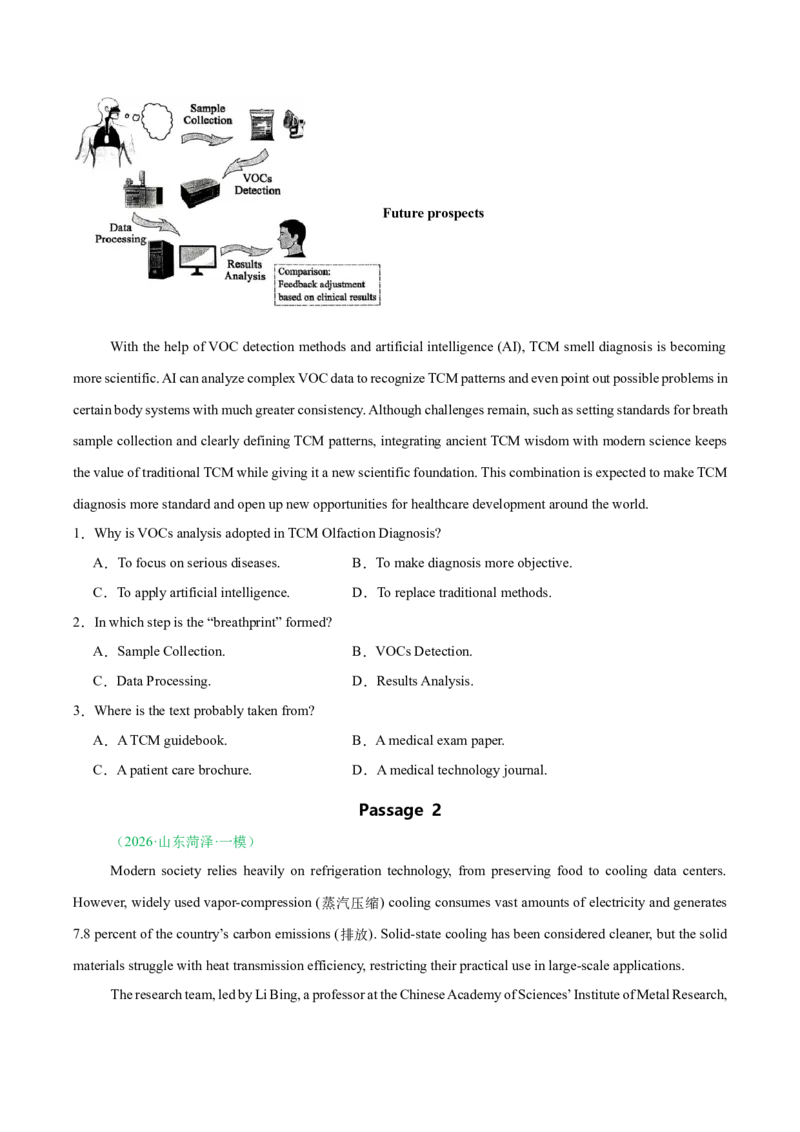
Modern technology is now transforming this long-standing challenge. Scientists have found that human breath
contains a variety of minute chemical substances known as volatile organic compounds (VOCs). These VOCs, when
captured and analyzed by modern detecting devices, form a unique digital “breathprint” for each individual — a
specific profile of VOCs. This profile can reflect the body’s health conditions, which corresponds with the core
principles of TCM olfaction diagnosis. By analyzing the breathprint, the subjective art of traditional olfactory
diagnosis can be converted into objective and measurable data, laying a solid foundation for its scientific
standardization.
Future prospects
With the help of VOC detection methods and artificial intelligence (AI), TCM smell diagnosis is becoming
more scientific. AI can analyze complex VOC data to recognize TCM patterns and even point out possible problems in
certain body systems with much greater consistency. Although challenges remain, such as setting standards for breath
sample collection and clearly defining TCM patterns, integrating ancient TCM wisdom with modern science keeps
the value of traditional TCM while giving it a new scientific foundation. This combination is expected to make TCM
diagnosis more standard and open up new opportunities for healthcare development around the world.
1.Why is VOCs analysis adopted in TCM Olfaction Diagnosis?
A.To focus on serious diseases.
B.To make diagnosis more objective.
C.To apply artificial intelligence.
D.To replace traditional methods.
2.In which step is the “breathprint” formed?
A.Sample Collection.
B.VOCs Detection.
C.Data Processing.
D.Results Analysis.
3.Where is the text probably taken from?
A.A TCM guidebook.
B.A medical exam paper.
C.A patient care brochure.
D.A medical technology journal.
Passage 2
(2026·山东菏泽·一模)
Modern society relies heavily on refrigeration technology, from preserving food to cooling data centers.
However, widely used vapor-compression (蒸汽压缩) cooling consumes vast amounts of electricity and generates
7.8 percent of the country’s carbon emissions (排放). Solid-state cooling has been considered cleaner, but the solid
materials struggle with heat transmission efficiency, restricting their practical use in large-scale applications.
The research team, led by Li Bing, a professor at the Chinese Academy of Sciences’ Institute of Metal Research,
discovered a way to bypass this limitation by integrating solid cooling effects with liquid flow.
In their study, they observed ammonium thiocyanate, a widely-used industrial salt, absorbs massive amounts
of heat when it dissolves (溶解) in water. By applying pressure, the process goes backward, separating the salt out
and releasing a large amount of heat. This two-way cycle enables continuous cooling as pressure is applied and
released in turn, making it an ideal one for refrigeration systems. “Unlike traditional cooling methods, the approach
integrates the cooling material and heat-carrying material into a single liquid, facilitating heat conductivity.” Li said.
This approach solves what scientists described as the “impossible triangle”, achieving low emissions, high cooling
power, and efficient heat transmission all at once.
Laboratory experiments demonstrated excellent results. At room temperature, the method achieved a
temperature drop of nearly 30℃ in just 20 seconds, while at higher temperatures the cooling reached as high as 54℃,
far exceeding that of existing methods. Another experiment proved the process’ stability and instant response to
pressure changes — key requirements for practical refrigeration systems.
Li emphasized that this technology lays foundation for the commercialization of powerful, zero-emission
refrigeration systems for industrial and home use, especially the next-generation artificial intelligence computing
centers. He added, however, further efforts are needed for practical application, such as breakthroughs in engineering
pressure-tuned changes.
4.What is one problem of traditional cooling systems?
A.They consume much energy.
B.They’re used in small scale.
C.They depend on solid materials.
D.They have low cooling efficiency.
5.What plays a key role in solving the “impossible triangle”?
A.The solid-state materials.
B.The two-way liquid cycle.
C.The pressure-tuned changes.
D.The traditional cooling method.
6.What is the purpose of listing the data in paragraph 4?
A.To illustrate the principle of solid cooling.
B.To explain the need for low carbon emission.
C.To show impressive effects of the new method.
D.To compare the differences of two experiments.
7.Which would be the best title for the passage?
A.Salt-based Methods Work Wonders
B.Traditional Cooling Meets its Limits
C.A Report on Eco-refrigeration Industry
D.A Breakthrough in Cooling Technology
主题02 人与自然——环境保护
Passage 1
(2026·山东烟台·一模)
“Ghost gear” refers to lost or abandoned fishing nets, a highly destructive pollutant in oceans. Each year,
approximately 1 million tons of such gear are discarded at sea, accounting for up to 86% of large marine floating
plastics. Unlike visible plastic waste like bottles, it sinks into the deep ocean, continuously trapping sea animals,
producing microplastics and endangering navigation.
To address this issue, organizations like Conservation International have launched programs worldwide. A
distinctive project in Mexico focuses on training female divers known as sirenas to clear away ghost gear and help
coastal communities gain a direct understanding of the pollution’s harm.
These female divers rely on commercial fishing as their primary income source but volunteer for the cleanup.
After professional training and certification, they start searching for and removing dangerous ghost gear. The operation
tests their physical limits and patience to the fullest. As many as 117 sailors once invested over 40 hours in clearing
a massive 300-foot-long fishing net. Their diving experience has completely transformed their perception of the
ocean. By engaging with communities and fishing cooperatives, they have gradually gained recognition, carving out
a space for women in marine conservation within the male-dominated fishing industry.
Undoubtedly, prevention deserves the equal priority to cleanup. The Global Ghost Gear Initiative has developed
a reporting system for fishers to notify lost gear for timely recovery and provided them with region-specific
recommendations, such as avoiding operations in severe weather and storing gear properly.
In selected regions, fishing nets bear unique identifiers, enabling the precise tracking of their ownership by
individuals or commercial fisheries post-recovery and instantly locking down whoever is at fault. “Once your fishing
gear is attached to distinct identifiers, it facilitates a heightened sense of individual accountability, which in turn
generates a concrete effect on your behavioral approach to fishing practices,” notes Jimenez, a marine biologist.
The governance of ghost gear demands cooperation among fishers, researchers and policymakers. By changing
mindsets and taking effective measures, this campaign against ocean “ghosts” is advancing steadily, injecting hope
for the sustainable future of marine ecosystems and coastal communities.
1.How does ghost gear differ from other marine plastics?
A.It’s harder to detect.
B.It’s distributed more extensively.
C.It takes longer to break down.
D.It floats evenly in shallower water.
2.Why does the author mention the 300-foot-long net removal example?
A.To showcase training effect.
B.To emphasize potential net risks.
C.To highlight work efficiency.
D.To demonstrate cleanup challenges.
3.What can we infer from Jimenez’s words?
A.Labels avoid fishing net loss.
B.Technology reshapes productivity.
C.Markings boost responsibility.
D.Identity validation guarantees security.
4.What can be the best title of the text?
A.Deep-sea Ghost Gear: Silent Killers.
B.Sirenas: Dedicated Ocean Guardians.
C.Multi-dimensional Actions: Tackling Marine Ghosts.
D.For Marine Conservation: Mind Your Fishing Gear.
Passage 2
(2026·山东枣庄·一模)
Deep in the forests of Uganda, Dr. Gladys Kalema-Zikusoka does something extraordinary: she protects
mountain gorillas. For 27 years, she has been working with mountain gorillas, pursuing her dream job, which gave
her the title of Uganda’s first wildlife vet.
Today, she is standing on the front lines of a growing crisis: climate change. The gorillas’ habitat in Bwindi
Impenetrable National Park is growing warmer and drier, and water is becoming scarce. “When droughts come,” she
explains, “the gorillas will struggle.”
Climate change also fuels the spread of infectious diseases, posing severe risks to both local communities and
wildlife. Dr. Gladys and her team work closely with village health teams or community health workers who they train
to do conservation work. They monitor the gorillas’ health and provide treatment. Each month, they collect fecal (粪
便)samples from all 26 habituated gorilla groups, to screen for viruses that could be transmitted from people or
livestock.
Society does not always encourage women to enter daring — even dangerous — fields; often, it discourages
them. “But I did just that,” says Dr. Gladys. When she started, few women worked in conservation. Now, more are
joining. “We still have a long way to go,” she says, “but things are changing.”
Thanks to her work, mountain gorillas are no longer classified as critically endangered. Their population has
risen from about 300 to over 500 since she started. “At times, I feel hopeless,” she admits. “But what keeps me going
is knowing that something can be done. Working with gorillas gives me a lot of hope. It really does.”
5.What is a major threat to the survival of mountain gorillas?
A.The chaos of war.
B.Deforestation.
C.Climate change. D.Water pollution.
6.How does Dr. Gladys’ team monitor the health of the mountain gorillas?
A.By giving regular physical exams.
B.By treating them in local clinics.
C.By analyzing their fecal samples.
D.By controlling infectious diseases.
7.Which of the following best describes Dr. Gladys’job?
A.Challenging.
B.Amazing.
C.Boring.
D.Well-paid.
8.What can we learn about Dr. Gladys’ work from the last paragraph?
A.It turns out ineffective.
B.It is quite fruitful.
C.It lacks official support.
D.It is very hopeless.
Passage3
(2026·山东·一模)
Climate change and habitat loss are affecting animal populations around the world, and reptiles (爬行动物)
such as South Australia’s endangered pygmy bluetongue lizards ( 蜥蜴), are particularly vulnerable to rising
temperatures and the long-term trend of decreasing rainfall.
Scientists from Flinders University are dedicated to ensuring a sustainable future for this burrow — dwelling
endemic species (Tiliqua adelaidensis) by assessing whether they can fit into cooler and slightly greener locations,
which are located below their typical range in the drier and hotter northern regions of the state.
The latest research, presented in a new article in Biology, compared the ability of three separate pygmy
bluetongue lizard populations to survive different microclimates in South Australia — between the northern Flinders
Ranges near Jamestown, Mid North near Burra, and southern-most translocation ( 迁移) sites near Tarlee and
Kapunda.
The study, led by PhD candidate Deanne Trewartha from the College of Science and Engineering, says moving
wildlife in a hotter, drier location to another microclimate can mean exposure to different temperatures, water
availability and humidity and needs extensive assessment.
“We need to understand how this species, which is highly dependent on body temperature, adapts to cooler
and often wetter seasons in these new environments,” says Trewartha.
Trewartha says the research recently suggests adapting to new sites may take longer than two years for all
three populations and may vary with their origins. She says, “These three populations have shown various responses to
their new locations, but behavioral variations are not harmful in the long term and may potentially aid animals in
adapting to changed environments to increase their chance of survival.”
Mike Gardner, Flinders University Professor of Biodiversity and Ecology, says, “Australia has the highest
reptile diversity in the world. With high biodiversity loss, translocation to ‘future — suitable’ sites is becoming
increasingly urgent for the conservation of numerous reptile species.”
“Further monitoring of the three populations will continue to see other behavioral variations and the long-term
behavioral adaptation periods for translocation,” says Trewartha.
9.What do Flinders University scientists keep doing to the translocated lizards?
A.Preserving their original living places.
B.Introducing more lizard species for them.
C.Ensuring their habitats are free from rainfalls.
D.Monitoring their adaptability to new locations.
10.What is Trewartha’s attitude to the lizards’ behavioral variations?
A.Negative.
B.Optimistic.
C.Indifferent.
D.Ambiguous.
11.What does Mike Gardner stress in Paragraph 7?
A.The potential of reptile species.
B.The survival chance of lizards.
C.The necessity of translocation.
D.The high biodiversity in Australia.
12.From which section of a website is the text most probably taken?
A.Technology.
B.Environment.
C.Health.
D.Tourism.
主题03 人与自我——文化与学习
Passage 1
(2026·山东临沂·一模)
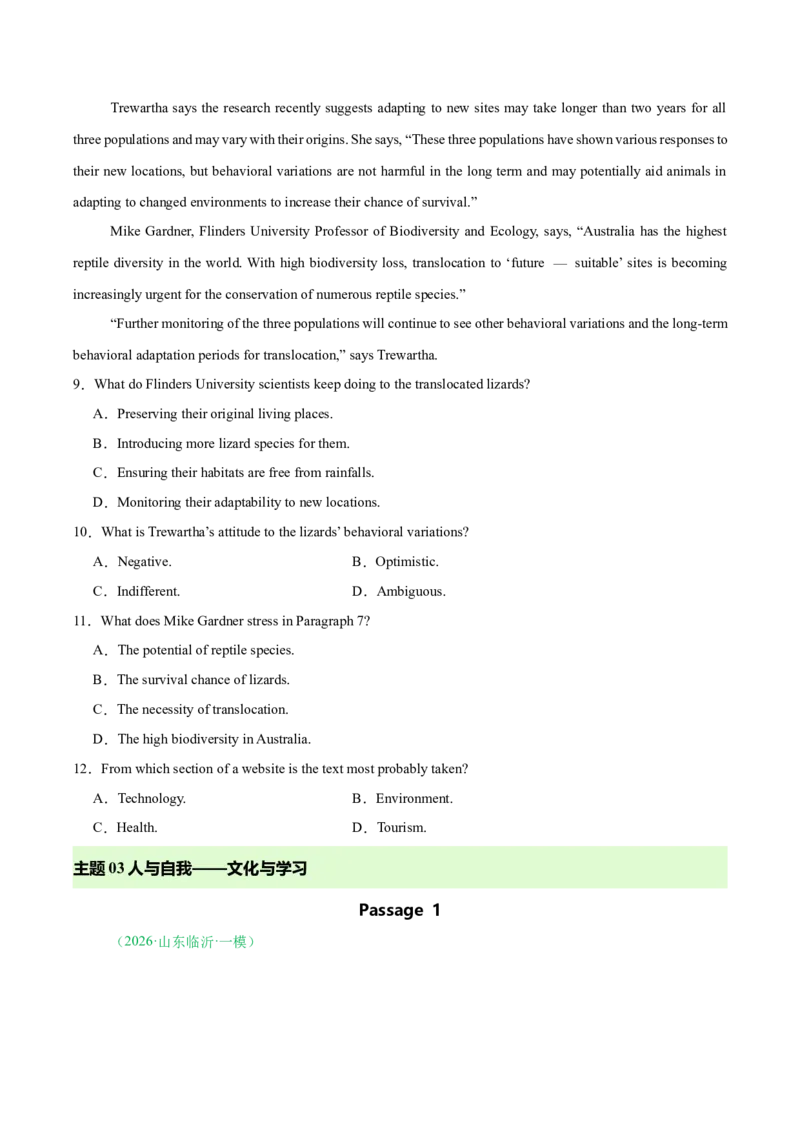
This chart shows global GDP per capita, adjusted for inflation. Looking at the world economy from this
perspective, it is the steadiness of this change that stands out. Average incomes per person have risen at a fairly
constant pace of roughly 2% per year, interrupted only by the 2008 financial crisis and the 2020 pandemic.
A definition of economic growth that can be found in many publications is “an increase in the amount of goods
and services produced per head of the population over a period of time.” There is one example of how growth is
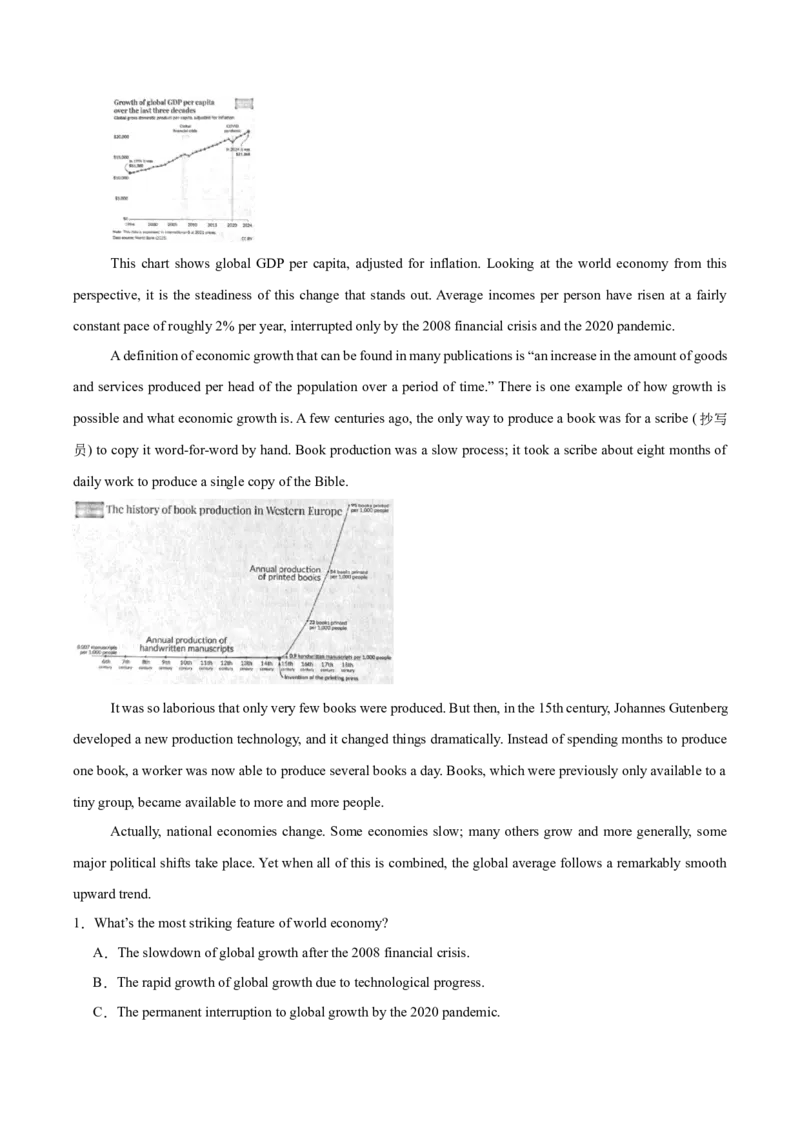
possible and what economic growth is. A few centuries ago, the only way to produce a book was for a scribe ( 抄写
员) to copy it word-for-word by hand. Book production was a slow process; it took a scribe about eight months of
daily work to produce a single copy of the Bible.
It was so laborious that only very few books were produced. But then, in the 15th century, Johannes Gutenberg
developed a new production technology, and it changed things dramatically. Instead of spending months to produce
one book, a worker was now able to produce several books a day. Books, which were previously only available to a
tiny group, became available to more and more people.
Actually, national economies change. Some economies slow; many others grow and more generally, some
major political shifts take place. Yet when all of this is combined, the global average follows a remarkably smooth
upward trend.
1.What’s the most striking feature of world economy?
A.The slowdown of global growth after the 2008 financial crisis.
B.The rapid growth of global growth due to technological progress.
C.The permanent interruption to global growth by the 2020 pandemic.
D.The relative consistency of global growth over the last three decades.
2.How does the author explain the concept of economic growth?
A.By citing an expert.
B.By listing definitions.
C.By giving an example.
D.By providing statistics.
3.What is the key factor that led to the dramatic change in book production?
A.The emergence of workers.
B.The printing press technology.
C.The wide availability of paper.
D.The growing number of scribes.
Passage 2
(2026·山东淄博·一模)
Berlin’s East Side Gallery attracts millions of visitors each year. Tourists crowd before vibrant murals (壁画)
painted after the Cold War, but few pause to consider what lies beneath the paint: an original section of the Berlin
Wall. The art has become the attraction; the history it covers has faded into background. This pattern extends far
beyond Berlin. Across the globe, old buildings fall for new developments. The logic seems unarguable: cities must
grow, economies must expand. But what disappears when we erase (清除) the physical traces of our past?
Urban historian Dolores Hayden describes cities as “palimpsests” — manuscripts written upon repeatedly,
earlier versions never fully erased. In her study of Los Angeles, she documented how development projects repeatedly
tore down communities inhabited by Mexican-American and African-American families, replacing them with
freeways and squares. The new structures served economic ambitions, but they also erased material evidence that
these communities ever existed. “When the buildings disappear,” Hayden writes, “so does the tangible ( 有形的)
proof that these people lived here, worked here, mattered here.”
Some argue that memory can survive through photographs and documents. In fact, there is a difference between
knowing about a place and experiencing it. A photograph of an old church conveys its appearance; walking through
its doors conveys something else entirely — the height of the ceiling, the echo of footsteps, the weight of silence.
These are not details; they are the substance of embodied memory.
Research in environmental psychology suggests that physical spaces maintain collective identity. When
communities lose familiar landmarks, they lose reference points that connect individuals to shared history. The result
can be spatial disorientation — not merely not knowing where you are, but not knowing who you are in relation to
those who came before.
None of this argues against all development. Every generation inherits a city and passes one on. Some walls
are meant to fall. Others are meant to stand — physical spaces ground memory in ways that images alone cannot,
grounding us in a past that continues to shape who we are.
4.What is the function of paragraph 1?
A.To present a phenomenon and introduce the topic.
B.To contrast historical significance with modern appeal.
C.To criticize the over-commercialization of historic sites.
D.To explain why history is overlooked and underestimated.
5.What does the example of Los Angeles intend to illustrate?
A.The cost of urban development.
B.The role of economic ambitions.
C.The preservation of tangible proof.
D.The success of redevelopment projects.
6.What can be inferred about the communities losing landmarks?
A.They cherish shared history.
B.They face identity confusion.
C.They maintain collective identity.
D.They prioritize growth over memory.
7.What does the text convey?
A.History outweighs art in value.
B.Photos preserve memory inadequately.
C.Cities face a growth-or-history choice.
D.Physical spaces hold irreplaceable memory.
Passage 3
(2026·山东青岛·一模)
Nature words like river, moss and blossom have appeared less frequently in books over the past years. This
decline, according to a study by professor Miles Richardson from the University of Derby, mirrors a broader change
he has traced through 220 years of records on urbanisation, the loss of wildlife in neighbourhoods, and parents no
longer passing on engagement with nature to their children.
The computer modelling in the study also predicts an “extinction of experience”, with future generations
continuing to lose an awareness of nature because it is not present in increasingly built-up neighbourhoods, while
parents no longer pass on an “orientation(倾向)” towards the natural world. This is consistent with findings from
other studies, which identify adult nature connectedness as the strongest predictor of whether a child will become
close to nature.
Richardson said that when he tested policy and urban environmental changes in the model he was surprised at
the scale of the changes required to restore the connection to nature. Increasing biodiverse green spaces in a city by
30% might look like significant positive progress for wildlife and people but Richardson said his study suggests a
city might need to be 10 times greener to turn around declines in nature connection.
Efforts to simply encourage adults to engage with nature are often insufficient for lasting change. More
effective are measures that build nature connection from an early age, such as forest schools for young children.
Research indicates that government initiatives reshaping early education and urban design must be consistently
applied over the next 25 years. Once established, this connection can become self-sustaining.
Richardson said the scale of societal change required might not be as challenging as it appeared. A study on
people in Sheffield found that they spent just 4 minutes and 36 seconds on average in natural spaces each day.
“Increase that by ten, and people are spending 40 minutes outside every day — that may be enough,” he said. “The
key is to make these gains last across generations,” he added.
8.What change has Richardson traced in his study?
A.Nature words have disappeared from books.
B.People have less direct contact with nature.
C.Urbanisation has damaged wildlife habitats.
D.Parents spend more time outdoors with kids.
9.What might cause future generations to have “extinction of experience” in the model?
A.They are raised away from nature.
B.They can’t adapt to changes in nature.
C.High-rise buildings fill neighbourhoods. D.Schools offer few nature science lessons.
10.What is a most effective solution to the issue according to the text?
A.Advancing long-term policies.
B.Launching eco-friendly campaigns.
C.Focusing on raising adults’ awareness.
D.Enlarging green space in certain areas.
11.Richardson mentioned the study on people in Sheffield to show ________.
A.nature contact varies from city to city
B.people’s living habits are hard to change
C.a new way to measure nature time is needed
D.small efforts help improve contact with nature
Passage 4
(2026·山东聊城·一模)
Many people who spot a rubber duck on a programmer’s desk might assume it is just a toy or a simple
decoration. In fact, the rubber duck serves as a practical tool to help solve problems. Programmers explain code or
problems in detail to the rubber duck. By describing the problem aloud step by step, they gain a clearer understanding
of the code’s flow and structure, leading to better problem-solving. This method is called “rubber duck debugging (调
试)”.
The term “rubber duck debugging” was first introduced in the 1999 book The Pragmatic Programmer by
Andrew Hunt and David Thomas. It originated in a practice among programmers of explaining their code problems
to objects to find mistakes more easily. Since then, the concept has become widely recognized in programming
culture, inspiring similar debugging techniques and discussions in software development communities.
While rubber duck debugging originated for programmers, the concept can be applied in many different
contexts. Research by US scholars Logan Fiorella and Richard Meyer shows that when students learn the material in
a lesson as if they were going to teach it to others, they develop a deeper and more persistent understanding of the
material. Teaching others forces us to break the material down into conceptual pieces, integrate it with our existing
knowledge, and organize it in logical ways. That’s why our little yellow friend is so helpful: In explaining the problem
aloud to your rubber duck, you are teaching it as well.
Though the term “rubber duck debugging” specifically refers to explaining the code to a rubber duck, the
actual presence of a rubber duck is not crucial to the process — any object or even a person can serve as a substitute for
it. What matters is externalizing your thoughts and clearly explaining the problem aloud. By adopting the technique,
you can gain new insights and perspectives, improve your problem-solving abilities, and overcome challenges more
effectively.
So, next time you’re stuck on a problem, try turning to a little yellow duck.
12.Why do programmers use rubber ducks?
A.To decorate their workplace.
B.To relieve their work pressure.
C.To help fix coding issues efficiently.
D.To assist in simplifying coding tasks.
13.What does paragraph 2 mainly tell us about rubber duck debugging?
A.Its major limitations.
B.Its broad applications.
C.Its background information.
D.Its operational procedures.
14.What principle does “rubber duck debugging” indicate?
A.Analyzing mistakes is a great way to improve.
B.Externalizing thoughts can enhance our learning.
C.Detailed explanations can improve concentration.
D.Logical thinking can help solve problems effectively.
15.Which of the following would be the best title?
A.Rubber Duck Debugging: A Programmer’s Trick
B.To Teach Is to Learn: The Secret of a Little Rubber Duck
C.The History and Application of a Programming Method
D.The Importance of a Rubber Duck in Teaching
主题01 人与自然——环境保护
Passage 1
(2026·山东青岛·一模)
Rise with the sun and rest at sunset — his was the way of life for our ancestors. Thanks to artificial light, which
improves visibility at night, we can enjoy a much safer society and around-the-clock productivity. For wildlife,
however, studies have shown it disturbs animals’ natural sleep cycles, affects amphibian (两栖类的) reproduction
and throws migrating birds off course.
New research in Frontiers in Plant Science investigated how artificial light impacts plant-insect relationships.
Researchers from Chinese Academy of Sciences noticed tree leaves in cities typically showed fewer signs of insect
damage than those outside of cities, so they analyzed 5,500 leaf samples from two tree species throughout Beijing.
Researchers found more artificial light in a given area meant tougher leaves. And the tougher the leaf, the less
evidence of hungry insects. They don’t fully understand why, but assume that trees under artificial light at night might
be extending their photosynthesis (光合作用) time.
 “Plants distribute their limited resources, such as nutrients, water and energy, among various functions like
growth, reproduction and defense, depending on the environment. Light can affect how plants use resources,” says
Ellen Cieraad, a plant ecologist from New Zealand. “Since plants use light for growth, artificial night light could be
unnaturally increasing the time trees spend on photosynthesis, allocating more resources to chemical compounds that
make leaves tougher.”
Changes in plants, and in interactions between plants and animals, can significantly impact the entire urban
ecosystem. Herbivorous insects, which rely on leaves for food, may struggle to survive, thus breaking the food chain.
Fewer herbivorous insects could lead to declines in predators like birds, affecting biodiversity. Insects also act as
pollinators (传粉媒介) and eat dying plants, supporting healthy soil and plant life that benefit humans, as plants
provide shade and reduce heat trapped in cities.
Moving forward, researchers are committed to refining their discovery, aiming to guide people to take
corresponding actions. They will cooperate with urban planners to take effective measures, like applying special
devices to lights, to establish practical guidelines for cities to balance lighting and ecological health.
1.What influence does artificial light bring according to the text?
A.It hardens tree leaves.
B.It shortens animals’ sleep hours.
C.It lights up birds’ migrating routes.
D.It increases amphibian reproduction rates.
2.Why is Ellen Cieraad quoted in paragraph 3?
A.To raise a concern.
B.To introduce a concept.
C.To support an assumption.
D.To clarify a misunderstanding.
3.Which of the following best summarizes the phenomenon in paragraph 4?
A.Time heals all wounds.
B.Nature always finds a way.
C.A chain is as strong as its weakest link.
D.A small move may affect the bigger picture.
4.What will the following research probably focus on?
A.Enhancing soil quality.
B.Improving urban biodiversity.
C.Selecting plant species in cities.
D.Reducing impacts of nighttime light.
Passage 2
(2026·山东日照·一模)
Half the world’s 100 largest cities are experiencing high levels of water stress, with 38 of these sitting in
regions of “extremely high water stress”, new analysis and mapping has shown.
Water stress means that withdrawals for public water supply and industry are close to exceeding available
supplies, often caused by ineffective regulation of water resources and intensified by climate breakdown. Watershed
Investigations and the Guardian mapped cities on stressed catchments revealing that Beijing, New York, Los Angeles,
and Delhi are among those facing extreme stress, while London, Bangkok and Jakarta are classed as being highly
stressed.
Separate analysis of NASA satellite data shows which of the largest 100 cities have been drying or getting
wetter over two decades with places such as Chennai, Tehran and Zhengzhou showing strong drying trends and
Tokyo, Lagos and Kampala showing strong wetting trends. Most of the city regions in notably wetting zones are in
sub-Saharan Africa, with just Tokyo and Santo Domingo in the Dominican Republic sitting elsewhere. Most of the
urban centers in areas with the strongest drying signals are across Asia, particularly northern India and Pakistan.
Now in its sixth year of drought, Tehran is critically close to “day zero” when no water will be available for
its citizens, and last year the president, Masoud Pezeshkian, said the city may have to be relocated if the drought
continues. Mohammad Shamsuddoha, professor of water crisis and risk reduction at UCL, said, “By tracking changes
in total water storage from space, Grace, the NASA project, shows which cities are drying and which are getting
wetter, offering an early warning of emerging water insecurity.”
Last week the UN announced the world had entered a state of serious water shortage where degradation of
some resources had become irreversible (不可逆的). The World Bank Group has also been sounding the alarm.
Global freshwater reserves have decreased sharply over the past 20 years, according to the group.
5.What does the author think leads to water stress?
A.Heavy water pollution.
B.Poor water management.
C.Freezing climate.
D.Large population.
6.What does NASA satellite data indicate?
A.Huge water loss.
B.Severe water shortage.
C.Changeable rainfall.
D.Uneven water distribution.
7.What is the purpose of Grace?
A.To control water use.
B.To increase freshwater reserves.
C.To issue an alert in time.
D.To slow down the drying trends.
8.What is the text mainly about?
A.The falling water storage across the world.
B.The problems with global water regulation.
C.NASA’s efforts to track global water changes. D.Growing water risks faced by big cities worldwide.
主题02 人与自我——文化与学习
Passage 1
(2026·山东滨州·一模)
In our exploration of literature this month, My Name is Miene stands out as an appealing comic essay that
has captured the hearts of many on social media. The fictional character, Miene, is a blind kitten who finds herself in
a risky situation after getting separated from her mother and hurting her paw, all while being chased by a crow.
Ultimately, she is rescued and finds a home with a caring family. The narrative follows Miene's comedic yet poignant
journey as she navigates the frightening world around her, struggling against her fears and pain. Her perception of
life, relying on her other senses instead of sight, offers a heartwarming perspective that encourages readers to cheer
for her.
One striking feature of this work is its substantial amount of text. The book is loaded with a remarkable amount
of written content, surprising for a comic essay, filled with hand-drawn letters that create an extraordinary rhythm
between the illustrations. The combination of text and visuals is so impressive that readers often laugh out loud when
recalling its funny moments, even after closing the book.
Furthermore, the book includes notable literary references, providing insights into classic works and figures.
The rich narrative not only entertains but also evokes a profound appreciation for life and existence. A particularly
touching scene is when the lady of the house, Rina, decides to adopt Miene, extending her hand and saying, “I will
give you my twenty years”, which showcases the deep commitment one needs to take on such responsibility.
Despite Rina's heartfelt intentions, Miene dashes around energetically, representing the spirit of adventure and
resilience. This portrayal resonates with anyone who has faced trials but still embraces life bravely, making the
reading experience both enjoyable and meaningful. There are numerous interesting works that can make one lose
track of time, and such a unique narrative is surely not to be missed.
1.What can be inferred about Miene from paragraph 1?
A.She fails to fit in with her new family.
B.Her story blends struggles and warmth.
C.Her disability makes her a bitter character.
D.She injured her paw while chasing a crow.
2.What sets the book apart from other comic essays?
A.It weighs visuals over written text.
B.It contains abundant written content.
C.It brings greater amusement to readers.
D.It is the first to combine text and visuals.
3.What does the underlined sentence in paragraph 3 convey?
A.Rina's affection for classic works.
B.Rina's commitment to animal charity.
C.Rina's reflection on life and existence.
D.Rina's lasting promise to attend Miene.
4.Which message below can best echo My Name is Miene?
A.No pains, no gains.
B.Every dog has its day.
C.Every cloud has a silver lining.
D.Where there is a will, there is a way.
Passage 2
(2026·山东聊城·一模)
In the age of large language models (LLMs) and generative AI, we are witnessing an unprecedented
transformation in how knowledge is produced, spread and consumed.
LLMs, we are told, make us more efficient, simplify complex work, automate boring tasks and allow us to
focus on what matters. But as we feel surprised at their capabilities, a pressing concern emerges: Are these models
genuinely boosting efficiency, or are they eroding our capacity for independent thought, judgment and critical
reflection?
Efficiency is not a neutral term. The current narrative around generative AI treats efficiency as progress. It
suggests that the faster something is done, the better. But faster is not always better. And not everything that can be
automated should be.
The popular belief is that LLMs allow humans to assign repetitive work to machines and reserve their energy
for more reflective tasks, but the opposite is often true. As the more intellectual labor — writing, summarizing and
decision-making, for example — is handed over to AI, the less we will engage with it ourselves. Instead of reserving
our thoughtfulness for higher tasks, we will increasingly lose the opportunities, and perhaps even the ability, to think
critically.
So what do we really mean by “efficiency”? If it means shortening the time it takes to write a report, perhaps
we have succeeded. But if it means replacing the intellectual effort that creates depth, coherence and reflection, then
it’s not a gain; it’s a loss. The moment we accept LLMs as thought substitutes, rather than thought aids, we begin to
worsen the very conditions under which human reasoning thrives: questioning, dialogue, uncertainty and
contradiction.
There is no turning back the presence of LLMs in our lives. But we can choose how to live with them. The
question is not whether they will think for us, but whether we will let them define what it means to think at all.
Efficiency, in the true sense, should not be about doing more with less thought. It should be about doing better, with
deeper attention, stronger ethics and sustained human insight.
5.What does the underlined word “eroding” in paragraph 2 mean?
A.Changing.
B.Improving.
C.Destroying.
D.Expanding.
6.What do LLMs lead to, according to paragraph 4?
A.We get more reflective labor.
B.We do independent thinking less.
C.We engage in more repetitive tasks.
D.We reduce our work efficiency indeed.
7.What does the author advocate about our using LLMs?
A.Putting efficiency first.
B.Reducing intellectual effort.
C.Achieving more with less time.
D.Increasing human engagement.
8.What is the author’s purpose in writing the text?
A.To describe the fast development of LLMs.
B.To reflect on the negative effects of LLMs.
C.To question the necessity of pursuing efficiency.
D.To challenge the traditional definition of efficiency.
Passage 3
(2026·山东菏泽·一模)
Ethics (伦理) in Cybersecurity by Marquez, a former cybersecurity analyst for a global tech firm, is a timely
exploration of the moral dilemmas that define modern digital life.
The book is organized around six “ethical crossroads”, each illustrated with a detailed case study. One of the
most striking chapters focuses on the 2025 “SecureData” case, where a major tech company discovered weakness in
its popular messaging app — one that could expose users’ private conversations. The company faced a choice: tell
users the problem immediately or fix it quietly over six months. Marquez walks readers through the arguments on
both sides: the “duty to protect users” versus the “duty to avoid bad reputation”. She doesn’t offer a simple answer
— instead, she teaches readers to weigh conflicting values, a skill she calls “ethical reasoning for the digital age”.
Marquez also challenges common myths about cybersecurity ethics. She argues against the idea that “the end
justifies the means” when it comes to fighting cybercrime, citing a 2024 case where a government accessed a criminal
group’s servers to recover stolen data, but in doing so, accidentally obtained the private emails of 10,000 innocent
people. “Security without ethics isn’t security — it’s just control,” she writes. This focus on balancing security and
ethics makes the book stand out in a field often dominated by technical solutions.
Marquez’s engaging style makes the book accessible. She, for instance, compares a company’s decision to
hide a software problem to “a teacher knowing a classroom door is broken but not fixing it because he doesn’t want
to stop class.” She also includes “Ethical Checklists” at the end of each chapter, which guide readers to apply the
book’s lessons to their own lives, for example, should you report a friend who shares your password with others?
Overall, Ethics in Cybersecurity is more than a book — it’s a tool for thinking critically about daily digital
choices. As Marquez puts it: “In cyberspace, every click is a choice — and every choice has an ethical cost.”
9.What can be inferred from the 2025 “SecureData” case?
A.Companies prioritize user privacy.
B.User data is hard to protect.
C.Cyber ethics involves tough choices.
D.Messaging apps are easy to access.
10.Which of the following is Marques probably against according to paragraph 3?
A.Download papers on the CNKI.
B.Polish an article by DeepSeek App.
C.Give a thump-up on a friend’s Moments.D.Disclose a friend’s address on the internet.
11.What is a feature of Ethics in Cybersecurity according to the text?
A.It is packed with complex theories.
B.It provides step-by-step instructions.
C.It is intended for cyber professionals.
D.It adopts a down-to-earth writing style.
12.What is the author’s purpose in writing the text?
A.To publicize cybercrime prevention.
B.To honor a talented technical expert.
C.To introduce a book on Cybersecurity.
D.To recommend an essay on digital life.