专题07 语法填空
主题01 人与社会  文化与科技
Passage 1
(2026·山东聊城·一模)
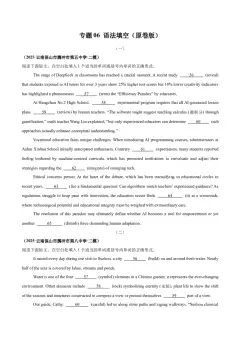
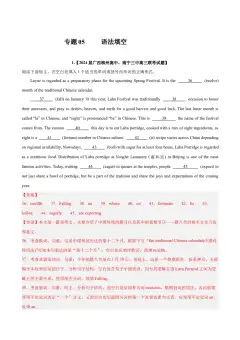
Two years after its launch, the Jakarta-Bandung High-Speed Railway, the first in Indonesia and Southeast Asia,
has safely transported more than 12 million passengers,     1     (mark) a milestone in the country’s modern
transit development.
A total of 11 sets of bullet trains and an inspection train, all adopting Chinese standards, were showcased in
Qingdao, Shandong Province in August, 2022. Then they     2     (ship) to Indonesia.
According to China Railway International, a subsidiary (子公司) of China State Railway Group,     3
oversaw (监管) the project, the trains, designed and developed by CRRC Qingdao Sifang Co., Ltd., were based on
4     (advance) and mature technologies of China-made Fuxing bullet trains which operate at the speed of 350 km per
hour. The CRRC had also made     5     (change) to adapt to the local environment and routes, and containing
Indonesia’s cultural elements made passengers travel     6     (comfortable).
The 142.3-kilometer line,     7     landmark project of the China-proposed Belt and Road Initiative,
8     (begin) construction in 2018 and was opened to traffic in June, 2023. With trains capable of     9     (reach)
speeds of up to 350 km per hour, the line cut the journey between Jakarta and the capital of Indonesia’s West Java
Province from over three hours     10     just 40 minutes.
Passage 2
(2026·山东烟台·一模)
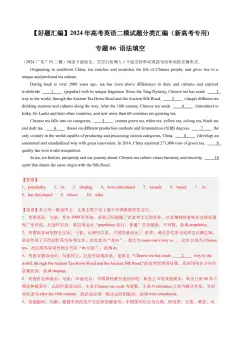
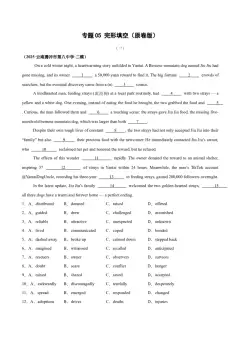
In the Mid-Autumn Festival season of 2025, specialty coffee brand M Stand    11    (partner) with Zhang
Dingjuan, a 30-year-old inheritor (继承人) of Daoming bamboo weaving (编织) . Recognized    12    our national
intangible cultural heritage, the craft, the roots of    13    date back to the Qin Dynasty, comes from Daoming
Town in Sichuan Province.
“During our    14    (collaborate) with a brand, we always look for shared elements between their identity
and bamboo weaving,” Zhang explained. “With M Stand, we focused on patterns and simplicity. The Z-shaped weave
echoes the ‘M’ in their logo, and the neutral colors match their clean, minimalist style.”
Zhang grew up watching her grandfather weave baskets. After studying product design at university, she
chose    15    (explore) the craft even further. She traveled to Daoming in person to receive training from Zhao
Sijin, the master inheritor of Daoming bamboo weaving.
One of the most    16    (wide) used materials in Daoming weaving is Yinshan cizhu bamboo    17
(harvest) at two or three years old. With long joints, thin walls and strong flexibility, it produces durable products.
  18

makes the process painstaking is that it involves dozens of complicated steps — scraping (刮) , splitting, slicing,
thinning and stretching the fibers.
So far, Zhang, together with other designers,    19    (diversify) the craft beyond traditional baskets into
earrings, phone cases and even car seat backs. A gourd-shaped bookmark she designed brought in over 100, 000 yuan
in a single month. Last year, she launched her own brand.
“I spent a decade    20    (learning) in Daoming. From making small pieces to taking on complex,
customized projects, it’s been a long and tough journey,” Zhang said.
Passage3
(2026·山东淄博·一模)
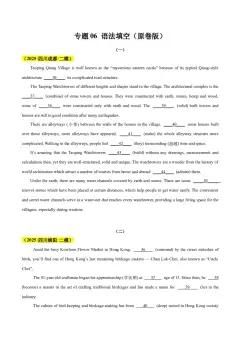
Patriotism (爱国主义) can be shown not only in the years of war but also in the years of peace. In today's era,
our country still needs patriotism     21     (realize) the Chinese Dream. The well-known figures of patriotism
we are familiar with     22     (be) the late scientists Huang Danian and Deng Jiaxian. Patriotism had been rooted
deeply in their bones, for they fulfilled their dreams of rejuvenating ( 复兴) the Chinese nation with exceptional
achievements.
The     23     (strategy) geophysicist Huang Danian, with his particular expertise in deep earth exploration
technology, has helped China take     24     lead in a number of technical fields, whether under the earth's crust (地壳)
25     in the high sky.
The nuclear physicist Deng Jiaxian, one of the founding fathers of the "Two Bombs and One Satellite" project,
made     26     (pioneer) contributions to China's cause of national defense. Up to now, their patriotic deeds and
deep affection for the motherland     27     (make) them role models, especially for the young.
Both Huang and Deng are heroes of our time,     28     tremendous contributions originate from their
hard work and patriotic feelings. With the passion     29     (pass) down to us, we should resolutely follow the
path paved by them and draw inspiration      30      their noble spirit, shouldering the mission of realizing
national rejuvenation.
Passage 4
(2026·山东菏泽·一模)
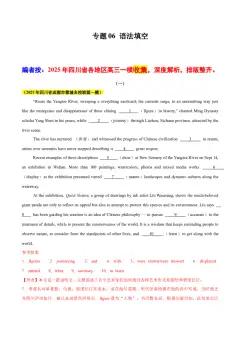
Forty-nine young professionals from different countries recently completed a 10-day training program in
China,     31     (explore) rural revitalization practices in Yunnan. The program, co-launched by China Agricultural
University and Tencent, aimed to share China’s experience in rural development with global     32     (young).
During their visit to Mengla County, Yunnan, the     33     (participant) were impressed by the “agri-
tourism integration” model in Hebian Village. They learned how Yao ethnic group’s wooden houses     34

(transform) into cozy guesthouses, and how villagers now earn income from rubber tapping, beekeeping, and
home-stay management. “We used to think rural areas could only rely on farming,” said Mirembe from Uganda. “But
here, culture and nature become treasures — this gives us new ideas     35     our villages.”
They also visited a smart coffee estate in Jinghong,     36     AI and drones are used for pest control and yield
prediction. Hakim from Indonesia, who runs a coffee workshop, noted: “China’s way of connecting small farmers to
big markets via live-streaming is eye-opening. We can adapt this to sell our Indonesian coffee     37     (global).”
A key takeaway was China’s focus on “farmer-centered development”. In Manluanzhan Village, the group saw
how     38     (abandon) water towers were turned into cafes, and how local villagers lead decision-making for
tourism projects. “China doesn’t just build pretty villages — it empowers people to own the development,” said
Mumbi from Kenya.
The program ended with a     39     (commit) to apply these lessons at home. As Tanzanian participant
Aboli put it: “China’s rural revitalization isn’t a copy-paste model,      40      a mindset of using local strengths.
That’s what we need to take back.”
Passage 5
(2026·山东德州·一模)
Drones spray (喷洒) pesticides over fields, livestreaming sales are made on smartphones, and high-speed trains
run on rail bridges     41     (stretch) across landscapes. These rural yet modern scenes appear in the paintings
of Zhang Qingyi,     42     81-year-old farmer and painter from Shaanxi province.
Farmer painting dates back to the 1950s, when it     43     (use) to serve production by promoting
agricultural knowledge and practices.     44     (ground) in authentic descriptions of life in the countryside,
Zhang’s paintings document     45     dramatically rural communities have transformed alongside the country’s
broader development.
Zhang is one of many farmer painters who are tracking China’s rural     46     (prosper) through their art.
“Stories of farmers and their life are captured into paintings,     47     serve as a living record of the daily life,” Zhang
says, adding that his inspiration often springs     48     ordinary scenes.
Supported by the local government’s push to combine agriculture with culture, a range of related initiatives
have emerged. These projects     49     (accurate) target the core goal of integration, leading to the renewal of
public art spaces. “Farmer painting is a local treasure. My goal is     50     (sow) creativity in the young so
future generations continue to portray the story of rural life,” Zhang says.
主题02 人与自我
Passage 1
(2026·山东济宁·一模)
Before I was hired, I was told part of my job in the pickle (腌菜) shop was to keep the conversation going with
customers. I’d never been talkative, so I lied on my application,     1     (claim) I was entirely at ease talking to
strangers.
Fake (假装) it till you make it and that’s     2     I did. A year later, I had no problem easing into
conversations with customers. I smiled, asked about their day and made     3     (comment) on the great sale.
Then I convinced them to buy our pickled garlic.
    4     was here that I truly learned what self-esteem is. Previously, I had always pictured it to be     5
quality only possessed by the skinny blonde cheerleaders. I’ve since come to understand a far     6     (broad)
definition of it.
Self-esteem is knowing yourself and not being afraid to let it shine. My big smile and loud laugh, which     7
(be) once a source of embarrassment, has become my trademark. Customers like my sincerity — I’m no     8

(robot) salesperson. Self-esteem is also not being completely shut down by a mistake. The other day, a customer told
me I was annoying. Prior to working here, I would have broken down,     9     with new confidence, I smiled
and apologized, knowing she was the exception, not the rule.
The pickle-shop self-esteem keeps motivating me     10     (excel) in college — two major club
involvements and a perfect 4.0 GPA.
Passage 2
(2026·山东日照·一模)
Food has long been regarded as the soul of Chinese culture. And Chinese cuisine, which is renowned for its
diversity and philosophical     11    (deep), holds the ancient art of fermentation (发酵) in particularly high
regard. This transformative process serves not only as a practical method of preservation but also as a     12    (base)
technique for unlocking complex flavor profiles. Over the past thousands of years, this traditional food-making
method, carried forward like a living heritage,     13    (pass) down from generation to generation, shining
brightly in the long river of Chinese food culture.
Beyond everyday seasonings     14     soy sauce and vinegar (醋), which are themselves products of
fermentation, more distinctive creations can be found. Southern cuisines, such as     15     of Guangdong, rely
on fermented seafood or beans to form the essential flavorful foundation for numerous dishes. In Sichuan, paocai
(pickled vegetables) provides a sharp counterpoint to the region’s fiery chilies, thus     16    (create) a thrilling
yet balanced taste sensation.
The most iconic example is perhaps fermented tofu (furu),     17     humble beancurd is transformed by
microbes (微生物) into a product with a creamy texture and a cheese-like flavor. This tasty food,     18     enjoyed
as a fragrant, flavor-packed seasoning or as a steaming, delicious street snack,     19    (reflect) a core cooking
principle: transforming simple ingredients into lasting sources of taste.
Indeed, fermentation represents where microbiology meets gastronomy. To explore them is to taste an essential
pillar of China’s food heritage— one     20    (preserve) through time and folk wisdom.
Passage 3
(2026·山东东营·一模)
In early November, seeders moved up and down the fields, placing wheat seeds in the soil in     21

agricultural district of Dongying, Shandong province. It’s hard to imagine back in 2010, nothing would grow on the
bare, white stretch of saline-alkaline land (盐碱地), just thin cotton with     22     (pitiful) low yields. “The
land     23     (consider) worthless. Fellow farmers rented it to me for only 50 yuan per mu,” said Li Dianquan, a local
farmer.
On the shores of the Bohai Sea where the winding Yellow River     24     (empty) into the ocean,
Dongying’s landscape has been shaped by an unusual geographical legacy. The gradual withdrawal of seawater over
time left behind salt deposits     25     have created 227,330 hectares of saline-alkaline land.
“In the autumn harvest season, Shandong’s landscape is a colorful palette (调色板),     26     the last
color we want to see is the white of saline-alkaline land,” said Wang Jingdong, an official of the Department of
Agriculture. This year farmers started planting a new strain of wheat, which has resistance     27     pests and
diseases.
The fourth general conference called for enhancing overall agricultural production performance, quality and
28     (efficient). Saline-alkaline land use is a crucial part of this effort, which holds significant strategic importance
for safeguarding national food security and     29     (ensure) China’s food supply remains firmly in its own
hands. Shandong is exploring a path     30     (characterize) by ecological prioritization and technological
support.
主题01 人与社会——文化与生活
Passage1
(2026·山东滨州·一模)
An international sculpture exhibition marking the Year of the Horse is underway at Inzone Harmony in Beijing.
Curated by renowned Chinese sculptor Sun Longben, it     1     (feature) horse-themed works by Chinese and
Russian artists.
For Sun, the horse is a loyal companion     2     (embody) speed, freedom and ambition. He also views
it as a symbol closely connected with ancient military glories and national unity in Chinese culture.
Sun highlights three ancient Chinese masterpieces     3     have deeply influenced modern art. The bronze
“Galloping Horse Treading on a Flying Swallow” from the Eastern Han Dynasty     4     (celebrate) for its
romantic charm. Another significant work is “The Six Steeds of Zhaoling,” Tang stone reliefs ( 浮雕) which Sun
sees     5     the beginning of thematic creation in Chinese art. Additionally, the stone statue of a galloping
horse at General Huo Qubing's tomb pioneered the “xieyi tradition”,     6     artistic style focusing on “sketching
the spirit”.
Drawing on his education at Russian academies, Sun notes Russian art also values the horse as a symbol of
heroism and victory. In many Russian sculptures, ancient heroes are portrayed on horseback,     7     the
Anichkov Bridge in St. Petersburg is famous for its four grand horse statues.
The exhibition beautifully bridges Chinese and Russian cultures through its featured works. Pavel Shevchenko's
sculpture of a water-drinking horse, for instance,     8     (subtle) refers to a Chinese idiom about gratitude,
while Sergey Kubasov's striking winged horse conveys wishes for     9     (prosper) and good fortune in the
Year of the Horse. This unique event offers a wonderful opportunity     10     (appreciate) the shared artistic
spirit across two nations.
Passage2
(2026·山东临沂·一模)
The first Lighting Xi’an Festival was launched at Xi’an city square. It was titled Geometry of Light,      11
combined traditional culture with modern design, as a joint effort between the management of Xi’an city square and
the art platform WAVELENGTH.
The festival,     12    (feature) works of international light artists, demonstrated their representative works
with site-specific creations tailored to Xi’an’s rich cultural context.     13     (root) in the belief that light is the
source of life and inspiration, it explored light’s nature: a spiritual geometry born from the meeting of human and
reality.
During its opening, two core topics     14    (address) in the discussions: the shared success of commerce
and cities and the integrated innovation of art and business. Event     15    (organizer) shared their insights into
several key areas: the designing philosophy dating back to the     16    (evolve) of public perception, the
customization of digital art, solidly based     17      Xi’an’s local culture, and the potential interaction between
technology and art.
The festival is not merely an endpoint but rather a starting point for sustained development, the target of which is
18    (continue) building and strengthening the cultural brand, thereby further integrating artistic beauty with public
spaces to     19    (significant) boost urban cultural vitality, enhance commercial experiences,     20     ultimately
foster the mutual growth of culture and commerce.
Passage3
(2026·山东青岛·一模)
Being an exchange student, I use my camera to bridge cultures and capture moments from the country I call
my second home.
Traditional Minnan-style houses, with roofs     21     (distinct) curved and walls time-honored, stood
shoulder to shoulder. The     22     (rhythm) calls of free-range chickens provided background music for our
shoot, occasionally interrupted by the distant laughter of villagers passing along the paths.
What     23     (strike) me most was such plain warmth. A woman rode past with a basketful of leafy
greens, her feet barely touching the ground as she slowed     24     (exchange) greetings with neighbors. At the store,
the owner,     25     (wear) a gentle smile, wiped his hands carefully before weighing out dried mushrooms
26     regular customers.
In that instant, I felt I was carried 3,000 kilometers south to my grandmother’s village. Though the landscape
differed, the essence remained unchanged: that familiar village ecosystem     27     shopkeepers remember your
favorite childhood treats and     28     (local) catch up on the latest news.
This is the China I have come to know. It is not just through its high-rises and express trains,     29     in these
pockets of everyday life that ring across cultures. The world stretches wide yet draws near, connected together by the
shared     30     (kind).
Passage 4
(2026·山东枣庄·一模)
For the past three months, French artist Roy Kohnke has been cycling through Beijing’s hutongs and parks,    31
(turn) the ancient capital into both his studio and muse.
He has explored art zones, museums, and cultural sites, each journey fueling his endless    32    (inspire). “It’s
my first time in China, a country so big and different. There’s so much    33    (discover) and explore,” says
Kohnke. He recalls being deeply impressed by the ancient bronze ware and intricate brick carvings at the National
Museum of China, photographs of    34    now inform his art.
During his stay last month at Beijing’s Choi Centre Cloud House —    35    cultural center blending
modern and traditional architecture — he    36    (use) laser-cutting technology to create paper-based works that mix
sculpture and drawing.
Beyond cultural heritage, Kohnke is also    37    (interest) in China’s technological landscape. He plans
to visit factories producing paper and laser-cutting facilities to    38    (well) understand his materials, which he
believes is crucial to artistic expression.
Although his three-month residency is ending, Kohnke sees this    39    just a beginning. “I prefer building
long-term connections with the places I work in,” he says. He views art as a powerful channel for cross-cultural
communication    40    (root) in sensory experience.
Passage 5
(2026·山东潍坊·一模)
A comprehensive guide to Qinqiang Opera has recently been published in Beijing.     41     (title)
Qinqiang Opera, the volume serves as both an art companion and a visual album, featuring over 300 high-definition
stage photos and detailed hand-drawn illustrations that offer readers     42     thorough look into the complex
artistry and its thousand-year evolution.
The book represents a great contribution to the urgent efforts to document and safeguard the intangible cultural
heritage. Not only does it trace the art form’s development over a thousand years, but it also     43     (vivid)
captures the artistic lives and     44     (dedicate) of the inheritors (传承人), highlights the stagecraft of master
performers,     45     explores the creative work of key institutions. Together, these elements create a dynamic,
modern record of Qinqiang Opera as a living cultural tradition.
Author Ding Kemin explains that Qinqiang Opera     46     (undergo) rapid development in its musical
and performative structure, reaching its peak during the periods of Emperors Kangxi and Qianlong in the Qing
Dynasty,     47     it enjoyed nationwide influence.
Despite     48     (it) rich heritage, most existing publications on the subject are aimed at specialists and
professionals, leaving a gap in accessible materials for general readers. Thus, Ding created the book     49    (bridge)
scholarship and popular understanding, combining ancient tradition with youthful appeal, and classic art with modern
presentation.
The book aims to introduce Qinqiang Opera to a     50     (broad) audience and bring the art form beyond
professional circles, he says.
Passage 6
(2026·山东济南·一模)
The first China-Pakistan Fashion Show,     51     (joint) organized by the Pakistani Embassy (巴基斯坦
大使馆) in Beijing and the China International Cultural Communication Centre  (CICCC), took place at the Badaling
section of the Great Wall,     52     UNESCO World Heritage site. The venue,     53     marked the 60th
anniversary of the first visit by a Pakistani president to the Great Wall, held special significance for both sides.
Titled “Silk Road Elegance: Two Nations, One Runway”, this event celebrated cross cultural artistry and
sought     54     (strengthen) the long-standing brotherhood between the two countries. It put Pakistani artistry
front and center, with emerging Pakistani designers showcasing innovative creations inspired by Pakistani truck art
while also     55     (integrate) Chinese cultural elements. Aqeel Chaudhary, a Pakistani designer     56     (base)
in China for years, presented a wonderful jewelry (珠宝) line, while Chinese designer Liang Suyun’s works also
57     (shine) on the catwalk.
Senior     58     (official), including Pakistan’s Ambassador to China Khalil Hashmi and CICCC Chairman
Long Yuxiang, underlined the event’s deep significance, highlighting it     59     more than a cultural display —
it was also a reflection of the two nations’ strategic, all-weather partnership. Organizers hope the show will     60
(far) strengthen commercial ties and promote expanded exchanges in art and music.