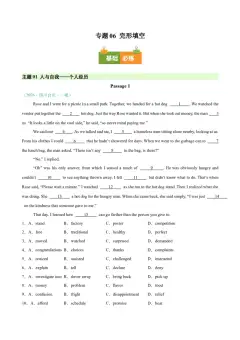
专题06 知识运用之语法填空
主题01 人与自我——人生哲理;跨文化交流
Passage 1
(2026·高三·湖南长沙银桥中学·一模)
The Power of Perseverance
Success rarely comes overnight. It is often the result of consistent effort and the courage to face challenges.
Many people dream of achieving great things, but only those     1     are willing to work hard truly succeed.
Thomas Edison, for example, failed thousands of times before     2     (invent) the light bulb. When asked about
it, he said, “I have not failed. I’ve just found 10,000 ways that     3     (not work). “ His story teaches us that
failure is not the opposite of success; it is a part     4     it.
The journey towards any goal is like climbing a mountain. The path     5     (be) steep and rocky at times.
You might feel like giving up,     6     you must keep moving forward. Every small step you take brings you
closer to the summit. Remember, progress     7     (make) not by giant leaps, but by continuous, determined
steps. It is during our     8     (hard) struggles that we discover our true strength. So, instead of     9     (fear)
difficulties, embrace them as opportunities to grow. After all, the view from the top is always worth the climb, and
the person you become in the process is the greatest reward of     10    .
Passage 2
(2026·高三·湖南湘潭部分学校·一模)
Hadiya Msham Abdulla and Dilxat Tursun met in 2013 in Fuzhou, while Dilxat was pursuing his undergraduate
degree at Fuzhou University at that time. Hadiya was     1     international student majoring in medicine at
Fujian Medical University. The two campuses are neighboring, separated only by a road, creating a shared social
scene that includes a restaurant     2     (specialize) in Xinjiang cuisine. It was a matter of time before they
would encounter each other, because they     3     (frequent) the restaurant.
They married in 2020 and welcomed a     4     (delight) son into their family. However, the couple soon
found themselves longing for something     5     the limits of traditional careers. “Owning our own cafe was a
shared dream,” Hadiya explained. Their dream took flight in 2022     6     they opened their cafe successfully.
Despite its modest size, the café witnesses many regular     7     (guest) and is filled with the couple’s
cherished memories. With the coffee beans     8     (source) from Tanzania, the couple ensured the quality of
the coffee they made. “We combine two cultures here,” Hadiya confidently said. “You     9     (definite) won’t
find this taste anywhere else.”
The industrious couple have also returned to Tanzania for coffee bean planting and processing      10

(explore), passionately promoting the charms of Kashi to their friends and family there.
主题02 人与社会——传统工艺;青少年健康;传统文化;饮食文化;历史遗迹;移动支付;
体育文化
Passage 1
(2026·高三·湖南天壹名校联盟·一模)
In recent years, Chinese decorative boxes have gained popularity in the global gift and packaging market,
1    unique combination of traditional skills, modern design, and cost-effectiveness has made them the go-to choice
for retailers (零售商)and importers.
Chinese decorative boxes usually feature awesome    2    (detail), such as silk linings, lacquer (漆)finishes
and fancy patterns inspired by centuries-old cultural ideas. Whether it’s for weddings, festivals, birthdays,    3

business gifting, these boxes offer a rich visual appeal that    4    (enhance)the perceived value of any gift.
What sets Chinese decorative boxes apart is their capability    5    (integrate) traditional art forms with
modern functionality. Manufacturers have    6    (smooth) combined technologies like laser cutting, UV printing,
and sustainable materials with age-old techniques such as embroidery (刺绣).The amazing integration makes each
box a piece of art as well as a practical packaging     7     (resolve).
Chinese manufacturers offer extremely    8    (compete) pricing thanks to economies of scale,well-
established supply chains, and efficient production processes. Even with high-end looks, the cost remains significantly
lower compared to Western companies, giving resellers and retailers more profits     9     lowering quality.
In today’s retail landscape, presentation matters more than ever. Chinese decorative boxes are not just a
container; they are a key part of the unboxing experience. Their cultural charm is together with usefulness and
affordability,    10    (make) them the perfect fit for businesses looking to stand out.
Passage 2
(2026·高三·湖南·一模)
Over the past years, Suzhou in Anhui Province has rolled out a range of    1    (initiative) to boost the
physical and mental health development of teenagers, which are producing remarkable outcomes. For instance, at the
city’s minor psychological (心理的) health consulting center, teenagers can release stress and stay active    2    (use)
tools such as VR exercise bikes and inflatable boxing targets. This year alone, so far the center    3    (conduct)
psychological assessments for more than 1 million teachers and students.
Miao Xunhong, mother of    4    participant, says she can see the positive influence of sports on her child.
She mentions that her son used to    5    (stick) at home but now he is more eager to go out, socialize and exercise
even on rest days and his psychological assessment results also have improved since joining team sports.
“The benefits of sports now extend    6    the court and campus and into our home. As my son has become
more lively and outgoing, our relationship has improved. Furthermore, through competitions, winning and losing, he
has learned resilience (坚韧不拔), helping him develop reflective abilities    7    a tougher mindset,” Miao
adds.
This year, Suzhou plans to expand its cooperation with more schools to establish a    8    (comprehend)
sports development framework    9    facilitates young athletes’ growth. Professional coaches will make weekly visits
to schools, co-teaching physical education classes alongside school teachers and providing specialized after-school
training, ensuring skill    10    (enhance) and sustained progress.
Passage 3
(2026·高三·湖南衡阳县一中·一模)
China Media Group unveiled the theme for the 2026 Spring Festival Gala, the country’s most-watched televised
event, tapping into     1     spirit of the upcoming Year of the Horse with the phrase: “Galloping Steeds,
Unstoppable.”
The theme, in Chinese “Qiji Chicheng, Shibukedang”, draws     2     the image of the “qiji” — a legendary
thousand-li horse from classical poetry     3     symbolizes perseverance and achievement. “The horse in the
Chinese zodiac (生肖) represents vitality and forward momentum (势头),” a CMG spokesperson explained. “This
theme reflects our collective drive as we enter a new development period.”
The official logo brings the theme to life,     4     (show) four powerful horses surging upward together.
The design mixes ancient Chinese patterns with a modern style. Designers say the “galloping pattern” can extend
infinitely, creating a sense of boundless energy and     5     (unite).
For the 2026 show, producers promise a blend of traditional     6     (performance) and cutting-edge
technology. The gala will feature popular singers, dancers, comedians, and — in a nod to its roots — everyday people
sharing their stories. Advanced stage technology     7     (use) to create an immersive experience for both the
studio audience and viewers at home.
Since its first major television broadcast in 1983, the Spring Festival Gala     8     (become) a cultural
icon, uniting families on Lunar New Year’s Eve     9     showcasing Chinese culture to a global audience. The
2026 edition, championing a spirit of     10     (stoppable) progress, aims to welcome the Year of the Horse with
energy and hope.
Passage 4
(2026·高三·湖南师大附中·一模)
Longevity noodles are not merely a dish but a cultural symbol representing the wish for along and rich life.
Chinese tradition is     1     the length of the noodle is directly associated with the length of the consumer’s life,
making it an essential part of birthday celebrations, especially for the elderly. The concept is simple yet far-reaching —
cutting the noodles is considered bad luck as it might symbolically     2     (short) one’s life.
In Dali, Yunnan province, longevity noodles are a highlight among the hundreds of local snacks. The
extraordinary feature of these noodles is their length; a single noodle is long enough     3     (serve) as many as 1,000
people. This practice not only shows cooking skills but also stresses the     4     (collect) aspect of dining, as
many people share from a single noodle,     5    (strengthen) social bonds.
Sometimes, in Lanzhou, Gansu province, Lanzhou beef noodles     6     (refer) to as “longevity noodles”.
These noodles are classified into more than ten types     7     (base) on thickness, suiting different age groups.
The thinner noodles are particularly associated with longevity, as they are easier for older individuals to eat, making
them popular among the elderly     8     consume them as a regular part of their diet.
In traditional settings, the noodles are pulled by hand,     9     technique that requires extensive training
and practice. This method of hand-pulling ensures that the noodles are     10     uniform thickness and texture.
The art of making longevity noodles is often passed down through generations, with each family or chef adding their
unique touch to the dish.
Passage 5
(2026·高三·湖南郴州市·一模)
In Tijuca National Park in Rio de Janeiro, there stands a “Chinese Pavilion”. It was constructed    1
(honour) 19th-century Chinese immigrants who boosted Brazil’s tea industry. Between 1812 and 1888, over 1,000
farmers migrated under agreements. They introduced advanced tea-processing    2   (technique) , which laid the
foundation for Brazil’s short-lived but    3   (influence) tea trade.
The pavilion combines Chinese architecture—styled eaves, six-sided frames, and    4   (point) roofs—with
Brazilian materials. Nestled in the world’s    5   (large) urban rainforest, it overlooks Rio’s landmarks including
Corcovado Mountain and Christ the Redeemer.
In 1812, the first Chinese immigrants to Brazil planted tea trees in    6    is now the Rio de Janeiro
Botanical Garden, a witness to the China-Brazil friendship. More than 200 years later, these tea trees have become a
deep-rooted part of Brazil’s cultural heritage. In 2003, on the 100th anniversary, commemorative plaques(牌匾)were
added,    7   (detail) its history in Portuguese, English, and Chinese.
Today, visitors to Rio’s Tijuca National Park may encounter the elegant pavilion. This landmark serves as
8    reminder of Brazil’s respect for the pioneers.    9    the vast distance between China and Brazil, the bridge
built through tea has brought the two nations closer than ever. The pavilion     10    (list) on UNESCO’s World
Heritage List in 2024, attracting visitors interested in eco-cultural tourism.
Passage 6
(2026·高三·湖南华大新高考联盟·一模)
When I set off in 2008 from Nashville in the U.S. for Shenyang, China, my wallet was filled with cash and
credit cards. Seventeen years later, my wallet   1   (gather) dust. My smartphone handles everything about
payment.
In my early days in Shenyang, cash ruled. Today, even an elderly   2   (sell) at the local market greets
customers with a payment QR code ( 二维码). China's mobile payment development,   3   (push) by many
advanced mobile software platforms, has been a way of life. These apps process some 500 trillion yuan   4   (annual),
connecting people to services ranging from public transit to healthcare.
The next hit came in late 2019 with   5   launch of the pilot programs of digital yuan, a state-backed currency
designed   6   (function) both online and offline, which safeguards privacy and reduces transaction (交易) fees.     7
the popularity of American mobile payment service Venmo, digital yuan is   8   (efficient) than physical cash and
heightens my perception of safety. By the end of June 2024, China's e-CNY transactions increased to 7 trillion
yuan.
China's innovations are drawing global attention.   9   (create) projects like mBridge, a cross-border payment
project involving the Chinese mainland, Hong Kong Special Administrative region, Thailand and the United Arab
Emirates, are testing the e-CNY for international trade,   10   aim is to simplify transactions and lessen reliance
on systems like SWIFT, the U.S-dominated global banking network.
Passage 7
(2026·高三·湖南益阳市·一模)
With a performance inspired by the Terracotta Warriors, the Chinese artistic swimming team     1

(conclude) their World Aquatics Championships campaign in Singapore on July 25, as they secured a gold in the
team acrobatic event, bringing their total medal tally to four golds and three silvers in the tournament with gold
medals in all three team events.
    2     (wear) golden headbands symbolizing the legendary Monkey King, China’s artistic swimmers
brought the myth     3     life in a powerful Wukong-inspired routine to win gold in the team technical event at
the 2025 World Aquatics Championships last Tuesday. Their performance,     4     (base) on the popular Chinese
video game Black Myth: Wukong, earned China 307.8001 points.
Performing a routine titled “Soul of the Terracotta Army”, the Chinese team topped the preliminary ( 预赛)
round     5     carried that momentum (势头) into the team acrobatic final,     6     they scored 229.0186
points to secure the gold.
Chinese head coach Zhang Xiaohuan expressed immense pride in promoting Chinese culture on the international
stage. “We never miss opportunities     7     (showcase) our culture on special platforms — it’s     8     (true) our

greatest honor,” Zhang stated.
“When performing Chinese-themed routines, five millennia of cultural heritage serves as our bedrock,” double
Olympic artistic swimming gold medalist Wang Qianyi told China Daily and Xinhua on July 28. “Our culture gains
global     9     (recognize), and we’re confident to embody and present      10      to the world through
our efforts and performances.”
主题03 人与自然——动物保护
Passage 1
(2026·高三·湖南永州市·一模)
Moscow Zoo hosted a week-long celebration, starting on Sunday, to mark the second birthday of Katyusha,
the first giant panda born in Russia.
The zoo    1    (decorate) with traditional Chinese elements, including red lanterns and festive displays.
Celebrations featured lively dragon dances, tea ceremonies,    2    educational workshops on panda conservation.
The parade created a carnival atmosphere, with crowds cheering and laughing as the dragon wove through the
pathways. Visitors enjoyed interactive    3    (activity), such as handmade craft sessions and thematic tours
showcasing animals native to China.
Katyusha, the center of attention, received a specially crafted birthday cake made of bamboo, fruits, and ice
carved into the number “2”,    4    (mark) the panda's age in a display combining Chinese tradition with zoological
enrichment. Dedicated zookeepers went to great lengths    5    (refresh) her and keep both her mind and body
active and enriched Katyusha’s daily life by adding edible (可食用的) decorations and hiding food in new toys. She
enjoyed a bamboo playhouse filled with treats,    6    she enthusiastically unpacked to find the    7    (hide)
biscuits.
Moscow Zoo Director Svetlana Akulova shared updates on Katyusha’s growth, noting that Katyusha is    8
unique example of natural upbringing and a key part of Sino-Russian    9    (science) research on giant pandas.
Zhang Wei, minister counselor at China’s embassy in Russia, attended the event, saying: “Katyusha is not only a
special    10    (represent) of cultural exchange but also a beloved star on social media in both countries.”
主题01 人与社会——体育经济;体育历史;非遗文化;国防科技;科技伦理;人工智能
Passage 1
(2026·高三·湖南怀化市·一模)
The 2025 “Xiangchao” (Hunan Football League) was far more than a sports event; it was     1     social
phenomenon that breathed new life into the province. Initially starting as local games, these events quickly crossed
the boundaries of the sports field and brought together people from all walks of life, all     2     (unite) by their
love for the game.
The real magic happened beyond the pitch. Stadium squares were transformed into lively night markets,     3
the air was filled with the inviting scent of local delicacies. This “event+consumption” model     4     (prove)
to be a powerful engine for the local economy. More importantly, it offered a unique platform to showcase rural
specialties, from house-made chili sauce to local rice noodles, helping these products reach     5     (wide)
audiences and boosting farmers’ incomes.
However, the most profound impact was on community spirit and youth development. Inspired by the players,
many youngsters     6     (draw) from screens to sports fields. In some villages, retired players and college
students even started organizing free coaching and tutoring sessions beside the new courts,     7     (combine)
physical training with academic support. This spirit of self-reliance and joint effort is exactly     8     drives
sustainable rural revitalization.
Thus, a simple football has kicked     9     wide-ranging developments — powering the economy,
connecting communities, and building a brighter future. It shows how sports can go beyond     10     (compete) to
become a force for social good.
Passage 2
(2026·高三·湖南岳阳市·一模)
Golf: China’s ancient game?
A mural painting of Yuan dynasty-era chuiwan(捶丸)     1    (preserve) on the wall of a Water God
Temple in Hungtung county, Shanxi province at present. The painting depicts a Mongolian official, some Han officials
and assistants. The sticks and devices are fairly identical to     2     of modern golf.
It is generally recognized that the Scots may well have made     3     a game of 18 holes. But the jury’s
still out on who first came up with the idea of an open-air game     4     players use a stick to hit a ball towards a
target. The most fascinating—and in many ways convincing—evidence of an early version of golf     5

(document) in history comes from China.
A game called chuiwan—chui meaning to hit and wan meaning ball—became popular in the Song dynasty.
Players used ten clubs to hit wooden balls towards     6    (bright) coloured flags. There was even an early
equivalent of the R&A Rules of Golf: Classic of the Ball, published during the Yuan dynasty. It lays out the rules,
and places great emphasis     7     sportsmanship and correct behaviour—echoes of modern golf, where
etiquette(礼仪) is such an important element of the game. There’s also a     8    (refer) in an ancient book to an
official of the Southern Tang dynasty     9    (tell) his daughter to“dig holes in the ground” so he could hit a ball
into them using a special stick.
The debate over who got there first will go on,     10     at least one thing is certain. Chuiwan, played by
Chinese emperors 1,000 years ago, certainly qualifies as a royal and ancient game.
Passage 3
(2026·高三·湖南邵阳市·一模)
The Zigong Lantern Festival, a time- honored tradition     1     roots tracing back to the Tang and Song
dynasties, has developed into a globally recognized cultural phenomenon, celebrated as a Chinese National Intangible
Cultural Heritage.     2     (originate) from local customs like “Lion Lamp Market” and “Lantern Pole Festival”
during the Qing Dynasty, it now stands as a stunning example of     3     traditional art continuously reinvents
itself.
This festival is not merely a local celebration     4     a significant event on the international cultural
calendar, having illuminated over 80 countries and regions, accounting for 92% of the overseas lantern exhibition
market share.
A defining characteristic of Zigong lanterns is their     5     (invent) use of materials. Artisans skillfully
employ everyday items such as porcelain tableware, glass bottles, and even silkworm cocoons     6     (construct)
intricate and colossal lantern sets.
This creativity is     7     (power) combined with modern technology. LED energy- saving light sources
have replaced traditional ones, reducing energy consumption by over 40%. Furthermore, the integration of AI
interaction, 3D printing, and augmented reality     8     (create) immersive experiences, such as the “Dinosaur
Valley,” which fascinates millions of visitors.
The festival’s international journey, which began in 1990 in Singapore, demonstrates     9     successful
model of cultural exchange.  To enhance cross - cultural appeal, designs now incorporate globally popular elements,
including collaborations with international IPs, while the core craftsmanship remains authentically Chinese. This
strategic fusion, along with supportive policies like “lantern culture loans,” has propelled its annual cultural exports
to exceed $50million. Ultimately, the Zigong Lantern Festival serves as a luminous bridge, showcasing China’s
cultural confidence and its      10      (commit) to sharing artistic beauty with the world.
Passage 4
(2026·高三·湖南株洲市·一模)
China displayed an amazing military parade (阅兵) on September 3, 2025. As all kinds of military equipment
made the first    1    (appear) in public, netizens joked that “all the Chinese are turning into military fans”.
“Made in China” and “main battle equipment” — these were no doubt the key words for the military equipment on
parade with our nation’s strategic property    2    (dominate) the entire scene.
The confidence of our great country comes from the “nuclear”. The moment of the DF-61 appeared, it quickly
shot to the top of trending    3    (search). The DF-5C    4    (describe) as the “ace (王牌) of aces” in the
calmest tone of the commentator that delivered the most exciting line: “Its strike range covers the entire globe. It is
5    alert all the time, provides effective deterrence (威慑), uses strength to secure peace, and anchors the balance
of the world.”
Also drawing attention on site    6    (be) some of the new-domain, new-type forces    7    looks left
many netizens wondering if they had stepped into the future, remarking that “military equipment from science fiction
films has entered reality”.
What people witnessed on    8    big day was not only the brilliant military parade but also the inspiring
image of a nation that has risen steadily, grown prosperous and become    9    (power). “May we meet again
when China rises in the world.” The dream Premier Zhou Enlai penned years ago is     10     (undoubted)
becoming a fact.
Passage 5
(2026·高三·湖南株洲一中·一模)
Increase your productivity. This is    1    AI tools attract its users. However, despite hopes that the
technology will improve the    2    (efficient) of work, not everyone is on board.
According to BBC, 59 percent of men aged 18 to 65 around the world use generative AI at least once a week,
compared    3    51 percent of women. The gender gap is even    4    (wide) among younger people; 71
percent of men and 59 percent of women aged 18 to 24 use generative AI weekly. Why are women less open to AI
than men?
According to AI expert Jodie Cook, this gap reflects the underrepresentation of women in STEM fields (science,
technology, engineering and mathematics). “For ages, STEM fields    5    (lead) by males. The current pattern in
the use of AI tools appears    6    (mirror) this difference,” Cook told the BBC.
Certain patterns in female thinking might also play    7    role. In a survey of 486 students,    8
(divide) by academic performance, researchers found that high-performing female students were more likely to use
ChatGPT only when it had been allowed by their professor. “It’s the idea that I have to do it on my own without    9
 (take) shortcuts,” Cook explained.
For some experts, women’s reluctance (不情愿) to use AI is troubling, as it could lead to technology being
designed more for men. Others, however, are less alarmed, pointing out that AI may right now act more as a “digital
toy”, and women may     10     (simple) be better at avoiding distractions.
Passage 6
(2026·高三·湖南湘西州·一模)
The three-day World Humanoid Robot Games, the first large-scale global event of its kind, officially kicked
off in Beijing, China, on Friday, August 15, 2025. It has drawn widespread attention as a historic opportunity    1
(display) humanoid robot technology.
Over 500 humanoid robots,    2     (represent) 280 teams from 16 countries including the US, Germany
and Japan, are competing in a range of sports such as soccer, running and boxing.    3     (operate) remotely by
their human teams, these robots not only compete for gold medals but also undergo tests for     4     (flexible)
and skill across 26 events — gymnastics, track and field, martial arts, and more.
Thursday evening’s opening ceremony     5     (feature) a series of impressive performances: robots
danced hip-hop, demonstrated martial arts moves,    6     played musical instruments like the keyboard, guitar
and drums.
The event comes as China has stepped up efforts to develop advanced AI-powered humanoid robots. During
the ceremony, robots also showcased their athletic abilities in soccer and boxing,     7    a large audience cheering
them on. In one soccer segment, a robot player scored a goal after a couple of    8    (attempt), knocking the
opposing robot goalkeeper to the ground; another robot fell but quickly stood up unassisted. They even joined human
models for a clothing show, though one robot tripped over and had to     9     (carry) offstage by two humans.
Among the audience was a senior government official from Beijing,     10     , when asked about the
significance of the ongoing World Humanoid Robot Games, emphasized that every humanoid robot taking part in
this groundbreaking international event “is creating history” through its participation in various athletic and skill-
based competitions.
Passage 7
(2026·高三·湖南·十月监测联考·一模)
The 2025 Reviving Craft — China’s Intangible Cultural Heritage and Contemporary Design exhibition was
held at Palazzo Serbelloni in Milan from Oct 3 to 12.
The exhibition     1     (organize) jointly by Sun Media Group and the Italy China Council Foundation.
2     the theme “A Narrative of Social Life”, the exhibition focused on the role of culture in social interactions,
3     (deepen) a mutual appreciation between Chinese and Italian audiences through dialogues of art and the     4
(wise) of their civilizations.
Structured through two interwoven parts, the exhibition space blended philosophical thoughts with aesthetic
feelings. The exhibition featured four     5     (theme) areas — Banquet, Salon, Merenda, and Opera. Through
exhibits that incorporated both intangible cultural heritage     6     contemporary designs, such as clothes,  jewelry,
furniture, porcelain (瓷器), wine vessels, and tea, they examined the different relationship between  humans, social
activities, fashion, and cultural heritage.
The exhibition broke away from     7     (convention) methods, employing immersive displays, stories
based on real life, and creative expressions. It also     8     (include) multimedia techniques and interactive AI
devices,     9     helped to facilitate an artistic journey that fostered     10     deeper appreciation for the
cultural depth and  lasting charm of Chinese intangible cultural heritage.
主题02 人与自我——职业成长;文学人物
Passage 1
(2026·高三·湖南长郡中学·一模)
Few people can truly touch the soul of 3000-year-old ancient Shu civilization, but 28-year-old digital restorer
Lin Mo can. One of her core tasks is working      1      (restore) the broken sacred bronze tree from Sanxingdui
Ruins, using cutting-edge 3D scanning technology. One of her most cherished memories is sitting in the lab,held
2      the quiet magic of the ancient relics,piecing together the tiny bronze      3      (fragment) on the
screen.The fragments are fragile,but she feels a strong connection to the ancient craftsmen, her eyes      4     (lock)
on the delicate cloud patterns like they were a hidden language,     5      (amaze) and respect filling her heart
with every successful match.The lab has a quiet hum of machines,but her focus overshadows all the noise, a sense of
achievement      6      always turns into a soft, proud smile.
Lin Mo would find endless charm even in the most repeated checking work.I remember      7      (visit) her
lab, watching her zoom in on a 0.1-mm crack over      8      high-definition screen like exploring an unknown world.
She would adjust the 3D model slightly, the soft light casting shadows on the virtual bronze      9      her voice
explained gently the story behind every line.
I realise now that Lin Mo didn’t find the wonder in the cold metal fragments:she created it. Who cares if you
spend days restoring a single broken piece? Life is full of so many       10      (seem) ordinary moments,but
we can bring the long-buried civilization back to life in the digital age.
Passage 2
(2026·高三·湖南衡阳市·一模)
San Mao, born Chen Ping, is     1     cultural representative in Chinese-speaking communities for her
groundbreaking travel literature.
Her work Stories of the Sahara,     2     was published in 1976, is rich     3     stories and vivid
descriptions of local cultures, offering readers a rare window into cross-cultural interactions.
San Mao’s decision to live in the Sahara was     4     (original) seen as adventurous. But her ability to
connect with Sahrawi communities despite language barriers highlighted her belief in     5     (universe) human
empathy. Decades after her passing away, San Mao’s books remain bestsellers, and her influence extends beyond
literature. Many people visit her former homes in the Canary Islands, follow her steps in the Sahara     6     regard
her as an inspiration to pursue unconventional lifestyles.
“The desert is not just sand, but a     7     (reflect) of one’s soul,” she writes in Stories of the Sahara.
This philosophy resonates (共鸣) with modern readers     8     (seek) meaning apart from material success. As
Singaporean-British author Sharlene Teo notes, “Her stories about identity and belonging feel more relevant than
ever in a divided world.”
For generations, San Mao’s work     9     (show) that travel can be a form of self-discovery. Her legend
proves that literature, when      10      (base) on authenticity (真实性), can bridge cultures and inspire
changes.
主题03 人与自然——清洁能源
Passage 2
(2026·高三·湖南衡阳八中·一模)
Egypt’s largest wind power project is to be designed and built by a Chinese company PowerChina,     1
is viewed by insiders as a milestone in the country’s renewable energy sector and     2     (demonstrate) the
growing global influence of Chinese energy and infrastructure firms.
This initiative is primary for Egypt’s goal     3     (source) 42 percent of its energy from renewables by
2030, with     4     expected annual output of over 4.3 billion kilowatt-hours, highlighting Egypt’s commitment to
reducing fossil fuel dependence.
The project, following PowerChina’s     5     (early) wind power facility in the region, sets a new record for
the company’s largest overseas project to date. For PowerChina, the project strengthens its position     6     a
global leader in renewable energy infrastructure, showing the competitiveness of Chinese companies in the global
clean energy market.
The project,     7     (involve) Saudi Arabia’s ACWA Power and support from the European Bank for
Reconstruction and Development (EBRD), is an example of international collaboration in large-scale renewable
projects. It will be developed and operated under an independent power producer model, with fund     8     (support)
by international institutions, including the EBRD.
PowerChina will oversee the project’s design, procurement, construction, commissioning, handover and
warranty (保修). The project     9     (expect) to generate over 4.3 billion kWh annually once operational,
providing clean and stable energy for more than 1 million households in Egypt.
The project’s impact on carbon emissions—a reduction of 2.2 million metric tons every year—and its     10
(provide) of clean energy to over 1 million households will have more long-term benefits.