专题06 语法填空
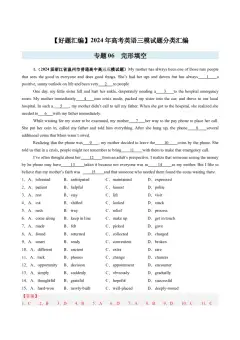
主题01 人与社会
Passage 1
(2026·河南开封·二模)
 阅读下面短文,在空白处填入1 个适当的单词或括号内单词的正确形式。
Traditional Chinese Medicine (TCM), with a history of more than 2,000 years,     11    (gain) increasing
recognition worldwide in recent decades.     12    (originate) in ancient China, this medical system is based on
the philosophy of balance between yin and yang, as well as the flow of qi (vital energy) through the body’s
meridians (经络).
What makes TCM particularly fascinating is its systematic approach     13     health. Unlike Western
medicine,     14     often focuses on treating specific symptoms. TCM examines the body as an integrated whole.
Practitioners believe that illness occurs when there’s     15     imbalance in the body’s natural harmony.
In 2019, TCM received a significant boost when the World Health Organization     16    (include) it in its
influential International Classification of Diseases. This recognition marked a milestone in TCM’s journey toward
global     17    (accept).
Today, TCM     18    (clinic) are found in many countries outside China. People worldwide are     19
(gradual) turning to TCM treatments such as acupuncture (针灸) and herbal medicine. As globalization continues,
the integration of Eastern and Western medical approaches may lead to     20    (innovate) solutions for healthcare
challenges in the future.
Passage 2
(2026·河南洛阳·二模)
阅读下面短文,在空白处填入1 个适当的单词或括号内单词的正确形式。
In Invitation to a Banquet: The Story of Chinese Food, Fuchsia Dunlop discovers the history of this remarkable
cuisine through 30 dishes, from slow-braised pork belly (红烧五花肉) to steamed rice. As     21     British
writer, she explores the surprising     22     (clever) of a cuisine which she feels has not won the respect it
deserves in the world of fine dining: “Only the Chinese have placed cooking at the very core of their identity,” she
stresses.
Many supposedly modern eating ideas, Dunlop points out,     23     (accept) in China for centuries. The
Chinese pioneered various foods and restaurants,     24     were fashionable gathering places in 12th-century
Kaifeng, six centuries before they first appeared in Paris. The ideal has always aimed     25     achieving
moderation (适度) and balance — yin and yang, heating and cooling elements, main dishes and rice — to feed the
body     26     people are living in harmony with nature.
For most     27     (record) history, ordinary Chinese ate whole grains, used small meat quantities for
flavor, and threw almost nothing away. Rice     28     (supply) more calories than other grains, while soybean
preparations (大豆制品) deliver protein more     29     (economical). This efficiency allowed China to support
a large population on limited land.
Dunlop’s career was defined by Chinese flavors. Over decades she has built a career explaining Chinese
cooking to western readers,     30     (gain) a large following at home and abroad. She’s known, like a celebrity, by
her first name: “Fu Xia” in Chinese.
Passage 3
(2026·河南信阳·二模)
阅读下面短文,在空白处填入1 个适当的单词或括号内单词的正确形式。
Imagine walking through a busy market in Guangzhou, the air filled with the smell of freshly steamed dim
sum (点心). This is the heart of Cantonese cuisine, a culinary (烹饪的) tradition that    31    (celebrate) for its
charm and flavor over centuries.
Cantonese cuisine highly    32    (value) fresh ingredients and simple cooking methods.    33
(cook) in Guangdong believe that the natural flavors of the ingredients should shine through. This philosophy is the
reason why steaming is    34    common cooking method in Cantonese kitchens. Steaming effectively preserves the
natural taste of the food,    35    it’s fish, vegetables, or delicate dumplings.
Another defining feature of Cantonese cuisine is its remarkable variety. The Guangdong province is blessed
with a(n)    36    (incredible) diverse landscape, from productive plains to coastal waters,    37    (provide)
a wide range of ingredients. Seafood, in particular, plays a significant role in Cantonese cooking. Dishes like steamed
fish with ginger and onion showcase the region’s wealth of fresh, high-quality seafood.
Cantonese cuisine is also known for its careful    38    (prepare) and presentation. Chefs spend years
perfecting their craft, learning the delicate balance of flavors and the art of visual appeal. The emphasis on
aesthetics (美学) is evident in dishes like Crispy Roast Goose, in    39    the skin and meat are artfully arranged    40
(please) both the eye and the taste buds.
Passage 4
(河南郑州市2026 届高中毕业年级下学期第二次质量预测英语试题卷)
阅读下面短文,在空白处填入1 个适当的单词或括号内单词的正确形式。
Yiwu: The World’s Supermarket
Yiwu, widely     71     (know) as “the World’s Supermarket”, is located in the heart of Zhejiang province.
Over the past four decades, it     72     (become) a lively global trade center, illustrating China’s rapid economic
growth and opening-up. At its core lies the soul of Yiwu — Yiwu International Trade City, the world’s largest
wholesale market for small goods,     73     vast complex stretches over 6.4 million square meters and houses
more than 75,000 stands. Here, it offers more than 2.1 million categories of products, ranging from common daily
needs and fashion accessories (配饰)     74     the latest festive decorations and electronic devices. It     75
(estimate) that nearly 80% of the world’s festive supplies come from this market.
Yiwu’s reach is truly global. It maintains close trade ties with over 230 countries and regions. Each year, it
attracts more than 560,000 overseas merchants. Around 18,000 foreign business people live permanently in the city,
making it a     76     (high) international community. Its total imports and exports keep hitting new highs, with
cross-border e-commerce and digital trade driving rapid growth. Furthermore, the Yiwu-Europe Railway Express
serves as a vital logistics (物流) link, which offers regular goods services to dozens of countries across Asia and
Europe, thus     77     (establish) efficient and cost-effective trade routes.
What truly sets Yiwu apart is its spirit of constant innovation and     78     (open). Its journey started with
the traditional exchange of local resources like feathers for sugar. Today, it has developed into a modern, digitalized
trading giant that connects millions of Chinese makers with international markets.
More than just a major trading city, Yiwu offers a clear view of China’s growing private economy     79
the real results of its reform and opening-up policy. Looking ahead, Yiwu continues to build      80

(strong) ties around the world, creating more new opportunities for China and its trading partners to grow and benefit
together.
Passage 5
(2026·河南濮阳·二模)
阅读下面短文,在空白处填入1 个适当的单词或括号内单词的正确形式,并将答案填写在答题卡上。
Suzhou Embroidery (刺绣) is a shining part of traditional Chinese folk art with a history of more than 2,500
years. Originating in Suzhou, Jiangsu Province, this delicate handcraft is     111     (wide) praised as “a painting
created with needles and threads” for its elegant designs, soft colors and excellent techniques.
    112     makes Suzhou Embroidery unique is its extremely strict standards for materials and techniques.
Craftsmen usually choose high-quality silk as the base and split one thin silk thread     113     dozens of even
finer ones. With over 40 basic sewing     114     (skill) and hundreds of variations, they can turn a simple piece of
silk into a vivid work, whether it is a lively animal, an extraordinary flower     115     a peaceful landscape. The most
    116
(fantasy) technique is double-sided embroidery, where the front and the back are equally beautiful without any visible
thread ends.
In 2006, Suzhou Embroidery     117     (add) to China’s Intangible Cultural Heritage List (非物质文化
遗产名录). Today, it is not only a treasure of Chinese culture but also a cultural bridge     118     (connect)
China with the world. It shows the     119     (wise) of ancient Chinese craftsmen and carries      120      beauty
of traditional aesthetics (美学), deserving to be cherished and passed down from generation to generation.
主题02 人与自我
Passage 1
(2026·河南信阳·二模)
语法填空
  Bees give us honey, and they play their part either pollinating the many vegetables and fruits we eat
directly     1     pollinating the food for the animals that we then consume. A study by the University of
Reading in the UK, has found bees and other pollinating insects have a     2     (globe) economic value of around
EUR20 billion ($150 billion) and contribute around £2.69 billion ($850 million) to the UK economy every year.
  Therefore, bees are worth protecting. Researchers say conservation efforts should, to be effective,     3
(target) at a wide number of species-even those that currently contribute little to crop pollination-in order to maintain
biodiversity and ensure future food     4     (secure).
  Unfortunately, in recent times, bee populations across nearly all terrestrial ecosystems, once thriving in every
corner of the globe,     5     (decline) dramatically due to the overuse of toxic pesticides, invasive parasites,
contagious diseases and large-scale habitat loss. It’s something we should be worried about because,     6     Gill
Perkins, chief executive of the Bumblebee Conservation Trust, told BBC Future website: They provide a whole
ecosystem service. The recent lock-downs     7     (trigger) by the coronavirus pandemic seem to have given
bee populations a little boost because they faced less human disturbance, traffic and polluting fumes.
  Conservationists hope,     8     (advance) forward, people will appreciate bees more and encourage them
to thrive as they reconnect with nature. Gill Perkins says, They are beginning to realize how their mental health and
wellbeing is supported by nature, particularly by bumblebees,     9     are so iconic, beautiful and buzzy. So, it
really seems time to give bees     10     second chance, one that could determine the balance of our entire
ecosystem.
主题03 人与自然
Passage 1
(2026·河南信阳·二模)
阅读下面短文,在空白处填入1 个适当的单词或括号内单词的正确形式。
Over the past five years, China has made great progress in building its national park system. The first five
national parks, officially    41    (establish) in 2021, cover 230,000 square kilometers and protect nearly 30% of the
country’s key wildlife species. These parks have joined over 120 nature reserves together, greatly improving ecosystem
health and long-term    42   (stable).
Each park plays a special role. The Sanjiangyuan National Park protects the sources of three major rivers,
having increased their water flow    43    nearly 50% in the past five years. The Giant Panda National Park
connects separate panda habitats, giving the animals a larger and    44    (safe) home. In the Northeast Tiger and
leopard National Park, the number of wild tigers    45    (grow) from 27 to about 70 since 2017. The Hainan
tropical Rainforest National Park is the only place    46    the Hainan gibbon population has been steadily rising.
Wuyishan National Park    47    (hold) the world’s most complete mid-subtropical forest ecosystem at its
latitude.
The parks also benefit local people: nearly 50,000 residents have found park-related jobs near their homes,
48    (earn) 10,000 — 20,000 yuan yearly. In August 2024, China completed property rights registration for these
parks, clarifying ownership    49    responsibilities. A new national park law will take effect on January 1, 2026,
providing strong legal protection for these natural     50     (treasure).
Passage 2
(2026·河南信阳·二模)
阅读下面短文,在空白处填入1 个适当单词或括号内单词的正确形式。
In recent years, rural museums have become important across China. They help to protect local culture and
support village development. By 2023, Yunnan Province in southwest China     61     (build) over 400 such
museums. These museums don’t just show old objects; they     62     (true) involve local people in protecting
their cultural traditions.
These museums are special because they keep traditions in their real setting. For example, they might show an
old farming tool together with stories told by village elders, making the experience     63     (meaningful). This helps
to keep the true meaning of culture, especially when traditional objects are taken from their original places. The
museums also hold classes     64     skilled elders teach young people traditional skills, making sure these
special traditions are saved for the future.
These museums also help the local economy. Many villages now combine museum visits with fun     65
(activity) like pottery making. This way of mixing culture with tourism has become very popular and successful.
66     it also brings a real economic benefit to local families through homestays and sales of local products.
Besides economic benefits, these museums help build community spirit. They make older people feel     67
(value) and give young people new chances by connecting traditional culture with modern life. In this way, the
museum becomes     68     unique place that brings people together. However,     69     (keep) being
successful, these museums need to balance keeping old traditions and trying new things.     70     this balance,
the museums might not be able to help their communities well in the long term.
主题01 人与社会
Passage 1
(2026·河南南阳·二模)
 请阅读下面短文,在空白处填入1 个适当的单词或使用括号中单词的正确形式。
President Xi Jinping has called for greater emphasis on balancing law-based governance with reform,
development and stability, and on protecting social fairness and justice. In a recent instruction, Xi stressed the
importance of the unity between Party leadership, the people running the country, and law-based governance. This
instruction was delivered at a central conference on overall law-based governance held in Beijing,     51     marked
the fifth anniversary of the introduction of Xi Jinping Thought on the Rule of Law.
Since the Party’s 18th National Congress in 2012, China     52     (make) remarkable progress in exercising
law-based governance. Xi said that the system of socialist rule of law with Chinese characteristics has been greatly
improved, and the path for it is growing ever broader. The main goal now is     53     (improve) this system
further. The president also highlighted the need for across-the-board efforts to ensure good laws, strict law enforcement,
fair justice, and society-wide observance of the law. This will provide legal safeguards     54     high-quality
development and protect people’s rights.
Speaking at the conference, Zhao Leji, chairman of the National People’s Congress Standing Committee,
stressed that the Party’s leadership must be carried out throughout the entire process of law-based governance. Law-
based governance, he said, helps to strengthen and show China’s institutional advantages. It also offers legal protection
for the country’s development     55      the people’s well-being. Furthermore, it promotes fairness and justice,
and safeguards national security and social stability.
China has always valued law-based governance. In 2018, Xi became the first Chinese leader     56

(take) an oath of office, pledging allegiance to the Constitution. A constitutional amendment that year requires all
State employees to do the same. By the end of October last year, China had 310 laws in force, more than 600
administrative regulations, and over 14,000 local regulations, showing the     57     (grow) strength of its legal
system.
To help people understand this thought better, the 2025 edition of the study outline on Xi Jinping Thought on
the Rule of Law has been published. The compilation,     58     (have) 14 chapters, explains the importance and
core ideas of the thought. It fully reflects its latest developments and is an     59     (increase) important guide
for the nation. This work will surely lead to     60     (great) progress in building a modern socialist country.
Passage 2
(2026·河南·二模)
 阅读下面短文,在空白处填入1 个适当的单词或括号内单词的正确形式。
Today, the advancement of technology has taken a front-row seat in the creation of smart campuses. In recent
years, many schools in China     81     (accept) technologies such as Al and big data to make school life     82
(simple) for students and teachers than before.
Using a smart campus system by the Chinese tech company iFlytek, Tianjin Eco-City School attached     83
Beijing Normal University has introduced     84     (innovate) applications to transform the educational
experience. In aerospace classes, students use simulation (模拟) devices and VR glasses for immersive (沉浸式的)
learning, enabling them     85     (find) out about rocket launches and a rocket’s internal structure through fun
learning.
    86     (similar), in swimming classes, “by wearing smart earphones, children can receive real-time
instructions from the coach underwater, ensuring maximum safety, said Li Rui,     87     leader of the school.
For PE classes, Yuwen School in Wuhu, Anhui, has installed (安装) self-testing kits with AI visual analysis
technology for     88     (activity) such as long-distance running, standing long jump, sit-ups and skipping rope.
Students’ faces     89     (register) in a facial recognition system,     90     (allow) them to receive voice
reports and instant performance results after each exercise.
Smart campuses can reshape how and what students learn and how they study and interact with an
institution.
Passage 3
(2026·河南信阳·二模)
阅读下面短文,在空白处填入1 个适当的单词或括号内单词的正确形式。
Visitors encounter a delicate window into classical Chinese aesthetics ( 美学) in the galleries of Liaoning
Provincial Museum. The museum is exploring a frontier: digital collectibles (数字藏品). The digital collectible     101
(base) on Lady Guoguo’s Spring Outing was officially released on Jan 25.
The digital launch has had     102     unexpected effect: drawing people back to the physical museum.
“The subscription numbers are quite     103     (impress),” Zhou Yingqiu, head of the museum’s cultural-creative
division, says. “Lady Guoguo’s Spring Outing is already a first-class masterpiece widely regarded     104     one
of China’s most famous surviving paintings and also the signature treasure of our museum. With the current
exhibition     105     (bring) it back into the spotlight, the popularity naturally followed.”
Since last year, the museum     106     (launch) 38 digital collectibles, each attracting fresh waves of
attention. Zhou believes part of the appeal lies in the strength of the museum’s artworks, many of     107    ,
especially classical paintings, are widely recognized cultural symbols.
Some digital collectible owners without experience in visiting a museum before have traveled to Shenyang
108     (specific) to see the original artifacts in person, a real-world     109     (confirm) of their digital
purchase.
“That moment, when people discover something online      110      then come to experience it offline,
is exactly what we hope for,” Zhou says.
主题02 人与自我
Passage 1
(2026·河南开封·二模)
阅读下面短文,在空白处填入1 个适当的单词或括号内单词的正确形式。
Horses have been an absolutely necessary part of Chinese civilization for thousands of years. The domestication
of horses in China     91     (date) back over 5,000 years, enabling it one of the earliest cultures to cultivate and utilize
these majestic animals. Initially, horses served practical purposes, such as transportation and agricultural work, but
their significance quickly evolved to encompass military, cultural, and symbolic dimensions.
During the Zhou Dynasty (1046 — 256 BC), the Chinese classified horses     92     several categories,
including military, ceremonial, and post horses. This period marked the establishment of a formal horse
administration     93     ensured the effective management of horse populations for various needs, particularly
in warfare. The importance of horses continued to grow through the Han Dynasty (206 BC — AD 220), where an
estimated 300,000 horses     94     (use) in military campaigns.
In Chinese culture, the horse is a powerful symbol of energy, speed, and success. The character for horse
resembles a standing horse,     95     (reflect) its significance in daily life and communication. Horses are
associated with various virtues, including perseverance, loyalty, and nobility.     96     (link) to the element of
fire in Chinese astrology, they become     97     iconic symbol of Chinese values and aspirations.
The colors of horses also carry specific meanings. For instance, a black horse signifies power and mystery,
98    a white horse represents purity and auspiciousness. This nuanced understanding of horse symbolism illustrates
the rich tapestry of     99     (belief) that surround these animals in Chinese culture.
The horse’s role in Chinese culture is a profound blend of history, symbolism, and artistic representation,
100      (noble) reflected in countless works of art and literature throughout the ages.
主题03 人与自然
Passage 1
(2026·河南南阳·二模)
阅读下面短文,在空白处填入1 个适当的单词或括号内单词的正确形式。
Despite coming from vastly different cultural backgrounds, China’s frozen north and the peaceful British
countryside, writers Chi Zijian and James Herriot share a deep     121     (emotion) connection: a deep and
sincere respect for the “spirit of all things”.
Known for her novel The Last Quarter of the Moon, Chi Zijian often     122     (describe) the world
through the wise eyes of the Evenki people, who believe that trees, rivers, and animals all possess gentle souls.
Similarly, James Herriot, in All Creatures Great and Small, turns his daily veterinary (兽医的) work into     123
warm celebration of life. A sick horse or an injured dog is not     124     (simple) a case to treat but a fellow
creature deserving of kindness. His     125     (story) reveal a beautiful combination of professional duty and
genuine affection.
In the past, nature     126     (treat) as nothing more than a tool to satisfy human desires. Both authors
reject the idea that nature exists merely as a resource for humans. Instead, they advocate for a world of coexistence
127     people show respect for nature and live in harmony with it. By reading their thoughtful works, we find that
whether one lives in a snowy Chinese forest     128     the misty English wild lands, the language of nature is
universal.
In a world increasingly     129     (dominate) by modern technology, their words serve as a gentle
reminder. True wisdom does not lie     130     conquering (征服) nature. It is listening to it carefully that
counts.