绝密★启用前
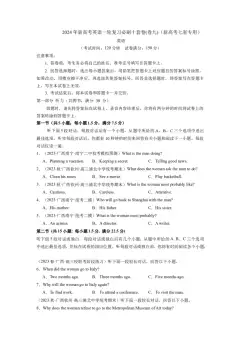
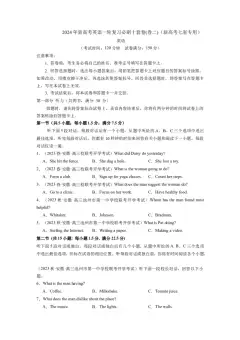
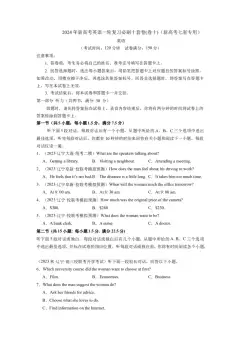
2024 年高考二轮复习零失误检测卷02(新高考九省)
英 语
(考试时间:120分钟 试卷满分:150分)
第一部分 听力(共两节,满分 30 分)
第一节(共5小题;每小题1分,满分5分)
听下面5段对话。每段对话后有一个小题,从题中所给的A、B、C三个选项中选出最
佳选项。听完每段对话后,你都有10秒钟的时间来回答有关小题和阅读下一小题。每段对
话仅读一遍。
1.What are the speakers mainly talking about?
A.Customs in China. B.Driving in Rome. C.Traffic rules in England.
2.Where did the woman go first?
A.The post office. B.Her friend’s home. C.The supermarket.
3.What time does the meeting begin?
A.At 6:20. B.At 6:00. C.At 6:10.
4.What are the speakers mainly talking about?
A.A painting. B.A photo. C.An exhibition.
5.What does the woman suggest the man do?
A.Take deep breaths.
B.Write key words on cards.
C.Try to memorize everything.
第二节(共15小题;每小题1分,满分15分)
听下面5段对话或独白。每段对话或独白后有几个小题,从题中所给的A、B、C三个
选项中选出最佳选项。听每段对话或独白前,你将有时间阅读各个小题,每小题 5秒钟;
听完后,各小题将给出5秒钟的作答时间。每段对话或独白读两遍。
听下面一段较长对话,回答以下小题。
6.Why will Jack go to Birmingham?
A.To watch a football game.
B.To attend a birthday party.
C.To travel on business.
7.When will the speakers have dinner together?
A.On May 21. B.On May 22. C.On May 17.
听下面一段较长对话,回答以下小题。8.What color is the man’s car?
A.Red. B.Blue. C.Black.
9.Why couldn’t the man find his car?
A.Someone stole it. B.The police moved it away. C.He’s got the wrong place.
听下面一段较长对话,回答以下小题。
10.Where does the conversation most probably take place?
A.At home. B.At the cleaner’s. C.At a clothing store.
11.What is the right way to wash the sweater?
A.By hand. B.By dry cleaning. C.By machine.
12.How does the woman probably feel now?
A.Sorry. B.Angry. C.Strange.
听下面一段对话,回答以下小题。
13.What is the man probably doing?
A.Hosting a program.
B.Listening to the radio.
C.Studying abroad.
14.Whom did the woman live with while studying in Britain?
A.Her classmates. B.Her host family. C.Her parents.
15.How was the woman’s life in Spain?
A.Boring. B.Nice. C.Hard.
16.What do we know about Sydney?
A.It is full of international students.
B.It is the most livable city in the world.
C.It is hard for students to get part-time jobs.
听下面一段独白,回答以下小题。
17.How long does a complete IELTS test last?
A.120 minutes.
B.165 minutes.
C.2-5 days.
18.What is an advantage of taking the IELTS test?
A.Improvement of one’s social status.
B.Access to international job opportunities.
C.Greater possibility of full-time education.
19.Which section of the two versions of LELTS differ from each other?A.Speaking.
B.Listening
C.Writing
20.Who has to take an IELTS General test?
A.A Japanese wanting to work in the UK.
B.A student preparing for exchange programs.
C.A job seeker eager for a position in the government.
第二部分 阅读(共两节, 满分50分)
第一节(共15小题:每小题2.5分, 满分37.5分)
阅读下列短文, 从每题所给的A、B、C、D四个选项中选出最佳选项。
A
There’s more to the jungle than just The Jungle Book. Let’s find out.
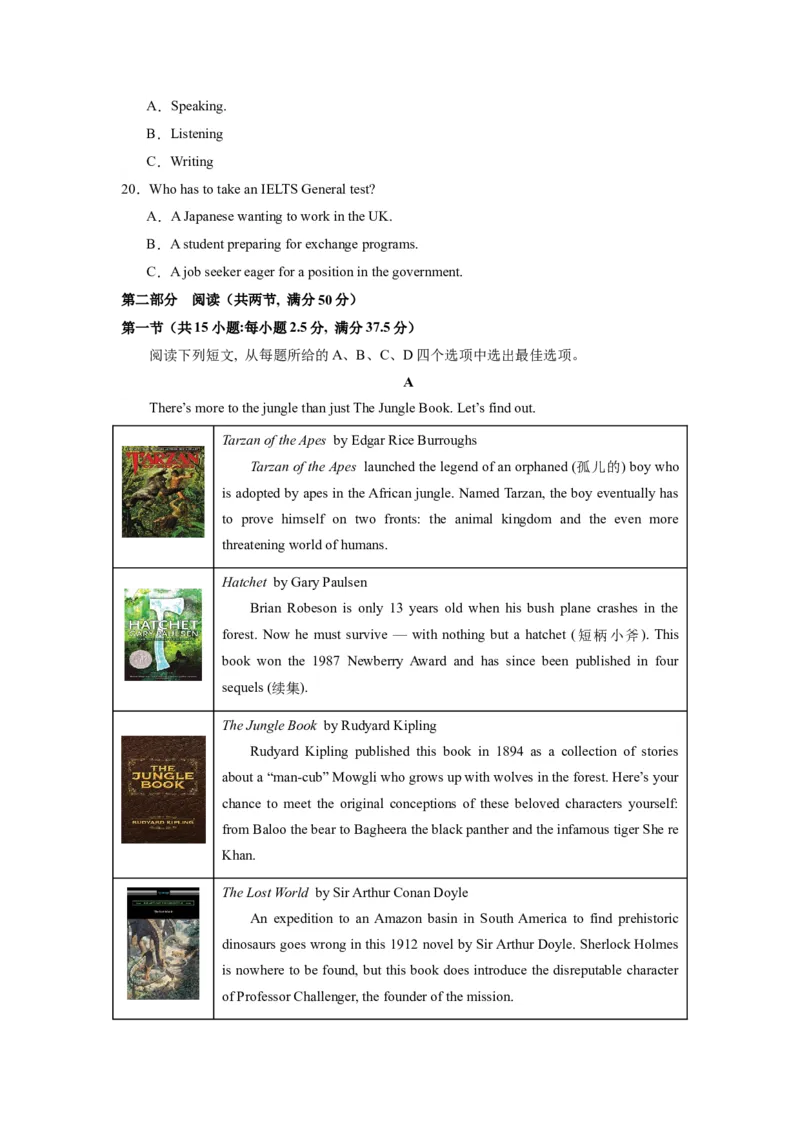
Tarzan of the Apes by Edgar Rice Burroughs
Tarzan of the Apes launched the legend of an orphaned (孤儿的) boy who
is adopted by apes in the African jungle. Named Tarzan, the boy eventually has
to prove himself on two fronts: the animal kingdom and the even more
threatening world of humans.
Hatchet by Gary Paulsen
Brian Robeson is only 13 years old when his bush plane crashes in the
forest. Now he must survive — with nothing but a hatchet (短柄小斧). This
book won the 1987 Newberry Award and has since been published in four
sequels (续集).
The Jungle Book by Rudyard Kipling
Rudyard Kipling published this book in 1894 as a collection of stories
about a “man-cub” Mowgli who grows up with wolves in the forest. Here’s your
chance to meet the original conceptions of these beloved characters yourself:
from Baloo the bear to Bagheera the black panther and the infamous tiger She re
Khan.
The Lost World by Sir Arthur Conan Doyle
An expedition to an Amazon basin in South America to find prehistoric
dinosaurs goes wrong in this 1912 novel by Sir Arthur Doyle. Sherlock Holmes
is nowhere to be found, but this book does introduce the disreputable character
of Professor Challenger, the founder of the mission.21.Which book won Newberry Award?
A.Tarzan of the Apes. B.Hatchet.
C.The Jungle Book. D.The Lost World.
22.Who describes the story about a wolf-child?
A.Edgar Rice Burroughs. B.Gary Paulsen.
C.Rudyard Kipling. D.Sir Arthur Conan Doyle.
23.Who is the main hero in The Lost World?
A.Brian Robeson. B.Mowgli.
C.Sherlock Holmes. D.Professor Challenger.
B
As children, our mother always taught my brother and me the value of acquiring life skills.
“It sets you apart,” she would say. While my brother chose the path of mastering musical
instruments, I gravitated towards the field of languages. Growing up in a multilingual household
where Mandarin, Cantonese, and English mixed, I felt it natural to continue exploring new
linguistic possibilities.
Languages fascinated me. I was attracted by the way words gracefully rolled off tongues and
how each language seemed to unlock a door to an entirely new world, no matter how challenging
they were to learn.
Eager to try beyond Asian languages, it was my mother who suggested French as a suitable
starting point. The elegance and poetic charm of the language quickly attracted me. The melodic
flow and the way the words effortlessly danced off my tongue caused a thrilling feeling, fuelling
my desire to explore deeper into its complexity. Interestingly, despite my passion and talent for it,
French proved to be the language that took the longest to fully grasp. Nevertheless, I insisted and
never gave up expanding my linguistic arsenal (宝库).
After realizing that Spanish wasn’t the right fit for me, I found myself addicted to the
fascinating world of German. Being enrolled in a German-speaking school speeded my progress,
and when two years, my command of German surpassed (超过) my years of studying French. As
time passed, I added Latin, Ancient Greek, and Japanese to my linguistic arsenal.
It fact, speaking multiple languages is not a mere accomplishment; it is a joyous celebration
of the richness of human expression. For me, it serves as a powerful tool to develop connections
with others on a great level, where humanity unites in a shared pursuit of compassion, harmony
and mutual respect.
24.Why did the author’s mother value acquiring life skills?
A.It contributes to future success. B.It is a tradition in their family.
C.It is part of making a living. D.It makes an individual outstanding.25.How did the author find a new language?
A.It widened his world. B.It was necessary for his future.
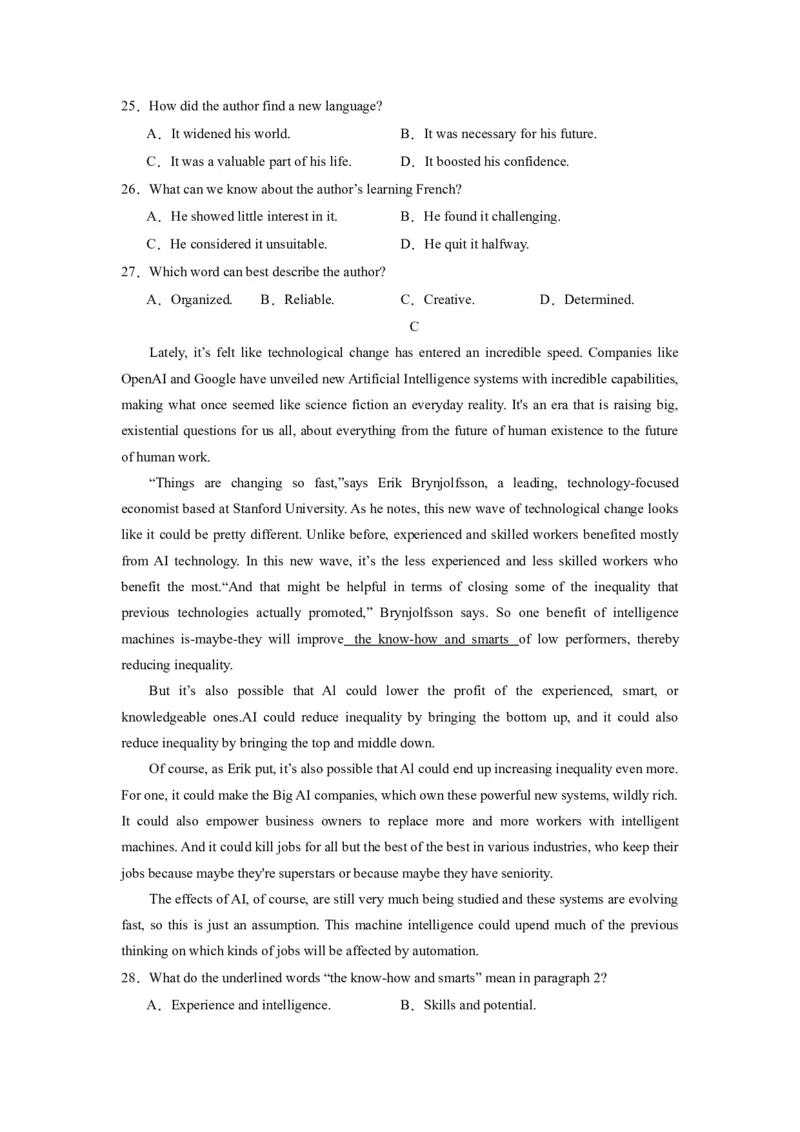
C.It was a valuable part of his life. D.It boosted his confidence.
26.What can we know about the author’s learning French?
A.He showed little interest in it. B.He found it challenging.
C.He considered it unsuitable. D.He quit it halfway.
27.Which word can best describe the author?
A.Organized. B.Reliable. C.Creative. D.Determined.
C
Lately, it’s felt like technological change has entered an incredible speed. Companies like
OpenAI and Google have unveiled new Artificial Intelligence systems with incredible capabilities,
making what once seemed like science fiction an everyday reality. It's an era that is raising big,
existential questions for us all, about everything from the future of human existence to the future
of human work.
“Things are changing so fast,”says Erik Brynjolfsson, a leading, technology-focused
economist based at Stanford University. As he notes, this new wave of technological change looks
like it could be pretty different. Unlike before, experienced and skilled workers benefited mostly
from AI technology. In this new wave, it’s the less experienced and less skilled workers who
benefit the most.“And that might be helpful in terms of closing some of the inequality that
previous technologies actually promoted,” Brynjolfsson says. So one benefit of intelligence
machines is-maybe-they will improve the know-how and smarts of low performers, thereby
reducing inequality.
But it’s also possible that Al could lower the profit of the experienced, smart, or
knowledgeable ones.AI could reduce inequality by bringing the bottom up, and it could also
reduce inequality by bringing the top and middle down.
Of course, as Erik put, it’s also possible that Al could end up increasing inequality even more.
For one, it could make the Big AI companies, which own these powerful new systems, wildly rich.
It could also empower business owners to replace more and more workers with intelligent
machines. And it could kill jobs for all but the best of the best in various industries, who keep their
jobs because maybe they're superstars or because maybe they have seniority.
The effects of AI, of course, are still very much being studied and these systems are evolving
fast, so this is just an assumption. This machine intelligence could upend much of the previous
thinking on which kinds of jobs will be affected by automation.
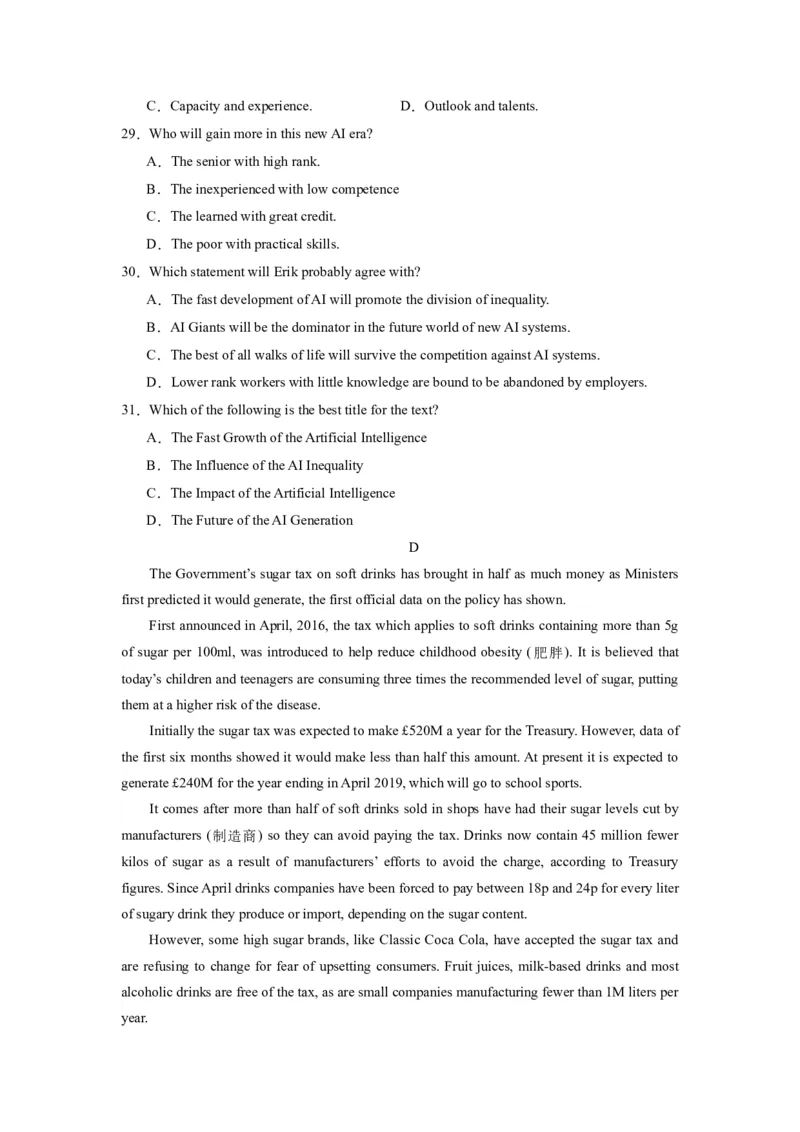
28.What do the underlined words “the know-how and smarts” mean in paragraph 2?
A.Experience and intelligence. B.Skills and potential.C.Capacity and experience. D.Outlook and talents.
29.Who will gain more in this new AI era?
A.The senior with high rank.
B.The inexperienced with low competence
C.The learned with great credit.
D.The poor with practical skills.
30.Which statement will Erik probably agree with?
A.The fast development of AI will promote the division of inequality.
B.AI Giants will be the dominator in the future world of new AI systems.
C.The best of all walks of life will survive the competition against AI systems.
D.Lower rank workers with little knowledge are bound to be abandoned by employers.
31.Which of the following is the best title for the text?
A.The Fast Growth of the Artificial Intelligence
B.The Influence of the AI Inequality
C.The Impact of the Artificial Intelligence
D.The Future of the AI Generation
D
The Government’s sugar tax on soft drinks has brought in half as much money as Ministers
first predicted it would generate, the first official data on the policy has shown.
First announced in April, 2016, the tax which applies to soft drinks containing more than 5g
of sugar per 100ml, was introduced to help reduce childhood obesity (肥胖). It is believed that
today’s children and teenagers are consuming three times the recommended level of sugar, putting
them at a higher risk of the disease.
Initially the sugar tax was expected to make £520M a year for the Treasury. However, data of
the first six months showed it would make less than half this amount. At present it is expected to
generate £240M for the year ending in April 2019, which will go to school sports.
It comes after more than half of soft drinks sold in shops have had their sugar levels cut by
manufacturers (制造商) so they can avoid paying the tax. Drinks now contain 45 million fewer
kilos of sugar as a result of manufacturers’ efforts to avoid the charge, according to Treasury
figures. Since April drinks companies have been forced to pay between 18p and 24p for every liter
of sugary drink they produce or import, depending on the sugar content.
However, some high sugar brands, like Classic Coca Cola, have accepted the sugar tax and
are refusing to change for fear of upsetting consumers. Fruit juices, milk-based drinks and most
alcoholic drinks are free of the tax, as are small companies manufacturing fewer than 1M liters per
year.Today’s figures, according to one government official, show the positive influence the sugar
tax is having by raising millions of pounds for sports facilities (设施) and healthier eating in
schools. Helping the next generation to have a healthy and active childhood is of great importance,
and the industry is playing its part.
32.How did the Government protect children’s health?
A.By collecting money for schools.
B.By forcing on sugar tax on soft drinks.
C.By improving the quality of drinks.
D.By encouraging research in education.
33.What measures did manufacturers take to the Government’s policy?
A.Exploring overseas markets.
B.Cutting down on their production.
C.Lowering their products’ sugar content.
D.Putting up the qualities of their products.
34.What can we learn about Classic Coca Cola?
A.It refused to accept the sugar tax.
B.It focuses on consumers’ feelings.
C.It worries about losing local customers.
D.It opposed free of the tax to alcoholic drinks.
35.What does the author intend to express in the last paragraph?
A.Comments of manufacturers.
B.Influence of government officials.
C.Desire for healthy next generation.
D.Success of the sugar tax policy.
第二节(共5小题:每小题2. 5分, 满分12. 5分)
阅读下面短文, 从短文后的选项中选出可以填入空白处的最佳选项。选项中有两项为多余
选项。
If you want to do well in class, studying is one of the best things you can do to boost your
grade. The following tips will help you do your best in class.
·Study in 1-hour blocks.
36 Set aside an hour for each of your subjects so you have time to review them
thoroughly. During each block, only focus on one subject at a time, so you don’t get information
mixed up between classes.
·Plan regular breaks.
Step away for a few minutes every hour so you don’t feel overworked. Since studying takesup a lot of energy and brainpower, schedule in 5-10 minutes every hour when you just relax. 37
Otherwise, you won’t feel as alert as you normally would.
· 38
Work on difficult concepts when you have the most energy. It might sound like a good idea to
save tough subjects for later, but you won’t feel as motivated to learn about them. Instead, choose
the class or subject you have the most trouble with and work on it right away when you sit down
to study.
·Rewrite your notes in your own words.
Organizing your notes helps you keep information a lot easier. Go through all of the notes
you’ve taken and pick out the information you think is most important. Rewrite the notes on a
separate page or in a different notebook. 39
•Reward yourself when you finish.
Treat yourself to something small when you reach your study goals. 40 You could
have a sweet snack, or buy yourself a small gift to celebrate.
A.Focus on hard topics first.
B.Schedule time to study every day.
C.Avoid working through the breaks you’ve scheduled.
D.Keep your study sessions shorter so you don’t get worn out.
E.In this way, all of the similar information is organized and easy to read.
F.Find a place where you won’t have trouble concentrating on the material.
G.Give yourself something to look forward to when you finish your studies.
第三部分 语言运用(共两节,满分30分)
第一节(共15小题,每小题1分,满分15分)
阅读下面短文, 从每题所给的A、B、C、D四个选项中选出可以填入空白处的最佳选项。
Holland is famous for being bike friendly. Recently, the world’s first plastic bike path has
been 41 in the Dutch city of Zwolle, a 100- foot bike path made of recycled plastic.
The company that created the path, PlasticRoad, says their 42 of making roads is
better in many ways than asphalt(沥青) roads. PlasticRoad creates its roads 43 in a
factory. All the pieces are the same. Since the plastic pieces are light, they are easy to 44 .
To make the road, a special truck 45 drives along and lays down the pieces, almost like
46 bricks in a sidewalk. This makes it much 47 to make than an asphalt road.
PlasticRoad thinks their road will 48 three times as long as an asphalt road. If part of it
breaks, it is easy to take out the broken section, and 49 it. The broken section can then be
recycled 50 and turned into a road again.
The plastic roads are hollow(中空的) below, allowing rainwater to flow away, instead of 51the street. The hollow area also makes it easy to 52 pipes under the road.
Many people think this is a 53 way to recycle plastic, but some are worried. One of the
biggest 54 is what will happen to the bits of plastic that break off as the path is used. The
company is planning another test, hoping to find 55 .
41.A.destroyed B.decorated C.widened D.created
42.A.secret B.way C.goal D.refusal
43.A.halves B.pairs C.groups D.pieces
44.A.break B.keep C.move D.shape
45.A.clumsily B.simply C.naturally D.difficultly
46.A.putting B.finding C.picking D.making
47.A.earlier B.harder C.faster D.cheaper
48.A.save B.take C.last D.count
49.A.replace B.sell C.recycle D.examine
50.A.in private B.at times C.on time D.once more
51.A.crossing B.blocking C.flooding D.deserting
52.A.control B.run C.below D.prepare
53.A.ridiculous B.conventional C.common D.creative
54.A.concerns B.challenges C.burdens D.disasters
55.A.users B.solutions C.similarities D.volunteers
第三部分 语言运用(共两节,满分30分)
第二节(共10小题;每小题1.5分 ,满分15分)
阅读下面短文,在空白处填入1个适当的单词或括号内单词的正确形式。
My husband, our children and I 56 (have) wonderful camping experiences over the
past ten years.
Some of our 57 (memory)are funny, especially from the early years when our
children were little. Once, we camped along Chalk Creek (小溪). I was worried that our 15-
month-old boy would fall 58 the creek. I tied a rope around his waist to keep him near to
our spot, 59 he was uncomfortable, and his crying let the whole campground know it.So
instead of 60 (tie) him up, I just kept a close eye on him. It worked —he didn’t end up in
the creek. My three-year-old, however, did.
Another time, we rented a boat in Vallecito Lake. The sky was clear 61 we headed off,
but storms moved in fast in the mountains, and this one quickly interrupted our peaceful morning
trip. My husband stopped fishing 62 (start) the motor. Nothing. He tried again. Noluck.
We were stuck in the middle of the lake with a dead motor. As we all sat there 63
(helpless), a fisherman pulled up, threw us a rope and towed (拖) us back by 64 (he). Wewere safe.
Now, every year when my husband pulls our camper out of the garage, we are filled with a
sense of 65 (excite), wondering what camping fun and adventure we will experience
next.
第四部分 写作(共两节, 满分40分)
第一节(满分15分)
假设你是李华,应学校英文报邀请,就文化古迹遭破坏的现象,写一封倡议书,呼吁大家
保护文化古迹。内容包括:
1.某古迹的现状;
2.解决措施。
注意:
1.写作词数应为80左右;
2.请按如下格式在答题卡的相应位置作答。
Dear fellow students,
_______________________________________________________________________________
_______________________________________________________________________________
_______________________________________________________________________________
_______________________________________________________________________________
___________________________________________________________
Li Hua
第二节(满分25分)
阅读下面材料,根据其内容和所给段落开头语续写两段,使之构成一篇完整的短文。
“Mom, I’m ready to go,” called Jason.
Every Saturday, Jason looked forward to going to Chinatown to shop for food because his
mom let him pick his favorite snacks: roast pork buns and bubble tea.
The streets in Chinatown were crowded with cars and pedestrians. His mother could not find
the same exotic vegetables in the local supermarkets, so they always came here to shop. What
fascinated Jason was tasty roast pork, even the whole pigs hanging on big hooks in the windows,
their skins roasted to a glistening brown. Jason’s mouth would water just looking at them.
As they passed the newsstand carrying Chinese newspapers and magazines, Jason spotted an
old man sitting on the sidewalk. His hair was long, white, and messy. The face beneath was lined,
dirty, and unshaven. Frayed and torn clothing wrapped around his thin frame, and in this kind of
cold weather, he even wore sandals, his feet blue with cold. He banged an empty can against the
sidewalk. As Jason walked by, he could smell a musty odor and pinched his nostrils together. The
old man reached out and touched Jason’s left leg. Instinctively, Jason gathered all his strength to
jerk(猛拉) his leg away and kick the old man’s hand heavily. Frightened, he hurried to catch upwith his mother without looking back.
“Mom, the old man touched me,” he cried, “He touched me with his dirty hands. It’s
disgusting! And he smelled too.”
Jason’s mother glanced back at the man with a look of understanding and said gently, “Jason,
he can’t help it. He’s homeless. He didn’t mean any harm.”
Mom’s words made Jason look back at the old man with regret, who now was looking up at
other passersby, still banging his can.
On their way home, Jason asked, his voice filled with concern. “Why is that old man
homeless? Where does he sleep?”
“I don’t know. It’s tough to be homeless, especially in this cold weather. He did look quite
weak,” his mother replied.
Mom’s words made Jason’s regret deepened. He confessed his heavy kick to his mother, who
reminded him that it was crucial to acknowledge his mistake and try to make up for it.
注意:1.续写词数应为150左右;
2.请按如下格式在答题卡的相应位置作答。
The next day, with his mother’s help, Jason decided to do something.
_______________________________________________________________________________
_______________________________________________________________________________
_______________________________________________________________________________
_______________________________________________________________________________
_______________________________________________________________________________
_______________________________________________________________________________
_
Hearing this, the old man looked at them with watery eyes.
_______________________________________________________________________________
_______________________________________________________________________________
_______________________________________________________________________________
_______________________________________________________________________________
_______________________________________________________________________________
_______________________________________________________________________________
_