绝密★启用前
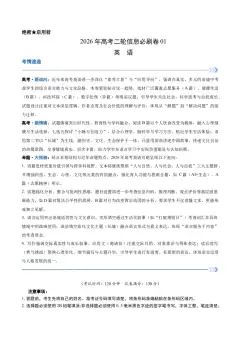
2026 年高考二轮信息必刷卷02(全国二卷)
英  语
考情速递
高考·新动向:阅读理解减少事实细节题,主旨概括与观点推断题占比提升,强化语篇逻
辑分析能力考查;完形填空聚焦深层逻辑链,需结合情节发展与情感变化推理,弱化孤立
词汇考查;语法填空突出基础语法的语境化运用,避免机械记忆类考点,强调知识整合能
力。
高考·新情境:选材紧扣时代热点与真实交际需求:阅读涵盖科技突破、绿色发展、跨文
化交流等主题,语篇贴近外刊原版风格;完形填空以生活化场景为载体,融入人际沟通、
文化认同等情境;语法填空创设校园生活、社会热点等真实语境,体现语言应用性。
命题·大预测:基于本卷题目结构与内容,并结合近年高考英语真题命题趋势作出如下预
测:
将持续深化核心素养导向,三类题型框架稳定但考查深度提升:阅读语篇复杂度增强,侧
重批判性思维选拔;完形填空逻辑线索更隐蔽,注重语篇连贯与语境适配;语法填空进一
步强化 “用语言解决问题” 的导向。整体趋势是弱化机械答题,突出语言运用与思维品
质的综合考查,贴合立德树人总目标。
(考试时间:120 分钟  试卷满分:150 分)
注意事项:
1. 答题前,考生先将自己的姓名、准考证号码填写清楚,将条形码准确粘贴在条形码区域
内。
2. 选择题必须使用2B 铅笔填涂;非选择题必须使用0. 5 毫米黑色字迹的签字笔书写,字体
工整,字迹清楚。
3. 请按照题号顺序在答题卡各题目的答题区域内作答,超出答题区域书写的答案无效;在
草稿纸、试卷上答题无效。
4. 作图可先使用铅笔画出,确定后必须用黑色字迹的签字笔描黑。
5. 保持卡面清洁,不要折叠、不要弄破、弄皱,不准使用涂改液、修正带、刮纸刀。
第一部分  听力(共两节,满分 30 分)
做题时,先将答案标在试卷上。录音内容结束后,你将有两分钟的时间将试卷上的答案转
涂到答题卡上。
第一节(共5 小题;每小题1.5 分,满分7.5 分)
听下面5 段对话。每段对话后有一个小题,从题中所给的A、B、C 三个选项中选出最
佳选项。听完每段对话后,你都有10 秒钟的时间来回答有关小题和阅读下一小题。每段对
话仅读一遍。
1.What season is it likely to be now?
A.Spring.
B.Summer.
C.Winter.
2.What is the woman’s feeling now?
A.Regret.
B.Relief.
C.Anger.
3.How did the man get to know the job?
A.From his friend.
B.From an advertisement.
C.From the company's
website.
4.What went on at Cooper’s last night?
A.A movie show.
B.A birthday party.
C.A sales promotion.
5.What went wrong with the woman’s presentation?
A.The screen was broken.        B.She forgot her laptop charger.
C.Her computer ran out of battery.
第二节(共15 小题;每小题1.5 分,满分22.5 分)
听下面5 段对话或独白。每段对话或独白后有几个小题,从题中所给的A、B、C 三个
选项中选出最佳选项。听每段对话或独白前,你将有时间阅读各个小题,每小题5 秒钟;
听完后,各小题将给出5 秒钟的作答时间。每段对话或独白读两遍。
听第6 段材料,回答第6、7 题。
6.What does Susan come to the poem club for?
A.To satisfy her interest in poems.    B.To perform live acting practice.
C.To look for more theatre lovers.
7.What day is it today?
A.Monday.
B.Tuesday.
C.Wednesday.
听第7 段材料,回答第8 至10 题。
8.How many bags were of colors other than black in Lost and Found?
A.Three.
B.Five.
C.Eleven.
9.What do we know about the woman’s bag?
A.It’s a handbag.
B.It is large.
C.It has a pocket on the front.
10.What is in the woman’s bag?
A.A toy.
B.Some snacks.
C.Some books.
听第8 段材料,回答第11 至13 题。
11.How is the woman feeling now?
A.Regretful.
B.Hesitant.
C.Happy.
12.How much will the woman spend monthly if living with friends?
A.About £420.
B.About £560.
C.About £750.
13.What does the man suggest the woman do?
A.Talk to her cousin.    B.Live independently.    C.Balance cost and enjoyment.
听第9 段材料,回答第14 至17 题。
14.What is the probable relationship between the speakers?
A.Former classmates.
B.Old workmates.
C.Close relatives.
15.How does Andy stay fit recently?
A.He exercises daily at the gym.    B.He has reduced unhealthy food.
C.He goes hiking regularly.
16.What does the man recommend the woman do?
A.Go on a diet.
B.Stay indoors.
C.Join a fitness centre.
17.What would Christina like to do for exercise?
A.Running.
B.Swimming.
C.Hiking.
听第10 段材料,回答第18 至20 题。
18.How did the speaker’s grandfather die?
A.Due to a disease.
B.During a charity event.
C.Because of a plane crash.
19.Why did the speaker decide to skydive?
A.To help some patients.  B.To have fun with friends.  C.To overcome a fear of
heights.
20.What does the speaker think was the best aspect about the skydive?
A.Falling from 2,000 meters.       B.Hearing stories about Alzheimer’s.
C.Raising a large amount of money.
第二部分  阅读(共两节, 满分50 分)
第一节(共15 小题;每小题2.5 分, 满分37.5 分)
阅读下列短文, 从每题所给的A、B、C 和D 四个选项中选出最佳选项。
A
Power of Public Speaking has partnered with ASI Innovation Labs to integrate
artificial intelligence into the Pops Classroom platform for improving public speaking skills. The
first project is the Pops Advisor which provides an automatic evaluation of students’ video
presentations with visual feedback.
The Advisor offers on-demand comments to students practicing public speaking from
anywhere.This flexibility benefits instructors, who can be as hands-on or hands-off during
practice. While students can operate autonomously with the tool, instructors can also choose to
keep track of students’ progress.Criteria
Using machine learning models, the Pops Advisor analyzes the following criteria:
Delivery
Introduction
Body
Conclusion
Vocal Style
Vocal Quality
Credibility
Attention
Support
Language
Signaling Ending
Summary
Vocal Filler
Eye Contact
Body Language
Central Idea
Preview
Connective
Connective
Credibility
Organization
Memorable Ending
Credibility
Feedback
The presenter receives feedback on the above four categories. And this feedback is given in
the following formats:
• Recommendations
To provide presenters with valuable feedback for the next practice, recommendations focus
on specific aspects needing improvement. For instance, the recommendation can be “Your
message is clear, but be sure you are grabbing your audience’s attention in your introduction to
ensure they are listening.”
• Speech Metrics (指标)
Useful speech metrics serve as quantitative descriptors on several aspects of the
presentation including number of words, total presentation time, speaking rate and vocal fillers
percentage.
Pops Advisor can be used in any classroom setting where students are presenting,
particularly in the Basic Public Speaking Course. When you are considering what can be achieved
by your students toward skill development in a single school semester, Advisor increases the
overall development.
21.What is the Pops Advisor?
A.A voice assistant. B.A video player.
C.A time tracker.
D.An evaluation tool.
22.Which of the following categories provides feedback on facial expressions?
A.Delivery.
B.Introduction.
C.Body.
D.Conclusion.
23.Who is the text intended for?
A.Lab technicians.
B.Public speech instructors.
C.Foreign language learners.
D.Artificial Intelligence engineers.
B
It was late at night, but I couldn't sleep. A battle was raging in my mind. I had made
a decision I regretted: browsing an online shopping platform before bed. A major promotion
immediately caught my attention and challenged my better judgment. I was drawn to a stylish
wash-and-dry machine. It perfectly matched my apartment’s white style and was heavily
discounted. My old washing machine was still working after ten years of service, so why replace it
now? What could be a better time than this? That thought launched me into a long period of
difficult consideration.
Minutes later, I was lost in product research. I read countless online reviews and watched
videos to learn about dryers. For the next hour, I questioned everything: energy use, maintenance
costs, and the supposed convenience. Strangely, the more I learned, the less sure I became. Just
hours earlier, I had told my colleagues that dryers were unnecessary where I lived. Yet there I was,
examining the model on sale, wondering if owning one might actually simplify my life. My
research only gave me more reasons to buy, besides the low price.
I started actively justifying my need. I thought back to a time during the pandemic when my
mother insisted on airing our duvet outside. I had argued with her, and I thought a dryer could
solve that issue. I would also be spared from the tedious task of hanging clothes, especially heavy
bed sheets. And I wouldn't have to see the ugly clothes-drying rack that has occupied a third of my
balcony for years. Those usually small annoyances were suddenly magnified, and the appeal was
undeniable.
With the discount about to expire, I made the purchase. But the moment I clicked "Confirm
Order," a strange unease settled over me. Lying in bed, wide awake, I questioned my decision.
Was it a rational choice, or had I fallen for a deal too good to miss? The mental burden of this
purchase seemed to invade my sleep. Why is making choices so difficult these days? I recalled
similar troubles when buying other products. The constant pressure to make the "right" choice
feels overwhelming.
In the end, I wasn't sure if the time I spent pondering and the interrupted sleep were worth it.
There's no turning back now—the machine is on its way. I've come to see this less as a simple
purchase and more as a lesson in understanding my own desires. Will it truly save me time, or just
become another appliance taking up space? I can't say for sure. Only time will tell.
24. What is the author’s main purpose in writing the article?
A. To introduce the functions of a new appliance.
B. To reflect on the complexity of modern consumption.
C. To complain about the poor quality of old machines.
D. To provide tips on how to get the best deals online.
25. How did the author feel after making the purchase?
A. Excited and proud.      B. Calm and satisfied.
C. Regretful and uncertain.  D. Angry and disappointed.
26. What reason did the author find to justify the purchase?
A. The old machine had completely broken down.
B. To avoid daily chores and settle family disagreements.
C. His colleagues strongly recommended the new model.
D. He was moving to a new apartment soon.
27. What does the author suggest is the main reason for difficult shopping decisions?
A. The high prices of major appliances.
B. The lack of reliable product information.
C. The pressure from family and colleagues.
D. The overload of information and choices.
C
The fight against cancer is witnessing exciting new developments, with scientists
exploring various innovative approaches. One promising discovery comes from the Amazon
rainforest, where researchers have identified a substance in the venom of a local scorpion. This
molecule has shown a stunning ability to destroy breast cancer cells in laboratory tests. Its effect is
comparable to that of a common chemotherapy drug, suggesting it could become a powerful new
weapon in treating this widespread disease.
Another strategy, known as theranostics(治疗诊断学), cleverly combines diagnosis and
treatment into a single process. Scientists attach special radioactive markers to molecules that are
designed to target specific tumors. These markers allow doctors to clearly see the cancer using
imaging equipment. Once a tumor is confirmed to have absorbed a large amount of the molecule,
doctors can then replace the imaging marker with a more powerful radioactive one. This stronger
radiation is then used to attack and kill the cancer cells directly, offering a highly targeted
treatment method.
Beyond these, researchers are also making progress with personalized cancer vaccines. In one
advanced method, scientists create a unique vaccine for each patient by combining cells from a
healthy donor with the patient’s own cancer cells. This custom-made vaccine trains the patient's
immune system to recognize and fight their specific tumor. Early studies with patients suffering
from cancers like melanoma and glioblastoma have shown very positive results, indicating this
approach could be a major breakthrough.
Furthermore, technology is playing a crucial role. Artificial intelligence is now being used to
analyze brain scans of patients with brain cancer. By applying AI to magnetic resonance imaging
(MRI), researchers can predict a patient’s response to chemotherapy with high accuracy. This non-
invasive method could help doctors make better decisions about treatment plans without the need
for painful biopsies.
These diverse efforts, from natural toxins to high-tech AI, all share a common goal: to
develop more effective, personalized, and less harmful ways to conquer cancer. The future of
cancer treatment is becoming increasingly hopeful.
28. What is the main purpose of the passage?
A. To argue for the protection of the Amazon rainforest.
B. To introduce several new approaches to fighting cancer.
C. To compare the effectiveness of different cancer drugs.
D. To explain the working principles of chemotherapy.
29. What can be inferred about the substance from scorpion venom?
A. It is more effective than existing chemotherapy drugs.
B. It works by preventing cancer cells from dividing.
C. It could be a potential alternative to traditional treatments.
D. It has been successfully used to cure breast cancer.
30. How does the theranostics method work according to paragraph 2?
A. It uses a single radioactive substance for both diagnosis and treatment.
B. It first locates tumors with markers and then attacks them with radiation.
C. It relies on artificial intelligence to identify cancer cells in the body.
D. It creates a personalized vaccine to boost the patient's immune system.
31. What is the author's attitude towards the future of cancer treatment?
A. Doubtful.    B. Optimistic.    C. Indifferent.    D. Cautious.
D
In the workplace, the way we help others matters just as much as the help itself.
New research shows that the emotions a helper expresses can decide whether their help is
welcomed, disliked, or returned. Helpers who show warm feelings like gratitude or sympathy are
often seen as having good intentions. This builds trust and makes future cooperation more likely.
On the other hand, those who show pride or look down on others may have their reasons
questioned. This can harm relationships and reduce the chance of getting help back in the future.
The person receiving help is not passive. They pay close attention to the helper's emotional
signals and use them to guess the real reason for the help. If they feel the helper is acting only for
personal gain or out of a sense of duty, their view of the help changes. They might not feel willing
to return the favor. This means that the success of helping depends heavily on the emotional
message sent along with the action.
These findings are based on several studies with working adults and students. In all cases, the
results were clear and consistent. Expressions of warm, friendly emotions led people to believe the
helper truly wanted to do good. This created stronger working relationships and a greater
willingness to give back help. It proves that the emotional side of helping is a powerful factor in
how we connect with colleagues.
For leaders, this study offers a clear lesson. To build a cooperative culture, managers should
create an environment where employees feel genuine gratitude for each other. It is not enough to
just tell people to help. When leaders themselves show real care and thankfulness when assisting
their teams, they set a positive example. This creates a more supportive and active workplace for
everyone.
On a personal level, employees can also improve their work relationships. They can think
about times they received help or try to see situations from their colleagues' points of view. These
practices help develop more authentic emotions and stronger social connections. By expressing
sincere gratitude or concern, we don't just help ourselves; we build a more resilient and
cooperative spirit at work.
32. What is the main purpose of the passage?
A. To discuss different ways of offering help in the workplace.
B. To explain why people sometimes refuse help from colleagues.
C. To advise managers on how to build more effective teams.
D. To emphasize the key role of emotions in workplace helping.
33. What can be inferred from paragraph 4?
A. Managers should force employees to help each other.
B. A leader's emotional expression can affect the whole team.
C. Cooperation is more important than individual work.
D. Employees will only help when they are rewarded.
34. How do receivers react to help according to paragraph 2?
A. They usually accept help passively.
B. They immediately return all the help they get.
C. They try to figure out the helper's true feelings.
D. They doubt the motives of every helper.
35. What is likely to happen if a helper shows pride?
A. They will get more help in return.
B. Their help might be turned down.
C. Their colleagues will consider them powerful.
D. They will build stronger relationships.
第二节(共5 小题;每小题2. 5 分, 满分12. 5 分)
阅读下面短文, 从短文后的选项中选出可以填入空白处的最佳选项。选项中有两项为
多余选项。
As our dogs enter their golden years, what they need for their continued comfort
and happiness will change.     36     It involves a comprehensive approach that covers their
changing health, mobility, and emotional well-being.
It’s important to stay on top of their health with regular vet check-ups to help detect any
age-related issues early on. This way, conditions such as joint pain or mental decline can be
managed effectively, ensuring your senior dog is getting the care they need. Remember to keep a
close eye on their behavior.     37
As your dog ages, their nutritional needs will change, too. It’s essential to change their diet
and monitor their weight to prevent any obesity-related health issues.     38     Also consider
giving supplements such as a multivitamin which includes joint-supporting ingredients, as well as
healthy fats which help improve brain function and support healthy skin.
Your dog might not be as lively as they once were, so adjusting their exercise routine makes
sense.     39     Activities like swimming are great, too, as they provide all-round exercise to
maintain muscle mass and joint flexibility without putting stress on their old bones.
    40     Spend quality time with your senior dog, engaging in activities they love. Your
companionship is invaluable to them. With a thoughtful approach to their needs, you can ensure
that your loyal companion enjoys their later years with dignity, comfort, and the love they deserve.
Remember, you’re not alone in this. Get in touch with your vet or fellow pet parents if you
need advice or support.
A.Choose high-quality senior dog food.
B.But preventive care is better than treatment.
C.Any small relevant shifts are often the first clues.
D.Emotional well-being should not be overlooked.
E.Think gentle walks instead of intense fetch sessions.
F.Don’t forget to reward them with their favorite treats after exercise.
G.Taking care of your senior dog goes beyond regular walks and meals.
第三部分 语言运用(共两节,满分30 分)
第一节(共15 小题,每小题1 分,满分15 分)
阅读下面短文, 从每题所给的A、B、C 和D 四个选项中选出可以填入空白处的最佳选
项。
Long before my daughter Carolyn could speak, she would hold my finger as she
learned to walk. Whenever her tiny hand was in mine, I would tenderly squeeze it twice and     41
, “I love you.” That became our     42     . She adored this little secret, and the gesture
became our special way of     43     . But as Carolyn grew older, I assumed there was no need
for little secret     44     anymore.
On the evening of her junior high graduation ceremony, I saw Carolyn sitting     45

waiting for her turn to perform. I wanted to     46     her, but I knew that anything I said
would make her feel uncomfortable.
Then I     47     our secret signal. I left my seat and     48     to her. Carolyn
watched each of my steps as I     49     closer. Without speaking, I leaned over, took her hand
and squeezed it twice. Her eyes met mine, and I knew that she     50     the message. She
instantly returned the     51     , giving my hand two quick squeezes in reply. We smiled.
Years later, on Carolyn’s wedding day, my heart was full of unspoken     52     .
Instead of risking tears, I took her hand and     53     our familiar signal. She responded
immediately, and in that     54     exchange, we said everything without speaking. Some
bonds never     55     — they only grow deeper.
41.A.whisper
B.shout
C.announce
D.declare
42.A.habit
B.rule
C.secret
D.story
43.A.competing
B.connecting
C.exercising
D.debating
44.A.signals
B.gifts
C.promises
D.lessons
45.A.calmly
B.nervously
C.proudly
D.lazily
46.A.praise
B.surprise
C.remind
D.comfort
47.A.checked
B.interpreted
C.remembered
D.followed
48.A.turned back
B.got across
C.gave in
D.walked over
49.A.inched
B.jumped
C.rushed
D.floated
50.A.conveyed
B.doubted
C.recognized
D.ignored
51.A.gift
B.gesture
C.blessing
D.favor
52.A.regrets
B.wishes
C.memories
D.emotions
53.A.repeated
B.created
C.secured
D.exhibited
54.A.bitter
B.silent
C.formal
D.awesome
55.A.maintain
B.break
C.fade
D.end
第二节(共10 小题;每小题1.5 分 ,满分15 分)
阅读下面短文,在空白处填入1 个适当的单词或括号内单词的正确形式。
An amazing exhibition in Wuhan, called "The Everlasting Yangtze," brings 8,000
years of history back to life. It displays 160 treasures from 37 museums, showing the development
of the Yangtze River civilization. The exhibition doesn't just display relics; it brings the soul of
ancient cultures back to life, showing a mix of myth and reality in materials like lacquer, bronze,
and gold.
The exhibition is organized into five thematic sections, which are 56.       (base) on
material: Crystal Jade Splendor, Radiant Lacquerware, Elaborate Bronze, Shiny Gold and Silver,
and Exquisite Ceramics. These sections systematically show the development of civilization in the
Yangtze River basin 57.       different historical periods. Visitors can admire jade artifacts
from the Liangzhu culture, Han Dynasty lacquerware, and a Ming Dynasty gold crown inlaid (镶
嵌) with rubies.
A standout piece is a Spring and Autumn Period mythical bronze beast from the Chu state.
This masterpiece of bronze work has a fantastical design, 58.       (combine) a dragon's
head, a tiger's body, and turtle-like feet. Each part of the beast is detachable, a remarkable feat of
engineering, 59.      its imaginative form reveals the romantic spirit of the Chu people. Experts
even tried to copy it with modern technology but 60.        (fail) to capture its unique charm.
According to the curator, all five 61       (category) of artifacts share a common pattern:
each of them has an origin phase, experiences continuous development, and influences later
cultures. This continuity shows the long and profound history of Yangtze culture. For example, the
earliest known lacquer artifact,62.       (find) about 8,000 years ago, was discovered in the
lower reaches. Research shows that while most lacquer items 63.       (produce) in the upper
reaches, they were widely used downstream, demonstrating active cultural exchange.
Compared with the Yellow River culture,64.        is often seen as more serious, Yangtze
River artifacts tend to be more dynamic and imaginative. To help visitors connect with history, the
exhibition includes interactive elements. Attendees can try reassembling relic puzzles or making
rubbings of bronze patterns. The goal is for visitors to not only look at the artifacts but also engage
with 65.       to better understand the history behind them.
第四部分  写作(共两节, 满分40 分)
第一节(满分15 分)
    假定你是某中学学生会主席李华。本学期初,学校成功举办了一年一度的“社团招新
周”(Club Recruitment Week)。请你代表学生会为校英文报写一篇英文报道。
内容包括:
1.描述活动总体情况;
2.重点介绍某一个社团的招新亮点;
3.活动反响。
注意:
1.词数约80 词;
2.可适当增加合理细节,文中不得出现真实社团名称;
3.标题已给出,不计入总词数。
Highlights of Our Club Recruitment Week
_______________________________________________________________________________
_______________________________________________________________________________
________________________________
第二节(满分25 分)
阅读下面材料,根据其内容和所给段落开头语续写两段,使之构成一篇完整的短文。
At the far end of town, next to a dark forest, sits an old and shabby white house. Kids at
school call it the Spook House. It’s where I live with Mom, little brother Andy and Grammy. The
outside looks scary; The paint is coming off, the shutters are loose with rusty nails, and weeds are
everywhere around it.
Mom rented it because our old apartment was too small. I thought she was crazy at first, but
I knew she did her best — money was tight. She cleaned every room and painted the inside with
bright colors. I loved my newly-painted bedroom, but the outside stayed ugly. Mr. Dudley, our
landlord, kept making excuses to avoid painting it.
“Let’s do it ourselves!” I suggested one evening while we were washing dishes. Mom
paused, her hands in soapy water, and sighed. “Honey, paint and tools cost money — we can’t just
splash cash like that.” But Grammy, who’ d been knitting on the couch, set down her yarn and
smiled. “I’ ve got a little nest egg saved up from my knitting sales. It’s not much, but it’ ll help.” I
grinned, running to grab my piggy bank — my babysitting money, which I’d been saving for a
new graphic novel, suddenly felt way less important. “I’ ll chip in too!” Andy yelled from the
living room, where he was coloring a picture of the house. “I can pull weeds! I’m super good at
it!”
We headed to the hardware store that weekend and picked out paint: Blue Heron for the
walls and Gull White for the trim. on the way home, we ran into Juan — an older boy from my
history class who’d been talking about starting his own small paint business lately. When we
mentioned our plan to paint the house, his face lit up right away. “I’ll help paint high parts if you
treat me with homemade pizza!” We agreed.
Every weekend, we worked together: Mom held the ladder, Grammy brought lemonade,
Andy pulled weeds, and I handed brushes. My arms ached, but Andy’s grins kept me going. After
two weeks, the house shone — bright blue, white trim, and red geraniums by the door. We stood in
the yard, grinning. I touched the warm paint, feeling something soft in my chest.
注意:(1) 续写词数应为150 个左右;
(2)请按如下格式在答题卡的相应位置作答。
Para 1: Every weekend after that, we became a little work team.
_______________________________________________________________________________
_______________________________________________________________________________
__________________________________________________
Para2: After two weeks, the house shone.
_______________________________________________________________________________
_______________________________________________________________________________
__________________________________________________