2027 年高考英语一轮复习能力突破(结构化知识+题型提升
练)
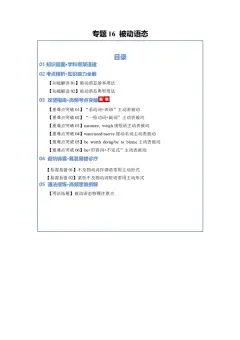
专题06 动词的时态与语态
目录
第一部分 必备知识结构化清单
         梳理必备的语言知识点,夯实语言基础能力
第二部分 知识运用题型强化练
         必备知识与能力提升练,提升语言运用能力
◇Part 01  必备知识结构化清单
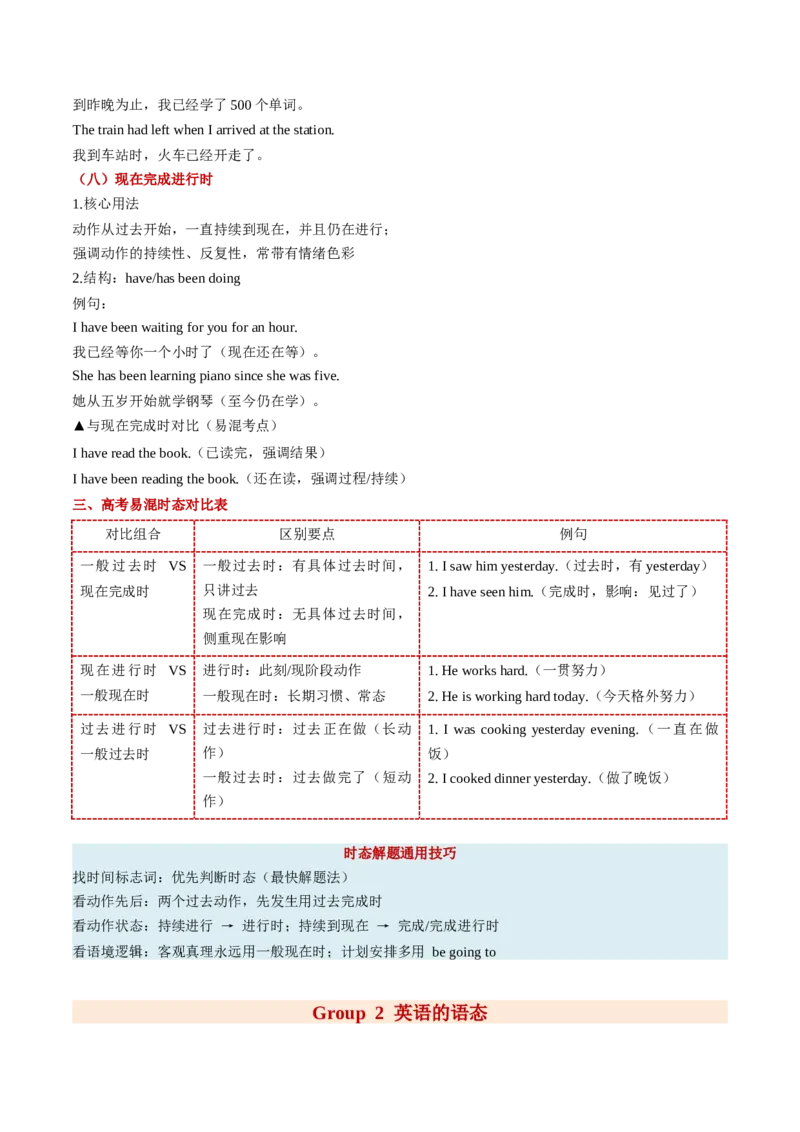
知|识|清|单
Group 1 英语的时态
真题分析
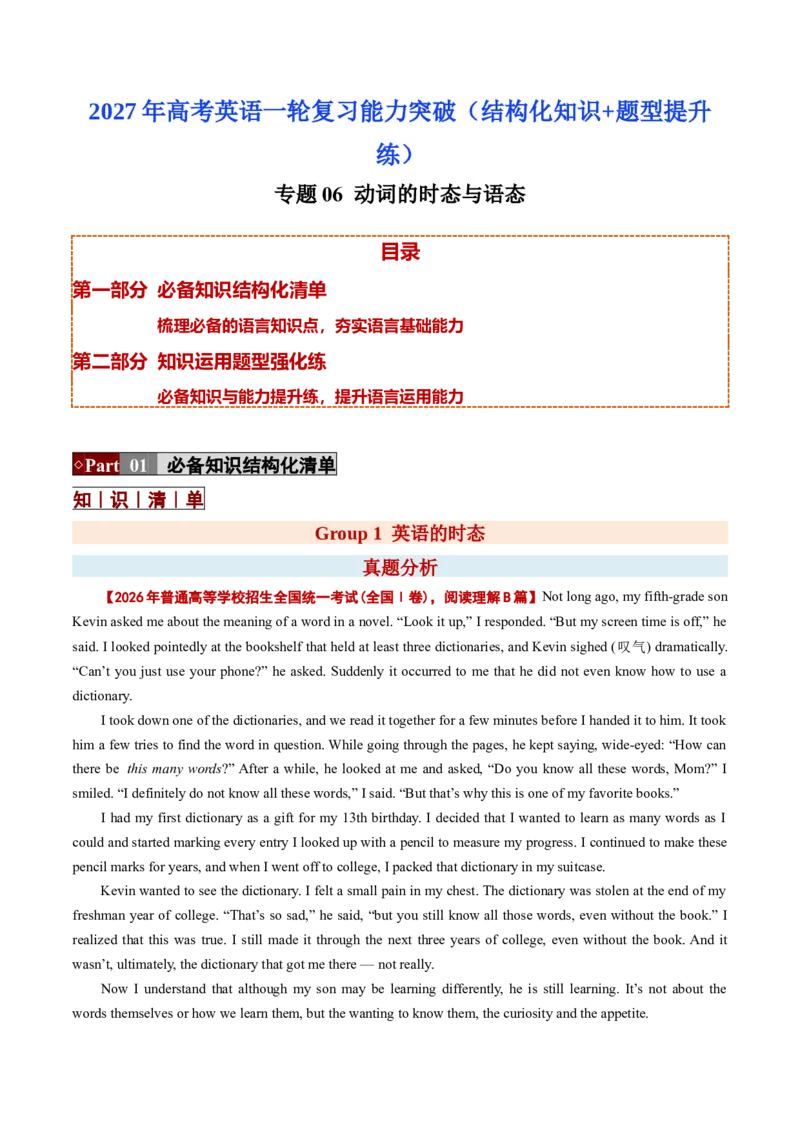
【2026 年普通高等学校招生全国统一考试(全国Ⅰ卷),阅读理解B 篇】Not long ago, my fifth-grade son
Kevin asked me about the meaning of a word in a novel. “Look it up,” I responded. “But my screen time is off,” he
said. I looked pointedly at the bookshelf that held at least three dictionaries, and Kevin sighed (叹气) dramatically.
“Can’t you just use your phone?” he asked. Suddenly it occurred to me that he did not even know how to use a
dictionary.
I took down one of the dictionaries, and we read it together for a few minutes before I handed it to him. It took
him a few tries to find the word in question. While going through the pages, he kept saying, wide-eyed: “How can
there be this many words?” After a while, he looked at me and asked, “Do you know all these words, Mom?” I
smiled. “I definitely do not know all these words,” I said. “But that’s why this is one of my favorite books.”
I had my first dictionary as a gift for my 13th birthday. I decided that I wanted to learn as many words as I
could and started marking every entry I looked up with a pencil to measure my progress. I continued to make these
pencil marks for years, and when I went off to college, I packed that dictionary in my suitcase.
Kevin wanted to see the dictionary. I felt a small pain in my chest. The dictionary was stolen at the end of my
freshman year of college. “That’s so sad,” he said, “but you still know all those words, even without the book.” I
realized that this was true. I still made it through the next three years of college, even without the book. And it
wasn’t, ultimately, the dictionary that got me there — not really.
Now I understand that although my son may be learning differently, he is still learning. It’s not about the
words themselves or how we learn them, but the wanting to know them, the curiosity and the appetite.
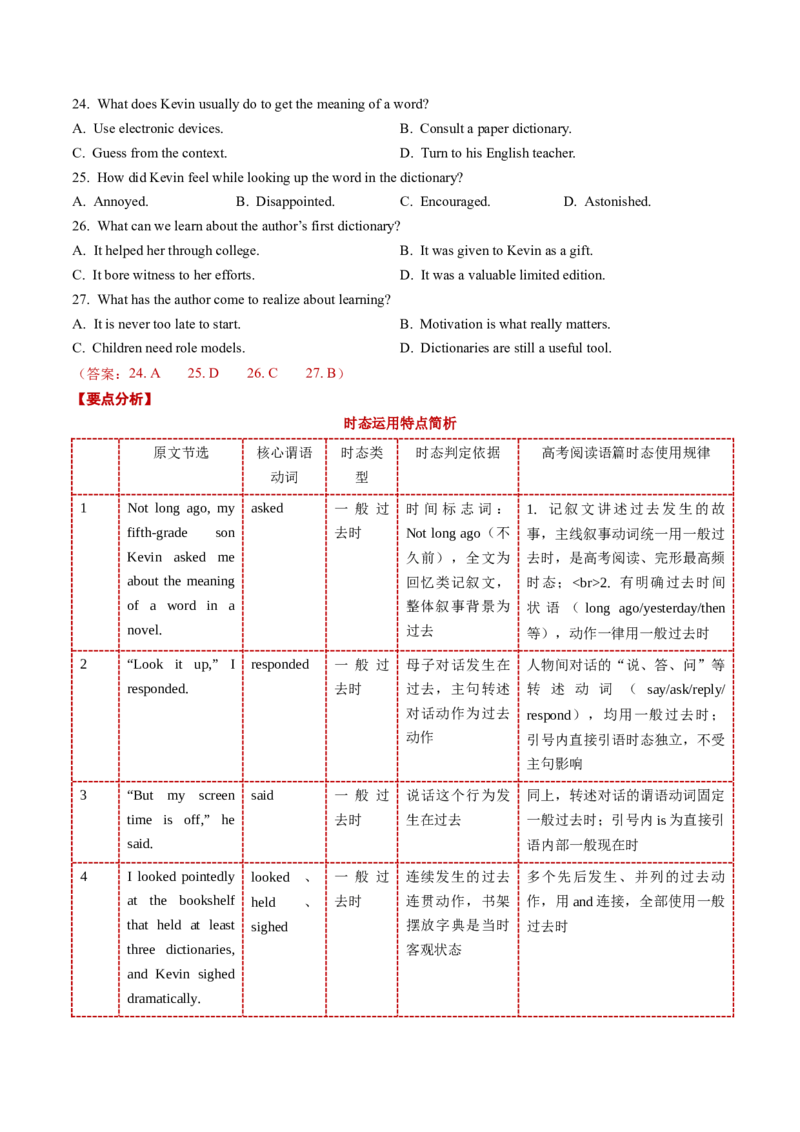
24. What does Kevin usually do to get the meaning of a word?
A. Use electronic devices.
B. Consult a paper dictionary.
C. Guess from the context.
D. Turn to his English teacher.
25. How did Kevin feel while looking up the word in the dictionary?
A. Annoyed.
B. Disappointed.
C. Encouraged.
D. Astonished.
26. What can we learn about the author’s first dictionary?
A. It helped her through college.
B. It was given to Kevin as a gift.
C. It bore witness to her efforts.
D. It was a valuable limited edition.
27. What has the author come to realize about learning?
A. It is never too late to start.
B. Motivation is what really matters.
C. Children need role models.
D. Dictionaries are still a useful tool.
(答案:24. A    25. D    26. C    27. B)
【要点分析】
时态运用特点简析
原文节选
核心谓语
动词
时态类
型
时态判定依据
高考阅读语篇时态使用规律
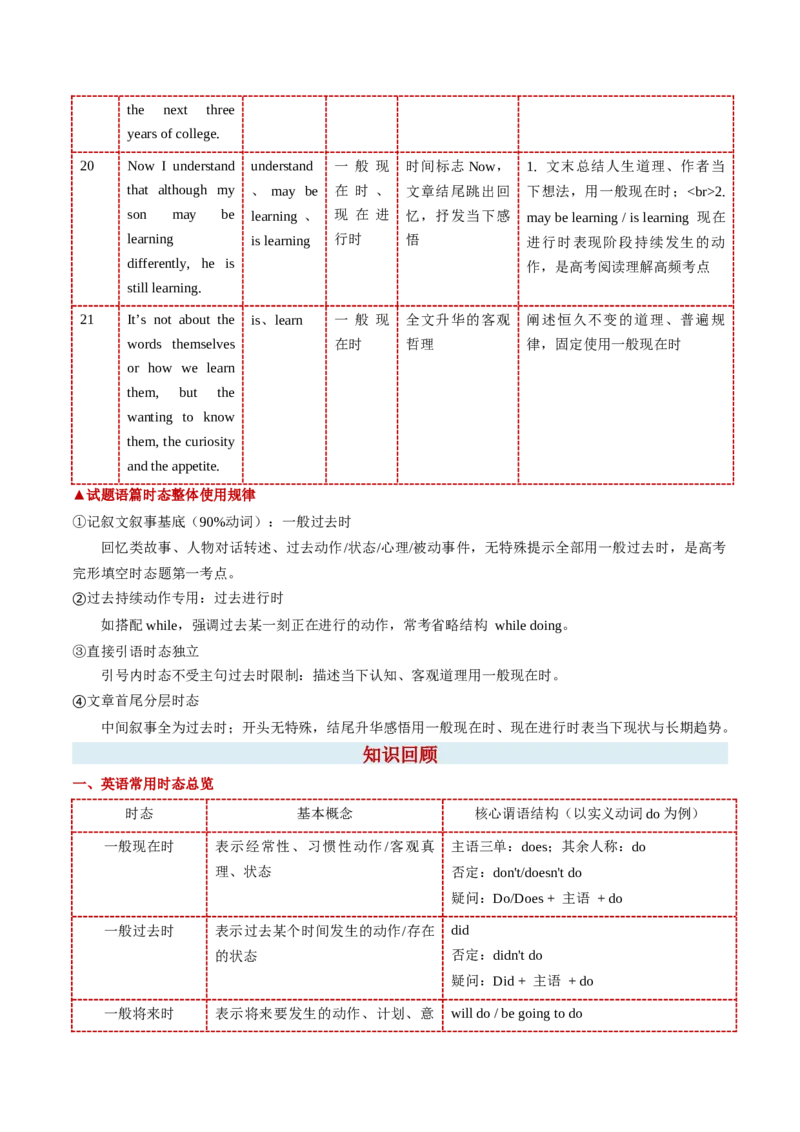
1
Not long ago, my
fifth-grade

son
Kevin asked me
about the meaning
of a word in a
novel.
asked
一般过
去时
时间标志词:
Not long ago(不
久前),全文为
回忆类记叙文,
整体叙事背景为
过去
1. 记叙文讲述过去发生的故
事,主线叙事动词统一用一般过
去时,是高考阅读、完形最高频
时态;<br>2. 有明确过去时间
状语(long ago/yesterday/then
等),动作一律用一般过去时
2
“Look it up,” I
responded.
responded
一般过
去时
母子对话发生在
过去,主句转述
对话动作为过去
动作
人物间对话的“说、答、问”等
转述动词(say/ask/reply/
respond),均用一般过去时;
引号内直接引语时态独立,不受
主句影响
3
“But my screen
time is off,” he
said.
said
一般过
去时
说话这个行为发
生在过去
同上,转述对话的谓语动词固定
一般过去时;引号内is 为直接引
语内部一般现在时
4
I looked pointedly
at the bookshelf
that held at least
three dictionaries,
and Kevin sighed
dramatically.
looked
、
held
、
sighed
一般过
去时
连续发生的过去
连贯动作,书架
摆放字典是当时
客观状态
多个先后发生、并列的过去动
作,用and 连接,全部使用一般
过去时
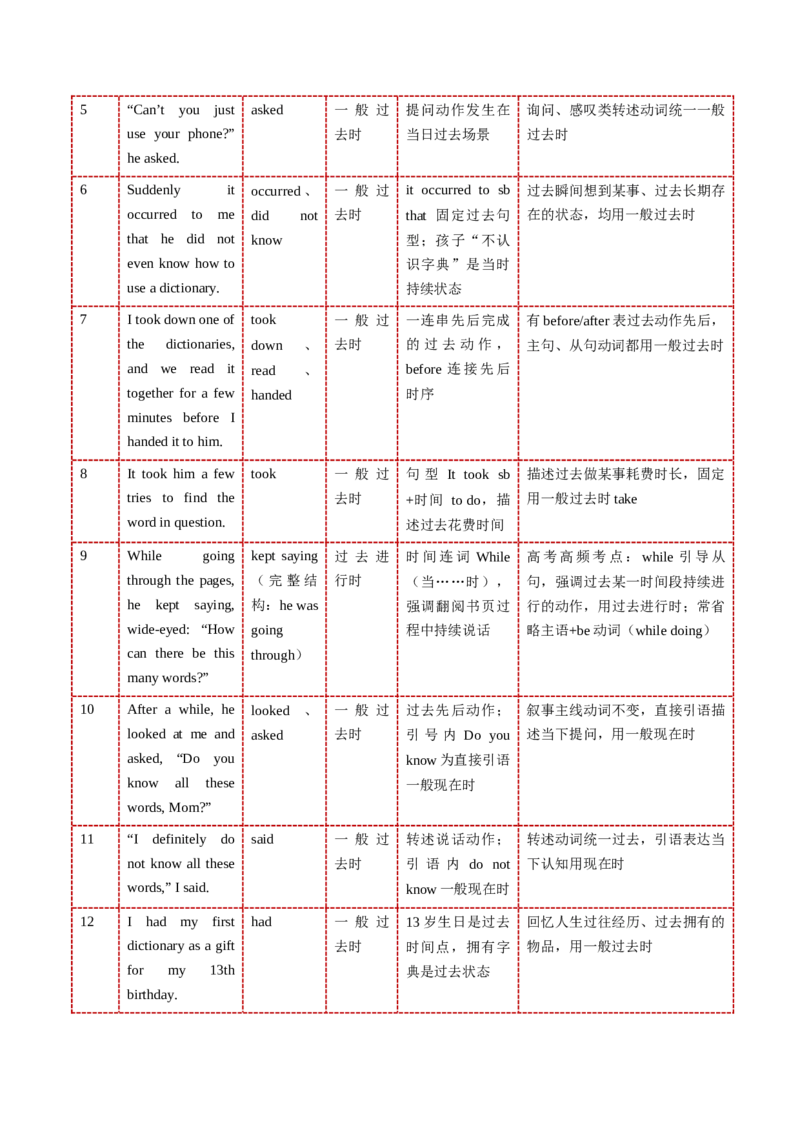
5
“Can’t you just
use your phone?”
he asked.
asked
一般过
去时
提问动作发生在
当日过去场景
询问、感叹类转述动词统一一般
过去时
6
Suddenly

it
occurred to me
that he did not
even know how to
use a dictionary.
occurred 、
did

not
know
一般过
去时
it occurred to sb
that 固定过去句
型;孩子“不认
识字典”是当时
持续状态
过去瞬间想到某事、过去长期存
在的状态,均用一般过去时
7
I took down one of
the dictionaries,
and we read it
together for a few
minutes before I
handed it to him.
took
down
、
read
、
handed
一般过
去时
一连串先后完成
的过去动作,
before 连接先后
时序
有before/after 表过去动作先后,
主句、从句动词都用一般过去时
8
It took him a few
tries to find the
word in question.
took
一般过
去时
句型It took sb
+时间 to do,描
述过去花费时间
描述过去做某事耗费时长,固定
用一般过去时take
9
While

going
through the pages,
he kept saying,
wide-eyed: “How
can there be this
many words?”
kept saying
(完整结
构:he was
going
through)
过去进
行时
时间连词While
(当……时),
强调翻阅书页过
程中持续说话
高考高频考点:while 引导从
句,强调过去某一时间段持续进
行的动作,用过去进行时;常省
略主语+be 动词(while doing)
10
After a while, he
looked at me and
asked, “Do you
know all these
words, Mom?”
looked
、
asked
一般过
去时
过去先后动作;
引号内Do you
know 为直接引语
一般现在时
叙事主线动词不变,直接引语描
述当下提问,用一般现在时
11
“I definitely do
not know all these
words,” I said.
said
一般过
去时
转述说话动作;
引语内do not
know 一般现在时
转述动词统一过去,引语表达当
下认知用现在时
12
I had my first
dictionary as a gift
for my 13th
birthday.
had
一般过
去时
13 岁生日是过去
时间点,拥有字
典是过去状态
回忆人生过往经历、过去拥有的
物品,用一般过去时
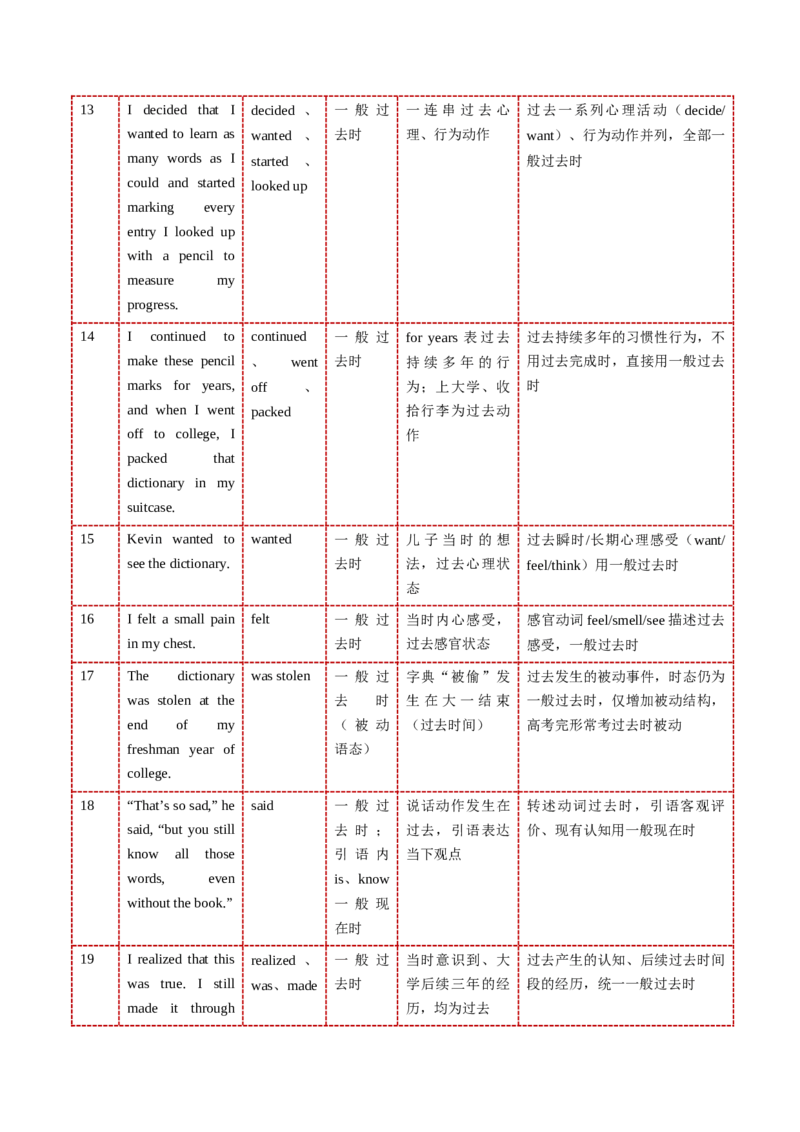
13
I decided that I
wanted to learn as
many words as I
could and started
marking

every
entry I looked up
with a pencil to
measure

my
progress.
decided 、
wanted
、
started
、
looked up
一般过
去时
一连串过去心
理、行为动作
过去一系列心理活动(decide/
want)、行为动作并列,全部一
般过去时
14
I continued to
make these pencil
marks for years,
and when I went
off to college, I
packed

that
dictionary in my
suitcase.
continued
、
went
off
、
packed
一般过
去时
for years 表过去
持续多年的行
为;上大学、收
拾行李为过去动
作
过去持续多年的习惯性行为,不
用过去完成时,直接用一般过去
时
15
Kevin wanted to
see the dictionary.
wanted
一般过
去时
儿子当时的想
法,过去心理状
态
过去瞬时/长期心理感受(want/
feel/think)用一般过去时
16
I felt a small pain
in my chest.
felt
一般过
去时
当时内心感受,
过去感官状态
感官动词feel/smell/see 描述过去
感受,一般过去时
17
The

dictionary
was stolen at the
end

of

my
freshman year of
college.
was stolen
一般过
去
时
(被动
语态)
字典“被偷”发
生在大一结束
(过去时间)
过去发生的被动事件,时态仍为
一般过去时,仅增加被动结构,
高考完形常考过去时被动
18
“That’s so sad,” he
said, “but you still
know all those
words,

even
without the book.”
said
一般过
去时;
引语内
is、know
一般现
在时
说话动作发生在
过去,引语表达
当下观点
转述动词过去时,引语客观评
价、现有认知用一般现在时
19
I realized that this
was true. I still
made it through
realized 、
was、made
一般过
去时
当时意识到、大
学后续三年的经
历,均为过去
过去产生的认知、后续过去时间
段的经历,统一一般过去时
the next three
years of college.
20
Now I understand
that although my
son may be
learning
differently, he is
still learning.
understand
、may be
learning 、
is learning
一般现
在时、
现在进
行时
时间标志Now,
文章结尾跳出回
忆,抒发当下感
悟
1. 文末总结人生道理、作者当
下想法,用一般现在时;<br>2.
may be learning / is learning 现在
进行时表现阶段持续发生的动
作,是高考阅读理解高频考点
21
It’s not about the
words themselves
or how we learn
them, but the
wanting to know
them, the curiosity
and the appetite.
is、learn
一般现
在时
全文升华的客观
哲理
阐述恒久不变的道理、普遍规
律,固定使用一般现在时
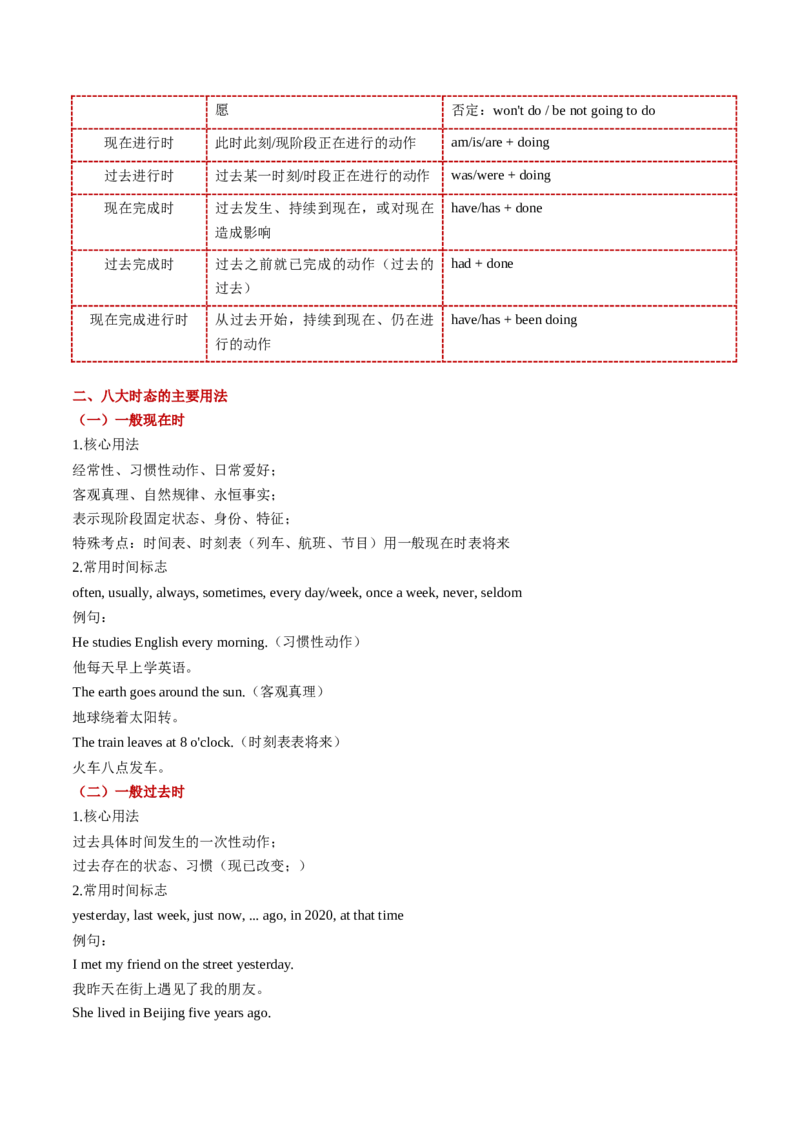
▲试题语篇时态整体使用规律
①记叙文叙事基底(90%动词):一般过去时
回忆类故事、人物对话转述、过去动作/状态/心理/被动事件,无特殊提示全部用一般过去时,是高考
完形填空时态题第一考点。
②过去持续动作专用:过去进行时
如搭配while,强调过去某一刻正在进行的动作,常考省略结构 while doing。
③直接引语时态独立
引号内时态不受主句过去时限制:描述当下认知、客观道理用一般现在时。
④文章首尾分层时态
中间叙事全为过去时;开头无特殊,结尾升华感悟用一般现在时、现在进行时表当下现状与长期趋势。
知识回顾
一、英语常用时态总览
时态
基本概念
核心谓语结构(以实义动词do 为例)
一般现在时
表示经常性、习惯性动作/客观真
理、状态
主语三单:does;其余人称:do
否定:don't/doesn't do
疑问:Do/Does + 主语 + do
一般过去时
表示过去某个时间发生的动作/存在
的状态
did
否定:didn't do
疑问:Did + 主语 + do
一般将来时
表示将来要发生的动作、计划、意
will do / be going to do
愿
否定:won't do / be not going to do
现在进行时
此时此刻/现阶段正在进行的动作
am/is/are + doing
过去进行时
过去某一时刻/时段正在进行的动作
was/were + doing
现在完成时
过去发生、持续到现在,或对现在
造成影响
have/has + done
过去完成时
过去之前就已完成的动作(过去的
过去)
had + done
现在完成进行时
从过去开始,持续到现在、仍在进
行的动作
have/has + been doing
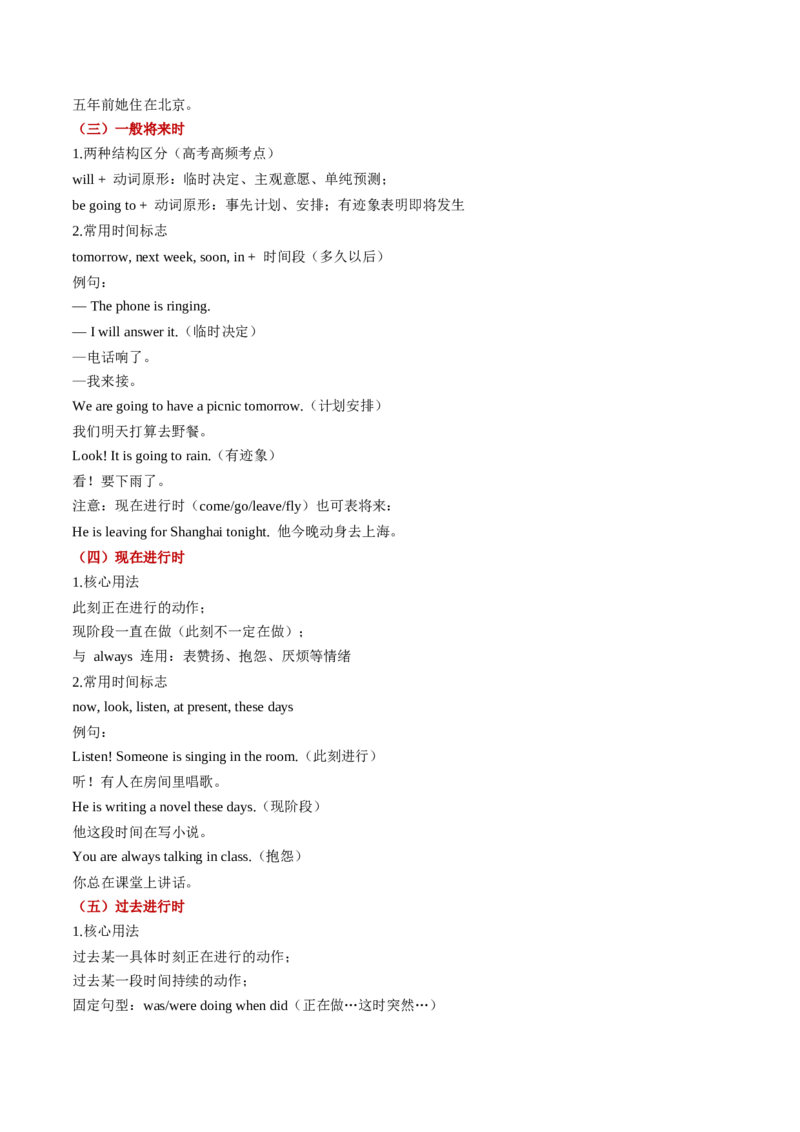
二、八大时态的主要用法
(一)一般现在时
1.核心用法
经常性、习惯性动作、日常爱好;
客观真理、自然规律、永恒事实;
表示现阶段固定状态、身份、特征;
特殊考点:时间表、时刻表(列车、航班、节目)用一般现在时表将来
2.常用时间标志
often, usually, always, sometimes, every day/week, once a week, never, seldom
例句:
He studies English every morning.(习惯性动作)
他每天早上学英语。
The earth goes around the sun.(客观真理)
地球绕着太阳转。
The train leaves at 8 o'clock.(时刻表表将来)
火车八点发车。
(二)一般过去时
1.核心用法
过去具体时间发生的一次性动作;
过去存在的状态、习惯(现已改变;)
2.常用时间标志
yesterday, last week, just now, ... ago, in 2020, at that time
例句:
I met my friend on the street yesterday.
我昨天在街上遇见了我的朋友。
She lived in Beijing five years ago.
五年前她住在北京。
(三)一般将来时
1.两种结构区分(高考高频考点)
will + 动词原形:临时决定、主观意愿、单纯预测;
be going to + 动词原形:事先计划、安排;有迹象表明即将发生
2.常用时间标志
tomorrow, next week, soon, in + 时间段(多久以后)
例句:
— The phone is ringing.
— I will answer it.(临时决定)
—电话响了。
—我来接。
We are going to have a picnic tomorrow.(计划安排)
我们明天打算去野餐。
Look! It is going to rain.(有迹象)
看!要下雨了。
注意:现在进行时(come/go/leave/fly)也可表将来:
He is leaving for Shanghai tonight. 他今晚动身去上海。
(四)现在进行时
1.核心用法
此刻正在进行的动作;
现阶段一直在做(此刻不一定在做);
与 always 连用:表赞扬、抱怨、厌烦等情绪
2.常用时间标志
now, look, listen, at present, these days
例句:
Listen! Someone is singing in the room.(此刻进行)
听!有人在房间里唱歌。
He is writing a novel these days.(现阶段)
他这段时间在写小说。
You are always talking in class.(抱怨)
你总在课堂上讲话。
(五)过去进行时
1.核心用法
过去某一具体时刻正在进行的动作;
过去某一段时间持续的动作;
固定句型:was/were doing when did(正在做…这时突然…)
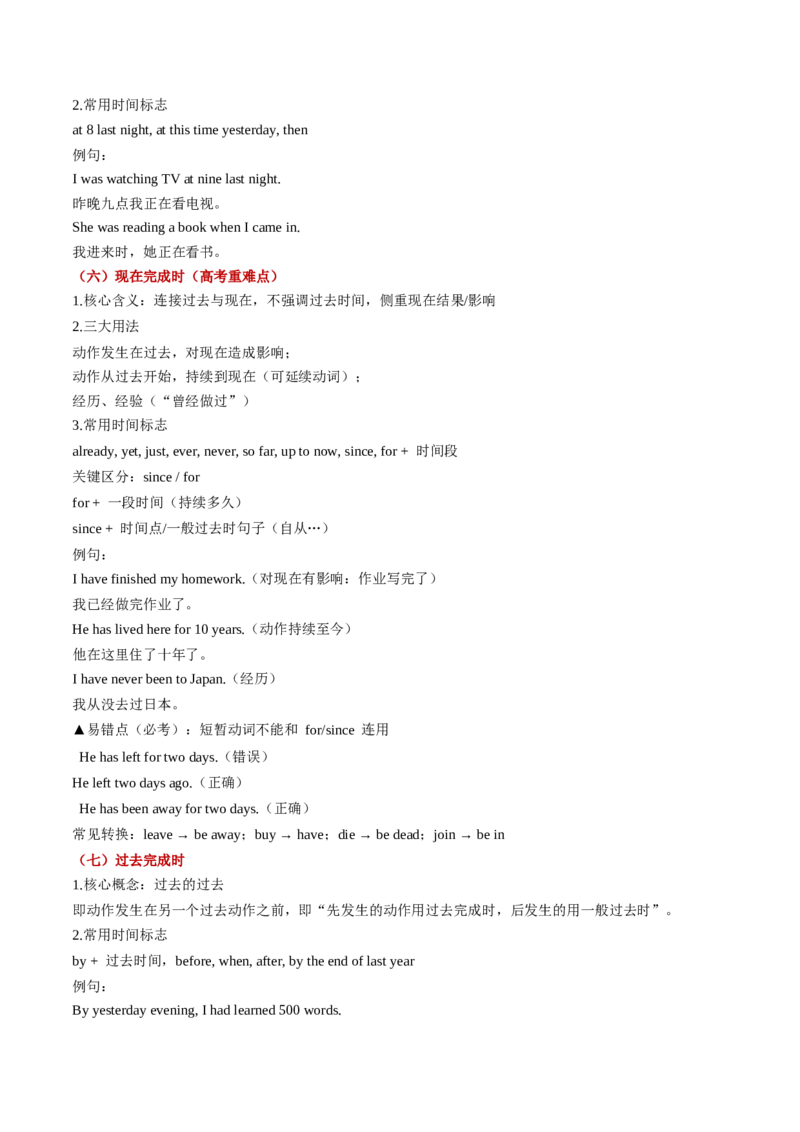
2.常用时间标志
at 8 last night, at this time yesterday, then
例句:
I was watching TV at nine last night.
昨晚九点我正在看电视。
She was reading a book when I came in.
我进来时,她正在看书。
(六)现在完成时(高考重难点)
1.核心含义:连接过去与现在,不强调过去时间,侧重现在结果/影响
2.三大用法
动作发生在过去,对现在造成影响;
动作从过去开始,持续到现在(可延续动词);
经历、经验(“曾经做过”)
3.常用时间标志
already, yet, just, ever, never, so far, up to now, since, for + 时间段
关键区分:since / for
for + 一段时间(持续多久)
since + 时间点/一般过去时句子(自从…)
例句:
I have finished my homework.(对现在有影响:作业写完了)
我已经做完作业了。
He has lived here for 10 years.(动作持续至今)
他在这里住了十年了。
I have never been to Japan.(经历)
我从没去过日本。
▲易错点(必考):短暂动词不能和 for/since 连用
 He has left for two days.(错误)
He left two days ago.(正确)
 He has been away for two days.(正确)
常见转换:leave → be away;buy → have;die → be dead;join → be in
(七)过去完成时
1.核心概念:过去的过去
即动作发生在另一个过去动作之前,即“先发生的动作用过去完成时,后发生的用一般过去时”。
2.常用时间标志
by + 过去时间,before, when, after, by the end of last year
例句:
By yesterday evening, I had learned 500 words.
到昨晚为止,我已经学了500 个单词。
The train had left when I arrived at the station.
我到车站时,火车已经开走了。
(八)现在完成进行时
1.核心用法
动作从过去开始,一直持续到现在,并且仍在进行;
强调动作的持续性、反复性,常带有情绪色彩
2.结构:have/has been doing
例句:
I have been waiting for you for an hour.
我已经等你一个小时了(现在还在等)。
She has been learning piano since she was five.
她从五岁开始就学钢琴(至今仍在学)。
▲与现在完成时对比(易混考点)
I have read the book.(已读完,强调结果)
I have been reading the book.(还在读,强调过程/持续)
三、高考易混时态对比表
对比组合
区别要点
例句
一般过去时 VS
现在完成时
一般过去时:有具体过去时间,
只讲过去
现在完成时:无具体过去时间,
侧重现在影响
1. I saw him yesterday.(过去时,有yesterday)
2. I have seen him.(完成时,影响:见过了)
现在进行时 VS
一般现在时
进行时:此刻/现阶段动作
一般现在时:长期习惯、常态
1. He works hard.(一贯努力)
2. He is working hard today.(今天格外努力)
过去进行时 VS
一般过去时
过去进行时:过去正在做(长动
作)
一般过去时:过去做完了(短动
作)
1. I was cooking yesterday evening. (一直在做
饭)
2. I cooked dinner yesterday.(做了晚饭)
时态解题通用技巧
找时间标志词:优先判断时态(最快解题法)
看动作先后:两个过去动作,先发生用过去完成时
看动作状态:持续进行 → 进行时;持续到现在 → 完成/完成进行时
看语境逻辑:客观真理永远用一般现在时;计划安排多用 be going to
Group 2 英语的语态
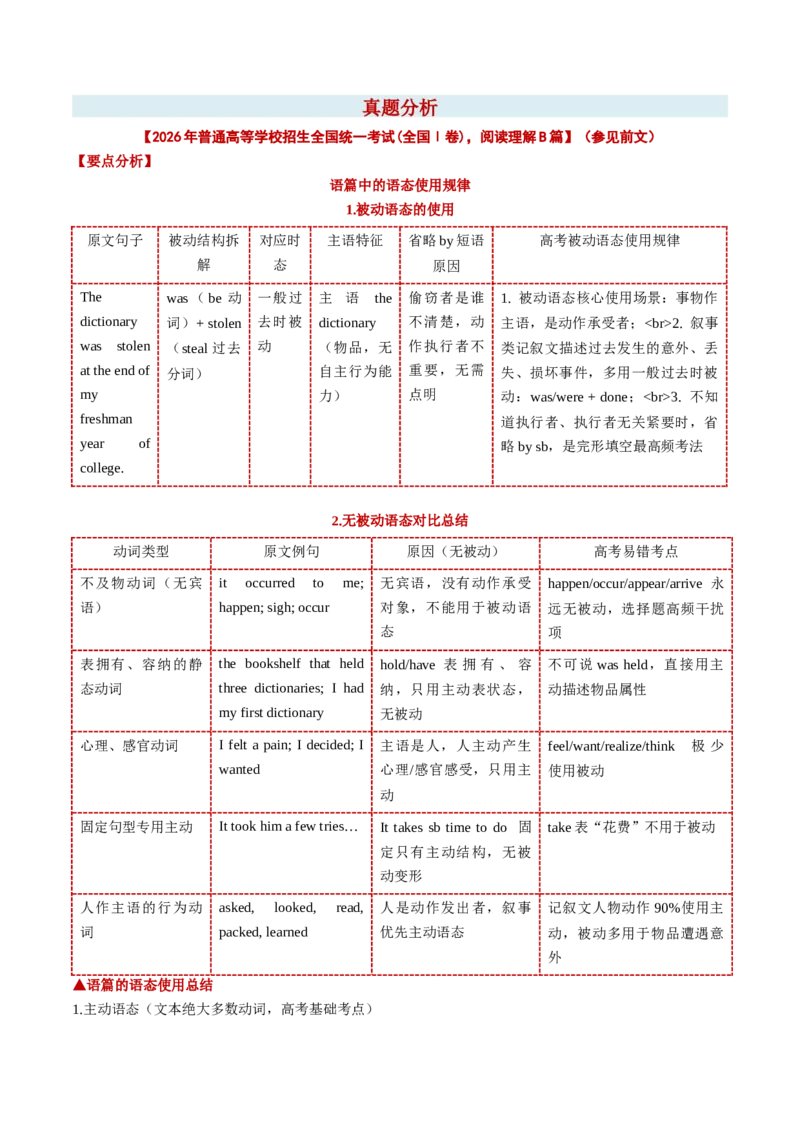
真题分析
【2026 年普通高等学校招生全国统一考试(全国Ⅰ卷),阅读理解B 篇】(参见前文)
【要点分析】
语篇中的语态使用规律
1.被动语态的使用
原文句子
被动结构拆
解
对应时
态
主语特征
省略by 短语
原因
高考被动语态使用规律
The
dictionary
was stolen
at the end of
my
freshman
year

of
college.
was (be 动
词)+ stolen
(steal 过去
分词)
一般过
去时被
动
主
语
the
dictionary
(物品,无
自主行为能
力)
偷窃者是谁
不清楚,动
作执行者不
重要,无需
点明
1. 被动语态核心使用场景:事物作
主语,是动作承受者;<br>2. 叙事
类记叙文描述过去发生的意外、丢
失、损坏事件,多用一般过去时被
动:was/were + done;<br>3. 不知
道执行者、执行者无关紧要时,省
略by sb,是完形填空最高频考法
2.无被动语态对比总结
动词类型
原文例句
原因(无被动)
高考易错考点
不及物动词(无宾
语)
it occurred to me;
happen; sigh; occur
无宾语,没有动作承受
对象,不能用于被动语
态
happen/occur/appear/arrive 永
远无被动,选择题高频干扰
项
表拥有、容纳的静
态动词
the bookshelf that held
three dictionaries; I had
my first dictionary
hold/have 表拥有、容
纳,只用主动表状态,
无被动
不可说was held,直接用主
动描述物品属性
心理、感官动词
I felt a pain; I decided; I
wanted
主语是人,人主动产生
心理/感官感受,只用主
动
feel/want/realize/think 极少
使用被动
固定句型专用主动
It took him a few tries…
It takes sb time to do 固
定只有主动结构,无被
动变形
take 表“花费”不用于被动
人作主语的行为动
词
asked, looked, read,
packed, learned
人是动作发出者,叙事
优先主动语态
记叙文人物动作90%使用主
动,被动多用于物品遭遇意
外
▲语篇的语态使用总结
1.主动语态(文本绝大多数动词,高考基础考点)
使用场景:
① 人作为主语,发出询问、阅读、书写、思考、感受、交谈等动作;
 hold
②
、contain、occur、happen、take(花费)等不及物 / 静态动词,无被动语态,只能用主动;
③ 心理动词(want/decide/realize/feel)、感官动词,永远主动。
时态搭配:记叙文主线一般过去时主动;文末感悟用一般现在时、现在进行时主动。
2.被动语态(全文仅 1 处,高考高频难点)
触发条件:主语是物品 / 事物,不能主动完成动作,只能承受动作(本句字典 “被偷走”);动作
执行者未知、不重要,省略 by + 人。
结构公式:时态体现在 be 动词 + 实义动词过去分词
本文:一般过去时被动 → was/were + done
高考命题偏好
故事中物品丢失、损坏、制作、使用常考过去时被动;完形填空常区分主动 did 和被动 was done。
知识回顾
一、基本概念
英语动词有两种语态:主动语态、被动语态。
语态
核心含义
句式结构
使用场景
主动语态
主语是动作的发出者
主语 + 谓语(主动)+ 宾语
强调执行者,日常表达最常用
被动语态
主语是动作的承受者
主语 + be + 过去分词(done)
1. 不知道动作执行者
2. 强调动作承受者
3. 正式文体、科技、新闻、公文
注意:
被动语态核心公式:be + 动词过去分词 (done)
时态、人称、单复数变化只改变 be 动词,过去分词永远不变。
二、八大时态对应的被动语态
1. 一般现在时
时态
被动结构
肯定/否定/疑问例句
一般现在时
am / is / are + done
肯定:English is taught in our school.
(我们学校教英语。)
否定:Rice isn't grown here.
(这里不种水稻。)
疑问:Are the letters sent every day?
(信件每天都寄出吗?)
2. 一般过去时
时态
被动结构
肯定/否定/疑问例句
一般过去时
was / were + done
肯定:The bridge was built in 1990.
(这座桥建于1990 年。)
否定:The tasks weren't finished yesterday.
(昨天任务没完成。)
疑问:Was the house repaired last week?
(房子上周修缮了吗?)
3. 一般将来时
时态
被动结构
肯定/否定/疑问例句
一般将来时
will be + done ;
 am/is/are going
to be + done
肯定:A new hospital will be built soon.
(很快会建一座新医院。)
否定:The plan won't be discussed tomorrow.
(明天不讨论这个方案。)
疑问:Is the problem going to be solved?
(这个问题会被解决吗?)
4. 过去将来时
时态
被动结构
例句
过去将来时
would be + done
 was/were going to be +
done
He said the work would be finished soon.
(他说工作很快就会做完。)
5. 现在进行时
时态
被动结构
例句
现在进行时
am / is / are + being + done
The classroom is being cleaned now.
(教室此刻正在被打扫。)
易错点:必须加 being,不能漏掉。
6. 过去进行时
时态
被动结构
例句
过去进行
时
was / were + being + done
I saw that the wall was being painted.
(我看见墙当时正在被粉刷。)
7. 现在完成时
时态
被动结构
例句
现在完成时
have / has + been + done
All the papers have been handed in.
(所有试卷都已经上交了。)
标志词:already, yet, ever, never, since, so far
8. 过去完成时
时态
被动结构
例句
过去完成时
had + been + done
The letter had been sent before I arrived.
(我到之前,信就已经寄出了。)
三、含情态动词的被动语态
结构:情态动词 + be + done
常用情态动词:can / may / must / should / need / will / would
用法
例句
can be done 能够被…
The rules can be understood easily.
(这些规则很容易被理解。)
must be done 必须被…
Your homework must be finished on time.
(作业必须按时完成。)
should be done 应该被…
Old people should be respected.
(老人应该被尊重。)
need be done 需要被…
The room needs to be cleaned.
(房间需要打扫。)
四、特殊句式的被动语态(高考重难点)
1. 带双宾语动词的被动
常用动词:give, send, tell, show, teach, buy
主动:Sb + give + sb + sth
两种被动形式:
间接宾语作主语:She was given a book.(她得到了一本书。)
直接宾语作主语:A book was given to her.
2. 带复合宾语(宾补)的被动
主动:Sb + make / let / see / hear / watch + sb + 动词原形
被动:主语 + be + made/seen/heard + to do(必须加 to)
主动:We saw him go out.
被动:He was seen to go out.(易错考点:漏 to)
3. 短语动词的被动(介词/副词不可丢)
短语动词整体看作一个及物动词,介词/副词必须保留
look after 照顾 → The children are looked after well.
take care of 照顾 → The old man is taken care of.
listen to 听 → The song is listened to everywhere.
4. 主动形式表被动含义(必考易混点)
下列动词形式主动,含义被动,不用被动语态:
感官系动词:look, sound, smell, taste, feel
The cloth feels soft. 这块布摸起来很柔软。(不说 is felt)
表示“畅销、耐磨、好写”:sell, wash, write, read, wear
The books sell well. 这些书很畅销。
want / need / require + doing(= to be done)表“需要被…”
The bike needs repairing = The bike needs to be repaired.
5. 不及物动词无被动语态
不及物动词(无宾语)永远不能用于被动:
happen, appear, disappear, rise, fall, arrive, come, go, occur, take place
错误:An accident was happened.
正确:An accident happened. 发生了一场事故。
基|础|练|习
一、阅读下面短文,在空白处填入1 个适当的单词或括号内单词的正确形式。
When it comes to China’s cultural ambassadors, food, pandas and other symbols enjoy worldwide fame.
However, the ancient art of embroidery (刺绣), as a national intangible     1     (culture) heritage, has a lower
global profile.
From March 5, an exhibition     2     (title) Suzhou Embroidery: The Awakening of a 1,000-Year
Tradition was held in London, aiming to introduce this delicate art     3     a wider audience. Jointly presented
by a Chinese publishing group and     4     (it) British partner, the show displayed 58 works by embroidery
masters Yao Huifen, Yao Huiqin and contemporary artist Wu Jianan. These works, divided into three sections,
combine traditional     5     (technique) with modern innovations, breaking old rules and regarding embroidery
as independent art rather than just a skill.
Yao,     6     has decades of experience and has exhibited globally, stressed that they inherit traditions
while making great innovations. Wu noted that embroidery     7     (require) slow and calm creation, much like
meditation (冥想), and he hoped the exhibition would enhance its global     8     (recognize).
Yu Junyao, a young supporter, also highlighted the importance of protecting and promoting this heritage,
9     (view) it not only as China’s treasure but also as a common legacy of humanity. The exhibition serves as
1  0

  window to help the world understand the charm of Suzhou embroidery and feel the beauty created by
Chinese craftspeople.
二、根据上文试题语篇的内容,完成下列有关动词的时态与语态的使用分析。
原句
核心动词(含填空词)
动词类型
时态
语态
1
When it comes to China’s
cultural ambassadors, food,
pandas and other symbols
enjoy worldwide fame.
comes;enjoy
谓语动词
一般现在时
主动
2
However, the ancient art of
embroidery…has a lower
global profile.
3
From March 5, an exhibition
titled Suzhou Embroidery: The
Awakening of a 1,000-Year
Tradition was held in London
4
…aiming to introduce this
delicate art to a wider
audience.
5
Jointly presented by a Chinese
publishing group and its
British partner, the show
displayed 58 works…
6
These

works…combine
traditional techniques with
modern innovations, breaking
old rules and regarding
embroidery as independent
art…
7
Yao, who has decades of
experience and has exhibited
globally, stressed that they
inherit traditions while making
great innovations.
8
Wu noted that embroidery
requires slow and calm
creation…
9
…he hoped the exhibition
would enhance its global
recognition.
1
0
Yu Junyao…also highlighted
the importance of protecting
and promoting this heritage,
viewing it not only as China’s
treasure…
1
1
The exhibition serves as a
window to help the world
understand the charm of
Suzhou embroidery and feel
the beauty created by Chinese
craftspeople.
◇Part 02  知识运用题型强化
一、阅读理解
1
“A hero is any person who is really keen on making the society a better place for all people.” Every time I
read the quote, I always have the Australian micro-influencer Tennilles_deals in mind.
Who exactly is Tennilles_deals? Firstly, she’s the Mother Teresa of Aussie supermarkets, committed and self-
giving. Secondly, I don’t know anything about her personally because this content creator doesn’t market herself
like average influencers. She lets her work speak for itself.
The work in question? She posts weekly uploads of supermarket walk-through videos where she carefully
goes through major supermarkets to show what’s on special that week. Her gentle voice and steady hand
accompany you through a sea of yellow price tags which signal special promotions or deals. It’s detailed,
thoughtful, and necessary work.
Even today, I still remember how I used to eagerly wait for the catalogues ( 目录) from my favorite
supermarkets every Monday. Nothing can outshine the feeling of a hard-to-find European snack or a new washing
machine with a 75% discount. For me, browsing ( 浏览) a supermarket catalogue produces a pleasure: the
anticipation of what could soon be yours. But the days of glancing through paper catalogues are over. That’s why
Tennilles_deals is so important, giving us tight, three-minute videos that provide us with a 360-degree view of each
product: a walking, talking catalogue.
There’s a reason that Tennilles_deals has almost 100,000 followers. What Tennilles_deals is doing is
building community. One fan comments that she should have been awarded “the Australian of the Year”, and my
only way to give credit to her is via this public essay.
1.What distinguishes Tennilles_deals from typical influencers?
A.Her unique marketing style.
B.Her practical video content.
C.Her focus on personal brand.
D.Her choice of supermarkets.
2.What is the theme of Tennilles_deals’ videos?
A.The operation of supermarkets.
B.The presentation of new products.
C.The display of discounted items.
D.The exposure of product packaging.
3.Why does the author value Tennilles_deals’ videos?
A.They teach useful video creating strategies.
B.They provide new perspectives on the goods.
C.They replace the need to visit physical stores. D.They bring back the joy of catalogue browsing.
4.What is the author’s purpose in writing this text?
A.To praise Tennilles_deals’ selfless contribution.
B.To vote Tennilles_deals the Australian of the Year.
C.To defend Tennilles_deals against online criticism.
D.To show shift from paper catalogues to digital ones.
2
A 16-year-old Granite Bay High School student is spreading holiday cheer by helping make sure kids in the
community don’t go without a present this Christmas. Livy Hickey, a responsible youth ambassador for Marine (海
军) Toys for Tots (a charity program), is on a mission to make this holiday season brighter for children in need.
Her journey with the nonprofit started when she was in eighth grade after she saw an activity for the
organization, which has been providing holiday joy to families since 1947. “I love Christmas, it’s my favorite time
of year, and I just value it so much,” said Livy, reflecting on her passion for the holiday season.
Livy’s efforts didn’t go unnoticed. Matt Vidosh, the local organizer for Marine Toys for Tots, quickly
recognized her potential (潜力). “She was so well-spoken, warm and friendly. I honestly thought she was already a
junior or senior in high school. She acted older than she actually was,” Vidosh said. For Livy, the desire to give
back has deep roots. “My grandpa was a Marine, so I wanted to honor his legacy (遗产). That’s really what inspired
me to take part in the program,” she explained.
She threw herself into the mission by buying toys, sorting them in the warehouse, and personally handing
them out to families in need. Her hard work paid off when she was selected as one of just 35 student ambassadors
nationwide for the program.
In 2024, the local Toys for Tots collected over 28, 000 toys, reaching more than 12,000 kids. The program
depends on the generosity of people like Livy, and they’re always looking for donations of new, unwrapped toys.
“We’re always accepting new, unwrapped toys, and if you’re someone who loves to make toys at home, we’ll take
those too. Every little bit helps,” Vidosh added.
For Livy, the true reward (回报) comes when the kids open their gifts. “Seeing the smiles on the kids’ faces
is priceless. It lights up their entire face. Honestly, it brightens my day and my whole year,” she said.
5.What impressed Matt Vidosh most about Livy Hickey at first?
A.Her excellent qualities.
B.Her school achievements.
C.Her skills in collecting toys.
D.Her strong interest in making gifts.
6.Why did Livy Hickey join Marine Toys for Tots?
A.She wanted to get volunteer experience.
B.Her grandfather’s background touched her.
C.The local organizer personally invited her.
D.She desired to share her favorite holiday joy.
7.What can we know from Livy’s words in the last paragraph?
A.She hopes to get valuable rewards.
B.The program helps kids build confidence.
C.The joy of helping others is lasting.
D.She expects more teens to join the program.
8.What is the best title for the text?
A.How to Donate Toys to Children
B.Marine Toys for Tots: A Care Program
C.A Teenage Volunteer’s Holiday Journey
D.Spreading Holiday Joy: A Teen’s Mission
3
Money and the Meaning of Life is not a typical personal finance book. Written by Jacob Needleman, a
philosophy professor at San Francisco State University, it invites readers to look at money not as something to
spend or save, but as a mirror that reflects who we really are.
The book grew out of a course Needleman taught, where he noticed how deeply money shapes people’s
emotions and decisions. To make his ideas easy to understand, Needleman creates two fictional characters based on
the rich exchanges with his students: Bill, a millionaire who has everything except happiness, and Alyssa, an artist
who becomes an accountant (会计) to feel safe but loses her passion along the way. Their stories help readers see
that money cannot buy self-understanding, love, or true friendship. As Needleman writes, expecting money to give
your life meaning is like expecting a hammer (锤子) to build a house by itself — it is just a tool.
Some readers might find this book a bit challenging because it asks deep questions rather than giving simple
answers. However, for high school students, especially freshmen, it is a great introduction to thinking critically (批
判性地) about money and values. You do not need to be a philosophy expert to enjoy it. The language is clear, and
the examples come from everyday life.
What makes this book especially valuable for young readers is that it speaks directly to teenagers and young
adults, who are just starting to form their views on money and success. Needleman reminds us that it’s important to
use money wisely, not to waste it on unnecessary things, but also not to let the fear of being poor or the desire for
wealth control our decisions. He encourages readers to ask themselves: What do I really want from life? How can
money help me achieve that, rather than become a problem?
I highly recommend this book to every high school student who wants to gain a clear understanding of
money’s role in life and avoid falling into the trap of blind materialism. It is a valuable guide that will benefit us for
a lifetime.
9.What can we learn about Bill and Alyssa?
A.They show a common job mistake.
B.They’re created based on real experience.
C.They prove artists earn less money.
D.They are skilled at managing finance.
10.What does the hammer example imply?
A.Tools are useless without workers.
B.Building houses requires teamwork.
C.It’s challenging to use money wisely.
D.Money alone cannot create meaningful life.
11.What does the author suggest about teenagers?
A.They easily fall into materialism.
B.They lack interest in philosophy.
C.They are forming their sense of values. D.They should ignore the impact of wealth.
12.What type of writing is this text?
A.A book review.
B.A news report.
C.A personal diary.
D.A research paper.
4
A new study shows that vitamin D might help people age more slowly. Scientists found that vitamin D may
protect telomeres. Telomeres are parts at the end of our DNA that get shorter as we get older.     13
The study used data from a larger project called the VITAL trial. In this study, over 1,000 adults were
followed for five years. The results showed that vitamin D helped slow the shortening of telomeres.     14

Experts say these results are interesting, but they want more research.
    15     It can help keep bones strong, lower blood pressure, and reduce the risk of diabetes and heart
disease. But too much vitamin D can cause health problems, like high calcium levels or kidney issues.
To get vitamin D, people can spend time in the sun, take supplements, or eat certain foods. These include
fatty fish like salmon and tuna, egg yolks, and vitamin D-fortified milk.     16
Doctors say it’s best to check your vitamin D level before taking supplements.     17     Good sleep,
exercise, a healthy diet, and not smoking are still the best ways to stay young and healthy.
A.When do we need vitamin D?
B.Vitamin D has other known health benefits.
C.Some mushrooms and cheese also contain small amounts.
D.However, omega-3 did not show any effect on telomere length.
E.When they get too short, they can cause health problems like cancer.
F.This may mean that vitamin D slows biological aging by about three years.
G.In healthy people with normal levels, extra vitamin D might not be helpful.
附加题:阅读理解试题中被动结构使用分析
语篇
原句
使用规律分析
阅读理解1
One fan comments that she
should have been awarded “the
Australian of the Year”.
1. 句式结构:
2. 动词搭配:
3. 使用场景:
阅读理解2
She was selected as one of just
35

student

ambassadors
nationwide for the program.
1. 句式结构:
2. 动词搭配:
3. 使用场景:
阅读理解3
Written by Jacob Needleman, a
philosophy professor at San
1. 句式结构:
Francisco State University, it
invites readers to look at money
not as something to spend or
save...
2. 动词搭配:
3. 使用场景:
二、完形填空
I was heading home when a display in a shop window caught my eye. Upon closer     18    , I realized it
was a jigsaw puzzle (拼图游戏) and the shop was full of such puzzles. When I stepped inside, I found my mind
kept     19     back to my childhood.
Long ago, well before the     20     of cellphones and video games, on long summer days my sisters and
I would spend the afternoons     21     jigsaw puzzles of colorful waterfalls and other natural     22    .
Many decades later, as I     23     shelf after shelf of puzzles, I wondered: Could fitting them together
today be as     24     as in bygone years?
Indeed, the two puzzles I purchased were just as fun as those of the past and I found the skills I had     25
over the decades prepared me to better complete the puzzles now and     26     the deep value of this pastime.
I knew I would need an eagle’s eye for different color matches and distinguishing details in     27     of
just the right piece. And when the puzzles seemed extremely     28    , I simply took a break, returned
refreshed, and quickly found the piece that had long     29     me.
Among the valuable lessons that these puzzles offer is that     30     and willpower are enhanced. But
what is most beneficial is how we look for answers or clues, working tirelessly to find the     31     fit. It’s an
approach that pays off when meeting any     32     that life presents.
18.A.connection
B.location
C.inspection
D.comparison
19.A.thinking
B.dating
C.pacing
D.flashing
20.A.operation
B.appearance
C.growth
D.decline
21.A.finding
B.watching
C.solving
D.building
22.A.responses
B.wonders
C.resources
D.disasters
23.A.glanced through
B.stormed into
C.checked out
D.went after
24.A.tough
B.shocking
C.incredible
D.exciting
25.A.ignored
B.forgotten
C.acquired
D.needed
26.A.appreciate
B.explain
C.predict
D.share
27.A.favor
B.search
C.possession
D.charge
28.A.odd
B.vibrant
C.difficult
D.flexible
29.A.surprised
B.amused
C.confused
D.escaped
30.A.integrity
B.patience
C.curiosity
D.ambition
31.A.typical
B.distinct
C.significant
D.perfect
32.A.challenge
B.prospect
C.amazement
D.clue
附加题:

 完形填空语篇时态

 使用分析


原句
考查时态
动词形态与时态使用规律分析
1
I was heading
home when a
display in a shop
window caught my
eye.
过去进行
时+ 一般
过去时
(
when
经典句
型)
动词形态:was heading(过去进行时谓语);caught(一般过去
时谓语)
使用分析:固定句型sb. was/were doing sth. when sth. did sth.,表
示“某人过去正在做某事,这时突然发生了另一件突发动作”。
延续性动作用过去进行时(回家是持续动作),短暂突发动作用
一般过去时(橱窗展品吸引目光是瞬间动作),是完形和语法填
空超高频时态句型。
2
Upon

closer
inspection,

I
realized it was a
jigsaw puzzle and
the shop was full of
such puzzles.
动词形态:
使用分析:
3
When I stepped
inside, I found my
mind kept flashing
back

to

my
childhood.
动词形态:
使用分析:
4
my sisters and I
would spend the
afternoons solving
jigsaw puzzles of
colorful waterfalls
and other natural
wonders.
动词形态:
使用分析:
5
Many

decades
later, as I glanced
through shelf after
shelf of puzzles, I
wondered: Could
fitting

them
together today be
as exciting as in
bygone years?
动词形态:
使用分析:
6
I found the skills I
动词形态:
had acquired over
the

decades
prepared me to
better complete the
puzzles now and
appreciate the deep
value of this
pastime.
使用分析:
7
And when the
puzzles

seemed
extremely difficult,
I simply took a
break,

returned
refreshed,

and
quickly found the
piece that had long
escaped me.
动词形态:
使用分析:
8
Among

the
valuable lessons
that these puzzles
offer

is

that
patience

and
willpower

are
enhanced.
动词形态:
使用分析:
三、语法填空
阅读下面短文,在空白处填入1 个适当的单词或括号内单词的正确形式。
The 20th China Wuqiao International Circus Festival was held in Wuqiao County, Hebei Province —     33
historic birthplace of Chinese acrobatics (杂技).
The festival, first     34     (establish) in 1987, is recognized as one of the world’s top three circus
competitions, alongside those in Monte-Carlo and Paris. This year’s celebration attracted great performers from 19
countries and regions, who presented 28 amazing acts     35     mixed artistry, strength, and innovation.
In Wuqiao, acrobatics has long been more than entertainment — it is a cultural identity.     36

(generation) of performers have traveled the world, spreading Chinese artistry and     37     (exchange) ideas
with performers from other countries.
Beyond its artistic value, the festival has become an     38     (influence) force in boosting local
development. Wuqiao Acrobatics World, a large cultural park, now attracts hundreds of thousands of visitors each
year. The park recreates ancient performance scenes, employs over 300 staff, and     39     (support) nearly
10,000 jobs in tourism and related industries.
The county’s acrobatic school     40     (train) more than 1,000 students from over 30 nations since
2002. “Acrobatics is an international language that connects people     41     (genuine) through creativity and
courage,” said Maria Teresa, a festival judge. True     42     its name — Wuqiao, meaning “bridge” — this
small county continues to link cultures, proving that artistry can bring people together.
四、写作
43.假定你是李华,原定本周五下午3 点在校图书馆门口与交换生朋友Tom 见面,一起为校英语报的“校
园文化”栏目拍摄照片。但你因临时接到班级紧急会议通知,无法按时赴约。请给Tom 写一封邮件,内容
包括:
1.表达歉意;
2.说明原因;
3.提出补救方案。
注意:1.写作词数应为80 个左右;
2.请按如下格式在答题卡的相应位置作答。
Dear Tom,
____________________________________________________________________________________________
____________________________________________________________________________________________
____________________________________________________________________________________________
____________________________________________________________________________________________
_____________________________________________________________________________________
Yours sincerely,
Li Hua