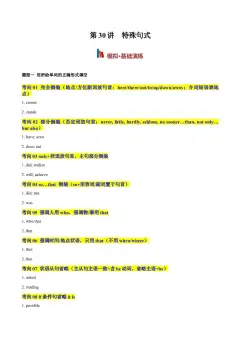
2027 年高考英语一轮复习能力突破(结构化知识+题型提升
练)
专题11 特殊句式
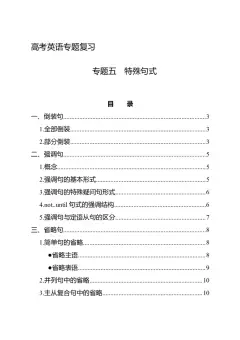
目录
第一部分 必备知识结构化清单
         梳理必备的语言知识点,夯实语言基础能力
第二部分 知识运用题型强化练
         必备知识与能力提升练,提升语言运用能力
◇Part 01  必备知识结构化清单
知|识|清|单
真题分析
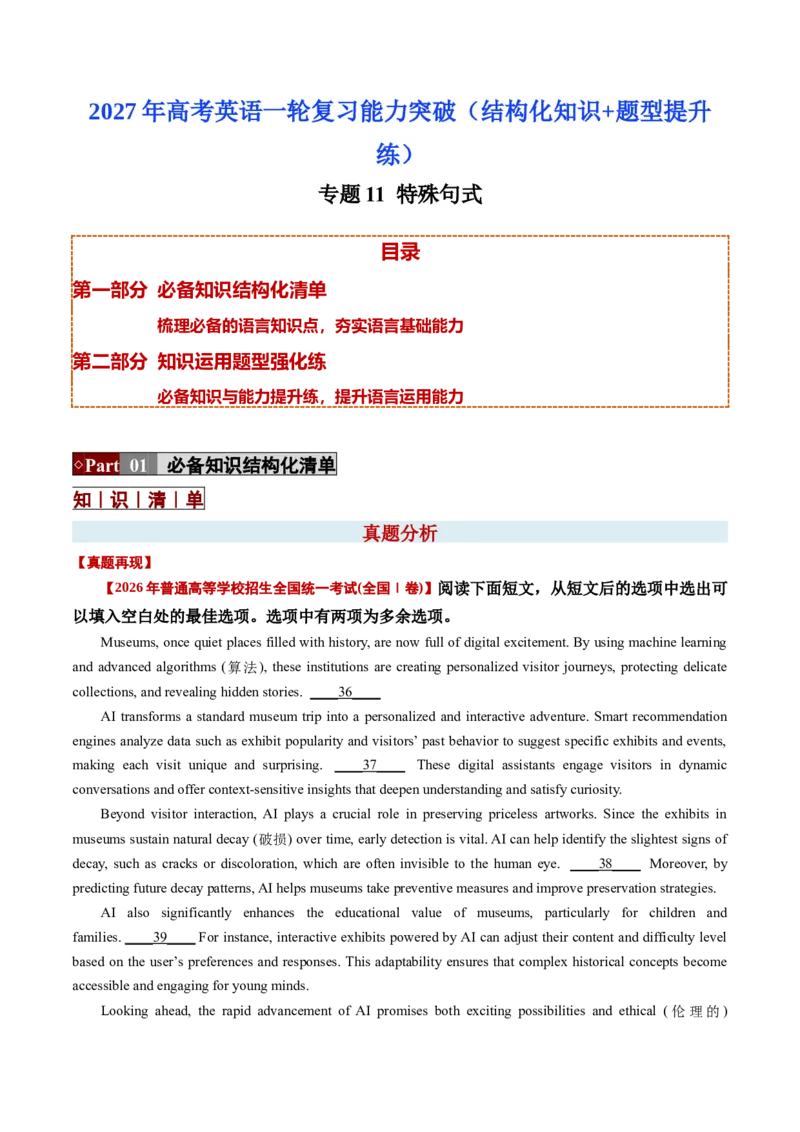
【真题再现】
【2026 年普通高等学校招生全国统一考试(全国Ⅰ卷)】阅读下面短文,从短文后的选项中选出可
以填入空白处的最佳选项。选项中有两项为多余选项。
Museums, once quiet places filled with history, are now full of digital excitement. By using machine learning
and advanced algorithms (算法), these institutions are creating personalized visitor journeys, protecting delicate
collections, and revealing hidden stories. ____36____
AI transforms a standard museum trip into a personalized and interactive adventure. Smart recommendation
engines analyze data such as exhibit popularity and visitors’ past behavior to suggest specific exhibits and events,
making each visit unique and surprising. ____37____ These digital assistants engage visitors in dynamic
conversations and offer context-sensitive insights that deepen understanding and satisfy curiosity.
Beyond visitor interaction, AI plays a crucial role in preserving priceless artworks. Since the exhibits in
museums sustain natural decay (破损) over time, early detection is vital. AI can help identify the slightest signs of
decay, such as cracks or discoloration, which are often invisible to the human eye. ____38____ Moreover, by
predicting future decay patterns, AI helps museums take preventive measures and improve preservation strategies.
AI also significantly enhances the educational value of museums, particularly for children and
families. ____39____ For instance, interactive exhibits powered by AI can adjust their content and difficulty level
based on the user’s preferences and responses. This adaptability ensures that complex historical concepts become
accessible and engaging for young minds.
Looking ahead, the rapid advancement of AI promises both exciting possibilities and ethical ( 伦理的)
challenges. Museums are working together with AI ethicists to develop fair algorithms. ____40____ Strict policies
should be established to protect visitors’ information.
A. This capability allows for timely restoration.
B. Visitor data collection also raises privacy issues.
C. In short, AI is redefining the museum in all respects.
D. It tailors learning experiences to different age groups and learning styles.
E. Museums are not only places to store artworks, but also spaces for learning.
F. Furthermore, AI-powered virtual guides are replacing traditional tour guides.
G. AI is changing this by using image recognition technology to analyze exhibits.
(答案:36. C    37. F    38. A    39. D    40. B)
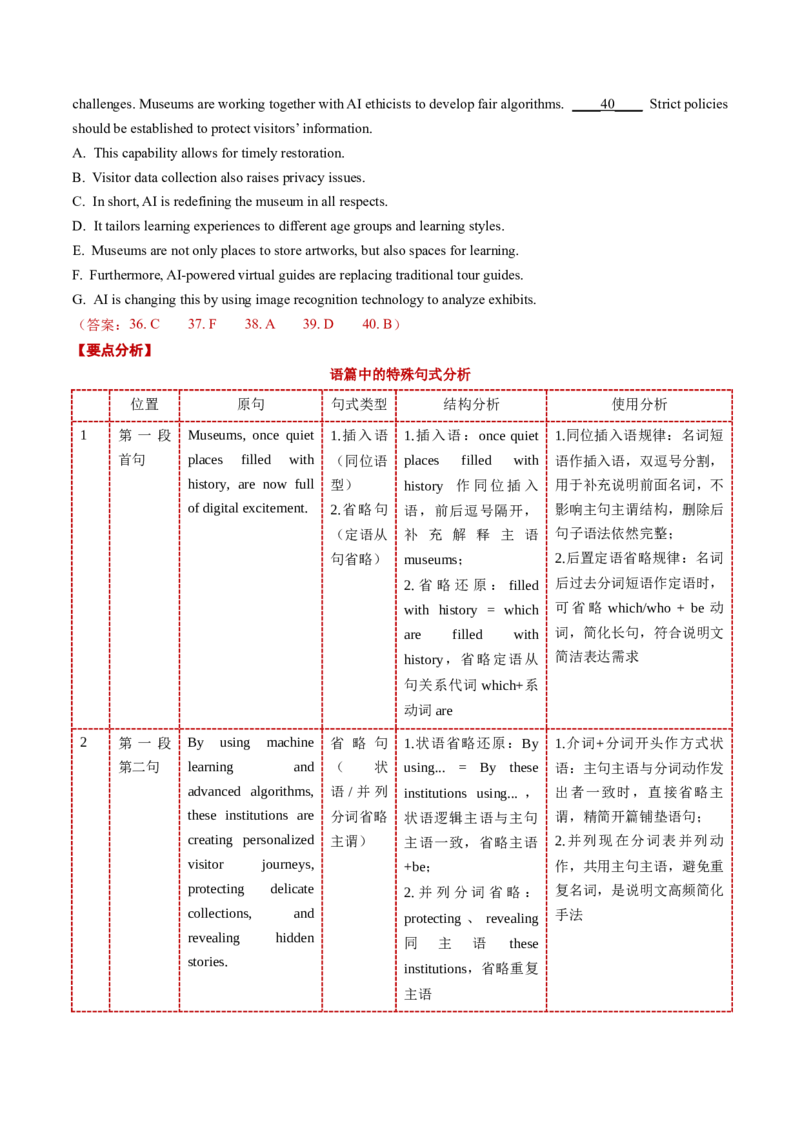
【要点分析】
语篇中的特殊句式分析
位置
原句
句式类型
结构分析
使用分析
1
第一段
首句
Museums, once quiet
places filled with
history, are now full
of digital excitement.
1.插入语
(同位语
型)
2.省略句
(定语从
句省略)
1.插入语:once quiet
places filled with
history 作同位插入
语,前后逗号隔开,
补充解释主语
museums;
2. 省略还原:filled
with history = which
are

filled

with
history,省略定语从
句关系代词which+系
动词are
1.同位插入语规律:名词短
语作插入语,双逗号分割,
用于补充说明前面名词,不
影响主句主谓结构,删除后
句子语法依然完整;
2.后置定语省略规律:名词
后过去分词短语作定语时,
可省略which/who + be 动
词,简化长句,符合说明文
简洁表达需求
2
第一段
第二句
By using machine
learning

and
advanced algorithms,
these institutions are
creating personalized
visitor

journeys,
protecting delicate
collections,

and
revealing

hidden
stories.
省略句
(
状
语/ 并列
分词省略
主谓)
1.状语省略还原:By
using... = By these
institutions using... ,
状语逻辑主语与主句
主语一致,省略主语
+be;
2. 并列分词省略:
protecting 、revealing
同
主
语
these
institutions,省略重复
主语
1.介词+分词开头作方式状
语:主句主语与分词动作发
出者一致时,直接省略主
谓,精简开篇铺垫语句;
2.并列现在分词表并列动
作,共用主句主语,避免重
复名词,是说明文高频简化
手法
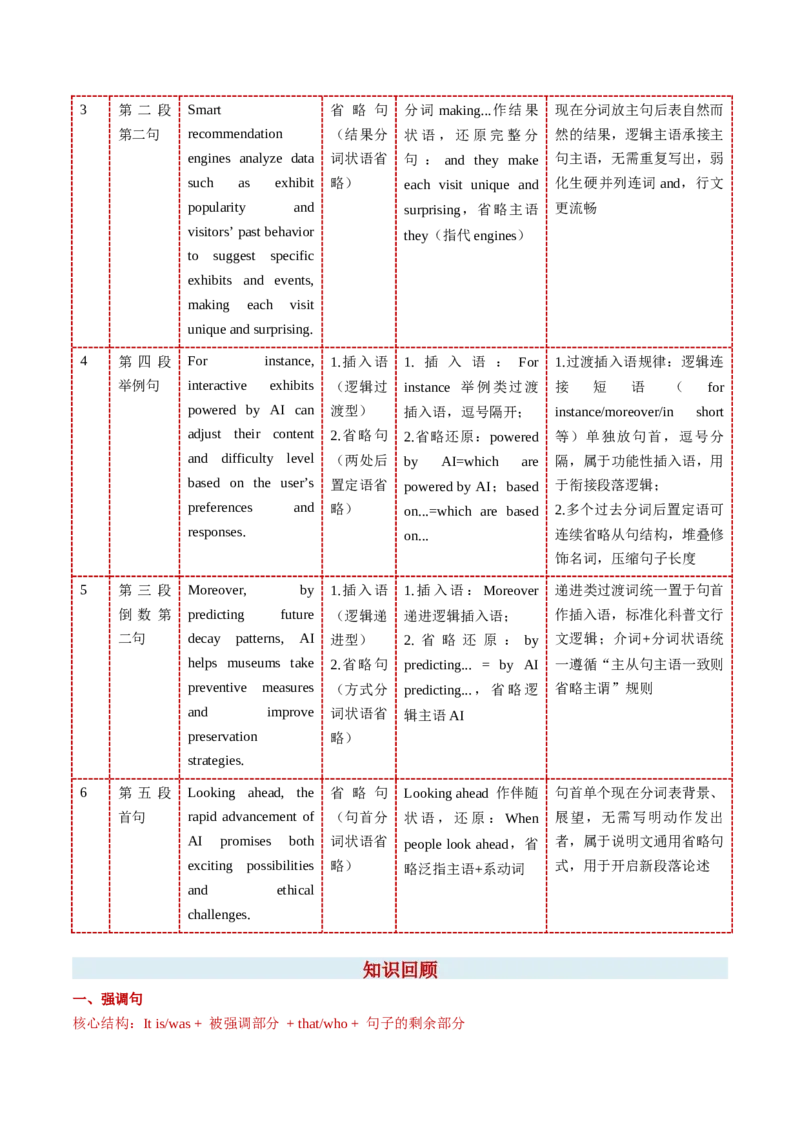
3
第二段
第二句
Smart
recommendation
engines analyze data
such as exhibit
popularity

and
visitors’ past behavior
to suggest specific
exhibits and events,
making each visit
unique and surprising.
省略句
(结果分
词状语省
略)
分词making...作结果
状语,还原完整分
句:and they make
each visit unique and
surprising,省略主语
they(指代engines)
现在分词放主句后表自然而
然的结果,逻辑主语承接主
句主语,无需重复写出,弱
化生硬并列连词and,行文
更流畅
4
第四段
举例句
For

instance,
interactive exhibits
powered by AI can
adjust their content
and difficulty level
based on the user’s
preferences

and
responses.
1.插入语
(逻辑过
渡型)
2.省略句
(两处后
置定语省
略)
1. 插入语:For
instance 举例类过渡
插入语,逗号隔开;
2.省略还原:powered
by AI=which are
powered by AI;based
on...=which are based
on...
1.过渡插入语规律:逻辑连
接
短
语
(
for
instance/moreover/in short
等)单独放句首,逗号分
隔,属于功能性插入语,用
于衔接段落逻辑;
2.多个过去分词后置定语可
连续省略从句结构,堆叠修
饰名词,压缩句子长度
5
第三段
倒数第
二句
Moreover,

by
predicting

future
decay patterns, AI
helps museums take
preventive measures
and

improve
preservation
strategies.
1.插入语
(逻辑递
进型)
2.省略句
(方式分
词状语省
略)
1. 插入语:Moreover
递进逻辑插入语;
2. 省略还原:by
predicting... = by AI
predicting... ,省略逻
辑主语AI
递进类过渡词统一置于句首
作插入语,标准化科普文行
文逻辑;介词+分词状语统
一遵循“主从句主语一致则
省略主谓”规则
6
第五段
首句
Looking ahead, the
rapid advancement of
AI promises both
exciting possibilities
and

ethical
challenges.
省略句
(句首分
词状语省
略)
Looking ahead 作伴随
状语,还原:When
people look ahead,省
略泛指主语+系动词
句首单个现在分词表背景、
展望,无需写明动作发出
者,属于说明文通用省略句
式,用于开启新段落论述
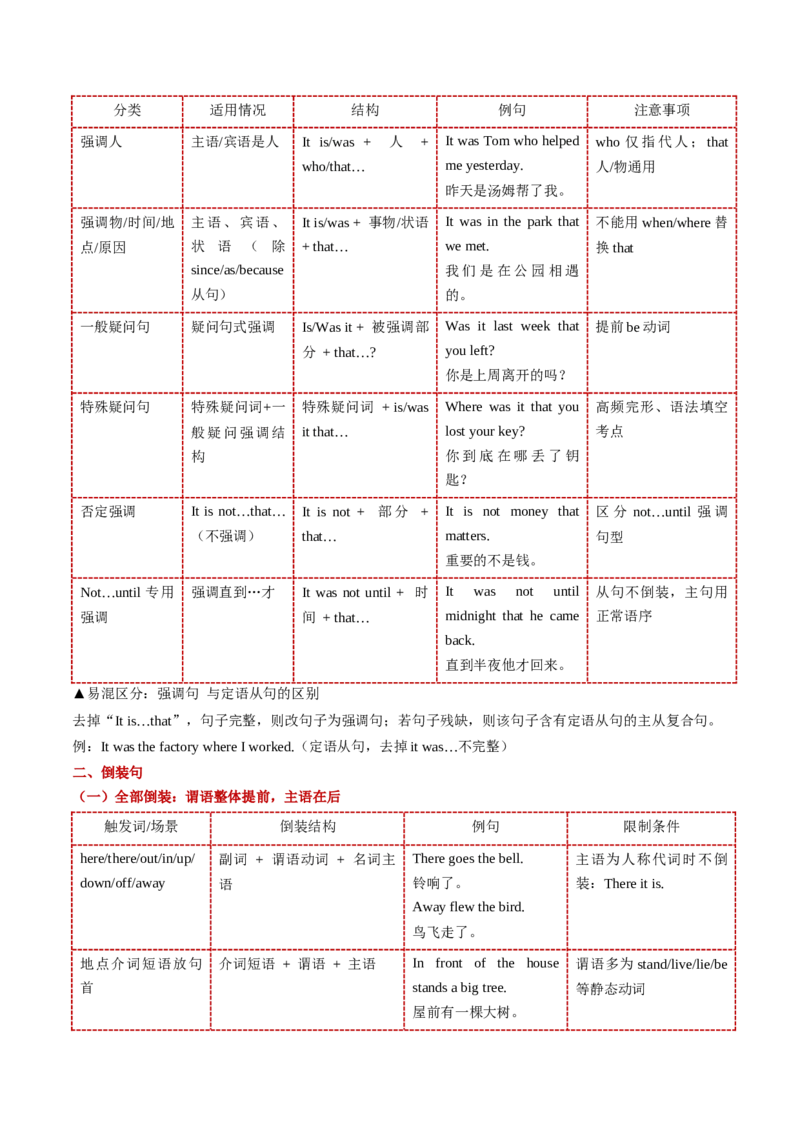
知识回顾
一、强调句
核心结构:It is/was + 被强调部分 + that/who + 句子的剩余部分
分类
适用情况
结构
例句
注意事项
强调人
主语/宾语是人
It is/was + 人 +
who/that…
It was Tom who helped
me yesterday.
昨天是汤姆帮了我。
who 仅指代人;that
人/物通用
强调物/时间/地
点/原因
主语、宾语、
状
语
(
除
since/as/because
从句)
It is/was + 事物/状语
+ that…
It was in the park that
we met.
我们是在公园相遇
的。
不能用when/where 替
换that
一般疑问句
疑问句式强调
Is/Was it + 被强调部
分 + that…?
Was it last week that
you left?
你是上周离开的吗?
提前be 动词
特殊疑问句
特殊疑问词+一
般疑问强调结
构
特殊疑问词 + is/was
it that…
Where was it that you
lost your key?
你到底在哪丢了钥
匙?
高频完形、语法填空
考点
否定强调
It is not…that…
(不强调)
It is not + 部分 +
that…
It is not money that
matters.
重要的不是钱。
区分not…until 强调
句型
Not…until 专用
强调
强调直到…才
It was not until + 时
间 + that…
It was not until
midnight that he came
back.
直到半夜他才回来。
从句不倒装,主句用
正常语序
▲易混区分:强调句 与定语从句的区别
去掉“It is…that”,句子完整,则改句子为强调句;若句子残缺,则该句子含有定语从句的主从复合句。
例:It was the factory where I worked.(定语从句,去掉it was…不完整)
二、倒装句
(一)全部倒装:谓语整体提前,主语在后
触发词/场景
倒装结构
例句
限制条件
here/there/out/in/up/
down/off/away
副词 + 谓语动词 + 名词主
语
There goes the bell.
铃响了。
Away flew the bird.
鸟飞走了。
主语为人称代词时不倒
装:There it is.
地点介词短语放句
首
介词短语 + 谓语 + 主语
In front of the house
stands a big tree.
屋前有一棵大树。
谓语多为stand/live/lie/be
等静态动词
then/now 放句首,
表时间
Then came the final exam.
期末考试来了。
仅书面正式文体
There be 句型
There + be/lie/live/exist + 主
语
There lives an old man by
the river.
河边住着一位老人。
固定存在句倒装
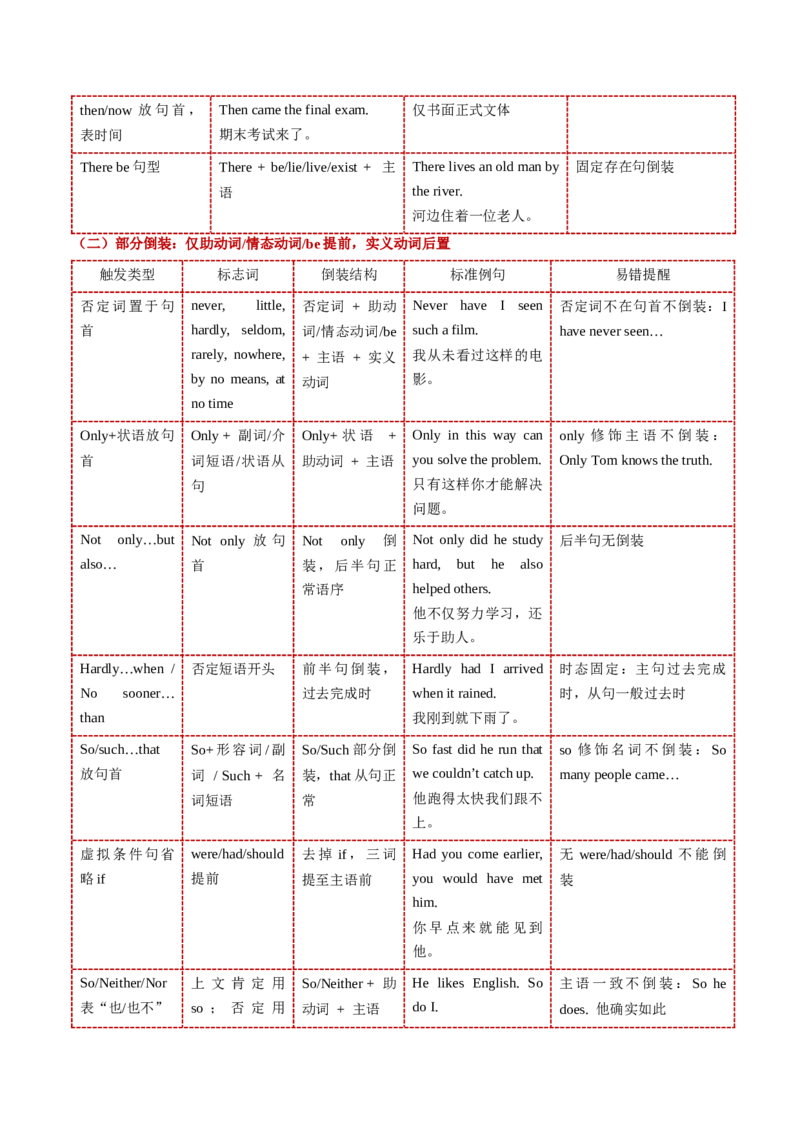
(二)部分倒装:仅助动词/情态动词/be 提前,实义动词后置
触发类型
标志词
倒装结构
标准例句
易错提醒
否定词置于句
首
never,

little,
hardly, seldom,
rarely, nowhere,
by no means, at
no time
否定词 + 助动
词/情态动词/be
+ 主语 + 实义
动词
Never have I seen
such a film.
我从未看过这样的电
影。
否定词不在句首不倒装:I
have never seen…
Only+状语放句
首
Only + 副词/介
词短语/状语从
句
Only+ 状语 +
助动词 + 主语
Only in this way can
you solve the problem.
只有这样你才能解决
问题。
only 修饰主语不倒装:
Only Tom knows the truth.
Not only…but
also…
Not only 放句
首
Not only
倒
装,后半句正
常语序
Not only did he study
hard, but he also
helped others.
他不仅努力学习,还
乐于助人。
后半句无倒装
Hardly…when /
No sooner…
than
否定短语开头
前半句倒装,
过去完成时
Hardly had I arrived
when it rained.
我刚到就下雨了。
时态固定:主句过去完成
时,从句一般过去时
So/such…that
放句首
So+ 形容词/ 副
词 / Such + 名
词短语
So/Such 部分倒
装,that 从句正
常
So fast did he run that
we couldn’t catch up.
他跑得太快我们跟不
上。
so 修饰名词不倒装:So
many people came…
虚拟条件句省
略if
were/had/should
提前
去掉if ,三词
提至主语前
Had you come earlier,
you would have met
him.
你早点来就能见到
他。
无were/had/should 不能倒
装
So/Neither/Nor
表“也/也不”
上文肯定用
so ;否定用
So/Neither + 助
动词 + 主语
He likes English. So
do I.
主语一致不倒装:So he
does. 他确实如此
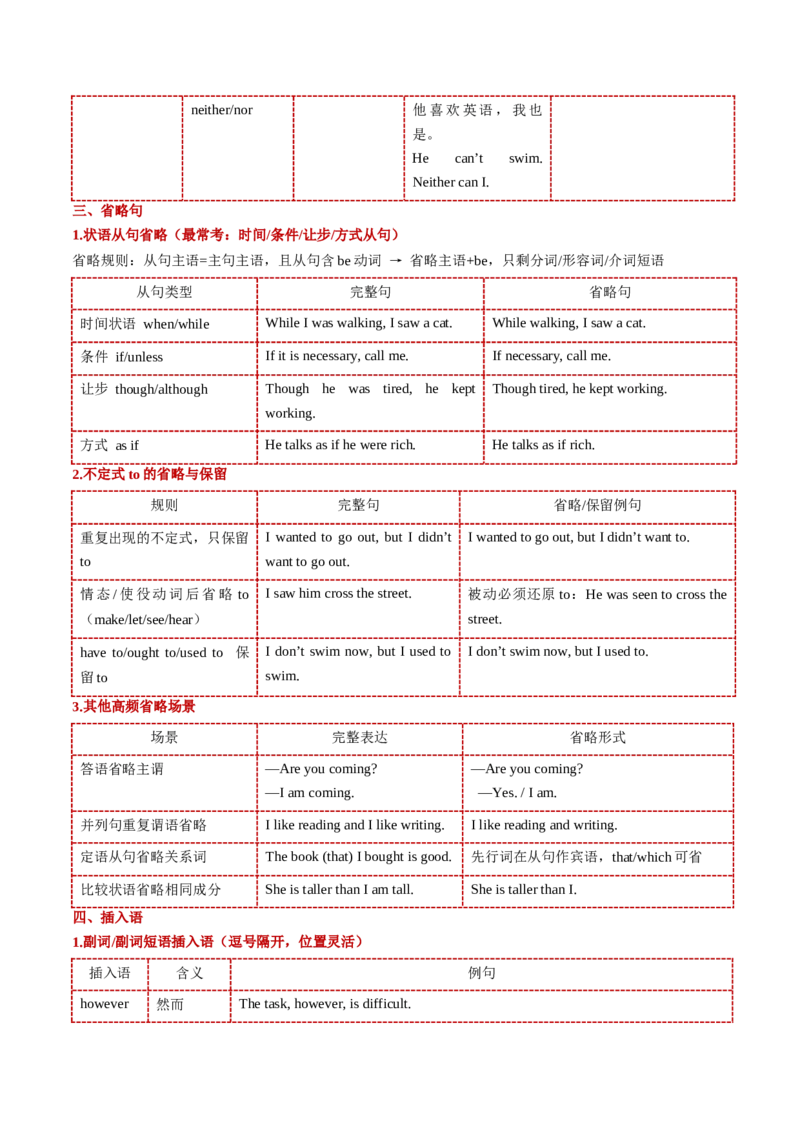
neither/nor
他喜欢英语,我也
是。
He can’t swim.
Neither can I.
三、省略句
1.状语从句省略(最常考:时间/条件/让步/方式从句)
省略规则:从句主语=主句主语,且从句含be 动词 → 省略主语+be,只剩分词/形容词/介词短语
从句类型
完整句
省略句
时间状语 when/while
While I was walking, I saw a cat.
While walking, I saw a cat.
条件 if/unless
If it is necessary, call me.
If necessary, call me.
让步 though/although
Though he was tired, he kept
working.
Though tired, he kept working.
方式 as if
He talks as if he were rich.
He talks as if rich.
2.不定式to 的省略与保留
规则
完整句
省略/保留例句
重复出现的不定式,只保留
to
I wanted to go out, but I didn’t
want to go out.
I wanted to go out, but I didn’t want to.
情态/ 使役动词后省略to
(make/let/see/hear)
I saw him cross the street.
被动必须还原to:He was seen to cross the
street.
have to/ought to/used to 保
留to
I don’t swim now, but I used to
swim.
I don’t swim now, but I used to.
3.其他高频省略场景
场景
完整表达
省略形式
答语省略主谓
—Are you coming?
—I am coming.
—Are you coming?
 —Yes. / I am.
并列句重复谓语省略
I like reading and I like writing.
I like reading and writing.
定语从句省略关系词
The book (that) I bought is good.
先行词在从句作宾语,that/which 可省
比较状语省略相同成分
She is taller than I am tall.
She is taller than I.
四、插入语
1.副词/副词短语插入语(逗号隔开,位置灵活)
插入语
含义
例句
however
然而
The task, however, is difficult.
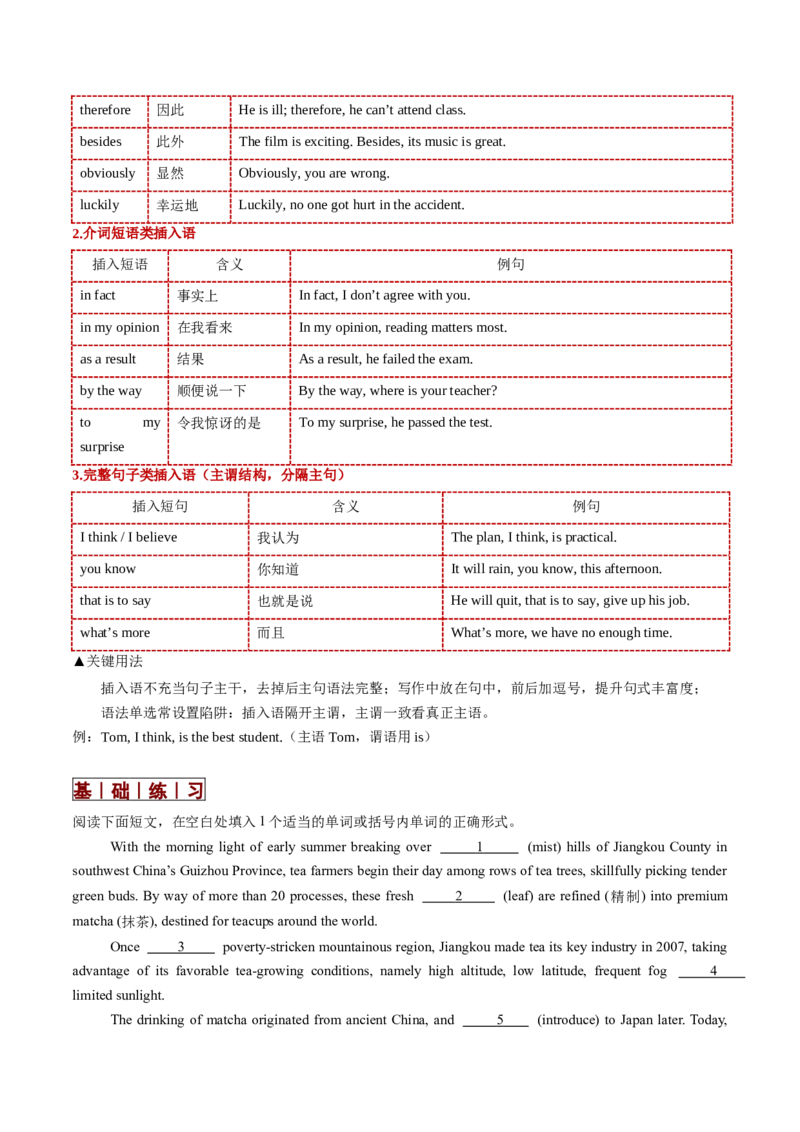
therefore
因此
He is ill; therefore, he can’t attend class.
besides
此外
The film is exciting. Besides, its music is great.
obviously
显然
Obviously, you are wrong.
luckily
幸运地
Luckily, no one got hurt in the accident.
2.介词短语类插入语
插入短语
含义
例句
in fact
事实上
In fact, I don’t agree with you.
in my opinion
在我看来
In my opinion, reading matters most.
as a result
结果
As a result, he failed the exam.
by the way
顺便说一下
By the way, where is your teacher?
to

my
surprise
令我惊讶的是
To my surprise, he passed the test.
3.完整句子类插入语(主谓结构,分隔主句)
插入短句
含义
例句
I think / I believe
我认为
The plan, I think, is practical.
you know
你知道
It will rain, you know, this afternoon.
that is to say
也就是说
He will quit, that is to say, give up his job.
what’s more
而且
What’s more, we have no enough time.
▲关键用法
插入语不充当句子主干,去掉后主句语法完整;写作中放在句中,前后加逗号,提升句式丰富度;
语法单选常设置陷阱:插入语隔开主谓,主谓一致看真正主语。
例:Tom, I think, is the best student.(主语Tom,谓语用is)
基|础|练|习
阅读下面短文,在空白处填入1 个适当的单词或括号内单词的正确形式。
With the morning light of early summer breaking over

 1

  (mist) hills of Jiangkou County in
southwest China’s Guizhou Province, tea farmers begin their day among rows of tea trees, skillfully picking tender
green buds. By way of more than 20 processes, these fresh

 2

  (leaf) are refined (精制) into premium
matcha (抹茶), destined for teacups around the world.
Once

 3

  poverty-stricken mountainous region, Jiangkou made tea its key industry in 2007, taking
advantage of its favorable tea-growing conditions, namely high altitude, low latitude, frequent fog

 4
limited sunlight.
The drinking of matcha originated from ancient China, and

 5

  (introduce) to Japan later. Today,
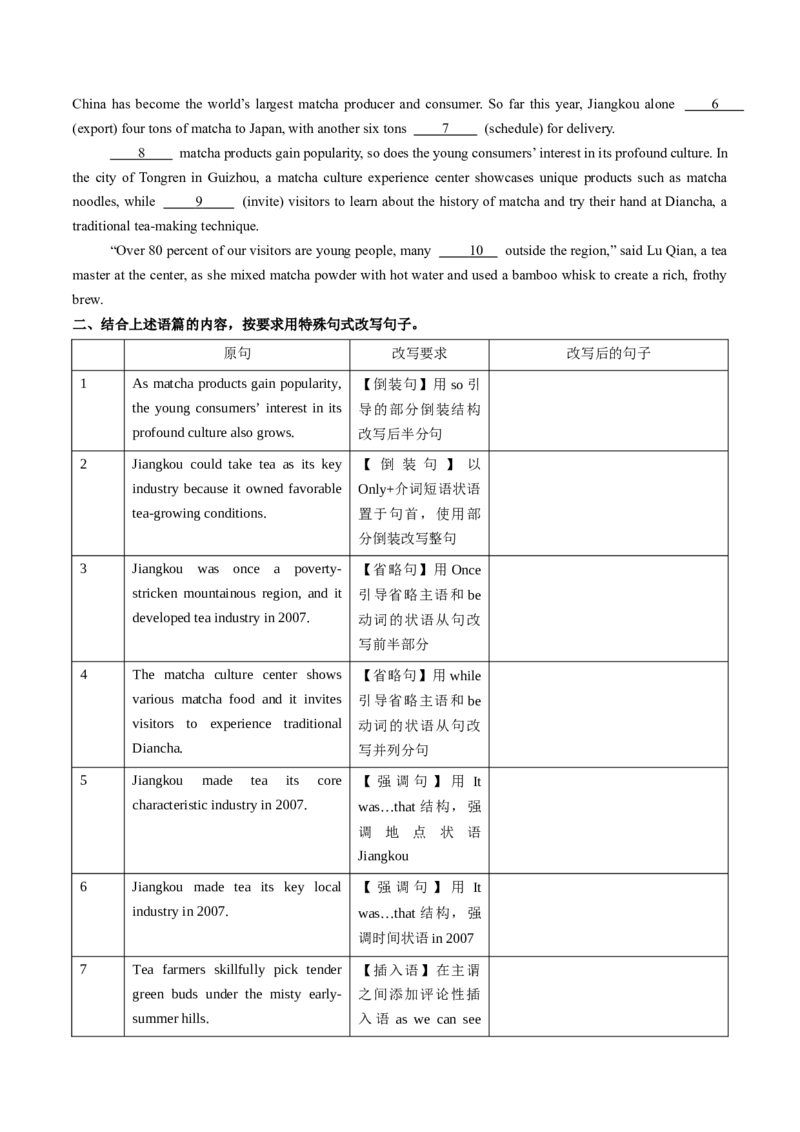
China has become the world’s largest matcha producer and consumer. So far this year, Jiangkou alone

 6
(export) four tons of matcha to Japan, with another six tons

 7

  (schedule) for delivery.


 8

  matcha products gain popularity, so does the young consumers’ interest in its profound culture. In
the city of Tongren in Guizhou, a matcha culture experience center showcases unique products such as matcha
noodles, while

 9

  (invite) visitors to learn about the history of matcha and try their hand at Diancha, a
traditional tea-making technique.
“Over 80 percent of our visitors are young people, many

 10
       outside the region,” said Lu Qian, a tea
master at the center, as she mixed matcha powder with hot water and used a bamboo whisk to create a rich, frothy
brew.
二、结合上述语篇的内容,按要求用特殊句式改写句子。
原句
改写要求
改写后的句子
1
As matcha products gain popularity,
the young consumers’ interest in its
profound culture also grows.
【倒装句】用so 引
导的部分倒装结构
改写后半分句
2
Jiangkou could take tea as its key
industry because it owned favorable
tea-growing conditions.
【倒装句】以
Only+介词短语状语
置于句首,使用部
分倒装改写整句
3
Jiangkou was once a poverty-
stricken mountainous region, and it
developed tea industry in 2007.
【省略句】用Once
引导省略主语和be
动词的状语从句改
写前半部分
4
The matcha culture center shows
various matcha food and it invites
visitors to experience traditional
Diancha.
【省略句】用while
引导省略主语和be
动词的状语从句改
写并列分句
5
Jiangkou made tea its core
characteristic industry in 2007.
【强调句】用It
was…that 结构,强
调
地
点
状
语
Jiangkou
6
Jiangkou made tea its key local
industry in 2007.
【强调句】用It
was…that 结构,强
调时间状语in 2007
7
Tea farmers skillfully pick tender
green buds under the misty early-
summer hills.
【插入语】在主谓
之间添加评论性插
入语as we can see
改写句子
8
Most visitors to the experience
center are young people, and many
of them come from other areas.
【插入语】将后半
分句改写为独立主
格补充类插入结构
◇Part 02  知识运用题型强化练
一、阅读理解
1
Icebreaker questions for teens
“Hi, my name is …,” followed by awkward silence, is a scene many teens know too well. Yet, one simple
question can turn that silence into excited chatter. A recent survey of more than 1,000 students from seven cities
reveals that 41% of teens arrive at summer camps or youth clubs feeling nervous. A well-chosen opener, however,
can change the mood in minutes. Over 60% of group leaders said that after they used planned icebreakers they saw
“clear improvement” in energy levels and cooperation.
What teens want to talk about
Question Category
Percentage
Personal interests
34%
Future aspirations
25%
Hypothetical scenarios
20%
Favorite things
12%
Random fun
9%
Total
100%
A closer look at the three categories
• Personal interests
Questions such as “What hobby could you never give up?” allow students to share stories about painting or
basketball. Many respondents said discovering a shared interest “created an instant friend”.
• Future aspirations (志向)
A quarter of the teens liked questions like “Where do you see yourself in ten years?” These questions push
young people to picture careers and life goals. Several respondents said the discussion later helped them choose
elective courses.
• Hypothetical scenarios (假定的场景)
Imaginative questions “If you owned a time machine, which century would you visit?” — ranked third.
Though less realistic, they invite creativity and laughter, and often reveal hidden values without asking personal
secrets.
Expert insights
Dr. Elena Morris, a youth psychologist, explains, “Teens are at a stage where they are exploring their
identities. Questions about interests and future dreams allow them to express themselves in a safe, structured way.”
Similarly, educational expert Michael Tan notes, “Hypothetical questions stimulate creativity and often
reveal deeper values without the pressure of being too personal.”
1.What effect did planned icebreakers have according to group leaders?
A.They made the group energetic.
B.They shortened the time of activities.
C.They reduced over 60% of teens’ nervousness.
D.They helped resolve conflicts among group members.
2.Which questions ranked second in popularity among the teens surveyed?
A.Those about imaginary situations.
B.Those about personal interests.
C.Those about favorite items.
D.Those about future goals.
3.What does Dr. Morris say about teens?
A.They are willing to share thoughts safely.B.They resist structured forms of expression.
C.They easily feel pressured before answering.
D.They prefer factual questions to creative ones.
2
Is friendship with a chatbot as good as friendship with an actual person? Valerie Tiberius, in her new book
Artificially Yours, dives headfirst into the philosophical puzzle of chatbot companionship and what it reveals about
the nature of friendship.
Concerned with ethics, moral psychology, and well-being, she approaches the subject not as a technologist
but with a philosophical interest in what makes friendships tick. The book’s central aim is less about predicting
technological change than about explaining what friendship is and why it’s valuable — and why there is no perfect
replacement for human friends.
She defines the ideal friendship as an enjoyable, close relationship built on shared activities between people
who care about each other for their own sake. But few things in life are ever ideal, including friendship. Tiberius
demonstrates how different kinds of friendships can be valuable in different ways: they can be pleasurable or
useful, they can shape who we are and how we see ourselves, and the best ones are good for their own sakes. With
this framework in place, she turns to the question of whether chatbots can be genuine friends.
Machines can have goals — much like a chess program that aims to win — and intelligence can be
understood as the ability to accomplish complex goals. But consciousness is the ability to have a subjective
experience, which contemporary chatbots lack. Chatbots can mimic some features of friendship — empathy,
attention, companionship — which is part of their powerful appeal. Although talking with chatbots can help people
cope with life’s challenges, they cannot genuinely admire us, share our vulnerability, or understand human suffering
and mortality.
Can future superintelligent chatbots self-improve and overcome their limitations? Tiberius observes, “I don’t
see any reason to trust that AI left to learn on its own will learn what we want it to.” The profit motives of AI
companies also give her pause. Ultimately rejecting both techno-pessimism and techno-optimism, she argues for a
middle ground: AI companions may offer comfort or teach us important skills, potentially enriching and
supplementing the irreplaceable value of human friendship.
4.What is the book aimed at?
A.Defining what friendship is scientifically.
B.Proving chatbots can never be genuine friends.
C.Predicting future AI companionship technologies.
D.Defending the irreplaceability of human friendship.
5.What might Valerie Tiberius agree with?
A.All friendships are not ideal.
B.Ideal friendships are all alike.
C.Imperfect friendship is worthless.
D.Mutual caring makes friendship valuable.
6.What does Para. 4 focus on?
A.The limitations of chatbots as friends.
B.Machines’ ability to achieve complex goals.
C.How chatbots mimic empathy and attention.
D.How chatbots help in overcoming challenges.
7.What’s Tiberius’s attitude towards AI companions?
A.Optimistic.
B.Cautious.
C.Doubtful.
D.Pessimistic.
3
William Butler Yeats, a most famous Irish writer, was born in Dublin on June 13, 1865. His childhood lacked
the harmony of a happy family. Later, Yeats shocked his family by saying that he remembered “little of childhood
but its pain”. In fact, he inherited (继承) excellent taste in art from his family — both his father and his brother
were painters. But he finally settled on literature, particularly drama and poetry.
Yeats had strong faith in coming of new artistic movements. He set himself the fresh task in founding an
Irish national theatre in the late 1890s. His early theatrical experiments, however, were not received favorably at the
beginning. He didn’t lose heart, and finally enjoyed success in his poetical drama.
Compared with his dramatic works, Yeats’s poems attract much admiring notice. The subject matter includes
love, nature, history, time and aging. Though Yeats generally depended on very traditional forms, he brought
modern factors to them. As his literary life continued, his poetry grew finer and richer, which led him to worldwide
recognition.
He had not enjoyed a major public life since winning the Nobel Prize in 1923. Yet, he continued writing
almost to the end of his life. Had Yeats stopped writing at age 40, he would probably now be valued as a minor
poet, for there is no other example in literary history of a poet who produces his greatest works between the ages of
50 and 75. After Yeats’s death in 1939, W. H. Auden wrote, among others, the following lines:
Earth, receive an honoured guest:
William Yeats is laid to rest.
Let the Irish vessel (船) lie
Emptied of its poetry.
8.Which of the following can describe Yeats’s family?
A.It was a typically wealthy family.
B.It had an artistic atmosphere.
C.It was shocked by Yeats’s choice.
D.It filled Yeats’s childhood with joy.
9.According to the passage, what do we know about Yeats?
A.He founded the first Irish theater.
B.He mainly wrote modern-style poems.
C.He produced his best works in his last 25 years.
D.He rose to fame after winning the Nobel Prize.
10.What feeling is expressed in W. H. Auden’s lines?
A.Disappointment.
B.Admiration.
C.Anxiety.
                    D.Emptiness.
11.What is the passage mainly about?
A.Yeats’s national honor.
B.Yeats’s artistic beliefs.
C.Yeats’s pain and delight.
D.Yeats’s art and influence.
4
Museums, once quiet places filled with history, are now full of digital excitement. By using machine learning
and advanced algorithms (算法), these institutions are creating personalized visitor journeys, protecting delicate
collections, and revealing hidden stories.     12
AI transforms a standard museum trip into a personalized and interactive adventure. Smart recommendation
engines analyze data such as exhibit popularity and visitors’ past behavior to suggest specific exhibits and events,
making each visit unique and surprising.     13     These digital assistants engage visitors in dynamic
conversations and offer context-sensitive insights that deepen understanding and satisfy curiosity.
Beyond visitor interaction, AI plays a crucial role in preserving priceless artworks. Since the exhibits in
museums sustain natural decay (破损) over time, early detection is vital. AI can help identify the slightest signs of
decay, such as cracks or discoloration, which are often invisible to the human eye.     14     Moreover, by
predicting future decay patterns, AI helps museums take preventive measures and improve preservation strategies.
AI also significantly enhances the educational value of museums, particularly for children and families.
15     For instance, interactive exhibits powered by AI can adjust their content and difficulty level based on the
user’s preferences and responses. This adaptability ensures that complex historical concepts become accessible and
engaging for young minds.
Looking ahead, the rapid advancement of AI promises both exciting possibilities and ethical ( 伦理的)
challenges. Museums are working together with AI ethicists to develop fair algorithms.     16     Strict policies
should be established to protect visitors’ information.
A.This capability allows for timely restoration.
B.Visitor data collection also raises privacy issues.
C.In short, AI is redefining the museum in all respects.
D.It tailors learning experiences to different age groups and learning styles.
E.Museums are not only places to store artworks, but also spaces for learning.
F.Furthermore, AI-powered virtual guides are replacing traditional tour guides.
G.AI is changing this by using image recognition technology to analyze exhibits.
附加题:结合上述阅读语篇的内容,按要求用特殊句式改写句子。
原句(语篇出处)
改写要求
改写后的句子
1
One simple question can turn that
silence into excited chatter. (阅读理
解1)
使用强调句,强调
主语
one simple
question
2
He produced his greatest works
between the ages of 50 and 75.(阅读
理解3)
使用强调句,强调
时间状语between
the ages of 50 and 75
3
AI helps museums take preventive
measures and improve preservation
strategies.(阅读理解4)
使用强调句,强调
主语AI
4
Shared activities form the close ideal
friendship between people who care
about each other.(阅读理解2)
使用强调句,强调
宾语shared activities
5
If Yeats had stopped writing at age 40,
he would probably now be valued as a
minor poet.(阅读理解3)
虚拟条件句省略
if,使用倒装句
6
Chatbots cannot genuinely admire us
or share our vulnerability.(阅读理解
2)
将否定词Not 置于
句首,使用部分倒
装句
7
Students create instant friends only
when they discover shared interests.
(阅读理解1)
Only+时间状语置于
句首,使用部分倒
装句
8
His poetry became so fine and rich that
he gained worldwide recognition.(阅
读理解3)
So 置于句首引导结
果状语从句,使用
部分倒装句
9
Modern museums are now full of
digital excitement.(阅读理解4)
表语full of digital
excitement 前置,使
用完全倒装句
10
When teens are arriving at summer
camps or youth clubs, they feel
时间状语从句省略
主语与be 动词,使
nervous.(阅读理解1)
用省略句
11
When people compare his dramatic
works with his poems, Yeats’s poems
attract much admiring notice.(阅读理
解3)
状语从句主谓省
略,用Compared
with 开头,使用省
略句
12
AI creates personalized visitor
journeys, AI protects delicate
collections and AI reveals hidden
stories.(阅读理解4)
并列结构省略重复
主语与谓语动词,
使用省略句
13
Though the hypothetical questions are
less realistic, they invite creativity and
laughter.(阅读理解1)
让步状语从句省略
主语与be 动词,使
用省略句
14
Dr. Elena Morris explains, “Teens are
at a stage where they are exploring
their identities.”(阅读理解1)
在主语后插入同位
语
a

youth
psychologist 作插入
语
15
She approaches the subject not as a
technologist but with philosophical
interest.(阅读理解2)
在句中加入转折副
词however 作插入
语
16
Interactive exhibits powered by AI can
adjust content based on the user’s
preferences and responses.(阅读理解
4)
在句首加入举例短
语for instance 作插
入语
二、完形填空
Holly Smith was a 19-year-old girl when she boarded a plane at New York’s Airport. She was full of     17
for her plan to spend a year studying abroad in Nancy, a city in northeast France. But within a few weeks of     18
, her enthusiasm turned into a strong sense of loneliness.
    19     daily life in a new country was tougher than she had expected, especially when it came to
20    . “I could understand a little, but my poor accent made it hard for others to     21     me,” Holly
recalled. The constant struggle to be     22     left her emotionally exhausted — until a care     23     from
her mom became her beacon (灯塔) of light.
When she went to the post office to     24     it, unfortunately, the     25     spoke no English and
couldn’t decode her broken French. Just as she was close to tears, a French woman named Chantal      26     .
She helped Holly communicate, and soon the package was in Holly’s hands. Chantal later invited her to weekly
dinners, a warm place where Holly could practice French without      27     .
Decades later, they still keep in      28     . Chantal’s small      29      of kindness became an
inspiration for Holly, who now makes it a      30      to lift up strangers in need, proving that a little warmth
can turn a      31      land into a home.
17.A.appreciation
B.excitement
C.confusion
D.anxiety
18.A.preparation
B.graduation
C.departure
D.arrival
19.A.Focusing on
B.Returning to
C.Getting through
D.Escaping from
20.A.language
B.climate
C.dining
D.custom
21.A.accept
B.follow
C.impress
D.ignore
22.A.heard
B.freed
C.noticed
D.understood
23.A.program
B.package
C.plan
D.product
24.A.claim
B.wrap
C.select
D.deliver
25.A.interpreter
B.client
C.clerk
D.cashier
26.A.spoke up
B.went away
C.showed off
D.stepped in
27.A.notice
B.permission
C.fear
D.interruption
28.A.mind
B.shape
C.touch
D.existence
29.A.trick
B.act
C.promise
D.duty
30.A.point
B.success
C.game
D.standard
31.A.native
B.deserted
C.public
D.foreign
三、语法填空
阅读下面短文,在空白处填入1 个适当的单词或括号内单词的正确形式。
It can be expanded with air like balloons, turned into various shapes like clay sculptures, or put into the
mouth like candies. It is “blown candy”,     32     unique Chinese folk art.
Although the Chinese name for “blown candy”     33     (include) the character “ren”, animals,
especially the 12 zodiac (生肖) animals, are     34     (undoubted) the most common shapes. It’s no surprise
35     the most popular shape is the “Monkey King” in the ancient classic novel Journey to the West.
Blown candy is said     36     (date) from the Ming Dynasty, when it first became a popular street art
across China. Since sugar figures are mostly made     37     the spot, the raw material must remain melted.
Craftsmen need to blow the “balloon” into a proper size and make shapes tailored depending on people’s
preferences as quickly as possible before the sugar cools down, which is a game against time.
Today, despite the great changes     38     (bring) by technological modernization, the craft of blown
candy has not been lost. On June 7, 2008, sugar sculpture art-represented by sugar-figure blowing and sugar
painting —     39     (list) as part of China’s National Intangible Cultural Heritage. With official     40

(recognise), blown candy will continue to keep     41     (it) strong life and ever-lasting artistic charm.
四、写作
    假定你是李华,你和同学制作的乡村发展英文短视频入选国际中学生媒体展。请给外教Evan 写一封
邮件,感谢他对视频的指导。内容包括:
(1)表达感谢;
(2)回顾其帮助。
注意:
(1)写作词数应为80 个左右;
(2)请按如下格式作答。
Dear Evan,
____________________________________________________________________________________________
____________________________________________________________________________________________
____________________________________________________________________________________________
____________________________________________________________________________________________
____________________________________________________________________________________________
Yours sincerely,
Li Hua