专题 05 文学、艺术与体育(原卷版)
【材料来源:The New York Times July 26, 2024】
Doused by Rain, Paris Opens Its Games
With a Boat Party on the Seine
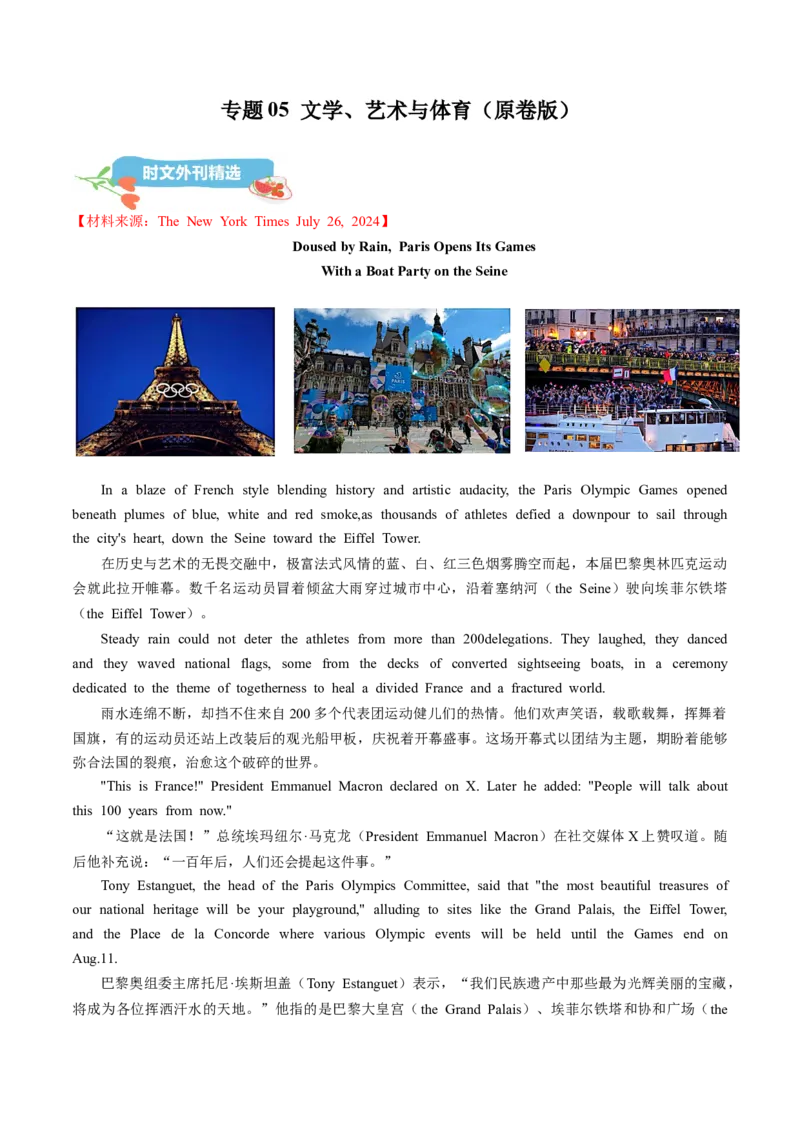
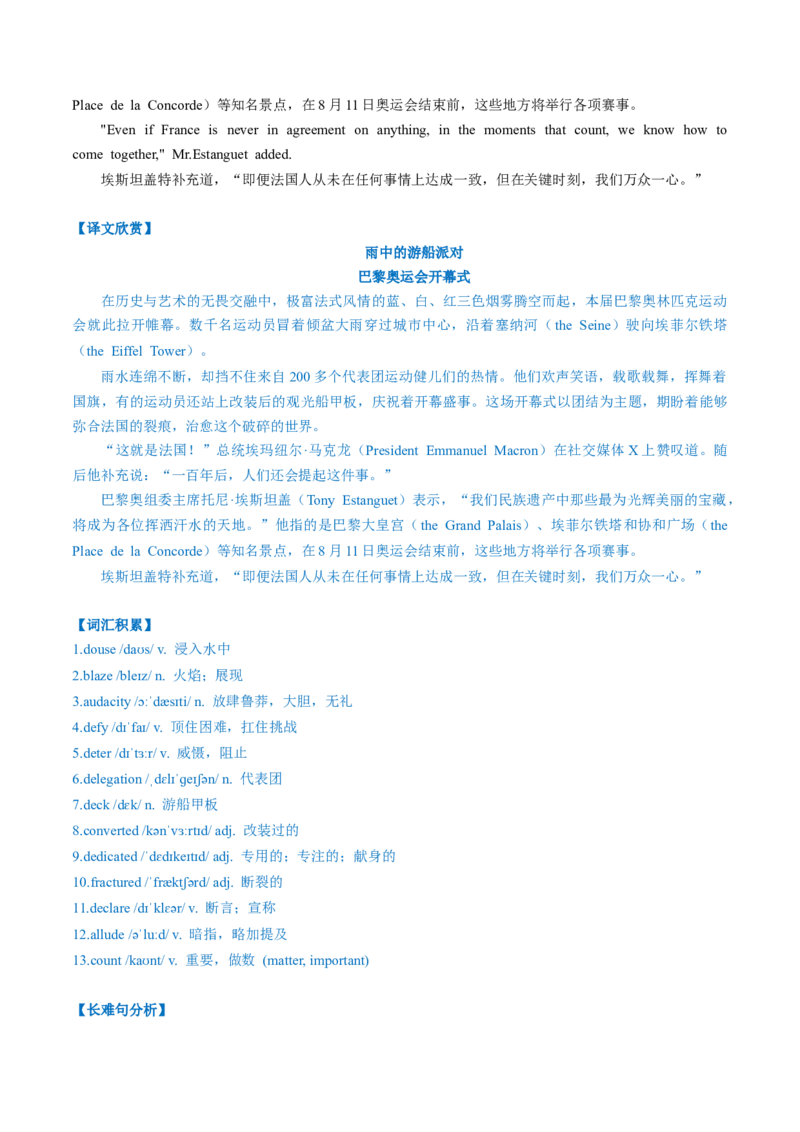
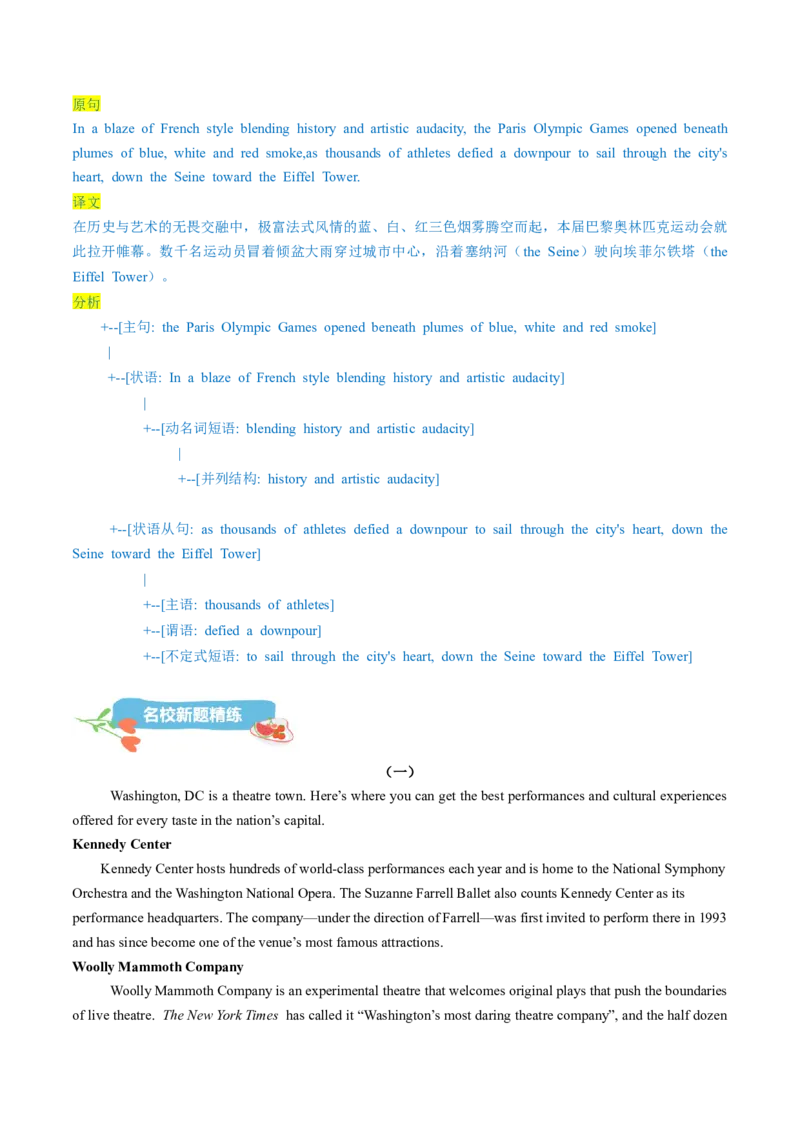
In a blaze of French style blending history and artistic audacity, the Paris Olympic Games opened
beneath plumes of blue, white and red smoke,as thousands of athletes defied a downpour to sail through
the city's heart, down the Seine toward the Eiffel Tower.
在历史与艺术的无畏交融中,极富法式风情的蓝、白、红三色烟雾腾空而起,本届巴黎奥林匹克运动
会就此拉开帷幕。数千名运动员冒着倾盆大雨穿过城市中心,沿着塞纳河(the Seine)驶向埃菲尔铁塔
(the Eiffel Tower)。
Steady rain could not deter the athletes from more than 200delegations. They laughed, they danced
and they waved national flags, some from the decks of converted sightseeing boats, in a ceremony
dedicated to the theme of togetherness to heal a divided France and a fractured world.
雨水连绵不断,却挡不住来自200多个代表团运动健儿们的热情。他们欢声笑语,载歌载舞,挥舞着
国旗,有的运动员还站上改装后的观光船甲板,庆祝着开幕盛事。这场开幕式以团结为主题,期盼着能够
弥合法国的裂痕,治愈这个破碎的世界。
"This is France!" President Emmanuel Macron declared on X. Later he added: "People will talk about
this 100 years from now."
“这就是法国!”总统埃玛纽尔·马克龙(President Emmanuel Macron)在社交媒体X上赞叹道。随
后他补充说:“一百年后,人们还会提起这件事。”
Tony Estanguet, the head of the Paris Olympics Committee, said that "the most beautiful treasures of
our national heritage will be your playground," alluding to sites like the Grand Palais, the Eiffel Tower,
and the Place de la Concorde where various Olympic events will be held until the Games end on
Aug.11.
巴黎奥组委主席托尼·埃斯坦盖(Tony Estanguet)表示,“我们民族遗产中那些最为光辉美丽的宝藏,
将成为各位挥洒汗水的天地。”他指的是巴黎大皇宫(the Grand Palais)、埃菲尔铁塔和协和广场(thePlace de la Concorde)等知名景点,在8月11日奥运会结束前,这些地方将举行各项赛事。
"Even if France is never in agreement on anything, in the moments that count, we know how to
come together," Mr.Estanguet added.
埃斯坦盖特补充道,“即便法国人从未在任何事情上达成一致,但在关键时刻,我们万众一心。”
【译文欣赏】
雨中的游船派对
巴黎奥运会开幕式
在历史与艺术的无畏交融中,极富法式风情的蓝、白、红三色烟雾腾空而起,本届巴黎奥林匹克运动
会就此拉开帷幕。数千名运动员冒着倾盆大雨穿过城市中心,沿着塞纳河(the Seine)驶向埃菲尔铁塔
(the Eiffel Tower)。
雨水连绵不断,却挡不住来自200多个代表团运动健儿们的热情。他们欢声笑语,载歌载舞,挥舞着
国旗,有的运动员还站上改装后的观光船甲板,庆祝着开幕盛事。这场开幕式以团结为主题,期盼着能够
弥合法国的裂痕,治愈这个破碎的世界。
“这就是法国!”总统埃玛纽尔·马克龙(President Emmanuel Macron)在社交媒体X上赞叹道。随
后他补充说:“一百年后,人们还会提起这件事。”
巴黎奥组委主席托尼·埃斯坦盖(Tony Estanguet)表示,“我们民族遗产中那些最为光辉美丽的宝藏,
将成为各位挥洒汗水的天地。”他指的是巴黎大皇宫(the Grand Palais)、埃菲尔铁塔和协和广场(the
Place de la Concorde)等知名景点,在8月11日奥运会结束前,这些地方将举行各项赛事。
埃斯坦盖特补充道,“即便法国人从未在任何事情上达成一致,但在关键时刻,我们万众一心。”
【词汇积累】
1.douse /daʊs/ v. 浸入水中
2.blaze /bleɪz/ n. 火焰;展现
3.audacity /ɔːˈdæsɪti/ n. 放肆鲁莽,大胆,无礼
4.defy /dɪˈfaɪ/ v. 顶住困难,扛住挑战
5.deter /dɪˈtɜːr/ v. 威慑,阻止
6.delegation /ˌdɛlɪˈɡeɪʃən/ n. 代表团
7.deck /dɛk/ n. 游船甲板
8.converted /kənˈvɜːrtɪd/ adj. 改装过的
9.dedicated /ˈdɛdɪkeɪtɪd/ adj. 专用的;专注的;献身的
10.fractured /ˈfræktʃərd/ adj. 断裂的
11.declare /dɪˈklɛər/ v. 断言;宣称
12.allude /əˈluːd/ v. 暗指,略加提及
13.count /kaʊnt/ v. 重要,做数 (matter, important)
【长难句分析】原句
In a blaze of French style blending history and artistic audacity, the Paris Olympic Games opened beneath
plumes of blue, white and red smoke,as thousands of athletes defied a downpour to sail through the city's
heart, down the Seine toward the Eiffel Tower.
译文
在历史与艺术的无畏交融中,极富法式风情的蓝、白、红三色烟雾腾空而起,本届巴黎奥林匹克运动会就
此拉开帷幕。数千名运动员冒着倾盆大雨穿过城市中心,沿着塞纳河(the Seine)驶向埃菲尔铁塔(the
Eiffel Tower)。
分析
+--[主句: the Paris Olympic Games opened beneath plumes of blue, white and red smoke]
|
+--[状语: In a blaze of French style blending history and artistic audacity]
|
+--[动名词短语: blending history and artistic audacity]
|
+--[并列结构: history and artistic audacity]
+--[状语从句: as thousands of athletes defied a downpour to sail through the city's heart, down the
Seine toward the Eiffel Tower]
|
+--[主语: thousands of athletes]
+--[谓语: defied a downpour]
+--[不定式短语: to sail through the city's heart, down the Seine toward the Eiffel Tower]
(一)
Washington, DC is a theatre town. Here’s where you can get the best performances and cultural experiences
offered for every taste in the nation’s capital.
Kennedy Center
Kennedy Center hosts hundreds of world-class performances each year and is home to the National Symphony
Orchestra and the Washington National Opera. The Suzanne Farrell Ballet also counts Kennedy Center as its
performance headquarters. The company—under the direction of Farrell—was first invited to perform there in 1993
and has since become one of the venue’s most famous attractions.
Woolly Mammoth Company
Woolly Mammoth Company is an experimental theatre that welcomes original plays that push the boundaries
of live theatre. The New York Times has called it “Washington’s most daring theatre company”, and the half dozenplays Woolly produces each year continue to live up to that reputation.
Shakespeare Theatre Company
For more than 25 years, Shakespeare Theatre Company has committed itself to serving as the nation’s
classical theatre. It operates out of two spaces, including Sidney Harman Hall at the Harman Center, which seats
775, and the Lansburgh Theatre, which seats 451. The shiny, glass-walled Harman Center showcases classic
Shakespeare plays, modern updates and Shakespeare-inspired original shows.
Wolf Trap
For locals, summer isn’t complete without at least one trip to Wolf Trap, the only national park dedicated to
the performing arts. The venue is best-known for performances of touring artists. The open-air theatre offers
covered seating, but when the weather warms up, we suggest buying seats on the grassland and packing a picnic.
1.When did the Suzanne Farrell Ballet first perform at Kennedy Center?
A.In 1993. B.In 1998. C.In 2000. D.In 2003.
2.Which of the following is known for experimental plays?
A.The Harman Center. B.Woolly Mammoth Company.
C.The Lansburgh Theatre. D.Shakespeare Theatre Company.
3.What sets Wolf Trap apart from other theatres?
A.Its covered seating. B.Its Shakespeare plays.
C.Its selected directors. D.Its open-air atmosphere.
原句
Woolly Mammoth Company is an experimental theatre that welcomes original plays that push the boundaries of
live theatre.
译文
Woolly Mammoth公司是一家试验性的剧院,欢迎突破现场戏剧界限的原创戏剧。
分析
+--[主句: Woolly Mammoth Company is an experimental theatre]
|
+--[定语从句: that welcomes original plays]
|
+--[宾语: original plays]
|
+--[定语从句: that push the boundaries of live theatre]1.orchestra n. 管弦乐队 2.performance n. 演出
3.symphony n. 交响乐 4.ballet n. 芭蕾
5.experimental adj. 实验性的 6.boundary n. 边界
7.reputation n. 名声 8.dedicated adj. 专用的
9.atmosphere n. 气氛 10.showcase v. 展示
(二)
When training for my first marathon, I treated myself to an expensive fitness watch that tracked my time,
pace and splits.
At the end of my final training run, I threw myself down on the floor the moment I got home, only to see my
watch had failed me. Twenty-one miles briefly flashed on the screen before it went blank and disappeared forever. I
screamed in pain. That tragic image of me crying on my living room floor pretty much sums up my relationship
with exercise tracking technology.
It can be a total joy to watch your data change as you get stronger and faster, but sometimes it became a stick
for punishment. I would compare my pace with other people’s or criticize myself for not doing it 30 seconds faster.
I never really recognized this as a problem. To me, tracking was the route to self-improvement, and the point was to
be better.
In the past year, “being better” has taken on a different meaning. My mental health dropped, and things like
brushing my teeth became unimaginably difficult. Being better stopped meaning getting faster or stronger. It meant
taking care of myself and feeling some joy. Once I started getting better, I reflected on what made me happy and
what did not. So, I stopped tracking my runs and deleted all the data.
I then found I genuinely love running. I run around my local park with a silly little smile. But I do not love
running quickly. I do not like races. I do not want to be pushed to be faster. I now notice how my legs feel and how
my mind feels afterwards — clear and focused. I notice the smell of the wild plants and the sunshine on my face.
I am better. Sometimes I am worse. But either way I’m moving forward slowly and firmly, and that’s good
enough.
4.The author cried after the final training run because she ________.
A.had to stop working out B.became physically worn out
C.lost the data on the watch D.felt a sharp pain in the legs
5.The author used to view exercise tracking as ________.
A.a fun hobby for enjoyment B.a strong need for recognition
C.a method of escaping punishment D.a way of being a better runner
6.What does “being better” mean to the author now?
A.Getting pleasure out of winning races. B.Being more focused on her life goal.
C.Freeing herself from demanding tasks. D.Improving her overall well-being.
7.What can we conclude from this passage?A.Adjustment brings happiness. B.Passion is the key to success.
C.Sports contribute to happiness. D.Success equals self-improvement.
原句
At the end of my final training run, I threw myself down on the floor the moment I got home, only to see my
watch had failed me.
译文
在我最后一次跑步训练结束时,我一回到家就扑倒在地,结果发现我的表坏了。
分析
+--[主句: I threw myself down on the floor]
|
+--[时间状语: at the end of my final training run]
+--[时间状语从句: the moment I got home]
|
+--[结果状语: only to see my watch had failed me]
1.marathon n. 马拉松 2.fitness n. 健康
3.pace n. 步伐,速度 4.splits n. 分段时间
5.briefly adv. 短暂地 6.scream v. 尖叫
7.criticize v. 批评 8.reflect v. 反思
9.genuinely adv. 真正地 10.firm adj. 坚定的
(三)
Orienteering (定向越野) involves running, jogging or walking, and using a map and compass to move
between places. It’s a great way to have fun outdoors with friends and family. The aim is to move between points,
called controls, in a certain order in the quickest time. Events are usually held in parks, fields or forests but they can
also happen in towns and cities and even school playgrounds. People can take part either as individuals or as a
team.
Beginners’ events will have easier controls to find and cover less distance — perhaps a mile or two. For
experienced orienteers, the length of the course could be much longer and take in hills and rough ground.
Orienteers are given a “control description sheet” to help them find each point. This sheet has details of
features to look for, like paths and rivers, and a code that must match the code at each control. You will either markyour sheet at each control or check in with an electronic card.
When you start orienteering, you will learn map-reading skills. A helpful tip is to keep your thumb on the
spot that shows your location on the map. Keep it the right way round: the features in front of you on the ground
should be in front of you on the map.
Orienteering maps can have five or six colors. Black areas show human features, like buildings; brown
shows the contour (轮廓) lines (height of the land); and blue shows water, such as lakes and rivers. White and green
together show woodlands; yellow areas represent grass and open areas. On orienteering maps, a course consists of a
triangle, circles, a double circle and sometimes connecting lines. The triangle is the start, the double circle is the
finish, and all the circles in between are checkpoints.
As you run between points by what you hope is the quickest route, you can take in the scenery around you
and have a great time choosing your path and trying to finish in a fast time.
8.What can we learn about orienteering at the beginning of the text?
A.Its route is random. B.Its result is distance-based.
C.It groups orienteers by age. D.It integrates various skills.
9.Which aspect of orienteering does paragraph 3 mainly focus on?
A.Tricks of saving time. B.The use of control description sheet.
C.Methods of checking in. D.The importance of codes.
10.Why do orienteers keep their thumb on their location on the map?
A.To track progress. B.To mark the finish point.
C.To maintain direction. D.To highlight checkpoints.
11.What do the colors on an orienteering map represent?
A.Geographical features. B.Difficulty levels.
C.Routes for competition. D.Stages of the orienteering race.原句
This sheet has details of features to look for, like paths and rivers, and a code that must match the code at each
control.
译文
此工作表包含要查找的特征的详细信息,例如路径和河流,以及必须与每个点标上的代码相匹配的代
码。
分析
+--[主句: This sheet has details]
|
+--[定语: of features to look for]
|
+--[不定式短语: to look for]
+--[并列结构: and a code]
|
+--[定语从句: that must match the code at each control]
1.orienteering n. 定向越野 2.compass n. 罗盘
3.controls n. 控制点 4.experienced adj. 有经验的
5.description n. 描述 6.contour n. 轮廓
7.feature n. 特征 8.checkpoint n. 检查点
9.scenery n. 风景 10.route n. 路线
(四)
Is art boring? It’s not, really. I don’t think so, at least. But there’s a problem with how we look at art, how we
approach it.
Museums are formal and strangely dry. There’s no embrace. Barriers prevent us from leaving the path set by
the curator (馆长). Glass traps the paintings permanently in their frames – an invisible barrier that prevents us from
ever getting close to the art, from touching it, feeling it. Guides and guards are constantly observing us, stopping us
from taking photos, or using selfie sticks, or talking too loud. Museums have too many rules. And they’ve made our
art boring.
We should be able to see art, to sometimes touch it. How can we feel any connection to the world? Art is a
way to connect to the world, and yet so much of our art (and it is our art, not theirs, not yours — but ours) is
unreachable.
Why can’t we laugh in museums? Why can’t we take silly selfies in front of art, our tongues sticking out, our
hands in the air? Art is not boring and yet, we as a society, have made it so. We’ve trapped incredible artists behindglass boxes, with random rules governing noise levels, lights, flashes, sounds, photos, selfies, pens & pencils.
I love art. I think it has this incredible power to change our world. It can move us — as individuals, or as a
collective society. Art is so often a window to something else. And yet we’ve allowed museums and galleries and
collectors to prevent us from ever opening those windows.
Don’t get me wrong. I enjoy art museums. There are many fantastic ones around the world. And without so
many wonderful curators and collectors, we wouldn’t be able to enjoy much of the art that is created -the
masterpieces and the newer, more contemporary (and sometimes crazy) art. But at the same time, we’ ve allowed
museums too much control.
They’ve taken our art. They’ve controlled our world. And our world, our art — it’s not meant to be
controlled. It’s meant to be experienced — however that may be. It’s an individual, personal choice. Let’s take back
our art, our museums. And take some selfies.
12.According to the writer, how may visitors to museums feel?
A.Interested. B.Unwelcome. C.Excited. D.Ashamed.
13.What can we infer from paragraph 5?
A.The writer believes that art should never be kept in museums.
B.The writer is losing his love of art due to museums’ policies.
C.The writer believes museums are taking away the power of art.
D.The writer believes that art should be replaced by something else.
14.What does the underlined phrase “get me wrong” in paragraph 6 mean?
A.Help me. B.Control me. C.Misunderstand me. D.Frighten me.
15.Which of the following statements would the writer agree with?
A.All of us can create art. B.Museums are of little use.
C.Admission to museums should be free. D.Museums should give visitors more freedom.
1.embrace v. 拥抱 2.curator n. 馆长
3.trap v. 困住 4.permanently adv. 永久地
5.guard n. 警卫 6.constantly adv. 不断地
7.connection n. 联系 8.prevent v. 阻止
9.contemporary adj. 当代的 10.misinterpret v. 误解
(五)
In today’s world of digital distractions (分心物), the thought of taking your kids to an art gallery might seem
a thankless and impossible challenge. Surely a child won’t have the patience to stare at something for long. 16
.
Being exposed to art, however, holds profound significance for the development of young minds, both
intellectually and emotionally. 17 . Each painting, sculpture, or photograph in art galleries tells a story,inviting young viewers to interpret and connect with it on a personal level.
But with many kids being extremely picky eaters, and galleries seeming as appetizing as yesterday’s
porridge, how can we get them to tuck (狂吃) in? 18 . I firmly believe art galleries can be great fun if we
set out with the intention of making them so.
First, why not let your children enjoy art on their own terms? Who said that walking around a gallery had to
be slow, stopping to look at every picture? 19 . If they want to head straight for a certain display, let them.
If something catches their eye on the other side of the room, that’s absolutely fine.
20 . What really matters in a gallery is that children build a connection with art, for whatever
reason. To encourage this, you can make it into a game, either with or without a reward, with simple questions like,
“Who can guess the artist?” I did this many times with my children and always found it to enhance their interest.
A.Let them determine the pace
B.Make the art gallery fit in with your kids
C.Turning art into a game is another trick
D.The answer is to approach them with fresh eyes
E.It is a crying shame that they are least-visited attractions
F.It allows children opportunities to engage in diverse perspectives and cultures
G.It’s understandable to think of art galleries as anything but child-friendly places
原句
Being exposed to art, however, holds profound significance for the development of young minds, both
intellectually and emotionally.
译文
然而,接触艺术对青少年的智力和情感发展都有着深远的意义。
分析
+--[主句: Being exposed to art holds profound significance]
|
+--[插入语: however]
+--[状语: for the development of young minds]
|
+--[并列结构: both intellectually and emotionally]1.digital adj. 数字的 2.distraction n. 分心物
3.thankless adj. 吃力不讨好的 4.profound adj. 深远的
5.intellectually adv. 智力上 6.emotionally adv. 情感上
7.appetizing adj. 诱人的 8.porridge n. 粥
9.intention n. 意图 10.connection n. 联系
(六)
Jessica has an amazingly burning passion for sports. She isn’t your 21 grandmother. She was 88
years old when crossing the finish line at the 2023 Detroit Marathon, 22 the record for the oldest person
to complete a marathon.
Jessica from Hawaii, USA, stays in shape all year round by running six days a week, no matter the 23
. Come rain or shine, she covered 36 miles every week, 24 when she’s on holiday. Actually the retired
doctor didn’t take up running 25 she was 46 years old.
“The Detroit Marathon is my favourite because they don’t close the 26 at a certain time which
allows even the 27 runners to finish the race,” she said. “Fantastic registration and management make it a
joy to participate in.”
Jessica says she is happiest when she’s on the 28 . She enjoys running for miles and 29
and saying hello to the people she 30 . To stay in shape, Jessica, who runs year around, keeps a 31
training routine. “I train year-round but increase the mileage starting 18 weeks before a marathon,” she said.
Her career as a physician allowed her to understand how her body and mind 32 to diet and
exercise. “I see the direct connection between moving and 33 ,”she said. It is important to reduce stress
rather than 34 it without a plan on how to do so in the long run.”
Jessica intends to keep running marathons and would like to 35 the record titles for the oldest
person to finish a half marathon (female) in two hours within the next year.
21.A.strict B.typical C.formal D.classical
22.A.bringing up B.setting up C.making up D.looking up
23.A.weather B.hurt C.altitude D.impression
24.A.still B.ever C.almost D.even
25.A.as B.when C.until D.after
26.A.entrance B.registration C.mission D.gate
27.A.cleverest B.oldest C.slowest D.bravest
28.A.road B.table C.board D.bicycle
29.A.singing B.dancing C.waving D.skipping
30.A.sponsors B.overlooks C.congratulates D.passes
31.A.heavy B.casual C.steady D.rigid
32.A.added B.contributed C.turned D.responded33.A.virtue B.health C.efficiency D.achievement
34.A.ignoring B.improving C.defining D.updating
35.A.represent B.comprehend C.attempt D.assemble
1.amazingly adv. 令人惊讶地 2.passion n. 热情
3.finish line n. 终点线 4.record n. 记录
5.shape n. 状态,体型 6.routine n. 例行公事
7.physician n. 医生 8.stress n. 压力
9.intend v. 打算 10.title n. 头衔
(一)
(2024·全国甲卷)Each ARTS FIRST festival is a unique annual celebration of the Harvard community's
artistic creativity. We invite you to join us for the coming ARTS FIRST. We look forward to welcoming you as we
showcase the creativity of the Harvard arts community through performances, art exhibitions and art-making
activities. The festival is a public event for Harvard and community members of all ages.
Light Awash in Watercolor
Learn about the materials and qualities of watercolor paint with experts from the Harvard Art Museums
Materials Lab. Try your hand at some of the painting tricks used by artists whose works will be in the upcoming
exhibition of American Watercolors 1880-1990: Into the Light.
Spineless Artists: Invertebrate Creativity
From webs to cocoons, invertebrates (无脊椎动物) create some of nature's most delicate and beautiful
designs. Join Javier Marin from the Harvard Museum of Natural History to learn how insects and other
invertebrates dance, inspire fashion and create art, while making your own spineless artists out of craft (手工艺)
materials.
Wheel Throwing
Join instructors from the Ceramics Program and great potters from Quincy, Cabot and Mather Houses for
demonstrations using the potter's wheel. Then create your own masterpiece!
Knitting and Pom-Pom Making
Join the Harvard Undergraduate Knitting Circle to make pom-poms and tassels out of thread, or pick up a pair
of needles and learn to knit (编织).
1.What do we know about ARTS FIRST?
A.It is an exhibition of oil paintings. B.It offers art courses for all ages.
C.It presents recreational activities. D.It is a major tourist attraction.2.Which program will you join if you're interested in drawing pictures?
A.Light Awash in Watercolor. B.Spineless Artists: Invertebrate Creativity.
C.Wheel Throwing. D.Knitting and Pom-Pom Making.
3.What can you do together with Javier Marin?
A.Practice a traditional dance. B.Make handcrafts.
C.Visit a local museum. D.Feed invertebrates.
(二)
(2024·北京·高考真题)When I was a little girl, I liked drawing, freely and joyously making marks on the
walls at home. In primary school, I learned to write using chalks. Writing seemed to be another form of drawing. I
shaped individual letters into repeating lines, which were abstract forms, delightful but meaningless patterns.
In secondary school, art was my favourite subject. Since I loved it so much I thought I was good at it. For the
art O-level exam I had to present an oil painting. I found it difficult, but still hoped to pass. I failed, with a low
grade. I’d been over-confident. Now I’d been declared talentless.
But other channels of creativity stayed open: I went on writing poems and stories. Still, I went to exhibitions
often. I continued my habitual drawing, which I now characterised as childish doodling (乱画). In my 30s, I made
painter friends and learned new ways of looking at art. However, I couldn’t let myself have a go at actually doing it.
Though these new friends were abstract painters using oil paints, or were printmakers or sculptors, I took oil
painting as the taboo (禁忌) high form I wasn’t allowed to practice.
One night, in my early 40s, I dreamed that a big woman in red approached me, handed me a bag of paints,
and told me to start painting. The dream felt so authoritative that it shook me. It was a form of energy, giving me
back something I’d lost. Accordingly, I started by experimenting with water colours. Finally, I bought some oil
paints.
Although I have enjoyed breaking my decades-long taboo about working with oil paints, I have discovered I
now prefer chalks and ink. I let my line drawings turn into cartoons I send to friends. It all feels free and easy. Un-
anxious. This time around, I can accept my limitations but keep going.
Becoming a successful painter calls for being resolute. I realised I was always afraid of wanting too much.
That dream reminded me that those fears and desires could encourage me to take risks and make experiments.
4.How did the author feel about the result of the art exam?
A.Scared. B.Worried. C.Discouraged. D.Wronged.
5.In her 30s, the author _________.
A.avoided oil painting practice B.sought for a painting career
C.fancied abstract painting D.exhibited child paintings
6.Which word would best describe the author’s dream?
A.Confusing. B.Empowering.
C.Disturbing. D.Entertaining.
7.What can we learn from this passage?A.Actions speak louder than words. B.Hard work is the mother of success.
C.Dreams are the reflections of realities. D.Creative activities involve being confident.
(三)
(2023·新课标I卷)On Oct. 11, hundreds of runners competed in a cross-country race in Minnesota.
Melanie Bailey should have 8 the course earlier than she did. Her 9 came because she was
carrying a 10 across the finish line.
As reported by a local newspaper, Bailey was more than two-thirds of the way through her 11
when a runner in front of her began crying in pain. She 12 to help her fellow runner, Danielle Lenoue.
Bailey took her arm to see if she could walk forward with 13 . She couldn’t. Bailey then 14 to
let Lenoue climb onto her back and carried her all the way to the finish line, then another 300 feet to where Lenoue
could get 15 attention.
Once there, Lenoue was 16 and later taken to a hospital, where she learned that she had serious
injuries in one of her knees. She would have struggled with extreme 17 to make it to that aid
checkpoint without Bailey’s help.
As for Bailey, she is more 18 about why her act is considered a big 19 . “She was
just crying. I couldn’t 20 her,” Bailey told the reporter. “I feel like I was just doing the right thing.”
Although the two young women were strangers before the 21 , they’ve since become friends.
Neither won the race, but the 22 of human kindness won the day.
8.A.designed B.followed C.changed D.finished
9.A.delay B.chance C.trouble D.excuse
10.A.judge B.volunteer C.classmate D.competitor
11.A.race B.school C.town D.training
12.A.agreed B.returned C.stopped D.promised
13.A.courage B.aid C.patience D.advice
14.A.went away B.stood up C.stepped aside D.bent down
15.A.medical B.public C.constant D.equal
16.A.interrupted B.assessed C.identified D.appreciated
17.A.hunger B.pain C.cold D.tiredness
18.A.worried B.ashamed C.confused D.discouraged
19.A.game B.problem C.lesson D.deal
20.A.leave B.cure C.bother D.understand
21.A.ride B.test C.meet D.show
22.A.secret B.display C.benefit D.exchange(2024·新课标I卷)假定你是李华,上周五你们班在公园上了一堂美术课。请你给英国朋友Chris写一封
邮件分享这次经历,内容包括:
(1)你完成的作品;
(2)你的感想。
注意:
(1)写作词数应为80个左右;
(2)请按如下格式在答题纸的相应位置作答。
Dear Chris,
I’m writing to share with you an art class I had in a park last Friday.
____________________________________________________________________________________________
____________________________________________________________________________________________
____________________________________________________________________________________________
____________________________________________________________________________________________
______________________________________________________________________________________
Yours,
Li Hua