专题 03 推理题(原卷版)
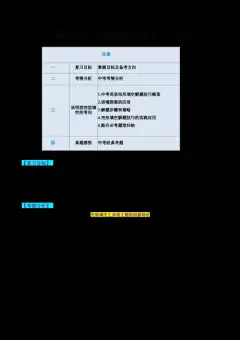
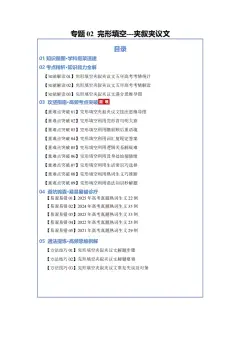
目录
Part1 技巧导图............................................................................................................................................3
Part3 干扰选项特征....................................................................................................................................3
Part2 知识详解............................................................................................................................................4
Part4 解题训练.............................................................................................................................................5
Part 5高考真题再现.....................................................................................................................................8
2023年2月四省联考...........................................................................................................................8
2023年1月浙江卷.............................................................................................................................11
2022年6月新高考1卷......................................................................................................................14
2022年6月新高考2卷......................................................................................................................18
2022年6月全国甲卷.........................................................................................................................20
2022年6月全国乙卷.........................................................................................................................22
2022年6月北京卷.............................................................................................................................25
2022年6月浙江卷..............................................................................................................................29
2022年1月浙江卷..............................................................................................................................32
2021年6月北京卷..............................................................................................................................34
2021年6月天津卷..............................................................................................................................38
2021年6月新高考1卷......................................................................................................................42
2021年6月新高考2卷......................................................................................................................45
2021年6月全国甲卷..........................................................................................................................47
2021年6月全国乙卷..........................................................................................................................50
2021年6月浙江卷..............................................................................................................................53
2021年3月天津卷..............................................................................................................................55
2021年1月八省联考..........................................................................................................................60
2021年1月浙江卷..............................................................................................................................64
2020年全国1卷..................................................................................................................................65
2020年北京卷.....................................................................................................................................672020年全国2卷..................................................................................................................................70
2020全国3..........................................................................................................................................73
2020.7浙江..........................................................................................................................................76
2020.5天津..........................................................................................................................................78
2020.7天津..........................................................................................................................................82
2020.1浙江..........................................................................................................................................85
2020江苏.............................................................................................................................................88
2020年新高考全国Ⅰ卷(山东卷)....................................................................................................93
2020年海南.........................................................................................................................................96
2019.1上海..........................................................................................................................................99
2019.3天津........................................................................................................................................101
2019江苏...........................................................................................................................................105
2019全国1........................................................................................................................................109
2019全国2........................................................................................................................................112
2019全国3........................................................................................................................................116
2019北京卷.......................................................................................................................................118
2019.6天津........................................................................................................................................122
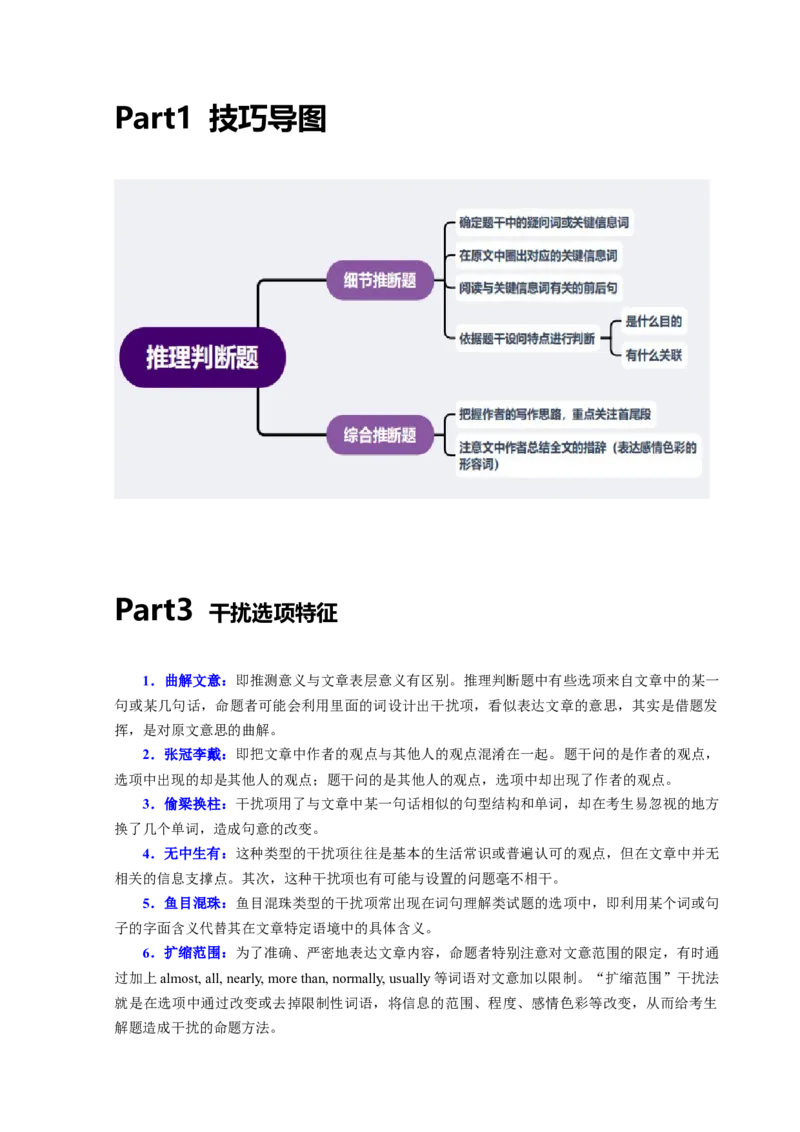
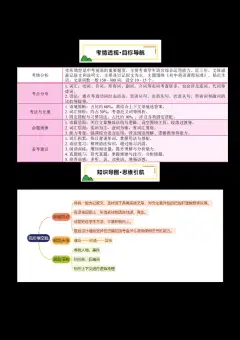
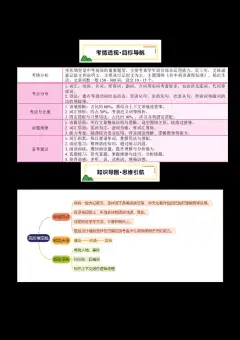
2019.6上海........................................................................................................................................125Part1 技巧导图
Part3
干扰选项特征
1.曲解文意:即推测意义与文章表层意义有区别。推理判断题中有些选项来自文章中的某一
句或某几句话,命题者可能会利用里面的词设计出干扰项,看似表达文章的意思,其实是借题发
挥,是对原文意思的曲解。
2.张冠李戴:即把文章中作者的观点与其他人的观点混淆在一起。题干问的是作者的观点,
选项中出现的却是其他人的观点;题干问的是其他人的观点,选项中却出现了作者的观点。
3.偷梁换柱:干扰项用了与文章中某一句话相似的句型结构和单词,却在考生易忽视的地方
换了几个单词,造成句意的改变。
4.无中生有:这种类型的干扰项往往是基本的生活常识或普遍认可的观点,但在文章中并无
相关的信息支撑点。其次,这种干扰项也有可能与设置的问题毫不相干。
5.鱼目混珠:鱼目混珠类型的干扰项常出现在词句理解类试题的选项中,即利用某个词或句
子的字面含义代替其在文章特定语境中的具体含义。
6.扩缩范围:为了准确、严密地表达文章内容,命题者特别注意对文意范围的限定,有时通
过加上almost, all, nearly, more than, normally, usually等词语对文意加以限制。“扩缩范围”干扰法
就是在选项中通过改变或去掉限制性词语,将信息的范围、程度、感情色彩等改变,从而给考生
解题造成干扰的命题方法。Part2 知识详解
推理判断题是指根据文中某一句话,也可是某几句话,进行加工得出的答案,即对原文某一
句话或某几句话所作的同义改写(paraphrase)或综合。以原文信息为依据,既不能做出在原文中找
不到文字根据的推理,也不能根据表面文字信息做多步推理。所以,推理判断题的答案只能是根
据原文表面文字信息进行一步推理。
知识点2 :推理判断题分类
推理判断题(客观) 段落 What can we infer from paragragh 3?
文章 What can we infer from the passage?
推理判断题(主观) Who are the intended readers of the passage?
知识点3:推理判断题(客观)解题方法与技巧:
A.段落推理1
主:读段落找关键句(推理分析);辅:选项分析排除。
B.段落推理2
主:读段落抓段中心(中心挂钩);辅:选项分析排除。
C.文章推理1
主:中心挂钩法;辅:选项分析排除。
D.文章推理2
主:关键句分析;辅:选项分析排除。
知识点4 :主观性推理判断题:
A.人物评价
B.事物评价
C.文章出处
D.目标读者
E.文章类型
F.后续研究知识点5:推理判断题注意事项
1.内容与原文一致,通常要淘汰。如果题目是推断题,而某个选项的内容却与原文相同,那么这是
与推断的含义相悖的,所以要淘汰。
2.推理的结论不要偏离文章的过远,一步推出的结论最理想。
3.不要脱离文章的主线,与文章的主基调相符的结论最可靠。无论哪种题型,无论考查的侧重点是
主旨还是推断,他们都不可能脱离文章的基调而存在。
4.客观,不要受自己主观意愿驱使。做推断题要始终以原文为依托,紧紧地围绕原文展开推理,围
绕原文来考虑对选项的取舍。
Part4 解题训练
例子1
We may think we're a culture that gets rid of our worn technology at the first sight of something
shiny and new, but a new study shows that we keep using our old devices (装置) well after they go out of
style. That's bad news for the environment — and our wallets — as these outdated devices consume much
more energy than the newer ones that do the same things.
…
32.What does the author think of new devices?
A.They are environmentfriendly.
B.They are no better than the old.
C.They cost more to use at home.
D.They go out of style quickly.
[解题示范]
What does the author think of:作者态度
题干信息
new devices:新设备
文体特点 科技说明文:一项研究新旧设备耗能的报告。
原文查找 That's bad news for the environment — and our wallets — as these outdated devices
consume much more energy than the newer ones that do the same things.
信息整合 ①做同样的事情旧设备耗能高(consume much more energy)
②旧设备不利于环境保护(bad news for the environment)
③旧设备更浪费钱财(our wallets)信息推断 上面旧设备的缺点是在和新设备相比较(than the newer ones)得出的结论,故新设
备可以克服以上缺点。
选项分析 A.新设备是环保的(They are environmentfriendly);属于正确信息推断。
B.新设备并不比旧设备好(They are no better than the old);属于“无中生有”型
错误。
C.新设备在家中使用的费用更高(They cost more to use at home);属于“无中生
有”型错误。
D.新设备很快就过时了(They go out of style quickly);属于“曲解文意”型错
误。
得出结论 由以上信息分析可知,A项正确。
例子2
We've all been there: in a lift, in line at the bank or on an airplane, surrounded by people who are, like
us, deeply focused on their smartphones or, worse, struggling with the uncomfortable silence.
…
32.What phenomenon is described in the first paragraph?
A.Addiction to smartphones.
B.Inappropriate behaviours in public places.
C.Absence of communication between strangers.
D.Impatience with slow service.
[解题示范]
细研题干定题型 由题干可知本题是对文章局部(第一段)进行深层理解的考查。
地点 公共场合:①电梯中;②在银行排队中;③飞机上
细读语段明大意
人物 ①专注地盯着自己的手机;②苦苦挣扎于令人不自在的沉默中
A项为原文中的事实,不是推断出的内容。
B项,文中提及的这些行为是否“合适”原文中没有提及,属
细研干扰项
于“无中生有”型错误。
D项在原文中没有提及,属于“无中生有”型错误。
甄别选项定答案
该段提到在公共场合中,周围都是人的情况下,人们只是专注
断定 地盯着自己的手机,或者苦苦挣扎于令人不自在的沉默中,从
答案 中可以推断出文章首段描述了陌生人之间缺少交流的现象。故
选择C项。
例子3
[1]Many of us love July because it's the month when nature's berries and stone fruits are inabundance. These colourful and sweet jewels from British Columbia's fields are little powerhouses of
nutritional protection.
[2]Of the common berries, strawberries are highest in vitamin C, although, because of their seeds,
raspberries contain a little more protein (蛋白质), iron and zinc (not that fruits have much protein).
Blueberries are particularly high in antioxidants (抗氧化物质). The yellow and orange stone fruits such as
peaches are high in the carotenoids we turn into vitamin A and which are antioxidants. As for cherries (樱
桃), they are so delicious who cares? However, they are rich in vitamin C.
[3]When combined with berries or slices of other fruits, frozen bananas make an excellent base for
thick, cooling fruit shakes and low fat “ice cream”. For this purpose, select ripe bananas for freezing as
they are much sweeter. Remove the skin and place them in plastic bags or containers and freeze. If you
like, a squeeze of fresh lemon juice on the bananas will prevent them turning brown. Frozen bananas will
last several weeks, depending on their ripeness and the temperature of the freezer.
[4]If you have a_juicer,_you can simply feed in frozen bananas and some berries or sliced fruit. Out
comes a “softserve” creamy dessert, to be eaten right away. This makes a fun activity for a children's party;
they love feeding the fruit and frozen bananas into the top of the machine and watching the ice cream
come out below.
27.From which is the text probably taken?
A.A biology textbook. B.A health magazine.
C.A research paper. D.A travel brochure.
[解题示范]
细研题干定题型 文章出处题。
本文介绍了丰收的七月给我们带来的多种浆果和核果,并告诉我们这些果实富含
文章内容
的营养成分和可以制作成各种美食。
第一段介绍了七月是水果丰富的季节;第二段介绍了各种莓类所含的营养成分;
文章语气 第三、四段介绍各种水果搭配的食用方法。在这一过程中作者使用了客观的语
气,通俗易懂的方法,形象地说明了水果搭配的技巧。
确定答案 本文是向大众介绍饮食方法,跟健康有关,应该出自健康杂志。所以B项正确。Part 5 高考真题再现
2023 年 2 月四省联考
B
As a young girl growing up in France, Sarah Toumi dreamed of becoming a leader who could make
the world a better place. Her passion to help others was awakened when, from the age of nine, she
accompanied her Tunisian father to his birthplace in the east of the country during holidays. There she
organized homework clubs and activities for children. Toumi witnessed first-hand the destructive effect of
desertification. “Within 10 years rich farmers became worse off, and in 10 years from now they will be
poor. I wanted to stop the Sahara Desert in its tracks.” A decrease in average rainfall and an increase in the
severity of droughts (干旱) have led to an estimated 75 percent of Tunisia’s agricultural lands being
threatened by desertification.
Toumi recognized that farming practices needed to change. She is confident that small land areas can
bring large returns if farmers are able to adapt by planting sustainable crops, using new technologies for
water treatment and focusing on natural products and fertilizers (肥料) rather than chemicals.
In 2012, Toumi consolidated her dream to fight the desert. She moved to Tunisia, and set up a
programme named Acacias for All to put her sustainable farming philosophy into action. “I want to show
young people in rural areas that they can create opportunities where they are. Nobody is better able to
understand the impact of desertification and climate change than somebody who is living with no access to
water.”
By September 2016, more than 130, 000 acacia trees had been planted on 20 pilot farms, with farmers
recording a 60 percent survival rate. Toumi estimates that some 3 million acacia trees are needed to protect
Tunisia’s farmland. She expects to plant 1 million trees by 2018. In the next couple of years, Toumi hopes
to extend the programme to Algeria and Morocco.
6. Why did Toumi set up Acacias for All in Tunisia?
A. To create job opportunities for young people.
B. To help the children obtain a basic education.
C. To persuade the farmers not to use fertilizers.D. To facilitate the protection of their farmland.
C
For years, David James, who studies insects at Washington State University, had wanted to examine
the migration (迁徙)patterns of West Coast monarch butterflies (黑脉金斑蝶). The route the butterflies
travel has been hardly known because the populations are too small to follow. For every 200 monarchs
tagged (打标签)by a researcher, only one is usually recovered at the end of its trip, James says, and finding
even 200 in the wild to tag is unlikely. Knowing the route is vital to conservation efforts, but James had no
way to figure it out- until he got a phone call from Washington State Penitentiary in Walla Walla.
The prison was looking for new activities to improve the mental health of those serving long-term
sentences. So James began working with prisoners to raise monarchs through the whole process of their
transformation. The adult insects were then tagged and released from the prison. Over five years, nearly
10, 000 monarchs flew from the facility. Elsewhere in Washington, Oregon and Idaho, researchers released
another few thousand.
The tags included email addresses, and soon after the first butterflies took off, James started receiving
messages from people who had spotted them. The butterflies, the reports confirmed, wintered in coastal
California. Twelve of them landed at Lighthouse Field State Beach in Santa Cruz. Several more headed to
Bolinas and Morro Bay.
The work helps researchers identify ideal places to plant milkweed and other vegetation that are
important to the life cycle of West Coast monarch butterflies. It also brought out the gentler side of some
of the prisoners. “They were very worried that they were going to harm the butterflies, ”James says.
Watching the monarch change their form also touched the men. “This butterfly changed, ” James recalls
prisoners telling him, “and maybe we can too. ”
9. Why are the butterflies tagged before being released?
A. To guarantee their safety.
B. To enable them to fly longer distances.
C. To track their travel routes.
D. To distinguish them from other species.D
We all know that unpleasant feeling when we’re talking about something interesting and halfway
through our sentence we’re interrupted. But was that really an interruption? The answer depends on whom
you ask, according to new research led by Katherine Hilton from Stanford University.
Using a set of controlled audio clips (录音片段), Hilton surveyed 5, 000 American English speakers
to better understand what affects people’s perceptions of interruptions. She had participants listen to audio
clips and then answer questions about whether the speakers seemed to be friendly and engaged, listening to
one another, or trying to interrupt.
Hilton found that American English speakers have different conversational styles. She identified two
distinct groups: high and low intensity speakers. High intensity speakers are generally uncomfortable with
moments of silence in conversation and consider talking at the same time a sign of engagement. Low
intensity speakers find it rude to talk at the same time and prefer people speak one after another in
conversation.
The differences in conversational styles became evident when participants listened to audio clips in
which two people spoke at the same time but were agreeing with each other and stayed on topic, Hilton
said. The high intensity group reported that conversations where people spoke at the same time when
expressing agreement were not interruptive but engaged and friendlier than the conversations with
moments of silence in between speaking turns. In contrast, the low intensity group perceived any amount
of simultaneous (同时) chat as a rude interruption, regardless of what the speakers were saying.
“People care about being interrupted, and those small interruptions can have a massive effect on the
overall communication,” Hilton said. “Breaking apart what an interruption means is essential if we want to
understand how humans interact with each other.”
14. What do low intensity speakers think of simultaneous chat?
A. It’s important. B. It’s interesting.
C. It’s inefficient. D. It’s impolite.
15. What can we learn from Hilton’s research?
A. Human interaction is complex.
B. Communication is the basis of life.
C. Interruptions promote thinking.
D. Language barriers will always exist.2023 年 1 月浙江卷
B
Live with roommates? Have friends and family around you? Chances are that if you’re looking to live
a more sustainable lifestyle, not everyone around you will be ready to jump on that bandwagon.
I experienced this when I started switching to a zero waste lifestyle five years ago, as I was living
with my parents, and I continue to experience this with my husband, as he is not completely zero waste
like me. I’ve learned a few things along the way though, which I hope you’ll find encouraging if you’re
doing your best to figure out how you can make the change in a not-always-supportive household.
Zero waste was a radical lifestyle movement a few years back. I remember showing my parents a
video of Bea Johnson, sharing how cool I thought it would be to buy groceries with jars, and have so little
trash! A few days later, I came back with my first jars of zero waste groceries, and my dad commented on
how silly it was for me to carry jars everywhere. It came off as a bit discouraging.
Yet as the months of reducing waste continued, I did what I could that was within my own reach. I
had my own bedroom, so I worked on removing things I didn’t need. Since I had my own toiletries (洗漱
用品), I was able to start personalising my routine to be more sustainable. I also offered to cook every so
often, so I portioned out a bit of the cupboard for my own zero waste groceries. Perhaps your household
won’t entirely make the switch, but you may have some control over your own personal spaces to make
the changes you desire.
As you make your lifestyle changes, you may find yourself wanting to speak up for yourself if others
comment on what you’re doing, which can turn itself into a whole household debate. If you have
individuals who are not on board, your words probably won’t do much and can often leave you feeling
more discouraged.
So here is my advice: Lead by action.
25. What was the attitude of the author’s father toward buying groceries with jars?
A. He disapproved of it. B. He was favorable to it.
C. He was tolerant of it. D. He didn’t care about it.
26. What can we infer about the author?A. She is quite good at cooking. B. She respects others’ privacy.
C. She enjoys being a housewife. D. She is a determined person.
C
A machine can now not only beat you at chess, it can also outperform you in debate. Last week, in a
public debate in San Francisco, a software program called Project Debater beat its human opponents,
including Noa Ovadia, Israel’s former national debating champion.
Brilliant though it is, Project Debater has some weaknesses. It takes sentences from its library of
documents and prebuilt arguments and strings them together. This can lead to the kinds of errors no human
would make. Such wrinkles will no doubt be ironed out, yet they also point to a fundamental problem. As
Kristian Hammond, professor of electrical engineering and computer science at Northwestern University,
put it: “There’s never a stage at which the system knows what it’s talking about.”
What Hammond is referring to is the question of meaning, and meaning is central to what
distinguishes the least intelligent of humans from the most intelligent of machines. A computer works with
symbols. Its program specifies a set of rules to transform one string of symbols into another. But it does
not specify what those symbols mean. Indeed, to a computer, meaning is irrelevant. Humans, in thinking,
talking, reading and writing, also work with symbols. But for humans, meaning is everything. When we
communicate, we communicate meaning. What matters is not just the outside of a string of symbols, but
the inside too, not just how they are arranged but what they mean.
Meaning emerges through a process of social interaction, not of computation, interaction that shapes
the content of the symbols in our heads. The rules that assign meaning lie not just inside our heads, but
also outside, in society, in social memory, social conventions and social relations. It is this that
distinguishes humans from machines. And that’s why, however astonishing Project Debater may seem, the
tradition that began with Socrates and Confucius will not end with artificial intelligence.
28. Why does the author mention Noa Ovadia in the first paragraph?
A. To explain the use of a software program.
B. To show the cleverness of Project Debater.
C. To introduce the designer of Project Debater.
D. To emphasize the fairness of the competition.D
According to the Solar Energy Industry Association, the number of solar panels installed(安装)has
grown rapidly in the past decade, and it has to grow even faster to meet climate goals. But all of that
growth will take up a lot of space, and though more and more people accept the concept of solar energy,
few like large solar panels to be installed near them.
Solar developers want to put up panels as quickly and cheaply as possible, so they haven’t given
much thought to what they put under them. Often, they’ll end up filling the area with small stones and
using chemicals to control weeds. The result is that many communities, especially in farming regions, see
solar farms as destroyers of the soil.
“Solar projects need to be good neighbors,” says Jordan Macknick, the head of the Innovative Site
Preparation and Impact Reductions on the Environment(InSPIRE)project. “They need to be protectors of
the land and contribute to the agricultural economy.” InSPIRE is investigating practical approaches to
“low-impact” solar development, which focuses on establishing and operating solar farms in a way that is
kinder to the land. One of the easiest low-impact solar strategies is providing habitat for pollinators(传粉
昆虫).
Habitat loss, pesticide use, and climate change have caused dramatic declines in pollinator
populations over the past couple of decades, which has damaged the U.S. agricultural economy. Over 28
states have passed laws related to pollinator habitat protection and pesticide use. Conservation
organizations put out pollinator-friendliness guidelines for home gardens, businesses, schools, cities—and
now there are guidelines for solar farms.
Over the past few years, many solar farm developers have transformed the space under their solar
panels into a shelter for various kinds of pollinators, resulting in soil improvement and carbon reduction.
“These pollinator-friendly solar farms can have a valuable impact on everything that’s going on in the
landscape,” says Macknick.
32. What do solar developers often ignore?
A. The decline in the demand for solar energy.
B. The negative impact of installing solar panels.C. The rising labor cost of building solar farms.
D. The most recent advances in solar technology.
2022 年 6 月新高考 1 卷
A
Grading Policies for Introduction to Literature
Grading Scale
90-100, A; 80-89, B; 70-79, C; 60-69, D; Below 60, E.
Essays (60%)
Your four major essays will combine to form the main part of the grade for this course: Essay 1 =
10%; Essay 2 = 15%; Essay 3 = 15%; Essay 4 = 20%.
Group Assignments (30%)
Students will work in groups to complete four assignments (作业) during the course. All the
assignments will be submitted by the assigned date through Blackboard, our online learning and course
management system.
Daily Work/In-Class Writings and Tests/Group Work/Homework (10%)
Class activities will vary from day to day, but students must be ready to complete short in-class
writings or tests drawn directly from assigned readings or notes from the previous class' lecture/discussion,
so it is important to take careful notes during class. Additionally, from time to time I will assign group
work to be completed in class or short assignments to be completed at home, both of which will be graded.
Late Work
An essay not submitted in class on the due date will lose a letter grade for each class period it is late.
If it is not turned in by the 4th day after the due date, it will earn a zero. Daily assignments not completed
during class will get a zero. Short writings missed as a result of an excused absence will be accepted.
21. Where is this text probably taken from?
A. A textbook. B. An exam paper.C. A course plan. D. An academic article.
23. What will happen if you submit an essay one week after the due date?
A. You will receive a zero. B. You will lose a letter grade.
C. You will be given a test. D. You will have to rewrite it.
B
Like most of us, I try to be mindful of food that goes to waste. The arugula (芝麻菜)was to make a
nice green salad, rounding out a roast chicken dinner. But I ended up working late. Then friends called
with a dinner invitation. I stuck the chicken in the freezer. But as days passed, the arugula went bad. Even
worse, I had unthinkingly bought way too much; I could have made six salads with what I threw out.
In a world where nearly 800 million people a year go hungry, “food waste goes against the moral
grain,” as Elizabeth Royte writes in this month’s cover story. It’s jaw-dropping how much perfectly good
food is thrown away — from “ugly” (but quite eatable) vegetables rejected by grocers to large amounts of
uneaten dishes thrown into restaurant garbage cans.
Producing food that no one eats wastes the water, fuel, and other resources used to grow it. That
makes food waste an environmental problem. In fact, Royte writes, “if food waste were a country, it would
be the third largest producer of greenhouse gases in the world.”
If that’s hard to understand, let’s keep it as simple as the arugula at the back of my refrigerator. Mike
Curtin sees my arugula story all the time — but for him, it's more like 12 bones of donated strawberries
nearing their last days. Curtin is CEO of DC Central Kitchen in Washington, D.C., which recovers food
and turns it into healthy meals. Last year it recovered more than 807,500 pounds of food by taking
donations and collecting blemished (有瑕疵的) produce that otherwise would have rotted in fields. And
the strawberries? Volunteers will wash, cut, and freeze or dry them for use in meals down the road.
Such methods seem obvious, yet so often we just don’t think. “Everyone can play a part in reducing
waste, whether by not purchasing more food than necessary in your weekly shopping or by asking
restaurants to not include the side dish you won’t eat,” Curtin says.
24. What does the author want to show by telling the arugula story?
A. We pay little attention to food waste.B. We waste food unintentionally at times.
C. We waste more vegetables than meat.
D. We have good reasons for wasting food.
C
The elderly residents (居民) in care homes in London are being given hens to look after to stop them
feeling lonely.
The project was dreamed up by a local charity (慈善组织) to reduce loneliness and improve elderly
people’s wellbeing, It is also being used to help patients suffering dementia, a serious illness of the mind.
Staff in care homes have reported a reduction in the use of medicine where hens are in use.
Among those taking part in the project is 80-year-old Ruth Xavier. She said: “I used to keep hens
when I was younger and had to prepare their breakfast each morning before I went to school. ”
“I like the project a lot. I am down there in my wheelchair in the morning letting the hens out and
down there again at night to see they’ve gone to bed.”
“It’s good to have a different focus. People have been bringing their children in to see the hens and
residents come and sit outside to watch them. I’m enjoying the creative activities, and it feels great to have
done something useful.”
There are now 700 elderly people looking after hens in 20 care homes in the North East, and the
charity has been given financial support to roll it out countrywide.
Wendy Wilson, extra care manager at 60 Penfold Street, one of the first to embark on the project,
said: “Residents really welcome the idea of the project and the creative sessions. We are looking forward
to the benefits and fun the project can bring to people here.”
Lynn Lewis, director of Notting Hill Pathways, said: “We are happy to be taking part in the project. It
will really help connect our residents through a shared interest and creative activities.”
28. What is the purpose of the project?
A. To ensure harmony in care homes. B. To provide part-time jobs for the aged.
C. To raise money for medical research. D. To promote the elderly people’s welfare.
29. How has the project affected Ruth Xavier?A. She has learned new life skills. B. She has gained a sense of achievement.
C. She has recovered her memory. D. She has developed a strong personality.
31. What can we learn about the project from the last two paragraphs?
A. It is well received. B. It needs to be more creative.
C. It is highly profitable. D. It takes ages to see the results.
D
Human speech contains more than 2,000 different sounds, from the common “m” and “a” to the rare
clicks of some southern African languages. But why are certain sounds more common than others? A
ground-breaking, five-year study shows that diet-related changes in human bite led to new speech sounds
that are now found in half the world’s languages.
More than 30 years ago, the scholar Charles Hockett noted that speech sounds called labiodentals,
such as “f” and “v”, were more common in the languages of societies that ate softer foods. Now a team of
researchers led by Damián Blasi at the University of Zurich, Switzerland, has found how and why this
trend arose.
They discovered that the upper and lower front teeth of ancient human adults were aligned (对齐),
making it hard to produce labiodentals, which are formed by touching the lower lip to the upper teeth.
Later, our jaws changed to an overbite structure (结构), making it easier to produce such sounds.
The team showed that this change in bite was connected with the development of agriculture in the
Neolithic period. Food became easier to chew at this point. The jawbone didn’t have to do as much work
and so didn’t grow to be so large.
Analyses of a language database also confirmed that there was a global change in the sound of world
languages after the Neolithic age, with the use of “f” and “v” increasing remarkably during the last few
thousand years. These sounds are still not found in the languages of many hunter-gatherer people today.
This research overturns the popular view that all human speech sounds were present when human
beings evolved around 300,000 years ago. ”The set of speech sounds we use has not necessarily remained
stable since the appearance of human beings, but rather the huge variety of speech sounds that we find
today is the product of a complex interplay of things like biological change and cultural evolution,“ said
Steven Moran, a member of the research team.
35. What does Steven Moran say about the set of human speech sounds?A. It is key to effective communication. B. It contributes much to cultural diversity.
C. It is a complex and dynamic system. D. It drives the evolution of human beings.
2022 年 6 月新高考 2 卷
C
Over the last seven years, most states have banned texting by drivers, and public service campaigns
have tried a wide range of methods to persuade people to put down their phones when they are behind the
wheel.
Yet the problem, by just about any measure, appears to be getting worse. Americans are still texting
while driving, as well as using social networks and taking photos. Road accidents, which had fallen for
years, are now rising sharply.
That is partly because people are driving more, but Mark Rosekind, the chief of the National
Highway Traffic Safety Administration, said distracted(分心)driving was "only increasing,
unfortunately. "
"Big change requires big ideas. " he said in a speech last month, referring broadly to the need to
improve road safety. So to try to change a distinctly modern behavior, lawmakers and public health experts
are reaching back to an old approach: They want to treat distracted driving like drunk driving.
An idea from lawmakers in New York is to give police officers a new device called the Textalyzer. It
would work like this: An officer arriving at the scene of a crash could ask for the phones of the drivers and
use the Textalyzer to check in the operating system for recent activity. The technology could determine
whether a driver had just texted, emailed or done anything else that is not allowed under New York's
hands-free driving laws.
"We need something on the books that can change people's behavior,” said Félix W. Ortiz, who
pushed for the state's 2001 ban on hand-held devices by drivers. If the Textalyzer bill becomes law, he
said, "people are going to be more afraid to put their hands on the cell phone. "
8. Which of the following best describes the ban on drivers' texting in the US?
A. Ineffective. B. Unnecessary.C. Inconsistent. D. Unfair.
D
As we age, even if we’re healthy, the heart just isn’t as efficient in processing oxygen as it used to be.
In most people the first signs show up in their 50s or early 60s. And among people who don’t exercise, the
changes can start even sooner.
“Think of a rubber band. In the beginning, it is flexible, but put it in a drawer for 20 years and it will
become dry and easily broken,” says Dr. Ben Levine, a heart specialist at the University of Texas. That’s
what happens to the heart. Fortunately for those in midlife, Levine is finding that even if you haven’t been
an enthusiastic exerciser, getting in shape now may help improve your aging heart.
Levine and his research team selected volunteers aged between 45 and 64 who did not exercise much
but were otherwise healthy. Participants were randomly divided into two groups. The first group
participated in a program of nonaerobic (无氧) exercise—balance training and weight training—three
times a week. The second group did high-intensity aerobic exercise under the guidance of a trainer for four
or more days a week. After two years, the second group saw remarkable improvements in heart health.
“We took these 50-year-old hearts and turned the clock back to 30-or 35-year-old hearts,” says
Levine. “And the reason they got so much stronger and fitter was that their hearts could now fill a lot
better and pump (泵送) a lot more blood during exercise. ” But the hearts of those who participated in less
intense exercise didn’t change, he says.
“The sweet spot in life to start exercising, if you haven’t already, is in late middle age when the heart
still has flexibility,” Levine says. “We put healthy 70-year-olds through a yearlong exercise training
program, and nothing happened to them at all. ”
Dr. Nieca Goldberg, a spokeswoman for the American Heart Association, says Levine’s findings are a
great start. But the study was small and needs to be repeated with far larger groups of people to determine
exactly which aspects of an exercise routine make the biggest difference.
12. What does Levine want to explain by mentioning the rubber band?
A. The right way of exercising. B. The causes of a heart attack.
C. The difficulty of keeping fit. D. The aging process of the heart.
13. In which aspect were the two groups different in terms of research design?A. Diet plan. B. Professional background.
C. Exercise type. D. Previous physical condition.
15. What does Dr. Nieca Goldberg suggest?
A. Making use of the findings. B. Interviewing the study participants.
C. Conducting further research. D. Clarifying the purpose of the study.
2022 年 6 月全国甲卷
B
Goffin’s cockatoos, a kind of small parrot native to Australasia, have been shown to have similar
shape-recognition abilities to a human two-year-old. Though not known to use tools in the wild, the birds
have proved skilful at tool use while kept in the cage. In a recent experiment, cockatoos were presented
with a box with a nut inside it. The clear front of the box had a “keyhole” in a geometric shape, and the
birds were given five differently shaped “keys” to choose from. Inserting the correct “key” would let out
the nut.
In humans, babies can put a round shape in a round hole from around one year of age, but it will be
another year before they are able to do the same with less symmetrical (对称的) shapes. This ability to
recognize that a shape will need to be turned in a specific direction before it will fit is called an “allocentric
frame of reference”. In the experiment, Goffin’s cockatoos were able to select the right tool for the job, in
most cases, by visual recognition alone. Where trial-and-error was used, the cockatoos did better than
monkeys in similar tests. This indicates that Goffin’s cockatoos do indeed possess an allocentric frame of
reference when moving objects in space, similar to two-year-old babies.
The next step, according to the researchers, is to try and work out whether the cockatoos rely entirely
on visual clues (线索), or also use a sense of touch in making their shape selections.
26. What does the follow-up test aim to find out about the cockatoos?
A. How far they are able to see. B. How they track moving objects.
C. Whether they are smarter than monkeys. D. Whether they use a sense of touch in the test.D
Sometime in the early 1960s, a significant thing happened in Sydney, Australia. The city discovered
its harbor. Then, one after another, Sydney discovered lots of things that were just sort of there — broad
parks, superb beaches, and a culturally diverse population. But it is the harbor that makes the city.
Andrew Reynolds, a cheerful fellow in his early 30s, pilots Sydney ferryboats for a living. I spent the
whole morning shuttling back and forth across the harbor. After our third run Andrew shut down the
engine, and we went our separate ways — he for a lunch break, I to explore the city.
“I’ll miss these old boats,” he said as we parted.
“How do you mean?” I asked.
“Oh, they’re replacing them with catamarans. Catamarans are faster, but they’re not so elegant, and
they’re not fun to pilot. But that’s progress, I guess.”
Everywhere in Sydney these days, change and progress are the watchwords (口号), and traditions are
increasingly rare. Shirley Fitzgerald, the city’s official historian, told me that in its rush to modernity in the
1970s, Sydney swept aside much of its past, including many of its finest buildings. “Sydney is confused
about itself,” she said. “We can’t seem to make up our minds whether we want a modern city or a
traditional one. It’s a conflict that we aren’t getting any better at resolving (解决).”
On the other hand, being young and old at the same time has its attractions. I considered this when I
met a thoughtful young businessman named Anthony. “Many people say that we lack culture in this
country,” he told me. “What people forget is that the Italians, when they came to Australia, brought 2000
years of their culture, the Greeks some 3000 years, and the Chinese more still. We’ve got a foundation
built on ancient cultures but with a drive and dynamism of a young country. It’s a pretty hard combination
to beat.”
He is right, but I can’t help wishing they would keep those old ferries.
34. What does Shirley Fitzgerald think of Sydney?
A. It is losing its traditions. B. It should speed up its progress.
C. It should expand its population. D. It is becoming more international.
35. Which statement will the author probably agree with?
A. A city can be young and old at the same time.
B. A city built on ancient cultures is more dynamic.
C. Modernity is usually achieved at the cost of elegance.D. Compromise should be made between the local and the foreign.
2022 年 6 月全国乙卷
B
In 1916, two girls of wealthy families, best friends from Auburn, N. Y. — Dorothy Woodruff and
Rosamond Underwood — traveled to a settlement in the Rocky Mountains to teach in a one-room
schoolhouse. The girls had gone to Smith College. They wore expensive clothes. So for them to move to
Elkhead, Colo. to instruct the children whose shoes were held together with string was a surprise. Their
stay in Elkhead is the subject of Nothing Daunted: The Unexpected Education of Two Society Girls in the
West by Dorothy Wickenden, who is a magazine editor and Dorothy Woodruff’s granddaughter.
Why did they go then? Well, they wanted to do something useful. Soon, however, they realized what
they had undertaken.
They moved in with a local family, the Harrisons, and, like them, had little privacy, rare baths, and a
blanket of snow on their quilt when they woke up in the morning. Some mornings, Rosamond and Dorothy
would arrive at the schoolhouse to find the children weeping from the cold. In spring, the snow was
replaced by mud over ice.
In Wickenden’s book, she expanded on the history of the West and also on feminism, which of course
influenced the girls’ decision to go to Elkhead. A hair-raising section concerns the building of the railroads,
which entailed (牵涉) drilling through the Rockies, often in blinding snowstorms. The book ends with
Rosamond and Dorothy’s return to Auburn.
Wickenden is a very good storyteller. The sweep of the land and the stoicism (坚忍) of the people
move her to some beautiful writing. Here is a picture of Dorothy Woodruff, on her horse, looking down
from a hill top: “When the sun slipped behind the mountains, it shed a rosy glow all around them. Then a
full moon rose. The snow was marked only by small animals: foxes, coyotes, mice, and varying hares,
which turned white in the winter.”
25. What can we learn about the girls from paragraph 3?
A. They enjoyed much respect. B. They had a room with a bathtub.C. They lived with the local kids. D. They suffered severe hardships.
27. What is the text?
A. A news report. B. A book review. C. A children’s story. D. A diary entry.
C
Can a small group of drones (无人机) guarantee the safety and reliability of railways and, at the same
time, help railway operators save billions of euros each year? That is the very likely future of applying
today’s “eyes in the sky” technology to making sure that the millions of kilometres of rail tracks and
infrastructure (基础设施) worldwide are safe for trains on a 24/7 basis.
Drones are already being used to examine high-tension electrical lines. They could do precisely the
same thing to inspect railway lines and other vital aspects of rail infrastructure such as the correct position
of railway tracks and switching points. The more regularly they can be inspected, the more railway safety,
reliability and on-time performance will be improved. Costs would be cut and operations would be more
efficient (高效) across the board.
That includes huge savings in maintenance costs and better protection of railway personnel safety. It
is calculated that European railways alone spend approximately 20 billion euros a year on maintenance,
including sending maintenance staff, often at night, to inspect and repair the rail infrastructure. That can be
dangerous work that could be avoided with drones assisting the crews’ efforts.
By using the latest technologies, drones could also start providing higher-value services for railways,
detecting faults in the rail or switches, before they can cause any safety problems. To perform these tasks,
drones for rail don’t need to be flying overhead. Engineers are now working on a new concept: the rail
drones of the future. They will be moving on the track ahead of the train, and programmed to run
autonomously. Very small drones with advanced sensors and AI and travelling ahead of the train could
guide it like a co-pilot. With their ability to see ahead, they could signal any problem, so that fast-moving
trains would be able to react in time.
28. What makes the application of drones to rail lines possible?
A. The use of drones in checking on power lines.
B. Drones’ ability to work at high altitudes.C. The reduction of cost in designing drones.
D. Drones’ reliable performance in remote areas.
30. What function is expected of the rail drones?
A. To provide early warning. B. To make trains run automatically.
.
C To earn profits for the crews. D. To accelerate transportation.
D
The Government’s sugar tax on soft drinks has brought in half as much money as Ministers first
predicted it would generate, the first official data on the policy has shown.
First announced in April, 2016, the tax which applies to soft drinks containing more than 5g of sugar
per 100ml, was introduced to help reduce childhood obesity (肥胖). It is believed that today’s children and
teenagers are consuming three times the recommended level of sugar, putting them at a higher risk of the
disease.
Initially the sugar tax was expected to make £520m a year for the Treasury. However, data of the first
six months showed it would make less than half this amount. At present it is expected to generate £240m
for the year ending in April 2019, which will go to school sports.
It comes after more than half of soft drinks sold in shops have had their sugar levels cut by
manufacturers (制造商) so they can avoid paying the tax. Drinks now contain 45 million fewer kilos of
sugar as a result of manufacturers’ efforts to avoid the charge, according to Treasury figures. Since April
drinks companies have been forced to pay between 18p and 24p for every litre of sugary drink they
produce or import, depending on the sugar content.
,
However some high sugar brands, like Classic Coca Cola, have accepted the sugar tax and are
refusing to change for fear of upsetting consumers. Fruit juices, milk-based drinks and most alcoholic
drinks are free of the tax, as are small companies manufacturing fewer than 1m litres per year.
Today’s figures, according to one government official, show the positive influence the sugar tax is
having by raising millions of pounds for sports facilities (设施) and healthier eating in schools. Helping
the next generation to have a healthy and active childhood is of great importance, and the industry is
playing its part.35. What can be inferred about the adoption of the sugar tax policy?
A. It is a short-sighted decision. B. It is a success story.
C. It benefits manufacturers. D. It upsets customers.
2022 年 6 月北京卷
B
My name is Alice. Early last year, I was troubled by an anxiety that crippled ( 削弱 ) my ability to
do anything. I felt like a storm cloud hung over me. For almost a year I struggled on, constantly staring at
this wall that faced me. My perfectionist tendencies were the main root of this: I wanted to be perfect at
whatever I did, which obviously in life is not possible, but it consumed me.
One day, I attended a presentation by wildlife conservationist Grant Brown at my high school. His
presentation not only awed and inspired me, but also helped emerge an inner desire to make a difference in
the world. I joined a pre-presentation dinner with him and that smaller setting allowed me to slowly build
up my courage to speak one-on-one with him—an idea that had seemed completely impossible. This first
contact was where my story began.
A month later, Brown invited me to attend the World Youth Wildlife Conference. Looking back, I now
see that this would be the first in a series of timely opportunities that my old self would have let pass, but
that this new and more confident Alice enthusiastically seized. Shortly after I received his invitation,
applications to join the Youth for Nature and the Youth for Planet groups were sent around through my
high school. I decided to commit to completing the applications, and soon I was a part of a growing global
team of young people working to protect nature. Each of these new steps continued to grow my
confidence.
I am writing this just six months since my journey began and I’ve realised that my biggest obstacle (
障碍 ) this whole time was myself. It was that voice in the back of my head telling me that one phrase that
has stopped so many people from reaching their potential: I can’t. They say good things come to those who
wait; I say: grab every opportunity with everything you have and be impatient. After all, nature does not
require our patience, but our action.27. What can we learn from this passage?
A. Practice makes perfect. B. Patience is a cure of anxiety.
C. Action is worry’s worst enemy. D. Everything comes to those who wait.
C
“What would the world be if there were no hunger?” It’s a question that Professor Crystal would ask
her students. They found it hard to answer, she wrote later, because imagining something that isn’t part of
real life—and learning how to make it real—is a rare skill. It is taught to artists and engineers, but much
less often to scientists. Crystal set out to change that, and helped to create a global movement. The result—
an approach known as systems thinking—is now seen as essential in meeting global challenges.
Systems thinking is crucial to achieving targets such as zero hunger and better nutrition because it
requires considering the way in which food is produced, processed, delivered and consumed, and looking
at how those things intersect (交叉 ) with human health, the environment, economics and society.
According to systems thinking, changing the food system—or any other network—requires three things to
happen. First, researchers need to identify all the players in that system; second, they must work out how
they relate to each other; and third, they need to understand and quantify the impact of those relationships
on each other and on those outside the system.
Take nutrition. In the latest UN report on global food security, the number of undernourished (营养不
良 )people in the world has been rising, despite great advances in nutrition science. Tracking of 150
biochemicals in food has been important in revealing the relationships between calories, sugar, fat and the
occurrence of common diseases. But using machine learning and artificial intelligence, some scientists
propose that human diets consist of at least 26,000 biochemicals—and that the vast majority are not
known.This shows that we have some way to travel before achieving the first objective of systems thinking
- which,in this example, is to identify more constituent parts of the nutrition system.
A systems approach to creating change is also built on the assumption that everyone in the system has
equal power. But as some researchers find, the food system is not an equal one. A good way to redress (修
正 ) such power imbalance is for more universities to do what Crystal did and teach students how to think
using a systems approach.
More researchers, policymakers and representatives from the food industry must learn to look beyond
their direct lines of responsibility and adopt a systems approach. Crystal knew that visions alone don’tproduce results, but concluded that “we’ll never produce results that we can’t envision”.
28. The author uses the question underlined in Paragraph 1 to ________.
A. illustrate an argument B. highlight an opinion
C. introduce the topic D. predict the ending
30. As for systems thinking, which would the author agree with?
A. It may be used to justify power imbalance.
B. It can be applied to tackle challenges.
C. It helps to prove why hunger exists.
D. It goes beyond human imagination.
D
Quantum ( 量子 ) computers have been on my mind a lot lately. A friend has been sending me
articles on how quantum computers might help solve some of the biggest challenges we face as humans.
I’ve also had exchanges with two quantum-computing experts. One is computer scientist Chris Johnson
who I see as someone who helps keep the field honest. The other is physicist Philip Taylor.
For decades, quantum computing has been little more than a laboratory curiosity. Now, big tech
companies have invested in quantum computing, as have many smaller ones. According to Business
Weekly, quantum machines could help us “cure cancer, and even take steps to turn climate change in the
opposite direction.” This is the sort of hype ( 炒作 ) that annoys Johnson. He worries that researchers are
making promises they can’t keep. “What’s new,” Johnson wrote, “is that millions of dollars are now
potentially available to quantum computing researchers.”
As quantum computing attracts more attention and funding, researchers may mislead investors,
journalists, the public and, worst of all, themselves about their work’s potential. If researchers can’t keep
their promises, excitement might give way to doubt, disappointment and anger, Johnson warns. Lots of
other technologies have gone through stages of excitement. But something about quantum computing
makes it especially prone to hype, Johnson suggests, perhaps because “‘quantum’ stands for something
cool you shouldn’t be able to understand.” And that brings me back to Taylor, who suggested that I read
his book Q for Quantum.
After I read the book, Taylor patiently answered my questions about it. He also answered my
questions about PyQuantum, the firm he co-founded in 2016. Taylor shares Johnson’s concerns abouthype, but he says those concerns do not apply to PyQuantum.
The company, he says, is closer than any other firm “by a very large margin ( 幅度 )” to building a
“useful” quantum computer, one that “solves an impactful problem that we would not have been able to
solve otherwise.” He adds, “People will naturally discount my opinions, but I have spent a lot of time
quantitatively comparing what we are doing with others.”
Could PyQuantum really be leading all the competition “by a wide margin”, as Taylor claims? I don’t
know. I’m certainly not going to advise my friend or anyone else to invest in quantum computers. But I
trust Taylor, just as I trust Johnson.
31. Regarding Johnson’s concerns, the author feels ________.
A. sympathetic B. unconcerned C. doubtful D. excited
2022 年 6 月浙江卷
A
Pasta and pizza were on everyone’s lunch menu in my native land of Italy. Everyone who had such a
lunch was fair-skinned and spoke Italian. A few years later, as I stood in the lunch line with my
kindergarten class in a school in Brooklyn, I realized things were no longer that simple. My classmates
ranged from those kids with pale skin and large blue eyes to those with rich brown skin and dark hair. The
food choices were almost as diverse as the students. In front of me was an array of foods I couldn’t even
name in my native language. Fearing that I would pick out something awful, I desperately tried to ask the
boy ahead of me for a recommendation. Unfortunately, between us stood the barrier of language.
Although my kindergarten experience feels like a century ago, the lessons I learned will stick in my
mind forever. For the past three summers, I have worked in a government agency in New York. New
immigrants much like the little girl in the lunch line flooded our office seeking help. I often had to be an
interpreter for the Italian-speaking ones. As I served the role of vital communication link, I was reminded
of my desperate struggle to converse before I learned English. I watched with great sympathy as elderly
Italians tried to hold a conversation in Italian with people who did not speak the language. It suddenly
became very clear to me how lucky I was to be fluent in two languages.In New York, a multicultural city, students like me are blessed with a chance to work with a diverse
population. In my English to Italian translations, I’ve learned about social programs that I didn’t know
existed. This work expanded my mind in ways that are impossible inside the four walls of a classroom.
Walking through the streets of Brooklyn today, I am no longer confused by this city’s sounds and smells.
Instead, enjoy its diversity.
2. Who does “the little girl” in paragraph 2 refer to?
.
A An Italian teacher. B. A government official.
C. The author herself. D. The author’s classmate.
3. How did the summer job benefit the author?
A. It strengthened her love for school. B. It helped sharpen her sense of direction.
C. It opened her eyes to the real world. D. It made her childhood dream come true.
B
All around the world, there are small changes taking place. At the side of roads, behind school
playgrounds and on all kinds of unloved pieces of land across towns and cities, tiny forests barely the size
of tennis courts are appearing, making a great place for both wildlife and local people who may not
normally have easy access to nature. This is the Tiny Forest movement, which aims to prove that the best
things in life really do come in small packages.
Tiny forests were first pioneered as a concept in the 1970s by Dr Miyawaki, a Japanese botanist. As
he went on to share his concept with others, the idea soon took off in India and other countries before
eventually reaching Europe, where it became popular in places like France, Belgium and the Netherlands.
So how does it work? Louise Hartley, who is leading the Tiny Forest project in the UK, explains that
the process begins by identifying areas in which a tiny forest could have the biggest influence. “We focus
on urban areas where access to nature is often not that easy”, says Hartley. “We see it as a chance to try to
break the growing disconnect between people and nature.”
In a Tiny Forest, there must be a minimum of 600 trees, and the trees are planted much closer together
and without chemicals or fertilisers (肥料). There are usually around 30 different kinds of all-native tree
species (物种). This variety, coupled with the fact that tiny forests grow up to ten times faster thanstandard forests, means they attract a rich abundance of wildlife. It’s also thought that these places could
help reduce the risk of flooding, remove carbon from the atmosphere and fight climate change, as well as
improving the mental health of those living locally.
4. What do we know about the Tiny Forest movement?
A. It has achieved notable success. B. It is led by number of schools.
C. It began in Europe in the 1970s. D. It will spread to the countryside.
5. What is the purpose of the project led by Hartley in the UK?
A. To promote eco-tourism. B. To improve forestry research.
C. To popularise gardening. D. To get people close to nature.
C
Many people believe that working to the maximum is the secret to success, but research has found
that moderation(适度) also gets results on the job.
In a study led by Ellen Langer of Harvard University, researchers asked people to translate sentences
into a new a made-up language. Subjects who practiced the language moderately beforehand made fewer
errors than those who practiced extensively or not at all. High levels of knowledge can make people too
attached to traditional ways of viewing problems across fields the arts, sciences, and politics. High
conscientiousness is related to lower job performance, especially in simple jobs where it doesn’t pay to be
a perfectionist.
How long we stay on the clock and how we spend that time are under careful examination in many
workplaces. The young banker who eats lunch at his desk is probably seen as a go-getter, while his
colleagues who chat over a relaxed conference-room meal get dirty looks from the corner office. “People
from cultures that value relationships more than ours does are shocked by the thought of eating alone in
front of a computer”, says Art Markman, a professor of psychology at the University of Texas, Austin.
Social interaction has been shown to lift mood(情绪) and get people thinking in new directions and in
ways that could help improve any post-lunch effort.
Markman also promotes off-task time. “Part of being a good thinker is experiencing things that are
seemingly unrelated to what you are working on at the moment but give you fresh ideas about your work,”
he says. “Also, there is a lot of research showing that a positive mood leads to higher levels of productivityand creativity. So, when people do things to increase their life satisfaction, they also make themselves
more effective at work.”
7. What does Ellen Langer’s study show?
A. It is worthwhile to be a perfectionist
B. Translation makes people knowledgeable.
C. Simpler jobs require greater caution.
D. Moderate effort produces the best result.
9. What can be inferred from the last paragraph?
A. A good thinker is able to inspire other people.
B. Experience unrelated to your job is useless.
C. A cheerful mood helps make a creative mind.
D. Focusing on what you do raises productivity.
10. What does the text seem to advocate?
A. Middle-of-the-road work habits. B. Balance between work and family.
C. Long-standing cultural traditions. D. Harmony in the work environment.
2022 年 1 月浙江卷
B
The United States rose to global power on the strength of its technology,and the lifeblood of that
technology has long been electricity.By providing long-distance communication and energy,electricity
created the modern world.Yet properly understood,the age of electricity is merely the second stage in the
age of steam, which began a century earlier.
"It is curious that no one has put together a history of both the steam and electric revolutions."writes
Maury Klein in his book The Power Makers:Steam,Electricity,and the Men Who Invented Modern
America.Klein,a noted historian of technology, spins a narrative(叙述) so lively that at times it reads like a
novel.
The story begins in the last years of the 18th century in Scotland,where Watt perfected"the machinethat changed the world".Klein writes,“America did not invent the steam engine,but once they grasped
its possibility they put it to more uses than anyone else.”
Meanwhile,over the course of 19th century,electricity went from mere curiosity to a basic
necessity.Morse invented a code for sending messages over an electromagnetic circuit. Bell then gave the
telegraph a voice. Edison perfected an incandescent bulb(白炽灯泡) that brought electric light into the
American home.
Most importantly,Edison realized that success depended on mass electrification,which he showed in
New York City.With help from Tesla,Westinghouse's firm developed a system using alternating current
(交流电),which soon became the major form of power delivery.
To frame his story,Klein creates the character of Ned,a fictional witness to the progress brought about
by the steam and electric revolutions in America during one man's lifetime. It's a technique that helps turn
a long narrative into an interesting one.
24.What is Klein's understanding of the age of electricity?
A. It is closely linked to the steam age. B.It began earlier than people thought.
C. It is a little-studied period of history. D.It will come to an end sooner or later.
25.What can be inferred about Ned?
A.He was born in New York City. B.He wrote many interesting stories,
C.He created an electricity company. D.He lived mainly in the 19th century.
26.What is the text?
A.A biography. B. A book review. C.A short story. D.A science report.
C篇
The benefits of regular exercise are well documented but there's a new bonus to add to the ever-
growing list.New research found that middle-aged women who were physically fit could be nearly 90
percent less likely to develop dementia(失智症)in later life-and if they did,it came on a decade later
than less sporty women.
Lead researcher Dr.Helena Horder, of the University of Gothenburg in Sweden,said:“These findingsare exciting because it's possible that improving people's cardiovascular(心血管的)fitness in middle
age could delay or even prevent them from developing dementia.”
For the study,191 women with an average age of 50 took a bicycle exercise test until they were tired
out to measure their peak(最大值的)cardiovascular capacity.The average peak workload was measured
at 103 watts.
A total of 40 women met the criteria for a high fitness level with a capacity of 120 watts or
higher. While 92 women were in the medium fitness category; A total of 59 were of low
fitness level ,with a peak workload of 80 watts or less,or having their tests stopped because of health
problems.
These women were then tested for dementia six times over the following four decades.During that
time,44 of the women developed dementia.Five percent of the highly fit women developed
dementia,compared to 25 percent of the women with medium fitness and 32 percent of the women with
low fitness.
"However,this study does not show cause and effect between cardiovascular fitness and dementia, it
only shows an association.said Horder. More research is needed to see if improved fitness could have a
positive effect on the risk of dementia and also to look at when during a lifetime a high fitness level is
most important." She also admitted that a relatively small number of women were studied,all of whom
were from Sweden,so the results might not be applicable to other groups.
29.What do we know about Dr Horder's study?
A. It aimed to find a cure for dementia. B.Data collection was a lengthy process.
C.Some participants withdrew from it. D.The results were far from satisfactory.
2021 年 6 月北京卷
B篇
I remember the day during our first week of class when we were informed about our semester(学
期)project of volunteering at a non-profit organization. When the teacher introduced us to the differentorganizations that needed our help, my last choice was Operation Iraqi Children (OIC). My first
impression of the organization was that it was not going to make enough of a difference with the plans I
had in mind.
Then, an OIC representative gave us some details, which somewhat interested me. After doing some
research, I believed that we could really do something for those kids. When I went online to the OIC
website, I saw pictures of the Iraqi children. Their faces were so powerful in sending a message of their
despair(绝望)and need that I joined this project without hesitation. We decided to collect as many
school supplies as possible, and make them into kits—one kit, one child.
The most rewarding day for our group was project day, when all the efforts we put into collecting the
items finally came together. When I saw the various supplies we had collected, it hit me that every kit we
were to build that day would eventually be in the hands of an Iraqi child. Over the past four months, I had
never imagined how I would feel once our project was completed. While making the kits, I realized that I
had lost sight of the true meaning behind it. I had only focused on the fact that it was another school
project and one I wanted to get a good grade on. When the kits were completed, and ready to be sent
overseas, the warm feeling I had was one I would never forget.
In the beginning, I dared myself to make a difference in the life of another person. Now that our
project is over, I realize that I have affected not only one life, but ten. With our efforts, ten young boys and
girls will now be able to further their education.
2.What mainly helped the author change his/her attitude toward the project?
A.Images of Iraqi children. B.Research by his/her classmates.
C.A teacher's introduction. D.A representative's comments.
4.What can we conclude from this passage?
A.One's potential cannot always be underrated.
B.First impression cannot always be trusted.
C.Actions speak louder than words.
D.He who hesitates is lost.
C篇Hundreds of scientists, writers and academics sounded a warning to humanity in an open
letter published last December: Policymakers and the rest of us must engage openly with the
risk of global collapse. Researchers in many areas have projected the widespread collapse as "a
credible scenario(情景)this century".
A survey of scientists found that extreme weather events, food insecurity, and freshwater
shortages might create global collapse. Of course, if you are a non-human species, collapse is
well underway.
The call for public engagement with the unthinkable is especially germane in this
moment of still-uncontrolled pandemic and economic crises in the world's most technologically
advanced nations. Not very long ago, it was also unthinkable that a virus would shut down
nations and that safety nets would be proven so disastrously lacking in flexibility.
The international scholars' warning letter doesn't say exactly what collapse will look like or
when it might happen. Collapseology, the study of collapse, is more concerned with identifying
trends and with them the dangers of everyday civilization. Among the signatories(签署者)of
the warning was Bob Johnson, the originator of the "ecological footprint" concept, which
measures the total amount of environmental input needed to maintain a given lifestyle. With
the current footprint of humanity, "it seems that global collapse is certain to happen in some
form, possibly within a decade, certainly within this century, " Johnson said in an email.
Only if we discuss the consequences of our biophysical limits, the December warning letter
says, can we have the hope to reduce their "speed, severity and harm". And yet messengers of
the coming disturbance are likely to be ignored. We all want to hope things will turn out fine.
As a poet wrote,
Man is a victim of dope(麻醉品)
In the incurable form of hope.
The hundreds of scholars who signed the letter are intent(执着)on quieting hope that
ignores preparedness. "Let's look directly into the issue of collapse, " they say, "and deal with
the terrible possibilities of what we see there to make the best of a troubling future."
3.What can we learn from this passage?
A.The signatories may change the biophysical limits.
B.The author agrees with the message of the poem.C.The issue of collapse is being prioritized.
D.The global collapse is well underway.
D篇
Early fifth-century philosopher St. Augustine famously wrote that he knew what time was unless
someone asked him. Albert Einstein added another wrinkle when he theorized that time varies depending
on where you measure it. Today's state-of-the-art atomic(原子的)clocks have proven Einstein right.
Even advanced physics can't decisively tell us what time is, because the answer depends on the question
you're asking.
Forget about time as an absolute. What if, instead of considering time in terms of astronomy, we
related time to ecology? What if we allowed environmental conditions to set the tempo(节奏)of human
life? We're increasingly aware of the fact that we can't control Earth systems with engineering alone, and
realizing that we need to moderate(调节)our actions if we hope to live in balance. What if our
definition of time reflected that?
Recently, I conceptualized a new approach to timekeeping that's connected to circumstances on our
planet, conditions that might change as a result of global warming. We're now building a clock at the
Anchorage Museum that reflects the total flow of several major Alaskan rivers, which are sensitive to local
and global environmental changes. We've programmed it to match an atomic clock if the waterways
continue to flow at their present rate. If the rivers run faster in the future on average, the clock will get
ahead of standard time. If they run slower, you'll see the opposite effect.
The clock registers both short-term irregularities and long-term trends in river dynamics. It's a sort of
observatory that reveals how the rivers are behaving from their own temporal frame(时间框架), and
allows us to witness those changes on our smartwatches or phones. Anyone who opts to go on Alaska
Mean River Time will live in harmony with the planet. Anyone who considers river time in relation to
atomic time will encounter a major imbalance and may be motivated to counteract it by consuming less
fuel or supporting greener policies.
Even if this method of timekeeping is novel in its particulars, early agricultural societies also
connected time to natural phenomena. In pre-Classical Greece, for instance, people "corrected" officialcalendars by shifting dates forward or backward to reflect the change of season. Temporal connection to
the environment was vital to their survival. Likewise, river time and other timekeeping systems we're
developing may encourage environmental awareness.
When St. Augustine admitted his inability to define time, he highlighted one of time's most noticeable
qualities: Time becomes meaningful only in a defined context. Any timekeeping system is valid, and each
is as praiseworthy as its purpose.
3.What can we learn from this passage?
A.Those who do not go on river time will live an imbalanced life.
B.New ways of measuring time can help to control Earth systems.
C.Atomic time will get ahead of river time if the rivers run slower.
D.Modern technology may help to shape the rivers' temporal frame.
4.What can we infer from this passage?
A.It is crucial to improve the definition of time.
B.A fixed frame will make time meaningless.
C.We should live in harmony with nature.
D.History is a mirror reflecting reality.2021 年 6 月天津卷
A篇
When starting college, most students enjoy a week's stay on campus before classes actually begin.
What should you do with that time? Below are several tips to ease(使熟悉) yourself into college life.Participating in Campus Welcome Activities
Most universities host welcome events before the academic year officially begins, including freshmen
orientations (迎新会),campus picnics, and entertainments like concerts.
Participating in such events is a great way to learn about school facilities and understand campus
culture: What do students do for fiin? What are their favorite classes? What is the history of youruniversity? It can help you observe campus life outside the classroom.
Exploring Campus
Getting to know where essential campus resources are—such as the student advising center,
psychological services, and the tutoring center~~will make your first few weeks on campus a lot easier,because you won't have to look for them while still getting used to your classes.
Take some time to check out the buildings where your classes will be held. This will prevent you
from getting lost in the first few days of classes, and familiarize you with how long it takes to get from
place to place. If you're worried about taking classes one after another in different buildings, a quick test
run won't hurt. That way, you will avoid potential time delays in getting to your classes.Starting a Routine
Before getting too excited about all of the fun things you will be able to do during the week,
remember that you do have a pretty big schedule change coming up. Starting classes means being in
different places at different times, so it’s a great idea to start getting used to that routine right this week.
What helps you most is to schedule your sleep. Following the planned time will ensure you haveenough sleep to get to those early classes and stay wide awake.
If you have other daily routines, such as exercising or talking on the phone with family, work those
into your day-to-day life before classes start so that you get a better idea of how they fit in with your
schedule.39.What does the author suggest freshmen do to stay focused in class?
A.Take physical exercise before class. B.Leave their phones powered off.
C.Take early classes every day. D.Keep to the sleep schedule.40.What is the author's purpose in writing this passage?
A.To offer some tips on making an easier start at college.
B.To remind freshmen about the first day of school.C.To help freshmen organize campus activities.
D.To share his college experience with the reader.B篇
When people ask me how I started writing, I find myself describing an urgent need that I felt to work
with language. Having said that, I did not know for a long time what I was looking for. It was not until I
followed this feeling to its source that I discovered I had a passion for writing. With some encouragement
from my colleagues, I had one of my poems published. This bit of success, however, was the point wheremy problem began.
Back in 1978, I had to travel between three different campuses in the morning, teaching freshman
composition. Afternoons I spent taking my daughter to her ballet and horse-riding lessons. I composed my
lectures on the way, and that was all the thinking time I had. When I returned home, there was not enough
of me left for writing after a full working day.
As a way out, I decided to get up two hours before my usual time. My alarm was set for 5:00 A.M.
The first day I shut it off because I had placed it within arm's reach. The second day I set two clocks, one
on my night table, and one out in the hallway. I had to jump out of bed and run to silence it before myfamily was awoken. This was when my morning writing began.
Since that first morning in 1978, I have been following the habit to this day, not making or accepting
many excuses for not writing. I wrote my poems in this manner for nearly ten years before my first book
was published. When I decided to write a novel, I divided my two hours: the first for poetry, the second for
fiction. Well or badly, I wrote at least two pages a day. This is how my novel, The Line of the Sun. was
finished. If I had waited to have the time, I would still be waiting to write my novel.
What I got out of getting up in the dark to work is the feeling that I am in control. For many people,
the initial sense of urgency to create easily dies away because it requires making the tough decision: takingthe time to create, stealing it from yourself if ifs the only way.
44.How did the author manage to finish her novel?
A.By sticking to writing every morning.B.By writing when her mind was most active.
C.By drawing inspirations from classic novels.
D.By reducing her teaching hours at school.45.What can we learn from the author's success in her writing career?
A.It is never too late to change your job.
B.Imaginative ideas die away if not taken in time.C.A tight schedule is no excuse for lack of action.
D.Daily life provides ideas for creative writing.C篇
In the fictional worlds of film and TV, artificial intelligence (Al) has been described as so
advanced that it is indistinguishable from humans. But what if we're actually getting closer to a worldwhere Al is capable of thinking and feeling?
Tech company UneeQ is heading for its "digital humans", which appear life like on the screen not
only in terms of language, but also because of facial movements: raised eyebrows, a smile, even a nod.
They look close to a human, but not quite.
What lies beneath UneeQ9 s digital humans? Their 3D faces are modeled on actual human features.
Speech recognition enables them to understand what a person is saying, and natural language processing is
used to work out a response. Meanwhile, another Al company, Soul Machines, is taking a more biological
approach, with a "digital brain", that imitates aspects of the human brain to adjust the emotions "fblt" and"expressed" by its "digital people".
Shiwali Mohan, an Al scientist at the Palo Research Center, is skeptical of these digital beings.
"They're humanlike in their looks and the way they sound, but that in itself is not being human," she says.
"Human qualities also involve how you think, how you approach problems, and how you break them
down; and that takes a lot of algorithmic (算 法)design. Designing for human-level intelligence is a
different attempt than designing images that behave like humans." She then continues, “If something looks
like a human, we have high expectations of them, but they might behave differently in ways that humans
just instinctively (直觉地)know how other humans react.Yet the demand is there, with UneeQ seeing high adoption of its digital employees across the
financial, health care, and commercial sectors (行业). "Unless these sectors make their business
models much more efficient digitally, they might be left behind," says Chetan Dube, UneeQ9s CEO.
Some other companies are taking their digital beings a step further, enabling organizations and
individuals to create digital humans themselves using free-access platforms they provide. "The biggestmotivation for such platforms is to popularize Al," Dube says.
Mohan is cautious about this approach, yet she supports the purpose behind these digital beings and is
optimistic about where they are headed. "As we develop more advanced Al technology, we would then
have to use new ways of communicating with that technology,she says. "'Hopefully, all of that is designed
to support humans in their goals."46.According to Para. 2, in what respect(s) do UneeQ9s "digital humans" resemble human beings?
A.In the way they move around. B.In the way they act and react.
C.In observation and analysis. D.In speech and facial expressions.47.Soul Machines’digital brain is a technological breakthrough because it .
A.learns to make proper emotional responses
B.tends to imitate human beings' tone vividlyC.recognizes the speech sounds it receives
D.processes the natural language it hears
48.In Mohan's opinion, what human quality is lacking in digital beings?A.Calculating brain. B.Language skills.
C.Instinctive judgments. D.Problem-solving ability.
49.What makes many sectors employ digital humans?A.The fear of falling behind in efficiency.
B.The urgency to promote e-commerce.
C.The wish to spread digital technology.D.The need to upgrade the health care system.
50.What does Mohan think of the future of digital beings?
A.It's well planned. B.It is promising. C.It is uncertain. D.It's quite hopeless.2021 年 6 月新高考 1 卷
B篇
By day, Robert Titterton is a lawyer. In his spare time though he goes on stage beside pianist Maria
Raspopova—not as a musician but as her page turner. "I'm not a trained musician, but I've learnt to read
music so I can help Maria in her performance."
Mr Titterton is chairman of the Omega Ensemble but has been the group's official page turner for the
past four years. His job is to sit beside the pianist and turn the pages of the score so the musician doesn't
have to break the flow of sound by doing it themselves. He said he became just as nervous as those playing
instruments on stage.
"A lot of skills are needed for the job. You have to make sure you don't turn two pages at once and
make sure you find the repeats in the music when you have to go back to the right spot, " Mr Titterton
explained.
Being a page turner requires plenty of practice. Some pieces of music can go for 40 minutes and
require up to 50 page turns, including back turns for repeat passages. Silent onstage communication is key,
and each pianist has their own style of "nodding" to indicate a page turn which they need to practise with
their page turner.
But like all performances, there are moments when things go wrong. "I was turning the page to getready for the next page, but the draft wind from the turn caused the spare pages to fall off the stand, " Mr
Titterton said. "Luckily I was able to catch them and put them back."
Most page turners are piano students or up-and-coming concert pianists, although Ms Raspopova has
once asked her husband to help her out on stage.
"My husband is the worst page turner, " she laughed. "He's interested in the music, feeling every note,
and I have to say: 'Turn, turn!'" "Robert is the best page turner I've had in my entire life."
2.Which of the following best describes Titterton's job on stage?
A.Boring. B.Well-paid. C.Demanding. D.Dangerous.
C篇
When the explorers first set foot upon the continent of North America, the skies and lands were alive
with an astonishing variety of wildlife. Native Americans have taken care of these precious natural
resourses wisely. Unfortunately, it took the explorers and the settlers who followed only a few decades
to decimate a large part of these resources. Millions of waterfowl(水禽)were killed at the hands of
market hunters and a handful of overly ambitious sportsmen. Millions of acres of wetlands were dried to
feed and house the ever-increasing populations, greatly reducing waterfowl habitat(栖息地).
In 1934, with the passage of the Migratory Bird Hunting Stamp Act (Act), an increasingly concerned
nation took firm action to stop the destruction of migratory(迁徙的)waterfowl and the wetlands so vital
to their survival. Under this Act, all waterfowl hunters 16 years of age and over must annually purchase
and carry a Federal Duck Stamp. The very first Federal Duck Stamp was designed by J.N. "Ding" Darling,
a political cartoonist from Des Moines, lowa, who at that time was appointed by President Franklin
Roosevelt as Director of the Bureau of Biological Survey. Hunters willingly pay the stamp price to ensure
the survival of our natural resources.
About 98 cents of every duck stamp dollar goes directly into the Migratory Bird Conservation Fund
to purchase wetlands and wildlife habitat for inclusion into the National Wildlife Refuge System—a fact
that ensures this land will be protected and available for all generations to come. Since 1934, better than
half a billion dollars has gone into that Fund to purchase more than 5 million acres of habitat. Little
wonder the Federal Duck Stamp Program has been called one of the most successful conservationprograms ever initiated.
3.What is a direct result of the Act passed in 1934?
A.The stamp price has gone down.
B.The migratory birds have flown away.
C.The hunters have stopped hunting.
D.The government has collected money.
D篇
Popularization has in some cases changed the original meaning of emotional ( 情 感 的 )
intelligence. Many people now misunderstand emotional intelligence as almost everything desirable in a
person's makeup that cannot be measured by an IQ test, such as character, motivation, confidence, mental
stability, optimism and "people skills." Research has shown that emotional skills may contribute to some
of these qualities, but most of them move far beyond skill-based emotional intelligence.
We prefer to describe emotional intelligence as a specific set of skills that can be used for either good
or bad purposes. The ability to accurately understand how others are feeling may be used by a doctor to
find how best to help her patients, while a cheater might use it to control potential victims. Being
emotionally intelligent does not necessarily make one a moral person.
Although popular beliefs regarding emotional intelligence run far ahead of what research can
reasonably support, the overall effects of the publicity have been more beneficial than harmful. The most
positive aspect of this popularization is a new and much needed emphasis (重视)on emotion by
employers, educators and others interested in promoting social well-being. The popularization of
emotional intelligence has helped both the public and researchers re-evaluate the functionality of emotions
and how they serve people adaptively in everyday life.
Although the continuing popular appeal of emotional intelligence is desirable, we hope that such
attention will excite a greater interest in the scientific and scholarly study of emotion. It is our hope that in
coming decades, advances in science will offer new perspectives (视角) from which to study how
people manage their lives. Emotional intelligence, with its focus on both head and heart, may serve to
point us in the right direction.2. Why does the author mention "doctor" and "cheater" in paragraph 2?
A.To explain a rule. B.To clarify a concept.
C.To present a fact. D.To make a prediction.
3.What is the author's attitude to the popularization of emotional intelligence?
A.Favorable. B.Intolerant. C.Doubtful. D.Unclear.
2021 年 6 月新高考 2 卷
B
I have worked as a keeper at the National Zoo, Paris for 11 years. Spot and Stripe are the first tiger
cubs that have ever been born here. Globally, a third of Sumatran cubs in zoos don't make it to adulthood,
so I decided to give them round-the-clock care at home.
I've got two children—the younger one, Kynan, was extremely happy about the tigers arriving - but
all of us really looked forward to being part of their lives and watching them grow. I wasn't worried about
bringing them into my home with my wife and kids. These were cubs. They weighed about 2.5 kg and
were so small that there was absolutely no risk.
As they grew more mobile, we let them move freely around the house during the day, but when we
were asleep we had to contain them in a large room, otherwise they'd get up to mischief. We'd come
down in the morning to find they'd turned the room upside down, and left it looking like a zoo.
Things quickly got very intense due to the huge amount of energy required to look after them. There
were some tough times and I just felt extremely tired. I was grateful that my family was there to help. We
had to have a bit of a production line going, making up “tiger milk”, washing baby bottles, and cleaning
the floors.
When Spot and Stripe were four months old, they were learning how to open doors and jump fences,
and we knew it really was time for them to go. It was hard for us to finally part with them. For the first few
days, Kynan was always a bit disappointed that the cubs weren't there.
I'm not sad about it. I'm hands-on with them every day at the zoo, and I do look back very fondly onthe time that we had them.
6. What did the author think of raising the tiger cubs at home?
A. Boring. B. Tiring. C. Costly. D. Risky.
C
A British woman who won a S1 million prize after she was named the World's Best Teacher will use
the cash to bring inspirational figures into UK schools.
Andria Zafirakou,a north London secondary school teacher, said she wanted to bring about a
classroom revolution (变革). “We are going to make a change, ”she said.“I’ve started a project to promote
the teaching of the arts in our schools.”
The project results from the difficulties many schools have in getting artists of any sort - whether an
up-and-coming local musician or a major movie star - into schools to work with and inspire children.
Zafirakou began the project at Alperton Community School, her place of work for the past twelve
years. “I've seen those magic moments when children are talking to someone they are inspired by - their
eyes are shining and their faces light up,” she said. “We need artists . more than ever in our schools."
Artist Michael Craig-Martin said: “Andria's brilliant project to bring artists from all fields into direct
contact with children is particularly welcome at a time when the arts are being downgraded in schools." It
was a mistake to see the arts as unnecessary, he added.
Historian Sir Simon Schama is also a supporter of the project. He said that arts education in schools
was not just an add-on. “It is absolutely necessary. The future depends on creativity and creativity depends
on the young. What will remain of us when artificial intelligence takes over will be our creativity, and it is
our creative spirit, our visionary sense of freshness,that has been our strength for centuries."
9. What does Craig-Martin think of the teaching of the arts in UK schools?
A. It is particularly difficult. B. It increases artists' income.
C. It opens children's mind. D. It deserves greater attention.2021 年 6 月全国甲卷
A篇
Take a view, the Landscape(风景) Photographer of the Year Award, was the idea of Charlie Waite,
one of today's most respected landscape photographers. Each year, the high standard of entries has shown
that the Awards are the perfect platform to showcase the best photography of the British landscape. Take a
view is a desirable annual competition for photographers from all corners of the UK and beyond.
It was an extremely cold winter's evening and freezing fog hung
in the air. I climbed to the top of a small rise and realised that the mist
Mike Shepherd
was little more than a few feet deep, and thought it was only a short
(2011) climb. I found myself completely above it and looking at a
wonderfully clear view of Skiddaw with the sun setting in the west. I
Skiddaw in Winter
used classical techniques, translated from my college days spent in
Cumbria, England the darkroom into Photoshop, to achieve the black-and-white image
(图像).
Timothy Smith
I was back in my home town of Macclesfield to take some
(2014) winter images. Walking up a path through the forest towards
Shutlingsloe, a local high point, I came across a small clearing and
Macclesfield
immediately noticed the dead yellow grasses set against the fresh
Forest snow. The small pine added to the interest and I placed it centrally to
take the view from the foreground right through into the forest.
Cheshire, England
2.What do the works by Shepherd and Smith have in common?
A.They are winter images. B.They are in black and white.
C.They show mountainous scenes. D.They focus on snow-covered forests.
3.Where can the text be found?
A.In a history book. B.In a novel. C.In an art magazine. D.In a biography.
B篇
Port Lympne Reserve, which runs a breeding(繁育) programme, has welcomed the arrival of a
rare black rhino calf (犀牛幼崽). When the tiny creature arrived on January 31. she became the 40th
black rhino to be born at the reserve. And officials at Port Lympne were delighted with the new arrival,
especially as black rhinos are known for being difficult to breed in captivity(圈养).
Paul Beer, head of rhino section at Port Lympne, said: "Obviously we're all absolutely delighted to
welcome another calf to our black rhino family. She's healthy, strong and already eager to play andexplore. Her mother, Solio, is a first-time mum and she is doing a fantastic job. It's still a little too cold for
them to go out into the open, but as soon as the weather warms up, I have no doubt that the little one will
be out and about exploring and playing every day."
The adorable female calf is the second black rhino born this year at the reserve, but it is too early to
tell if the calves will make good candidates to be returned to protected areas of the wild. The first rhino to
be born at Port Lympne arrived on January 5 to first-time mother Kisima and weighed about 32kg. His
mother, grandmother and great grandmother were all born at the reserve and still live there.
According to the World Wildlife Fund, the global black rhino population has dropped as low as 5500,
giving the rhinos a "critically endangered" status.
3.What similar experience do Solio and Kisima have?
A.They had their first born in January. B.They enjoyed exploring new places.
C.They lived with their grandmothers. D.They were brought to the reserve young.
4.What can be inferred about Port Lympne Reserve?
A.The rhino section will be open to the public.
B.It aims to control the number of the animals.
C.It will continue to work with the World Wildlife Fund.
D.Some of its rhinos may be sent to the protected wild areas.
C篇
When I was 9, we packed up our home in Los Angeles and arrived at Heathrow, London on a gray
January morning. Everyone in the family settled quickly into the city except me. Without my beloved
beaches and endless blue-sky days, I felt at a loss and out of place. Until I made a discovery.
Southbank, at an eastern bend in the Thames, is the center of British skateboarding, where the
continuous crashing of skateboards left your head ringing. I loved it. I soon made friends with the local
skaters. We spoke our own language. And my favorite: Safe. Safe meant cool. It meant hello. It meant
don't worry about it. Once, when trying a certain trick on the beam(橫杆), I fell onto the stones,
damaging a nerve in my hand, and Toby came over, helping me up: Safe, man. Safe. A few minutes later,
when I landed the trick, my friends beat their boards loud, shouting: "Safe! Safe! Safe!" And that's what
mattered—landing tricks, being a good skater.When I was 15, my family moved to Washington. I tried skateboarding there, but the locals were far
less welcoming. Within a couple of years, I'd given it up.
When I returned to London in 2004, I found myself wandering down to Southbank, spending hours
there. I've traveled back several times since, most recently this past spring. The day was cold but clear;
tourists and Londoners stopped to watch the skaters. Weaving(穿梭) among the kids who rushed by on
their boards, I found my way to the beam. Then a rail-thin teenager, in a baggy white T-shirt, skidded
(滑) up to the beam. He sat next to me. He seemed not to notice the man next to him. But soon I caught
a few of his glances."I was a local here 20 years ago, " I told him. Then, slowly, he began to nod his
head."Safe, man. Safe.”
"Yeah, " I said.“Safe."
1.What can we learn about the author soon after he moved to London?
A.He felt disappointed. B.He gave up his hobby.
C.He liked the weather there. D.He had disagreements with his family.
D篇
Who is a genius? This question has greatly interested humankind for centuries.
Let's state clearly: Einstein was a genius. His face is almost the international symbol for genius. But
we want to go beyond one man and explore the nature of genius itself. Why is it that some people are so
much more intelligent or creative than the rest of us? And who are they?
In the sciences and arts, those praised as geniuses were most often white men, of European origin.
Perhaps this is not a surprise. It's said that history is written by the victors, and those victors set the
standards for admission to the genius club. When contributions were made by geniuses outside the club—
women, or people of a different color or belief—they were unacknowledged and rejected by others.
A study recently published by Science found that as young as age six, girls are less likely than boys to
say that members of their gender(性别)are "really, really smart." Even worse, the study found that girls
act on that belief: Around age six they start to avoid activities said to be for children who are "really, really
smart." Can our planet afford to have any great thinkers become discouraged and give up? It doesn't take a
genius to know the answer: absolutely not.
Here's the good news. In a wired world with constant global communication, we're all positioned tosee flashes of genius wherever they appear. And the more we look, the more we will see that social factors
(因素) like gender, race, and class do not determine the appearance of genius. As a writer says, future
geniuses come from those with “intelligence, creativity, perseverance(毅力), and simple good fortune,
who are able to change the world."
1.What does the author think of victors' standards for joining the genius club?
A.They're unfair. B.They're conservative.
C.They're objective. D.They're strict.
2.What can we infer about girls from the study in Science?
A.They think themselves smart.
B.They look up to great thinkers.
C.They see gender differences earlier than boys.
D.They are likely to be influenced by social beliefs.
2021 年 6 月全国乙卷
B篇
When almost everyone has a mobile phone, why are more than half of Australian homes still paying
for a landline(座机)?
These days you'd be hard pressed to find anyone in Australia over the age of 15 who doesn't own a
mobile phone. In fact plenty of younger kids have one in their pocket. Practically everyone can make and
receive calls anywhere, anytime.
Still, 55 percent of Australians have a landline phone at home and only just over a quarter (29%) rely
only on their smartphones, according to a survey(调查). Of those Australians who still have a landline,
a third concede that it's not really necessary and they're keeping it as a security blanket—19 percent say
they never use it while a further 13 percent keep it in case of emergencies. I think my home falls into that
category.
More than half of Australian homes are still choosing to stick with their home phone. Age is naturally
a factor(因素)—only 58 percent of Generation Ys still use landlines now and then, compared to 84percent of Baby Boomers who've perhaps had the same home number for 50 years. Age isn't the only
factor; I'd say it's also to do with the makeup of your household.
Generation Xers with young families, like my wife and I, can still find it convenient to have a home
phone rather than providing a mobile phone for every family member. That said, to be honest the only
people who ever ring our home phone are our Baby Boomers parents, to the point where we play a game
and guess who is calling before we pick up the phone (using Caller ID would take the fun out of it).
How attached are you to your landline? How long until they go the way of gas street lamps and
morning milk deliveries?
4.What can be inferred about the landline from the last paragraph?
A.It remains a family necessity. B.It will fall out of use some day.
C.It may increase daily expenses. D.It is as important as the gas light.
C篇
You've heard that plastic is polluting the ocean—between 4.8 and 12.7 million tonnes enter ocean
ecosystems every year. But does one plastic straw or cup really make a difference? Artist Benjamin Von
Wong wants you to know that it does. He builds massive sculptures out of plastic garbage, forcing viewers
to re-examine their relationship to single-use plastic products.
At the beginning of the year, the artist built a piece called "Strawpocalypse, " a pair of 10-foot-tall
plastic waves, frozen mid-crash. Made of 168, 000 plastic straws collected from several volunteer beach
cleanups, the sculpture made its first appearance at the Estella Place shopping center in Ho Chi Minh City,
Vietnam.
Just 9% of global plastic waste is recycled. Plastic straws are by no means the biggest source(来
源)of plastic pollution, but they've recently come under fire because most people don't need them to
drink with and, because of their small size and weight, they cannot be recycled. Every straw that's part of
Von Wong's artwork likely came from a drink that someone used for only a few minutes. Once the drink is
gone, the straw will take centuries to disappear.
In a piece from 2018, Von Wong wanted to illustrate(说明) a specific statistic: Every 60 seconds,
a truckload's worth of plastic enters the ocean. For this work, titled "Truckload of Plastic, " Von Wong anda group of volunteers collected more than 10, 000 pieces of plastic, which were then tied together to look
like they'd been dumped(倾倒) from a truck all at once.
Von Wong hopes that his work will also help pressure big companies to reduce their plastic footprint.
2.Why does the author discuss plastic straws in paragraph 3?
A.To show the difficulty of their recycling. B.To explain why they are useful.
C.To voice his views on modern art. D.To find a substitute for them.
3.What effect would "Truckload of Plastic" have on viewers?
A.Calming. B.Disturbing.
C.Refreshing. D.Challenging.
D篇
During an interview for one of my books, my interviewer said something I still think about often.
Annoyed by the level of distraction(干扰)in his open office, he said, "That's why I have a membership
at the coworking space across the street—so I can focus." His comment struck me as strange. After all,
coworking spaces also typically use an open office layout(布局). But I recently came across a study
that shows why his approach works.
The researchers examined various levels of noise on participants as they completed tests of creative
thinking. They were randomly divided into four groups and exposed to various noise levels in the
background, from total silence to 50 decibels(分贝), 70 decibels, and 85 decibels. The differences
between most of the groups were statistically insignificant; however, the participants in the 70 decibels
group—those exposed to a level of noise similar to background chatter in a coffee shop—significantly
outperformed the other groups. Since the effects were small, this may suggest that our creative thinking
does not differ that much in response to total silence and 85 decibels of background noise.
But since the results at 70 decibels were significant, the study also suggests that the right level of
background noise—not too loud and not total silence—may actually improve one's creative thinking
ability. The right level of background noise may interrupt our normal patterns of thinking just enough to
allow our imaginations to wander, without making it impossible to focus. This kind of "distracted focus"
appears to be the best state for working on creative tasks.So why do so many of us hate our open offices? The problem may be that, in our offices, we can't
stop ourselves from getting drawn into others' conversations while we're trying to focus. Indeed, the
researchers found that face-to-face interactions and conversations affect the creative process, and yet a
coworking space or a coffee shop provides a certain level of noise while also providing freedom from
interruptions.
3.What makes an open office unwelcome to many people?
A.Personal privacy unprotected. B.Limited working space.
C.Restrictions on group discussion. D.Constant interruptions.
4.What can we infer about the author from the text?
A.He's a news reporter. B.He's an office manager.
C.He's a professional designer. D.He's a published writer.
2021 年 6 月浙江卷
A篇
Leslie Nielsen's childhood was a difficult one, but he had one particular shining star in his life—his
uncle, who was a well-known actor. The admiration and respect his uncle earned inspired Nielsen to makea career(职业)in acting. Even though he often felt he would be discovered to be a no-talent, he moved
forward, gaining a scholarship to the Neighborhood Playhouse and making his first television appearance a
few years later in 1948. However, becoming a full-time, successful actor would still be an uphill battle for
another eight yeas until he landed a number of film roles that finally got him noticed.
But even then, what he had wasn't quite what he wanted. Nielsen always felt he should be doing
comedy but his good looks and distinguished voice kept him busy in dramatic roles. It wasn't until 1980—
32 years into his career—that he landed the role it would seem he was made for in Airplane! That movie
led him into the second half of his career where his comedic presence alone could make a movie a
financial success even when movie reviewers would not rate it highly.
Did Nielsen then feel content in his career? Yes and no. He was thrilled to be doing the comedy that
he always felt he should do, but even during his last few year he always had a sense of curiosity,
wondering what new role or challenge might be just around the corner. He never stopped working, never
retired.
Leslie Nielsen's devotion to acting is wonderfully inspiring. He built a hugely successful career with
little more than plain old hard work and determination. He showed us that even a single desire, never given
up on, can make for a remarkable life.
3.What does Nielsen's career story tell us?
A.Art is long, life is short. B.He who laughs last laughs longest.
C.It's never too late to learn. D.Where there's a will there's a way.
C篇
If you ever get the impression that your dog can "tell" whether you look content or annoyed, you
may be onto something. Dogs may indeed be able to distinguish between happy and angry human
faces, according to a new study.
Researchers trained a group of 11 dogs to distinguish between images(图像) of the same
person making either a happy or an angry face. During the training stage, each dog was shown only the
upper half or the lower half of the person's face. The researchers then tested the dogs' ability to
distinguish between human facial expressions by showing them the other half of the person's face orimages totally different from the ones used in training. The researchers found that the dogs were able
to pick the angry or happy face by touching a picture of it with their noses more often than one would
expect by random chance.
The study showed the animals had figured out how to apply what they learned about human faces
during training to new faces in the testing stage. "We can rule out that the dogs simply distinguish
hetween the pictures bused on a simple cue, such as the sight of teeth, " said study anthor Corsin
Muller. "Instead, our results suggest that the surcessful dogs realized that a smiling mouth means the
same thing as smiling eyes, and the same rule applies to an angry mouth having the same meaning as
angry eyes."
"With our study, we think we can now confidently conclude that at least some dogs can
distinguish human facial expressions," Muller told Live Science.
At this point, it is not clear why dogs seem to be equipped with the ability to recognize different
facial expressions in humans."To us, the most likely explanation appears to be that the basis lies in
their living with humans, which gives them a lot of exposure to human facial expressions, ” and this
exposure has provided them with many chances to learn to distinguish between them, Muller said.
2.What can we learn about the study from paragraph 2?
A.Researchers tested the dogs in random order.
B.Diverse methods were adopted during training.
C.Pictures used in the two stages were different.
D.The dogs were photographed before the test.
2021 年 3 月天津卷
B篇About five weeks ago, I noticed the skin of our pet lizard(蜥蜴)was growing dusty. It worried
me. I reported the strange surface on the skin of the lizard to my husband and children the next
morning. Seconds later, our lizard emerged from its tank with its old skin flowing behind it.
I didn't think about it much until a morning last week when I knocked my favorite teapot off the
table. It burst into hundreds of pieces. As I swept up the mess, I wondered why we had been breaking
so many things over the months.
The destruction started three months ago. It was my husband's birthday. He had just lost his job.
The uncertainty was starting to wear on us, so I wanted to do something special.
"Let's make a cake for Dad!" I cried.
My kids screamed with joy. We baked, iced and sprinkled for most of the day. Candles on the
cake! Balloons on the walls! Flowers on the table!
Two hours before my husband came back home from another job interview, my daughter climbed
up to grab a glass vase from a high shelf. It fell and crashed beside the cake. Tiny pieces of glass were
everywhere. She sobbed loudly as I threw the cake away. My husband had banana pudding for his
birthday.
Three days ago, the light in our living room suddenly went out. After several frustrating hours of
unsuccessful attempts to fix it, my husband suggested watching the Michael Jordan documentary(纪
录片)series The Last Dance.
The poignancy(酸楚)of Jordan retiring from his beloved basketball to play baseball and what
had pushed him to make such a tough decision took me by surprise. As I watched him take off his
basketball uniform and replace it with a baseball uniform, I saw him leaving behind the layer that no
longer served him, just as our lizard had. Neither of them chose the moment that had transformed
them. But they had to live with who they were after everything was different. Just like us. I realized
that we have to learn to leave the past behind.Humans do not shed skin(蜕皮)as easily as other animals. The beginning of change is
upsetting. The process is tiring. Damage changes us before we are ready. I see our lizard, raw and
nearly new.
Jordan said that no matter how it ends, it starts with hope. With our tender, hopeful skin, that is
where we begin.
3.Why does the author mention The Last Dance in the passage?
A.To prove a theory. B.To define a concept.
C.To develop the theme. D.To provide the background.
5.What does the author most likely want to tell us?
A.Love of family helps us survive great hardships.
B.It's not the end of the world if we break things.
C.We should move on no matter what happens.
D.Past experiences should be treasured.
C篇
A trial project by the Montreal Children's Hospital suggested that the use of medical hypnosis
(催眠)can reduce pain and anxiety in patients. The project also resulted in a reduction in the
amount of medicines used to perform medical-imaging (医学影像) procedures.
"During the examination children don't move. It works perfectly. It's amazing," said Johanne
L'Ecuyer, a medical-imaging technologist at the hospital.
The project was inspired by a French team from Rouen University Hospital Centre where
examinations are done under hypnosis instead of general anesthesia (麻醉).
A French medical-imaging technologist—also a hypnotist—was invited to train a few members in
the medical-imaging department of the children's hospital. In all, 80 examinations were conducted for
the project between January and September, 2019, focusing on the imaging procedures that would
cause anxiety.Hypnosis is not a state of sleep: It is rather a modified (改变的)state of consciousness. The
technologist will guide the patient to this modified state—an imaginary world that will disassociate
itself more and more from the procedure that follows.
"The technologist must build up a story with the patient," Ms. L'Ecuyer said. "The patient is left
with the power to choose what he wants to talk about. Do you play sports? Do you like going to the
beach? We establish a subject that we will discuss throughout the procedure."
Everything that happens next during the procedure must be related to this story—an injection
(注射)becomes the bite of an insect; the heat on the skin becomes the sensation of the sun and a
machine that rings becomes a police car passing nearby.
"The important thing is that the technologist associates what is happening outside the patient's
body with what the patient sees in his head," Ms. L'Ecuyer said. "It requires creativity on the part of
the technologist, imagination, a lot of patience and kindness."
The procedure appealed to the staff a lot when it was introduced in January. "It spread like
wildfire that someone from France was here to train the technologists," Ms. L'Ecuyer said. She added
that she had a line of staff at her door wanting to take the training
4.What can we learn about the story used in the procedure?
A.It should keep pace with the procedure. B.It reflects the patient's creativity.
C.It is selected by the technologist. D.It tells what doctors are doing to the patient,
D篇
There is something to be said for being a generalist, even if you are a specialist. Knowing a little
about a lot of things that interest you can add to the richness of a whole, well-lived life.Society pushes us to specialize, to become experts. This requires commitment to a particular
occupation, branch of study or research. The drawback to being specialists is we often come to know
more and more about less and less. There is a great deal of pressure to master one's field. You may
pursue training, degrees, or increasing levels of responsibility at work. Then you discover the pressure
of having to keep up.
Some people seem willing to work around the clock in their narrow specialty. But such
commitment can also weaken a sense of freedom. These specialists could work at the office until ten
each night, then look back and realize they would have loved to have gone home and enjoyed the
sweetness of their family and friends, or traveled to exciting places, meeting interesting people.
Mastering one thing to the exclusion (排除)of others can hold back your true spirit.
Generalists, on the other hand, know a lot about a wide range of subjects and view the whole with
all its connections. They are people of ability, talent, and enthusiasm who can bring their broad
perspective (视角)into specific fields of expertise(专长). The doctor who is also a poet and
philosopher is a superior doctor, one who can give so much more to his patients than just good medical
skills.
Things are connected. Let your expertise in one field fuel your passions in all related areas. Some
of your interests may not appear to be connected but, once you explore their depths, you discover that
they are. My editor Toni, who is also a writer, has edited several history books. She has decided to
study Chinese history. Fascinated by the structural beauty of the Forbidden City as a painter, she is
equally interested to learn more about Chinese philosophy. "I don't know where it will lead, but I'm
excited I'm on this pursuit."
These expansions into new worlds help us by giving us new perspectives. We begin to see the
interconnectedness of one thing to another in all aspects of our life, of ourselves and the universe.
Develop broad, general knowledge and experience. The universe is all yours to explore and enjoy.
1.To become a specialist, one may have to .
A.narrow his range of knowledge B.avoid responsibilities at work
C.know more about the society D.broaden his perspective on life4.What does the author intend to show with the example of Toni?
A.Passion alone does not ensure a person's success.
B.In-depth exploration makes discoveries possible.
C.Everyone has a chance to succeed in their pursuit.
D.Seemingly unrelated interests are in a way connected.
2021 年 1 月八省联考
A
Non-Credit Courses
The Pre-College Program offers non-credit courses. Students will experience college-level courses
given by some of our college’s leading experts and will receive written feedback (反馈) on their work at
the end of the course. Pre-College students will also receive a grade of Satisfactory/Unsatisfactory and a
certificate of completion at the conclusion of the program.
All non-credit courses meet from 9:00 a. m.-11:30 a. m. daily and may have additional requirements
in the afternoons or evenings.
COURSE: Case Studies in Neuroscience
·June 11— July 2
·Leah Roesch
Using student-centered, active-learning methods and real-world examples, this course is designed to
provide a fuller understanding of how the human brain works.
COURSE: Psychology of Creativity
·June 15—June 28
·Marshall Duke
Why are certain people so creative? Is it genetic (遗传的), or a result of childhood experience? Are
they different from everyone else? This popular psychology course highlights the different theories of
creativity.
COURSE: Creative Storytelling·June 21 — July 3
·Edith Freni
This college-level course in creative storytelling functions as an introduction to a variety of
storytelling techniques that appear in different forms of creative writing, such as short fiction and
playwriting.
COURSE: Sports Economics
·July 19 — August 1
·Christina DePasquale
In this course we will analyze many interesting aspects of the sports industry: sports leagues, ticket
pricing, salary negotiations, discrimination, and NCAA policies to name a few.
1. Who is the text intended for?
A. The general public. B. College freshmen.
C. Educational experts. D. High school students.
B
In my everyday life, I am on an ongoing journey to figure out different ways to reduce my carbon
footprint on the planet. A carbon footprint is the measure of influence our activities have on the
environment, in particular climate change. It is calculated by the amount of greenhouse gas we produce in
our daily lives. Fortunately, nowadays it is much easier to make eco-friendly lifestyle choices than, let's
say, 20 years ago. But one question has been on my mind a lot lately: is it better to buy new eco-friendly
products or used traditionally produced goods?
After doing some research, I have decided that some things are better new and others are better used.
Let me try to explain.
A carbon footprint is made up of two parts, the primary footprint and the secondary footprint. The
primary footprint is a measure of our direct emissions(排放)of carbon dioxide(CO2)from the burning of
fuels, including household energy consumption and transportation. The secondary footprint is a measure of
the indirect CO2 emissions from the whole lifecycle of products we use-those related to their production
and breakdown.
Based on this understanding, we have a good deal of control and responsibility over our carbon
footprint. Things like dishes, clothes and furniture fall into the “secondary footprint” group, so less is moreand we can focus on finding used goods to avoid the added production. However, for the car and the other
appliances(设备)that we need we can go with new, energy-saving models. I heard somewhere that
electronics and appliances give off 90% of their carbon footprint after they leave the factory. So it seems
most reasonable to go for the energy-saving models. The main concern here is the amount of energy that
goes into the making of new products and whether or not that extra carbon is worth the footprint the
product will make once it gets to you.
.
5 What do we know about the secondary carbon footprint?
A. It is related to our consumption of fuels.
B. It is made when we are buying the products.
C. It is less harmful than the primary carbon footprint.
D. It is counted as ours though not directly made by us.
6. Which of the following helps reduce our carbon footprint according to the author?
A. Using second-hand textbooks. B. Using old and expensive cars.
C. Buying new but cheap clothes. D. Buying new wooden furniture.
C
Magic is a form of entertainment that is based on pretending to do things that are impossible. The
magician is a specially trained actor. He tries to make the audience believe that he has the power to do
things which are against the laws of nature.
Magic shows are entertaining as long as the audience does not discover how the tricks are done. The
magician usually depends on his skill with his hands, on his knowledge of psychology, and, sometimes, on
mechanical devices(机械装置). Since magic performance is meant to trick people, the use of psychology
is important. The magician must keep people from noticing all the movements of his hands and from
thinking about the secret parts of his equipment. He must also lead the audience to draw false conclusions.
The magician's success depends on the fact that many things seen by the eye are not the things that matter.
Two basic magic tricks are making objects seem to appear and making objects seem to disappear. A
combination of these two tricks makes for some interesting effects. For example, the magician puts a small
ball under one of several cups. The ball then seems to jump from one cup to another or to change colour.What actually happens is that the magician, employing quick hand movements or a mechanical device,
hides one ball. While doing this he talks to the audience and waves a brightly coloured cloth with one
hand. The audience is too busy watching the cloth and listening to the magician's words to notice that his
other hand is hiding the ball.
Another favourite trick is to cut or burn something, and then make it appear whole again. What
actually happens is that the magician makes the cut or burned object disappear by quickly hiding it while
the audience watches something else. Then he “magically” makes it appear whole again by displaying(展
示)another object that has not been cut or burned.
10. What does the author focus on in the last two paragraphs?
A. Providing examples. B. Making a summary.
C. Drawing comparisons. D. Explaining a concept.
11. What can we infer from the text?
A. Mechanical devices are expensive. B. Most magicians employ assistants.
C. It takes practice to perform magic. D. Small objects are magicians' favourite.
D
The average bear, it seems, is getting ever smarter. First, it turned out that at least one can use a comb.
Now it appears that some can count, too.
Jennifer Vonk, of Oakland University, in Michigan, and Michael Beran, from Georgia State
University, set three American black bears the task of distinguishing between numerically larger and
smaller groups of dots(点)on a computer screen. In return for a food reward one bear, Brutus, would touch
the more heavily dotted pattern with his nose. The others, Bella and Dusty, would touch the screen with
their claws(爪子).
As the researchers report in Animal Behavior, the bears did best with patterns where the coloured dots
did not move and where more of them also took up a larger coloured area. This could be explained by the
bears' distinguishing the different areas of colour rather than truly counting the dots. However, the three
bears managed to pick out the bigger number of dots even in pairs of patterns where fewer dots took up a
larger area.
Moving patterns, where each dot followed its own path around the screen, were more of a challenge.But Brutus, at least, was not defeated. He seemed to be counting mobile dots even when the scientists tried
to mislead him by moving the total coloured area of the dots at the same time.
It is not entirely surprising that bears should have a high degree of intelligence. They face a lot of
challenges when trying to get food. They are, however, always alone, and so do not have the complex
social systems that contribute to animal smarts. Perhaps, then, their maths skill developed because they
cannot count on their friends for help.
15. What can be a suitable title for the text?
A. Bears Taught to Distinguish Colours
B. New Evidence of Bear Intelligence Found
C. Three Bears Learned How to Count
D. The Smartest American Black Bear Brutus
2021 年 1 月浙江卷
C篇
Researchers say they have translated the meaning of gestures that wild chimpanzees(黑猩猩)use
to communicate. They say wild chimps communicate 19 specific messages to one another with a
"vocabulary" of 66 gestures. The scientists discovered this by following and filming groups of chimps in
Uganda, and examining more than 5, 000 incidents of these meaningful exchanges.
Dr Catherine Hobaiter, who led the research, said that this was the only form of intentional
communication to be recorded in the animal kingdom. Only humans and chimps, she said, had a system of
communication where they deliberately sent a message to another group member.
"That's what's so amazing about chimp gestures, " she said. "They're the only thing that looks like
human language in that respect."
Although previous research has shown that apes and monkeys can understand complex information
from another animal's call, the animals do not appear to use their voices intentionally to communicate
messages. This was a significant difference between calls and gestures, Dr Hobaiter said.
Chimps will check to see if they have the attention of the animal with which they wish tocommunicate. In one case, a mother presents her foot to her crying baby, signaling: "Climb on me." The
youngster immediately jumps on to its mother's back and they travel off together. "The big message from
this study is that there is another species(物种)out there that is meaningful in its communication, so
that's not unique to humans, " said Dr Hobaiter.
Dr Susanne Shultz, an evolutionary biologist from the University of Manchester, said the study was
praiseworthy in seeking to enrich our knowledge of the evolution of human language. But, she added, the
results were "a little disappointing".
"The vagueness of the gesture meanings suggests either that the chimps have little to communicate, or
we are still missing a lot of the information contained in their gestures and actions, " she said. "Moreover,
the meanings seem to not go beyond what other animals convey with non-verbal communication. So, it
seems the gulf remains."
2.What did Dr Shultz think of the study?
A.It was well designed but poorly conducted.
B.It was a good try but the findings were limited.
C.It was inspiring but the evidence was unreliable.
D.It was a failure but the methods deserved praise.
2020 年全国 1 卷
B篇
Returning to a book you've read many times can feel like drinks with an old friend. There's a welcome
familiarity—but also sometimes a slight suspicion that time has changed you both, and thus the
relationship. But books don't change, people do. And that's what makes the act of rereading so rich and
transformative.
The beauty of rereading lies in the idea that our bond with the work is based on our present mental
register. It's true, the older I get, the more I feel time has wings. But with reading, it's all about the present.
It's about the now and what one contributes to the now, because reading is a give and take between authorand reader. Each has to pull their own weight.
There are three books I reread annually. The first, which I take to reading every spring, is Emest
Hemingway's A Moveable Feast. Published in 1964, it's his classic memoir of 1920s Paris. The language is
almost intoxicating(令人陶醉的), an aging writer looking back on an ambitious yet simpler time.
Another is Annie Dillard's Holy the Firm, her poetic 1975 ramble(随笔) about everything and nothing.
The third book is Julio Cortázar's Save Twilight: Selected Poems, because poetry. And because Cortázar.
While I tend to buy a lot of books, these three were given to me as gifts, which might add to the
meaning I attach to them. But I imagine that, while money is indeed wonderful and necessary, rereading an
author's work is the highest currency a reader can pay them. The best books are the ones that open further
as time passes. But remember, it's you that has to grow and read and reread in order to better understand
your friends.
1.Why does the author like rereading?
A.It evaluates the writer-reader relationship.
B.It's a window to a whole new world.
C.It's a substitute for drinking with a friend.
D.It extends the understanding of oneself.
2.What do we know about the book A Moveable Feast?
A.It's a brief account of a trip.
B.It's about Hemingway's life as a young man.
C.It's a record of a historic event.
D.It's about Hemingway's friends in Paris.
4.What can we infer about the author from the text?
A.He loves poetry. B.He's an editor.
C.He's very ambitious. D.He teaches reading.
2020 年北京卷
B篇Baggy has become the first dog in the UK—and potentially the world—to join the fight against air
pollution by recording pollutant levels near the ground.
Baggy wears a pollution monitor on her collar so she can take data measurements close to the ground.
Her monitor has shown that air pollution levels are higher closer to ground level, which has helped
highlight concerns that babies and young kids may be at higher risk of developing lung problems.
Conventional air pollution monitors are normally fixed on lampposts at about nine feet in the air.
However, since Baggy stands at about the same height as a child in a pushchair (婴儿车), she
frequently records pollution levels which are much higher than the data gathered by the Environment
Agency.
The doggy data research was the idea of Baggy's 13-year-old owner Tom Hunt and his dad Matt. The
English youngster noticed that pollution levels are around two-thirds higher close to the ground than they
are in the air at the height where they are recorded by the agency. Tom has since reported the shocking
findings to the government in an attempt to emphasise that babies are at higher risk of developing asthma
(哮喘).
Matt Hunt said he was "very proud" of his son because "when the boy gets an idea, he keeps his head
down and gets on with it, and he really does want to do some good and stop young kids from getting
asthma."
"Tom built up a passion for environmental protection at a very early age, " Matt added. "He became
very interested in gadgets (小装置). About one year ago, he got this new piece of tech which is like a
test tube. One Sunday afternoon, we went out to do some monitoring, and he said, 'why don't we put it on
Baggy's collar and let her monitor the pollution? 'So we did it."
Tom said, "Most of the time, Baggy is just like any other dog. But for the rest of the time she is a
super dog, and we are all really proud of her."
3.What is Tom's purpose of doing the research?
A.To warn of a health risk. B.To find out pollution sources.C.To test his new monitor. D.To prove Baggy's abilities.
4.According to the passage, which word can best describe Tom Hunt?
A.Modest. B.Generous. C.Creative. D.Outgoing.
C篇
For the past five years, Paula Smith, a historian of science, has devoted herself to re-creating long-
forgotten techniques. While doing research for her new book, she came across a 16th-century French
manuscript(手稿)consisting of nearly 1, 000 sets of instructions, covering subjects from tool making to
finding the best sand.
The author's intention remains as mysterious(神秘)as his name; he may have been simply taking
notes for his own records. But Smith was struck mainly by the fact that she didn't truly grasp any of the
skills the author described. "You simply can't get an understanding of that handwork by reading about it, "
she says.
Though Smith did get her hands on the best sand, doing things the old-fashioned way isn't just about
playing around with French mud. Reconstructing the work of the craftsmen(工匠)who lived centuries
ago can reveal how they viewed the world, what objects filled their homes, and what went on in the
workshops that produced them. It can even help solve present-day problems: In 2015, scientists discovered
that a 10th-century English medicine for eye problems could kill a drug-resistant virus.
The work has also brought insights for museums, Smith says. One must know how an object was
made in order to preserve it. What's more, reconstructions might be the only way to know what treasures
looked like before time wore them down. Scholars have seen this idea in practice with ancient Greek and
Roman statues. These sculptures were painted a rainbow of striking colours. We can't appreciate these
kinds of details without seeing works of art as they originally appeared—something Smith believes you
can do only when you have a road map.
Smith has put the manuscript's ideas into practice. Her final goal is to link the worlds of art and
science back together. She believes that bringing the old recipes to life can help develop a kind of learning
that highlights experimentation, teamwork, and problem solving.
Back when science—then called "the new philosophy" —took shape, academics looked to craftsmenfor help in understanding the natural world. Microscopes and telescopes were invented by way of artistic
tinkering(修补), as craftsmen experimented with glass to better bend light.
If we can rediscover the values of hands-on experience and craftwork, Smith says, we can marry the
best of our modern insights with the handiness of our ancestors.
2.According to Smith, the reconstruction work is done mainly to .
A.restore old workshops B.understand the craftsmen
C.improve visual effects D.inspire the philosophers
3.Why does the author mention museums?
A.To reveal the beauty of ancient objects. B.To present the findings of old science.
C.To highlight the importance of antiques. D.To emphasise the values of hand skills.
D篇
Certain forms of AI are indeed becoming ubiquitous. For example, algorithms(算法)carry out
huge volumes of trading on our financial markets, self-driving cars are appearing on city streets, and our
smartphones are translating from one language into another. These systems are sometimes faster and more
perceptive than we humans are. But so far that is only true for the specific tasks for which the systems
have been designed. That is something that some AI developers are now eager to change.
Some of today's AI pioneers want to move on from today's world of "weak" or "narrow" AI, to create
"strong" or "full" AI, or what is often called artificial general intelligence(AGI). In some respects,
today's powerful computing machines already make our brains look weak. AGI could, its advocates say,
work for us around the clock, and drawing on all available data, could suggest solutions to many problems.
DM, a company focused on the development of AGI, has an ambition to "solve intelligence" . "If we're
successful, " their mission statement reads, "we believe this will be one of the most important and widely
beneficial scientific advances ever made." Since the early days of AI, imagination has outpaced what is
possible or even probable. In 1965, an imaginative mathematician called Irving Good predicted the
eventual creation of an "ultra-intelligent machine … that can far surpass all the intellectual(智力的)
activities of any man, however clever." Good went on to suggest that "the first ultra-intelligent machine"
could be "the last invention that man need ever make."
Fears about the appearance of bad, powerful, man-made intelligent machines have been reinforced(强化)by many works of fiction—Mary Shelley's Frankenstein and the Terminator film series, for
example. But if AI does eventually prove to be our downfall, it is unlikely to be at the hands of human-
shaped forms like these, with recognisably human motivations such as aggression(敌对行为). Instead, I
agree with Oxford University philosopher Nick Bostrom, who believes that the heaviest risks from AGI do
not come from a decision to turn against mankind but rather from a dogged pursuit of set objectives at the
expense of everything else.
The promise and danger of true AGI are great. But all of today's excited discussion about these
possibilities presupposes the fact that we will be able to build these systems. And, having spoken to many
of the world's foremost AI researchers, I believe there is good reason to doubt that we will see AGI any
time soon, if ever.
3.As for Irving Good's opinion on ultra-intelligent machines, the author is .
A.supportive B.disapproving C.fearful D.uncertain
4.What can be inferred about AGI from the passage?
A.It may be only a dream. B.It will come into being soon.
C.It will be controlled by humans. D.It may be more dangerous than ever.
2020 年全国 2 卷
C篇
When you were trying to figure out what to buy for the environmentalist on your holiday list, fur
probably didn't cross your mind. But some ecologists and fashion(时装) enthusiasts are trying to bring
back the market for fur made from nutria(海狸鼠).
Unusual fashion shows in New Orleans and Brooklyn have showcased nutria fur made into clothes in
different styles. "It sounds crazy to talk about guilt-free fur—unless you understand that the nutria are
destroying vast wetlands every year, " says Cree McCree, project director of Righteous Fur.
Scientists in Louisiana were so concerned that they decided to pay hunters $5 a tail. Some of the furends up in the fashion shows like the one in Brooklyn last month.
Nutria were brought there from Argentina by fur farmers and let go into the wild. "The ecosystem
down there can't handle this non-native species(物种). It's destroying the environment. It's them or us, "
says Michael Massimi, an expert in this field.
The fur trade kept nutria in check for decades, but when the market for nutria collapsed in the late
1980s, the cat-sized animals multiplied like crazy.
Biologist Edmond Mouton runs the nutria control program for Louisiana. He says it's not easy to
convince people that nutria fur is green, but he has no doubt about it. Hunters bring in more than 300, 000
nutria tails a year, so part of Mouton's job these days is trying to promote fur.
Then there's Righteous Fur and its unusual fashions. Model Paige Morgan says, "To give people a
guilt-free option that they can wear without someone throwing paint on them—I think that's going to be a
massive thing, at least here in New York." Designer Jennifer Anderson admits it took her a while to come
around to the opinion that using nutria fur for her creations is morally acceptable. She's trying to come up
with a label to attach to nutria fashions to show it is eco-friendly.
4.What can we infer about wearing fur in New York according to Morgan?
A.It's formal. B.It's risky. C.It's harmful. D.It's traditional.
D篇
I have a special place in my heart for libraries. I have for as long as I can remember. I was always an
enthusiastic reader, sometimes reading up to three books a day as a child. Stories were like air to me and
while other kids played ball or went to parties, I lived out adventures through the books I checked out from
the library.
My first job was working at the Ukiah Library when I was 16 years old. It was a dream job and I did
everything from shelving books to reading to the children for story time.
As I grew older and became a mother, the library took on a new place and an added meaning in my
life. I had several children and books were our main source(来源) of entertainment. It was a big deal
for us to load up and go to the local library, where my kids could pick out books to read or books they
wanted me to read to them.I always read, using different voices, as though I were acting out the stories with my voice and they
loved it! It was a special time to bond with my children and it filled them with the wonderment of books.
Now I see my children taking their children to the library and I love that the excitement of going to
the library lives on from generation to generation.
As a novelist, I've found a new relationship with libraries. I encourage readers to go to their local
library when they can't afford to purchase a book. I see libraries as a safe haven(避风港) for readers
and writers, a bridge that helps put together a reader with a book. Libraries, in their own way, help fight
book piracy(盗版行为) and I think all writers should support libraries in a significant way when they
can. Encourage readers to use the library. Share library announcements on your social media. Frequent
them and talk about them when you can.
1.Which word best deseribes the author's relationship with books as a child?
A.Cooperative. B.Uneasy. C.Inseparable. D.Casual.
2.What does the underlined phrase "an added meaning" in paragaph 3 refer to?
A.Pleasure from working in the library.
B.Joy of reading passed on in the family.
C.Wonderment from acting out the stories.
D.A closer bond developed with the readers.
2020 全国 3
A篇
Journey Back in Time with Scholars
Classical Provence(13 days)
Journey through the beautiful countryside of Provence, France, with Prof. Ori Z. Soltes. We
will visit some of the best-preserved Roman monuments in the world. Our tour also includes a
chance to walk in the footsteps of Van Gogh and Gauguin. Fields of flowers, tile-roofed(瓦屋
顶) villages and tasty meals enrich this wonderful experience.Southern Spain(15 days)
Spain has lovely white towns and the scent(芳香) of oranges, but it is also a treasury of
ancient remains including the cities left by the Greeks, Romans and Arabs. As we travel south
from Madrid with Prof. Ronald Messier to historic Toledo, Roman Merida and into Andalucia, we
explore historical monuments and architecture.
China's Sacred Landscapes(21 days)
Discover the China of "past ages", its walled cities, temples and mountain scenery with Prof.
Robert Thorp. Highlights(精彩之处) include China's most sacred peaks at Mount Tai and
Hangzhou's rolling hills, waterways and peaceful temples. We will wander in traditional small
towns and end our tour with an exceptional museum in Shanghai.
Tunisia(17 days)
Join Prof. Pedar Foss on our in-depth Tunisian tour. Tour highlights include the Roman city
of Dougga, the underground Numidian capital at Bulla Regia, Roman Sbeitla and the remote areas
around Tataouine and Matmata, uique for underground cities. Our journey takes us to picturesque
Berber villages and lovely beaches.
2.Which country is Prof. Thorp most knowledgeable about?
A.France. B.Spain. C.China. D.Tunisia.
B篇
When "Rise of the Planet of the Apes" was first shown to the public last month, a group of excited
animal activists gathered on Hollywood Boulevard. But they weren't there to throw red paint on fur-coat-
wearing film stars. Instead, one activist, dressed in a full-body monkey suit, had arrived with a sign
praising the filmmakers: "Thanks for not using real apes(猿)!"
The creative team behind "Apes" used motion-capture(动作捕捉) technology to create digitalized
animals, spending tens of millions of dollars on technology that records an actor's performance and later
processes it with computer graphics to create a final image(图像). In this case, one of a realistic-
looking ape.Yet "Apes" is more exception than the rule. In fact, Hollywood has been hot on live animals lately.
One nonprofit organization, which monitors the treatment or animals in filmed entertainment, is keeping
tabs on more than 2, 000 productions this year. Already, a number of films, including "Water for
Elephants", "The Hangover Part Ⅱ" and "Zookeeper", have drawn the anger of activists who say the
creatures acting in them haven't been treated properly.
In some cases, it's not so much the treatment of the animals on set in the studio that has activists
worried; it's the off-set training and living conditions that are raising concerns. And there are questions
about the films made outside the States, which sometimes are not monitored as closely as productions
filmed in the States.
4.What can we infer from the last paragraph about animal actors?
A.They may be badly treated. B.They should take further training.
C.They could be traded illegally. D.They would lose popularity.
C篇
With the young unable to afford to leave home and the old at risk of isolation(孤独), more families
are choosing to live together.
The doorway to peace and quiet, for Nick Bright at least, leads straight to his mother-in-law, she lives
on the ground floor, while he lives upstairs with his wife and their two daughters.
Four years ago they all moved into a three-storey Victorian house in Bristol—one of a growing
number of multigenerational families in the UK living together under the same roof. They share a front
door and a washing machine, but Rita Whitehead has her own kitchen, bathroom, bedroom and living
room on the ground floor.
"We floated the idea to my mum of sharing at a house, " says Kathryn Whitehead. Ria cuts in: "We
spoke more with Nick because I think it's a big thing for Nick to live with his mother-in-law."
And what does Nick think? "From my standpoint, it all seems to work very well. Would I recommend
it? Yes, I think I would."
It's hard to tell exactly how many people agree with him, but research indicates that the numbers have
been rising for some time. Official reports suggest that the number of households with three generationsliving together had risen from 325, 000 in 2002 to 419, 000 in 2013.
Other varieties of multigenerational family are more common. Some people live with their elderly
parents; many more adult children are returning to the family home, if they ever left. It is said that about
20% of 25-34-year-olds live with their parents, compared with 16% in 1991. The total number of all
multigenerational households in Britain is thought to be about 1.8 million.
Stories like that are more common in parts of the world where multigenerational living is more firmly
rooted. In India, particularly outside cities, young women are expected to move in with their husband's
family when they get married.
2.What is Nick's attitude towards sharing the house with his mother-in-law?
A.Positive. B.Carefree. C.Tolerant. D.Unwilling.
D篇
We are the products of evolution, and not just evolution that occurred billions of years ago. As
scientists look deeper into our genes(基因), they are finding examples of human evolution in just the
past few thousand years. People in Ethiopian highlands have adapted to living at high altitudes. Cattle-
raising people in East Africa and northern Europe have gained a mutation(突变) that helps them digest
milk as adults.
On Thursday in an article published in Cell, a team of researchers reported a new kind of adaptation
—not to air or to food, but to the ocean. A group of sea-dwelling people in Southeast Asia have evolved
into better divers. The Bajau, as these people are known, number in the hundreds of thousands in
Indonesia, Malaysia and the Philippines. They have traditionally lived on houseboats; in recent times,
they've also built houses on stilts(支柱) in coastal waters. "They are simply a stranger to the land, "
said Rodney C. Jubilado, a University of Hawaii researcher who studies the Bajau.
Dr. Jubilado first met the Bajau while growing up on Samal Island in the Philippines. They made a
living as divers, spearfishing or harvesting shellfish. "We were so amazed that they could stay underwater
much longer than us local islanders, " Dr. Jubilado said. "I could see them actually walking under the sea."
In 2015, Melissa Ilardo, then a graduate student in genetics at the University of Copenhagen, heard
about the Bajau. She wondered if centuries of diving could have led to the evolution of physical
characteristics that made the task easier for them. "it seemed like the perfect chance for natural selection toact on a population, " said Dr. Ilardo. She also said there were likely a number of other genes that help the
Bajau dive.
1.What does the author want to tell us by the examples in paragraph 1?
A.Environmental adaptation of cattle raisers. B.New knowledge of human evolution.
C.Recent findings of human origin. D.Significance of food selection.
2020.7 浙江
B篇
The traffic signals along Factoria Boulevard in Bellevue, Washington, generally don't flash the same
length of green twice in a row, especially at rush hour. At 9:30 am, the full red/yellow/green signal cycle
might be 140 seconds. By 9:33 am, a burst of additional traffic might push it to 145 seconds. Less traffic at
9:37 am could push it down to 135. Just like the traffic itself, the timing of the signals changes.
That is by design. Bellevue, a fast-growing city just east of Seattle, uses a system that is gaining
popularity around the US: intersection(十字路口) signals that can adjust in real time to traffic
conditions. These lights, known as adaptive signals, have led to significant declines in both the trouble and
cost of travels between work and home.
"Adaptive signals can make sure that the traffic demand that is there is being addressed, " says Alex
Stevanovic, a researcher at Florida Atlantic University.
For all of Bellevue's success, adaptive signals are not a cure-all for jammed roadways. Kevin Balke, a
research engineer at the Texas A&M University Transportation Institute, says that while smart lights can be
particularly beneficial for some cities, others are so jammed that only a sharp reduction in the number of
cars on the road will make a meaningful difference. "It's not going to fix everything, but adaptive signals
have some benefits for smaller cities, " he says.
In Bellevue, the switch to adaptive signals has been a lesson in the value of welcoming new
approaches. In the past, there was often an automatic reaction to increased traffic: just widen the roads,
says Mark Poch, the Bellevue Transportation Department's traffic engineering manager. Now he hopes thatother cities will consider making their streets run smarter instead of just making them bigger.
3.What can we learn from Bellevue's success?
A.It is rewarding to try new things. B.The old methods still work today.
C.It pays to put theory into practice. D.The simplest way is the best way.
C篇
Challenging work that requires lots of analytical thinking, planning and other managerial skills might
help your brain stay sharp as you age, a study published Wednesday in the journal Neurology suggests.
Researchers from the University of Leipzig in Germany gathered more than 1, 000 retired workers
who were over age 75 and assessed the volunteers' memory and thinking skills through a battery of tests.
Then, for eight years, the scientists asked the same group to come back to the lab every 18 months to take
the same sorts of tests.
Those who had held mentally stimulating(刺激), demanding jobs before retirement tended to do
the best on the tests. And they tended to lose cognitive(认知) function at a much slower rate than those
with the least mentally challenging jobs. The results held true even after the scientists accounted for the
participants' overall health status.
"This works just like physical exercise, " says Francisca Then, who led the study. "After a long run,
you may feel like you're in pain, you may feel tired. But it makes you fit. After a long day at work—sure,
you will feel tired, but it can help your brain stay healthy. "
It's not just corporate jobs, or even paid work that can help keep your brain fit, Then points out. A
waiter's job, for example, that requires multitasking, teamwork and decision-making could be just as
stimulating as any high-level office work. And "running a family household requires high-level planning
and coordinating(协调), " she says. "You have to organize the activities of the children and take care of
the bills and groceries."
Of course, our brains can decline as we grow older for lots of reasons—including other environmental
influences or genetic factors. Still, continuing to challenge yourself mentally and keeping your mind busy
can only help.
2.How does Francisca Then explain her findings in paragraph 4?A.By using an expert's words. B.By making a comparison.
C.By referring to another study. D.By introducing a concept.
2020.5 天津
B篇
One of the most stressful days of Susan McFrederick's life was watching her son get wheeled away
for surgery hours after he was born in 2011.
But after the operation, Susan burst into tears for a different reason: across the cut on their newborn
son's back was a sweet winter scene, hand-drawn on his bandages(绷带).
"There were rolling hills of snow, a pine tree and a snowman with a hat and broom, " she recalled. "It
was extremely touching and comforting to know that somebody had taken the time to do that for my
family. It was a moment I'll never forget."
Susan soon learned the artist was her son's surgeon, Robert Parry, who discovered another way to use
his hands in the mid-1980s during his internship(实习期) at a children's medical center, where he saw
one of his colleagues cut out heart and shark shapes to decorate children's bandages.
"My first reaction was, 'What is he doing? Hey, that's kind of neat, ' " Parry recalled. "I especially
liked the reactions of the parents and the patients when they saw his artwork. The smiles took everyone's
attention from the surgery. Then I decided to follow suit."
Parry quickly graduated from his early hearts and sharks, and
started to surprise families with drawings that captured young patients' personalities. From Snoopy to
Spider-Man and bears to butterflies, there isn't much he hasn't drawn. Most kids want superheroes sports
team logos or princesses, while babies often receive scenes with flowers, trees and sea creatures. During
the last 30 years, Parry estimates he has left examples of his handiwork over the stitches(伤口缝线) of
more than 10, 000 children."During a time of stress for families, it's nice to be able to help them smile and laugh, " Parry said.
"This is something positive that I can do for them, which is what I like most about it."
For Parry, the reward is knowing he hopefully made a difference in a child's life, and except for his
drawings on bandages, "they can go on and live their lives and never know I was in it, " he said.
He's not ready to retire, but he's found a new hobby to keep his hands skillful in the years to come.
"I've taken up knitting(编织), " Parry said. "Hats, sweaters, gloves—I enjoy it all. But mostly, I
enjoy giving everything away."
5.What can we learn about Parry from the last two paragraphs of the passage?
A.He is eager to show others his new skills.
B.He enjoys trying new ways to help others.
C.He is looking forward to life after retirement.
D.He is more interested in knitting than drawing.
C篇
Transport has a lot to answer for when it comes to harming the planet. While cars and trains are
moving towards greener, electric power, emissions from air travel are expected to increase massively by
2050. If we want big green sky solutions, we need blue sky thinking. Fortunately, there's plenty of that
happening right now, particularly the short-haul flights powered by batteries.
Harbour Air is the largest seaplane airline in North America, flying 30, 000 commercial flights in 40
seaplanes each year. Significantly, all Harbour Air routes last less than 30 minutes, making it perfectly fit
for electric engines. "As an airline, we're currently in the process of turning all our planes into electric
airplanes." says CEO Greg McDougall. To make this happen, the airline has partnered up with MagniX to
create the world's first commercial flight with an electric engine.
Making the skies electric isn't just good for the environment, it also makes sound financial sense: a
small aircraft uses $400 on conventional fuel for a 100-mile flight, while an electric one costs $8—12
for the same distance, and that's before you factor in the higher maintenance costs of a traditional engine.
There's also the added bonus that electric planes are just much more pleasant to fly in. No loud engine
noise, no smell of fuel, just environmentally friendly peace and quiet.While there has been real progress in the e-plane industry, the technical challenges that remain are
keeping everyone's feet firmly on the ground. A battery, even a lithium one, only provides 250 watt-hours
per kilogram; compare this to liquid fuel, which has a specific energy of 11, 890 watt-hours per kilogram.
Carrying adequate batteries, however, would make the plane too heavy to get off the ground. In aircraft,
where every bit of weight counts, this can't just be ignored.
The transition(过渡) from gas to electric in the automobile industry has been made easier by
hybrids—vehicles powered by both fuel and electricity. Many believe the same pattern could be followed
in the air. Fuel consumption could be reduced as the electric component is switched on at key parts of the
journey, especially on take-off and landing.
It's certainly an exciting time for electric flying. With companies like Harbour Air taking the lead,
battery-powered planes, especially on short-haul journeys, are set to become a reality in the next few years.
4.What might be the biggest challenge of electric flying?
A.To improve the ground service for e-planes.
B.To find qualified technicians for e-plane industry.
C.To calculate the energy needed to power e-planes.
D.To balance power and weight of batteries ine-planes.
D篇
Studying a subject that you feel pointless is never a fun or easy task. If you're studying history, asking
yourself the question "why is history important" is a very good first step. History is an essential part of
human civilization. You will find something here that will arouse your interest, or get you thinking about
the significance of history.
History grounds us in our roots. History is an important and interesting field of study, and learning
the history of our home country can give us a deeper, more meaningful glimpse(一瞥) into our
ancestral pasts, and how we got to where we are today. Many people feel like they need a sense of
cultural belonging, which is something that studying your roots and being open-minded to the evolution of
your culture can provide.
History enriches our experience. Reading history is an amazing experience because it enables us toreflect on the social and economic life of the people living long time ago. According to the experts,
problems faced by people regardless of the past and present are the same. With the information about the
ancestors, one can become more experienced in handling challenges of life.
History makes us more empathetic(具有共情能力的). Studying history can give us insight(洞
察力) into why our culture does certain things, and how the past has shaped it into what we know now.
It also provides a rather strong foundation for empathy across cultures. Fear and hate for others is usually
caused by ignorance(无知). We're scared of the things that we don't understand. History has the
potential to break down those boundaries by offering us insight into entire worlds that would otherwise be
foreign to us.
History can inspire us to learn more. What's fantastic about history is the way it broadens our
horizons. It's almost impossible to learn about one historical period without having dozens of questions
about related concepts. Study the 19th century England, and you might catch a glimpse of Charles
Dickens' Oliver Twist. Look up Charles Dickens, and you might learn a thing or two about realism. Or
maybe you end up switching your attention away from novels, and discover the history of romantic poets
in England. It can go anywhere, and there is something in there for absolutely anybody.
The value of history cannot be underestimated. We don't have to live in the past, but we can
definitely do better by learning from it and using the lessons learnt to lead more meaningful lives.
3.What can be concluded from Para.4?
A.It is difficult to get rid of cultural barriers.
B.People are willing to accept foreign cultures.
C.Cultural conflicts in history are difficult to ignore.
D.History helps us improve our cross-cultural awareness.
2020.7 天津
B篇
"They tell me that you'd like to make a statue(塑像) of me—is that correct, Miss Vinnie Ream? "
The deep, gentle voice helped calm the nervous girl. Asking a favor of the President of the UnitedStates was no casual matter, especially for a seventeen-year-old girl.
"Yes, sir, " she replied, her dark eyes meeting his. "I wouldn't have dared to ask you, but my teacher,
Mr. Mills, says I am ready. I plan to make it in an admirable manner."
President Lincoln smiled. "Painters, sculptors—they've all tried to make the best of this ordinary face,
but I'm afraid there's not much hope. What did you have in mind, Miss Ream? A bust(半身像)? "
Before Vinnie could say yes, the President hurried on, a shade of apology in his voice. "Of course—I
shouldn't have asked. A full-length pose would be much too big a project for a young woman your size."
Vinnie's face turned red. She realized she looked like a child, with her tiny figure. "Small does not
mean weak, sir, " she defended herself. "I was born in the country of Wisconsin. I've driven horses and
carried water. Making a full-length clay(粘土) figure would not exhaust my strength—and that is what
I intend to do!"
The President's eyes, brightened at her show of spirit. "Sorry, madam, I have underestimated you as I
didn't know your background."
But his smile faded as he rubbed his beard with bony fingers, in thought. "Miss Ream, " he sighed.
"I'd like to let you do it, but as you know, we are in the middle of a war. How could I possibly take the time
to pose for a sculpture now? I hardly have a minute to myself."
Vinnie glanced around and noted the size of his office. "I work quickly, " she said. Her voice was soft
but confident as she pointed to the corner near the windows. "If I were to bring my clay here and work for
three hours every afternoon, I could complete most of the project while you are at your desk."
The President seemed to consider her idea seriously. He got up and shook Vinnie's hand warmly, "I've
heard that you are a talented young woman, and I have found you charming and intelligent as well. I
cannot make my decision immediately, but you will hear from me soon."
The very next day, Vinnie received an invitation from the President.
3.Vinnie confirmed her ability to make a full-length statue by highlighting .
A.her experience from other projects B.her innocent childhood in the country
C.the heavy labor she had done before D.the skill she picked up in Wisconsin
C篇For people who are interested in sound, the field of sound technology is definitely making noise. In
the past, sound engineers worked in the back rooms of recording studios, but many of today's sound
professionals are sharing their knowledge and experience with professionals in other fields to create new
products based on the phenomenon we call sound.
Sound can be used as a weapon. Imagine that a police officer is chasing a thief. The thief tries to
escape. And the officer can't let him get away. He pulls out a special device, points it at the suspect, and
switches it on. The thief drops to the ground. This new weapon is called a Long Range Acoustic Device
(LRAD,远程定向声波发射器). It produces a deafening sound so painful that it temporarily disables
a person. The noise from the LRAD is directed like a ray of light and travels only into the ears of that
person, but it is not deadly.
For those who hunger for some peace and quiet, sound can now create silence. Let's say you are at the
airport, and the little boy on the seat next to you is humming(哼唱) a short commercial song. He hums
it over and over again, and you are about to go crazy. Thanks to the Silence Machine, a British invention,
you can get rid of the sound without upsetting the boy or his parents. One may wonder how the Silence
Machine works. Well, it functions by analyzing the waves of the incoming sound and creating a second set
of outgoing waves. The two sets of waves cancel each other out. Simply turn the machine on point it at the
target, and your peace and quiet comes back.
Directed sound is a new technology that allows companies to use sound in much the same way
spotlights(聚光灯) are used in the theater. A spotlight lights up only one section of a stage; similarly, a
"spotsound" creates a circle of sound in one targeted area. This can be useful for businesses such as
restaurants and stores because it offers a new way to attract customers. Restaurants can offer a choice of
music along with the various food choices on the menu, allowing customers more control over the
atmosphere in which they are dining. Directed sound is also beginning to appear in shopping centers and
even at homes.
1.What could be inferred from Paragraph 2 about the effect of the LRAD?
A.It causes temporary hearing loss. B.It slows down a running man.
C.It makes it easy to identify a suspect. D.It keeps the suspect from hurting others.D篇
After years of observing human nature, I have decided that two qualities make the difference between
men of great achievement and men of average performance curiously and discontent. I have never known
an outstanding man who lacked either. And I have never known an average man who had both. The two
belong together.
Together, these deep human urges(驱策力) count for much more than ambition. Galileo was not
merely ambitious when he dropped objects of varying weights from the Leaning Tower at Pisa and timed
their fall to the ground. Like Galileo, all the great names in history were curious and asked in discontent,
"Why? Why? Why? "
Fortunately, curiosity and discontent don't have to be learned. We are born with them and need only
recapture them.
"The great man, " said Mencius(孟子), "Is he who does not lose his child's heart." Yet most of us
do lose it. We stop asking questions. We stop challenging custom. We just follow the crowd. And the
crowd desires only the calm and restful average. It encourages us to occupy our own little corner, to avoid
foolish leaps into the dark, to be satisfied.
Most of us meet new people, and new ideas, with hesitation. But once having met and liked them, we
think how terrible it would have been, had we missed the chance. We will probably have to force ourselves
to waken our curiosity and discontent and keep them awake.
How should you start? Modestly, so as not to become discouraged. I think of one friend who couldn't
arrange flowers to satisfy herself. She was curious about how the experts did it. How she is one of the
experts, writing books on flower arrangement.
One way to begin is to answer your own excuses. You haven't any special ability? Most people don't;
there are only a few geniuses. You haven't any time? That's good, because it's always the people with no
time who get things done. Harriet Stowe, mother of six, wrote parts of Uncle Tom's Cabin while cooking.
You're too old? Remember that Thomas Costain was 57 when he published his first novel, and that
Grandma Moses showed her first pictures when she was 78.
However you start, remember there is no better time to start than right now, for you'll never be more
alive than you are at this moment.
4.What can we learn from Paragraphs 6 and 7?
A.Gaining success helps you become an expert.B.The genius tends to get things done creatively.
C.Lack of talent and time is no reason for taking no action.
D.You should remain modest when approaching perfection.
2020.1 浙江
A篇
I never knew anyone who'd grown up in Jackson without being afraid of Mrs. Calloway, our librarian.
She ran Jackson's Carnegie Library absolutely by herself. SILENCE in big black letters was on signs hung
everywhere. If she thought you were dressed improperly, she sent you straight back home to change your
clothes. I was willing; I would do anything to read.
My mother was not afraid of Mrs. Calloway. She wished me to have my own library card to check out
books for myself. She took me in to introduce me. "Eudora is nine years old and has my permission to read
any book she wants from the shelves, children or adults." Mother said.
Mrs. Calloway made her own rules about books. You could not take back a book to the library on the
same day you'd taken it out; it made no difference to her that you'd read every word in it and needed
another to start. You could take out two books at a time and two only. So two by two, I read library books
as fast as I could go, rushing them home in the basket of my bicycle. From the minute I reached our house,
I started to read. I knew this was extreme happiness, knew it at the time.
My mother shared this feeling of mine. Now, I think of her as reading so much of the time while
doing something else. I remember her reading a magazine while taking the part of the Wolf in a game of
"Little Red Riding Hood" with my brother's two daughters. She'd just look up at the right time, long
enough to answer—in character—"The better to eat you with, my dear, " and go back to her place in the
magazine article.
1.Which of the following best described Mrs. Calloway?
A.Quiet. B.Strict C.Humorous. D.Considerate.
2.What do the underlined words "this feeling" refer to in the last paragraph?
A.Desire to read. B.Love for Mrs. Calloway.C.Interest in games. D.Fear of the library rules.
B篇
Milwaukee, Wisconsin, is road testing a new way to keep winter roads ice-free-by spreading on them
cheese bring, the salty liquid used to make soft cheeses, like mozzarella.
Wisconsin. also called "America's Dairyland, " is famous for its cheese. The state produced 2.8 billion
pounds of cheese last year! As a result, there was a lot of leftover cheese bring. Disposing of(处置)the
bring can be expensive. So what should cheese makers do with the waste?
Normally, towns use rock salt to de-ice streets. The salt lowers water's freezing point, causing ice to
melt(融化). But using cheese bring could help both cheese producers and cities save money, while
keeping roads safe. Cheese bring has salt in it, which, like the rock salt, helps lower water's freezing point.
In addition to saving money, cheese bring could also be a more eco-friendly option. Many people
suspect that all the rock salt used every winter is harming the environment.
Rock salt is made of sodium chloride, the same compound(化合物)in ordinary table salt. Sounds
harmless, right? But while you probably add only a small amount of salt to your food, road crews spread
about 20 million tons of salt on U. S. roads every year!
The chemical washes off roads and goes into the ground. There it can pollute drinking water, harm
plants, and eat away soil. By spreading cheese bring on streets before adding a layer of rock salt,
Milwaukee may be able to cut its rock salt use by 30 percent.
Cheese bring has a downside too—a smell similar to that of bad milk. "I don't really mind it, " Email
Norby told Modern Farmer magazine. He works for one of Wisconsin's county highway commissions and
came up with the idea of using cheese bring. "Our roads smell like Wisconsin!" he said.
3.Milwaukee's new way to de-ice streets may be an example of .
A.barking up the wrong tree B.putting the cart before the horse
C.robbing Peter to pay Paul D.killing two birds with one stoneC篇
Today's world is not an easy adjustment for young adults. A key skill set for success is persistence
(毅力), a characteristic that researchers say is heavily influenced by fathers. Researchers from Brigham
Young University discovered that fathers are in a unique position to help their adolescent children learn
persistence.
BYU professors Laura Padilla-Walker and Randal Day arrived at these findings after following 325
American families over several years. And over time, the persistence gained through fathers led to higher
achievement in school.
"There are relatively few studies that stress the unique role of fathers." Padilla-Walker said. "This
research also helps to prove that characteristics such as persistence-which can he taught-are key to a child's
life success."
Researchers determined that dads need to practice an "authoritative" parenting style. Authoritative
parenting is not authoritarian: rigid, demanding or controlling. Rather, an authoritative parenting style
includes some of the following characteristics: children feel warmth and love from their father;
responsibility and the reasons behind rules are stressed; children are given an appropriate level of
autonomy(自主权).
In the study, about 52 percent of the dads exhibited above-average levels of authoritative parenting. A
key finding is that over time, children raised by an authoritative father were significantly more likely to
develop persistence, which leads to better outcomes in school.
This particular study examined la to 14-year-olds living in two-parent homes. Yet the researchers
suggest that single parents still may play a role in teaching the benefits of persistence, which is an avenue
of future research.
2.What would an authoritative father do when raising his children?
A.Ignore their demands. B.Make decisions for them.
C.Control their behaviors. D.Explain the rules to them.2020 江苏
A篇
1.What happened between January 20 and February 20?
A.The Central Steering Group arrived in Wuhan.
B.The WHO-China Joint Mission on Covid-19 held a press conference.
C.The last Covid-19 patient in Wuhan was discharged from hospital.
D.Beijing lowered its emergency response level.
B篇
Sometimes it's hard to let go. For many British people, that can apply to institutions and objects thatrepresent their country's past-age-old castles, splendid homes… and red phone boxes.
Beaten first by the march of technology and lately by the terrible weather in junkyards (废品场), the
phone boxes representative of an age are now making something of a comeback. Adapted in imaginative
ways, many have reappeared on city streets and village greens housing tiny cafes, cellphone repair shops
or even defibrillator machines (除颤器).
The original iron boxes with the round roofs first appeared in 1926. They were designed by Giles
Gilbert Scott, the architect of the Battersea Power Station in London. After becoming an important part of
many British streets, the phone boxes began disappearing in the 1980s, with the rise of the mobile phone
sending most of them away to the junkyards.
About that time, Tony Inglis' engineering and transport company got the job to remove phone boxes
from the streets and sell them out. But Inglis ended up buying hundreds of them himself, with the idea of
repairing and selling them. He said that he had heard the calls to preserve the boxes and had seen how
some of them were listed as historic buildings.
As Inglis and, later other businessmen, got to work, repurposed phone boxes began reappearing in
cities and villages as people found new uses for them. Today, they are once again a familiar sight, playing
roles that are often just as important for the community as their original purpose.
In rural areas, where ambulances can take a relatively long time to arrive, the phone boxes have taken
on a lifesaving role. Local organizations can adopt them for 1 pound, and install defibrillators to help in
emergencies.
Others also looked at the phone boxes and saw business opportunities. LoveFone, a company that
advocates repairing cellphones rather than abandoning them, opened a mini workshop in a London phone
box in 2016.
The tiny shops made economic sense, according to Robert Kerr, a founder of LoveFone. He said that
one of the boxes generated around 400 to rent.
Inglis said phone boxes called to mind an age when things were built to last. "I like what they are to
people, and I enjoy bringing things back," he said.
3.The phone boxes are becoming popular mainly because of .
A.their new appearance and lower prices B.the push of the local organizations
C.their changed roles and functions D.the big funding of the businessmenC篇
For those who can stomach it, working out before breakfast may be more beneficial for health than
eating first, according to a study of meal timing and physical activity.
Athletes and scientists have long known that meal timing affects performance. However, far less has
been known about how meal timing and exercise might affect general health.
To find out, British scientists conducted a study. They first found 10 overweight and inactive but
otherwise healthy young men, whose lifestyles are, for better and worse, representative of those of most of
us. They tested the men's fitness and resting metabolic (新陈代谢的) rates and took samples (样品) of
their blood and fat tissue.
Then, on two separate morning visits to the scientists' lab, each man walked for an hour at an average
speed that, in theory, should allow his body to rely mainly on fat for fuel. Before one of these workouts,
the men skipped breakfast, meaning that they exercised on a completely empty stomach after a long
overnight fast (禁食). On the other occasion, they ate a rich morning meal about two hours before they
started walking.
Just before and an hour after each workout, the scientists took additional samples of the men's blood
and fat tissue.
Then they compared the samples. There were considerable differences. Most obviously, the men
displayed lower blood sugar levels at the start of their workouts when they had skipped breakfast than
when they had eaten. As a result, they burned more fat during walks on an empty stomach than when they
had eaten first. On the other hand, they burned slightly more calories (卡路里), on average, during the
workout after breakfast than after fasting.
But it was the effects deep within the fat cells that may have been the most significant, the researchers
found. Multiple genes behaved differently, depending on whether someone had eaten or not before
walking. Many of these genes produce proteins (蛋白质) that can improve blood sugar regulation and
insulin (胰岛素) levels throughout the body and so are associated with improved metabolic health. These
genes were much more active when the men had fasted before exercise than when they had breakfasted.
The implication of these results is that to gain the greatest health benefits from exercise, it may be
wise to skip eating first.4.What could be learned from the research?
A.A workout after breakfast improves gene performances.
B.Too much workout often slows metabolic rates.
C.Lifestyle is not as important as morning exercise.
D.Physical exercise before breakfast is better for health.
B篇
I was in the middle of the Amazon (亚马逊) with my wife, who was there as a medical researcher. We
flew on a small plane to a faraway village. We did not speak the local language, did not know the customs,
and more often than not, did not entirely recognize the food. We could not have felt more foreign.
We were raised on books and computers, highways and cell phones, but now we were living in a
village without running water or electricity. It was easy for us to go to sleep at the end of the day feeling a
little misunderstood.
Then one perfect Amazonian evening, with monkeys calling from beyond the village green, we
played soccer. I am not good at soccer, but that evening it was wonderful. Everyone knew the rules. We all
spoke the same language of passes and shots. We understood one another perfectly. As darkness came over
the field and the match ended, the goal keeper, Juan, walked over to me and said in a matter-of-fact way,
"In your home, do you have a moon too?" I was surprised.
After I explained to Juan that yes, we did have a moon and yes, it was very similar to his, I felt a sort
of awe (敬畏) at the possibilities that existed in his world, In Juan's world, each village could have its own
moon. In Juan's world, the unknown and undiscovered was vast and marvelous. Anything was possible.
In our society, we know that Earth has only one moon. We have looked at our planet from every angle
and found all of the wildest things left to find. I can, from my computer at home, pull up satellite images of
Juan's village. There are no more continents and no more moons to search for, little left to discover. At
least it seems that way.
Yet, as I thought about Juan's question, I was not sure how much more we could really rule out. I am,
in part, an ant biologist, so my thoughts turned to what we know about insect life and I knew that much in
the world of insects remains unknown. How much, though? How ignorant (无知的) are we? The questionof what we know and do not know constantly bothered me.
I began collecting newspaper articles about new species, new monkey, new spider…, and on and on
they appear. My drawer quickly filled. I began a second drawer for more general discoveries: new cave
system discovered with dozens of nameless species, four hundred species of bacteria found in the human
stomach. The second drawer began to fill and as it did, I wondered whether there were bigger discoveries
out there, not just species, but life that depends on things thought to be useless, life even without DNA. I
started a third drawer for these big discoveries. It fills more slowly, but all the same, it fills.
In looking into the stories of biological discovery, I also began to find something else, a collection of
scientists, usually brilliant, occasionally half-mad, who made the discoveries. Those scientists very often
see the same things that other scientists see, but they pay more attention to them, and they focus on them to
the point of exhaustion (穷尽), and at the risk of the ridicule of their peers. In looking for the stories of
discovery, I found the stories of these people and how their lives changed our view of the world.
We are repeatedly willing to imagine we have found most of what is left to discover. We used to think
that insects were the smallest organisms (生物), and that nothing lived deeper than six hundred meters.
Yet, when something new turns up, more often than not, we do not even know its name.
3.Why was the author surprised at Juan's question about the moon?
A.The question was too straightforward. B.Juan knew so little about the world.
C.The author didn't know how to answer. D.The author didn't think Juan was sincere.
4.What was the author's initial purpose of collecting newspaper articles?
A.To sort out what we have known. B.To deepen his research into Amazonians.
C.To improve his reputation as a biologist. D.To learn more about local cultures.
2020 年新高考全国Ⅰ卷(山东卷)
B篇
Jennifer Mauer has needed more willpower than the typical college student to pursue her goal of
earning a nursing degree. That willpower bore fruit when Jennifer graduated from University ofWisconsin-Eau Claire and became the first in her large family to earn a bachelor's degree.
Mauer, of Edgar, Wisconsin, grew up on a farm in a family of 10 children. Her dad worked at a job
away from the farm, and her mother ran the farm with the kids. After high school, Jennifer attended a local
technical college, working to pay her tuition (学费), because there was no extra money set aside for a
college education. After graduation, she worked to help her sisters and brothers pay for their schooling.
Jennifer now is married and has three children of her own. She decided to go back to college to
advance her career and to be able to better support her family while doing something she loves: nursing.
She chose the UW-Eau Claire program at Ministry Saint Joseph's Hospital in Marshfield because she was
able to pursue her four-year degree close to home. She could drive to class and be home in the evening to
help with her kids. Jennifer received great support from her family as she worked to earn her degree: Her
husband worked two jobs to cover the bills, and her 68-year-old mother helped take care of the children at
times.
Through it all, she remained in good academic standing and graduated with honors. Jennifer
sacrificed (牺牲) to achieve her goal, giving up many nights with her kids and missing important events to
study. ''Some nights my heart was breaking to have to pick between my kids and studying for exams or
papers,'' she says. However, her children have learned an important lesson witnessing their mother earn her
degree. Jennifer is a first-generation graduate and an inspiration to her family — and that's pretty powerful.
4.What can we learn from Jennifer's story?
A.Time is money. B.Love breaks down barriers.
C.Hard work pays off. D.Education is the key to success.
C篇
In the mid-1990s, Tom Bissell taught English as a volunteer in Uzbekistan. He left after seven
months, physically broken and having lost his mind. A few years later, still attracted to the country, he
returned to Uzbekistan to write an article about the disappearance of the Aral Sea.
His visit, however, ended up involving a lot more than that . Hence this book, Chasing the Sea: Lost
Among the Ghosts of Empire in Central Asia, which talks about a road trip from Tashkent to
Karakalpakstan, where millions of lives have been destroyed by the slow drying up of the sea. It is the
story of an American travelling to a strange land, and of the people he meets on his way: Rustam, his
translator, a lovely 24-year-old who picked up his colorful English in California, Oleg and Natasha, hishosts in Tashkent, and a string of foreign aid workers.
This is a quick look at life in Uzbekistan, made of friendliness and warmth, but also its darker side of
society. In Samarkand, Mr Bissell admires the architectural wonders, while on his way to Bukhara he gets
a taste of police methods when suspected of drug dealing. In Ferghana, he attends a mountain funeral (葬
礼) followed by a strange drinking party. And in Karakalpakstan, he is saddened by the dust storms,
diseases and fishing boats stuck miles from the sea.
Mr Bissell skillfully organizes historical insights and cultural references, making his tale a well-
rounded picture of Uzbekistan, seen from Western eyes. His judgment and references are decidedly
American, as well as his delicate stomach. As the author explains, this is neither a travel nor a history
book, or even a piece of reportage. Whatever it is, the result is a fine and vivid description of the purest of
Central Asian traditions.
3.Which of the following best describes Mr Bissell's road trip in Uzbekistan?
A.Romantic. B.Eventful. C.Pleasant. D.Dangerous.
4.What is the purpose of this text?
A.To introduce a book. B.To explain a cultural phenomenon.
C.To remember a writer. D.To recommend a travel destination.
D 篇
According to a recent study in the Journal of Consumer Research, both the size and consumption
habits of our eating companions can influence our food intake. And contrary to existing research that says
you should avoid eating with heavier people who order large portions (份), it's the beanpoles with big
appetites you really need to avoid.
To test the effect of social influence on eating habits, the researchers conducted two experiments. In
the first, 95 undergraduate women were individually invited into a lab to ostensibly (表面上) participate in
a study about movie viewership. Before the film began, each woman was asked to help herself to a snack.
An actor hired by the researchers grabbed her food first. In her natural state, the actor weighed 105 pounds.
But in half the cases she wore a specially designed fat suit which increased her weight to 180 pounds.
Both the fat and thin versions of the actor took a large amount of food. The participants followed suit,taking more food than they normally would have. However, they took significantly more when the actor
was thin.
For the second test, in one case the thin actor took two pieces of candy from the snack bowls. In the
other case, she took 30 pieces. The results were similar to the first test: the participants followed suit but
took significantly more candy when the thin actor took 30 pieces.
The tests show that the social environment is extremely influential when we're making decisions. If
this fellow participant is going to eat more, so will I. Call it the "I'll have what she's having" effect.
However, we'll adjust the influence. If an overweight person is having a large portion, I'll hold back a bit
because I see the results of his eating habits. But if a thin person eats a lot, I'll follow suit. If he can eat
much and keep slim, why can't I?
3.Why did the researchers hire the actor?
A.To see how she would affect the participants.
B.To test if the participants could recognize her.
C.To find out what she would do in the two tests.
D.To study why she could keep her weight down.
4.On what basis do we "adjust the influence" according to the last paragraph?
A.How hungry we are. B.How slim we want to be.
C.How we perceive others. D.How we feel about the food.
2020 年海南
B篇
The end of the school year was in sight and spirits were high. I was back teaching after an absence of
15 years, dealing with the various kinds of "forbidden fruit" that come out of book bags. Now was the
spring of the water pistol(手枪).
I decided to think up a method of dealing with forbidden fruit.
"Please bring that pistol to me, " I said. "I'm going to put it in my Grandma's Box."
"What's that? " they asked."It's a large wooden chest full of toys for my grandchildren, " replied.
"You don't have grandchildren, " someone said.
"I don't know, " I replied. "But someday I will. When I do, my box will be full of wonderful things for
them."
My imaginary Grandma's Box worked like magic that spring, and later. Sometimes students would
ask me to describe all the things I had in it. Then I would try to remember the different possessions I
supposedly had taken away-since I seldom actually kept them. Usually the offender would appear at the
end of the day, and I would return the belonging.
The years went by, and my first grandchild Gordon was born. I shared my joy with that year's class.
Then someone said, "Now you can use your Grandma's Box." From then on, instead of coming to ask their
possessions back, the students would say, "That's okay. Put it in your Grandma's Box for Gordon."
I loved talking about the imaginary box, not only with my students but also with my own children.
They enjoyed hearing about all the forbidden fruit I had collected. Then one Christmas l received a
surprise gift—a large, beautifully made wooden chest. My son Bruce had made my Grandma's Box a
reality.
4.What can we infer about the author?
A.She enjoys telling jokes. B.She is a strict and smart teacher.
C.She loves doing woodwork. D..She is a responsible grandmother.
C篇
In May 1987 the Golden Gate Bridge had a 50th birthday party. The bridge was closed to motor
traffic so people could enjoy a walk across it. Organizers expected perhaps 50, 000 people to show up.
Instead, as many as 800, 000 crowded the roads to the bridge. By the time 250, 000 were on the bridge,
engineers noticed something terrible: the roadway was flattening under what turned out to be the heaviest
load it had ever been asked to carry. Worse, it was beginning to sway(晃动). The authorities closed
access to the bridge and tens of thousands of people made their way back to land. A disaster was avoided.
The story is one of scores in To Forgive Design: Understanding Failure, a book that is at once a love
letter to engineering and a paean(赞歌)to its breakdowns. Its author, Dr. Henry Petroski, has long been
writing about disasters. In this book, he includes the loss of the space shuttles(航天飞机)Challengerand Columbia, and the sinking of the Titanic.
Though he acknowledges that engineering works can fail because the person who thought them up or
engineered them simply got things wrong, in this book Dr. Petroski widens his view to consider the larger
context in which such failures occur. Sometimes devices fail because a good design is constructed with
low quality materials incompetently applied. Or perhaps a design works so well it is adopted elsewhere
again and again, with seemingly harmless improvements, until, suddenly, it does not work at all anymore.
Readers will encounter not only stories they have heard before, but some new stories and a moving
discussion of the responsibility of the engineer to the public and the ways young engineers can be helped
to grasp them.
"Success is success but that is all that it is, " Dr. Petroski writes. It is failure that brings improvement.
2.Which of the following is Dr. Petroski's idea according to paragraph 3?
A.No design is well received everywhere
B.Construction is more important than design.
C.Not all disasters are caused by engineering design.
D..Improvements on engineering works are necessary.
D篇
Rainforests are home to a rich variety of medicinal plants, food, birds and animals. Can you believe
that a single bush(灌木丛)in the Amazon may have more species of ants than the whole of Britain!
About 480 varieties of trees may be found in just one hectare of rainforest.
Rainforests are the lungs of the planet—storing vast quantities of carbon dioxide and producing a
significant amount of the world's oxygen. Rainforests have their own perfect system for ensuring their own
survival; the tall trees make a canopy(树冠层)of branches and leaves which protect themselves, smaller
plants, and the forest animals from heavy rain, intense dry heat from the sun and strong winds.
Amazingly, the trees grow in such a way that their leaves and branches, although close together, never
actually touch those of another tree. Scientists think this is the plants' way to prevent the spread of any tree
diseases and make life more difficult for leaf-eating insects like caterpillars. To survive in the forest,
animals must climb, jump or fly across the gaps. The ground floor of the forest is not all tangled leaves and
bushes, like in films, but is actually fairly clear. It is where dead leaves turn into food for the trees and
other forest life.They are not called rainforests for nothing! Rainforests can generate 75% of their own rain. At least
80 inches of rain a year is normal—and in some areas there may be as much as 430 inches of rain annually.
This is real rain—your umbrella may protect you in a shower, but it won't keep you dry if there is a full
rainstorm. In just two hours, streams can rise ten to twenty feet. The humidity(湿气)of large rainforests
contributes to the formation of rainclouds that may travel to other countries in need of rain.
1.What can we learn about rainforests from the first paragraph?
A.They produce oxygen. B.They cover a vast area.
C.They are well managed. D..They are rich in wildlife.
2.Which of the following contributes most to the survival of rainforests?
A.Heavy rains. B.Big trees.
C.Small plants. D..Forest animals
3.Why do the leaves and branches of different trees avoid touching each other?
A.For more sunlight. B.For more growing space.
C.For self-protection. D..For the detection of insects.
4.What can be a suitable title for the text?
A.Life-Giving Rainforests B.The Law of the Jungle
C.Animals in the Amazon D..Weather in Rainforests
2019.1 上海
C篇
Everything about nuclear energy seems terrifically big: the cost, construction and decommissioning—
and the fears of something going badly wrong.
The future, however may well be much smaller. Dozens of companies are working on a new
generation of reactors that, they promise, can deliver nuclear power at lower cost and reduced risk.
These small-scale plants will on average generate between 50MW and 300MW of power compared
with the 1, 000MW-plus from a conventional reactor. They will draw on modular manufacturingtechniques that will reduce construction risk, which has plagued larger-scale projects. Supporters believe
these advanced modular reactors (AMRs)—most of which will not be commercial until the 2030s—are
critical if atomic power is to compete against the rapidly falling costs of solar and wind.
"The physics hasn't changed. It's about much cleverer design that offers much-needed flexibility in
terms of operation, " said Tim Stone, long-term industry adviser and chairman of Nuclear risk Insurers,
which insures nuclear sites in the UK.
Since the Fukushima meltdown in Japan in 2011, safety fears have threatened nuclear power. But the
biggest obstacle today is economic. In western Europe, just three plants are under construction: in the UK
at Hinkley point C in Somerset; at Flamanville in France; and at Olkiluoto in Finland. All involve the
European Pressurized Reactor technology of EDF that will be used at Hinkley Point. All are running years
late and over budget. In the US, the first two nuclear projects under way for the past 30 years are also
blowing through cost estimates.
The UK, which opened the world's first commercial nuclear reactor in 1956, is one of the few western
nations committed to renewing its ageing fleet to ensure energy security and meet tough carbon reduction
targets. It is seen as a proving ground, by many in the industry, of nuclear power's ability to restore
confidence.
However, the country's agreement with EDF to build two units at Hinkley Point—which together will
generate 3.2GW of electricity—has come under severe criticism over its cost. The government is looking
at different funding models but said it still sees nuclear power as vital to the country's future energy mix.
Small reactors, it believes, have the potential to generate much-needed power from the 2030s.
A nuclear sector deal, unveiled last month, promised up to £56m in funding for research and
development into AMRs and attracted interest of start-ups from around the world. The government hopes
the funding will give the UK a lead in the global race to develop these technologies, helping to provide
energy security while also creating a multibillion-dollar export market for British engineering companies.
1.Which of the following is true about the advanced modular reactors(AMRs)?
A.AMRs produce more power than traditional reactors.
B.Small in scale, AMRs rose more safety risks.
C.So far, most AMRs have not been put into use yet.
D.Governments prefer energy of solar and wind to that of AMRs.
2.In paragraph 5, the author mentions the plants in Western Europe and the US to .A.prove that nuclear power has been threatened by safety concern
B.show that the construction of nuclear power plants cost more that the budget available
C.indicate the construction of nuclear plants are slow in speed
D.point out that most power plants have adopted the latest nuclear technology
3.What can be inferred from the passage?
A.Some people have lost confidence in the development of nuclear plants.
B.The UK government seeks to reduce the negative impact of nuclear power on its economy.
C.The plan to build two power plants in Hinkley Point has been deserted.
D.a kind costs for small modular reactors would be higher relative to large nuclear reactors.
2019.3 天津
B篇
An unpleasant smell floated into my nose as the bowl of fried stinky tofu (臭豆腐)settled onto my
grandmother's dinner table. I immediately sat back. The smell ruined my appetite, and I pushed the dish
away.
"It's supposed to stink. Just give it a try!" my grandmother said.
Holding my breath, I unwillingly took a bite. To my surprise, the tofu beneath the fried skin was
warm, soft, and mouthwatering. Since then, whenever I visited my grandmother's house, I would rush to
the kitchen for the stinky tofu with excitement. Thus, stinky tofu became more than a household tradition.
It became my favorite dish.
Along with the stinky tofu, I would meet my Uncle Chan on every visit. As an immature boy, I never
understood my uncle's condition of Down syndrome(唐氏综合征). He was an unfriendly and terrible
creature in my eyes. He constantly walked around the house, talking to himself. Whenever he was within
view, I would run away in fear.
However, one day, my view of my uncle suddenly changed. I was just getting out of my bed when I
heard soft steps approaching. It was my uncle. My muscles froze. He slowly sat next to me and touched
my face gently, as a mother would stroke(抚摸) a baby. A wide smile emerged from his blankexpression. How beautiful his smile was! I could not help but smile back. My fear disappeared gradually,
and my muscles relaxed. For the first time, I could see softness and warmth in his eyes.
My uncle very much resembled stinky tofu. Stinky tofu smells unpleasant on the outside, yet feels
warm and soft on the inside. Like stinky tofu, my uncle's Down syndrome made me keep my distance at
first. Yet, I learned that deep inside, he is harmless and has a loving nature.
Some people tend to look down upon disabled people and regard them as unfit for a regular life. As I
was unable to see through the outer surface of the tofu, these people are unable to see through the surface
of prejudice (偏见). As a result, they judge the disabled with one glance.
The outside and inside of the stinky tofu exist as two extremely different worlds. Perhaps that is what
makes it such a tasty dish. Not only is it delicious, stinky tofu offers a valuable lesson: never judge people
at first glance, for true beauty comes from the inside.
4.The comparison between stinky tofu and the author's uncle serves to .
A.highlight the nature of Uncle Chan B.analyze the family relationship
C.describe a childhood memory D.introduce a traditional Chinese food
C篇
Essentially, everyone has two ages: a chronological (按年计算的) ages, how old the calendar
says you are, and a biological age, basically the age at which your body functions as it compares to
averages or health levels.
"Chronological age is not how old we really are. It is merely a number, " said Professor David
Sinclair at Harvard University. "It is biological age that determines our health and ultimately our lifespan.
We all age biologically at different rates according to our genes, what we eat, how much we exercise, and
what environment we live in Biological age is the number of candles we really should be blowing out. In
the future, with advances in our ability to control biological age, we may have even fewer candles on our
birthday cake than the previous one.”
To calculate biological age, Professor Levine at Yale University identified nine biomarkers(生物标
志)that seemed to be the most influential on lifespan by a simple blood test. The numbers of those
markers, such as blood sugar and immune(免疫的)measures, can be put into the computer, and thealgorithm(算式,算法)does the rest.
Perhaps what's most important here is that these measures can be changed. Doctors can take this
information and help patients make changes to lifestyle, and hopefully take steps to improve their
biological conditions. "I think the most exciting thing about this research is that these things aren't set in
stone, " Levine said. "People can be given the information earlier and take steps to improve their health
before it's too late."
Levine even entered her own numbers into the algorithm. She was surprised by the results. "I always
considered myself a very healthy person. I'm physically active; I eat what I consider a fairly healthy diet.
But I did not find my results to be as good as I had hoped they would be. It was a wake-up call." she said.
Levine is working with a group to provide access to the algorithm online so that anyone can calculate
their biological age, identify potential risks and take steps to improve their own health in the long run. "No
one wants to live an extremely long life with a lot of chronic(慢性的)diseases, " Levine said. "By
delaying the development of mental and physical functioning problems, people can still be engaged in
society in their senior years. That is the ideal we should be pursuing."
2.By saying "we may have even fewer candles on our birthday cake than the previous one" in Para. 2,
the author means .
A.we don't have to celebrate our birthday every year
B.we are chronologically older than last year
C.we might be less happy than the previous year
D.we may be biologically younger than the year before
3.According to Prof. Levine, what is the most exciting thing about her research?
A.The measures are not fixed. B.Health services can be set up.
C.The problems are not that serious. D.The research results are written in stone.
4.What does the author want to tell us by Levine's example in Para. 5?
A.It is necessary to change our diet regularly.
B.The test results may give us wrong information.
C.Waking up early in the morning is good for our fitness.
D.The algorithm can reveal our potential health problems.
5.The ultimate goal of Levine's research is to .
A.free people from chronic diseases
B.work out a solution to genetic problemsC.keep people socially active even in old age
D.provide people with access to scientific theory
D篇
When I graduated from high school, I wanted to major in comparative literature. But, once I found
out my friends were going into "real" majors, like marketing, nursing, and engineering, I figured I needed
to do the same to ensure a good career. So I changed my mind and chose Business Management as my
major. I forced myself to believe that I would enjoy it and succeed in the future, but eventually I exhausted
myself understanding the economy and trying new marketing technique. Coming out of this experience, I
realize it is ok to be different from others and to study things like classics, art history and other majors
offered in the College of Humanities(人文学科)!
The worries most people have about a Humanities degree and finding a career afterwards are that the
majors are too abstract, and one will not obtain any applicable skills. Actually ideas discussed in
Humanities classes, which are occasionally different from what people commonly believe, offer a broad
perspective(视角) How could one effectively be an unbiased (无偏见的) writer with only a
knowledge of the popular opinion of society? How could one speak persuasively with closed minds? Only
seeing the world through a single perspective leads to missed learning, missed friendships, and missed
growth! With a broaden perspective, we will be more free, more open-minded, and less limited in what we
can become!
STEM (science, technology, engineering, and mathematics) graduates learn actual skills in their
studies, while humanities majors learn "soft skills” like communicating effectively through writing
critically and speaking persuasively, synthesizing(综合)ideas through gathering and interpreting
information, and developing cultural awareness. Do those soft skills sound useless and inapplicable to
you? Think of it. How often do you communicate with others? Produce ideas? Encounter people from
other cultures? Every day. Every SECOND of every day. So why not master these skills?
If you choose a major in the College of Humanities, you will be needed. The job market is quickly
creating thousands of openings a week for people who can bring a humanist's grace to our rapidly evolvinghigh-tech future. Your skills will be valuable to any workplace you hope to be in. Chase after your dream
major with all your energy, no matter what other people think.
2.According to the author, what is a possible way to gain a broad perspective?
A.Making more friends and learning from them.
B.Exchanging ideas in a philosophy seminar.
C.Opening your mind to future possibilities.
D.Getting to know the popular opinion of society.
3.In which of the following situations do soft skills play the most important role?
A.Writing a software program. B.Performing a heart operation.
C.Playing a musical instrument. D.Negotiating with a business partner.
4.The author believes the job market for Humanities graduated is .
A.recovering B.depressing C.promising D.challenging
2019 江苏
C篇
Who cares if people think wrongly that the Internet has had more important influences than the
washing machine? Why does it matter that people are more impressed by the most recent changes?
It would not matter if these misjudgments were just a matter of people's opinions. However, they have
real impacts, as they result in misguided use of scarce resources.
The fascination with the ICT(Information and Communication Technology)revolution, represented
by the Internet, has made some rich countries wrongly conclude that making things is so "yesterday" that
they should try to live on ideas. This belief in "post-industrial society" has led those countries to neglect
their manufacturing sector(制造业)with negative consequences for their economies.
Even more worryingly, the fascination with the Internet by people in rich countries has moved the
international community to worry about the "digital divide" between the rich countries and the poor
countries. This has led companies and individuals to donate money to developing countries to buycomputer equipment and Internet facilities. The question, however, is whether this is what the developing
countries need the most. Perhaps giving money for those less fashionable things such as digging wells,
extending electricity networks and making more affordable washing machines would have improved
people's lives more than giving every child a laptop computer or setting up Internet centres in rural
villages. I am not saying that those things are necessarily more important, but many donators have rushed
into fancy programmes without carefully assessing the relative long-term costs and benefits of alternative
uses of their money.
In yet another example, a fascination with the new has led people to believe that the recent changes in
the technologies of communications and transportation are so revolutionary that now we live in a
"borderless world". As a result, in the last twenty years or so, many people have come to believe that
whatever change is happening today is the result of great technological progress, going against which will
be like trying to turn the clock back. Believing in such a world, many governments have put an end to
some of the very necessary regulations on cross-border flows of capital, labour and goods, with poor
results.
Understanding technological trends is very important for correctly designing economic policies, both
at the national and the international levels, and for making the right career choices at the individual level.
However, our fascination with the latest, and our under valuation of what has already become common,
can, and has, led us in all sorts of wrong directions.
2.The example in Paragraph 4 suggests that donators should .
A.take people's essential needs into account
B.make their programmes attractive to people
C.ensure that each child gets financial support
D.provide more affordable internet facilities
3.What has led many governments to remove necessary regulations?
A.Neglecting the impacts of technological advances.
B.Believing that the world has become borderless.
C.Ignoring the power of economic development.
D.Over-emphasizing the role of international communication.
4.What can we learn from the passage?
A.People should be encouraged to make more donations.B.Traditional technology still has a place nowadays.
C.Making right career choices is crucial to personal success.
D.Economic policies should follow technological trends.
D篇
The 65-year-old Steve Goodwin was found suffering from early Alzheimer's(阿尔兹海默症). He
was losing his memory.
A software engineer by profession, Steve was a keen lover of the piano, and the only musician in his
family. Music was his true passion, though he had never performed outside the family.
Melissa, his daughter, felt it more than worthwhile to save his music, to which she fell asleep catch
night when she was young. She thought about hiring a professional pianist to work with her father.
Naomi, Melissa's best friend and a talented pianist, got to know about this and showed willingness to
help.
"Why do this? " Steve wondered.
"Because she cares." Melissa said.
Steve nodded, tears in eye.
Naomi drove to the Goodwin home. She told Steve she'd love to hear him play. Steve moved to the
piano and sat at the bench, hands trembling as he gently placed his fingers on the keys.
Naomi put a small recorder near the piano, starts and stops and mistakes. Long pauses, heart sinking.
But Steve pressed on, playing for the first time in his life for a stranger.
"It was beautiful." Naomi said after listening to the recording. "The music was worth saving."
Her responsibility, her privilege, would be to rescue it. The music was sill in Steve Goodwin. It was
bidden in rooms with doors about to be locked.
Naomi and Steve met every other week and spent hours together. He'd move his fingers clumsily on
the piano, and then she'd take his place. He struggled to explain what he heard in his head. He stood by the
piano, eyes closed, listening for the first time to his own work being played by someone else.
Steve and Naomi spoke in musical code lines, beats, intervals, moving from the root to end a song in
a new key. Steve heard it. All of it. He just couldn't play it.
Working with Naomi did wonders for Steve. It had excited within him the belief he could write onelast song. One day, Naomi received an email. Attached was a recording, a recording of loss and love, of the
fight. Steve called it "Melancholy Flower" .
Naomi heard multiple stops and starts, Steve struggling, searching while his wife Joni called him
"honey" and encouraged him. The task was so hard, and Steve, angry and upset, said he was quitting. Joni
praised him, telling her husband this could be his signature piece.
Naomi managed to figure out 16 of Steve's favorite, and most personal songs. With Naomi's help, the
Goodwin family found a sound engineer to record Naomi playing Steve's songs. Joni thought that would
be the end. But it wasn't.
In the months leading up to the 2016 Oregon Repertory Singers Christmas concert, Naomi told the
director she had a special one in mind: "Melancholy Flower".
She told the director about her project with Steve. The director agreed to add it to the playing list. But
Naomi would have to ask Steve's permission. He considered it an honor.
After the concert, Naomi told the family that Steve's music was beautiful and professional. It needed
to be shared in public.
The family rented a former church in downtown Portland and scheduled a concert. By the day of the
show, more than 300 people had said they would attend.
By then, Steve was having a hard time remembering the names of some of his friends. He knew the
path his life was now taking. He told his family he was at peace.
Steve arrived and sat in the front row, surrounded by his family. The house lights faded. Naomi took
the stage. Her fingers. His heart.
2.After hearing Steve's playing, Naomi .
A.refused to make a comment on it B.was deeply impressed by his music
C.decided to free Steve from suffering D.regretted offering help to her friend
3.How can the process of Steve's recording be described?
A.It was slow but productive. B.It was beneficial to his health.
C.It was tiresome for Naomi. D.It was vital for Naomi's career.
4.Before Steve finished "Melancholy Flower" his wife Joni .
A.thought the music talent of Steve was exhausted
B.didn't expect the damage the disease brought about
C.didn't fully realize the value of her husband's music
D.brought her husband's music career to perfection5.How did Steve feel at the concert held in downtown Portland?
A.He felt concerned about his illness. B.He sensed a responsibility for music.
C.He regained his faith in music. D.He got into a state of quiet.
2019 全国 1.
B篇
For Canaan Elementary's second grade in Patchogue, N.Y., today is speech day, and right now it's
Chris Palaez's turn. The 8-year-old is the joker of the class. With shining dark eyes, he seems like the kind
of kid who would enjoy public speaking.
But he's nervous. "I'm here to tell you today why you should … should …" Chris trips on the "-ld, " a
pronunciation difficulty for many non-native English speakers. His teacher, Thomas Whaley, is next to
him, whispering support. "… Vote for … me …" Except for some stumbles , Chris is doing amazingly
well. When he brings his speech to a nice conclusion, Whaley invites the rest of the class to praise him.
A son of immigrants, Chris started learning English a little over three years ago. Whaley recalls(回
想起)how at the beginning of the year, when called upon to read, Chris would excuse himself to go to the
bathroom.
Learning English as a second language can be a painful experience. What you need is a great teacher
who lets you make mistakes. "It takes a lot for any student, " Whaley explains, "especially for a student
who is learning English as their new language, to feel confident enough to say, 'I don't know, but I want to
know.'"
Whaley got the idea of this second-grade presidential campaign project when he asked the children
one day to raise their hands if they thought they could never be a president. The answer broke his heart.
Whaley says the project is about more than just learning to read and speak in public. He wants these kids
to learn to boast(夸耀)about themselves.
"Boasting about yourself, and your best qualities, " Whaley says, "is very difficult for a child who
came into the classroom not feeling confident."3.We can infer that the purpose of Whaley's project is to .
A.help students see their own strengths B.assess students' public speaking skills
C.prepare students for their future jobs D.inspire students' love for politics
4.Which of the following best describes Whaley as a teacher?
A.Humorous. B.Ambitious. C.Caring. D.Demanding.
D篇
During the rosy years of elementary school(小学), I enjoyed sharing my dolls and jokes, which
allowed me to keep my high social status. I was the queen of the playground.Then came my tweens and
teens, and mean girls and cool kids. They rose in the ranks not by being friendly but by smoking cigarettes,
breaking rules and playing jokes on others, among whom I soon found myself.
Popularity is a well-explored subject in social psychology. Mitch Prinstein, a professor of clinical
psychology sorts the popular into two categories: the likable and the status seekers. The likables' plays-
well-with-others qualities strengthen schoolyard friendships, jump-start interpersonal skills and, when
tapped early, are employed ever after in life and work. Then there's the kind of popularity that appears in
adolescence: status born of power and even dishonorable behavior.
Enviable as the cool kids may have seemed. Dr. Prinstein's studies show unpleasant consequences.
Those who were highest in status in high school, as well as those least liked in elementary school, are
"most likely to engage(从事)in dangerous and risky behavior."
In one study, Dr. Prinstein examined the two types of popularity in 235 adolescents, scoring the least
liked, the most liked and the highest in status based on student surveys( 调查研究). "We found that the
least well-liked teens had become more aggressive over time toward their classmates. But so had those
who were high in status. It clearly showed that while likability can lead to healthy adjustment, high status
has just the opposite effect on us.
Dr. Prinstein has also found that the qualities that made the neighbors want you on a play date-
sharing, kindness, openness-carry over to later years and make you better able to relate and connect with
others.
In analyzing his and other research, Dr. Prinstein came to another conclusion: Not only is likabilityrelated to positive life outcomes, but it is also responsible for those outcomes, too. "Being liked creates
opportunities for learning and for new kinds of life experiences that help somebody gain an advantage, "
he said.
1.What sort of girl was the author in her years of elementary school?
A.Unkind. B.Lonely. C.Generous. D.Cool.
2.What is the second paragraph mainly about?
A.The classification of the popular. B.The characteristics of adolescents.
C.The importance of interpersonal skills. D.The causes of dishonorable behavior.
3.What did Dr. Prinstein's study find about the most liked kids?
A.They appeared to be aggressive. B.They tended to be more adaptable.
C.They enjoyed the highest status. D.They performed well academically.
4.What is the best title for the text?
A.Be Nice-You Won't Finish Last B.The Higher the Status, the Better
C.Be the Best-You Can Make It D.More Self-Control, Less Aggressiveness
2019 全国 2.
A篇
My Favourite Books
Jo Usmar is a writer for Cosmopolitan and co-author of the This Book Will series(系列) of
lifestyle books. Here she picks her top reads.
Matilda
Roald Dahl
I once wrote a paper on the influence of fairy tales on Roald Dahl's writing and it gave me a new
appreciation for his strange and delightful words. Matilda's battles with her cruel parents and the bossy
headmistress, Miss Trunchbull, are equally funny and frightening, but they're also aspirational.
After DarkHaruki Murakami
It's about two sisters—Eri, a model who either won't or can't stop sleeping, and Mari, a young student.
In trying to connect to her sister, Mari starts changing her life and discovers a world of diverse "night
people" who are hiding secrets.
Gone Girl
Gillian Fynn
There was a bit of me that didn't want to love this when everyone else on the planet did, but the horror
story is brilliant. There's tension and anxiety from the beginning as Nick and Amy battle for your trust. It's
a real whodunit and the frustration when you realise what's going on is horribly enjoyable.
The Stand
Stephen King
This is an excellent fantasy novel from one of the best storytellers around. After a serious flu outbreak
wipes out 99.4% of the world's population, a battle unfolds between good and evil among those left.
Randall Flagg is one of the scariest characters ever.
1.Who does "I" refer to in the text?
A.Stephen King. B.Gillian Flynn. C.Jo Usmar. D.Roald Dahl.
2.Which of the following tells about Mari and Eri?
A.Cosmopolitan. B.Matilda. C.After Dark. D.The Stand.
3.What kind of book is Gone Girl?
A.A folk tale. B.A biography. C.A love story. D.A horror story.
B篇
"You can use me as a last resort(选择), and if nobody else volunteers, then I will do it." This was
an actual reply from a parent after I put out a request for volunteers for my kids' lacrosse(长曲棍球)
club.
I guess that there's probably some demanding work schedule, or social anxiety around stepping up to
help for an unknown sport. She may just need a little persuading. So I try again and tug at the
heartstrings. I mention the single parent with four kids running the show and I talk about the dad
coaching a team that his kids aren't even on… At this point the unwilling parent speaks up, "Alright. Yes,I'll do it."
I'm secretly relieved because I know there's real power in sharing volunteer responsibilities among
many. The unwilling parent organizes the meal schedule, sends out emails, and collects money for end-of-
season gifts. Somewhere along the way, the same parent ends up becoming an invaluable member of the
team. The coach is able to focus on the kids while the other parents are relieved to be off the hook for
another season. Handing out sliced oranges to bloodthirsty kids can be as exciting as watching your own
kid score a goal.
Still, most of us volunteers breathe a sigh of relief when the season comes to a close. That relief is
coupled with a deep understanding of why the same people keep coming back for more: Connecting to the
community(社区)as you freely give your time, money, skills, or services provides a real joy.
Volunteering just feels so good.
In that sense, I'm pretty sure volunteering is more of a selfish act than I'd freely like to admit.
However, if others benefit in the process, and I get some reward too, does it really matter where my
motivation lies?
1.What can we infer about the parent from her reply in paragraph 1?
A.She knows little about the club. B.She isn't good at sports.
C.She just doesn't want to volunteer. D.She's unable to meet her schedule.
3.What can we learn about the parent from paragraph 3?
A.She gets interested in lacrosse. B.She is proud of her kids.
C.She'll work for another season. D.She becomes a good helper.
4.Why does the author like doing volunteer work?
A.It gives her a sense of duty. B.It makes her very happy.
C.It enables her to work hard. D.It brings her material rewards.
C篇
Marian Bechtel sits at West Palm Beach's Bar Louie counter by herself, quietly reading her e-book as
she waits for her salad. What is she reading? None of your business! Lunch is Bechtel's "me" time. And
like more Americans, she's not alone.A new report found 46 percent of meals are eaten alone in America. More than half(53 percent)
have breakfast alone and nearly half(46 percent) have lunch by themselves. Only at dinnertime are we
eating together anymore, 74 percent, according to statistics from the report.
"I prefer to go out and be out. Alone, but together, you know? " Bechtel said, looking up from her
book. Bechtel, who works in downtown West Palm Beach, has lunch with coworkers sometimes, but like
many of us, too often works through lunch at her desk. A lunchtime escape allows her to keep a boss from
tapping her on the shoulder. She returns to work feeling energized. "Today, I just wanted some time to
myself, " she said.
Just two seats over, Andrew Mazoleny, a local videographer, is finishing his lunch at the bar. He likes
that he can sit and check his phone in peace or chat up the barkeeper with whom he's on a first-name basis
if he wants to have a little interaction(交流). "I reflect on how my day's gone and think about the rest of
the week, " he said. "It's a chance for self-reflection. You return to work recharged and with a plan."
That freedom to choose is one reason more people like to eat alone. There was a time when people
may have felt awkward about asking for a table for one, but those days are over. Now, we have our
smartphones to keep us company at the table. "It doesn't feel as alone as it may have before all the
advances in technology, " said Laurie Demeritt, whose company provided the statistics for the report.
1.What are the statistics in paragraph 2 about?
A.Food variety B.Eating habits.
C.Table manners. D.Restaurant service.
3.What do we know about Mazoleny?
A.He makes videos for the bar. B.He's fond of the food at the bar.
C.He interviews customers at the bar. D.He's familiar with the barkeeper.
D篇
Bacteria are an annoying problem for astronauts. The microorganisms(微生物) from our bodies
grow uncontrollably on surfaces of the International Space Station, so astronauts spend hours cleaning
them up each week. How is NASA overcoming this very tiny big problem? It's turning to a bunch of high
school kids. But not just any kids. It is depending on NASAHUNCH high school classrooms, like the onescience teachers Gene Gordon and Donna Himmelberg lead at Fairport High School in Fairport, New
York.
HUNCH is designed to connect high school classrooms with NASA engineers. For the past two years,
Gordon's students have been studying ways to kill bacteria in zero gravity, and they think they're close to a
solution(解决方案). "We don't give the students any breaks. They have to do it just like NASA
engineers, " says Florence Gold, a project manager.
"There are no tests, " Gordon says. "There is no graded homework. There almost are no graded, other
than 'Are you working towards your goal? ' Basically, it's 'I've got to produce this product and then, at the
end of year, present it to NASA.' Engineers come and really do an in-person review, and… it's not a very
nice thing at times. It's a hard business review of your product."
Gordon says the HUNCH program has an impact(影响)on college admissions and practical life
skills. "These kids are so absorbed in their studies that I just sit back. I don't teach." And that annoying
bacteria? Gordon says his students are emailing daily with NASA engineers about the problem, readying a
workable solution to test in space.
2.What is the purpose of the HUNCH program?
A.To strengthen teacher-student relationships.
B.To sharpen students' communication skills.
C.To allow students to experience zero gravity.
D.To link space technology with school education.
2019 全国 3.
C篇
Before the 1830s, most newspapers were sold through annual subscriptions in America, usually $8
to $10 a year. Today $8 or $10 seems a small amount of money, but at that time these amounts were
forbidding to most citizens. Accordingly, newspapers were read almost only by rich people in politics or
the trades. In addition, most newspapers had little in them that would appeal to a mass audience. Theywere dull and visually forbidding. But the revolution that was taking place in the 1830s would change all
that.
The trend, then, was toward the "penny paper"—a term referring to papers made widely available to
the public. It meant any inexpensive newspaper; perhaps more importantly it meant newspapers that could
be bought in single copies on the street.
This development did not take place overnight. It had been possible(but not easy)to buy single
copies of newspapers before 1830, but this usually meant the reader had to go down to the printer's office
to purchase a copy. Street sales were almost unknown. However, within a few years, street sales of
newspapers would be commonplace in eastern cities. At first the price of single copies was seldom a penny
—usually two or three cents was charged—and some of the older well-known papers charged five or six
cents. But the phrase "penny paper" caught the public's fancy, and soon there would be papers that did
indeed sell for only a penny.
This new trend of newspapers for "the man on the street" did not begin well. Some of the early
ventures(企业)were immediate failures. Publishers already in business, people who were owners of
successful papers, had little desire to change the tradition. It took a few youthful and daring businessmen
to get the ball rolling.
2.What did street sales mean to newspapers?
A.They would be priced higher. B.They would disappear from cities.
C.They could have more readers. D.They could regain public trust.
4.What can we say about the birth of the penny paper?
A.It was a difficult process. B.It was a temporary success.
C.It was a robbery of the poor. D.It was a disaster for printers.
D篇
Monkeys seem to have a way with numbers.
A team of researchers trained three Rhesus monkeys to associate 26 clearly different symbols
consisting of numbers and selective letters with 0-25 drops of water or juice as a reward. The researchers
then tested how the monkeys combined—or added—the symbols to get the reward.
Here's how Harvard Medical School scientist Margaret Livingstone who led the team, described theexperiment: In their cages the monkeys were provided with touch screens. On one part of the screen, a
symbol would appear, and on the other side two symbols inside a circle were shown. For example, the
number 7 would flash on one side of the screen and the other end would have 9 and 8. If the monkeys
touched the left side of the screen they would be rewarded with seven drops of water or juice; if they went
for the circle, they would be rewarded with the sum of the numbers—17 in this example.
After running hundreds of tests, the researchers noted that the monkeys would go for the higher
values more than half the time, indicating that they were performing a calculation, not just memorizing the
value of each combination.
When the team examined the results of the experiment more closely, they noticed that the monkeys
tended to underestimate(低估) a sum compared with a single symbol when the two were close in value
—sometimes choosing, for example, a 13 over the sum of 8 and 6. The underestimation was systematic:
When adding two numbers, the monkeys always paid attention to the larger of the two, and then added
only a fraction(小部分)of the smaller number to it.
"This indicates that there is a certain way quantity is represented in their brains, "Dr. Livingstone
says. "But in this experiment what they're doing is paying more attention to the big number than the little
one."
4.In which section of a newspaper may this text appear?
A.Entertainment. B.Health. C.Education. D.Science.
2019 北京卷
B篇
Alice Moore is a teenager entrepreneur (创业者), who in May 2015 set up her business
AilieCandy. By the time she was 13, her company was worth millions of dollars with the invention of a
super-sweet treat that could save kids' teeth, instead of destroying them.It all began when Moore visited a bank with her dad. On the outing, she was offered a
candy bar. However, her dad reminded her that sugar treats were bad for her teeth. But Moore was sick of
missing out on candies. So she desired to get round the warning, "Why can't I make a healthy candy that's
good for my teeth so that my parents can't say no to it? " With that in mind, Moore asked her dad if she
could start her own candy company. He recommended that she do some research and talk to dentists about
what a healthier candy would contain.
With her dad's permission, she spent the next two years researching online and conducting trials to get
a recipe that was both tasty and tooth-friendly. She also approached dentists to learn more about teeth
cleaning. Consequently, she succeeded in making a kind of candy only using natural sweeteners, which can
reduce oral bacteria.
Moore then used her savings to get her business off the ground. Afterwards, she and her father
secured their first business meeting with a supermarket owner, who finally agreed to sell Moore's product-
CanCandy.
As CanCandy's success grows, so does Moore's credibility as a young entrepreneur. Moore is
enthusiastic about the candy she created, and she's also positive about what the future might bring. She
hopes that every kid can have a clean mouth and a broad smile.
Meanwhile, with her parents' help, Moore is generally able to live a normal teenage life. Although she
founded her company early on in life, she wasn't driven primarily by profit. Moore wants to use her unique
talent to help others find their smiles. She donates 10% of AilieCandy's profits to Big Smiles. With her
talent and determination, it appears that the sky could be the limit for Alice Moore.
1.How did Moore react to her dad's warning?
A.She argued with him. B.She tried to find a way out.
C.She paid no attention. D.She chose to consult dentists.
4.What can we learn from Alice Moore's story?
A.Fame is a great thirst of the young.
B.A youth is to be regarded with respect.
C.Positive thinking and action result in success.D.Success means getting personal desires satisfied.
C篇
The problem of robocalls has gotten so bad that many people now refuse to pick up calls from
numbers they don't know. By next year, half of the calls we receive will be scams(欺诈). We are finally
waking up to the severity of the problem by supporting and developing a group of tools, apps and
approaches intended to prevent scammers from getting through. Unfortunately, it's too little, too late. By
the time these "solutions" (解决方案)become widely available, scammers will have moved onto
cleverer means. In the near future, it's not just going to be the number you see on your screen that will be
in doubt. Soon you will also question whether the voice you're hearing is actually real.
That's because there are a number of powerful voice manipulation (处理) and automation
technologies that are about to become widely available for anyone to use. At this year's I/O Conference, a
company showed a new voice technology able to produce such a convincing human-sounding voice that it
was able to speak to a receptionist and book a reservation without detection.
These developments are likely to make our current problems with robocalls much worse. The reason
that robocalls are a headache has less to do with amount than precision. A decade of data breaches(数据
侵入)of personal information has led to a situation where scammers can easily learn your mother's name,
and far more. Armed with this knowledge, they're able to carry out individually targeted campaigns to
cheat people. This means, for example, that a scammed could call you from what looks to be a familiar
number and talk to you using a voice that sounds exactly like your bank teller's, tricking you into
"confirming" your address, mother's name, and card number. Scammers follow money, so companies will
be the worst hit. A lot of business is still done over the phone, and much of it is based on trust and existing
relationships. Voice manipulation technologies may weaken that gradually.
We need to deal with the insecure nature of our telecom networks. Phone carriers and consumers need
to work together to find ways of determining and communicating what is real. That might mean either
developing a uniform way to mark videos and images, showing when and who they were made by, or
abandoning phone calls altogether and moving towards data-based communications-using apps like Face
Time or WhatsApp, which can be tied to your identity.Credibility is hard to earn but easy to lose, and the problem is only going to get harder from here on
out.
1.How does the author feel about the solutions to the problem of robocalls?
A.Panicked. B.Confused. C.Embarrassed. D.Disappointed.
3.What does the passage imply?
A.Honesty is the best policy. B.Technologies can be double-edged.
C.There are more solutions than problems. D.Credibility holds the key to development.
D篇
By the end of the century, if not sooner, the world's oceans will be bluer and greener thanks to a
warming climate, according to a new study.
At the heart of the phenomenon lie tiny marine microorganisms ( 海 洋 微 生 物 ) called
phytoplankton. Because of the way light reflects off the organisms, these phytoplankton create colourful
patterns at the ocean surface. Ocean colour varies from green to blue, depending on the type and
concentration of phytoplankton. Climate change will fuel the growth of phytoplankton in some areas,
while reducing it in other spots, leading to changes in the ocean's appearance.
Phytoplankton live at the ocean surface, where they pull carbon dioxide(二氧化碳)into the ocean
while giving off oxygen. When these organisms die, they bury carbon in the deep ocean, an important
process that helps to regulate the global climate. But phytoplankton are vulnerable to the ocean's warming
trend. Warming changes key characteristics of the ocean and can affect phytoplankton growth, since they
need not only sunlight and carbon dioxide to grow, but also nutrients.
Stephanie Dutkiewicz, a scientist in MIT's Center for Global Change Science, built a climate model
that projects changes to the oceans throughout the century. In a world that warms up by 3℃, it found that
multiple changes to the colour of the oceans would occur. The model projects that currently blue areas with
little phytoplankton could become even bluer. But in some waters, such as those of the Arctic, a warming
will make conditions riper for phytoplankton, and these areas will turn greener. "Not only are the quantities
of phytoplankton in the ocean changing, " she said, "but the type of phytoplankton is changing."
And why does that matter? Phytoplankton are the base of the food web. If certain kinds begin todisappear from the ocean, Dutkiewicz said, "it will change the type of fish that will be able to survive."
Those kinds of changes could affect the food chain.
Whatever colour changes the ocean experiences in the coming decades will probably be too gradual
and unnoticeable, but they could mean significant changes. "It'll be a while before we can statistically
show that the changes are happening because of climate change, " Dutkiewicz said, "but the change in the
colour of the ocean will be one of the early warning signals that we really have changed our planet."
3.What can we learn from the passage?
A.Phytoplankton play a declining role in the marine ecosystem.
B.Dutkiewicz's model aims to project phytoplankton changes.
C.Phytoplankton have been used to control global climate.
D.Oceans with more phytoplankton may appear greener.
2019.6 天津
A篇
History Fair Competition
Understanding history is vital to understanding ourselves as a people and as a nation. History
is much more than the study of dusty old objects and events long past. It is an essential part of who
we are today and who we will become. Thornton Middle School History Fair Competition makes
understanding history exciting, engaging, and fun!
This Year's Theme
All participants must address how communication or transportation technology has promoted
the quality of life for Americans throughout history. To many people, technology means
computers, hand-held devices, or vehicles that travel to distant planets. However, technology is
also the application of scientific knowledge to solve a problem, touching lives in countless ways.
Individuals or groups may enter one of the following categories:• Performance
• Documentary (纪实作品)
• Essay Writing
Category Requirements
Performance: A dramatic presentation of the topic no more than 10 minutes long. If special
clothes are used, they should truly represent a given period.
Documentary: A visual presentation (such as a video, slide show, or computer project)
no more than 10 minutes long. A desktop computer, screen, projector, and loudspeakers will be
available. Students must provide their presentations on CDs before Friday, March 23.
Essay Writing: An academic paper of 2, 000 to 2, 500 words. No illustrations (图解)are
allowed. Please do not include covers. A list of references must be included.
Important Dates
January 5 Submit a topic proposal to your history teacher. The teacher may require a second
proposal if the first is off-topic or unclear.
February 5 Submit a first draft of your essay, performance script(剧本) , or
documentary highlights.
February 19 A committee of teachers will evaluate materials and give opinions. Students then
have an opportunity to improve their products.
March 9 Submit a final draft of your essay.
March 15 Performance and documentary committee preview
March 24 Thornton Middle School History Fair Competition
7:00 A.M.—9:00 A.M. Participants signing in at the gym
10:00 A.M.—6:00 P.M. Competition and judges' review7:00 Р.M. Awards ceremony and picnic
2.What is the theme of this year's competition?
A.Technology advances science.
B.Science interacts with technology.
C.Science has made the study of history easy.
D.Technology has improved the life of Americans.
4.What would a participant have to do with an essay of 1, 500 words to meet the category
requirement?
A.Include more information in the essay. B.Remove the references.
C.Provide a cover for the essay. D.Explain the details with illustrations.
B篇
I must have always known reading was very important because the first memories I have as a child
deal with books. There was not one night that I don't remember mom reading me a storybook by my
bedside. I was extremely inspired by the elegant way the words sounded.
I always wanted to know what my mom was reading. Hearing mom say, "I can't believe what's
printed in the newspaper this morning, " made me want to grab it out of her hands and read it myself. I
wanted to be like my mom and know all of the things she knew. So I carried around a book, and each
night, just to be like her, I would pretend to be reading.
This is how everyone learned to read. We would start off with sentences, then paragraphs, and then
stories. It seemed an unbending journey, but even as a six-year-old girl I realized that knowing how to read
could open many doors. When mom said, "The C-A-N-D-Y is hidden on the top shelf, " I knew where the
candy was. My progress in reading raised my curiosity, and I wanted to know everything. I often found
myself telling my mom to drive more slowly, so that I could read all of the road signs we passed.
Most of my reading through primary, middle and high school was factual reading. I read for
knowledge, and to make A's on my tests. Occasionally, I would read a novel that was assigned, but I didn'tenjoy this type of reading. I liked facts, things that are concrete. I thought anything abstract left too much
room for argument.
Yet, now that I'm growing and the world I once knew as being so simple is becoming more complex, I
find myself needing a way to escape. By opening a novel, I can leave behind my burdens and enter into a
wonderful and mysterious world where I am now a new character. In these world I can become anyone. I
don't have to write down what happened or what technique the author was using when he or she wrote this.
I just read to relax.
We're taught to read because it's necessary for much of human understanding. Reading is a vital part
of my life. Reading satisfies my desire to keep learning. And I've found that the possibilities that lie within
books are limitless.
3.What was the author's view on factual reading?
A.It would help her update test-taking skills.
B.It would allow much room for free thinking.
C.It would provide true and objective information.
D.It would help shape a realistic and serious attitude to life.
2019.6 上海
A篇
All I had to do for the two dollars was clean her house for a few hours after school. It was a beautiful
house, too, with a plastic-covered sofa and chairs, wall-to-wall blue-and-white carpeting, a white enamel
stove, a washing machine and a dryer—things that were common in her neighborhood, absent in mine. In
the middle of the war, she had butter, sugar, steaks, and seam-up-the-back stockings.
I knew how to scrub floors on my knees and how to wash clothes in our zinc tub, but I had never seen
a Hoover vacuum cleaner or an iron that wasn't heated by fire.
Part of my pride in working for her was earning money I could squander(浪费): on movies, candy,
paddleballs, jacks, ice-cream cones. But a larger part of my pride was based on the fact that I gave half mywages to my mother, which meant that some of my earnings were used for real things—an insurance-
policy payment or what was owed to the milkman or the iceman. The pleasure of being necessary to my
parents was profound. I was not like the children in folktales: burdensome mouths to feed, nuisances to be
corrected, problems so severe that they were abandoned to the forest. I had a status that doing routine
chores in my house did not provide—and it earned me a slow smile, an approving nod from an adult.
Confirmations that I was adultlike, not childlike.
In those days, the forties, children were not just loved or liked; they were needed. They could earn
money; they could care for children younger than themselves; they could work the farm, take care of the
herd, run errands(差事), and much more. I suspect that children aren't needed in that way now. They
are loved, doted on, protected, and helped. Fine, and yet…
Little by little, I got better at cleaning her house—good enough to be given more to do, much more. I
was ordered to carry bookcases upstairs and, once, to move a piano from one side of a room to the other. I
fell carrying the bookcases. And after pushing the piano my arms and legs hurt so badly. I wanted to
refuse, or at least to complain, but I was afraid she would fire me, and I would lose the freedom the dollar
gave me, as well as the standing I had at home—although both were slowly being eroded. She began to
offer me her clothes, for a price. Impressed by these worn things, which looked simply gorgeous to a little
girl who had only two dresses to wear to school, I bought a few. Until my mother asked me if I really
wanted to work for castoffs. So I learned to say "No, thank you" to a faded sweater offered for a quarter of
a week's pay.
Still, I had trouble summoning(鼓起) the courage to discuss or object to the increasing demands
she made. And I knew that if I told my mother how unhappy I was she would tell me to quit. Then one day,
alone in the kitchen with my father, I let drop a few whines about the job. I gave him details, examples of
what troubled me, yet although he listened intently, I saw no sympathy in his eyes. No "Oh, you poor little
thing." Perhaps he understood that what I wanted was a solution to the job, not an escape from it. In any
case, he put down his cup of coffee and said, "Listen. You don't live there. You live here. With your people.
Go to work. Get your money. And come on home."
That was what he said. This was what I heard:
Whatever the work is, do it well—not for the boss but for yourself.
You make the job; it doesn't make you.
Your real life is with us, your family.You are not the work you do; you are the person you are.
I have worked for all sorts of people since then, geniuses and morons, quick-witted and dull, big-
hearted and narrow. I've had many kinds of jobs, but since that conversation with my father I have never
considered the level of labor to be the measure of myself, and I have never placed the security of a job
above the value of home.
3.What did the author's father make her understand?
A.Don't escape from difficulties at work.
B.Whatever decision she made, her father would support her.
C.Convey her dissatisfaction with her work.
D.Make a distinction between work and life.