高三全程班-时态
董宇辉
新东方在线英语经理
18392386583
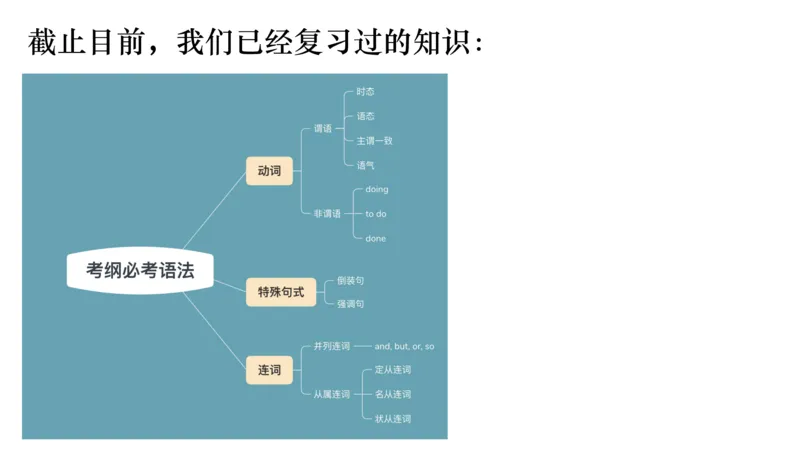
截止目前,我们已经复习过的知识:
1. 时态究竟在考什么?
2. 时态有多少个?
2. 时态有多少个?
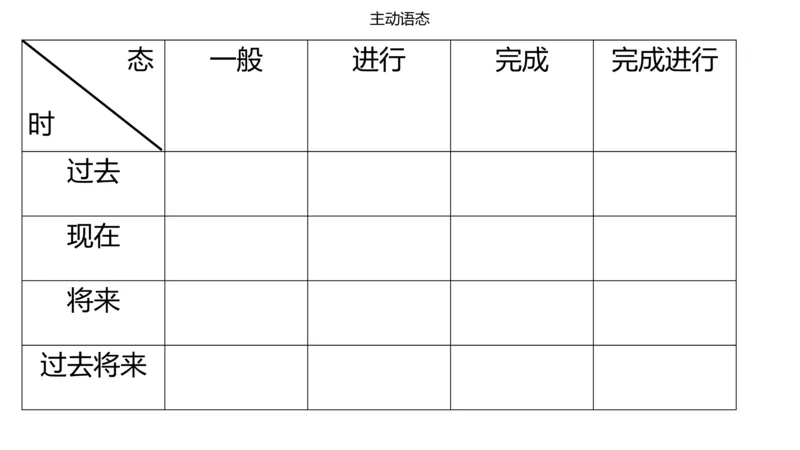
态
时
一般
进行
完成
完成进行
过去
现在
将来
过去将来
主动语态
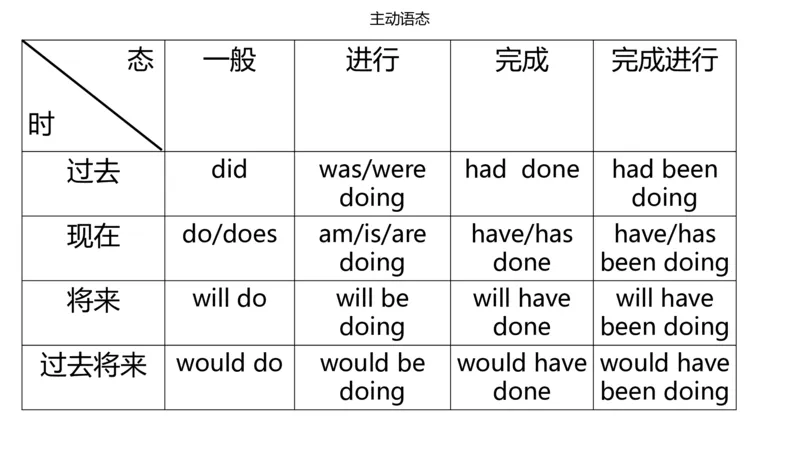
态
时
一般
进行
完成
完成进行
过去
did
was/were
doing
had done
had been
doing
现在
do/does
am/is/are
doing
have/has
done
have/has
been doing
将来
will do
will be
doing
will have
done
will have
been doing
过去将来
would do
would be
doing
would have
done
would have
been doing
主动语态
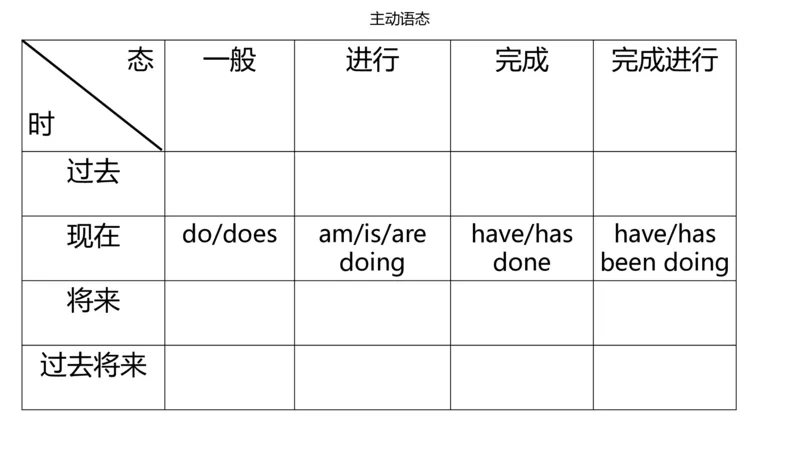
态
时
一般
进行
完成
完成进行
过去
现在
do/does
am/is/are
doing
have/has
done
have/has
been doing
将来
过去将来
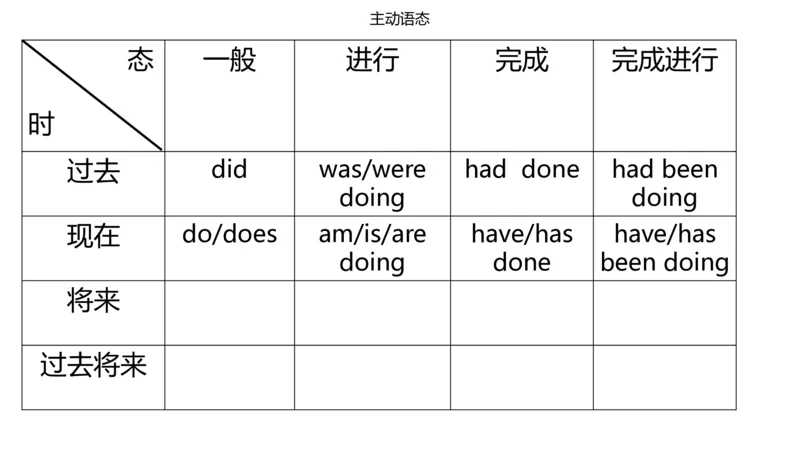
主动语态
态
时
一般
进行
完成
完成进行
过去
did
was/were
doing
had done
had been
doing
现在
do/does
am/is/are
doing
have/has
done
have/has
been doing
将来
过去将来
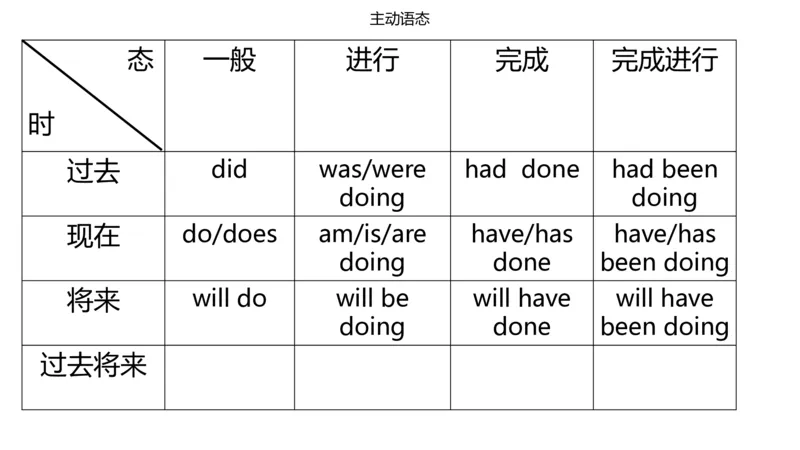
主动语态
态
时
一般
进行
完成
完成进行
过去
did
was/were
doing
had done
had been
doing
现在
do/does
am/is/are
doing
have/has
done
have/has
been doing
将来
will do
will be
doing
will have
done
will have
been doing
过去将来
主动语态
态
时
一般
进行
完成
完成进行
过去
did
was/were
doing
had done
had been
doing
现在
do/does
am/is/are
doing
have/has
done
have/has
been doing
将来
will do
will be
doing
will have
done
will have
been doing
过去将来
would do
would be
doing
would have
done
would have
been doing
主动语态
来,我们重复一遍
接下来我们看这些时态的被动形式怎么写?
态
时
一般
进行
完成
完成进行
过去
was/were
done
was/were
being done
had been
done
had been
being done
现在
am/is/are
done
am/is/are
being done
have/has
been done
have/has
been being
done
将来
will be done
will be being
done
will have
been done
will have
been being
done
过去将来
would be
done
would be
being done
would have
been done
would have
been being
done
被动语态
等等,又发生了什么?
来,我们重复一句话,
do 变be done
doing 变being done
done 变been done
态
时
一般
进行
完成
完成进行
过去
did
现在
do/does
将来
will do
过去将来
would do
主动语态
态
时
一般
进行
完成
完成进行
过去
was/were
done
现在
am/is/are
done
将来
will be done
过去将来
would be
done
被动语态
态
时
一般
进行
完成
完成进行
过去
did
was/were
doing
现在
do/does
am/is/are
doing
将来
will do
will be
doing
过去将来
would do
would be
doing
主动语态
态
时
一般
进行
完成
完成进行
过去
was/were
done
was/were
being done
现在
am/is/are
done
am/is/are
being done
将来
will be done
will be being
done
过去将来
would be
done
would be
being done
被动语态
态
时
一般
进行
完成
完成进行
过去
did
was/were
doing
had done
现在
do/does
am/is/are
doing
have/has
done
将来
will do
will be
doing
will have
done
过去将来
would do
would be
doing
would have
done
主动语态
态
时
一般
进行
完成
完成进行
过去
was/were
done
was/were
being done
had been
done
现在
am/is/are
done
am/is/are
being done
have/has
been done
将来
will be done
will be being
done
will have
been done
过去将来
would be
done
would be
being done
would have
been done
被动语态
态
时
一般
进行
完成
完成进行
过去
did
was/were
doing
had done
had been
doing
现在
do/does
am/is/are
doing
have/has
done
have/has
been doing
将来
will do
will be
doing
will have
done
will have
been doing
过去将来
would do
would be
doing
would have
done
would have
been doing
主动语态
态
时
一般
进行
完成
完成进行
过去
was/were
done
was/were
being done
had been
done
had been
being done
现在
am/is/are
done
am/is/are
being done
have/has
been done
have/has
been being
done
将来
will be done
will be being
done
will have
been done
will have
been being
done
过去将来
would be
done
would be
being done
would have
been done
would have
been being
done
被动语态
1.现在—— 一般现在时态
用法1 客观性(客观事实+客观真理)
经典例题
1. “Life is like walking in the snow”, Granny used to say,
“because every step _______________ (show).”
2. Fast food as well as BBQ, _______________ (be) full of fat and salt;
by eating more fast food people will get more salt and fat than they need in their diet.
3. Professor Williams keeps telling his students that the future__________
(belong) to the well-educated.
shows
is
belongs
用法1 客观性(客观事实+客观真理)
易错点主谓一致与动词过去分词
经典例题
4. People _______________ (have) better access to health care
than they used to, and they're living longer as a result.
5. According to the literary review, Shakespeare__________(make) his characters live
through their language in his plays.
have
makes
1.现在—— 一般现在时态
用法2 规律性(习惯+经常)
难点1. 对常见的一般现在时标志词的掌握;2. 对语态的判断
易错点主谓一致
备注常见的一般现在时的时间标志词:
always, usually, frequently, often, generally,
sometimes, occasionally, seldom, rarely, barely,
scarcely, never, every day/week/month/year等
1.现在—— 一般现在时态
经典例题
1. Most of us usually _______________ (take) an hours to drive to work
although the actual distance is only 20 miles.
2. This cycle _______________ (go) day after day: The walls warm up
during the day and cool off during the night and thus always a timely
offset (抵消) for the outside temperatures.
3. Leaving the less important things until tomorrow _______________ (be) often acceptable.
take
goes
is
1.现在—— 一般现在时态
经典例题
4. In the spoken English of some areas in the US, the “r” sounds
at the end of the words_______________(drop).
5. Every few years, the coal workers_______(have) their lungs X-rayed
to ensure their health.
have
are dropped
1.现在—— 一般现在时态
用法3 主将从现(时间+条件状从中)
难点1. 对时间+条件状语从句引导词掌握;2. 对语态的判断
易错点主谓一致
备注常见的条件状语从句引导词:
if, once, unless, in case
常见的时间状语从句引导词:
when, while, as, since,
1.现在—— 一般现在时态
经典例题
1. When the summer _______________ (come), they will invite me to pick the tomatoes.
2. Unless some extra money _______________ (find), the theatre will close.
3. If nothing _______________ (do), the oceans will turn into fish deserts.
4. My parents have promised to come to see me before I__________(leave)for Africa.
comes
is found
is done
leave
1.现在—— 一般现在时态
课堂检测
1. You’d better write down her phone number before you
(forget) it.
2. Whenever you______(buy)a present, you should think about it from the
receiver’s point of view.
forget
buy
1.现在—— 一般现在时态
拓展1 主情从现(时间+条件状从中)
1. If everyone _______________ (intend) to go out, you must finish your homework first.
2. You should be quiet when you _______________ (be) in the reading room.
3. Once you _______________ (decide) to do that, you must spare no effort to achieve
your goal.
intends
are
decide
1.现在—— 一般现在时态
拓展2 主祈从现(时间+条件状从中)
1. Please let me know if all of them _______________ (come) back.
2. Don’t laugh at me when I _______________ (make) a mistake.
3. Leave her alone when she _______________ (lose) her temper.
come
make
loses
1.现在—— 一般现在时态
用法4 "祈使"语气
1. It could be anything—gardening, cooking, music, sports—but whatever it is,
_______________ (make) sure it’s a relief from daily stress rather than another
thing to worry about.
make
1.现在—— 一般现在时态
用法5 ——难点
①A Midsummer Night’s Dream ____________ (open)at the Theatre
Royal on 19th June, and then tours throughout Scotland.
②Hurry up! The train ____________ (leave) at 10 o’clock. We don’t have much
time.
③It ________________(be) years since we met each other last time.
opens
leaves
1. 现在表将来
has been/is
2. 现在表完成
1.现在—— 一般现在时态
用法1 此刻正发生
易错点语态
经典例题
1. That piece of music sounds quite familiar. Who _______________(play) the
piano upstairs?
2. It is reported that many a new house________________(build) at present in
the disaster area.
3. The church tower which__________________(restore) will be open to
tourists soon. The work is almost finished.
is playing
is being built
is being restored
2. 现在—— 现在进行时态
用法2
最近发生,翻译为“最近在做,暂时”
易错点语态
经典例题
1.
The water supply has been cut off temporarily
because the workers _______________ (repair) one of the main pipes
2. They ____________(live) with their parents recently,
because their house ______________ (decorate)
are repairing
are living
is being decorated
2. 现在—— 现在进行时态
用法3 现在进行时表将来
难点瞬时动词的理解
常见位移动词:arrive, come, drive, leave, return, start, travel等.
经典例题
1.—Do you know when your mother _______________(come) to pick you up?
—At 11: 40 am.
2. Food supplies in the flood stricken area _______________ (run out).
We must act immediately before there none left.
is coming
are running out
2. 现在—— 现在进行时态
用法4——难点
经典例题
1.
My deskmate ________________(talk) in class all the time and it somewhat bothers me.
2. Don’t be fooled by him. He ______________ (be) honest to you for the moment.
is being
is talking
常见标志词:always, constantly, all the time
常见说法:is just being +形容词
2. 现在—— 现在进行时态
用法1 动作发生在过去,对现在有影响
难点和一般过去的区分
常见信号词:by now, up to now, so far, since, in/during/over the past/last
days/weeks/years 等.
经典例题
1. Despite the previous rounds of talks, no agreement_________________(reach) so far
by the two sides.
2. The reports went missing in 2012 and nobody________________(see)them since.
has been reached
has seen
3. 现在—— 现在完成时态
用法2:先行词被最高级和序数词修饰的定从中,必须用完成时
难点和一般过去的区分
常见信号词:the first, the second, the best, the worst, 等.
经典例题
1. This is the first time that I __________(be) to China.
2. It is the most instructive lecture that I__________________(attend) since I came to this school.
3. 现在—— 现在完成时态
用法—— 动作从过去持续发生到现在
难点和现在进行的区分
常见位移动词:since, for+时间段,in/during/over the past/last
days/weeks/months/years
经典例题
1. Joseph___________________(go) to evening classes since last month,
but he still can’t say “What’s your name?” in Russian.
has been going
4. 现在—— 现在完成进行时态
用法—— 动作从过去持续发生到现在
难点和现在进行的区分
常见位移动词:since, for+时间段,in/during/over the past/last
days/weeks/months/years
2.
Mother
wanted
to
be
a
good
provider,
a
role
she_____________________(shoulder) since her marriage to Father.
3. Over the past decades, sea ice____________________(decrease) in
the Arctic as a result of global warming.
has been shouldering
has been decreasing
4. 现在—— 现在完成进行时态
课堂检测
1.—Haven’t seen you for ages! Where have you been?
—I went to Ningxia and______________(stay)there for one year, teaching as a
volunteer.
2.—You speak very good French!
—Thanks. I________________
(study) French in Sichuan University for four years.
3. He_______________(play) football regularly for many years when he was young.
4. So far this year we_____________(see) a fall in house prices by between 5 and
10 percent.
stayed
studied
played
have seen
【课堂练习】
1. Would you please keep silent? The weather report
_________________(broadcast)  and I want to listen.
2. —Hi, Torry, can I use your computer for a while this
afternoon?
—Sorry. It
(repair).
3. In my hometown, there is always a harvest supper for the
farmers after all the wheat
(be) cut.
4. In the last few years, China
(make)
great achievements in environmental protection.
5. In the last few years thousands of films
______________(produce) all over the world.
6. This is the first time we
(see) a film in the
cinema together as a family.
7. I’m tired out. I
(shop) all afternoon and I
don’t seem to have finished anything.
8. Excuse me, Marcia, a reporter from Vanity Fair
(phone) all day. Could you speak to her now?
9. I’ll go to the library as soon as I finish what I_______(do).
10. —What’s that noise?
—Oh, I forgot to tell you. The new machine______(test).
11. I like these English songs and they_______(teach) many
times on the radio.
12. Progress_______(be) so far very good and we are sure
that the work will be finished on time.
13. Tom_______(work) in the library every night over the
last three months.
14. We_______(work) on this project for four hours. Let’s
have a rest.
15. —Why do you want to work for our company?
—This is the job that I_______(look) for.
16. I wasn’t sure if he was really interested or if
he__________(be) polite.
17. The manager____________ (tell) the workers
how to improve the program since 9 am.
18.“The moment____________(come) soon, ” he
thought to himself, waiting nervously.
19. Planning so far ahead____________(make) no
sense—so many things will have changed by next
year.
20. I_______(do) all the cooking for my family, but
recently I’ve been too busy to do it.
21. My parents_______(live) in Hong Kong. They
were born there and have never lived anywhere else.
22. —Why don’t we choose that road to save time?
—The bridge to it_______(repair).
23. Up to now, the program_______(save) thousands
of children who would otherwise have died.
24. His first novel_______(receive)good reviews
since it came out last month.
用法—— 过去的动作或状态
难点和现在完成的区分
常见标志词:ago, in the past,
经典例题
1. I wasn’t able to hide my eagerness when
I____________(ask), “What do you wish me to do now?”
2. The real reason why prices___________(be), and still are,
too high is complex, and no short discussion can satisfactorily
explain this problem.
3. When I first met Bryan I didn’t like him, but I
(change) my mind.
5. 过去—— 一般过去时态
4. In 1492, Columbus____________(land) on
one of the Bahama Islands, but he mistook it
for an island off India.
5. The book has been translated into thirty
languages since it__________(come) on the
market in 1973.
6. You’ve failed to do what you ___________
(expect) to and I’m afraid the teacher will
blame you.
7. I was out of town at the time, so I don’t know
exactly how it_______(happen).
8. Edward, you play so well. But I______________
(know) you played the piano.
9.The president hopes that the people will be better
off when he quits than when he____________(start).
10.—I’ve got to go now.
—Must you? I_________________(think) you could
stay for dinner with us.
用法1—— 过去某刻正在做
常见标志词:at that moment, then , A was doing sth when B did sth.
1. She________________(phone) someone, so I nodded to her
and went away.
2. —I saw Jane and her boyfriend in the park at eight yesterday
evening.
—Impossible. She________________(watch) TV with me in
my home then.
3. —Did you see a man in black pass by just now?
—No, sir. I________________(read) a newspaper.
6. 过去—— 过去进行时态
用法2—— 过去一段时间一直做
常见标志词:常见完整地过去时间段,如all day yesterday
1. —Have you finished reading Jane Eyre?
—No, I_____________(do) my homework all day
yesterday.
6. 过去—— 过去进行时态
用法3—— 一直,老是(表情绪)
常见标志词:always, all the time, constantly,
1. I called Hannah many times yesterday evening, but I
couldn’t get through. Her brother____________(talk) on
the phone all the time!
6. 过去—— 过去进行时态
用法4—— 瞬间动词表过去将来
常见瞬间动词:come, leave, open, close, die, take off,
1. —It was really very kind of you to give me a lift
home.
—Oh, don’t mention it. I____________(come) past
your house anyway.
2. I
(come) to visit you later that day, but I
had to phone and cancel.
6. 过去—— 过去进行时态
用法4—— 过去的过去,发生在更早的事情
常见标志词:did,before, earlier,
Hardly had I done sth when sth happened
No sooner had I done sth than sth happened.
1.
Just as I got to the school gate, I realized
I____________(leave) my book in the cafe.
2. During his stay in Xi’an, Jerry tried almost all the
local foods his friends _________(recommend).
7. 过去—— 过去完成时态
1.
Hardly ________ I got home when the telephone
began to ring.
2.
Scientists have found how the universe
______(come) into being.
7. 过去—— 过去完成时态
3. The twins, who_____________(finish)their
homework, were allowed to play badminton on the
playground.
4. Sofia looked around at all the faces:she had the
impression that she________________(see) most of the
guests before.
5. Writing out all the invitations by hand was more time-
consuming than we_____________(expect).
7. 过去—— 过去完成时态
6. I found the lecture hard to follow because
it____________________(start) when I arrived.
7. She was surprised to find the fridge empty; the
children_________________(eat) everything!
8. We arrived at work in the morning and found that
somebody________________(break) into the office
during the night.
7. 过去—— 过去完成时态
9. It took me a long time before I was able to fully
appreciate what they_____________(do) for me.
10. John was given the same suitcase his father and
grandfather____________(take) with to school.
11. (2019天津)I________(hope) to send Peter a gift
to congratulate him on his marrigage, but I couldn’t
manage it.
7. 过去—— 过去完成时态
12. (2018北京) A rescue worker risked his life saving
two tourists who ________(trap) in the mountains for
two days.
13. (2018江苏) I was sent to the village last month to
see how the development plan ____________(carry) out
in the past two years.
7. 过去—— 过去完成时态
用法—— 时间在过去,动作未发生
常见标志词:would do =was/were doing = was/were to do
1. At college, Barack Obama didn’t know that
he________________(become) the first black president
of the United States of America.
2. Albert Einstein was born in 1879.As a child, few
people guessed that he __________ (be) a famous
scientist whose theories would change the world.
3. James has just arrived, but I didn’t know
he______________(come) until yesterday.
8. 过去—— 过去将来时态
1. The play had already been on for quite some time
when we_______(arrive) at the New Theater.
2. The three of us_____ (travel) around Europe for
about a month last summer.
3.—That must have been a long trip.
—Yeah, it_______(take) us a whole week to get
there.
4. After school we went to the reading- room to do
some reading, only to be told that it ___________
(decorate).
5. Jim
(watch) a late night film at home
when, right in the middle of a thrilling scene, the
television went blank.
6. I ____________down to London when I suddenly
found that I was on the wrong road.
7.(2018北京) Susan had quit her well-paid job and
___________as a volunteer in the neighborhood
when I visited her last week.
用法1—— 未发生的动作或状态
常见标志词:tomorrow,next month 等将来时间
1. It is reported that a space station ______ (build) on
the moon in years to come.
2. More expressways ______ (build) in Sichuan soon to
promote the local economy.
3. If we don’t act now to protect the environment,
we_____(live) to regret it.
9. 将来—— 一般将来时态
用法2—— 习惯性动作
常见标志词:every day, every week等频率副词
1. Every weekend, my mother _______(take) me to the
park and enjoy the sunshine.
9. 将来—— 一般将来时态
用法1—— 未发生的动作或状态
常见标志词:this time tomorrow, then,
1. Jane can’t attend the meeting at 3 o’clock this
afternoon because she______(teach) a class at that time.
2. Daniel’s family_______(enjoy) their holiday in
Huangshan this time next week.
4.(2013江苏卷)—Could I use your car tomorrow
morning?
—Sure. I
(write) a report at home.
10. 将来—— 将来进行时态
用法1—— 等到……时候,就已经……
常见标志词:by +未来时间点
1. By the time Jack returned home from England, his
son_______(graduate) from college.
2. On her next birthday, Ann _______ (be) married for
twenty years.
3.(2018江苏)Hopefully in 2025 we will no longer
be e-mailing each other, for we ____________ more
convenient electronic communication tools by then.
11. 将来—— 将来完成时态
1. (2019江苏)They are trying to make sure
that 5G terminals ____________________
(install) by 2022 for the Beijing Winter
Olympics.
2. As you go through this book,
you______(find) that each of the millions of
people who lived through World War Ⅱ had a
different experience.
3. In the near future, more advances in the
robot technology_______(make) by scientists.
4. No decision_______(make) about any future
appointment until all the candidates have been
interviewed.
5. Close the door of fear behind you, and you
_____(see) the door of faith open before you.
6. We are confident that the environment
(improve)by our further efforts to reduce
pollution.
7. As you go through this book,
you______(find) that each of the millions of
people who lived through World War Ⅱ had a
different experience.