第1 页共16 页
2025 年上半年国家教师资格考试试题初中英语(回忆版)
一、单项选择题(本大题共30 小题,每小题2 分,共60 分)
在每小题列出的四个备选项中只有一个是符合题目要求的,请用2B 铅笔把答题
卡上对应题目的答案字母按要求涂黑。错选、多选或未选均无分。
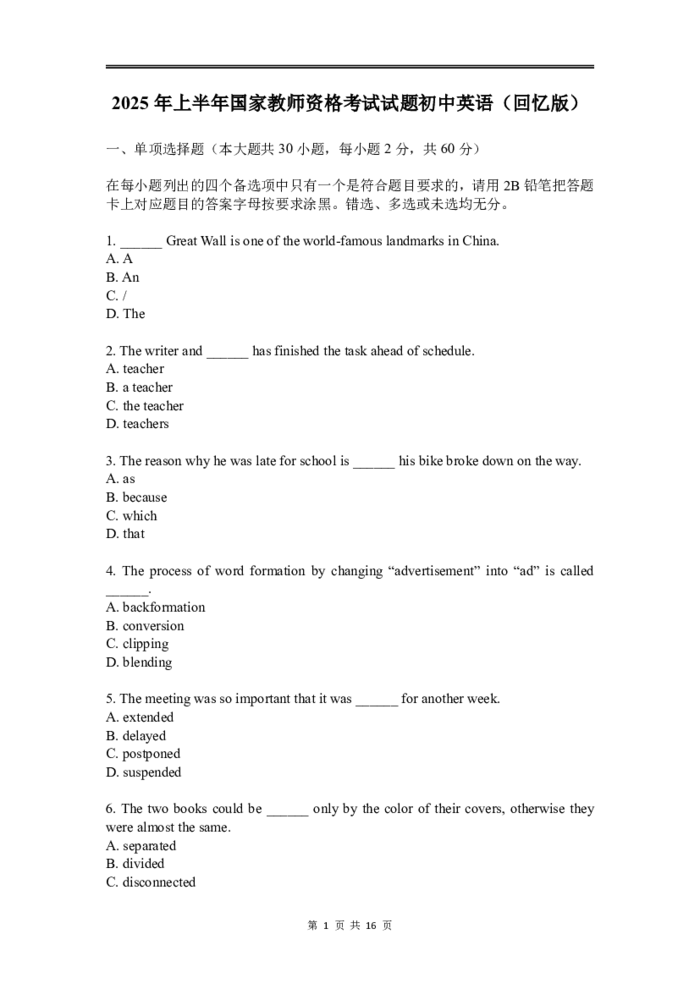
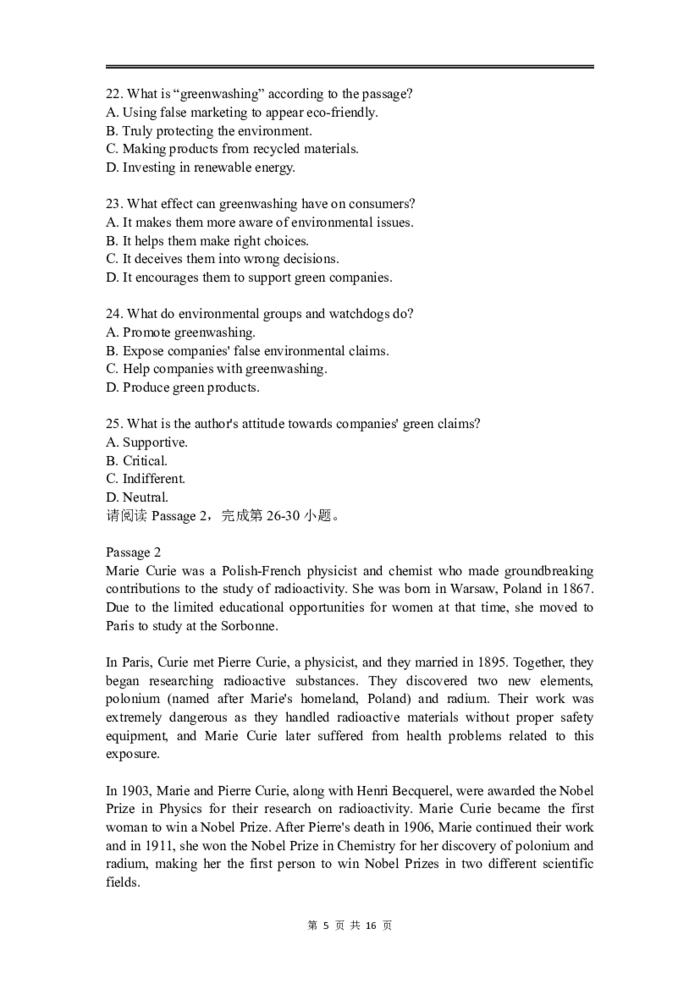
1. ______ Great Wall is one of the world-famous landmarks in China.
A. A
B. An
C. /
D. The
2. The writer and ______ has finished the task ahead of schedule.
A. teacher
B. a teacher
C. the teacher
D. teachers
3. The reason why he was late for school is ______ his bike broke down on the way.
A. as
B. because
C. which
D. that
4. The process of word formation by changing “advertisement” into “ad” is called
______.
A. backformation
B. conversion
C. clipping
D. blending
5. The meeting was so important that it was ______ for another week.
A. extended
B. delayed
C. postponed
D. suspended
6. The two books could be ______ only by the color of their covers, otherwise they
were almost the same.
A. separated
B. divided
C. disconnected
第2 页共16 页
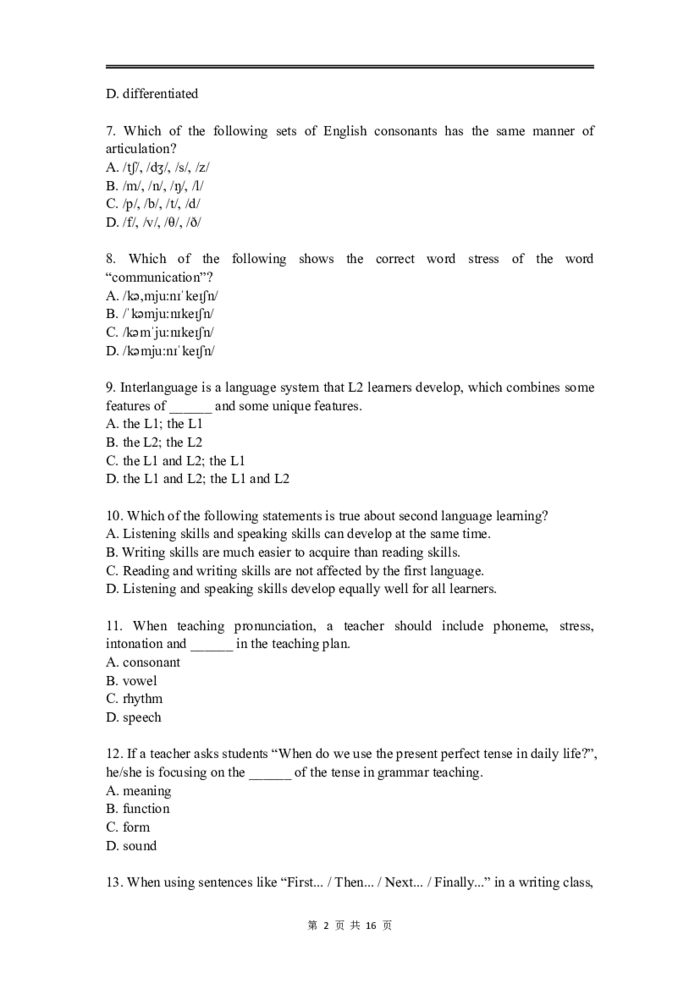
D. differentiated
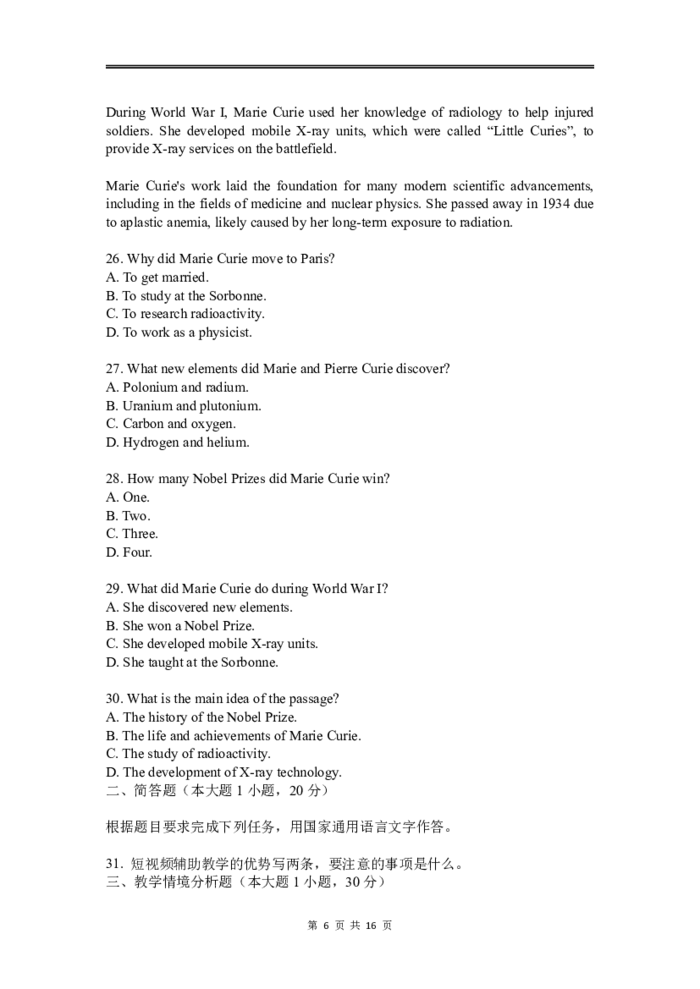
7. Which of the following sets of English consonants has the same manner of
articulation?
A. /tʃ/, /dʒ/, /s/, /z/
B. /m/, /n/, /ŋ/, /l/
C. /p/, /b/, /t/, /d/
D. /f/, /v/, /θ/, /ð/
8.
Which
of
the
following
shows
the
correct
word
stress
of
the
word
“communication”?
A. /kə,mju:nɪˈkeɪʃn/
B. /ˈkəmju:nɪkeɪʃn/
C. /kəmˈju:nɪkeɪʃn/
D. /kəmju:nɪˈkeɪʃn/
9. Interlanguage is a language system that L2 learners develop, which combines some
features of ______ and some unique features.
A. the L1; the L1
B. the L2; the L2
C. the L1 and L2; the L1
D. the L1 and L2; the L1 and L2
10. Which of the following statements is true about second language learning?
A. Listening skills and speaking skills can develop at the same time.
B. Writing skills are much easier to acquire than reading skills.
C. Reading and writing skills are not affected by the first language.
D. Listening and speaking skills develop equally well for all learners.
11. When teaching pronunciation, a teacher should include phoneme, stress,
intonation and ______ in the teaching plan.
A. consonant
B. vowel
C. rhythm
D. speech
12. If a teacher asks students “When do we use the present perfect tense in daily life?”,
he/she is focusing on the ______ of the tense in grammar teaching.
A. meaning
B. function
C. form
D. sound
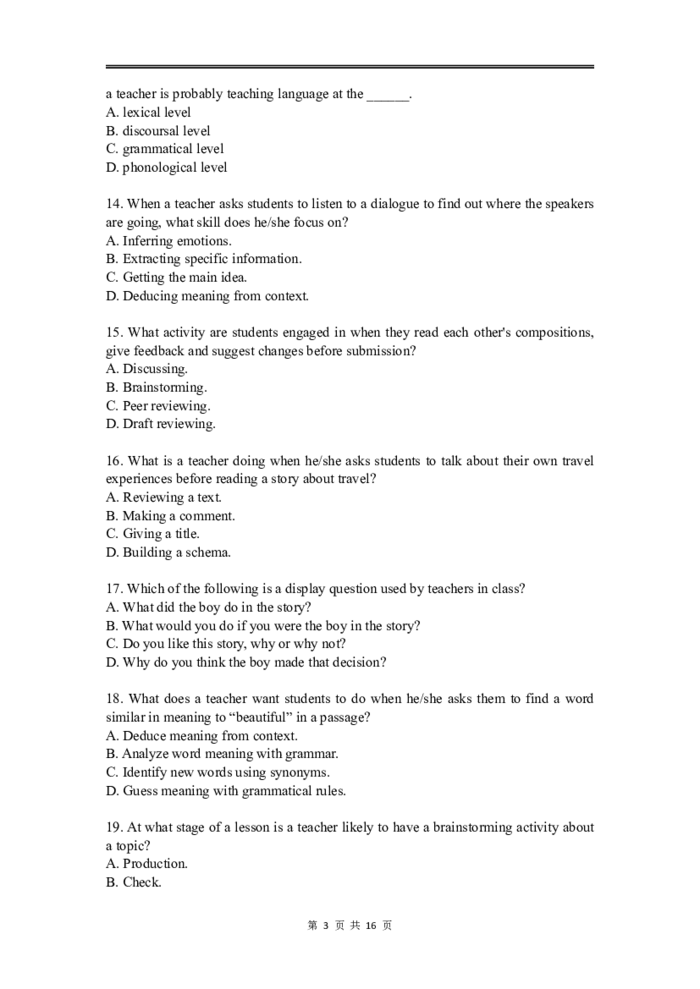
13. When using sentences like “First... / Then... / Next... / Finally...” in a writing class,
第3 页共16 页
a teacher is probably teaching language at the ______.
A. lexical level
B. discoursal level
C. grammatical level
D. phonological level
14. When a teacher asks students to listen to a dialogue to find out where the speakers
are going, what skill does he/she focus on?
A. Inferring emotions.
B. Extracting specific information.
C. Getting the main idea.
D. Deducing meaning from context.
15. What activity are students engaged in when they read each other's compositions,
give feedback and suggest changes before submission?
A. Discussing.
B. Brainstorming.
C. Peer reviewing.
D. Draft reviewing.
16. What is a teacher doing when he/she asks students to talk about their own travel
experiences before reading a story about travel?
A. Reviewing a text.
B. Making a comment.
C. Giving a title.
D. Building a schema.
17. Which of the following is a display question used by teachers in class?
A. What did the boy do in the story?
B. What would you do if you were the boy in the story?
C. Do you like this story, why or why not?
D. Why do you think the boy made that decision?
18. What does a teacher want students to do when he/she asks them to find a word
similar in meaning to “beautiful” in a passage?
A. Deduce meaning from context.
B. Analyze word meaning with grammar.
C. Identify new words using synonyms.
D. Guess meaning with grammatical rules.
19. At what stage of a lesson is a teacher likely to have a brainstorming activity about
a topic?
A. Production.
B. Check.
第4 页共16 页
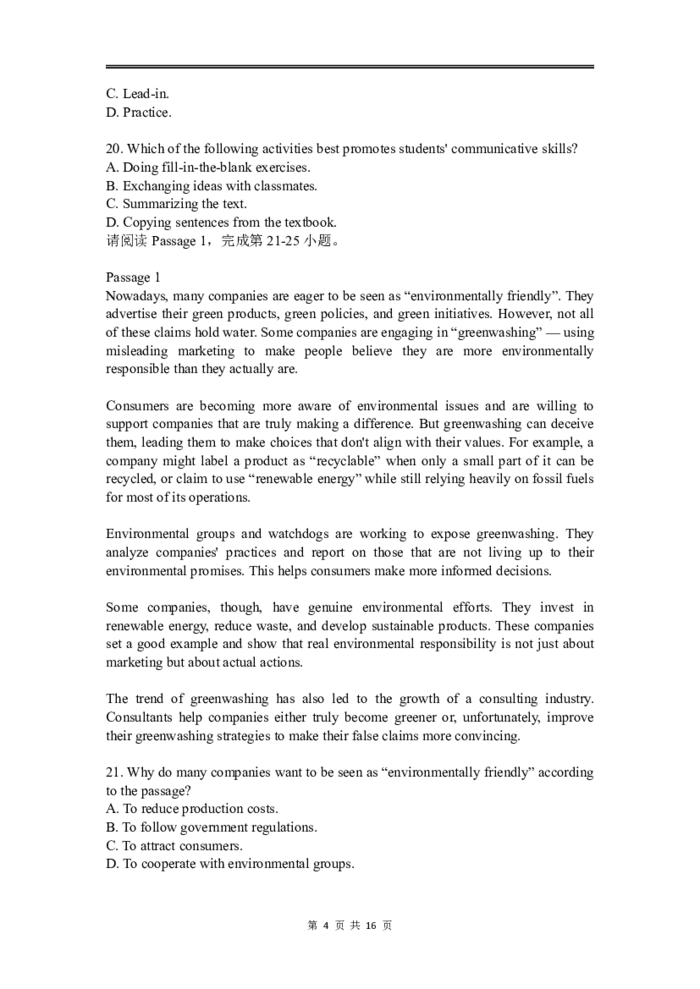
C. Lead-in.
D. Practice.
20. Which of the following activities best promotes students' communicative skills?
A. Doing fill-in-the-blank exercises.
B. Exchanging ideas with classmates.
C. Summarizing the text.
D. Copying sentences from the textbook.
请阅读Passage 1,完成第21-25 小题。
Passage 1
Nowadays, many companies are eager to be seen as “environmentally friendly”. They
advertise their green products, green policies, and green initiatives. However, not all
of these claims hold water. Some companies are engaging in “greenwashing” — using
misleading marketing to make people believe they are more environmentally
responsible than they actually are.
Consumers are becoming more aware of environmental issues and are willing to
support companies that are truly making a difference. But greenwashing can deceive
them, leading them to make choices that don't align with their values. For example, a
company might label a product as “recyclable” when only a small part of it can be
recycled, or claim to use “renewable energy” while still relying heavily on fossil fuels
for most of its operations.
Environmental groups and watchdogs are working to expose greenwashing. They
analyze companies' practices and report on those that are not living up to their
environmental promises. This helps consumers make more informed decisions.
Some companies, though, have genuine environmental efforts. They invest in
renewable energy, reduce waste, and develop sustainable products. These companies
set a good example and show that real environmental responsibility is not just about
marketing but about actual actions.
The trend of greenwashing has also led to the growth of a consulting industry.
Consultants help companies either truly become greener or, unfortunately, improve
their greenwashing strategies to make their false claims more convincing.
21. Why do many companies want to be seen as “environmentally friendly” according
to the passage?
A. To reduce production costs.
B. To follow government regulations.
C. To attract consumers.
D. To cooperate with environmental groups.
第5 页共16 页
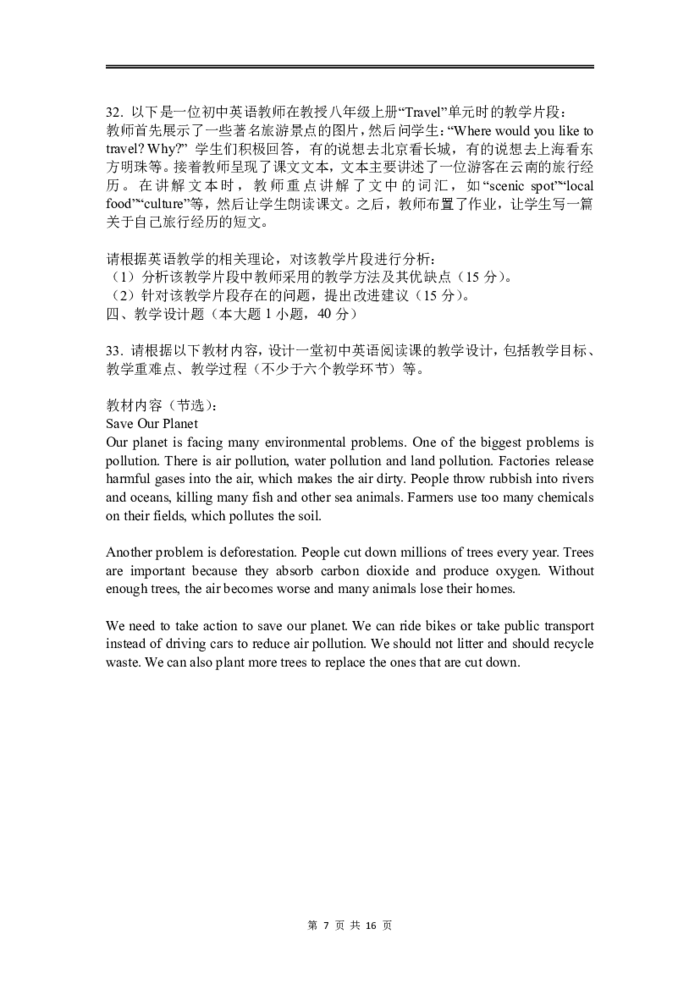
22. What is “greenwashing” according to the passage?
A. Using false marketing to appear eco-friendly.
B. Truly protecting the environment.
C. Making products from recycled materials.
D. Investing in renewable energy.
23. What effect can greenwashing have on consumers?
A. It makes them more aware of environmental issues.
B. It helps them make right choices.
C. It deceives them into wrong decisions.
D. It encourages them to support green companies.
24. What do environmental groups and watchdogs do?
A. Promote greenwashing.
B. Expose companies' false environmental claims.
C. Help companies with greenwashing.
D. Produce green products.
25. What is the author's attitude towards companies' green claims?
A. Supportive.
B. Critical.
C. Indifferent.
D. Neutral.
请阅读Passage 2,完成第26-30 小题。
Passage 2
Marie Curie was a Polish-French physicist and chemist who made groundbreaking
contributions to the study of radioactivity. She was born in Warsaw, Poland in 1867.
Due to the limited educational opportunities for women at that time, she moved to
Paris to study at the Sorbonne.
In Paris, Curie met Pierre Curie, a physicist, and they married in 1895. Together, they
began researching radioactive substances. They discovered two new elements,
polonium (named after Marie's homeland, Poland) and radium. Their work was
extremely dangerous as they handled radioactive materials without proper safety
equipment, and Marie Curie later suffered from health problems related to this
exposure.
In 1903, Marie and Pierre Curie, along with Henri Becquerel, were awarded the Nobel
Prize in Physics for their research on radioactivity. Marie Curie became the first
woman to win a Nobel Prize. After Pierre's death in 1906, Marie continued their work
and in 1911, she won the Nobel Prize in Chemistry for her discovery of polonium and
radium, making her the first person to win Nobel Prizes in two different scientific
fields.
第6 页共16 页
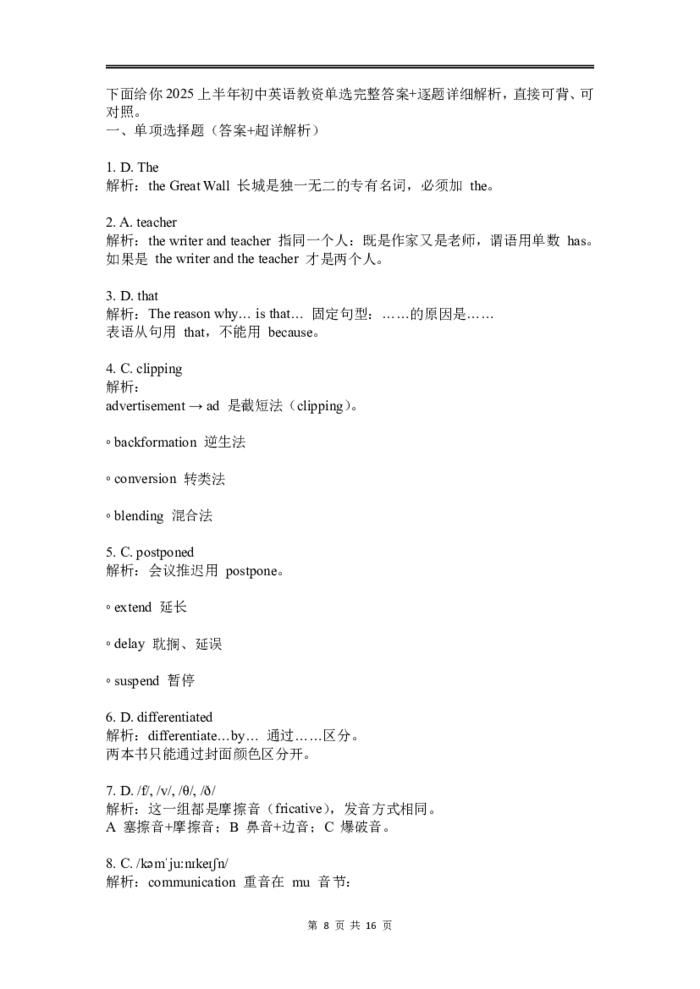
During World War I, Marie Curie used her knowledge of radiology to help injured
soldiers. She developed mobile X-ray units, which were called “Little Curies”, to
provide X-ray services on the battlefield.
Marie Curie's work laid the foundation for many modern scientific advancements,
including in the fields of medicine and nuclear physics. She passed away in 1934 due
to aplastic anemia, likely caused by her long-term exposure to radiation.
26. Why did Marie Curie move to Paris?
A. To get married.
B. To study at the Sorbonne.
C. To research radioactivity.
D. To work as a physicist.
27. What new elements did Marie and Pierre Curie discover?
A. Polonium and radium.
B. Uranium and plutonium.
C. Carbon and oxygen.
D. Hydrogen and helium.
28. How many Nobel Prizes did Marie Curie win?
A. One.
B. Two.
C. Three.
D. Four.
29. What did Marie Curie do during World War I?
A. She discovered new elements.
B. She won a Nobel Prize.
C. She developed mobile X-ray units.
D. She taught at the Sorbonne.
30. What is the main idea of the passage?
A. The history of the Nobel Prize.
B. The life and achievements of Marie Curie.
C. The study of radioactivity.
D. The development of X-ray technology.
二、简答题(本大题1 小题,20 分)
根据题目要求完成下列任务,用国家通用语言文字作答。
31. 短视频辅助教学的优势写两条,要注意的事项是什么。
三、教学情境分析题(本大题1 小题,30 分)
第7 页共16 页
32. 以下是一位初中英语教师在教授八年级上册“Travel”单元时的教学片段:
教师首先展示了一些著名旅游景点的图片,然后问学生:“Where would you like to
travel? Why?” 学生们积极回答,有的说想去北京看长城,有的说想去上海看东
方明珠等。接着教师呈现了课文文本,文本主要讲述了一位游客在云南的旅行经
历。在讲解文本时,教师重点讲解了文中的词汇,如“scenic spot”“local
food”“culture”等,然后让学生朗读课文。之后,教师布置了作业,让学生写一篇
关于自己旅行经历的短文。
请根据英语教学的相关理论,对该教学片段进行分析:
(1)分析该教学片段中教师采用的教学方法及其优缺点(15 分)。
(2)针对该教学片段存在的问题,提出改进建议(15 分)。
四、教学设计题(本大题1 小题,40 分)
33. 请根据以下教材内容,设计一堂初中英语阅读课的教学设计,包括教学目标、
教学重难点、教学过程(不少于六个教学环节)等。
教材内容(节选):
Save Our Planet
Our planet is facing many environmental problems. One of the biggest problems is
pollution. There is air pollution, water pollution and land pollution. Factories release
harmful gases into the air, which makes the air dirty. People throw rubbish into rivers
and oceans, killing many fish and other sea animals. Farmers use too many chemicals
on their fields, which pollutes the soil.
Another problem is deforestation. People cut down millions of trees every year. Trees
are important because they absorb carbon dioxide and produce oxygen. Without
enough trees, the air becomes worse and many animals lose their homes.
We need to take action to save our planet. We can ride bikes or take public transport
instead of driving cars to reduce air pollution. We should not litter and should recycle
waste. We can also plant more trees to replace the ones that are cut down.
第8 页共16 页
下面给你2025 上半年初中英语教资单选完整答案+逐题详细解析,直接可背、可
对照。
一、单项选择题(答案+超详解析)
1. D. The
解析:the Great Wall 长城是独一无二的专有名词,必须加the。
2. A. teacher
解析:the writer and teacher 指同一个人:既是作家又是老师,谓语用单数has。
如果是the writer and the teacher 才是两个人。
3. D. that
解析:The reason why… is that… 固定句型:……的原因是……
表语从句用that,不能用because。
4. C. clipping
解析:
advertisement →ad 是截短法(clipping)。
◦backformation 逆生法
◦conversion 转类法
◦blending 混合法
5. C. postponed
解析:会议推迟用postpone。
◦extend 延长
◦delay 耽搁、延误
◦suspend 暂停
6. D. differentiated
解析:differentiate…by… 通过……区分。
两本书只能通过封面颜色区分开。
7. D. /f/, /v/, /θ/, /ð/
解析:这一组都是摩擦音(fricative),发音方式相同。
A 塞擦音+摩擦音;B 鼻音+边音;C 爆破音。
8. C. /kəmˈju:nɪkeɪʃn/
解析:communication 重音在mu 音节:
第9 页共16 页
com-mu-ni-ca-tion。
9. B. the L2; the L2
解析:中介语(interlanguage)是二语学习者构建的介于母语和目的语之间、并
不断向L2 靠近的系统。
它结合L1 和L2 的特征,并具有自身独特性,最终向L2 靠拢。
10. A. Listening skills and speaking skills can develop at the same time.
解析:听说技能可以同步发展,这是正确表述。
B 写作比阅读简单错;C 读写不受母语影响错;D 所有人听说发展一样错。
11. C. rhythm
解析:语音教学包括:音素、重音、语调、节奏(rhythm)。
12. B. function
解析:问“现在完成时什么时候用”,关注的是用法/功能(function)。
meaning 意义;form 形式。
13. B. discoursal level
解析:first/then/next/finally 是语篇衔接手段,属于语篇层面。
14. B. Extracting specific information.
解析:听对话找地点,属于获取具体信息。
15. C. Peer reviewing
解析:同学之间互改作文、提建议= 同伴互评(peer review)。
16. D. Building a schema.
解析:读前谈论旅行经历,是激活背景知识,构建图式(schema)。
17. A. What did the boy do in the story?
解析:展示性问题(display question)答案唯一、在文中。
B/C/D 都是参考性问题(referential)。
18. C. Identify new words using synonyms.
解析:找和beautiful 意思相近的词= 用同义词识别词义。
19. C. Lead-in
解析:头脑风暴一般用于导入环节(lead-in)。
20. B. Exchanging ideas with classmates.
解析:交流想法最能锻炼交际能力。
阅读理解Passage 1 答案(greenwashing)
第10 页共16 页
21. C. To attract consumers.
22. A. Using false marketing to appear eco-friendly.
23. C. It deceives them into wrong decisions.
24. B. Expose companies' false environmental claims.
25. D. Neutral
解析:作者既讲虚假环保,也讲真正环保,态度中立客观。
阅读理解Passage 2 答案(Marie Curie)
26. B. To study at the Sorbonne.
27. A. Polonium and radium.
28. B. Two.
29. C. She developed mobile X-ray units.
30. B. The life and achievements of Marie Curie.
二、简答题31 参考答案(满分版)
短视频辅助英语教学的优势:
1. 直观形象,能激发学生学习兴趣,吸引注意力。
2. 提供真实语境与地道语音,帮助学生理解语言运用。
注意事项:
1. 视频内容要紧扣教学目标,不喧宾夺主。
2. 控制时长,避免占用过多课堂时间;观看后要有任务与互动,防止只看热闹。
三、教学情境分析题32 要点(直接可写)
(1)教学方法& 优缺点
方法:
• 情境教学法
• 图片导入法
第11 页共16 页
• 词汇讲解法
• 朗读法
• 任务型写作
优点:
• 导入贴近生活,激发兴趣。
• 重视词汇基础,符合初中阶段特点。
• 由输入到输出,环节较完整。
缺点:
• 以教师讲解为主,学生互动、合作少。
• 只讲词汇,忽视语篇结构与思维训练。
• 朗读形式单一,缺乏理解性任务。
• 写作前缺少支架、范例和操练。
(2)改进建议
1. 增加小组讨论、信息差活动,提高学生参与度。
2. 设计语篇任务:找主旨、细节、旅行结构,不只讲词。
3. 给写作提供句型支架、模板、范文。
4. 加入同伴互评,提升写作效果。
5. 读后设置输出活动,如介绍旅行计划,强化运用。
我给你32 题考场标准满分答案,直接背、直接写卷子上,条理清晰、踩点全。
32. 教学情境分析题(30 分)
(1)教学方法及优缺点(15 分)
①采用的教学方法
• 情境导入法:用景点图片导入,贴近学生生活。
第12 页共16 页
• 直观演示法:借助图片呈现教学内容。
• 讲授法:教师讲解重点词汇。
• 朗读法:组织学生朗读课文。
• 任务型教学法:布置写作任务,实现语言输出。
②优点
1. 导入贴近生活,能激发学生学习兴趣与参与度。
2. 重视词汇教学,夯实语言基础,符合初中生认知特点。
3. 教学流程较完整:导入→呈现→讲解→操练→输出。
4. 关注读写结合,有利于巩固知识。
③缺点
1. 以教师为中心,学生被动接受,互动与合作学习不足。
2. 只侧重词汇讲解,忽视语篇结构、逻辑与深层理解。
3. 朗读活动单一,缺乏针对性阅读任务。
4. 写作前缺少思路引导、句型支架、范文示范,输出难度大。
5. 缺乏评价与反馈环节,难以检验学习效果。
(2)改进建议(15 分)
1. 增加互动活动
设计小组讨论、同伴交流,如“分享旅行计划”,提高学生主体性。
2. 强化语篇教学
增加略读、寻读任务,如找主旨、细节、文章结构,不只讲单词。
3. 丰富朗读形式
采用自由读、分组读、配乐读、角色扮演读,提升朗读效果。
4. 搭建写作支架
提供写作模板、常用句型、范文,降低写作难度。
第13 页共16 页
5. 完善评价环节
加入同伴互评、教师点评,及时反馈,巩固学习成果。
6. 拓展输出活动
增加口头输出,如介绍自己的旅行经历,实现“由读到说再到写”的递进。
我直接给你第33 题完整、可直接写在考卷上的标准答案版教学设计,结构规范、
踩分点全,考场直接默写就行。
四、教学设计题(40 分)
一、教学基本信息
• 课型:阅读课
• 话题:Save Our Planet
• 时长:45 分钟
二、教学目标
1. 知识目标
• 学生能够掌握有关环保的词汇:pollution, air/water/land pollution, deforestation,
recycle, carbon dioxide 等。
• 学生能够理解并运用重点句型:
◦One of the biggest problems is…
◦We should/ can… to save our planet.
2. 能力目标
• 学生能通过略读、寻读获取文章主旨大意和细节信息。
• 学生能运用所学内容口头或书面简单介绍环境问题并提出建议。
3. 情感态度与价值观
• 增强环保意识,树立保护地球的责任感。
• 愿意在生活中采取实际行动保护环境。
三、教学重难点
• 重点:理解文章内容;掌握环保相关词汇和表达。
第14 页共16 页
• 难点:运用所学语言谈论环境问题并提出合理建议。
四、教学过程(不少于6 环节,满分结构)
1. Lead‑in 导入(3 分钟)
• 教师展示环境污染与美好自然的对比图片,提问:
◦What problems is our planet facing?
◦What can we do to help?
• 引出话题:Save Our Planet,激发兴趣,激活背景知识。
2. Pre‑reading 读前(7 分钟)
• 学习新词汇:pollution, deforestation, recycle, absorb 等。
• 预测文章内容:
◦Look at the title and pictures. What do you think the passage is about?
• 为阅读扫清障碍。
3. While‑reading 1: Skimming 略读(5 分钟)
• 任务:快速阅读,找出文章主旨。
• 问题:
◦What is the main idea of the passage?
• 核对答案:The passage tells us environmental problems and ways to save our
planet.
4. While‑reading 2: Scanning 寻读(10 分钟)
• 任务1:细读第一段,找出三种污染。
◦air pollution, water pollution, land pollution
• 任务2:细读第二段,找出deforestation 的危害。
• 任务3:细读第三段,找出3 条建议。
第15 页共16 页
• 以信息定位为主,训练阅读技巧。
5. Post‑reading 读后活动(12 分钟)
(1)小组讨论
• What else can we do to protect the environment?
(2)语言输出
• 让学生用句型介绍:
◦Our planet has… problems. We should…
(3)巩固练习
• 补全句子/填空,巩固重点词汇与结构。
6. Summary 总结(3 分钟)
• 师生共同总结:
◦环境问题:pollution, deforestation
◦解决措施:recycle, plant trees, take public transport…
• 强调环保重要性。
7. Homework 作业(2 分钟)
1. 熟读课文,背诵重点短语。
2. 写作:Write a short passage: How to Protect Our Planet(不少于5 句话)。
五、板书设计(简版,考场可写)
Save Our Planet
Problems:
1. pollution: air, water, land
2. deforestation
第16 页共16 页
Ways:
1. ride bikes / take public transport
2. don’t litter, recycle
3. plant more trees