定价:9.15元
批准文号:渝发改价格〔2024〕778号 举报电话:12315
物 流 码
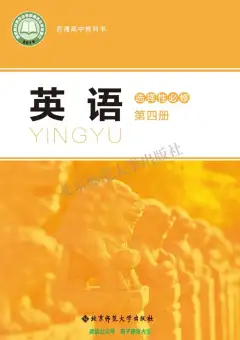
普通高中教科书
英 语
(选择性必修第四册)
主编 杨晓钰
责任编辑:陈 亮 版式设计:陈 亮
责任校对:关德强 责任印制:赵 晟
*
重庆大学出版社出版发行
出版人:饶帮华
社址:重庆市沙坪坝区大学城西路21号
邮编:401331
电话:(023)88617190 88617185(中小学)
传真:(023)88617186 88617166
网址:http://www.cqup.com.cn
邮箱:fxk@cqup.com.cn(营销中心)
全国新华书店经销
重庆俊蒲印务有限公司印刷
*
开本:890mm×1240mm 1/16 印张:8.25 字数:356千
2021年12月第1版 2022年12月第2次印刷
ISBN 978-7-5689-2509-9 定价:9.15元
本书如有印刷、装订等质量问题,本社负责调换
版权所有,请勿擅自翻印和用本书
制作各类出版物及配套用书,违者必究
副主编 黄学军 黄 宇
编 者 郑加明 邹凌云 成 林
3
To the student
To the student
亲爱的同学,欢迎你随本书一起继续高中阶段的英语学习。我们希望充
满求知欲的你,能喜欢书中所提供的学习材料,喜欢各种鼓励探究和发展思
维、注重学习能力和学习习惯培养的教学设计。
高中英语学习是初中英语学习的延伸,同时也是新的英语学习生活的开
始。在这一阶段,提高基本语言运用能力极其重要,但提高用英语获取信
息、处理信息、分析和解决问题的能力,用英语进行思考和表达的能力,以
及跨文化交际的意识和基本的跨文化交际能力也必不可少;而掌握有效的英
语学习策略,提高自主学习能力,会帮助你更有效地学习,形成具有个性的
学习方法和风格,为将来进一步学习英语和终身发展打下良好基础。
关于本教材的使用,我们有以下建议:
1. 请仔细阅读每个主题前的 Guiding Page,它会帮助你熟悉该部分的主要
学习内容,激发你思考与之相关的问题,为本主题的学习做好必要的准备。
2. 只有充分了解了学习目标,你才能在学习中处于主动地位,发挥主体
作用,才能使自己的“学”与教师的“教”形成协调发展的合力,从而取得
最佳的学习效果。因此,各单元的学习从研读 Looking Ahead 开始,并在每
个单元学习后根据 Self-assessing 帮助自己反思学习效果,调整自己的学习目
标、学习方式和学习进程。
3. Activating and Predicting 旨在最大限度地激活你与所学内容相关的背景
知识,激发你学习的兴趣和动机,为进入下一步学习做好准备。在本板块的
学习中一定要勤于思考,积极参与,勇于表达。
4.“学而不思则罔,思而不学则殆”,没有思考、缺乏创造性的学习收
获甚少。建议你在进行 Reading,Thinking and Analysing 部分课文的学习
时,不要忽略了 Margin Notes 和 TIP,一定要边学边思,学思结合,掌握
策略,举一反三,这样你才能真正提高阅读能力,逐渐成长为高效的英语
阅读者。
5. Exploring and Using 将为你轻松化解阅读课文中的语言知识,引导你通
过观察和分析,了解语法形式,理解语法意义,发现语法规则。这将帮助你
1
2
在真实语境中运用所学语言知识来理解和表达意义,加强准确、得体地使用语言的意
识,深化对语言的理解。
6. 在进行了大量的听说和阅读后,你一定记住了许多优美的词句、漂亮的段落,
一定发现了英语文章与汉语文章在风格和组织结构上的异同,也一定跃跃欲试地想用
英语表达自己的所感所想。这的确是一件值得高兴的事!那么,请一定经常读一读、
听一听、说一说、记一记一些好的句子和美文,并认真完成每课的写作任务,这样,
你的英语写作就会不断进步,逐步达到“行文如流水,落笔如有神”的境界。
7. 在必修教材的 Recycling Time 和 Word Builder 板块,你已经学习了归纳所学
内容、在语境下猜测词义等策略,在4-7册的选择性必修教材学习阶段,请主动应
用和积极调试所学策略,不断提高自主学习能力。Learning Individually 部分鼓励你
主动做好阅读课的预习,在 Question Corner 中提出自学中存在的疑惑,在 Learning
Cooperatively 部分,与同学和老师一起互动、探究、应用,并且在 Learning Reflectively
板块应用1-3册的多维评价方式,提高反思的意识和能力。
8. 附录中的 Word Learning Booster 会引导你在学习新词汇的同时,注重对已学词
汇的定期复习,逐步养成良好的词汇学习习惯,记忆词汇也将不再是一件难事。
“学而时习之,不亦说乎?”古人告诉我们,学习要采取积极的态度,既要时
时、处处、事事地“学”,又要时时、处处、事事地“习”;于“学”中积累、丰
富、提高,于“习”中求巩固、受启发、得效益;争取日有所新,日有所获。这样你
的内心就能充满掌握英语学习真谛的愉悦。
我们衷心希望通过本教材的学习,能进一步激发你学习英语的热情和用英语交流
的欲望,最终能用英语了解、学习他国优秀文化,同时向世界介绍祖国灿烂的文化。
作为学习者,获取知识是一种乐趣,不断克服困难、不断创新也是一种乐趣。记
住永远对自己说:“I can do it!”。
愿你快乐地度过英语学习的每一阶段,享受克服困难的快乐,享受创新的快乐,
享受成功的快乐!
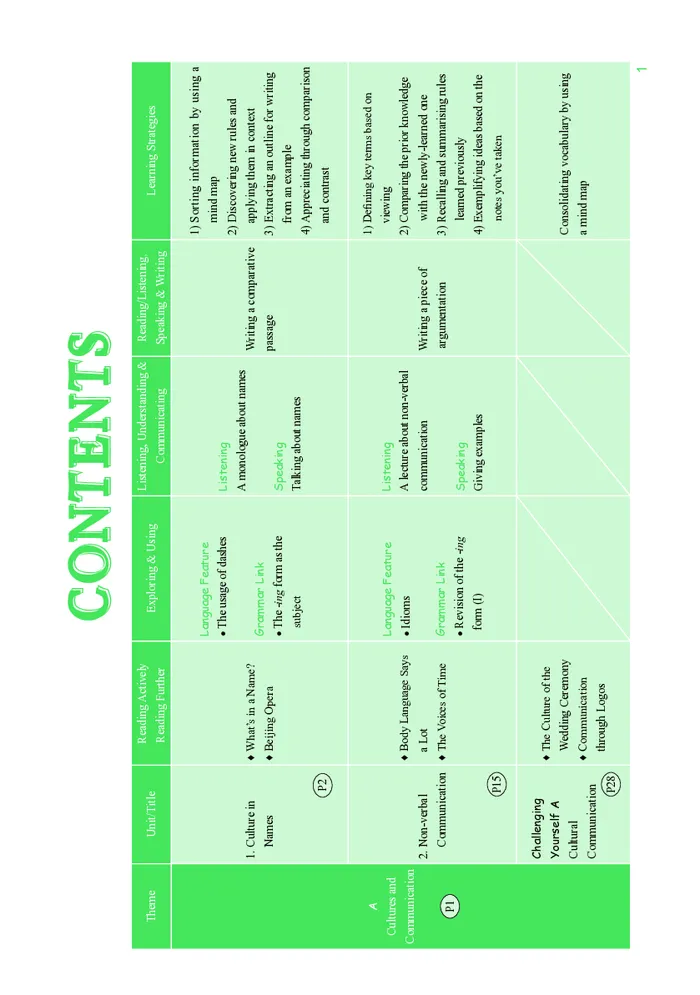
Theme
Unit/Title
Reading Actively
Reading Further
Exploring & Using
Listening, Understanding &
Communicating
Reading/Listening,
Speaking & Writing
Learning Strategies
A
Cultures and
Communication
1. Culture in
Names
♦ What’s in a Name?
♦ Beijing Opera
Language Feature
● The usage of dashes
Grammar Link
● �The -ing form as the
subject
Listening
A monologue about names
Speaking
Talking about names
Writing a comparative
passage
1) �Sorting information by using a
mind map
2) Discovering new rules and
applying them in context
3) Extracting an outline for writing
from an example
4) Appreciating through comparison
and contrast
2. Non-verbal
Communication
♦ Body Language Says
a Lot
♦ The Voices of Time
Language Feature
● Idioms
Grammar Link
● Revision of the -ing
form (I)
Listening
A lecture about non-verbal
communication
Speaking
Giving examples
Writing a piece of
argumentation
1) Defining key terms based on
viewing
2) Comparing the prior knowledge
with the newly-learned one
3) Recalling and summarising rules
learned previously
4) Exemplifying ideas based on the
notes you’ve taken
Challenging
Yourself A
Cultural
Communication
♦ The Culture of the
Wedding Ceremony
♦ Communication
through Logos
Consolidating vocabulary by using
a mind map
CONTENTS
P28
P15
P1
P2
1
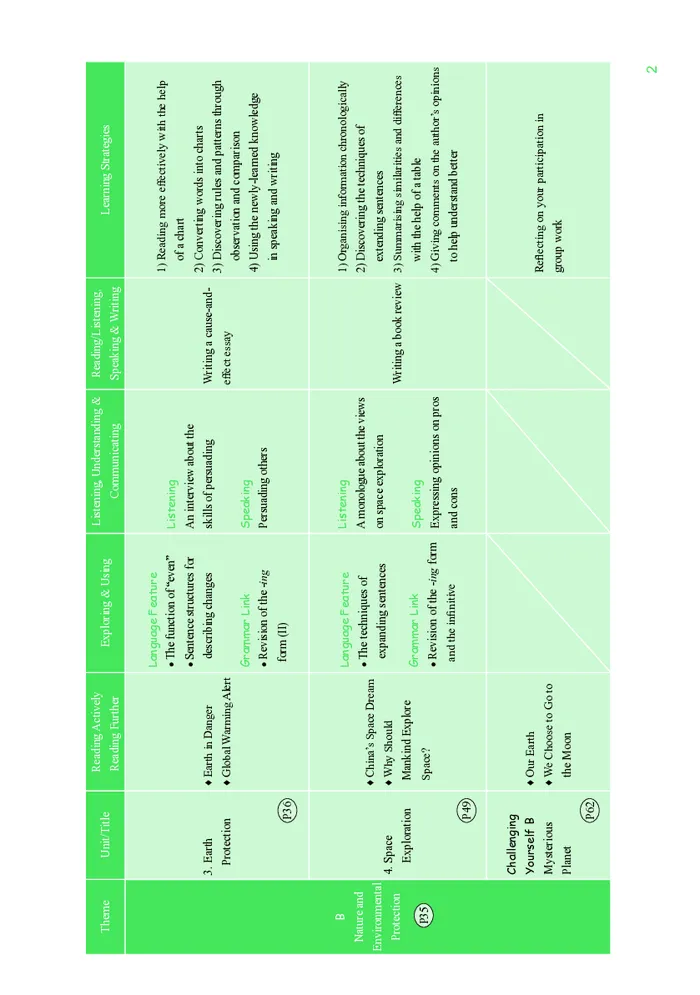
Theme
Unit/Title
Reading Actively
Reading Further
Exploring & Using
Listening, Understanding &
Communicating
Reading/Listening,
Speaking & Writing
Learning Strategies
B
Nature and
Environmental
Protection
3. Earth
Protection
♦ �Earth in Danger
♦ Global Warming Alert
Language Feature
● The function of “even”
● Sentence structures for
describing changes
Grammar Link
● Revision of the -ing
form (II)
Listening
An interview about the
skills of persuading
Speaking
Persuading others
Writing a cause-and-
effect essay
1) Reading more effectively with the help
of a chart
2) Converting words into charts
3) Discovering rules and patterns through
observation and comparison
4) Using the newly-learned knowledge
in speaking and writing
4. �Space
Exploration
♦ �China’s Space Dream
♦ �Why Should
Mankind Explore
Space?
Language Feature
�● The techniques of
expanding sentences
Grammar Link
● Revision of the -ing form
and the infinitive
Listening
A monologue about the views
on space exploration
Speaking
Expressing opinions on pros
and cons
Writing a book review
1) Organising information chronologically
2) Discovering the techniques of
extending sentences
3) Summarising similarities and differences
with the help of a table
4) Giving comments on the author’s opinions
to help understand better
Challenging
Yourself B
Mysterious
Planet
♦ Our Earth
♦ We Choose to Go to
the Moon
Reflecting on your participation in
group work
P36
P49
P62
2
P35
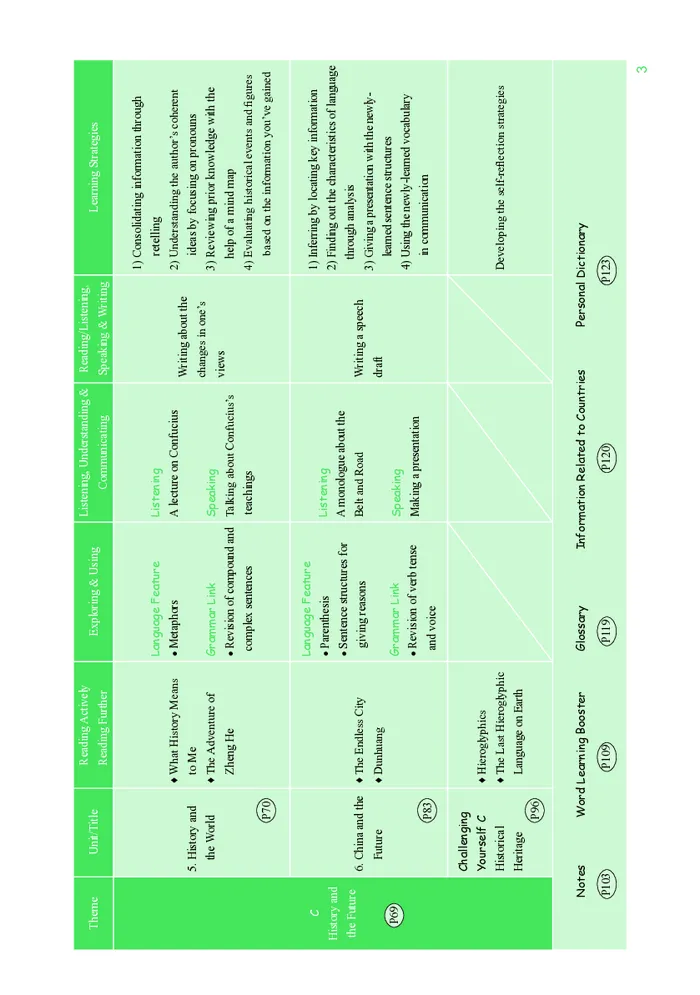
Theme
Unit/Title
Reading Actively
Reading Further
Exploring & Using
Listening, Understanding &
Communicating
Reading/Listening,
Speaking & Writing
Learning Strategies
C
History and
the Future
5. History and
the World
♦ What History Means
to Me
♦ The Adventure of
Zheng He
Language Feature
● Metaphors
Grammar Link
● Revision of compound and
complex sentences
Listening
A lecture on Confucius
Speaking
Talking about Confucius’s
teachings
Writing about the
changes in one’s
views
1) Consolidating information through
retelling
2) Understanding the author’s coherent
ideas by focusing on pronouns
3) Reviewing prior knowledge with the
help of a mind map
4) Evaluating historical events and figures
based on the information you’ve gained
6. China and the
Future
♦ The Endless City
♦ Dunhuang
Language Feature
● �Parenthesis
● Sentence structures for
giving reasons
Grammar Link
● Revision of verb tense
and voice
Listening
A monologue about the
Belt and Road
Speaking
Making a presentation
Writing a speech
draft
1) Inferring by locating key information
2) Finding out the characteristics of language
through analysis
3) Giving a presentation with the newly-
learned sentence structures
4) Using the newly-learned vocabulary
in communication
Challenging
Yourself C
Historical
Heritage
♦ Hieroglyphics
♦ The Last Hieroglyphic
Language on Earth
Developing the self-reflection strategies
Notes Word Learning Booster Glossary Information Related to Countries Personal Dictionary
P70
P83
P96
P103
P109
P119
P120
P123
3
P69
1
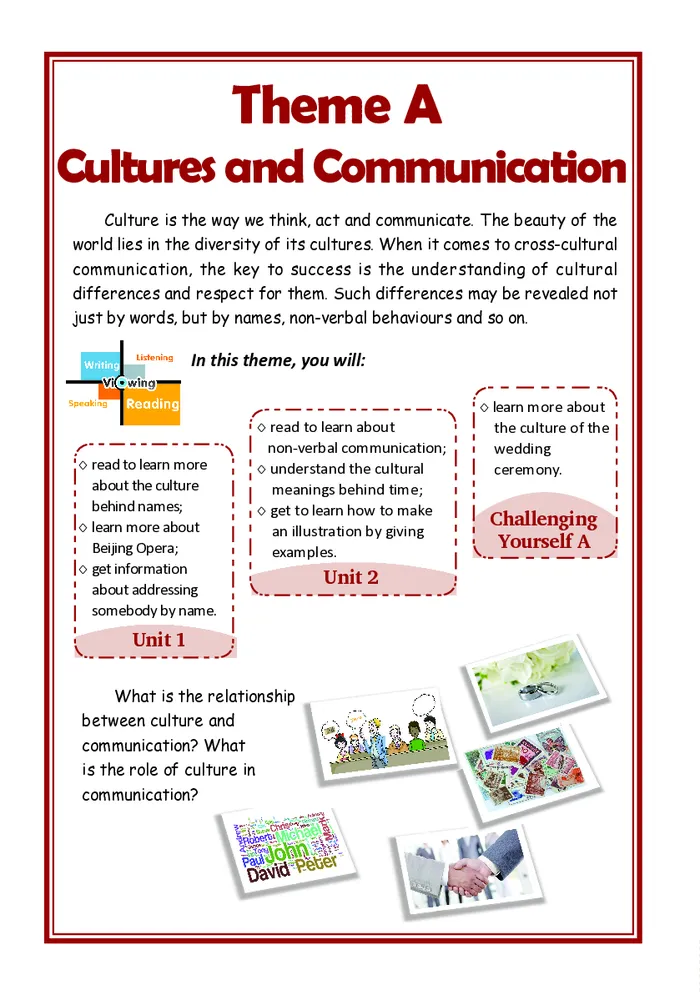
Theme A
Cultures and Communication
Culture is the way we think, act and communicate. The beauty of the
world lies in the diversity of its cultures. When it comes to cross-cultural
communication, the key to success is the understanding of cultural
differences and respect for them. Such differences may be revealed not
just by words, but by names, non-verbal behaviours and so on.
What is the relationship
between culture and
communication? What
is the role of culture in
communication?
Unit 1
◊ read to learn more
about the culture
behind names;
◊ learn more about
Beijing Opera;
◊ get information
about addressing
somebody by name.
Unit 1
◊ read to learn about
non-verbal communication;
◊ understand the cultural
meanings behind time;
◊ get to learn how to make
an illustration by giving
examples.
Unit 2
Unit 2
Challenging
Yourself A
◊ learn more about
the culture of the
wedding
ceremony.
Challenging
Yourself A
In this theme, you will:
Theme A Cultures and Communication
Looking Ahead
By the end of this unit, you will be able to:
introduce the origins of English names;
identify the functions of dash and use it correctly;
write about a picture by using the -ing form as the subject;
interpret the meanings behind names;
write a passage by making comparisons;
introduce Beijing Opera to foreign visitors.
Unit 1
Culture in Names
A name represents identity, a deep feeling and holds tremendous
signifi cance to its owner.
—Rachel Ingber
Reading Actively
► Activating and Predicting
Fill in the blanks and tell your partner the meaning behind your Chinese name.
Study the following English surnames and work in groups to classify them by following
the examples. Then read to check.
I was given the Chinese name by my . It
means because .
A. William Hunter
B. Neil Armstrong
C. Peter Surgeon
D. James Lake
E. Sam Wilson
F. Henry Longfellow
G. Earvin Johnson
H. Jim Green
I. Thomas Field
J. James White
Occupation: A, C
Physical characteristics:
Father’s fi rst name:
Colour:
Location:
2
Unit 1 Culture in Names
3
► Reading, Thinking and Analysing
What’s in a Name?
Names are the quickest and easiest—as well as friendliest—way to
say who’s who and they do not change as people do. Yesterday Mary’s
hair was long. Today her hair is short. But her name is still Mary. On his
birthday Uncle George did not have a beard. At Christmas time he did.
But his name is still George. People are always changing, a little or a lot.
But people’s names stay the same.
Another good thing about a name is that it sometimes says something
nice about the one whose name it is. Girls’ names often come from words
meaning “pretty”, “happy”, “lovely”, ... “Lily” comes from the name of a
fl ower. The name means that she is pretty and sweet like a lily. “Catherine”
comes from a word meaning “truthful”. It says that she is an honest lady
and loved by all. “Dorothy” comes from a word meaning “gift”. You know
how happy you are when a gift comes your way! Boys’ names are often
borrowed from words meaning “strong”, “brave”, “lucky”, ... “Richard”
comes from a word meaning “brave”. “Victor” comes from a word
meaning “winner”. “Charles” comes from a word meaning “man of the
common people”—a man who works on the land.
However, there are so many people named Richard or Lily. Without
a last name to go with your first name, how could people tell which
Richard or which Lily you are? A very long time ago, that was the way
it was everywhere. People had only one name. As there got to be more
and more people in the world, it became harder and harder to tell them
apart. So people began making up last names for themselves—now called
family names or surnames.
Sometimes in choosing a last name, a man would think about the
kind of work he did. If he was a cook he might say, “I am Tom, the cook.”
Or just plain Tom Cook. If he was a cook for a king, he might become
known as Tom Kingcook. A man who was a carpenter, a tailor, a miller, a
baker, a farmer, or a weaver might choose to call himself by one of these
names. One of the most common names in the English language is Smith,
which is short for Blacksmith. There used to be a blacksmith in every
village. Instead of iron, some smiths worked with gold or silver, which
led to such names as Tom Goldsmith or Tom Silversmith. Sometimes the
names became shortened to Tom Gold or Tom Silver.
Sometimes a man got his last name from his father’s fi rst name. Tom
was the son of John. So he began calling himself Tom Johnson. A man
last name
= family name
= surname
fi rst name
= ____________
= ____________
Plain means ______
here.
A. simple
B. frank and direct
moustache
whiskers
beard
Theme A Cultures and Communication
4
who was the son of Jack might have called himself Jackson.
Often a man got his last name from the place where he lived. James
lived on a hill. So people began to call him James Hill. Another James lived
by a lake. He became James Lake.
A man was sometimes called by a nickname. If a person had an unusual
physical characteristic, it became part of his name. So, a man who was
unusually tall might be called Long Tom or Tom Long or Tom Longfellow.
A short man might become Little John, and his son was probably called
Tom Littlejohn. William who was always thirsty might be called William
Drinkwater.
Sometimes colours became last names. A man with red hair might be called
Tom Red. But sometimes down through the years, the name was changed. So
Tom Read or Tom Reade is still probably a descendant of Tom Red. A man who
lived near the village Green might have called himself Tom Green.
If Tom had strong arms, what name might he have? What if he had big feet?
► Comprehending, Integrating and Creating
Complete the following mind map and share your ideas with a partner.
Based on Activity 1, complete the passage below.
The Chinese used surnames about 2,500 years ago. Most Western countries did not
start to use them until about 1,000 years ago. At fi rst, people had only one name, their
. Later, as there were more and more people, they began to use .
There were mainly types of surnames. Some surnames came from .
For example, possibly, the ancestor of Tom Goldsmith was a person who owned or
worked in a/an that sold . Other surnames may come from
or the where a person lived. It was also possible that unusual
became part of a person’s name. Finally, may sometimes become last names.
Guess the meaning
of nickname in the
context.
Name
The functions of
The of
English surnames
The
way to tell
who’s who
Expressing
wishes
Occupation
●
●
●
●
●
●
●
●
● Tom Cook
● Tom Smith
Unit 1 Culture in Names
5
In English, a word can have more than one meaning. Its meaning in
a sentence is determined by the context.
TIP
The sentence structures may help you:
His/Her ancestor may have been a…, or might have lived near…
It is also possible that his/her ancestor had…
In the name…, it is possible that the surname…
It might/may/must also…
Besides, it possibly suggests…
Work in groups to discuss where the following English surnames come from and what we
can learn about their ancestors.
Based on Activities 1-3, work in pairs to discuss the differences between Chinese names
and English names.
Choose one of the following activities and do it in groups.
1) Surf the Internet for information about ancient and modern Chinese names. Make a
table to show the similarities and differences between them.
2) Surf the Internet to review the trends relating to the fi rst names the Chinese have given
to their babies over time. Report to the class.
3) Consult your parents or other family members to draw a family tree to trace the history
of your family. Share it in groups.
Exploring and Using
► Language Feature
Read the following groups of sentences, paying close attention to the coloured words.
Then match them with the given choices.
Hi, Tom! Have you
noticed the differences
between Chinese names
and English names?
Oh, yes. There are
lots of differences since
names convey the language
of a nation, as well as its
history, culture, religion,
social status and so on.
That’s right. Can you
give some examples?
Sure. Firstly, Chinese people put their
family names first while in English
we put the given names fi rst.
Thomas
Field
Jim
Green
June
Apple
Henry
Longfellow
Catherine
Johnson
Theme A Cultures and Communication
6
1) Can you stay for dinner, or must you go?
The temperature has stayed high this week.
My wife’s mother is staying with us this week.
A. stop and remain rather than leave B. live in a place for a while C. continue to be
2) She looks prettier with long hair than with short hair.
I’m pretty sure that he will say “yes”.
He made a pretty fortune by selling all his land.
A. (of money) quite large B. pleasing/nice to look at C. quite
3) What is the name of the town where you live?
He has a good name in the business. You can trust him.
Can you name all the plants in the garden?
A. tell the name B. fame; reputation C. the word(s) sb./sth. is called/known by
4) A straight line is the shortest distance between two points.
I’m short of money this week. Can you lend me some?
We paid him a short visit of only an hour.
A. lacking sth. B. a smaller length C. taking a small amount of time
Study the following sentences from the text, paying attention to the use of the dashes. Match
them with their corresponding functions and then write your own sentences with dashes.
A. as a parenthesis
B. as an explanation
C. as a complement
1) Names are the quickest and easiest—as well as friendliest—way to say who’s
who and they do not change as people do.
2) “Charles” comes from a word meaning “man of the common people”—a man
who works on the land.
3) So people began making up last names for themselves—now called family
names or surnames.
► Grammar Link
The -ing Form as the Subject
Understanding the meaning
Read the following passage and pay special attention to the coloured parts. Try to fi nd
out the functions of the -ing form.
● (as a parenthesis)
● (as an explanation)
● (as a complement)
Unit 1 Culture in Names
7
When you meet a foreign friend on the road, calling him/her by his/her name is what we
usually do. Do you know the meaning of his/her name, however? If she is a girl by the name
of Lily, it means being pretty and sweet like a lily. If he is a boy named Richard, being brave
in the future may be the wish of his parents. There are so many people, however, named Lily
and Richard. In order to avoid causing misunderstanding, people also have their last names.
In choosing a last name, one may think about the kind of work he/she does. If his/her job is
cooking, he/she will be called Richard Cook. Don’t you think it is an interesting way to call
somebody?
Discovering the rule
Study the following examples and fi nd out how the -ing form is used. Then share your
ideas with a partner.
Work in groups to complete the table below.
Applying the rule
Complete the following sentences by using the appropriate forms of the given words. A
word may be used more than once.
Example
Form
Meaning
1) Drinking too much alcohol is bad for your
health.
2) Talking mends no holes.
+ linking
verb/verb (singular
form)
showing an
act which is
performed
habitually or
usually
1) It is a waste of time discussing such a matter.
2) It is no use/no good/useless crying over
spilt milk.
3) It is a hard/diffi cult job learning a foreign
language well.
4) It isn’t worthwhile quarrelling with him over
such a trivial thing.
+ a waste of
time/
+
learn
believe
go
eat
see
gain
read
keep
wait
get
as a noun
1) If she is a girl by the name of Lily, it means being pretty and sweet like a lily.
object
as a noun
2) If he is a boy named Richard, being brave in the future may be the wish of his parents.
subject
·Example·
Theme A Cultures and Communication
8
1) aloud is very important in a foreign language.
2) too much fat and sugar is bad for healthy.
3) to bed early and up early is considered to be a good habit.
4) Don’t believe him. is .
5) It’s no good here. I suggest home.
6) Bob has given up junk food since he was told that junk food
is the cause of him weight.
Complete the following passage by using the appropriate forms of the given lexical
chunks. Then work together to analyse their functions.
How Did “Uncle Sam” Come into Being?
Uncle Sam is regarded as the symbol of the U.S.A. Do you know
why? During the Second War of Independence, to the
West was the aim of the newly-born U.S. It was diffi cult ,
however. At that time, there was a patriotic businessman called
Samuel Wilson. He was locally respected for and called
Uncle Sam. In the 1812 war, his responsibility was .
On each barrel he would mark U.S., shortened for his pet name Uncle
Sam. Later, in 1861, Harper’s Weekly carried a cartoon of Uncle
Sam: a thin, tall old man, with silver hair, in a swallowtail and striped
trousers, and a cap with stars. This cartoon endeared the American
people. In addition, Uncle Sam was in line with the American spirit. All
these combined made the Americans consider Uncle Sam as the symbol of the U.S.A. In
1916, the United States Congress offi cially a bill.
Based on the given picture, complete the passage. Use the -ing form as much as possible.
A. do so
B. supply canned beef for the American army
C. expand its territory
D. put the nickname Uncle Sam in
E. be honest and open-minded
F. place the interests of the nation above all
Collecting stamps was once a favourite hobby for many
people.
However, with the wide use of the Internet, people seldom write letters.
Unit 1 Culture in Names
9
Listening, Understanding and Communicating
Talking about Names
Tick the items you may cover when talking about the topic of people’s names and add your
own ideas. Then listen to a monologue to check your ideas.
Listen again and note down the key words to answer the following questions.
1) When American parents choose names for their children, what do they usually think about?
2) What kind of name or kinds of names may parents try to avoid?
3) Does popularity have anything to do with names?
4) Are nicknames often used by Americans?
5) How are people called differently in informal settings or formal situations?
Listen for a third time and fi ll in the missing information.
People in America don’t always call their friends or relatives by their
names. Instead, they often use . Sometimes a nickname is a short form of a
longer name. , a girl named Elizabeth may be called Lisa, Beth or Betsy. As
a child , he may for himself which nickname he wishes to be
called. If he considers his nickname , he may start using a more
form. Sometimes, people just go by the initials of the fi rst and names, like
B. J. or R. C. And of course, people may call their children or their sweethearts other
nicknames. Often they have a “sweet” , like Honey or Sugar.
Work in pairs to have a dialogue about different ways to ask about somebody’s name. You
may use the sentence structures listed in the box.
How to ask about names informally
How to ask about names formally
Are you…?
Are you called…?
Do your friends call you…?
What do your parents call you?
Is your name…?
What’s your name, please?
Could/Would you give me your name, please?
May I have/know your name?
Sorry to disturb you, but what’s your name?
Your name, please?
Sometimes you can use hesitation fi llers like “well”, “um”, “you see”,
“you know”, etc. to get time for thinking during a conversation.
TIP
A the meanings of names
B the forms of names
C customs for referring to friends or relatives
D different settings
E considerations when choosing names
F other ideas:
Theme A Cultures and Communication
10
Reading, Speaking and Writing
Writing a Comparative Passage
Read the following passage and answer the questions below.
Chinese Names and English Names
Personal names refer to the symbols indicating each particular member in society. It
is an interesting topic to compare Chinese names and English names.
Names, whether in China or in English-speaking countries, are carriers and mirrors
of cultures, refl ecting the changes of history and culture. In both cultures we may fi nd
sources of names from positions, occupations and good expectations, such as “Tian (田)”
and “Land”, “Sima (司马)” and “Mayor”, “Fugui (富贵)” and “Property”, etc.
However, names in China and English-speaking countries are different in many
aspects. In Chinese names, the culture of Confucian-worship can be found. For this
reason, people like to name their kids with “Ren (仁)” “Yi (义)” “Xiao (孝)”, etc., such
as “Shouren (守仁)” “Xinyi (信义)” “Anxiao (安孝)”, etc. In contrast, the influence of
religion can hardly be ignored in English names. As a large number of English-speaking
people believe in Christianity, their names may be taken from the Bible such as John,
Matthew, etc. In addition, the concept of family and unity is represented in Chinese
names, such as “Jiahe (家和)” and “Tuanjie (团结)”. On the other hand, individualism is
one of the features of English names.
It is therefore important for us to learn about the cultural differences of names in
China and English-speaking countries. We can respect different customs and bridge the
gap in cross-cultural communication.
Read the passage again and complete the diagram below. Then check your answers with
a partner.
1) What is the main idea of the passage?
2) What is the writer’s most probable purpose?
3) Is this piece of writing argumentative or expository?
4) How does the writer develop the passage? Does he make a comparison?
Making a
comparison
Conclusion:
Introduction: It is to compare Chinese names and
English names.
Similarities:
Body:
Differences: 1)
2)
Unit 1 Culture in Names
11
Read the passage for a third time and underline the expressions and sentence structures
for making a comparison.
Based on the same title of the passage in Activity 1, write a passage of your own by
making a comparison. Then read your passage to your group members and ask for advice
in order to polish it.
Reading Further
► Getting Ready
Look at the following pictures and match the roles in Beijing Opera with their explanations.
1) Sheng can be subdivided into laosheng (an old man), xiaosheng (a young man)
and wusheng (a martial arts expert).
2) Dan includes qingyi (a quiet and gentle lady), huadan (a lively woman), wudan
(a woman with martial arts skills), daomadan (a woman skilled in fi ghting with
weapons or on a horse) and laodan (an old woman).
3) Jing (painted face roles) is always played by men with brightly coloured faces.
4) Chou (clown roles) is marked by a dab of white on the ridge of the nose featuring
both positive and negative characters.
Read the following statements about Beijing Opera and judge whether they are true (T) or
false (F). Then read the passage to check.
1) Beijing Opera originated in Beijing.
2) There are only two categories of Beijing Opera: “civil” pieces and “martial”
pieces.
3) Red facial make-up shows that the character is upright and loyal.
4) The singing and acting style of each role varies from performer to performer.
5) Exaggeration and symbolism are typical characteristics of Beijing Opera.
► Reading
Beijing Opera
Beijing Opera, China’s national opera, originated in the late 18th century and is a mixture of
music, dance, art and acrobatics. It is the most infl uential and representative of all operas in China.
Based upon traditional Anhui Opera, it has adopted its repertoire, music and performing
A
B
C
D
Theme A Cultures and Communication
12
techniques from Kun Opera (a local opera from Jiangsu
Province) and Qinqiang Opera (from Shaanxi Province) as
well as traditional folk tunes in its development, eventually
forming its own highly stylised music and performing
techniques.
Beijing Opera can be divided into “civil” pieces,
which are characterised by singing, and “martial” ones,
which feature acrobatics and stunts. Some operas are
combinations of both.
Its repertoire includes historical plays, comedies, tragedies and farces. Many historical
events are adapted for Beijing Opera plays, which in the past were an important primer on
history and ethical principles for poorly-educated people.
There are four roles in general: the male, the female, the “painted face”, and the clown,
which are further classified by age and profession. Sheng (male roles) can be divided into
three categories: the old, the young and the martial arts expert. Dan (female roles) includes
qingyi (a quiet and gentle lady), huadan (a lively woman), wudan (a woman with martial arts
skills), daomadan (a woman skilled in fi ghting with weapons or on a horse) and laodan (an old
woman). Jing (painted face roles) is always played by men with brightly coloured faces. Chou
(clown roles) is marked by a dab of white on the ridge of the nose. This character is sometimes
positive, kind-hearted and humourous, but sometimes negative, cunning or silly. Each role has
its fi xed singing and acting styles.
Like the acting and singing, the make-up is stylised, inspired by the masks worn by
dancers in Tang, Song and Yuan Dynasty operas. The make-up highlights and exaggerates the
principal features of the characters.
For the painted face role, the colour of their made-up faces can be an indication of their
characters or personalities. Red indicates uprightness and loyalty, white craftiness and cunning.
Blue indicates a vigorous, courageous and enterprising nature while yellow means an intelligent
character, but a less extroverted one. Black shows a sound and honest character while green is
often the symbol of a brave and irritable one.
The costumes are based on those of the Ming Dynasty, no matter when the story is set.
The props can include a cloth wall, tents, whips, paddles and weapons. The props are realistic,
but not so elaborate that they detract from the performance. Exaggeration and symbolism are
characteristics of the opera. Holding a whip is enough to indicate that an actor is galloping on
a horse. A few soldiers on the stage may represent a whole army. An actor’s circling the stage
suggests a long journey.
Often there is just a table and a few chairs on the stage. The description of many situations
depends on the performance of the actors and actresses. Opening a door, walking at night,
rowing a boat, eating, drinking and the like are all demonstrated by the stylised movements of
the actors and actresses. Performers also use their eyes and facial expressions to help convey
the specifi c meaning.
In the past 200 years, numerous schools and celebrated performers have emerged. As a
result of the hard work of hundreds of artists over the past two centuries, Beijing Opera has
become a refi ned art form and now represents an important part of Chinese culture.
TIP
Learn the terms related to
Beijing Opera by consulting
your dictionary. The more you
use your dictionary, the more
you will learn.
Unit 1 Culture in Names
13
► Comprehending
Read the passage and complete the following chart with the information you have gained.
Beijing Opera
Origin
Beijing Opera originated in and is a mixture
of .
Based on Opera, it has adopted its repertoire,
and from Opera
and Opera as well as traditional folk tunes.
Role
There are four roles in Beijing Opera: , ,
, and . Each role has its
styles.
Make-up
The make-up is inspired by worn by dancers in ,
, and Dynasty operas.
The colour of the made-up face indicates the or
of the role.
Costumes
& Props
The costumes are based on .
The props are , but not so that they
detract from the performance.
Performance
The depends on the performance
of the actors and actresses. Performers use their and
to help convey meanings.
Read Paragraph 7 again and fi nd the corresponding character for each facial make-up
below. Then draw yourself a facial make-up based on your personality and describe it to a
partner.
Your Facial Make-up
Theme A Cultures and Communication
14
Suppose that some visitors from Canada are visiting the Beijing Opera Club in your school.
Introduce Beijing Opera to them with the help of the following words and expressions.
Your introduction may begin like this:
Welcome to our school, our honoured guests! I am very happy to introduce Beijing
Opera, our national opera, to you. Beijing Opera has become a refi ned art form and now
represents an important part of Chinese culture...
Select one opera from each column to watch and try to find out the similarities and
differences between them. Then share your fi ndings in groups.
Self-assessing
Refl ect on your learning in this unit and rate each of the items according to the following
rating scales. Then decide what you should do for further progress.
5=Exceeding expectations 4=Meeting expectations 3=Approaching expectations
2=Partially meeting expectations 1=Not meeting expectations
Item
Rating
Improvement
● I can introduce the origins of English names.
● I can identify the functions of dash and use it correctly.
● I can use the -ing form as the subject to write about a picture.
● I can interpret the meanings behind names.
● I can write a passage of comparison between Chinese and
English names.
● I can introduce Beijing Opera to foreign visitors.
originate
based upon
“civil” pieces
“martial” pieces
a mixture of
repertoire
adapt into
roles
acting and singing
stylised movements
indication
colours
costumes
performance
characters or personalities
Chinese opera
Divergence (San Cha Kou)
The Drunken Beauty
Farewell, My Concubine
Cao Cao and Yang Xiu
Sha Jia Bang
Western opera
Carmen
The Lady of the Camellias
The Magic Flute
Turandot
Madame Butterfl y
Unit 2 Non-verbal Communication
Reading Actively
► Activating and Predicting
Work in pairs to fi nd out what the following pictures suggest. Then defi ne non-verbal
communication.
Looking Ahead
By the end of this unit, you will be able to:
interpret the meanings of non-verbal communication;
make sentences with some idiomatic expressions;
identify the functions of the -ing form and use it properly in its context;
talk about non-verbal communication by giving examples;
write a piece of argumentation;
report the understanding of the cultural meanings of time.
People pick up more from non-verbal communication
than from words.
—Anonymous
Unit 2
Non-verbal Communication
Verbal communication refers to the means of communication that involves the use of words.
Non-verbal communication .
15
16
Theme A Cultures and Communication
Body Language Says a Lot
In a crowded room, the boy and the girl steal glances at each other,
turning their eyes away when their eyes meet. The boy acts cool, crossing
his legs and affecting a casual air—even though his heart is beating wildly.
The girl is also afraid the boy will see her looking at him. A few seconds
pass. He looks at her again. She starts to blush. He nervously looks at the
ceiling and whistles softly to himself. They continue to play their cat-and-
mouse game for some time. Will they ever talk to each other?
The fact is that they have already communicated a lot, without
ever saying anything. Non-verbal elements form a major part of any
communication. That means people pick up more from non-verbal
communication than from the words. When studying a foreign culture,
therefore, we should pay attention to how people use non-verbal cues.
Gestures make up a major form of non-verbal communication and
they function as visual icons which represent a single idea. But often they
are embarrassingly culture-bound. For example, when the Maoris of New
Zealand stick out their
tongues at someone, it is
a sign of respect. When
Americans make the same
gesture, it means just
the opposite. Americans
often indicate “OK” with
Read the following statements about non-verbal communication and tick those you think
are possible and reasonable. Then read to check.
□ 1) In most Middle and Far Eastern countries, pointing at someone with the forefi nger is
considered polite.
□ 2) In the United States, people signal for someone to come by holding the palm of the
hand up and moving the fi ngers towards the body.
□ 3) In a casual conversation, many Americans stand about four feet apart while people
in Latin or Arab cultures stand very close to each other.
□ 4) Crossing one’s legs in the U.S. is often a sign of being relaxed; in other countries, it may
be a taboo.
□ 5) Many Asians believe it is not good manners to use both hands when offering or
receiving objects.
□ 6) In an American’s opinion, if a person doesn’t look at you in the eye in a conversation,
he doesn’t like you.
► Reading, Thinking and Analysing
blush (vi.): become
A. angry
B. red in the face
Guess the meaning of
cat-and-mouse game
from the context.
Icon here means
.
Unit 2 Non-verbal Communication
17
their thumbs and forefi ngers touching to form a circle. The same gesture
means “money” to the Japanese, “zero” to the French and rudeness to
Brazilians and Germans. For that reason, people in a foreign culture must
use gestures with caution.
Another cultural aspect of non-verbal communication is one that
you might not think about: space. Every person perceives himself to
have a sort of invisible shield surrounding his physical body. When
someone comes too close, he feels uncomfortable. When he bumps
into someone, he feels obligated to apologise. But the size of a person’s
“comfort zone” varies, depending on his cultural or ethnic origin. For
example, in a casual conversation, many Americans stand about four
feet apart. In other words, they like to keep each other “at arm’s length”.
People in Latin or Arab cultures, in contrast, stand very close to each
other, and touch each other often. If someone from one of those cultures
stands too close to an American while in conversation, the American
may feel uncomfortable and back away.
When Americans are talking, they expect others to respond to what
they are saying. To Americans, polite conversationalists empathise
by displaying expressions of excitement or disgust, shock or sadness.
Americans also indicate their attentiveness in a conversation by raising
their eyebrows, nodding, smiling politely and maintaining good eye
contact. Whereas some cultures view direct eye contact as impolite or
threatening, Americans see it as a sign of genuineness and honesty. If a
person doesn’t look at you in the eye, Americans might say you should
question his motives or assume that he doesn’t like you. Yet as for eye
contact, Americans still consider staring—especially at strangers—to
be rude.
Considering the infl uence of non-verbal communication, we never
really stop communicating. How we walk, how we stand, how we use
our hands, how we position our bodies and how we show emotions—all
send a message to others. That’s why it’s possible, as the saying goes,
to “read someone like a book”.
Guess the meaning of
ethnic in the context.
conversation→
conversational→
conversationalist
It means in
Chinese.
Empathise (vi.) means
.
A. place emphasis on
B. show pity for
Guess the meaning of
genuineness through
the context.
Position is a
(n./vt.). It means
in Chinese.
► Comprehending, Integrating and Creating
Complete the following diagram and share your ideas with a partner.
18
Theme A Cultures and Communication
Based on the above diagram, ask and answer the following questions in pairs.
1) What are the three means of non-verbal communication mentioned in the text?
2) Can we make a gesture of “connecting the thumb and forefi nger in a circle and holding
the other fi ngers straight” to a Brazilian? Why?
3) In Chinese culture, is it appropriate to keep very close to each other while you are
talking with your friends? Give examples to support your ideas.
4) Why must people be careful with their gestures in a foreign culture?
5) How do you understand “read someone like a book”?
Work in groups to discuss whether the non-verbal communication in each of the situations
is appropriate or not. Give your reasons.
Situation 1: Xiaofang (a Chinese student) dare not look at her American teacher while
they are talking.
Situation 2: Wang Fei (a Chinese student) stands very close to his American friend,
Tony.
Situation 3: Bob (an American) is travelling in Mexico. He stands by the road with his
thumb up.
Work in groups to interpret the following non-verbal actions in your daily life. Then share
your ideas with other classmates.
1) A customer in a restaurant is waving his hand over his head and saying something loudly.
2) The manager of a company is patting a young employee on the shoulder.
3) A man is walking slowly, with his shoulders hunched.
People use cues to send messages to others.
But the message may vary in different cultures.
A scene of communicating through
Non-verbal communiction forms a/an part of any
communication, but they are often -bound.
Gestures
● Maoris:
respect
● Americans:
● Americans:
● Japanese:
● French:
● Brazilians and Germans:
● Americans:
at arm’s length
● People in Latin
or Arab cultures:
● Americans:
● People in other
countries:
Unit 2 Non-verbal Communication
19
Select one of the following situations and work in groups to act it out by using only
non-verbal communication. Then let your classmates interpret your non-verbal
communication in words.
Here are some situations for you:
◎ It’s the night before an important exam, …
◎ On the bus back home, …
◎ During the break time at school, …
Exploring and Using
► Language Feature
Use the lexical chunks in the box to replace the underlined parts in the sentences below.
Change the form if necessary.
1) She looked at her watch quickly, trying not to let it be noticed that she found the
lecture boring.
2) The man shouted so loudly that I immediately moved backwards, since I was so
frightened.
3) I wrote a letter to the writer, never expecting any reply. However, he personally
answered all my questions with a phone call.
4) Americans consider eye contact to be an important non-verbal form of communication,
but many people may not offer you a direct eye gaze for many reasons.
5) Angela looked at him for a long time in disbelief, shaking her head.
Write down the meanings of the three idioms from the text and discuss what an idiom is. Then
work out the meanings of four more idioms and use them to complete the given sentences.
steal glances at
back away
respond to
look at sb. in the eye stare at
A. to play their “cat-and-mouse game”
B. to keep each other “at arm’s length”
C. to “read someone like a book”
An idiom is a set expression of two or more words that means something other
than the literal meanings of its individual words. People use idioms to make their
language more expressive and more idiomatic.
TIP
20
Theme A Cultures and Communication
1) My mother when she accused me of stealing. It was my sister.
2) I bought a special gift for Jane. I wanted it to be a surprise, but my sister .
3) You need sound financial advice and a strong plan if you’re going to start your own
business—don’t just .
4) When the news came that there was going to be a war, the entire country was .
There were too many guns around.
► Grammar Link
Revision of the -ing Form (I)
Reviewing the rule
Read the fi rst two paragraphs from the text again and underline all the -ing forms. Then
identify their functions.
In a crowded room, the boy and the girl steal glances at each other, turning their
eyes away when their eyes meet. The boy acts cool, crossing his legs and affecting a
casual air—even though his heart is beating wildly. The girl is also afraid the boy will
see her looking at him. A few seconds pass. He looks at her again. She starts to blush.
He nervously looks at the ceiling and whistles softly to himself. They continue to play
their cat-and-mouse game for some time. Will they ever talk to each other?
The fact is that they have already communicated a lot, without ever saying
anything. Non-verbal elements form a major part of any communication. That means
people pick up more from non-verbal communication than from the words. When
studying a foreign culture, therefore, we should pay attention to how people use
non-verbal cues.
Rediscovering the rule
Complete the table by putting “√” in the appropriate boxes and share your ideas with a partner.
build a castle
in Spain
bark up the
wrong tree
armed to the teeth
let the cat out
of the bag
Subject Object Predicative Attributive Adverbial
Object
complement
The -ing form as
an adj. or adv.
The -ing form as
a noun
Unit 2 Non-verbal Communication
21
Work in groups to discuss and complete the table below.
Applying the rule
Identify the functions of the -ing form which you have underlined in Reviewing the rule
by following the example.
·Example·
Considering the infl uence of non-verbal communication, we never really stop communicating.
( adverbial) ( object)
Complete the following sentences with the -ing form of the given verbs. A verb can be
used more than once.
1) It is that the meeting should be put off.
2) Susan’s job is care of the elderly, and the job is .
3) On the day, he found the stick under the bed.
4) One of the best exercises is . However, don’t swim in a river or lake. You
should practise in a pool.
5) Reading is learning, but is a more important kind of learning.
6) The movie was so that I was moved to tears.
7) Look at the baby in the bag. He must be hungry.
Complete the following passage with the appropriate forms of the given lexical chunks.
walk
annoy
take
tire
sleep
swim
follow
cry
touch
apply
Form
Function
Example
Meaning
The -ing
form
predicative
as a/an The difference between
them is very striking.
explaining the feature
of the subject
as a noun
A nurse’s job is looking
after the patients.
explaining what the
is
attributive
as an adjective
a swimming boy
showing that the boy is
as a/an a swimming pool
showing that the pool is
for
shrug one’s shoulders
speak in public
tell a lie
press one’s forefi nger
study the gestures
communicate with them
get information
face outwards
think about
touch one’s chin
keep one from
use one’s hand
22
Theme A Cultures and Communication
Note-taking is a skill which combines listening and writing. It requires
you to write down what you consider important while listening.
TIP
Gestures
It is said that the proportion of
by means of books, oral communication and body
language stands at about 7:38:55 in daily social
activities. So of English-speaking
people is necessary before .
• against the lip means keeping
silence. An Englishman will
hold up both his hands level with his shoulder, with the palms , if he
wishes to request the audience to be silent.
• indicates that I don’t care.
• suggests a decision.
• to cover the mouth is interpreted as being revealed
when .
• Putting one’s hand trumpet-like around the ear means, “Would you please speak louder?
I can’t catch you.”
Listening, Understanding and Communicating
Giving Examples
Work in pairs to communicate with each other in the following situations without saying
any words. Then listen to check whether your ways are the same with the ones mentioned
in the coming lecture.
Situations:
A. Saying goodbye to your friend when leaving.
B. Greeting a new guest on a formal occasion.
C. Listening attentively.
D. Being delighted.
Listen again and note down the key words to answer the following questions.
1) Who is most probably giving the lecture?
2) How does he begin his lecture?
3) According to the lecturer, how can people communicate other than by speaking?
4) Can verbal and non-verbal communication be separated easily?
5) What will be the most probable topic the speaker will focus on next?
Listen for a third time and fi ll in the missing information.
We can communicate successfully by using our hands, our eyes or by .
This is non-verbal communication, which might be thought of as of
communication that is not directly the use of language. Generally speaking,
Unit 2 Non-verbal Communication
23
it is not always easy to know where to verbal and non-verbal forms of
communication. Such aspects of communication as nodding the head
accompany and are part and parcel of the verbal system of language use.
While there are non-verbal communication, the lecturer will focus on only
of human behaviour which are intercultural communication:
the movements of our bodies, paralanguage, our , and our use of time.
Work in pairs to give examples to support your opinions on the following statements. You
may use the sentence structures listed in the box.
1) People pick up more from non-verbal communication than from words.
2) Body language says a lot.
3) Gestures are often culture-bound.
Giving Examples
Informal
Formal
For example/instance, …
Let me give you an example.
Take… for instance/example…
What’s more, you…
You only look at… to see that.
What about…?
Just look at…
Allow me to cite an example.
An example of this would be…
And as evidence of that, …
It follows from that…
Let me cite a few instances: …
Take the case of…
To make it clearer, let us have a look at…
Reading, Speaking and Writing
Writing a Piece of Argumentation
Read the following piece of argumentation and complete the diagram after it.
The Importance of Non-verbal Communication
Non-verbal communication complements as well as supplements the spoken language
and it’s as important as verbal communication. The following evidence proves that non-verbal
communication is as important as verbal communication in our daily life.
To begin with, non-verbal communication is important in expressing our emotions.
Researchers have found that only 7% of the attitudinal meaning of message comes from
words and the other 93% comes from non-verbal signals. And wordless communication is
mostly true and is not faked.
In addition, non-verbal communication is the main supporter of verbal interaction. We can
substitute, complement or emphasise our verbal communication with non-verbal cues. For
example, when I came across my students with frowning faces seeking permission to take a
rest, I would immediately grant permission because I saw how much they were suffering not
only by hearing the reason, but more by judging their facial expression.
Last but not least, non-verbal communication plays a greater role in performing rituals
such as greetings and goodbyes. Waving our hands indicating goodbye is an example.
24
Theme A Cultures and Communication
Also, nodding or shaking our heads indicates accepting or refusing when others tell or offer
something to you.
In brief, we can conclude that non-verbal communication shares equal importance with
verbal communication. In fact, sometimes the former is more important than the latter.
Fill in the blanks with the information from the passage to complete the examples. Then
work with a partner to match them with the corresponding techniques the author uses.
Example Technique
Choose one topic and write a piece of argumentation individually by following the steps below.
A. Will classrooms disappear with the development of e-education?
B. Do smartphones bring modern people closer or farther away?
C. Is it a waste of valuable resources trying to save endangered animal species?
Researchers have found
When I came across my students
Nodding or shaking our heads
indicates
Personal experience
General experience
Data from scientifi c experiments
or research
Aspect 1:
It is important in
.
Statement:
Non-verbal
communication
is
verbal communication
in our daily life.
Aspect 3:
It plays
in
such as greetings and
goodbyes.
Supporting
evidence:
Supporting
evidence:
Supporting
evidence:
Conclusion:
Non-verbal
communication
shares
verbal
communication.
Aspect 2:
It is of
verbal interaction
because we can
our verbal
communication.
Unit 2 Non-verbal Communication
25
Step 1 Work out your opinion on the topic.
Step 2 List your reasons and the supporting evidence.
Step 3 Write your draft and remember to use the techniques mentioned in Activity 2.
Step 4 Self-correct your writing and then do peer-correction.
Reading Further
► Getting Ready
Look at the clocks and answer the questions below in pairs.
1) What do people usually do at the time shown in each of the above clocks?
2) Is it suitable to make a call at the time shown above in China? Why or why not? How
about in other countries?
Judge whether the following statements are true (T) or false (F). Then read to check.
1) It’s OK to make a casual phone call to somebody early in the morning.
2) All over the world, time plays the same role in people’s daily lives.
3) We cannot hold or see time, but we respond to it as if it had command over our
lives.
4) Time may cause communication problems.
5) Time in the East moves at a slower and easier pace than it does in the West.
► Reading
The Voices of Time
Time talks. It speaks more plainly than words. Time communicates in many ways.
Consider the different parts of the day, for example. The time of the day when something
is done can give a special meaning to the event. It is not customary to telephone someone
very early in the morning. If you telephone him early in the day, while he is shaving or having
breakfast, the time of the call shows that the matter is very important and requires immediate
attention. The same meaning is attached to telephone calls made after 11:00 p.m. If someone
receives a call during sleeping hours, he assumes it is a matter of life or death. The time chosen
for the call communicates its importance.
In social life, time plays a very important part. In the United States, guests tend to feel they
are not highly regarded if the invitation to a dinner party is extended only three or four days
before the party date. But this is not true in all countries. In other areas of the world, it may be
considered foolish to make an appointment too far in advance because plans which are made
for a date more than a week away tend to be forgotten.
26
Theme A Cultures and Communication
The meaning of time differs in different parts of the world. Thus, misunderstandings often
arise between people from cultures that treat time differently. Promptness is highly valued in
American life, for example. If people are not prompt, they may be regarded as impolite or not
fully responsible. In the U.S., no one would think of keeping a business partner waiting for an
hour; it would be too impolite. A person who is fi ve minutes late is expected to make a short
apology. If he is less than fi ve minutes late, he will say a few words of explanation, though
perhaps he will not complete the sentence.
This way of treating time is quite different from that of several other cultures. This helps to
explain the unfortunate experience of a certain agriculturist from the United States, assigned to
duty in another country. After a long delay, the agriculturist was fi nally granted an appointment
with the Minister of Agriculture. Arriving a little before the appointed hour (according to the
American way of showing respect), the agriculturist waited. The hour came and passed. At
this point he suggested to the secretary that perhaps the minister did not know he was waiting
in the outer offi ce. This gave him the feeling of having done something to solve the problem,
but he had not. Twenty minutes passed, then thirty, then forty-five. To an American, that is
the beginning of the “insult period”. No matter what is said in apology, there is little that can
remove the damage done by an hour’s wait in an outer office. Yet in the country where this
story took place, a forty-fi ve-minute waiting period was not unusual.
In the West, particularly in the United States, people tend to think of time as something
fi xed in nature, something from which one cannot escape. As a rule, Americans think of time
as a road or a ribbon stretching into the future, along which one progresses. The road has many
sections, which are to be kept separate—“one thing at a time”. People who cannot plan events
are not highly regarded. Thus, an American may feel angry when he has made an appointment
with someone and then fi nds a lot of other things happening at the same time.
Since time has such different meanings in different cultures, communication is often
diffi cult. We will understand each other a little better if we can keep this fact in mind.
► Comprehending
Complete the following diagram with the information from the passage.
The Voice of Time
People will if they keep those differences in mind.
◆ The time of a call communicates
its .
◆ The date for making an
varies from culture to culture.
◆ is valued differently,
often leading to .
◆ “ ” is highly regarded,
because Westerners tend to think of
time as .
communicating in many ways
meaning in different cultures
Unit 2 Non-verbal Communication
27
Work in pairs to discuss the following questions.
1) What view do Americans have on promptness? What about Chinese?
2) How do Westerners perceive time? How about Chinese?
3) Do Chinese use time to give special meaning to events? Give some examples to
support your ideas.
4) How do you understand “Time talks”?
5) What are the similarities and differences between Chinese and Westerners in the
culture of time? Try to give some examples.
Discuss in groups whether you should be present early, on time, or late on the following
occasions. Give your reasons.
● a business meeting ● a job interview
● a rock ’n’ roll concert
● a dinner party
● a wedding ceremony
● a date
● a meeting with a friend
● a graduation ceremony
Self-assessing
Refl ect on your learning in this unit and rate each of the items according to the following
rating scales. Then decide what you should do for further progress.
5=Exceeding expectations 4=Meeting expectations 3=Approaching expectations
2=Partially meeting expectations 1=Not meeting expectations
Item
Rating
Improvement
● I can interpret the meanings of non-verbal communication.
● I can use some idiomatic expressions to make sentences.
● I can identify the functions of the -ing form and use it properly
in its context.
● I can provide examples when talking about non-verbal
communication.
● I can write a piece of argumentation on the importance of
non-verbal communication.
● I can report the understanding of the cultural meanings of
time to classmates.
Theme A Cultures and Communication
Looking Ahead
After completing this project, you will be able to:
use your previous knowledge about the wedding ceremonies consciously to help you while
reading;
develop cross-cultural understanding of different wedding customs by making comparisons
and contrasts in a diagram;
summarise and classify words and expressions relating to weddings by using a mind map;
reproduce a scene of a wedding ceremony through group work;
refl ect on the learning of the whole theme from the aspect of vocabulary strategies.
Each tradition of the wedding ceremony has a fl avour of its own.
—Anonymous
Learning Individually
Match each of the following pictures with the corresponding customs.
Predict whether the following wedding customs are true (T) or false (F). Then read to
check.
1) In Western countries, the bride usually wears a red dress and face veil.
E
h t
diti
f th
E
h t
diti
f th
Self-directed
Learning Project
Challenging Yourself A
Cultural Communication
( ) ( ) ( ) ( )
A. Setting up a wish tree.
B. Breaking plates into pieces.
C. Dressing a bride in a white dress and face veil.
D. Selecting the wedding date.
28
Challenging Yourself A Cultural Communication
29
2) At a Czech wedding, the bride wears a rosemary wreath made by her
mother.
3) Flowers play a more important role in Indian weddings than in Western ones.
4) A Chinese wedding date is carefully chosen according to birth dates and
Chinese zodiac signs in order to assure happiness and prosperity.
5) All over the world, the bride’s father puts his daughter’s hands into the
groom’s to begin the wedding.
► Reading and Thinking
The Culture of the Wedding Ceremony
Many couples wish to carry on the long-established wedding culture
of their ancestors, whether or not they reside in the country where it
originated. Varying customs and traditions can take place during, before,
and/or after the blessed event.
In Western culture, it is conventional for the bride to wear a white
dress and face veil, the dress symbolising purity and the veil symbolising
virginity. The groom wears a formal suit, bow tie, and boutonniere.
Numerous societies and many Europeans have adopted this “white
wedding”. Also, it’s considered to be good luck for the bride to wear
“something old, something new, something borrowed, something blue,
and a penny in her shoe.” In America, the wedding ceremony usually
takes place at a church, in which case everything matches in colour,
including fl owers, bridesmaids’ dresses and decorations. It may, however,
be held in a courthouse or other locations, such as an outdoors setting.
Special clothing and decorations are important in most countries
as well. For instance, on the night before an Armenian wedding, the
groom’s family brings the bride’s veil and shoes in beautifully wrapped
boxes to the bride’s family. At a
Czech wedding, the bride wears
a rosemary wreath made by her
bridesmaids, which symbolise
wisdom, love, and loyalty. Flowers
add beauty to any wedding, but they
play a more important role in Indian
weddings than in Western ceremonies. At an Indian wedding, garlands
are presented for the guests of honour to wear. The couple also exchange
garlands during the ceremony. The garland is a traditional gesture of
acceptance of one another. It consists of a variety of colourful fl owers,
all tied together on a string signifying the marital union.
Concern for the future of the married couple is prominent in many
Long-established means
in Chinese.
Guess the meaning of
garland.
boutonniere
rosemary wreath
30
Theme A Cultures and Communication
Chinese zodiac signs
altar
places. This is apparent in China. A Chinese
wedding date is carefully chosen according
to birth dates and Chinese zodiac signs in
order to assure happiness and prosperity. A
Dutch wedding custom is to create a “wish
tree” where guests write wishes for the
couple’s future to hang on tree branches at
the reception. Before a German wedding, the
bride and groom break dishes into pieces and clean them up together in
order to prepare them for life’s trials.
Family members often take a very significant role at a wedding.
In many Western countries, the bride walks down the aisle towards the
bridegroom with her father. After the bride’s father puts his daughter’s
hands into the groom’s, the wedding begins. At a French wedding, the
groom walks his mother down the aisle before he himself arrives at
the altar. In the case of a Filipino wedding, it is conventional for the
grandparents to act as the witnesses.
As you can see, each tradition in the culture of the wedding
ceremony has a flavour of its own. To showcase it is a beautiful and
memorable tribute to the families and honourable guests who are present.
► Analysing and Questioning
Read the article and complete the diagram.
● In Western culture, the bride
wears a dress
and face veil; the groom wears
a formal , bow
, and boutonniere.
● In Armenia, the groom’s family
brings the bride’s veil and shoes
in beautifully boxes.
Clothing
● In the Czech Republic,
the bride wears a
wreath made by her
bridesmaids.
● In India, the guests of
honour wear ;
the couple also exchange
during the
ceremony.
Decorations
● In Western countries, the bride
walks down the aisle with her
.
● In France, the groom walks his
down the aisle.
● In the Philippines, the grandparents
act as the .
Roles of family members
● In China, people choose a wedding date
according to and Chinese
zodiac signs.
● In Dutch, they create a “ tree”.
● In Germany, the bride and groom break
into pieces and clean them up
together.
Concern for the married couple
The Culture
of the Wedding
Ceremony
Challenging Yourself A Cultural Communication
31
Read the article again and answer the following questions.
1) Why does the bride in Western countries wear a white dress and face veil?
2) What’s the purpose of inviting family members and guests to be present at a wedding?
3) Which custom in the article do you think is the most special or meaningful? Why?
4) What do you think is the signifi cance of a wedding ceremony?
What wedding traditions and customs do you have in your hometown? Collect information
and prepare well for further discussion in class.
Reflect on what you have learned from the article and write down some questions or
problems for further discussion in class.
·Question Corner·
Learning Cooperatively
Phase 1 Sharing the individual work
1) Check and discuss your answers in Learning Individually and improve them.
2) Share your questions or problems and try to deal with them with group members.
Phase 2 Exploring further
1) Complete the following activities.
Activity 1 Draw a mind map to summarise words and expressions relating to a
wedding.
Activity 2 Choose one of the wedding customs in the article and role-play as the
bride, groom, parents, grandparents, guests, etc.
2) Listen to your teacher for his/her comments and suggestions.
Phase 3 Utilising resources
1) Read the article The Exchanging Vows at the Wedding in Reading Box and take
notes.
2) Watch the following videos in Video Bank and learn more about wedding
customs.
• A video clip of the wedding ceremony of Prince Harry and Meghan Markle (2018).
• A movie Love Story (1970).
1)
2)
...
32
Theme A Cultures and Communication
Learning Creatively
Study the logos inserted in the article and think what messages they have conveyed to
you. Then read it to check your ideas.
Communication through Logos
Milton Glaser said, “To design is to communicate clearly by whatever means you can
control or master.” Like any design, a logo can communicate a message. By communication,
we mean “share or tell a message”. And a message can be a story, an idea, an emotion or a
mood.
A logo can communicate its message through the symbol itself representing a core value,
product or service. Or it can communicate a message through the application of the design—
simplicity, luxury, high-tech, low-tech are all easily communicated through the application of
a design. Or a logo can communicate a larger story that is either understood indirectly or after
some explanation, such as Amazon’s A-Z logo or Twitter’s bird logo.
Let’s take a closer look at the ways in which a logo can communicate.
A logo can tell you the name of what it represents. The term “logo” is from the Greek word
“logos” which is for “word”. But now it has become synonymous with trademark, regardless
of whether the trademark is a logotype, symbol,
monogram or other graphic device. Most logos are
simply the names. Sometimes, a logo can also visually
represent the name, taking the logo of “The Palace
Museum” as an example.
A logo can relay a sense, mood or feeling. The shape of the person
in the offi cial logo of the 2008 Beijing Summer Olympics is based on the
Chinese character “京(jing)”, which means capital, but is also a short
form way of referring to Beijing, the capital city of China. Moreover, its
signifi cance is more than that. Known as “Dancing Beijing”, it shows a
dancing person (or maybe running) and gives people a cheerful feeling of
the sport meeting it represents.
A logo can also tell a story, or at least hint at one. This feature can make a logo shine
more than any other and leave a lasting impression. The logo for the “Friends of Jacksonville
Animals”, is a classic example of a logo that tells a story. It features an
open hand graphic that holds two pictures of animals in the palms of the
hands. Their onsite tag line helps emphasise the logo, “Helping hands
helping animals.” This friendly logo graphic helps people know that they
are all about helping animals who cannot help themselves and empowers
people to support their organisation by adopting an animal or contributing
to their cause.
Challenging Yourself A Cultural Communication
33
Therefore a logo is not only a mark but reflects a brand, an event or organisation via
the use of shapes, fonts, colours, and/or images. A logo is for inspiring trust, recognition and
admiration, and it is the designers’ task to create a logo that will do its job.
Now, want to have a try yourself? We will tell you everything you must know about a logo
design. Here are some basic rules and principles of effective logo design.
• Determine the primary function of your logo.
A logo represents your purpose through the use of shapes, fonts, colours and images.
Being clear on why you need a logo can guide your design. For example, if you are designing a
logo for a children’s toy store, it would be appropriate to use a childish font and colour scheme.
This would not be so appropriate for a law fi rm, however.
• Make your logo simple and memorable.
A simple logo design allows for easy recognition and allows the logo to be memorable. It
is achieved by having a simple yet unexpected or unique feature.
• Use colour wisely.
We all know the important role colour plays in any design. While it differs from person to
person, most of us make specifi c connections, like associating red with urgency, yellow with
vitality and green with growth and development.
Do the following activities.
1) Look at the following logos and say what messages they communicate to you, and then
evaluate them according to the rules in the article. Then select your favourite one and explain
your reasons in groups.
2) Choose a festival or an event, and then design a logo for it. Hold a Logo Design Competition
in class.
34
Theme A Cultures and Communication
Learning Reflectively
Refer back to Guiding Page and Looking Ahead in Theme A to refl ect on your learning. Write
down your discoveries.
1) How well have I learned, consolidated and used words by applying vocabulary strategies?
What kinds of vocabulary strategies have I adopted? Tick the ones you have used and cite
your examples.
2) What is your progress in learning words and expanding your vocabulary? Do you have any
other diffi culties or problems in vocabulary learning? Please list them.
Vocabulary strategy
Your example
A. Skip or ignore some new words in reading.
B. Guess the meanings of new words by using affi xes or context clues.
C. Consult a dictionary for some difficult words or to confirm your
guesses.
D. Identify the “new” meaning of an “old” word in a new context.
E. Memorise newly-learned words regularly.
F. Classify the words under the same topic.
G. Use the new words as much as possible in speaking and writing.
…
Theme B
Nature and Environmental
Protection
What‛s the relationship
between nature and human
beings? Why do we have to
protect nature? What can we
do to protect the environment
in our daily lives?
Man and nature coexist on the earth. What we are doing to nature
or the environment is but a mirror refl ection of what we are doing to
ourselves or one another. Our mission is to create a world where we can
live in harmony with nature. So, let‛s love, study, explore and protect
nature.
In this theme, you will:
Unit 3
◊ read to learn more
about the earth;
◊ get to learn more about
global warming;
◊ learn to persuade others
while talking.
Unit 3
◊ read to learn about
China’s space dream;
◊ find out the reasons for
space exploration;
◊ get to learn how to talk
about pros and cons.
Unit 4
Unit 4
◊learn more about
our planet.
Challenging
Yourself B
Theme B Nature and Environmental Protection
Looking Ahead
By the end of this unit, you will be able to:
describe the greenhouse effect and talk about the solutions to it;
identify and use sentence structures to describe changes;
analyse the usage of the -ing form and use it appropriately in its context;
persuade people in oral communication;
write a cause-and-effect essay;
explain the causes and effects of global warming.
Reading Actively
► Activating and Predicting
Match the pictures with the problems labelled from A to E. Then work in pairs to talk
about these problems with the given words and expressions.
Unit 3
Unit 3
Earth Protection
Earth Protection
Make it a better place for you and for me and the entire human race.
Make it a better place for you and for me and the entire human race.
—Michael Jackson
—Michael Jackson
Use various methods to guess the meanings of unknown
words. Then you may turn to a dictionary to know more.
TIP
TIP
36
( )
( )
( )
( )
( )
Unit 3 Earth Protection
37
Work in pairs to predict what our earth will be like in 50 years. Then read the first
paragraph to check.
A: Hi, Joe. Have you ever imagined what our planet will be like in 50 years?
B: Oh, yes. You know, we are actually facing all kinds of problems. So in 50 years, our earth...
...
► Reading, Thinking and Analysing
Earth in Danger
The year is 2080, and the world is a
very different place. Sea levels have risen
and flooded millions of homes. London,
New York, Sydney and many other cities
are underwater. The Earth has become a lot
warmer and heatwaves are killing crops.
People are fi ghting for food and clean water. This sounds like a Hollywood
fi lm. But it could defi nitely happen if we keep damaging the environment.
Claire Addison, an environmental expert, said the biggest challenge
for our planet would be climate change. “The most signifi cant aspect of
climate change is going to be global warming which is caused mainly by
the increase of greenhouse gases,” she added. She also pointed out that
too much greenhouse gas would bring changes that can affect our water
supplies, agriculture, power and traffi c systems, the natural environment,
and even our own health and safety.
The Vision
Some scientists think the Earth will be about six degrees warmer by
2100. That doesn’t sound like a lot but it would have disastrous effects
globally. There could be more drought and desert in Australia and Africa, and
dangerous heatwaves in Europe. More ice in the Arctic and Antarctic regions
could melt and sea levels could rise, covering areas like Bangladesh, the
Netherlands and Florida. Even London, New York and Shanghai could be
fl ooded. Malaria and other tropical diseases could be common in Europe and
many of the animals and plants could disappear forever.
The Facts
When trying to fi gure out the causes of such horrible changes, 97
heatwave (n.) = heat (n.)
+ wave (n.)
It means in
Chinese.
37
A. Environmental pollution: plastic waste, atmosphere, sandstorm, acid rain, smog
B. Overpopulation: food supplies, nutrition, disease, crops, deforestation
C. Energy crisis: electric energy, fuels, underwater, oil
D. Natural disasters: hurricane, fl ood, drought, extinction of species
E. Global warming: greenhouse gases, melted ice, sea level, desert
Malaria here must be
a kind of .
The tropics area refers
to the hottest area of
the world. So tropical
means .
Theme B Nature and Environmental Protection
38
38
percent of scientists say humans are to blame for global warming.
There has been a 40% rise in the level of carbon dioxide in the
atmosphere since the Industrial Revolution, and we add 70 million tons
of carbon dioxide to the atmosphere daily.
We’ve already lost two thirds of the world’s forests. Every year, we
cut down 160,000 square kilometres—an area the size of England and
Wales!
Many people talk about factories, but the truth is: we all cause
climate change. Mobile phones, televisions and computers all need
electric energy to work. Most of this energy comes from burning fossil
fuels, which gives off CO2 and other gases into the air.
We Can Make a Difference
You can take steps at home, on the road, and in your school to
reduce greenhouse gas emissions and the risks associated with climate
change. Many of these steps can save your money; some, such as
walking or biking to school, can even improve your health! Many
students said they were about to start the next day but never made it. So
take action now! Our decisions today are going to shape the world our
children and grandchildren will live in.
► Comprehending, Integrating and Creating
Complete the following chart and share your ideas with a partner.
The author’s purpose in writing this passage is to
carbon dioxide: CO2
It means
in Chinese.
Square here means
in Chinese.
What’s the function of
the dash “—”?
fossil fuels: natural fuels
such as coal or natural
gas
Drawing a chart may help you know how the author develops
his ideas and then work out his writing purpose.
TIP
Conclusion: Our decision today will the world.
The vision
• About warmer
by 2100
• More , desert
and dangerous
• Risen due to
• Spreading
Topic: Global warming is the for us.
The facts
• of CO2
because of our need
for
• Losing 2/3 of
• Causing climate change
by using
The difference we can make
• Taking almost
anywhere
• Taking action
Unit 3 Earth Protection
39
39
Fighting against Greenhouse Gas Emissions
At home, do you
◎ order take-away food?
◎ ...
On the road, do you
◎ walk or ride a bike to school?
◎ ...
At school, do you
◎ talk with your classmates about global warming or other environmental issues?
◎ ...
Based on the chart on Page 38, ask and answer the following questions in pairs.
1) What measures are mentioned in the text to fi ght against global warming? What else
can we do?
2) What might be used to replace the need to burn fossil fuels?
3) What are the phenomena related to global warming around us? What might be the
solutions?
4) Do you think every country is equally responsible for fi ghting global warming? Why
or why not?
5) How do you understand the title of the text “Earth in Danger”? Do you really believe
so? Give your reasons.
Work in groups of four to retell the main idea of the text.
Student A: State the challenge.
Student B: Describe the vision.
Student C: Analyse the causes.
Student D: Talk about the measures.
Work in groups to design a T-shirt for the annual Earth Day of this year. Then show it in class
and explain why you created such a design.
The focus:
The slogan:
The reasons:
The logo:
Other elements:
Do the activity by following the steps below.
Step 1
Work in groups to prepare questions by following the examples.
TIP
While you are retelling, you may refer
to the information in Activities 1&2.
While your group members are retelling,
you may take notes.
Theme B Nature and Environmental Protection
40
Step 2 Make a survey in your school and collect data.
Step 3 Summarise your fi ndings by using a pie chart or bar graph like the ones below.
Step 4 Write down your suggestions or solutions based on your fi ndings.
Step 5 Report to the class.
Exploring and Using
► Language Feature
Read the following three sentences from the text and match them with their corresponding
functions. Then write your own sentence with “even”.
1) She also pointed out that too much greenhouse gas would bring changes
that can affect our water supplies, agriculture, power and traffi c systems, the
natural environment, and even our own health and safety.
2) Even London, New York and Shanghai could be fl ooded.
3) Many of these steps can save your money; some, such as walking or biking to
school, can even improve your health!
Complete the following sentences with the information from the text. Then use some of
them to describe the following two graphs.
1) Claire Addison said for our planet would be climate change.
And climate change is going to be global warming which
the increase of greenhouse gases.
2) Some scientists think the Earth .
3) scientists say humans are to blame for global warming.
4) There is carbon dioxide in the atmosphere the Industrial
Revolution. And we add carbon dioxide to the atmosphere daily.
5) Every year, we cut down forests—an area the size of England and Wales.
A. to show something surprising
B. to emphasise something by using comparatives
C. to call attention by adding a more extreme word or phrase
Fighting against Greenhouse Gas Emissions
Unit 3 Earth Protection
41
Now describe the graphs below by using similar sentence structures.
► Grammar Link
Revision of the -ing Form (II)
Reviewing the rule
Read the following passage and underline all the -ing forms. Then decide what the -ing
forms function as.
According to some scientists, with sea level rising gradually, the world will be a
very different place in 2080. With the temperature going up and up, the earth will be
about six degrees warmer by 2100. Having foreseen the facts, scientists think we should
think about what the cause of these changes is. The answer is global warming. But what
causes global warming? Not knowing the truth, many of us can’t realise the disastrous
effects which global warming will bring to us. The fact that people add 70 million tons
of carbon dioxide to the atmosphere daily means that the earth is surrounded by more
greenhouse gases. More importantly, we are all causing climate change. Using mobile
phones and computers, we need electrical energy to work, which comes from burning
fossil fuels. Being burned, fossil fuels give off CO2 and other gases into the air. So we
should immediately take steps to reduce greenhouse gas emissions. Our decisions today
are going to shape the world our children and grandchildren will be living in.
Rediscovering the rule
Based on the passage in Reviewing the rule, fi ll in the blanks. Then share your ideas with
a partner.
The -ing form Structure Example
The perfect form
The passive form
The negative form
Theme B Nature and Environmental Protection
42
Work in groups to discuss and complete the table below.
Applying the rule
Correct the mistakes in the following sentences by using the proper -ing form, adding
some information if necessary.
1) Doing his homework, the boy went to play football.
2) Being over, they came back to school.
3) Recovering from her illness, Jean can’t go to school.
4) The problem having solved, we ended the meeting.
5) Being late again made the teacher very angry.
6) Rolling down her cheeks, Susan buried the little bird in the garden.
7) Asked to stand up to answer the question, she felt a little nervous.
Complete the following passage with the appropriate -ing form of the given lexical chunks.
Green Houses
is a hot topic now.
A lot of construction companies are thinking of
ways of “ ”. Therefore,
and are
their dreams. With this trend ,
the construction companies have done a lot to
have their dreams come true.
Example
Function
Structure
Meaning
According to some scientists, with sea level rising
gradually a lot, the world will be a very different
place in 2080.
with + n.
+ v-ing
giving
the logic
subject
With the temperature going up and up, the earth
will be about six degrees warmer by 2100.
1) go green
2) heat or cool them
3) save the environment
4) become popular
5) include recycled plastic
6) reduce pollution
7) install on
8) save electricity
9) make energy use reduced
10) look different
11) heat or cool the houses
12) keep the temperature inside stable
Unit 3 Earth Protection
43
in our home, we can make our home eco-friendly.
So we should live in a “green” house. from the houses we live in
today, “green” houses have a few noticeable features. the roofs, solar
panels can generate the electricity. Most importantly, solar energy is pure and clean
energy. Furthermore, one of the main reasons that we use so much power in our homes
is . , “green” houses thereby reduce the need for a lot
of power in . Obviously, the appliances used inside our houses must
also be “green” to limit the energy they use and the waste heat they emit. Finally, “green”
houses are built largely from recycled materials, , paper and rubber.
In this way, they can ease the burden on the environment for raw materials.
Write a composition based on the picture, using as many -ing forms as possible.
Listening, Understanding and Communicating
Persuading Others
Tick the habits which you think are good ones and predict what the coming interview is
mainly about. Then listen to check.
□ 1) washing fruits and vegetables in a container
□ 2) unplugging laptops after they’re charged
□ 3) keeping a fridge full
□ 4) taking a short shower instead of a bath
□ 5) no littering
□ 6) turning off the tap while brushing teeth
□ 7) loving the plants and animals around us
□ 8) using things for as long as possible
The interview may be mainly about .
Listen again and complete the table with the information you’ve gained. Then put the
numbers of the habits in Activity 1 back into the appropriate boxes.
As can be seen from the picture,
...
In fact, the idea conveyed by the picture is obvious.
...
As far as I am concerned,
...
Theme B Nature and Environmental Protection
44
Good living habit
Reason
Saving water
4
A uses about litres of hot water.
You can use the used water to plants.
It avoids water.
Using less energy
It can energy use.
fridges need more energy to cool.
It takes energy to make products.
Performing small
deeds
Littering makes our dirty.
To love animals and plants is to love .
Listen for a third time and complete the following sentence structures for persuading.
1) a short shower instead of a bath.
2) And wash fruits and vegetables in a container.
3) What’s more, turn off the tap while brushing your teeth.
4) Also, keep your fridge full.
5) So save water and use less energy.
6) keep the bags and bottles until we fi nd a rubbish bin.
7) love the plants and animals around us.
Role-play one of the following situations by using some of the above sentence structures.
Situation 1:
A never takes reusable bags with him/her.
B persuades A to use reusable bags while shopping.
Situation 2:
A would like to take a taxi wherever he/she goes.
B persuades A to take a bus instead.
Situation 3:
A always forgets to turn off the lights before leaving his/her dorm.
B persuades A to remember to turn off the lights before leaving.
Reading, Speaking and Writing
Writing a Cause-and-effect Essay
Read the following short essay and complete the chart below it.
Will All the Trees Disappear?
Major deforestation is a known issue today. Though forests still cover roughly 30%
of the Earth’s surface, they are being cut down massively each year. At the current rate of
Unit 3 Earth Protection
45
deforestation, rainforests will no longer exist within 100 years. What are the main causes
of deforestation and what is being done about it?
The main cause of deforestation is agriculture, specifically farming (48%) and
commercial agriculture (32%). The two other causes of deforestation are logging (14%)
and fuel wood removals (5%). However, not all deforestation is done with intent, for
instance, natural wildfi res.
What can we do about the deforestation? Sustainable forestry is one option. As you
might have guessed, sustainable forestry focuses on doing as little damage as possible to
the ecosystem in which the forests reside.
Since one of the main causes of deforestation is clearing land for agriculture, erosion
control is pertinent. Erosion control consists of maintaining soil quality, and matching
crops and farming techniques with terrain. The maintenance of soil quality results in less
deforestation, as it leads to less clearing of land for agriculture.
Our forests are rapidly disappearing due to agriculture, logging, and fuel wood
removals. However, with the help of sustainable forestry, and erosion control, we might
be able to properly fi ght back against the total elimination of the world’s forests. Though
the future looks vague, humankind has almost always stepped up to meet the challenge of
solving our problems when the situation is truly dire.
Tick the writing techniques which have been used, based on the text and the above essay.
Then share your ideas with a partner.
□ Giving a defi nition
□ Stating facts by using data
□ Stating facts through quotation
□ Listing examples
□ Making a comparison
□ Giving further explanation
□ Drawing a chart or diagram
□ Comparing A to B
Find some useful sentence structures for writing a cause-and-effect essay from the text
and the above essay and note them down. Then check in groups.
Write a cause-and-effect essay on protecting our forests and improve it after sharing it
with your group members.
When you have a serious problem, it’s important to explore all of the
things that could cause it, before you start to think about a solution.
TIP
Conclusion:
Causes
Phenomenon:
Effects
Solutions
Theme B Nature and Environmental Protection
46
Reading Further
► Getting Ready
Work in pairs to describe the pictures with the given lexical chunks. Then fi nd out what
problems they are about.
Put the following statements in the correct order according to your understanding of
global warming. Then read to check.
1) Carbon dioxide (CO2) stays around the Earth.
2) Heat from the sunlight can’t escape and makes the Earth warmer.
3) Factories and cars release CO2 into the air.
4) Sunlight travels through the layer of CO2.
The correct order is:
► Reading
Global Warming Alert
As many as one million species of land
plants and animals are in danger of becoming
extinct if “the greenhouse effect” or “global
warming” continues. According to a recent
study, the warming of the Earth could destroy
as many as 37 percent of the world’s living
species by the year 2050!
What and Why?
“Global warming” is caused when we burn fossil fuels such as natural gas, oil and coal.
Carbon dioxide (CO2) and other dangerous gases are released into the air. These gases act like
a blanket to trap the earth’s heat in the atmosphere. That is to say, they act like the glass walls
and ceiling of a greenhouse. They let sunlight in to warm things up, but they don’t let the heat
escape. The result is that both land and sea temperatures increase.
Moreover, humans have caused changes in land use. Deforestation and desertification
melting of polar ice
the greenhouse effect
natural disasters
disappearance of plants and animals
live a low-carbon life
unplug computers when they’re not in use
emission of CO2
switch off lights when leaving a classroom
Unit 3 Earth Protection
47
reduce the net uptake of CO2 and contribute to global warming.
But why is “global warming” a bad thing? The answer is that as the Earth heats up, the
balance of nature also changes and there will be more terrible natural disasters, like hurricanes,
fl ooding and drought.
Many of the plants we eat do not grow well if the temperature is high, and thus many
people may die from starvation. Many plants and animal species will also become extinct.
Perhaps worst of all, the huge amount of ice in the Arctic and Antarctic regions will melt.
Hundreds of millions of people in low-lying countries may have to move to areas that are above the
new sea level. People in the countries that are too hot may try to move to cooler countries.
Alarming Findings
A study was conducted by researchers in England who used computer models to predict
what would happen to certain species if global warming continues.
The team studied 1,103 species in Australia, Brazil, Costa Rica, Europe, Mexico and South
Africa. These regions represent about 20 percent of the Earth’s land area. The study predicted
that Australia would lose over half of its more than 400 butterfl y species by 2050.
“We’re already seeing biological communities respond very rapidly to climate warming,”
said Chris Thomas, a biologist at the University of Leeds in England, and the head of the study.
The study found that between 15 and 37 percent of the studied species could be extinct or
nearly extinct by 2050.
What Should Be Done?
Global warming is already a real problem. Researchers say businesses and governments
must create new technology that limits the production of greenhouse gases. These gases, such
as carbon dioxide, pollute the environment. Researchers also say that limiting carbon dioxide
emissions could save 15-20 percent of species from extinction.
► Comprehending
Read the passage and complete the following mind map.
● must be
created to
● More like hurricanes,
, and
● Suffering from
because crops well
● The many plants and
animal species
● The sea level due to
the ice
● People’s to other
areas or countries
Effect
● Burning of
such as
● Change of ,
and
Cause
Global
Warming
Alert
Solution
Theme B Nature and Environmental Protection
Complete the following fl ow chart and work in pairs to talk about the process of global
warming.
Do the activity by following the steps below.
Step 1
Study the pie chart below and answer the questions.
1) What is the pie chart mainly about?
2) What are the sources of greenhouse gas emissions
shown in the chart?
3) Which are the main causes of greenhouse gas
emissions?
4) Which one/ones produce the least greenhouse gas?
Step 2
Based on the chart, work in groups to discuss whether you, as students, can
make a change in reducing greenhouse gas emissions.
Step 3
Make a poster to introduce your opinions.
Self-assessing
Refl ect on your learning in this unit and rate each of the items according to the following
rating scales. Then decide what you should do for further progress.
5=Exceeding expectations 4=Meeting expectations 3=Approaching expectations
2=Partially meeting expectations 1=Not meeting expectations
Item
Rating
Improvement
● I can introduce the greenhouse effect with its causes,
effects and solutions.
● I can identify and use sentence structures to describe
changes.
● I can analyse the usage of the -ing form and use it
appropriately in its context.
● I can persuade people when talking about environmental
protection.
● I can write a cause-and-effect essay.
● I can explain the causes and effects of global warming.
Total Greenhouse Gas Emissions by
Economic Sector in 2016
Using figures, charts, and data can make
your opinions more persuasive and logical.
TIP
Those gases act like
,
trapping
in the .
CO2 and other
gases are
by like
natural gas, oil and
coal.
The temperature of
both and
increases.
Sunlight
things, not letting
escape.
48
Unit 3 Earth Protection
Looking Ahead
By the end of this unit, you will be able to:
introduce China’s achievements in space exploration;
analyse long sentences and extend short ones;
compare the usage of the -ing form and the infi nitive;
express opinions on pros and cons;
write a book review;
explain the reasons for mankind to explore space.
The universe is full of magical things, patiently waiting for our
The universe is full of magical things, patiently waiting for our
wits to grow sharper.
wits to grow sharper.
—Eden Phillpotts
—Eden Phillpotts
Unit 4
Unit 4
Space Exploration
Space Exploration
Reading Actively
► Activating and Predicting
Match the following names with their basic information. Then work in pairs to talk about
how much you know about them.
Put the above names in the correct box. Then read to check.
49
A. Dongfanghong-1
China’s fi rst manned spacecraft
B. Shenzhou-5
China’s fi rst unmanned spacecraft
C. Chang’e-1
China’s fi rst artifi cial satellite
D. Shenzhou-1
China’s fi rst unmanned moon-orbiting spacecraft
E. Tiangong-1
China’s fi rst space station
1970:
1999:
2003:
2007:
2011:
50
Theme B Nature and Environmental Protection
► Reading, Thinking and Analysing
China’s Space Dream
Reaching for the moon has been a long cherished wish for the Chinese
nation since ancient times. The lunar probe mission therefore carries the
space dreams of the nation and its people. China has come a long way to
realise its space dream. It continues to increase research and development
investment at a very fast pace and is rapidly closing many technology gaps.
Here is a look at China’s efforts to pursue its space dream through the
decades, and where it is headed.
The First Satellite
Inspired by the Soviet Union’s first sputnik launch in 1957, China
declared at that time “Chinese will make satellites too”. It took more than
a decade for the Chinese to realise this goal. In 1970, China’s fi rst artifi cial
satellite named Dongfanghong-1 on the back of a Long March rocket was
lifted into space, which meant that China was the fifth country able to
launch man-made satellites.
Human Space Flight
Another milestone in China’s
space dream was reached on October
15, 2003, when China became the
third nation to independently launch an
astronaut into Earth’s orbit on its own
manned space fl ight. The mission went
off smoothly, with Yang Liwei orbiting
the Earth 14 times during his 21-hour fl ight aboard the Shenzhou-5. Since
then, China has sent men and women into space with increasing regularity.
Space Station
Following the footsteps of the
United States and Russia, China
is striving to open a space station.
In September 2011, its first space
station, Tiangong-1, was shot into
orbit. It orbited the Earth from
September 2011 to April 2018,
serving as both a laboratory and an experimental testbed for medical
experiments and, most importantly, tests intended to prepare for the building
of another space station.
In 2016, China launched its second station, Tiangong-2, into orbit,
milestone (n.): an
important event in
the development or
history of something
sputnik (n.): an
unmanned Soviet
satellite
Strive to means
________.
Unit 4 Space Exploration
51
393 kilometres (244 miles) above Earth, which will likely serve as a fi nal
building block before China launches a manned space station. Astronauts
who have visited the station have run experiments on growing rice and thale
cress and docking spacecraft.
Dreams to Be Realised
The deep aspiration of China’s space dream, which pursues the peaceful
use of space to benefi t humankind, is a source of national pride and inspiration
for further development. It will not only serve China’s own population but
also contribute to space exploration for the human race. China will continue to
promote innovation in space science, space technology and space applications,
contributing more to both national development and the well-being of
mankind. China is planning to put its space station into manned use around
2022, and is also planning to build a base on the moon, and has been carrying
out experiments in a lab with a moon-like environment in preparation for its
long-term goal of putting humans on the moon.
The universe is vast and the exploration of it will never end. With the
concepts of innovative, balanced, green, open and shared development,
China and its people are making step-by-step progress to pursue their space
dream.
thale cress
dock (vt.): join
spacecraft together
in space
► Comprehending, Integrating and Creating
Read the text and complete the following chart about China’s space exploration.
Achievement
Milestone
1970
2003
2011
2016
launched its fi rst
artifi cial satellite
The fi fth country to launch
man-made satellites
The future prospect
In 2022:
52
Theme B Nature and Environmental Protection
Work in groups to discuss the following questions.
1) What do you think have been the main diffi culties when China has been trying hard to
realise its space dreams through the decades?
2) Are there any spacewomen in China’s space project? How do you know that?
3) What is the deep aspiration of China’s space dream?
4) When will Chinese astronauts actually use a space station?
5) What is the author’s attitude towards China pursuing its space dream? How do you
know?
Based on Activities 1&2, role-play in the given situation.
Work in groups to imagine the achievements which China will have made in space by 2050.
Then write a short paragraph to introduce them with the help of the given lexical chunks.
By 2050, China will have launched , which
. It will mean that .
In , .
land on the moon
cooperate with other countries
explore the solar system
search for life on other planets
mine on Mars
…
In China’s Space Museum
Role A
A tour guide
Roles B, C...
Visitors
Introduce China’s space
exploration.
Ask necessary questions
to know more.
Unit 4 Space Exploration
53
attributive
Work in groups to choose one from the following topics and surf the Internet for further
information. Then share your fi ndings with your classmates.
1) The significance of China’s space dream
2) The famous people who have made great contributions to China’s space exploration
3) The legends or stories about the space dream or exploration in ancient China
Exploring and Using
►Language Feature
Read the following four pairs of sentences and identify the part of speech of each coloured
word.
1) A. Yang Liwei orbited the Earth 14 times during his 21-hour flight aboard the
Shenzhou-5.
B. In September 2011, its fi rst space station, Tiangong-1, was shot into orbit.
2) A. Inspired by the Soviet Union’s fi rst sputnik launch in 1957, China declared at that
time “Chinese will make satellites too”.
B. Tiangong-2 will likely serve as a final building block before China launches a
manned space station.
3) A. The deep aspiration of China’s space dream, which pursues the peaceful use of
space to benefi t humankind, is a source of national pride and inspiration for further
development.
B. The new sports centre will bring lasting benefi t to the community.
4) A. The universe is vast and the exploration of it will never end.
B. Turn left at the end of the road.
Study the following example to know how a short sentence can be extended into a long
one. Find more long and diffi cult sentences in the text and analyse them.
·Example·
In 1970, China’s fi rst artifi cial satellite named Dongfanghong-1 on the back of a Long March rocket
was lifted into space, which meant that China was the fifth country able to launch man-made satellites.
adverbial
attributive
attributive
54
Theme B Nature and Environmental Protection
Now extend the following sentences as long as possible. Then share your sentences in
groups.
1) The Chinese people are trying to realise their space dream.
2) The exploration of the universe will never end.
► Grammar Link
Revision of the -ing Form and the Infinitive
Reviewing the rule
Read the following passage and underline all the -ing forms and the infi nitives. Then
decide what they function as.
To realise its space dream, China has come a long way in its race to catch up with the
United States and Russia. It took more than a decade for the Chinese to make their own
satellites. The launching of the fi rst satellite, named Dongfanghong-1, into space meant
that China had become the fi fth country able to launch satellites. Then a milestone was
reached on Oct. 15, 2003 when China became the third nation to independently launch
an astronaut into Earth’s orbit on its own Long March 2F rocket. With the fi rst space
station Tiangong-1 being shot into orbit, China opened a space station circling our planet.
Now, one of our space dreams is to build a base on the moon. With the experiments being
carried out in a lab with a moon-like environment, we are planning to send humans to the
moon. Although these achievements come decades after those of the United States and
Russia, the Chinese people are moving towards realising their space dreams.
Rediscovering the rule
Work in groups to complete the table by putting “√” in the proper boxes.
Subject
Object Predicative Attributive
Adverbial
Complement
The -ing form
The infi nitive
The core information in a simple sentence can usually be extended by adding:
●adjectives and adverbs
●prepositional phrases
●-ed/-ing forms
●the infinitive
●clauses (attributive, adverbial, appositive, objective)
TIP
Unit 4 Space Exploration
55
Understand the following mini-dialogues and then work in groups to find out the
differences in using the -ing form and the infi nitive. Then complete the table below them.
Mum: Going to bed early is a good habit.
Daughter: Yes, Mum. But you know, to go to bed early is impossible for me now because
I still have so much homework to do.
Student: Thank you very much, Mr. Li. I know, you are an English teacher and your job
is teaching English.
Teacher: Right. Now my job is to help you with your English learning. Take out your
textbook and look at Page 15.
Jean: Susan is always the fi rst to come and the last to leave the reading room.
Daisy: Yes, she is really a diligent student. She has set a good example for us.
Mum: George, you should stop watching TV; you have been watching it for an hour. Stop
to do your homework now.
Son: OK, Mum.
Applying the rule
Read the text again and fi nd out the sentences containing the infi nitive or the -ing form
with the following functions. Then label them with A to F.
The infi nitive functions as:
A. the object
B. the adverbial
C. the subject
The -ing form functions as:
E. the adverbial
E. the attributive
F. the object
Complete the following email to Pam by using the appropriate forms of the words and
phrases in the box. A word or phrase may be used more than once.
Function
Difference
The -ing form
The infi nitive
Subject
a general act
a act
Predicative
Attributive
a noun
after a noun
Object
to stop what is being done
to stop in order to
another act
worry about
take off
fl y
have
look at
fl oat
go up
take
be
56
Theme B Nature and Environmental Protection
Listening, Understanding and Communicating
Expressing Opinions on Pros and Cons
Understand the lexical chunks from the coming monologue and predict what it is mainly
about. Then listen to check.
It is mainly about
Listen again and complete the table with the information you’ve gained.
Pros
Cons
• helping us of other planets • being very
• increasing of the earth
• putting the astronauts
• bringing to our living
• life on the earth
space exploration be worthwhile to do sth. the pros and cons of...
sustain life
have the potential to do sth. put... at risk harsh conditions
Dear Pam,
I have just had my dream of in
the air come true. Together with my cousin Kate,
we went to Luxor and got a chance
in a hot air balloon! I didn’t have time to
being scared. We just climbed into the basket,
impatient for the balloon . You
know, I was so excited that my dream
and, having a bird’s-eye view of the ancient city, would be realised.
As soon as we were in the air, Kate started photographs, but she
soon stopped the breathtaking view. I wanted
photographs, too, but I hadn’t remembered my camera with me. It was
stupid of me so careless.
over the Nile, I began another dream. The dream is
into the space someday in a special kind of “balloon” a
bird’s-eye view of the whole earth. What a feeling!
Bob
Unit 4 Space Exploration
57
Listen for a third time and complete the following sentences.
1) Although it sounds unbelievable, it may .
2) Thanks to space exploration, we might be able to fi nd a planet .
3) Satellites help the scientists assess and our planet
will be able to sustain life.
4) of space exploration is the money spent on research.
5) The stay in a spacecraft is not easy; the conditions are harsh, during
space travel a challenge.
Select some topics from the list below and talk about their pros and cons, using the
sentence structures provided in the table.
Topic 1 Animal testing
Topic 2 Online shopping
Topic 3 Social media
Topic 4 School uniforms
Topic 5 Compulsory subjects
Topic 6 College entrance examination
Reading, Speaking and Writing
Writing a Book Review
Read the following book review and fi ll in the table with the information you gained.
A Book Review of From the Earth to the Moon
From the Earth to the Moon is an 1865 novel by the famous French novelist Jules
Verne. It tells the story of the Baltimore Gun Club, a post-American Civil War society of
weapons enthusiasts, and their attempts to build an enormous Columbia space gun and
launch three people—the Gun Club’s president, his Philadelphian armour-making rival,
and a French poet—in a projectile with the goal of landing on the moon.
The story is notable in that Verne attempted to do some rough calculations as to
the requirements for the cannon and, considering the comparative lack of knowledge
Pros
Cons
1) It is a great way to...
2) It helps ... to...
3) Thanks to..., we are able to...
4) It is essential to...
5) It enables us to...
1) It poses a risk/risks to...
2) On the contrary, it has the potential to...
3) One of the cons of (doing)... is...
4) It might endanger...
5) It is harmful to...
58
Theme B Nature and Environmental Protection
or data on the subject at the time, some of his figures are remarkably accurate. His
pictures turned out to be impractical for safe manned space travel, however, since a much
longer muzzle would have been required to reach the escape speed, while limiting the
projectile’s acceleration to ensure the survival of the passengers.
During their return journey from the moon, the crew of Apollo 11 made reference
to Jules Verne’s book during a TV broadcast on July 23. The mission’s commander,
astronaut Neil Armstrong, said, “A hundred years ago, Jules Verne wrote a book about a
voyage to the Moon. His spaceship, Columbia, took off from Florida and landed in the
Pacifi c Ocean after completing a trip to the Moon. It seems appropriate to us to share
with you some of the refl ections of the crew as the modern-day Columbia completes its
rendezvous with the planet Earth and the same Pacifi c Ocean tomorrow.”
Work in pairs to discuss the following questions.
1) What is the setting of the story?
2) What are the tenses the writer of the passage mainly uses to review the book?
3) Why does the writer quote Armstrong in the end?
4) What kind of novel do you think From the Earth to the Moon is?
5) Do you want to read the novel after reading the book review? Why or why not?
Fill in the blanks with information from the passage to study how the writer elaborates on
his ideas.
1) The story is Verne to do some calculations as to the
requirements for the cannon.
2) Considering the any knowledge or data on the subject at the time, some
of his fi gures are .
3) His pictures turned out to be for safe manned space travel a much
longer muzzle would have been required to reach the escape speed limiting
the projectile’s acceleration to ensure the survival of the passengers.
Write a review of one book that you have recently fi nished reading. Then share it with
your group members.
Name of the book:
Date of publishing:
Author:
Nationality:
Plot:
Infl uence/Comments:
Unit 4 Space Exploration
59
Reading Further
► Getting Ready
Look at the following words and tick the one(s) you think will appear in the coming
passage about the reasons for exploring space. Then share your ideas with a partner.
□ ancestor
□ astronaut
□ budget
□ civilisation
□ mineral
□ forecast
□ gravity
□ rocket
□ satellite
Work in pairs to note down your reasons why we should explore space. Then read to check.
We should explore space because
• •
• •
► Reading
Why Should Mankind Explore Space?
Why should mankind explore space? Why should money, time and effort be spent
exploring and researching something with so few apparent benefi ts? Why should resources be
spent on space rather than on conditions and people on the Earth? These are questions that,
understandably, are very often asked.
Perhaps the best answer lies in our genetic makeup as human beings. What drove
our ancestors to move from the trees into the plains, and on into all possible areas and
environments? The wider the spread of a species, the better its chance of survival. Perhaps the
best reason for exploring space is this genetic tendency to expand wherever possible.
Nearly every successful civilisation has explored, because by doing so, any danger
in surrounding areas can be identified and prepared for. Without knowledge, we may be
completely destroyed by the danger. With knowledge, we can lessen its effect.
Exploration also allows minerals and other potential resources to be found. Even if we
have no immediate need of them, they will perhaps be useful later. Resources may be more than
just physical possessions. Knowledge or techniques have been acquired through exploration.
The techniques may have medical applications which can improve the length or quality of our
lives. We have already benefi ted from other spin-offs including improvements in earthquake
prediction, in satellites for weather forecasts and in communication systems. Even non-stick
pans and mirrored sunglasses are by-products of technological developments in the space
60
Theme B Nature and Environmental Protection
industry!
While many resources are put into what seems a small return, the exploration of space
allows creative, brave and intelligent members of our species to focus on what may serve
to save us. While space may hold many wonders and explanations of how the universe was
formed or how it works, it also holds dangers. The danger exists, but knowledge can help
human beings to survive. Without the ability to reach out across space, the chance to save
ourselves might not exist.
While the Earth is the only planet known to support life, surely the adaptive ability of
humans would allow us to live on other planets. It is true that the lifestyle would be different,
but human life and cultures have adapted in the past and surely could in the future.
► Comprehending
Read the passage and complete the following diagram.
Work in pairs to discuss the questions below.
1) Which do you think is the most important among the three reasons for space exploration
given by the author? And why?
2) Apart from these three reasons, can you give more reasons for space exploration?
3) Do you have a strong desire to explore space?
4) Can you give any examples of the “dangers in surrounding areas” mentioned in the
text?
Human beings have the to expand.
Reasons for
exploring space
Dangers in surrounding areas can be .
will be obtained, including knowledge
and techniques.
Unit 4 Space Exploration
61
Comments
Agree
Somewhat
agree
Disagree
The introduction gets readers interested in the topic.
Each body paragraph begins with a topic sentence, a
statement of the main point of the paragraph.
Good examples are used to illustrate the author’s
point.
The author is very persuasive as to why we should
explore space.
The passage has clearly answered the questions in the
fi rst paragraph.
5) Can you tell others some knowledge and techniques human beings have obtained from
space exploration?
6) What does the author say about the disadvantages of exploring space?
Read the following comments on the passage and give your opinions by ticking in the
corresponding boxes. Then work in groups to share your opinions and explain why you
think so.
Self-assessing
Refl ect on your learning in this unit and rate each of the items according to the following
rating scales. Then decide what you should do for further progress.
5=Exceeding expectations 4=Meeting expectations 3=Approaching expectations
2=Partially meeting expectations 1=Not meeting expectations
Item
Rating
Improvement
● I can introduce China’s achievements in space exploration.
● I can analyse long sentences and extend short ones.
● I can compare the usage of the -ing form with that of the
infi nitive.
● I can express my opinions on pros and cons of space
exploration and other topics.
● I can write a book review.
● I can explain the reasons for mankind to explore space.
Theme B Nature and Environmental Protection
Looking Ahead
After completing this project, you will be able to:
give practical suggestions on how to improve the environment based on personal experience;
comprehend the article about the Earth better by working out its profi le;
exchange learning resources;
make yourself understood in discussion by using techniques such as repetition, clarifi cation,
explanation, giving examples, etc.;
refl ect on how you have applied your knowledge of the text type to help you understand the
whole theme.
Treat the earth well: it was not given to you by your
parents but lent to you by your children.
—Anonymous
—Anonymous
Treat the earth well
Treat the earth well
parents but lent to y
parents but lent to y
Self-directed
Learning Project
Challenging Yourself B
Challenging Yourself B
Mysterious Planet
Mysterious Planet
Learning Individually
Classify the words in the box. Then think what you know about the Sun, the Moon and the
Earth.
bright
land
cold
rock
planet
shining
huge
satellite
round
fi reball
hot
sand
ice
fl at
water
The sun
The moon
The earth
Look at the picture of the Earth below and complete the short paragraph with your own
words. Then read to check.
What does the Earth look like? This photo shows what the Earth looks like from a
spaceship. If you were on the spaceship, you’d see a huge and ball.
62
Challenging Yourself B Mysterious Planet
63
The blue parts are the that are on the Earth
and the white parts are . The clouds are part of
the atmosphere. The Earth is not perfectly . The
parts we call “top” and “bottom” are a little . We
call the top part the Pole and the bottom
part the Pole. The Earth is just the right distance
from the sun. It’s not too or too .
That’s why people and other things can live on .
The Earth is the only planet we know of that has .
► Reading and Thinking
Our Earth
The Earth, the planet on which we are living, is the third planet
from the sun. It was formed from the shrinking and clumping together
of a vast cloud of dust and gas in outer space. Many scientists believe
that the Earth, as well as the
sun and the other planets in our
solar system, was formed at
least fi ve billion years ago.
Our Earth is a ball of rock
and iron with a diameter of a
little more than 7,900 miles.
The Earth is slightly flattened
at the North and South Poles. The distance from the North Pole to the
equator is a little longer than that from the equator to the South Pole.
Also, the Earth swells at the equator. But if you were far out in space
and could see the whole Earth, it would look like a perfect ball. The
fl attening and swelling are too small to see.
Mountain climbers take weeks to climb the highest mountains.
The tallest mountain, Mount Qomolangma, rises a little more than 5.5
miles above sea level. This is a very small rise when compared with
the size of the whole Earth. If you were in a rocket near the moon, you
would not be able to see Mount Qomolangma at all. You might be able
to see the huge continent of Asia, but even that would look very small
from so far away.
Nearly three-quarters of the Earth’s surface is covered with water. The
Earth is the only planet we know of on which water can exist in liquid form
Planet Earth in Space
Clump here means
.
Mount Qomolangma is
called in Chinese.
Solar System
64
Theme B Nature and Environmental Protection
on the surface. Liquid water is, of course, necessary for life, as we
know it. Almost all of this water makes up the oceans, and these play
a very important role in keeping the Earth’s temperature relatively
stable. Some parts of the oceans are seven miles deep, but the average
depth is two miles. Although the oceans seem to be vast and deep,
they are only a thin fi lm of water on the Earth’s surface.
One-fourth of the Earth’s surface is land. Sand or soil covers
much of it. The part of the soil in which crops grow is rarely more
than 20 inches deep. The materials beneath the soil are usually not
many feet deep, but may extend as many as several hundred feet
down to solid rock. About one-fi fth of the land, including Antarctica
and some other places, is always covered by ice.
An envelope of gases, called the atmosphere, or air, surrounds
the Earth. People, animals and plants need these gases to live.
The very thin coverings of air, soil and water—from the bottom
of the sea to the top of the thickest part of the atmosphere—form a
very narrow band on and above the Earth’s surface. All living things
exist within this region, the biosphere.
► Analysing and Questioning
Scan the article and complete the profi le of the Earth below.
Film here means
in Chinese.
Guess the meaning of
envelope from the context.
Biosphere (n.) means
in Chinese.
Planet name
the Earth
Formation
Shape
global
Diameter
The highest mountain
Surface
three-quarters
land
Surrounding gas
Biosphere
Challenging Yourself B Mysterious Planet
65
Match the appropriate method of expository writing with the sentences below.
1) The distance from the North Pole to the equator is a little longer than that
from the equator to the South Pole.
2) The Earth looks like a perfect ball.
3) Nearly three-quarters of the Earth’s surface is covered with water.
4) Many scientists believe that the Earth was formed at least fi ve billion years
ago.
5) This is a very small size when compared with the size of the whole Earth.
6) The part of soil in which crops grow is rarely more than 20 inches.
Write down some green tips for senior high school students to protect our Earth. You can
search the Internet and refer to other books for more information.
Reflect on what you have learned from the article and write down some questions or
problems for further discussion in class.
·Question Corner·
Learning Cooperatively
Phase 1
Sharing the individual work
1) Check and discuss your answers in Learning Individually and improve them.
2) Work out the individual questions and problems together.
Phase 2
Exploring further
1) Do the following activities.
A fi gures B comparison and contrast C quotation
Green Tips for Students
◎ Insist on double-sided printing.
◎
◎
◎
...
1)
2)
...
66
Theme B Nature and Environmental Protection
Activity 1 Find out the possible source of this article and the purpose of the author.
Activity 2 Imagine you are moving to live on another planet. Work out the aspects
you may consider for your new home and explain why.
2) Listen to your teacher for his/her comments and suggestions.
Phase 3
Utilising resources
Watch the following videos in Video Bank and get to know more about the
exploration of the space and the protection of the environment.
● Movie: Apollo 13 (1995)
● Documentary: Journey to the Edge of the Universe with Chinese subtitles
● Movie: Arctic Tale (2007)
● Documentary: The 11th Hour (2007)
Learning Creatively
Talk with a partner about the pros and cons of going to the moon, and then read the excerpt
from Kennedy’s speech to compare your ideas with his.
We Choose to Go to the Moon
… scientists, distinguished guests, and ladies and gentlemen:
…
I am delighted to be here and I’m particularly delighted to be here on this occasion.
We meet at a college noted for knowledge, in a city noted for progress, in a state noted
for strength, and we stand in need of all three, for we meet in an hour of change and challenge,
in a decade of hope and fear, in an age of both knowledge and ignorance. The greater our
knowledge increases, the greater our ignorance unfolds.
… No man can fully grasp how far and how fast we have come, but… Surely the opening
vistas of space promise high costs and hardships, as well as high reward.
… This country was conquered by those who moved forward—and so will space… The
exploration of space will go ahead, whether we join in it or not, and it is one of the great
adventures of all time… We mean to be a part of it…
For the eyes of the world now look into space, to the moon and to the planets beyond, and
we have vowed that we shall not see it governed by a hostile fl ag of conquest, but by a banner
of freedom and peace.
We have vowed that we shall not see space fi lled with weapons of mass destruction, but
with instruments of knowledge and understanding.
Yet the vows of this nation can only be fulfi lled if we in this nation are fi rst, and, therefore,
we intend to be fi rst.
… We set sail on this new sea because there is new knowledge to be gained, and new
rights to be won, and they must be won and used for the progress of all people.
Challenging Yourself B Mysterious Planet
67
For space science, like nuclear science and all technology, has no conscience of its own.
Whether it will become a force for good or ill depends on man…
But why, some say, the moon?
Why choose this as our goal?
…
We choose to go to the moon.
We choose to go to the moon.
We choose to go to the moon in this decade and do the other things, not because they are
easy, but because they are hard, because that goal will serve to organize and measure the best of
our energies and skills, because that challenge is one that we are willing to accept, one we are
unwilling to postpone, and one which we intend to win, and the others, too.
…
The growth of our science and education will be enriched by new knowledge of our
universe and environment, by new techniques of learning and mapping and observation, by
new tools and computers for industry, medicine, the home as well as the school.
Technical institutions, such as Rice, will reap the harvest of these gains.
And fi nally, the space effort itself, while still in its infancy, has already created a great
number of new companies, and tens of thousands of new jobs.
Space and related industries are generating new demands in investment and skilled
personnel, and this city and this state, and this region, will share greatly in this growth.
…
To be sure, all this costs us all a good deal of money.
…
However, I think we’re going to do it, and I think that we must pay what needs to be paid.
I don’t think we ought to waste any money, but I think we ought to do the job.
…
And I am delighted that this university is playing a part in putting a man on the moon as
part of a great national effort of the United States of America.
…
Well, space is there, and we’re going to climb it, and the moon and the planets are there,
and new hopes for knowledge and peace are there.
…
Thank you.
Do the following activities.
1) Work in groups to fi nd out more pros and cons of going to the moon and list them out. Then
listen to the speech and recite the part which impressed you most.
2) Find out the worries mentioned by Kennedy in this speech and tell your group members
what you think of them. Then work together to fi nd out how we can remove these worries.
68
Theme B Nature and Environmental Protection
Learning Reflectively
Refer back to Guiding Page and Looking Ahead in Theme B to refl ect on your learning. Write
down your discoveries.
1) Have you understood better with the help of the knowledge of text types? Complete the
following information.
2) Do you still have any confusion about text types?
Text type
Features
Ways to study
Unit 3
Unit 4
Challenging
Yourself B
My confusion about text types:
Theme C
History and the Future
As the inseparable link between yesterday, today and tomorrow,
history can hardly be ignored for a better future. As Confucius‛s
teaching goes, “Study the past if you would defi ne the future”, it is
essential for us to look at history closely, learn from it and create a
glorious future with wisdom.
In this theme, you will:
Unit 5
◊ read to understand
the meaning of history;
◊ get to learn more about
Zheng He and his
adventure;
◊ learn more about Confucius
and Confucianism.
Unit 5
◊ read to learn about the
endless city on the Silk Road;
◊learn more about
Dunhuang;
◊get to learn how to make
a presentation orally.
Unit 6
Unit 6
◊ learn more about
hieroglyphics.
Challenging
Yourself C
What do you know about the
Silk Road and Dunhuang? Have
you ever been to any famous
historic sites? How should we
treat the heritage of
traditional
culture?
Theme C History and the Future
70
Looking Ahead
By the end of this unit, you will be able to:
illustrate your understanding of history critically;
identify metaphors and use them;
analyse compound and complex sentences and use them properly;
talk about Confucius and Confucianism;
write about changes in your views;
introduce Zheng He and his adventure.
History never looks like history when you are
History never looks like history when you are
living through it.
living through it.
—John W. Gardner
—John W. Gardner
Unit 5
Unit 5
History and the World
History and the World
70
Reading Actively
► Activating and Predicting
Complete the following mind map by brainstorming. Then share your ideas with a partner.
Exchange your opinion on history with a partner and define the word. Then read to
compare your idea with the author’s.
To me, history is .
History is a mystery.
History is a web.
History is a nightmare.
History
fi gure
Napoleon
Unit 5 History and the World
71
► Reading, Thinking and Analysing
What History Means to Me
History is a tangled web of stories, opinions and mysteries.
True facts are hidden by the mess found in the web. We are spiders,
climbing around the web, searching for facts so that we may come to
our own opinions, yet only to fi nd them drowning among everything
else that has gotten tangled inside. Because of this, history used to be
boring for me. The opinions that I found were not appealing to me and
drew me away from it. Two things happened this year that completely
changed my view of history. The fi rst was September 11. The second
was my fi rst research paper.
On September 11, I ran home from the bus stop, anxious to hear
what had happened. Some boys and girls on my bus were discussing
the plane crashes in whispers. I caught a few words, such as “twin
towers” and “plane” but could not see a connection. When I fi nally
got home, I found my mom sitting on our front steps. When she told
me what had happened, I reeled back in shock and disbelief. A fact
had just fl own out of my web and slapped me in the face. In the next
few days, some of my web began to unravel. This was how Americans
had felt after Pearl Harbor and how Japanese children had felt after the
atomic bombs were dropped on Hiroshima and Nagasaki—horrified,
shocked, and terrified. September 11 gave me a chance to see these
historic events through my own eyes, not another person’s.
Later in the year, around December, I took on a project that would
change a large portion of my web forever. The project was a research
paper, and my topic was Charles Cornwallis. I entered the assignment very
reluctantly. I knew that Cornwallis had surrendered to George Washington,
at Yorktown, Virginia. My web told me that since he was a British he must
have been inhumane, as well as strongly in agreement with taxes and
tyranny. As I began to research
on him, however, I found that
my web had lied to me. I recall
staring at my computer screen
in disbelief after visiting a
particularly informative website.
After a while, I began to see
a connection between the two
of us. Before researching
unravel (vi.):
become undone
The closest meaning
of caught from the
context is .
A. heard
B. overheard
Reel means .
A. feel very shocked
B. move unsteadily
portion (n.): part
humane (adj.): kind
Inhumane means
.
It means
in Chinese.
web
spider
October 19,1781
Surrender of Cornwallis
+ =
disbelief
It means .
A. lack of belief
B. failure to believe
Theme C History and the Future
72
► Comprehending, Integrating and Creating
Read the text and complete the following diagram.
Based on the above diagram, work in pairs to ask and answer the following questions.
1) How did the author view history in the past?
2) What is the author’s understanding of history now?
3) What were the influential events that have changed the author’s opinion on history?
Cornwallis, I had been seeing history in terms of black and white,
good and bad. This paper forced me to recognize that life is not a
fairy tale. As I turned in my report, I could almost see my web start to
slowly untangle itself.
The way I look at all of history, and at the whole world, changed
as my web unraveled. I began to get a deeper understanding of every
situation, every war, and every story. I have found that I can no longer
see only good guys or bad guys. I no longer believe that someone is
wicked because he believed in what my country sees as the wrong
cause. When I expressed these feelings to my mother, she said that
I was seeing in shades of gray. I prefer to call it colour. From that
perspective, this year has made my world a lot more colourful.
wicked (adj.):
morally bad
Previous view
Two events
Present view
seeing historic events
● a web with true facts
● being
not seeing history in
terms of
● a web
● seeing into everything
● seeing a more world
Unit 5 History and the World
73
4) What lessons did the events teach the author about the study of history?
5) How do you understand “History is a tangled web of stories, opinions and mysteries”?
6) After reading the text, have you changed your view on “history”? If yes, what is it
now? If no, why not?
Identify whether the following statements from the text are facts (F) or opinions (O). Then
share your ideas with a partner.
1) History is a tangled web of stories, opinions and mysteries.
2) Two things happened this year that completely changed my view of history.
3) Some boys and girls on my bus were discussing the plane crashes in whispers.
4) When I fi nally got home, I found my mom sitting on our front steps.
5) I prefer to call it colour.
Work in groups of four to retell how the author changed his view on “history”.
Do the activity by following the steps below.
Step 1
Read the survey questions in the table on the next page and choose at least three
classmates to be your subjects.
Facts may be true or false.
Opinions can be argued.
Facts can be proved.
Opinions cannot be proved.
Opinions may be supported with facts.
TIP
Before retelling, you
should:
1) select and organise
the details;
2) note down the
key words;
3) find some useful
lexical chunks and
sentence structures.
TIP
Theme C History and the Future
74
Step 2
Make a survey by asking the questions and note down the key information of
their answers.
Step 3
Analyse and summarise your survey.
Step 4
Report your survey and the results in class.
Exploring and Using
► Language Feature
Read the following sentences from the text and understand the coloured pronouns. Then
work in pairs to discuss how they help you understand the author’s view on “history”.
1) We are spiders, climbing around the web, searching for facts so that we may make
our own opinions, yet only to fi nd them drowning among everything else that has got
tangled inside. (Para. 1)
2) Because of this, history used to be boring for me. (Para. 1)
3) The opinions that I found were not appealing to me and drew me away from it. (Para. 1)
4) I prefer to call it colour. (Para. 4)
5) From that perspective, this year has made my world a lot more colourful. (Para. 4)
Question to survey
Subject A
Subject B
Subject C
1) Are you interested in reading historic books
or watching historic fi lms? And why?
2) Are you proud of the history of our nation?
And why?
3) Do you believe we really learn from history?
What have you personally learned from
history?
4) To what extent can we trust stories from
history? What are some of the famous
historical lies?
A pronoun is usually used to replace a noun to make a sentence shorter
and less repetitive. It refers to the previous or subsequent information. So
it helps to make the writer’s ideas more coherent.
TIP
Unit 5 History and the World
75
Study the following examples and fi ll in the blanks to know what a metaphor is.
·Example·
1) History is a tangled web with stories, opinions and mysteries.
(It compares to , as the common point is that both of them are .)
2) We are spiders, climbing around the web, searching for facts so that we may come to
our own opinions, yet only to fi nd them drowning among everything else that has got
tangled inside.
(It compares to , as the common point is that both of them are .)
Now complete the sentences below by using metaphors with the help of the given words.
1) History is the study of , because no witness ever recalls events with total
accuracy, not even eyewitnesses.
2) If you don’t know history, then you don’t know anything. You are a/an that
doesn’t know its part of a tree.
3) History is not a/an on the memory but an illumination of the soul.
4) History is a cyclic written by time upon the memories of man.
5) History is a/an of the past in the future.
► Grammar Link
Revision of Compound and Complex Sentences
Reviewing the rule
Read the following passage to underline all the compound and complex sentences with “
”
and “
” respectively. Then identify the different types of complex sentences.
In the past, history, in my view, was a tangled web in which a lot of stories, opinions
and mysteries were twisted together. Two things which I experienced this year completely
changed my view of history. The fi rst thing happened on September 11, when a shocking
event took place to Americans. When I fi nally got home on that day, I found that my mom
was sitting on our front steps. At that moment, what I felt was how Japanese children had
felt after the atomic bombs were dropped. I began to see these historic events through
my own eyes. The second thing was writing my research paper on Charles Cornwallis.
A metaphor is a fi gure of speech that is used to make a comparison between
two things that aren’t alike but do have something in common. A metaphor’s
comparison is expressed by stating something is something else.
TIP
echo
burden
leaf
poem
lie
Theme C History and the Future
76
Before researching Cornwallis, I saw historical events as either black or white. After I
turned in my report, I could see that my web started to slowly untangle itself. Now, my
web has unraveled itself, and I can see deeper into every event and story.
Rediscovering the rule
Work in pairs to analyse the following two sentences. Then find out the differences
between a compound sentence and a complex sentence.
The differences:
•
•
•
Work in groups to complete drawing the following mind map. Then share yours with other
classmates.
Applying the rule
Read the text again to underline all the compound and complex sentences with “
”and
“
” respectively. Then analyse them.
Write down the coordinating conjunctions and subordinating conjunctions which you have
learned. Then use some of them to complete the passage on the next page. You can use
any conjunction more than once.
Coordinating conjunctions:
Subordinating conjunctions:
1) My web has unraveled itself, and I can get a deeper understanding of every
event and story.
2) After I turned in my report, I could see that my web started to slowly
untangle itself.
Complex
sentence
Attributive
clause
Adverbial
clause
Noun
clause
Object
Unit 5 History and the World
77
Why Do We Study History?
People live in the present they plan for the future. History is the study
of the past events may teach us lessons. The purpose of historical fi ndings
is we can search for an interpretation of past issues. It is commonly
understood an understanding of the past is essential to an understanding of the
present. We know we study history for a variety of reasons. The fi rst reason is
we can understand our ancestors thought and acted differently for the duration
of their lives. Besides that, history can provide is a unique understanding into
human nature and human civilisation. we don’t study history, we will not be
able to fi nd out about ourselves, our ancestors, our country or even the world. History has
also shown many people worked and sacrifi ced a lot to bring us certain rights
and freedoms. In conclusion, history shapes our world today is something that
we should all learn about and study.
Write complex sentences with the key word “history” according to the given cues.
Listening, Understanding and Communicating
Talking about Confucius’s Teachings
Understand the lexical chunks from the coming lecture and predict what it is mainly
about. Then listen to check.
It is mainly about
Subject clause:
Object clause:
Predicative clause:
Appositive clause:
Attributive clause:
Adverbial clause:
a Chinese educator and philosopher Confucianism
ren, self-discipline and integrity a school of thought
centre on education
source of virtue
Theme C History and the Future
78
Listen again and complete the table with the information you’ve gained.
Listen for a third time and complete the following sentences.
1) Confucianism is represented by Confucius and Mencius.
2) Confucius believed that being kind to other people was critical to .
3) What you do not wish for yourself, .
4) He was the founder of the modern ideal that all people .
5) He who learns but does not think ; he who thinks but does not learn
is .
Based on the information in Activities 2&3, work in groups to talk about Confucius and
your understanding of his ideas. The following quotations from “The Analects” (《论语》)
may help you.
1) They who know the truth are not equal to those who love it, and they who love it are
not equal to those who delight in it.
2) When I walk along with two others, from at least one I will be able to learn.
3) If a man keeps cherishing his old knowledge, so as continually to be acquiring new
knowledge, he may be a teacher of others.
4) The wise fi nd pleasure in water; the virtuous fi nd pleasure in hills.
Reading, Speaking and Writing
Writing about the Changes in One’s Views
Based on Activity 1 in Comprehending, Integrating and Creating, work out the outline of
the text.
Paragraph 1:
Paragraph 2:
Paragraph 3:
Paragraph 4:
Confucius was a famous Chinese and philosopher in century B.C.E.
His main ideas
Ren:
: controlling yourself and
Integrity: being
His thinking about
education
The most important job of a teacher: to teach his students to
The learning method: to advocate for
The infl uence of his
ideas
countries also embrace Confucianism in their
and .
Unit 5 History and the World
79
Think whether you have changed your view on something or somebody after you began
your study in senior middle school. Then fi ll in the lines below and share your ideas in
groups.
I used to think was .
Now, I think is .
Decide on your topic and answer the following questions.
My View on
1) What is your original view?
2) What event(s) made you change your view?
Event 1:
Event 2:
3) What have you learned from your own experiences?
4) What is your view now?
Write your composition, using some of the following words and phrases from the text to
help you. Then proofread it and ask a partner to correct it.
Reading Further
► Getting Ready
Work in pairs to talk about the following two pictures and then fi ll in the blanks.
Making an outline before writing a composition may help you get a clear
idea of what key points should be included and how to arrange them to
develop your writing.
TIP
later
however
unlike
no longer
fi nally
yet
the fi rst
the second
such as
after a while
because (of)
as well as
from that perspective
Picture 1
Picture 2
Theme C History and the Future
80
Picture 1:
1) Who was he?
2) Which dynasty did he live in?
3) What were his achievements?
Picture 2:
1) What can you see?
2) Which was Zheng He’s?
3) How many people could it hold?
Tick the places which Zheng He visited. Then read to check.
► Reading
The Adventure of Zheng He
In the East Asian reading room at the Library of Congress, one can view a 21-foot-
long map, a series of coastlines and Chinese place names drawn in black ink on thin, almost
transparent paper. This is a copy of the actual map used by Zheng He, the greatest Chinese
navigator and explorer of the Ming Dynasty (1368-1644), who led seven voyages between
1405 and 1433 into Southeast Asia, India, Persia, Arabia and Africa, marking the peak of
historical Chinese ocean exploration, some 80 years before Columbus’ voyages.
The year 2005 marks the 600th anniversary of Zheng He’s adventures. Back in 1405,
while the rest of the world still believed that sailing past Cape Bojador would mean burning in
boiling seas, Zheng He sailed far and wide throughout the Indian Ocean. His special task was
to reach as far as possible and spread the infl uence of the powerful kingdom, China, to all those
countries he visited. With the help of the compass, he visited over 37 countries.
During his fi rst voyage, he sailed with a huge fl eet, including over 60 large ships, called
junks, 255 smaller ships, and over 27,000 crew members. The Chinese junks were much larger
and more advanced than the ships being built in Europe at the time. They held up to 500 people
and had watertight cabins for storage and comfortable cabins for the crew. Rather than cloth
sails, many had bamboo sails that folded neatly like window blinds. For comparison’s sake,
when Christopher Columbus sailed to America nearly a century later, his three ships held only
90 men each, and the longest of them was the 85-foot Santa Maria. However, Zheng He’s junk
was four hundred feet long, much larger than Columbus’.
The image of Zheng He was not of a powerful nation who sought to colonise the land of
those natives but a message of peace from an ancient nation in the world. For example, when
Zheng He’s fl eet visited Indonesia, they helped tribal leaders defend attacks from rebels, caught
the rebel leader and brought him back to China. These voyages left an important infl uence on
the culture and politics of those nations for years to come. Trade relations grew and annual
□ Southeast Asia
□ Indonesia
□ America
□ Arabia
□ the Indian Ocean
□ Europe
□ India
□ Persia
□ Australia
□ Africa
□ the Pacifi c Ocean
□ England
Unit 5 History and the World
81
visits to China began.
Unfortunately, unlike Europe, which was turning its face outwards to new lands, China at
that time began to close its border and turn away from the outside world. Chinese rulers were
convinced that their country and culture would only be harmed by contact with foreigners.
As a result, although Zheng He made an amazing voyage to so many lands new to China,
the emperor’s court ordered him not to take any more trips abroad. China stopped exploring
beyond its borders just when the Western navigators began to set out to fi nd new lands.
Can you imagine how differently world history might have turned out if Zheng He kept
exploring?
► Comprehending
Read the passage and complete the table below with the information you have gained.
Zheng He
Life time
The Dynasty
Mission
Achievement
The greatest and of his time in China, leading
the voyages marking the of historical Chinese ocean
exploration
His adventure
Time
Number of voyages
Places visited
and over countries
The fl eet for the
fi rst voyage
● Number of ships: over Chinese junks; smaller
ships
● Number of crew: over
● Size and equipment of the Chinese junks:
It contained people, a division of cabins for storage
and , a to tell directions and sails
which could be folded like window blinds.
Signifi cance
● Exploration (comparison with Columbus’ voyages):
years earlier with much larger ship
●Culture and politics:
●Trade:
Read the last two paragraphs and discuss in groups how differently world history might
have turned out if Zheng He kept exploring.
The world might have been
•
•
Theme C History and the Future
82
Do the activity by following the steps below.
Step 1
Read a notice about a call for articles and get to know what you should do.
Step 2
Choose one topic provided in the notice and write an outline.
Step 3 Surf the Internet for more information about Zheng He and his adventures and take
notes down.
Step 4
Write your article based on your outline and the information you have gained.
Step 5
Share your article with your group members and choose the best one to
submit.
Self-assessing
Refl ect on your learning in this unit and rate each of the items according to the following
rating scales. Then decide what you should do for further progress.
5=Exceeding expectations 4=Meeting expectations 3=Approaching expectations
2=Partially meeting expectations 1=Not meeting expectations
Item
Rating
Improvement
● I can illustrate my understanding of history critically.
● I can identify metaphors and use them.
● I can analyse compound and complex sentences and use
them properly.
● I can talk about Confucius and Confucianism.
● I can write about changes in my views.
● I can introduce Zheng He and his adventure.
Call for Articles
March 18, 2020
To all,
To remember and celebrate Zheng He’s contribution to China and the world,
an anniversary celebration of Zheng He’s return voyage will be held at Zheng He
Memorial Park in July. You are welcome to write about Zheng He and his voyages.
All forms of writing are acceptable: poem, prose, argumentation, exposition or
research report, etc. The topics are as follows:
Zheng He in My Eyes
World History Without Zheng He’s Exploration
My Dream Voyage Along Zheng He’s Adventure Route
Please send your articles to the mailbox: ... @ ...
The deadline for the articles is: June 10, 2020
The Administration Offi ce
Zheng He Memorial Park
Unit 6 China and the Future
83
Looking Ahead
By the end of this unit, you will be able to:
introduce the endless city on the Silk Road;
identify parenthesis and the sentence structures for giving reasons and use them to write sentences;
distinguish the usage of verb tense and voice and use them correctly;
give a presentation on the Belt and Road;
write a speech draft and deliver the speech;
introduce Dunhuang to foreign visitors.
Reading Actively
► Activating and Predicting
Match the cities on the Silk Road with their features. Then share your ideas with a partner.
Unit 6
Unit 6
China and the Future
China and the Future
The Chinese culture belongs to both the Chinese and
The Chinese culture belongs to both the Chinese and
the whole world.
the whole world.
—Anonymous
—Anonymous
·City·
·Feature·
1) Lanzhou
A. the third Rome
2) Moscow
B. the city of water
3) Tehran
C. the golden city
4) Istanbul
D. the city of heat
5) Venice
E. the endless city
83
84
Theme C History and the Future
stretch (vi.): draw out
or extend
Tick the aspects which you think will be covered in introducing “an endless city”. Then
read to check.
□ its large size
□ its growth and development
□ its ancient history
□ its prosperous future
□ its beautiful scenery
□ its potential
□ its trade centre
□ its strategic location
□ its royal kingdom
► Reading, Thinking and Analysing
The Endless City
The Belt and Road refers
to the Silk Road Economic
Belt and the 21st-Century
Maritime Silk Road.
re-: again
vital: full of energy
Revitalise means
in Chinese.
Guess the meaning
of infrastructure from
the context.
As a young man living in Northern California, I always wanted to
live in a big city like New York or San Francisco, and when I arrived
in Istanbul eight years ago, I sensed immediately that I’d finally
arrived. Istanbul, one of the major cities in Turkey, is a 6,000-year-old
royal city of seemingly unlimited potential.
An endless city stretches as far as the eye can see in every
direction. One of the things I like most about living in Istanbul is
that it’s always changing and growing. You can never get bored
of it because it is like a kaleidoscope of bright colors and shifting
perspectives. As a writer, if you reach a dead end, it’s best to make
a change of some kind. For me, that change came in the shape of a
new job. Two weeks ago, I started teaching at an English preparation
program at a medical university in Fatih, an old district on the
European side of the city. My students are learning English as part of
their general studies. This past week, we learned about the ancient Silk
Road, a trading route between Asia and Europe that lasted for 1,500
years. Europeans wanted silk and other luxury goods from China,
while the Chinese needed horses and gold. Istanbul, with its strategic
location between Europe and Asia, was also part of this vast network.
My students seemed interested, so we expanded the topic and
talked about the Belt and Road. This massive, trillion-dollar effort
seeks to revitalise and expand the ancient network, with most of the
money aimed at improving ports and other infrastructure, including a
train that will go directly from Beijing to London.
Unit 6 China and the Future
85
metro (n.): subway
Pharmacy here means
in Chinese.
In Istanbul, a third international airport is set to open soon and
the city has invested huge sums of money already to add a third
transcontinental bridge. The city also has a still-incomplete metro
system that competes with New York’s and London’s.
My students and I talked about what the Belt and Road holds for
them. After all, they are the future. The network will certainly create
new opportunities for the medical fi eld as much as for anything else:
medical equipment for hospitals, drugs for pharmacies, and new
technology. The ancient Silk Road also traded information as much as
products, and I suppose the Belt and Road will as well. To be honest,
I envy them somewhat: the possibilities seem as endless as this great
city.
At least I get to participate in some fashion, even if it is only by
teaching them some English that most of them seem to think they will
never use. Maybe they should be learning Chinese. Who knows? Yet I
arrived at last to the realization that I, too, am a part of life on the Belt
and Road, just as I have unavoidably become a part of this endless
city. Maybe northern California’s Lost Coast may even be part of it
too.
► Comprehending, Integrating and Creating
Read the text and complete the following diagram.
Istanbul: The city with potential
● stretching
the eye can see
●like a kaleidoscope of
● a international
airport to open
● a transcontinental
bridge
● a metro system
● new opportunities for
fi eld
● trading
as much as products
Size
Being always and
The possibilities
86
Theme C History and the Future
Read the text again and judge whether the following statements are true (T) or false (F).
Correct the false one(s).
1) The text is a travel journal.
2) The ancient Silk Road extended as far as Asia, Europe and America.
3) The author thinks too much money has been invested in the Belt and Road.
4) The ancient Silk Road promoted the exchange of goods and ideas.
5) The author thinks that his students should learn Chinese instead of English.
Based on Activities 1&2, work in groups to discuss the following questions.
1) Why is Istanbul an “endless” city to the author?
2) According to this text, what are the similarities and differences between the ancient
Silk Road and the Belt and Road?
3) What impact has the Belt and Road had on Istanbul? And what might it have in
the future?
Complete the following diagram and discuss how the relationship between the author and
the city, Istanbul, has changed.
Do the activity by following the steps below.
Step 1
Work in groups to answer the following questions.
1) Are the author and the people in Istanbul happy to welcome the Belt and Road
Initiative proposed by China? How do you know?
2) What’s your attitude towards the Belt and Road Initiative?
Eight years ago
●arrived as a
●found the city really
very
●found the city always
and
growing
ago
●became a
Since last week
●found himself a
of both the city and the
Unit 6 China and the Future
87
3) Have you ever thought of anything that you can do with the Belt and Road
Initiative?
Step 2 Surf the Internet for more information about the Belt and Road Initiative and
note down the key information.
Step 3
Discuss what you should do to seize the opportunities and meet the challenges.
Step 4
Make a report to the class.
Exploring and Using
►Language Feature
Study the following sentences from the text, paying special attention to the coloured parts.
Then work in pairs to discuss their functions.
1) Istanbul, one of the major cities in Turkey, is a 6,000-year-old royal city of seemingly
unlimited potential.
2) This massive, trillion-dollar effort seeks to revitalise and expand the ancient network,
with most of the money aimed at improving ports and other infrastructure, including a
train that will go directly from Beijing to London.
Study the following sentences from the text and mark the places where reasons have
been given. Then use the same sentence structures to write your own sentences, adding
parenthesis if possible.
1) One of the things I like most about living in Istanbul is that it’s always changing and
growing.
Opportunities:
Challenges:
A parenthesis is a word, clause or sentence inserted in the middle of a
piece of speech or dashes. It gives a little more information about the
subject being discussed.
TIP
88
Theme C History and the Future
2) You can never get bored of it because it is like a kaleidoscope of bright colours and
shifting perspectives.
3) To be honest, I envy them somewhat: the possibilities seem as endless as this great city.
►Grammar Link
Revision of Verb Tense and Voice
Reviewing the rule
g
Read the following passage and pay attention to the use of verb tense and voice.
When the writer was a young man living in Northern California, he always yearned
to live in a big city. Eight years ago, when he arrived in Istanbul, he sensed that he had
fi nally arrived. He likes living there because the city is always changing and growing.
This city was considered part of the ancient Silk Road due to its strategic location
between Europe and Asia. Now, it is also part of the Belt and Road. In this city, people
have been building a third international airport and it will be opened soon. Huge sums
of money have been invested in building a new transcontinental bridge in the city. The
writer began to wonder whether Northern California’s Lost Coast in his hometown would
also become part of the Belt and Road someday.
Rediscovering the rule
g
Work in pairs to complete the following two tables. Then check your ideas in groups.
The Active Voice
The Passive Voice
Present
Past
Future
Past future
Simple
do/does
Continuous
will/shall
be doing
Perfect
Perfect continuous
Present
Past
Future
Simple
was/were done
Continuous
Perfect
have/has been done
Unit 6 China and the Future
89
A. The simple present tense
B. The simple past tense
C. The simple future tense
D. The present continuous tense
E. The present perfect continuous tense
F. The simple present passive voice
G. The simple perfect tense
Read the passage in Reviewing the rule again and underline the sentences with different
verb tense and voice. Then work in groups to share your understanding.
You may make up your dialogue like this:
Applying the rule
Read the text again to fi nd out the corresponding sentences based on the following cues.
Then write your own sentences.
My sentences:
1) (The simple present tense)
2) (The simple past tense)
3) (The simple future tense)
4) (The present continuous tense)
5) (The present perfect continuous tense)
6) (The simple present passive voice)
7) (The simple perfect tense)
A: Hi, have you found a sentence with the past future tense?
B: Yes. In the last sentence—“would become”.
A: Why is this tense used here?
C: Because this is a wish to be fulfi lled in the future, the future tense is used. At the
same time, the verb “wonder” in the main clause is in the simple past tense, so we
use “would become”.
90
Theme C History and the Future
the Belt and Road Initiative
be proposed by
build an infrastructure network
mutual learning
sign cooperation agreement with...
economic prosperity
regional economic cooperation
establish a community with...
Look at the picture and write a passage based on the given topic, using different forms of
verb tense or voice.
Listening, Understanding and Communicating
Making a Presentation
Understand the lexical chunks from the coming monologue and predict what it is mainly
about. Then listen to check.
It is mainly about
Listen again and complete its summary.
The Silk Road has been a/an
between East and West. The initiative of
the Silk Road Economic Belt and the 21st-Century Maritime Silk Road was proposed in
2013. It aims to build a/an
and infrastructure network by linking Asia with
Africa and Europe. More than
countries and organisations have joined the
initiative. The popularity of the Belt and Road Initiative has its
in the human
desire to trade ideas and communicate. Not just silk and other goods, but
about
science and technology was shared across the network. It encourages
and
mutual
between different civilisations, and promotes world peace and
development. It also sends a message to establish a/an
with a/an
for mankind.
The Silk Road
Unit 6 China and the Future
91
1) In today’s presentation, I’d like to show you…/explain to you how…
2) My topic today is about…
3) Today I am going to present you an overview of…
4) My presentation is in three parts.
The speaker:
The audience:
The occasion:
The purpose of the speech:
The message the speech conveys:
1)
2)
3)
…
Listen for a third time and judge whether the following statements are true (T) or false (F).
1) In the past, jade, china, silk and glass from China were traded for Western iron
and precious stones.
2) The initiative was proposed 2,000 years ago.
3) The purpose of the Belt and Road Initiative is to build a trade and infrastructure
network linking Asia with Africa and Europe.
4) About 60 countries have signed the cooperation agreement with China.
5) With the development of the Belt and Road Initiative, there would be no
globalisation problems any more.
Based on the information in Activities 2&3, give a presentation on the Belt and Road in
groups. The following sentence structures may help you.
Listening, Speaking and Writing
Writing a Speech Draft
Listen to a speech and note down the basic information about it.
Draft your speech based on the above outline as a representative of the students at a
farewell party.
92
Theme C History and the Future
Read the following rules for drafting a speech and tick the ones you will adopt in your
writing.
Write your speech draft and deliver your speech in groups. Then get the feedback from
your group members and improve your draft and delivery.
Reading Further
► Getting Ready
Translate the following lexical chunks from the coming passage into Chinese, using a
dictionary if necessary. Then check your translation with a partner.
the ancient Silk Road Hexi Corridor
the 492 caves on the mountain cliff
amazing paintings
the Mogao Caves
sculptures of Buddha
the Western Regions
Yueyaquan like a crescent
a pastime of sand skiing
Predict what the coming passage is mainly about, based on Activity 1 and the title. Then
read to check.
The passage is mainly about Dunhuang, .
A. a poor desert with yellow sands
B. a wonderful tourist attraction
C. a place with a glorious history
D. a place leading to the west
► Reading
Dunhuang
For many years, Dunhuang has attracted travellers with its 45,000 square metres of
breathtaking murals and more than 3,000 painted statues. If the ancient Silk Road is wonderful,
then the 492 caves on the mountain cliff are really exciting.
Dos
Don’ts
◆ Use simple and direct words.
◆ Be specifi c.
◆ Cut words if possible.
◆ Use everyday English words, not
foreign or scientifi c words and phrases.
◆ Simplify your sentences.
◆ Vary the length of your sentences.
◆ Don’t use jargon or slang terms.
◆ Don’t use passive verbs or voice.
◆ Don’t use euphemisms.
◆ Don’t use a long word when a short one
will do.
◆ Don’t use sexist words or phrases.
◆ Don’t use expressions like: “I think” and
“I feel”.
Unit 6 China and the Future
93
Located at the west end of the “Hexi Corridor” in Gansu Province, Dunhuang has a
glorious history and culture. Dun means large; Huang means prosperous. This large and
prosperous ancient town is a centre for various peoples and became an important trading and
cultural centre on the Silk Road.
The Mogao Caves, also known as the Thousand Buddha Grottoes, are famous for the
amazing art works created about 2,000 years ago. It represents the history of communication
between the East and the West. In 366 B.C.E. the fi rst cave on the cliff was built. Since then,
and for over a thousand years, more and more caves have been built.
The caves range in size from a few metres across to huge halls. Apart from paintings
they also contain sculptures, mostly of Buddha and his followers. There are also angels, who,
however, do not have wings, but fl y among coloured ribbons as if by their own lightness. The
lightness and worldly beauty of the creatures remain attractive. They catch the feeling of fl ying,
which many know from their dreams, in a painting. The images fl oat around in the twilight
coming from the caves’ entrances. The spots of the torch highlight a face here, a horse there,
or a fi sh, or a castle. There are certain rules here, however. Some items are not allowed to be
carried in the caves such as cameras, electronic recorders or even personal bags.
The Dunhuang paintings were completed during a period of 600 years under several
different rulers by people of many different ranks and professions. The artists are not known by
name and little is known about their conditions of production either.
Artists today are still following the traditional way of painting, however. One fi nds caves
painted in dark tones of black, blue, and white, showing fi gures in vigorous action completed in
equally vigorous expressive strokes, jumping and dancing on the walls.
Serving as the westernmost outpost of the early Tang Dynasty, Dunhuang was not only a
key trading post situated on the Silk Road but also the military headquarters for operations in
the Western Regions. Foreign businessmen from the West, as well as offi cials and soldiers from
central China brought their own cultures to Dunhuang and made the trading centre a cultural
“melting pot”.
There are two important sites west of Dunhuang—the
Yangguan and Yumenguan. Guan means post or military
station. They were built in the Han Dynasty before 111 B.C.E.
Outside of the post is a place that the locals call “The
Antique Market”. In the past, there were so many battles and
wars that had happened in this landscape. Therefore, material
evidence such as copper coins from hundreds of years can be
discovered on the ground if the visitor is lucky.
94
Theme C History and the Future
Hexi Corridor
Mogao Caves
A “melting pot”
The Antique Market
The Devil’s Town
Yueyaquan
Millions of years ago, this land was all covered by water. And now people call it “The
Devil’s Town” since the stones and hills are all formed into terrible shapes.
Within the Mingsha Mountain lies Yueyaquan. It is so named because of its shape as a
crescent. It received its present name in the Qing Dynasty (1644-1911). Yueyaquan has an
average depth of 3.2 metres. The water is sweet and clear. The sand never gets into the spring,
and the water is never muddy and neither dries up. Sand skiing is a wonderful pastime if the
visitors are ready for a fast speed ride.
Dunhuang will offer the visitors a very romantic and wonderful trip.
► Comprehending
Complete the table below with the information you have got.
Discuss the following questions in groups.
1) Who is the passage most probably written for? How do you know? Find evidence from
the passage to support your idea.
2) Which aspects of Dunhuang are talked about in the passage?
3) What will attract visitors to Dunhuang?
4) What do you think is the purpose of the author in writing this passage?
Describe one of the three pictures by using some of the words and expressions in the box
on the next page.
Unit 6 China and the Future
95
grotto
amazing art work
painting
sculpture
coloured ribbon
in dark tones of...
fi gures in vigorous action
angel
shape as a crescent
sweet and clear water
spring
lie
Now read your description to your group members and let them guess which picture you
are describing.
Do the activity by following the steps below.
Situation: One of your cyber friends, Elizabeth, from America, will come to China. She
is planning to go to visit Dunhuang, but she knows little about it and needs
your help.
Step 1 Surf the Internet and get more information about Dunhuang.
Step 2 Get ready by preparing some questions that you think Elizabeth will ask.
Question 1:
Question 2:
Question 3:
...
Step 3 Try to answer these questions by yourself.
Answer 1:
Answer 2:
Answer 3:
...
Step 4 Role-play in pairs, with your partner acting Elizabeth. You may choose online
voice chat or text chat.
Self-assessing
Refl ect on your learning in this unit and rate each of the items according to the following
rating scales. Then decide what you should do for further progress.
5=Exceeding expectations 4=Meeting expectations 3=Approaching expectations
2=Partially meeting expectations 1=Not meeting expectations
Item
Rating
Improvement
● I can introduce the endless city on the Silk Road.
● I can identify parenthesis and the sentence structures for
giving reasons and use them to write sentences.
● I can distinguish the usage of verb tense and voice and use
them correctly.
● I can give a presentation on the Belt and Road.
● I can write a speech draft and deliver the speech in class.
● I can introduce Dunhuang to classmates or foreign visitors.
Theme C History and the Future
Looking Ahead
After completing this project, you will be able to:
describe a picture with the given lexical chunks;
introduce hieroglyphics and its discovery with the help of a fl ow chart;
cooperate by giving ideas, searching for information, and division of the roles in the debate;
support your argumentation by giving examples or making comparisons, etc.;
refl ect on the learning of the whole theme using a refl ection strategy.
Learning Individually
Guess the meanings of the following pictures and write down your answers on the lines.
Look at the picture below and describe it with the given information. Then guess the main
idea of the coming article.
The heritage of the past is the seed that brings forth the
harvest of the future.
harvest of the future.
—F. P. Bowyer
—F. P. Bowyer
The heritage of the pa
The heritage of the pa
Self-directed
Learning Project
Challenging Yourself C
Challenging Yourself C
Historical Heritage
Historical Heritage
carve
stone
walls of temples and monuments
record
Pharaohs
skilled and time-consuming
trained craftsman
96
Challenging Yourself C Historical Heritage
97
► Reading and Thinking
Hieroglyphics
By understanding the meaning of hieroglyphics, experts have
been able to fi nd out more about life in ancient Egypt. Hieroglyphics
are a kind of writing made up of pictures. Each picture, or hieroglyph,
represents either an idea or a sound. This was the method of writing
invented by the ancient Egyptians and used by them for almost 3,500
years.
Hieroglyphs were usually carved in stone on the walls of temples
and monuments, and were originally used to record important
information about the Pharaohs. This was a highly skilled and time-
consuming job, however, done only by trained craftsmen. The ordinary
people of Egypt needed a more useful method of keeping records
about everyday events.
So, around 300 C.E., the Egyptians created a simpler form of
hieroglyphs which could be written more quickly. They also invented a
kind of paper, which was easier to write on and much lighter to carry.
Everyone used the new, simple hieroglyphs and they began to forget
the meanings of the old formal ones.
By the middle of the 4th century C.E.,
the meanings of the old hieroglyphs
were completely unknown.
It was not until many centuries
later that their meanings were
rediscovered. In 1799, a French army
officer found a carved piece of stone
next to the Nile River near Rosetta
in Egypt. This became known as
the Rosetta Stone, and was the key
The Rosetta Stone
From Fort St. Julien, El-Rashid (Rosetta),
Egypt Ptolemaic Period, 196 B.C.E.
Pharaoh []
You may guess the
meaning of the word
by its pronunciation.
The article is mainly about .
A. the discovery of the Rosetta Stone
B. the ancient method of writing used by the Egyptians
C. life in ancient Egypt
98
Theme C History and the Future
which fi nally allowed modern man to understand the hieroglyphs.
The carvings on the stone were three passages in three different
kinds of writing—two were written in the form of Egyptian hieroglyphs
and the other was written in Greek. Scholars were able to read the
Greek passage, and they soon realised that the three passages were
all saying the same thing. By translating the Greek passage they
could understand what the hieroglyphic passages said.
After many years of study, experts were eventually able to
translate all the hieroglyphic symbols. This opened up a whole new
world of knowledge about life in ancient Egypt. Finally, after nearly
1,500 years of silence the writing of the ancient Egyptians could be
read again.
► Analysing and Questioning
Read the article and complete the chart below.
Hieroglyphics is a kind of writing made up of
which was invented by .
Originally, hieroglyphs were usually in stone to
record about the Pharaohs.
The Egyptians created a of hieroglyphs which
could be written more quickly.
The Egyptians also invented a kind of , which
was to write and much to carry.
A French army offi cer found a carved piece of stone known as
, which was the that allowed modern
man to understand the hieroglyphs.
By translating the passage carved on the stone,
scholars understood what the other two hieroglyphic passages said.
Appearing
( )
(Around 300 C.E.)
Rediscovering
( )
Challenging Yourself C Historical Heritage
99
Read the passage again and answer the following questions.
1) Why do you think that the original hieroglyphics were only used to record information
about the Pharaohs?
2) Why did the Egyptians develop hieroglyphics?
3) Why did people want to rediscover the meanings of the old hieroglyphics?
4) Which group of people were probably most interested in the discovery of the Rosetta
Stone?
5) What are experts able to fi nd out about ancient Egypt from reading hieroglyphics?
Reflect on what you have learned from the article and write down your questions or
problems for further discussion in class.
·Question Corner·
Learning Cooperatively
Phase 1 Sharing the individual work
1) Check and discuss your answers in Learning Individually and improve them.
2) Help each other with your questions or problems.
Phase 2 Exploring further
1) Do the following activities.
Activity 1 Retell the course of invention, improvement and rediscovery of hieroglyphs
with the help of the fl ow chart in Activity 2.
1)
2)
...
100
Theme C History and the Future
Activity 2 Have a debate on whether it is necessary to understand languages which
are no longer in use.
2) Listen to your teacher for his/her comments and suggestions.
Phase 3 Utilising resources
1) Read the passage about the oracle-bone script in Reading Box, and compare it
with hieroglyphics.
2) Watch the documentary The Secrets of the Hieroglyphics in Video Bank and get to
know more about ancient language.
Learning Creatively
Work in pairs to identify the meanings of the symbols in the following picture, and then read the
article to check your ideas.
The Last Hieroglyphic Language on Earth
Dongba Culture refers to ancient Naxi culture, which is given the name because it has been
passed down by “dongbas”. The Naxi people, who live around Lijiang County in northwestern
Yunnan Province, are an ancient civilised people. As early as over one thousand years ago, they
created the hieroglyph, which has become a precious cultural legacy of the Chinese people.
The Dongba scripture, a Naxi encyclopedia, is believed to be as old as the inscriptions
on bones and tortoise shells from the Shang Dynasty (16th century-11th century B.C.E.).
The more than 20,000 volumes of the book series contain ancient legends and tales, narrative
epics, folk poems, proverbs and descriptions of the Naxi people’s life in olden times and its
relationship with other peoples. It is therefore a precious source material for the study of the
Naxi people’s religion, history, social development, life customs and language. Incredibly,
the Dongba symbols continue to be used by the elders of the Naxi people, making it the only
hieroglyphic language still used in the world. Today, most of the 270,000 Naxi people in the
county of Lijiang retain many of their ancient traditions.
Challenging Yourself C Historical Heritage
101
The Dongba script of the Naxi people is both pictographic and ideographic. It consists
of more than 3,000 words in addition to some 700 simplifi ed hieroglyphs. The writing, unlike
anything known elsewhere, superfi cially resembles the ancient Egyptian hieroglyphics, but it
has a certain action and humour that distinguish it from other scripts. The construction of the
Dongba pictograms is really curious. The pictographs commonly used are possibly derived
from only a hundred basic pictographs. For instance, we see that a person is represented as
much as in the basic lines of a person in a comic strip. To represent a person of the different
peoples who live in their vicinity: Han, Zang, Bai, Yi, Lisu or Pumi, they stress some of their
characteristics. In the images, we see from left to right, the pictograms to represent: “person”,
“Naxi”, “Zang” and “Bai”.
Historically, the Dongba script was used by the Dongba priests, and the creation and
development of the script is closely connected with the emergence of the Dongba religion.
Only a few Dongbas who wrote and used the unique characters are still alive. That makes the
scriptures all the more precious. Most of them are over 70 and they are afraid that when they
die, the traditions and writing of their people will die with them.
These types of characters are now virtually extinct. Influenced by the Han people,
Naxi people began learning the Chinese language and its characters. However, the Chinese
government has been trying to revive it in an attempt to preserve the Naxi culture. Chinese
experts began collecting copies of these scriptures in the 1950s. More than 25,000 copies of
such scriptures, in 1,000 categories, have been discovered. Over 30 books have now been
published with instruction on how to read the Dongba symbols. Dongba Culture Research
Institute, in addition to collecting as many copies as possible, began translating the scriptures.
Young students regularly visit the Lijiang Dongba Museum to learn about the language, where
more than 1,000 scrolls of Dongba scriptures have been collected, covering the branches
of astronomy, geography, literature, art, history, religions and so on. Efforts to preserve the
knowledge of the script were quite successful at fi rst—in 1982, 200 people could read Dongba
and by 1985, 1,700 could do so. The Chinese government has started teaching the language
again, and since 1998, the people from Lijiang have been receiving free tuition on the Dongba
language, culture and dancing, with the goal of transmitting this ancient knowledge to the
coming generations.
102
Theme C History and the Future
Do the following activities.
1) Study the following Dongba scripts and write down the corresponding Chinese characters.
Then work in groups to illustrate why the Dongba script is both pictographic and ideographic
by using them as examples.
2) Discuss in groups whether it is necessary to preserve such an old language as the Dongba
script, which is in danger of extinction. If necessary, what other efforts should we make
besides what the government has done?
About my practice of refl ection:
Comments on my refl ection in English learning:
Learning Reflectively
Refer back to Guiding Page and Looking Ahead in Theme C to refl ect on your learning. Write
down your discoveries.
1) How well have you monitored your learning process through refl ection? Have you refl ected
frequently? Can you raise questions before, during and after refl ection? Have you adjusted
your learning after the refl ection?
2) Is your refl ection about your English learning effective? Do you have any confusion about
your refl ection? Give your comments on refl ection.
103
Unit 1 Culture in Names
Reading Actively
1. Or just plain Tom Cook. If he was a cook for a king, he might become known as Tom
Kingcook.
或者干脆就叫汤姆·库克(Cook的音译,意思是“厨师”)。如果他是给国王做饭
的,他可能叫汤姆·金库克(Kingcook 的音译,意思是“国王的厨师”)。
2. One of the most common names in the English language is Smith, which is short for
Blacksmith.
英语中最常见的姓之一是史密斯。史密斯是“铁匠”的简略形式。
be short for sth. 意思是“⋯⋯的简称”。
3. What if he had big feet?
如果他的脚很大,他又该被叫作什么呢?
该句为省略句。完整的句子应为:What name might he have if he had big feet?
Reading Further
1. Beijing Opera can be divided into “civil” pieces, which are characterised by singing, and
“martial” ones, which feature acrobatics and stunts. 京剧分为“文戏”和“武戏”两种。“文
戏”以唱为特色,而“武戏”则以杂技和特技为主要特征。
be characterised by 和 feature 的意思都是“以……为特色;以……为主要特征”。
2. Its repertoire includes historical plays, comedies, tragedies and farces. Many historical events
are adapted for Beijing Opera plays, which in the past were an important primer on history
and ethical principles for poorly-educated people.
京剧的常备曲目包括历史剧、喜剧、悲剧
和笑剧。许多历史事件被改编进京剧曲目中,成为旧时候受教育不多的人了解历史、理解伦理道
德的重要入门材料。
3. The costumes are based on those of the Ming Dynasty, no matter when the story is set.
不管故事发生在什么时候,京剧的戏服都是以明朝的服饰为蓝本的。
set 是动词,意思是“设置(戏剧、小说等)的背景”。本句使用的是 set 的被动语态。
Notes
Notes
104
4. In the past 200 years, numerous schools and celebrated performers have emerged.
在过去的200年中,无数流派和各路名家先后涌现出来。
Unit 2 Non-verbal Communication
Reading Actively
1. The boy acts cool, crossing his legs and affecting a casual air—even though his heart is
beating wildly.
尽管他的心在狂跳,那小伙子却表现镇静,跷着二郎腿,装出很随意的样子。
cross one’s legs 意思是“跷二郎腿”。
2. But often they are embarrassingly culture-bound.
但让人尴尬的是,它们通常是受限于某一种文化。
culture-bound 意思是“受限于某一文化的”。
3. But the size of a person’s “comfort zone” varies, depending on his cultural or ethnic origin.
但是每个人的“舒适区”的大小是不尽相同的,这取决于其文化或民族根源。
comfort zone 意思是“让人舒适的区域”。
4. That’s why it’s possible, as the saying goes, to “read someone like a book”.
这也是为什么如谚语所说,我们可能“像读书一样阅人”。
本句意思是说人们在交际的过程中可以充分利用非言语行为来判断他人的行为、意图,等等。
Reading Further
1. The Voices of Time 《时间的声音》
Time talks.
时间会说话。
It speaks more plainly than words. 它比语言更清楚、明白。
Time communicates in many ways.
时间以多种方式表达其意义。
以上几种说法意思相近,都是指时间在人们的生活中实际上有着传达意义的功用。
2. Yet in the country where this story took place, a forty-fi ve-minute waiting period was not
unusual.
然而在上述事件发生的国度,让人等上45分钟根本就不是什么稀罕事。
not unusual 是双重否定,意思等于 usual。
Challenging Yourself A
Cultural Communication
1. Many couples wish to carry on the long-established wedding culture of their ancestors,
whether or not they reside in the country where it originated. 许多新婚夫妇希望继承他们
Notes
105
祖先的悠久婚礼文化,无论他们是否居住在它的起源国。
2. As you can see, each tradition in the culture of the wedding ceremony has a flavour of its
own. 正如你所看到的,婚礼文化中的每一种传统都有自己的特色。
Unit 3 Earth Protection
Reading Actively
1. Malaria and other tropical diseases could be common in Europe and many of the animals
and plants could have disappeared forever. 疟疾和其他的热带病在欧洲是常见的,而且许
多动物和植物也可能已经永远消失了。
2. Most of this energy comes from burning fossil fuels, which gives off CO2 and other gases into
the air. 大部分能量来自燃烧化石燃料,这一过程将二氧化碳及其他气体释放到空气中。
本句中which引导的非限定性定语从句修饰主句中的burning fossil fuels,作用是说明燃烧化
石能源的结果。
Reading Further
1. A study was conducted by researchers in England who used computer models to predict what
would happen to certain species if global warming continues. 来自英国的研究者们利用计算机
模型开展了一项研究,预测全球变暖持续加剧对特定物种的影响。
2. “We’re already seeing biological communities respond very rapidly to climate warming,” said
Chris Thomas, a biologist at the University of Leeds in England, and the head of the study.
这项研究的负责人、来自英国利兹大学的生物学家克里斯·托马斯说:“我们业已看到生物种群对
气候升温做出的迅速反应”。
Unit 4 Space Exploration
Reading Actively
1. The mission went off smoothly, with Yang Liwei orbiting the Earth 14 times during his
21-hour flight aboard the Shenzhou-5. 这项任务进行得很顺利。神舟五号载着杨利伟在21个小
时内环绕地球轨道飞行了14圈。
Notes
106
orbit在本句中用作动词,意思是“绕轨道飞行”;做名词时的意思是“轨道”。
2. In 1970, China’s first artificial satellite named Dongfanghong-1 on the back of a Long March
rocket was lifted into space, which meant that China was the fifth country able to launch man-
made satellites.
1970年,中国第一颗人造卫星东方红一号由长征运载火箭送往太空,标志着中国成为全球第五个有能
力发射人造卫星的国家。
此句为复合句。句子主干为:China’s first artificial satellite was lifted into space;named
Dongfanghong-1为过去分词短语作定语,修饰satellite;on the back of a Long March rocket
为介词短语修饰Dongfanghong-1;which meant that China was the fifth country able to
launch man-made satellites为非限制性定语从句,关系代词which指代前面整个句子。
Reading Further
1. Perhaps the best answer lies in our genetic makeup as human beings.
或许最好的答案植根于人类的遗传性格之中。
lie in动词短语意思是“存在于;在……之中”。
2. Without knowledge, we may be completely destroyed by the danger.With knowledge, we can
lessen its effect. 如若未能预知危险,我们可能会被其完全毁灭;若能知晓危险,我们便能减轻
其影响。
3. We have already benefited from other spin-offs including improvements in earthquake
prediction, in satellites for weather forecasts and in communication systems.Even non-stick
pans and mirrored sunglasses are by-products of technological developments in the space
industry! 我们已经从许多空间探索的衍生技术中获益,包括地震预测、气象卫星以及通信系统
的改进,甚至是不粘锅和反光太阳镜也是空间工程技术发展的副产品。
spin-off意思是“衍生物;衍生品”,它与后面的by-product都用来代指空间技术发展所带来的其
他领域的进步成果。
Challenging Yourself B Mysterious Planet
1. The Earth, the planet on which we are living, is the third planet from the sun.
我们所居住的地球是太阳系第三颗行星。
此句中on which we are living是定语从句修饰planet。
2. The very thin coverings of air, soil and water —from the bottom of the sea to the top of the
thickest part of the atmosphere—form a very narrow band on and above the Earth’s surface.
All living things exist within this region, the biosphere.
由空气、土壤和水组成的非常薄的覆
盖层——从大洋底部到最厚的大气层顶端——在地球表面及其上空之间构成了一个狭窄的区域。
Notes
107
所有生物都存在于这一区域,这就是所谓的生物圈。
biosphere 是指地球上凡是出现并感受到生命活动影响的地区,是地表有机体包括微生物及其自
下而上环境的总称,是行星地球特有的圈层。它也是人类诞生和生存的空间。生物圈是地球上最
大的生态系统。
Unit 5 History
Reading Actively
1. True facts are hidden by the mess found in the web.
真相被掩盖于杂乱的网中。
found in the web 是过去分词短语,在此作定语,修饰 mess。
2. We are spiders, climbing around the web, searching for facts so that we may come to our
own opinions, yet only to find them drowning among everything else that has gotten tangled
inside. 我们是蜘蛛,在网上爬来爬去,寻找可以形成自己观点的事实,可是却发现它们被淹没在
千丝万缕、纠缠不清的网中。
climbing...; searching for...
两个分词短语并列作主语补足语。
Reading Further
1. This is a copy of the actual map used by Zheng He, the greatest Chinese navigator and explorer
of the Ming Dynasy (1368-1644), who led seven voyages between 1405 and 1433 into
Southeast Asia, India, Persia, Arabia and Africa, marking the peak of historical Chinese ocean
exploration, some 80 years before Columbus’ voyages.
这就是郑和使用过的地图的副本。郑和是中国明朝时期(1368—1644)最伟大的航海家和探险
家。在1405年到1433年间,他带领船队7次航行到了南亚、印度、波斯(现在的伊朗)、阿拉伯半
岛和非洲。这使中国的海洋探险达到了顶峰,比哥伦布的航行还要早大约80年。
who led seven voyages... 是非限制性定语从句,修饰 Zheng He。中间插入的 the greatest
Chinese navigator and explorer of the Ming Dynasy (1368—1644)部分是 Zheng He 的同位
语。marking the peak of historical Chinese ocean exploration 是分词短语,在此作状语,其
逻辑主语是who led seven voyages between 1405 and 1433 into Southeast Asia, India, Persia,
Arabia and Africa 这件事情。
2. The image of Zheng He was not of a powerful nation who sought to colonise the land of
those natives but a message of peace from an ancient nation in the world.
郑和的形象不是一
个强大的国家要对那些当地居民进行殖民化,而是一个来自世界古老国家的和平信号。
注意结构 not... but... 表示“不是…… 而是……”。
Notes
108
3. Unfortunately, unlike Europe, which was turning its face outwards to new lands, China at
that time began to close its border and turn away from the outside world.
不幸的是,当时中
国不但没有像欧洲那样关注新大陆,反而是关上了国门与外界隔绝了。
unlike Europe 是状语,which was turning its face outwards to new lands 是非限制性定语从
句,先行词是 Europe。
Unit 6 China and the World
Reading Actively
1. One of the things I like most about living in Istanbul is that it’s always changing and growing.
我最喜欢住在伊斯坦布尔的原因之一就是它一直都在变化和发展着。
句中I like most为定语从句,修饰things,that it’s always changing and growing为表语从句。
2. You can never get bored of it because it is like a kaleidoscope of bright colors and
shifting perspectives. 你永远不会厌倦它,因为它就像一个色彩艳丽的万花筒,不断地变换景致。
Reading Further
1. Located at the west end of the “Hexi Corridor” in Gansu Province, Dunhuang has a glorious
history and culture.
敦煌位于甘肃省河西走廊的西端,有着灿烂的历史和文化。
过去分词短语located at the west end of the “Hexi Corridor” in Gansu Province,在此作状语,
其逻辑主语与句子主语(即Dunhuang)一致。
2. They catch the feeling of flying, which many know from their dreams, in a painting.
这些绘制的艺术形象捕获住了人们只有在梦中才有的那种飘飘欲飞的感觉。
which many know from their dreams 为非限制性定语从句,修饰 the feeling of flying。
Challenging Yourself C Historical Heritage
1. Hieroglyphs were usually carved in stone on the walls of temples and monuments, and were
originally used to record important information about the Pharaohs.
象形文字通常刻在寺庙的石壁和纪念碑的石墙上,原本是用来记录有关法老的重要信息的。
2. After many years of study, experts were eventually able to translate all the hieroglyphic
symbols.
经过多年的研究,专家们最后终于能够破译所有的象形符号了。
109
Word Learning Booster
WordsforProduction的词汇为课标要求掌握的词汇;WordsforRecognition的词汇为只需要理解的词汇;绿色词汇为根
据构词法复现相关的初中或高中已学词汇。
Unit1
ReadingActively
ⅠWordsforProduction
truthful[ˈtruːθfəl]adj.诚实的
(3)
apart[əˈpɑːt]adv.分离地
(3)
plain[pleIn]adj.(用于姓名前)直呼其名的,
不带头衔的
(3)
baker[ˈbeIkə]n.面包师
(3)
bake[beIk]vt.烤;烘焙
blacksmith[ˈblæksmI]n.铁匠
(3)
goldsmith[ˈəʊldsmI]n.金匠
(3)
silversmith[ˈsIlvəsmI]n.银匠
(3)
shorten[ˈʃɔːtn]vt.缩短
(3)
lengthen[ˈleən]vt.加长
status[ˈsteItəs]n.地位;身份
(5)
ⅡWordsforRecognition
surgeon[ˈsɜːdʒən]n.外科医生
(2)
beard[bIəd]n.胡须
(3)
carpenter[ˈkːpəntə]n.木匠
(3)
miller[ˈmIlə]n.磨坊主
(3)
ⅢPhrasesandExpressions
staythesame
保持不变
(3)
comefrom
来自
(3)
borrowfrom
从……借入
(3)
gowith
伴随
(3)
tellapart
区分;辨别
(3)
makeup
虚构;拼凑
(3)
becomeknownas
以……出名
(3)
byname
凭名字
(3)
beshortfor
……的简称
(3)
usedto
过去常常
(3)
downthroughtheyears
随着时间的流逝(4)
Exploring&Using
patriotic[ˌpeItrIˈɒtIk]adj.爱国的
(8)
patriot[ˈpætrIət]n.爱国者
responsibility[rIˌspɒnsəˈbIlətI]n.责任;
职责
(8)
weekly[ˈwiːklI]n.周刊adj.每周的
(8)
swallowtail[ˈswɒləʊteIl]n.燕尾服
(8)
endear[InˈdIə]vt.使受喜爱
(8)
inlinewith
与……一致;与……相符
(8)
congress[ˈkɒres]n.国会;代表大会
(8)
Listening,Understanding&Communicating
withcare
小心地
(9)
odd[ɒd]adj.古怪的
(9)
nameafter
以……命名
(9)
110
Word Learning Booster
respected[rIˈspektId]adj.受尊敬的
(9)
popularity[ˌpɒpjʊˈlærətI]n.普及;流行(9)
old⁃fashioned[ˌəʊldˈfæʃənd]adj.过时的
(9)
childish[ˈtʃaIldIʃ]adj.幼稚的;孩子气的
(9)
sweetheart[ˈswiːthːt]n.爱人;心上人
(9)
flavour[ˈfleIvə]n.味道;特色
(9)
basis[ˈbeIsIs]n.基础
(9)
Reading,Speaking&Writing
carrier[ˈkærIə]n.载体
(10)
religion[rIˈlIdʒən]n.宗教
(10)
ReadingFurther
ⅠWordsforProduction
opera[ˈɒprə]n.剧;歌剧
(11)
originate[əˈrIdʒIneIt]vi.发源
(11)
stylised[ˈstaIlaIzd]adj.风格化的
(12)
characterise[ˈkærəktəraIz]vt.使……具有
特点(或引人注目的特征)
(12)
tragedy[ˈtrædʒIdI]n.悲剧
(12)
ethical[ˈeIkl]adj.伦理的;道德的
(12)
clown[klaʊn]n.小丑
(12)
category[ˈkætəərI]n.种类;分类
(12)
fixed[ˈfIkst]adj.确定的
(12)
mask[mːsk]n.面具
(12)
exaggerate[IˈzædʒəreIt]vt.使增大;夸张
(12)
exaggeration[IˌzædʒəˈreIʃn]n.夸张;夸张
的手法
principal[ˈprInsəpl]adj.主要的
(12)
uprightness[ˈʌpraItnəs]n.正直;诚实(12)
courageous[kəˈreIdʒəs]adj.有胆量的;勇
敢的
(12)
enterprising[ˈentəpraIzI]adj.有事业心的;
有进取心的
(12)
enterprise[ˈentəpraIz]n.企业;事业
numerous[ˈnjuːmərəs]adj.许多的
(12)
convey[kənˈveI]vt.传达;表达
(12)
celebrated[ˈselIbreItId]adj.著名的;有名
望的
(12)
emerge[Iˈmɜːdʒ]vi.出现
(12)
ⅡWordsforRecognition
acrobatics[ˌækrəˈbætIks]n.杂技
(11)
repertoire[ˈrepətwː]n.保留剧目
(11)
stunt[stʌnt]n.绝技
(12)
farce[fːs]n.滑稽剧
(12)
primer[ˈpraImə]n.初级读本;入门材料(12)
dab[dæb]n.少量
(12)
cunning[ˈkʌnI]adj.狡猾的
(12)
vigorous[ˈvIərəs]adj.精力充沛的
(12)
costume[ˈkɒstjuːm]n.剧装;服装
(12)
elaborate[Iˈlæbərət]adj.精心制作的
(12)
refined[rIˈfaInd]adj.精制的;高雅的
(12)
ⅢPhrasesandExpressions
becharacterisedby
……的特点是
(12)
divideinto
把……分成
(12)
beadaptedinto
被改编成
(12)
ingeneral
通常;一般而言
(12)
Unit2
ReadingActively
ⅠWordsforProduction
wildly[ˈwaIldlI]adv.疯狂地
(16)
nervously[ˈnɜːvəslI]adv.焦急地;提心吊
胆地
(16)
ceiling[ˈsiːlI]n.天花板
(16)
embarrassingly[ImˈbærəsIlI]adv.令人难
堪地
(16)
culture⁃bound[ˈkʌltʃəbaʊnd]adj.受文化局
限的
(16)
forefinger[ˈfɔːfIə]n.食指
(17)
rudeness[ˈrʊdnəs]n.粗鲁;无礼
(17)
rude[ruːd]adj.粗鲁的
111
Word Learning Booster
perceive[pəˈsiːv]vt.察觉;感觉
(17)
zone[zəʊn]n.地带;地区
(17)
contrast[ˈkɒntrːst]n.对比;差异
(17)
[ˈkənˈtrːst]vt./vi.对比
(17)
respond[rIˈspɒnd]vi.回答;做出反应
(17)
attentiveness[əˈtentIvnəs]n.专注
(17)
whereas[weərˈæz]conj.然而;反之
(17)
impolite[ˌImpəˈlaIt]adj.无礼的;粗鲁的(17)
threatening[ˈretnI]adj.危险的;胁迫的
(17)
threaten[ˈretn]vt.威胁;恐吓
threat[ret]n.威胁;恐吓
genuineness[ˈdʒenjʊInnəs]n.真诚
(17)
genuine[ˈdʒenjʊIn]adj.真实的;诚恳的
honesty[ˈɒnəstI]n.诚实;正直
(17)
motive[ˈməʊtIv]n.动机;目的
(17)
ⅡWordsforRecognition
glance[lːns]n.一瞥vi.匆匆一看
(16)
casual[ˈkæʒjʊəl]adj.休闲的;随便的(16)
whistle[ˈwIsl]n.口哨
(16)
non⁃verbal[nɒnˈvəːbəl]adj.非语言的(16)
cue[kjuː]n.提示;线索
(16)
gesture[ˈdʒestʃə]n.姿态;手势vt./vi.作
手势
(16)
thumb[ʌm]n.拇指
(17)
shield[ʃiːld]n.保护物vt./vi.遮蔽;防御
(17)
disgust[dIsˈʌst]n.厌恶vt.使反感
(17)
eyebrow[ˈaIbraʊ]n.眉毛
(17)
ⅢPhrasesandExpressions
stealglancesat
偷看
(16)
turnaway
回绝;把……打发走
(16)
pickup
获得
(16)
makesense
有意义
(16)
makeup
组成
(16)
stickoutone’stongueatsomeone
对某人
伸出舌头
(16)
bumpintosomeone
撞上某人
(17)
feelobligatedtodo
觉得有必要做
(17)
inotherwords
换句话说
(17)
keepeachotheratarm’slength
相互间保
持距离
(17)
incontrast
相反
(17)
backaway
逐渐后退
(17)
raiseone’seyebrows
扬扬眉毛
(17)
Listening,Understanding&Communicating
onaformaloccasion
在一个正式场合
(22)
inthiscase
在这种情况下
(22)
putonasmile
面带微笑
(22)
takeanalmostimmediatelikingtosb.
几乎
立刻喜欢上某人
(22)
dependent[dIˈpendənt]adj.从属的;依靠的
(22)
bepartandparcelof...
是……不可缺少的
一部分
(22)
berelevantto
与……相关
(22)
interculturalcommunication
跨文化交际
(23)
paralanguage[ˌpærəˈlæwIdʒ]n.副语言
(23)
Reading,Speaking&Writing
complement[ˈkɒmplImənt]vt.补足
(23)
supplement[ˈsʌplImənt]vt.增补;补充(23)
attitudinal[ˌætIˈtjuːdInl]adj.态度的
(23)
fake[feIk]vt.伪造
(23)
substitute[ˈsʌbstItjuːt]vt.替代
(23)
permission[pəˈmIʃn]n.允许;许可
(23)
ritual[ˈrItʃʊəl]n.惯例;仪式
(23)
ReadingFurther
ⅠWordsforProduction
customary[ˈkʌstəmərI]adj.习惯的;通常的
(25)
shave[ʃeIv]vi.剃须
(25)
112
Word Learning Booster
misunderstanding[ˌmIsʌndəˈstændI]
n.误解
(26)
arise[əˈraIz]vi.出现;上升
(26)
differently[ˈdIfərəntlI]adv.不同地;差异
(26)
responsible[rIˈspɒnsəbl]adj.有责任的;
负责的
(26)
complete[kəmˈpliːt]vt.完成adj.完全的
(26)
agriculturist[ˌærIˈkʌltʃərIst]n.农学家
(26)
assign[əˈsaIn]vi.分配
(26)
delay[dIˈleI]n.耽搁;推迟
(26)
minister[ˈmInIstə]n.部长;大臣
(26)
appointed[əˈpɒIntId]adj.约定的;指定的
(26)
escape[IˈskeIp]vt./vi.避开;逃脱
(26)
progress[prəˈres]vi.前行;进步
[ˈprəʊres]n.进步
(26)
ⅡWordsforRecognition
foolish[ˈfuːlIʃ]adj.愚蠢的;傻的
(25)
promptness[ˈprɒmptnəs]n.准时;迅速(26)
prompt[prɒmpt]adj.准时的;迅速的
(26)
grant[rːnt]vt.允许n.补助金
(26)
insult[ˈInsʌlt]n.侮辱;无礼
[Inˈsʌlt]vt.侮辱
(26)
ribbon[ˈrIbən]n.带;缎带
(26)
ⅢPhrasesandExpressions
beattachedto
附加到
(25)
playaveryimportantpart
起重要作用(25)
tendto
常常;趋向于
(25)
makeanappointmentwithsomebody
与某
人约会
(25)
inadvance
预先;提前
(25)
beexpectedto
期望;预计
(26)
makeashortapology
做一个简短的道歉(26)
showrespect
表示尊重
(26)
asarule
通常;一般说来
(26)
stretchinto
延伸到
(26)
onethingatatime
每次只做一件事
(26)
keepinmind
牢记;记住
(26)
ChallengingYourselfA
ⅠWordsforProduction
wedding[ˈwedI]n.婚礼
(29)
vary[ˈveərI]vi.变化;相异
(29)
blessed[ˈblesId]adj.可喜的;令人高兴的(29)
conventional[kənˈvenʃənl]adj.符合习俗
的;传统的
(29)
bride[braId]n.新娘
(29)
purity[ˈpjʊərItI]n.纯洁
(29)
groom[ruːm]n.新郎
(29)
bow[bəʊ]n.蝴蝶结
[baʊ]n.鞠躬
(29)
clothing[ˈkləʊðI]n.(总称)服装
(29)
wrap[ræp]vt.(用布、纸等)包裹
(29)
wisdom[ˈwIzdəm]n.智慧
(29)
apparent[əˈpærənt]adj.显然的;表面的(30)
Dutch[dʌtʃ]adj.荷兰的n.荷兰语
(30)
bridegroom[ˈbraIdruːm]n.新郎
(30)
trial[ˈtraIəl]n.试验
(30)
Filipino[ˌfIlIˈpiːnəʊ]adj.菲律宾的
(30)
n.菲律宾人
(30)
witness[ˈwItnIs]n.证人vt./vi.目击;见证
(30)
showcase[ˈʃəʊkeIs]vt.使展现n.玻璃陈
列柜
(30)
memorable[ˈmemərəbl]adj.难忘的;值得
纪念的
(30)
honourable[ˈɒnərəbl]adj.可敬的;体面的
(30)
ⅡWordsforRecognition
reside[rIˈzaId]vi.居住
(29)
veil[veIl]n.面纱
(29)
113
Word Learning Booster
penny[ˈpenI]n.(美)分;便士
(29)
bridesmaid[ˈbraIdzmeId]n.伴娘
(29)
courthouse[ˈkɔːthaʊs]n.法院(大楼)(29)
outdoorssetting
户外环境
(29)
loyalty[ˈlɔIəltI]n.忠诚
(29)
signify[ˈsInIfaI]vt.意味着;表示
(29)
maritalunion
婚姻生活
(29)
themarriedcouple
已婚夫妇
(29)
prominent[ˈprɒmInənt]adj.突出的;显著的
(29)
Chinesezodiac
中国生肖
(30)
assure[əˈʃʊə]vt.保证;确保
(30)
prosperity[prɒˈsperItI]n.繁荣
(30)
tribute[ˈtrIbjuːt]n.致敬
(30)
ⅢPhrasesandExpressions
takeplace
举行;发生
(29)
aswell
也;同样地
(29)
consistof
由……组成
(29)
avarietyof
各种各样的
(29)
hangontreebranches
挂在树枝上
(30)
atthereception
在接待处
(30)
breakintopieces
把……打破成碎片(30)
cleanup
清理
(30)
takeaverysignificantrole
扮演非常重要的
角色
(30)
atawedding
在婚礼上
(30)
actas
充当
(30)
Unit3
ReadingActively
ⅠWordsforProduction
underwater[ˌʌndəˈwɔːtə]adj.在水下的(37)
heatwave[ˈhiːtweIv]n.热浪
(37)
damage[ˈdæmIdʒ]vt./n.毁坏;损害
(37)
greenhousegas
温室气体
(37)
flood[flʌd]vt.淹没n.洪水
(37)
carbondioxide
二氧化碳
(38)
atmosphere[ˈætməsfIə]n.大气;大气层;
气氛
(38)
theIndustrialRevolution
工业革命
(38)
squarekilometre
平方公里
(38)
ⅡWordsforRecognition
Arctic[ˈːktIk]n.北极圈
(37)
tropical[ˈtrɒpIkl]adj.热带的
(37)
fossilfuel
矿物燃料
(38)
emission[IˈmIʃn]n.排放物;排放
(38)
ⅢPhrasesandExpressions
fightfor
为……而战
(37)
figureout
想出
(37)
betoblamefor
对……应负责任
(38)
giveoff
放出
(38)
makeadifference
有影响
(38)
takesteps
采取措施
(38)
beassociatedwith
与……有关
(38)
beaboutto
即将;正打算
(38)
takeaction
采取行动
(38)
Exploring&Using
install[Inˈstɔːl]vt.安装;安顿
(42)
panel[ˈpænl]n.面板;专门小组
(43)
solarpanel
太阳能电池板
(43)
generate[ˈdʒenəreIt]vt.产生;发(电)(43)
appliance[əˈplaIəns]n.家用电器;家用
器具
(43)
emit[IˈmIt]vt.发出;散发
(43)
burden[ˈbɜːdn]n.负担
(43)
Listening,Understanding&Communicating
takeashower
洗淋浴
(43)
takeabath
洗澡
(43)
litre[ˈliːtə]n.公升
(43)
turnoffthetap
关水龙头
(43)
unplug[ʌnˈplʌ]vt.拔掉……的电源插头(43)
charge[tʃːdʒ]vt.充电
(43)
114
Word Learning Booster
aslongaspossible
尽可能长久
(43)
litter[ˈlItə]vt./vi.乱扔垃圾(于某处)
(43)
oughtto
应该
(43)
persuasive[pəˈsweIsIv]adj.有说服力的(43)
persuade[pəˈsweId]vt.说服;劝说
ReadingFurther
ⅠWordsforProduction
alert[əˈlɜːt]n.警报;警惕adj.警惕的
vt.使警觉
(46)
extinct[IkˈstIkt]adj.灭绝的;熄灭的(46)
naturalgas
天然气
(46)
blanket[ˈblækIt]n.覆盖物;地毯
(46)
net[net]adj.最后的;最终的
(47)
uptake[ˈʌpteIk]n.摄取;吸收
(47)
low⁃lying[ˌləʊˈlaII]adj.低洼的
(47)
alarmingfinding
惊人的发现
(47)
biological[ˌbaIəˈlɒdʒIkl]adj.生物的;生物
学的
(47)
biologist[baIˈɒlədʒIst]n.生物学家
(47)
ⅡWordsforRecognition
deforestation[ˌdIfɒrIˈsteIʃn]n.森林砍伐
(46)
deforest[diːˈfɒrIst]vt.砍伐森林
desertification[dIˌzɜːtIfIˈkeIʃn]n.沙漠化
(46)
butterfly[ˈbʌtəflaI]n.蝴蝶
(47)
ⅢPhrasesandExpressions
asmanyas
多达
(46)
indangerof
有……的危险
(46)
percentof
百分之
(46)
actlike
表现得像
(46)
thatistosay
也就是说;换言之
(46)
warmup
使……变热
(46)
contributeto
促成
(47)
heatup
升温
(47)
diefromstarvation
饿死
(47)
worstofall
最糟糕的是
(47)
thehugeamountof
大量的
(47)
hundredsofmillionsof
数以亿计的
(47)
respondto
对……作出反应
(47)
Unit4
ReadingActively
ⅠWordsforProduction
satellite[ˈsætəlaIt]n.卫星
(50)
launch[lɔːntʃ]n./vt.发射
(50)
man⁃madesatellite
人造卫星
(50)
rocket[ˈrɒkIt]n.火箭
(50)
astronaut[ˈæstrənɔːt]n.宇航员
(50)
orbit[ˈɔːbIt]n.轨道vt.绕轨而行
(50)
smoothly[ˈsmuːðlI]adv.平稳地
(50)
aboard[əˈbɔːd]prep.在……上
(50)
regularity[ˌrejʊˈlærətI]n.规则性
(50)
ⅡWordsforRecognition
probe[prəʊb]n.探测
(50)
milestone[ˈmaIlstəʊn]n.里程碑
(50)
dock[dɒk]vt.使靠码头
(51)
spacecraft[ˈspeIskrːft]n.宇宙飞船
(51)
long⁃termgoal
长远目标
(51)
ⅢPhrasesandExpressions
liftintospace
使……升入太空
(50)
followthefootstepsof
仿效(某人)
(50)
striveto
努力
(50)
beshotintoorbit
被送入轨道
(50)
serveas
充当
(51)
mostimportantly
最重要的是
(51)
intendto
打算
(51)
preparefor
为……准备
(51)
carryoutexperiments
做实验
(51)
inalabwithamoon⁃likeenvironment
在一个类似月球环境的实验室里
(51)
115
Word Learning Booster
inpreparationfor
为……做准备
(51)
Listening,Understanding&Communicating
pro[prəʊ]n.赞成的理由
(56)
con[kɒn]n.反对的理由
(56)
beworthwhiletodosth.
值得
(56)
theprosandconsof
……的利与弊;赞成与
反对……
(56)
havethepotentialtodosth.
有做……的
潜力
(56)
costly[ˈkɒstlI]adj.昂贵的
(56)
putatrisk
使……处于危险中
(56)
harsh[hːʃ]adj.严酷的
(56)
essential[Iˈsenʃl]adj.基本的;必要的(57)
endanger[InˈdeIndʒə]vt.危及
(57)
Reading,Speaking&Writing
projectile[prəˈdʒektaIl]n.发射物;投掷物
(57)
cannon[ˈkænən]n.大炮;加农炮
(57)
ReadingFurther
ⅠWordsforProduction
understandably[ˌʌndəˈstændəblI]adv.可理
解地
(59)
tendency[ˈtendənsI]n.倾向
(59)
lessen[ˈlesn]vt.使……减轻
(59)
physicalpossession
物质占有
(59)
benefitfrom
受益于
(59)
prediction[prIˈdIkʃn]n.预报
(59)
forecast[ˈfɔːkːst]vt./n.预报
(59)
technological[ˌteknəˈlɒdʒIkl]adj.技术的;
科技的
(59)
universe[ˈjuːnIvɜːs]n.宇宙;世界
(60)
adaptive[əˈdæptIv]adj.适应的
(60)
adapt[əˈdæpt]vt.使适应vi.适应
adaptation[ˌædæpˈteIʃn]n.适应
ⅡWordsforRecognition
geneticmakeup
基因组成
(59)
spin⁃off
(意外但有用的)副产品
(59)
non⁃stickpan
不粘锅
(59)
mirroredsunglasses
反光太阳镜
(59)
by⁃product
副产品
(59)
spaceindustry
航天工业
(60)
asmallreturn
小回报
(60)
ⅢPhrasesandExpressions
liein
在于
(59)
thewiderthebetter
越广……越好……
(59)
evenif
即使
(59)
havenoimmediateneedof
不急需
(59)
benefitfrom
受益于
(59)
reachout
伸出
(60)
ChallengingYourselfB
ⅠWordsforProduction
shrink[ʃrIk](shrank/shrunk,shrunk)
vt./vi.(使)收缩;缩小
(63)
dust[dʌst]n.灰尘
(63)
solar[ˈsəʊlə]adj.太阳的
(63)
flatten[ˈflætn]vi.变平
(63)
equator[IˈkweItə]n.赤道
(63)
climber[ˈklaImə]n.登山者
(63)
stable[ˈsteIbl]adj.稳定的;牢固的
(64)
stability[stəˈbIlItI]n.稳定性;稳固
rarely[ˈreəlI]adv.很少地
(64)
solid[ˈsɒlId]adj.固体的;坚硬的;结实的
(64)
envelope[ˈenvələʊp]n.包围层;信封
(64)
covering[ˈkʌvərI]n.遮盖物;覆盖物(64)
band[bænd]n.带;范围;乐队
(64)
ⅡWordsforRecognition
diameter[daIˈæmItə]n.直径
(63)
swell[swel]vi.膨胀;鼓起;肿胀n.膨胀;
鼓起;隆起
(63)
116
Word Learning Booster
swelling[ˈswelI]n.膨胀处;自然突出部分
(63)
biosphere[ˈbaIəʊsfIə]n.生物圈
(64)
sphere[sfIə]n.范围;球体
ⅢPhrasesandExpressions
faroutinspace
远在太空中
(63)
abovesealevel
海平面以上
(63)
asweknowit
正如我们所知
(64)
makeup
构成
(64)
playaveryimportantroleindoingsth.
在做……方面起着非常重要的作用
(64)
becoveredby
被……覆盖
(64)
Unit5
ReadingActively
ⅠWordsforProduction
web[web]n.网
(71)
drown[draʊn]vt.淹没
(71)
anxious[ˈækʃəs]adj.焦虑的;担忧的(71)
anxiety[æˈzaIətI]n.焦虑
twin[twIn]n.双胞胎中的一人
(71)
bomb[bɒm]n.炸弹
(71)
atomicbomb
原子弹
(71)
horrified[ˈhɒrIfaId]adj.惊骇的
(71)
terrified[ˈterIfaId]adj.感到恐惧的
(71)
tax[tæks]n.税;税款
(71)
fairytale
童话故事
(72)
ⅡWordsforRecognition
tangled[ˈtæld]adj.缠结的;复杂的
(71)
pearl[pɜːl]n.珍珠
(71)
reluctantly[rIˈlʌktəntlI]adv.不情愿地(71)
surrender[səˈrendə]vi.投降
(71)
tyranny[ˈtIrənI]n.暴政;专横
(71)
untangle[ʌnˈtæl]vt.整理;解开
(72)
ⅢPhrasesandExpressions
beappealingto
对……有吸引力
(71)
drawawayfrom
吸引……远离
(71)
beanxiousto
渴望;急于想
(71)
inwhisper
低声地
(71)
inshockanddisbelief
吃惊和怀疑地
(71)
slapsb.intheface
打某人一巴掌
(71)
alargeportionof
大部分
(71)
inagreementwith
同意;与……一致
(71)
lietosb.
对……撒谎
(71)
stareat
凝视;盯住
(71)
turnsth.in
上交
(72)
fromthatperspective
从这个角度看
(72)
Exploring&Using
interpretation[InˌtɜːprIˈteIʃn]n.解释(77)
duration[djʊˈreIʃn]n.持续时间;期间(77)
Listening,Understanding&Communicating
Confucianism[kənˈfjuːʃənIzəm]n.儒家
思想
(77)
integrity[InˈterətI]n.正直;诚实
(77)
virtue[ˈvɜːtjuː]n.美德
(77)
Confucius[kənˈfjuːʃIəs]n.孔子
(78)
philosopher[fIˈlɒsəfə]n.哲学家
(78)
Mencius[ˈmenʃIəs]n.孟子
(78)
advocate[ˈædvəkeIt]vt.提倡;主张
(78)
quote[kwəʊt]vt./n.引用
(78)
makesense
有意义
(78)
vital[ˈvaItl]adj.至关重要的
(78)
embrace[ImˈbreIs]vt.信奉;拥抱n.拥抱
(78)
Taoism[ˈtaʊIzəm]n.道家学说;道教
(78)
ReadingFurther
ⅠWordsforProduction
coastline[ˈkəʊstlaIn]n.海岸线
(80)
117
Word Learning Booster
explorer[Ikˈsplɔːrə]n.探险家
(80)
voyage[ˈvɒIIdʒ]n.航行
(80)
anniversary[ˌænIˈvɜːsərI]n.周年纪念日
(80)
boiling[ˈbɔIlI]adj.汹涌的;沸腾的
(80)
compass[ˈkʌmpəs]n.指南针
(80)
crew[kruː]n.全体船员
(80)
advanced[ədˈvːnst]adj.高级的;先进的
(80)
storage[ˈstɔːrIdʒ]n.存储
(80)
neatly[ˈniːtlI]adv.整洁地
(80)
blind[blaInd]n.窗帘(尤指卷帘或百叶窗)
adj.盲的
(80)
native[ˈneItIv]n.本地人
(80)
tribal[ˈtraIbl]adj.部落的;部族的
(80)
attack[əˈtæk]n./vt./vi.攻击
(80)
outwards[ˈaʊtwədz]adv.向外
(81)
convince[kənˈvIns]vt.使确信
(81)
ⅡWordsforRecognition
fleet[fliːt]n.舰队
(80)
watertight[ˈwɔːtətaIt]adj.不漏水的
(80)
colonise[ˈkɒlənaIz]vt.将……开拓为殖民地
(80)
rebel[ˈrebl]n.反叛者[rIˈbel]vi.反叛
(80)
ⅢPhrasesandExpressions
makethepeakof
创造了……巅峰
(80)
sailpast
航行经过
(80)
farandwide
到处;广泛地
(80)
reachasfaraspossible
行得越远越好(80)
spreadtheinfluenceof
传播……的影响
(80)
withthehelpof
在……的帮助下
(80)
forcomparison’ssake
为了比较
(80)
beconvincedthat
确信
(81)
setoutto
打算;着手
(81)
Unit6
ReadingActively
ⅠWordsforProduction
sense[sens]vt.感觉到n.感觉
(84)
unlimited[ʌnˈlImItId]adj.无限制的
(84)
Englishpreparationprogram
英语预科课程
(84)
route[ruːt]n.路线;通道
(84)
luxury[ˈlʌkʃərI]n.奢侈;豪华
(84)
strategiclocation
战略位置
(84)
belt[belt]n.地带;地区;腰带;皮带
(84)
massive[ˈmæsIv]adj.大量的;巨大的
(84)
sum[sʌm]n.金额
(85)
transcontinental[ˌtrænzkɒntIˈnentl]
adj.横贯大陆的
(85)
incomplete[ˌInkəmˈpliːt]adj.不完全的
(85)
beloved[bIˈlʌvd]adj.心爱的
(85)
countryman[ˈkʌntrImən]n.同胞;同乡(85)
ⅡWordsforRecognition
trillion[ˈtrIljən]num.万亿
(84)
revitalise[riːˈvaItəliːz]vt.使恢复生机;
使复兴
(84)
infrastructure[ˈInfrəstrʌktʃə]n.基础设施
(84)
metro[ˈmetrəʊ]n.地铁
(85)
pharmacy[ˈfːməsI]n.药房;药剂学
(85)
ⅢPhrasesandExpressions
getboredof
厌倦
(84)
intheshapeof
以……的形式
(84)
lastfor
延续;持续
(84)
besetto
做好准备;有可能
(85)
hugesumsof
大量的
(85)
afterall
毕竟
(85)
118
Word Learning Booster
participatein
参与
(85)
tosomedegree
在某种程度上
(85)
Listening,Understanding&Communicating
cooperation[kəʊˌɒpəˈreIʃn]n.合作
(90)
similarly[ˈsImələllI]adv.同样地
(90)
prosperity[prɒˈsperItI]n.繁荣
(90)
involvesb.insth.
涉及;牵涉
(90)
mutual[ˈmjuːtʃʊəl]adj.共同的;相互的
(90)
globalisation[ˌləʊbəlaIˈzeIʃn]n.全球化
(91)
trend[trend]n.趋势
(91)
ReadingFurther
ⅠWordsforProduction
breathtaking[ˈbreteIkI]adj.惊人的;
激动人心的
(92)
glorious[ˈlɔːrIəs]adj.辉煌的
(93)
prosperous[ˈprɒspərəs]adj.繁荣的
(93)
work[wɜːk]n.作品
(93)
range[reIndʒ]vi.变动;变化n.范围
(93)
lightness[ˈlaItnəs]n.轻;明亮
(93)
worldly[ˈwɜːldlI]adj.尘世的;世俗的
(93)
float[fləʊt]vi.浮动
(93)
torch[tɔːtʃ]n.火炬;火把
(93)
castle[ˈkːsl]n.城堡
(93)
recorder[rIˈkɔːdə]n.录音机
(93)
expressive[IkˈspresIv]adj.富于表现力的(93)
westernmost[ˈwestənməʊst]adj.最西的(93)
tradingpost
(尤指旧时远离人口居住区的)
贸易站
(93)
situate[ˈsItʃʊeIt]vt.使位于
(93)
headquarters[ˈhedkwɔːtəz]n.总部;总公司
(93)
antique[ænˈtiːk]adj.古老的
(93)
muddy[ˈmʌdI]adj.浑浊的
(94)
mud[mʌd]n.泥
pastime[ˈpːstaIm]n.娱乐;消遣
(94)
ⅡWordsforRecognition
mural[ˈmjʊərəl]n.壁画
(92)
cliff[klIf]n.悬崖;绝壁
(92)
corridor[ˈkɒrIdɔː]n.走廊
(93)
grotto[ˈrɒtəʊ]n.石窟
(93)
Buddha[ˈbʊdə]n.佛像
(93)
angel[ˈeIndʒl]n.天使
(93)
stroke[strəʊk]n.一笔;笔画
(93)
outpost[ˈaʊtpəʊst]n.前哨
(93)
devil[ˈdevl]n.魔鬼
(94)
crescent[ˈkresənt]n.新月
(94)
ⅢPhrasesandExpressions
sincethen
从那以后
(93)
inthetwilight
黄昏里;暮色中
(93)
dryup
干涸
(94)
ChallengingYourselfC
ⅠWordsforProduction
monument[ˈmɒnjʊmənt]n.纪念碑
(97)
record[rIˈkɔːd]vt.记录;记载
[ˈrekɔːd]n.记录
(97)
time⁃consuming[ˈtaImkənˌsjuːmI]adj.耗
时的
(97)
consume[kənˈsjuːm]vt.消耗;消费
consumption[kənˈsʌmpʃn]n.消耗;消费
craftsman[ˈkrːftsmən]n.工匠
(97)
rediscover[ˌriːdIˈskʌvə]vt.重新发现
(97)
ⅡWordsforRecognition
hieroglyphics[ˌhaIrəˈlIfIks]n.(尤指古埃
及的)象形文字
(97)
hieroglyph[ˈhaIərəlIf]n.象形文字;图画
文字
(97)
Pharaoh[ˈfeərəʊ]n.法老(古埃及国王)
(97)
ⅢPhrasesandExpressions
(be)madeupof
由……组成
(97)
keeprecords
做记录
(97)
intheformof
以……的形式
(98)
openup
开创;开辟
(98)
119
The following list of special words from the tips, directions and Grammar Link are helpful
for your learning. They are arranged in alphabetic order and their Chinese meanings are given
for your reference.
Glossary
argumentation
议论文
bar chart
柱状图
claim
主张
core information
核心信息
debate
辩论
hesitation fi ller
搪塞语;补白词
idiomatic expression
习惯用语
parenthesis
插入语
reproduce
重现;再现
stance
立场
subtopic
小标题
text type
文本类型
120
国 家
COUNTRY n.
PERSON n.
RELATED
ADJECTIVES
阿富汗
Afghanistan
Afghan
Afghan
阿尔及利亚
Algeria
Algerian
Algerian
阿根廷
Argentina
Argentine
Argentinian
澳大利亚
Australia
Australian
Australian
奥地利
Austria
Austrian
Austrian
比利时
Belgium
Belgian
Belgian
巴西
Brazil
Brazilian
Brazilian
英国
Britain/U.K.=(the)
United Kingdom
British
British
缅甸
Burma
Burmese
Burmese
加拿大
Canada
Canadian
Canadian
中国
China
Chinese
Chinese
哥伦比亚
Colombia
Colombian
Colombian
古巴
Cuba
Cuban
Cuban
丹麦
Denmark
Dane
Danish
埃及
Egypt
Egyptian
Egyptian
芬兰
Finland
Finn
Finnish
法国
France
Frenchman
French
德国
Germany
German
German
Information Related
to Countries
121
Information Related to Countries
续表
国 家
COUNTRY n.
PERSON n.
RELATED
ADJECTIVES
希腊
Greece
Greek
Greek
匈牙利
Hungary
Hungarian
Hungarian
印度
India
Indian
Indian
印度尼西亚
Indonesia
Indonesian
Indonesian
伊朗
Iran
Iranian
Iranian
伊拉克
Iraq
Iraqi
Iraqi
爱尔兰共和国
(the) Republic of
Ireland
Irish
Irish
以色列
Israel
Israeli
Israeli
意大利
Italy
Italian
Italian
日本
Japan
Japanese
Japanese
约旦
Jordan
Jordanian
Jordanian
肯尼亚
Kenya
Kenyan
Kenyan
科威特
Kuwait
Kuwaiti
Kuwaiti
黎巴嫩
Lebanon
Lebanese
Lebanese
卢森堡
Luxembourg
Luxembourger
Luxembourgish
马来西亚
Malaysia
Malaysian
Malaysian
墨西哥
Mexico
Mexican
Mexican
荷兰
(the) Netherlands
Netherlander/
Dutchman,
Dutchwoman
Netherlandish/
Dutch
新西兰
New Zealand
New Zealander
New Zealand/
Zelanian
122
Information Related to Countries
续表
国 家
COUNTRY n.
PERSON n.
RELATED
ADJECTIVES
挪威
Norway
Norwegian
Norwegian
巴基斯坦
Pakistan
Pakistani
Pakistani
巴拿马
Panama
Panamanian
Panamanian
菲律宾
(the) Philippines
Filipino
Philippine
波兰
Poland
Polish
Polish
葡萄牙
Portugal
Portuguese
Portuguese
俄罗斯
Russia
Russian
Russian
新加坡
Singapore
Singaporean
Singaporean
南非共和国
(the) Republic of
South Africa
South African
South African
西班牙
Spain
Spaniard
Spanish
瑞典
Sweden
Swede
Swedish
瑞士
Switzerland
Swiss
Swiss
泰国
Thailand
Thai
Thai
土耳其
Turkey
Turk
Turkish
美国
U.S.A.=(the) United
States of America
American
American
越南
Vietnam
Vietnamese
Vietnamese
123
Personal Dictionary
根据教育部制订的《普通高中英语课程标准》(2017版)、由重庆大学出版
社组织编写的普通高中教科书《英语》,得到了教育界诸多前辈、专家和学
者的热情帮助和大力支持。在高中英语教科书出版之际,我们衷心感谢从教
材修订工作伊始就一直支持我们的各位前辈、专家和学者,感谢各省市的高
中英语教研员及一线教师,感谢所有对本套教材提出修改意见、提供帮助和
支持的朋友们。
希望教师和同学们在使用本套教材的过程中与我们保持联系,及时反馈
在使用中发现的问题,提出宝贵的意见和建议,以利我们更好地完善教材。
让我们携手同行,为我国高中英语教材建设做出积极的贡献。
联系方式:
电话: 023-88617136
023-88617133
版权所有。未经许可,本书的任何部分
不得以任何方式在世界任何地区以任何
文字翻印、拷贝、仿制或转载。
后 记