
















































































文档内容
初中英语语法突破 @ Mr.Han 英语教学
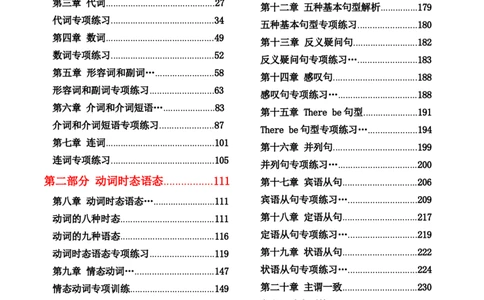
目 录
第一部分 词类..................................1 分词…....................................................162
第一章 名词.............................................1 非谓语动词专项练习…........................163
名词专项练习..........................................4 第四部分 句法........................174
第二章 冠词............................................18
第十一章 句子成分分析.......................174
冠词专项练习..........................................21
句子成分分析专项练习........................176
第三章 代词............................................27
第十二章 五种基本句型解析...............179
代词专项练习..........................................34
五种基本句型专项练习........................180
第四章 数词............................................49
第十三章 反义疑问句..........................182
数词专项练习..........................................52
反义疑问句专项练习…........................183
第五章 形容词和副词…........................58
第十四章 感叹句..................................188
形容词和副词专项练习..........................63
感叹句专项练习…................................188
第六章 介词和介词短语….....................83
第十五章 There be句型......................191
介词和介词短语专项练习......................87
There be句型专项练习…....................194
第七章 连词............................................101
第十六章 并列句..................................199
连词专项练习..........................................105
并列句专项练习…................................200
第二部分 动词时态语态.................111 第十七章 宾语从句..............................206
第八章 动词时态语态….........................111 宾语从句专项练习…............................209
动词的八种时态......................................111 第十八章 定语从句..............................217
动词的九种语态......................................116 定语从句专项练习…............................219
动词时态语态专项练习..........................119 第十九章 状语从句..............................222
第九章 情态动词…................................147 状语从句专项练习…............................224
情态动词专项训练..................................149 第二十章 主谓一致..............................230
主谓一致专项练习…............................233
第三部分 非谓语...........................157
达标测试 一..........................................242
第十章 非谓语动词.................................157
达标测试 二..........................................249
动词不定时..............................................158
达标测试 三..........................................257
动名词......................................................160
参考答案…............................................264初中英语语法突破 @ Mr.Han 英语教学
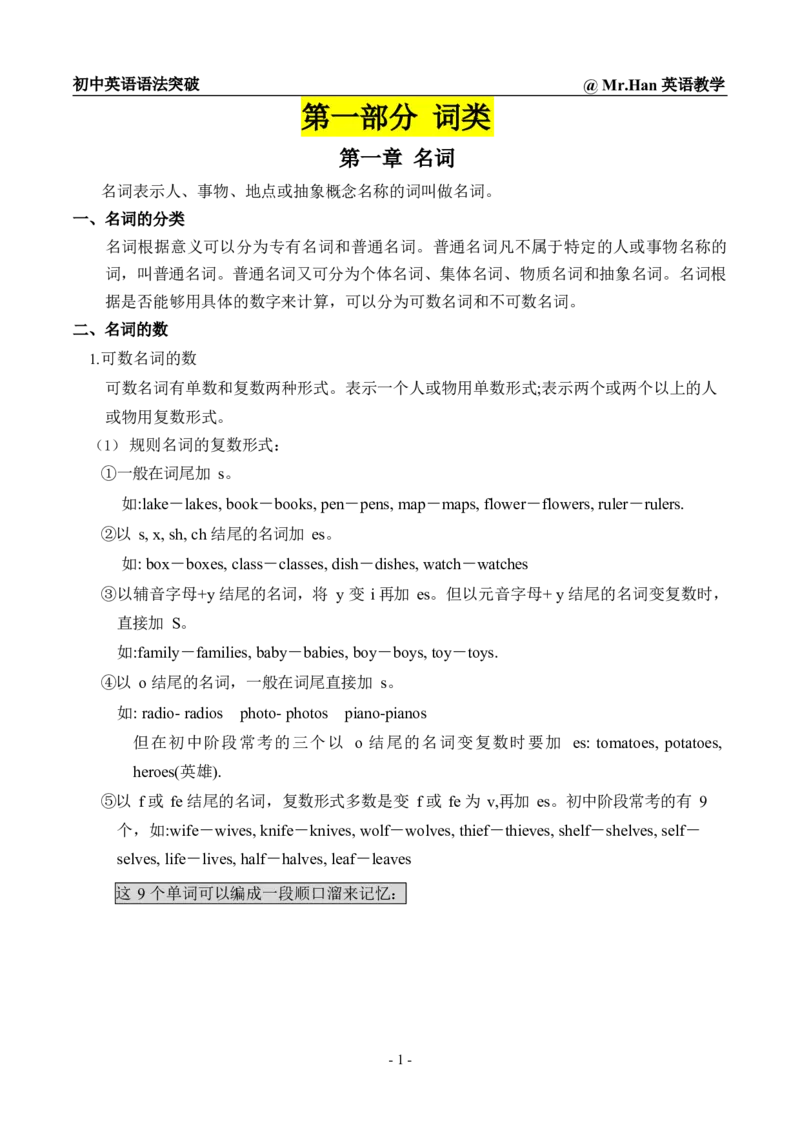
第一部分 词类
第一章 名词
名词表示人、事物、地点或抽象概念名称的词叫做名词。
一、名词的分类
名词根据意义可以分为专有名词和普通名词。普通名词凡不属于特定的人或事物名称的
词,叫普通名词。普通名词又可分为个体名词、集体名词、物质名词和抽象名词。名词根
据是否能够用具体的数字来计算,可以分为可数名词和不可数名词。
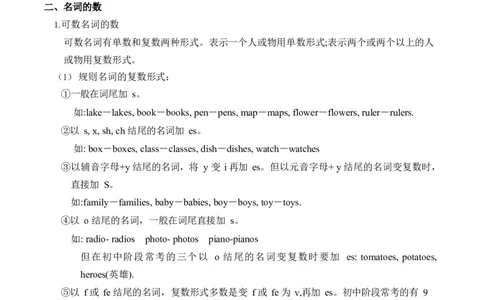
二、名词的数
1.可数名词的数
可数名词有单数和复数两种形式。表示一个人或物用单数形式;表示两个或两个以上的人
或物用复数形式。
(1)规则名词的复数形式:
①一般在词尾加 s。
如:lake-lakes, book-books, pen-pens, map-maps, flower-flowers, ruler-rulers.
②以 s, x, sh, ch 结尾的名词加 es。
如: box-boxes, class-classes, dish-dishes, watch-watches
③以辅音字母+y 结尾的名词,将 y 变 i 再加 es。但以元音字母+ y 结尾的名词变复数时,
直接加 S。
如:family-families, baby-babies, boy-boys, toy-toys.
④以 o 结尾的名词,一般在词尾直接加 s。
如: radio- radios photo- photos piano-pianos
但在初中阶段常考的三个以 o 结尾的名词变复数时要加 es: tomatoes, potatoes,
heroes(英雄).
⑤以 f 或 fe 结尾的名词,复数形式多数是变 f 或 fe 为 v,再加 es。初中阶段常考的有 9
个,如:wife-wives, knife-knives, wolf-wolves, thief-thieves, shelf-shelves, self-
selves, life-lives, half-halves, leaf-leaves
这 9 个单词可以编成一段顺口溜来记忆:
- 1 -初中英语语法突破 @ Mr.Han 英语教学
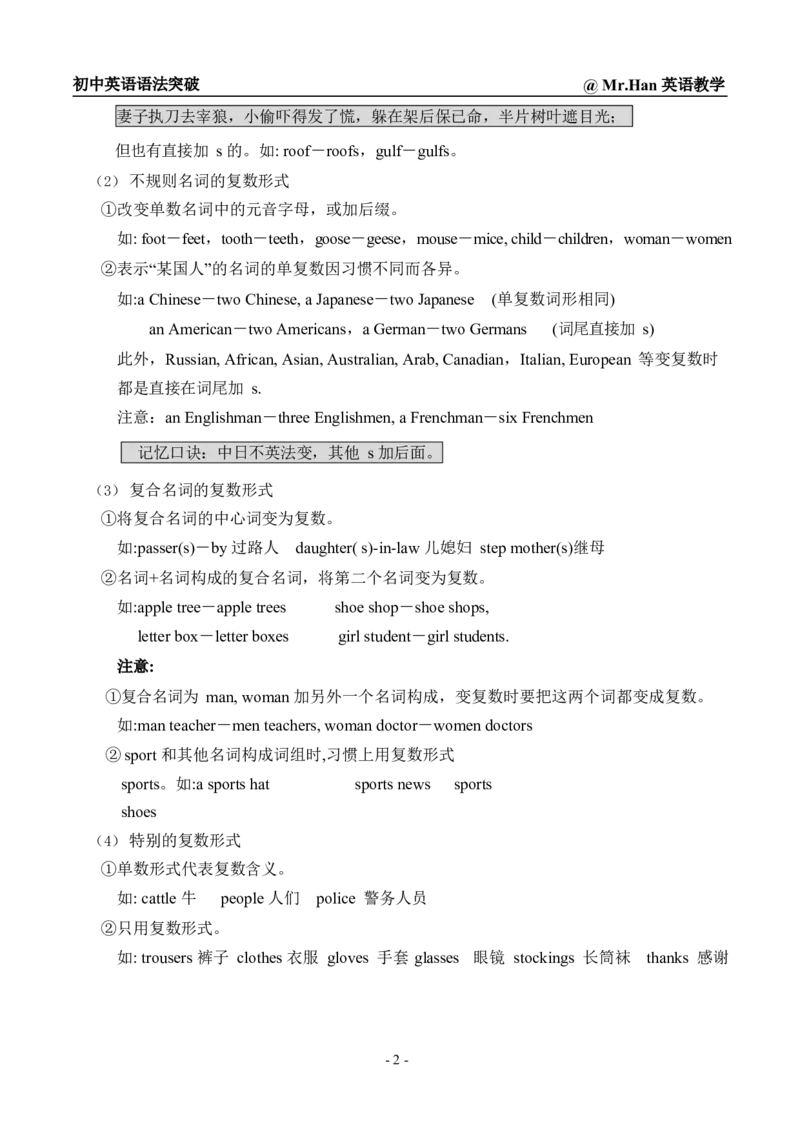
妻子执刀去宰狼,小偷吓得发了慌,躲在架后保已命,半片树叶遮目光;
但也有直接加 s 的。如: roof-roofs,gulf-gulfs。
(2)不规则名词的复数形式
①改变单数名词中的元音字母,或加后缀。
如: foot-feet,tooth-teeth,goose-geese,mouse-mice, child-children,woman-women
②表示“某国人”的名词的单复数因习惯不同而各异。
如:a Chinese-two Chinese, a Japanese-two Japanese (单复数词形相同)
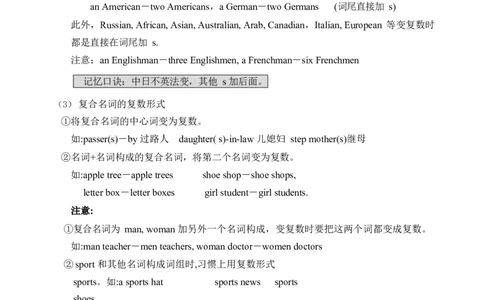
an American-two Americans,a German-two Germans (词尾直接加 s)
此外,Russian, African, Asian, Australian, Arab, Canadian,Italian, European 等变复数时
都是直接在词尾加 s.
注意:an Englishman-three Englishmen, a Frenchman-six Frenchmen
记忆口诀:中日不英法变,其他 s 加后面。
(3)复合名词的复数形式
①将复合名词的中心词变为复数。
如:passer(s)-by 过路人 daughter( s)-in-law 儿媳妇 step mother(s)继母
②名词+名词构成的复合名词,将第二个名词变为复数。
如:apple tree-apple trees shoe shop-shoe shops,
letter box-letter boxes girl student-girl students.
注意:
①复合名词为 man, woman 加另外一个名词构成,变复数时要把这两个词都变成复数。
如:man teacher-men teachers, woman doctor-women doctors
②sport 和其他名词构成词组时,习惯上用复数形式
sports。如:a sports hat sports news sports
shoes
(4)特别的复数形式
①单数形式代表复数含义。
如: cattle 牛 people 人们 police 警务人员
②只用复数形式。
如: trousers 裤子 clothes 衣服 gloves 手套 glasses 眼镜 stockings 长筒袜 thanks 感谢
- 2 -初中英语语法突破 @ Mr.Han 英语教学
③单复数同形。
如: deer 鹿 sheep 绵羊 fish 鱼 ( 注意: fishes 指鱼的种类)
2.不可数名词的数
不可数名词一般没有复数形式,它包括抽象名词和物质名词。
如: health, advice, milk, water, English, money , news, weather, homework, furniture, air,
information, progress, rice, traffic, luck, paper, trouble.
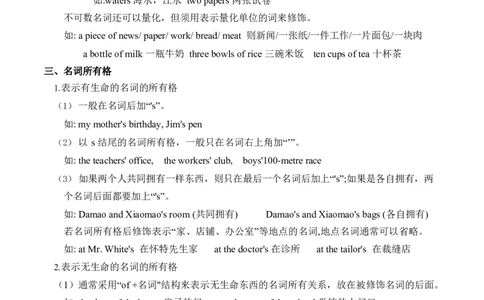
注意:当 water 意为“海水, 江水”,paper 意为“报纸,试卷” 时可有复数形式。
如:waters 海水,江水 two papers 两张试卷
不可数名词还可以量化,但须用表示量化单位的词来修饰。
如: a piece of news/ paper/ work/ bread/ meat 则新闻/一张纸/一件工作/一片面包/一块肉
a bottle of milk 一瓶牛奶 three bowls of rice 三碗米饭 ten cups of tea 十杯茶
三、名词所有格
1.表示有生命的名词的所有格
(1)一般在名词后加“'s”。
如: my mother's birthday, Jim's pen
(2)以 s 结尾的名词所有格,一般只在名词右上角加“’”。
如: the teachers' office, the workers' club, boys'100-metre race
(3)如果两个人共同拥有一样东西,则只在最后一个名词后加上“'s”;如果是各自拥有,两
个名词后面都要加上“'s”。
如: Damao and Xiaomao's room (共同拥有) Damao's and Xiaomao's bags (各自拥有)
若名词所有格后修饰表示“家、店铺、办公室”等地点的名词,地点名词通常可以省略。
如: at Mr. White's 在怀特先生家 at the doctor's 在诊所 at the tailor's 在裁缝店
2.表示无生命的名词的所有格
(1)通常采用“of +名词"结构来表示无生命东西的名词所有关系,放在被修饰名词的后面。
如: the door of the house 房子的门 the gate of the school 学校的大门口
the name of the film 电影的名字 the cover of the book 书的封面
(2)有些表示时间、距离、国家、城市、团体、机构等无生命东西的名词,也可以加上
“'s”来构成所有格。复数名词如果以 s 结尾,在 s 的右上角加“’”即可。
如: today's newspaper 今天的报纸 ten hours' work 十个小时的工作
- 3 -初中英语语法突破 @ Mr.Han 英语教学
3.双重所有格
(1)双重所有格
双重所有格是将 of 所有格和“'s”所有格结合在一起表示所有关系,一般是在所修饰的
名词前有一个表示数量的词或指示代词。如:his, that, a, two, some, any, several, few, no,
many 等,但不能用定冠词 the。
(2)双重所有格两种形式:
①名词 A+of+名词 B’s。
如: a friend of my sister's 我姐姐的一个朋友
two sons of my brother's 我哥哥的两个儿子
②名词 A+of+名词性物主代词。
如:a book of mine 我的一本书
a classmate of his 他的一位同学
注意:a photo of Kate's 凯特的一张照片
(照片有很多张,这只是其中之一,照片上拍的不一定是凯特) ,
a photo of Kate 一张凯特的照片
(照片上拍的人是凯特)
名词专项练习
一、选择填空。
( ) 1. I want something to eat. Please give me a .
A. book B. watch C. shirt D. cake
( ) 2. -What's the like today?
-Cloudy.
A. sky B. air C. land D. weather
( ) 3. Which is the to the bus stop, please?
A. road B. way C. street D. address
( ) 4. that pair of new Mary’s?
A. Is, shoe B. Are, shoe C. Is, shoes D. Are, shoes
- 4 -初中英语语法突破 @ Mr.Han 英语教学
( ) 5. I’m very thirsty. May I have , please?
A. two cups of teas B. two cups of tea C. two cup of teas D. two cup of tea
( ) 6. March 8 is Day.
A. Woman’s B. Womans’ C. Woman of D. Women’s
( ) 7. We should keep our clean.
A. tooth B. tooths C. toothes D. teeth
( ) 8. There are workers in the factory.
A. thousand B. thousands C. thousand of D. thousands of
( ) 9. Wu Dong won the girls’ race in the school sports meeting last week.
A. 100 metres B. 100-metres C. 100 metre D. 100-metre
( ) 10. How many can you see in the picture?
A. tomatos B. tomatoes C. tomato D. the tomato
( ) 11. Lucy tried her best to find a good job in the city, but she had no .
A. trouble B. idea C. luck D. time
( ) 12. foreigners visit the Great Wall every year.
A. Thousands of B. Thousand C. Thousands D. Thousand of
( ) 13. Where are the students? They are in .
A. the Room 8 B. Room 8 C. the 8 Room D. 8 Room
( ) 14. What’s your for being late again?
A. idea B. key C. excuse D. news
( ) 15. -I feel tired. I have so much work to do and don’t have much time for myself.
-You should take , I think.
A. health B. exercise C. lesson D. time
( ) 16. Can you see a little in the picture?
A. sheep B. dogs C. pigs D. horses
( ) 17. There are on the table.
A. a glass of water B. a glass of milk C. two glasses of water D. a glass of oranges
( ) 18. The sing “NUSINESS HOURS” can be seen in a .
A. shop B. school C. park D. museum
- 5 -初中英语语法突破 @ Mr.Han 英语教学
( ) 19. Ask the boy not to make any . I can’t fall asleep.
A. voice B. sound C. noise D. singing
( ) 20. Twelve were hurt, but no were lost in that accident.
A. person, life B. people, lives C. peopeles, lives D. persons, life
( ) 21. The are going to fly to Harbin.
A. Germen B. Germany C. Germanys D. Germans
( ) 22. A group of are talking with two .
A. Frenchmen, Germans B. German, Frenchmen
C. Frenchmans, Germen D. Germans, Frenchmans
( ) 23. -Please help me move the table in.
-But there is not enough for it.
A. place B. floor C. room D. ground
( ) 24. Look, these eating grass on the hill.
A. sheep is B. sheeps is C. sheep are D. sheeps are
( ) 25. My father told me just now.
A. two piece of news B. two pieces of news C. two news D. two pieces of newses
( ) 26. May 1 is Day.
A. the Work People’s B. the Working people
C. the Working People’s D. the Worker’s
( ) 27. The eat a lot of rice.
A. Japanese B. Japan people C. people of Japanese D. Japaneses
( ) 28. Here come three .
A. woman teacher B. women teacher C. woman teachers D. women teachers
( ) 29. turn green in spring.
A. Leaf B. Leaves C. Leave D. Leafs
( ) 30. Tables are made of .
A. wood B. some woods C. wooden D. woods
( ) 31. If these trousers are too big, buy a smaller .
A. set B. one C. piece D. pair
- 6 -初中英语语法突破 @ Mr.Han 英语教学
( ) 32. Father went to his doctor for about his heart trouble.
A. an advice B. advice C. advices D. the advices
( ) 33. We know travels not so fast as light.
A. sound B. sounds C. the sounds D. a sound
( ) 34. Will you make with Tom?
A. friend B. a friend C. friends D. the friend
( ) 35. Joan is .
A. Mary’s and Jack sister B. Mary and Jack’s sister
C. Mary and Jack sister D. Mary’s and Jack’s sister
( ) 36. Mr. Smith has and he is quite able to pay for the house.
A. million dollars B. millions of dollars C. millions of dollar D. million of dollars
( ) 37. The whole trip cost about three thousand dollars.
A. the Smith’s B. Smiths C. the Smiths D. the Smith
( ) 38. After that they had sleep.
A. a night good B. a night’s good C. a good night D. a good night’s
( ) 39. Yesterday we visited .
A. a friend of my uncle’s B. uncle’s C. uncle D. my uncle’s
( ) 40. This is my dictionary.
A. sister Mary B. sister’s C. sister Mary’s D. sister’s Mary’s
( ) 41. Miss Smith is a friend of .
A. Mary’s mother’s B. Mary’s mother C. Mary mother’s D. mother’s of Mary
( ) 42. This is a useful book for .
A. maths teacher B. maths’s teachers C. maths’ teachers D. maths teachers
( ) 43. Help yourself to some , please.
A. fishes B. fish meat C. fish D. fishs
( ) 44. There are stamp collectors in our class.
A. a number B. number C. the number of D. a number of
( ) 45. We had for dinner yesterday evening.
A. chick B. chicken C. hen D. cock
- 7 -初中英语语法突破 @ Mr.Han 英语教学
( ) 46. Would you please show me the way to the shop?
A. shoe’s B. shoes’ C. shoe D. shoes
( ) 47. I’ve forgotten both of the .
A. room numbers B. rooms number C. rooms numbers D. room number
( ) 48. We must make for the old on the bus.
A. room B. a room C. seat D. place
( ) 49. She is the tallest of in the family.
A. any sister B. all the sisters C. all her sisters D. any other
sisters ( ) 50. room is very nice.
A. Tom’s and Jim’s B. Tom’s and Jim C. Tom and Jim’s D. Tom and Jim
( ) 51. September10 is Day.
A. Teachers’ B. the Teachers’ C. a Teacher’s D. Teacher’s
( ) 52. In Harbin Daily Paper, there’s an article(文章)written by uncle.
A. today, Tom B. today’s, Toms’ C. today’s, Tom’s D. today, Tom’s
( ) 53. What we are having today!
A. fine weather B. a fine weather C. fine weathers D. fine a
weather ( ) 54. How many are there in these ?
A. tomatoes, photoes B. tomatoes, photos C. tomatos, photos D. tomatoes, photo
( ) 55. Liu Mei is a girl, she is a good student.
A. sixteen-years-old B. sixteen-year old C. sixteen-year-old D. sixteen-old-year
( ) 56. The trousers on the chair Mr. Green’s.
A. is B. are C. was D. were
( ) 57. Is this an car?
A. Chinese B. English C. Japanese D. Shanghai
( ) 58. Those boys are .
A. a American B. an American C. Amerias D. Americans
( ) 59. Do you like ?
A. the color of these clothes B. these clothes’ color
C. these clothes color D. these clothes of the color
- 8 -初中英语语法突破 @ Mr.Han 英语教学
( ) 60. Where are ?
A. the teachers’ rooms B. the teacher’s rooms
C. the teacher’s room D. the room of the teachers
( ) 61. Is your teacher ?
A. a man, a woman B. men or women C. a man or a woman D. man or woman
( ) 62. How wonderful! The is made of .
A. house, glass B. house, glasses C. houses, glass D. houses, glasses
( ) 63. June 1 is Day.
A. Child B. the Children C. Children’s D. childrens’
( ) 64. I can’t get on the bus, because there is on it.
A. not any rooms B. no rooms C. little room D. few room
( ) 65. The vegetable market is walk from our school.
A. a quarter of an hours’ B. a quarter-of-an-hour’s
C. a quarter of an hour’s D. a quarter-of-an-hours’
( ) 66. I want to make with you.
A. a friend B. friend C. the friend D. friends
( ) 67. Have you got ?
A. enough the breads B. enough bread C. enough of the bread D. enough the bread
( ) 68. It’s about walk from my home to the park.
A. two hours B. two hour’s C. two hours’ D. two of hours
( ) 69. Mr. Smith told me that he had got to do at the moment.
A. enough thing B. enough C. much enough D. thing enough
( ) 70. I’m not feeling very well now. I’ve got .
A. headache B. a headache C. the headache D. cold
( ) 71. Those books in the classroom are .
A. Jim and Dick B. Jim’s and Dick’s C. Jim’s and Dick D. Jim and Dick’s
( ) 72. Near our school there are two .
A. shoe shops B. shoes shops C. shoe’s shops D. shoes’ shops
( ) 73. Everyone is speaking the man who has given his life to our country.
- 9 -初中英语语法突破 @ Mr.Han 英语教学
A. in the praise of B. in praise for C. in praise of D. in the praise for
( ) 74. When Mr. Brown came yesterday, his family having supper.
A. is B. are C. was D. were
( ) 75. -Where is your father?
-At .
A. Mr. Black’s B. Mr. Black C. the Mr. Black’s D. the Mr. Black
( ) 76. Here is for you.
A. a good news B. a piece of news C. so good news D. many good
news ( ) 77. I will give you a . Have good
journey home.
A. two months time B. two-month time C. two month’s time D. two month time
( ) 78. cold weather it was when we were in England!
A. What B. What an C. How D. What a
( ) 79. There a bag of apples on the ground.
A. is B. are C. were D. was
( ) 80. We met some in England.
A. Japaneses B. the Japanese C. Japanese D. Japan
( ) 81. Three years since my brother joined the army.
A. has passed B. have passed C. passed D. passes
( ) 82. 4000 dollars enough for me.
A. is B. are C. do D. does
( ) 83. There two minutes left.
A. are B. is C. have D. has
( ) 84. I haven’t got any with me.
A. change B. changes C. pay D. pays
( ) 85. There isn’t in the glass.
A. a lot of waters B. much water C. much waters D. many water
( ) 86. She had for breakfast.
A. three piece of bread B. three pieces of bread
C. three piece of breads D. three pieces of breads
- 10 -初中英语语法突破 @ Mr.Han 英语教学
( ) 87. This is ball, you should return it to him at once.
A. the boys B. the boy C. the boys’ D. the boy’s
( ) 88. There was in the room.
A. a box banana B. a box of bananas C. some boxes of bananas D. three box pens
( ) 89. I have .
A. three box of pen B. three boxes pens C. three boxes of pens D. three box pens
( ) 90. Please bring us a glass of milk and .
A. four piece of bread B. four piece of breads
C. four pieces of bread D. four pieces of breads
( ) 91. They got much from those new books.
A. ideas B. pictures C. information D. stories
( ) 92. Mr. Green gave us on how to learn the language.
A. an advice B. advices C. some advice D. some advices
( ) 93. Pass me , will you?
A. two papers B. two piece paper C. two pieces of paper D. two pieces of papers
( ) 94. The doctor had saved many of the SARS patients before he lost his own .
A. left, life B. lives, life C. lifes, life D. life, lives
( ) 95. There are in the garden.
A. a kind of flower B. all kinds of flowers
C. a few kind of flowers D. a few kinds of flower
( ) 96. Please pass me .
A. two glass of water B. two glasses of waters C. two glasses of water D. two glass water
( ) 97. Less than lived there two ago.
A. hundred of people, hundreds years B. hundreds of peoples, hundred years
C. hundreds of people, hundred years D. hundreds of people, hundreds year
( ) 98. Shall we take rest?
A. a few minute B. a few minute’s C. a few minutes D. a few minutes’
( ) 99. Our uncle bought two for us yesterday.
A. watchs B. watches C. the watches D. watch
- 11 -初中英语语法突破 @ Mr.Han 英语教学
( ) 100. The man over there is father.
A. Lily’s and Lucy’s B. Lily’s and Lucy C. Lily and Lucy’s D. Lily and Lucy
( ) 101. Oh, there are two beds here. This is the bedroom.
A. twin’s B. twins’ C. twins D. twin’
( ) 102. Did you hear the report?
A. policemen B. policemen’s C. policemens D. plicmens
( ) 103. On Day, even babies beautiful clothes.
A. Children’s, dress up in B. Childrens’, are dressing up in
C. Childrens’, dress up with D. Children’s, are dressed up in
( ) 104. says, there will be rain in nigh. rain will be very heavy in
some places.
A. Today’s weather report, /, The, the B. The weather report of today, /, the, /
C. Today’s weather report, the, The, / D. Today weather report, the , / ,
/ ( ) 105. She has to do this afternoon.
A. a lot work B. a lot of work C. many work D. a lot of works
( ) 106. Hello, Lucy, good news for you.
A. I have a B. There is a C. There are some D. There is some
( ) 107. There are three in my family-my parents and myself.
A. people B. peoples C. pupil D. pupils
( ) 108. What !
A. a nice weather B. an nice weather C. nice weather D. nice weathers
( ) 109. There are some on the mountain.
A. deers B. a deer C. deer D. deeres
( ) 110. Those are black .
A. bike B. a bike C. bikes D. the bike
( ) 111. Does Lily like Chinese .
A. food B. foods C. any food D. some food
( ) 112. didn’t visit the Great Wall.
A. One of the boy B. One of the boys C. One of boy D. One of boys
- 12 -初中英语语法突破 @ Mr.Han 英语教学
( ) 113. There are some new books in the library. They are books.
A. child B. childrens’ C. children D. children’s
( ) 114. There are on the table.
A. two cups of teas B. two cup of tea C. two cups of tea D. two cup of teas
( ) 115. Li Lei’s handwriting is better than any other in his class.
A. students B. student C. student’s D. students’
( ) 116. One the wall there is a .
A. map of the world B. world map C. World’s map D. the world map
( ) 117. Li Lei had last Sunday.
A. quite busy B. quite a busy day C. a quite busy day D. quite busy a day
( ) 118. How much are the .
A. meat B. meats C. orange D. oranges
( ) 119. Meimei has much and many .
A. bread, pears B. breads, pear C. pear, breads D. pears, bread
( ) 120. Lily wanted to buy two .
A. pencils-box B. pencil-boxes C. pencil-box D. pencils-boxes
( ) 121. There are many in the hospital.
A. woman doctors B. woman’s doctors C. women doctors D. women’s doctors
( ) 122. Some will visit our school tomorrow.
A. German B. Germans C. Germen D. Germens
( ) 123. Li Lei has been to many times this month.
A. his aunt B. his aunts C. aunt’s D. his aunt’s
( ) 124. The boss asked me to buy two for his children.
A. pair of shoes B. pairs of shoe C. pairs of shoes D. pair of shoe
( ) 125. Would you try ?
A. the two times B. a second time C. times D. time
( ) 126. is the only animal that can speak.
A. Man B. A man C. The man D. Men
( ) 127. The boy always stays there for .
- 13 -初中英语语法突破 @ Mr.Han 英语教学
A. one and half hour B. one and half hour C. one and half hours D. one and a half hours
( ) 128. foreigners visit the Great Wall every year.
A. Thousands of B. Thousand C. Thousands D. Thousand of
( ) 129. Look! There are some on the floor.
A. child B. water C. girl D. boxes
( ) 130. She likes to eat .
A. fishes and beefs B. boiling egg C. frozen meat D. fried potatos
( ) 131. Maths still very difficult for me, though I have done my best.
A. looks B. seem C. is D. are
( ) 132. Richard became a doctor at the of 20.
A. year B. time C. age D. old
( ) 133. He feels lonely. He has friends here except me.
A. many B. some C. more D. few
( ) 134. There is a shop near the station.
A. book B. book’s C. books’ D. books
( ) 135. The rich man is living in a building.
A. two-story B. two stories C. two story D. two-stories
( ) 136. There are few in the fridge. Let’s go and buy some peas, carrots and cabbages.
A. vegetables B. fruit C. meat D. eggs
( ) 137. China joined the in 2001.
A. CCTV B. WTO C. PLA D. NBA
( ) 138. is a lovely animal.
A. Pandas B. The panda C. A panda D. Pandaes
( ) 139. Beijing has so many buses that there is often a traffic jam in rush .
A. a hour B. hours C. an hour D. moment
( ) 140. He won the race.
A. 100 meters B. 100-meter C. 100-meters D. 100 meter
( ) 141. I do like “Chinese .”
A. take away B. take-aways C. taken away D. take aways
- 14 -初中英语语法突破 @ Mr.Han 英语教学
( ) 142. She needs to buy new trousers.
A. a piece of B. a pair of C. a bit of D. a group of
( ) 143. No news good news.
A. is B. seems C. have D. has
( ) 144. Have you your new classmates yet?
A. had friends with B. made friend with C. got friend to D. made friends with
( ) 145. There was just now.
A. the cold rain B. cold rain C. cold rains D. a cold rain
( ) 146. Jim, I passed the English exam. Did you? .
A. Good idea B. Congratulations C. Best wishes D. With pleasure
( ) 147. Han Mei is not feeling very well now. She’s got .
A. cough B. a cough C. the cough D. cold
( ) 148. Let the children go away. They’re making too much .
A. voice B. noise C. noisy D. sounds
( ) 149. comes from the sheep and some people like eating it.
A. Wool B. Pork C. Mutton D. Milk
( ) 150. One day Jim walked along towards his boat.
A. sand B. the sands C. sands D. the sand
( ) 151. I met her at the other day.
A. the barber’s B. barber’s C. a barber D. the barber
( ) 152. They bought some to make a dress.
A. clothing B. clothes C. coats D. cloth
( ) 153. Uncle is man that he always helps others.
A. such friend of B. such a friendly C. such friendly a D. such friendly
( ) 154. The students will have during May Day.
A. five days holiday B. five-day holiday C. five days’ holiday D. five day holiday
( ) 155. Beijing is one of the biggest in China.
A. citys B. city C. cities D. city’s
( ) 156. May I use your dictionary?
- 15 -初中英语语法突破 @ Mr.Han 英语教学
A. pockets B. pocket C. pocket’s D. pockets’
( ) 157.-Would you like ?
-Thank you, but I’m not thirsty.
A. some sandwiches B. some mooncakes C. some bread D. some orange
( ) 158. The teacher told us to hand in the on time.
A. exercise paper B. exercises papers C. exercise papers D. pieces of exercise paper
( ) 159. Xi’an is one of capital in China.
A. older, city B. the older, city C. oldest, cities D. the oldest, cities
( ) 160. I want eggs. I have eaten too much.
A. some more B. many more C. much more D. no more
( ) 161. Please give me .
A. two oranges B. two glass of orange C. two orange D. two glasses of oranges
( ) 162. She has been in Harbin for five gears. Harbin has become her second .
A. family B. house C. home D. room
( ) 163. English is a bridge .
A. of many knowledges B. of much knowledge
C. to much knowledge D. to many knowledges
( ) 164. The like to eat fried chicken.
A. American B. America people C. people of American D. Americans
( ) 165. The happened at 3 o’clock in the afternoon Miss Brown was robleed.
A. rob B. robber C. accident D.
robbery ( ) 166. I did give my parents trouble
when I was young.
A. large B. many C. much D. not small
( ) 167. If your shoes are too small, but a bigger .
A. one B. copy C. pair D. pairs
( ) 168. The old man has tow .
A. son-in-law B. sons-in-law C. son-in-laws D. sons-in-laws
( ) 169. are falling in Autumn.
A. Leafs B. Leavse C. Leaves D. Leafes
- 16 -初中英语语法突破 @ Mr.Han 英语教学
( ) 170. I found in the city of Beijing.
A. a work B.works C. piece of work D. a pieceof work
( ) 171. is a faithful(忠实的)animal.
A. Dogs B. The dog C. Dog D. An dog
( ) 172. Which comes after winter?
A. month B. week C. season D. day
( ) 173. Several are still watching the traffic on May Day.
A. hundreds polices B. hundred police C. hundred polices D. hundreds police
( ) 174. She found on the Internet.
A. a information B. information C. piece of information D. a piece of information
二、写出下列名词的复数形式。
1. watch 2. tooth 3. German
4. brush 5. box 6. knife
7. story 8. sheep 9. child
10. Japanese 11. zero 12. mouth
13. foot 14. tomato 15. American
16. man-doctor
三、用所给的名词的适当形式填空。
1.Look! There are a lot of (leaf) on the ground.
2.There are a few (people) in the room.
3.I want two (glass) of (milk).
4.I have a lot of (money) in my pocket.
5.People wear shoes on their (foot).
6.The (woman) teachers are playing basketball.
7.There are some (dumpling) on the plate.
8.Tom is at the (doctor).
9.Can you tell us the differences between buildings and (house).
10.The first room is the (teacher) office.
11.Those (child) are playing football outside.
- 17 -初中英语语法突破 @ Mr.Han 英语教学
12.The doctor has saved a lot of (life).
13.There are five (pear) trees in the yard.
14.This isn’t my book, but my (brother).
15.There are some (sheep) in the field.
四、将下列短语译成英语。
1、露茜的妈妈 2、今天的报纸
3、长城 4、宇宙的知识
5、世界地图 6、一块面包
7、四年三班 8、生日礼物
9、儿童读物 10、中国的首都
11、世界人口 12、三箱苹果
13、吉姆的一张照片 14、成千上万棵树
15、星期天的早晨 16、步行二十分钟的路程
17、一张教室的图画 18、一年中最热的季节
19、两杯牛奶 20、2003年的春天
第二章 冠词
冠词是一种虚词,本身不能单独使用,通常放在名词的前面,帮助说明名词的含义,用
来限定名词的意义。
一、冠词的分类
冠词有不定冠词a / an和定冠词the两种,起泛指或特指的作用。
冠词 分类 用 法 举 例
用在辅音开头的
a a dog
不定 单数名词前面
冠词
用在元音开头的
an an orange
单数名词的前面
在可数名词的单数或复数或
定冠词 the the apple/the apples
不可数的名词前面
- 18 -初中英语语法突破 @ Mr.Han 英语教学
二、不定冠词的用法
不定冠词a / an用在单数名词的前面,a用在辅音开头的词前面; an用在元音开头的词的前。
1.表示某一个人或东西,但不具体说明何人或何物。
如:There is a dog lying on the ground.有一只狗躺在地上。
2.表示某类人或事物,以区别于其他种类。
如:An elephant is much stronger than a man.大象比人强壮多了。
(不能译为:一头大象比一个人强壮)
3.表示某类人或事物中的任何一个。
如:He is a teacher of English.他是英语教师
4.表示“一”这个数量。
如:There is a table and four chairs in that dining-room.
在那个餐厅里有一张桌子和四把椅子。
5.几个用不定冠词的习语:a bit(一点), a little(一点), a few(几个), a lot (许多), a kind of(一种),
a pair of(一副、一双), a number of(大量的), a piece of (一张、一片), half an hour(半小时),
have a good time(玩得开心), have a cold(感冒), make a noise(发出嘈杂声)等。
三、定冠词的用法
定冠词the用在可数名词的单数或复数或不可数的名词前面。
1.表示特指的人或事物。
如:The man with a flower in his hand is Jack..
手上拿着一朵花的男人是杰克。
2.指谈话双方都熟悉的人或事物。
如:Look at the blackboard,Lily. 莉莉,请看黑板。
3.复述前面提到过的人或事物。
如:There is a man under the tree. The man is called Robert.
树下有个人, 那个人叫罗伯特。
4.表示世界上独一无二的事物。
如:The earth turns around the sun.地球绕太阳旋转。
5.用在表示方位的名词前面。
如:There will be strong wind to the south of the Yangtze River.
- 19 -初中英语语法突破 @ Mr.Han 英语教学
长江以南地 区将会刮大风。
6.在序数词和形容词最高级的前面。
如:Who is the first one to go? 谁第一个去?
Of all the stars, the sun is the nearest to the earth.
在所有的恒星之中太阳离地球最近。
7.常用在乐器名称的前面。
如:He began to play the violin at the age of 5. 五岁时他开始拉小提琴。
8.用在江河、海洋、山脉等名称的前面。
如:I have never been to the Himalaya Mountains.
我从没有去过喜马拉雅山。
9.用在含有普通名词的专有名词的前面。
如:He is from the United States of America. 他来自美利坚合众国。
10.用在姓氏之前表示一家人。
如:The Greens are going to Mount Emei next month.
下个月格林家要去峨眉山。
11.same之前一般用the。
如:Lucy and Lily look the same.露西和莉莉看上去长得一样。
12.几个用定冠词的习语:at the same time (与此同时), make the bed (铺床), in the end (最后),
all the time (一直), by the way (顺便说一下), on the way (在路上)等。
四、零冠词的情况
1.专有名词和(第一次使用)一些不可数名词时前面通常不用。
如:China is a very large country.中国是个大国。
Man needs air and water.人类需要空气和水。
2.名词前已有指示、物主或不定代词作定语时不用。
如:My pen is much more expensive than yours.我的钢笔比你的昂贵多了。
3.周名,月名或季节名前一般不用。
如:He was born on Monday, February 18,1995. 他出生于1995年2月18日。
They usually plant trees on the hills in spring.春天他们通常在山上植树。
4. (第一次使用)复数名词表示人或事物的类别时不用。
- 20 -初中英语语法突破 @ Mr.Han 英语教学
如:Men are cleverer than monkeys.人比猴子聪明。
5.三餐饭前不用。
如:We have breakfast at home and lunch at school.
我们在家吃早饭,在校吃午饭。
6.节假日前一般不用。
如:On Children’s Day the boys often get presents from their parents.
在儿童节,这些男孩经常得到父母的礼物。
7.球类名词前不用。
如:The children play football on Saturday afternoons.
孩子们星期六下午踢足球。
8.城市的重要/主要建筑物名称前不用。
如:They are now at People’s Cinema.他们此刻在人民电影院。
9.一些习惯用语中不用。
如:at first/last/once take care of in English
冠词专项练习
一、选择填空。
( ) 1. She is girl. She is English girl.
A. a…a B. an….a C. a….an D. a…./
( ) 2. Tom is English. He is English boy.
A. an….an B. /….an C. /…/ D. a…a
( ) 3. live in Room 208.
A. The Green B. Green C. The Greens D. Greens
( ) 4. January is first month of the year.
A. a B. / C. an D. the
( ) 5. We should think of old and sick.
A. a….a B. an…a C. the….the D. /…./
( ) 6. number of the students in our class is 52.
- 21 -初中英语语法突破 @ Mr.Han 英语教学
A. A B. An C. The D. /
( ) 7. She can play piano, but she can't play football.
A. the…the B. the…/ C. /…the D. a….a
( ) 8. There is "s" in the word "six" and "s" is the first letter of the word.
A. a…the B. a….an C. an…the D. a…a
( ) 9. A horse is useful animal.
A. an B. a C. the D. this
( ) 10. He has already worked for hour.
A. an B. a C. the D. three
( ) 11. Lucy wants to become .
A. some teacher B. a teacher C. teacher D. teachers
( ) 12. Hainan is islands, isn't it?
A. the B. one C. a D. an
( ) 13. What do you usually do after ?
A. the class B. class C. the classes D. a class
( ) 14. I'll have to buy trousers.
A. a B. two C. a pair of D. pair
( ) 15. I've thrown my old shoes away. I'll have to buy .
A. a new pair B. a new one C. some new D. some new pair
( ) 16. My uncle told me he was going to visit .
A. the United State B. the United States C. United States D. United States
( ) 17. They failed six times, but they have decided to try .
A. seven times B. the seven time C. the seventh time D. seventh time
( ) 18. Who are those boys? One is my brother and .
A. the big boy is Mike B. a big boy is Mike
C. the big boy is a Peter D. a big boy is a Peter
( ) 19. You will find girl in black. She is teacher.
A. a, the B. the, a C. a, a D. the, the
( ) 20. birds can fly every high in sky.
- 22 -初中英语语法突破 @ Mr.Han 英语教学
A. The, the B. The, a C. An, the D. A, the
( ) 21. I'm not looking at .
A. sun B. sky C. the sun D. some sky
( ) 22. The little boy wishes to be .
A. Lei Feng B. the Lei Feng C. this Lei Feng D. a Lei Feng
( ) 23. have studied English in our school.
A. Most of students B. The most students C. Most of the students D. Most student
( ) 24. Tom's brother hit Bob on nose.
A. his B. the C. its D. a
( ) 25. We are going to have an exam .
A. in the class B. in a class C. at the class D. in class
( ) 26. We have had .
A. good dinner B. a good dinner C. the good dinner D. good dinners
( ) 27. fine weather we have today! Let's go swimming.
A. What a B. How C. What D. How a
( ) 28. There's apple tree behind house.
A. an, the B. a, a C. an, a D. the, the
( ) 29. We can see the sun in daytime, but we can't see it at night.
A. a, the B. the, / C. a, / D. an, /
( ) 30. I saw old man walking across the street and old man looked worried.
A. an, an B. the, the C. an, the D. the, an
( ) 31. What it is!
A. a heavy rain B. heavy rain C. a heavy rains D. heavy
rains ( ) 32. time we had at the party!
A. What wonderful B. What a wonderful C. How wonderful D. How a wonderful
( ) 33. tallest building in the town is Bank of China.
A. The, the B. A, a C. The, a D. A, the
( ) 34. Little Tom looked at the big shark .
A. in the surprise B. in surprised C. in surprise D. at a surprise
- 23 -初中英语语法突破 @ Mr.Han 英语教学
( ) 35. more carefully you ride, fewer falls you'll get.
A. The, the B. A, the C. The, a D. A, a
( ) 36. He has made decision that he will be inventor some time.
A. a, the B. a, an C. the, an D. the, the
( ) 37.-We haven't seen for long time. Where have you been?
-I have been for holiday with my parents.
-Have nice time!
-Thank you.
A. a, the, a B. the, a, a C. a, a, a D. a, the, the
( ) 38.-Excuse me, can you tell me way to Xinhua Bookstore?
-Go along this road, and then turn to right at first crossing, at
end of the street, you can find it.
A. the, a, the, the, the B. a, the, the, a, the
C. the, the, the, a, the D. the, the, the, the, the
( ) 39. Why not take friend with you? That's good idea.
A. a, the B. the, the C. a, a D. the, a
( ) 40. Take the medicine three times day.
A. a B. the C. an D. /
( ) 41. English is language. It is important tool.
A. a, a B. a, an C. the, an D. a, /
( ) 42. Mei mei has high fever and his mother is looking after her.
A. a B. the C. an D. /
( ) 43. Lucy takes walk after supper every day.
A. the B. a C. / D. an
( ) 44. Paper is made of wood.
A. a B. the C. / D. that
( ) 45. February is the second month of the year.
A. The B. A C. / D. an
( ) 46. We have no classes on Sundays.
- 24 -初中英语语法突破 @ Mr.Han 英语教学
A. the B. a C. an D. /
( ) 47. I studied English in England.
A. / , / B. an, the C. an, an D. /, the
( ) 48. We go to school by bus.
A. / B. a C. the D. an
( ) 49. These boys play football after class.
A. a B. the C. an D. /
( ) 50. There is bridge over the river. bridge is made of stone.
A. a, a B. a, the C. the, the D. the, a
( ) 51. Sunday is first day of the week.
A. the B. / C. a D. an
( ) 52. Greens were having breakfast at seven this morning.
A. A B. An C. / D. The
( ) 53. She is one of most popular teachers in this school. Every student loves her.
A. a B. the C. an D. /
( ) 54. There is 800-metre-long bridge over the river.
A. a B. an C. the D. /
( ) 55. number of the students are playing basketball on the playground.
A. A, a B. The, the C. The, a D. A, /
( ) 56. They often take a walk in Bei Hai Park.
A. the B. a C. / D. this
( ) 57. The old man was ill in hospital.
A. the B. / C. a D. an
( ) 58. There is no book on the desk.
A. the B. a C. an D. /
( ) 59. Beijing is capital of people's Republic of China.
A. a, the, the B. the, the, / C. the, the, the D. the, a, the
( ) 60. He started school when he was seven.
A. the B. a C. an D. /
- 25 -初中英语语法突破 @ Mr.Han 英语教学
( ) 61. He has great deal of interest in English.
A. a, an B. the, the C. a, / D. a, the
( ) 62. He is cleverest boy in our school.
A. a B. an C. the D. /
( ) 63. She often spends much time reading.
A. a B. an C. the D. /
( ) 64. Boys likes to go boating.
A. a B. an C. / D. the
二、用适当冠词填空。
1. Thomas Edison was one of greatest inventors in world.
2. Man is only animal that can talk.
3. Is this house older of the two?
4. earth moves around sun.
5. I live in northeast of China.
6. There are sixty minutes in hour.
7. honest boy is Jim, friend of mine.
8. Children usually go to school at age of seven.
9. Here is useful book to read.
10.Would you like rice or bread for your breakfast?
11. poor are always happier than rich.
12.He took me by hand.
13.They have son and daughter. son is a doctor and daughter
is a teacher.
14. orange is orange.
15.He watched the student from head to foot.
16.What interesting book it is!
17. clouds over sea were lovely yesterday.
18.There is little milk in the fridge, I'll go and boy sone.
- 26 -初中英语语法突破 @ Mr.Han 英语教学
第三章 代词
一、人称代词
1.人称代词的分类
分 类 单 数 复 数
人 称
第一人称 第二人称 第三人称 第一人称 第二人称 第三人称
主格 I you he, she, it we you they
人称代词
宾格 me you him, her, it us you them
2.人称代词的用法
(1)主格用来做句子的主语、表语。
如:I often go shopping on Sundays. 星期天我常去购物。
Are they from Brazil ? 他们是巴西人吗?
That’s it. 就那么回事。
It’s he ! 是他!
(2)宾格用来做及物动词或者介词的宾语。
如:Who teaches you English this year ? 今年谁教你们的英语?
Help me ! 救救我!
We often write letters to her. 我们常给他写信。
(3)人称代词作表语或者放在比较状语从句连词 than 或 as 之后时,可以用主格形式,也可以
用宾格形式,口语中大多用宾格。
如: It’s I/me.是我。
三个不同人称同时出现,或者主语中包含“我”时,按照“you→he→I”的顺序。
如:Both he and I are working at that computer company.
我和他都在那家电脑公司上班
–Who will go there? 谁要去哪儿?
–You and me. 你和我。
(4)人称代词 it 除了可以指人植物之外,还可以表示“时间、天气、温度、距离、情况”等含义,
此外还可以作“非人称代词”使用,替代作主语或者宾语的不定式、动名词或者名词性从句。
- 27 -初中英语语法突破 @ Mr.Han 英语教学
如:—What’s the weather like today ? 今天天气怎样?
—It’s fine. 天气晴好。
—What’s the time ? 几点啦?
—It’s 12:00. 12 点
It’s a long way to go. 那可要走好长的路。
It is very clear that the public want to know when these men can go into space.
很显然,公众想知道这些人什么时候能进入太空。
We found it very difficult to learn a foreign language well.
我们发觉要学好一门外语是非常困难的。
二、物主代词的分类
1.人称代词的分类
单数 复数
分 类
人 称 第一人称 第二人称 第三人称 第一人称 第二人称 第三人称
形容
my your his, her, its our your their
物主 词性
代词
名词性 mine yours his,hers, its ours yours theirs
2.人称代词的用法
(1)形容词性物主代词只能作句子中名词的修饰语,后面要跟名词。
如:Is that your umbrella? 那是你的伞吗?
I often go to see my aunt on Sundays. 我周日常去看望阿姨。
(2)名词性物主代词相当于名词,既代替事物又表明所属关系,在句子中往往独立地作主语、宾
语或者表语,后面千万不可以跟名词。
如:This is your cup, but where is mine? 这是你的杯子,可我的在哪儿?
Your classroom is very big, but ours is rather small. 你们教室很大,我们得相当小。
- 28 -初中英语语法突破 @ Mr.Han 英语教学
(3)“of + 名词性物主代词”称为双重所有格,作定语时放在名词的后面。
如:A friend of mine came to see me yesterday.
我的一个朋友昨天来看我了。(指若干朋友中有一个。)
比较:My friend came to see me yesterday.
我的朋友昨天来看我了。(指我的那个特定的朋友)
三、反身代词
1.反身主代词的分类
人 称 单 数 复 数
第一人称 myself ourselves
第二人称 yourself yourselves
himself themselves
第三人称
herself
itself
通 称 oneself
2.反身主代词的用法
(1) 反身代词在句子中作宾语表示反身(指一个动作回到该动作执行者本身)。
如:Don’t play with the knife, you might hurt yourself.
不要玩刀子,那会割伤你的。
(2) 在句子中作同位语表示强调 (即用来强调名词或代词的语气)。
如:The story itself is good. Only he didn’t tell it well.
故事本身是好的,只是他没有讲好。
四、指示代词
1.常见的指示代词
单复数 单数 复数
指示代词 this,that these, those
- 29 -初中英语语法突破 @ Mr.Han 英语教学
2.指示代词的用法
(1)this 时间或空间上“近指”,既可与 here 连用,又可与可数名词单数或不可数名词连用。
如:This man is my maths teacher.这个人是我的数学老师。
(2)these“这些”可与可数名词复数连用。
如:I do not like these flowers here.我不喜欢这儿的这些花。
(3)that 时间或空间上“远指”,既可与 here 连用,又可与可数名词单数或不可数名词连用。
也代替刚刚提到的或已经发生的事。
如:She is going to marry that man there. 她打算跟那边那个人结婚。
Who drank that water on the desk over there? 谁喝了那边书桌上的水?
—Let me pour a glass of water for you. 让我给你倒一杯水吧。
—That would be very nice. 那太好了。
He is ill.That's why he didn't go to work.
他病了,这就是为什么他没去上班的原因。
(4)those 那些时间或空间上“远指”,既可与用 there 连用,又可与可数名词复数连用。
如:Those men are my teachers there. 那边那些人是我的老师。
3.使用指示代词应注意的问题
(1)用在打电话中常用 this 介绍自己,that 询问对方是谁。
如:This is Lucy. 我是露西
Who is that speaking? 你是哪位?
(2)在疑问句中 this,that,these 和 those 作主语,回答要用 it 代替 this 或 that,they 代替 these
或 those。
如:—Is this your dictionary? 这是你的字典吗?
—Yes,it is. 是的,它是
—What are those? 那些是什么?
—They are cows. 它们是奶牛
(3)在比较级句型中指代与前面的名词“同类”的事物,以避免重复。that 常用来指代前面提
到的可数名词单数或不可数名词;those 常用来指代前面提到的复数名词。
如:The vase on the left is more beautiful than that on the right.
左边的花瓶比右边的(花瓶)漂亮。
- 30 -初中英语语法突破 @ Mr.Han 英语教学
The weather of Beijing is colder than that of Guangzhou.
北京的天气比广州的(天气)冷。
The windows of your room are cleaner than those of mine.
你房间的窗户比我房间的(窗户)干净。
五、不定代词
不是指明代替任何特定名词的代词叫不定代词。常见的有some,any,all,none,both,
either,either,each, other,another,much,many,few,little,one 等。
1.all 指人用复数,指事用单数
如:All are here.大家都在这儿。
All is over.全都结束。
2.one 表“一个”,ones 表“一些”
如:One has to do one's best. 人做事要尽力而为。
These apples are not red.Give me some red ones.
这些苹果不红,给我些红苹果吧。
3.another,the other,others,the others
another 三者以上的另一个;the other 两者之中的另一个,或是三者以上的另一些,others
其余的人和物,数量不准确,the others 两部分中的另一些,数量较准确。
如:This ruler is too short for me.Please give me another.
这把尺子太短了,请另给我一把。
Give me the other one. 把另一个给我。
Where are the other pupils? 其余的学生在哪儿。
Show me some others,please. 请拿些别的给我看。
There are fifty pupils in our class.Thirty of them are boys.The others are girls.
我们班有五十个学生,其中 30 个是男孩,其他的是女孩。
4.either,neither,no one 只表示单数无复数。either 两者中任一个,表肯定,neither 指两者都
不,表否定,no one 无人做某事,表否定。
如:Either of the boys is Tom's brother. 两个男孩中的一个是汤妈的兄
弟。 Neither of the boys is Sam's brother. 两个男孩都不是萨姆的兄
弟。 No one knows it. 无人知道此事。
- 31 -初中英语语法突破 @ Mr.Han 英语教学
5.both,all,few,a few,many。只有复数无单数,both“两者都.…”,all“(三个以上的人或物)
都…”, few“没有一些”,后接可数名词,表否定,a few“有一些”,后接可数名词,表肯定,
many“很多,非常多”。
如:Both are in good health. 两个人都健康。
I have few good books. 我没有几本好书。 (否定)
I have a few good friends here. 在这儿我有些好朋友。 (肯定)
I have many English books. 我有许多英语书。
6.many,much,little,a little。many 后接可数名词复数,表示“多”,much 后接不可数名词,表示
“多”,little 不多,表否定,a little 虽不多,但有些,表肯定。
如:There are many books on the desk. 课来上有许多书。
There is much water in the bottle. 瓶子里有许多水。
I have little money. 我身上没带钱。 (否定)
I have a little money with me. 我身上带了点钱。 (肯定)
7.each,every。each 强调“个体”和“个别”,every 强调“全体”“一个也不缺”
如:Each book on his desk is worth reading. 他课来上的每本书都值得一读。
Every pupil must study well. 每个学生都必须好好学习。
8.some 用来表示肯定,any 疑问和否定,some,any 后接可数名词,不可数名词。
如:Some boys are playing football. 一些男孩在踢球。
I want some milk. 我想要些牛奶。
—Do you want any milk? 你想要些牛奶吗?
—No,I don't want any. 不,我不要。
some+可数名词的单数,表示不明确的人或物。
如:Some fool mixed coffee and tea. 不知道哪个傻瓜把咖啡和茶水混在一起了。
六、复合不定代词
复合不定代词是由some-,any-,no-,every-加上-one,-body,-thing,-where,-time 所
组成的不定代词。
1.复合不定代词包括:someone(某人)somebody(某人)something(某事物)somewhere
(某地)anyone(任何人)anybody(任何人)anything(任何事物)anywhere(任何地方)
no one(没人)nobody(没人)nothing(没事物)nowhere(没有地方)everyone(每个人)
- 32 -初中英语语法突破 @ Mr.Han 英语教学
everybody(每个人)everything(一切事物)everywhere(一切地方)等。
注:含-body 和-one 的复合代词只用来指人
含-thing 的复合不定代词只用来指示物
2.复合代词具有名词性质,在句中可用作主语、宾语或表语
如:Someone/Somebody is crying in the next room. 有人在隔壁房间哭。
No one/Nobody is stupid. 没有谁是愚蠢的。
Are you going to buy anything? 你会去买东西吗?
I can hear nothing but your voice. 我只听到了你的声音。
3.复合不定代词的定语必须后置,即放在复合不定代词的后面。
如:Can you tell something interesting? 你能讲些有趣的事情吗?
Is there anybody important here? 这儿有大人物吗?
Would you like something to eat? 要来些吃的东西吗?
七、疑问代词
疑问代词在句中起名词词组的作用,用来构成疑问句。疑问代词有下列几个:what, who,
whose, whom, which, whatever, whichever ,whoever, whomever。 疑问代词在句中应位于谓
语动词之前,没有性和数的变化,除 who 之外也没有宾格的变化。what, which, whose 还
可作限定词。
如:Who is calling? 谁在打电话?(主语)
Whom did she marry? 她嫁给谁了? (宾语)
Whom did you come with? 你和谁来的? (宾语)
Whose bike is under the tree? 这棵树下的自行车是谁的? (定语)
What do you mean? 你是什么意思呀? (宾语)
What has happened? 发生了什么? (主语)
Whose are these books in the classroom? 教室里的这些书是谁的? (表语)
Which room shall we stay in? 我们应该住在哪个房间? (定语)
Which of these is yours? 这些当中哪个是你的? (主语)
- 33 -初中英语语法突破 @ Mr.Han 英语教学
代词专项练习
一、选择填空
( ) 1. This is my book. are over there.
A. Your B. Yours C. You D. mine
( ) 2. Help to some fish, Jenny.
A. yourselves B. yourself C. himself D. herself
( ) 3. is wrong with my watch. It has stopped .
A. Something, working B. Something, to work
C. Anything, working D. Anything, to work
( ) 4. Whose radio is it? It’s .
A. her B. hers C. she D. herself
( ) 5. The children heard on the island.
A. something strange B. anything strange C. strange something D. strange anything
( ) 6. I have three pens. One is red, two are black.
A. another B. other C. the other D. the others
( ) 7. There is in today’s newspaper, is there?
A. something important B. anything important
C. nothing important D. important nothing
( ) 8. I asked Jim and Bob to my house for a meal, but of them came.
A. both B. nor C. none D. neither
( ) 9. The man has two sons, and of them are strong. One is tall and is short.
A. All, another B. Neither, the other C. Both, another D. Both, the other
( ) 10. The man downstairs found very difficult to get to sleep.
A. that B. them C. it D. its
( ) 11. He can speak French, but not .
A. some, much B. any, much C. much, many D. many, any
( ) 12. Mr. Smith is an old friend of .
A. I B. me C. my D. mine
- 34 -初中英语语法突破 @ Mr.Han 英语教学
( ) 13. Tom is here and a friend of is here, too.
A. his father B. his father’s C. he’s father D. he father
( ) 14. Granny is ill and she doesn’t feel like .
A. to eat something B. to eat anything C. eating something D. eating anything
( ) 15. There isn’t paper in the box. Will you go and get for me?
A. any, some B. any, any C. some, some D. some, any
( ) 16. He fell off the ladder but he didn’t hurt .
A. herself B. his C. him D. himself
( ) 17. Lucy runs faster than in her class.
A. any other girls B. any of the other girl C. the other girl D. any other
girl ( ) 18. They are both good at English, but of them is good
at maths.
A. both B. either C. all D. neither
( ) 19. -Haven’t you forgotten ?
- ? Oh, I forgot my bag.
A. anything, Excuse me B. something, Excuse me
C. something, Pardon D. everything, Pardon
( ) 20. Did she go to school when she was young? No she taught at home.
A. her B. herself C. hers D. she
( ) 21. Is that coat ? No, it’s .
A. your brother, mine B. your brother’s, me C. your brother’s, mine D. your brother, me
( ) 22. Is here today? No, Li Lei isn’t here.
A. someone B. somebody C. everyone D. anyone
( ) 23. American take-away food is quite different from .
A. we B. ours C. us D. our
( ) 24. A friend of came to see yesterday.
A. his, his B. he, him C. him, his D. his, him
( ) 25. The boys and girls seemed to enjoy in the park.
A. themselves B. them C. they D. their
( ) 26. My mother told a very interesting story yesterday.
- 35 -初中英语语法突破 @ Mr.Han 英语教学
A. me B. I C. our D. my
( ) 27. This apple is delicious. Give me one, please.
A. the other B. another C. others D. other
( ) 28. likes maths, but both of them like misic.
A. Neither of him B. Neither of them C. Both of them D. Both of the two
( ) 29. There are fifty students in our class. Some are from the USA, and are from China.
A. another B. the other C. others D. other
( ) 30. Put it away, Richard. You mustn’t read letter.
A. anyone’s else’s B. anyone’s else C. anyone else’s D. them, ourselves
( ) 31. Most of want to do the work .
A. theirs, himself B. their, theirs C. them, themselves D. them, ourselves
( ) 32. Are these stories interesting? Yes, of them are interesting.
A. all B. both C. either D. neither
( ) 33. You can borrow my bike, but you mustn’t lend it to .
A. others B. other C. the other D. the others
( ) 34. We study Chinese, English and some subjects.
A. the other B. other C. another D. others
( ) 35. Tom studies better than of the other boys in his class.
A. some B. most C. any D. one
( ) 36. has taken my pen by mistake. I can’t find it.
A. Nobody B. Everybody C. Somebody D. Anyone
( ) 37. Tom made mistakes in his test.
A. any B. one C. no D. another
( ) 38. If you need a ruler, I’ll lend you .
A. one B. some C. the one D. another
( ) 39. He found very difficult to get to sleep. So he decided to read a book.
A. this B. that C. its D. it
( ) 40. Mike lost new watch while he was playing volleyball at school.
A. his B. he C. him D. himself
- 36 -初中英语语法突破 @ Mr.Han 英语教学
( ) 41. Kate had lost key, asks for help.
A. her, He, I B. his, He, me C. his, She, I D. her, She, me
( ) 42. The two friends were so pleased to see each other that the forgot .
A. anything else B. something else C. nothing else D. everything else
( ) 43. Who teaches French?
A. we B. our C. us D. ours
( ) 44. book is new and is new, too.
A. Our, he B. Ours, his C. My, his D. My, her
( ) 45. Thank you for having us. We enjoyed very much.
A. ourselves B. us C. our D. ours
( ) 46. Let’s give her to eat, then.
A. English something B. something English C.. anything English D. English anything
( ) 47. In learning a language, I find important to do more speaking.
A. it B. us C. you D. everyone
( ) 48. Mr. Green gave Lin Tao to eat.
A. delicious something B. Chinese something
C. something English D. something England
( ) 49. This room is ours, and that one is .
A. they B. them C. theirs D. their
( ) 50. -Whose books are these?
-They’re .
A. my B. me C. mine D. our
( ) 51. How much do the workers in that factory produce a day?
A. bicycle B. cake C. bread D. machine
( ) 52 -Who has a dictionary, children?
-I have .
A. it B. this C. one D. so
( ) 53. of the shoes in the shop were the right size for me. They were either too big or too
small.
- 37 -初中英语语法突破 @ Mr.Han 英语教学
A. Both B. Neither C. None D. Either
( ) 54. You’re old enough to take care of .
A. you B. your C. yourself D. yours
( ) 55. Nobody taught . She learnt all by .
A. she, her B. her, herself C. her, her D. herself, herself
( ) 56. of the students in our class has new books.
A. All B. Each C. Both D. Every
( ) 57. -Is the new watch ?
-Yes, it’s .
A. you, me B. yours, mine C. your, my D. your, mine
( ) 58. Mrs. White has her heart.
A. wrong something with B. something wrong in
C. something wrong with D. anything wrong with
( ) 59. They got a Christmas tree and it was ours.
A. so tall as B. so taller as C. as tall as D. as taller as
( ) 60. The young man often travels from China to England .
A. himself B. by himself C. only him D. him
( ) 61. Lily asked Jim, Bob and Tom to her house for a meal, but of them came.
A. both B. nor C. none D. neither
( ) 62. Could I borrow a pan, please? has just broken.
A. My B. You C. Mine D. Your
( ) 63. My skirt is expensive than .
A. much, her B. much, hers C. more, her D. more, hers
( ) 64. -Do you like Jane’s new skirt?
-Yes, very much. I’ll ask mum to buy for me.
A. one B. it C. the other D. a
( ) 65. She is always ready to help .
A. other B. others C. the other D. the others
( ) 66. The colour of her skirt is different from of mine.
- 38 -初中英语语法突破 @ Mr.Han 英语教学
A. one B. that C. it D. this
( ) 67. The Class 3 and Class 1 runners both ran very slowly. of them ran faster than the
Class 2 runner.
A. Either B. Nobody C. None D. Neither
( ) 68. The weather in Guangzhou is hotter than in Harbin.
A. that B. it C. this D. one
( ) 69. Boys, don’t touch the machine, or you may hurt .
A. myself B. yourself C. yourselves D. themselves
( ) 70. The old man has two sons. But of them lives with him.
A. both B. none C. neither D. all
( ) 71. There are man has two sons. But of them lives with him.
A. both B. all C. neither D. none
( ) 72. They were all very tired, but of them would like to have a rest.
A. both B. all C. neither D. neither
( ) 73. -I want to buy a dictionary. Could you show me ?
-Yes. This is the most popular kind.
A. other B. anything C. it D. one
( ) 74. -My watch keeps good time. What about ?
-Mine? Oh, two minutes slow.
A. you B. her C. hers D. yours
( ) 75. Suddenly he came in and said he had to tell the class.
A. anything important B. important everything
C. something important D. important something
( ) 76. -I made the cake by . Help , Tom.
-Thanks.
A. ourselves, yourself B. myself, yourself C. myself, yourselves D. ourselves, yourselves
( ) 77. Jane’s answer is different from , but I really agree with .
A. his, her B. his, hers C. him, hers D. him, her
( ) 78. There is left in the fridge, is there?
- 39 -初中英语语法突破 @ Mr.Han 英语教学
A. something B. nothing C. anything D. everything
( ) 79. There are twenty students in the room. Nine of them are girls and are boys.
A. the other B. the others C. other D. others
( ) 80. like music.
A. Both of they B. Both of them C. The both girl D. Both them
( ) 81. -Which would you like to eat, bread or Sandwiches?
- is OK.
A. All B. Both C. None D. Either
( ) 82. draws so well as Tom.
A. Nobody B. Somebody C. Everybody D. Anybody
( ) 83. Is there new in today’s newspaper?
A. anything else B. else anything C. something else D. else everything
( ) 84. The population of Harbin is smaller than of Shanghai.
A. it B. that C. this D. one
( ) 85. To say is one thing, to do is .
A. one B. other C. the other D. another
( ) 86. This blue shirt looks better than the green .
A. / B. one C. suits D. ones
( ) 87. I’ll give students minutes to finish the composition.
A. the other, other two B. the other, tow more C. others, another two D. other, two
other ( ) 88. Few of them like to go for a walk
?
A. do they B. don’t they C. are they D. aren’t they
( ) 89. Here are two pears. You may have of them.
A. every B. any C. all D. either
( ) 90. likes playing football in our class, aren’t they?
A. No one B. Some C. Everyone D. Nobody
( ) 91. What’ wrong with your watch? .
A. It works good B. It’s a nice one C. It doesn’t work D. I can’t mend it
( ) 92. I saw playing basketball on the playground just now.
- 40 -初中英语语法突破 @ Mr.Han 英语教学
A. them B. they C. their D. theirs
( ) 93. The two little girls are crying in the street. They can’t find mother.
A. she B. them C. her D. their
( ) 94. Whose shoes are those? They are .
A. me B. mine C. my D. myself
( ) 95. Can you do it all by , Jill?
A. you B. yourselves C. yourself D. yours
( ) 96. It’s cold today, ?
A. is it B. it is C. isn’t it D. it isn’t
( ) 97. He knows French but he has French friends.
A. little, few B. few, little C. a little, few D. a few, little
( ) 98. Is there with your car?
A. something wrong B. wrong something C. anything wrong D. wrong anything
( ) 99. There isn’t milk in the fridge. You’d better buy some.
A. no B. any C. some D. few
( ) 100. The box is empty. There is in it.
A. anything B. something C. nothing D. everything
( ) 101. I have two pears. of them are on the table.
A. All B. One C. Both D. Each
( ) 102. I didn’t like the cross talk. of the actors was funny.
A. Both B. All C. Neither D. Either
( ) 103. “You’ll have a nice present , my children.” Mother said.
A. each B. every C. all D. either
( ) 104. The question are so difficult that students can answer them.
A. a few B. few C. a little D. little
( ) 105. She is a student, name is Han Mei.
A. its B. her C. hers D. his
( ) 106. It’s a dog. I don’t know name.
A. its’ B. its C. it D. it’s
- 41 -初中英语语法突破 @ Mr.Han 英语教学
( ) 107. This ruler isn’t mine. I think it is .
A. he B. him C. his D. her
( ) 108. Could you help with maths, please?
A. I, my B. me, me C. me, my D. my, I
( ) 109. A friend of came to Harbin the day before yesterday.
A. my B. his C. him D. himself
( ) 110. schoolbag is beautiful. But is more beautiful than .
A. Jims, my, be B. Jim’s, mine, his C. Jim’s mine, him D. Jim’s, my, his
( ) 111. Most of like American fast food.
A. they B. their C. them D. theirs
( ) 112. His handwriting is better than .
A. her B. she C. hers D. she’s
( ) 113. Won’t you let help you?
A. I and my friend B. my friend and I C. my friend and me D. my friend and to
( ) 114. The teacher asked the three girl Kate, Lucy and to be ready.
A. I B. himself C. me D. herself
( ) 115. How hard is working at his English!
A. we B. him C. he D. his
( ) 116. are on the school football team.
A. I, you and he B. He, you and I C. You, he and I D. You, he and me
( ) 117. Open the door, please! It’s .
A. I B. my C. mine D. me
( ) 118. The teacher gave the books to Lily and .
A. I B. me C. mine D. my
( ) 119. That model plane is not , it is . I made it .
A. ours, mine, myself B. your, mine, myself C. yours, her, myself D. yours, my, myself
( ) 120. Are Lucy and Lily friends ?
A. of B. to you C. to yours D. of yours
( ) 121. I thought it was computer.
- 42 -初中英语语法突破 @ Mr.Han 英语教学
A. him B. himself C. his D. he
( ) 122. Last Sunday, in the supermarket we bought some sweets.
A. us B. ours C. ourselves D. to us
( ) 123. Those students think are wrong.
A. ours B. ourselves C. we D. us
( ) 124. Two students, were sent to help them with the apple picking.
A. him and me B. he and I C. him and I D. I and he
( ) 125. of us wants to read it.
A. Everyone B. Every one C. All D. Nobody
( ) 126. There wrong with my computer.
A. are something B. are anything C. is anything D. is something
( ) 127. I’m not busy at the moment. I haven’t to do.
A. something B. everything C. nothing D. anything
( ) 128. His parents are computer engineers.
A. each B. all C. both D. no one
( ) 129. Of the three foreign travelers, one is from America, two are from France.
A. other B. the other C. others D. the others
( ) 130. She is too tired to go .
A. somewhere B. everywhere C. other where D. anywhere
( ) 131. Look at those students. Some are cleaning the windows, are sweeping the floor.
A. the other B. other C. others D. the others
( ) 132. The students have on Saturday and Sunday.
A. no any classes B. not class C. no classes D. no any class
( ) 133. John is stronger than in his class.
A. any boys B. any boy C. any other boy D. other boy
( ) 134. The farmers are very happy to have rice harvest.
A. other B. the other C. another D. others
( ) 135. Would you like to drink?
A. something B. anything C. nothing D. everything
- 43 -初中英语语法突破 @ Mr.Han 英语教学
( ) 136. We’ll have to hurry. We haven’t got time.
A. much B. many C. a few D. plenty
( ) 137. She isn’t very popular. She has friends.
A. few B. a few C. little D. a little
( ) 138. he village was quite small. There were only houses.
A. few B. a few C. little D. a little
( ) 139. My bike is out of order. I want to buy .
A. a B. a one C. an one D. a new one
( ) 140. Mr. Smith has four sisters, one is in London, but are in Liverpool.
A. another B. others C. the other ones D. the others
( ) 141. These shoes are too small. Do you have larger ?
A. some B. them C. ones D. those
( ) 142. Would you please pass the salt? needs it.
A. she, Her B. her, She C. hers, She D. herself, Her
( ) 143. Someone is knocking at the door, but who can be?
A. one B. he C. she D. it
( ) 144. Look at the clouds. is going to rain.
A. It’s B. It C. Today D. That
( ) 145. Her pronunciation is better than .
A. my B. me C. mine D. I
( ) 146. Jim said to , “Who am I?”
A. himself B. hisself C. herself D. myself
( ) 147. This book is more interesting than .
A. the other B. other the C. others D. another
( ) 148. Jim is taller than in his class.
A. any student B. any others C. anyone else D. the other
( ) 149. There are lots of English books here, and of them is easy to understand.
A. both B. all C. every D. each
( ) 150. -What colour do you like better, black or white?
- 44 -初中英语语法突破 @ Mr.Han 英语教学
-I like but red.
A. neither B. either C. every D. each
( ) 151. There are many students outside the school gate at that time, but I knew of them.
A. everyone B. every C. none D. some
( ) 152. Please keep together! I don’t want to get lost.
A. nobody B. any of you C. every of you D. no one
( ) 153. You may stay here for five days.
A. more B. the other C. others D. another
( ) 154. This question is so easy that can answer it.
A. nobody B. anyone C. no one D. someone
( ) 155. Will you buy stamps for me?
A. some B. any C. no D. none
( ) 156. She had a bad cold. is why she didn’t come to work.
A. This B. That C. These D. Those
( ) 157. The two of them help .
A. each other B. one another C. to each other D. for one another
( ) 158. English best?
A. Who does speak B. Who speaks C. Which speaks D. Whom speaks
( ) 159. He had many friends there. But of them went to see him that day.
A. all B. some C. every D. none
( ) 160. I hope goes well.
A. something B. anything C. everything D. nothing
( ) 161. Would you like some sugar in your coffee? Yes, just .
A. few B. a few C. little D. a little
( ) 162. There is time left. We must be late if we don’t hurry.
A. little B. a little C. few D. a few
( ) 163. There isn’t chalk in the classroom. Please get for me.
A. some, any B. any, any C. any, some D. some, some
( ) 164. I’ll come again in days.
- 45 -初中英语语法突破 @ Mr.Han 英语教学
A. little B. other C. a few D. any
( ) 165. Practice in is learning.
A. himself B. itself C. herself D. themselves
( ) 166. You can do better than .
A. him and hers B. he and she C. he and her D. him and she
( ) 167. Jack gave .
A. to her the flowers B. the flowers to she C. her the flowers D. she the flowers
( ) 168. never wanted to be bad children.
A. We boy B. Our boys C. Us boys D. We boys
( ) 169. Let do it.
A. his and her B. he and she C. him and her D. he and her
( ) 170. Listen to sister!
A. she and her’s B. her and she C. she and her D. his and her
( ) 171. All are leaving for Shanghai today except .
A. him and me B. he and me C. I and he D. him and I
( ) 172. Food and water are more expensive than used to be.
A. it B. their C. they D. he
( ) 173. Every boy and girl got the present and was given on New Year’s Eve.
A. she B. he C. they D. he
( ) 174. He introduced .
A. her to I B. she to I C. she to me D. her to me
( ) 175. I mistook .
A. hers for mine B. hers to my C. she’s to mine D. her for mine
( ) 176. sang a song together at the party.
A. I, Mary and Anna B. Mary, Anna and me
C. Mary, Ann and I D. Mary, Anna and myself
( ) 177. If you meet my teacher or my classmates, tell about it.
A. him B. them C. one D. her
( ) 178. student in our class can answer this easy question.
- 46 -初中英语语法突破 @ Mr.Han 英语教学
A. Anyone B. Some C. Any D. Someone
( ) 179. I like better than yours.
A. him and her B. he and she C. him and she D. his and hers
( ) 180. They often ask about work.
A. each other’s B. others’ C. the other’s D. each others’
( ) 181. I don’t want to use your pen, I want .
A. somebody else’s B. somebody’s else C. somebody else D. somebody’s else’s
( ) 182. Please help to some fruit.
A. myself B. oneself C. yourself D. himself
二、用正确的人称代词及物主代词填空
1. My name is Li Lei. m twelve. father is a doctor. works in a hospital.
mother is a teacher. teaches English. I love both of .
2. -Excuse ! Is this bike yours?
-No, it isn’t . I think it is Li Lei.
-Yes, it’s .
3. Lucy and Lily are twin sister. are in the same class. Miss Gao is headmaster.
She likes and they like , too.
4. Jim has a nice Parrot. name is Polly. looks after every day.
5. I’d like to go swimming. too.
6. Will finish the work herself.
7. She has lost pen. Will you lend her ?
三、用适当的反身代词填空:
1.Jim and Li Lei are teaching French.
2.“What shall I do next?” Wei Hua asked .
3.I think we can do the work by .
4.“Help to some fruit.” Mother said to the children.
5.Jim enjoyed at the party yesterday.
6.I wasn’t quite lost night.
7.Make at home.
- 47 -初中英语语法突破 @ Mr.Han 英语教学
8.Look, the cat is washing her face .
四、用不定代词完成下列各句
1.There isn’t chalk in the classroom. Please get for me.
2.If you have questions, please put up your hands.
3.Jim lent me two English books, but of them is easy enough for me.
4.The trousers are too long. Would you please show me pair?
5.Last week they planted a lot of flowers on side of the road.
6.The boy is standing with hards in the pockets.
7.They lave got ready for the football match.
8.Lily looks unhappy, must have happened to her.
9. has taken my maths book by mistake.
10.Miss Gao wants to teach his pupil he knows.
11. -How many students can you see in the classroom?
-I can see .
12. should take care of his health.
13. Would you like some sugar in your coffee? Yes, Just .
14. There’s time left. We must hurry.
15. How did you pay for the trousers?
16. The old woman had three children. But of them lived with her.
17. Will you please do shopping for me.
18. How times have you been to Beijing?
19. You can have one cake , children.
20. Good morning, ! Good morning, Teacher!
- 48 -初中英语语法突破 @ Mr.Han 英语教学
第四章 数词
数词:表示数目多少或者顺序先后的词叫数词,它有两种形式:表示数目多少的叫基数词。例
如:one 一,two 二,three 三,four 四。表示顺序先后的词叫序数词。例如:first 第一,second
第二,third 第三,fourth 第四,fifth 第五。
一、基数词
1.基数词的构成:
(1)1-12 的基数词是:one 1, two 2, three 3, four 4, five 5, six 6, seven7,
eight 8, nine 9, ten 10, eleven11, twelve 12。
(2)13-19 的基数词:分别在 3-9 的基数词后加词缀-teen,但要注意几个特殊变化的基数词:
13-thirteen,15-fifteen, 18-eighteen。
(3)20-90 的逢十的基数词:分别在 2-9 的基数词后加-ty 构成,即:20 twenty,30 thirty,
40 forty,50 fifty,60 sixty,70 seventy,80 eighty,90 ninety。(注意 20,30,40,
50, 80 拼写的特殊变化)
(4)21-29 的基数词:由十位数 20 的单词形式 twenty 加个位数 1-9 构成。中间用连字
符。即:21 twenty-one,22 twenty-two,23 twenty-three,24 twenty-four,25 twenty-
five,
26 twenty-six,27 twenty-seven,28 twenty-eight,29 twenty-nine。
其他的十位数照此类推。
(5)百位数是由 1-9 加 hundred 构成。例如:200 two hundred。有百位数、十位数和个位
数的三位数,百位数和十位数之间用 and 连接。
如:127 one hundred and twenty-seven。
(6)千位数是由 1-9 加 thousand 构成,后面的百位数、十位数和个位数与前面的构成方
法一样。
如:3000 three thousand。1,149 one thousand one hundred and forty-nine。
英语没有“万”这个单位。10,000 ten thousand。十万用 one hundred thousand,但有百
万这个单位 million。
2.基数词应用的几点注意事项:
(1)基数词可以用来表示年级、班级、房间号码、电话号码和编号。并且单词开头字母
要大写。
- 49 -初中英语语法突破 @ Mr.Han 英语教学
如:I am in Class Five, Grade Nine. 我在九年级五班。
Tomorrow we are going to learn Lesson Five. 明天我们将要学习第五课。
(2)基数词作为数字在句子中作主语,谓语动词用第三人称单数形式。
如:In the western countries, people think thirteen is unlucky number.
在西方国家,人们认为 13 是一个不吉利的数字。
但是代表可数名词的复数形式时要用复数
如:Two of them are from America. 他们中有两人是从美国来的。(Two = Two people)
(3)基数词的单位 hundred,thousand,million 和 billion 等用来表示具体数目,前面有具
体的基数词时,这些词的后面不加-s。
如:There are ten hundred students in our school. 我们学校有 1000 名学生。
但是当 hundred,thousand,million 和 billion 等用来表示不具体的数目时,
用“hundreds/ thousands/millions/ billions of +名词”来表示,这些词的前面也不用具
体的基数词。如:We have already planted thousands of trees on the farm.
我们在农场里已经种植了成千上万棵树。
二、 序数词
1.序数词的构成:
(1)1-19 的序数词除了第一(first),第二(second)和第三(third)之外,其他的序数词是由基
数词加后缀-th 构成的。如:第四-fourth,第六-sixth,第七-seventh 等。注意几个
序数词的特殊变化:fifth 第五,eighth 第八,ninth 第九,twelfth 第十二。
(2)逢十的序数词的构成方法是:先将“几十”的基数词的词尾-ty 变为-ti 再加
eth。如:第 20-twentieth,第 30-thirtieth,第 40-fortieth。
(3)两位数的序数词如果包含 1-9 的个位数,十位数用基数词,个位数用序数词。
如:第 21 twenty-first,第 34 thirty-fourth。
(4)百、千、万的序数词有 hundred-hundredth,thousand-thousandth。
2.序数词的用法:
(1)序数词在句子中主要作定语,有时也可以用作主语、宾语和表语。
如:The sixth man went forward to feel the elephant. 第六个人走上前去摸象。
I think the first is better than the second. 我认为第一个比第二个好。
My sister is the fourth in this exam. 我妹妹这次考试是第四名。
- 50 -初中英语语法突破 @ Mr.Han 英语教学
(2)定冠词 the 和序数词连用表示顺序。不定冠词 a/an 和序数词连用表示“又一、再
一”如:You are the second and I am the fourth. 你第二,我第四。(表示顺序)
Can you do it a third time? 你能再做一次吗? (已经做过两次了)
三、分数表示法:
分数是以基数词代表分子,序数词代表分母,除了分子是“1”的情况外,分母的序数词都
要用复数。
如:a half 1/2 , one third 1/3, two thirds 2/3, a (one) quarter 或 one fourth 1/4
分数在句子中作主语的时候,谓语动词的单、复数形式由 of 后面的名词来决定。
如果 of 后面的名词是可数名词的复数形式,谓语动词用复数形式;如果 of 后面的名词是
不可数名词,谓语动词用第三人称单数形式。
如:It is said that two thirds of information on the Internet is not true.
据说互联网上三分之二的信息是不真实的。
Two fifths of the students in my class are from the village.
我们班五分之二的学生来自那个村子。
四、年、月、日、时的表示法
1.年代
1984 nineteen eighty-four 1990’s (1990s) nineteen nineties
2009 two thousand and nine
2.日期
September 1, 2009, 读作:September the first, two thousand and nine
3.时刻
数字写法 读 法
8:00 eight o’clock eight
8:10 ten past eight eight ten
8:15 (a) quarter past eight eight fifteen
8:30 half past eight eight thirty
8:40 twenty to nine eight forty
8:45 (a) quarter to nine eight forty-five
- 51 -初中英语语法突破 @ Mr.Han 英语教学
数词专项练习
一、选择填空
( ) 1. There are about students in our school.
A. two thousand of B. two thousands C. two thousands of D. two thousand
( ) 2. There are students in our grade.
A. three hundreds and forty-five B. three hundred and forty five
C. three hundred forty-five D. three hundred and forty-five
( ) 3. Sunday is day of the week.
A. the first B. one C. he seventh D. the seven
( ) 4. Please come to my office .
A. at half past eight B. at half passed either C. in half past eight D. on half past eight
( ) 5. If you want to go to the cinema, take .
A. bus No. the ninth B. the No. 9 bus C. No. 9 the bus D. No. the ninth bus
( ) 6. The Greens came to China .
A. in 1984 October 27 B. in October 27, 1984
C. on 27, 1984 October D. on October 27, 1984
( ) 7. The story took place in .
A. nineteen centuries B. nineteen century
C. the nineteenth century D. nineteenth century
( ) 8. I was told they would stay in China for .
A. one and a half years B. one and a half year
C. one and half years D. one half and one year
( ) 9. Tomorrow we are going to learn .
A. Lesson Second B. the Lesson Two C. Lesson Two D. second lesson
( ) 10. I think that the first day of spring is .
A. twenty-two of March B. twenty-second on March
C. twenty-two in March D. the twenty-second of March
( ) 11. letter of the word “restaurant” is “n”.
- 52 -初中英语语法突破 @ Mr.Han 英语教学
A. The nineth B. Nineth C. The ninth D. Ninth
( ) 12. We talked for .
A. half a hour B. half hour C. an hour half D. half an hour
( ) 13. The bus will leave at this afternoon.
A. three fifteen B. three and fifteen C. three quarters D. fifty to three
( ) 14. The earth is the size of the moon.
A. 49 the times B. 49 times C. 49 time D. fourty-nine times
( ) 15. It’s a ruler.
A. two-feet-long B. two feet long C. two-foot-long D. two-foot-long
( ) 16. students are planting trees.
A. Several hundreds B. Several hundred C. Five hundreds D. Five hundred of
( ) 17. to finish quickly.
A. No every student wants B. No every student want
C. Not every student wants D. Not every student want
( ) 18. ago, our country was covered by thick forests.
A. Several million of year B. Several million year
C. Several million years D. Several million of years
( ) 19. The weight of the moon is only about of that of the earth.
A. one eighty B. one of eighty C. one the eightieth D. one eightieth
( ) 20. It’s 11:45. Yes, it’s .
A. fifteen past twelve B. fifteen from twelve
C. a quarter past eightieth D. a quarter to twelve
( ) 21. What date is it? It’s .
A. July twentieth-first B. of July twenty-first
C. the twenty-first of July D. a quarter to twelve
( ) 22. - , please?
-It was April 25th.
A. How old are you B. What was the date yesterday
C. What time was it D. What day is it today
- 53 -初中英语语法突破 @ Mr.Han 英语教学
( ) 23. I have things to do. I can’t play .
A. many, no more B. a lot of, any more C. much, more D. much, any more
( ) 24. I have a paper on my desk.
A. little B. lot C. lots D. little of
( ) 25. This is .
A. the question thirty B. the question thirteen C. thirty question D. question thirteen
( ) 26. of the work has been done.
A. Two third B. Two three C. Two thirds D. Two
third ( ) 27. It’s now. Let’s hurry.
A. half passed six B. thirty passed six C. half pass six D. half to seven
( ) 28. What’s the date today? It’s .
A. the June fourth B. the fourth of June C. of June the fourth D. fourth June
( ) 29. Next week we’re going to lean .
A. unit 5 B. the unit 5 C. Unit 5 D. 5 Unit
( ) 30. Do you have much work to do this weekend? Yes, I have to write a paper.
A. two-thousand-word B. two-thousand-words
C. two-thousands-word D. two-thousands-
words ( ) 31. The tree is tall.
A. fifteen feet B. fourteen feet C. fourteen foot D. fourty foot
( ) 32. Fifty plus .
A. fourty is ninety B. forty is ninety C. thirty is ninety D. fourty is ninety
( ) 33. There are students in this school.
A. four hundred fifty-two B. four hundreds fifty-two
C. four hundred and fifty-two D. four hundred and fifty two
( ) 34. My home is about away from the school.
A. three hundred metre B. three hundreds meters
C. three hundred meters D. three hundreds metre
( ) 35. December is and last month is a year.
A. the twelveth B. twelveth C. the twelfth D. twelfth
- 54 -初中英语语法突破 @ Mr.Han 英语教学
( ) 36. of the teachers in the school are from colleges.
A. Three quarters B. Two-third C. Two fifth D. Two-nineths
( ) 37. There are two world wars during century.
A. the twenties B. the twentieth C. twenties D. twentieth
( ) 39. In the forties, his father served in the New Army(新四军),while this mother
worked in the Route Army.(八路军)
A. the twenty-first lesson B. Lesson Twenty First
C. the 21th lesson D. Lesson 21th
( ) 40. He will stay here for .
A. one and half month B. one and a half month
C. one months and half D. one and a half months
( ) 41. -What’s the date today?
-It’s .
A. nine B. Monday C. June 5 D.
11:00 ( ) 42. -Would you like to eat apples?
-No, thank you.
A. more two B. two more C. two another D. two else
( ) 43. He said he would come back in .
A. one or two days B. a or two days C. one and two days D. a day and two
( ) 44. -How often do you write to your parents abroad?
- .
A. Twice a month B. Second times a month
C. A second time a month D. Second a time a month
( ) 45. people died in the traffic accidents in the world.
A. Thousand of B. Thousands of C. Ten thousands of D. Ten thousand
of ( ) 46. What is the time? It’s . (4:25)
A. four twenty-five B. four past twenty-five C. twenty-five to four D. four twenty five
( ) 47. Mr. Smith lives on floor.
A. fiveth B. fifth C. the fifth D. the fifth
- 55 -初中英语语法突破 @ Mr.Han 英语教学
( ) 48. He began to learn English in his .
A. fifty B. fiftieth C. fifties D. fifth
( ) 49. His sister was born .
A. in 1998, October 21 B. on 1998, October 21
C. in October 21, 1998 D. on October 21, 1998
( ) 50. When he was , he left home to work in different cities.
A. in his twenty B. at his twenty C. in his twenties D. at his twenties
( ) 51. I’m than you.
A. five years older B. fifteen year old C. fifteen years D. fifteen old
( ) 52. -How old are you?
-I’m .
A. fifteen years old B. fifteen year old C. fifteen years D. fifteen old
( ) 53. -How many teachers are there in your school?
- , but I’m not sure.
A. Hundreds B. Hundred C. Hundreds D. One hundred
( ) 54. About of the books in our school library are written in Chinese.
A. four-fifth B. four-fifths C. fourth-fifths D. fourths-
fifth ( ) 55. They planted trees on the farm last year.
A. two hundreds B. two hundred of C. two hundreds of D. hundreds of
( ) 56. I think that the century will bring us more hopes.
A. twenty-one B. twentieth-first C. twenty-first D. twentieth-one
( ) 57. I think lesson is the most difficult in this book.
A. five B. fifth C. the fifth D. fifteen
( ) 58. travelers come to visit our city every year.
A. Hundred of B. Hundreds of C. Five Hundreds D. Hundred
( ) 59. We have five students in our school.
A. hundred of B. Hundreds of C. hundred D. hundreds
( ) 60. of the teachers in the school is 300. of them are women teachers.
A. The number, first fourth B. The number, one fourth
- 56 -初中英语语法突破 @ Mr.Han 英语教学
C. A number, one second D. A number, three
quarters ( ) 61. The English swimmer came
in third.
A. a B. an C. / D. the
( ) 62. I found out that he was away in town.
A. Other day B. One day C. A day D. Some day
( ) 63. Play music for me, will you?
A. a B. a piece of C. an D. some piece of
( ) 64. of the land is covered water.
A. Two third, by B. Two three, with C. Two thirds, by D. Two third, with
- 57 -初中英语语法突破 @ Mr.Han 英语教学
第五章 形容词和副词(一)
形容词修饰名词,用来说明人或事物的性质或特征。
一、形容词的基本用法
1.作定语:一般放在所修饰词的前面
如:It’s a cold and windy day today. 今天是个寒冷、有风的天气。
2.作表语:放在系动词的后面
如:He looks happy today. 他今天看上去很开心。
3.做补足语: 作主语或宾语的补足语,说明主语或宾语的性质、状态或特征。
如:I think it impossible for him to finish the work before dark.
我认为他不可能在天黑之前完成这一工作。
4.作状语:主要表示原因、伴随或方式。
如:Hungry and tired, I had to stop to have a rest. 又累又饿,我只好停下来休息一下。
二、形容词的分类
1.性质形容词:用于表示人或物所具有的性质。在英语中,大量的形容词属于这一类别,多
数有比较级和最高级,有程度大小的区别,可以使用程度副词修饰。
如:funny滑稽的,lovely可爱的,healthy健康的
2.类别形容词:用于阐明人或事物所属的特定类别。这一类形容词往往没有程度大小的区别、没有
比较级和最高级,而且不使用程度副词修饰。
如:financial经济的,mental脑力的,cultural文化的
3.颜色形容词:用于表示事物颜色的形容词。这一类形容词没有比较级和最高级。
如:blue蓝色的,green绿色的,white白色的
4.叙述形容词:这类形容词只能作表语,所以又称为表语形容词。这类形容词没有级的变化,也
不可用程度副词修饰,大多数以a开头的形容词都属于这一类。
如:afraid 害怕的,alone 单独的,asleep 睡着的,worth 值得的,ill 病的
5.分词形容词:英语中有些表情感态度的动词,如excite,worry,其过去分词和现在分词
可形容词化,即相当于形容词。
如:worried 担忧的,worrying 令人担忧的,exciting 令人兴奋的,excited 感到兴奋的
6.复合形容词:指的是由几个词共同构成并起形容词作用的词。
- 58 -初中英语语法突破 @ Mr.Han 英语教学
如:three-year-old 三岁的,ordinary-looking 相貌普通的,middle-aged 中年的
三、考点拓展
1.形容词修饰something, anything, nothing, everything等复合不定代词时,须放在其
后。如:Would you like something hot to drink? 你想喝点热的东西吗?
There is nothing important in the paper. 报上没什么重要的事情。
2.表示长、宽、高、深及年龄的形容词,应放在相应的名词之后。
如:The bridge is about two hundred meters long. 这座桥长约两百米。
Last year we built a building thirteen storeys high. 去年,我们盖了一栋十三层高的楼。
3.多个形容词作定语时的顺序排列:限定词(冠词、数词、代词等)→描绘性形容词→大、小
(长、短、高、低)形容词→形状形容词→年龄(新、旧)形容词→颜色形容词、国籍形容
词、材料形容词、用途(类别)形容词、名词。
巧记顺口溜:美小圆旧黄,中国木书房。
如:a Chinese writing desk 一张中式写字桌
her charming small round pink face 她迷人的小而圆的粉红脸蛋
those beautiful little old Chinese earthen vases 那些漂亮小巧的中国古代花瓶
四、形容词比较级和最高级的构成
构 成 方 式 例 词
单 一般在词尾加-er,-est small→smaller→smallest
音
以不发音的字母e结尾的词,加-r,-st large→larger→largest
节
以两个辅音字母加一个元音字母结
和 big→bigger→biggest
尾的重读闭音节词,双写词尾的辅音
规
部 thin→thinner→thinnest
字母,再加-er,-est
则
分
变
以"辅音字母+y"结尾的词,变y为
双
busy→busier→busiest
化 i,
音
再加-er,-est
节
词 少数以er或ow结尾的双音节词,词 narrow→narrower→narrowest
尾加-er,-est clever→cleverer→cleverest
多音节 其他双音节词和多音节词及分词形 important→more important
- 59 -初中英语语法突破 @ Mr.Han 英语教学
容词,在词前加more,most →most important
bad/ill→worse→worst; much/many→more→most;
good/well→better→best; far→farther/further→farthest/furthest;
old→older/elder→oldest /eldest; little→less→least
【易错辨析】
1.farther/farthest和further/furthest的区别:二者表示距离时,往往可互换,但是用
于引申义,表示程度时,只能使用后者。
如:He can throw much farther/further than you. 他可以比你扔得远得多。
不
His suggestion is that Kate should be sent abroad for further education.
规
他的建议是凯特被派往国外进修。
则
2.older/oldest 和 elder/eldest 的区别:前者用于人或者物,可作定语和表语,可与
变
than连用,而后者主要用于家人之间,表明长幼关系,往往用于人,不用于物,
化
而且只作定语不作表语,也不与than连用。
如:I’m two years older than him. 我比他大两岁。
His elder brother works in a clothing factory. 他哥哥在一家服装厂工作。
五、形容词比较等级的句式结构和用法
1.句式:A+be+形容词比较级than+B:表示一方超过或低于另一方的情况。
如:You are taller than me. 你比我高。
2.句式:as+形容词原级+as 表示 “……和……一样……”。
如:The weather in Beijing is not as( =so) hot as that in Wuhan. 北京的天气不如武汉热。
3.句式:比较级+and+比较级 表示"越来越……
如:China is becoming stronger and stronger. 中国正变得越来越强大。
4.句式:the+比较级, the+比较级 表示"越……,就越……
如:The quicker you walk, the less time you will use. 你走得越快,花的时间就越少。
5.句式:A+be+形容词最高级of/in… 表示"A在某范围内是最……的"
如:Michael is the best teacher in Jim’s eyes. 在吉姆看来,迈克尔是最好的老师。
- 60 -初中英语语法突破 @ Mr.Han 英语教学
形容词和副词(二)
副词是用来修饰动词、形容词、其他副词以及全句话的词类,表示时间、地点、程度、
方式等概念。
一、副词的基本用法
如:We should listen to our teachers carefully. 我们应该认真听老师讲
课。 He is very happy today. 他今天非常高兴。
"What happened?"I asked, rather angrily. "发生什么事情了?"我相当生气地问。
In spring, I can see flowers everywhere. 在春天,我到处都能看到花。
不少副词同时也可用作介词或其他词类。
如:Have you read this book before? (副词,作时间状语) 你以前读过这本书吗?
He will arrive before ten o’clock.(介词,before ten o’clock 介词短语,作时间状
语)他将在10点钟前到达。
二、副词的分类
副词按词汇意义可分为:
1. 时间副词:today, early, soon, now, then, recently, still
(1)表示发生时间的副词: It’s beginning to rain now! 现在开始下雨了!
(2)表示频繁程度的副词,也称频度副词always, often, usually, sometimes, never,
ever, hardly等一般位于系动词、情态动词和助动词之后,实义动词之前。
(3)还有一些其他表示时间的副词:
如:He has just had an operation. 他刚动过手术。
2. 地点副词:here, there, out, somewhere, abroad, home等。
(1)有不少表示地点的副词:She is studying abroad. 她在国外留学。
(2)有一些部分与介词同形的副词。它们与介词同形,后跟宾语的是介词,否则是副词:
①用作副词:Stand up! 起立!
②用作介词: A cat climbed up the tree. 猫爬上了树。
(3)以where构成的副词也是地点副词: It’s the same everywhere. 到处都一样。
3. 方式副词:well, fast, slowly, carefully, quickly
(1)英语中有大量方式副词,说明行为方式(回答how的问题):
- 61 -初中英语语法突破 @ Mr.Han 英语教学
How beautifully your wife dances. 你夫人舞跳得真美。
(2)还有相当多的副词,表示某些情绪:She smiled gratefully. 她感激地笑了笑。
(3)还有一些以-ly结尾的副词,表示动作发生的状况:
He left the town secretly. 他悄然离开了这座城市。
4. 程度副词:very, much, enough, almost, rather, quite等。
5. 频度副词:always, often, usually, sometimes, seldom, never
等。三、副词比较等级的句式结构和用法
1.句式: 同级比较 "as + 形容词/ 副词的原型 + as";当然也要注意它的否定形式、以及
在第一个as前加倍数或程度副词的情况。
如:My car cannot run so fast as yours. 我的车没有你的车跑得快。
2.句式: 副词比较级 + than。
如:They worked even harder than they promised. 他们工作得比他们承诺的还要卖力。
注意:在比较级+ than的结构前可以加上某些副词类和表示倍数的词,以对其进行修饰
如:far(远), even(甚至), much(许多), still(更,还), a lot(许多), a little / bit
(一
点), rather(相当地), slightly(略微), not any(不再), three times(三倍)等。
如:This book is far more interesting than that one. 这本书比那一本有趣多了。
3.句式: 比较级中的两个特殊作用的结构是:
The + 比较级 + 句子,the + 比较级 + 句子 或 比较级 + and + 比较级。
如:The harder you work at your study, the better academic records you will have.
你学习越努力,你的成绩就越好。
The more we have, the more we want. 人欲无穷。
注意1:没有比较对象的比较结构。所谓没有比较对象的比较结构不是指省略而言,而
是指并非真正的比较。
如:The car runs faster than 110 miles. 那辆车时速为110多英里。
注意2:用比较级的形式表达最高级的意思。在这种情况下,往往是将一个人或是一件
事与其他所有的人或事相比较。
如:He is taller than anyone else in our class. 他在我们班比其他任何人都高。
4.句式: no +比较级+ than的结构表示"A和B一样不……"。
如:She runs no faster than her sister. 她与她妹妹一样跑不快。
- 62 -初中英语语法突破 @ Mr.Han 英语教学
形容词和副词专项练习
一、选择填空
( )1. Which is Lesson Five or Lesson Six?
A. interesting B. more interesting C. most interesting D. the most interesting
( ) 2. Sorry, I can’t answer your question. I know about the news.
A. a little B. little C. few D. a few
( ) 3. “I’ve got an A for my history.” Judy said .
A. sadly B. sad C. happy D. happily
( ) 4. I think the song in the film “Titanic” is one of the film songs.
A. the most beautiful B. most beautiful C. much more beautiful D. a beautiful
( ) 5. Jim works as as Zhang Hua.
A. careful B. carefully C. more careful D. most carefully
( ) 6. Can you speak to a person in old clothes?
A. kind B. kindly C. polite D. friendly
( ) 7. Just a moment, please! I’ll finish in five minutes.
A. another B. other C. more D. less
( ) 8. Who jumped of all in the long jump?
A. longest B. longer C. farther D. farthest
( ) 9. My sister isn’t maths.
A. good for B. well in C. good at D. best at
( ) 10. Of all the shoes in your shop, is this pair one?
A. very good B. much better C. a cheaper D. the cheapest
( ) 11. Jack didn’t run to catch up with the other runners.
A. fast enough B. quick enough C. enough slow D. slowly enough
( ) 12. India has the second population in the world.
A. most B. largest C. least D. smallest
( ) 13. We have milk for baby. You’d better go and buy some.
A. little B. a little C. few D. a few
- 63 -初中英语语法突破 @ Mr.Han 英语教学
( ) 14. Jim has friends here. So he often feels lonely.
A. a little B. little C. a few D. few
( ) 15. Lucy has made quite friends since she came here. She’s very happy.
A. few B. little C. a few D. few
( ) 16. The old woman lives , but he doesn't feel .
A. alone, alone B. alone, lonely C. lonely, lonely D. lonely, alone
( ) 17. Mrs. Green gave Lucy to eat.
A. delicious something B. Chinese something C. something English D. something
England ( ) 18. Mum will give him to eat.
A. something real Chinese B. real Chinese something
C. something really Chinese D. really Chinese something
( ) 19. I couldn’t see much during the flight because there was cloud.
A. too many B. too much C. much too D. a lot
( ) 20. The sweater is very beautiful, but it’s dear.
A. too much B. much too C. many D. more
( ) 21. Today, trees are still being cut down somewhere in the world.
A. much too B. too much C. many too D. too many
( ) 22. I think football is basketball in America.
A. more popular B. so popular as C. as popular as D. less popular
( ) 23. Shanghai is the of all the cities in China.
A. large B. larger C. largest D. most large
( ) 24. The boy doesn’t run the bus.
A. much faster as B. as fastest as C. more fast than D. so fast as
( ) 25. Germany has people than France.
A. fewer B. smaller C. large D. more
( ) 26. The population of Xi’an is than that of Shanghai.
A. smaller B. fewer C. more D. larger
( ) 27. It rained last night.
A. heavily B. heavy C. heavyly D. hardly
- 64 -初中英语语法突破 @ Mr.Han 英语教学
( ) 28. Eating more vegetables will keep you .
A. good B. fat C. weak D. healthy
( ) 29. The elephant is big that he can’t be put into a small cage.
A. so, so B. such, so C. so, such D. such, such
( ) 30. Lily said she hadn’t heard music before.
A. such a beautiful piece of B. a beautiful C. so beautiful a D. such a wonderful
( ) 31. Maths is one of the subjects in middle schools.
A. important B. most important C. more important D. much important
( ) 32. Jim is of the two.
A. taller B. the taller C. tallest D. the tallest
( ) 33. This book is interesting than that one.
A. little more B. little much C. a little more D. a little much
( ) 34. He can’t help you with your maths. I’m afraid I can’t .
A. too B. else C. also D. either
( ) 35. Don’t worry. Your granny will get .
A. well and well B. better and better C. well and better D. best and best
( ) 36. -Can you understand me?
-Sorry, I can understand you.
A. hardly B. almost C. nearly D. ever
( ) 37. The little boy books .
A. lovely B. carefully C. heavily D. sadly
( ) 38. Jim can draw the teacher.
A. as well as B. not so well as C. as better as D. as good as
( ) 39. It’s going to be a busy day today. I have work to do.
A. a hard B. a lot C. many D. much
( ) 40. How they are working!
A. hardly B. a hard C. hard D. a hardly
( ) 41. These shoes are much too for me.
A. big B. bigger C. biggest D. the biggest
- 65 -初中英语语法突破 @ Mr.Han 英语教学
( ) 42. There are many tall trees on side of the street.
A. both B. all C. either D. neither
( ) 43. In Harbin, it’s in November, but it’s even in December.
A. cold, cold B. cold, colder C. colder, cold D. colder
coldest ( ) 44. Look! The children are playing , they are always
.
A. happy, happy B. happily, happily C. happily, happy D. happy, happily
( ) 45. Jim please turn the radio a little I’m talking with your uncle.
A. off B. on C. down D. up
( ) 46. Everything is on the moon than on the earth.
A. much more lighter B. much more light C. more light D. much lighter
( ) 47. It’s nice of you to help me.
A. true B. truly C. real D. really
( ) 48. Don’t eat the meat. It smells .
A. dirty B. delicious C. bad D. sweet
( ) 49. Their school is three times as as ours. That means our school is than theirs.
A. big, three times smaller B. small, large C. big, small D. large, twice smaller
( ) 50. The population problem may be one of the world today.
A. the most B. most difficult C. the greatest D. more interesting
( ) 51. The ice in the lake is about one metre . It’s strong enough to skate on.
A. long B. high C. thick D. wide
( ) 52. Miss Green asked a question, but it was that nobody could answer it.
A. very difficult B. too difficult C. difficult enough D. so difficult
( ) 53. -My watch doesn’t work. Could you mend it, please?
-Sorry. But the workers in that watch shop may be .
A. kind B. friendly C. nice D. helpful
( ) 54. Sam often talks but does . So everyone says he is a good boy.
A. less, more B. few, much C. more, little D. little, many
( ) 55. When the famous singer started to sing, everyone began to shout very .
A. loudly B. loud C. heavily D. high
- 66 -初中英语语法突破 @ Mr.Han 英语教学
( ) 56. In spring and summer, we have rain in Harbin. It’s good for growing crops(庄家).
A. a lot B. quite a few C. lots of D. many
( ) 57. -Can you come on Friday or Saturday?
-I’m afraid day is possible.
A. either B. some C. any D. neither
( ) 58. There is a smile on her face. I think she’s with my work.
A. strict B. angry C. pleased D. sorry
( ) 59. She is than any other girl in her class.
A. thiner B. thinner C. thin D. the thinnest
( ) 60. Jane’s English is very good, but her French is not so as her English.
A. well B. good C. better D. best
( ) 61. He is two years than I.
A. elder B. smaller C. younger D. less
( ) 62. The song sounds .
A. sweetly B. nicely C. well D. good
( ) 63. Australia is country.
A. an English-spoken B. a speaking-English C. a spoken-English D. an English-
speaking ( ) 64. I seen to have met you .
A. before B. ago C. yet D. some time
( ) 65. They have moved away from Beijing. They don’t live there .
A. any longer B. once more C. either D. again
( ) 66. The road is not for three trucks to run side by side.
A. wide enough B. so wide C. too wide D. enough wide
( ) 67. The streets are wet because it has rained all morning.
A. thickly B. strongly C. heavily D. deeply
( ) 68. You’ll miss your train if you don’t put on your clothes .
A. fast B. soon C. quick D. quickly
( ) 69. Who is of you three?
A. the oldest B. much older C. oldest D. older
- 67 -初中英语语法突破 @ Mr.Han 英语教学
( ) 70. These apples look .
A. nice B. well C. sweetly D. nicely
( ) 71. Can we do our work with money and people?
A. less, fewer B. lesser, few C. few, less D. little, less
( ) 72. He made mistakes in the last exam.
A. the least B. fewer C. the fewest D. less
( ) 73. Which do you think is , the chicken or the fish?
A. good B. better C. best D. well
( ) 74. As it was a rainy night, people went to see the film.
A. few B. several C. many D. a few
( ) 75. It takes time to go there by plane than by train.
A. little B. less C. few D. fewer
( ) 76. This shirt is not good. The one is even .
A. better B. worse C. well D. worst
( ) 77. Monday is my day.
A. the busiest B. busy C. busier D. busiest
( ) 78. He drives much than be did three years ago.
A. more careful B. more carefully C. careful D. carefully
( ) 79. I couldn’t find my English-Chinese dictionary .
A. everywhere B. nowhere C. somewhere D. anywhere
( ) 80. John did badly I the sports meeting. I did even .
A. also badly B. worse C. worst D. more badly
( ) 81. He is teacher that all of like him.
A. such good a B. a so good C. so good a D. a such good
( ) 82. Jack doesn’t work Tom.
A. as so good B. so good as C. so hard as D. so harder as
( ) 83. The story book was interesting I could not put it down.
A. as, that B. so, that C. so, as D. as, as
( ) 84. Li Ying understand the foreigner.
- 68 -初中英语语法突破 @ Mr.Han 英语教学
A. can hardly B. cannot hardly C. can hardly not D. cannot hard
( ) 85. His father is than his mother.
A. older four years B. as four years older C. four years older D. bigger four years
( ) 86. Shanghai is larger than in Japan.
A. any other city B. other cities C. the other city D. any city
( ) 87. Don’t you think it to write the letter?
A. well B. better C. best D. good
( ) 88. The Great Pyramid(金字塔)is about 137 metres high today, but it was once .
A. higher B. highest C. high too D. more high
( ) 89. “Are you feeling ?” “Yes, I’m fine now.”
A. quite good B. quite better C. any well D. any better
( ) 90. I got up today than yesterday.
A. later B. more lately C. lately D. late
( ) 91. She isn’t so at maths as you are.
A. well B. good C. better D. best
( ) 92. Who did in the test, Mary, Kate or Betty?
A. best B. better C. as well D. well
( ) 93. It is today than yesterday.
A. very hotter B. quite hotter C. more hotter D. much hotter
( ) 94. The water is hot that I can’t drink it.
A. quite B. so C. too D. very
( ) 95. Today, he is feeling to go Changjiang River.
A. enough good B. well enough C. good enough D. enough well
( ) 96. Your grandmother goes to the cinema, does she?
A. usually B. always C. hardly D. sometimes
( ) 97. He made the mistakes in the best.
A. less B. least C. fewer D. fewest
( ) 98. John was so tired that he could hardly keep his eyes .
A. open B. to be open C. to open D. opening
- 69 -初中英语语法突破 @ Mr.Han 英语教学
( ) 99. Can you believe that in a rich country there should be many poor people?
A. such, such B. so, so C. so, such D. such, so
( ) 100. There are more books in our library than in theirs.
A. much B. too much C. many D. little
( ) 101. His sister is than he.
A. older four years B. four years older C. elder four years D. four years elder
( ) 102. A: How do you go shopping? B: Once a week.
A. many B. much C. long D. often
( ) 103. You don’t like him .
A. very B. often C. many D. much
( ) 104. My father comes home from work late every day. So he is man.
A. a quite busy B. a busy quite C. quite a busy D. quite busy a
( ) 105. Do you sleep every night?
A. bad B. nice C. well D. good
( ) 106. The green shirt is as as the yellow one.
A. cheap B. cheaper C. cheapest D. the cheapest
( ) 107. You know about it than Jim does.
A. even little B. even less C. more little D. more less
( ) 108. Lucy is to make a living by herself.
A. very old B. too young C. so big D. much strong
( ) 109. The school is that one.
A. three times as large as B. three time larger as
C. three times larger as D. as large as three times
( ) 110. The earth is getting .
A. warm and warm B. warmer and warm C. warmer and warmer D. warm and warmer
( ) 111. the ground is, the air becomes.
A. The higher, the thinner B. Higher, thinner C. The high, the thin D. Higher, the
thinner ( ) 112. To my surprise, a little boy can draw
many beautiful pictures.
A. such, so B. so, such C. so, so D. such, such
- 70 -初中英语语法突破 @ Mr.Han 英语教学
( ) 113. Several weeks later, Li Lei found maths chemistry.
A. less difficult B. less difficult than C. the more difficult than D. as difficult
than ( ) 114. He can draw an artist.
A. as well as B. not so well as C. as good as D. as better as
( ) 115. I have never seen flower before. It’s wonderful.
A. such a beautiful B. a such beautiful C. so a beautiful D. a so beautiful
( ) 116. I don’t feel very today. I can’t go to school.
A. good B. better C. nice D. well
( ) 117. Have you got money to buy this car?
A. a little B. few C. enough D. many
( ) 118. I’m interested in the film.
A. deep B. depth C. deeply D. deepen
( ) 119. The wind is blowing hard, the rain is falling.
A. strong, heavy B. big, large C. great, huge D. strongly,
heavily ( ) 120. The trousers were . He paid a
price for it.
A. high, dear B. expensive, high C. dear, expensive D. low,
cheap ( ) 121. John is his brother.
A. as clever as B. so clever as C. cleverer as D. more clever than
( ) 122. It is not in Nanjing .
A. so cold, as Shenyang B. colder, than Shenyang
C. as cold, as in Shenyang D. so colder, as
Shenyang ( ) 123. I was at the news that the kind
man was .
A. surprised, died B. surprised, dead C. surprising, dead D. surprised, death
( ) 124. Jim is much today, but Lucy is even .
A. well, ill B. well, worse C. better, ill D. better,
worse ( ) 125. He was too tired to go any .
A. far B. Both are OK C. farthest D. farest
( ) 126. Let’s go by bus. It’s .
- 71 -初中英语语法突破 @ Mr.Han 英语教学
A. cheap a lot B. cheap much C. more cheap D. much cheaper
- 72 -初中英语语法突破 @ Mr.Han 英语教学
( ) 127. she is she feels.
A. Busy, happy B. Busier, happier C. The busier, the happier D. The busy, the
happy ( ) 128. The horse is getting old and can’t run it did.
A. as fast as B. so fast than C. fast as D. faster as
( ) 129. He drives much than he did one year ago.
A. careful B. carefully C. more careful D. more carefully
( ) 130. Kate has some pears. Jim has pears than Kate. Lucy has of all.
A. more, the most B. the most, more C. more, most D. many, the
more ( ) 131. This one isn’t good, that one is .
A. more bad B. still worst C. even worse D. more badly
( ) 132. Of all the apples in the paper box, this one is .
A. red B. reder C. redder D. the reddest
( ) 133. Of all the apples in the paper box, this one is .
A. very carefully B. the most carefully C. more carefully D. the most careful
( ) 134. As the girl was so , she soon fell .
A. tiring, sleeping B. tired, sleeping C. tired, asleep D. tired, sleepy
( ) 135. Which subject do you like , English or Chinese?
A. better B. best C. well D. very much
( ) 136. The girl was when she heard the words.
A. frightening, frightening B. frightened, frightened
C. frightening, frightened D. frightened, frightening
( ) 137. This city has bridge.
A. a stone old fine B. a fine old stone C. an old stone fine D. an old fine stone
( ) 138. in his class is taller than he.
A. No boys B. No other boy C. No other boys D. Not all the boys
( ) 139. -Is the TV set OK now?
-I’m sure there’s with the TV set. You can take it home.
A. something wrong B. serious something C. nothing wrong D. some wrong things
( ) 140. Are these enough for both of you. I’m afraid not. are needed.
- 73 -初中英语语法突破 @ Mr.Han 英语教学
A. Much wrong B. Many more C. More many D. Too
much ( ) 141. This chair is too small. I need .
A. big something B. bigger something
C. something much big D. something much bigger
( ) 142. It’s getting in winter.
A. cold and cold B. colder and colder C. more and more cold D. coldest or coldest
( ) 143. he sings, he sings.
A. Often, better B. The often, the better C. The oftener, the better D. The oftener, the
well ( ) 144. Lucy jumped as as Lily did in the long jump.
A. far B. farther C. long D. longer
( ) 145. They have held three meetings this week .
A. alone B. lonely C. ever D. just
( ) 146. After three days’ careful treatment, the old man was to go home.
A. enough good B. good enough C. well enough D. enough well
( ) 147. Could you pass me the cup? It’s my reach.
A. too far to B. higher for C. without D. beyond
( ) 148. girls like flowers.
A. The most B. Most C. Most of D. The most of
( ) 149. All these dishes taste . Don’t you think so?
A. good B. well C. fine D. pleased
( ) 150. Helping the old and the weak is a good virtue(美德),and it is necessary for us to
do so.
A. however B. otherwise C. still D. therefore(因此)
( ) 151. The noise of the train died in the distance.
A. away B. down C. out D.
off ( ) 152. Have you ever heard
wonderful music?
A. so B. such C. too D. much
( ) 153. She was excited to say a word.
A. so B. as C. such D. too
- 74 -初中英语语法突破 @ Mr.Han 英语教学
( ) 154. How do you go to the South Lake?
A. often B. long C. soon D. fast
( ) 155. The meeting hall is to hold 5000 people.
A. large enough B. enough large C. so large D. too
large ( ) 156. The boy wore a jacket large for
him.
A. too much B. much too C. greatly D. very much
( ) 157. He plans to stay here for more week.
A. a B. one C. another D. next
( ) 158. “When are you going to see your uncle?” “ next week.”
A. Some time B. Sometime C. Some times D. Sometimes
( ) 159. He’ll go north to the country while his old friends will go to town to
meet him before he leaves.
A. up, up B. down, down C. up, down D. down, up
( ) 160. Bill sat to Jane, watching TV.
A. closely B. close C. nearby D. nearly
( ) 161. The film is worth seeing again.
A. very B. quite C. well D. much
( ) 162. Mr. Chen is older than I.
A. very B. more C. much D. quite
( ) 163. Wait a minute, Li Ming. I have to tell you.
A. anything important B. nothing important
C. something important D. important everything
( ) 164. It’s one o’clock, but her father hasn’t come back .
A. already B. still C. too D.
yet ( ) 165. My sister doesn’t like skating. .
A. So do I B. So I don’t C. Neither I don’t D. Neither do I
( ) 166. It’s that I’d like to get out for a walk.
A. lovely day quite B. too lovely a day C. so a lovely day D. such a lovely day
( ) 167. He leans Russian .
- 75 -初中英语语法突破 @ Mr.Han 英语教学
A. good B. nice C. well D. fine
( ) 168. The fish smells . Take it out, please,
A. well B. nice C. good D. bad
( ) 169. I don’t feel very today.
A. good B. well C. nice D. better
( ) 170. His father was out of work. He got .
A. worrying B. worried C. worry D. be worried
( ) 171. He voice doesn’t sound .
A. beautiful B. beautifully C. more beautiful D. beauty
( ) 172. I always feel .
A. happy B. happily C. happiness D. happier
( ) 173. Don’t make noise. Please keep .
A. quiet B. quietly C. quite D. more quietly
( ) 174. He bought from a shop.
A. an old, black wood, round table B. a round old black wood table
C. an old, round, black wood table D. a round, black wood, old table
( ) 175. This is the .
A. old, high red wall B. high, old read wall C. old, red high wall D. red, high old wall
( ) 176. He is a .
A. full of new ideas man B. man full of new ideas
C. man with full of new ideas D. new ideas full man
( ) 177. He said modestly that he had done .
A. an important B. a nothing important C. important nothing D. nothing important
( ) 178. We must by three o’clock.
A. get everything readily B. get everything ready C. have ready D. be ready everything
( ) 179. Mr. Smith has arrived as usual.
A. later B. late C. lately D. latest
( ) 180. aren’t so happy as .
A. The rich / poor B. Rich / the poor C. Rich / poor D. The rich / the poor
- 76 -初中英语语法突破 @ Mr.Han 英语教学
( ) 181. At the meeting, she kept all the time.
A. silence B. silent C. silently D. still
( ) 182. It is getting .
A. latter B. lately C. late D. latest
( ) 183. His voice is .
A. aloud B. loudly C. loudness D. loud
( ) 184. the music sounds!
A. How sweetly B. How sweetest C. How sweet D. How sweetness
( ) 185. “Where is your sister?” “She has gone .”
A. upstairs B. in the upstairs C. for the upstairs D. to upstairs
( ) 186. He looked at it again.
A. care B. carefulness C. careful D. carefully
( ) 187. is warm and sunny.
A. The weather in here B. The here weather C. The weather here D. The weather of
here ( ) 188. Teachers very busy.
A. nearly are always B. always are nearly C. always nearly are D. are nearly
always ( ) 189. The little boy can’t find the toy .
A. nowhere B. anywhere C. everywhere D. somewhere
( ) 190. I have told her many times but she doesn’t understand.
A. no longer B. still C. yet D. already
( ) 191. He isn’t young any more. His wife isn’t .
A. either B. also C. too D. already
( ) 192. Mary is tall and .
A. Tom is, too B. Tom is, either C. Tom is, neither D. Tom isn’t,
either ( ) 193. He traveled abroad and .
A. so did I B. neither did I C. I didn’t either D. I did so
( ) 194. Don’t feel . Everything will be all right.
A. good B. well C. bad D. badly
( ) 195. Who left the window ?
- 77 -初中英语语法突破 @ Mr.Han 英语教学
A. opening B. open C. opened D. opens
( ) 196. They found this book .
A. easy B. easily C. well D. hardly
( ) 197. We must do with money.
A. less, more B. more, less C. many, little D. little, much
( ) 198. She is at swimming, she can swim .
A. good, well B. well, good C. better, best D. well, well
( ) 199. In those years our life was than that of animals.
A. bad B. worse C. worst D. badly
( ) 200. My sister is than he.
A. six years old B. six years older C. six years ago D. six years older
( ) 201. He is one of in Class Three.
A. most tallest boy B. the tallest boy C. the most taller boy D. the tallest
boys ( ) 202. She is of the two girls.
A. weak B. weaker C. the weaker D. the weakest
( ) 203. Are you in science?
A. interesting B. interested C. interestest D. interests
( ) 204. He works at English.
A. harder B. hard C. hardly D. mor hardly
( ) 205. Is there with today’s newspaper?
A. something wrong C. anything wrong C. wrong something D. wrong anything
( ) 206. Our teacher is getting and .
A. newer, newer B. healthier, healthiest C. healthier, healthier D. redder,
redder ( ) 207. Why are you looking today?
A. happy B. happily C. happier D. happiest
( ) 208. Mr. King is , but not as Mr. Green.
A. rich, kind B. richer, kindly C. richer, kind D. richer, as
kind ( ) 209. I think science is more popular
than English.
A. much B. more C. a few D. little
- 78 -初中英语语法突破 @ Mr.Han 英语教学
( ) 210. It takes time to go there by bus than by boat.
A. less B. little C. more D. fewer
( ) 211. The Mrs. Green is, the she feels.
A. busy, happy B. busiest, happiest C. busier, happier D. busy,
happily ( ) 212. Which of these would you like to own?
A. more B. most C. very D. quite
( ) 213. Which island is , the first, the second or the third?
A. farther B. farthest C. the farthest D. far
( ) 214. I’m not feeling . I’m going to the hospital.
A. well B. good C. nice D. best
( ) 215. I lived in Yuannan.
A. ever B. once C. ago D. before
( ) 216. It’s nice of you.
A. really B. real C. true D. like
( ) 217. , she was not hurt.
A. Lucky, badly B. Luckily, badly C. Luckily, bad D. Luck, bad
( ) 218. The playground is that one.
A. as twice as big B. as twice big as C. twice big D. twice as big as
( ) 219. We can’t play in the open air because it is raining .
A. ad B. strong C. hardly D. heavily
( ) 220. It was book that all of us wanted to buy it.
A. a such good B. so good a C. a so good D. such good a
( ) 221. You must keep your room and tidy.
A. to clean B. cleaning C. clean D. cleaned
( ) 222. The sun is larger than the moon.
A. very B. more C. much D. much the
( ) 223. There’s time left. Let’s hurry up.
A. a little B. little C. some D. few
( ) 224. He said he had seen strange things like saucers.
- 79 -初中英语语法突破 @ Mr.Han 英语教学
A. a lot B. some C. much D. any
( ) 225. He said he had seen strange things like saucers.
A. other B. the other C. neither D. another
( ) 226. The street is on Sunday afternoon.
A. crowded B. full with people C. filled of people D. thick with people
( ) 227. People are inventing new sports or games .
A. sometime B. some time C. all the time D. whole the time
( ) 228. There are ten computers in the computer room. Three were made in Japan and
seven were made in China.
A. another B. other C. the other D. the others
( ) 229. I can’t find the stamp. I must have put it in .
A. some book B. any book C. some books D. any books
( ) 230. It’s my bag, not my best one.
A. every day B. every day’s C. everyday D. everyday’s
( ) 231. The number of English speakers .
A. is much B. are much C. is large D. are
large ( ) 232. city is bigger than Shanghai in
our country.
A. Not other B. No other C. Not some D. No any
( ) 233. Grandpa has returned the book to the library .
A. yet B. already C. even D. still
( ) 234. When she heard the news, he looked up at me.
A. sad, sad B. sadly, sad C. sad, sadly D. sadly,
sadly ( ) 235. We should plant more trees to make our coutry .
A. beautifully B. much beautiful C. most beautiful D. more beautiful
( ) 236. Have you picked up rubbish and thrown it into a dustbin?
A. more B. some C. much D. many
( ) 237. The plane trip was and many people were enjoying themselves.
A. pleased B. a pleasure C. pleasant D. please
( ) 238. Speak English possible in class and after class.
- 80 -初中英语语法突破 @ Mr.Han 英语教学
A. as many as B. as soon as C. as much as D. as more as
( ) 239. Kate draws better than Jim.
A. ever B. far C. little D. more
( ) 240. She is always very dressed.
A. reat B. neatness C. near D. neatly
( ) 241. The Chinese people are than you think.
A. much friendly B. more friendly C. very friendly D. as friendly
( ) 242. I don’t like swimming, .
A. too B. either C. also D. neither
( ) 243. -Has anyone in your class ever been to Kunming?
- .
A. No, of course B. Yes, never C. No, ever D. Not
yet ( ) 244. Do you have anything to say at
the meeting?
A. other B. another C. others D. else
( ) 245. When she saw what happened, he was frightened to say a word.
A. very B. so C. too D. quite
( ) 246. The children have never seen .
A. everything so beautiful B. so beautiful anything
C. anything so beautiful D. anything such beautiful
( ) 247. I don’t know where to go.
A. really B. true C. ever D. as well
( ) 248. It was not a very good line. Would you please speak more ?
A. clearly B. fast C. softly D. strongly
( ) 249. I don’t understand why he was late for school yesterday.
A. quite B. very C. too D. so
二、用所给词的适当形式填空
1. It is just as to day as it was yesterday. (hot)
2. The apples will get and when autumn comes. (big, red)
3. Do you think Lucy is a girl? (forget)
- 81 -初中英语语法突破 @ Mr.Han 英语教学
4. He has been a teacher for fifteen years. (near)
5. My watch is . Can you mend it? (break)
6. There is (little) water in the glass than in that one.
7. My brother is two years (old) than I and my little sister is three years
(young) than I.
8. I’m (surprise) to find him here.
9. I’m afraid that the old man can’t go any (far).
10.Look at the cow. How it walks. (slow)
11.Which is , an elephant or a tiger? (strong)
12.The Huang River is the second in China. (long)
13.That is of all. (easy)
14.Which film is (interest) film of all?
15.Among the subjects, I like English (well).
16.Be to cross the road. (care)
17.Please speak a bit (loud) so that we can hear you.
18.Lily was ill yesterday. (terrible)
19.Lucy plays the piano (wonderful) than Kate.
20.She cried and (hard).
三、写出下列形容词或副词的比较级和最高级
1. good 2. thin 3. badly
4. ill 5. busy 6. slowly
7. important 8. terrible 9. fine
10. far 11. little 12. many
四、将下列词变成形容词
1. cloud 2. sun 3. care
4. thank 5. worry 6. interest
7. health 8. friend 9. health
10. danger 11. wool 12. Japan
五、将下列形容词变为副词
- 82 -初中英语语法突破 @ Mr.Han 英语教学
1. wide 2. loud 3. happy
4. healthy 5. late 6. terrible
7. usual 8. final 9. full
10. early 11. probable 12. sad
- 83 -初中英语语法突破 @ Mr.Han 英语教学
第六章 介词和介词短语
介词是一种虚词,不能独立使用。介词之后一般有名词或代词(宾格)或相当于名词的其他词
类、短语或从句作它的宾语,即构成介词短语。
一、表示时间的介词
1.in,on,at,over
at 用于表示时刻、时间的某一点
at lunch 在午饭时 at breakfast 早餐时 at noon 正午时 at night 在夜间
at that time 那时 at the moment 此刻 at the same time 同时 at times 偶尔,有时
at nine 在九点钟 at first 起初 at last 最后
如:We usually have lunch at noon/ at twelve. 我们通常中午吃午饭(十二点吃午
饭)。注意:表示时间的名词前有 this, last, next, every 等修饰时,其前面不加介
词。
如:this morning 今天早上 last Monday 上周一 every week 每周
on 用于表示某天,某一天的上、下午(指具体的某一时,一律用
on) on Monday 在周一 on Monday evening 在周一晚上
on Tuesday morning 在周二早上 on June 6 在 6 月 6 日
on May 4,2016 在 2016 年 5 月 4 日 on a cold night 在一个寒冷的夜晚
on that day 在那天 on Christmas Day 在圣诞节那天
on time 准时 on the night of July(the)first 在七月一日的夜晚
如:We didn’t listen to the lecture on Wednesday afternoon. 周三下午我们没去听演讲。
in 用于表示周、月、 季节、年和泛指的上午、下午、晚上(指在一段时间内)。
in the week 在这周 in the holiday 在假期中
in May 在五月 in 1995 在 1995 年
in summer 在夏季 in Spring 在春季
in autumn 在秋季 in winter 在冬季
in September, 1995 在 1995 年 9 月 in the morning 在上午
in the afternoon 在下午 in the evening 在晚上
in the 21st century 在二十一世纪 in time 及时
in an hour 一个小时后 in a minute 一会儿,立刻
- 84 -初中英语语法突破 @ Mr.Han 英语教学
如:The plane took off on time. 飞机准时起飞了。
People go skating in winter. 人们冬天去滑冰。
Do they work in the day time or at night ? 他们是白天工作还是夜里工作?
2.in,after
(1)"in+一段时间" 表示将来的一段时间之后。
(2)"after+一段时间" 表示过去的一段时间之后。 (3)"
after+具体时间" 表示将来或过去的某一时刻之后。
3.from,since,for
(1)from 后接具体时间,说明从什么时候开始,不说明某动作或情况持续多久。
(2)since 后接具体过去时间,表示某动作或情况持续至说话时刻,通常与完成时连用。
(3)for 后接一段时间,通常与完成时连用。
二、表示地点、方位的介词
1.at,in,on,to
(1) at 表示在小地方或"在……附近;在……旁边"。
(2) in 表示在大地方或"在……范围之内,在……方面"。
(3) on 表示毗邻或接壤。
(4) to 表示"在……范围外",不强调是否接壤。
2.above,over,on
(1) above 意为"在……上方",只表示位置高于某物,但不强调是否垂直,与 below 相对。
(2) over 意为"在……之上",表示垂直高于,与under 相对。over 强调与物体有一定的
空间,不直接接触。
(3) on 意为"在……之上",表示在某物体上面并与之接触。
三、固定搭配用法:be good at / be good with / be good to / be good for 的区别
- 85 -初中英语语法突破 @ Mr.Han 英语教学
be good 后接不同的介词,表达的意思也不同。
1.be good at 意为"擅长……",后接名词、代词或 ving 形
式。如:I’m good at playing chess.我擅长下象棋。
2.be good with 意为"灵巧的;与……相处得好"。
如:She is good with her hands. 她手很巧。
He is very good with the children. 他与这些孩子处得很好。
3.be good to 意为"对……友好"。
如:My friend was good to me when I was ill. 我生病时我的朋友对我关怀备至。
4.be good for 意为 "对……有好处"。
如:Eating more vegetables is good for your health. 多吃蔬菜对你的健康有好处。
四、常见介词短语:
1.名词词组:key/way to……的方法;name of……的名字;entrance to/of……的入口等。
2.动词词组:remind sb. of sth.提醒某人某事;result from 由……引起;call at 访问(某地);
lead to 导致等。
3.形容词词组:be interested in 对……兴趣;be amazed/surprised at……对……惊讶;be
curious about 对……好奇;be proud of 因……而自豪;be popular with 受
到……的欢迎等。
4.介词短语:apart from 除……之外;in addition to 除……之外(还);because of 因为;
instead of 代替;in fear of 为……提心吊胆;for fear of 以免;in case of 防
备,万一; thanks to 由于;in the middle of 在……中间 according to 根
据;in front of在……前面;in return for 作为对……的回报;in charge of 负
责;as a result of作为……的结果;in exchange for 与……交换;on the
contrary 相反;in turn依次;in one’s opinion 根据某人的看法;on time 准时;
out of reach 够不着等。
5.by 作为介词,有很多种意思,通过;被;依据;经由;在附近;在……之前。
by 通过……方法、手段
"by+交通工具"的词组: by bicycle 骑自行车 by train 坐火车
by plane/by air 坐飞机 by taxi 坐出租车 by car 坐小汽车
by ship/water 坐船 by bus 坐公共汽车
6.表方位:in front of,behind,opposite
- 86 -初中英语语法突破 @ Mr.Han 英语教学
in front of 在……的前面;在……的前部
如:There is a tree in front of the house. 在房子前面有一棵树。
There is a big desk for the teacher in the front of the classroom.
在教室的前部有一张大讲桌。
behind 在……后面 behind 是 in front of 的反义词
如:There is a tree behind my house. 我家房子后面有一棵树。
There is a tree at the back of my house. 我家房子后面有一棵树。
opposite 在……对面
如:Our school is opposite a university. 我们学校在一所大学的对面。
He stood opposite me. 他站在我对面。
7.be made from 和 be made of 的区别
be made from 和 be made of 都可以表示物体由什么材料制成,区别如下:
be made from 表示材料时,一般表示物质做成这个物体时已经发生了化学变化,我
们从物体的外观上已看不出原来的材料。
如:Wine is made from grapes. 葡萄酒由葡萄制成。
(葡萄糖是由酒化酶的催化作用下发酵变成酒精的,已发生了化学变化)
Paper is made of wood. 纸张是由木头做成的。
(纸中已看不出它的原材料是木头)
Bread is made from flour. 面包由面粉做成。
be made of 表示材料,一般表示从物体的外观上看得出原来的材料,这些材料在做成
这个物体时,只是发生了一些物理变化,也可以用 be made out of 表示材料。
如:This salad is made of cucumber and lettuce. 这种沙拉是由小黄瓜和莴苣做成的。
This pair of shoes is made of leather. 这双鞋子是由皮革做成的。
I made my bicycle out of four old ones. 我用四辆旧的自行车拼成了我的自行车。
8.介词 of 和 from 的区别
of(属于)……的;表示……的数量或种类
如:This is a map of china. 这是一幅中国地图。
Will you please give me a cup of tea? 请您给我一杯茶好吗?
from 来自(某地、某人);以……起始(时间或地点)
- 87 -初中英语语法突破 @ Mr.Han 英语教学
如:I’m from Nanjing. 我是南京人。
We work from Monday to Friday. 我们从星期一到星期五上班。
介词和介词短语专项练习
一、选择填空
( ) 1. It’s hot summer in Beijing.
A. by B. on C. at D. in
( ) 2. The desks and chairs are made wood.
A. from B. of C. by D. in
( ) 3. China is famous her Great Wall.
A. as B. for C. to D. of
( ) 4. What do you mean saying so?
A. with B. of C. for D. by
( ) 5. Taiwan is the southeast of China.
A. in B. to C. on D. at
( ) 6. Our teacher told us to look the new words in the dictionary.
A. for B. up C. at D. into
( ) 7. She was born September, 1990.
A. at B. on C. in D. to
( ) 8. These coats are different the coats over there.
A. in B. on C. at D. from
( ) 9. Thank you very much leading the eraser me.
A. for, at B. to, to C. for, to D. to, for
( ) 10. Since you are trouble, why not ask help?
A. in, for B. in, to C. with, for D. with, to
( ) 11. No one can stop her leaving for China.
A. of B. from C. to D. for
( ) 12. -When did Mr. Green come back.
- 88 -初中英语语法突破 @ Mr.Han 英语教学
- nine o’clock yesterday morning.
A. At B. For C. In D. On
( ) 13. Mr. Ted taught English in China 1999.
A. for B. since C. in D. at
( ) 14. Don’t tell anybody about it. Keep it you and me.
A. among B. between C. in D. with
( ) 15. He is a good student. He gets well others.
A. up, on B. in, on C. on, with D. on, at
( ) 16. My father often helps me my maths.
A. of B. to C. on D. with
( ) 17. Li Ping is good maths, but he is weak English.
A. at, at B. at, in C. in, in D. in, at
( ) 18. The woman a red dress is my aunt.
A. in B. at C. of D. on
( ) 19. A new bridge was built the river.
A. on B. over C. in D. of
( ) 20. The girl often gets school 8:30.
A. at, in B. to, on C. at, at D. to, at
( ) 21. Walk the bridge and you’ll find the post office.
A. along B. through C. across D. past
( ) 22. Can you write a letter English?
A. with B. in C. by D. from
( ) 23. “What’s wrong you?” The doctor asked.
A. from B. with C. for D. in
( ) 24. Grandma prefers tea coffee.
A. about B. to C. on D. of
( ) 25. You are getting too fat. Eating too much is bad your health.
A. for B. to C. about D.
with ( ) 26. Yesterday it snowed. Now the roads
are covered snow.
- 89 -初中英语语法突破 @ Mr.Han 英语教学
A. with B. by C. for D. in
( ) 27. It’s not good to be late school.
A. on B. for C. in D. to
( ) 28. Poor Tom fell the ladder the ground.
A. off, into B. down, into C. down, onto D. off, onto
( ) 29. My father has gone to New York. He’ll be back four months.
A. after B. in C. later D. for
( ) 30. Is this kind of car made Harbin?
A. of B. in C. by D. from
( ) 31. It’s time supper. Lucy and Lily are sitting the table.
A. to, at B. at, for C. for, on D. for,
at () 32. Their parents are waiting a bus.
A. to B. at C. on D. for
( ) 33. Be careful when you get or the bus.
A. in, off B. on, off C. on, from D. in, from
( ) 34. Please don’t shout the boy. He is right.
A. at B. on C. with D. from
( ) 35. It is dangerous children to play fire.
A. for, with B. for, / C. to, with D. to, /
( ) 36. My friend, Miss Chen, lives the other side of the street.
A. by B. for C. in D. on
( ) 37. How far is it his hometown Beijing?
A. between, or B. either, or C. both, and D. from, to
( ) 38. John hit Bob .
A. in the face B. on his face C. in face D. by the face
( ) 39. If you spend more time your studies, I am sure you will do well them.
A. in, in B. on, on C. on, in D. in, on
( ) 40. Don’t read the sun. It’s bad your eyes.
A. in, to B. under, to C. in, for D. under, for
- 90 -初中英语语法突破 @ Mr.Han 英语教学
( ) 41. She wanted Tom to sing her friends.
A. to B. for C. at D. into
( ) 42. Marx began to learn Russian his fifties.
A. in B. at C. for D. since
( ) 43. his surprise, he found the child at home.
A. For B. To C. At D. With
( ) 44. Our teachers are not only strict their work, but also strict their students.
A. in, with B. with, in C. in, in D. with, with
( ) 45. How many songs had you learned the end of last month?
A. at B. on C. by D. in
( ) 46. Look the blackboard. Don’t look out the window.
A. in, from B. to, with C. to, to D. at, of
( ) 47. Open your books and turn page 10.
A. at B. to C. in D. of
( ) 48. We have no lessons Thursday afternoon.
A. on B. in C. / D. at
( ) 49. Does he always go to work bike or foot?
A. by, by B. on, on C. by, on D. on, by
( ) 50. Tom’s sister had breakfast a hurry and went school.
A. in, to B. for, for C. to, to D. after,
into ( ) 51. The doctor came time to save
her life.
A. in B. on C. at D. before
( ) 52. There is a big lake the foot the mountain.
A. on, to B. of, of C. to, with D. at, of
( ) 53. All the people were sad the news.
A. to B. for C. at D. with
( ) 54. I was good learning others.
A. in, to B. in, in C. at, from D. at, /
( ) 55. It’s very important me to say something you.
- 91 -初中英语语法突破 @ Mr.Han 英语教学
A. for, for B. to, to C. for, to D. to, for
( ) 56. There is a big hole the front wall and two beautiful pictures the back wall.
A. in, in B. in, on C. on, on D. on, in
( ) 57. It is very kind you to help me.
A. to B. for C. of D. on
( ) 58. She arrived in Shanghai the afternoon her birthday.
A. in, of B. on, of C. on, to D. at, in
( ) 59. My sister wanted to have a bike her own.
A. on B. to C. of D. by
( ) 60. The young man spent a lot of money his clothes.
A. in B. with C. to D. on
( ) 61. How are you getting your work?
A. on with B. up with C. along for D. among to
( ) 62. The boy asked his father a bottle of water.
A. to B. for C. with D. in
( ) 63. China is East Asia. Japan is the east of China.
A. in, to B. to, in C. on, to D. on, in
( ) 64. There is nothing in our bedroom, a new bed.
A. and B. without C. with D. except
( ) 65. The bag the way must be moved away.
A. in B. by C. on D. at
( ) 66. The new houses were built young trees.
A. among B. on C. with D. into
( ) 67. Don’t write black pencil or blue ink.
A. in a, in B. in, with C. with, with D. with a, in
( ) 68. The man turned the key the lock and opened the door.
A. to B. in C. on D. with
( ) 69. You can do the cleaning all yourself.
A. by B. to C. for D. with
- 92 -初中英语语法突破 @ Mr.Han 英语教学
( ) 70. There is something wrong with his bike, so he came here his girlfriend’s.
A. by B. in C. with D. on
( ) 71. Children in western countries can usually get all kinds of presents Christmas and
their birthdays
A. on, on B. in, at C. at, on D. by,
on ( ) 72. The two rooms are the
same size.
A. at B. for C. on D. of
( ) 73. About 100 people entered the classroom.
A. to B. in C. into D. /
( ) 74. Mr. Brown sat back a smile his face.
A. with, on B. with, in C. for, on D. with, at
( ) 75. We can’t live water air.
A. with, and B. without, or C. for, on D. with, at
( ) 76. Mary found a small bag the ground the way to school.
A. on, on B. on, in C. in, by D. in, at
( ) 77. The boat is passing the bridge.
A. across B. through C. into D. cross
( ) 78. My room is the second floor.
A. at B. on C. in D. to
( ) 79. y uncle lives 105 Beijing Street.
A. on B. at C. to D. of
( ) 80. He slept well all the windows open.
A. when B. while C. with D. because
( ) 81. I don’t think you can finish the work my help.
A. since B. because C. without D. until
( ) 82. His parents will be here two o’clock.
A. in B. on C. to D. around
( ) 83. The plane is flying the clouds.
A. on B. above C. over D. through
- 93 -初中英语语法突破 @ Mr.Han 英语教学
( ) 84. The children threw a stone the flog.
A. at B. for C. on D. cross
( ) 85. The old man sat a big tree, keeping away sunshine.
A. under, from B. on, in C. in, from D. over,
on ( ) 86. He arrived here an old
taxi.
A. by B. in C. into D. with
( ) 87. He’s stayed here 1995.
A. for B. in C. after D. since
( ) 88. The field was full sheep and they were lying the ground.
A. with, on B. of, on C. with, in D. of, onto
( ) 89. the end of last year, they had had four English parties.
A. At B. By C. On D.
After ( ) 90. “We must hand in our composition
Thursday,” said the monitor.
A. before B. since C. after D. in
( ) 91. New China was founded 1949.
A. in B. on C. at D. since
( ) 92. They say they will have a basketball match school.
A. behind B. after C. around D. about
( ) 93. Do you do your homework home?
A. in B. at C. inside D. on
( ) 94. She usually has lunch school.
A. in B. to C. at D. from
( ) 95. A group of people moved the east the Great Salt lake.
A. from…to B. in….in C. on….in D. to….to
( ) 96. This kind of machine is made China.
A. in B. of C. by D. at
( ) 97. s there enough rain your country?
A. about B. around C. in D. at
- 94 -初中英语语法突破 @ Mr.Han 英语教学
( ) 98. Now we know there are no living things the moon.
- 95 -初中英语语法突破 @ Mr.Han 英语教学
A. at B. over C. in D. on
( ) 99. Li Ping is taller than Wnag Hai but shorter than Wu Dong. His seat is Wang Hai’s
Wu Dong’s.
A. behind…in after B. behind…in front of C. in front of….behind D. between…and
( ) 100. We saw them playing football the playground.
A. on B. near C. round D. over
( ) 101. Li Ping is good English. He always works hard it.
A. at….at B. at…in C. in…at D. with…at
( ) 102. What’s the matter you, Tom?
A. to B. of C. in D. with
( ) 103. The Great Pyramid is made stones.
A. by B. of C. in D. with
( ) 104. their joy, the seagulls came to eat not the crops, but the locusts.
A. With B. To C. For D. Of
( ) 105. all the stars the sun is the nearest to us.
A. Of B. Among C. Between D.
About ( ) 106. Young Tom became interested science.
A. of B. on C. in D. about
( ) 107. I have a few other friends you.
A. besides B. except C. except for D. but
( ) 108. Beijing is the north of China.
A. in B. to C. on D. of
( ) 109. Japan is the east of China.
A. to B. on C. in D. of
( ) 110. He always goes out a hat.
A. of B. about C. in D. at
( ) 111. the help of our teacher, his handwriting is getting better and better.
A. Under B. In C. With D. On
( ) 112. Do you go to school bus?
- 96 -初中英语语法突破 @ Mr.Han 英语教学
A. of B. on C. by D. at
( ) 113. We go to school every day Sunday.
A. besides B. except C. beside D. except for
( ) 114. Under the table, there is a box books.
A. filed of B. full of C. fill with D. filled of
( ) 115. Can you come and stay us for a time?
A. on B. with C. of D. about
( ) 116. In a way I agree you.
A. to B. with C. on D. at
( ) 117. He died overwork.
A. from B. of C. through D. by
( ) 118. He said he would show the students the factory.
A. about B. around C. on D. of
( ) 119. The sun rises the east and gets down the west.
A. in, in B. on, on C. from, from D. at, at
( ) 120. Guangzhou is a beautiful city the south of China.
A. on B. at C. to D. in
( ) 121. Who is knocking the door?
A. at B. in C. of D. to
( ) 122. I want to have a word you.
A. to B. with C. for D. at
( ) 123. my way home, I met an old friend of mine.
A. In B. By C. On D. At
( ) 124. the way, where is Li Ping, do you know?
A. On B. In C. By D. At
( ) 125. their surprise, the farmers saw not locusts this time, but seagulls.
A. In B. With C. To D. By
( ) 126. “How do you know I’m a scientist?” the man asked surprise.
A. at B. in C. to D. with
- 97 -初中英语语法突破 @ Mr.Han 英语教学
( ) 127. The old fisherman asked the Genie if he could change smoke again.
A. into B. in C. to D. about
( ) 128. Hurry up, or we’ll be late the meeting.
A. to B. of C. at D. for
( ) 129. Don’t read the sun. It’s bad your eyes.
A. in, for B. under, to C. in, with D. under,
for ( ) 130. You’d better come here time
tomorrow. Don’t keep us waiting.
A. at B. on C. by D. before
( ) 131. The vet came time to save the horse’s life.
A. in B. on C. at D. before
( ) 132. boy put the picture book the table.
A. on B. about C. to D. of
( ) 133. It’s cold winter in Harbin.
A. by B. on C. at D. in
( ) 134. My parents took me to the zoo the morning of June 1.
A. in B. at C. on D. for
( ) 135. The beautiful sofa is made wood.
A. from B. of C. by D. in
( ) 136. Egypt is famous her pyramids.
A. as B. for C. to D. of
( ) 137. hat does Li Lei mean saying so?
A. with B. of C. for D. by
( ) 138. Hainan Island is the south of China.
A. in B. to C. on D. at
( ) 139. Our teacher told us to look the information on the Internet.
A. for B. up C. at D. into
( ) 140. e little girl was born May, 2000.
A. at B. on C. in D. to
( ) 141. I remember Susan left a very cold morning of
- 98 -初中英语语法突破 @ Mr.Han 英语教学
January.
- 99 -初中英语语法突破 @ Mr.Han 英语教学
A. in B. on C. at D. from
( ) 142. These trousers are different the trousers over there.
A. from B. of C. to D. in
( ) 143. Thank you very much taking the message me.
A. for, at B. to, to C. for, to D. to, for
( ) 144. Lucy and Lily are trouble, why not ask help?
A. in, for B. in, to C. with, for D. with, to
( ) 145. students don’t go to school Sundays.
A. on B. in C. at D. with
( ) 146. The Great Green Wall stop the wind blowing the earth.
A. of B. from C. to D. for
( ) 147. -What time did Mrs. King come back?
- nine o’clock yesterday morning.
A. At B. For C. In D. On
( ) 148. Mr. Brown taught English in Japan 1980.
A. for B. since C. in D. at
( ) 149. his special school has had more than 1, 000 students 1990.
A. for B. since C. in D. during
( ) 150. here was no air line the two cities in the old days.
A. by B. at C. for D. from
( ) 151. There was no air line the two cities in the old days.
A. among B. between C. in D. with
( ) 152. He is a good student. He gets well others.
A. up, on B. in, on C. on, with D. on, at
( ) 153. Last week, I went to school .
A. by the bus B. by foot C. on the foot D. by bus
( ) 154. Bill heard his friends. They told him to study hard.
A. from B. of C. to D. at
( ) 155. Tom is a boy ten.
- 100 -初中英语语法突破 @ Mr.Han 英语教学
A. in B. of C. at D. with
( ) 156. Mary, what’s this Chinese?
A. in B. with C. on D. for
( ) 157. Don’t laugh others when they are in trouble.
A. in B. to C. of D. at
( ) 158. The tiger jumped him and began to hit him.
A. to B. at C. round D. though
( ) 159. Drink your milk.
A. off B. up C. away D. in
( ) 160. We are leaving London next week.
A. from B. to C. for D. at
( ) 161. Go the bridge and you’ll find the hospital on the left.
A. along B. through C. across D. past
( ) 162. Do you feels singing?
A. about B. like C. by D. for
( ) 163. He will wait for you the bus stop.
A. at B. on C. before D. over
( ) 164.The girl a red dress is my sister.
A. at B. of C. on D. in
二、用适当的介词填空
1. Shall I see you Sunday?
2. She has been to Shanghai last week.
3. It’s a secret you and me.
4. The bus arrives a village in the evening.
5. ere does he come ?
6. It’s very kind you to help me with my English.
7. He has visited seven book shops one another.
8. I’m sorry I can’t say it English.
9. The farmers are carrying baskets of apples the truck.
- 101 -初中英语语法突破 @ Mr.Han 英语教学
10.There are a lot of leaves the tree.
11.The girl the hat is Lucy.
12.Give me a bottle orange please.
13.What’s wrong your TV?
14.I think the shop is closed this time of day.
15.They have lunch the middle of the day.
16. his way home, he met a strange man.
17.She was born June 6, 1995.
18.What’s the time, please? It’s half five.
19.hat are they talking ?
20.He is sitting the front of the bus.
21.Zhang Hong is duty today.
22.Dong eye exercises is good your eyes.
23.His pen is different mine.
24.What’s the weather , today?
25.They have rice for supper times.
26.Can you tell me the way the post office?
27.He left Beijing visit London.
28.Don’t laugh at those trouble.
29.sunshine can reach the vegetables the glass.
30.We should learn each other.
31.What do you mean panda?
32.He goes to work usual.
33.Li Lei went to the meeting instead me.
34.I felt a little afraid my father.
35.He doesn’t like eggs all.
36.You’re just time the match.
37.I saw the news a newspaper.
38.What do you think the book? Interesting.
- 102 -初中英语语法突破 @ Mr.Han 英语教学
39.The moon moves the earth.
40.Can you find the answer the question?
41.A woman was standing the corner of the street.
42.Here’s a page a student’s diary.
43.Have you heard your under yet?
44.The students walked the gate with Uncle Wang.
45.hen he was ready, he jumped the water.
46.Every morning on his way to school Jim walks the little house.
47.We’re flying the clouds.
48.There’s a bridge the river.
49.She lives 320 Liao He Road.
- 103 -初中英语语法突破 @ Mr.Han 英语教学
第七章 连词
连词是一种在句子与句子之间,短语之间以及名词等其他词语之间起连接作用的虚词,它
不能单独作句子的成分。按其意义可分为并列连词和从属连词两大类。
并列连词连接的双方是对等的。常有的并列连词有 and, both…and, either…or, neither…nor,
not only…but also, as well as 等。但如果连接的两部分意义不趋向一致,意义有转折的并列连词
有:but, however, while (而),only (只不过)。
还有表示选择关系的并列连词,如:or, or else, otherwise… 再有的是连接双方,互为因果,
或表示前因后果的连词有:for, so, therefore (因此),then 等。
从属连词在初中范围内常常用来连接名词性从句,如:that, if, whether, 其次用来连接状语
从句。其中有原因状语从句,常用的连接词有:when , while, as, since, before, after, once, as soon
as, until, till。
连接条件状语的连词有:if, unless, as long as 等,而原因状语的连接词有: because, since, as,
now that (既然)。目的、结果、方式、比较、地点等状语从句的连接词有:so that, so…that,
such…that, as…as, than, where…
1.并列连词
并列连词 用 法 例 句
He came into the classroom and put his
表并列或顺承关系
schoolbag on the desk.
and
用于“祈使句,and +陈述句”结构 Be careful, and you will make fewer
mistakes.
意为“或者”,表示任选其一 Do you want to go the zoo or the museum?
or 意为“否则”,用于“祈使句,or + Please be quick, or we will miss the last
陈述句”结构 bus.
It’s raining heavily now, so we have to put
so 表示因果关系
off the P.E class.
for 表示原因,及附带理由 I must be off now, for it is getting late.
2.并列连词短语
连词短语 意义用法 例 句
既不…也不,谓语动词的数遵循“就近原 Neither he nor his children
neither…nor…
则” like fish.
- 104 -初中英语语法突破 @ Mr.Han 英语教学
或者…或者…,谓语动词的数遵循“就近 Either you or he is wrong.
either…or…
原则”
两者都,谓语动词用复数形式 Both she and I are good at
both…and…
English.
不但…而且…,谓语动词的数遵循“就近 Not only you but also he
not only… but also
原则” wants to buy the book.
3.引导时间状语从句的从属连词
从属连词 用 法 例 句
when 引导的从句中,谓语动词可以是短 It was raining when he came out of the
当…时候 暂性动词也可以是延续性动词 office.
while 引导的从句中,谓语动词必须是延 Don't make any noise while others are
当…时候 续性动词,且常用进行时 reading in the library.
before “在……之前”,从句的动作通常发 She reached the train station before he
在…之前 生在主句动作之后 called her yesterday.
after “在……之后”,从句的动作通常发 He turned off the light and went to bed
在…之后 生在主句动作之前 after he cleaned the room.
until 常用在“not...until...”结构中,表示 Nancy didn't appear until it was ten
直到…才… “直到…才…” o'clock last night.
as 表示一件事情在发生,另一件事情 The students took notes as they listened
一边…一边 也在同时发生 to the radio in English class.
as soon as 表示从句的动作一发生,主句的动 I'll write a letter to you as soon as I get
一…就… 作就随之发生 to America.
The girl who can speak English
since 从句常用一般过去时,主句用现在
smoothly has lived in London since she
自从 完成时
was five years old.
once 表示从句动作一发生,主句的动作 Once they find people in trouble, they
一旦 就随之发生 are eager to help them without
payment.
4.引导条件状语从句的从属连词
- 105 -初中英语语法突破 @ Mr.Han 英语教学
连 词 用 法 例 句
if 主句用一般现在时,主句通常用 1.If he has time tomorrow, he will come to
如果 一般将来时,即主将从现,但有 the meeting.
时用主情从现或主祈从现。 2.None can succeed if he doesn’t work hard.
unless 主句用一般现在时,主句通常用 1. He won’t finish the work unless he works
除非, 一般将来时,即主将从现,但有 hard.
如果不 时用主情从现或主祈从现。。
2. If it doesn’t rain, go for a picnic.
unless 可转化成 if…not 结构。
as long as 主句用一般现在时,主句通常用 You can take any book as long as you like.
只要 一般将来时,即主将从现。
5.引导让步状语从句的从属连词
连 词 意义及用法 例 句
though
虽然,尽管
引导让步状语从句时,
although
不能与 but 同时使用。
Although it was raining hard, he still went out.
even
即使
though if
whatever 无论什么
Whatever you may say, I will not change my mind.
等于 no matter what
whenever 无论什么时候 Whenever you come to my home, I will treat you
等于 no matter when well.
6.引导原因状语从句的从属连词 because, since, as
连 词 意 义 例 句
表示造成某种情况的直接原因,语气最强,
He has to leave because it is too late.
because 常用来回答由 why 引导的问句,其从句的
位置通常在主句的后面。
- 106 -初中英语语法突破 @ Mr.Han 英语教学
since 语气比 as 稍强,不表示直接的或根
Since everyone is here, let’s start.
since 本的原因,而是一种已知的或非常显然的
理由,since 引导的从句通常位于主句之
前。
as 是从属连词,表示原因时,语气最弱,
We all like her as she is kind.
as 所说的原因比较明显或是已知的事实,它引
导的从句一般位于主句之前。
7.引导方式状语从句的从属连词
连 词 意 义 例 句
as 按照…方式 She always does as her father tells her.
as if 似乎,好像 He walked around as if he was looking for something.
8.引导结果状语从句的从属连词
连 词 意 义 用法及例句
so 后跟形容词副词原形。
(so…that…结构常与 too…to… 结构转化)。
so…that
She was so tired that she couldn’t go any farther
如此……以至于
such 后跟名词或名词性词组。
such…that It’s such a fine day that many people go to the park for
fun.
9.引导结果状语从句的从属连词
连 词 意 义 用 法
so that 以便于,为了
They sped up so that they could get there on time.
in order that 为了
注意:主谓一致现象
- 107 -初中英语语法突破 @ Mr.Han 英语教学
1.就近原则:There be 句型; Neither...nor...; Either...or...;Not only...but also...。
2.就前原则:with,along with, together with, as well as, besides,like, without, except(but),
including,but, rather than, in addition to, apart from...
连词专项练习
一、选择填空
( ) 1. it was early, she turned off the radio and went to bed.
A. Because B. Though C. Since D. As
( ) 2. Which shirt is more expensive, the white one the green one?
A. and B. or C. but D. so
( ) 3. Work hard, you’ll learn English well.
A. and B. but C. for D. or
( ) 4. You may go you clean the classroom.
A. before B. because C. as soon as D. after
( ) 5. He is a teacher I am a farmer.
A. or B. so C. but D. while
( ) 6. I like autumn I can have a lot of fruit.
A. but B. if C. though D. because
( ) 7. Jim Kate has come. I don’t know when they will come.
A. Both…and B. Not only….but also C. Neither….nor D. either…or
( ) 8. He’s at home these days. You may come today tomorrow.
A. either…or B. both….and C. not only…but also D. neither…nor
( ) 9. My grandma is old strong.
A. and B. or C. but D. so
( ) 10. The boy is clever, , he often makes mistakes.
A. and B. however C. when D. or
( ) 11. You’d better put on more clothes, it’s very cold outside.
A. for B. and C. because of D. or
- 108 -初中英语语法突破 @ Mr.Han 英语教学
( ) 12. I went into the classroom,, the students were talking about the film.
A. While B. After C. When D. Before
( ) 13. We’ll go back to the fields the snow stops.
A. as soon as B. because C. but D. and
( ) 14. The plane flew so high it looked very small.
A. that B. why C. whether D. /
( ) 15. I didn’t get up Father came back from the factory.
A. when B. until C. while D. because
( ) 16. I don’t know or not we’ll have an exam tomorrow.
A. if B. when C. whether D. that if
( ) 17. Please speak loudly I can hear a little better.
A. though B. so that C. that D. while
( ) 18. Please speak loudly I can hear a little better.
A. though B. so that C. such that D. as
( ) 19. Ring me up you come to my house.
A. though B. as C. before D. than
( ) 20. More people came I expected.
A. as if B. so that C. since D. than
( ) 21. You must do I told you.
A. after B. before C. where D. as
( ) 22. Class One is large Class Two.
A. so, that B. as, as C. such, that D. so, as
( ) 23. They will be thankful for you have done.
A. what B. that C. which D. who
( ) 24. I will write to you I get there.
A. while B. as soon as C. as D. since
( ) 25. he is old, he can walk very fast.
A. If B. Although C. Since D. Because
( ) 26. We’ll go to visit the Great Wall it rains tomorrow.
- 109 -初中英语语法突破 @ Mr.Han 英语教学
A. since B. as soon as C. when D. unless
( ) 27. You most get up early tomorrow, I will go there alone.
A. or B. and C. yet D. for
( ) 28. It was raining hard, , the peasant went on with their work.
A. but B. and C. however D. although
( ) 29. Do you know Jane is getting on well with her classmates?
A. what B. how C. that D. which
( ) 30. He is not a football player .
A. but also plays the piano B. but the pianist
C. but play the piano as well D. but a famous pianist
( ) 31. It’s such an interesting story everybody likes it.
A. as B. that C. so that D. which
( ) 32. I don’t like him. I’d rather in than to play with him.
A. to play, to go B. stay, go C. to play, go D. stay, to
go ( ) 33. He is very old, he still
works very hard.
A. if B. when C. and D. but
( ) 34. Mrs. Smith likes music her husband likes sport.
A. while B. or C. for D. so
( ) 35. Tom Mary is free. You’d better play with others.
A. Both, and B. Not only, but also C. Neither, nor D. Either,
or ( ) 36. They didn’t start to work the boss
arrived.
A. so B. as soon as C. while D. until
( ) 37. you’re all here, we can work out a solution.
A. Because B. Though C. Since D For
( ) 38. The child is clever healthy.
A. as soon as B. as good as C. as well as D. as tall as
( ) 39. We must set off now, we’ll miss the last train.
A. and B. while C. then D. or
- 110 -初中英语语法突破 @ Mr.Han 英语教学
( ) 40. Can you name three countries Chinese is used as one of their languages?
- 111 -初中英语语法突破 @ Mr.Han 英语教学
A. that B. which C. where D. there
( ) 41. Mr. Smith comes from Australia, but he has worked in China for five years. So you can talk
with him .
A. either in English or in Chinese B. not in Chinese but in English
C. just in English, not in Chinese D. neither in Chinese nor in English
( ) 42. The teacher asked the new student class he was in.
A. which B. where C. how D. when
( ) 43. Stop cutting trees, the earth will become worse and worse.
A. and B. then C. but D. or
( ) 44. Jim has been in the factory for two years he left school.
A. when B. since C. as soon as D. whether
( ) 45. There is no air water on the moon.
A. and B. or C. yet D. so
( ) 46. I’ve sent him three letters, he hasn’t written back.
A. so B. but C. for D. or
( ) 47. the parents their daughter have been to Australia.
A. Neither, nor B. Either, or C. Both, and D. Not only, but also
( ) 48. the students their teacher is going to watch the football match on TV.
A. Not only, but also B. Both, and C. Either, nor D. Neither, or
( ) 49. she students their teacher is going to watch the football match on TV.
A. When B. While C. Before D. until
( ) 50. The lights went out they were reading.
A. while B. before C. after D. if
( ) 51. They waited the bus came.
A. as B. until C. when D. by
( ) 52. I really didn’t know who is our new English teacher you told me.
A. until B. after C. when D. though
( ) 53. it was so cold, the boy went out without a cap.
A. But B. When C. Although D. Because
- 112 -初中英语语法突破 @ Mr.Han 英语教学
( ) 54. Have you been here ?
A. at eight the day before yesterday B. since one year ago
C. two years ago D. since two years
( ) 55. Lucy thinks Mr. Hu is a good PE teacher.
A. this B. it C. that D. her
( ) 56. You must set off now, you’ll miss the train.
A. and B. while C. then D. or
( ) 57. Every night Li Lei studied hard and did his homework 11:30 pm.
A. at B. since C. until D. for
( ) 58. Jim is clever he understands everything.
A. such a, that B. as, so C. so, that D. so, as
( ) 59. We don’t understand the passage there are some new words in it.
A. and B. if C. though D. because
( ) 60. He asked his father .
A. where it happens B. where did it happen C. how it happened D. how did it
happen ( ) 61. Miss Gao wants to know next week.
A. when my aunt leaves B. when will my aunt leave
C. where my aunt leaves D. where does my aunt stay
( ) 62. it was raining heavily, he came on time.
A. because B. For C. Though D. If
( ) 63. you lose confidence(信心),you won’t be able to do the work well.
A. When B. And C. Because D. If
( ) 64. I’ll speak slowly you can understand me.
A. so B. so that C. as D. since
( ) 65. The clouds began to lift the sun came out.
A. since B. as C. as soon as D. before
( ) 66. Rose is an English girl, she doesn’t like English food.
A. yet B. so C for D. and
( ) 67. I don’t know I should choose.
- 113 -初中英语语法突破 @ Mr.Han 英语教学
A. why B. when C which D. what
二、用适当的连词填空
1. Lily could swim well she was young.
2. I did he told me.
3. Hurry up, you won’t find a seat.
4. You can’t know you try.
5. I’ve not seen him he left.
6. Lucy can speak a little French Jim can’t.
7. I didn’t meet you the train was late.
8. I got up early I can get to school on time.
9. I know you better he does.
10.I was reading she was playing games.
11.You’ll miss the train you hurry up.
12.It looks it’s gong to rain.
13. you are all here. Let’s begin.
14.You can ask Jim to do the work you want.
15.You should look both ways you cross the road.
16.I wondered she would come or not.
17.I’ll tell her about it I see her.
18. it rains tomorrow. We’ll stay at home.
19.Young people love this time of year . It’s good for sports.
20.Summer comes spring.
21.Tom is tall his brother is short.
22.You may come on Friday Saturday I’m free these days.
23.I didn’t know he had passed the exam.
- 114 -初中英语语法突破 @ Mr.Han 英语教学
第二部分 动词、时态、语态
第八章 动词、时态、语态
一、动词的概述和分类
动词是表示人或事物的动作、存在、变化的词。根据其词义和其在谓语中的作用可分为:实
义动词、连系动词助动词和情态动词。根据其在句子中的功用可分为及物动词和不及物动词。
1.实义动词:意义完全,能独立用作谓语。如:enable,watch,run,open 等。
2.连系动词:是一个表示谓语关系的动词。它必须在后面接表语(通常为名词或形容词)。
如:seem,look,smell,taste,sound,get,become,turn,be 等。
3.助动词:本身没有词汇意义。不能单独用作谓语。在句中与实义动词一起构成各种时态、
语态、语气以及否定和疑问结构。如:do,does,did 等。
4.情态动词:词义不完全。在句中不能单独作谓语,只能与实义动词一起构成谓语。如:can,
may,must,need,ought to 等。
二、动词八种时态
1.一般现在时的用法
(1)表示经常性或习惯性的动作或存在的状态。与一般现在时连用的时间状语:
表示频度的副词 always,often,usually,sometimes 等。on Sundays,on Monday
afternoon, every day,in the morning,every year 等时间状语。once a year, twice a
month, three times a week 之类的表示频率的词组。
如:He gets up at five o’clock every day. 他每天 5 点起床。
He often plays football. 他经常踢足球。
(2)表示客观真理、事实、人的技能或现在的状态时句子里一般不用时间状语。
如:The earth turns round the sun. 地球绕着太阳转
Light travels faster than sound. 光传播比声音快
(3)表示十分确定会发生(如安排好的事情)或按照时间表进行的(将要发生的)事情,用一
般现在可以表达将来,句子中可以有将来时间。
如:The train for Hankou leaves at 8:00 in the morning. 开往汉口的列车上午 8 点开车
(4) 在时间状语从句中(以 when, after, before, while, until, as soon as 等引导)和条件状语从
句中(以 if, unless 引导),用一般现在时代替一般将来时,句子可以有将来时间。
- 115 -初中英语语法突破 @ Mr.Han 英语教学
如:Please ring me up as soon as you arrive in Germany. 你一到德国就给我打电话。
If it rains tomorrow, we will have to stay at home. 如果明天下雨我们就只好待在家。
(5)一般现在时用于倒装句中可以表示正在发生的动作,动词以 come, go 为
主。如:Here comes the bus. 车来了
There goes the bell. 铃响了。
(6) 一般现在时常用于体育比赛的解说或寓言故事中。
如:Now the midfield player catches the ball and he keeps it. 中锋拿到了球,带球跑。
2.一般过去时的用法
(1)表示过去具体时刻发生的一次性动作时,
时间状语有:at (eight) (yesterday morning),(ten minutes) ago, yesterday, last week, some
years ago, in 1995, in the past, the other day, at that time, just now 等。还有 when 引导的时
间状语从句。
如:I got up at 6:00 this morning. 我今早是六点钟起床的
Little Tom broke the window at nine this morning.Tom 今早 9 点打坏了玻璃。
He came to our city in the year 2000. 他 2000 年来到我们市
(2)表示过去一个阶段中经常发生的事情时,
时间状语有:last…, from…to…, for(10 years),often, usually, sometimes, always, never
等。如:Mr Jackson usually went to evening schools when he was young.
杰克逊先生小时候经常去夜校。
(3)讲故事、对过去经历的回忆、双方都明白的过去事件等一般用过去时,而且经常省略时
间状语。
如:I happened to meet Rose in the street. 我正好在街上遇到露西
3.现在进行时
(1) 现在进行时由“助动词 be (am is are ) +现在分词”构成。
(2) 现在进行时的用法
① 表示此时此刻进行的动作。常与 now, look, listen, at the moment 等连用。
如: —What are you doing?
—I’m reading English.
② 表示现阶段进行的动作或持续的状态。常与 these days 等时间状语连用。
- 116 -初中英语语法突破 @ Mr.Han 英语教学
如:They are studying hard this term. 他们这学期学习一直很努力。
My father is writing a novel these days. 我的父亲这些天一直在写一部小学。
(3)位移动词:go,come,leave,stay,start,begin 等,常用进行时表将来。表示即发
生或安排好要做的事情。
如:We are leaving for London soon. 我们很快就要动身去伦敦了。
She is going there tomorrow. 她明天要去哪里。
I’m coming now. 我就来
(4) 表示频繁发生或反复进行的动作,常与 always 等频度副词连用,以表示赞扬、不满或
讨厌等感情色彩。
如:He is always borrowing money from me and forgetting all about it a few days later.
他总是向我借钱但却忘了还。
4.过去进行时
(1)过去进行时由“助动词 be (was / were ) +现在分词”构成
(2)过去进行时主要表示过去某个时刻进行的动作,常和表示过去的状语连用。
如: What were you doing at nine last night ? 昨晚九点的时候,你在做什么?
(3)过去进行时也可以表示过去某一段时间内进行的动作。
如: From 1983 to 1998 , he was teaching at Yale .从 1983 到 1998 年,他在耶鲁大学教书。
5.一般将来时
(1)一般将来时“助动词 shall/ will+动词原形”构成
(2)一般将来时的时间状语有:tomorrow, this (afternoon),next (year),one day, soon,
someday, sometime, in the future, in+一段时间; when/ after 等引导的状语从句的主句
中。如:I will call you when my mother comes back. 当我妈妈回来我会打电话给
你。
(3)用 will 构成的将来时,表示动作与人的主观愿望无关。“shall”用于第一人称。“will”用
于所有人称。
如:I will graduate from this school soon. 我很快就会从这所学校毕业。
(4)表示有礼貌地询问对面是否愿意或表示客气的邀请或命令时。(不用 be going
to)如: Will you please lend me your bike? 你会借自行车给我吗?
(5)表示意愿时。(不用 be going to)
如:We will help him if he asks us. 如果他请我们,我们愿意帮助他。
- 117 -初中英语语法突破 @ Mr.Han 英语教学
(6)表示单纯性的将来,与人的主观愿望和判断无关时。(不用 be going
to)如:The sun will rise at 6:30. 太阳将在 6:30 升起。
(7)“be going to+动词原形”表示打算或准备要做的事情,或者主观判断即将要发生的事情或
有某种迹象表明要发生的事。
如:It’s going to rain soon. 天快要下雨了
(8)现在进行时、一般现在时也可以表示将来。(见相应时态)
(9)shall 和 will 在口语的一些疑问句中相当于情态动词,表示征求对方意见或请求。
Shall一般与第一人称连用,will 与第二人称连用。
如:Shall we go to the zoo next Saturday? 我们下周六去动物园好吗?
Will you please open the door for me? 替我把门打开好吗?
(10)“be about to+动词原形”和“be to+动词原型”结构表示按照计划即将发生的动作。
如:Tom told her that he was (about) to go abroad. Tom 告诉她说他要去国外了。
6.过去将来时
(1)过去将来时立足于过去某一时刻,从过去看将来,由“助动词 would +动词原形”构
成。如: Wang Lei said that she was going to visit her uncle next Saturday.
王蕾说她下周六将要去看望她的叔叔。
(2)过去将来时常由于宾语从句中,时间状语有:later, soon, the next (day).
如:Tom told me (that) he would go swimming the next day.
(3)表示曾经打算或准备要做的动作,用 were/was going+动词原形。
如:I thought it was going to rain soon. 我原以为马上就要下雨了。
7.现在完成时
(1)在完成时由“助动词 have (has)+动词的过去分词”构成。
(2)表示发生在过去的对现在仍有影响的动作时,时间状语有:already, yet, just, once, twice,
ever, never, three times, before 等。
如:I have never seen such fine pictures before. 我以前从来没有看过这么好的画。
He has just gone to England. 他刚去英国。
(3)表示在过去开始一直延续到现在(可能延续下去)的动作或状态时(肯定句或疑问句中
动词必须用延续性动词),时间状语有:for (two years),since 1990, since (two weeks
ago)和 since 引导的状语从句。
- 118 -初中英语语法突破 @ Mr.Han 英语教学
如:I have been away from my hometown for three years.
= I have been away from my hometown since three years ago.
= I have been away from my hometown since 2005.
= It is 3 years since I left my hometown.
我离开家乡有 3 年了。
(4)口语中 have got 往往表示 have(有)的意思。
如:They have got thousands of books in their library. 他们图书馆有上万本书
(5) have been to 与 have gone to 的区别:have gone to (“已经去了”)表示人不在这
里,have been to (“去过…(次)”)表示人在这里。
如:-Where is Mr Li? 李先生在哪里?
-He has gone to the UK. 他去了英国。
I have been to Beijing three times. 我去过那里三次。
(6)在完成时中,一个瞬间性动词(一次性动作)不能与表示一段时间的状语连用,此时须将该
瞬间动词改为延续性动词或状态动词。come→be here, go→be there, die→be dead,
borrow→keep, buy→have, join→be in(be a …member), leave→be away, begin to
study→study 等。
使用下面这个句型:
It is / has been + (多久) + since + 主语(人) +谓语(过去时)+……+过去时间状语
注意:在其他的时态中也存在类似问题,记住,关键是:瞬间动词不能和表达一段时间的
状语连用。
如:How long may I keep the book? 这本书我能借多久?(句子中 keep 取代了 borrow)
8.过去完成时
(1)过去完成时以过去某个时间为标准,在此以前发生的动作或行为,或在过去某动作之
前完成的行为,即“过去的过去”。由“助动词 had+动词的过去分词”构成。
(2) 过去完成时连用的时间状语有:by (yesterday), by then, by the end of (last…)或者
由 when, before 等引出状语从句。有时句子中会有 already, just, once, ever, never 等词
语,也会有 for… 或 since…构成的时间状语。
如:They had already finished cleaning the classroom when their teacher came.
The woman had left before he realized she was a cheat.
- 119 -初中英语语法突破 @ Mr.Han 英语教学
She had left by the time I arrived. 我到达以前,她已经离开了。
He had lived in Shanghai for ten years before he came here.
I met Tom in the street yesterday. We hadn’t seen each other for 3 years.
(3)过去完成时常用于宾语从句、after 引导的从句,或者从句是 before 引导的主句
中。如:After I had put on my shoes and hat, I walked into the darkness.
He said that he had never seen a kangaroo before.
(直接引语中的过去时或现在完成时,改为间接引语时常改为过去完成时)
三、动词时态的判断
时态类型 时间状语 标 志
一般现在时 Sometimes/usually/always/often/ 频率/真理/时间条件状语从句
seldom/ never/ every day 等
一般过去时 ago/ yesterday/last week/in 1989 yesterday, just now,when+从句
一般将来时 tomorrow/next year in+时间段
现在进行时 now/ these days Look!Listen!与频度副词连用
过去进行时 at this/that time yesterday when+过去进行时,while+过去进行时
过去将来时 the next day/ year/ week 常用于宾语从句中
现在完成时 so far/ in the past years/ since already, yet, ever, never, before,
for + 一段时间
过去完成时 by yesterday/then/the end of before/ by+过去进行时
四、被动语态的含义
英语中时态很多,但语态不多,只有两种,即: 主动语态和被动语态。所谓“被动语态”相
当于中文中常说的“被”“由”的句式,其主语是动作的承受者。如:“他的自行车被偷了。”,
“这座楼房是由他们建造的。”
五、被动语态的结构
英语中被动语态是怎么样构成的呢?
如:This is called “the greenhouse effect.”
They are called renewable sources.
通过上面的例句,可以看出,“被动语态”的构成是:
- 120 -初中英语语法突破 @ Mr.Han 英语教学
be+及物动词的过去分词+(by+动作执行者)
六、被动语态的运用
下面几种情况一般要用被动语态:
1.不知道谁是动作的执行者或没有必要。
如: Paper is made from wood. 纸是由木材生产出来的。
He was wounded in the fight. 他在战斗在受伤了。
Electricity is used to run machines. 电是用来开动机器的。
2.不需要强调动作的对象时。
如: Calculator can’t be used in the maths exam. 计算器不能用于数学考试。
Books in the reading room mustn' t be taken away. 阅览室的书籍不准带走。
3.句子的主语是物。
如: Spanish is spoken as the official language there.在那里西班牙语被当作官方语言来说。
七、各种时态的被动语态
最主要是要掌握 be 动词的各种时态变化:
1.一般现在时的被动语态:am/is/are +动词的过去分词
如:One is known as the one-child policy. 其中一项被称为独生子女政策
Sea waves are used for producing electricity. 海浪用来发电。
2.一般过去式的被动语态: was/ were +动词的过去分词
如:Big family were crowded into small houses. 大家庭被挤一间小房子里。
Electric vehicles were developed in the 1990s. 电动汽车是 20 世纪 90 年代被发展了。
3.现在进行时的被动语态: am /is/ are + being+动词的过去分词
如:A new factory is being built in our city now. 现在我们市里一家新工厂正在被兴建。
Some trees are being cut down in the park. 一些公园里的树木正在被砍伐。
4.过去进行时的被动语态: was/were+ being+动词的过去分词
如:A new factory was being built in our city at that time.
那时候在我们市里一家新工厂正在被兴建。
Some babies were being looked after by Miss Chen last year.
去年,一些宝宝正在被陈小姐照看着。
5.一般将来时的被动语态:
- 121 -初中英语语法突破 @ Mr.Han 英语教学
(A) will/shall + be +动词的过去分词
(B)am/ is / are + going to be +动词的过去分词.
如:Some new factories will be built in our city this year.
今年我们市里将要兴建一些新工厂。
Your watch is going to be mended in an hour.
你的手表将在一小时内(被)修好。
6.过去将来时的被动语态:
(1)would/ should + be+动词的过去分词
(2)was/ wee +going to be +动词的过去分词.
如:She said that some new factories would be built in our city.
她说在我们市里将要兴建一些新工厂。
He thought that your watch was going to be mended after an hour.
他认为你的手表将在一个小时内被修好。
7.现在完成时的被动语态:have /has + been+动词的过去分词
如:Their materials have been changed so that it feels more comfortable.
它们的材料已经被更换了,为了它摸起来更舒服。
8.过去完成时的被动语态:had + been+动词的过去分词
如:He said that some new factories had been built in the city.
他说在市里一些新工厂已经被兴建了。
9.含情态动词的被动式: can/may/must + be + done
如:A lot of water can be saved by forests. 大量的水可以被森林储存下来。
八、主动语态变位被动语态
1.从句子意义上说,就是重新找出“什么事物”作为句子的主语,来表示是“被完成”的。
例 1. 主动语态: 人们说英语。 People speak English in many countries.
被动语态: 英语被说。 English is spoken in many countries.
例 2. 主动语态: 我们造这座桥。We built this bridge last year.
被动语态: 这座桥被建造。This bridge was built last year.
2.从语法角度说,把原句的宾语改成主语。
例 1.主动语态: 小王邀请你(宾语) Xiao Liu has invited you to a lunch party.
- 122 -初中英语语法突破 @ Mr.Han 英语教学
被动语态: 你(宾语)被邀请。 You has been invited to a lunch party by XiaoWang.
例 2.主动语态: 你不准带走杂志(宾语)
You must not take these magazines out of the reading-room.
被动语态: 杂志(宾语)不准被带走
These magazines must not be taken out of the reading-room.
例 3.可接双宾语的动词如:give, send, show, buy 等变被动语态可有两种变化形
式。主动语态: 他们授给他(宾语)枚奖章(宾语).
They gave him a medal for his wonderful work.
被动语态: 他(宾语)被授予一枚奖章.
He was given a medal for his wonderful work.
被动语态: 一枚奖章(宾语)被授给了他.
A medal was given to him for his wonderful work.
动词专项练习
一、选择填空
( ) 1. Where Uncle Sun yesterday?
A. was B. were C. did D. does
( ) 2. They going to see Mr. Sun tomorrow.
A. is B. are C. am D. be
( ) 3. Some are in the river and some are games.
A. swiming, playing B. swimming, plaiing C. swimming, playing D. swimming, plaing
( ) 4. Where is Dick? He to the reading-room.
A. has been B. went C. has gone D. goes
( ) 5. Mark Twain, an American writer, everybody here.
A. knows B. is known as C. is known to D. is known for
( ) 6. I hope he will come to see me before he here.
A. leave B. leaves C. will leave D. left
( ) 7. My teacher told me that Australians English.
- 123 -初中英语语法突破 @ Mr.Han 英语教学
A. spoke B. speak C. speaks D. are speaking
( ) 8. I think she right now.
A. reading B. reads C. is reading D. read
( ) 9. - Where are the children?
- They a good time in the garden.
A. are having B. have C. have had D. had
( ) 10. -Where my glasses? I can’t find them.
-I them on the bookshelf, but they aren’t there.
A. you put, put B. you have put, have put C. have you put, put D. did you put, have put
( ) 11. When the police arrived, the man for 10 minutes.
A. died B. was death C. had died D. had been dead
( ) 12. By the time this talk is over, we a lot about the earth.
A. shall be learning B. are learning C. world learn D. shall have learnt
( ) 13. The teachers told me that they me to smooth away the difficulties.
A. helped B. will help C. help D. were going to help
( ) 14. Have you seen him today? Yes, I him this morning.
A. has seen B. see C. will see D. saw
( ) 15. He worried when he heard this news.
A. is B. was C. does D. did
( ) 16. What’s your friend going next week.
A. doing B. do C. does D. to do
( )17. I don’t think that it’s true. He’s always strange stories.
A. tell B. telling C. told D. tells
( ) 18. Have you ever West Hill Farm?
A. gone to B. arrived C. come to D. been to
( ) 19. How long he the novel?
A. has, borrowed B. has, kept C. has, lent D. is, using
( ) 20. He to do this lessons at eight every evening.
A. is begining B. is beginning C. begin D. begins
- 124 -初中英语语法突破 @ Mr.Han 英语教学
( ) 21. The children a swim this afternoon.
A. are going to has B. is going to have C. are having D. are going to have
( ) 22. There a telephone call for my brother Steven yesterday.
A. is B. are C. was D. were
( ) 23. he on well with his friends this term?
A. Does, gets B. Does, get C. Is, getting D. Is, geting
( ) 24. Who away my pen? I can’t find it.
A. haven taken B. takes C. has taken D. took
( ) 25. Shall we football this Saturday?
A. play B. playing C. plays D. to play
( ) 26. The children at school now.
A. is B. are C. was D. were
( ) 27. Mr. Smith short stories, but he a TV play these days.
A. is writing, is writing B. is writing, writes C. writes, is writing D. writes, writes
( ) 28. He said he the league for two years.
A. has joined B. has been in C. had been in D. joined
( ) 29. She likes watering trees in the garden, she?
A. doesn’t B. don’t C. isn’t D. didn’t
( ) 30. What you to do to keep the room clean?
A. do, have B. does, have C. did, have D. are, have
( ) 31. Some flowers by Kate already.
A. have been watered B. watered C. have watered D. has been watered
( )32. When winter comes, the leaves fall.
A. are going to B. will C. will be D. would
( ) 33. I to the cinema. I there every Sunday.
A. go, go B. am going, go C. go, am going D. am going, am going
( ) 34. You about the future now, you?
A. don’t think, don’t B. aren’t thinking, aren’t C. don’t think, do D. aren’t thinking, are
( )35. He was afraid that he his way.
- 125 -初中英语语法突破 @ Mr.Han 英语教学
A. would lost B. would lose C. is going to D. shall lose
( ) 36. We each other since he left here.
A. didn’t see B. hadn’t seen C. haven’t seen D. had seen
( ) 37. Mr. Smith out for a walk in the park every day.
A. is going B. goes C. went D. go
( ) 38. He from home for a long time.
A. has gone away B. had gone away C. has left D. has been away
( ) 39. You mustn’t go too high, or you dangerous.
A. will be B. are C. would be D. is going to
( ) 40. We have known each other .
A. since we were young B. after we were young
C. when we are young D. if we are young
( ) 41. She promised she do better work.
A. would B. will C. shall D. is going to
( ) 42. How long has this shop ?
A. be open B. been open C. opened D. been opened
( ) 43. Mr. Smith here since he moved to his city.
A. had lived B. have live C. have lived D. has lived
( ) 44. Have you read the newspaper? No, I haven’t .
A. too B. yet C. just D. already
( ) 45. Our knowledge of the universe all the time.
A. grow B. is growing C. grows D. grew
( ) 46. She won’t go to the cinema if she the work tomorrow.
A. doesn’t finish B. won’t finish C. will finish D. finish
( ) 47. My grandma for half a year.
A. has been dead B. was dead C. has died D. died
( ) 48. She to the Great Wall several times.
A. goes B. has gone C. went D. has been
( ) 49. The earth round the sun.
- 126 -初中英语语法突破 @ Mr.Han 英语教学
A. move B. moves C. moved D. will move
( ) 50. Liu Fengwei three yuan for the lost library book.
A. paid B. spent C. cost D. took
( ) 51. I the bike for over four years.
A. have bought B. have buy C. have had D. bought
( )52. He told us that he that factory the next day.
A. had visited B. has visited C. will visit D. would visit
( ) 53. His mother the Party last year. She a Party member for a year..
A. joined, was B. has joined, is C. joined, has been D. has joined, has been
( ) 54. We don’t know if it the day after tomorrow.
A. will rain B. rains C. rained D. would rain
( ) 55. He said he his life for his country.
A. give B. gave C. had given D. would give
( ) 56. He always to the park on Sunday morning.
A. go B. goes C. went D. is going
( ) 57. Look, the students to the teacher carefully.
A. is listening B. are listening C. listen D. listened
( ) 58. He in this school in 1958.
A. taught B. has taught C. teaches D. had taught
( ) 59. They said they to England the next day.
A. will fly B. had flown C. would fly D. flew
( ) 60. They the work in two days.
A. had finished B. would finished C. is finishing D. will finish
( ) 61. By the end of last week, we two thousand words.
A. would learn B. have learned C. had learned D. were learning
( ) 62. When he left, his mother .
A. is cooking B. cooked C. was cooking D. cooks
( ) 63. We’ll go to play with snow if it tomorrow.
A. snow B. snows C. will snow D. snowed
- 127 -初中英语语法突破 @ Mr.Han 英语教学
( ) 64. There now milk in the glass.
A. have B. has C. are D. is
( ) 65. The train when we got to the station.
A. has just left B. had just left C. leaves D. left
( ) 66. Dr Smith is not at home. He to work.
A. has gone B. has been C. had been D. had gone
( ) 67. That man knows a lot about New York. I heard he before.
A. had gone to the city B. had been in there C. had been there D. had been New
York ( ) 68. The artist to Europe. He is there now.
A. has gone B. has been C. had gone D. had been
( ) 69. Miss Brown said she never to North China before.
A. has, gone B. has, been C. had, gone D. had, been
( ) 70. What your grandma this time yesterday?
A. is, doing B. was, doing C. did, do D. had, done
( ) 71. I to see the film because I have lost my ticket.
A. won’t go B. didn’t go C. don’t go D. haven’t
gone ( ) 72. The students will have a football match if it
fine next Saturday.
A. will be B. would be C. was D. is
( ) 73. She asked me if I the story before.
A. have read B. had read C. would read D. will read
( ) 74. What they at eight yesterday evening?
A. are, doing B. did, do C. have, done D. were, doing
( ) 75. You can’t see him now because he an important meeting.
A. is having B. have C. has D. was having
( ) 76. I to my brother since last summer.
A. didn’t write B. hadn’t written C. haven’t written D. don’t
write ( ) 77. Li Ping will visit the Great Wall as soon as he
free.
A. will be B. is C. was D. has been
- 128 -初中英语语法突破 @ Mr.Han 英语教学
( ) 78. One day when I the post office I my uncle.
- 129 -初中英语语法突破 @ Mr.Han 英语教学
A. pass, say B. said, made C. said, had made D. said, make
( ) 79. He he some mistakes in the test.
A. said, will make B. said, made C. said, had made D. said, make
( ) 80. They tired so they stopped a rest.
A. are, have B. were, have C. were, to have D. are, having
( ) 81. My father every day.
A. takes a walk B. took walk C. take a walk D. is taking a walk
( ) 82. Mary is seven years old. She eight next year.
A. is B. will C. was D. will be
( ) 83. A table and many chairs made by him yesterday.
A. was B. were C. are being D. was being
( ) 84. I’ll go with you as soon as I my work.
A. will finish B. shall finish C. finish D. finished
( ) 85. Trees green in spring.
A. turn B. turns C. would turn D. is turning
( ) 86. Yesterday I in bed all day because I had a fever.
A. lay B. lie C. laid D. lain
( ) 87. Hello, Mike. It’s you. I you in Beijing. How long have you been here?
A. don’t know, were B. hadn’t know, are C. haven’t known, are D. didn’t know,
were ( ) 88. A: When again? B: When he . I’ll let you
know.
A. he comes, comes B. will be come, will come
C. he comes, will come D. will he come, comes
( ) 89. The last bus . I had to walk home.
A. had gone B. have gone C. went D. has gone
( ) 90. A: Are you making cakes? B: .
A. Yes, I do B. Yes, I am C. Yes, I’m D. Yes, I’m
making ( ) 91. What time ? My watch .
A. it is, stopped B. is it, has stopped C. it is, has stopped D. is it, is stopping
( ) 92. What on Sunday?
- 130 -初中英语语法突破 @ Mr.Han 英语教学
A. does he sometimes do B. is he often doing C. has he done D. is usually he do
( )93. Did you hear someone at the door when you TV last night?
A. knock, was watching B. knock, watching
C. knock, were watching D. knock, are watching
( ) 94. That Japanese knows the Salt Lake City. I heard he before.
A. a lot of, had been there B. a lot about, had been there
C. lot, had been there D. a lot of, had gone there
( ) 95. As soon as we saw his face, we the news bad.
A. knew, was B. know, were C. know, was D. know,
were ( ) 96. Reading English magazines and newspapers helpful
to your study of English.
A. is B. are C. will D. is going to do
( ) 97. Mary, what doing?
A. she is B. are you C. you are D. is
( ) 98. A: Is this a new radio? B: No, I it for five years.
A. have B. have had C. had had D. will have
( ) 99. I’m sure he will come to see me before he Beijing.
A. will leave B. is leaving C. would leave D. leaves
( ) 100. It seemed that he something expensive.
A. have lost B. lost C. had lost D. has losted
( ) 101. Comrade Li a talk on man-made satellites next Saturday.
A. gives B. will give C. is giving D. gave
( ) 102. When my sister her work, she left her office.
A. finishes B. had finished C. has finished D. was finished
( ) 103. It was raining hard when he home.
A. got B. get C. gets D. was getting
( ) 104. He to New York two weeks ago, and he there three times.
A. has gone, has been B. went, has gone C. went, was D. was going, went
( ) 105. How many English parties by the end of last term?
A. had you had B. had you have C. have you had D. did you have
- 131 -初中英语语法突破 @ Mr.Han 英语教学
( ) 106. The train when she to the station.
A. has left, gets B. left, got C. had left, got D. has left got
( ) 107. My classmate away for about two weeks.
A. is B. has been C. has gone D. has left
( ) 108. His father has gone to Shanghai. He said he in a week.
A. had been back B. would be black C. was going back D. will be back
( ) 109. You are late. The film for five minutes.
A. has begun B. had begun C. has been on D. had been on
( ) 110. you where the teacher has gone?
A. Did, know B. Will, know C. Are, know D. Do, know
( ) 111. He can’t go swimming with me because he a meeting.
A. was having B. would have C. is having D. had
( ) 112. I won’t go to the cinema if it tomorrow.
A. rains B. is rain C. rained D. will rain
( ) 113. I my homework before supper.
A. am doing B. do C. would do D. have been done
( ) 114.He is writing a letter now, he free in an hour.
A. will be B. will C. is going D. would be
( ) 115. What you from 7 to 9 yesterday evening?
A. were, doing B. did, do C. have, done D. do, do
( ) 116. Nancy he his life for his country.
A. said, had given B. says, will give C. said, would give D. said gave
( ) 117. He has taught in this school since he work.
A. began to B. begins to C. begun to D. begins to
( ) 118. Look! Here the teacher.
A. came B. comes C. is coming D. has come
( ) 119. He a new film after school today.
A. sees B. is going to see C. has gone to D. see
( ) 120. Before Mr. White went to Paris, he French for two years.
- 132 -初中英语语法突破 @ Mr.Han 英语教学
A. will learn B. has learned C. had learned D. was learning
( ) 121. She said her brother in Beijing. He to Japan on business last week.
A. wasn’t, went B. hasn’t, went C. wasn’t, would go D. would be,
went ( ) 122. Because I my bicycle, I have to walk to school.
A. lose B. will lose C. have lost D. had lost
( ) 123. Now these magazines in the library for a long time.
A. have kept B. were kept C. have been kept D. had kept
( ) 124. Our first computers in 1956.
A. were made B. made C. have been made D. had been made
( ) 125. The new building in two years.
A. will put up B. will be put up C. is put up D. puts up
( ) 126. The bridge in two or three weeks.
A. completed B. would be completed C. have been completed D. will be completed
( ) 127. The work soon.
A. will be finished B. finishes C. has finished D. will finish
( ) 128. This story in 1981.
A. was taken place B. is taken place C. took place D. took the place
( ) 129. He wanted to know how long there.
A. I had been B. had I been C. I have been D. have I been
( ) 130. He ran back into his room to see if he anything behind.
A. has forgotten B. had forgotten C. has left D. had left
( ) 131. Do you know if tomorrow?
A. he will come B. he comes C. will he come D. he would come
( ) 132. He when you came.
A. will arrive B. had already arrived C. would already arrive D. has already arrived
( ) 133. when you started out?
A. Has it rained B. Did it rain C. Was it raining D. Is it raining
( ) 134. I’ll be very glad to the lecture tomorrow afternoon.
A. if he will come B. if he comes C. if he should writes D. knows, had written
- 133 -初中英语语法突破 @ Mr.Han 英语教学
( ) 135. If he it he to me.
A. will know, will write B. knows, will write
C. knows, writes D. knows, had written
( ) 136. I’ll let you know as soon as he .
A. arrives B. will arrive C. arrive D. arrived
( ) 137. You can not leave until you your homework.
A. finished B. will finish C. would finish D. have finished
( ) 138. I’ll give the note to him as soon as .
A. he comes B. he will come C. he is coming D. he is going to come
( ) 139. The sun in the east.
A. is always rising B. is always raise C. rises D. always raises
( ) 140. My classmate me his pencil, for mine was stolen.
A. borrowed B. lent C. helped D.
changed ( ) 141. I’ve my bag at home.
A. forget B. forgotten C. left D. lost
( ) 142. Jack a teacher for months.
A. has become B. has turned C. has changed D. has been
( ) 143. They friends since they met in Shanghai.
A. have made B. have become C. have been D. have turned
( ) 144. A: What are you doing? B: I’m my lost watch.
A. searching B. looking for C. finding D. look at
( ) 145. The young man .
A. hold his breath B. held his breath C. held his breathe D. held her
breath ( ) 146. He is so rich that he work.
A. didn’t have to B. doesn’t have to C. must D. has to
( ) 147. He his homework at home. He likes to finish it at school.
A. doesn’t B. don’t to C. hasn’t done D. doesn’t
do ( ) 148. Do you know which picture best?
A. does she like B. she likes C. did she like D. she is liking
- 134 -初中英语语法突破 @ Mr.Han 英语教学
( ) 149. Our school will hold a sorts meeting if it tomorrow.
A. isn’t B. rains C. won’t rain D. doesn’t rain
( ) 150. The students will go to the West Hill Farm by bike if it fine tomorrow.
A. will be B. is C. shall be D. was
( ) 151. The farmer will take the cows to the field if the rain later on.
A. stop B. stops C. stopped D. will stop
( ) 152. Go to help her if she in trouble.
A. is going B. will be C. comes D. is
( ) 153. We’ll go as soon as it .
A. will stop raining B. stops raining C. will stop to rain D. stop to rain
( ) 154. Please tell him about it as soon as he back.
A. come B. comes C. came D. will come
( ) 155. I’ll catch up with Lucy before she the finishing line.
A. reach B. is reaching C. reaches D. will reach
( ) 156. I the message to him as soon as he back tomorrow.
A. give, came B. will give, will come C. will give, comes D. give, will come
( ) 157. Granny Wang told the little children that the sun in the east.
A. has risen B. rose C. rises D. rise
( ) 158. -Do you know if he to play basketball with us?
-I think he will come if he free tomorrow.
A. comes, is B. comes, will be C. will come, is D. will come, will be
( ) 159. I don’t know if she tomorrow. If she , I’ll call you.
A. comes, comes B. will come, will come C. will come, comes D. comes, will come
( ) 160. I want to know if they the spring sports meeting next month. If they it,
I must get ready for it.
A. hold, will hold B. will hold, hold C. hold, hold D. will hold, will hold
( ) 161. Mrs. Fang asked the boys .
A. where is Miss Green B. where was Miss Green
C. where Miss Green is D. where Miss Green was
- 135 -初中英语语法突破 @ Mr.Han 英语教学
( ) 162. I thought the news important for us all.
A. is B. was C. are D. were
( ) 163. Henry a birthday card for Sam yesterday.
A. has bought B. buys C. bought D. will buy
( ) 164. -Mei mei, why didn’t you give the book to Ann?
-Well, she a copy for herself last week.
A. buys B. had bought C. bought D. has bought
( ) 165. John me the book two weeks ago, so I it for two weeks.
A. borrowed, have borrowed B. lent, have borrowed
C. borrowed, have had D. lent, have kept
( ) 166. -Have you mended the motorbike, Tom?
-Yes, I it ten minutes ago.
A. have B. had C. mended D. have
mended ( ) 167. It’s five years since I you last time.
A. met B. meet C. have met D. had met
( ) 168. Jane is busy now. She pictures.
A. draws B. drew C. is drawing D. drawn
( ) 169. Look! Lily with he sister a kite on the playground.
A. is flying B. flying C. are flying D. fly
( ) 170. Our knowledge of the universe all the time.
A. grow B. is growing C. grows D. grew
( ) 171. -Where is Mr. Hu?
-Look! He on a big machine over there.
A. works B. worked C. is working D. has worked
( ) 172. Stay inside, please. It hard right now.
A. is raining B. has rained C. rains D. was raining
( ) 173. Be quiet! The child .
A. sleeps B. spelt C. is sleeping D. has slept
( ) 174. -When the Greens back to China?
- 136 -初中英语语法突破 @ Mr.Han 英语教学
-Next week.
A. did, come B. are, come C. will, come D. have, come
( ) 175. We a sports meeting next month.
A. will have B. have had C. will D. had
( ) 176. I want to know when start.
A. will we B. we will C. do we D. did we
( ) 177. Please tell me where have our picnic tomorrow.
A. we will B. will we C. will D. will you
( ) 178. Do you know .
A. when the meeting will begin B. when begins the meeting
C. when will the meeting begins D. when does the meeting begin
( ) 179. -Would you please not draw pictures on the wall?
-Sorry. I it again.
A. am not doing B. don’t do C. didn’t do D. won’t
do ( ) 180. How long at this factory?
A. have you come B. has he in C. will he be D. has he been to
( ) 181. -Do you know when he back tomorrow?
-Sorry, I don’t. When he back, I’ll tell you.
A. comes, comes B. comes, will come C. will come, comes D. will come, will come
( ) 182. I don’t know when he . When he , I’ll let you know.
A. comes, comes B. will come, comes C. comes, will come D. will come, will come
( ) 183. We English for three years already. And we can speak a little English now.
A. learn B. have learned C. has learned D. will learned
( ) 184. My grandpa died six months ago, that is to say, he for half a year.
A. has been dead B. died C. was dead D. has died
( ) 185. Our workshop since two years ago.
A. was open B. opened C. has been open D. has
opened ( ) 186. John the factory since 1984. He’s one of
the oldest workers here now.
A. came to B. comes to C. has been in D. has come to
- 137 -初中英语语法突破 @ Mr.Han 英语教学
( ) 187. Mrs. Black is a worker of No. 1 Machine Factory. She here since it opened in 1958.
A. worked B. works C. has worked D. is working
( ) 188. His hair white these days.
A. be B. are C. has turned D. turned
( ) 189. -How long have you there?
-About four years.
A. come B. gone C. left D. worked
( ) 190. I’ve this dictionary a year. It’s still new now.
A. bought, for B. had, for C. bought, since D. had, since
( ) 191. Our maths teacher has Australia for a week.
A. gone to B. been in C. arrived in D. been to
( ) 192. How nice you’ve come. We’ve waited for you about two hours. Where , Jim?
A. are you B. have you been C. are you from D. have you
gone ( ) 193. He his homework and now is listening to
music.
A. finished B. finishes C. has finished D. finish
( ) 194. -Where’s your headmaster?
-He Beijing. He won’t be back next week.
A. went to, after B. has gone to, until C. has been to, until D. has been to, after
( ) 195. -Have you ever to the Huaxi Park?
-Yes, I there last summer.
A. gone, went B. gone, have been C. been, went D. been, have
( ) 196. When I got to the factory, the workers about the film.
A. are talking B. talked C. were talking D. have talked
( ) 197. I a letter when my mother came in.
A. write B. was having C. are having D. is having
( ) 198. The Reads lunch when I got to their house.
A. were having B. was having C. are having D. is having
( ) 199. My parents TV when I got home yesterday.
A. watched B. were watching C. have watched D. are watching
- 138 -初中英语语法突破 @ Mr.Han 英语教学
( ) 200. By the end of last term, we one thousand English words.
A. have learned B. has learned C. had learned D. learned
( ) 201. He remembered he a new sweater, but he for it.
A. has chosen, has paid B. has chosen, hasn’t paid
C. had chosen, had paid D. had chosen, hadn’t
paid ( ) 202. David has China for 5 years.
A. been to B. come to C. arrived in D. been in
( ) 203. “Mum, have you the party? It’s time to leave now.” said Dick.
A. waited for B. looked for C. got ready for D. heard from
( ) 204. This T-shirt is very nice, but it too much.
A. spends B. pays C. takes D. costs
( ) 205. Tom’s ill in hospital and his mother is him.
A. looking for B. looking over C. looking at D. looking after
( ) 206. I’m sorry. Mr. White can’t see you now. He a meeting.
A. has B. has had C. is having D. will
have ( ) 207. -How did the accident happen?
-You know, it difficult to see the road clearly because it .
A. was, was raining B. is, has rained C. is, is raining D. will be, will
rain ( ) 208. Either Bob or Peter watching the
17th world Cup now.
A. is B. are C. am D. be
( ) 209. We are glad that the Shenzhen Underground very soon.
A. will complete B. will be completed C. has completed D. has been completed
( ) 210. -Have all the students known that our class will visit the factory this afternoon?
-Yes. Every student about it.
A. tells B. told C. was told D. has told
( ) 211. They won’t e back until the work .
A. do B. does C. is done D. will do
( ) 212. Jack his homework yet, so he won’t go out with his friends.
A. finishes B. his finished C. doesn’t finish D. hasn’t finished
- 139 -初中英语语法突破 @ Mr.Han 英语教学
( ) 213. -What’s in the fridge?
-There some orange, some milk and some apples.
A. is B. are C. have D. has
( ) 214. -When will they be back?
-They back until the work finished.
A. aren’t, is B. won’t be, will be C. aren’t, will be D. won’t be,
is () 215. -How do you like Hangzhou, Miss Read? - Sorry, I there.
A. have gone B. have been C. haven’t gone D. haven’t been
( ) 216. -Are Alice and Tom still living in New York?
-No, they to Toronto.
A. are moved B. will move C. will join D. has joined
( ) 217. China the WTO and became a new member of it last year.
A. joined B. join C. will join D. has joined
( ) 218. -What did your son say in the letter?
-He told me that he the Disney World the next day.
A. will visit B. has visited C. is going to visit D. would visit
( ) 219. They all their money, so they have to walk home.
A. spend B. had spent C. have spent D. will spend
( ) 220. -When this kind of computer ?
-Last year.
A. did, use B. was, used C. is, used D. are, used
( ) 221. She said she didn’t take the dictionary, but I am sure she .
A. is B. was C. does D. did
( ) 222. Do you know if back next week? If he back, please let me know.
A. he comes, will come B. will he come, comes
C. he will come, comes D. will be come, will come
( ) 223. The teacher told us yesterday that December 25 Christmas Day.
A. is B. was C. has been D. will be
( ) 224. -Do you know him well?
- 140 -初中英语语法突破 @ Mr.Han 英语教学
-Sure. We friends since ten years ago.
A. were B. have been C. have become D. have made
( ) 225. -May I speak to John?
-Sorry, he Japan. But he in two days.
A. has been to, will come back B. has gone to, will be back
C. has been in, would come back D. has gone to , won’t come
back ( ) 226. I won’t go to see the film
tonight, because I my ticket.
A. lost B. have lost C. will lose D. didn’t
have ( ) 227. Neither he nor I form Canada.
We are from Australia.
A. is B. are C. am D. be
( ) 228. I today’s homework already. What about you?
A. have finished B. finish C. to finish D. finishing
( ) 229. -Excuse me. What did you say you would like to do, Miss white?
-I said I’d better go back to the office. I something this afternoon.
A. would meet B. met C. am going to meet D. was meeting
( ) 230. -Hi, Lin Tao, I didn’t see you at the party.
-Oh, I ready for the maths exam.
A. am getting B. was getting C. got D. have got
( ) 231. The flowers well if they .
A. won’t grow, don’t take good care of B. don’t grow, are taken good care of
C. don’t grow, don’t take good care of D. won’t grow, are not taken good care of
( ) 232. The meeting at 8:30 next Monday in Beijing University. Let’s
for Beijing this evening.
A. will start, begin B. will begin, start C. will begin, begin D. begin, start
( ) 233. -Where are the smiths? I saw them this morning.
-They England for ther winter holidays.
A. have been in B. have been to C. have gone in D. have gone to
( ) 234. How can I sleep when you so much noise?
- 141 -初中英语语法突破 @ Mr.Han 英语教学
A. made B. are making C. have made D. were making
- 142 -初中英语语法突破 @ Mr.Han 英语教学
( ) 235. Be quick, the door ! You’ll just in time.
A. is closing, make it B. is closed, miss it C. has closed, go out D. will close, catch it
( ) 236. His grandfather for over two years.
A. has died B. has been dead C. has dead D. died
( ) 237. -What did the teacher say just now?
-He said that light faster than sound.
A. traveled B. traveling C. to travel D. travels
( ) 238. They TV when the telephone .
A. watched, was ringing B. are watching, rang C. watch, rings D. were watching, rang
( ) 239. We’ll go for a picnic if it this Friday.
A. won’t rain B. isn’t raining C. doesn’t rain D. don’t
rain ( ) 240. So nice to see you here. I know you .
A. don’t, have come B. don’t, will come C. didn’t, already come D. didn’t, had
come ( ) 241. No one knows what on the earth a hundred years.
A. are happened, after B. will be happened, after C. happens, since D. will happen, in
( ) 242. -I can find few children in the classroom. Where’re they?
-They the World Cup Football Games on TV in the hall.
A. watch B. have watched C. watching D. are watching
( ) 243. All my classmates, except Wu Lin, interested in singing English songs.
A. is B. am C. are D. be
( ) 244. There a sports meeting in our school next week.
A. will hold B. will have C. is going to be D. is going to hold
( ) 245. Excuse me. you my dictionary? I can’t find it.
A. Do, see B. Did, see C. Are, seeing D. Have, seen
( ) 246. Both his parents look sad. Maybe they what’s happened to him.
A. knew B. have known C. must know D. will know
( ) 247. Good food us healthy.
A. gives B. helps C. keeps D. does
( ) 248. We English five years ago. We it for five years.
- 143 -初中英语语法突破 @ Mr.Han 英语教学
A. learned, learned B. learn, have learned
C. have learned, have learned D. learned, have learned
( ) 249. Mrs. Green with her two children often to the museum.
A. is going B. go C. goes D. are going
( ) 250. Fish and chips the most popular take-away food in England.
A. are B. is C. were D. was
( ) 251. He asked what was in the street outside.
A. going on B. happened C. taken place D. took place
( ) 252. -Excuse me. you a pencil sharpener?
-Yes, here you are.
A. Have, get B. Have, got C. Do, got D. Does, have
( ) 253. A few days late, the necklace was still .
A. miss B. missing C. misses D. missed
( ) 254. He a part-time job.
A. found B. look for C. found out D. find
( ) 255. I’m for home tomorrow.
A. has gone to, on business B. has been to, to business
C. went, at business D. have gone to, for business
( ) 256. My father isn’t at home now. He Guangzhou .
A. has gone to, on business B. has been to, to business
C. went, at business D. have gone to, for business
( ) 257. She not only well but also well.
A. sing, dance B. to sing, to dance C. sing, danced D. sang, danced
( ) 258. How long have you Greener China?
A. joined B. become a member of C. been a member of D. be with
( ) 259. If everyone a contribution to the environment, the world much more beautiful.
A. make, protecting, will become B. makes, protecting, will become
C. makes, protect, will become D. makes, protecting,
become ( ) 260. I suppose he come on time, ?
- 144 -初中英语语法突破 @ Mr.Han 英语教学
A. don’t, will, will he B. /, won’t, will he C. /, won’t, will I D. don’t, will, do I
( ) 261. Mr. Smith last year. He for a year. His made us very sad.
A. die, died, dying B. died, has died, death
C. died, has been dead, death D. has died, is dead, dying
( ) 262. The ground snow yesterday.
A. covered by B. covered with C. were covered by D. was covered with
( ) 263. She from a language school last month.
A. graduates B. graduated C. graduating D. to graduate
( ) 264. We’re Yunman Province this summer.
A. plan to visit B. plan visiting C. plan visiting D. planning to visit
( ) 265. Yesterday the hen an egg.
A. lay B. laid C. lie D. lain
( ) 266. Light 300, 000 kilometers a second.
A. travel B. travels C. traveler D. traveled
( ) 267. Columbus(哥伦布) America.
A. cover B. discover C. discovered D. covered
( ) 268. When we got to the station, the train for ten minutes.
A. had left B. had been away C. has been away D. has left
( ) 269. Linda the book two days.
A. has borrowed, for B. has kept, since C. has kept, for D. has borrowed, since
( ) 270. Did you hear ?
A. what did I say B. what do I say C. that I said D. what I said
( ) 271. Jim has England. He’ll be back in January.
A. been to B. been in C. gone in D. gone to
( ) 272. Now many people are the environment.
A. do will in protect B. do well in protecting
C. doing well in protecting D. doing well in protect
( ) 273. How many boys there in Class One?
A. be B. is C. are D. am
- 145 -初中英语语法突破 @ Mr.Han 英语教学
( ) 274. -Can you ride a bike?
-No, I .
A. may not B. can’t C. needn’t D.
mustn’t ( ) 275. You’re a student,
you?
A. don’t B. aren’t C. do D. are
( ) 276. Mr. Wang asked me him.
A. help B. helps C. to help D. helping
( ) 277. We’ll have a sports meeting if it rain tomorrow.
A. won’t B. isn’t C. don’t D.
doesn’t ( ) 278. My parents in Beijing since 1995.
A. are living B. have lived C. live D. will live
( ) 279. He is so careful that he always looks over his exercises to there are no mistakes.
A. make sure B. find out C. think about D. try out
( ) 280. My clock doesn’t . Can you mend it for me?
A. use B. move C. walk D. work
( ) 281. It him half an hour to do the work.
A. spent B. took C. used D. lent
( ) 282. His mother is ill. He is going to her at home.
A. look at B. look up C. look for D. look after
( ) 283. I her to bring my book to school yesterday.
A. told B. tell C. am telling D. have told
( ) 284. Mr. Green in China since five years ago.
A. lived B. has lived C. lives D. is going to live
( ) 285. I to bed until my granny came back home.
A. didn’t go B. went C. had gone D. have
gone ( ) 286. I’ll let you know as soon as he .
A. comes back B. will come back C. is coming back D. come back
( ) 287. Mr. Zhang asked me the words again.
A. read B. reads C. to read D. reading
- 146 -初中英语语法突破 @ Mr.Han 英语教学
( ) 288. You play on the road. It’s dangerous.
A. mustn’t B. may C. can D. must
( ) 289. Li Tao’s uncle is a driver, he?
A. is B. isn’t C. does D.
doesn’t ( ) 290. Mr. Brown in Beijing
since 1993.
A. work B. works C. worked D. has worked
( ) 291. It’s not an important party, you needn’t .
A. pay for it B. wear it out C. try it out D. dress up for it
( ) 292. Your brother came to see you, ?
A. does he B. doesn’t he C. did he D. didn’t
he ( ) 293. Can I a bike from him?
A. lend B. return C. give D. borrow
( ) 294. -Must I stay at home?
-No, you .
A. mustn’t B. needn’t C. may not D. can not
( ) 295. Stamps by people for sending letters.
A. use B. using C. used D. are used
( ) 296. The radio says Harbin will be tomorrow.
A. rains B. rain C. rained D. rainy
( ) 297. If you don’t know this word, in the dictionary.
A. look for it B. look at it C. look after it D. look it up
( ) 298.-Where is my pen, Mum?
-Maybe it’s in your pencil-box. You must .
A. put down your things B. put on your things
C. put your things away D. put up your things
( ) 299. He enjoys others and everyone loves him.
A. help B. helped C. helps D. helping
( ) 300. Trucks all kinds of goods here and there.
A. carry B. take C. bring D. hold
- 147 -初中英语语法突破 @ Mr.Han 英语教学
( ) 301. The bottle on the table cool water.
A. is covered with B. is made of C. is full of D. is changed into
( ) 302. It was so hot that the man his coat and opened all the window.
A. took out B. took off C. took down D. took up
( ) 303. A: I have some cakes now?
B: No, you . It’s time for ed. You can have some tomorrow.
A. May, mustn’t B. Must, needn’t C. Must, mustn’t D. May,
needn’t ( ) 304. My brother in this factory since ten years ago.
A. worked B. has worked C. has begun to work D. is working
( ) 305. Chinese by the largest number of people in the world.
A. speaks B. is speaking C. are speaking D. is spoken
( ) 306. You’d better more clothes when you go out. It’s snowing outside.
A. turn on B. find out C. put on D. take off
( ) 307. The student to move the bag of rice he heard the sound of motorbike.
A. was running, when B. was running, while C. runs, when D. ran, while
( ) 308. I’ll go to the zoo if it tomorrow.
A. won’t rain B. doesn’t rain C. isn’t raining D. don’t
rain ( ) 309. Where is Han Mei? She to the post
office.
A. has been B. has gone C. is going to D. will go
( ) 310. I wonder if Mrs. Green again. Please call me when she .
A. comes, comes B. will come, will come C. comes, will come D. will come, comes
( ) 311. Our classroom must clean.
A. keep B. be kept C. to keep D. to be kept
( ) 312. His brother for two years.
A. has joined the League B. has become a League member
C. has been in the League D. has had a League member
( ) 313. That new TV set in China.
A. made B. are made C. makes D. is made
( ) 314. Lily was dancing, while Jim the piano.
- 148 -初中英语语法突破 @ Mr.Han 英语教学
A. played B. was playing C. were playing D.
plays ( ) 315. The children by the
nurse.
A. were looked B. looked after C. were looked after D. looked
( ) 316. you ever of such an interesting story.
A. Have, heard B. Are, hearing C. Will, hear D. Do, hear
( ) 317. These inventions are very important and the world.
A. is going to change B. has changed C. have changed D. has changing
( ) 318. Jim to sleep until he worked the maths problem.
A. went, out B. wouldn’t go, on C. didn’t go, out D. had gone, at
( ) 319. When the accident ?
A. was, happen B. did, happen C. is, happen D. was, happened
( ) 320. The building in 1999.
A. built B. is built C. was built D. build
( ) 321. Great changes place. Many new schools .
A. have taken, have been opened B. take, are open
C. are taken, open D. have been taken, are
opened ( ) 322. I will tell him as soon as he
back.
A. come B. comes C. will come D. came
( ) 323. She’s telephoned the police, she?
A. isn’t B. wasn’t C. hasn’t D.
doesn’t ( ) 324. “Have you met Peter today?” “Yes, I
him in the street.”
A. meet B. met C. have watched D. will find
( ) 325. “Are you still looking for your watch?” “No, I it.”
A. am looking for B. have found C. haven’t seen D. looked for
( ) 326. Have they written to each other ?
A. recently B. have found C. haven’t seen D. looked for
( ) 327. “Have you got a new car?” “Yes, I’ve bought one.”
- 149 -初中英语语法突破 @ Mr.Han 英语教学
A. just B. just now C. ever D. never
( ) 328. How can I give it to him now? He to the country for the holidays.
- 150 -初中英语语法突破 @ Mr.Han 英语教学
A. went B. will come C. has been D. has gone
( ) 329. He English for only a few months. But he can speak it quite well.
A. will learn B. is learning C. has learned D. had learned
( ) 330. The famous scientists Beijing two days ago.
A. arrived B. have got to C. left D. have been away
from ( ) 331. I have never to the Great Wall. But
I’ll go for a visit next summer.
A. been B. gone C. got D. arrived
( ) 332. have they visited the museum?
A. How often B. How soon C. How far D. How many times
( ) 333. “How long have you known Jack?” “ .”
A. Two year ago B. Since 1999 C. For two years ago D. in 1999
( ) 334. Look, what a wonderful picture the artist !
A. will draw B. draws C. has drawn D. had drawn
( ) 335. They next Wednesday, aren’t they?
A. will leave B. are going to leaving C. are leaving D. aren’t going to
leave ( ) 336. Be quiet, or you’ll wake .
A. up him B. him out C. out him D. him up
( ) 337. The children ate the cake.
A. off B. away C. about D. by
( ) 338. Do you feel singing.
A. like B. near C. about D. by
( ) 339. The door .
A. isn’t going to shut B. isn’t going to be shut C. won’t shut D. won’t be
shutted ( ) 340. She said she her lunch yet.
A. hadn’t had B. hasn’t had C. wouldn’t have D. was having
二、用所给动词的正确时态填空
1.How many floors the building ? (have)
2. he (live) in Harbin? Yes he does.
3.They to work here two years ago. (come)
- 151 -初中英语语法突破 @ Mr.Han 英语教学
4.Light faster than sourd. (travel).
5. -What they now? (do)
-They (make) some cakes.
6.Where Li Lei? Her her a moment ago (be).
7.What you yesterday evening when I called you? (do)
8.We a big party next month (have).
9.Listen! Someone a song. (sing)
10.While We TV, there was a knock on the door. (watch)
11.We many trees dicring the last 3 years.
12.She often a blue skirt last year. (wear)
13.Spring in China from February to April. (last)
14.The old woman worried because she couldn’t find the address. (look)
15.He said he come here early. (can)
16.If you stay in bed, you better. (feel)
17.By the end of last month, we 300 new words. (learn)
18.She’ll you an E-mail as soon as she (arrive) in Sydney.
19.He up smoking last year. (give) He for about a year. (not smoke)
20. you ever to the summer Palace? (be)
21.When you here? (come) I (come).
22.By the time they (get) there, the bus already (leave).
23.There an important meeting next day. (be)
24.She just (go) out. He (say).
25.She swimming to skating last year. (prefer)
26.It (rain) hard when I (go) to school yesterday.
27.It (take) me I hours (do) my homework.
28.Here a bus.
29.The factory for 10 years. (open)
30.Let’s (hurry). The teacher (wait) for us at the gate.
三、根据句意改写句子。
- 152 -初中英语语法突破 @ Mr.Han 英语教学
1.Mr. Green left America two months ago.
Mr. Green from America for two weeks.
2.The old doctor died five years ago.
The old doctor for five years.
3.The meeting stopped a few minutes ago.
The meeting has for a few minutes.
4.I borrowed a book from the library a week ago.
A week since I borrowed the book.
5.The train arrived ten minutes ago.
It is since the train arrived.
6.I want to know when I must start.
I want to know .
7.He has got something important that he wants to tell us.
He has got something important .
8.I heard that his parents were learning English.
I heard his parents English.
9.He found the room was clean.
He found the room .
10.I think it is right to help those people in trouble.
I think it those people in trouble.
- 153 -初中英语语法突破 @ Mr.Han 英语教学
第九章 情态动词
情态动词有词义,但它和助动词一样,但也不能单独作谓语:另外情态动词没有人称和数
的变化,后面必须接动词原形。常见的情态动词有:can (could) ,may (might), must ,shall (should),
will (would), dare (dared) , need 等,另外,have to、had better 也当作情态动词使用。
1.can 表示体力、脑力方面的能力或客观的可能性。口语中, 在询问或说明一件事可不可以
做时,常用“can”代替“may”。情态动词“can”的过去式是“could”,否定式是“cannot”通常缩写
成“can’t”,“could”的否定式是“could not”,通常缩写成“couldn’t”。
如:Can I help you? 要帮忙吗?
He can swim. 他会游泳
That can’t be Mr Li. 那不可能是李先生。
2.may 表示允许、请求或可能性,用 may 提问时,肯定回答一般用 Certainly 或 Yes,you may.;
否定回答一般用 can’t 或 mustn’t.
如:— May I ask you a question? 可以问你一个问题吗?
— Certainly. 当然可以。
You may go now. 现在你可以走了
It may be in your pocket. 它可能在你的衣袋里。
3. must 表示“必须”、“一定”的意思。表示“必须”时否定形式是 mustn’t;表示“一定”时,否定
形式是“can’t”
如:We must be very careful when we cross the road.
我们过马路时一定要非常小心。
It must be Jack. 那准是杰克。
I haven’t seen Kate today. She can’t be here.
我今天没有看到过凯特,她不可能在这里。
注意:用 must(必须)进行提问时,肯定回答用 must,否定回答用 needn’t;用 must(一定)进行
提问时,肯定回答仍用 must,但是否定回答用 can’t.
如:—Must we clean the room before we leave?
我们走之前必须要打扫房间吗?
—Yes,you must. 是的,必须打扫。或 No,you needn’t. 不,不需要。
- 154 -初中英语语法突破 @ Mr.Han 英语教学
—Must she be in the room? 她一定在房间里吗?
—Yes,she must. 是的,一定。或 No,she can’t. 不,不可能在。
4.“have to” 表示“不得不”、“必须”。(客观上)
如:We’ll have to leave now for it is very late at night.天色已晚,我们的走了。
have to 的疑问形式是:助动词+…+have to, have to 的否定形式是:助动词+not+have to 或
者用 needn’t.
如:Do you have to stay until 8 o’clock? 你得待到 8 点钟吗?
You don’t have to do so. (=You needn’t do so.) 你不用这么做。
5. shall 在问句中,可表示征求对方意见,与第一人称连用;在陈述句的第二、三人称的主语后
或表示“命令”、“警告”、“允许”等。
如:Shall we go to the zoo this weekend? 我们这个周末去动物园好吗?
He shall bring his own book next time. 他下次必须带自己的书来。
6. should 可表示“劝告”、“建议”、“惊奇”等意思。
如:We should speak to old people politely. 我们应该礼貌地对老人讲话。
7. will 表示“意愿”、“决心”等意思,一般与第二人称连用。
如:Will you please close the door for me? 请你替我把门关上好吗?
I will teach you a lesson. 我要教训你一顿。
8.would 表示过去的“意愿”、“决心”等。
如:He would sit near the fire every time he returned home.
每次他回到家中总要坐在火炉边。
would 也可以表示现在的情况,表达说话人向对方提出的要求,语气比“will”婉转、客气。在
日常会话中,“我想要…”通常用“I would like to”或“I should(I’d) like to”来表示。
如:Would you like to have a rest at the moment?
你现在想要休息一下吗?
would 还可以表示过去经常发生的事情。
如:Every year parents would tell their children about the boy who would save his people.
每一年父母们总是向孩子们讲述这个将会拯救他的人民的男孩的事。
9. need 表示“需要”,用于疑问句或否定句。“need”作实义动词时,在肯定、否定、疑问句中都
可以用。
- 155 -初中英语语法突破 @ Mr.Han 英语教学
如:He needn’t do it in such a hurry. 他不需要如此匆忙地做这件事。
He needs some help. 他需要一些帮助。
He doesn’t need to bring his football socks then. 那么他就无须带上足球袜了。
10.dare 是“敢”的意思,用法几乎与“need”完全相同,即在疑问句和否定句中,可以作情态动词,
后面用不带“to”的动词不定式。在肯定句中和实义动词一样,后面的动词不定式要带“to”。
如:How dare you say I am a fool? 你竟敢说我是个傻瓜?
He didn’t dare to touch the red button. 他不敢触碰那个红色的按钮。
11.‘d better (do) (“最好是”)一般也当做情态动词使用。
否定式是:’d better not (do).
如:You’d better sit here and say nothing. 你最好坐在这儿不讲话。
You’d better not speak because he is sleeping. 你最好不要讲话因为他正在睡觉。
情态动词专项练习
一、选择填空
( ) 1. Henry be at home because he phoned me from the farm just now.
A. mustn’t B. isn’t able to C. may not D. can’t
( ) 2. Peter could hardly see the words on the blackboard, ?
A. did he B. couldn’t he C. didn’t he D. could he
( ) 3. We’ll go for a picnic if it this Friday.
A. won’t rain B. isn’t raining C. doesn’t rain D. don’t
( ) 4. There will be a volleyball match in our school, ?
A. be there B. is there C. will there D. won’t there
( ) 5. Buses and cars stop when the traffic lights are red.
A. can B. must C. may D. need
( ) 6. -How do you like Hangzhou, Miss Read?
-Sorry, I there.
A. have gone B. have been C. haven’t gone D. haven’t been
( ) 7. -Listen! Somebody is singing in the next room. Who it he? Is it Wei Fang?
- 156 -初中英语语法突破 @ Mr.Han 英语教学
-No. It be her. She is at school now.
A. will, may not B. must, mustn’t C. may, can’t D. may, won’t
( ) 8. -Excuse me. Will you please tell me the way to the railway station?
-Oh, sorry, but I don’t know. You go and ask that policeman.
A. may B. must C. would D. should
( ) 9. -What’s wrong with my bike?
-It’s broken, but it in an hour.
A. can be mended B. must mend C. can mend D. must be mended
( ) 10. -Children all bike this book.
-I think it very interesting.
A. need be B. must be C. may be D. can be
( ) 11. -May I go to the cinema, dad?
-No, you . You must finish your homework first.
A. mustn’t B. won’t C. must D. may
( ) 12. To make our hometown more beautiful, you throw rubbish into the river.
A. needn’t B. mustn’t C. must D. may
( ) 13. She know the answer, but I’m not sure.
A. maybe B. may be C. may D. must
( ) 14. The city cleaners repeat their work many times a day during the dust – storm season.
A. may B. can C. might D. have to
( ) 15. -Must I go with them tomorrow?
-No, you .
A. mustn’t B. shouldn’t C. needn’t D. can’t
( ) 16. - I have your name, please?
-Yes, Michael. M-I-C-H-A-E-L.
A. Must B. Will C. May D. Would
( ) 17. you pass me a pen? I’d like to write down the telephone number.
A. Need B. Could C. Must D. Should
( ) 18. you be happy!
- 157 -初中英语语法突破 @ Mr.Han 英语教学
A. May B. Can C. Must D. Would
( ) 19. Since the road is wet this morning, last night.
A. it must rain B. is must have rained C. it must be rained D. it must have been rained
( ) 20. I such a mistake again.
A. shall never make B. can never do C. will never make D. need never do
( ) 21. I it again.
A. would like you to read B. would like that you read
C. would like you reading D. would like you read
( ) 22. You had better late next time.
A. not be B. not to be C. being not D. to be not
( ) 23. open the door for you?
A. Would you like that I B. Do you want me C. Will I D. Shall I
( ) 24. As the English is difficult enough, I study it.
A. cannot B. am not able to C. can’t D. am not able
( ) 25. He to meet us at the station, but didn’t see us.
A. did go B. did went C. goes D. had
( ) 26. I’ve lost my watch. you seen it anywhere?
A. Have B. had C. has D. having
( ) 27. you read today’s newspaper? Not yet.
A. Did B. Have C. Are D. Has
( ) 28. What it mean?
A. does B. is C. has D. was
( ) 29. Work come first.
A. can B. may C. should D. must
( ) 30. The animals in cages be happy.
A. aren’t B. can’t C. don’t D. doesn’t
( ) 31. He come here tomorrow.
A. don’t need B. doesn’t need to C. needn’t to D. needs not
( ) 32. What time the Reads usually have supper?
- 158 -初中英语语法突破 @ Mr.Han 英语教学
A. are B. does C. have D. do
( ) 33. you in Grade One last year? Yes, I .
A. Are, am B. Were, was C. Are, was D. Was,
was ( ) 34. Li Ping ill in bed, so he go to school
today.
A. was, wasn’t B. was, don’t C. did, didn’t D. was, didn’t
( ) 35. Where the twins last night?
A. were B. was C. are D. did
( ) 36. you enjoy living on the farm?
A. Do B. Are C. Can D. Have
( ) 37. He come here tomorrow.
A. needn’t B. needn’t to C. doesn’t need D. needs not
( ) 38. The temperature below zero after twelve at night.
A. will be B. won’t C. is going to D. does
( ) 39. I think it fine tomorrow.
A. is B. was C. will be D. be
( ) 40. I’d to dance with my classmates on Sunday afternoon.
A. loves B. want C. hope D. like
( ) 41. you have breakfast yesterday morning?
A. Do B. Did C. Are D. Were
( ) 42. Li Lei and Wu Dong on the maths problem when I left.
A. are working B. work C. was working D. were working
( ) 43. In our school, classrooms cleaned every Saturday.
A. will do B. shall do C. must be D. can be
( ) 44. Many trees every year.
A. was planted B. must planted C. must be planted D. must be plant
( ) 45. Can the museum next year?
A. built B. be built C.. build D. will be built
( ) 46. The teachers .
A. must be listened to carefully B. must listen to carefully
- 159 -初中英语语法突破 @ Mr.Han 英语教学
C. must strict with their students D. should listen to by the students
( ) 47. I don’t know when she to Beijing. When she there, her daughter will go with her.
A. will go, will go B. will go, goes C. goes, will go D. goes, goes
( ) 48. The twins a little Chinese from then on.
A. were speaking B. was able to speak C. could speak D. have been able to speak
( ) 49. -Please don’t use my computer.
-Sorry! I do it again.
A. can’t B. must not C. won’t D. should
( ) 50. How often you to the park when you were in Beijing?
A. do, go B. did, go C. will, go D. have, go
( ) 51. - I hand in the work now?
-No, you needn’t.
A. Must B. May C. Shall D. Need
( ) 52. -Can I go to see a film tonight, Dad?
- .
A. Yes, you must B. Yes, you need C. No, you can’t D. No, you won’t
( ) 53. He be in his office, fo I saw him in the street just now.
A. can’t B. shouldn’t C. mustn’t D. needn’t
( ) 54. -Must we clean the classroom right now?
-No, you . You clean it after lunch.
A. needn’t, must B. mustn’t, can C. needn’t, may D. mustn’t, must
( ) 55. -May I take these magazines out of the reading room?
-No, you .
A. won’t B. don’t C. needn’t D. mustn’t
( ) 56. Mary can hardly believe her eyes, ?
A. can’t she B. can she C. doesn’t she D. does she
( ) 57. Excuse me, you show me the way to the station?
A. must B. shall C. may D. could
( ) 58. You return the book now; you can keep it till next week.
- 160 -初中英语语法突破 @ Mr.Han 英语教学
A. can’t B. mustn’t C. don’t D. needn’t
( ) 59. I can’t do it, so I your help.
A. need B. will need C. needn’t D. don’t need
( ) 60. - you lend me you pen?
-Sorry, I’m using it. You borrow Mary’s.
A. May, must B. Can, may C. Can, need D. Would, will
( ) 61. Sir, you sit here, it’s for women or children only.
A. don’t B. can’t C. won’t D. needn’t
( ) 62. -Can you write a letter in English?
-No, I .
A. can’t B. may not C. shouldn’t D. mustn’t
( ) 63. My boy, you talk to your father like that.
A. won’t B. may not C. shouldn’t D. has to
( ) 64. -Hello, may I speak to Mr. Smith, please?
- .
A. can B. must C. can D. should
( ) 65. She said that he smoke there.
A. Yes, you may B. Sorry, you can’t C. Yes, I am D. Hold on, please
( ) 66. Don’t play with the knife. You hurt yourself.
A. might B. mustn’t C. would D. should
( ) 67. Don’t play with the knife. You hurt yourself.
A. may B. should C. have to D. need
( ) 68. He said that he speak a little English.
A. might B. could C. would D. should
( ) 69. You be late next time.
A. mustn’t B. can C. needn’t D. need
( ) 70. When the traffic lights are red, you go.
A. can’t B. needn’t C. may not D. mustn’t
( ) 71. -You must be here at half past five tomorrow morning.
- 161 -初中英语语法突破 @ Mr.Han 英语教学
-Sorry I be here so early.
A. needn’t B. mustn’t C. can’t D. may not
( ) 72. -May I smoke here?
-No, you .
A. mustn’t B. don’t C. won’t D. need
( ) 73. - I take the book out?
-Yes, but you return it before next Thursday.
A. Can, may B. May, must C. May, need D. Need, must
( ) 74. you lend me your dictionary?
A. Could B. Need C. Should D. Must
( ) 75. You go to see a doctor at once if you have hurt yourself badly.
A. can B. need C. must D. may
( ) 76. The traffic stop when the lights are red.
A. must B. need C. may D. can
( ) 77. -Is the boy by the window your brother?
-It him.
A. need to B. would be C. maybe D. may be
( ) 78. -Can your brother swim?
- .
A. Yes, he is B. No, he isn’t C. Yes, he can D. No, he can
( ) 79. This is a good film. You it.
A. can’t see B. don’t have to see C. can’t miss D. must
watch ( ) 80. -Must I stay in till this evening?
-No, you .
A. can’t B. mustn’t C. needn’t D. won’t
( ) 81. -Do you have to write to your pen-friend?
-Sorry, but I really .
A. can’t B. must C. have D. should
( ) 82. -Could I borrow your pen?
- 162 -初中英语语法突破 @ Mr.Han 英语教学
-Yes, you .
A. could B. can C. were able D. may
( ) 83. - I watch TV now, Mum?
-No, you finish your homework first.
A. must, needn’t B. Can, may C. May, must D. May, mustn’t
- 163 -初中英语语法突破 @ Mr.Han 英语教学
第三部分 非谓语
第十章 非谓语动词
一、非谓语动词的分类
非谓语动词指的是在句中起名词,形容词或副词作用的动词形式,而不是作谓语的动词形
式。动词的非谓语形式分为动名词,分词,动词不定式。
如:Climbing mountain is a good exercise. (Climbing 起名词作用)
爬山是好的锻炼方式。
Do you know the man wearing a white shirt? (wearing 起形容词作用)
你认识那个穿着白衬衫的人吗?
He gets up early to catch the first bus. (to catch ...不定式起副词作用)
1.谓语动词和非谓语动词的区别:
(1)谓语动词在句中可单独作谓语,而非谓语动词不能单独作谓语。
如:Miss Mary teaches us English. (teaches 动词作谓语)
玛丽女士教我们英语。
Mr. Li came to our classroom to have a talk with us last week. (不定式作状语)
李先生上周来到我们班和我们交流。
(2)谓语动词受主语的人称和数的限制,而非谓语动词形式没有这种限制。
如:Mike likes the pop music. (动词用单数第三人称形式)
迈克喜欢流行音乐。
Lucy has nothing to do today。(do 用原型)
露西今天无事可做。
2.非谓语动词的特征
(1)如果非谓语动词是及物动词,后面须跟宾语。
如:Studying English is my favorite. (studying 后跟宾语)
学习英语是我的最爱
To help him is my duty. (help 后跟宾
语)帮助他是我的职责。
(2)非谓语动词可以带有自己的状语或逻辑主语。
- 164 -初中英语语法突破 @ Mr.Han 英语教学
如:Working under such a condition is terrible.
(under such a condition 是 working 的状语)
在这样的环境下工作很糟糕。
It's too difficult for him to master English in such a short time.
(for him 作不定式的逻辑主语)
在如此短的时间内掌握一门外语是不可能的。
(3)非谓语动词仍有语态和时态的变化。
如:I am sorry to have kept you waiting long.
(to have kept...是不定式的完成形式)
很抱歉让你等了这么久。
Seen from the mountain, the city looks much more beautiful.
(Seen from...是分词的被动形式)
从山上看去,这座城市更美。
(4)非谓语动词在句中可以当成名词或者形容词来使用。
如:Our coming made him happy. (coming 起名词作
用)
我们的到来让他很高心。
There are two big swimming pools here. (swimming 起形容词作用)
这里有两座大的游泳池。
二、动词不定式
动词不定式是由 to + 动词原形构成,在句中起名词,形容词和副词的作用,可以担当除谓语
以外的其他任何成分。
动词不定式的语法作用:
1. 动词不定式作主语
如:To master a language is not an easy thing. 掌握一门外语不是轻松的事。
To teach English is my favorite. 教英语是我的最爱。
It's my pleasure to help you. 能帮助你我很荣幸
注意:动词不定式作主语时可以放在后面,而用 it 作形式主语放在原主语的位置上。
如:It's very kind of you to have given us much help. 你真好给了我这么多的帮助。
It's necessary to find the witness. 找到目击者是必要的。
- 165 -初中英语语法突破 @ Mr.Han 英语教学
2. 动词不定式作宾语
一些及物动词可以用动词不定式作宾语,这些动词有:
decide, begin, help, begin, want, wish, like, forget, learn, ask.
如:What I wish is to learn English well. 我希望学好英语
I like to help others if I can. 如果可能我愿帮助他人。
3. 动词不定式作宾语补语
如:We expect you to be with us. 我们希望你和我们在一起。
Please ask him to come here quickly.请叫他快过来。
4. 动词不定式作表语
如:What I should do is to finish the task soon. 我应该做的是赶快完成任务。
The most urgent thing is to find the boy immediately. 当务之急是去找孩子。
5. 动词不定式作定语
如:There are many ways to solve the problem. 有许多方法能解决这个问题。
I have something important to tell you. 我有重要的事情要告诉你。
6. 不定式作状语
如:We went to the hospital to see our teacher. 我们去医院看了我们的老师。
She is making a test to get a kind of useful medicine from a Tibet flower.
她在做实验,从一种西藏花中提取某种有用的药物。
7. 动词不定式的否定形式: not + to + 动词原形
如:The teacher told us not to swim in that river. 老师告诉我们不要在那条河里游泳。
It's unfair not to tell us. 没告诉我们真是不公平。
8. 带疑问词的不定式
疑问词 who, what,which,when, where, how, why 可以加在不定式的前面,构成不定式短语,使
含义更加具体。
如:Where to go is not known yet.去什么地方还不知道。
I don't know when to begin. 我不知道什么时间开始。
Can you tell me where to get the battery. 你能告诉我哪儿能买到电池吗?
Do you know how to get to the station. 你知道怎样去车站吗?
9. 动词不定式省去 to 的情况
- 166 -初中英语语法突破 @ Mr.Han 英语教学
下列动词后接不定式应省去 to:
(一感)feel; (二听) listen to,hear;(三让)make,have.let;(四看)see,watch,look at,notice
但是在被动语态中,则不能省掉 to.
如:The teacher made him stay after school. 老师要他放学后留下来。
He was made to stay after school by the teacher. 放学后他被老师留下来。
10. It is(was) +形容词+of (for)sb.to do sth.
如:It was foolish of you to leave school.你中途退学,真是傻瓜。
It was not easy for me to learn French. 对我而言,学法语并不容易。
什么情况下用 of,什么情况下用 for,完全取决于前面的形容词。如果前面的形容词和
后面的 sb.能构成逻辑意义上的主谓关系,则用 of,否则用 for。如上例(1)的 foolish
和 you 就构成了一定的主谓关系。一般来说,句型中的形容词表示主观感情或态度:
如:It is good of you to let me come.承蒙邀请,万分感谢。
for sb.句型中的形容词一般表示客观情况的词。
如:easy,difficult,hard,important,necessary,possible,impossible 等。
It was hard for me to climb the mountain. 爬那应山对我来说太项了。
三、动名词
动名词是由动词原形 + ing 构成,同现在分词形式一样,在句中可作主语,宾语,表语和定语。
1.动名词作主语
如:Talking like that is not polite. 那样说话是不礼貌的。
Learning from others is important .让他人学习是重要的。
Putting on more clothes is not so good .衣服穿多了不好。
注意:动名词可以像动词不定式一样,用 it 作形式主语而把动名词放在后面。
如:It's no use waiting here, let's go home. 在这里等没用,我们回家吧。
It's very difficult climbing this mountain. 爬这座山是困难的。
2.动名词作表语
如:The nurse's job is looking after the patients. 护士的工作是照顾病人。
Seeing is believing. 眼见为实。
3.动名词作宾语
有些动词须用动名词来作宾语,它们是:begin, mind, suggest, finish, stop, need, enjoy, miss,
- 167 -初中英语语法突破 @ Mr.Han 英语教学
keep.
如:Please stop smoking in the house. 屋内请不要抽烟。
I like reading in the forest. 我喜欢在森林里读书。
Do you mind my opening the windows? 你介意我打开窗户吗?
4.动名词作定语
如:She is studying in the reading room. 她正在阅览室学习
He slept in the sleeping bag. 他睡在睡袋里
5.动名词的否定形式:not + 动名词
如:He pretend not knowing it at all. 他假装全然不知。
We considered not doing it now. 我们考虑现在不做这件事。
6.动名词的几种特殊情况
有些动词的后面能跟动名词做宾语,有些动词能跟不定式,有些两者都可以,它们的具体含
义有时还不一样。
(1)能跟动名词的动词有:avoid, consider, delay, deny, dislike, endure, enjoy, escape, forgive,
finish,imagine, keep, mind, miss, pardon, prevent, resist, suggest, understand, can't help, 等。
(2) 能跟不定式的动词有:decide, desire, expect, hope, mean, pretend, promise, refuse,
undertake, want, wish, agree, manage 等。
(3)能跟动名词和不定式的动词有: love, like, hate, prefer, dislike, begin, continue, intend,
attempt, propose, want, need, remember, forget, regret, try, deserve, start 等。
动词后面跟动名词还是不定式,含义不相同,总的来说,表示习惯的,一般性的动作多跟动
名词,一次性的具体的被动动作多跟不定式。
如:I like to go with you. 我想和你去。
I like reading. 我喜欢阅读。
He promised to help her. 他答应要帮她。
We love watching VCD. 我们喜欢看录像。
remember, forget, regret 后面跟动名词时,动名词表示过去的动作,后面跟不定式时表示
将来的动作。
如:I remember meeting him in the street.(表过去)
我记得在街上见过他。
- 168 -初中英语语法突破 @ Mr.Han 英语教学
I remember to write a letter to my parents.(表将来)
我要记得写封信给父母。
注意:"stop + 动名词"表示停止动名词所表示的动作:
Stop smoking, please. 请不要抽烟。
"stop + 不定式"表示停下来做:
Let's stop to have a rest. 咱们停下来休息一下吧。
四、分词
分词可分为现在分词和过去分词两种,现在分词的形式同动名词一样,动词后面加 ing,而
过去分词的形式则在动词后面加ed.在句中起形容词或副词的作用,可以作定语,表语,状
语。
1.分词作定语
如:China is a developing country. 中国是一个发展中国家。
That's an interesting story. 这是一个有趣的故事,
The girl singing for us is ten years old. 在为我们唱歌的女孩十岁大。
注意 1:作定语的分词要放在被修饰的名词之前,如果是分词短语则放在被修饰的名词之后,
如被修饰的名词是 something, anything, everything, nothing 等,分词放在被修饰名词的后
面。
如:The working people have played a great role in the activity.
工作人员在活动中发挥了很大的作业。
The boy hurt by the car was sent to the hospital immediately.
被车伤到的男孩被立刻送去了医院。
There is nothing interesting. 没什么有趣的事。
注意 2:分词和动名词都可以作定语,判断是分词还是动名词,可以根据它们和被修饰词有
无逻辑上的主谓关系来判断,有主谓关系的是分词,否则判断为动名词。
如:a swimming girl 游泳的女孩。(分词)
a swimming pool 游泳的池子(动名词)
2.分词作状语
如:Being a student, he likes to help others. 作为学生的他乐于助人。
Wearing a new pair of glasses, she can read easily. 戴上新眼镜阅读更轻松了。
She is there waiting for us. 她正在那边等我们。
- 169 -初中英语语法突破 @ Mr.Han 英语教学
Told by the teacher, she knew she was wrong.通过老师的解释她认识到了错误。
3.分词作表语
如:The story is interesting . 这个故事是有趣的。
We are interested in computer. 我们对电脑感兴
趣。 The glass is broken. 杯子破了。
The water is boiled. 水开了。
4.分词作宾语补足语
可以跟宾语补足语的谓语动词:see, watch, hear, set, keep, find, have, get 等词。
如:I saw him walking in the street. 我看他走在大街上。
I heard them singing in the classroom. 我听到他们在教室里唱歌。
We found the boy sleeping. 我们发现那个男孩在睡觉。
have 后面的宾语补足语用过去分词常表示动作不是句子的主语发出的,而是由别人做的。
如:I have my hair cut. 我理发了。(是别人给我理发)
She has her bike repaired. 她把自行车修理了。(别人修理的)
They have their house rebuilt. 他们重修了房子。
非谓语动词专项练习
一、选择填空
( ) 1. They kept the fire to keep them warm.
A. to burn B. burn C. burnt D. burning
( ) 2. Who’s the boy under the tree?
A. stand B. to stand C. standing D. stood
( ) 3. I don’t like to sit here nothing.
A. doing B. do C. to do D. does
( ) 4. The girl student enjoy English songs.
A. singing B. to sing C. sing D. sung
( ) 5. Thank you for us so well.
A. to teach B. teaches C. teaching D. taught
- 170 -初中英语语法突破 @ Mr.Han 英语教学
( ) 6. I often do some on Sundays.
A. washed B. to wash C. wash D. washing
( ) 7. The boy Li Hua in Class One is his brother.
A. called B. calling C. to call D. call
( ) 8. It often takes me half an hour home.
A. walking B. to walk C. walked D. walk
( ) 9. Don’t forget her clean water every day.
A. to give B. giving C. given D. give
( ) 10. I think it important English well.
A. learning B. learn C. to learn D. learned
( ) 11. The funny story makes us .
A. laugh B. laughing C. to laugh D. laughed
( ) 12. She was often heard in English.
A. sing B. singing C. sung D. to sing
( ) 13. Our teacher told us hard.
A. to work B. working C. worked D. work
( ) 14. Could you tell me this word?
A. to how read B. how to read C. how read D. how read to
( ) 15. I don’t know .
A. when start B. when to start C. to how start D. how start
( ) 16. Please give me a pen .
A. to write B. writing C. to write with D. written
( ) 17. He went home some books.
A. got B. getting C. get D. to get
( ) 18. Remember late for class again.
A. not to B. not to be C. to be not D. be not to
( ) 19. Stop , please. I’ve something to tell you.
A. to read B. reading C. read D. to write
( ) 20. Miss Li likes the students questions.
- 171 -初中英语语法突破 @ Mr.Han 英语教学
A. ask B. asking C. to ask D. asked
( ) 21. Would you please ?
A. not to go there B. to go there C. not go there D. going there
( ) 22. You don’t look well. Why to see the doctor?
A. not to go B. you not to go C. not go D. didn’t
go ( ) 23. There’s something wrong my radio. I’ll
have it .
A. with, fixed B. with, fixing C. on, to be repaired D. in, repaired
( ) 24. Let’s to the cinema together.
A. to go B. going C. go D. went
( ) 25. Jim asked Li Ping his best wishes to everybody.
A. give B. gave C. giving D. to give
( ) 26. Have you read the book? It’s worth .
A. read B. to read C. reading D. to reading
( ) 27. Please tell him the light when he leaves.
A. to turn off B. turn down C. turn off D. to reading
( ) 28. I’m sorry your friend is ill.
A. hear B. to hear C. listen D. to listen
( ) 29. You had better home at once. Don’t keep your mother .
A. to, wait B. going, waiting C. to go, to wait D. go, waiting
( ) 30. in the sun is bad for your eyes.
A. Read B. Reads C. Reading D. To
reading ( ) 31. When the little baby saw her mother
, she couldn’t help .
A. coming, laughing B. come, to laugh C. come, laughs D. came, laughing
( ) 32. Will you please get me something ?
A. to eat B. eat C. eating D. for eating
( ) 33. The story is . So we are in it.
A. interest, interesting B. interesting, interesting
C. interested, interesting D. interesting, interested
- 172 -初中英语语法突破 @ Mr.Han 英语教学
( ) 34. I’d like a word with you.
- 173 -初中英语语法突破 @ Mr.Han 英语教学
A. had B. having C. to have D. have
( ) 35. By then there may be only standing room on the earth. will be a very serious problem.
A. Where to go B. Where to live C. Where to sitting D. Where to stand
( ) 36. Hurry up! It’s time .
A. for have class B. having class C. have class D. to have class
( ) 37. Can you finish an elephant in two minutes?
A. draw B. to draw C. drew D. drawing
( ) 38. The doctor was busy on the boy at that time.
A. operate B. operating C. to operated D. operated
( ) 39. It was very late at nigh, but Mr. Brown still went on .
A. works B. worked C. working D. work
( ) 40. I have something important you.
A. tell B. telling C. to tell D. tell to
( ) 41. It’s important and helpful.
A. to be kind B. to kind C. be kind D. kind
( ) 42. The young man is old enough the army.
A. join B. joining C. to join D. joins
( ) 43. His wish was a scientist.
A. to becomes B. becomes C. become D. to become
( ) 44. On Sundays I prefer at home to out.
A. to stay, go B. staying, go C. staying, going D. to stay,
going ( ) 45. A: What made you so sad? B: three tickets to
the pop music concert.
A. Lost B. Losing C. Because of concert D. Since I lost
( ) 46. The teacher agreed lessons to his students.
A. give B. that he give C. to give D. that he will give
( ) 47. All the students learned up words in a dictionary.
A. look how B. how to look C. how look D. to how look
( ) 48. Nobody knew a living in that country.
A. go to B. to make C. how to go D. how to make
- 174 -初中英语语法突破 @ Mr.Han 英语教学
( ) 49. The baby started . Try it quiet.
A. cry, keep B. to cry, to keep C. to cry, keep D. cry, to
keep ( ) 50. He hopes better, but never works hard.
A. how to study B. to how study C. to study how D. to study
( ) 51. I never heard him so.
A. say B. to say C. saying D. having said
( ) 52. The teacher made her students text twice a day.
A. recite the B. reciting C. to recite the D. recited the
( ) 53. She was seen paper planes in the room.
A. made B. to make C. makes D. making
( ) 54. We sometimes heard songs in English.
A. that he sing B. that he sings C. him to sing D. him sing
( ) 55. I won’t have him at his mother.
A. shout B. to shout C. shouting D. to have shouted
( ) 56. He made us on the tree.
A. go, to water B. to go, to water C. go, watering D. to go, water
( ) 57. We have no money and no place .
A. to live in B. to live C. living in D. living
( ) 58. I have a few words to you.
A. say B. to say C. speak D. to speak
( ) 59. There is no chair for me .
A. to sit at B. sit with C. to sit D. to sit on
( ) 60. Do you have anything for yourself?
A. tell B. say C. to tell D. to say
( ) 61. Here is the pen I want .
A. to write with B. to write C. writing D. to writing
( ) 62. He is always the first and the last .
A. coming, leaving B. to come, to leave C. comes, leaves D. come, leave
( ) 63. I don’t feel some cooking.
- 175 -初中英语语法突破 @ Mr.Han 英语教学
A. enough well to do B. well enough to do C. enough well and do D. well enough and do
( ) 64. Do you think him easy ?
A. to get along with B. to get along C. to be got along with D. to be got along
( ) 65. The man run out what was wrong with his horse.
A. to see B. seeing C. see D. for seeing
( ) 66. his book is difficult .
A. to be read B. to read C. read under D. to read by
( ) 67. Remember the book in time when you have finished it.
A. to return, reading B. returning, reading C. returning, to read D. to return, to read
( ) 68. Do you often see her for him at the bus stop?
A. wait B. to wait C. waiting D. being waited
( ) 69. The boy promised him at the bus stop?
A. give B. to give C. that be give D. that he
give ( ) 70. Thank you for us so well.
A. to teach B. teaches C. teaching D. taught
( ) 71. Do you know the “There is no use over the spilt milk?”
A. word, cry B. saying, crying C. saying, cry D. word, crying
( ) 72. The patient refused any medicine.
A. have B. to have C. how to have D. to how have
( ) 73. He asked the frisby, but didn’t know .
A. how to fly, how to fly B. to fly, to fly C. to fly, how to fly D. how to fly, to fly
( ) 74. The teacher explained to them the piano,\.
A. that they played B. how they play C. to play D. how to play
( ) 75. It’s foolish her to over a film.
A. for, cry B. of, crying C. for, crying D. of thinking
( ) 76. I can’t help that he is still alive.
A. thinking B. think C. to think D. of thinking
( ) 77. It’s impolite to keep someone for a long time.
A. wait B. to wait C. waiting D. of have waited
- 176 -初中英语语法突破 @ Mr.Han 英语教学
( ) 78. Would you mind the window, please?
A. open B. me open C. I open D. my opening
( ) 79. Do you understand the machine.
A. how to operate B. to how operate C. to operate D. that you operate
( ) 80. Did you notice the little boy away?
A. took the apple and run B. take the apples and run
C. taking the apple and run D. who taking the apple and run
( ) 81. Yesterday I saw a wallet on the ground.
A. lying B. laying C. lies D. lay
( ) 82. I think the boy is reach the apple.
A. enough tall to B. tall enough to C. short enough D. enough short to
( ) 83. Many people like to watch others the game.
A. plays B. played C. to play D. play
( ) 84. The doctor advised Lao Li more rest.
A. that he get B. to get C. would get D. get
( ) 85. Don't forget to your friends with you tomorrow.
A. take B. bring C. carry D. get
( ) 86. Our teacher told us waste time.
A. not B. not to C. don't D. to not
( ) 87. Look! There is a boy in the river.
A. swim B. is swimming C. swimming D. swims
( ) 88. Would you please a rest? You looked tired.
A. to stop have B. to stop to have C. stop having D. stop to have
( ) 89. Don’t be afraid of mistakes when you learn English.
A. make B. making C. to make D. made
( ) 90. Do you have anything at the meeting for yourself.
A. speak B. say C. to speak D. to say
( ) 91. It’ll take me only twenty minutes to school.
A. walk B. walking C. to walk D. walked
- 177 -初中英语语法突破 @ Mr.Han 英语教学
( ) 92. He has something about with them.
A. to talk B. talk C. to tell D. tell
( ) 93. is really dangerous!
A. Drive cars fast B. Driving cars fast C. To drive car fast D. Driving car fast
( ) 94. We have no time a rest.
A. to take B. take C. taking D. to have
( ) 95. I have three more letters today.
A. I write B. to write C. to write to D. writing
( ) 96. He is still unable to make himself in English.
A. understand B. understood C. understands D. understanding
( ) 97. I don’t feel some cooking.
A. enough well to do B. well enough to do C. enough well and do D. well enough and do
( ) 98. I didn’t spend all the money the books.
A. to buy B. buying C. have bought D. bought
( ) 99. The students used bikes water for Granny Wang.
A. to carry B. carry C. carrying D. carried
( ) 100. Does he often you on Sunday?
A. come to see B. comes to see C. comes and sees D. come and to see
( ) 101. The water is good .
A. to drink it B. to be drunk C. to drink D. at drinking
( ) 102. After supper they took their dog a walk.
A. take B. took C. to take D. taking
( ) 103. Lucy ran home the money.
A. to get B. getting C. get D. for gething
( ) 104. This book is too difficult for the children .
A. to be read B. to read C. read D. for reading
( ) 105. You’d better TV right now. It’s time for supper.
A. not turn on B. to not turn on C. not turn on D. not turning on
( ) 106. This is the room .
- 178 -初中英语语法突破 @ Mr.Han 英语教学
A. for me to live B. for me living C. my living in D. for me to live in
( ) 107. I have heard him the film twice.
A. saw B. see C. to see D. seeing
( ) 108. Mother warns him any more.
A. to not smoke B. not to smoke C. not smoking D. don’t smoke
( ) 109. o you find it important our environment?
A. took care of B. took care C. take care D. to take care of
( ) 110. I saw attend the concert yesterday evening.
A. too busy to B. busy enough to C. very busy to D. so busy to
( ) 111. Tom was noticed into that room at that time.
A. walk B. walks C. walking D. walked
( ) 112. We want you to your work in China.
A. talk at B. talk to C. talk about D. talk with
二、用所给的动词的适当形式填空
1. Would you like (play) basketball with us?
2. I have nothing (say) at the meeting.
3. I always see Li Lei (read) books at home.
4. They asked us (come) to the party early.
5. It’s not easy (plant) trees.
6. The boy is too young (go) to school.
7. Watch them (do) it, and you’ll do it like them.
8. Tell her (not speak) in class.
9. He was made (sweep) the floor.
10.It’s time for us (have) lunch.
11.It took him an hour (do) his homework.
12.I can’t decide which shirt (buy).
13.The doctor was tired. He wanted to stop (have) a rest.
14.Let me (help) you with your maths.
15.Thank you for (buy) me a watch.
- 179 -初中英语语法突破 @ Mr.Han 英语教学
16.You must remember (close) the window when you leave.
17.You’d better (not look) out of the window in class.
18.I’m sorry (keep) you (wait) so long.
19.Do you like (fish)?
20.The girl is good at (draw).
21.Tom is then first (get) to school.
22.She looked (worry). What’s wrong with her?
23.We can’t decide what (do) next.
24.Have you finish (read) the book yet?
25.I prefer (swim) to (skate).
26.I heard her (sing) in the next room just now.
27.I remembered (see) him before.
28.Parents stop children from (play) with fire.
29.He practiced (speak) English.
30.Jim went to the cinema instead of (fly) a kite.
三、根据句意改写句子
1.The old man is so old that he can’t work.
The old man is too old .
2.His father said to him, “Listen to the teacher carefully.”
His father told him the teacher carefully.
3.I don’t know how I can get to the TV factory.
I don’t know the TV factory.
4.He said he would clean the window.
He said he would have the window .
5.He is so strong that he can carry the heavy box.
He is strong the heavy box.
6.Mr. Green went back to England for a holiday.
Mr. Green went back to England a holiday.
7.Mike hopes he can visit the Great Wall one day.
- 180 -初中英语语法突破 @ Mr.Han 英语教学
Mike hopes the Great Wall one day.
8.Does he say anything for himself at the meeting?
Does he have anything for himself at the meeting?
9.The boy is Kate’s brother. His name is Jim.
The boy is Kate’s brother.
10.I helped him with his physics.
I helped him physics.
11.I saw that the boy was making a model plane.
I saw the boy a model plane.
- 181 -初中英语语法突破 @ Mr.Han 英语教学
第四部分 句法
第十一章 句子成分分析
句子成分是指组成句子的各部分,可以是单词、词组(不定式、动名词)或从句。
一、主语:主语是主体,说明“什么”或是“谁”。
名词、代词、the+形容词、动名词、不定式短语、从句等都可以作主语。
如:The poor live in the old houses near the river. 穷人住在河边的破房子里。
(the+形容词表示人为复数形式)
Running is good for our health. 跑步对身体有好处。(动名词)
To study a foreign language is very important.
学习一门外语是非常重要的。(不定式短语)
二、谓语:谓语说明主语的动作或状态。
谓语必须由动词充当,并且和主语保持人称和数上的一致。
如:He is wrong .他错了。(系词+表语,作谓语)
He works at a car factory. 他在一家汽车工厂工作。(实义动词作谓语)
三、表语:表语放在联系动词之后,说明主语的身份、特征和状态。
名词、代词、介词短语、形容词、数词等可作表语。
如:-Who is it? 是谁?
-It's me.是我。(代词)
My grandfather is in good health. 我祖父身体状况很好。(介词短语)
Fifty and fifty is a hundred. 50 加 50 等于 100。(数
词)四、宾语:宾语是及物动词的动作对象。
凡是能做主语的词均可作宾语。介词后的宾语为介词宾语。
如:My brother helps me with my lessons. 我哥哥帮我做功课。(代词)
The rich seldom help the poor. 富人很少帮助穷人。((the+形容词)
I enjoy reading English novel. 我喜欢看英语小说。(动名词)
I don't know what to say or what to do. 我不知所措。(名词短语)
I wonder when he will leave Beijing for Shanghai
我想知道他何时离家去上海。(名词性从句)
- 182 -初中英语语法突破 @ Mr.Han 英语教学
双宾语:如果一个及物动词后面有两个宾语
一个指人为间接宾语,另一个植物为直接宾语
如:My grandmother often told me stories when I was young.
小时候我祖母常给我讲故事。
He gave me a pen yesterday. 昨天他给我一支钢笔。
五、宾语补足语:补充说明宾语,使宾语与宾补之间构成逻辑(意思)上的
主谓关系。
名词、形容词、不定式短语、现在分词、过去分词都可以作宾语补足语。
如:We call him Lao Wang. 我们叫他老王。(名词)
What makes you so happy? 什么事使你这么高兴?(形容词)
I heard him singing in the next room.
我听到他在隔壁的屋子里唱歌。(现在分词)
I found my purse stolen. 我发现我的钱包被偷了。(过去分词)
六、定语:用于修饰名词和相当于名词作用的词。
形容词、代词、数词、名词、不定式、现词、过去分词、从句都可作定语。
如:I have something to tell you. 我有话跟你说。(不定式短语)
The boy wearing a red cap is Mike's brother。
线红帽子的男孩是迈克的弟弟。(现在分词短语)
This is a broken glass. 这是个破杯子。(过去分词)
This isn't the book I need. 这不是我需要的书。(定语从句)
七、状语:修饰动词、形容词或副词的词,表示动作发生的时间、地点、目的、方式、程度。
副词、不定式短语、介词短语等都可以作状语。
如:We danced happily there. 我们快乐地在那儿跳舞。(副词)
I get up early to do morning exercises. 我早起做早操。(不定式短语)
The dog ran away with fear。狗受惊吓而逃跑。(介词短语)
- 183 -初中英语语法突破 @ Mr.Han 英语教学
句子成分分析练习
一、写出下列所给句子的主语。
1.Many readers of this magazine are students.
2.Workers build factories and houses.
3.We love our school forever.
4.Somebody knows his name.
5.Who believes what you do.
6.Nobody believes what you said.
7.Three plus five is eight.
8.To do homework takes her much time.
9.Watching TV after lunch is his habit.
10.The poor had to work from morning till night.
11.When to go has not been decided yet.
二、写出下列所给句子的谓语。
1.The sun rises in the east.
2.She speaks English.
3.The weather gets colder.
4.He is a teacher.
5.Both the sky and the lake are blue.
6.The Chinese people are great people.
7.Bread and butter is a daily food in the west.
8.Ten years is a long time.
三、写出下列所给句子的表语。
1.It was my fault.
2.The pen is his.
3.He is well educated.
4.The door is open
5.The door is open.
- 184 -初中英语语法突破 @ Mr.Han 英语教学
6.His wish is to become a doctor.
7.My job is teaching English in the middle school.
8.That's what I want to know.
四、写出下列所给句子的宾语。
1.We study English.
2.Do you like this?
3.The house needs repairing.
4.The old love the young.
5.The boy can take care of himself.
五、写出下列句子的直接宾语和间接宾语。
1.His parents often buy him books.
直接宾语 间接宾语
2.The sun gives us light and warmth.
直接宾语 间接宾语
3.He showed his photo to me.
直接宾语 间接宾语
4.They bring a pen to me.
直接宾语 间接宾语
六、写出下列句子的宾语补足语。
1.I wish you good luck.
2.We keep our classroom clean and tidy.
3.We make him getup at5 in the morning.
4.I saw a lot of farmers working in the fields.
5.Let him in.
七、写出下列句子的定语。
1.This is a good book.
2.We went to a beautiful park yesterday.
3.Those students are your friends.
4.I have three pens.
- 185 -初中英语语法突破 @ Mr.Han 英语教学
5.The children do morning exercises every day.
6.He sat in the reading room.
7.He came at the time when I expected him.
8.Is there anything wrong with the car?
八、写出下列句子的状语。
1.They will arrive here tomorrow morning.
2.She came here running.
3.Suddenly it began to rain.
4.She sat there waiting.
5.We held a meeting to discuss the problem.
- 186 -初中英语语法突破 @ Mr.Han 英语教学
第十二章 五种基本句型解析
一、句型:S+V(不及物动词) (主+谓)
如:The sun was shining. 太阳在照耀着。
What he said does not matter. 他所讲的没有什么关系。
They talked for half an hour. 他们谈了半个小时。
The pen writes smoothly. 这支笔书写流利。
二、句型:S+V(系动词)+P (主+系+表)
此句型的句子有一个共同的特点:句子谓语动词都不能表达一个完整的意思,必须加上一
个表明主语身份或状态的表语构成复合谓语,才能表达完整的意思。这类动词叫做系动词。
如:This is an English-Chinese dictionary. 这是本英汉词典。
The dinner smells good. 午餐的气味很好。
Everything looks different. 一切看来都不同了。
The trouble is that they are short of money. 麻烦的是他们缺少钱。
注意:系动词分两类:be, look, keep, seem 等属一类,表示状态;get, grow, become, turn 等
属另一类,表示变化。be 本身没有什么意义,只起联系主语和表语的作用。其它系动
词仍保持其部分词义。感官动词多可用作联系动词:look well.面色好,sound nice.听起
来不错,feel good.感觉好,smell bad.难闻
三、句型:S+V(及物动词)+O (主+谓+宾)
如:Who knows the answer? 谁知道答案?
I want to have a cup of tea. 我想喝杯茶。
He enjoys reading. 他喜欢看书。
They ate what was left over. 他们吃了剩饭。
此句型句子的共同特点是:谓语动词都是主语产生的动作,但不能表达完整的意思,
必须跟有一个宾语,即动作的承受者,才能使意思完整。这类动词叫做及物动词。宾语位
于及物动词之后,要注意的是构成宾语的代词必须是代词的宾格,如:me,him,them
等
四、句型: S+V+o(人)+O(物) (主+谓+间宾+直宾)
有些及物动词可以有两个宾语,如:give 给,pass 递,bring 带,show 显示。这两个宾语
通常一个指人,为间接宾语;一个植物,为直接宾语。间接宾语一般位于直接宾语之前。
- 187 -初中英语语法突破 @ Mr.Han 英语教学
一般的顺序为:动词 + 间接宾语 + 直接宾语。
如:Give me a cup of tea,please.
强调间接宾语顺序为:动词 + 直接宾语 +介词+ 间接宾语。
如:Give a cup of tea to me.
若直接宾语为人称代词:动词+ 代词直接宾语 +介词+ 间接宾语。
如:Bring it to me,please.
She ordered herself a new dress . 她给自己定了一套新衣裳。
She cooked her husband a delicious meal . 她给丈夫煮了一顿美餐。
He brought you a dictionary . 他给你带来了一本字典。
五、句型 : S+V+O+C (主+谓+宾+宾补)
宾语补足语:位于宾语之后对宾语做出说明的成分。宾语与其补足语有逻辑上的主谓关系,它们
一起构成复合宾语。
如:The war made him a soldier.战争使他成为一名战士。
New methods make the job easy.新方法使这项工作变得轻
松。 I often find him at work.我经常发现他在工作。
The teacher asked the students to close the windows.老师让学生关上窗户。
I saw a cat running across the road. 我看见一只猫跑过了马路。
五种基本句型解析练习
一、写出下列句子属于哪种基本句型。
1.We are students.
2.We love our country very much.
4.He told me an interesting story yesterday.
5.We elected Wang Fang our monitor.
6.My brother gave me a pen.
7.I drink a cup of coffee every morning.
8.You sit.
9.The weather gets warmer.
- 188 -初中英语语法突破 @ Mr.Han 英语教学
10.I don't know how to say.
11.He became a doctor.
12.I buy him a wallet.
13.Don't get your hands dirty.
14.He likes playing football.
15.The milk smells fresh.
16.You looked very worried.
17.The accident happened at the corner.
18.She let her children play in the garden.
19.The story sounds interesting.
20.They saw lots of boats on the lake.
21.They arrived at the airport.
22.Those are beautiful pictures.
23.His gift made me very happy.
24.I feel hungry.
25.I want you to come back early.
- 189 -初中英语语法突破 @ Mr.Han 英语教学
第十三章 反意疑问句
反意疑问句:反意疑问句表示对陈述句所说的事实提出相反的疑问,要求对方用“yes”或
“no”来进行回答。
一、反意疑问句的构成
由两部分组成,前一部分是陈述句,后一部分是疑问句,如果陈述句是肯定结构,反意疑问
句须用否定结构;反之,陈述句如果是否定结构,反意疑问句须用肯定结构。反意疑问句的
两部分,必须保持人称和时态的一致;反意疑问句的回答有时会和汉语不同。
如:He is old, isn’t he? 他老了不是吗?
The man went away, didn’t he? 那个男人走开了不是吗?
He isn’t old, is he? 他不老是吗?
He never went there, did he? 他从没有去过那里是吗?
二、反意问句的回答
无论哪种形式的反意问句,回答时要遵循:“Yes,+肯定式”或者“No,+否定
式”如:—The man went away, didn’t he? 那人走开了,不是吗?
—Yes, he did. 是的,他走了。或者
— No, he didn’t. 不,他没有走。
—The man never went there, did he? 这人从来不去那里,是吗?
—Yes, he did. 不是呀,他去的。
—No, he didn’t. 是呀,他不去。
三、特殊用法
1.如果陈述部分是主从复合句,那么疑问部分的谓语应该跟主句的谓语所用形式一样。
如:You never told us you are the headmaster, did you? 你从来没有告诉我你是校长不是吗?
2.当陈述句中的主语为 everybody, everyone, anyone, nobody, none, no one 时,疑问部分通常
要用 they 来代替。
如:Everybody admires him, don’t they? 每个人都羡慕他,不是吗?
3.如果陈述句部分已经用了表示否定意义的词,如 never, nothing, hardly,那么疑问部分应该使
用肯定形式。
如:He never speaks loudly, does he? 他说话声音很小,不是吗?
- 190 -初中英语语法突破 @ Mr.Han 英语教学
4.当陈述句部分的主语为 everything, nothing, anything, something 时,疑问部分的主语要用 it.
如:Something is wrong with the machine, isn’t it?
这台机器出了故障,不是吗?
Everything is in good order, isn’t it? 一切正常,不是吗?
5.祈使句的反意疑问句部分要用 shall, will。
Let’s 表示第一人称的祈使句,所以反意疑问句为“shall we?”, let me 和 let us 表示第二人
称的祈使句,反意疑问句为“will you?”,其他行为动词引起的祈使句,反意疑问句都为“will
you?”。祈使句的反意疑问句通常只有肯定形式。
如:Let’s go for a walk, shall we?
让我们去散步好吗?
Let us stop for a rest, will you?
让我们停下来休息一下,好吗?
6.感叹句的反意疑问句要用“be”的现在时,对人的感叹,用“he”“you”等,对事物的感
叹,用“it”,而且疑问部分必须用否定式。
如:What a clever boy, isn’t he?
多么聪明的男孩,不是吗?
What a wonderful lecture, isn’t it?
多么精彩的演讲,不是吗?
反意疑问句专项练习
一、选择填空
( ) 1. He was late for school that morning, ?
A. wasn’t he B. was he C. did he D. didn’t
he ( ) 2. She will have lunch at school, ?
A. doesn’t she B. won’t she C. is she D. will she
( ) 3. She doesn’t talk much, ?
A. is he B. doesn’t she C. did she D. does she
( ) 4. The computer is very useful to us, ?
- 191 -初中英语语法突破 @ Mr.Han 英语教学
A. isn’t it B. isn’t the computer C. does it D. doesn’t
it () 5. There is going to be an English party this afternoon, ?
A. is there B. is going there C. isn’t there D. did there
( ) 6. That is her dictionary, ?
A isn’t that B. is that C. does it D. isn’t
it () 7. She has a brother and a sister, ?
A. hasn’t she B. has she C. don’t she D. does she
( ) 8. He really must go now, ?
A. must be B. doesn’t he C. mustn’t he D. must be
( ) 9. You need a new bike, ?
A. don’t you B. do you C. needn’t you D. need you
( ) 10. Mary lost her pen, ?
A. didn’t she B. didn’t Mary C. doesn’t she D. wasn’t
she ( ) 11. He can hardly believe it, ?
A. can’t they B. can he C. is he D. cannot he
( ) 12. Somebody told me about it yesterday, ?
A. did they B. didn’t somebody C. didn’t they D did he
( ) 13. We do morning exercises in the morning, ?
A. do we B. did we C. didn’t we D. don’t
we ( ) 14. You have got nothing to say, ?
A. have you B. haven’t you C. had you D. you have
( ) 15. The Arab has never seen such a camel, ?
A. hasn’t he B. has the Arab C. did he D. has he
( ) 16. She does well in English, ?
A. doesn’t she B. does she C. did she D. isn’t she
( ) 17. He speaks neither Russian nor French, ?
A. can’t he B. doesn’t he C. does he D. aren’t
there ( ) 18. There is little time left ?
A. isn’t there B. is there C. are there D. aren’t there
- 192 -初中英语语法突破 @ Mr.Han 英语教学
( ) 19. She doesn’t much care for a car, ?
A. is she B. does she C. doesn’t she D. did she
( ) 20. Somebody borrowed my bike yesterday, ?
A. didn’t they B. did they C. did he D. doesn’t
he ( ) 21. There aren’t thirty days in February, are they? No,
.
A. there are B. there aren’t C. there do D. there
don’t ( ) 22. You don’t think so, ?
A. don’t you B. aren’t you C. are you D. aren’t
you ( ) 23. They have never been to the Summer Palace, ?
A. have they B. haven’t you C. don’t you D. aren’t
you ( ) 24. Kate’s father will go to London for his holiday,
?
A. won’t he B. will he C. doesn’t he D. isn’t he
( ) 25. My daughter wants to learn popular music, ?
A. doesn’t she B. isn’t she C. does she D. will she
( ) 26. Your father can speak German, ?
A. does he B. is he C. doesn’t he D. can’t he
( ) 27. You were at school last year, ?
A. were you B. did you C. weren’t you D. didn’t
you ( ) 28. You’d better go shopping with her, ?
A. didn’t you B. don’t you C. hadn’t you D. haven’t
you ( ) 29. None of us liked her lessons, ?
A. do we B. did we C. don’t we D. didn’t
we ( ) 30. He can’t do what she said, ?
A. does he B. can’t she C. can I D. can he
( ) 31. I don’t think he can finish the work, ?
A. do I B. does he C. can I D. can be
( ) 32. Let us have a rest, ?
A. will you B. shall we C. do you D. don’t
- 193 -初中英语语法突破 @ Mr.Han 英语教学
we ( ) 33. What a nice girl, ?
- 194 -初中英语语法突破 @ Mr.Han 英语教学
A. isn’t it B. isn’t she C. doesn’t it D. does it
( ) 34. Most of the money has been spent, ?
A. have they B. haven’t they C. has it D. hasn’t it
( ) 35. Do come to see me, ?
A. don’t you B. can’t you C. will you D. won’t you
( ) 36. I’m the first, ?
A. am not I B. aren’t I C. be I D. do I
( ) 37. No one knew the truth, ?
A. don’t they B. didn’t they C. does he D. did they
( ) 38. The girl is unhappy, ?
A. is she B. does she C. isn’t she D. doesn’t she
( ) 39. Don’t be careless, ?
A. do you B. can you C. will you D. are you
( ) 40. He must be very tired, ?
A. mustn’t you B. isn’t he C. were they D. do they
( ) 41. Few people were late yesterday, ?
A. weren’t they B. wasn’t he C. were they D. do they
( ) 42. Don’t do that again, ?
A. shall you B. would you C. can’t you D. will you
二、把下列句子变成反意疑问句
1. They aren’t students ?
2. There is a book on the table, ?
3. His brother is a solider, ?
4. Lucy and her parents will come to China, ?
5. My daughter can’t swim, ?
6. Li Lei lives in this city, ?
7. They watched TV last Sunday, ?
8. He has never been to New York, ?
9. She knows little about English, ?
- 195 -初中英语语法突破 @ Mr.Han 英语教学
10.There is nothing in the room, ?
11.Nobody came to see him, ?
12.Nothing can stop him from going there, ?
13.Let’s go to school, ?
14.I don’t believe she knows it, ?
15.He never said he could come, ?
16.You have no classes on Sunday, ?
17.Dogs can run faster than hens, ?
18.You need a new bike, ?
19.He speaks neither English nor Japanese, ?
20.He can hardly believe it, ?
21.There is little time left, ?
22.You haven’t seen my book anywhere, ?
23.His son doesn’t learn English, ?
24.Nobody can do this work, ?
25.This is an interesting film, ?
26.Let’s go out for a picnic, ?
27.Don’t close the door, ?
28.They were doing their homework this time yesterday, ?
29.The boys began to play football, ?
30.The birds have flown away, ?
- 196 -初中英语语法突破 @ Mr.Han 英语教学
第十四章 感叹句
感叹句表示说话时的惊讶、喜悦、气愤等情绪,带有强烈的感情色彩。句末常
用“!”一、含有形容词的名词短语感叹的结构
What + (a /an) + (形容词) +名词+ 陈述句结构(主谓语) !
如:What a good kind girl (she is) ! 她是多么善良的好女孩 !
What bad weather (it is) ! 天气真糟糕 !
二、形容词或副词进行感叹的结构
How + 形容词/副词 + 陈述句结构(主谓语) !
如:How carefully the old man walks ! 这老人走路真小心 !
How delicious the food is ! 这食品真好吃 !
How beautiful ! 真美呀 !
感叹句专项练习
一、选择填空
( ) 1. Look! beautiful that take is!
A. What a B. What C. What an D. How
( ) 2. -Hi, Mary, beautiful day!
-Yes, it is.
A. How B. What a C. What D. How a
( ) 3. new radio it is!
A. How B. How a C. What a D.
What ( ) 4. nice computers!
A. What a B. What C. How a D. How
( ) 5. day we’re having today!
A. What fine a B. How fine C. What a fine D. What
a ( ) 6. nice girl Kate is!
A. How B. What C. What an D. What
a ( ) 7. -Hi, Mary, beautiful day!
- 197 -初中英语语法突破 @ Mr.Han 英语教学
-Yes, it is.
A. How B. What a C. What D. How a
( ) 8. time we’re having today!
A. What a good B. How good C. What good a D. What
good ( ) 9. surprising news it is!
A. How B. How a C. What D. What
a ( ) 10. nice cars!
A. What a B. What C. How a D. How
( ) 11. the mooncakes are!
A. How delicious B. How a delicious C. What a delicious D. What
delicious ( ) 12. fast the boys are running!
A. What B. What a C. How D. How a
( ) 13. great day January 1, 2001 will be!
A. How a B. What a C. How D.
What ( ) 14. fine weather it is today!
A. What a B. What C. How a D. How
( ) 15. supper we’re having today!
A. What a delicious B. How delicious C. What delicious a D. What
delicious ( ) 16. exciting moment it is!
A. How B. How an C. What D. What
an ( ) 17. old bike Li Lei is riding!
A. What a B. What C. What an D. How
( ) 18. heavy snow!
A. What a B. What C. How a D. How
( ) 19. high the building is!
A. What B. What a C. How D. How a
( ) 20. a lively view!
A. Is it B. Isn’t it C. Are they D. Aren’t
they ( ) 21. delicious soup!
- 198 -初中英语语法突破 @ Mr.Han 英语教学
A. What a B. How C. How a D.
What ( ) 22. noisy they are making!
A. What B. What a C. How D. How a
( ) 23. clever boy he is!
A. What B. What a C. How D. How a
( ) 24. quiet the park is!
A. What B. What a C. How a D. How
( ) 25. the school is!
A. what big B. what a big C. How big D. How a big
( ) 26. she dances!
A. How good B. How well C. What well D. What a
good ( ) 27. you working hard!
A. What B. How C. Are D.
Aren’t ( ) 28. his father works!
A. How careful B. How carefully C. What D. What
careful ( ) 29. clever students they are!
A. What a B. How C. What D. How a
二、完成下列感叹句
1. lovely the snow looks!
2. a clever boy Jim is!
3. worried they looked!
4. hard the workers are working!
5. long hair she has!
6. they love their country!
7. important questions they are!
8. slowly the old man walks!
9. lovely a girl she is!
10. an interesting story he told!
11. fine the weather is!
- 199 -初中英语语法突破 @ Mr.Han 英语教学
12. kind teachers!
三、改为感叹句
1.They are very beautiful flowers.
they are! flowers are!
2.The woman is very kind.
the woman is! kind woman!
3.They had a very good idea, idea they had!
4.It’s an interesting maths problems. a maths problem!
5.The Chinese people live a happy life today.
the Chinese people live today.
6.You told us a very good idea. good idea you told us!
7.Time flies very fast. time !
- 200 -初中英语语法突破 @ Mr.Han 英语教学
第十五章 There be 句型
There be 句型是英语中最为常用的句型之一,用来表示“人或事物的存在”或“某处有某物”。
在这种句型的句子中主语通常应放在谓语后面,引导词 there 放在句首,以 be 动词的某种形式
作谓语,以名词或名词词组作句子的真正主语放在 be 动词之后,句子最后为地点或时间状语。
并且句中谓语应和后面的主语的数保持一致,即主语是单数时,用 there is,主语是复数时,
用 there are。但如果句中有两个或更多的主语时,谓语常和最靠近它的主语保持一致,遵循“就
近原则”。在 there be..句型中,be 动词有不同的时态,如一般过去时,主语为单数时,以 there
was 开头,主语为复数时,以 there were 开头。
一、There be 句型的构成
1.there be...的肯定结构:There is/are+主语+地点/时间状语
如:There is a bird in the tree. 树上有一只鸟。
There are two boys and a girl under the tree.
树下有两个男孩,一个女孩。
There is a flower in the bottle. 瓶里有一朵花。
There is some money in the purse. 钱包里有些钱。
There are some books on the desk. 桌子上有许多书。
2.there be...的否定结构:There is/are not+主语+地点/时间状语
如:There is not a knife in the kitchen. 厨房里没有刀。
There are not apples on the tree. 书上没有苹果。
There is not any milk in the bottle. 瓶子里没有牛奶。
There are not any students in the classroom. 教室里没有学生。
3.there be...的一般疑问句结构:Is/Are there+主语+(地点/时间状语)
如:Is there an monkey in the zoo? 动物园里有猴子吗?
肯定回答:Yes, there is. 是,有猴子。
否定回答:No, there isn't. 不,没有。
Is there a map on the wall? 墙上有一幅地图吗?
肯定回答:Yes, there is. 是的,有一幅。
否定回答:No, there isn't. 不,没有。
- 201 -初中英语语法突破 @ Mr.Han 英语教学
Are there any pianos in your school? 你们学校有钢琴吗?
肯定回答:Yes, there are some. 是,有一些。
否定回答:No, there aren't any. 不,没有。
Are there any gifts for me? 有我的来信吗?
肯定回答:Yes,there is one. 有,有一个。
否定回答:No,there aren’t. 不,没有。
4.there be..的特殊疑问句:特殊疑问词+is/are there+地点/时间状语
如:-How many toy bears are there in the shop? 商店里有多少玩具熊?
-There are about twenty . 有约 100 辆。
-How many seasons are there in a year ? 一年有多少季节 ?
-There are four seasons in a year. 一年有四个季节。
二、there be...句型与动词 have/has 的区别
1.there be 和 have/has 从汉语字面意思上来看似乎都表示“有”的意思,但实际上 have/has
表示的是“所属”的“有”,而 there be...则表示的是“存在”的有。另外在结构上它们也不相
同,have/has 前须有主语,而 there be...句型的主语则放在谓语动词 be 之后。
如:I have a pen. 我有一支笔。
I have long hair. 我留着长发。
He has two sons.他有两个儿子。
There is a cup on the table. 桌上有一个杯子。
There are four students in the classroom. 教室里有 4 个学生。
There was a meeting in this room yesterday. 昨天这儿有个会议。
2. 尽管 there be 和 have/has 的结构不同,但有时它们也可表达相似的意
思。如:Mr.Black has an English book in her hands.
=There is a book in Mr.Black’s hands.布兰科先生手里拿着本英语
书。 Our class has a map of world on the wall.
= There is a map of world on the wall of our class.我们班的墙上有世界地图。
- 202 -初中英语语法突破 @ Mr.Han 英语教学
There be 句型专项练习
一、选择填空
( ) 1. a lot of rain in our hometown in summer.
A. There is B. There has C. We have D. We
has ( ) 2. There a little milk in the bottle.
A. is B. has C. are D. have
( ) 3. There is going to a class meeting this afternoon.
A. have B. hold C. is D. be
( ) 4. There a lot of traffic at this time of day, so you’d better more careful.
A. has, be B. have, been C. is, be D. are, are
( ) 5. There some water in the cup.
A. is B. am C. are D. be
( ) 6. there enough good news in today’s newspaper?
A. Is B. Are C. Were D.
Was ( ) 7. How many people
in your family?
A. do you have B. are there C. you had D. there are
( ) 8. There an apple and ten bananas in the basket. You can take any of them.
A. is B. are C. has D. have
( ) 9. How many teachers there in your school?
A. is B. are C. have D. has
( ) 10. There isn’t any bread on the table, ?
A. is there B. isn’t there C. has there D. was there
( ) 11. There an apple tree near the river.
A. is B. am C. are D. be
( ) 12. There a talk about American country music in our school tonight.
A. will have B. is going to have C. is going to has D. will be
( ) 13. There anything new in today’s newspaper.
A. isn’t B. aren’t C. hasn’t D. haven’t
- 203 -初中英语语法突破 @ Mr.Han 英语教学
( ) 14. There sheep in the field.
A. is small B. are much C. are a few D. are a little
( ) 15. There are in the field. They are eating grass.
A. a horse B. much horse C. many horse D. many horses
( ) 16. There is no rice in the bag, ?
A. is it B. isn’t it C. is there D. isn’t
there ( ) 17. There many trees here two years ago.
A. was B. is C. are D. were
( ) 18. - ?
- There are five.
A. How many boxes on the table B. What are those
C. What’s this D. How many boxes are there on the table
( ) 19. on the table.
A. The pen is B. There is the pen C. Pen is D. There has a
pen ( ) 20. There a new bed and an old desk in the
room.
A. is B. are C. have D. has
( ) 21. There an important meeting tomorrow.
A. will have B. will be C. is going to have D. is going to has
( ) 22. many trees here three years ago.
A. There is B. There was C. There are D. There
were ( ) 23. There thousands of workers in that factory.
A. am B. have C. be D. are
( ) 24. There a lot more people in this room than in that one.
A. is B. am C. have D. are
( ) 25. There a map between the two windows.
A. is B. are C. will be D. was
( ) 26. There a box of oranges in the room.
A. is B. are C. have D. has
( ) 27. If there a “No Swimming” sign don’t get into water.
- 204 -初中英语语法突破 @ Mr.Han 英语教学
A. are B. have C. were D. is
( ) 28. There a lot of people over there. Do you know what has happened?
A. are B. was C. have D. is
( ) 29. There are a few differences between them, ?
A. are there B. are they C. aren’t they D. aren’t
there ( ) 30. There something new in tomorrow’s
newspaper.
A. is going to have B. is going to be C. are going to have D. are going to be
( ) 31. Beijing rainy. And there much wind, too.
A. will have, will have B. will be, will have C. will be, will be D. will have, will be
( ) 32. There will e hardly any people on this island .
A. will there B. won’t there C. is there D. are there
( ) 33. The radio says a cold day in South China tomorrow.
A. will be B. will have C. will get D. there will be
( ) 34. There is little water in the bottle, ?
A. isn’t there B. is there C. are there D. is they
( ) 35. There are few apples in the fridge ?
A. are there B. aren’t there C. aren’t they D. are they
( ) 36. There is a teacher and students in the classroom.
A. any B. some C. the D. much
( ) 37. -Is there egg in your bag?
-No, there is apple in my bag.
A. a, a B. a, an C. an, a D. an, an
( ) 38. There two bottles of milk on the table.
A. is B. are C. have D. be
( ) 39. There are some on the beds.
A. baby B. babys C. babies D. babyies
( ) 40. There are in the room.
A. a man teacher B. some man teachers C. some men teachers D. some mans teachers
( ) 41. How many students in your class?
- 205 -初中英语语法突破 @ Mr.Han 英语教学
A. is there B. are there C. has D. have
( ) 42. - Is there a cat near the chair?
- Yes, .
A. it is B. they are C. there is D. there are
( ) 43. There some in the glass.
A. is, milk B. are, milk C. is, milks D. are, milk
( ) 44. There some food in the basket.
A. have B. has C. is D. are
( ) 45. Are there in the picture?
A. a flower B. some flower C. some flowers D. any flowers
( ) 46. What’s in the box? some bottle of milk in it.
A. There has B. There have C. There is D. There
are ( ) 47. There a meeting this afternoon.
A. is going to have B. will have C. is going to be D. are going to be
( ) 48. There’s food in the fridge.
A. not B. any C. many D. no
( ) 49. There’s going to be tomorrow.
A. raining B. rain C. rains D. rainy
( ) 50. Is there going to a football match tomorrow?
A. is B. have C. be D. hold
( ) 51. There are people in the USA than in China.
A. many B. a few C. fewer D. a fewer
( ) 52. There’re days in a week. The day is
Saturday.
A. seventh, sixth B. seven, seventh C seventh, six D. seven, seven
( ) 53. There are white houses by the river.
A. rows of B. two rows C. row of D. many row of
( ) 54. The desk four sides.
A. there is B. there are C. has D. have
( ) 55. There is a tree the classroom.
- 206 -初中英语语法突破 @ Mr.Han 英语教学
A. in the front of B. in front of C. on front of D. in the front of
( ) 56. How many are there in your family?
A. peoples B. the people C. people D. some people
二、用 be 的适当形式填空
1. There a book on the desk.
2. There an orange and two apples on the table.
3. There some bread in the paper bag.
4. How many chairs there in your classroom?
5. There two English books and a Chinese book in my bag.
6. What’s in the purse? There some money.
7. there any children in the room?
8. There a strong wind tomorrow.
9. There great changes in Harbin in the past ten years.
10.There a sports meeting next Friday.
11.There no airline between Harbin and Beijing before 1978.
12.There a hospital near our school for years.
13.There anything wrong with the little boy.
14. there any factories here ten years ago?
- 207 -初中英语语法突破 @ Mr.Han 英语教学
第十六章 并列句
由并列连词连接、含有两个或更多主谓结构的句子叫并列句。
一、表示转折对比关系的并列连词
1.but 但是,可是,而,却
连接两个简单句,有时句中某些词可以省略;连接两个并列成分,可以放在一个句子的句
首,后面不接逗号。
如:I hope you don't mind me asking,but where did you buy those shoes?
希望不要介意我的问题,这些鞋子是在哪里买的吗?
2.yet 但是;尽管如此
可连接两个句子,用逗号分开,也可在 yet 前加 and,还可以放在一个句子的句
首。如:The car is old,yet it is in good condition.这辆车旧了,但车况很好。
3.while 而,但是,可是,却
while 作连词用时,可表示对比或转折关系。
如:I do every single bit of housework while my husband Bob just does the dishes now and then.
二、表示因果关系的并列连词
1.for 因为
由并列连词 for 引导的分句常置于句子后部,而且常用逗号与前面的分句隔开。for 分句主
要是对前一分句补充说明理由或推断原因。for 分句不能用来回答 why 问句。
如:I did my best not to show pleasure,but what I was feeling was pure happiness,for my words
had the power to make people laugh.
2.so 因此
连接两个句子,中间有时用逗号隔开;也可在 so 前加 and;还可以放在一个句子的句
首。如:The shop doesn't open until 11 am,so it loses a lot of business.
三、表示选择关系的连词 or
or 连接并列成分时,意为“或者,还是”;用于否定句中,意为“也不”,这时不宜用
and;还有“否则,要不然”之意,相当于 otherwise。
如:Would you like a cup of coffee or shall we get down to business right away?
四、表示并列关系的并列连词
- 208 -初中英语语法突破 @ Mr.Han 英语教学
1.and 和,同,与,又,并且
如:Stand over there and you'll be able to see it better.
站在那边你会看得更清楚。
2.not only...but also...不仅……而且
如:Not only I but also Jane and Mary are tired of having one examination after another.
我和简还有玛丽厌烦了一场接一场的考试。
3.neither...nor...既不……也不
如:They worked neither for fame nor for personal gains.他们工作一不为名,二不为利。
4.both...and...既……又
如:A man should have both courage and wisdom.人既要有勇气又要有智
慧。五、其他并列连词
1.not...but...不是……而是
如:It was not the bones of an animal but of a human being.
这不是一只动物的骨头,而是人的骨头。
2.rather than 而不是;与其……宁愿
如:Rather than ride on a crowded bus,he always prefers to ride a bicycle.
与其挤公交他更愿意骑自行车。
3.when 正当那时,相当于 and at that time
如:Jasmine was holidaying with her family in a wildlife park when she was bitten on the leg
by a lion. 詹姆斯在野生动物园和家人度假时腿被狮子咬伤了。
并列句专项练习
一、选择填空
( ) 1. did she go to see her father, did she want her father to come.
A. Either, or B. Not, only C. No sooner, than D. Neither, nor
( ) 2. She didn’t go to school yesterday, he had hurt her legs while climbing the mountain.
A. but B. however C. or D. for
( ) 3. You can study Chinese English.
- 209 -初中英语语法突破 @ Mr.Han 英语教学
A. not only, but B. either, or C. both, or D. only,
and ( ) 4. Tom works very hard, his
family is still very poor.
A. yet B. for C. so D. and
( ) 5. you your parents go with us.
A. Either, or B. Both, or C. Either, nor D. Not, but
( ) 6. Some are reading newspapers, others are playing basketball.
A. or B. for C. so D. while
( ) 7. We want high speed good marks.
A. both, said B. Either, or C. neither, nor D. not, also but
( ) 8. In spring it is hot cold here.
A. both, and B. either, or C. neither, nor D. not only,
but ( ) 9. Maybe he has gone home, he is in his
office.
A. or B. but C. nor D. yet
( ) 10. You can stay at home go out to play.
A. either, or B. both, and C. so, that D. as, as
( ) 11. I help him he helps me. We help each other.
A. but B. and C. or D. for
( ) 12. Don’t play football here, you may break the window.s.
A. or B. but C. and D. so
( ) 13. Jim was very hungry he ate all the cakes.
A. and B. but C. so D. or
( ) 14. Hurry up, we’ll e late for the concert.
A. and B. but C. so D. or
( ) 15. The nurse is very tired she is still working very hard.
A. but B. and C. or D. if
( ) 16. Li Lei passed his father this cup asked for some more tea.
A. but B. and C. of D. if
( ) 17. Are you going to play basketball football this afternoon?
- 210 -初中英语语法突破 @ Mr.Han 英语教学
A. and B. or C. but D. so
- 211 -初中英语语法突破 @ Mr.Han 英语教学
( ) 18. He speaks not only English also French.
A. and B. but C. or D. that
( ) 19. He likes sports Jim enjoys reading.
A. When B. while C. then D. or
( ) 20. Go straight along the street, turn to the left at the end of the street and you’ll fine
the post office.
A. then B. so C. but D.
yet ( ) 21. She came here, she
didn’t see me.
A. so B. but C. and D. or
( ) 22. Jim likes getting up early, his sister doesn’t.
A. and B. or C. so D. but
( ) 23. He got up late this morning, he was late for school.
A. so B. but C. while D.
yet ( ) 24. Are you free busy this evening?
A. and B. but C. or D. then
( ) 25. They are not apples, pears.
A. and B. yet C. but D. so
( ) 26. Jim is good at maths. is Kate.
A. So B. And C. But D.
Then ( ) 27. He didn’t do his homework, his
teacher was very angry.
A. but B. yet C. or D. so
( ) 28. Get up early, you’ll be late for school.
A. but B. so C. or D. and
( ) 29. Hurry up, you’ll catch the early bus.
A. but B. and C. so D. or
( ) 30. We may take Grandma Li to hospital, we are busy.
A. and B. but C. so D. or
( ) 31. I went there by plane, he went there by car.
- 212 -初中英语语法突破 @ Mr.Han 英语教学
A. and B. but C. so D. or
- 213 -初中英语语法突破 @ Mr.Han 英语教学
( ) 32. He made faces in class we laughed.
A. and B. but C. so D. or
( ) 33. I was ill, I stayed at home.
A. and B. so C. but D. or
( ) 34. He was late, was she.
A. and B. so C. but D. or
( ) 35. She can’t swim, can be.
A. nor B. or C. so D. but
( ) 36. he I know about this accident because it was kept as a secret.
A. Both, nor B. Neither, nor C. Both, and D. Neither,
or ( ) 37. Tuesday Wednesday
is OK. I’ll be free these days.
A. Both, and B. Either, or C. Both, and D. So, that
( ) 38. John Ann were ill yesterday.
A. Neither, nor B. Either, or C. Both, and D. So, that
( ) 39. The shop is new, it has been open only for three days.
A. for B. and C. but D. so
( ) 40. His face turned red he felt shy.
A. for B. but C. so D. and
( ) 41. He never drinks smokes.
A. and B. but C. or D. so
( ) 42. Call a taxi, you won’t be ale to catch the underground train.
A. and B. or C. but D. so
( ) 43. Li Lei found a watch in the street, he picked it up.
A. or B. but C. and D. so
( ) 44. You needn’t sweep the floor, it’s very clean.
A. and B. but C. or D. for
( ) 45. Chinese dishes are delicious, cooking takes a lot of time.
A. for B. so C. but D. and
( ) 46. Neither of them is in good health, both work very hard.
- 214 -初中英语语法突破 @ Mr.Han 英语教学
A. and B. but C. then D. so
( ) 47. Tom works very hard, he still failed in the exam.
A. yet B. so C. and D. or
( ) 48. The sky was clear, the sun was shining.
A. but B. and C. or D. for
( ) 49. Hide behind the tree, he will see and catch you.
A. and B. or C. but D.
yet ( ) 50. I felt tired after the work, I took
a long rest.
A. so B. but C. for D. or
( ) 51. I hate smoking, I don’t like drinking, either.
A. though B. but C. and D. for
( ) 52. Hurry up, you’ll be lat for the early bus.
A. and B. then C. but D. or
( ) 53. The man lives simply, for he for a long time.
A. has been out of work B. has lost his works
C. was out of his work D. was lost his job
( ) 54. Everyone is here, Li Lei isn’t.
A. or B. but C. and D.
yet ( ) 55. I am a student
my brother is a doctor.
A. or B. yet C. and D. so
( ) 56. He didn’t answer her, he asked her a question.
A. that B. if C. or D. yet
( ) 57. Everyone in our class has finished their homework, Lin Tao didn’t.
A. but B. or C. and D. so
( ) 58. Work harder, you’ll catch up with the others.
A. and B. but C. or D. so
( ) 59. They bought her a present, she liked it very much.
A. and B. but C. or D. so
- 215 -初中英语语法突破 @ Mr.Han 英语教学
( ) 60. This is our first lesson, I don’t know all your names.
- 216 -初中英语语法突破 @ Mr.Han 英语教学
A. and B. but C. or D. so
( ) 61. I’m poor, I always enjoy myself.
A. and B. but C. or D. so
( ) 62. I want to go shopping this afternoon. What about you? do I.
A. So B. Neither C. Only D. But
( ) 63. you I are students.
A. Not only…but also B. Either…or C. Both…and D. Neither…nor
二、用 but, and, so, for, or 等并列连词填空
1. His letter is interesting his hand writing is beautiful.
2. Put on your coat, you’ll get a cold.
3. Work hard at your lessons, you will fail in the final exams.
4. Come early tomorrow, I’ll show you the picture.
5. He did the work in times, he did it quite well.
6. Everybody went there, I didn’t.
7. We started early that day, the place was so far.
8. I didn’t feel well last night, I had to go to bed early.
9. He is very clever, he doesn’t like studying hard.
10.Be quick, we’ll miss the first lesson.
- 217 -初中英语语法突破 @ Mr.Han 英语教学
第十七章 宾语从句
在句中起宾语作用的从句称为宾语从句。属于名词性从句,包括动词的宾语从句、介词的
宾语从句和形容词的宾语从句。
一、宾语从句的引导词
在复合句子中,作宾语的从句叫宾语从句。
如:I want to know whose book this is. 我想知道这是谁的书。
He said that he could help me. 他说他能够帮助我。
Your mother asked if you could finish your work this week.
你妈妈问这个星期你能否完成工作。
Can you tell me when the sports meeting will begin?
你能告诉我运动会将在什么时候开始吗?
1.以 that 引导的宾语从句
that 引导的宾语从句一般都是由陈述句充当,引导词 that 没有实际意义,不在从句中作任
何成分,that 可以省略,而且从句成分齐全,句意完整。
如:Do you think (that) it will rain? 你认为天会下雨吗?
He said (that) he could come on time. 他说他会准时来的。
2.以 whether 或 if 引导的宾语从句
从属连词 if, whether 引导的名词从句是由一般疑问句或选择疑问句转化而来的,变成从句
后,语序由原来的倒装语序变成陈述语序。whether 和 if 意为“是否”。
如:Let us know whether / if you can finish the work before Friday.
请让我们知道你是否能在星期五以前把工作做完。
I don’t care whether you like the story or not.
我不在乎你是否喜欢这个故事。
注意:以下情况一般只用 whether 不用 if。
(1)接带 to 的动词不定式。
如:She doesn’t know whether to go to the zoo. 她不知道是不是去动物园。
(2)与 or not 连用时。
如:I’m not sure whether or not he will come on time.他能否准时来,我说不准。
- 218 -初中英语语法突破 @ Mr.Han 英语教学
3.特殊疑问词 what/ when/ where/ who 等引导的宾语从句
此类宾语从句原来是特殊疑问句,变成宾语从句后要用陈述语序,由 wh-开头的疑问词引
导。包括 who, whom, whose, what, which 等连接代词和where, when, how, why 等连接副
词,这些引导词有各自的意思,在从句中要作相应的成分,不能省略。
如:Could you tell me which gate we have to go to? 请问我们得走哪个门?
He didn’t tell me how long he would stay here. 他没有告诉我他要在这里呆多长久。
二、宾语从句的语序
由 whether/ if 和特殊疑问词引导的宾语从句要用陈述语序,原来的倒装语序改成陈述语序
时注意相应的助动词和动词的变化等。
如:Where does your father work? Can you tell us? →
Can you tell us where your father works? 你能告诉我们你爸爸在哪里工作吗?
Did you get home very late? He asked me. →
He asked me if I got home very late. 他问我是否到家很晚。
三、宾语从句的时态对应
1.如果主句是一般现在时,宾语从句根据实际情况用各种时态。
如:My teacher says he will be back in a week. (一般将来时)
我的老师说他将在一个星期后回来。
My teacher says he is watching TV. (现在进行时)
我的老师说他正在看电视。
My teacher says he has seen the movie. (现在完成时)
我的老师说他已经看过这部电影了。
2.如果主句是一般过去时,宾语从句用相应的过去时态。
如: My father said he was watching TV at that time.(过去进行时)
我爸爸说在那个时候他在看电视。
My father said the he had already seen the movie. (过去完成时)
我爸爸说他已经看过那部电影了。
注意:如果宾语从句是表示客观真理和规律的句子时,用一般现在时。
如:Our teacher told us the sun is much bigger than the earth. (一般现在时)
我们的老师告诉我们太阳比地球大多了。
- 219 -初中英语语法突破 @ Mr.Han 英语教学
四、宾语从句的否定转移
主句如果是 I think/ believe/ imagine/ suppose/ guess/ expect 等,从句的否定一般要转移到主
句中,其反意疑问句与从句一致。例如:
如:I don’t think they’ll wait to the last minute,will they?
我认为他们不会等到最后一分钟,他们会吗?
如:I don’t believe he did this, did he?
我相信他不会做这样的事,他会吗?
五、宾语从句的简化形式
当主句谓语动词是 hope,decide,wish,choose,agree,promise 等,宾语从句的简化形式
为:动词+to do sth.
如:We decided that we would help him→We decided to help him.
我们决定去帮他。
She agreed that she could help me with my maths→
She agreed to help me with my maths.
她同意帮我学习数学。
当主句谓语动词是 know,learn,remember,forget,tell 等.且主句的主语与从句的主语一致
时。宾语从句的简化形式为:连接词+to do
如:She has forgotten how she can open the window.→
She has forgotten how to open the window.
她忘了怎样去关闭窗户。
She forgot what she should take.→She forgot what to take.
她忘了应该去拿什么。
当 hear/see/find+that+从句时,hear/see/find+sth./sb.(要用宾格)+do/doing
如:I heard that they were singing in the next room.→
I heard them singing in the next room.
我听到他们在隔壁房间唱歌。
She found that the wallet lay on the ground.→
She found the wallet lying on the ground.
她发现地上放着钱夹。
- 220 -初中英语语法突破 @ Mr.Han 英语教学
宾语从句专项练习
一、选择填空
( ) 1. It’s so dark. I can’t find out it’s a boy a girl.
A. if, and B. that, and C. either, or D. whether,
or ( ) 2. Could you tell me if he to Shanghai?
A. has gone B. had gone C. went D. go
( ) 3. He told me she would catch the early bus.
A. which B. whether C. why D. that
( ) 4. Mrs. Green asked me I would go with her.
A. what B. which C. why D. that
( ) 5. I don’t know the coat cheap enough.
A. if, is B. where, were C. that, was D. if, were
( ) 6. Can you tell me why yesterday?
A. you didn’t come B. did you not come C. didn’t you come D. you don’t come
( ) 7. He said that they Yunnan.
A. have been to B. had gone to C. have gone to D. has gone to
( ) 8. Jack isn’t sure students there are in his class.
A. how many B. what C. which D. whether
( ) 9. Can you tell me yesterday?
A. what they do B. what they did C. what do they do D. what did they do
( ) 10. I want to know his homework yesterday evening.
A. if he finished B. whether he had finished C. had she finished D. has she finished
( ) 11. Do you know what this time yesterday?
A. they are doing B. are they doing C. they were doing D. were they doing
( ) 12. Excuse me, can you tell me ?
A. why was the train late B. why the train was late
C. why is the train late D. whey the train is late
( ) 13. Do you know where ? Someone is looking for him.
- 221 -初中英语语法突破 @ Mr.Han 英语教学
A. he is B. he was C. is he D. was he
( ) 14. He wanted to know how long in hospital.
A. she is staying B. she had stayed C. did she stay D. she stay
( ) 15. My brother said he going his friend the next day.
A. was, to meet B. would go, has C. will go, was going to D. will go, will
( ) 16. He told me that he to London the next day.
A. would go B. go C. went D. has gone
( ) 17. He said that light much faster than sound.
A. traveled B. will travel C. travels D. is
traveling ( ) 18. Our teacher said that the moon around the
earth.
A. turn B. turned C. has turned D. turns
( ) 19. He said that April the month of a year.
A. is, third B. is, fourth C. was, fourth D. was, third
( ) 20. Do you know ?
A. is it whose pen B. whose pen is it C. whose pen it is D. it is whose pen
( ) 21. Can you tell me ?
A. who are you B. who you are C. you are who D. who you be
( ) 22. Do you know of the three?
A. which book she likes best B. which best book does she like
C. that which book she likes best D. which book she best likes
( ) 23. I hear the teacher will come back from the UK soon.
A. which B. that C. when D. whether
( ) 24. Can you tell me language she speaks?
A. which B. what C. that D. whether
( ) 25. Can you tell us you grow cotton in your country?
A. that B. whether C. which D. whose
( ) 26. I don’t understand you said.
A. when B. that C. where D. what
( ) 27. Do you know the meeting will begin?
- 222 -初中英语语法突破 @ Mr.Han 英语教学
A. when B. that C. where D. what
( ) 28. Can you tell me the meeting will begin?
A. what B. whether C. when D.
where ( ) 29. surprised me most was he didn’t
go to school yesterday.
A. What, how B. What, that C. That, that D. Whom,
that ( ) 30. I wondered they had been to America.
A. if B. what C. who D. that
( ) 31. You will feel hungry you don’t have breakfast.
A. what B. why C. if D. how
( ) 32. Do you know Jack left so early?
A. what B. why C. until D. though
( ) 33. You must do I told you.
A. after B. before C. which D. who
( ) 34. I am sure you said is true.
A. what B. that C. which D. what
( ) 35. It has not been decided they will leave.
A. why B. when C. which D. what
( ) 36. Go back you come from.
A. until B. where C. when D. that
( ) 37. Do you know she will go to the cinema with us?
A. if B. where C. who D. which
( ) 38. The children said they themselves very much.
A. if, enjoy B. why, enjoyed C. where, enjoy D. that enjoyed
( ) 39. I don’t think I out the problem.
A. if, can work B. how, will work C. that, can work D. when, will work
( ) 40. She is afraid he cold at night.
A. that, will catch B. that, catches C. whether, will catch D. is, catches
( ) 41. We are sure he to speak English well.
A. that, learned B. that, has learned C. if, learned D. if, has learned
- 223 -初中英语语法突破 @ Mr.Han 英语教学
( ) 42. The boy asked I any noise from outside.
A. when, heard B. why, had learned C. whether, had heard D. what, heard
( ) 43. Who can tell us about over there?
A. what they talk B. what do they talk C. what are they talking D. what they are talking
( ) 44. We couldn’t find out , so we asked a policeman.
A. whose bike it was B. whose bike was it C. whose it was bike D. whose was it bike
( ) 45. Do you know take to get to the hospital?
A. which way must we B. which must we way
C. which way we must D. which we must way
( ) 46. Tom asked to school late.
A. who did often come B. who often came C. why had she left D. why she had left
( ) 47. I don’t remember the boy by himself.
A. why did she leave B. why she left C. why had she left D. why she had left
( ) 48. Have you forgotten when he died?
A. how old he was B. how old was he C. what did he say D. what he did say
( ) 49. Nobody knows to visit our school.
A. when will be come B. when does he come
C. when he will come D. when he does come
( ) 50. Please tell us to the Science Museum.
A. how can we reach B. how we can reach C. how can we get D. how we can get
( ) 51. Don’t you believe to the moon by spaceship?
A. that man did fly B. how did the man fly C. if man fly D. whether man fly
( ) 52. The teacher told us .
A. is the earth round B. the earth was round C. the earth is round D. was the earth round
( ) 53. It’s foggy today. I can’t find out it’s a man a girl.
A. if, and B. that, and C. either, or D. whether,
or ( ) 54. Could you tell me if he to Beijing?
A. has gone B. had gone C. went D. go
( ) 55. Mrs. White asked me I would go shopping with her.
- 224 -初中英语语法突破 @ Mr.Han 英语教学
A. what B. which C. whether D. that
( ) 56. I don’t know the shoes cheap enough.
A. if, are B. where, was C. that, was D. if, was
( ) 57. Li Lei didn’t tell the teacher why yesterday?
A. he didn’t come B. did he not come C. didn’t he come D. he don’t
come ( ) 58. He said that they Zhangjiajie for
a holiday.
A. have been to B. had gone to C. have gone to D. has gone to
( ) 59. Lucy told me she me with my English this afternoon.
A. will help B. to help C. would help D. is helping
( ) 60. Jack isn’t sure students there are in his factory.
A. how many B. what C. which D. whether
( ) 61. Who knows dictionary it is?
A. who’s B. whose C. whom D. who
( ) 62. Could you tell me if it a lot in summer in your hometown?
A. rained B. rain C. rains D. is raining
( ) 63. I can’t remember I sent the book to.
A. that B. which C. where D. whom
( ) 64. None of us knows which floor on.
A. is she B. she living C. she is D. did she live
( ) 65. We didn’t know to visit our school.
A. when did he come B. when would he come C. when he was coming D. when he came
( ) 66. Do you know when take off?
A. we will B. we are C. shall we D. will we
( ) 67. I want to know will go with us.
A. who B. whom C. what D. that
( ) 68. Can you tell me the train leaves?
A. what B. where C. when D. how
( ) 69. The students must do the leacher told them.
A. as B. before C. after D. if
- 225 -初中英语语法突破 @ Mr.Han 英语教学
( ) 70. -I don’t know if he .
-He will come if it .
A. comes, won’t rain B. will come, doesn’t rain C. comes, doesn’t D. will come, won’t
rain ( ) 71. Do you know what time ?
A. the train leave B. does the train leave C. will the train leave D. the train
leaves ( ) 72. -Could you tell me with the bike?
-It’s broken down.
A. what’s the matter B. what the matter is C. what’s the wrong D. what the wrong is
( ) 73. She said it wouldn’t matter much.
A. that B. if C. which D. what
( ) 74. We wanted to know the answer was right or not.
A. if B. that C. whether D. what
( ) 75. John is behind others in maths, but it doesn’t follow he doesn’t use his brains, he
may not be interested in it.
A. what B. that C. if D. which
( ) 76. She has made it clear she will have nothing to do with him.
A. what B. which C. whether D. that
( ) 77. For centuries, people have wondered this continent is really like, since it is
covered with solid thick ice and deep snow all the year round.
A. what B. how C. which D. whether
( ) 78. Li Lei told Jim .
A. how much yuan is the sweater B. how much is the sweater
C. how much the sweater is D. how much the sweater was
( ) 79. He really doesn’t know the overhead bridge will be finished.
A. how long B. how far C. how soon D. how often
( ) 80. The teacher came up to see .
A. what was the matter B. what the matter was
C. what the matter is D. what’s the
matter ( ) 81. Nobody knew .
- 226 -初中英语语法突破 @ Mr.Han 英语教学
A. where he comes B. where he was from
C. where he is from D. where does he come from
( ) 82. Can you tell me Mr. Green lives in Room 2318?
A. that B. where C. until D. if
( ) 83. I told them that the sun in the east.
A. rises B. rose C. has risten D. was rising
( ) 84. You must remember the train .
A. that, leaves B. when, leaves C. when, will leave D. if, leave
( ) 85. The boy asked how far the moon from the earth.
A. was B. were C. is D. was
( ) 86. I was surprised at .
A. what he is saying B. what he said C. what did he say D. what said he
( ) 87. I forgot France.
A. he has gone to B. he had been to C. he went D. he had gone to
( ) 88. I forgot France.
A. she has been to B. she has gone to C. she had been in D. she had gone to
( ) 89. He said he me before.
A. has met B. met C. was meeting D. had met
( ) 90. I’d like to know when you the army.
A. join B. joined C. have joined D. was joining
( ) 91. I’m sorry for what I .
A. do B. did C. have done D. am doing
( ) 92. Do you remember you the look?
A. where, put B. if, have put C. what, put D. where, are putting
( ) 93. They will be thankful for you have done.
A. what B. that C. which D. who
二、将下列简单句改成宾语从句
1.He’s gone to Hunan. I forget….
- 227 -初中英语语法突破 @ Mr.Han 英语教学
2.She said, “They are waiting for a bus.”
3.Whose bag is it? Do you know…
4.What will you do? He asked….
5.Who teaches you maths? He asked one…
6.I have seen him. I remember….
三、完成句子
1. I wanted to know (她在和谁交谈)
2. He said (他以前见过我)
3. I’m sorry for (我所做的事)
4. The teacher asked (谁能回答这个问题)
5. Jane said that (她将乘飞机去哪)
6. I wanted to know (她是否有一些钱)
7. We haven’t decided (我们下一步该做什么)
8. I think that English is (没有数学难)
9. I’m not sure (昨天天气是否晴朗)
10.He asked me (是如何处理这件事的)
11.Do you know (是否要下雨)
12.I wanted to know (她是否来还是不来)
- 228 -初中英语语法突破 @ Mr.Han 英语教学
第十八章 定语从句
定语从句在复合句中,修饰某一名词或代词的从句叫定语从句。
一、先行词
被修饰的名词或代词叫先行词,引导定语从句的词叫关系词,定语从句一般放在先行词的后
面。如: The woman who(lives next door is a teacher. )
先行词 连接词 定语从句
二、引导定语从句的关系词
引导定语从句的关系词有关系代词和关系副词,常见的关系代词包括 that , which , who(宾
格 whom ,所有格 whose )等,关系副词包括 where , when,why 等。关系代词和关系副词放
在先行词及定语从句之间起连接作用,同时又作定语从句的重要成分。
三、定语从句的分类
根据定语从句与先行词的关系, 定语从句可以分为限制性定语从句及非限制性定语从句。
限制性定语从句紧跟先行词主句与从句不用逗号分开,从句不可省去。非限制性定语从句
与主句之间有逗号分开,起补充说明作用,如省去,意思仍完整。
如:Tom works for a factory which makes watches . 汤姆在一个制表厂工作。
I knew a girl, whose father is a professor .我认识一个女孩,她的爸爸是个教
授。四、关系代词的用法
1.that 既可以用于指人,也可以用于植物。在从句中作主语、宾语或表语。作主语时不可省略,
作宾语可省略。
如:Mary likes music that is quiet and gentle. 玛丽喜欢轻柔的音乐。( that 作主语)
The coat ( that) I put on the desk is blue.放在桌子上的那件外套是蓝色的。( that 作宾语)
2.which 用于植物,在句中作主语、宾语或表语。作主语不可省略,作宾语可省
略。如:The building which stands near the train station is a supermarket.
位于火车站附近的那座大楼是一家超市。( 作主语)
The film ( which ) we saw last night was wonderful.
我们昨天晚上看的那部电影很好看。( 作宾语)
3.who,whom 用于指人, who 用作主语, whom 用作宾语。在口语中,有时可用 who 代替
whom。 who 和 whom 作宾语时也可省略。
- 229 -初中英语语法突破 @ Mr.Han 英语教学
如:The girl who often helps me with my English is from England.
经常在英语方面帮助我的那个女孩是英国人。( 作主语)
Who is the teacher ( whom) Li Ming is talking to ?
正在与李明谈话的老师是谁? (作宾语)
注意:(1)当定语从句中含有介词放在句末时,who ,whom , that,which 可省略,但介词
在关系代词前时,只能用“介词+ which/whom"结构。
如:This is the house in which we lived last year.这是我们去年居住的房
子。 Please tell me from whom you borrowed the English novel.
请告诉我你从谁那借的这本英文小说。
(2)含有介词的固定动词词组中,介词不可前置,只能放在原来的位置上。
如:This is the person whom you are looking for. 这就是你要找的那个人。
(3) that 作介词的宾语时,介词不能放它的前面,只能放在从句中动词的后面。
如:The city that she lives in is very far away. 她居住的城市非常远。
4. 关系词只能用 that 的情况:
(1)先行词被序数词或形容词最高级所修饰, 或本身是序数词、基数词、形容词最高级
时,只能用 that ,而不用 which.
如:He was the first person that passed the exam.他是第一个通过考试的人。
(2)被修饰的先行词为 all, any,much,many , everything,anything ,none,the one 等不
定代词植物时,只能用 that,而不用 which.
如:Is there anything that you want to buy in the shop?在商店里有什么东西要买吗?
(3)先行词被 the only,the very,the same , the last, little , few 等词修饰时,只能用 that,
而不用 which.
如:This is the same bike that I lost. 这就是我丢的那辆自行车。
(4)先行词里同时含有人或物时,只能用 that ,而不用 which.
如:I can remember well the persons and some pictures that I saw in the room.
我能清楚记得我在那个房间所见到的任何一些照片。
(5)以 who 或 which 引导的特殊疑问句为避免重复, 只能用 that.
如:Who is the girl that is crying ? 正在哭泣的那个女孩是谁?
(6)主句是 there be 结构,修饰主语的定语从句用 that,而不用 which,
- 230 -初中英语语法突破 @ Mr.Han 英语教学
如:There is a book on the desk that belongs to Tom.桌子上那本书是汤姆的。
5.关系词只能用 which,而不用 that 的情况:
(1)先行词为 that,those 时,用 which,而不用 that.
如:What' s that which is under the desk ? 在桌子底下的那些东西是什么?
(2)关系代词前有介词时,which ,而不用 that.
如:This is the room in which he lives. 这是他居住的房间。
(3)引导非限制性定语从句,先行词指事物时,用 which,而不用 that。
如:Tom came back,which made us happy. 汤姆回来了,这使我们很高
兴。五、关系副词的用法
1.when 指时间,其先行词表示时间, when 在定语从句中作时间状语。
如:This was the time when he arrived. 这是他到达的时间。
2.where 指地点,其先行词表示地点, where 在定语从句中作地点状语。
如: This is place where he works. 这是他工作的地点。
3.why 指原因,其先行词是原因, why 在定语从句中做原因状语。
如:Nobody knows the reason why he is often late for school.
没人知道他为什么上学总迟到。
定语从句专项练习
一、选择填空
( ) 1. This was the best model of a radio set the factory produced in 1997.
A. that B. where C. which D. when
( ) 2. Do you know anyone knows about the history of the Ming Tombs?
A. which B. whom C. whose D. that
( ) 3. We’ll never forget the day the teacher came to see me in the hospital.
A. that B. why C. which D. when
( ) 4. This is the worker son died in a traffic accident.
A. whose B. whom C. who D. that
( ) 5. He told me everything he had seen in the factory.
- 231 -初中英语语法突破 @ Mr.Han 英语教学
A. that B. which C. when D. where
( ) 6. I don’t know the reason she didn’t agree to our study plan.
A. when B. why C. who D. that
( ) 7. Yesterday I met Dr. Li told me the good news.
A. who B. when C. which D. when
( ) 8. The two pupils you taught three years ago have become drivers.
A. when B. whom C. where D. whose
( ) 9. The first thing my sister is going to do this evening is to write a report about
English study.
A. which B. who C. that D. why
( ) 10. This place you are standing was the site of an old church.
A. who B. where C. which D. that
( ) 11. You can telephone the people you want to invite to dinner.
A. whom B. where C. which D. why
( ) 12. This is the biggest tiger has ever been shown in the zoo.
A. that B. which C. who D. whom
( ) 13. This is the man photo I took yesterday.
A. who B. whose C. whom D. that
( ) 14. The doctor is treating for your heart trouble is a friend of mine.
A. who B. when C. which D. whom
( ) 15. Mary dress is all white, looks very pretty.
A. who B. whom C. whose D. that
( ) 16. Who’s the man you just talked with?
A. who B. whom C. that D. all the above
( ) 17. This is the school I worked seven years ago.
A. in which B. in that C. which D. that
( ) 18. This is the book I’m looking for.
A. / B. which C. that D. all the above
( ) 19. This is the only boy read the book.
- 232 -初中英语语法突破 @ Mr.Han 英语教学
A. who B. whom C. which D. whose
( ) 20. This is the only book I bought last year.
A. which B. that C. what D. who
( ) 21. All the books I put on the desk are yours.
A. that B. which C. what D. Both A and
B () 22. This is the best book I have read.
A. that B. which C. what D. Both A and
B () 23. All I’m going to do is good.
A. that B. which C. what D. Both A and B
二、把下列单句合并成定语从句的复合句
1.The story-book is good. He is reading it.
2.The watch is very nice. He gave me the watch for my birthday.
3.The teacher is named Li Hong. She teaches us Chinese.
4.This is the room. We lived in last year.
5.This is the reason. He was late for school.
三、根据汉语完成句子
1. The man (正在浇花的)is my uncle.
2. Here is all the money .(我所拥有的)
3. The necklace is not the only thing .(所丢失的)
4. I saw an old man and the dog on the road. (正在街上散步的)
5. The English book (封皮是红色的)was lost.
- 233 -初中英语语法突破 @ Mr.Han 英语教学
第十九章 状语从句
状语从句是句子的状语由一个从句充当,它可以修饰谓语、非谓语动词、定语、状语和整
个句子。状语从句都由从属连词引导,与主句连接,放在句末时,一般不在前面加逗号。
一、状语从句的位置
状语从句可以放在主句之前,也可以放在主句之后,时间、条件、原因和让步。状语从句
放在句首时需要用逗号和主句隔开。
二、状语从句的分类
根据其作用可以分为时间、地点、原因、条件、目的、让步、方式和比较等状语从句。
1.时间状语从句: 引导连词有 when,while,till,not…until,since,after ,before ,as soon
as。如:The bus won’t start until everybody gets on. 公共汽车直到每人都上车为止,才开
动。
When he knocked at the door I was cooking. 当他敲门时,我正在煮饭。
After I went to church, I went shopping. 我去教堂后,我去购物了。
2.地点状语从句:地点状语从句通常由 where, wherever 引导。
如:Where there is a will, there is a way. 哪里有志向,哪里就有出路。有志者事竟成。
Wherever you go, whatever you do, I will be right here waiting for you.
不管你去哪里,不管你做什么,我都会在此守候你。
3.原因状语从句:引导连词有 because,as, since,for。
如:He didn’t see the film because he had seen it. 他没有看那部电影,因为他已经看过了。
They couldn’t get on the train,for it was too crowed. 他们没能上到火车,因为太挤了。
比较:because, since, as 和 for
(1)because 语势最强,用来说明人所不知的原因,回答 why 提出的问题。当原因是显
而易见的或已为人们所知,就用 as 或 since。
如:I didn't go, because I was afraid. 我没有去因为我害怕。
Since /As the weather is so bad, we have to delay our journey.
因为天气不好,我们得推迟我们的旅行。
(2)由 because 引导的从句如果放在句末,且前面有逗号,则可以用 for 来代替。但如果
不是说明直接原因,而是多种情况加以推断,就只能用 for。
如:He is absent today, because / for he is ill. 他今天没来,因为他病了。
- 234 -初中英语语法突破 @ Mr.Han 英语教学
He must be ill, for he is absent today. 他一定是病,因为他今天没来。
注意:because 不能和 so 连用。
4.目的状语从句:引导连词有 so that……,in order that。
如:He must get up early so that he can catch the first bus.
他必须早起,以便能赶上头班公交车。
The mother left work earlier in order that she could be at home when the children arrived.
那位妈妈很早就下班了为了能赶在她的孩子们到之前回家去。
5.结果状语从句:引导连词有 so……that……,such……that……
So+形容词/副词+that… 如此……以致……
如:The box is so heavy that I can’t lift it. 这个盒子如此沉,以致我无法抬起来。
such+名词性词组+that… 如此……以致……
如:She is such a good teacher that we all love her. 她是如此一位好老师以致我们都爱戴她。
It was such a hot day that they didn’t go out for a walk as usual.
如此热的天以至于他们不能像往常一样出去散步。
6.让步状语从句:引导连词有 though,although; even though/if; whatever; however
如:Although he is young,he knows a lot of things. 虽然他年龄小,但却认识许多事物。
Even though you don’t like him, you still have to be polite.即使你不喜欢他,也得礼貌。
Whatever you say, I will not change my mind. 不管你说什么,我都不会改变我的主意。
注意:although,though 不能和 but 连用。
7.比较(方式)状语从句:以 than 为引导连词。常见连词(as)…as.., …than…; the…, the…
如:Jim is older than Lucy(is). 吉姆比路希年长。
Skiing is more exciting than running. 滑雪比跑步更刺激。
The more you practice, the more knowledge you will get. 你练习越多,得到知识越多。
注意:than 引导的比较状语从句中的谓语常省略。
8.条件状语从句:以 if, unless 为引导连词。
如:If you eat bad food,you may be ill. 如果你吃到坏了的食物,就会生病。
If it doesn’t rain tomorrow, we will have a sports meet.
如果明天不下雨,我们会举行运动会。
- 235 -初中英语语法突破 @ Mr.Han 英语教学
状语从句专项练习
一、选择填空:
( ) 1. you always eat too much, you may be ill.
A. Before B. If C. Why D.
Which ( ) 2. it was night, they stopped working.
A. As B. But C. And D. If
( ) 3. The teacher had already left I got to his office.
A. before B. since C. after D. while
( ) 4. I have known him he was a boy of eight years old.
A. when B since C. before D. while
( ) 5. He is listening to the music she is cleaning the house.
A. after B. that C. before D. while
( ) 6. Would you please look after my dog I am out?
A. that B. where C. while D. if
( ) 7. I’ll give the book to him as soon as I him.
A. see B. saw C. am going to see D. seeing
( ) 8. We’ll have a picnic on the island if it fine tomorrow.
A. is B. will be C. must be D. be
( ) 9. Jim may fall behind the other boys in his class when he back from England next week.
A. comes B. will go C. goes D. will come
( ) 10. The sports meeting three days if it is fine.
A. lasts B. will last C. lasted D. lasting
( ) 11. I him since we last met in 2000.
A. won’t see B. didn’t see C. don’t see D. haven’t
seen ( ) 12. I didn’t begin the class all the students
.
A. until, stopped to talk B. before, stopped talking
C. while, stopped talking D. because, stopped talking
( ) 13. We’ll visit my aunt’s family if it tomorrow.
- 236 -初中英语语法突破 @ Mr.Han 英语教学
A. isn’t going to rain B. won’t rain C. doesn’t rain D. isn’t
raining ( ) 14. Don’t get off until the bus .
A. will stop B. is stopping C. is going to stop D. stops
( ) 15. You shouldn’t jump a queue you have something important.
A. if B. unless C. so D. if not
( ) 16. It fifteen years since I taught in the school.
A. will B. was C. has D. is
( ) 17. he is young, he knows a lot of things.
A. As B. Because C. Although D.
If () 18. The river is longer that one.
A. as B. so C. than D. such
( ) 19. He didn’t come to the party he has a lot of work to do.
A. because B. if C. so D. also that
( ) 20. We in the factory since we moved to Shanghai.
A. have worked B. worked C. will work D. are working
( ) 21. Everyone before we got there.
A. had left B. leaves C. will leave D. leave
( ) 22. I will write to you I get there.
A. while B. as soon as C. as D. since
( ) 23. It has been three years I studied English.
A. when B. since C. as D. before
( ) 24. I can’t use your pen there is no ink in it.
A. for B. since C. as D. because
( ) 25. Three years has passed we left school.
A. after B. since C. as D. as if
( ) 26. He made great progress we were all very happy.
A. as, that B. so, as C. such, that D. so, that
( ) 27. Class 1 is large Class 2.
A. so, that B. as, as C. such, that D. so, that
- 237 -初中英语语法突破 @ Mr.Han 英语教学
( ) 28. Take the medicine you go to bed.
A. until B. before C. because D. but
( ) 29. The doctor didn’t take a rest the operation was over.
A. after B. until C. and D. because
( ) 30. The old man was tired he couldn’t work any longer.
A. so, that B. both, and C. either, or D. not only, but
also ( ) 31. I saw Li Lei yesterday. We had not seen each other
I left Beijing.
A. after B. before C. since D. until
( ) 32. He put his bag away it was dry.
A. where B. when C. since D. until
( ) 33. he is old, he can walk very fast.
A. If B. Whether C. But D.
Though ( ) 34. Mary is a little child, she knows a lot of knowledge.
A. If B. Though C. Since D. Because
( ) 35. I sit in the front of the classroom I can hear clearly.
A. since B. so that C. as D. so
( ) 36. Let’s get up earlier we can get to school in time.
A. as B. than C. so that D. in order
( ) 37. He likes collecting stamps he was a child.
A. before B. after C. when D. as soon as
( ) 38. I got home, my parents were watching TV.
A. As soon as B. Before C. After D. When
( ) .39. She had cleaned the room her mother came home.
A. after B. before C. as soon as D. if
( ) 40. I haven’t heard from him he left school.
A. after B. since C. when D. before
( ) 41. Lin Tao didn’t recite the text he had a fever last night.
A. why B. because C. until D. unless
( ) 42. Look after the children I am out.
- 238 -初中英语语法突破 @ Mr.Han 英语教学
A. though B. so that C. such that D. while
( ) 43. Please speak loudly I can hear a little better.
A. though B. so that C. before D. as
( ) 44. Ring me up you come to my house.
A. though B. as C. before D. than
( ) 45. More people came I expected.
A. as if B. so that C. since D. than
( ) 46. He reached the station shortly the train had left.
A. after B. before C. where D. as
( ) 47. We’ll go to visit the Great Wall it doesn’t rain tomorrow.
A. since B. as soon as C. when D. if
( ) 48. I’ll give the note to her she comes back.
A. until B. as soon as C. before D. since
( ) 49. I won’t believe it I see it with my own eyes.
A. and B. that C. until D. if
( ) 50. Pleas answer the question in a loud enough voice all the class may hear.
A. so, that B. so that C. and D. or
( ) 51. The boy didn’t go to school, he was ill.
A. because B. if C. but D. so
( ) 52. You’ll learn English well you put your heart into it.
A. if B. so C. until D. or
( ) 53. he was very tired, he went on working without any rest.
A. Before B. But C. Though D.
As ( ) 54. Where did he work he
come to our school?
A. before B. when C. while D. since
( ) 55. He didn’t go with us he was very busy.
A. when B. until C. because D. so
( ) 56. There are many League members in Class One in Class Two.
A. as, as B. so, that C. than, than D. such, that
- 239 -初中英语语法突破 @ Mr.Han 英语教学
( ) 57. I’ll go to the English Corner next Sunday .
A. if it will be sunny B. if I’m free C. when I have to time D. because I have time
( ) 58. The film was interesting I wanted to see it again.
A. not, until B. such, that C. too, to D. so, that
( ) 59. I don’t know if it tomorrow. If it , I won’t go out.
A. will rain, rains B. will rain, will rain C. rains, rains D. rains, will rain
( ) 60. The exam was much easier I had expected.
A. because B. though C. than D. if
( ) 61. Lucy always takes a seat in the first now she can hear better.
A. so B. so that C. in order to D. but
( ) 62. the students walked along the street, they sang happily.
A. As B. For C. When D. Since
( ) 63. We will send the money the goods are delivered.
A. so B. so that C. in order to D. but
( ) 64. you won’t help me, I must do it myself.
A. Because B. Since C. If D.
While ( ) 65. I have been happy since he me the
news.
A. tells B. told C. has told D. tell
( ) 66. They were hurrying they wouldn’t miss the plane.
A. so B. in order to C. so that D. as
( ) 67. Young people love this time of year it’s good for sports.
A. since B. because C. so D. though
( ) 68. We the language so that we might speak to the people there.
A. learned B. are learning C. learn D. will learn
( ) 69. He didn’t come before the film .
A. begun B. had begun C. has begun D. was beginning
( ) 70. As the last train , we had to stay here for the night.
A. left B. had left C. was leaving D. leaves
( ) 71. he’s old, he’s healthy.
- 240 -初中英语语法突破 @ Mr.Han 英语教学
A. For B. When C. Though D. because
( ) 72. As I the book. I can’t tell you what I think of it.
A. didn’t read B. don’t read C. haven’t read D. am not reading
二、用所给动词的适当形式填空
1. Thought it (rain) heavily, he come on time.
2. They won’t have a meeting until he (come).
3. If you’re not better by then, I (take) you to see the doctor.
4. He (lived) home since he came to the city in 1980.
5. Tom won’t feel well until the biggest football match (be) over.
6. I made so many mistakes that I (fail) the exam.
7. If you lose confidence, you (not be) able to finish the work.
8. Be careful when you (cross) the road.
9. He said he (give) me a call as soon as he reached Paris.
10.As I (read) the book, I can’t tell you what I think of it.
三、用义句转换
1.She was very angry. She could say nothing.
She was angry to say .
2.My father went to bed after the TV play was over.
My father to bed the TV play was over.
3.Hurry up, or you’ll fall behind the others.
you , you’ll with the others.
4.I won’t work out the problem it you don’t help me.
I won’t work out the problem .
5.The old woman is too weak to go upstairs.
The old woman is weak she can’t go upstairs.
6.She was late for school because it was raining heavily.
She was late for school the heavy rain.
- 241 -初中英语语法突破 @ Mr.Han 英语教学
第二十章 主谓一致
主谓一致是指谓语动词与主语在人称和数上保持一致,主谓一致必须遵循三原则:语法一
致原则,意义一致原则,就近一致原则。
一、主谓一致的三个原则
1. 意义一致
意义一致就是根据句子主语的意义来确定谓语动词的单复数。
如:Maths is difficult for us. 数学对我们来说很难。
The police are trying to search for the thief on the hill.警察们正在山上尽力搜查小偷。
2. 语法一致
语法一致即单数主语要用单数谓语动词,复数主语要用复数谓语动词。
如:My bike is under the tree. 我的自行车在树下。
These books are old. 这些书是旧的。
3. 就近原则
就近原则即当主语被某些连词(短语)连接时,谓语动词的数与离它最近的词保持一致。
如:Either my father or brother is coming. 我父亲来,要不然就是我弟弟来。
Not only you but also they are good students. 不仅你是好学生而且他们也是好学生。
二、并列结构作主语
由 and 或 both... and 连接两个名词、代词作主语,表示不同的人或事物时,句子的谓语
用复数。
如:John and Mike are good friends. 约翰和迈克是好朋友。
Both bread and milk are good for you. 面包和牛奶对你都有好处。
注意:and 连接的两个名词作主语,在意义上指同一人、同一物或同一概念时,谓语动词
用单数。
如:The famous singer and dancer is coming to Chongqing.
那位著名的歌唱家兼舞蹈家要来重庆。
三、"名词+介词短语"作主语
名词或代词后接as well as,with,along with,together with,except,but 等短语作主语
时,谓语动词的形式应和介词短语前的名词或代词的人称和数保持一致。(就前原则)
- 242 -初中英语语法突破 @ Mr.Han 英语教学
如:She as well as other students likes playing computer games.
她和其他学生都喜欢玩电脑游戏。
He with his parents is working in the fields.
他正和他的父母在地里干活。
Nobody but you and me knows it.
除了你和我,没人知道。
四、不定代词作主语
1. 当作主语的名词前有 each,neither,either,every 修饰或 each,neither,either 作主
语时,谓语动词用单数。
如:Each student has a book. 每一个学生都有一本书。
Either answer is correct. 两个答案都是正确的。
Neither parent is with him. 他的父母都没有和他在一起。
Every minute is important to us. 每一分钟对大家都很重要。
2. 当复合不定代词 someone,anyone,somebody,anybody,nobody,everybody,
something, anything,nothing,everything 等作主语时,谓语动词用单数。
如:Somebody is waiting for you outside. 有人在外面等你。
Is everybody here today? 今天大家都到了吗?
Something is wrong with my watch. 我的手表出故障了。
Nobody was away yesterday. 昨天没有人离开。
五、There be 和 Here be 的就近原则
There be 和 Here be 结构后面接并列名词时,谓语动词be 均与最近的名词在数上保持一
致。如:There is a pen,a pencil,a knife and three books on the desk.
书桌上有一支钢笔,一支铅笔,一把刀和三本书。
Here are some flowers and a card. 这里有一些花和一张卡片。
六、特殊名词作主语
1.国名、人名、书名、报刊名、组织机构等专有名词作主语时,即使其形式上是复数,
谓语动词也要用单数。
如:The United States lies to the east of China. 美国在中国的东方。(国名)
Engels was good at learning foreign languages. 恩格斯擅长学外语。(人名)
- 243 -初中英语语法突破 @ Mr.Han 英语教学
2."the+形容词"作主语时,表示某类人,谓语动词用复数。
如:The sick are taken good care of. 病人得到很好地照顾。
The old are supposed to be spoken to politely. 跟老人讲话要有礼貌。
3.以-s 结尾的学科名词,如 maths,physics,politics 等和以-s 结尾的抽象名词,如 news,
plastics 等作主语时,谓语动词要用单数。
如:Physics is very difficult for me to learn. 物理对我来讲很难学。
The news was very exciting. 这条新闻十分激动人心。
4.单复数形式相同的名词,如 Chinese,Japanese,sheep,deer 等作主语时,谓语动词的单
复数由名词前的修饰语来确定。
如:A Chinese wants to see you. 一个中国人想见你。
Ten sheep are eating grass there. 那边有 10 只绵羊在吃草。
注意:Chinese,Japanese,English 等前加 the 表示一国人,作主语时,谓语动词用复数。
如:The Chinese speak Chinese. 中国人说汉语。
七、表数量概念的词或短语作主语
1.表示时间、金钱、距离、重量等的复数名词作主语时,通常看作一个整体,谓语动词用
单数。
如:Ten years has passed quickly. 10 年很快就过去了。
Ten dollars is enough. 10 美元就够了。
100 kilometers is a long way. 100 千米是一段很长的路。
2.加减乘除运算中的谓语动词用单数,其中加法与乘法也可用复数。
如:Two and two is/are four. 2 加 2 等于 4。
Six times one is/are six. 6 乘以 1 等于 6。
3."many a/more than one+单数名词"作主语时,谓语动词用单数。
如:There is more than one answer. 有不止一个答案。
Many a student has passed the exam. 许多学生通过了考试。
4."one and a half+复数名词"作主语时,谓语用单数。
如:One and a half days is all I can spare. 一天半是我所能支配的全部时间。
One and a half pears is left on the plate. 一个半梨被留在盘子里。
5. the rest of... 短语作主语时,如果 of 后接复数名词,谓语用复数;如果 of 后接不可数名
- 244 -初中英语语法突破 @ Mr.Han 英语教学
词,谓语用单数。
如:The rest of the bikes are on sale. 余下的自行车降价出售。
The rest of the bread is gone. 剩余的面包不见了。
6."none of+复数名词"作主语时,谓语动词既可以用单数也可以用复数。
如:None of the dogs was/were there. 那儿没有狗。
7."a number of+名词复数"表示"许多/大量的……",其后的谓语动词用复数;"the
number of+名词复数"表示"……的数量",其中心词为 number,故谓语动词用单数。
如:A number of farmers are standing over there. 许多农民站在那边。
The number of the students in this school has reached over 2,000.
这所学校的学生数量已达到 2 000 多人。
8."a lot of/lots of/plenty of+名词"作主语,谓语动词由 of 后的名词来确定。如果 of 后是
不可数名词,谓语动词用单数;如果 of 后是复数名词,谓语动词用复数。
如:A lot of time is needed. 需要大量的时间。
Plenty of workers are working. 许多工人在工作。
八、动名词、不定式和从句作主语
动名词、不定式或从句作主语时,谓语一般用单数。
如:Doing morning exercises is good for your body. 做早操对你的身体有益。
To play with fire near a gas station is very dangerous. 在加油站附近玩火很危险。
What he said at the meeting is very important. 他在会上的发言很重要。
主谓一致专项练习
一、选择填空
( ) 1. Not all the children going to the park.
A. likes B. like C. doesn’t like D. don’t like
( ) 2. Everyone in the school English well.
A. speaks B. speak C. have spoken D. speak in
( ) 3. Not only the children but also their father in town.
A. is B. were C. are D. have been
- 245 -初中英语语法突破 @ Mr.Han 英语教学
( ) 4. Either he or I wrong.
A. am B. does C are D. makes
( ) 5. The old well here very well.
A. are, looked B. is, looked after C. are, looked after D. is, looked
( ) 6. Each boy and each girl to help.
A. asks B. ask C. is asked D. are asked
( ) 7. of them Young Pioneers.
A. Two-fives, is B. Two-fifths, are C. Second-fifth, are D. Two-five,
are ( ) 8. Neither Jim nor his parents in America.
A. lives B. living C. to live D. live
( ) 9. was beginning to laugh.
A. All class B. The whole class C. All the classes D. The all
class ( ) 10. How many students in your class?
A. are there B. is there C. there are D. there is
( ) 11. There several fish in the basket?
A. are B. is C. has D. have
( ) 12. Whose those?
A. box are B. boxes are C. box is D. boxes is
( ) 13. The windows of our classroom every day.
A. is cleaned B. are cleaned C. are cleaning D. is cleaning
( ) 14. You and she of the same age.
A. is B. was C. are D. were
( ) 15. The news he told you very wonderful.
A. is B. sound C. are D. am
( ) 16. An old man with his two children down the road now.
A. comes B. is coming C. are coming D. was coming
( ) 17. The rest of the milk hot.
A. are B. look like C. is D. taste
( ) 18. The Browns getting ready for the picnic.
- 246 -初中英语语法突破 @ Mr.Han 英语教学
A. are B. is C. can be D. has been
( ) 19. The Chinese people a great and working people.
A. will be B. is C. are D. may be
( ) 20. Where my glasses? I can’t find them.
A. is B. are C. was D. were
( ) 21. Class Two all out when the door opened.
A. are B. is C. were D. was
( ) 22. The teacher and writer to visit our school.
A. is coming B. are coming C. have come D. was coming
( ) 23. Playing basketball and watching TV both interesting.
A. are B. is C. were D. was
( ) 24. A man with a baby to the market.
A. are coming B. is coming C. were coming D. is to come
( ) 25. One or two words wrong in that sentences.
A. is B. are C. do D. does
( ) 26. None of the money mine.
A. are B. is C. have D. has
( ) 27. Five buses enough for all of us.
A. are B. is B. will D. are looking
( ) 28. Half of the apples good.
A. look B. looks B. is looked D. are looking
( ) 29. there anybody in the classroom?
A. Are B. Is C. Has D. Have
( ) 30. Each of the books a red cover.
A. have B. has C. is D. are
( ) 31. These books each too much.
A. costs B. cost C. is cost D. has cost
( ) 32. Ten thousand dollars a lot of money.
A. is B. are C. mean D. are thought
- 247 -初中英语语法突破 @ Mr.Han 英语教学
( ) 33. A number of students from the USA.
A. is B. are C. comes D. was
( ) 34. The socks mine.
A. are B. is C. am D. were
( ) 35. When each person , they must take off their coats.
A. comes in B. come in C. are coming in D. came
( ) 36. Everyone in the class very happy.
A. is B. are C. am D. were
( ) 37. Few near here.
A. lives B. live C. is living D. was living
( ) 38. This kind of apple good.
A. taste B. tastes C. will taste D. tasted
( ) 39. Some new types of bus on show.
A. is B. are C. be D. was
( ) 40. Reading aloud very important in learning a foreign language.
A. Are B. is C. has D. have
( ) 41. What he said untrue.
A. was B. is C. are D. were
( ) 42. Football my favourite sport.
A. is B. are C. be D. were
( ) 43. The girl’s teacher and friend a young doctor.
A. is B. are C. be D. being
( ) 44. Everything around us OK.
A. are B. have gone C. has gone D. is gone
( ) 45. my old trousers washed now.
A. are B. is C. are being D. is being
( ) 46. This pair of trousers too long for me to wear.
A. are B. is C. has D. have
( ) 47. Thirty kilos too heavy for me.
- 248 -初中英语语法突破 @ Mr.Han 英语教学
A. is B. are C. takes D. take
( ) 48. Are my books on the table? No, ther e on the table.
A. aren’t anything B. isn’t anything C. aren’t something D. isn’t some thing
( ) 49. His family going to have a long journey.
A. has B. have C. is D. are
( ) 50. His family very worried about him.
A. are B. is C. has D. have
( ) 51. Not many families cars.
A. has B. own C. there is D. there are
( ) 52. Here some new kinds of computers.
A. is B. are C. have D. has
( ) 53. Nobody but Jane the secret.
A. knows B. know C. have know D. is known
( ) 54. Three-fourths of the surface of the earth sea.
A. is B. are C. were D. has
been ( ) 55. All but one here just now.
A. is B. was C. has been D. were
( ) 56. A fork and knife on the table.
A. is B. are C. has been D. have seen
( ) 57. Each boy and girl a new book.
A. are given B. was given C. being given D. were given
( ) 58. The old taken good care of in our country.
A. is B. has C. are D. have
( ) 59. More than one person made the suggestion.
A. was B. has C. were D. have
( ) 60. Half of the students made the same mistake.
A. has B. have C. is D. are
( ) 61. good exercise.
A. Climbing hills is B. Climbing the hill is
- 249 -初中英语语法突破 @ Mr.Han 英语教学
C. The climbing hill are D. The climbing of hill
are ( ) 62. The first two
questions were easy, but the rest of them not.
A. was B. were C. being D. to be
( ) 63. Twenty dollars enough for the coat.
A. is B. are C. has D. have
( ) 64. Five minus three two.
A. is B. are C. am D. were
( ) 65. My old friend and schoolmate in Beijing.
A. live B. living C. are living D. lives
( ) 66. He as well as his classmates physics.
A. like B. likes C. have liked D. liked
( ) 67. Mr. lack with his wife visiting China now.
A. are B. is C. were D. was
( ) 68. Either of the answers right.
A. are B. were C. is D. work
( ) 69. He is one of the best teachers who at our school.
A. works B. working C. is working D. work
( ) 70. There always a lot of good news over the radio.
A. are B. is C. were D. have been
( ) 71. His new books.
A. is B. am C. was D. are
( ) 72. All I can say that she has been always good to me.
A. is B. are C. were D. he
( ) 73. A number of students come.
A. has B. have C. having D. is
( ) 74. The number of students in this class forty.
A. are B. were C. is D. have been
( ) 75. None of them of any use to me.
A. is B. were C. was D. being
- 250 -初中英语语法突破 @ Mr.Han 英语教学
( ) 76. The blind help.
A. needing B. needs C. does need D. need
( ) 77. There a dictionary and some books on the shelf.
A. is B. are C. were D. have been
( ) 78. No teachers present at the meeting.
A. was B. be C. were D. is
( ) 79. Bread and butter their daily food.
A. is B. are C. were D. seem to be
( ) 80. Many a student great progress in study.
A. have made B. make C. has made D are making
( ) 81. Every boy and girl high spirits.
A. are in B. were in C. look in D. is in
( ) 82. Mine a new book.
A. were B. are C. is D. have been
( ) 83. The doctor and the writer from America.
A. is B. are C. am D. were
( ) 84. No news good news.
A. are B. is C. am D. were
( ) 85. No news good news.
A. has passed B. have passed C. has past D. have
past ( ) 86. Both Lucy and Lily
ready for the match.
A. is not B. is getting C. are getting D. am getting
( ) 87. Three hundred dollars a month not enough to live on.
A. are B. is C. has D. have
( ) 88. Either Li Lei or Jim going to carry water for Grandma Li tomorrow.
A. was B. were C. is D. are
( ) 89. Every student and every teacher not late for school.
A. is B. be C. are D. were
( ) 90. There a little sheep in the field.
- 251 -初中英语语法突破 @ Mr.Han 英语教学
A. are B. is C. have D. has
( ) 91. Ten yuan now expensive.
A. is B. are C. be D. was
( ) 92. More than one student gone to the USA.
A. has B. have C. is D. are
( ) 93. More students than one gone to the USA.
A. has B. have C. is D. are
( ) 94. Someone knocking at the door now.
A. is B. are C. was D. were
( ) 95. Many a boy and girl the same mistake.
A. make B. has made C. have made D. makes
( ) 96. The police looking for the lost bog.
A. is B. are C. be D. will be
( ) 97. Reading in the sun bad for your eyes.
A. are B. was C. is D. are
( ) 98. To help animals helping people.
A. is B. are C. was D. were
( ) 99. On the wall two large pictures.
A. hangs B. hang C. hanged D. hanging
( ) 100. The shoes mine. This pair of shoes my brothers’.
A. are, is B. is, are C. are, are D. are, am
二、用所给动词的适当形式填空
1. Lily and I (be) going to see a film this evening.
2. Mrs. Read, with his mother, (e) watching TV.
3. The doctor and writer (have) been here for two years.
4. There (be) a bottle and three oranges on the desk.
5. My family all (like) to have a talk.
6. He or she (have) gone there.
7. The news (be) very interesting.
- 252 -初中英语语法突破 @ Mr.Han 英语教学
8. The rich (be) not always happy.
9. The number of the students in the school (be) small.
10.Three months (be) not enough for us.
11.Neither of us (dare) to climb the tall tree.
12.Every door and every window (be) to be cleaned.
13.The Englishmen (like) to talk about weather.
14.This pair of shoes (be) too old.
15.The whole class (be) listening to me carefully.
16.There (be) plenty of rain in our country.
17.The teacher said that neither you nor he (be) right.
18.Tom’s new trousers (be) blue.
19.Five hundred miles (be) a long way.
- 253 -初中英语语法突破 @ Mr.Han 英语教学
达标测试 一
一、选择填空:
( ) 1. I want to make a card for .
A. the Teacher’s Day B. Teachers’ Day C. The Teachers’ Day D. Teacher’s
Day ( ) 2. Teachers don’t like to get presents students.
A. for B. to C. from D. of
( ) 3. We hope you us.
A. to enjoy teaching B. enjoying teaching C. enjoy teaching D. enjoy to teach
( ) 4. My parents good teachers.
A. are both B. both a C. are all D. all are
( ) 5. Lucy King is a name.
A. girl’s B. boy’s C. Chinese D.
man’s ( ) 6. What is she doing? She a
birthday card.
A. is doing does B. does C. is making D. makes
( ) 7. We wish Teachers’ Day.
A. a happy B. happy C. the happy D. an happy
( ) 8. What subject should I ?
A. talk B. say C. use D. choose
( ) 9. Everyone hard in our class.
A. study B. studies C. studying D. studied
( ) 10. We call John Henry Brown .
A. Mr. John B. Mr. Henry C. Mr. Brown D. Mr. John
Henry ( ) 11. Tom is short for .
A. Kate B. Catch C. Tom D.
Thomas ( ) 12. Here are some presents you our
best wishes.
A. for, for B. with, for C. for, with D. with, with
( ) 13. We hope you very happy year.
A. all have B. have all C. to have all D. all to have
- 254 -初中英语语法突破 @ Mr.Han 英语教学
( ) 14. He chose English names.
A. talking about B. talking on C. to talk about D. to talk on
( ) 15. food we have for our lunch!
A. What a nice B. How nice C. What nice D. How nice a
( ) 16. All of them hope has a good time every day.
A. her B. you C. him D. Lucy
( ) 17. Would you come to our party tonight? Yes, .
A. I would B. I could come C. I’d be happy D. I’d be glad to
( ) 18. Here is a seat for .
A. both us B. us both C. both of us D. B and C
( ) 19. Miss Gao, with John going into the classroom.
A. are B. is C. will D. were
( ) 20. June 1 is .
A. Childrens’ Day B. Children’s Day C. The Childrens’ Day D. The Children’s
Day ( ) 21. Must we finish the work today? No, you .
A. needn’t B. mustn’t C. can’t D. may not
( ) 22. Li Lei some reading after he gets up every day.
A. runs B. reads C. does D. has
( ) 23. He is looking for the key the problem the back of the book.
A. of, on B. to, in C. to, at D. of, at
( ) 24. are you shouting for?
A. How B. Why C. Where D.
What ( ) 25. Singing and talking happily, the students
by.
A. passed B. past C. pass D. pasted
( ) 26. The ball every player in the hall.
A. was passed on B. was passed on to C. passed on to D. passed on
( ) 27. Our city is going to hold a concert the end of this year.
A. in B. on C. from D. by
( ) 28. Neither Li Lei nor I able to solve the puzzle.
- 255 -初中英语语法突破 @ Mr.Han 英语教学
A. is B. am C. are D. be
( ) 29. It’s hard with a brush on “Xuan” paper.
A. to write B. wrote C. writing D. for writing
( ) 30. Where’s my key? I forget it in my pocket when I locked the bike.
A. to put B. putting C. writing D. for writing
( ) 31. May I know your name, sir? .
A. Call me William B. No, you can’t C. Thanks D. Not at all
( ) 32. Ladies often themselves up at the parties.
A. wear B. make C. put on D. dress
( ) 33. How the horse !
A. fast, run B. slowly, walks C. fastly, is D. slow,
runs ( ) 34. I hope my kids give you any
trouble.
A. not B. will C. won’t D. not to
( ) 35. Our monitor came to school as early today.
A. as often B. as usually C. as always D. as usual
( ) 36. “Quick” is another way of fast.
A. saying B. to say C. says D. said
( ) 37. Physics is more difficult than maths, but I physics to maths.
A. enjoy B. like C. choose D. prefer
( ) 38. I think we’d better go there by bus. It’s too far. I agree you.
A. to B. with C. in D. on
( ) 39. Tomorrow we will take some pictures of the animals in the park. So don’t forget
the camera with you.
A. to bring B. bringing C. to take D. taking
( ) 40. At last Tom won the light jump. There was a big smile his face.
A. on B. on C. at D. with
( ) 41. This problem is than that one.
A. difficult B. more easier C. more much difficult D. much easier
( ) 42. This problem is than that one.
- 256 -初中英语语法突破 @ Mr.Han 英语教学
A. speak B. tell C. say D. talk
( ) 43. It’s time us the meeting.
A. for, starting C. to, starting C. for, to start D. to, to start
( ) 44. Could you show , please?
A. the map me B. me the map C. me to the map D. the map to I
( ) 45. Which do you prefer, tea coffee? I prefer tea coffee.
A. to, to B. to, of C. and, to D. or,
to ( ) 46. He is one of in the
country.
A. the most popular football players B. the most popular football player
C. the more popular football players D. most popular football
players ( ) 47. Can you do the work with time
and people?
A. little, fewer B. few, little C. less, most D. less, fewer
( ) 48. I haven’t got money I thought.
A. as many, as B. many as, as C. much as, as D. as much, as
( ) 49. I’m very my sister.
A. as B. so C. like D. with
( ) 50. Would you please come late again?
A. not B. not to C. don’t D. to not
( ) 51. The radio says that it may stop .
A. to rain later B. and rain later C. raining later D. to raining later
( ) 52. His parents him to get up early every day.
A. enjoy B. speak C. like D. talk
( ) 53. He writes more carefully than in his class.
A. any student B. any other student C. any other students D. all students
( ) 54. Do you like playing football or playing piano?
A. /, the B. the, the C. / , / D. the, /
( ) 55. Most of the business letters around the world are written English language.
A. in the B. in C. with D. with the
- 257 -初中英语语法突破 @ Mr.Han 英语教学
( ) 56. It’s time for Linda and to school.
- 258 -初中英语语法突破 @ Mr.Han 英语教学
A. me going B. me to go C. I going D. I to go
( ) 57. Be honest, don’t lies.
A. tell B. talk C. speak D. say
( ) 58. There are three other hospitals this one in the city.
A. except B. and C. besides D. with
( ) 59. My aunt will return from her holiday one month.
A. after B. in C. later D. before
( ) 60. The man in the chair is an engineer a manager.
A. no, but B. both, and C. or, nor D. neither,
nor ( ) 61. Did you know with the bike?
A. what did he go B. what he does C. what he did D. what does he do
( ) 62. Everything goes well, don’t worry about your family life.
A. or B. and C. themselves D. them
( ) 63. The children should learn to do some washing by .
A. they B. himself C. themselves D. them
( ) 64. exciting news you brought to us.
A. What an B. How a C. How D.
What ( ) 65. What does he mean by at us
like that?
A. smell B. smiling C. smiles D. smile
( ) 66. Why are you so angry each other?
A. at B. to C. with D. for
( ) 67. He is quite a good singer, his father used to be.
A. like B. so C. as D. with
( ) 68. We got three times people at the meeting we expected.
A. as many, as B. much as, as C. as much, as D. many as,
as ( ) 69. What’s the matter with your old clock? It doesn’t
.
A. walk B. go C. run D. work
( ) 70. The boy always likes playing football.
- 259 -初中英语语法突破 @ Mr.Han 英语教学
A. / B. with C. at D. of
- 260 -初中英语语法突破 @ Mr.Han 英语教学
( ) 71. It is picture.
A. a quite nice B. quite a nice C. a very nice D. B and C
( ) 72. I was doing my homework I heard a knock at the door.
A. then B. as C. when D. after
( ) 73. We’ll our best help them.
A. try, / B. trying, / C. try, to D. be tried, /
( ) 74. Do you know ?
A. he happened what B. what did he happen
C. what he happened D. what happened to him
二、根据所给词的正确形式填空
1. Americans eat a lot of each year. (potato)
2. Is this question easier than the one. (twelve)
3. Why is the man going so (show)?
4. The boy spent much time the story books. (read)
5. Guangzhou is a city in China. (south)
6. They said they could look after . (they)
7. All the girls were the in the lost match. (win)
8. Playing on the road is very . (danger)
9. We often go in summer. (swim)
10.Fish can’t live water. (with)
11.It’s today than yesterday. (wind)
12.There are three tall in the street. (build)
13.There is a dog under the tree. (lie)
14.Here’s a card for you with our best . (wish)
15.As you know, dictionaries are very to us students. (use)
三、用词填空:根据句意填入一个适当的词,使句子完整正确
1. Australia is very large, but the population is quite .
2. Teacher should make their lessons .
3. The world “ ” is another way of saying expensive.
- 261 -初中英语语法突破 @ Mr.Han 英语教学
4. Which is your favourite TV programme on?
5. I’ve decided to go Nothing can my mind.
6. The world is very wonderful in the of the children.
7. It’s said that land animals from sea animals.
8. Listening to music is one of his greatest in his tree time.
9. Don’t tell anyone else. It’s just you and me.
10.The moon hasn’t its own .
11.Washington D.C. is the of the USA.
12. is what you make it, so try to make it beautiful.
13.New Zealand is a country of islands.
14.The East means China, japan and other countries of East and Southeast Asia.(亚洲)
15.Many hands make work.
四、句型转达换:按要求改写各句,每空一词
1.Li Lei has lunch at the school every day.(改为一般疑问句)
Li Lei lunch at the school every day?
2.Miss Li also likes them to borrow the books. (改为否定句)
Miss Li them to borrow the books.
3.She won’t go with you because she is very busy .(对划线部分提问)
she go with you?
4.Use your head and you’ll find a way.(改为复合句)
you your head, you’ll find a way.
5.You’d better stay in bed today. (改为反意疑问句)
You’d better stay in bed today, ?
6.Jim was so tired that he couldn’t carry the box.(改为简单句)
Jim was tired the box
7.It took her half an hour to make a dress.(改为同义句)
She half an hour a dress.
8.Jill is the tallest in her class.(改为同义句)
No one in her class is Jill.
- 262 -初中英语语法突破 @ Mr.Han 英语教学
达标测试 二
一、选择填空
( ) 1. His motorbike hit a big stone and he .
A. fell down B. fell off C. fell behind D. fell in
( ) 2. I saw Tom out of the school just now.
A. go B. to go C. went D. goes
( ) 3. Don’t you remember a talk with Mr. Green the day before yesterday.
A. to have B. having C. had D. has
( ) 4. Our family are going to visit .
A. the Brown B. the Browns C. the Brown’s D. the Browns’
( ) 5. She said hello to me when she my garden.
A. pasted B. walked passed C. pass D. walked past
( ) 6. they a football game at four yesterday afternoon.
A. Were, having B. Are, having C. Do, have D. Did, had
( ) 7. The man was badly . We should go and a doctor at once.
A. hurt, take B. hurt, ask C. fallen, carry D. hurt, get
( ) 8. My grandpa was only a boy of fourteen when he .
A. left school B. leaves school C. was leaving school D. left turn school
( ) 9. Please the window. It’s so cold outside.
A. not open B. don’t open C. not to open D. not opening
( ) 10. Who broke glasses?
A. of both B. both of C. the both D. both the
( ) 11. I hear they’ll come back from Guangzhou in two weeks.
A. when B. that C. what D. if
( ) 12. When we do the experiment, we should be .
A. as careful as we can B. as carefully as possible
C. as possible as careful D. as we can as carefully
( ) 13. Buses fewer people than trains.
- 263 -初中英语语法突破 @ Mr.Han 英语教学
A. carry B. get C. bring D. take
( ) 14. It’s a little strange that the girl always sleeps her eyes open.
A. but B. and C. when D. with
( ) 15. - What’s your uncle’s job?
- He is a .
A. cooker B. cook C. cooking D. cooks
( ) 16. - Don’t you like skating?
- .
A. No, I do B. Yes I don’t C. Yes, I will D. No, I don’t
( ) 17. here to ask them something about the traffic accident on the highway.
A. A police is B. The police are C. The police is D. The polices
are ( ) 18. I do well in geography Lin Tao is good
at history.
A. so B. as C. or D. while
( ) 19. It’s quite bright the little boy that physics problem.
A. of, to work out B. of, working out C. for, to work out D. for, working
out ( ) 20. One apple dropped to the ground while he on the
beach under the tree.
A. is laying B. lay C. is lying D. was lying
( ) 21. Listen! Can you hear the student English next door?
A. reads B. reading C. to read D. are reading
( ) 22. The girl walked across the bridge a basket her head.
A. and, in B. with, with C. with, on D. and, with
( ) 23. They found a wallet on the ground.
A. lied B. lay C. lying D. lie
( ) 24. When are you going to leave Kunming?
A. of B. to C. for D. towards
( ) 25. Have you got books about science?
A. any B. no C. every D. none
( ) 26. -Has she any books about music?
- 264 -初中英语语法突破 @ Mr.Han 英语教学
-Yes, but she hasn’t many. She has .
- 265 -初中英语语法突破 @ Mr.Han 英语教学
A. any B. many C. several D. little
( ) 27. Can you find out the answer the question?
A. of B. on C. for D. to
( ) 28. There are books many different subjects in the library.
A. at B. on C. for D. from
( ) 29. The teacher likes the students the work themselves.
A. do B. doing C. to do D. done
( ) 30. Yesterday I borrowed a story book Li Ming.
A. from B. to C. in D. for
( ) 31. He has never lost anything .
A. ago B. at the time C. before D. from now on
( ) 32. -Have you got a Chinese-English dictionary?
-Yes, I’ve got .
A. a B. one C. this D. that
( ) 33. Peter his science book and he’s looking for it now.
A. lost B. is losing C. loses D. has lost
( ) 34. Have you traveled train?
A. in B. on C. by D. by a
( ) 35. The man America will give us a talk his country.
A. from, on B. from, of C. of, in D. of, about
( ) 36. Meimei had to the lost book.
A. pay for B. pay C. paid D. paid it
for ( ) 37. Jim’s mother is a teacher in his school and has
father here.
A. teaches too B. too teaches C. teaches also D. also teaches
( ) 38. was pleased at the good news.
A. All city B. Whole the city C. The all city D. The whole city
( ) 39. Don’t play with my chalk from now .
A. in B. on C. after D. then
( ) 40. Our English teacher is very strict herself.
- 266 -初中英语语法突破 @ Mr.Han 英语教学
A. on B. with C. by D. to
( ) 41. When we speak to people, we should be .
A. as politely as possible B. as polite as possible
C. as politely as possibly D. as polite as possibly
( ) 42. I’ve lost my new watch. !
A. What a pity B. What a bad thing C. Sorry D. Bad luck
( ) 43. This isn’t pen. is broken.
A. my, Mine B. mine, My C. her, Her D. yours,
Yours ( ) 44. Please lend me some money, ?
A. won’t you B. don’t you C. shall we D. will you
( ) 45. They could not find the boy .
A. somewhere B. anywhere C. everywhere D. nowhere
( ) 46. Have you finished your work ?
A. yet B. still C. already D. later
( ) 47. Sorry, I don’t know the answer the question.
A. of B. about C. to D. for
( ) 48. We may the book for two weeks.
A. borrow B. keep C. lend D. renew
( ) 49. Are you sure you it?
A. pay B. paid C. pay for D. paid for
( ) 50. She doesn’t like her children in the street.
A. play B. to play C. playing D. played
( ) 51. I borrowed a book grammar the library.
A. on, to B. about, from C. of, in D. with, at
( ) 52. Have you got a new English-Chinese dictionary? Yes, I’ve got .
A. that B. this C. one D. a
( ) 53. This is the biggest bell the history of China.
A. in B. at C. on D. of
( ) 54. How many English words ? Do you know?
- 267 -初中英语语法突破 @ Mr.Han 英语教学
A. have you learned B. did you learn C. are you learning D. you learned
( ) 55. We like playing piano, but they like playing football.
A. a , the B. the, / C. / , a D. the, a
( ) 56. My car is not so expensive as .
A. his B. he’s C. he D. him
( ) 57. They are busy their work.
A. do B. doing C. to do D. does
( ) 58. What when I called you on the telephone?
A. did you do B. have you done C. were you doing D. are you doing
( ) 59. Bill wanted me to ask you with me.
A. go B. going C. to go D. went
( ) 60. You look ill. anything wrong with you?
A. Have B. Are there C. Has D. Is there
( ) 61. We hope you be late for class tomorrow.
A. not to B. don’t C. not D.
won’t ( ) 62. It’s bad manners to on
the grass.
A. lay B. lie C. lying D. lies
( ) 63. Have you read this magazine ?
A. before B. ago C. for D. on
( ) 64. When I went downstairs, Mum was waiting for me the table.
A. with B. on C. at D. in
( ) 65. Lily’s father is an engineer in that company and her mother there.
A. works also B. too works C. also works D. works too
( ) 66. was excited when we heard that our team won the football game.
A. All class B. The whole class C. Whole class D. All a
class ( ) 67. He got two letters from his friend but he answered of
them.
A. either B. both C. neither D. all
( ) 68. How long did it you to finish drawing that picture?
- 268 -初中英语语法突破 @ Mr.Han 英语教学
A. take B. spend C. need D. use
- 269 -初中英语语法突破 @ Mr.Han 英语教学
( ) 69. Have you ever seen small bird?
A. such B. so C. a so D. such a
( ) 70. is not easy to see a rainbow now because of the air pollution(污染).
A. People B. Man C. It D. Children
( ) 71. He has that bike for three months.
A. bought B. had C. borrowed D. used
( ) 72. A always thinks his own time is more important than others.
A. football player B. shop assistant C. queue jumper D. Mr. Know-
all ( ) 73. Many people were sitting on the bench the
doctor.
A. seeing B. for seeing C. saw D. to see
( ) 74. Stand back! The bus !
A. is coming B. will come C. comes D. came
( ) 75. It was midnight already when they home.
A. got to B. reached to C. arrived D. went to
( ) 76. How much did he on the bike?
A. pay B. take C. spend D. cost
二、根据所给词的正确形式填空
1. English is used in the world. (wide)
2. Spring is the time to plant trees. (good)
3. There were of people watching the football match at that tince yesterday. (million)
4. We often go in winter. (skate)
5. He did the work very (care). Everybody said he had done a good job.
6. We hope it will be tomorrow, for our picnic. (sun)
7. Jim looks the of all in his class. (thin)
8. The girl often spend two hours every day. (dance)
9. The boy lost his pen. He felt (happy)
10.We hope that the people in the world should be to each other. (friend)
11.He is in his year at QingHua University. (three)
12.I can’t eat any (much) because I’m too full.
- 270 -初中英语语法突破 @ Mr.Han 英语教学
13.I saw my students (play) on the play ground. I was very happy.
14.We’re all very interested in the (nine) lesson of new Book 3.
15.Look! Mum is busy English food for us. (cook)
三、用词填空:根据句意填入一个适当的词,使句子完整正确
1. In China the last name is the name.
2. It’s sunny today. We’re going out for a play. Would you like to us?
3. England lies to the of France.
4. The Yellow River is the river of China.
5. Where two lines meet makes a .
6. You’d better not tell others about it. Please keep it as a .
7. His favourite V at school were science and English.
8. We’re living in the century.
9. I feel tired these days. I must sit down and rest ten minutes.
10. is short for World Trade Organization.
11.Quick is way of saying fast.
12.The 2008 Olympic Games will be held in .
13.Driving carefully on the road, or there may be an .
14.Relay race is a race.
15.May Day is the People’s Day.
四、句型转换:按要求改写下列各句,每空一词
1.She has got a new dictionary?(改为一般疑问句)
she a new dictionary?
2.They cat some old trees yesterday.(改为否定句)
They old trees yesterday.
3.My father will come back in a month .(就划线部分填空)
father back?
4.Everybody goes to the shop for meat.(反意疑问句)
Everybody goes to the shop for meat, ?
5.Boys are usually not as quiet as girls.(同意句)
- 271 -初中英语语法突破 @ Mr.Han 英语教学
Boys are usually girls.
6.The room is very small. It cannot hold 50 students.(改写句子,句意不变)
The classroom is 50 students.
7.Jim doesn’t go to Japan. I don’t go to Japan, either.(合并为一句)
Jim I to Japan.
- 272 -初中英语语法突破 @ Mr.Han 英语教学
达标测试 三
一、选择填空
( ) 1. His temperature seems all right.
A. to be B. to have C. he D. is
( ) 2. I think he has caught cold.
A. a bad B. a very C. much D. a few
( ) 3. He doesn’t feel like anything.
A. eat B. to eating C. eating D. ate
( ) 4. It is an important match. We can’t it.
A. such, miss B. so, miss C. very, miss D. so, missed
( ) 5. I want a Christmas tree today.
A. choosing B. chose C. chosen D. to choose
( ) 6. He said it was very cold Moscow.
A. in B. at C. for D. of
( ) 7. Put the tree in the hole it is straight.
A. and B. so C. such that D. so that
( ) 8. The Green Wall will stop the wind from the earth away.
A. blowing B. to blow C. blown D. blew
( ) 9. Man-made satellites have been sent up into space many countries.
A. for B. by C. with D. to
( ) 10. That is we’re learning English China.
A. why, in B. what, in C. which, at D. when, for
( ) 11. the time the bell rang, every student of the class was busy .
A. At, reading B. By, reading C. To, to read D. For, to read
( ) 12. They were pleased to see each other they even forgot everything else.
A. so, that B. such, that C. too, that D. very,
to ( ) 13. Mrs. Green tried , but she
found it difficult.
A. doesn’t worry B. not worry C. not to worry D. not worry
- 273 -初中英语语法突破 @ Mr.Han 英语教学
( ) 14. There is here to last for two months.
A. bird enough food B. enough food bird C. enough bird food D. food bird enough
( ) 15. Christmas is important festival in Britain, and many countries in the world.
A. an, other B. a, any C. an, others D. a, another
( ) 16. Have you ever been to a chicken farm? .
A. Yes, I do B. No, I haven’t C. Yes, I haven’t D. No, I don’t
( ) 17. Mr. Hu isn’t here. He to England.
A. has been B. have gone C. has gone D. went
( ) 18. Do you think a foreign language is than maths?
A. as difficult as B. more difficult C. most difficult D. the most difficult
( ) 19. The elephant is much than the panda.
A. as strong as B. strongest C. stronger D. more strong
( ) 20. I think maths is not physics.
A. so easy as B. do some wash C. easier D. easiest
( ) 21. I’m going to this afternoon.
A. do some washing B. do some wash C. do washing D. washing
( ) 22. Tom likes to play .
A. basketball B. the basketball C. a basketball D. an basketball
( ) 23. Betty usually does lessons the evening.
A. her, in B. his, in C. to help, in D. helps, to
( ) 24. His brother is going me my English.
A. to help, with B. helping, with C. to help, in D. helps, to
( ) 25. This desk is in the room.
A. newer B. new C. newest D. the newest
( ) 26. Jane’s coat is . But Sue’s is much than Jame’s.
A. cheap, cheap B. cheaper, cheaper C. cheapest, cheap D. cheap, cheaper
( ) 27. We are going this afternoon.
A. to having a swim B. swimming C. have a swim D. to have a swim
( ) 28. He is often for school.
- 274 -初中英语语法突破 @ Mr.Han 英语教学
A. later B. late C. latest D. much late
( ) 29. Who is in your class?
A. the shortest B. shortest C. shorter D. the most short
( ) 30. Granny Lin often us interesting story in the evening.
A. tell, a B. tells, an C. tell, an D. tells, a
( ) 31. look out of the window, please, and at the blackboard.
A. Don’t, look B. Not, look C. Don’t, see D. Not, see
( ) 32. I’m going to my teacher tomorrow.
A. look B. look at C. see D. watch
( ) 33. we meet? At ten tomorrow.
A. When shall B. When will C. Where shall D. What
shall ( ) 34. He knows English now.
A. few B. a little C. any D. a few
( ) 35. Tom is good Chinese.
A. in B. of C. at D. for
( ) 36. Jenny looks her mother very much.
A. like B. as C. of D. in
( ) 37. Please come here a little tomorrow morning.
A. early B. earlier C. late D. earlier
( ) 38. The boy can some animals the picture.
A. see, in B. sees, in C. look, in D. looks, of
( ) 39. He stayed in the park for yesterday.
A. half an hour B. half a hour C. a half hour D. a half hours
( ) 40. Please remember the door when you leave the room.
A. to lock B. locking C. lock D. locked
( ) 41. Please don’t forget Mr. John to come to my party.
A. asking B. to ask C. asked D. asks
( ) 42. Uncle Wang told them a plane with wood and metal.
A. how to make B. to make C. making D. made
- 275 -初中英语语法突破 @ Mr.Han 英语教学
( ) 43. No ,please!
A. to smoke B. smoking C. smoke D. smoked
( ) 44. Keep , you’re sure to get a good mark.
A. to try B. tried C. trying D. try
( ) 45. A fridge is used for vegetables and food cool.
A. keeping B. to keep C. keeps D. dept
( ) 46. She didn’t know at the meeting the day before yesterday.
A. what to say B. how to saying C. to say D. saying
( ) 47. I don’t want to go so far film in the cold night. Let’s TV at home instead.
A. to see, watch B. to watch, see C. seeing, to watch D. look at, see
( ) 48. When the little girl someone upstairs, she stopped crying.
A. heard, coming B. hears, to come C. listened, to come D. listens, coming
( ) 49. It’s easy for some people to read English books, but difficult to English.
A. say B. talk C. tell D. speak
( ) 50. That’s my key, I lost it a week ago. Who it?
A. has found B. found C. looked for D. looks for
( ) 51. Mr. Smith to Moscow on Tuesday morning.
A. arrived B. get C. reached D. got
( ) 52. Great Wall is longest wall in the world.
A. The, a B. The, the C. A, a D. A,
the ( ) 53. Is your child boy or girl?
A. the, the B. a, a C. the, a D. a, the
( ) 54. Mr. Read doesn’t drive Mrs. Read.
A. carefully B. more carefully C. careful as D. as carefully as
( ) 55. Travelling by air is much than by train.
A. as expensive as B. more expensive C. expensive D. most expensive
( ) 56. He is listening to the music he is watching TV.
A. while B. when C. before D. after
( ) 57. This programme was sent to Japan China satellite.
- 276 -初中英语语法突破 @ Mr.Han 英语教学
A. in, of B. of, in C. from, of D. by, to
( ) 58. China has built a Green Wall the northern part the country.
A. to, in B. cross, of C. across, of D. from, to
( ) 59. Which team are you going to play ?
A. with B. against C. about D. by
( ) 60. Please leave 8:00, them you’ll be able to get there time.
A. after, in B. before, on C. till, in D. when, on
( ) 61. These shoes are too small for me to wear. Would you please show me pair?
A. the other B. other C. one D. another
( ) 62. The two girls are crying. can’t find mother.
A. Her, she B. They, them C. They, her D. They,
their ( ) 63. The girl put on her dress and then went to the mirror to
look at .
A. herself B. her C. she D. hers
( ) 64. There isn’t paper in the box. Will you please get for
me?
A. any, any B. some, some C. any, some D. some, any
( ) 65. How money do you spend on food each month? About one hundred yuan.
A. many B. much C. long D. for
( ) 66. We have milk for the baby. You’d better busy some.
A. a little B. a few C. few D. little
( ) 67. All of us, Xiao Li went to XiangShan Park last Sunday because he had caught a
bad cold.
A. besides B. except C. beside D. for
( ) 68. Many the stars can’t be seen because they are too far away us.
A. of, form B. for, to C. of, behind D. to, of
( ) 69. He asked me to sit him and help him his Chinese.
A. between, at B. below, on C. before, in D. beside, with
( ) 70. I can’t go home I finish my homework..
A. old B. older C. oldest D. the oldest
- 277 -初中英语语法突破 @ Mr.Han 英语教学
( ) 71. My sister is eight years than I.
- 278 -初中英语语法突破 @ Mr.Han 英语教学
A. until B. after C. as D. because
( ) 72. I open the window? It’s so hot here.
A. Must B. Will C. Shall D.
Would ( ) 73. Who is today?
A. for duty B. on duty C. at duty D. in duty
( ) 74. His father him because he didn’t go to school.
A. be very angry to B. was very angry with C. is very angry in D. being very angry to
( ) 75. There are forty students in our classroom.
A. more than B. less many C. much than D. many than
二、根据所给词的正确形式填空
1. China is one of the countries with the (long) history.
2. It’s an (hour) ride from here to the factory.
3. You look (health) than Jim.
4. The students enjoyed (answer) the (visit) questions.
5. Jim was (bad) hart, so he has to stop (walk).
6. The smile on the teacher’s face that he was pleased with the work of the class.(seem)
7. Jim was first the finishing line in the boy’s 100-metre race.(pass)
8. Everything is getting on well. We can’t find anything . (usual)
9. I have (hear)from my uncle, and now I’m answering him.
10.The time-tables for plane, train the ship are the 24- clock.
11.The old man looked at him (angry) and couldn’t say a word.
12.Jim was ill yesterday. (terrible)
13.Good are grown in North China. (potato)
14.My father has gone to English on (busy).
15.The teachers live with her students. (happy)
三、用词填空:根据句意填入一个适当的词,使句子完整正确
1. 12th is Tree Planting Day.
2. A is used for sending letters.
3. Without the clouds, we can’t the sunshine.
- 279 -初中英语语法突破 @ Mr.Han 英语教学
4. is a busy season.
5. Green make food for the whole plants.
6. Usually there are players in a football team.
7. If you keep the milk for too long, it will go .
8. Keeping a will help you remember things every day.
9. The weather in England keeps all the time.
10.Spring winter.
11.Spring winter.
12.Harbin is for its Sun Island.
13.The radio says the clouds will quite soon.
14.Now we’re living in a “Computer .”
15.Beethoven is famous in the of music.
四、句型转换:按要求改写各句,每空一词
1.Jim does morning exercises every day.(改为否定句)
Jim morning exercises every day.
2.I had to stay at home to look after my sister.(改为一般疑问句)
to stay at home to look after your sister?
3.I like Backstreet Boys. But he likes F4 better.(合并为一
句) He F4 Backstreet Boys.
4.After Li Lei finished his maths homework he went to bed.(合为一句)
Li Lei go to bed he finished his maths homework.
5.She seems to be worried now.(改为)
that she worried now.
6.Nobody but Jack, can speak Japanese in our school.(改为同义句)
can speak Japanese in our school.
7.They enjoyed themselves at the party.
They at the party.
- 280 -初中英语语法突破 @ Mr.Han 英语教学
参考答案
第一章 名词专项练习
一、1. D 2. D 3. B 4. C 5. B 6. D 7. D 8. D 9. D 10. B 11. C 12. A 13. B 14. C 15. B 16. A 17. C 18.
A 19. C 20. B 21. D 22. A 23. C 24. C 25. B 26. C 27. A 28. D 29. B 30. A 31. D 32. B 33. A 34. C
35. B 36. B 37. C 38. C 39. A 40. C 41. A 42. D 43. C 44. D 45. B 46. C 47. A 48. A 49. B 50. C 51.
A 52. C 53. A 54. B 55. C 56. B 57. B 58. D 59. A 60. A 61. C 62. A 63. C 64. C 65. C 66. D 67. B
68. C 69. C 70. B 71. B 72. A 73. C 74. D 75. A 76. B 77. B 78. A 79. A 80. C 81. A 82. A 83. A 84.
A 85. B 86. B 87. D 88. B 89. C 90. C 91. C 92. C 93. C 94. B 95. B 96. C 97. D 98. D 99. B 100. C
101. B 102. B 103. D 104. C 105. B 106. D 107. A 108. C 109. C 110. C 111. A 112. B 113. D 114.
C 115. C 116. A 117. B 118. D 119. A 120. B 121. C 122. B 123. D 124. C 125. B 126. A 127. D
128. A 129. D 130. C 131. C 132. C 133. D 134. A 135. A 136. A 137. B 138. C 139. B 140. 141.
B 142. B 143. A 144. D 145. D 146. B 147. B 148. B 149. C 150. B 151. A 152. D 153. B 154. C
155. C 156. B 157. D 158. C 159. D 160. D 161. A 162. C 163. C 164. D 165. D 166. C 167. C 168.
B 169. C 170. D 171. B 172. C 173. B 174. D
二、1. watches 2. teeth 3. Germans 4. brushes 5. boxes 6. knives 7. stories 8. sheep 9. children 10.
Japanese 11. zeros(es) 12. mouths 13. feet 14. tomatoes 15. Americans 16. men-doctors
三、1. leaves 2. people 3. glasses, milk 4. money 5. feet 6. women 7. dumplings 8. doctor’s 9. houses
10. teacher’s 11. children 12. lives 13. pear 14. brother’s 15. sheep
四、1. Lucy’s mother 2. today’s newspaper 3. the Great Wall 4. knowledge of the universe 5. a
map of the world 6. a piece of bread 7. Class Three Grade Four 8. birthday present 9. children’s
book 10. the capital of China 11. the world’s population / the population of the world 12. three
boxes of apples 13. a photo / picture of Jim’s 14. thousands of trees 15. Sunday morning 16. twenty
minutes’ talk 17. a picture of a classroom 18. the hottest season of a year 19. two glasses of milk 20.
in the spring of 2003
第二章 冠词专项练习
一、1.C 2. B 3. C 4. D 5. C 6. C 7. B 8. C 9. B 10. A 11. B 12. B 13. B 14. C 15. A 16. B 17. C 18. A
19. B 20. A 21. C 22. D 23. C 24. B 25. D 26. B 27. C 28. A 29. B 30. C 31. A 32. B 33. A 34. C 35.
A 36. B 37. C 38. D 39. C 40. A 41. B 42. A 43. B 44. C 45. C 46. D 47. A
- 281 -初中英语语法突破 @ Mr.Han 英语教学
48. A 49. D 50. B 51. A 52. D 53. B 54. B 55. D 56. C 57. B 58. D 59. B 60. D 61. C 62. C
63. D 64. C
二、1. the, the 2. the 3. the 4. The, the 5. the 6. an 7. The, a 8. /, the 9. a 10. /,/ 11. The, the 12. the 13.
a, a The, the 14. An 15. /,/ 16. an 17. The, the 18. /
第三章 代词专项练习
一、1. B 2. B 3. A 4. B 5. A 6. C 7. C 8. D 9. D 10. C 11. A 12. D 13. B 14. D 15. A 16. D 17. D 18.
D 19. C 20. B 21. C 22. C 23. B 24. D 25. A 26. A 27. B 28. B 29. C 30. C 31. C 32. A 33. A 34. B
35. C 36. C 37. C 38. A 39. D 40. A 41. D 42. D 43. C 44. C 45. A 46. B 47. A 48. C 49. C 50. C 51.
C 52. C 53. C 54. C 55. B 56. B 57. B 58. C 59. C 60. B 61. C 62. C 63. D 64. A 65. B 66. B 67. B
68. A 69. C 70. C 71. D 72. C 73. D 74. D 75. C 76. B 77. A 78. B 79. B 80. B 81. D 82. A 83. A 84.
B 85. D 86. B 87. B 88. B 89. D 90. C 91. C 92. A 93. D 94. B 95. C 96. C 97. C 98. C 99. B 100. C
101. C 102. C 103. A 104. B 105. B 106. B 107. C 108. C 109. B 110. B 111. C 112. C 113. C 114.
C 115. C 116. C 117. D 118. B 119. A 120. D 121. C 122. C 123. C 124. B 125. B 126. D 127. D
128. C 129. B 130. D 131. C 132. C 133. C 134. C 135. A 136. A 137. A 138. B 139. D 140. D 141.
C 142. B 143. D 144. B 145. C 146. A 147. C 148. C 149. D 150. A 151. C 152. B 153. D 154. B
155. A 156. B 157. A 158. B 159. D 160. C 161. D 162. A 163. C 164. C 165. B 166. B 167. C 168.
D 169. C 170. D 171. A 172. C 173. D 174. D 175. A 176. C 177. B 178. C 179. D 180. A 181. A
182. C
二、1. I, My, He, My, She, them 2. me, mine, his 3. They, their, them, her 4. Its, he, it 5. Me 6. She 7.
her, yours
三、1. themselves 2. herself 3. ourselves 4. yourselves 5. himself 6. myself 7. yourself 8. itself
四、 1. any,. Some 2. any 3. neither 4. another 5. either 6. both 7. everything 8. something 9.
Someone 10. all 11. one 12. One 13. a little 14. little 15. much 16. none 17. some 18. many 19. each
20. everyone
第四章 数词专项练习
一、1. D 2. D 3. A 4. A 5. B 6. D 7. C 8. A 9. C 10. D 11. C 12. D 13. A 14. B 15. C 16. B 17. C 18.
C
19. D 20. D 21. C 22. B 23. B 24. A 25. D 26. C 27. C 28. B 29. C 30. A 31. B 32. B 33. C 34. C 35.
C 36. A 37. B 38. A 39. A 40. D 41. C 42. B 43. A 44. A 45. B 46. A 47. D 48. C 49. D 50. C 51. A
52.
- 282 -初中英语语法突破 @ Mr.Han 英语教学
A 53. D 54. B 55. D 56. C 57. C 58. B 59. C 60. B 61. C 62. B 63. B 64. C
第五章 形容词和副词专项练习
一、1. B 2. B 3. D 4. A 5. B 6. B 7. A 8. D 9. C 10. D 11. A 12. B 13. A 14. D 15. C 16. B 17. C 18. C
19. B 20. B 21. D 22. C 23. C 24. D 25. D 26. D 27. A 28. D 29. C 30. A 31. B 32. B 33. C 34. D 35.
B 36. A 37. A 38. A 39. D 40. C 41. A 42. C 43. B 44. C 45. C 46. D 47. D 48. C 49. D 50. C 51. C 52.
D 53. D 54. A 55. A 56. C 57. D 58. C 59. B 60. B 61. C 62. D 63. D 64. A 65. A 66. A 67. C 68. D
69. A 70. A 71. A 72. C 73. B 74. A 75. B 76. B 77. D 78. B 79. D 80. B 81. C 82. C 83. B 84. A 85.
C 86. D 87. C 88. A 89. D 90. A 91. B 92. A 93. D 94. B 95. B 96. C 97. D 98. A 99. D 100. C 101. B
102. D 103. D 104. C 105. C 106. A 107. B 108. B 109. A 110. C 111. A 112. A 113. B 114. A 115. A
116. D 117. C 118. C 119. A 120. B 121. A 122. C 123. B 124. D 125. B 126. D 127. C 128. A 129. D
130. A 131. C 132. D 133. B 134. C 135. A 136. D 137. B 138. B 139. C 140. B 141. D 142. B 143.
C 144. A 145. A 146. C 147. D 148. B 149. A 150. C 151. A 152. B 153. D 154. A 155. A 156. B 157.
B 158. B 159. A 160. B 161. C 162. C 163. C 164. D 165. D 166. D 167. C 168. D 169. B 170. B 171.
A 172. A 173. A 174. C 175. A 176. B 177. D 178. B 179. B 180. D 181. B 182. C 182. C 183. D 184.
C 185. A 186. D 187. C 188. D 189. B 190. B 191. A 192. A 193. A 194. C 195. B 196. A 197. B 198.
A 199. B 200. D 201. D 202. C 203. B 204. B 205. B 206. C 207. A 208. D 209. A 210. A 211. C 212.
B 213. C 214. A 215. B 216. A 217. B 218. D 219. D 220. B 221. C 222. C 223. B 224. B 225. A 226.
A 227. C 228. C 229. A 230. C 231. C 232. B 233. B 234. C 235. D 236. B 238. C 238. C 239. B 240.
D 241. B 242. B 243. D 244. D 245. C 246. C 247. A 248. A 249. A
二、1. hot 2. bigger, redder 3. forgetful 4. nearly 5. broken 6. less 7. elder, older, younger 8. surprised
9. further 10. slowly 11. stronger 12. longest 13. the easiest 14. the most interesting 15. best 16.
careful 17. louder 18. terribly 19. more wonderfully 20. harder, harder
三、1. better, best 2. thinner, thinnest 3. worse worst 4. worse worst 5. busier busiest 6. more slowly
most slowly 7. more important most important 8. more terrible most terrible 9. finer finest 10. farther
farthest 11. less least 12. more / most
四、1. cloudy 2. sunny 3. careful 4. thankful 5. worried 6. interesting 7. dead 8. friendly 9. health 10.
dangerous 11. woollen 12. Japanese
五、1. widely 2. loudly 3. happily 4. healthily 5. lately 6. terribly 7. usually 8. finally 9. fully 10. early
- 283 -初中英语语法突破 @ Mr.Han 英语教学
11. probably 12. sadly
第六章 介词和介词短语专项练习
一、1. D 2. B 3. B 4. D 5. A 6. B 7. C 8. D 9. C 10. A 11. B 12. A 13. B 14. B 15. C 16. D 17. B 18. A
19. B 20. D 21. C 22. B 23. B 24. B 25. A 26. A 27. B 28. D 29. B 30. B 31. D 32. D 33. B 34. A 35.
A 36. D 37. D 38. A 39. C 40. C 41. B 42. A 43. B 44. A 45. C 46. D 47. B 48. A 49. C 50. A 51. A 52.
D 53. C 54. C 55. C 56. B 57. C 58. B 59. C 60. D 61. A 62. B 63. A 64. D 65. A 66. A 67. D 68. A 69.
A 70. D 71. A 72. D 73. D 74. A 75. B 76. A 77. B 78. B 79. B 80. C 81. C 82. D 83. B 84. A 85. A 86.
B 87. D 88. B 89. B 90. A 91. A 92. B 93. B 94. C 95. A 96. A 97. C 98. D 99. D 100. A 101. A 102.
D 103. B 104. B 105. A 106. C 107. A 108. A 109. A 110. C 111. C 112. C 113. B 114. B 115. B 116.
B 117. A 118. B 119. A 120. D 121. A 122. B 123. C 124. C 125. C 126. B 127. A 128. D 129. A 130.
B 131. A 132. A 133. D 134. C 135. B 136. B 137. D 138. A 139. B 140. C 141. B 142. A 143. C 144.
A 145. A 146. B 147. A 148. C 149. B 150. C 151. B 152. C 153. D 154. A 155. B 156. A 157. D 158.
B 159. B 160. C 161. C 162. B 163. A 164. D
二、1. on 2. since 3. between 4. at 5. from 6. of 7. from, to 8. in 9. onto 10. on 11. in 12. of 13. with
14. at 15. in 16. On 17. on 18. past 19. about 20. in 21. on 22. for 23. from 24. like 25. at 26. to 27.
on, to 28. in 29. through 30. from 31. by 32. as 33. of 34. of 35. at 36. in, for 37. in 38. of 39. round
40. to 41. at 42. from 473. through 45. into 46. by 47. above 48. over 49. at
第七章 连词专项练习
一、1. B 2. B 3. A 4. D 5. D 6. D 7. C 8. A. 9. C 10. B 11. A 12. C 13. A 14. A 15. B 16. C 17. D 18. B
19. C 20. D 21. D 22. B 23. A 24. B 25. B 26. D 27. A 28. C 29. C 30. D 31. B 32. D 33. D 34. A 35.
C 36. D 37. C 38. C 39. D 40. C 41. A 42. A 43. D 44. B 45. B 46. B 47. C 48. A 49. A 50. 51. B 52.
A 53. C 54. B 55. C 56. D 57. C 58. C 59. D 60. C 61. C 62. C 63. D 64. B 65. C 66. A 67. C
二、1. when 2. as 3. or 4. until 5. since 6. while, 7. because 8. so that 9. than 10. while 11. unless 12.
as if 13. since 14. if 15. before 16. whether 17. when, as soon as 18. If 19. because 20. after 21. but,
yet 22. either, or 23. that
第八章 动词时态语态专项练习
一、1. A 2. B 3. C 4. C 5. C 6. B 7. B 8. C 8. C 9. A 10. A 11. D 12. B 13. D 14. D 15. B 16. D 17.
B
18. D 19. B 20. D 21. D 22. C 23. C 24. C 25. A 26. B 27. C 28. C 29. A 30. A 31. A 32. B 33. B 34.
- 284 -初中英语语法突破 @ Mr.Han 英语教学
D 35. B 36. C 37. B 38. D 39. A 40. A 41. A 42. B 43. D 44. B 45. B 46. A 47. A 48. D 49. B 50. A 51.
C 52. D 53. C 54. A 55. D 56. B 57. B 58. A 59. C 60. D 61. C 62. C 63. B 64. D 65. B 66. A 67. C
68. A 69. D 70. B 71. A 72. D 73. B 74. D 75. A 76. C 77. B 78. B 79. C 80. C 81. A 82. D 83. B 84.
C 85. A 86. A 87. D 88. D 89. A 90. B 91. B 92. A 93. C 94. B 95. A 96. A 97. B 98. B 99. D 100. C
101. B 102. B 103. A 104. B 105. A 106. C 107. B 108. B 109. C 110. D 111. C 112. A 113. B 114. A
115. A 116. C 117. A 118. B 119. B 120. C 121. A 122. C 123. C 124. A 125. 126. D 127. A 128. C
129. A 130. D 131. A 132.B 133. C 134. B 135. B 136. A 137. D 138. A 139. C 140. B 141. C 142. D
143. C 144. B 145. B 146. B 147. D 148. B 149. D 150. B 151. B 152. D 153. B 154. 155. C 156. C
157. C 158. C 159. C 160. B 161. D 162. B 163. C 164. C 165. D 166. C 167. A 168. C 169. A 170. B
171. C 172. A 173. C 174. C 175. A 176. B 177. A 178. A 179. D 180. C 181. C 182. B 183. B 184. A
185. C 186. C 187. C 188. C 189. D 190. B 191. B 192. B 193. C 194. B 195. C 196. C 197. C 198. A
199. B 200. C 201. D 201. D 203. C 204. D 205. D 206. C 207. A 208. A 209. B 210. C 211. C 212.
D 213. A 214. D 215. D 216. D 217. A 218. D 219. C 220. B 221. D 222. C 223. A 224. B 225. B 226.
B 227. C 228. A 229. C 230. B 231. D 232. B 233. D 234. B 235. A 236. B 237. D 238. D 239. C 240.
D 241. D 242. D 243. C 244. C 245. D 246. B 247. C 248. D 249. C 250. B 251. A 252. B 253. B 254.
A 255. C 256. A 257. D 258. C 259. B 260. A 261. C 262. D 263. B 264. D 265. B 266. B 267. C 268.
B 269. C 270. D 271. D 272. C 273. C 274. B 275. B 276. C 277. D 278. B 279. A 280. D 281. B 282.
D 283. A 284. B 285. A 286. A 287. C 288. A 289. B 290. D 291. D 292. D 293. D 294. B 295. D 296.
D 297. D 298. C 299. D 300. A 301. C 302. 303. A 304. B 305. D 306. C 307. A 308. B 309. B 310.
D 311. B 312. C 313. D 314. B 315. C 316. A 317. C 318. C 319. B 320. C 321. A 322. B 323. C 324.
B 325. B 326. A 327. A 328. D 329. C 330. C 331. A 332. D 333. 334. C 335. C 336. D 337. C 338.
A 339. C 340. A
二、1. does, have 2. Does live 3. came 4. travels 5. are, doing, are making 6. was, was 7. were, doing
8. will have 9. is singing 10. were watching 11. have planted 12. wore 13. lasts 14. looked 15. could
16. will feel 17. had learned 18. send, arrives 19. gave, hasn’t smoked 20. Have, been 21. did, come,
came, have 22. got, had, left 23. will be 24. has, gone, said, would do 25. preferred 26. was raining,
went 27. took, to do 28. comes 29. has been open 30. hurry, is waiting
三、1. has been away 2. has been dead 3. been over 4. has passed 5. ten minutes 6. when to start 7. to
tell us 8. both of, learning 9. clean 10. right, to, help
- 285 -初中英语语法突破 @ Mr.Han 英语教学
第九章 情态动词专项练习
一、1. D 2. D 3. C 4. D 5. B 6. D 7. C 8. A 9. A 10. B 11. A 12. B 13. C 14. D 15. C 16. C 17. B 18.
A 19. B 20. A 21. A 22. A 23. D 24. B 25. A 26. A 27. B 28. A 29. D 30. B 31. B 32. D 33. B 34. D
35. A 36. A 37. A 38. A 39. C 40. D 41. B 42. D 43. C 44. C 45. B 46. A 47. B 48. D 49. C 50. B 51.
A 52. C 53. A 54. C 55. D 56. B 57. D 58. D 59. A 60. B 61. B 62. A 63. C 64. B 65. D 66. B 67. A
68. B 69. A 70. D 71. C 72. A 73. B 74. A 75. C 76. A 77. D 78. C 79. C 80. C 81. B 82. B 83. C
第十章 非谓语动词专项练习
一、1. D 2. C 3. A 4. A 5. C 6. D 7. A 8. B 9. A 10. C 11. A 12. D 13. A 14. B 15. B 16. C 17. D 18.
B 19. B 20. C 21. C 22. C 23. A 24. C 25. D 26. C 27. A 28. B 29. D 30. C 31. A 32. A 33. D 34. C
35. B 36. D 37. D 38. B 39. C 40. C 41. A 42. C 43. D 44. C 45. D 46. C 47. B 48. D 49. B 50. D 51.
A 52. A 53. B 54. D 55. A 56. C 57. A 58. B 59. D 60. D 61. A 62. B 63. B 64. A 65. A 66. B 67. A
68. A 69. B 70. C 71. B 72. B 73. C 74. D 75. B 76. A 77. C 78. D 79. A 80. B 81. A 82. B 83. D 84.
B 85. A 86. B 87. C 88. D 89. B 90. D 91. C 92. A 93. B 94. D 95. B 96. B 97. B 98. B 99. A 100. A
101. C 102. C 103. A 104. B 105. A 106. D 107. B 108. 109. D 110. A 111. C 112. C
二、1. to play 2. to say 3. read 4. come 5. to plant 6. to go 7. do 8. not to speak 9. to sweep 10. to
have 11. to do 12. drawing 21. to get 22. worried 23. to do 24. reading 25. swimming, skating 26.
singing 27. seeing 28. playing 29. speaking 30. flying
第十一章 句子成分
一、写出下列所给句子的主语。
1. Many readers of this magazine are students. 2.Workers build factories and houses.
3.We love our school forever. 4.Somebody knows his name.
5.Who believes what you do. 6.Nobody believes what you said.
7. Three plus five is eight. 8 .To do homework takes her much time.
9. Watching TV after lunch is his habit. 10. The poor had to work from morning till night.
11. When to go has not been decided yet.
二、写出下列所给句子的谓语。
1.The sun rises in the east. 2.She speaks English.
3.The weather gets colder. 4.He is a teacher.
- 286 -初中英语语法突破 @ Mr.Han 英语教学
5.Both the sky and the lake are blue. 6.The Chinese people are great people.
7.Bread and butter is a daily food in the west. 8.Ten years is a long time.
三、写出下列所给句子的表语。
1.It was my fault . 2.The pen is his.
3.He is well educated . 4.The door is open .
5.The door is open. 6.His wish is to become a doctor .
7.My job is teaching English in the middle school. 8.That's what I want to know .
四、写出下列所给句子的宾语。
1.We study English. 2.Do you like this ?
3.The house needs repairing. 4.The old love the young .
5.The boy can take care of himself.
五、写出下列句子的直接宾语和间接宾语。
1.His parents often buy him books.
直接宾语 books 间接宾语 him
2.The sun gives us light and warmth.
直接宾语 light and warmth 间接宾语 us
3.He showed his photo to me.
直接宾语 his photo 间接宾语 me
4.They bring a pen to me.
直接宾语 a pen 间接宾语 me
六、写出下列句子的宾语补足语。
1.I wish you good luck . 2.We keep our classroom clean and tidy .
3.We make him get up at 5 in the morning . 4.I saw a lot of farmers working in the fields .
5.Let him in.
七、写出下列句子的定语。
1.This is a good book. 2.We went to a beautiful park yesterday.
3.Those students are your friends. 4.I have three pens.
5.The children do morning exercises every day. 6.He sat in the reading room.
7.He came at the time when I expected him . 8.Is there anything wrong with the car?
- 287 -初中英语语法突破 @ Mr.Han 英语教学
八、写出下列句子的状语。
1.They will arrive here tomorrow morning . 2.She came here running.
3.Suddenly it began to rain. 4.She sat there waiting.
5.We held a meeting to discuss the problem.
第十二章 五种基本句型练习
一、写出下列句子属于哪种基本句型。
1.We are students. S+V+P
2.We love our country very much. S+V+O
4.He told me an interesting story yesterday. S+V+O+O
5.We elected Wang Fang our monitor. S+V+O+C
6.My brother gave me a pen. S+V+O+O
7.I drink a cup of coffee every morning. S+V+O
8.You sit. S + V
9.The weather gets warmer. S+V+P
10.I don't know how to say. S+V+O
11.He became a doctor. S+V+P
12.I buy him a wallet. S+V+O+O
13.Don't get your hands dirty. (S)+V+O+C
14.He likes playing football. S+V+O
15.The milk smells fresh. S+V+P
16.You looked very worried. S+V+P
17.The accident happened at the corner. S+V
18.She let her children play in the garden. S+V+O+C
19.The story sounds interesting. S+V+P
20.They saw lots of boats on the lake. S+V+O
21.They arrived at the airport. S+V+O
22.Those are beautiful pictures. S+V+P
23.His gift made me very happy. S+V+O+C
- 288 -初中英语语法突破 @ Mr.Han 英语教学
24.I feel hungry. S+V+P
25.I want you to come back early. S+V+O+C
第十三章 反意疑问句专项练习
一、1. A 2. B 3. D 4. A 5. C 6. D 7. A 8. A 9. A 10. A 11. B 12. C 13. D 14. A 15. B 16. A 17. C 18. B
19. B 20. A 21. B 22. D 23. A 24. A 25. D 26. D 27. C 28. C 29. B 30. C 31. D 32. A 33. B 34. D 35.
C 36. B 37. D 38. C 39. C 40. C 42. D
二、1. are they 2. isn’t there 3. isn’t he 4. won’t they 5. can she 6. doesn’t she 7. didn’t they 8. has he
9. does she 10. is there 11. did they 12. can it 13. shall we 14. does she 15. did he 16. do you 17.
can’t they 18. don’t you 19. doesn’t he 20. can he 21. is there 22. have you 23. does he 24. can they
25. isn’t it 26. will you 27. will you 28. weren’t they 29. didn’t they 30. haven’t they
第十四章 感叹句专项练习
一、1. D 2. B 3. C 4. B 5. C 6. D 7. B 8. A 9. C 10. B 11. A 12. C 13. B 14. B 15. A 16. D 17. C 18. A
19. C 20. B 21. D 22. C 23. B 24. D 25. C 26. B 27. D 28. B 29. C
二、1. How 2. What 3. How 4. How 5. What 6. How 7. What 8. How 9. How 10. What 11. How 12.
What
三、1. What beautiful flowers, How beautiful the 2. How kind, what a 3. What a good 4. What an
interesting 5. What a happy life 6. What a 7. How fast, flies
第十五章 There be 句型专项练习
一、1. A 2. A 3. D 4. C 5. A 6. A 7. B 8. A 9. B 10. A 11. A 12. D 13. A 14. C 15. D 16. C 17. D 18. D
19. A 20. A 21. B 22. D 23. D 24. D 25. A 26. A 27. D 28. A 29. D 30. B 31. C 32. A 33. D 34. B 35.
A 36. B 37. D 38. B 39. C 40. C 41. B 42. C 43. A 44. C 45. D 46. D 47. C 48. D 49. B 50. C 51. C
52. B 53. A 54. C 55. B 56. C
二、1. is 2. is 3. are 4. is 5. are 6. is 7. Are 8. will be 9. have been 10. is going to be / will be 11. was
12. has been 13. isn’t 14. were
第十六章 并列句专项练习
一、1. D 2. D 3. B 4. A 5. A 6. D 7. A 8. C 9. A 10. A 11. B 12. A 13. C 14. D 15. A 16. B 17. B 18.
B
19. B 20. A 21. B 22. D 23. A 24. C 25. C 26. A 27. D 28. C 29. B 30. B 31. A 32. A 33. B 34. B 35.
- 289 -初中英语语法突破 @ Mr.Han 英语教学
A 36. B 37. C 38. C 39. A 40. D 41. C 42. B 43. C 44. D 45. C 46. B 47. A 48. B 49. 50. A 51. C 52.
D 53. A 54. B 55. C 56. D 57 A 58. A 59. A 60. D 61. B 62. A 63.C
二、1. and 2. or 3. or 4. and 5. and 6. but 7. for 8. so 9. but 10. or
第十七章 宾语从句专项练习
一、1. D 2. A 3. D 4. C 5. A 6. A 7. B 8. A 9. B 10. A 11. C 12. B 13. A 14. B 15. A 16. A 17. C 18.
D
20. C 21. B 22. A 23. B 24. A 25. B 26. D 27. D 28. C 29. B 30. A 31. C 32. B 33. D 34. A 35. B 36.
37. A 38. D 39. C 40. A 41. B 42. C 43. D 44. A 465. C 46. B 47. B 48. A 49. C 50. D 51. A 52. C 53.
D 54. A 55. C 56. A 57. A 58. B 59. C 60. A 61. B 62. C 63. D 64. C 65. C 66.A 67. A 68. C 69. A 70.
B 71. D 72. A 73. A 74. C 75. B 76. D 77. A 78. D 79. C 80. A 81. B 82. D 83. A 84. C 85. C 86. B 87.
D 88. C 89. D 90. B 91. C 92. A 93. A
二、1. I forgot that he had gone to Hunan. 2. She said that they were waiting for a bus. 3. Do you
know whose bag it is? He asked what you would do. 5. He asked me who taught me maths. 6. I
remembered that I had seen him.
三、1. whom she was talking with 2. he had seen me before 3. what I have done 4. who could answer
the question 5. she would go there by plane 6. if / whether she had any money 7. what we should do
next 8. not so difficult as maths 9. if / whether it will be sunny tomorrow 10. what I did with the
matter 11. if it is going to rain 12. whether she would come or not
第十八章 定语从句专项练习
一、1. A 2. D 3. D 4. A 5. A 6. B 7. A 8. B 9. C 10. B 11. A 12. A 13. B 14. A 15. C 16. D 17. A 18. D
19. A 20. B 21. A 22. A 23. A
二、1. The story-book which / that he is reading is good. 2. The watch that / which he gave me for
my birthday is very nice. 3. The teacher who teaches us Chinese is named Li Hong. 4. This is the
room in which we lived last year. 5. This is the reason why he was late for school.
三、1. who is watering flowers 2. that I have 3. that is missing 4. that are taking 5. whose cover is red
第十九章 状语从句专项练习
一、1. B2.A 3. A 4. B 5. D 6. C 7. A 8. A 9. A 10. B 11. D 12. B 13. C 14. D 15. B 16. D 17. C 18. C
19. A 20. A 21. A 22. B 23. B 24. D 25. D 26. C 27. B 28. B 29. B 30. A 31. C 32. D 33. D 34. B 35.
D 36. C 37. C 38. D 39. B 40. B 41. B 42. D 43. B 44. C 45. D 46. A 47. D 48. B 49. C 50. B 51. A
- 290 -初中英语语法突破 @ Mr.Han 英语教学
52. A 53. C 54. A 55. C 56. A 57. B 58. D 59. A 60. C 61. B 62. A 63. B 64. B 65. B 66. C 67. B 68. A
69. B 70. B 71. C 72. C
二、1. was raining 2. comes 3. will take 4. has lived 5. is 6. failed 7. won’t be 8. cross 9. would give
10.haven’t read
三、1. too, anything 2. didn’t go, until 3. it, hurry, catch up 4. without your help 5. so, that 6.
because of
第二十章 主谓一致专项练习
一、1. B 2. A 3. A 4. A 5. C 6. A 7. B 8. D 9. B 10. A 11. B 12. B 13. B 14. C 15. A 16. B 17. C 18. A
19. B 20. B 21. C 22. A 23. A 24. B 25. B 26. B 27. A 28. A 29. B 30. B 31. B 32. A 33. B 34. A 35. A
36. A 37. B 38. B 39. B 40. B 41. B 42. A 43. A 44. C 45. C 46. B 47. A 48. B 49. C 50. A 51. B 52. B
53. A 54. A 55. D 56. A 57. B 58. C 59. B 60. B 61. A 62. B 63. A 64. A 65. D 66. B 67. B 68. C 69.
D 70. B 71. D 72. A 73. B 74. C 75. A 76. D 77. A 78. C 79. A 80. C 81. D 82. C 83. B 84. B 85. A 86.
C 87. B 88. C 89. A 90. B 91. A 92. A 93. B 94. A 95. B 96. B 97. C 98. A 99. B 100. A
二、1. are 2. is 3. has 4. is 5. like 6. has 7. is 8. are 9. is 11. dares 12. is 13. like 14. is 15. is was 18.
are 19. is
达标检测 一
一、1. B 2. C 3. C 4. A 5. A 6. C 7. A 8. D 9. B 10. C 11. D 12. C 13. A 14. C 15. C 16. D 17. D 18. D
19. B 20. B 21. A 22. C 23. C 24. D 25. A 26. B 27. D 28. B 29. A 30. A 31. A 32. D 33. B 34. C 35.
D 36. A 37. D 38. B 39. C 40. A 41. D 42. C 43. C 44. B 45. D 46. A 47. D 48. D 49. C 50. A 51. C
52. C 53. B 54. A 55. A 56. B 57. A 58. C 59. B 60. D 61. C 62. A 63. C 64. D 65. B 66. C 67. C 68.
A 69. D 70. A 71. D 72. C 73. C 74. D
二、1. potatoes 2. twelfth 3. slowly 4. reading 5. southern 6. themselves 7. winners 8. dangerous 9.
swimming 10. without 11. windier 12. buildings 13. lying 14. wises 15. useful
三、1. small 2. interesting 3. dear 4. channel 5. change 6. eyes 7. develop 8. interests 9. between 10.
light 11. capital 12. Life 13. two 14. Far 15. light
四、1. Does, have 2. doesn’t like 3. why, won’t 4. If, use 5. hadn’t you 6. too, to carry 7. spent, in,
making 8. so / as tall as
达标检测 二
- 291 -初中英语语法突破 @ Mr.Han 英语教学
一、1. A 2. A 3. B 4. B 5. D 6. A 7 D 8. A 9. B 10. D 11. B 12. A 13. A 14. D 15. B 16. D 17. B 18. D
19. A 20. D 21. B 22. C 23. C 24. C 25. A 26. C 27. D 28. B 29. C 30. A 31. C 32. B 33. D 34. C 35.
A 36. A 37. D 38. D 39. B 40. B 41. B 42. D 43. A 44. D 45. B 46. A 47. C 48. B 49. D 50. B 51. B
52. C 53. A 54. A 55. B 56. A 57. B 58. C 59. C 60. D 61. D 62. B 63. A 64. C 65. C 66. B 67. C 68.
A 69. D 70. C 71. B 72. C 73. D 74. A 75. C 76. C
二、1. Widely 2. best 3. millions 4. skating 5. carefully 6. sunny 7. thinnest 8. dancing 9. unhappy 9.
friendly 11. third 12. more 13. playing 14. ninth 15. cooking
三、1. family 2. join 3. northwest 4. second 5. corner 6. secret 7. subjects 8. twenty-fist/21st 9. every
10, WTO 11. another 12. Beijing 13. accident 14. team 15. working
四、1. Has, got 2. didn’t, cut, any 3. How soon will your, come / be / get 4. don’t they 5. noisier, than
6. too small hold 7. Neither, nor, go
达标检测 三
一、1. A 2. A 3. C 4. A 5. D 6. A 7. D 8. A 9. B 10. A 11. B 12. A 13. C 14. C 15. A 16. B 17. C 18. B
19. C 20. A 21. A 22. A 23. A 24. A 25. D 26. D 27. D 28. B 29. A 30. B 31. A 32. C 33. A 34. B 35. C
36. A 37. B 38. A 39. A 40. A 41. B 42. A 43. B 44. C 45. A 46. A 47. A 48. A 49. D 50. B 51. D 52. B
53. B 54.D 55. B 56. A 57. C 58. C 59. B 60. B 61. D 62. D 63. A 64. C 65. B 66. D 67. B 68. A 69.
D 70. A 71. B 72. C 73. B 74. B 75.A
二、1. longest 2. hour’s 3. healthier 4. answering, visitor’s 5. badly, walking 6. seemed 7. past 8.
unusual 9. heard 10. hour 11. angrily 12. terrible 13. potatoes 14. business 15. happily
三、1. March 2. stamp 3. enjoy 4. Autumn 5. leaves 6. drop 7. eleven 8. bad 9. diary 10. changing 11.
follows 12. famous 13. life 14. Age 15. field
四、1. doesn’t do 2. Did, you, have 3. preferred, to 4. didn’t until 5. It, seems, is 6. Only Jack 7. had a
good time
- 292 -