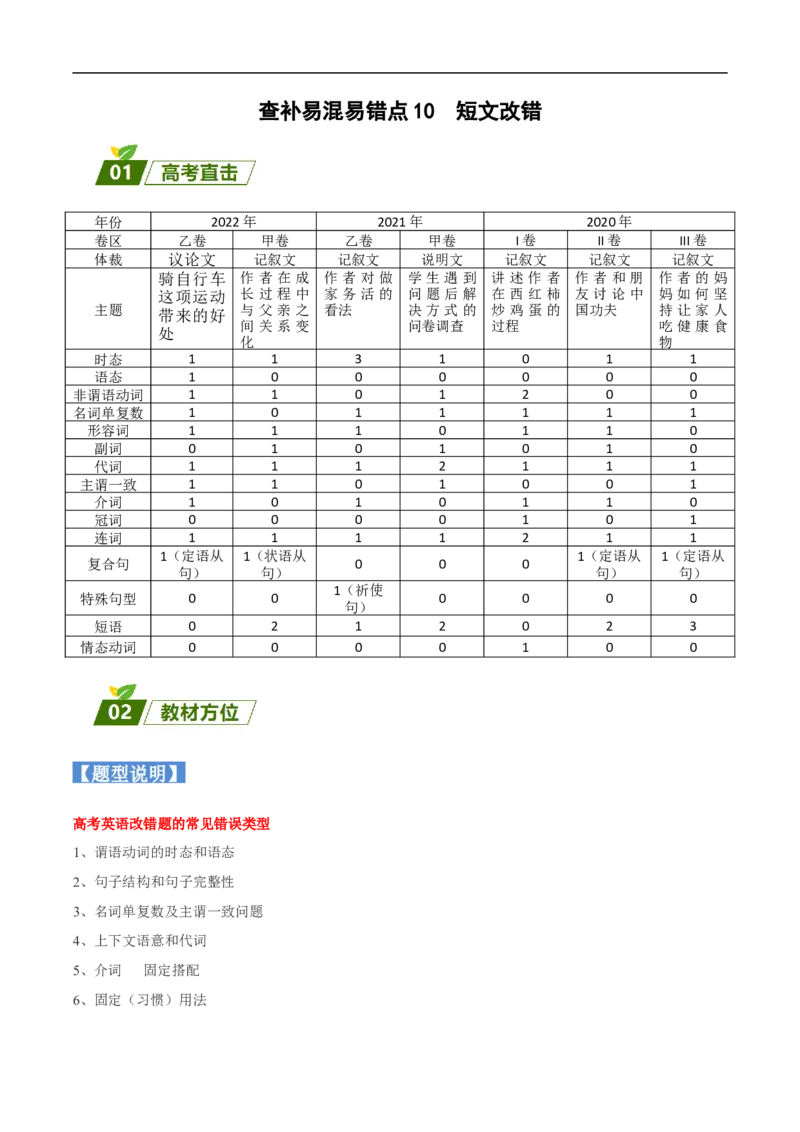
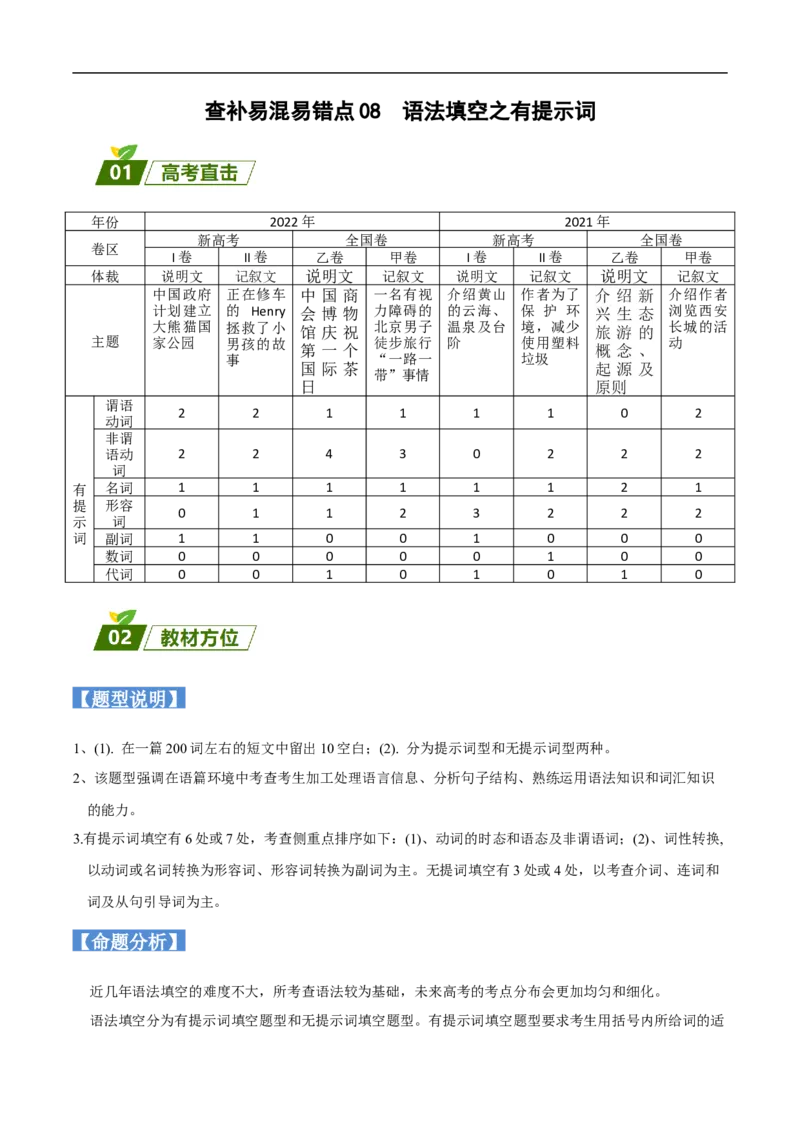
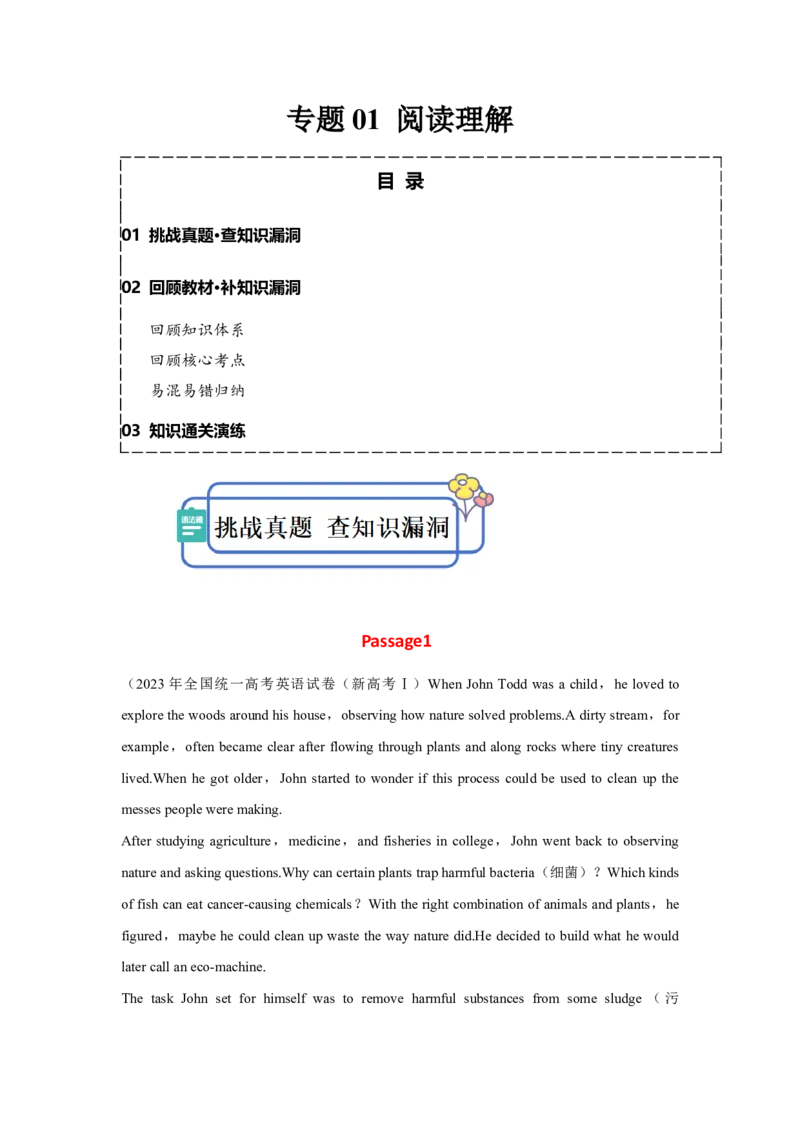
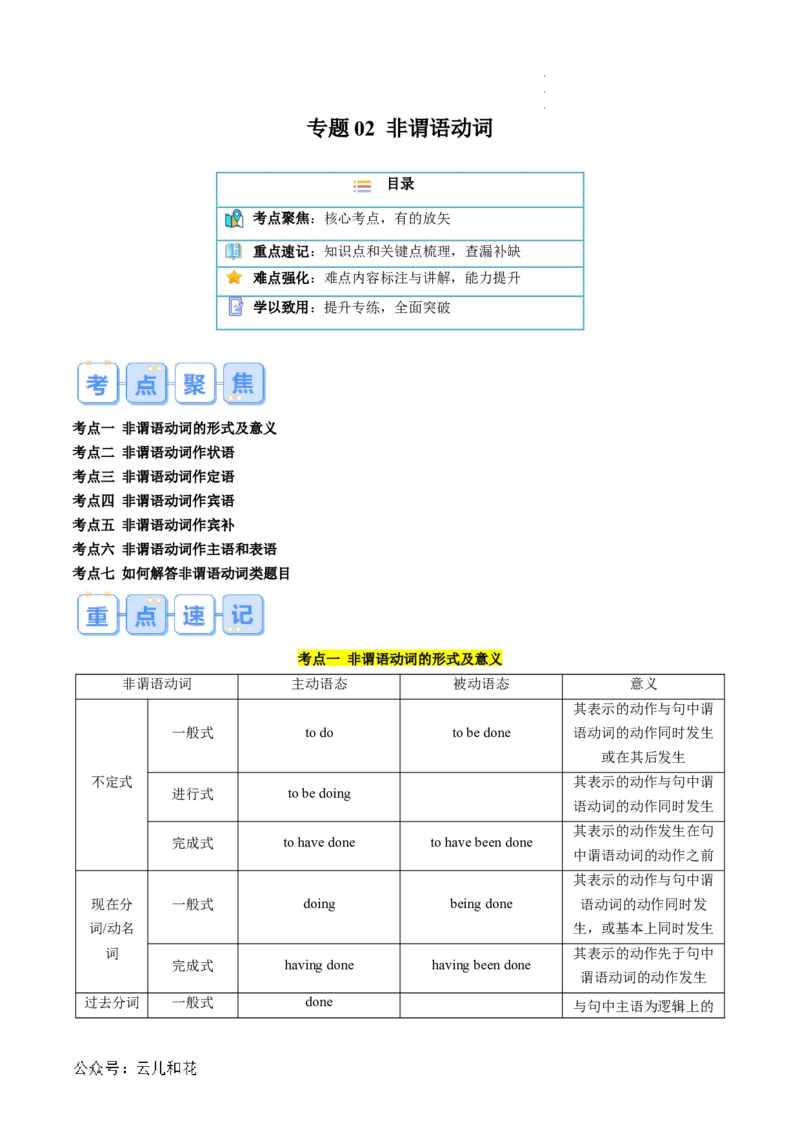
专题 04 非谓语
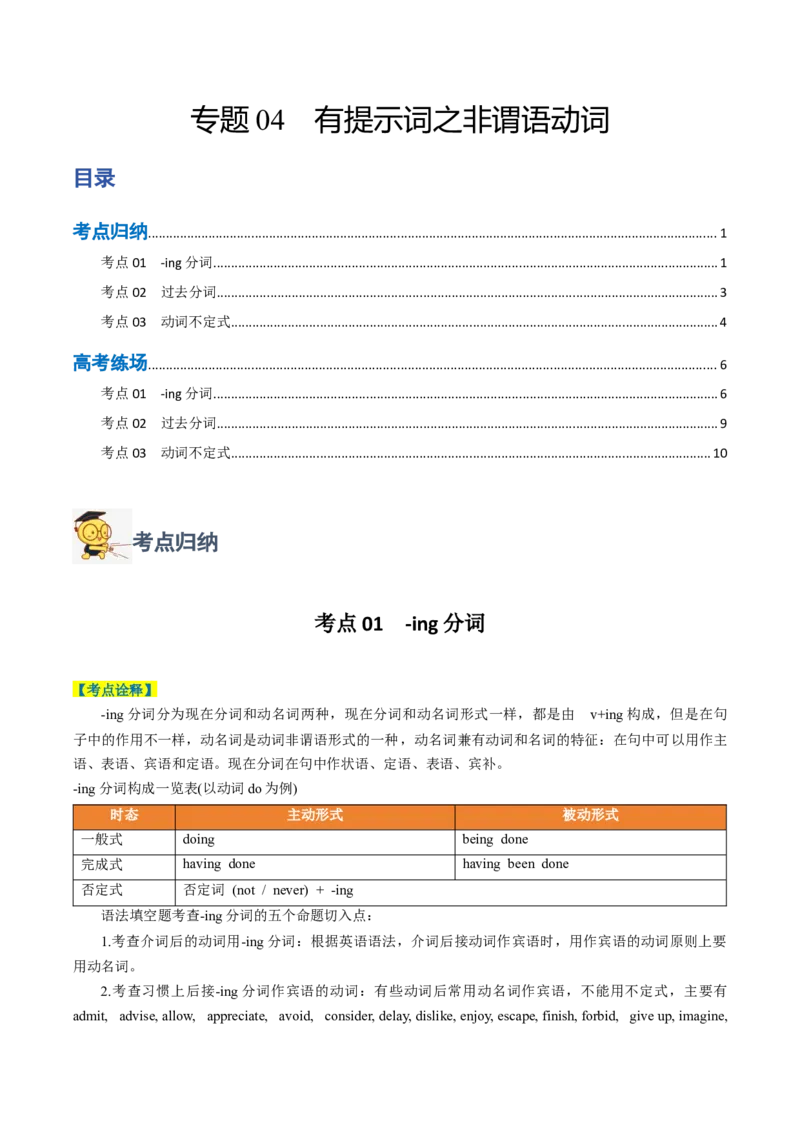
目 录
01 挑战真题·查知识漏洞
02 回顾教材·补知识漏洞
回顾知识体系
回顾核心考点
易混易错归纳
03 知识通关演练
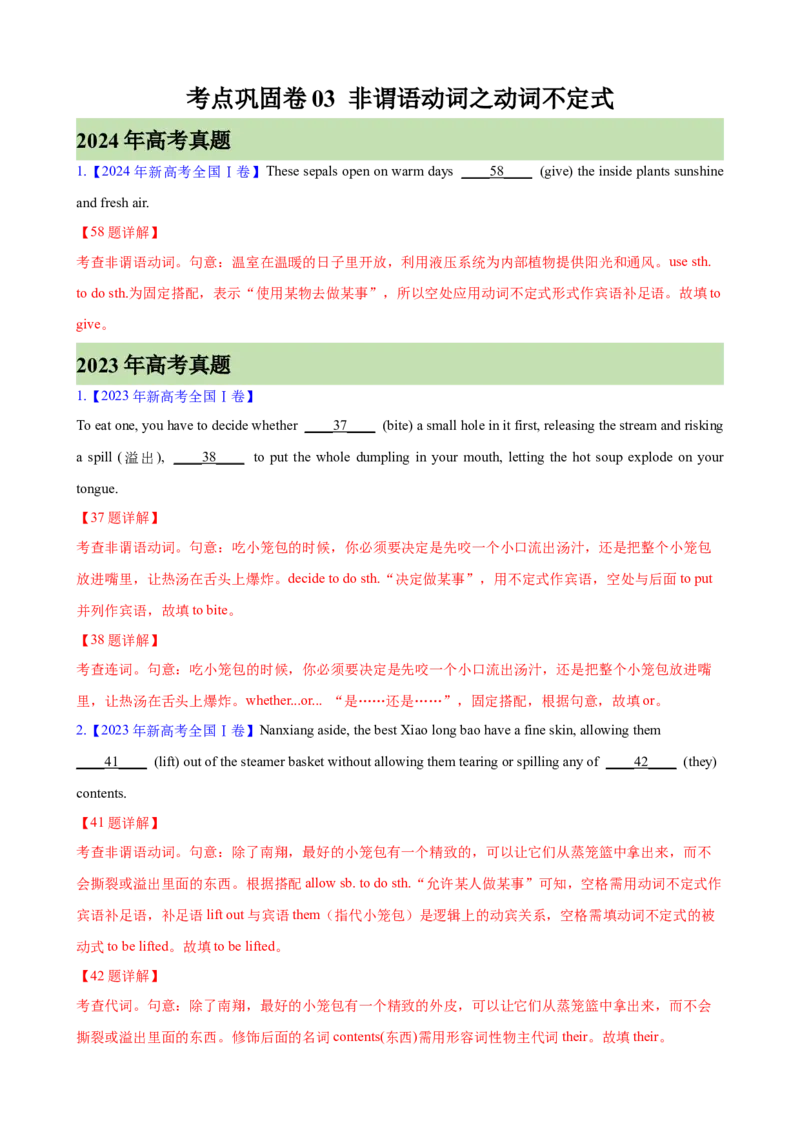
1.(2023年新高考I卷)Nanxiang aside, the best Xiao long bao have a fine skin, allowing
them ________ (lift) out of the steamer basket without tearing or spilling any of their
contents.
【答案】to be lifted
【详解】考查非谓语动词。根据搭配allow sb to do sth.允许某人做某事,空格需用动词
不定式作宾语补足语,补足语与宾语是逻辑上的动宾关系,空格需填动词不定式被动形
式to be lifted。句意:最好的小笼包外皮很薄,从蒸笼中被取出来时不会撕裂或洒出任
何东西。
2.(2023年新高考 I卷)No matter where I buy them, one steamer is rarely enough, yet
two seems greedy, so I am always left ________(want) more next time.
【答案】wanting
【详解】考查非谓语动词。这句话中已有谓语动词 am left,所以want这个动词应该为非谓语动词作结果状语,want 与逻辑主语是 I 是主动关系,所以空格用现在分词
wanting。句意:无论我在哪里买,一笼都不够,两笼又显得太贪心了,所以我总是想
下次再买。
3.(2023 年新高考 II 卷)They talk to the flood of international tourists and to _________
(visit) Chinese zookeepers who often come to check on the pandas, which are on loan from China.
【答案】visiting
【详解】考查分词形容词。句意:他们与蜂拥而至的国际游客和来访的中国动物园管理员
交谈,这些管理员经常来检查从中国租借来的大熊猫。分析句子结构可知,空后是名词,
所以空处应填形容词作定语;visit对应的形容词为visiting“来访的”。故填visiting。
4.(2023全国甲卷)For thousands of years,people have told fables(寓言) 61 (teach)a
lesson or to pass on wisdom.
【答案】to teach
【解析】:考查非谓语动词。句意:几千年来,人们通过讲寓言来传授知识或传授智慧。
根据句意可知,此处表达“来传授知识和智慧”,所以用不定式作目的状语。故填
toteach。
5.(2023全国甲卷)There was once a town in the heart of America,where all life seemed to enjoy
peaceful existence with is surroundings,”her fable begins. (borrow) some familiar words
from many age-old fables.
【答案】borrowing
【解析】:考查非谓语动词。句意:“从前,在美国的中心地带有一个小镇,那里所有
的生命似乎都和周围的环境一起享受着和平的生活,“她的寓言是这样开头的,借用了
许多古老寓言中的一些熟悉的词。句中已有谓语词,所以用非谓语动词形式。逻辑主语
her fable与borrow之间为主动关系,所以用现在分词作状语。故填borrowing
6.(2023 全国甲卷)Behind the simple style,however,s a serious message (intend) for
everyone.
【答案】:intended
【解析】:考查非谓语动词。句意:然而,在简洁的风格背后,是每个人都想要传达的
重要信息。Be intended for打算为....所用,在句中作定语,所以用过去分词形式。故填
intended。
7.(2023全国乙卷)From Buddhist temples to museums,narrow hutong to royal palaces,it is home
to morethan3,000years of glorious history even down to its layout, with the city keeping itscarefully (build) system of ring roads.
【答案】built
【解析】:考查非滑语动词。句意:从佛教寺庙到博物馆,狭窄的胡同和皇家宫殿,它
是3000多年辉煌历史的家园,即使是在它的布局上,这座城市也保持着精心建造的环
城公路系统。这里为非谓语动词担当定语,表示精心建造的....",和被修饰词“system
of ring roads"之间为被动关系,用过去分词。故填built
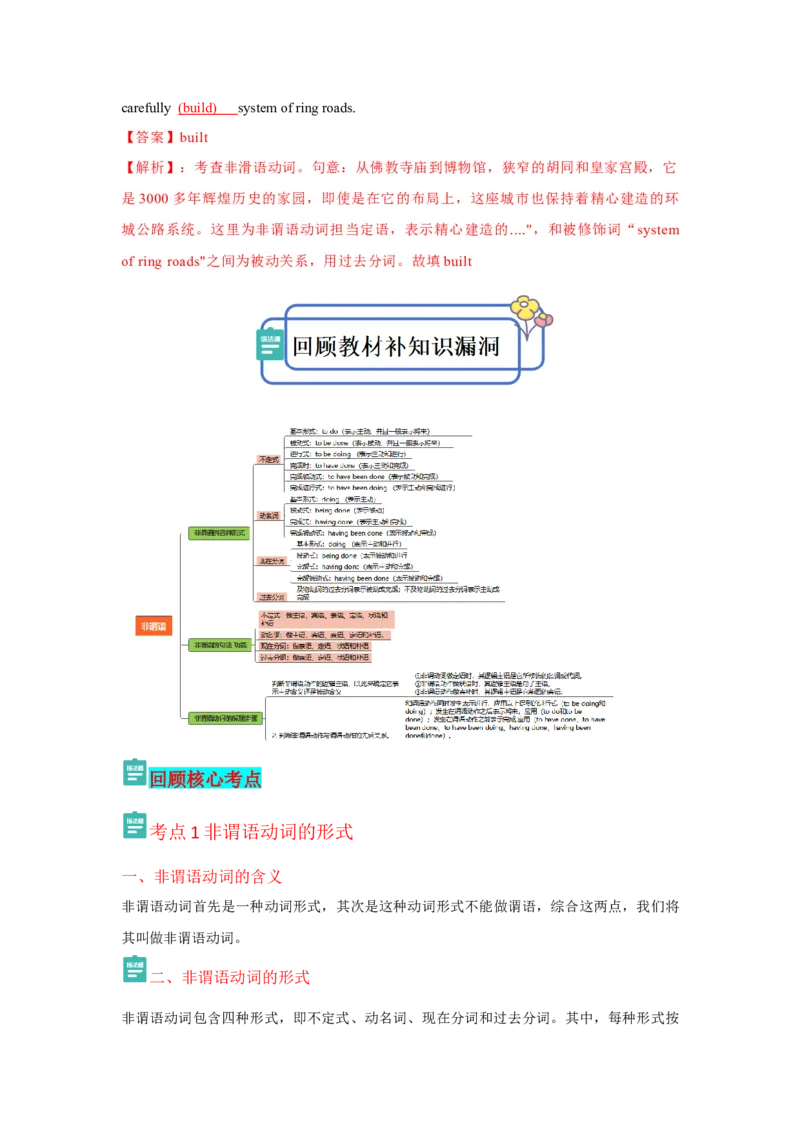
回顾核心考点
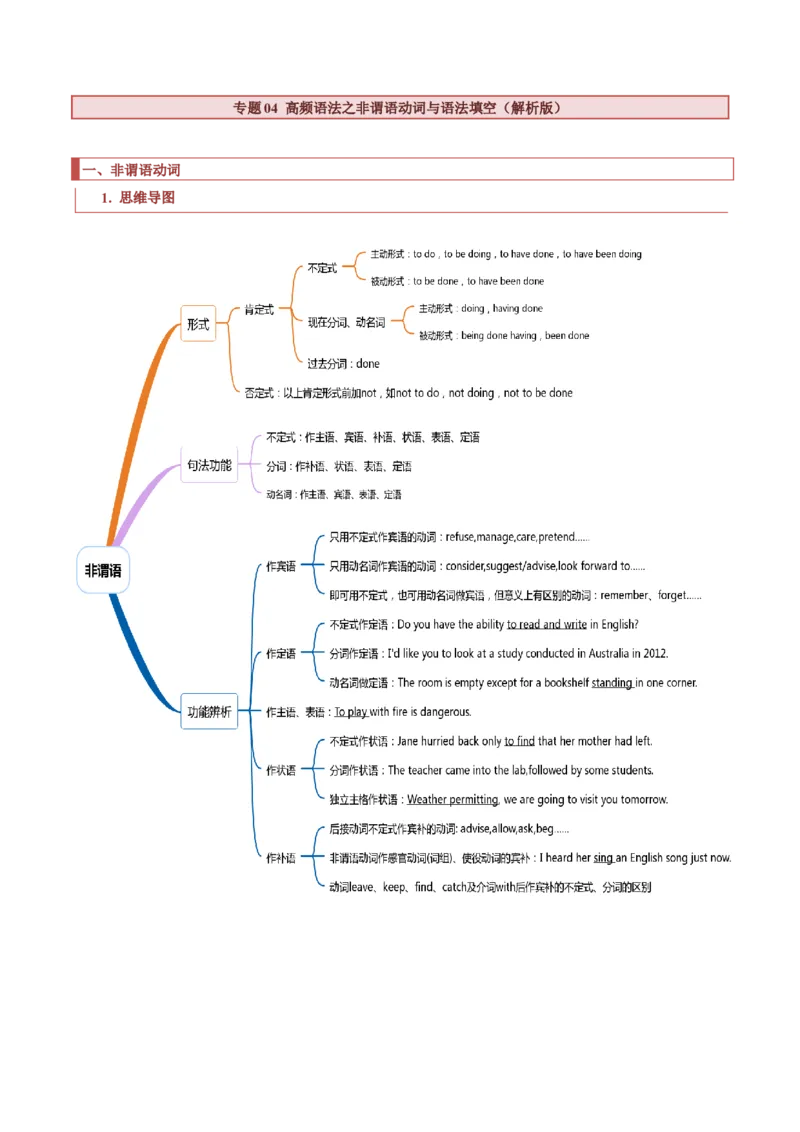
考点1非谓语动词的形式
一、非谓语动词的含义
非谓语动词首先是一种动词形式,其次是这种动词形式不能做谓语,综合这两点,我们将
其叫做非谓语动词。
二、非谓语动词的形式
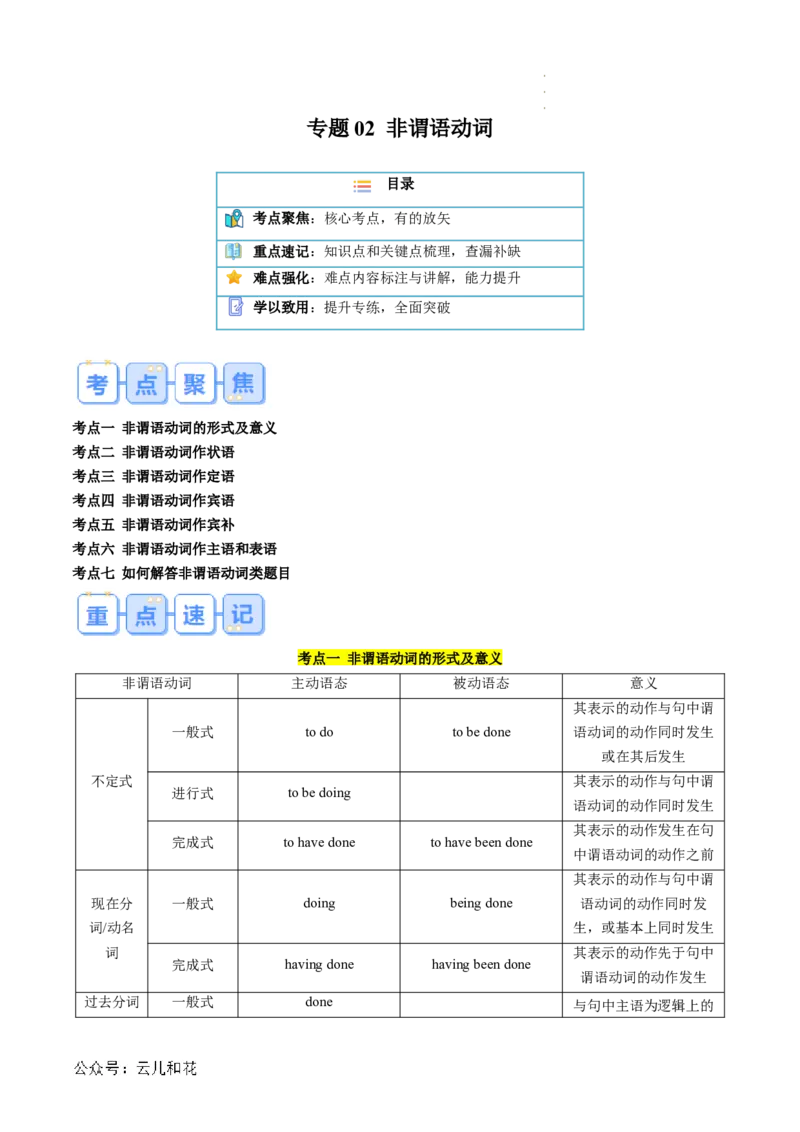
非谓语动词包含四种形式,即不定式、动名词、现在分词和过去分词。其中,每种形式按照发生时间和主被动又包括不同的子形式。具体如下:
1.不定式
①基本形式:to do(表示主动,并且一般表示将来)
②被动式:to be done(表示被动,并且一般表示将来)
③进行式:to be doing (表示主动和进行)
④完成时:to have done(表示主动和完成)
⑤完成被动式:to have been done(表示被动和完成)
⑥完成进行式:to have been doing (表示主动和完成进行)
The teacher told us to do morning exercises. 老师让我们做早操。
The car to be bought is for his sister. 要买的这辆车是给他的姐姐的。
She pretended to be reading when the teacher came into the classroom. 老师进来时,她假装正
在读书。
The thief is said to have escaped. 据说小偷已经逃跑了。
The thief is said to have been arrested. 据说小偷已经被抓住了。
She is said to have been working in the factory over the last 20 years. 据说在过去的20年里,
她一直在这家工厂工作。
2. 动名词
①基本形式:doing (表示主动)
②被动式:being done(表示被动)
③完成式:having done(表示主动和完成)
④完成被动式:having been done(表示被动和完成)
Travelling in space by ordinary people will be common in the future. 在未来,普通人在太空旅
行将会是普遍的事情。
Freddy and his band could go nowhere without being followed by their fans. Freddy 和他的乐队
到哪里都被他们的粉丝跟着。
I have no idea of his having done such a thing against you. 我不知道他做过这样一件违背你的
事情。
Many customers complain of having been given short weight at that shop. 很多顾客抱怨在那家
商店被缺斤少两过。3. 现在分词
①基本形式:doing (表示主动和进行)
②被动式:being done(表示被动和进行)
③完成式:having done(表示主动和完成)
④完成被动式:having been done(表示被动和完成)
He sat there,reading a newspaper. 他坐在那里,读着一张报纸。
The area being studied may be rich in coal. 这个正在被研究的地方可能富含煤。
Having finished my homework,I began to watch TV. 完成作业后,我开始看电视。
Having been told many times,she still can't remember it. 已经被告诉了很多次,她仍然记不
住。
4. 过去分词:done
及物动词的过去分词表示被动或完成;不及物动词的过去分词表示主动或完成。
polluted river 被污染的河流;fallen leaves 落叶
注意:非谓语动词本身不能表示现在和过去。非谓语动词表示进行、将来和完成时是相对
于谓语动作来说的。和谓语动作同时发生表示进行;发生在谓语动作之后表示将来;发生
在谓语动作之前表示完成。
三.非谓语动词的句法功能
一).填非谓语动词时要填不定式to do的情况:
1.主语: It is/was+adj./n.+for/of sb. to do sth.
It takes/took sb. some time to do sth.
2.宾语:①.有些动词只能用不定式作宾语:决心学会想希望,拒绝设法愿假装
decide/determine, learn, want, expect/ hope/wish; refuse, manage, care, pretend 主动答应选
offer, promise, choose, plan; agree, ask/beg, help
②. find/think/believe/consider/make/feel+it+adj./n.+to do sth.
3.表语:
不定式作表语多表示某一次具体的特定的或有待实现的动作(aim, dream, plan, purpose等后)
4.定语:
①.不定式作定语表示将来的动作;②.不定式用来修饰被序数词、最高级或only, next等修饰的中心词,且与中心词为逻辑上的
主动关系;
③.下列名词或代词,常用不定式作定语。ability, chance,opportunity, plan, attempt, way,
something, idea, hope, wish, fact, excuse, promise等。
5.状语:
①.作目的状语。表示“为了”,可以单独放在句首、句中或句末。如果强调目的性,不定
式前也可加in order或so as,但so as to不能置于句首。2.作结果状语。不定式作结果状语
常表示令人意外的结果,有时前面加only,以加强语气。
only to do 表示意想不到的结果 enough to do 足够做……too ... to do 太……而不
能……so/such ... as to ... 如此……以至于……
②.作原因状语。表示喜、怒、哀、乐等的形容词作表语时,后可接不定式作原因状语,用
以说明产生这种心理活动或情绪的原因,常用于这类结构的形容词有 sorry, surprised,
disappointed, excited, glad, happy, anxious, delighted, pleased, foolish等。
6.宾语补足语:
①.在很多动词后都可以用不定式作宾语补足语,如:ask, want, invite, get, force, expect, allow,
persuade, order, warn, remind, prefer, cause, permit, forbid, advise, teach等。
②.下列动词(短语)接省略to的动词不定式作宾语补足语:一感 (feel),二听(hear, listen
to),三使(let,have, make),五看 (see, notice, observe, watch, look at),半帮助 (help),但
在变为被动语态时需加to。
7.动词不定式的时态和语态的构成和用法
形式 意义 主动语态 被动语态
一般式:与句子谓语动词的动作同时发生或在谓语动词的动作之后发生to do to be done
进行式 在谓语动词的动作发生时正在进行 to be doing —
完成式 在谓语动词的动作之前发生 to have done to have been done
二) 填非谓语动词时要填动名词v-ing的情况:
1.主语:单个动名词短语作主语时,谓语动词用三单形式;
It is/was a waste (of ...)/no use/no good doing sth.
2. 表语: 动名词作表语表示通常的情况,多指抽象的、经常性的动作;
3.定语: 动名词可置于名词前作定语,表示被修饰的名词的用途、性能或目的。
4.宾语:(1) 介词 + v -ing (注意to为介词的情况);
(2) 下列动词(短语)只能用动名词作宾语:考虑建议盼原谅,承认推迟没得想 consider, sug
gest/advise, look forward to, excuse/pardon; admit, delay/put off, fancy避免错过继续练,否认
完成就avoid, miss, keep/keep on, practice; deny, finish, enjoy/appreciate
禁止想象才冒险,不禁介意准逃亡 forbid, imagine, risk; can't help (禁不住), mind, allow/per
mit, escape
(3)既可以接动名词作宾语,也可以接不定式作宾语,但意义上有区别:forget, remember,
regret, mean, try, stop, go on
三).填非谓语动词时要填分词的情况:
1.状语:分词作状语时,其逻辑主语是句子的主语,一般在句中作时间、原因、结果、方
式、条件、伴随、让步等状语。
2.表语:表示心理状态的动词-ing形式的形容词,意为“令人……的”;动词-ed形式的形
容词,意为“(人)感到……的”,也可修饰体现内心感受的 look,expression,tears,
smile,voice等名词。
On hearing the exciting news,she shouted in an excited voice.
3.定语:现在表主动 进行
4.宾语补足语:
①.现在分词作宾语补足语表示主动、进行
常用现在分词作宾语补足语的词语有feel,find,hear,notice,observe,see,watch,get,
have,keep,leave,send,set,listen to,look at等。
②.过去分词作宾语补足语表示被动、完成
常用过去分词作宾语补足语的动词有have,make,get,find,see,notice,watch,hear,
feel,want,like等。 I will have my bike repaired tomorrow.
③现在分词的时态和语态的构成和用法
形式 意义 主动语态 被动语态
一般式 与谓语动词的动作同时发生 doing being done
完成式 先于谓语动词的动作完成 having done having been done
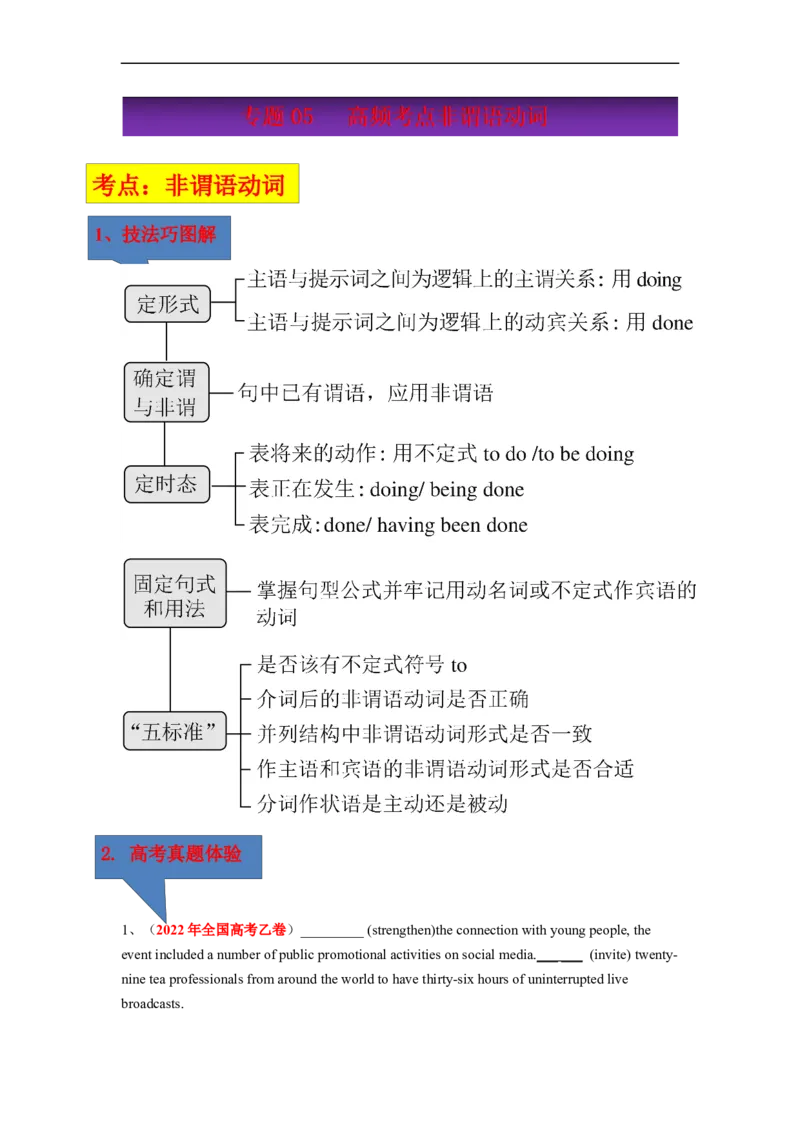
三.总结:提示词为动词考非谓语动词的策略
1.分析非谓语动词发生的时间以及非谓语动词与其逻辑主语的关系
(1)若非谓语动词与逻辑主语之间是主谓关系, 且正在进行,要想到用现在分词形式(doing);
(2)若非谓语动词与逻辑主语之间是动宾关系,且表完成, 要想到用过去分词形式(done);
(3)若非谓语动词表将来的动作,或作目的状语,或跟在表示喜怒哀乐的形容词后表示原因
或意料之外的结果等, 要想到用不定式形式(to do)。
2.掌握非谓语动词的固定句式结构
(1)It's+形容词+(for/of sb.+)to do sth.;
It takes/took sb. some time to do sth.
(2)It's no good/use/pleasure doing sth.;
(3)find/think/believe/consider+it+adj.+to do sth.;
3.牢记后跟非谓语动词的特定动词
(1)牢记用动名词或不定式作宾语的动词;
(2)牢记用动词不定式或分词作补足语的动词。
(3)既可以接动名词作宾语,也可以接不定式作宾语,但意义上有区
别:forget, remember, regret, mean, try, stop, go on
4.非谓语动词作定语
(1)现在分词作定语,表示动作主动,正在进行,若表示”正在被……”则用being done.
(2)过去分词作定语表示被动,完成。
(3)当名词被形容词最高级,序数词(the first, the last 等)修饰时,用to do作定语
(4)抽象名词ability, plan, chance, promise, wish, opportunity,
responsibility 等后常用ability, plan, chance, promise, wish,
opportunity,responsibility作后置定语。
5. 非谓语动词作宾补
(1)常用不定式作宾补的动词有: tell, order, allow, permit, enable, persuade, force, warn,
encourage, ask, invite, expect. 感官动词和使役动词后的不定式作宾补,在主动语态中要省略
不定式的符号to, 但在被动语态中to要还原。
(2)现在分词作宾补,表主动,进行。常接现在分词作宾补的动词有感官动词和使役动词,
但注意,have/leave sb doing sth 译为“让宾语一直做……”。
(3)过去分词作宾补,被动,完成
(4)with +O+OC to do 将来,目的
with +O+OC doing 进行,主动
with +O+OC done 完成,被动6.非谓语动词作状语
(1)分词作状语,要与主句保持逻辑主语一致
(2)现在分词作状语,现在分词与句子主语是主动关系,可以表伴随原因, 时间或条件,
表示意料之中的结果,用 doing, 若表示分词的动作发生在谓语动词之前,则用 having
done.
(3)过去分词作状语,过去分词与句子主语是被动关系
(4)不定式作状语可以表目的, only to do 表示意料之外的结果, 形容词或过去分词作表语
时,后接to do 作状语常见的形容词有: happy, lucky, anxious, proud, disappointed, surprised,
delighted, foolish, pleased, fortunate 等, 主系表+to do ,用 主动表被动
1.The plan will extend protection to a significant number of areas that were previously
unprotected, bringing many of the existing protected areas for giant pandas under one
authority ___________(increase)effectiveness and reduce inconsistencies in management.
答案:to increase
解析:考查非谓语动词。句意:该计划将把保护范围扩大到大量以前未受保护的地区,将
许多现有的大熊猫保护区纳入一个管理机构,以提高效率,减少管理上的不一致性。设空
处在句中作非谓语,做目的状语,应用动词的不定式的形式。故填to increase。
2.A visually-challenged man from Beijing recently hiked (徒步) 40 days to Xi’an, as a first
step ___________ (journey) the Belt and Road route (路线) by foot.
答案:to journey
解析:考查非谓语动词。句意:近日,一名来自北京的盲人徒步 40天来到西安,作为“一
带一路”徒步旅行的第一步。分析句子结合句意可知,journey为动词,表示“旅行”,
step前面有序数词,应用不定式,作后置定语。故填to journey。
3.Inspired by the Belt and Road Forum for International Cooperation ___________ (hold) in
Beijing, Cao decided to cover the route by hiking as a tribute (致敬) to the ancient Silk Road.
答案:held
解析:考查非谓语动词。句意:受到在北京举行的“一带一路”国际合作高峰论坛的启发曹决定徒步穿越这条路线,以向古代丝绸之路致敬。分析句子可知,本句已有谓语动词
decided,所以hold应用非谓语动词形式,hold与cooperation之间为逻辑动宾关系,应用过
去分词,作后置定语,表被动。故填held。
4.He flew 4, 700 kilometers from Xi’an to Kashgar on Sept. 20, __________ (plan) to hike back
to Xi’an in five months.
答案:planning
解析:考查非谓语动词。句意:9月20日,他从4700公里外的西安飞到了喀什,计划在五
个月内徒步回到西安。分析句子可知,已有谓语动词 flew,所以动词plan(计划)应用非谓
语动词形式,plan 与主语 He 之间为逻辑主谓关系,应用现在分词,表主动。故填
planning。
5.__________ (strengthen)the connection with young people, the event included a number of
public promotional activities on social media, __________ (invite) twenty-nine tea professionals
from around the world to have thirty-six hours of uninterrupted live broadcasts.
答案:to strengthen; inviting
解析:考查非谓语动词。第一空:句意:为了加强与年轻人的联系,活动包括在社交媒体
上的一系列公共宣传活动,邀请了来自世界各地的29名茶叶专业人士进行36小时不间断
的直播。根据句意可知,此处表达“为了加强与年轻人的联系”,需要用不定式作目的状
语。故填To strengthen。第二空:句意:为了加强与年轻人的联系,活动包括在社交媒体
上的一系列公共宣传活动,邀请了来自世界各地的29名茶叶专业人士进行36小时不间断
的直播。此处为非谓语动词,逻辑主语the event与invite之间为主动关系,所以用现在分
词作状语。故填inviting。
6.That approach brought Cobb's air travel last year down by 75%, and she plans ____________
(continue) the practice. "It has been fairly rewarding. ", she says, "a really positive change."
答案:to continue
解析:考查动词不定式。句意:他打算继续这个实践。动词plan后面跟动词不定式,plan
to do sth“计划做”,故填to continue。
7.Henry Tyler made the catch of the year on the weekend. When he saw a young child hanging
from a sixth-floor apartment balcony (阳台), Henry ran one hundred metres, jumped over a 1. 2-
metre fence, and held out his arms to catch the ___36___ (fall) child.
答案:falling解析:考查非谓语动词。句意:当亨利看到一个小男孩挂在六楼公寓的阳台上时,他跑了
100米,跳过了1. 2米高的栅栏,伸出双臂去接要掉下来的孩子。句中的hold out为谓语动
词,设空处应该使用非谓语动词。根据句意,fall为动词,意为“掉落”, child和fall之
间是主动关系,同时表示正在进行的含义。故应该使用现在分词作定语。故填falling。
1. (2024·全国·二模)The Chinese zodiac, also known as Sheng Xiao or Shu Xiang, is a 1
(repeat) circle of 12 years.
【解析】考查非谓语动词。句意:中国的十二生肖,也被称为“生肖”或“属相”,是一
个重复的12年循环。空处需填非谓语动词作定语,此处表示十二生肖的周而复始,circle
是repeat这一动作的发出者,二者为逻辑主谓关系,需用现在分词形式。故填repeat
2.(2024·河南濮阳·一模)A video capturing (拍摄) Peng’s heroics went popular 15
instant it appeared on Chinese social media, 16 (make)him get much attention from the
public.
【解析】考查现在分词。句意:同上。分析句子可知,空格处应填入非谓语动词作状语。
根据句意,此处是结果状语,且表示自然而然的结果,故用现在分词。故填making。
3.(2024·山东青岛·一模)Chinese Loong is the fifth animal of the 12-year Chinese zodiac
cycle, 21 (consider) to be mythical and symbolic of fortune
【解析】考查非谓语动词。句意:龙是中国12年生肖周期中的第五只动物,被认为是神话
和财富的象征。分析句子结构可知,已有谓语动词is,空处需填非谓语动词,Chinese
Loong和consider为逻辑动宾关系,需用过去分词形式。故填considered。
4.(2024·山东青岛·一模)a research fellow said, 30 (stress) that Spring
Festival is the traditional festival Chinese people attach the most importance to, and it’s also a
peak season for consumption.
【解析】考查非谓语动词。句意同上。分析句子结构可知,已有谓语动词said,空处需填
非谓语动词,作状语,a research fellow和stress为逻辑主谓关系,需用现在分词形式。故
填stressing。5.(2024·黑龙江·二模)39 (promote) rural vitalization (振兴) further, villages in Anji
have widely adopted a model called “Two investments and three returns”
【解析】考查非谓语动词。句意:为了进一步推进乡村振兴,安吉村广泛采用“两投三
酬”模式,即居民和村庄共同投入资金和资源,通过合作公司或创业团队经营,获得租金、
工资和分红。非谓语动词担当目的状语,用动词不定式形式;出现在句首,首字母大写。
故填To promote。
6.(2024·江苏·一模)a piece in the NMC’s collection from the Eastern Han Dynasty, 42
play presented a fantasy “dialogue” between the ancient ceramic (陶瓷的) figures and the
audience while 43 (integrate) art forms such as drama, musical and opera.
【解析】考查非谓语动词。句意参考上题。while引导时间状语从句,从句中省略了和主句
一致的主语。逻辑主语play和integrate之间是主谓关系,所以应用现在分词。故填
integrating。
7.(2024·江苏·一模)the NMC’s Ancient China exhibition hall often lead visitors 46
(impress) by ancient Chinese civilization.
【解析】考查非谓语动词。句意参考上题。lead sb. to do sth.意为“让某人做某事”,不定
式作宾补,逻辑主语visitors和impress之间是动宾关系,所以这里应用不定式的被动形式。
故填to be impressed。
8.(2024·江苏·一模) 49 they can also help visitors better relate to 50
(hide) cultural meanings.
【解析】考查非谓语动词。句意参考上题。分析句子结构,空处应用非谓语动词。逻辑主
语cultural meanings和hide之间是动宾关系,所以这里应用过去分词,作定语。故填
hidden。
9.(2024·安徽合肥·一模) People had to fetch water from five kilometers away every day.
55 (ease) this area’s water shortages, the local government decided to construct a canal across
the mo
【解析】考查非谓语动词。句意:为了缓解这一地区的缺水问题,当地政府决定在山区修
建一条运河,这是一项了不起的工程成就。分析句子结构可知ease在句中作目的状语,应
用不定式,首字母大写。故填To ease。
10.(2024·安徽·一模)The Analects of Confucius (《论语》) records the words and deeds of
the ancient Chinese philosopher Confucius, 81 (write) somewhere between the Springand Autumn Period and the Warring States Period more than 2,000 years ago.
【解析】考查非谓语动词。句意:《论语》记载了中国古代哲学家孔子的言行,成书于
2000多年前的春秋战国时期。分析句子可知,空处作The Analects of Confucius的非限制性
后置定语,write“编写”和The Analects of Confucius逻辑上是被动关系,且动作已完成,应
用write的过去分词形式。故填written。
11.(2024·湖北·二模)Between 121 BC and 111 BC, Emperor Wu set up four counties to the
west of the Yellow River, Jiuquan, Wuwei, Zhangye and Dunhuang 91 (expand) the
influence of the Han central government and develop ties with countries in XiYu (西域)
【解析】考查非谓语动词。句意:公元前121年至公元前111年,汉武帝在黄河以西设立
酒泉、武威、张掖和敦煌四郡,以扩大汉中央政府的影响力,并发展与位于玉门关以西的
西域国家的联系。此处用动词不定式结构作目的状语。故填to expand。
12.(2024·广东广州·二模)Chinese tea falls into six categories, namely green tea, white tea,
yellow tea, oolong tea, black tea and dark tea, 56 (base) on different production methods and
fermentation (发酵) degrees.
【解析】考查非谓语动词。句意:根据不同的生产方法和发酵条件,中国茶可以分为五类
即绿茶、白茶、黄茶、乌龙茶和红茶。“以……为基础”表达为 be based on,作状语,故
用过去分词based,故填based。
13.(2023·浙江丽水·三模) 101 (note)China’s achievements of green development in
urban and rural areas, Zhang Xiaohong, vice minister of housing and urban-rural development,
stressed the difficult task of saving energy and reducing carbon emissions in urban and rural
construction at a press conference on Monday.
【解析】考查非谓语动词。句意:住房和城乡建设部副部长张晓红在周一的新闻发布会上
提到了中国在城乡绿色发展方面取得的成就,强调了在城乡建设中节能减排的艰巨任务。
分析句子可知,句中已有谓语动词,设空处在句中只能用非谓语动词形式,逻辑主语
Zhang Xiaohong与动词note之间为主动关系,应用现在分词,整个分词短语作状语,设空
处位于句首,需首字母大写。故填Noting。
14.(2024·广东佛山·二模)“Addressing the issue requires multi-sectoral and interdisciplinary
cooperation, making full use of cutting-edge technology and jointly 70 (develop) risk
prevention and response plans,” he adds.
【解析】考查非谓语动词。句意:“解决这个问题需要多部门和跨学科的合作,充分利用尖端技术,共同制定风险预防和应对计划,”他补充说。本句谓语为requires“需要”,此
处为非谓语动词,应用 develop“研制”的动名词,multi-sectoral and interdisciplinary
cooperation、making full use of cutting-edge technology 和 jointly developing risk prevention
and response plans一起作requires的宾语。故填developing。
15.(2024·广东广州·二模) Since the Tang Dynasty, Chinese tea has made its way to the
world, through the Ancient Tea Horse Road and the Ancient Silk Road, 53 (shape) different
tea drinking customs and cultures along the way.
【解析】考查非谓语动词。句意:自唐代以来,中国茶就走向了 世界,通过古代茶马道
和古丝绸之路,沿途形成了不同的饮茶风俗和文化。此处作结果状语,是前文“Chinese
tea has made 2 way to the world, through the Ancient Tea Horse Road and the Ancient
Silk Road,”的自然而然的结果,故应用现在分词作结果状语,故填shaping。