文档文本内容
Unit 5 Poems
目标导航
重点词汇 阅读单词
1.rhythm n.
2.nursery adj.
3.mockingbird n.
4.brass n.
5.billy goat n.
6.bull n.
7.bee n.
8.dewdrop n.
9.dawn n.
10.clover n.
11.butterfly n.
12.lawn n.
13.cinquain n.
14.tease vi.& vt.
15.haiku n.
16.syllable n.
17.blossom n.
18.await vt.
19.revolve vi.
20.utter vt.
21.cherry n.
22.cherry blossom
23.verse n.
24.prose n.
25.dominant adj.
26.sonnet n.
27.barren adj.
28.grief n.
29.Shakespeare
重点单词
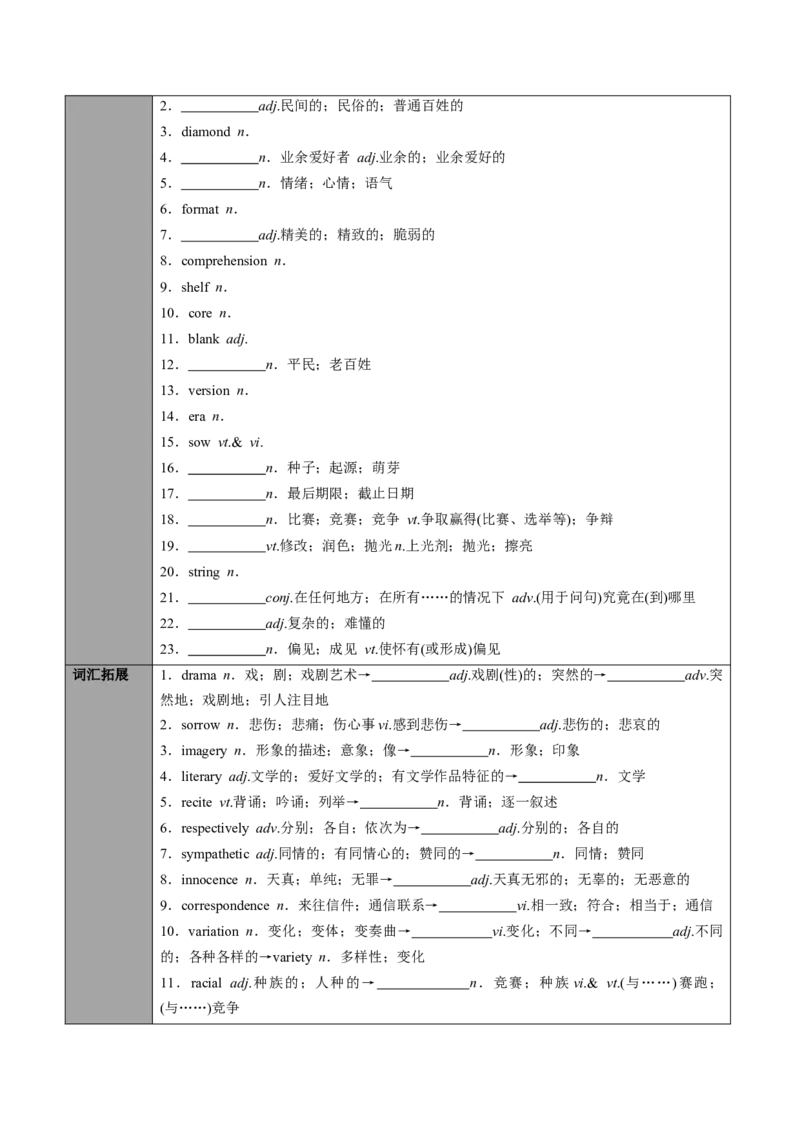
1.rhyme n.2. adj.民间的;民俗的;普通百姓的
3.diamond n.
4. n.业余爱好者 adj.业余的;业余爱好的
5. n.情绪;心情;语气
6.format n.
7. adj.精美的;精致的;脆弱的
8.comprehension n.
9.shelf n.
10.core n.
11.blank adj.
12. n.平民;老百姓
13.version n.
14.era n.
15.sow vt.& vi.
16. n.种子;起源;萌芽
17. n.最后期限;截止日期
18. n.比赛;竞赛;竞争 vt.争取赢得(比赛、选举等);争辩
19. vt.修改;润色;抛光n.上光剂;抛光;擦亮
20.string n.
21. conj.在任何地方;在所有……的情况下 adv.(用于问句)究竟在(到)哪里
22. adj.复杂的;难懂的
23. n.偏见;成见 vt.使怀有(或形成)偏见
词汇拓展 1.drama n.戏;剧;戏剧艺术→ adj.戏剧(性)的;突然的→ adv.突
然地;戏剧地;引人注目地
2.sorrow n.悲伤;悲痛;伤心事vi.感到悲伤→ adj.悲伤的;悲哀的
3.imagery n.形象的描述;意象;像→ n.形象;印象
4.literary adj.文学的;爱好文学的;有文学作品特征的→ n.文学
5.recite vt.背诵;吟诵;列举→ n.背诵;逐一叙述
6.respectively adv.分别;各自;依次为→ adj.分别的;各自的
7.sympathetic adj.同情的;有同情心的;赞同的→ n.同情;赞同
8.innocence n.天真;单纯;无罪→ adj.天真无邪的;无辜的;无恶意的
9.correspondence n.来往信件;通信联系→ vi.相一致;符合;相当于;通信
10.variation n.变化;变体;变奏曲→ vi.变化;不同→ adj.不同
的;各种各样的→variety n.多样性;变化
11.racial adj.种族的;人种的→ n.竞赛;种族 vi.& vt.(与……)赛跑;
(与……)竞争重点词组 1.nursery rhyme
2.be made up of
重点句型 1.There are various reasons people compose poetry.
人们创作诗歌有各种各样的原因。
2.The reason is .
原因是他们能感觉到爱的温暖、享受童年的纯真。
3.Tagore was in Literature.
泰戈尔是第一个获得诺贝尔文学奖的亚洲人。
4. ,I should know that the wind had been going there,too.
无论向哪里吹,我都知道风也曾去过那里。
知识精讲
知识点01 sorrow n.悲伤;悲痛;伤心事vi.感到悲伤
先练基础——单句语法填空
(1)Much my sorrow,all of my classmates teased my nursery rhyme,saying that it lacked rhythms.
(2)As a matter of fact,he daren’t look up to see her (sorrow) eyes.
•to one’s sorrow让某人悲伤的是
•sorrow at/for/over sth.对某事感到悲伤
•sorrowful adj.悲伤的
再提能力——完美写作·完成句子·背诵
(3)出席会议的人都对他的离世感到悲伤。
The people present at the meeting sorrowed over his death.
(4)悲伤的泪水顺着脸颊往下流,我紧紧地拥抱着父亲,说道:“我又失败了。”(with复合结构)
With tears of sorrow rolling down my cheeks,I hugged my father tightly,saying,“I failed again.”
知识点2 mood n.情绪;心情;语气
先练基础——单句语法填空
(1)My two novels won the first prizes respectively in the contest,so I was a good mood.
(2)Having finished a string of things,I am in the mood (walk) on the lawn.
in a good/bad mood心情好/坏
be/feel in the mood for sth./to do sth.有心情做某事
be/feel in no mood for sth./to do sth.没有心情做某事再提能力——完美写作·完成句子·背诵
(3)简心情如此好,她几乎要跳起来,眼里噙满了喜悦的泪水。(读后续写之喜乐心理描写)
Jane was in such a good mood that she almost jumped up and tears of happiness filled her eyes.
知识点3 sympathetic adj.同情的;有同情心的;赞同的
先练基础——单句语法填空
(1)As a (sympathy) person,I have sympathy civilians and the homeless.
(2)To tell you the truth,I am in sympathy the way you polished the format of the article.
•be sympathetic to/towards...赞同某事;同情某人
•sympathy n.同情;赞成
have (no) sympathy for sb.(不)同情某人
in sympathy with...赞同/支持
with sympathy=sympathetically adv.同情地
再提能力——完美写作·一句多译·背诵
(3)Meredith太太同情穷人,因此每当她有时间的时候,她都会给他们带来食物和药品。
①Mrs Meredith was sympathetic towards/to the poor,so she would bring food and medicine to them whenever
she had time.(sympathetic)
②Mrs Meredith had sympathy for the poor,so she would bring food and medicine to them whenever she had
time.(sympathy)
知识点4 correspondence n.来往信件;通信联系
先练基础——一词多义
写出下列句子中correspond的汉语意思
(1)My brother frequently corresponds with literary amateurs,who prefer drama and prose.
(2)Your complicated account does not correspond with hers.
(3)The British job of Lecturer corresponds roughly to the US Associate Professor.
•in correspondence with与……有通信联系;与……一致
•correspond vi.相一致;符合;相当于;通信
correspond with sb.与某人通信
correspond to相当于……;类似于……
correspond with/to与……一致;符合
再提能力——完美写作·一句多译·背诵
(4)只有当你言行一致时,你才能和其他人建立更好的关系。
①You can make better relationships with others only when what you do corresponds with what you say.
②Only when what you do corresponds with what you say can you make better relationships with others.(用倒装句改写)
知识点5 不定式短语作后置定语
Tagore was the first Asian to win the Nobel Prize in Literature.
泰戈尔是第一个获得诺贝尔文学奖的亚洲人。
•句中不定式短语to win the Nobel Prize in Literature作后置定语,修饰the first Asian。
•英语中常用不定式短语作后置定语的情况:
①被修饰词为序数词、形容词最高级或被序数词、形容词最高级修饰时;
②抽象名词way,chance,ability,courage,opportunity,wish等后常用不定式作定语;
③被修饰词前有the only,the very,the next等词对其进行修饰时。
能力提升——完美写作·完成句子·背诵
(1)我能说一口流利的英语,我是班上第一个出国深造的学生。
I can speak fluent English and I am the first student in my class to go abroad for further study.
(2)我有能力使班级秩序井然,因为多年当班长的经验已经使我成为一个优秀的组织者。
I have the ability to keep the class in order because the experience of being a monitor for many years has made me
a brilliant organizer.
知识点6 wherever引导让步状语从句
Wherever it blew,I should know that the wind had been going there,too.
无论向哪里吹,我都知道风也曾去过那里。
•whenever,wherever,however引导让步状语从句,相当于no matter when/where/how。
•whatever,whoever,whichever,whomever既可引导名词性从句,也可引导让步状语从
句;在引导让步状语从句时相当于no matter what/who/which/whom。
•“no matter+疑问词”只能引导让步状语从句,可放在主句前或主句后。
能力提升——完美写作·完成句子·背诵
(1)无论你何时需要帮助,我真诚地希望你能毫不犹豫地联系我。
Whenever/No matter when you need help,I sincerely hope that you can get in touch with me without hesitation.
(2)无论我多么忙,每天我都会匀出一些时间帮助来自美国的交换生学习汉语,并且告诉他们更多的中国习
俗和传统。
However/No matter how busy I am,I will spare some time every day to help the exchange students from the USA
with Chinese and tell them more about our customs and traditions.
(3)任何人触犯法律都会受到惩罚。
Whoever breaks the law will be punished.
语法精讲定语从句
【观察例句】
1.Eric set sail once again,this time with 25 ships,of which only 14 made it to Greenland.
2.Eric reached Greenland and discovered that people could live in the place where he landed.
3.Biarni was the man with whom Leif discussed his plans.
4.By around 900AD,there were many places in Northern Europe where the Vikings chose to live.
【归纳用法】
一、限制性定语从句与非限制性定语从句概述
1.限制性定语从句是先行词不可缺少的一部分,若去掉,主句的内容就不完整,意义也会发生改变。从
句和先行词的关系十分密切,从句紧跟先行词,两者之间不可用逗号隔开。
She has found the necklace (that) she lost two weeks ago.
她找到了那条两周前丢失的项链。
2.非限制性定语从句是对先行词的补充说明。没有它,主句也能独立存在;非限制性定语从句和先行词
的关系不是很密切,两者之间用逗号隔开。
He has two sisters,who are working in the city.
他有两个姐姐,她们在城里工作。
[即学即练1] 单句语法填空
①The weather turned out to be very good, was more than we could expect.
②Is this the museum the exhibition was held?
二、限制性定语从句和非限制性定语从句的区别
1.标点的运用有所不同
限制性定语从句一般紧跟在先行词后,其后不可用逗号分开;而非限制性定语从句也常放在先行词
后,但必须用逗号与主句分开。
Who is the girl that is standing under the tree?
站在树下的那个女孩是谁?
He is a teacher of much knowledge,from whom much can be learned.
他是一个学识渊博的老师,从他那儿可以学到许多东西。
2.从句的作用不同
限制性定语从句对先行词起到修饰限制作用,是先行词在意义上不可缺少的定语,一旦省略,主句的
意思就不完整。而非限制性定语从句则是对一个概念清楚的先行词进行附加说明,若将其去掉,主句的意
思仍然完整。
The next day,my brother and I went to the beach where we watched some people play volleyball.
第二天,我和弟弟去了海边。在那里,我们看到一些人在打沙滩排球。
Alice received a letter from her former classmate,which came as a surprise.
艾丽斯收到了她以前同学的一封信,这真是件令人惊奇的事情。
3.关系词的选用不同
限制性定语从句可以用关系代词who,whom,whose,that,which,关系副词when,where,why等
引导,而非限制性定语从句不可用that或why来引导(上述引导词除了这两者以外均可用来引导非限制性定语从句)。
Yesterday he bought a new car,which was made in Japan.(which不可换用that)
昨天他买了一辆新车,是日本生产的。
He didn't give the reason,which explained his absence from the meeting held last week.(which 不可换用
why,因为which在定语从句中作主语,而why只能在定语从句中作状语)
=He didn't give the reason,for which he was absent from the meeting held last week.
他没有给出他上周没参加会议的理由。
4.从句所修饰的先行词有所不同
限制性定语从句的先行词通常是名词、代词或词组;而非限制性定语从句的先行词除了名词、代词
外,还可以是句子。
This is the best book that I have ever read.
这是我曾经读过的书中的最好的一本。
He won the first prize in the contest,which was more than we expected.
他在比赛中得了一等奖,这一点真出乎我们预料。
5.关系词的省略不同
在限制性定语从句中,当关系代词在定语从句中作宾语或表语时,在口语中可以省略,关系副词有时
也可省略。而非限制性定语从句中的关系代词或关系副词不可省略。
I still remember the days we spent together in college.(we前省略了that/which)
我仍然记得我们在大学时一起度过的日子。
She is not the one (that) she used to be.(that在定语从句中作表语)
她已不再是昔日的她了。
6.英译汉时有所不同,译成汉语时,往往把限制性定语从句的内容置于先行词之前;而非限制性定语从
句和主句往往翻译成两个分句。
Which is the machine that we used last Sunday?
上星期天我们用的那台机器是哪一台?
The concert,which was held last week,was a great success.
那场音乐会是上周举行的,获得了巨大的成功。
He may be late,in which case we ought to wait for him.
他可能迟到,要是那样的话我们就等等他。
[即学即练2] 单句语法填空
①Liquid water changes to vapor, is called evaporation.
②Charles Smith, was my former teacher,retired last year.
③This is the house I lived two years ago.
三、as和which引导非限制性定语从句的区别
which as
位置上 只能放在先行词的后面 位置灵活,可位于句前、句中,也可置于句后
搭配上 无动词的限制 谓语动词通常是表示感觉或心理活动的动词,如see,hear,know,expect,remember,guess,hope等
句意上 意为“这一点” 表示“正如……,正像……的那样”
The air quality in the city,as is shown in the report,has improved over the past two months.
正如报告所显示的,在过去的两个月里,这个城市的空气质量已有所改善。
After graduating from college,I took some time off to go travelling,which turned out to be a wise decision.
大学毕业后我抽出一部分时间去旅游,事实证明这是一个明智的选择。
[即学即练3]
①Metals have many good properties, has been stated before.
②Light travels in straight lines, explains why shadows are formed when it goes past an object.
Ⅰ.单句语法填空
1.The reason he explained for his being late was that his alarm clock didn't work.
2.Life is like a long race we compete with others to go beyond ourselves.
3.I often have the case I can't recognise my friend's voice on the phone.
4.Some pictures of the river brought the days back to the old they swam in it.
5.Many countries are now setting up national parks animals and plants can be protected.
6.Mexico City, has a population of over 10 million,is probably the fastest growing city in the
world.
7.We will be shown around the city: schools,museums,and some other places, other visitors
seldom go.
8. is known to everybody,the moon travels round the earth once every month.
9.English is a language shared by several diverse cultures,each of uses it differently.
10.I wish to thank Professor Smith,without help I would never have got this far.
Ⅱ.短文语法填空
I have a good friend 1. name is Wang Fang. She is from a town 2. rice is grown.
She likes reading novels 3. are written by Americans. She often goes to the park 4.
many beautiful flowers are grown. She often discusses the problems 5. she can't solve by herself.
She went to the city 6. her father 7. (work) last year to experience life. This year
she wants to visit the city of Beijing 8. her aunt lives. She is so kind 9. she is ready to
help the people 10. are in trouble.
写作园地
写一篇关于诗歌的议论文
本单元写作项目是写一篇关于诗歌评论的文章,属于议论文写作范畴。
[基本框架]
1.开头(beginning)——简单介绍
2.主体(body)——详细介绍对诗歌的理解
3.结尾(ending)——总体评论[常用词块]
1.compare to比作
2.reflect on思考
3.go through 浏览
4.be worthy of being read/to be read值得阅读
5.sit around 闲坐
6.beyond description无法形容;难以描述
[常用语句]
★精彩开头
1.I like the poems composed by Li Bai,a famous Chinese poet in the Tang Dynasty.
我喜欢唐朝著名诗人李白的诗。
2.What do you think of the poems in the Tang Dynasty?你认为唐诗怎么样?
3.I want to share my feelings about the poem written by Shelley.
我想分享一下我对雪莱写的诗的感受。
★正文佳句
1.These poems are popular among Chinese people and also attract lots of foreigners.
这些诗深受中国人的喜爱,也吸引了许多外国人。
2.A Spring Morning is my favourite poem because its words are beautiful and I can feel the sense of spring in it.
《春天的早晨》是我最喜欢的诗,它的诗句很美,我能从中感受到春天的感觉。
3.Li Bai is best known for his rich imagination and striking imagery,as well as for his great love for liquor.李白
以其丰富的想象力和鲜明的意象以及对酒的热爱而闻名。
★余味结尾
1.I strongly recommend you to read the poem and enjoy its beauty.
我强烈建议你读这首诗,欣赏它的美。
2.This is the most beautiful poem that I have ever read.这是我读过的最美的诗。
3.Do you want to understand the connotation of Tang poetry?你想领略一下唐诗的内涵吗?
假定你叫李华,是一名高中生。你和外国笔友 Lucy 都是文学爱好者,你们尤其喜欢英文诗歌。最近
Lucy发来电子邮件,询问你最喜欢哪一首英文诗歌,作者是谁,你为什么喜欢它。请根据自己的亲身体
会,给Lucy写一封电子邮件。
注意:1.词数80左右;
2.开头和结尾已给出,不计入总词数。
Dear Lucy,
I am glad to tell you about my favourite poem.Looking forward to hearing from you soon.
Yours,
Li Hua
分层提分
题组A 基础过关练
Ⅰ.单词拼写(根据汉语提示或首字母提示写单词)(每小题1分,共8分)
1.The tournament is open to both (业余爱好者) and professionals.
2.The two newspapers gave different (版本) of what had happened.
3.The young boy decided to defeat the other students in the (竞赛).
4.They were working hard in order not to miss the (最后期限).
5.The girl spent much time the article before handing it in.
6.Our teacher asked us to read the text again and then fill in the .
7.The problem is not as as he imagined.
8.She had no (理解力) of what was involved.
Ⅱ.词形变化填空(用括号内所给词的适当形式填空)(每小题2分,共14分)
9.Our boss has for the poor,that is,he is to people at a disadvantage.(sympathy)
10.All the proof proved his ,so he was an and straight man.(innocence)
11.The poems that he created were easy (recite) and were popular with children.
12.Judging from her eyes,I knew that her life was full of .(sorrow)
13.I take part in activities, from playing basketball to dancing.(vary)
14.English ,especially English fiction,is of great significance in the world.
(literature)
15.She regularly with her former teacher and their make them more familiar with
each other.(correspond)
Ⅲ.经典句型仿写(每小题4分,共16分)
16.无可否认,中国有各种节日,其中春节最为突出。
There is no denying that there are a variety of festivals in China, .
17.人们庆祝端午节的原因是为了纪念屈原,一位伟大的中国诗人。
The reason t they honor Qu Yuan,a great Chinese poet.18.我总是第一个到教室,最后一个离开教室的人。
I’m always .
19.将来无论我去哪里,我都会努力保护并丰富我们自己的传统文化。
,I’ll make great efforts to preserve and enrich our own traditional culture.
题组B 能力提升练
Ⅰ.课文语法填空——复习本单元Reading and Thinking部分
There are various reasons why people compose poetry.Some poems tell a story or describe a certain image in
the readers’ mind.1. try to convey certain feelings such as joy and sorrow.Poets use many different
forms of poetry 2. (express) themselves.Now we will look at a few of the simpler
3. (form).Some of the first poems a young child learns in English are nursery rhymes.The poems
may not make sense and even seem contradictory,but they are easy 4. (learn) and recite.One of the
simplest kinds of poem is the “list poem”,5. contains a list of things,people,ideas or descriptions
that develop a particular theme.Another simple form of poem is the cinquain 6. (make) up of five
lines.Haiku is a Japanese form of poetry that consists of seventeen syllables.It is not a 7. (tradition)
form of English poetry,but is very popular 8. English writers.English speakers also enjoy poems
from China,those from the Tang Dynasty in particular.A lot of Tang poetry 9. (translate) into
English.With so many different forms of poetry to choose from,you may 10. (eventual) want to write
poems of your own.
请先从表格中选用本单元所学词汇完成下列短文,然后核对答案并背诵该短文。(文中加波浪线的句子
为本单元的语法项目:定语从句)
Being a literary amateur,Tom was fond of drama,prose,poems full of rhythms and folk stories.So
there were a string of versions of literature in his book shelf.He often created nursery rhymes, whose core
centered on lively animals,such as billy goats,bulls,bees and butterflies.They were within children’s 1.
,so they were easy to recite.His imagery of sorrow,grief and good moods attracted 2. and
nobles, who often corresponded with him .Tom’s sister,Jane,was keen on various plants.At dawn she would
appreciate
3. blossoms,dewdrops on clovers and cherry blossoms.In spring,she would sow seeds,
4. them to grow up.She was innocent and had great 5. for the poor.So she organized a
team, which was made up of ten adults ,to oppose racial prejudice in this modern era.All in all,Tom and
Jane were successful in their 6. fields.
题组C 培优拔尖练
A
Cruise(巡航) lines worldwide suspended sailings March 13 because of the spread of the coronaviruspandemic.Now companies such as Carnival and Disney are pushing out their return dates and canceling more
trips,meaning passengers can receive full refunds for the price of their trips.
Those who want to take their chances and postpone—even though there’s no firm date when this pandemic
will end—can choose to receive a credit for a future cruise.Just remember:If you choose a credit,you have given
up your refund.Cruise companies want you to stick with them,and are offering extra perks(津贴) and credits to
keep you on board.
Carnival Cruises
On Wednesday,Carnival Cruises announced it would suspend Alaska sailings through June 30 and scrap all
San Francisco cruises for the rest of the year.Typical five-day cruises along the California coast called at Catalina
Island and Ensenada,Mexico,before returning to the Bay Area.
The company also canceled cruises aboard Carnival Radiance(an upgrade of the Carnival Victory) through
Nov.1,and Carnival Legend,through Oct.30.Carnival Legend typically sails from Seattle to Alaska in summer
months.
Passengers whose trips have been cancelled may opt for a refund or a future cruise credit.
Disney Cruise Line
Disney Cruise Line on Monday extended its suspension for sailings departing in April.Passengers who had
tickets on any of its four ships through April 28 may receive a refund or a cruise credit for a trip within 15 months
of their original departure date,according to the company’s website.
Disney also warned passengers about sailings aboard the Disney Wonder that are scheduled to resume April
29.The itinerary(行程) calls for a stop in Vancouver,Canada,but Canada has closed its ports at least through
July 1.
1.What can the passengers select if they want to cruise later?
A.Refunds. B.Credits.
C.Perks. D.Chances.
2.What do we know about Carnival Cruises?
A.Carnival Legend typically sails from Seattle to Alaska in winter months.
B.Passengers whose trips have been canceled only choose a future cruise credit.
C.Carnival Radiance is canceled through Oct.30.
D.San Francisco cruises will be canceled for the rest of the year.
3.What may happen if you had tickets on any of the ships of Disney Cruise Line?
A.You will receive refunds before April 28.
B.Your trip will be delayed till June.
C.You will receive a cruise credit for a trip.
D.You will receive refunds on April 29.
B
John White,a typical teenage boy,is keen on hiking and photography.He also lives in a large zoo.John,the son of the late “Crocodile Hunter” star Steve White,is now taking center stage in “Crikey! It’s the
Whites,”a new series on Animal Planet.“We’ve worked on quite a few different TV projects,but this is
actually the first time my whole family has come back to Animal Planet together,so it’s pretty unusual,” says
John.Premiering(首映)at 8 p.m.on Sunday,“Crikey!” follows the Whites as they run the 100-acre Australia
Zoo,founded by Steve White’s parents.Steve owned and ran the zoo before he died in 2006.“We’ve always grown
up in front of a camera.Bindi,my sister,and I were both filmed for some of the original ‘Crocodile Hunter’
documentaries(纪录片),” says John.
“I’m very lucky in the way that I’ve had so much of my life captured(拍摄)on camera,so as the memories
you have of Dad start to fade,you can always look back at the old footage(镜头)and relive those special
moments,” he says.
“Crikey! It’s the Whites” has some footage of Steve.The most exciting part of the premiere involves John
leading the “Croc Show” at the zoo’s “Crocoseum” , a 5,500-seat stadium Steve built to give crocodile
performances and educate visitors about crocodile behavior.
Of course,running a zoo doesn’t leave much time for school,so John participates in Distance Education,a
program similar to homeschooling.“School can be difficult for me to fit in,” he says.“But I’ve actually got a
classroom that’s set up at Australia Zoo and a teacher that travels with us wherever we go,so I can fit in all of my
studies.” John continues,“I’m learning as much as I can about all of the animals and all of the work at Australia
Zoo.I feel really honored to be following in Dad’s footsteps.I love continuing that work.”
4.Why is the new series special to John?
A.It includes his whole family.
B.It is being filmed in a large zoo.
C.It is the first documentary he made.
D.It allows him to work with his dad.
5.What does John think of being captured on camera?
A.It helps increase his popularity.
B.It encourages him to work hard.
C.It helps strengthen his ties to his dad.
D.It encourages him to care about animals.
6.How does John keep up with his schooling?
A.He is taking unique education.
B.He is home-schooled by his mom.
C.He goes to school whenever he has time.
D.He asks some teachers to teach him at home.
7.What’s John’s dream job in the future?
A.Feeding animals.
B.Running Australia Zoo.C.Becoming a crocodile expert.
D.Becoming a wildlife photographer.
C
Empathy(同理心) is one of those strange qualities—something almost everyone wants,but few know how to
truly give or receive it.In a world where self-satisfaction is emphasized,it is in short supply but high demand.This
is all the more reason to teach the next generation what it means to have empathy for those around them.
What Is Empathy?—Many people confuse sympathy and empathy,but they are two distinct values.Empathy
is not just the ability to understand someone’s feelings;criminals often take advantage of people by appearing to
understand their feelings and subsequently gaining their trust.Empathy is more than that.Not only is it the ability to
recognize how someone feels,but it also values and respects the feelings of another person.It means treating
others with kindness,dignity,and understanding.
Kids Need To See Adults Show Empathy—While some children are gifted with naturally kind hearts,in most
cases kids need to see empathy modeled by the adults around them.It begins with the way parents relate to their
children.Parents who show an interest in the things that matter to their kids and respond to emotions in a positive
and caring way are teaching the skill of empathy.
Meet Emotional Needs—When children have their emotional needs met,two things happen.They learn how
to meet the emotional needs of others and they are anchored in what they are receiving,meaning that they are
secure enough to give to others when the need arises but first they need to receive.An empty jug cannot fill a cup.
It’s a good idea to talk to kids about emotions and how other people experience them.Give their emotions
names(for example,jealousy,anger,and love) and teach them that these are normal.Talk to them about how to
handle emotions in a positive way and point out situations where other people are experiencing emotions.Teach
them about respecting the emotions of others and show them how to act in a situation where a response is required.
8.Why is it that the next generation are taught to have empathy?
A.Because people tend to center themselves.
B.Because everyone lacks empathy.
C.Because empathy is a strange quality.
D.Because it’s better to give than to receive.
9.Which situation can empathy be used in?
A.When a mathematician is calculating the area of a farmland.
B.When a teacher is comforting a student about his failure in exams.
C.When a criminal is cheating a victim.
D.When a dancer is dancing to music.
10.What does the underlined sentence “An empty jug cannot fill a cup.” mean?
A.An empty jug is too small to hold a cup.
B.It’s a must to talk to kids about emotions.
C.Adults should set an example to kids.
D.Kids give empathy with their emotional needs met first.11.What is the main topic of the passage?
A.How to train kids to have empathy.
B.How to distinguish sympathy and empathy.
C.How to help kids finish empathy-related tasks.
D.Whether kids can be trained to be more empathetic.