Unit 2 Stay Healthy!
Reading & Writing
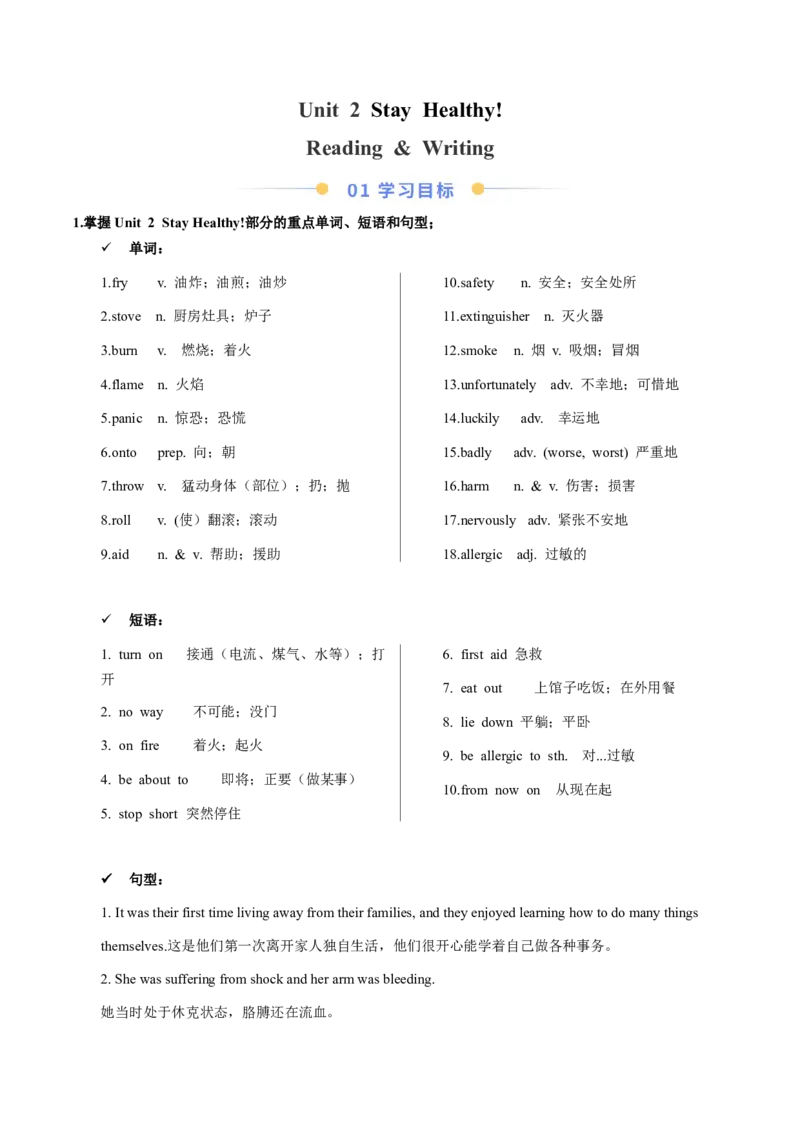
1.掌握Unit 2 Stay Healthy!部分的重点单词、短语和句型;
单词:
1.fry v. 油炸;油煎;油炒 10.safety n. 安全;安全处所
2.stove n. 厨房灶具;炉子 11.extinguisher n. 灭火器
3.burn v. 燃烧;着火 12.smoke n. 烟 v. 吸烟;冒烟
4.flame n. 火焰 13.unfortunately adv. 不幸地;可惜地
5.panic n. 惊恐;恐慌 14.luckily adv. 幸运地
6.onto prep. 向;朝 15.badly adv. (worse, worst) 严重地
7.throw v. 猛动身体(部位);扔;抛 16.harm n. & v. 伤害;损害
8.roll v. (使)翻滚;滚动 17.nervously adv. 紧张不安地
9.aid n. & v. 帮助;援助 18.allergic adj. 过敏的
短语:
1. turn on 接通(电流、煤气、水等);打 6. first aid 急救
开
7. eat out 上馆子吃饭;在外用餐
2. no way 不可能;没门
8. lie down 平躺;平卧
3. on fire 着火;起火
9. be allergic to sth. 对...过敏
4. be about to 即将;正要(做某事)
10.from now on 从现在起
5. stop short 突然停住
句型:
1. It was their first time living away from their families, and they enjoyed learning how to do many things
themselves.这是他们第一次离开家人独自生活,他们很开心能学着自己做各种事务。
2. She was suffering from shock and her arm was bleeding.
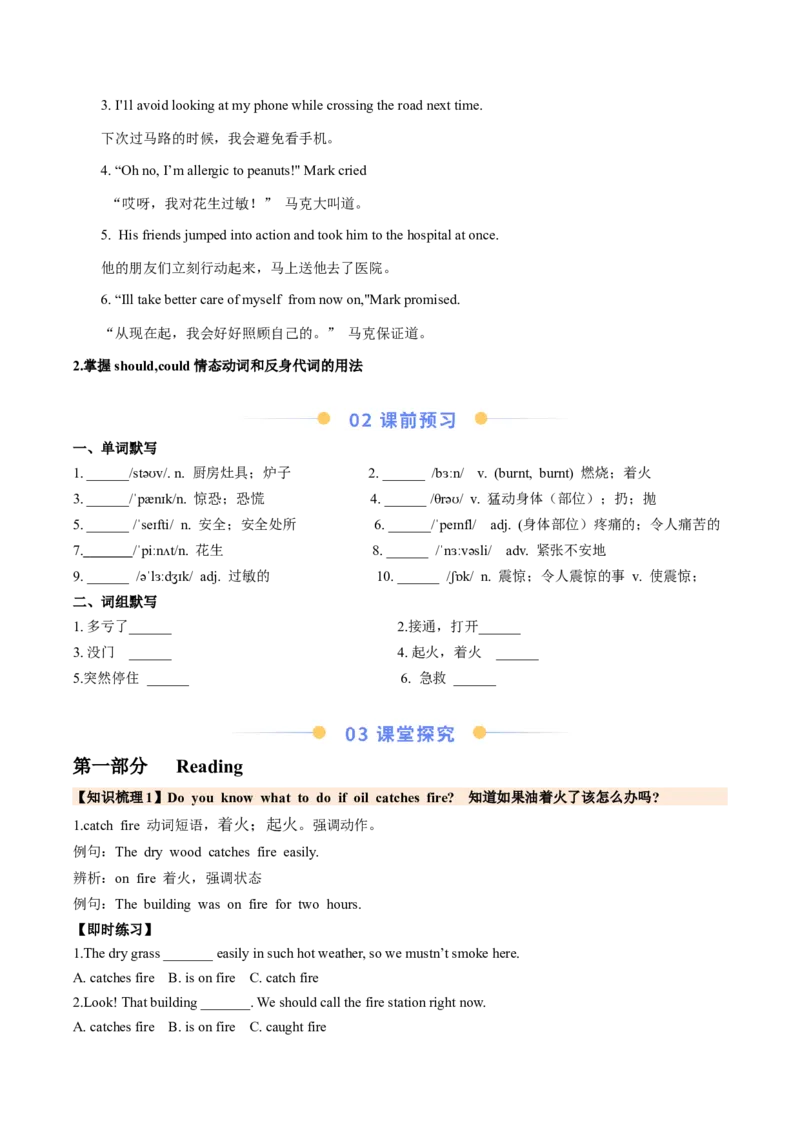
她当时处于休克状态,胳膊还在流血。3. I'1l avoid looking at my phone while crossing the road next time.
下次过马路的时候,我会避免看手机。
4. “Oh no, I’m allergic to peanuts!" Mark cried
“哎呀,我对花生过敏!” 马克大叫道。
5. His friends jumped into action and took him to the hospital at once.
他的朋友们立刻行动起来,马上送他去了医院。
6. “Ill take better care of myself from now on,"Mark promised.
“从现在起,我会好好照顾自己的。” 马克保证道。
2.掌握should,could情态动词和反身代词的用法
一、单词默写
1. ______/stəʊv/. n. 厨房灶具;炉子 2. ______ /bɜːn/ v. (burnt, burnt) 燃烧;着火
3. ______/ˈpænɪk/n. 惊恐;恐慌 4. ______ /θrəʊ/ v. 猛动身体(部位);扔;抛
5. ______ /ˈseɪfti/ n. 安全;安全处所 6. ______/ˈpeɪnfl/ adj. (身体部位)疼痛的;令人痛苦的
7. /ˈpiːnʌt/n. 花生 8. ______ /ˈnɜːvəsli/ adv. 紧张不安地
9. ______ /əˈlɜːdʒɪk/ adj. 过敏的 10. ______ /ʃɒk/ n. 震惊;令人震惊的事 v. 使震惊;
二、词组默写
1. 多亏了______ 2.接通,打开______
3. 没门 ______ 4. 起火,着火 ______
5.突然停住 ______ 6. 急救 ______
第一部分 Reading
【知识梳理1】Do you know what to do if oil catches fire? 知道如果油着火了该怎么办吗?
1.catch fire 动词短语,着火;起火。强调动作。
例句:The dry wood catches fire easily.
辨析:on fire 着火,强调状态
例句:The building was on fire for two hours.
【即时练习】
1.The dry grass _______ easily in such hot weather, so we mustn’t smoke here.
A. catches fire B. is on fire C. catch fire
2.Look! That building _______. We should call the fire station right now.
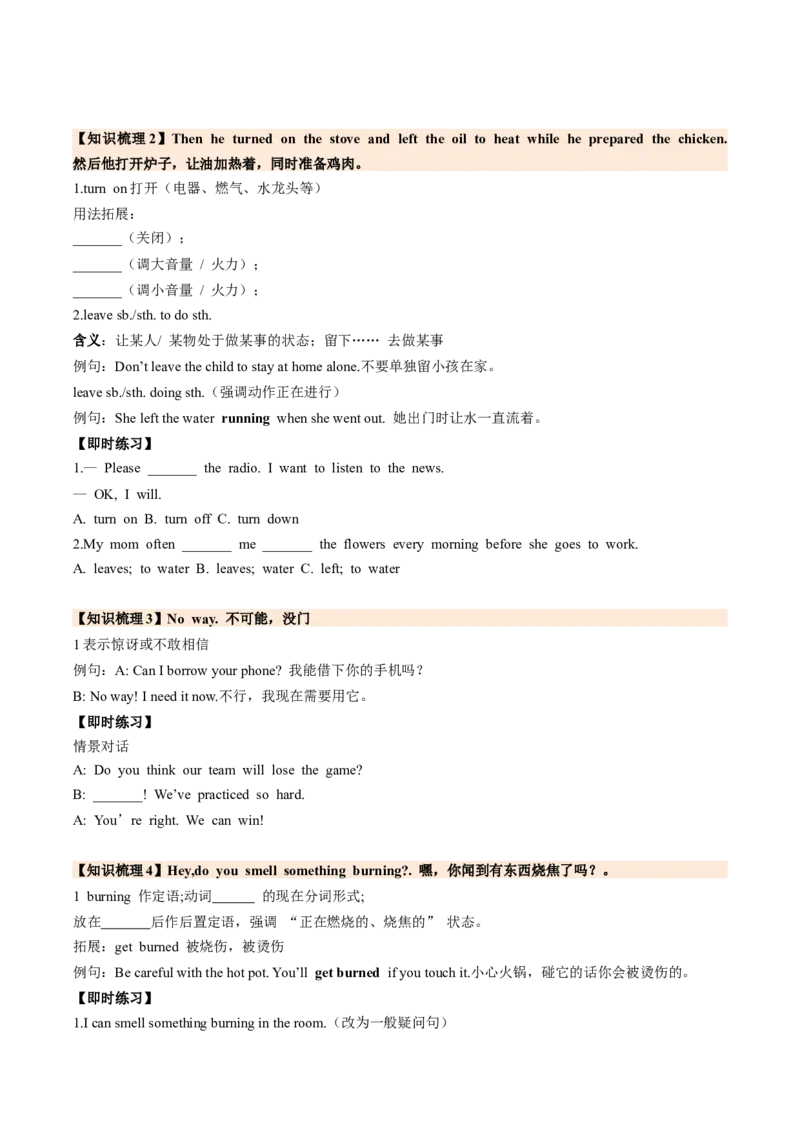
A. catches fire B. is on fire C. caught fire【知识梳理2】Then he turned on the stove and left the oil to heat while he prepared the chicken.
然后他打开炉子,让油加热着,同时准备鸡肉。
1.turn on打开(电器、燃气、水龙头等)
用法拓展:
_______(关闭);
_______(调大音量 / 火力);
_______(调小音量 / 火力);
2.leave sb./sth. to do sth.
含义:让某人/ 某物处于做某事的状态;留下…… 去做某事
例句:Don’t leave the child to stay at home alone.不要单独留小孩在家。
leave sb./sth. doing sth.(强调动作正在进行)
例句:She left the water running when she went out. 她出门时让水一直流着。
【即时练习】
1.— Please _______ the radio. I want to listen to the news.
— OK, I will.
A. turn on B. turn off C. turn down
2.My mom often _______ me _______ the flowers every morning before she goes to work.
A. leaves; to water B. leaves; water C. left; to water
【知识梳理3】No way. 不可能,没门
1表示惊讶或不敢相信
例句:A: Can I borrow your phone? 我能借下你的手机吗?
B: No way! I need it now.不行,我现在需要用它。
【即时练习】
情景对话
A: Do you think our team will lose the game?
B: _______! We’ve practiced so hard.
A: You’re right. We can win!
【知识梳理4】Hey,do you smell something burning?. 嘿,你闻到有东西烧焦了吗?。
1 burning 作定语;动词 的现在分词形式;
放在 后作后置定语,强调 “正在燃烧的、烧焦的” 状态。
拓展:get burned 被烧伤,被烫伤
例句:Be careful with the hot pot. You’ll get burned if you touch it.小心火锅,碰它的话你会被烫伤的。
【即时练习】
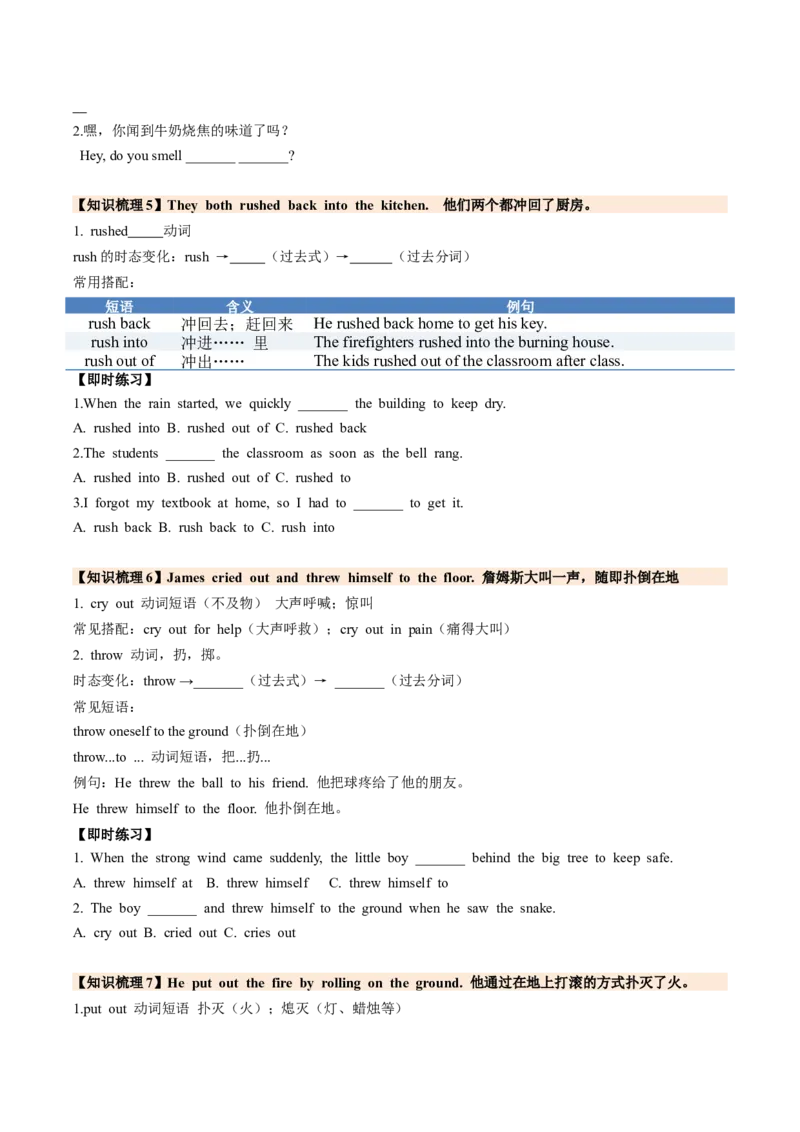
1.I can smell something burning in the room.(改为一般疑问句)2.嘿,你闻到牛奶烧焦的味道了吗?
Hey, do you smell _______ _______?
【知识梳理5】They both rushed back into the kitchen. 他们两个都冲回了厨房。
1. rushed 动词
rush的时态变化:rush → (过去式)→ (过去分词)
常用搭配:
短语 含义 例句
rush back 冲回去;赶回来 He rushed back home to get his key.
rush into 冲进…… 里 The firefighters rushed into the burning house.
rush out of 冲出…… The kids rushed out of the classroom after class.
【即时练习】
1.When the rain started, we quickly _______ the building to keep dry.
A. rushed into B. rushed out of C. rushed back
2.The students _______ the classroom as soon as the bell rang.
A. rushed into B. rushed out of C. rushed to
3.I forgot my textbook at home, so I had to _______ to get it.
A. rush back B. rush back to C. rush into
【知识梳理6】James cried out and threw himself to the floor. 詹姆斯大叫一声,随即扑倒在地
1. cry out 动词短语(不及物) 大声呼喊;惊叫
常见搭配:cry out for help(大声呼救);cry out in pain(痛得大叫)
2. throw 动词,扔,掷。
时态变化:throw →_______(过去式)→ _______(过去分词)
常见短语:
throw oneself to the ground(扑倒在地)
throw...to ... 动词短语,把...扔...
例句:He threw the ball to his friend. 他把球疼给了他的朋友。
He threw himself to the floor. 他扑倒在地。
【即时练习】
1. When the strong wind came suddenly, the little boy _______ behind the big tree to keep safe.
A. threw himself at B. threw himself C. threw himself to
2. The boy _______ and threw himself to the ground when he saw the snake.
A. cry out B. cried out C. cries out
【知识梳理7】He put out the fire by rolling on the ground. 他通过在地上打滚的方式扑灭了火。
1.put out 动词短语 扑灭(火);熄灭(灯、蜡烛等)例句:The firefighters put out the big fire quickly.消防员很快扑灭了这场大火
① 宾语为名词时,可放在 put 和 out _______:
例句:put the fire out / put out the fire
② 宾语为代词时,必须放在 put 和 out _______:
例句:put it out(扑灭它)
2. by rolling on the ground(方式状语)
by + 动名词(doing) → 表 “通过某种方式 / 手段”
by 是介词,后面的动词必须变成 _______。
例句:She improves her writing by keeping a diary. 她通过写日记提高写作。
【即时练习】
1.我们可以通过在地上打滚来扑灭身上的火。
We can _______ _______ the fire _______ _______ on the ground.
【知识梳理8】Allen was about to do so when he stopped short.艾伦正要这么做,却突然停住了。
1.be about to do sth.即将/正要做某事。表示即将发生的动作,不可与表示将来的时间状语连用,但可与
when
构成“be about to do... when...”句型,表示“刚要做某事,这时……”。
例句:The train is about to leave. 火车马上就要开了。
【即时练习】
翻译句子:
1. 公交车马上就要开了,快跑!
2. 我正要写作业,妈妈叫我去吃饭了。
【知识梳理9】Thanks to the first aid and safety classes he took at school,he knew that water could
make oil fires much worse!当我试图起床的时候,我差点摔倒伤到自己。
1.first aid:名词短语,“急救”
例句:We should learn some first aid knowledge in daily life.
常见搭配:first aid classes 急救课
first aid skills 急救技能
2. safety 不可数名词,安全;
例句:I’m worried about your safety.我担心你的安全。
【即时练习】
1. We should learn some ______ knowledge to help ourselves and others in danger.
A. first aid B. first aids C. one aid D. a first aid
2. —For your own ______, you mustn’t play football on the busy road.A. safe B. safer C. safety D. safely
【知识梳理10】Suddenly, they smelt smoke and found the pan was on fire.突然,他们闻到了烟味,
发现平底锅着火了。
1. suddenly副词,意为 “突然地”,在句首作状语,用来修饰整个句子,强调动作发生的突
发性。形容词形式为: (突然的)
常用搭配:a sudden noise 一声巨响
__________ = suddenly,意为 “突然”
例句:All of a sudden, the lights went out.
2. smoke n.烟v.吸烟;冒烟
词性 含义 例句
1. 烟,烟雾(不可数) 1. There is a lot of smoke from the factory.
名词 (n.)
2. 香烟,烟草(可数 / 不可数) 2. He doesn’t like smokes (可数) / smoke (不可数).
1. 冒烟,冒气 1. The wet wood is smoking.
动词 (v.)
2. 吸烟,抽烟 2. He smokes a lot every day.
固定搭配:
(1)smoke heavily:烟抽得很凶
例:His father smokes heavily, so his mother always asks him to give up smoking.
(2)no smoking:禁止吸烟(公共场所标识常用)
例:You can see the “No Smoking” sign in the hospital.
(3)give up smoking:戒烟
例:It’s good for your health to give up smoking.
(4)smoke out of:从…… 冒出烟
例:Smoke is coming out of the window.
【即时练习】
1.______, a bird flew into the classroom through the window.
A. Sudden B. Suddenly C. Suddenlyly D. Suddenness
2. There is a lot of ______ coming from the pan. Maybe it is on fire.
A. smoke B. smokes C. smoker D. smoky
【知识梳理11】Luckily, James was not badly hurt.幸运的是,伤得不重。
1.Luckily是副词,由形容词 变来,意为 “幸运地”。常位于句首修饰整个句子。
例句:Luckily, we can use AI for good ideas now. 幸运的是,我们现在可以用人工智能来想出好主意。
词汇变形
形容词:lucky(幸运的) 例:She is a lucky girl.
名词:luck(运气) 例:Good luck to you!
反义词: (不幸地) 例:Unluckily, he missed the bus.
【即时练习】在括号中写出划线单词的词性(A. 形容词 B. 副词),并说明其在句中的作用。
1 . Luckily , James was not badly hurt.
词性: ______
作用: ______
2.James was not badly hurt.
词性: ______
作用: ______
James had a fall, but it was not a bad one.
词性: ______
作用: ______
【知识梳理12】At the hospital, the doctor checked Kelly’s arm carefully.在医院里,仔细检查了凯莉
的胳膊。
1.check v.检查;查明n.检查;调查
(1)动词,检查;查明
例句:Your answer might be right, but I’m going to check to make sure.
你的答案可能是正确的,但是我要核查下以确保正确。
(2)名词,检查;调查
例句:We should complete a safety check before starting the project.
我们在启动项目前应完成安全调查。
【即时练习】
I always _____ my emails as soon as I get to the office.
A. check B. checks C. checked D. checking
【知识梳理13】so they had it all to themselves.所以他们就可以独自享用这一切了。
1.短语have sth. to oneself 独自占有 / 享用某物;独自使用某地。
例句:She was alone in the office, so she had the whole room to herself.
她独自一人在办公室,所以整间屋子都归她用。
【即时练习】
After the party, she had the big house _______.
A. to her B. to herself C. by herself
【知识梳理14】I’m allergic to peanuts! 我对花生过敏。
1.be allergic to sth. 对...过敏
例句:My father was allergic to pollen when he was young.
我爸爸年轻时对花粉过敏。
词汇变形:allergy 名词 过敏症 She has an allergy to cats.
allergic 形容词 过敏的 I’m allergic to pollen.
allergen 名词 过敏原 Pollen is a common allergen in spring.
【即时练习】
我的弟弟对牛奶过敏,所以他只能喝豆奶。
My brother _______ _______ _______ milk, so he can only drink soy milk.
第二部分 Writing
【知识梳理1】写作指导
本单元以谈论如何保持健康和安全为话题,属于“人与自我”主题范畴中“生活与健康”这一主题。这类
话题常见的写作思路为:描述生病或不适时的症状--描述意外事故对人体造成的伤害--不同场景的急救知
识--治疗和康复措施及建议。
【知识梳理2】写作素材
1.开篇引出话题
I’m sorry to hear that...(听到我很遗憾)……
例:I’m sorry to hear that many people have the flu these days.
2.描述事物特点...is very common in...and...get it easily.(在很常见,且很容易染上)………………
例:The flu is very common in winter and people get it easily.
3.提出建议的疑问句式What should we do to...?(我们应该做什么来?)……
例:What should we do to prevent the flu?
4.建议类祈使句(表措施)We should...(我们应该)……
例:First, we should wash our hands and change clothes often.
5. “做某事有必要 句型”Doing sth. is necessary for sb.(做某事对某人来说是必要的)
例:Doing some sports is necessary for us.
6. “做某事很重要 句型(”it作形式主语)It’s important for sb. to do sth.(对某人来说做某事很重
要)
例:It’s important for us to eat healthy food every day.,
【即时练习】
1.请结合自己的经历,用英语写一篇短文,介绍你曾经遇到过的一个健康问题(如感冒、头痛、胃
痛等)。内容包括:
(1)你遇到了什么健康问题;
(2)这个问题是如何发生的;
(3)你采取了哪些措施来缓解或解决它;
(4)从这次经历中你学到了什么。
写作要求:
(1)层次清晰,语言流畅;(2)词数80左右,标题已给出,不计入总词数;
(3)书写规范,卷面整洁;
(4)文中不能出现考生姓名和学校名称。
A health problem I once had
____________________________________________________________________________________________
____________________________________________________________________________________________
____________________________________________________________________________________________
____________________________________________________________________________________________
____________________________________________________________________________________________
____________________________________________________________________________________________
一、根据汉语提示填写单词
1. Polluted water ______ (有害的) to fish and plants.
2. The ______ (志愿者) are cleaning the park this weekend.
3. Remember to take this ______ (药片) after meals.
4. She felt ______ (难过的) when her pet cat was lost.
二、根据汉语意思完成句子
1. 然后他打开炉灶,让油加热,同时准备鸡肉。
Then he ______ ______ the ______ and left the ______ to ______ while he ______ the chicken.
2. 惊慌中,詹姆斯立刻关掉了炉灶。
In a ______, James ______ ______ the stove ______ ______.
3. 他通过在地上打滚扑灭了身上的火,但平底锅还在燃烧!
He ______ ______ the ______ by ______ on the ground, but the pan was still ______!
4. 多亏了他在学校上的急救和安全课,他知道水会让油火变得更严重!
Thanks ______ the ______ ______ and safety classes he took at school, he knew ______ water could
make oil fires ______ ______!
5. 几秒钟内,燃烧的平底锅里的火就被扑灭了。
In ______, the fire in the ______ ______ was ______ ______.
6. 那个小女孩从自行车上摔下来,疼得大叫。
The little gir1 fell off her bike and in pain.
一、词汇运用
1. The girl can look after (her) when her parents are not at home.
2. On his way to school, he saw an old man (lie) on the side of the road.3.Emma (hurt) her back when she fell off her horse.
4.The ball (hit) the boy just now.
5.—Could you please (not say) bad words about our hero?
—Sorry, I won’t.
6.The boy (can) play some of the most famous piano music in the world at the age of five.
7.We (should) always (encourage) our friends when they fail.
8.We should be quiet in the library, and we (should) eat food there.
9.Make sure you protect (you) from the sun with hats and sunscreen, boys and girls.
10.We enjoyed (we) singing and dancing happily with our classmates at last night’s school party.
二、单项选择
1.We ________ not talk loudly in the school hall. It’s one of our school rules.
A.should B.can C.may D.will
2.—Could you play tennis when you were ten?
—Yes, I ________.
A.can B.should C.need D.could
3.Earthquakes can be very dangerous. We ________ learn to protect ourselves.
A.might B.should C.could
4.—Could you please help me make my bed, Mom?
—I’m afraid I ________. You ________ do it on your own.
A.couldn’t; need B.shouldn’t; should C.can’t; should
5.You ________ be so emotional. Taking a deep breath can help you calm down.
A.needn’t B.shouldn’t C.mustn’t D.can’t
6.—More and more students love playing computer games at weekends.
—That’s too bad. Everyone ________ be a book lover. Reading makes a full man.
A.need B.would C.should D.could
7.— Mum, ________ I play football this afternoon?
— Sure, but you ________ finish your homework first.
A.could; must B.may; could C.could; can
8.—My bike is broken. ________ I borrow yours?
—Yes, you ________.
A.Could; may B.Can; could C.Could; can D.May; could
9.He didn’t finish his homework, so he ________ watch TV last night.
A.can’t B.couldn’t C.mustn’t D.shouldn’t
10.—What are you doing, Jack?
—I didn’t have breakfast. I’m making a sandwich for ________.
A.my B.myself C.you D.yourself11.—Mum, do you think I _________ take part in the Chemistry competition?
— Why not? If I were in your shoes, I certainly would.
A.might B.would C.should D.must
12.—Whose umbrella is this?
—It ______ belong to Mr. Smith. Look, his name is on it.
A.can B.might C.must D.should
13.We ________ get something ________ after watching the movie. I am hungry now.
A.mightn’t; to eat B.might; eating
C.couldn’t; eating D.could; to eat
14.—Listen! Is Bruce singing in the class?
—It ________ be him. But I’m not sure.
A.need B.could
C.must D.would
15.— Who teaches ________ volleyball?
— Nobody, they learn it by ________.
A.them; themself B.them; them C.their; themselves D.them; themselves
三、完形填空
阅读短文,理解其大意,从A、B、C、D四个选项中选出可以填入空白处的最佳选项。
It’s important for everyone to stay healthy. But sometimes we may feel sick, like 1 a headache or a
sore throat. When this happens, what should we do?
First, 2 you’re not feeling well, you should drink plenty of water. Water helps our bodies work
better and can make us feel more comfortable. Second, 3 working too much. When we are sick, our
bodies need rest to get better. You can lie 4 and listen to some soft music to relax.
To stay healthy every day, there are also some good habits to keep. You should have a healthy diet. Too much
junk food is 5 to your body. Instead, eat more fruits and vegetables. Doing exercise is another key.
Taking a walk after dinner or playing sports with friends twice a week can make your body strong.
It’s also important to keep clean. Wash your hands often, especially before eating. This can 6 you
from getting sick easily. If you have a fever or cough 7 , don’t forget to go to see a doctor. The doctor can
give you the right advice. What’s more, the doctor can also 8 your body and find out the real reason why
you feel sick.
Remember, health is the most important thing. Following these small 9 , you can stay healthy and
enjoy your daily life. Let’s start from now on and take good care of 10 .
1.A.turning on B.suffering from C.getting into D.being connected with
2.A.if B.although C.because D.while
3.A.start B.keep C.avoid D.finish
4.A.down B.up C.on D.over5.A.important B.boring C.helpful D.harmful
6.A.help B.stop C.let D.make
7.A.tightly B.nervously C.badly D.happily
8.A.throw B.check C.manage D.accept
9.A.rules B.habits C.suggestions D.plans
10.A.himself B.yourselves C.themselves D.ourselves
四、阅读理解
Mrs. Green notices some areas of Tom’s mouth are sore, and he can’t even eat his favorite chicken. Little
Tom doesn’t feel like having meals these days at all. Maybe you feel pain in some parts of your body like Tom.
This is because the seasons change in this special time, and there is little rain, high temperature and strong wind. In
such dry weather, children are facing the risk of getting sick.
△ Yes. If your kids’ symptoms are coughing, fever, head and muscle aches, maybe the flu comes into their
bodies. It’s also the holiday season for the hand-foot-mouth disease. Something cold can make their stomach hurt.
And perhaps children have a pain around a tooth easily after they eat hot food.
What shouldn’t we eat to prevent children from these diseases? In autumn and winter, the human bodies will
feel dry. Be careful not to give them dry food, such as biscuits and candy. Also remember not to give your children
cold drinks or cold water. For children with a poor stomach, do not eat grapes or watermelon.
All in all, we should try our best to keep children away from diseases. Let’s remember, “A healthy diet is an
important part of a healthy lifestyle”.
1.How does the writer start the text?
A.By asking a question. B.By giving an example.
C.By telling a story. D.By showing a saying.
2.Why do people get sick easily during that time in the text?
A.Because it rains little. B.Because the weather is dry.
C.Because the temperature is high. D.Because the wind is strong .
3.Which of the following should fill in △ ?
A.Will you tell us something useful?
B.Should we eat breakfast after we get up?
C.Do we feel tired during autumn and winter?
D.Are there any common diseases we should pay attention to?
4.What shouldn’t children eat during that time from the text?
a. bread b. apples c. tomatoes d. candy e. soup f. biscuits g. tea
h. medicine i. ice cream j. grapes k. watermelons l. cabbage m. pumpkin
A.a, b, d,e, h B.b, e, f, g, h C.d, f, i, j, k D.c, h, j, l, m
5.Who’s the text written for?
A.Parents. B.Children. C.Teachers. D.Workers.
五、书面表达1.Bob的妈妈最近总是睡不好觉,昨天她去看了医生。请结合提示和要求,写一篇英语短文,谈谈
Bob妈妈的这次就医经历以及医生给的建议
提示:1.多锻炼,多喝水,多吃水果、蔬菜和其他健康食品;2.避免着急等等……
要求:字迹工整,涵盖全部信息,可适当发挥。不少于80词,不出现真实人名、校名。
提示词:look over 检查;follow听从
____________________________________________________________________________________________
____________________________________________________________________________________________
____________________________________________________________________________________________
____________________________________________________________________________________________
____________________________________________________________________________________________
____________________________________________________________________________________________