Unit 3 Growing Up
Reading & Writing
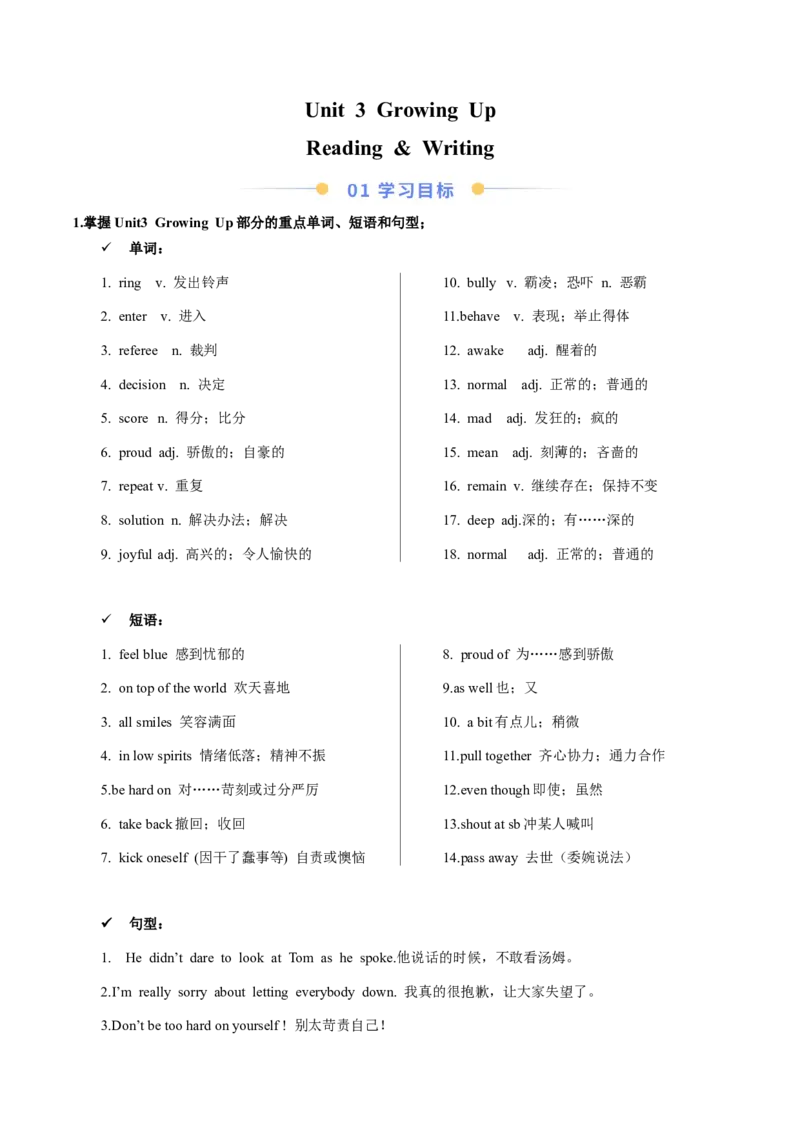
1.掌握Unit3 Growing Up部分的重点单词、短语和句型;
单词:
1. ring v. 发出铃声 10. bully v. 霸凌;恐吓 n. 恶霸
2. enter v. 进入 11.behave v. 表现;举止得体
3. referee n. 裁判 12. awake adj. 醒着的
4. decision n. 决定 13. normal adj. 正常的;普通的
5. score n. 得分;比分 14. mad adj. 发狂的;疯的
6. proud adj. 骄傲的;自豪的 15. mean adj. 刻薄的;吝啬的
7. repeat v. 重复 16. remain v. 继续存在;保持不变
8. solution n. 解决办法;解决 17. deep adj.深的;有……深的
9. joyful adj. 高兴的;令人愉快的 18. normal adj. 正常的;普通的
短语:
1. feel blue 感到忧郁的 8. proud of 为……感到骄傲
2. on top of the world 欢天喜地 9.as well也;又
3. all smiles 笑容满面 10. a bit有点儿;稍微
4. in low spirits 情绪低落;精神不振 11.pull together 齐心协力;通力合作
5.be hard on 对……苛刻或过分严厉 12.even though即使;虽然
6. take back撤回;收回 13.shout at sb冲某人喊叫
7. kick oneself (因干了蠢事等) 自责或懊恼 14.pass away 去世(委婉说法)
句型:
1. He didn’t dare to look at Tom as he spoke.他说话的时候,不敢看汤姆。
2.I’m really sorry about letting everybody down. 我真的很抱歉,让大家失望了。
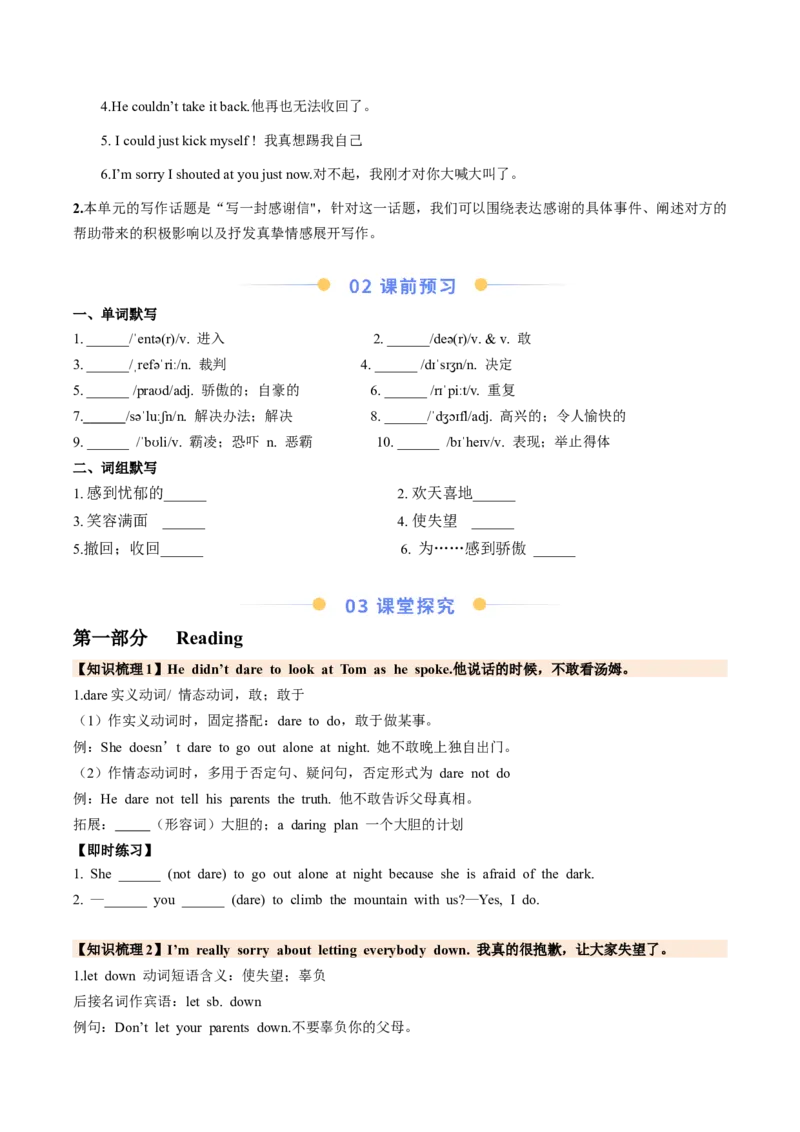
3.Don’t be too hard on yourself ! 别太苛责自己!4.He couldn’t take it back.他再也无法收回了。
5. I could just kick myself ! 我真想踢我自己
6.I’m sorry I shouted at you just now.对不起,我刚才对你大喊大叫了。
2.本单元的写作话题是“写一封感谢信",针对这一话题,我们可以围绕表达感谢的具体事件、阐述对方的
帮助带来的积极影响以及抒发真挚情感展开写作。
一、单词默写
1. ______/ˈentə(r)/v. 进入 2. ______/deə(r)/v. & v. 敢
3. ______/ˌrefəˈriː/n. 裁判 4. ______ /dɪˈsɪʒn/n. 决定
5. ______ /praʊd/adj. 骄傲的;自豪的 6. ______ /rɪˈpiːt/v. 重复
7. /səˈluːʃn/n. 解决办法;解决 8. ______/ˈdʒɔɪfl/adj. 高兴的;令人愉快的
9. ______ /ˈbʊli/v. 霸凌;恐吓 n. 恶霸 10. ______ /bɪˈheɪv/v. 表现;举止得体
二、词组默写
1. 感到忧郁的______ 2. 欢天喜地______
3. 笑容满面 ______ 4. 使失望 ______
5.撤回;收回______ 6. 为……感到骄傲 ______
第一部分 Reading
【知识梳理1】He didn’t dare to look at Tom as he spoke.他说话的时候,不敢看汤姆。
1.dare实义动词/ 情态动词,敢;敢于
(1)作实义动词时,固定搭配:dare to do,敢于做某事。
例:She doesn’t dare to go out alone at night. 她不敢晚上独自出门。
(2)作情态动词时,多用于否定句、疑问句,否定形式为 dare not do
例:He dare not tell his parents the truth. 他不敢告诉父母真相。
拓展: (形容词)大胆的;a daring plan 一个大胆的计划
【即时练习】
1. She ______ (not dare) to go out alone at night because she is afraid of the dark.
2. —______ you ______ (dare) to climb the mountain with us?—Yes, I do.
【知识梳理2】I’m really sorry about letting everybody down. 我真的很抱歉,让大家失望了。
1.let down 动词短语含义:使失望;辜负
后接名词作宾语:let sb. down
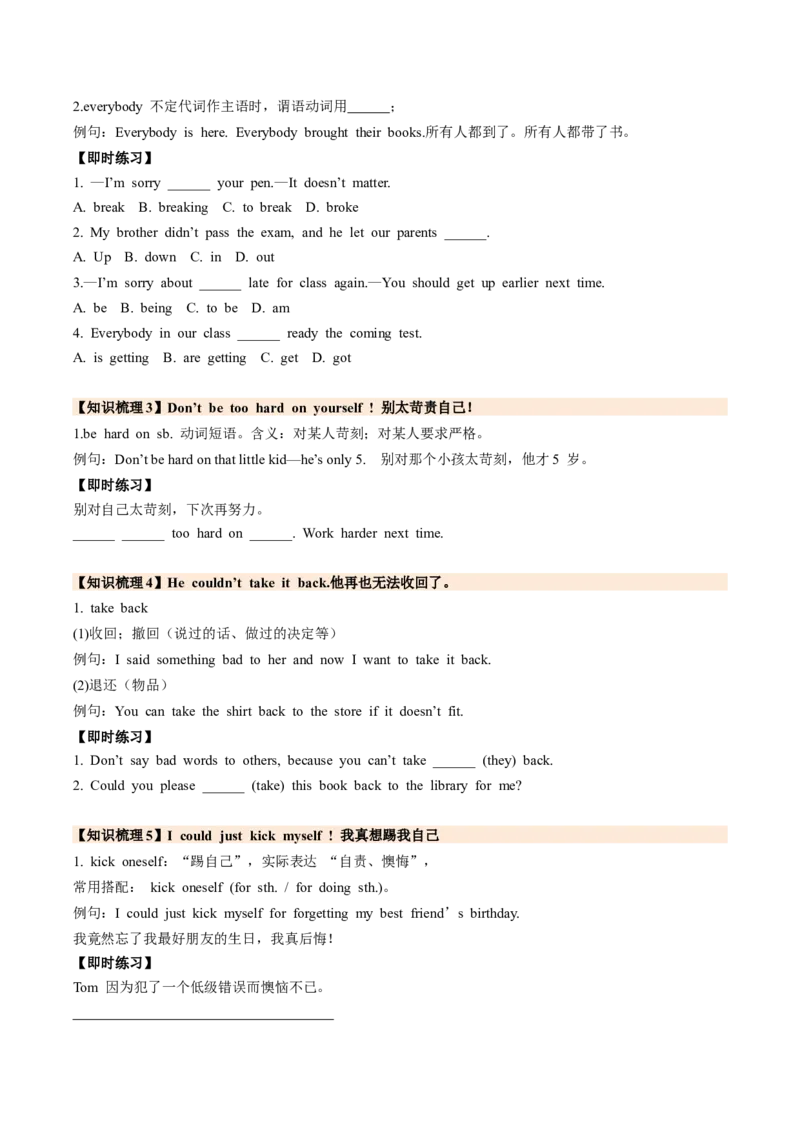
例句:Don’t let your parents down.不要辜负你的父母。2.everybody 不定代词作主语时,谓语动词用 ;
例句:Everybody is here. Everybody brought their books.所有人都到了。所有人都带了书。
【即时练习】
1. —I’m sorry ______ your pen.—It doesn’t matter.
A. break B. breaking C. to break D. broke
2. My brother didn’t pass the exam, and he let our parents ______.
A. Up B. down C. in D. out
3.—I’m sorry about ______ late for class again.—You should get up earlier next time.
A. be B. being C. to be D. am
4. Everybody in our class ______ ready the coming test.
A. is getting B. are getting C. get D. got
【知识梳理3】Don’t be too hard on yourself ! 别太苛责自己!
1.be hard on sb. 动词短语。含义:对某人苛刻;对某人要求严格。
例句:Don’t be hard on that little kid—he’s only 5. 别对那个小孩太苛刻,他才5 岁。
【即时练习】
别对自己太苛刻,下次再努力。
______ ______ too hard on ______. Work harder next time.
【知识梳理4】He couldn’t take it back.他再也无法收回了。
1. take back
(1)收回;撤回(说过的话、做过的决定等)
例句:I said something bad to her and now I want to take it back.
(2)退还(物品)
例句:You can take the shirt back to the store if it doesn’t fit.
【即时练习】
1. Don’t say bad words to others, because you can’t take ______ (they) back.
2. Could you please ______ (take) this book back to the library for me?
【知识梳理5】I could just kick myself ! 我真想踢我自己
1. kick oneself:“踢自己”,实际表达 “自责、懊悔”,
常用搭配: kick oneself (for sth. / for doing sth.)。
例句:I could just kick myself for forgetting my best friend’s birthday.
我竟然忘了我最好朋友的生日,我真后悔!
【即时练习】
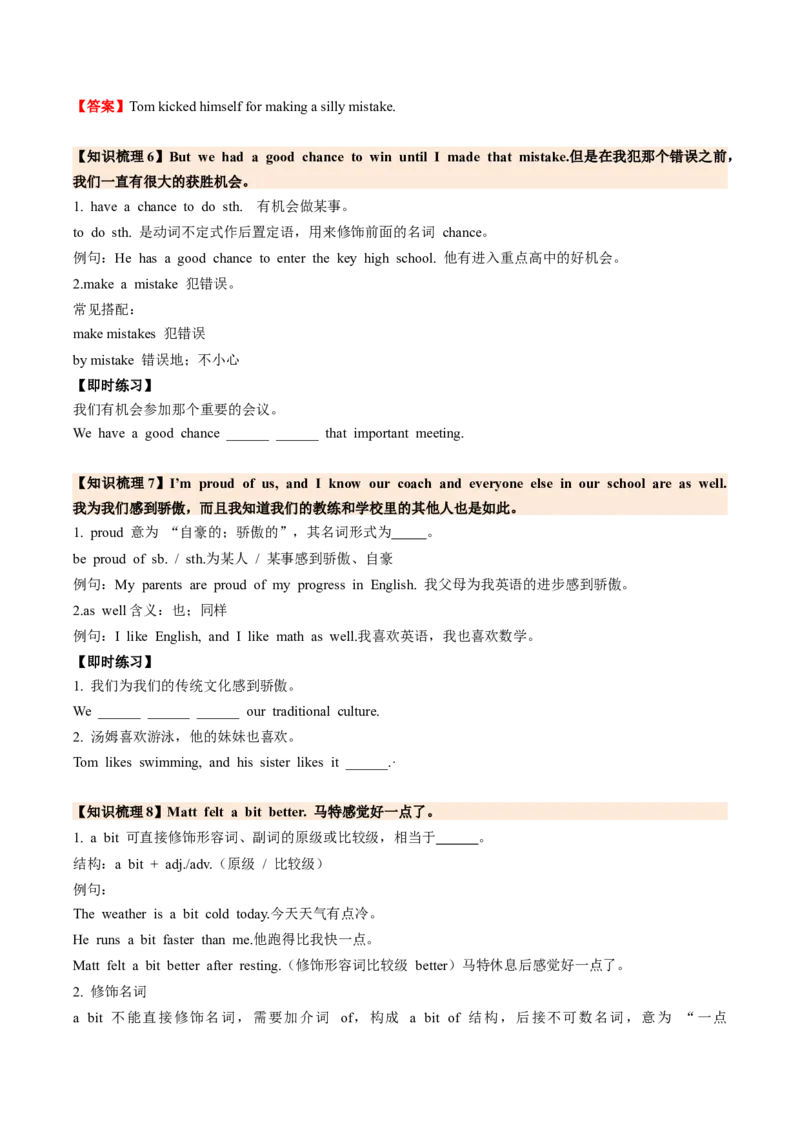
Tom 因为犯了一个低级错误而懊恼不已。【答案】Tom kicked himself for making a silly mistake.
【知识梳理6】But we had a good chance to win until I made that mistake.但是在我犯那个错误之前,
我们一直有很大的获胜机会。
1. have a chance to do sth. 有机会做某事。
to do sth. 是动词不定式作后置定语,用来修饰前面的名词 chance。
例句:He has a good chance to enter the key high school. 他有进入重点高中的好机会。
2.make a mistake 犯错误。
常见搭配:
make mistakes 犯错误
by mistake 错误地;不小心
【即时练习】
我们有机会参加那个重要的会议。
We have a good chance ______ ______ that important meeting.
【知识梳理7】I’m proud of us, and I know our coach and everyone else in our school are as well.
我为我们感到骄傲,而且我知道我们的教练和学校里的其他人也是如此。
1. proud 意为 “自豪的;骄傲的”,其名词形式为 。
be proud of sb. / sth.为某人 / 某事感到骄傲、自豪
例句:My parents are proud of my progress in English. 我父母为我英语的进步感到骄傲。
2.as well含义:也;同样
例句:I like English, and I like math as well.我喜欢英语,我也喜欢数学。
【即时练习】
1. 我们为我们的传统文化感到骄傲。
We ______ ______ ______ our traditional culture.
2. 汤姆喜欢游泳,他的妹妹也喜欢。
Tom likes swimming, and his sister likes it ______.·
【知识梳理8】Matt felt a bit better. 马特感觉好一点了。
1. a bit 可直接修饰形容词、副词的原级或比较级,相当于 。
结构:a bit + adj./adv.(原级 / 比较级)
例句:
The weather is a bit cold today.今天天气有点冷。
He runs a bit faster than me.他跑得比我快一点。
Matt felt a bit better after resting.(修饰形容词比较级 better)马特休息后感觉好一点了。
2. 修饰名词
a bit 不能直接修饰名词,需要加介词 of,构成 a bit of 结构,后接不可数名词,意为 “一点儿……”。
结构:a bit of +
例句:
I need a bit of water.我需要一点水。
She has a bit of time to help us.她有一点时间帮我们。
【即时练习】
1. The film is ______ boring. I don’t want to watch it again.
A. a bit of B. a bit C. a little of D. bit
2. There is ______ bread on the plate. You can eat it.
A. a bit B. a bit of C. a little of D. bit of
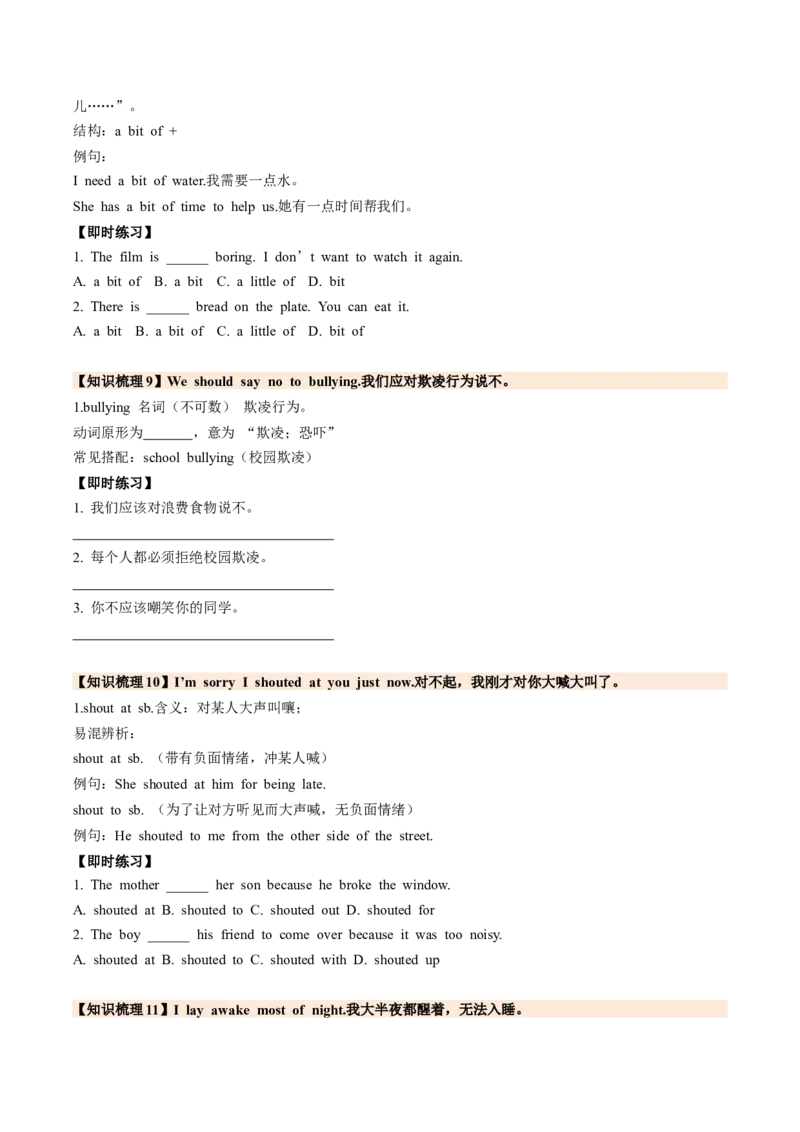
【知识梳理9】We should say no to bullying.我们应对欺凌行为说不。
1.bullying 名词(不可数) 欺凌行为。
动词原形为 ,意为 “欺凌;恐吓”
常见搭配:school bullying(校园欺凌)
【即时练习】
1. 我们应该对浪费食物说不。
2. 每个人都必须拒绝校园欺凌。
3. 你不应该嘲笑你的同学。
【知识梳理10】I’m sorry I shouted at you just now.对不起,我刚才对你大喊大叫了。
1.shout at sb.含义:对某人大声叫嚷;
易混辨析:
shout at sb. (带有负面情绪,冲某人喊)
例句:She shouted at him for being late.
shout to sb. (为了让对方听见而大声喊,无负面情绪)
例句:He shouted to me from the other side of the street.
【即时练习】
1. The mother ______ her son because he broke the window.
A. shouted at B. shouted to C. shouted out D. shouted for
2. The boy ______ his friend to come over because it was too noisy.
A. shouted at B. shouted to C. shouted with D. shouted up
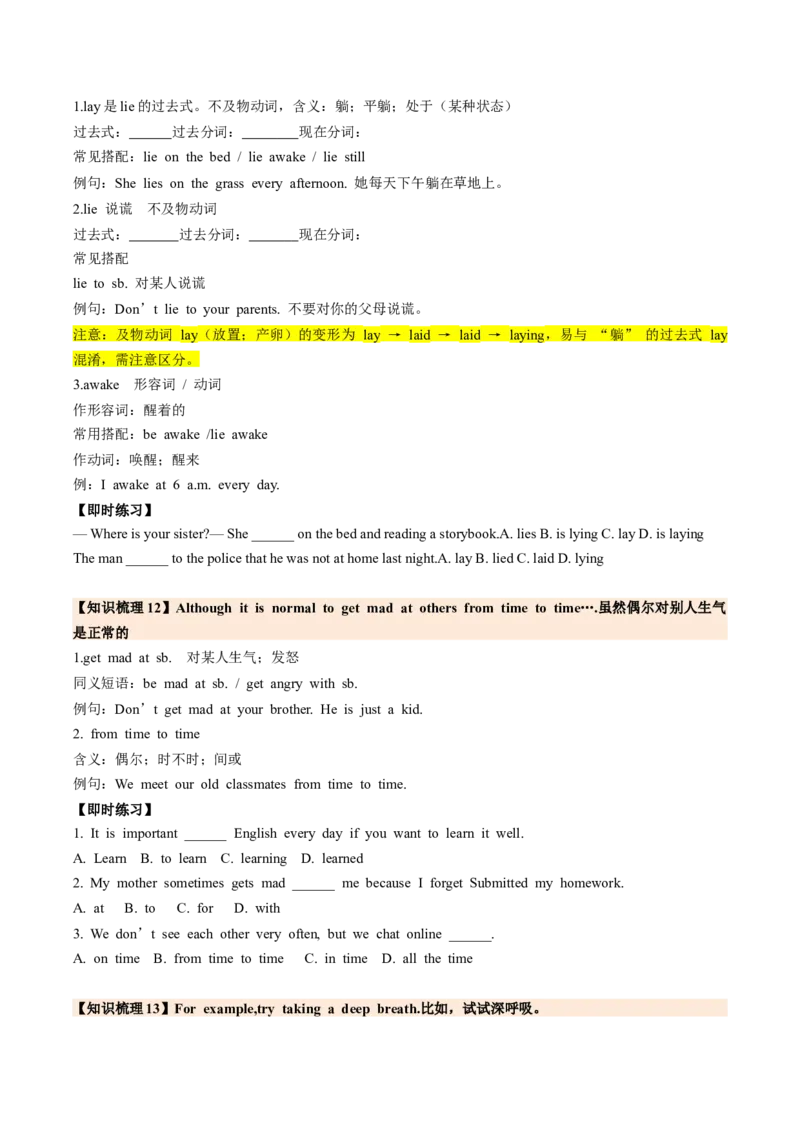
【知识梳理11】I lay awake most of night.我大半夜都醒着,无法入睡。1.lay是lie的过去式。不及物动词,含义:躺;平躺;处于(某种状态)
过去式: 过去分词: 现在分词:
常见搭配:lie on the bed / lie awake / lie still
例句:She lies on the grass every afternoon. 她每天下午躺在草地上。
2.lie 说谎 不及物动词
过去式: 过去分词: 现在分词:
常见搭配
lie to sb. 对某人说谎
例句:Don’t lie to your parents. 不要对你的父母说谎。
注意:及物动词 lay(放置;产卵)的变形为 lay → laid → laid → laying,易与 “躺” 的过去式 lay
混淆,需注意区分。
3.awake 形容词 / 动词
作形容词:醒着的
常用搭配:be awake /lie awake
作动词:唤醒;醒来
例:I awake at 6 a.m. every day.
【即时练习】
— Where is your sister?— She ______ on the bed and reading a storybook.A. lies B. is lying C. lay D. is laying
The man ______ to the police that he was not at home last night.A. lay B. lied C. laid D. lying
【知识梳理12】Although it is normal to get mad at others from time to time….虽然偶尔对别人生气
是正常的
1.get mad at sb. 对某人生气;发怒
同义短语:be mad at sb. / get angry with sb.
例句:Don’t get mad at your brother. He is just a kid.
2. from time to time
含义:偶尔;时不时;间或
例句:We meet our old classmates from time to time.
【即时练习】
1. It is important ______ English every day if you want to learn it well.
A. Learn B. to learn C. learning D. learned
2. My mother sometimes gets mad ______ me because I forget Submitted my homework.
A. at B. to C. for D. with
3. We don’t see each other very often, but we chat online ______.
A. on time B. from time to time C. in time D. all the time
【知识梳理13】For example,try taking a deep breath.比如,试试深呼吸。1. take a deep breath 动词短语,深呼吸
breath 是名词,形容词形式为 (气喘吁吁的);
breathe 是动词,意为 “呼吸”,注意区别(名词 breath 无 e,动词 breathe 有 e)。
例:We should breathe fresh air every day.
【即时练习】
1. I have many hobbies, ______, I like playing the guitar and painting.
A. such as B. for example C. like D. as
2. If you don’t know the way, you can ______ asking the police for help.
A. try B. try to C. try on D. try out
3. When you feel nervous, you should ______ to calm yourself down.
A. take deep breath B. take a deep breath C. take deep breaths D. take a deeply breath
【知识梳理14】Thank you so much for being not only my teacher but also my friend. 非常感谢你,
你不仅是我的老师,更是我的朋友。
1.not only...but also... 不仅…… 而且……
主谓一致:连接两个主语时,谓语动词的单复数遵循 。
例句:Not only he but also I am happy today.
成分省略:当连接的两个成分结构相同时,后一个成分可省略重复部分。
例句:She is not only a teacher but also a friend.
【即时练习】
1.Not only my mother but also my father ______ interested in reading.
A. is B. are C. be D. were
2.She is not only a singer but also ______.
A. an actor B. actor C. to be an actor D. being an actor
第二部分 Writing
【知识梳理1】写作指导
本单元的话题是“写一封感谢信",针对这一话题,我们可以围绕表达感谢的具体事件、阐述对方的帮助带
来的积极影响以及抒发真挚情感展开写作。感谢信的主要目的在于向对方致谢,因此语言要诚挚,友善;在
信的开头部分一般会使用Thank you very much for your kindness and deep concern,在结尾部分一般会
使用Thanks again and wish you all the best之类的语言来表达感激之情。
【知识梳理2】写作素材
1.Thank you for helping me to.谢谢你帮助我
2.I am writing to express my sincere thanks for... 我写这封信是为了就…… 表达我诚挚的谢意。
3.On that day,I.., and you helped me to..那天我.....,你帮助我
4.You took the time to, although you were so busy.尽管您很忙,却仍抽出时间来..5.I couldn't.until.我无法..直到..
6.I am very thankful because.我非常感激,因为.
7.When I..you were there to.当我..,你在那里
8.Because of you, I no longer feel sad about the failure.因为有你,我不再为这次失败而感到难过。
【即时练习】
1.假如你是李华,刚结束在英国为期一个月的交流学习。请你给你的房东 Mr. Wilson写一封感谢信,
感谢他对你在英国期间的照顾和帮助,并邀请他来中国旅游。
注意:
1. 词数80左右(开头结尾已给出,不计入总词数);
2. 要点齐全,可适当发挥;
3. 不得出现真实姓名和校名;
4. 条理清楚,语句通顺,意义连贯,书写规范。
Dear Mr. Wilson,
How is everything going?
_______________________________________________________________________________________
____________________________________________________________________________________________
____________________________________________________________________________________________
____________________________________________________________________________________________
____________________________________________________________________________________________
____________________________________________________________________________________________
____________________________________________________________________________________________
___________________________________________
Looking forward to your reply.
Yours,
Li Hua
【答案】例文
Dear Mr. Wilson,
How is everything going? I have safely returned home and would like to express my sincere thanks for your
care and help during my stay in England.
I really enjoyed the time we spent together. You cooked meals for me every day and patiently explained the
bus routes to school. Moreover, you made my experience richer by sharing wonderful stories about British history
and customs.
I sincerely invite you to visit China. I would be happy to show you around. I believe you will love it here.
Looking forward to your reply.
Yours,
Li Hua
【详解】[总体分析]
①题材:本文是一篇应用文,为书信作文;②时态:一般过去时(回顾经历)、一般现在时(邀请) ;
③提示:需包含感谢房东的照顾、回忆具体帮助、并发出旅游邀请。
[写作步骤]
第一步:礼貌问候后直接表达感谢;
第二步:回忆具体细节,并表达对过往时光的怀念;
第三步:正式发出邀请,说明愿意陪同游览中国。
[亮点词汇]
①express表达
②patiently耐心地
③sincerely真诚地
[高分句型]
①I really enjoyed the time we spent together.(运用了省略关系词的定语从句)
②I believe you will love it here.(运用了宾语从句)
一、根据汉语提示填写单词
1. His ______ (决定) to study abroad surprised us.
2. The ______ (裁判) made a fair call in the game.
3. Could you ______ (重复) the question? I didn't catch it.
4. We should ______ (齐心协力) to make our class better.
5. Try to ______ (从好的方面想) even when things go wrong.
二、根据汉语意思完成句子
1.他说话时,不敢看汤姆。
He ______ ______ ______ look ______ Tom ______ he ______.
2.“尽管你撞到了对方球员,但那只是个意外。所有人都清楚这一点!”
"______ you ______ ______ player, it was ______ ______ accident. Everyone knows that!"
3.意外发生时,马特和所有人一样震惊,但已经太晚了。
Matt was ______ ______ ______ anyone ______ ______ accident ______, but it was ______late.
4.本来我们有很好的赢球机会,直到我犯了那个错误。
But we ______ ______ ______ chance ______ win ______ I ______ ______ mistake.
5.更重要的是从错误中学习,以免你以后再犯同样的错。
______ ______ ______ ______ to learn ______ ______ mistakes ______ you ______ repeat______ in
future.
6.当我们生气的时候,可能会对别人大喊大叫,或者对他们说刻薄的话。
______ we're mad, we ______ ______ ______ other people ______ ______ ______ ______ to______.一、单项选择
1.________ robots can do lots of work for people, they cannot take our place completely.
A.Because B.Although C.Until D.So
2.—Are you excited about the hike tomorrow?
—Sure, ________ it’s going to be a long and tiring walk, the view will be worth it.
A.if B.when C.because D.although
3.—In my opinion, it’s so important for children to do chores at home ________ some parents don’t think they
need help from the kids.
—That’s true. Doing housework is about developing their responsibility.
A.although B.until C.that
4.I write the new words in a small notebook __________ I can take it with me.
A.to B.for C.when D.so that
5.Recently, a middle school in Beijing had an activity named “Guinness Campus”(校园吉尼斯). Students will
never know their potential(潜力) they try their best.
A.though B.until C.when
6.—Do you know a group of wild elephants left the Xishuangbanna National Nature Reserve (西双版纳国家自
然保护区) and started moving north.
—Yes, I couldn’t stop worrying about them ________ they went back home.
A.until B.because C.but D.if
7.—Why hasn’t the speaker started his talk?
—Well, he ________ start it ________ everyone is quiet.
A.won’t; after B.will; until C.won’t; until D.will; before
8.—________ you told me, I had no idea about the fact.
—Well, the earlier you know the truth, the better it will be for you.
A.Until B.If C.Whatever D.After
9.—________ we are busy, ________ we can’t forget to show love to our parents.
—That’s right. Parents are the most important people in our life.
A.Though, but B./, though C.But, though D.Although, /
10.________ it is very cold in winter in Harbin, ________ you can often see many young people eat ice-cream
outside in the snowy weather.
A.Although, but B.Although, / C.Though, but
11.________ the cinema had a big park, I could not find a space to park my car.
A.If B.When C.Although D.Because
12.—I’ve made some sandwiches ________ we can have a snack on the way.—But the park is only ________ drive from here! We won’t get hungry, Mom.
A.so that; forty minutes’ B.until; forty minute’s
C.in order that; forty-minutes D.as long as; forty-minute
13.—I heard Hefei Central Library has been open to the public recently.
—Yes, it has plenty of desks and chairs ________ it’s quite convenient for reading.
A.as if B.so that C.as long as D.as soon as
14.The music has brought him confidence ________ he can give talks to encourage other young people.
A.because of B.so that
C.in order to D.because
15.—Why didn’t you go out with us last Sunday?
—I’d like to. But I must do housework ________ my parents wouldn’t be more tired after work.
A.in order to B.unless C.so that D.although
二、完形填空
Teenagers are like ships sailing through a stormy sea of emotions. One minute they’re laughing loudly, and
the next, they’re sitting in silence with a heavy heart. These sudden changes are not just “bad moods”—they’re
often 1 by big changes happening in their bodies.
During the teenage years, hormones (荷尔蒙) start to 2 quickly. This makes emotions swing up
and down like a roller coaster. It’s common for teens to 3 angry over small things, or feel sad without any
clear reason. For example, Mia, 14, once cried because her favorite song ended too soon. “I knew it was silly, but I
couldn’t 4 the tears,” she said.
Hiding these feelings can make things worse. Many teens try to 5 like they’re always okay, but
this only builds up pressure. Psychologists say the first step to dealing with emotions is to 6 them. “It’s
okay to feel angry or sad—these are normal feelings,” says Dr. Lee. “What matters is how you 7 with
them.”
Talking to someone you trust is a great way to start. This could be a parent, teacher, or friend. Writing in a
diary also 8 . It helps you sort out your thoughts and see why you’re feeling a certain way.
Another useful tip is to let go of the past. If you had a fight with a friend, don’t 9 it all day. Learn
from what happened and move forward. Remember, emotions are part of being human. The goal is not to avoid
them, but to 10 them wisely.
1.A.caused B.taught C.found D.saved
2.A.change B.sleep C.wait D.read
3.A.become B.turn C.get D.grow
4.A.finish B.stop C.start D.keep
5.A.sound B.look C.feel D.taste
6.A.hide B.forget C.recognise D.refuse
7.A.agree B.fight C.play D.deal8.A.helps B.hurts C.fails D.loses
9.A.think about B.talk about C.hear about D.dream about
10.A.hurt B.manage C.fear D.waste
三、语法填空
根据课文内容与语境,用括号内单词的适当形式填空。
As teenagers, we often 1 (find) it hard to understand and control our emotions. Yesterday
afternoon, Abigail 2 (prepare) for her geography test while her sister 3 (watch) TV loudly.
This made her angry and they started arguing.
Why are teenagers so emotional? Because we 4 (leave) childhood and our brains and bodies 5
(change) rapidly now. These physical changes 6 (cause) emotional ups and downs.
To manage emotions, first, we should 7 (recognise) them. Then, don’t just 8 (hide)
feelings—talk to friends or write them down. Also, try not 9 (think) too much about the past. Remember,
people around us should be patient as we 10 (learn) to deal with emotions.
四、书面表达
1.题目:Analyze an Advice Column
假设你在英文网站上看到一个“健康建议”栏目。一位名叫Mike的中学生留言说:“我每天学习很
长时间,经常感到眼睛疲劳、颈背酸痛,而且因为压力大睡眠不好。我应该怎么办?”
请你以栏目助手的身份,给Mike写一封回信。你的回信应:
1. 对他的问题表示理解。
2. 针对他的三个问题(眼疲劳、颈背酸痛、睡眠差)分别给出具体、合理的建议。
3. 使用本单元所学的提建议句型(如:You should... You could... You shouldn’t... Why not...?)。
4. 词数80左右。
____________________________________________________________________________________________
____________________________________________________________________________________________
____________________________________________________________________________________________
____________________________________________________________________________________________
____________________________________________________________________________________________
____________________________________________________________________________________________
___________________________________________________________________