Unit 5 Nature’s Temper
Reading & Writing
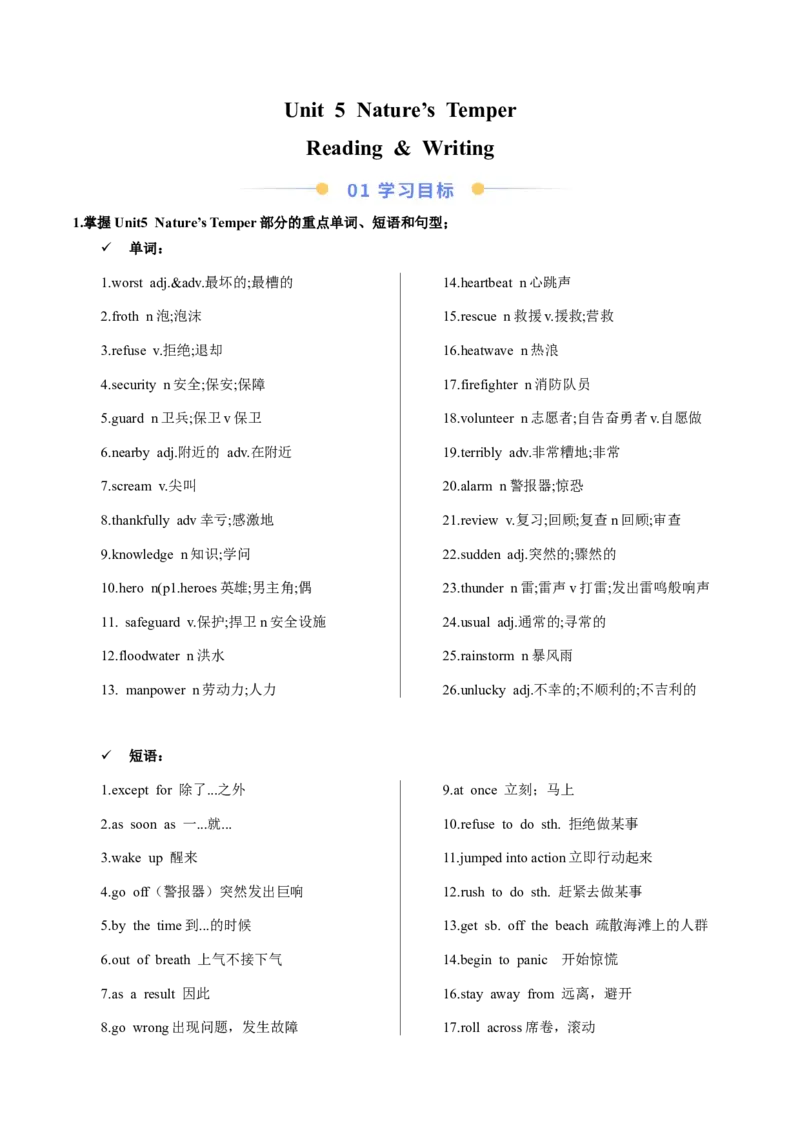
1.掌握Unit5 Nature’s Temper部分的重点单词、短语和句型;
单词:
1.worst adj.&adv.最坏的;最槽的 14.heartbeat n心跳声
2.froth n泡;泡沫 15.rescue n救援v.援救;营救
3.refuse v.拒绝;退却 16.heatwave n热浪
4.security n安全;保安;保障 17.firefighter n消防队员
5.guard n卫兵;保卫v保卫 18.volunteer n志愿者;自告奋勇者v.自愿做
6.nearby adj.附近的 adv.在附近 19.terribly adv.非常糟地;非常
7.scream v.尖叫 20.alarm n警报器;惊恐
8.thankfully adv幸亏;感激地 21.review v.复习;回顾;复查n回顾;审查
9.knowledge n知识;学问 22.sudden adj.突然的;骤然的
10.hero n(p1.heroes英雄;男主角;偶 23.thunder n雷;雷声v打雷;发出雷鸣般响声
11. safeguard v.保护;捍卫n安全设施 24.usual adj.通常的;寻常的
12.floodwater n洪水 25.rainstorm n暴风雨
13. manpower n劳动力;人力 26.unlucky adj.不幸的;不顺利的;不吉利的
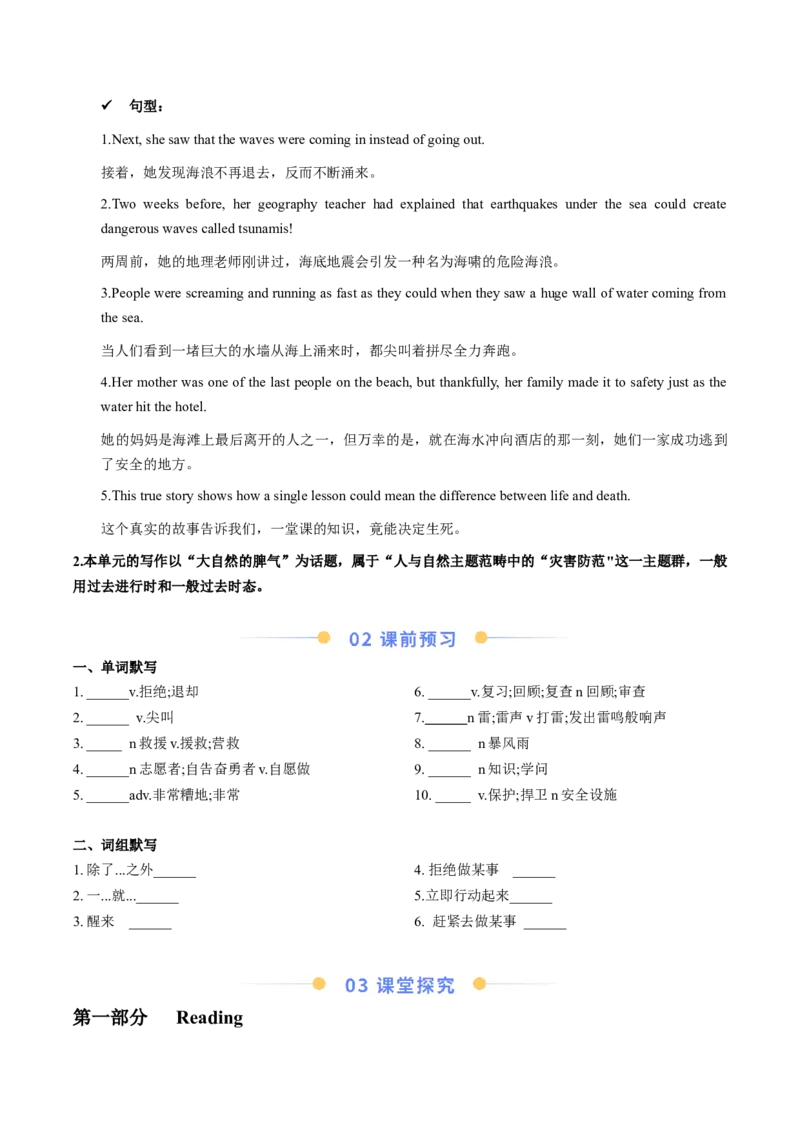
短语:
1.except for 除了...之外 9.at once 立刻;马上
2.as soon as 一...就... 10.refuse to do sth. 拒绝做某事
3.wake up 醒来 11.jumped into action立即行动起来
4.go off(警报器)突然发出巨响 12.rush to do sth. 赶紧去做某事
5.by the time到...的时候 13.get sb. off the beach 疏散海滩上的人群
6.out of breath 上气不接下气 14.begin to panic 开始惊慌
7.as a result 因此 16.stay away from 远离,避开
8.go wrong出现问题,发生故障 17.roll across席卷,滚动 句型:
1.Next, she saw that the waves were coming in instead of going out.
接着,她发现海浪不再退去,反而不断涌来。
2.Two weeks before, her geography teacher had explained that earthquakes under the sea could create
dangerous waves called tsunamis!
两周前,她的地理老师刚讲过,海底地震会引发一种名为海啸的危险海浪。
3.People were screaming and running as fast as they could when they saw a huge wall of water coming from
the sea.
当人们看到一堵巨大的水墙从海上涌来时,都尖叫着拼尽全力奔跑。
4.Her mother was one of the last people on the beach, but thankfully, her family made it to safety just as the
water hit the hotel.
她的妈妈是海滩上最后离开的人之一,但万幸的是,就在海水冲向酒店的那一刻,她们一家成功逃到
了安全的地方。
5.This true story shows how a single lesson could mean the difference between life and death.
这个真实的故事告诉我们,一堂课的知识,竟能决定生死。
2.本单元的写作以“大自然的脾气”为话题,属于“人与自然主题范畴中的“灾害防范"这一主题群,一般
用过去进行时和一般过去时态。
一、单词默写
1. ______v.拒绝;退却 6. ______v.复习;回顾;复查n回顾;审查
2. ______ v.尖叫 7. n雷;雷声v打雷;发出雷鸣般响声
3. _____ n救援v.援救;营救 8. ______ n暴风雨
4. ______n志愿者;自告奋勇者v.自愿做 9. ______ n知识;学问
5. ______adv.非常糟地;非常 10. _____ v.保护;捍卫n安全设施
二、词组默写
1. 除了...之外______ 4. 拒绝做某事 ______
2. 一...就...______ 5.立即行动起来______
3. 醒来 ______ 6. 赶紧去做某事 ______
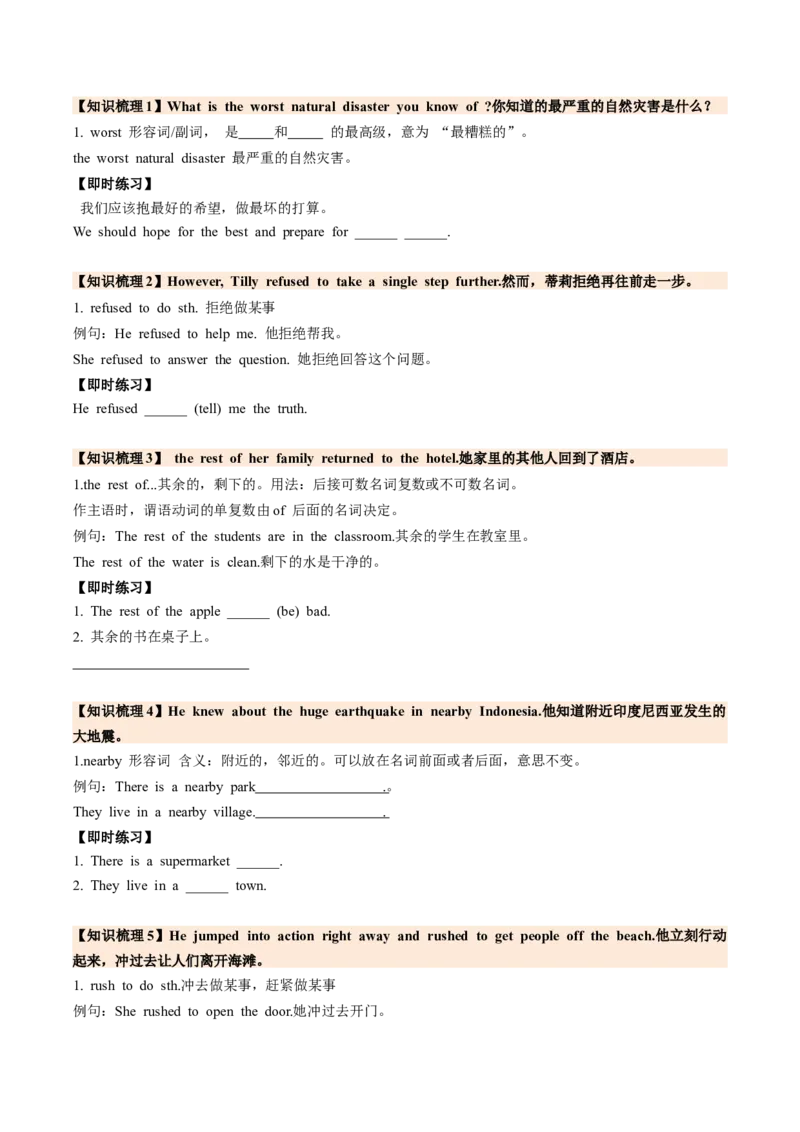
第一部分 Reading【知识梳理1】What is the worst natural disaster you know of ?你知道的最严重的自然灾害是什么?
1. worst 形容词/副词, 是 和 的最高级,意为 “最糟糕的”。
the worst natural disaster 最严重的自然灾害。
【即时练习】
我们应该抱最好的希望,做最坏的打算。
We should hope for the best and prepare for ______ ______.
【知识梳理2】However, Tilly refused to take a single step further.然而,蒂莉拒绝再往前走一步。
1. refused to do sth. 拒绝做某事
例句:He refused to help me. 他拒绝帮我。
She refused to answer the question. 她拒绝回答这个问题。
【即时练习】
He refused ______ (tell) me the truth.
【知识梳理3】 the rest of her family returned to the hotel.她家里的其他人回到了酒店。
1.the rest of...其余的,剩下的。用法:后接可数名词复数或不可数名词。
作主语时,谓语动词的单复数由of 后面的名词决定。
例句:The rest of the students are in the classroom.其余的学生在教室里。
The rest of the water is clean.剩下的水是干净的。
【即时练习】
1. The rest of the apple ______ (be) bad.
2. 其余的书在桌子上。
【知识梳理4】He knew about the huge earthquake in nearby Indonesia.他知道附近印度尼西亚发生的
大地震。
1.nearby 形容词 含义:附近的,邻近的。可以放在名词前面或者后面,意思不变。
例句:There is a nearby park .。
They live in a nearby village. .
【即时练习】
1. There is a supermarket ______.
2. They live in a ______ town.
【知识梳理5】He jumped into action right away and rushed to get people off the beach.他立刻行动
起来,冲过去让人们离开海滩。
1. rush to do sth.冲去做某事,赶紧做某事
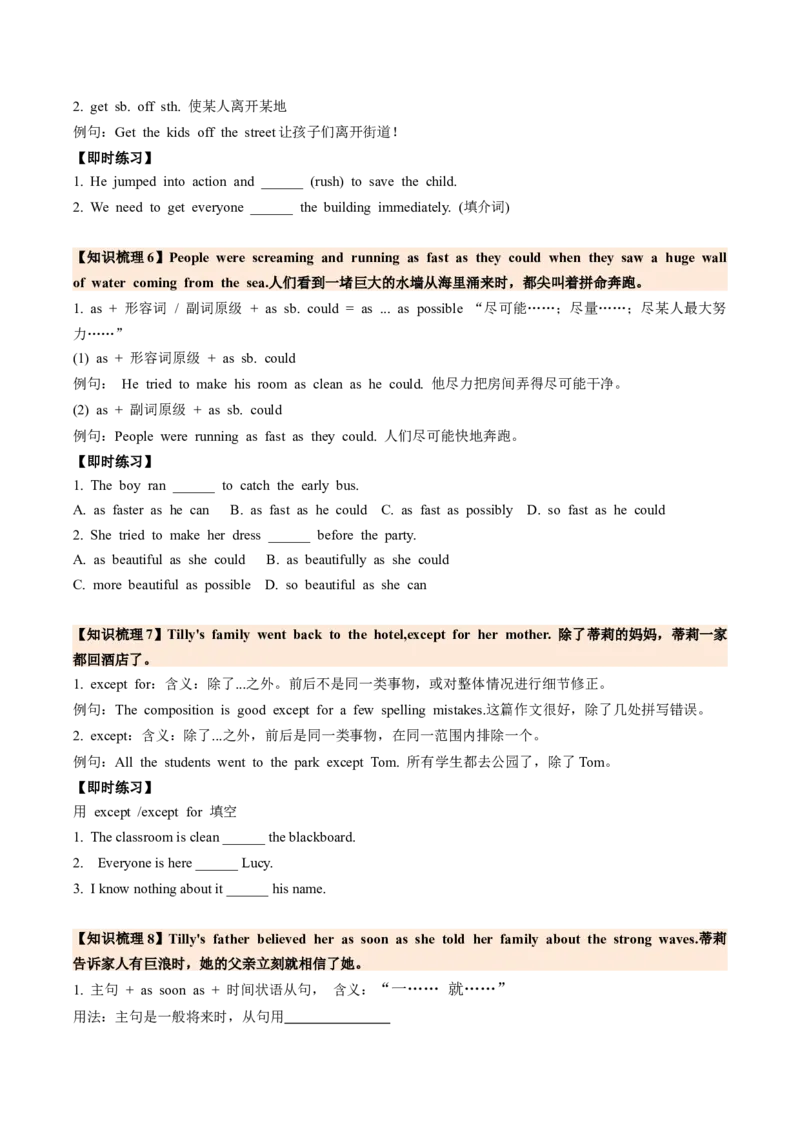
例句:She rushed to open the door.她冲过去开门。2. get sb. off sth. 使某人离开某地
例句:Get the kids off the street让孩子们离开街道!
【即时练习】
1. He jumped into action and ______ (rush) to save the child.
2. We need to get everyone ______ the building immediately. (填介词)
【知识梳理6】People were screaming and running as fast as they could when they saw a huge wall
of water coming from the sea.人们看到一堵巨大的水墙从海里涌来时,都尖叫着拼命奔跑。
1. as + 形容词 / 副词原级 + as sb. could = as ... as possible “尽可能……;尽量……;尽某人最大努
力……”
(1) as + 形容词原级 + as sb. could
例句: He tried to make his room as clean as he could. 他尽力把房间弄得尽可能干净。
(2) as + 副词原级 + as sb. could
例句:People were running as fast as they could. 人们尽可能快地奔跑。
【即时练习】
1. The boy ran ______ to catch the early bus.
A. as faster as he can B. as fast as he could C. as fast as possibly D. so fast as he could
2. She tried to make her dress ______ before the party.
A. as beautiful as she could B. as beautifully as she could
C. more beautiful as possible D. so beautiful as she can
【知识梳理7】Tilly's family went back to the hotel,except for her mother. 除了蒂莉的妈妈,蒂莉一家
都回酒店了。
1. except for:含义:除了...之外。前后不是同一类事物,或对整体情况进行细节修正。
例句:The composition is good except for a few spelling mistakes.这篇作文很好,除了几处拼写错误。
2. except:含义:除了...之外,前后是同一类事物,在同一范围内排除一个。
例句:All the students went to the park except Tom. 所有学生都去公园了,除了Tom。
【即时练习】
用 except /except for 填空
1. The classroom is clean ______ the blackboard.
2. Everyone is here ______ Lucy.
3. I know nothing about it ______ his name.
【知识梳理8】Tilly's father believed her as soon as she told her family about the strong waves.蒂莉
告诉家人有巨浪时,她的父亲立刻就相信了她。
1. 主句 + as soon as + 时间状语从句, 含义:“一…… 就……”
用法:主句是一般将来时,从句用例句:I will call you as soon as I arrive home. 我一到家就给你打电话。
主句是一般过去时,从句
本句:believed (过去时) ... as soon as she told (过去时) ... 她一告诉,爸爸就相信了。
【即时练习】
1. I will tell him the news ______ he comes back.
A. as soon as B. while C. since D. because
2. She ran to the bus stop ______ she heard the bus coming.
A. as soon as B. as good as C. as fast as D. as well as
【知识梳理 9】Over 5,000 firefighters,police,and volunteers all worked together to keep the people
and their homes safe. 5000多名消防员、警察和志愿者齐心协力,保障民众及其家园的安全。
1.volunteer n.志愿者;自告奋勇者 v.自愿做;义务做
(1)volunteer作可数名词,意为“志愿者;自告奋勇者” 复数形式:
常见搭配为:
a volunteer for sth 一名志愿者
volunteer(s) for sth. 做某事的志愿者
例句:We need more volunteers for the sports meeting. 我们需要更多运动会志愿者。
(2)volunteer作动词,意为“自愿做;义务做”
常见搭配为:
volunteer as...自愿充当……
volunteer to do sth自愿做某事
例句:She was a volunteer for the Red Cross before training as a nurse.
她在接受护士培训之前是红十字会的志愿者。
例句:I volunteered as a guide in Chengdu Museum last weekend.上周末我在成都博物馆志愿当导游。
【即时练习】
1. Many ______ came to help after the earthquake.
A. volunteers B. volunteer C. voluntary D. help
2. She often ______ to clean the street on weekends.
A. volunteer B. volunteers C. volunteered D. volunteering
【知识梳理10】Last Friday started terribly. 上周五开局糟透了。
1. terribly adv. 非常;很;糟糕地 形容词形式: 可怕的;糟糕的
a terrible day 糟糕的一天
The weather is terrible. 天气很糟糕。
【即时练习】
1. The wind blew ______ (terrible) last night.
2. It was a ______ (terribly) storm.【知识梳理11】First, my alarm clock didn't go off, so I woke up late and had to rush to the bus stop.
首先,我的闹钟没有响,所以我醒得很晚,不得不匆匆赶到公共汽车站。
1. go off(闹钟)发出响声
2. wake up 醒来;叫醒。过去式:wake →
结构:wake up 醒来
例句:I usually wake up at 6:00. 。
wake sb. up 叫醒某人 例句:Please wake me up at 7:00. 。
3. rush to... 冲向……;奔到……
例句:He rushed to the hospital when he heard the news. 他听到消息后冲向医院。
【即时练习】
1. My alarm didn't ______ this morning, so I was late.
A. go off B. go out C. get off D. get up
【知识梳理12】I had a test that morning, so I was reviewing my notes while I was waiting for my
bus. 那天早上我有一场考试,所以在等公交车的时候我一直在复习笔记。
1. review v. 复习;回顾 现在分词: 过去式 / 过去分词:
搭配:review notes 复习笔记;
review lessons 复习功课
例句:I need to review for the math test. 我需要为数学考试复习。
review名词 含义:复习;回顾;(书、电影等的)评论
常见搭配
do some review 做些复习
a book review 书评
a film review 影评
例句:Before the exam, we need a review. 考试前,我们需要复习。
【即时练习】
1. It's necessary to ______ your lessons every day.
A. review B. think C. look D. ask
2. She is ______ for the English test.
A. review B. reviewing C. reviewed D. reviews
3. He wrote a ______ of the new book.
A. review B. lesson C. story D. song
【知识梳理13】All of a sudden, thunder rolled across the sky. 突然,雷声在天空中隆隆作响。
1.All of a sudden 突然;猛地 =
例句: All of a sudden, I remembered his name. = Suddenly, I remembered his name.突然,我想起了他的名字。
2. thunder n. 雷;雷声
thunder and lightning 雷电
v. 打雷;轰隆隆地响
It is thundering. 天在打雷。
3. across the sky 穿过天空;划过天空
例句:A rainbow appeared across the sky. 一道彩虹出现在天空。
【即时练习】
1. ______, a big dog ran out of the house.
A. All of sudden B. All of a sudden C. Sudden D. Of sudden
2. We heard the thunder ______ in the distance.
A. roll B. rolls C. rolled D. rolling
3. Lightning flashed ______ the sky.
A. through B. across C. on D. at
【知识梳理14】By the time the bus came, I was cold and wet.
1. By the time 到…… 时候为止;等到…… 时候
By the time + 时间状语从句的用法:
(1)从句用一般过去时,主句用一般过去时
By the time the bus came (过去时), I was cold and wet (过去时).
等到车来的时候,我已经又冷又湿了。
(2)从句用一般现在时,主句用一般将来时
By the time he arrives, I will be ready. 等到他到的时候,我将会准备好了。
易混辨析:By the time vs When
By the time:强调截止到某个时间点,主句动作 / 状态已经完成或存在。
例句:By the time I got there, the movie had started. (电影已经开始了)
When:强调动作发生的时间点,主从句动作可同时或先后发生。
例句:When I got there, the movie started. (我到的时候,电影开始了)
【即时练习】
1. ______ I got to school, the bell had rung.
A. By the time B. When C. While D. If
2. By the time he ______, we had already left.
A. arrives B. arrived C. will arrive D. is arriving
3. It began to rain ______ I was walking home.
A. by the time B. when C. since D. until
第二部分 Writing【知识梳理1】写作指导
本单元的写作以“大自然的脾气”为话题,属于“人与自然主题范畴中的“灾害防范"这一主题群,写作思
路为:①描述自然灾害发生时的人物活动;②陈述自然灾害带来的危害并阐述应对的办法或措施;③描写灾难
新闻报道及志愿救援等。此类文章通常以一般过去时和过去进行时为主,要求学生能够熟练运用“was/
weret+v-ing"及引导时间状语从句的连词when/while讲述自然灾害发生时,自己正在做的事情或当时的情
景。
【知识梳理2】写作素材
1. At that time, I was doing my homework quietly at home.
2. The...... made me realize the great power of nature.
3. When the ...... comes, stay indoors and keep away from windows.
4. One evening last summer, I was doing my homework when a ..... suddenly started.
5. The wind was blowing hard and rain was hitting the windows.
6. That experience taught me to stay calm and act quickly during natural disasters.
7. Workers cleared the main roads, and volunteers helped people in need with food and warm supplies.
8. We can help our families and neighbours, and always remember the importance of teamwork and helping each
other in difficult times.
【即时练习】
1.2023年12月,我们国家的部分地区遭遇了罕见的暴雪。请以“The Snowstorm”为题,根据下列
提示并结合所学内容,写一篇80词左右的英语作文。
内容提示:
1. What was the result of the snowstorm?
2. What did our country do to deal with the snowstorm?
3. What should we do as students?
注意:
1. 必须包含所有提示内容,可适当发挥;
2. 文中不得出现真实的人名、校名和地名。
____________________________________________________________________________________________
____________________________________________________________________________________________
____________________________________________________________________________________________
____________________________________________________________________________________________
____________________________________________________________________________________________
____________________________________________________________________________________________
____________________________________________________________________________________________
____________________________________________________________________________________________
__________一、用所给单词的正确形式填空
1.The weather got even (bad) than we expected.
2. (thank). no one was hurt in the accident.
3.Quick (think) saved her life during the tsunami.
4.The firefighter is one of the greatest (hero) in our town.
5.She felt (terrible) sick after eating that.
6.When the rainstorm began.I (review) my lessons at home.
二、根据汉语意思完成句子
1. 最后,她妈妈决定独自继续散步,家人其余的人则返回了酒店。
_______, her mother ____ ____ ______ the walk ________, and _____ _____ her family ____ the
hotel.
2. 他立刻行动起来,冲过去把人们从海滩上转移走。
He______ ______ _______ ________ and________ _________ _______ people ________ the
beach.
3. 当人们看到海面涌来一堵巨大的水墙时,都尖叫着拼命奔跑。
People ________ _________and _______ ________ _________ _______ ____________ _________
_________ they saw a huge __________ __________ water _________ from the sea.
4. 这个真实的故事表明,一堂课的知识,可能就是生与死的差别。
This true story _______ how a single lesson _______ _______ the _______ _______ life _____ death.
5. 多亏了她的知识和敏捷的思维,一名女学生成功救了100多人的性命。
________ _____ her knowledge and _____ _______, one schoolgirl ______ ______ _____ save _____
100 lives.
6. 突然,雷声在天空中轰鸣。
__________ __________ _________, thunder __________ _________ the sky.
7. 公交车来的时候,我已经又冷又湿了。
__________ __________ _______ the bus _________, I ___________ cold and wet.
8. 当我终于气喘吁吁地赶到教室时,老师已经在门口等着了。
______ I finally ____ my classroom, ______ _____ ______, my teacher _______ ______ ______ at the
door.
一、单项选择
1. When the flood came, no one ______ to help the affected villagers. Everyone tried their best to give a
hand.
A. refused B. refused C. refuse D. refusing
2.Some volunteers cleared the roads, and ______ them helped send emergency supplies to the disasterarea.
A. the rest B. the rest of C. rest of D. a rest of
3. As soon as the firemen heard the news of the flood, they ______ the village to save people.
A. rushed to B. rushed C. run to D. rush to
4.After days of heavy rain, the small town faced a terrible ________, with water covering the streets and houses.
A.drought B.flood C.wildfire D.earthquake
5.—Learning to love is like learning to walk.
—Yes. ________ we step out bravely, we’ll find it’s not so difficult.
A.As soon as B.As well as C.As long as D.As for
6.The latest learning apps enable students ________ lessons at any time.
A.review B.to review C.reviewed D.reviewing
7.They ________ for safety when the alarm ________.
A.ran; went off B.run; goes off
C.were running; was going off D.will run; will go off
8.— Did you study any other languages ________ English when you were at college?
— Yes, I studied three. But I have forgotten all ________ a few words of each.
A.besides; except B.except; besides C.except; except D.besides; besides
9.When my father ________ through the evening paper, a stranger ________ into the dining room.
A.looked; came B.was looking; came
C.was looking; was coming D.looked; was coming
10.Lily _________ TV when her father came home.
A.watches B.has watched C.watched D.was watching
二、完形填空
通读下面短文,掌握其大意,然后在每小题所给的四个选项中,选出一个最佳答案。
Natural disasters can happen suddenly and cause great damage. As middle school students, we need to know
1 to protect ourselves.
When it comes to earthquakes, if we are indoors, we should 2 hide under a strong table or desk
and protect our heads and necks with our hands. We mustn’t be afraid or 3 .
During a flood, we need to 4 going to low-lying areas and stay away from rivers and lakes. If we
receive a 5 , we should follow the instructions (指引) of the local government and move to a 6
place in time.
For wildfires, we should never play with fire in the forest. If we notice a fire, we must 7 it to the
government immediately. During a storm, we should stay away from windows and doors to keep safe from the
flying objects (物体).
For typhoons, we should stay indoors and close all the windows and doors. Do not go out until the typhoon
has 8 . Lightning is also dangerous. When there is a thunderstorm, we should stay away from large 9and metal (金属) objects.
By learning and practicing these preventive methods, we can better protect ourselves and our families from
the 10 of natural disasters. Have you got them?
1.A.why B.how C.when D.where
2.A.happily B.quietly C.luckily D.quickly
3.A.stay calm B.run around C.shout loudly D.stand still
4.A.keep B.notice C.avoid D.remember
5.A.writing B.calling C.talking D.helping
6.A.safe B.busy C.clean D.empty
7.A.give B.send C.report D.present
8.A.passed B.moved C.turned D.changed
9.A.rocks B.hills C.fields D.forests
10.A.stress B.damage C.trouble D.pollution
三、语法填空
根据课文内容与语境,用括号内单词的适当形式填空。
A very terrible fire happened in Hong Kong not long ago. It took many lives, including a brave firefighter
who was trying 1 (save) people.
The bamboo scaffolding (脚手架) 2 the buildings acted as fuel (燃料) helping the fire grow fast.
The way of the building arrangements (安排) 3 (create) a “chimney effect (烟囱效应)”. This effect made
the fire move upward 4 (quick) and become extremely hot, just like how air moved through a real chimney.
Strong winds made everything even 5 (bad).
Firefighters faced great challenges during the rescue (救援). The chimney effect made 6 fire too hot
and dangerous to get close to. Burning pieces kept falling from above, and thick black smoke made it hard to see
and breathe. Still, these brave 7 (work) did their best to save people caught inside.
Our hearts are with all the families who lost 8 (they) loved ones. We also remember the heroic
fighter because he gave his life trying to help others. We hope the injured (伤者) will recover (康复) soon.
The terrible event reminds us how important fire safety is. 9 we all learn from this and are more
careful, such tragedies (悲剧) 10 (not happen) again and everyone may live safely.
四、书面表达
根据以下提示,写一篇80词左右的短文,描述“一次你经历过的自然灾害(如暴风雨、雷雨等)”,
要求用上过去进行时和一般过去时。
提示:
1. 灾害发生的时间、场景;
2. 你当时正在做什么;
3. 发生了什么情况,你是如何应对的。____________________________________________________________________________________________
____________________________________________________________________________________________
____________________________________________________________________________________________
____________________________________________________________________________________________
____________________________________________________________________________________________
____________________________________________________________________________________________
_________________________