2025-2026 学年八年级下册英语单元自测(安徽卷专用)
Unit 5·培优卷
学校:___________班级:___________姓名:___________分数:___________
注意事项:
1.本试卷满分120分,考试时间120分钟。
2.考生务必用黑色字迹的签字笔或钢笔在答题卡上填写自己的考号、姓名、试室号、座位号,用 2B铅
笔把对应该号码的标号涂黑。
3.选择题每小题选出答案后,用 2B铅笔把答题卡上对应题目选项的答案信息点涂黑,如需改动,用橡
皮擦干净后,再选涂其他答案,答案不能答在试题上。
4.非选择题必须用黑色字迹钢笔或签字笔作答,答案必须写在答题卡各题目指定区域内相应位置上;如
需改动,先划掉原来的答案,然后再写上新的答案;不准使用铅笔、涂改液,不按以上要求作答的答
案无效。
5.考生务必保持答题卡的整洁,考试结束时,将答题卡交回。
第一部分 听力(共四大题,满20分)
Ⅰ.短对话理解(共5小题:每小题1分,满分5分)
你将听到五段对话,每段对话后有一个小题。请在每小题所给的A、B、C三个选项中选出一个最佳选项。
每段对话读两遍。
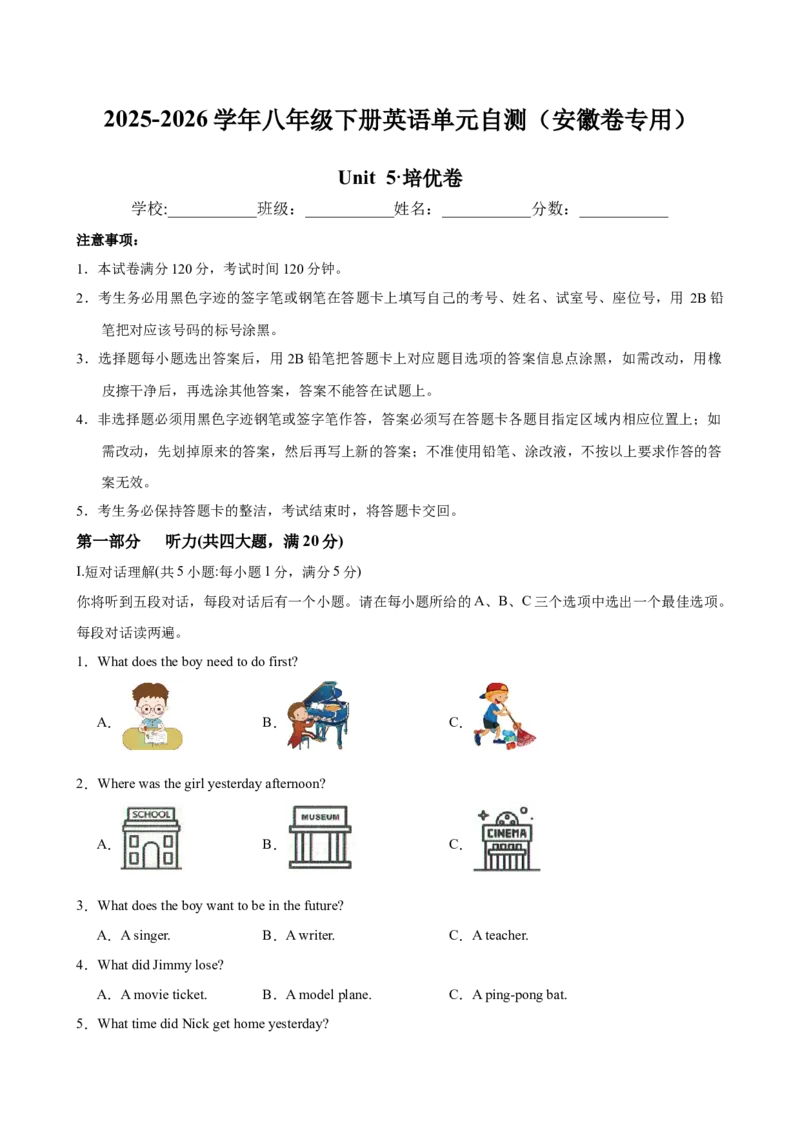
1.What does the boy need to do first?
A. B. C.
2.Where was the girl yesterday afternoon?
A. B. C.
3.What does the boy want to be in the future?
A.A singer. B.A writer. C.A teacher.
4.What did Jimmy lose?
A.A movie ticket. B.A model plane. C.A ping-pong bat.
5.What time did Nick get home yesterday?A.At 7:30 p.m. B.At 8:30 p.m. C.At 9:30 p.m.
听下面一段对话,回答问题。
6.What does Tom advise the girl to do first?
A.Speak more in English. B.Listen to the radio. C.Watch more English movies.
7.How long does Tom listen to VOA every day?
A.About 15 minutes. B.About 25 minutes. C.About 35 minutes.
听下面一段对话,回答问题。
8.When did Jane go to the old people’s home?
A.On Saturday morning. B.On Sunday morning. C.On Sunday afternoon.
9.What did Jane do at the old people’s home?
A.She read stories. B.She cleaned the rooms. C.She sang songs.
10.Where is the old people’s home?
A.On River Street. B.On Green Road. C.On Sun Road.
你将听到一篇短文,短文后有五个小题。请根据短文内容,在每小题所给的A、B、C三个选项中选出一
个最佳选项。短文读两遍。
11.What sport was Li Qiang playing at three yesterday afternoon?
A.Basketball. B.Volleyball. C.Football.
12.What did Ms. Zhang do?
A.She called 120 at once. B.She bought some medicine. C.She took Li Qiang to the hospital.
13.What happened to Li Qiang?
A.His arm was broken. B.His leg was broken. C.His foot was broken.
14.How long should Li Qiang stay in hospital at least?
A.7 days. B.10 days. C.15 days.
15.What is Li Qiang’s favorite fruit?
A.The banana. B.The apple. C.The watermelon.
IV. 信息转换(共5小题,每小题1分,满分5分)
你将听到一篇短文。请根据短文内容,写出下面表格中所缺的单词,每空仅填一词。短文读两遍。
A Heavy Rain CameTime At 16 p.m. last Sunday.
•Tony was playing 17 .
•Lily was 18 the TV set to the living room.
Activities
•Sarah was buying 19 .
•Jeff was flying a kite near a (n) 20 lake.
第二部分 英语知识运用(共两大题,满分30分)
V. 单项填空(共10小题;每小题1分,满分10分)
从每小题所给的人B、C、D四个选项中选出一个可以填入空白处的最佳选项。
21.A sudden ________ can bring great danger to the coastal towns.
A.typhoon B.calligraphy C.ski D.program
22.At noon, I took a photo of some swans while they ________ on the lake.
A.dance B.are dancing C.would dance D.were dancing
23.People in the neighbourhood were warned to ________ for the coming drought.
A.make preparations B.give up C.dream of D.cut down
24.The ________ roared loudly, waking everyone up in the early morning.
A.thunder B.stroke C.coin D.stamp
25.The firefighter tried his best to put out the ________ and save the family.
A.wildfire B.tsunami C.tornado D.landslide
26.We should ________ the roof of the old house to keep it safe from the heavy snowstorm.
A.repair B.fry C.cross D.burn
27.She was out of ________ after running to the neighbourhood to ask for help.
A.breath B.control C.danger D.trouble
28.The exam was ________ difficult, so most students failed.
A.hardly B.nearly C.luckily D.terribly
29.—What’s your plan for the coming winter holiday?
—Pardon? Sorry, I ________ about something else.
A.think B.thought C.will think D.was thinking
30.—The drought has lasted for three months.
—________ We must save every drop of water.A.That’s terrible! B.No way! C.Me too! D.I don’t know.
VI. 完形填空(共20小题;每小题1分,满分20分)
阅读下列短文,从每小题所给的A、B、C、D四个选项中选出一个最佳选项。
A
A Hero in the Storm
Nature’s temper is unpredictable. It can bring beautiful days one minute, and terrible disasters the next. Last
summer, a 31 hit the small town near the sea. The wind blew so hard that it 32 windows and
knocked down trees. The sea level rose quickly, and soon 33 covered the streets.
Tilly, a 12-year-old schoolgirl, was playing in the yard with her family 34 . She had learned about
tsunamis in her geography class. She noticed the sea water was rising 35 and there was a strange froth
on the surface. She immediately shouted to her parents and told them to 36 the neighbourhood.
At first, people didn’t believe her. But Tilly kept explaining what she had learned. 37 , the
neighbours started to make preparations. They moved their things to the second floor, checked the 38
and called the security guard for help.
Soon, the tsunami came. Thanks to Tilly’s quick thinking, most people were 39 to safety. No one
was badly hurt in the town. Tilly became a 40 in her neighbourhood. She taught us that knowledge can
help us face nature’s temper bravely.
31.A.rainstorm B.typhoon C.snowstorm D.drought
32.A.broke B.lit C.painted D.hid
33.A.floodwater B.heatwave C.smoke D.dust
34.A.luckily B.happily C.thankfully D.terribly
35.A.all of a sudden B.so far C.once in a while D.bit by bit
36.A.leave B.enter C.clean D.repair
37.A.Unluckily B.Finally C.Sadly D.Nervously
38.A.power B.roof C.truck D.supply
39.A.rescued B.refused C.attracted D.located
40.A.hero B.traveller C.explorer D.volunteer
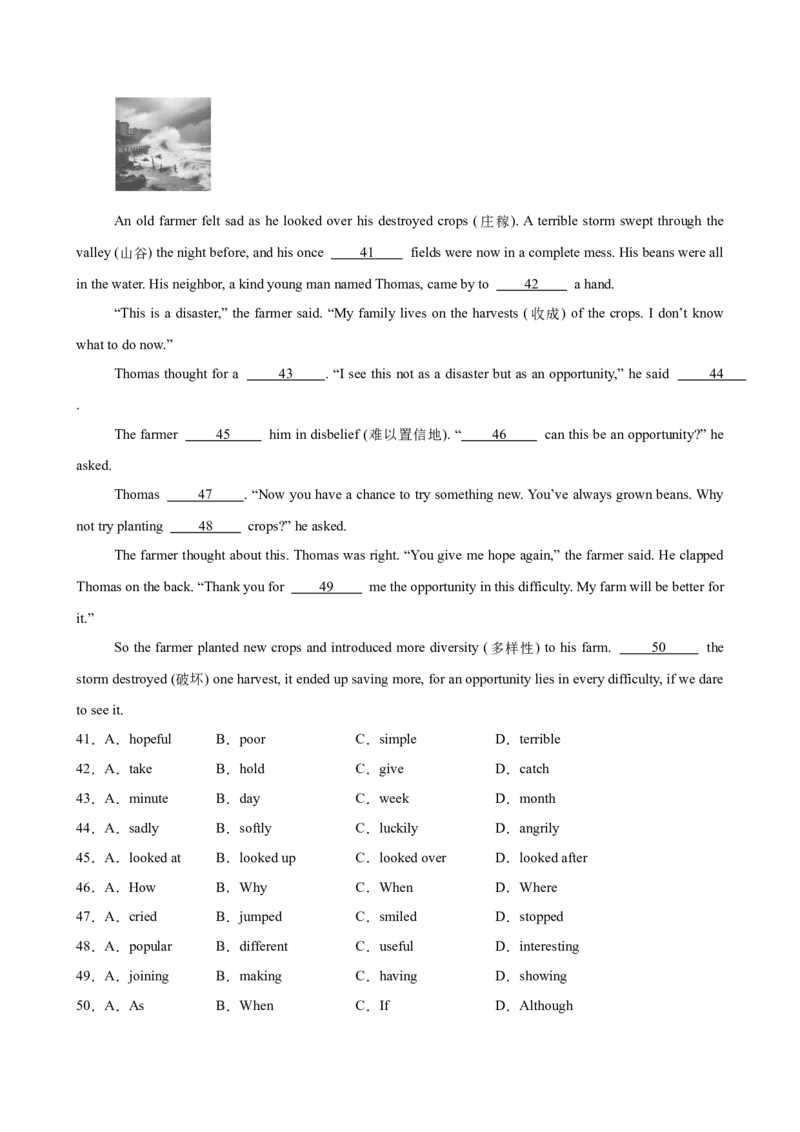
BAn old farmer felt sad as he looked over his destroyed crops (庄稼). A terrible storm swept through the
valley (山谷) the night before, and his once 41 fields were now in a complete mess. His beans were all
in the water. His neighbor, a kind young man named Thomas, came by to 42 a hand.
“This is a disaster,” the farmer said. “My family lives on the harvests (收成) of the crops. I don’t know
what to do now.”
Thomas thought for a 43 . “I see this not as a disaster but as an opportunity,” he said 44
.
The farmer 45 him in disbelief (难以置信地). “ 46 can this be an opportunity?” he
asked.
Thomas 47 . “Now you have a chance to try something new. You’ve always grown beans. Why
not try planting 48 crops?” he asked.
The farmer thought about this. Thomas was right. “You give me hope again,” the farmer said. He clapped
Thomas on the back. “Thank you for 49 me the opportunity in this difficulty. My farm will be better for
it.”
So the farmer planted new crops and introduced more diversity (多样性) to his farm. 50 the
storm destroyed (破坏) one harvest, it ended up saving more, for an opportunity lies in every difficulty, if we dare
to see it.
41.A.hopeful B.poor C.simple D.terrible
42.A.take B.hold C.give D.catch
43.A.minute B.day C.week D.month
44.A.sadly B.softly C.luckily D.angrily
45.A.looked at B.looked up C.looked over D.looked after
46.A.How B.Why C.When D.Where
47.A.cried B.jumped C.smiled D.stopped
48.A.popular B.different C.useful D.interesting
49.A.joining B.making C.having D.showing
50.A.As B.When C.If D.Although第三部分 阅读理解(共两大题,满分45分)
VII. 补全对话 (共5小题;每小题1分,满分5分)
根据对话内容,从下面选项中选出能填入空白处的最佳选项,其中有两个为多余选项。
A: Bert, do you remember the earthquake last month?
B: Of course. 51
A: What were you doing at that time?
B: I was doing some shopping in a shopping center.
A: 52
B: I tried my best to run to the street. 53
A: But you know, it’s dangerous to run during the earthquake.
B: 54 But I know little about how to protect myself in an earthquake.
A: You should read some information about that online. 55
B: Very afraid.
A: Well, Bert, thanks for talking with me.
B: You’re welcome.
A.Yes, I see.
B.I will never forget it.
C.Then what did you do?
D.Did you shout for help?
E.Many other people were also running quickly.
F.I think we should learn more about earthquakes.
G.By the way, how did you feel when you found yourself in danger?
VIII. 阅读理解(共20小题;每小题2分,满分40分)
阅读下列短文,从每小题所给的A、B、C、D四个选项中选出一个最佳选项。
A
We are asking for help because of the terrible floods in Libya.
On Sunday, September 10, a big storm named Daniel hit the northeast part of Libya. It
brought strong winds and very heavy rain. This caused sudden and very bad floods. The floods
were so strong that they were like huge waves, and they destroyed (摧毁) everything in their
way.In Derna, two dams (大坝) were broken, and the three-meter-high floods destroyed the
whole neighborhoods. Thousands of people died, and bridges, buildings, and important things
like roads were badly damaged (损坏).
The eastern cities of Benghazi, Sousa, and Al-Marj also had big floods and need help
quickly. People really need our help right now. If you can, please make a donation (捐赠) today.
Click https://donate.redcross.org.cn and donate to Libya now.
56.How many cities are mentioned (提及) in the passage?
A.One. B.Two. C.Three. D.Four.
57.Why did the writer write the passage?
A.To ask for help. B.To tell people to keep safe.
C.To invite people to visit Libya. D.To tell people not to go to Libya.
58.Who might write this passage?
A.A student. B.A news reporter.
C.A story writer. D.A science teacher.
B
These years, the world has seen more and more natural disasters. Floods sweep through villages, droughts
dry up farmlands, and strong storms destroy houses. These disasters bring great harm to people’s lives. Many lose
their homes and have to move to safe places. Some even lose their family members. Crops die in the fields, so
food becomes hard to get. Schools close, roads break, and people can’t work or study as usual. Clean water also
becomes scarce in disaster-hit areas.
Why do these disasters happen so often? One main reason is human activities. People cut down too many
trees to build houses or make paper. Factories and cars give off dirty smoke and waste water, polluting the air and
rivers. We also overuse natural resources (自然资源) like coal and oil. All these actions break nature’s balance.
When nature can’t stand it anymore, it fights back with disasters.
We must learn to live with nature, not against it. Let’s plant more trees—they can stop floods and keep the
air fresh. Save water and energy: turn off lights when leaving rooms, and don’t waste water while washing hands.
Protect wild animals, as they help keep ecosystems balanced (生态系统平衡). Use public transport more instead
of driving cars to cut pollution.
Nature is our only home. If we care for it well, disasters will become fewer. People can live safely and
happily for a long time. Small actions from everyone can make a big difference. Let’s work together to keep
harmony (和谐) between humans and nature.59.Which natural disasters are mentioned in the passage?
A.Earthquakes and wildfires. B.Floods, droughts and storms.
C.Tsunamis and snowstorms. D.Landslides and sandstorms.
60.What harm do natural disasters bring?
A.People’s homes are destroyed. B.More crops grow well.
C.People become richer. D.Water becomes more abundant.
61.What human activity causes problems for nature according to the passage?
A.Planting more trees. B.Cutting down too many trees.
C.Saving water and energy. D.Protecting wild animals.
62.What can we do to protect nature?
A.Drive cars every day. B.Waste water while washing.
C.Use public transport more. D.Cut down trees for paper.
C
On December 18th, 2023, a big earthquake hit Jishishan County in Gansu.
Ding Xiaolong was asleep at home when the earthquake happened. It woke him up and he quickly ran out
of his house. He felt lucky to be alive, but all four members of his friend’s family had lost their lives. He was so
sad when he knew the bad news.
Ma Shijun, a middle school student, ran out of the dormitory (宿舍) without shoes. And his teachers
quickly asked the students to go to the playground. “Seeing more and more rescue workers arriving, I find myself
less afraid,” Ma said.
The members of Blue Sky Rescue Team set up lots of tents. Some villagers offered hot water. Taxi drivers
were busy carrying the injured to hospitals. M… teams were racing against time to help those in need. “Life is
the most important,” said the head of a hospital. “There’s hope as long as people are alive.”
63.What does the underlined word “It” refer to in paragraph 2?
A.The outside noise.
B.Ding’s parents’ shouts.
C.The earthquake.
D.Ding’s friend’s call.
64.What is the proper word in the sentence “M… teams were racing against time to help those in need.”?
A.Magical. B.Mobile. C.Medical. D.Musical.65.What does the last paragraph mainly talk about?
A.The earthquake caused many problems.
B.People were trying their best to offer help.
C.Lots of people lost homes during the earthquake.
D.People had different opinions on the earthquake.
D
My dad and I went hiking in the mountain. We enjoyed the fresh air and decided to stay in the hotel for two
days. However, I had one of the most terrible experiences of my life! A storm woke me up early. I got up and
looked out of the window of our hotel. I listened to the thunder and watched the lightning. It wasn’t scary at that
time—it was exciting!
But then I looked at my phone and saw on the news that a hurricane was coming. I asked my dad what a
hurricane was and asked him if he knew what to do. He told me not to worry because a hurricane was just a big
storm. We stayed in our hotel room and by the afternoon, there was even more rain. And the winds were getting
stronger and stronger.
In the evening, a hotel worker asked all the visitors to go to the dining hall. When we were all inside, we
put tables in front of the doors and then we got down on the floor together in the corner. We waited and waited.
The winds got louder, the rain became heavier and then it suddenly went dark. I was so startled that I held (抓住)
my dad’s hand. We stayed there for a long time.
Finally, morning arrived. The storm was over. I felt so happy that we were safe. I hope I will never have a
night like that again.
66.The writer learned what a hurricane was ________.
A.on his phone B.in the newspaper
C.from his father D.on the computer
67.What does the underlined word “startled” in Paragraph 3 mean?
A.Happy. B.Afraid. C.Bored. D.Excited.
68.How did the writer’s feelings change in the passage?
A.Excited→worried→scared→happy.
B.Worried→excited→happy→scared.
C.Scared→excited→worried→happy.
D.Happy→excited→worried→scared.69.What’s the best title for the passage?
A.A Nice Hotel Worker B.A Piece of Bad News
C.Visiting a Special Hotel D.Experiencing a Hurricane
E
On 26 December 2004, 10-year-old Tilly Smith was on holiday in Thailand with her family. While walking
on the beach, she noticed strange waves: thick white froth was on top, and the waves were coming in instead of
going out. Suddenly, she remembered her geography teacher’s lesson—earthquakes under the sea can cause
tsunamis!
Tilly told her family, but they didn’t believe her at first. She refused to walk further, so her family returned
to the hotel. Her dad told a security guard about the tsunami. The guard rushed to clear the beach. Just then, a
huge wave hit. Thanks to Tilly, over 100 people were saved.
70.What did Tilly notice on the beach?
A.Heavy rain. B.Strange waves. C.Strong winds. D.Many tourists.
71.How did Tilly know a tsunami was coming?
A.Her dad told her. B.She saw it on TV.
C.She learned it at school. D.The security guard warned her.
72.What did the security guard do after hearing about the tsunami?
A.He ran to the hotel. B.He cleared the beach.
C.He called the police. D.He hid with Tilly’s family.
F
Last Friday, a storm swept through two villages, destroying fourteen homes completely. Seven others were
so badly damaged (被损坏的) that their owners had to leave them, and fifteen others had broken windows or
broken roofs. One person died, several were badly hurt and taken to hospital, and a number of other people
suffered minor injuries. Altogether (总共) over two hundred people were homeless after the storm.
Mr. Tan, a farmer, said that the storm began early in the morning and lasted for over an hour. “I was eating
with my wife and children when we heard a loud noise,” he said. “A few minutes later, part of the house fell
down. We tried our best to climb out, but then I found that one of my children was missing. I went back inside and
found him, safe but very scared.” Mrs. Woo said that her husband just left for work when she felt that the house
was shaking. She ran outside at once with her children. “There was no time to take anything,” she said. “A fewminutes later, the roof came down.”
Soldiers (士兵) helped to take people out of the flooded area, and the welfare department (福利部门)
provided them with food, clothes and shelter.
73.How many people lost their homes after the storm? (不超过5个词)
74.What was Mr. Tan doing when the storm happened? (不超过10个词)
75.高阶思维·开放 In your opinion, what will the villagers do next? (不超过15个词)
第四部分 写作(共两大题,满分25分)
IX. 单词拼写(共5小题;每小题1分,满分5分)
根据首字母及汉语提示,完成下列单词的拼写,使句意明确,语言通顺。
76.Many houses fell down in the e (地震) in that area.
77.We should stay away from the window during a t (龙卷风).
78.The temperature dropped below zero and the lake was f (结冰的).
79.The l (闪电) lit up the dark sky in a second.
80.Look! A big t (卡车) is coming down the road.
X. 书面表达(共1小题;满分20分)
81.在一个冬天的下午,一场突如其来的暴风雪降临了。作者一家积极应对,安然无恙且愉快地度
过了这一天。根据提示内容写一篇短文。
要点:
1. 妈妈正在做饭;爸爸在电脑上工作;我在写作业;
2. 妈妈收集蜡烛;爸爸检查门窗;我收集柴火。
注意:
1. 短文要包含上述细节,可适当发挥;
2. 词数80~100。
___________________________________________________________________________________________
___________________________________________________________________________________________
______________________________________________________________________________________________________________________________________________________________________________________
___________________________________________________________________________________________
___________________________________________________________________________________________
___________________________________________________________________________________________
____________