Unit 3 Growing Up
Welcome to the unit & Grammar
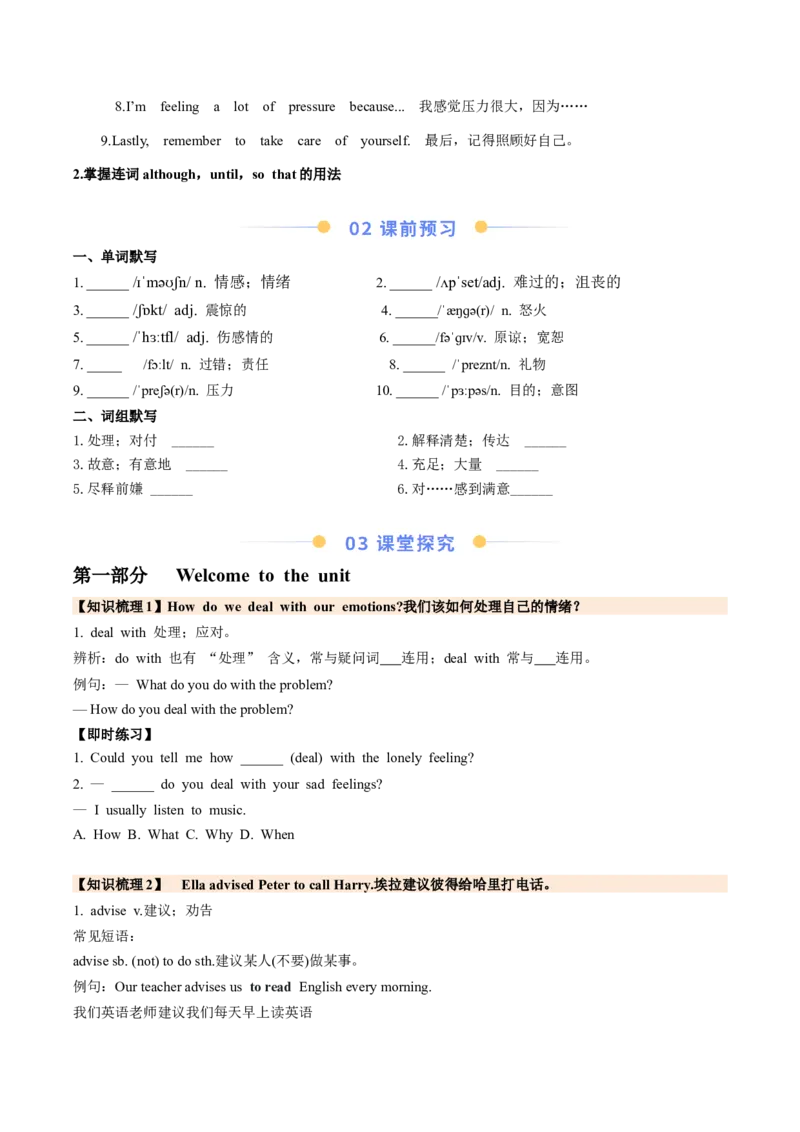
1.掌握Unit 3 Growing Up部分的重点单词、短语和句型;
单词:
1.emotion n. 情感;情绪 8.present n. 礼物
2.upset adj. 难过的;沮丧的 9.standard n. 标准;水平 adj. 标准的
3.shocked adj. 震惊的 10.award n. 奖;奖品
4.anger n. 怒火 11.pressure n. 压力
5.advise v. 建议;劝告 12.purpose n. 目的;意图
6.hurtful adj. 伤感情的 13.pressure n. 压力
7.forgive v. 原谅;宽恕 14.plenty pron. 充足;丰富;大量
短语:
1.deal with 处理;对付 5.plenty of 充足;大量
2.in future 今后;从今以后 6.say sorry to sb.向某人道歉
3.get across 解释清楚;传达 7.be happy with 对……感到满意
4.on purpose 故意;有意地 8.compare...with... 把……和……作比较
句型:
1.I was upset. 我当时很难过。
2.If you want to say sorry, you could call him.如果你想道歉,你可以给他打电话。
3.Maybe you could send him a text message first. 也许你可以先给他发条短信。
4.It's hard to control our anger sometimes. 有时候控制我们的怒火很难。
5.Although he was wrong. you hurt him too.虽然是他不对,但你也伤害了他。
6.How do we deal with our emotions?我们该如何处理自己的情绪?
7.I forgive you.我原谅你了。8.I’m feeling a lot of pressure because... 我感觉压力很大,因为……
9.Lastly, remember to take care of yourself. 最后,记得照顾好自己。
2.掌握连词although,until,so that的用法
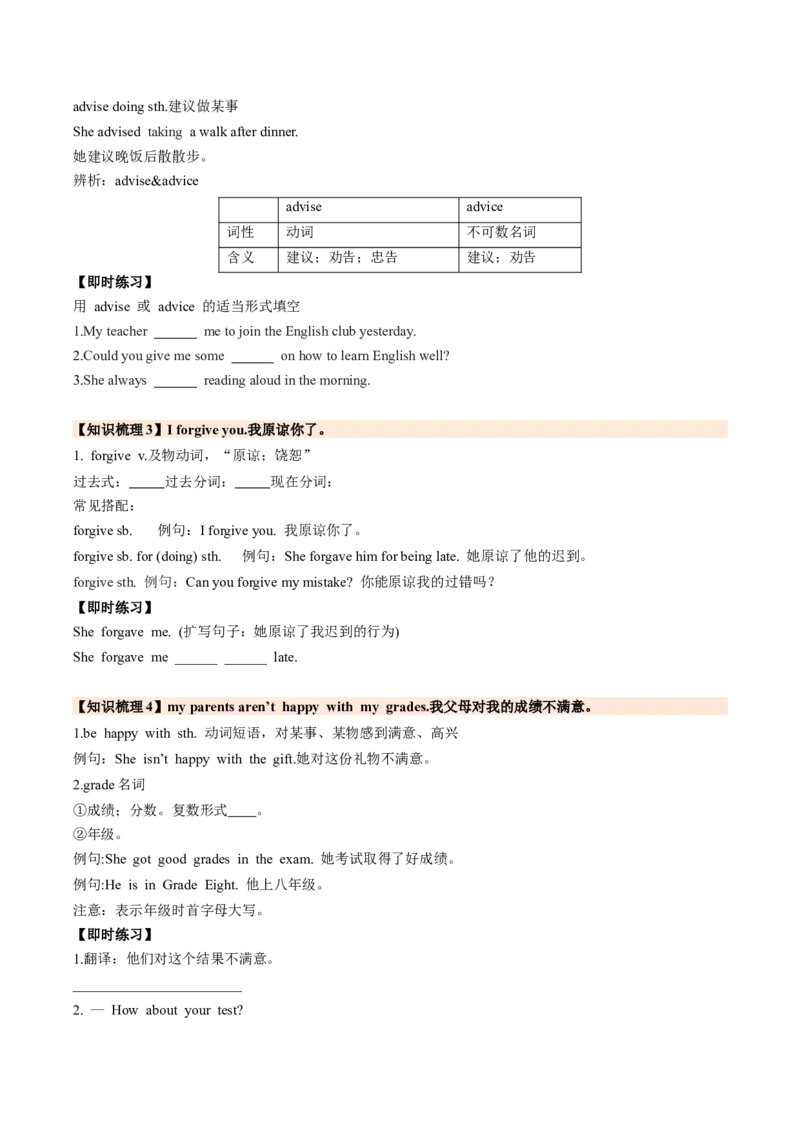
一、单词默写
1. ______ /ɪˈməʊʃn/ n. 情感;情绪 2. ______ /ʌpˈset/adj. 难过的;沮丧的
3. ______ /ʃɒkt/ adj. 震惊的 4. ______/ˈæŋɡə(r)/ n. 怒火
5. ______ /ˈhɜːtfl/ adj. 伤感情的 6. ______/fəˈɡɪv/v. 原谅;宽恕
7. _____ /fɔːlt/ n. 过错;责任 8. ______ /ˈpreznt/n. 礼物
9. ______ /ˈpreʃə(r)/n. 压力 10. ______ /ˈpɜːpəs/n. 目的;意图
二、词组默写
1.处理;对付 ______ 2.解释清楚;传达 ______
3.故意;有意地 ______ 4.充足;大量 ______
5.尽释前嫌 ______ 6.对……感到满意______
第一部分 Welcome to the unit
【知识梳理1】How do we deal with our emotions?我们该如何处理自己的情绪?
1. deal with 处理;应对。
辨析:do with 也有 “处理” 含义,常与疑问词 连用;deal with 常与 连用。
例句:— What do you do with the problem?
— How do you deal with the problem?
【即时练习】
1. Could you tell me how ______ (deal) with the lonely feeling?
2. — ______ do you deal with your sad feelings?
— I usually listen to music.
A. How B. What C. Why D. When
【知识梳理2】 Ella advised Peter to call Harry.埃拉建议彼得给哈里打电话。
1. advise v.建议;劝告
常见短语:
advise sb. (not) to do sth.建议某人(不要)做某事。
例句:Our teacher advises us to read English every morning.
我们英语老师建议我们每天早上读英语advise doing sth.建议做某事
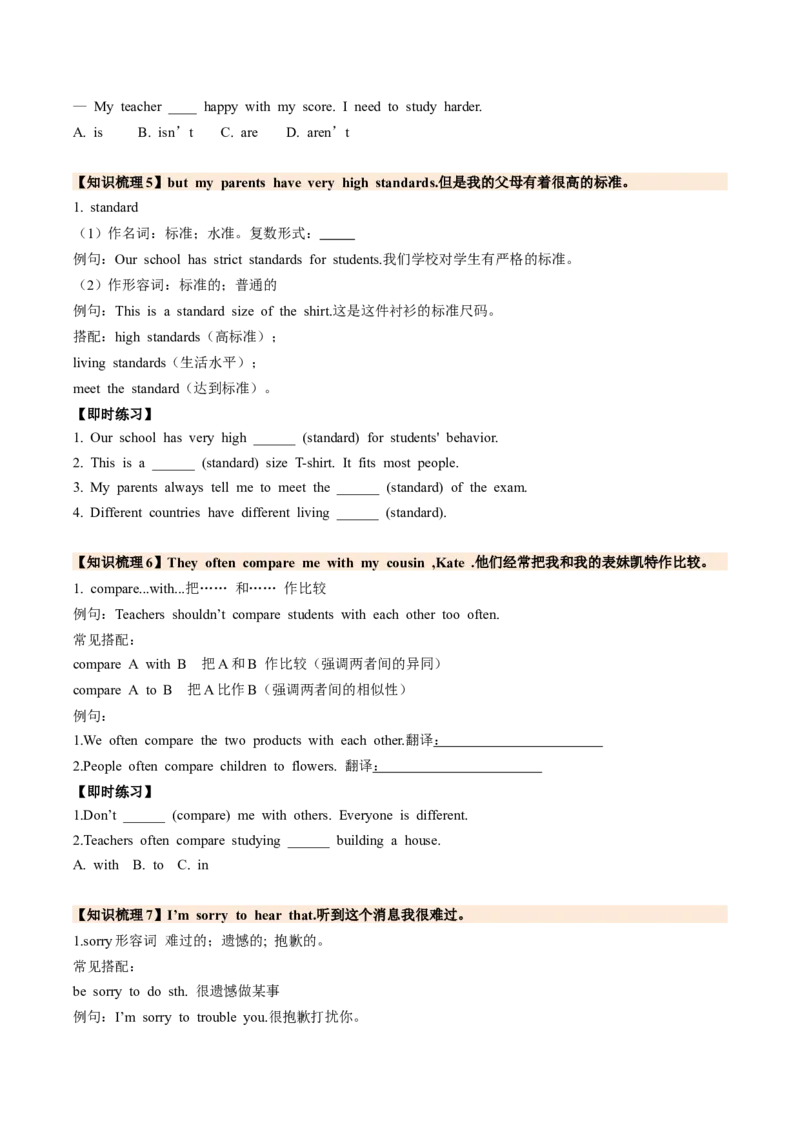
She advised taking a walk after dinner.
她建议晚饭后散散步。
辨析:advise&advice
advise advice
词性 动词 不可数名词
含义 建议;劝告;忠告 建议;劝告
【即时练习】
用 advise 或 advice 的适当形式填空
1.My teacher ______ me to join the English club yesterday.
2.Could you give me some ______ on how to learn English well?
3.She always ______ reading aloud in the morning.
【知识梳理3】I forgive you.我原谅你了。
1. forgive v.及物动词,“原谅;饶恕”
过去式: 过去分词: 现在分词:
常见搭配:
forgive sb. 例句:I forgive you. 我原谅你了。
forgive sb. for (doing) sth. 例句:She forgave him for being late. 她原谅了他的迟到。
forgive sth. 例句:Can you forgive my mistake? 你能原谅我的过错吗?
【即时练习】
She forgave me. (扩写句子:她原谅了我迟到的行为)
She forgave me ______ ______ late.
【知识梳理4】my parents aren’t happy with my grades.我父母对我的成绩不满意。
1.be happy with sth. 动词短语,对某事、某物感到满意、高兴
例句:She isn’t happy with the gift.她对这份礼物不满意。
2.grade名词
①成绩;分数。复数形式 。
②年级。
例句:She got good grades in the exam. 她考试取得了好成绩。
例句:He is in Grade Eight. 他上八年级。
注意:表示年级时首字母大写。
【即时练习】
1.翻译:他们对这个结果不满意。
________________________
2. — How about your test?— My teacher ____ happy with my score. I need to study harder.
A. is B. isn’t C. are D. aren’t
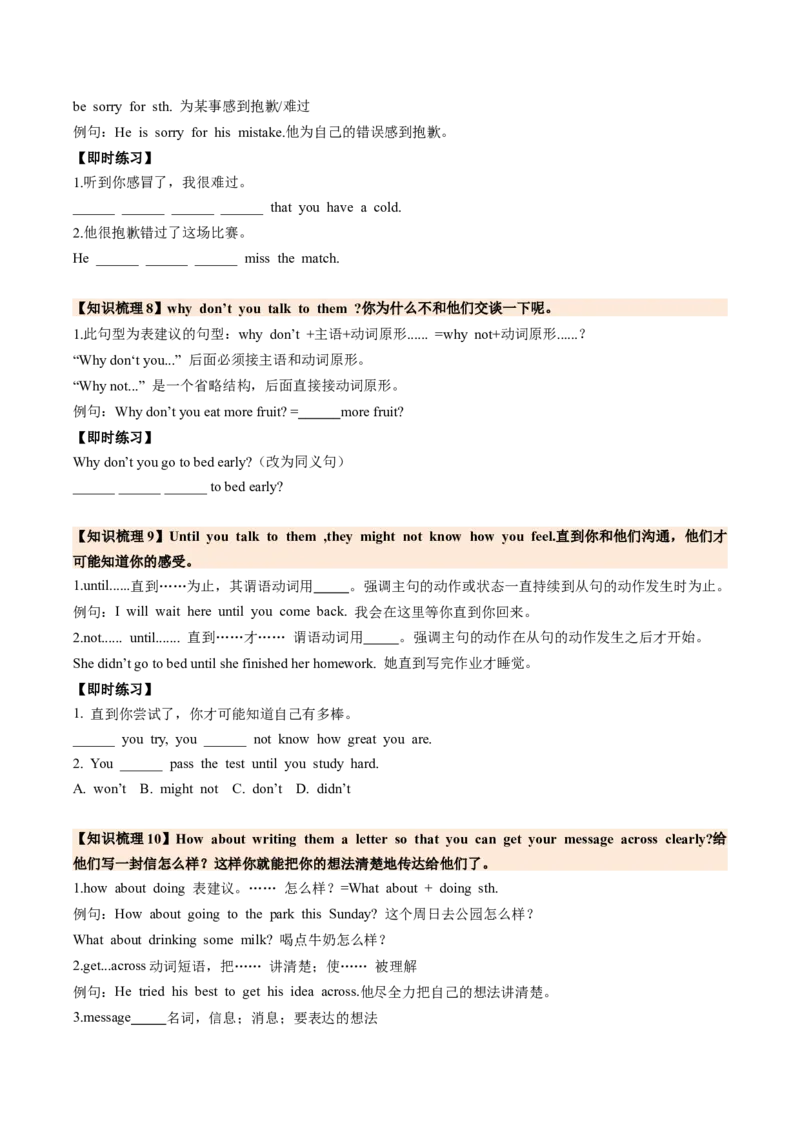
【知识梳理5】but my parents have very high standards.但是我的父母有着很高的标准。
1. standard
(1)作名词:标准;水准。复数形式:
例句:Our school has strict standards for students.我们学校对学生有严格的标准。
(2)作形容词:标准的;普通的
例句:This is a standard size of the shirt.这是这件衬衫的标准尺码。
搭配:high standards(高标准);
living standards(生活水平);
meet the standard(达到标准)。
【即时练习】
1. Our school has very high ______ (standard) for students' behavior.
2. This is a ______ (standard) size T-shirt. It fits most people.
3. My parents always tell me to meet the ______ (standard) of the exam.
4. Different countries have different living ______ (standard).
【知识梳理6】They often compare me with my cousin ,Kate .他们经常把我和我的表妹凯特作比较。
1. compare...with...把…… 和…… 作比较
例句:Teachers shouldn’t compare students with each other too often.
常见搭配:
compare A with B 把A和B 作比较(强调两者间的异同)
compare A to B 把A比作B(强调两者间的相似性)
例句:
1.We often compare the two products with each other.翻译:
2.People often compare children to flowers. 翻译:
【即时练习】
1.Don’t ______ (compare) me with others. Everyone is different.
2.Teachers often compare studying ______ building a house.
A. with B. to C. in
【知识梳理7】I’m sorry to hear that.听到这个消息我很难过。
1.sorry形容词 难过的;遗憾的; 抱歉的。
常见搭配:
be sorry to do sth. 很遗憾做某事
例句:I’m sorry to trouble you.很抱歉打扰你。be sorry for sth. 为某事感到抱歉/难过
例句:He is sorry for his mistake.他为自己的错误感到抱歉。
【即时练习】
1.听到你感冒了,我很难过。
______ ______ ______ ______ that you have a cold.
2.他很抱歉错过了这场比赛。
He ______ ______ ______ miss the match.
【知识梳理8】why don’t you talk to them ?你为什么不和他们交谈一下呢。
1.此句型为表建议的句型:why don’t +主语+动词原形...... =why not+动词原形......?
“Why don‘t you...” 后面必须接主语和动词原形。
“Why not...” 是一个省略结构,后面直接接动词原形。
例句:Why don’t you eat more fruit? = more fruit?
【即时练习】
Why don’t you go to bed early?(改为同义句)
______ ______ ______ to bed early?
【知识梳理9】Until you talk to them ,they might not know how you feel.直到你和他们沟通,他们才
可能知道你的感受。
1.until......直到……为止,其谓语动词用 。强调主句的动作或状态一直持续到从句的动作发生时为止。
例句:I will wait here until you come back. 我会在这里等你直到你回来。
2.not...... until....... 直到……才…… 谓语动词用 。强调主句的动作在从句的动作发生之后才开始。
She didn’t go to bed until she finished her homework. 她直到写完作业才睡觉。
【即时练习】
1. 直到你尝试了,你才可能知道自己有多棒。
______ you try, you ______ not know how great you are.
2. You ______ pass the test until you study hard.
A. won’t B. might not C. don’t D. didn’t
【知识梳理10】How about writing them a letter so that you can get your message across clearly?给
他们写一封信怎么样?这样你就能把你的想法清楚地传达给他们了。
1.how about doing 表建议。…… 怎么样?=What about + doing sth.
例句:How about going to the park this Sunday? 这个周日去公园怎么样?
What about drinking some milk? 喝点牛奶怎么样?
2.get...across动词短语,把…… 讲清楚;使…… 被理解
例句:He tried his best to get his idea across.他尽全力把自己的想法讲清楚。
3.message 名词,信息;消息;要表达的想法常见搭配:
a message(一条消息)
take a message(捎口信)
send a message(发消息)
例句:I left a message on her desk.我在她的桌子上留了一张字条。
【即时练习】
1. — I’m too shy to talk to my teacher.
— ______ writing a note to him?
A. Why not B. What about C. Let’s D. You should
2. He tried to get his story ______ to the children.
A. across B. clear C. away D. out
3.喝点水怎么样?这样你就不会那么渴了。
______ ______ drinking some water ______ ______ you won’t be so thirsty.
【知识梳理11】Writing things down can also make you feel better.把事情写下来也能让你感觉好一些。
1.本句主语是Writing things down, 作主语,表示“做某事”,谓语动词用 形式。
例句:Reading books is good for us.读书对我们有好处。
Swimming is my favorite sport.游泳是我最喜爱的运动。
2.write down动词短语,写下;记下。
后接名词作宾语时,名词可放write和 down中间,也可放在down后面。
例:write the words down = write down the words(写下这些单词)
后接代词作宾语时,代词必须放在 write和down 中间。
例:write them down(写下它们)
例句:Please write down your name on the paper.
【即时练习】
每天记日记也能帮助你缓解压力。
______ a diary every day can also help you relieve stress.
【知识梳理12】Although people might hurt you sometimes, it doesn’t always mean that they did it
on purpose. 尽管有时可能会有人伤害你,但这并不总是意味着他们是故意这么做的。
1.on purpose故意;有意地
例句:He broke the window on purpose.他故意打破窗户。
【即时练习】
我不是故意迟到的,路上堵车了。
I didn’t arrive late ______. There was a traffic jam on the way.
【知识梳理13】Next, share your problems with someone you trust instead of shutting yourself away.接下来,与你信任的人分享你的问题,而不是封闭自己
1.share动词,分享;分担。名词形式为 ,意为 “分享”。
例:Sharing is caring.(分享即是关爱)
搭配:share sth. with sb. 与某人分享某物/某事
例句:She often shares her snacks with her classmate.她经常和同学分享零食。
2.instead of介词短语,代替;而不是
用法:后接 ,不能接
例句:I will go by bike instead of by bus.
She chose to read books instead of watching TV.
注意:instead 是副词,常放在句末
例:I don’t like coffee. I will drink tea instead.
3.shut...away动词短语,把……关起来;封闭(自己)
例句:He shut himself away in his room after the exam. 考试后,他把自己关在房间里。
相关短语 shut up 闭嘴
shut down 关闭
【即时练习】
1. You should share your ideas ______ your group members.
A. to B. with C. for D. at
2. He stayed at home instead of ______ to the cinema.
A. go B. goes C. going D. went
【知识梳理14】You should eat healthy food, get plenty of sleep... 你应该吃健康的食物,保证充足的睡
眠……
1.plenty of大量;充足,修饰 。和lots of / a lot of用法一致。
例句:There is plenty of water in the bottle.(不可数名词)
She has plenty of friends at school.(可数名词复数)
【即时练习】
There is ______ milk in the fridge. We don’t need to buy it today.
A. a few B. few C. plenty of D. a little
第二部分 Grammar 连词although,until,so that的用法
【知识梳理1】although的用法
1.意为“尽管;然而”,引导让步状语从句,可放在主句前,也可放在主句后,相当于though。
例句:Although he is tired, he still keeps working. 虽然他很累,但他仍然坚持工作。
2.although引导的让步状语从句的时态:
(1)若主句是一般现在时,从句根据语境可用一般现在时或一般过去时;例句:Although she studies hard, she doesn’t get good grades sometimes.(主现从现)
(2)若主句是一般过去时,从句通常也用一般过去时。
例句:Although it rained heavily, we went to the park yesterday.(主过从过)
3.不能与 but 连用,可与 yet/still 连用。
例句:Although the machine is old, it still runs well.
=The machine is old, but it still runs well.
尽管这台机器老旧了,但是它依然运行良好。
【即时练习】
1._______ there will be more AI teachers in the future, _______ I don’t think they can take the place of teachers
in school.
A.Although; / B.Although; but
C.Although; although D.But; although
2.—________ the Moon doesn’t give off light, it looks bright at night.
—That’s because it can reflect the light of the Sun.
A.So B.Because C.If D.Although
3.Many Chinese people are too shy to say “I love you” to their parents ________ they love them very much.
A.although B.because C.so that D.when
4._______ we were quite tired, _______ we still continued _______.
A.Though; but; working B.Although; /; worked
C.Though; /; working D.Although; but; to work
【知识梳理2】until的用法
1.until作连词,意为“直到……为止”,引导时间状语从句。
(1)主句是肯定句时,其谓语动词用延续性动词,强调主句的动作或状态一直持续到从句的动作发生时
为止,译成“直到……为止”。
例句:I’ll stay here until you come back. 我会待在这里,直到你回来。
(2)主句是否定句时,其谓语动词用非延续性动词,强调主句的动作在从句的动作发生之后才开始。常
用 not...until... 结构,一般译成“直到……才……”。
例句:We can’t get off the bus until it stops. 直到公共汽车停下来我们才可以下车。
2.until引导的从句时态:
(1)当主句为一般将来时时,until 引导的从句用一般现在时表将来(“主将从现” 原则)。
例句:I will wait here until you come back.我会在这里等你回来。
(2)当主句为一般过去时时,until 引导的从句也用一般过去时。
例句:They didn’t leave the park until the sun set.他们直到太阳落山才离开公园。
【即时练习】
1.It’s raining too hard outside. We won’t leave ________ the rain stops.A.if B.after C.when D.until
2.Sandy ________ the competition notice ________ I told her.
A.didn’t notice; if B.won’t notice; until C.will notice; if D.didn’t notice; until
3.—When did you come to know the information?
—________ I ________ yesterday.
A.Until, told B.Not until, told C.Until, was told D.Not until, was told
【知识梳理3】so that的用法
1.so that意为“为了,以便”,引导目的状语从句,一般放在主句后,且不用逗号隔开,相当于in order
that,从句谓语中多含有can、could、may、might等情态动词。主句为手段,从句为目的。
2.so that 还可引导结果状语从句,意为“因此,所以”。此时从句谓语中通常不含情态动词。主句为原
因,从句为结果。
【即时练习】
1.The performers practiced for months, ________ they could perform perfectly.
A.so that B.because C.although
2.—Li Ming argued with his best friend. What should he do?
—He should talk to his friend ________ he can say he’s sorry.
A.so that B.although C.but D.unless
3.The online tour is ________ fantastic that I feel like I am visiting the museum in person.
A.very B.too C.so D.such
4.The rainstorm was ________ terrible ________ the streets suddenly turned into rivers.
A.too; to B.such; that C.so; that D.to; too
一、首字母填空
1.It's important to express your e______ in a healthy way, like talking to friends.
2. Please a______ me on how to improve my English writing skills.
3. He tried to c______ his temper when he heard the bad news.
4. We should learn to d______ with our worries in a positive way.
5. After arguing, he asked for f______ from his sister.
6. Too much p______ from parents can make kids stressed.
二、根据汉语意思完成句子
1.虽然他犯了错,但他并不是故意的。
__________ he made a mistake, he didn’t do it __________ __________.
2.但我确定你父母只是希望你能表现好,尽管他们可能没表现出来。
But I'm ______ your parents ______ want you ______ do well, ______ they ______ not show it.3.给他们写封信怎么样?这样你就能把你的意思清楚地传达给他们了。
How about ______ them ______ letter ______ you ______ get your message ______ clearly?
4.接下来,把你的问题告诉你信任的人,而不是把自己封闭起来。
Next, ______ ______ problems ______ someone you trust instead of ______ ______ ______.
5.直到收到你的邮件,我才知道发生了什么。
I __________ know what happened __________ I received your email.
一、词汇运用
1. Peter felt great ______ (stress) about the final exam last week, as he was afraid to fail.
2. His mother often ______ (advise) him to take 10-minute breaks every hour when studying.
3. We should learn to express our ______ (emotion) in proper ways instead of keeping them inside.
4. Yesterday, Peter ______ (wait) until his father finished work to talk about his exam worries.
5. Anna is good at ______ (deal) with stress by listening to light music after a busy day.
6. She told Peter to look on the bright side ______ (positive) when facing difficulties.
二、单项选择
1.He doesn’t know the details of the class activity ________ you tell him through the class group chat.
A.because B.after C.if D.until
2.________ there are many different suggestions on health from experts, I think listening to our own body clock
makes us live a healthier life.
A.Although B.Because C.So D.Until
3.After the speech, it was time for photos. ________ some of our eyes were wet, we still tried to show bright
smiles.
A.But B.So C.Although
4.—I met Jack this morning. I thought he was still in Beijing.
—Me, too. I didn’t know he came back __________ he called me just now.
A.if B.until C.unless D.when
5.On the journey to space, Gui Haichao said excitedly, “I don’t know how fantastic it is to take a rocket (火箭)
into outer space I experience it for myself.”
A.when B.after C.until D.since
6.—Why hasn’t the speaker started his talk?
—Well, he ________ start it ________ everyone is quiet.
A.won’t; after B.will; until C.won’t; until D.will; before
7.People did not worry about AI safety ________ Deepseek became popular.
A.when B.while C.since D.until
8.Although this meant that people could travel further and faster, ________.A.and humans continued walking across the globe
B.so these old paths quickly became extremely difficult to use
C.but the inventor probably first used them to transport things
D.transporting large amounts of goods was still a difficult job
9.—Do you know the player? He did a good job in 2024 Paris Olympic Games.
—Yes, he is Pan Zhanle. ________ he is a talented swimmer, he still practices hard every day.
A.Although B.Because C.However D.As long as
10.There are ________ wonderful movies on TV and the Internet that we don’t need to go to the movie theater on
weekends.
A.too many B.so many C.too much
11.My piano teacher is ______ nice and patient to me ______ I make a great progress in the piano lesson.
A.as; as B.so; that C.such; that
12.Labubu’s new series of blind boxes(盲盒) are ________ popular ________ people buy them quickly.
A.not; until B.such; that C.so; that D.not; unless
三、完形填空
Many people think being healthy is difficult. In fact, you can 1 make it if you can do the following
well.
Drink more water. Everyone should get 2 water each day. It can keep your body at the right
temperature and 3 your desire (欲望) of food. What’s more, it can keep you from junk drink like cola.
Drinking hot water even makes you far from being 4 in hospital. Make sure it’s comfortably hot and
won’t 5 you.
Eat at the 6 time. It is good for health. Try not to eat 3 or 4 hours before you go to bed. Or it will
make your sleep hard. Then you’ll feel very 7 the next morning.
Take 8 . It’s not being lazy, but being healthy. You need to rest and drink some water after 30
minutes of exercise.
Keep a happy 9 every day. It’s quite important for everyone’s health. If you have a happy mood
(心情), you’ll be easy to 10 . When a person is often in a bad mood, he is often easy to fall ill.
1.A.hardly B.heavily C.easily D.warmly
2.A.enough B.quick C.light D.famous
3.A.happen B.compete C.prepare D.control
4.A.busy B.sick C.poor D.rich
5.A.plan B.hurt C.send D.leave
6.A.right B.fresh C.cute D.funny
7.A.bored B.lovely C.tired D.full
8.A.walks B.breaks C.tests D.photos
9.A.story B.visit C.class D.spirit
10.A.relax B.fall C.shake D.touch四、语法填空
阅读下面短文,根据语境或所给单词的提示,在每个空格内填入一个恰当的词,要求所填的词意义准确、
形式正确,使短文意思完整、行文连贯。
Now many students spend too much time doing their schoolwork. 1 (learn) to stay positive is 2
important lesson for all the students.
Staying positive 3 (help) students better face difficulties in learning. It also brings benefits to
students’ 4 (physics) health and keeps students in a good mood.
Here are some ways to help you stay positive. 5 (one), write down three things you want to thank
for. This can help you think about what you have 6 your life. Second, we should spend time with positive
friends. They can encourage us when we face 7 (difficulty). Third, positive self-talk (自我谈话) is also a
good way to stay positive. Don’t say “I can’t do it.” We should say “I can do it.” This helps build our confidence.
The last one, doing exercise is another good choice. You can 8 (choose) a sport you like, such as
running, swimming or playing basketball. After exercising, you can sleep 9 (good). This can make you
have a good mood.
Hope you can follow these ways. Stay positive 10 be in a good mood.
五、阅读理解
Do you sometimes feel down or worried? Life has its difficult moments, but a positive attitude (心态) helps
a lot. Staying positive is like a skill. You can learn it and practice it every day. Here are some simple ways to keep
your mind and body healthy.
First, move your body. When you feel sad, you often don’t want to move. But exercise is a helpful tool. You
can go for a walk in the park, play a ball game with friends, or just dance in your room. When your body is active,
your mind often feels clear and happy. It’s a great way to take a break from your worries.
Second, talk about your feelings. It is not good to keep your worries a secret. You can talk to someone you
trust, like your parents or a good friend. They can listen to you and offer you support. Sharing your feelings helps
you feel less alone and brings you close to others.
Third, focus on things you enjoy. You can read an interesting book, draw a picture, or listen to music.
Hobbies take your mind away from bad things and bring you joy. You can also try this: Every night before you
sleep, think of three good things you enjoyed that day—maybe a delicious lunch you liked, a friend’s smile that
made you happy, or a hobby you spent time on. This simple habit helps you see the good in your life.
Remember, keeping a positive mind is a journey. These small actions can make a big difference in how you
feel.
根据材料内容选择最佳答案。
1.What is staying positive like according to the passage?
A.A difficult problem. B.An expensive gift.
C.A skill to learn and practice. D.A secret from friends.
2.According to the passage, what is one benefit of exercise?
A.It makes you a good dancer. B.It helps your mind feel clear.
C.It is a good way to get a prize. D.It helps you make new friends.3.Why does the writer suggest (建议) talking about your feelings?
A.To get some interesting ideas. B.To show you are a good speaker.
C.To learn to solve all your problems. D.To make you feel less alone.
4.What’s the purpose of thinking about three good things every night?
A.To have interesting dreams. B.To see the good in your life.
C.To remember your whole day. D.To make plans for the next day.
5.What is the best title for this passage?
A.The Benefits of Hobbies B.How to Be a Good Friend
C.The Importance of Exercise D.Simple Ways to Keep Positive and Healthy