Unit 1 Time to Relax!
Welcome to the unit & Grammar
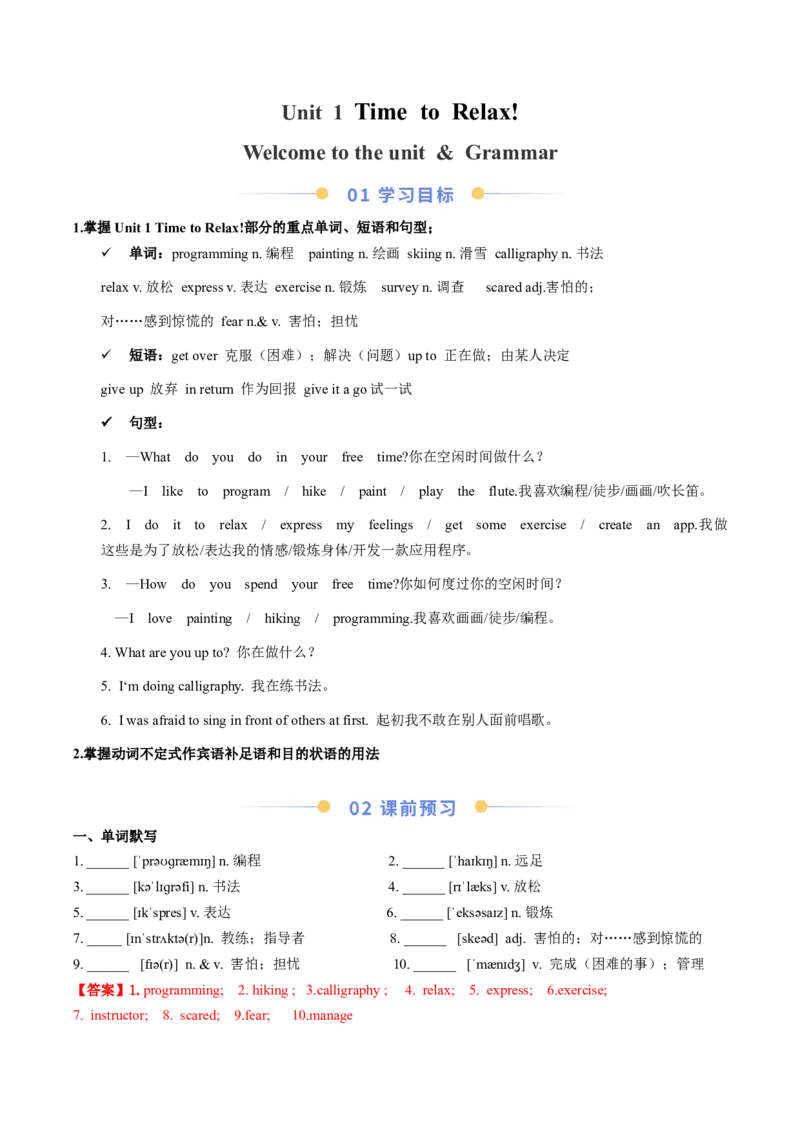
1.掌握Unit 1 Time to Relax!部分的重点单词、短语和句型;
单词:programming n. 编程 painting n. 绘画 skiing n. 滑雪 calligraphy n. 书法
relax v. 放松 express v. 表达 exercise n. 锻炼 survey n. 调查 scared adj.害怕的;
对……感到惊慌的 fear n.& v. 害怕;担忧
短语:get over 克服(困难);解决(问题)up to 正在做;由某人决定
give up 放弃 in return 作为回报 give it a go试一试
句型:
1. —What do you do in your free time?你在空闲时间做什么?
—I like to program / hike / paint / play the flute.我喜欢编程/徒步/画画/吹长笛。
2. I do it to relax / express my feelings / get some exercise / create an app.我做
这些是为了放松/表达我的情感/锻炼身体/开发一款应用程序。
3. —How do you spend your free time?你如何度过你的空闲时间?
—I love painting / hiking / programming.我喜欢画画/徒步/编程。
4. What are you up to? 你在做什么?
5. I‘m doing calligraphy. 我在练书法。
6. I was afraid to sing in front of others at first. 起初我不敢在别人面前唱歌。
2.掌握动词不定式作宾语补足语和目的状语的用法
一、单词默写
1. ______ [ˈprəʊɡræmɪŋ] n. 编程 2. ______ [ˈhaɪkɪŋ] n. 远足
3. ______ [kəˈlɪɡrəfi] n. 书法 4. ______ [rɪˈlæks] v. 放松
5. ______ [ɪkˈspres] v. 表达 6. ______ [ˈeksəsaɪz] n. 锻炼
7. _____ [ɪnˈstrʌktə(r)]n. 教练;指导者 8. ______ [skeəd] adj. 害怕的;对……感到惊慌的
9. ______ [fɪə(r)] n. & v. 害怕;担忧 10. ______ [ˈmænɪdʒ] v. 完成(困难的事);管理
【答案】1.programming; 2. hiking ; 3.calligraphy ; 4. relax; 5. express; 6.exercise;
7. instructor; 8. scared; 9.fear; 10.manage二、词组默写
1. 做调查 ______ 2. 表达情感 ______
3. 试一试 ______ 4. 放弃 ______
5..克服恐惧 ______ 6. 正在做某事 ______
【答案】1. do a survey; 2.express feelings; 3.give it a go; 4.give up; 5.get over one’s fear; 6. be up to;
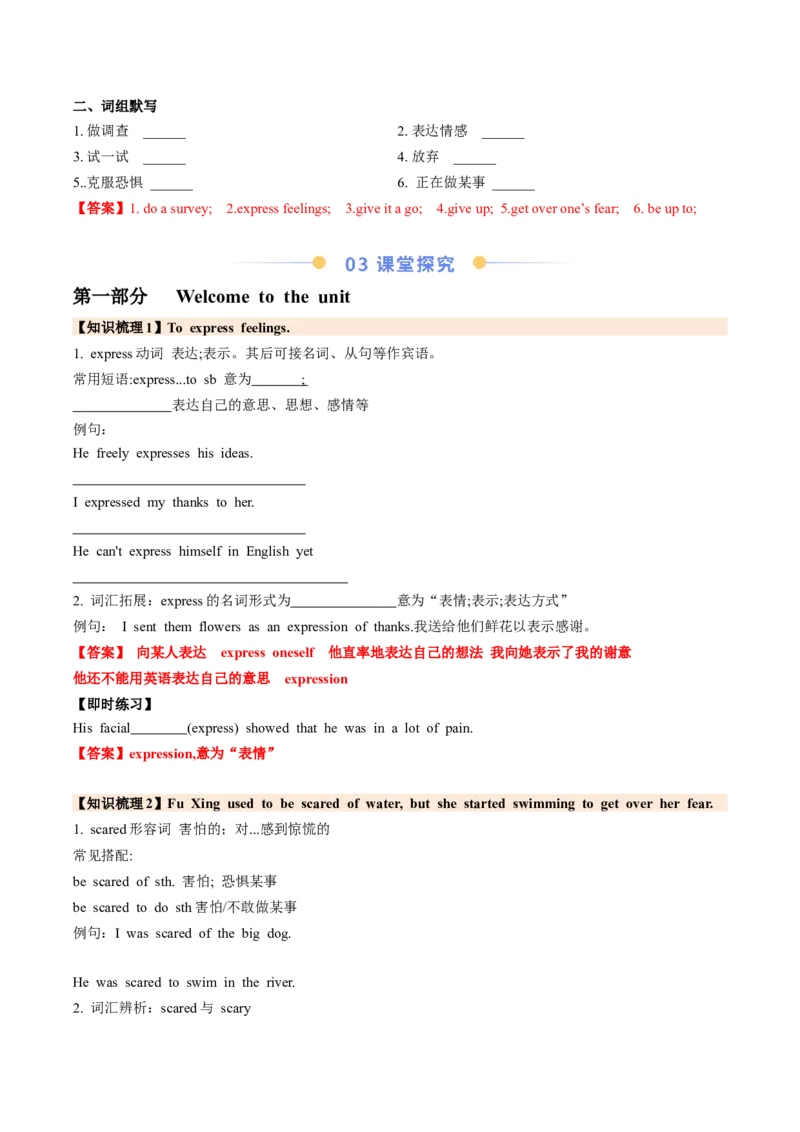
第一部分 Welcome to the unit
【知识梳理1】To express feelings.
1. express动词 表达;表示。其后可接名词、从句等作宾语。
常用短语:express...to sb 意为 ;
表达自己的意思、思想、感情等
例句:
He freely expresses his ideas.
I expressed my thanks to her.
He can't express himself in English yet
2. 词汇拓展:express的名词形式为 意为“表情;表示;表达方式”
例句: I sent them flowers as an expression of thanks.我送给他们鲜花以表示感谢。
【答案】 向某人表达 express oneself 他直率地表达自己的想法 我向她表示了我的谢意
他还不能用英语表达自己的意思 expression
【即时练习】
His facial (express) showed that he was in a lot of pain.
【答案】expression,意为“表情”
【知识梳理2】Fu Xing used to be scared of water, but she started swimming to get over her fear.
1. scared形容词 害怕的;对...感到惊慌的
常见搭配:
be scared of sth. 害怕; 恐惧某事
be scared to do sth害怕/不敢做某事
例句:I was scared of the big dog.
He was scared to swim in the river.
2. 词汇辨析:scared与 scaryscared 害怕的;对...感到惊慌的,常说明 的感受。
scary 吓人的;恐怖的,常说明 所具有的特性。
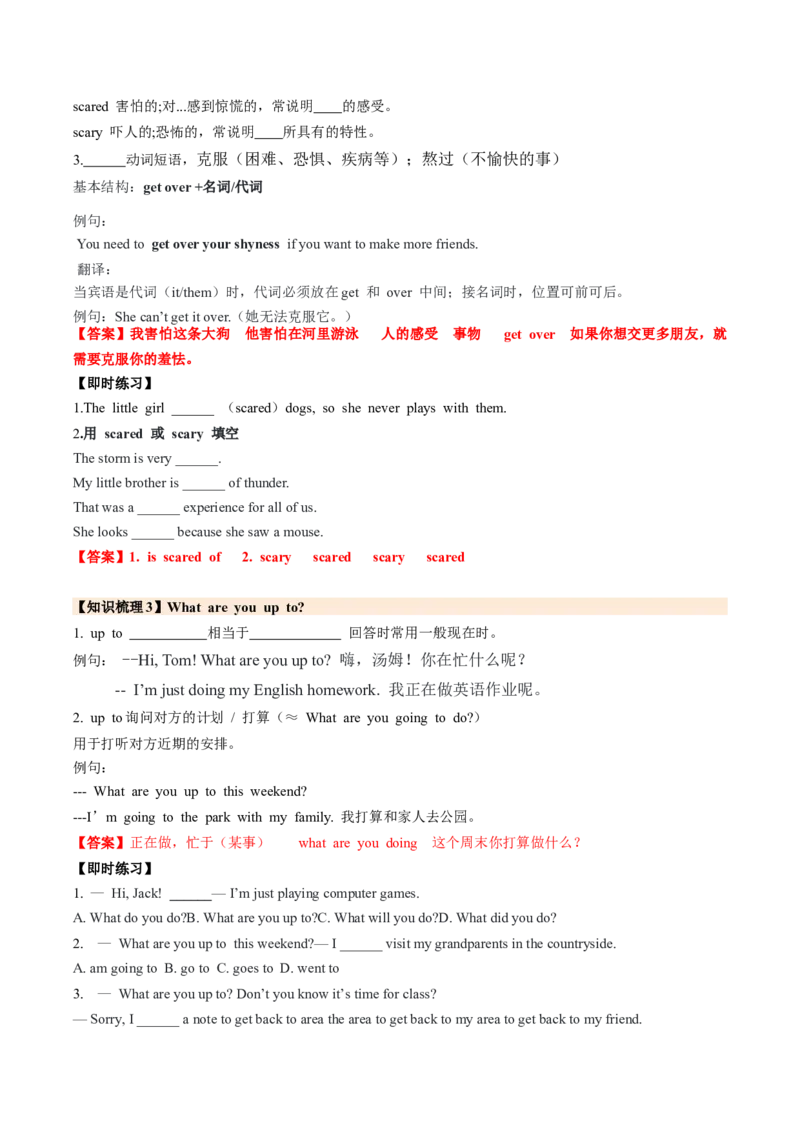
3. 动词短语,克服(困难、恐惧、疾病等);熬过(不愉快的事)
基本结构:get over +名词/代词
例句:
You need to get over your shyness if you want to make more friends.
翻译:
当宾语是代词(it/them)时,代词必须放在get 和 over 中间;接名词时,位置可前可后。
例句:She can’t get it over.(她无法克服它。)
【答案】我害怕这条大狗 他害怕在河里游泳 人的感受 事物 get over 如果你想交更多朋友,就
需要克服你的羞怯。
【即时练习】
1.The little girl ______ (scared)dogs, so she never plays with them.
2.用 scared 或 scary 填空
The storm is very ______.
My little brother is ______ of thunder.
That was a ______ experience for all of us.
She looks ______ because she saw a mouse.
【答案】1. is scared of 2. scary scared scary scared
【知识梳理3】What are you up to?
1. up to 相当于 回答时常用一般现在时。
例句: --Hi, Tom! What are you up to? 嗨,汤姆!你在忙什么呢?
-- I’m just doing my English homework. 我正在做英语作业呢。
2. up to询问对方的计划 / 打算(≈ What are you going to do?)
用于打听对方近期的安排。
例句:
--- What are you up to this weekend?
---I’m going to the park with my family. 我打算和家人去公园。
【答案】正在做,忙于(某事) what are you doing 这个周末你打算做什么?
【即时练习】
1. — Hi, Jack! ______— I’m just playing computer games.
A. What do you do?B. What are you up to?C. What will you do?D. What did you do?
2. — What are you up to this weekend?— I ______ visit my grandparents in the countryside.
A. am going to B. go to C. goes to D. went to
3. — What are you up to? Don’t you know it’s time for class?
— Sorry, I ______ a note to get back to area the area to get back to my area to get back to my friend.A. Write B. wrote C. am writing D. will write
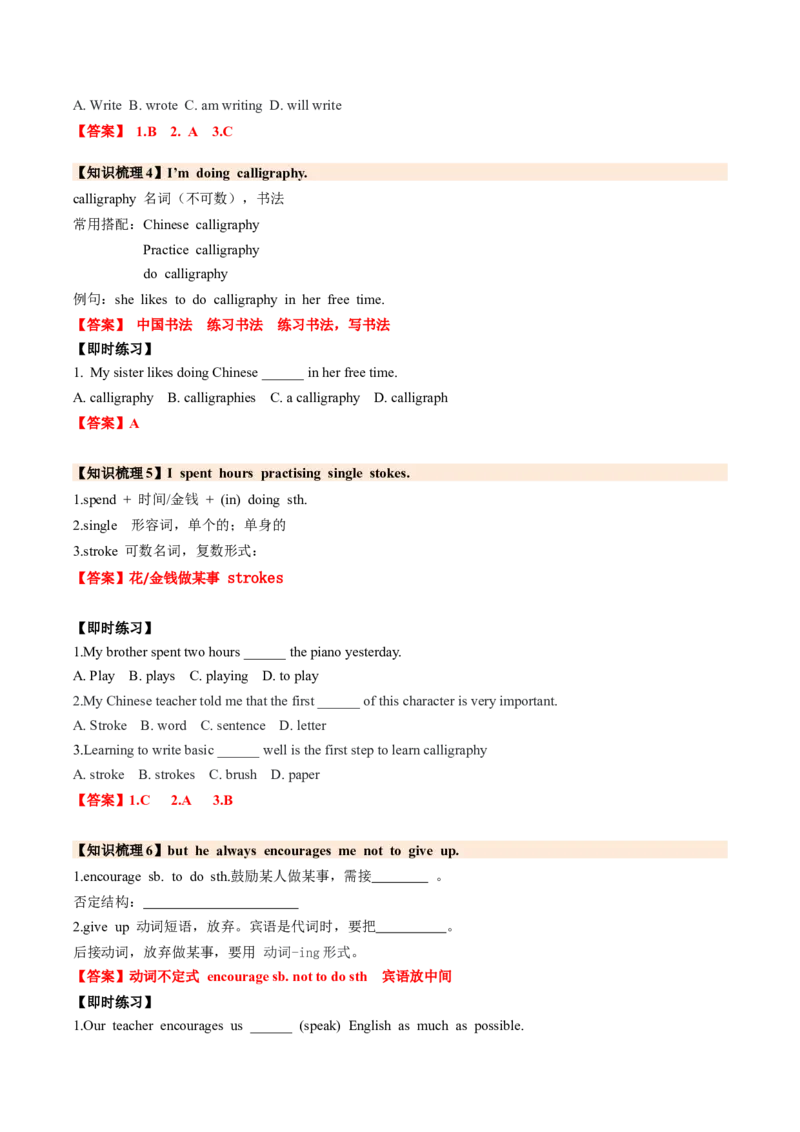
【答案】 1.B 2. A 3.C
【知识梳理4】I’m doing calligraphy.
calligraphy 名词(不可数),书法
常用搭配:Chinese calligraphy
Practice calligraphy
do calligraphy
例句:she likes to do calligraphy in her free time.
【答案】 中国书法 练习书法 练习书法,写书法
【即时练习】
1. My sister likes doing Chinese ______ in her free time.
A. calligraphy B. calligraphies C. a calligraphy D. calligraph
【答案】A
【知识梳理5】I spent hours practising single stokes.
1.spend + 时间/金钱 + (in) doing sth.
2.single 形容词,单个的;单身的
3.stroke 可数名词,复数形式:
【答案】花/金钱做某事 strokes
【即时练习】
1.My brother spent two hours ______ the piano yesterday.
A. Play B. plays C. playing D. to play
2.My Chinese teacher told me that the first ______ of this character is very important.
A. Stroke B. word C. sentence D. letter
3.Learning to write basic ______ well is the first step to learn calligraphy
A. stroke B. strokes C. brush D. paper
【答案】1.C 2.A 3.B
【知识梳理6】but he always encourages me not to give up.
1.encourage sb. to do sth.鼓励某人做某事,需接 。
否定结构:
2.give up 动词短语,放弃。宾语是代词时,要把 。
后接动词,放弃做某事,要用 动词-ing形式。
【答案】动词不定式 encourage sb. not to do sth 宾语放中间
【即时练习】
1.Our teacher encourages us ______ (speak) English as much as possible.2.My father gave up ______ (smoke) last year.
【答案】1.to speak 2. smoking
【知识梳理7】I can teach you to play a song in return.
1.in return介词短语;译为:
常放在句首或句末,表目的/答谢.
例句:I gave him a gift in return.
【答案】作为回报;作为回应
【即时练习】
1. He shared his calligraphy skills with me, and I taught him to play the guitar ______.
A. in return B. in fact C. in a hurry D. in time
2.She gave me a beautiful card. She wanted to thank me for helping her. (合并为一句)。
She gave me a beautiful card ______ for my help.
3.作为回报,我可以帮你练习书法。
【答案】1.A 2.in return 3.I can help you practise calligraphy in return.
【知识梳理8】It’s a deal.
意思是: 。或者常说:That’s a deal.
【答案】就这么定了
【即时练习】
— I’ll lend you my storybook if you share your calligraphy works with me.
— OK. ______
A. It’s a deal. B. Thank you. C. Good luck.
【答案】A
【知识梳理9】How do you usually feel when you manage to do something difficult?
详解:manage 动词 完成(困难的事);管理。其后可接名词、代词或动词不定式。
例句:You should manage to finish the work in time.你应该设法及时完成工作。
辨析: manage to do sth与 try to do sth
manage to do He managed to finish the hard work alone.
努力且成功
sth (他独自完成了这项困难的工作)
He tried to finish the hard work alone, but failed.
try to do sth 努力去做,但不确定结果
(他努力独自完成,但失败了)
【即时练习】
选词填空(try to do /manage to do)
She ____________ (finish) the 1000 - word essay in one hour yesterday. She was really good at writing.My father ____________ (repair) the broken bike, but he failed. He will ask a worker for help.
The little boy ____________ (climb) up the big tree and picked a lot of apples.
【答案】1. managed to finish 2. tried to repair 3.managed to climb
第二部分 Grammar 动词不定式
【知识梳理1】动词不定式作目的状语
说明主句动作的“目的”,常位于主句后,可译为“为了......”,是单元描述“爱好目的”的核心语法。
例句:I play the flute to relax..(我吹长笛是为了放松。“放松”是“吹长笛”的目的)
They went to the sports centre to ice skate.(他们去运动中心是为了滑冰 。“滑冰”是“去运动中心”的
目的)
【即时练习】
1.We need more work ________ our sky clearer, water cleaner and air fresher.
A.make B.to make C.makes D.made
2.________ communication easier and faster, engineers in that company have designed a kind of smart watches.
A.Make B.Making C.To make
【答案】1.B 2. C
【知识梳理2】动词不定式作宾补
作宾语补足语:补充说明“宾语的动作或状态”,常见于“主语+ 动词(tell/ask/encourage/want 等)+宾语
+to do”结构,单元中多出现于“他人建议、鼓励培养爱好”的场景。
例句:The instructor told Emma not to give up so easily.(教练告诉埃玛不要轻易放弃。“不要放弃”补
充说明“埃玛”的动作)
Peter’s dad encouraged him to practice the guitar every day.(彼得的爸爸鼓励他每天练吉他.“每天练吉
他”补充说明“彼得”的动作)
【即时练习】
1.The spirit of Lei Feng tells us (help) people in need.
2.Father asks me (not play) computer before finishing my homework.
【答案】1.to help 2.not to play
【知识梳理3】动词不定式to的省略
1.感官动词(see,watch,hear,feel,notice等)后接动词不定式作宾补时,需要省略to.
例句:I saw my mother paint when I was young.(我小时候看到妈妈画画。see为感官动词后省略to)
2.使役动词(make,let,have等)后接动词不定式时,需要省略to.
If you have any questions,please let me know.(如果你有任何问题,请让我知道.let为使役动词后省略 to)
【即时练习】
1.Our English teacher is humorous and he often tells funny jokes to make us ________.A.to laugh B.laugh C.laughed
2.The boy is crazy about music and we always hear him ________ in the music room.
A.to sing B.sings C.singing D.sing
3.Go and have a good sleep, baby. Let me (worry) about these things.
【答案】1.B 2.D 3.worry
一、首字母填空
1.Learning to play the piano requires a lot of p__________ .
2. Don’t s___________the dog; it’s friendly.
3. We should learn to e______________ our thanks to others.
4. It’s important to d______________ with peer pressure correctly.
5. Please r______________ the magazine to me when you’re done.
【答案】1. patience,2. scare,3. express,4. deal,5. return。
二、根据汉语意思完成句子
1. 学生们需要空闲时间来放松身心、培养兴趣,这有助于他们平衡学习与生活。
Students need free-time ______ ______ ______ ______ ______ ______, which helps them balance study
and life.
2. 我刚开始练书法时,花了好几个小时练习单笔画,以此提升自己的书写能力。
When I started to ______ ____________, I spent hours ______ ______ ______ to improve my writing
skills.
3. 当我在学习编程时遇到困难,他总是鼓励我不要放弃。
He always encourages me ______ ______ ______ ______ when I face difficulties in ______ ______
4. 我们努力学习是为了取得好成绩,这也有助于我们培养责任感。
We study hard ______ ______ ______ ______ ______ ______, and this also helps us develop a sense of
responsibility.
5. 这款新软件是为帮助学生练习英语听力而编写的。
The new software is ______ ______ ______ students with their English listening practice.
6. 我吹长笛是为了放松,这个爱好还能让我通过音乐表达自己的情绪。
I play the ______ ______ ______, and this hobby also ______ ______ ______ ______ my emotions
through music.
【答案】1. to relax and develop their interests
2. to do calligraphy, practising single strokes
3. not to give up ;learning programming.
4. in order to get good grades
5. programmed to help6. flute to relax, allows me to express
一、词汇运用
1. It's meaningful for us ______ (practise) Chinese calligraphy, as it's a traditional art form.
【答案】to practise
【解析】本单元核心句型“it's + 形容词 + for sb. to do sth.”(对某人来说做某事是……的)
句意:练习中国书法对我们很有意义,因为它是一种传统艺术形式。“it”为形式主语,真正主语用不定
式,故填“to practise”。
2. The new software ______ (program) by a group of teenagers last month is very popular.
【答案】was programmed
【解析】 句意:上个月由一群青少年编写的新软件很受欢迎。“software”(软件)是“program”(编写
程序)的承受者,需用被动语态;“last month”(上个月)表过去,被动语态结构为“was/were + 过去
分词”,主语为单数,故填“was programmed”。
3. She always finds a proper way ______ (express) her opinions in public without offending others.
【答案】to express
【解析】句意:她总能找到合适的方式在公共场合表达观点,又不冒犯他人。“way”后用不定式作后置
定语,表“……的方法”,故填“to express”。
4. Don't let the horror movie ______ (scare) you; it's just a story.
【答案】 scare
【解析】句意:别让恐怖片吓到你,它只是个故事。“let”后接宾语补足语时用动词原形,故填“scare”
二、单项选择
1.In recent years, red phone boxes have become mini-libraries, cafes and even art spaces in Britain. People are
finding creative ways ________ this symbol of British cultural heritage (文化遗产).
A.protect B.protecting C.to protect
【答案】C
【详解】句意:近年来,红色电话亭在英国变成了迷你图书馆、咖啡馆甚至艺术空间。人们正在寻找创造
性的方式来保护这一英国文化遗产的象征。
考查非谓语动词。此处表示寻找方法的目的是保护这一象征,用动词不定式的to protect表示目的。故选
C。
2.On the other side, you must believe in yourself first ________ make friends.
A.as well as B.because of C.instead of D.in order to
【答案】D
【详解】句意:另一方面,为了交朋友,你必须先相信自己。
考查短语辨析。as well as也;because of因为;instead of而不是;in order to为了。根据“you must believe
in yourself first…make friends.”可知,这里指为了交朋友,需要填入表示目的的短语。in order to表示目的,符合句意,故选D。
3.This change makes learners ________ beyond outdated ideas that once limited education to fixed schedules and
locations.
A.going B.to C.go D.gone
【答案】C
【详解】句意:这种变化使学习者超越了曾经将教育局限于固定时间和地点的过时观念。
考查非谓语动词。going动名词或现在分词;to到……,动词不定式符号;go去,动词原形;gone过去分
词。根据语境可知,此处为make sb do sth“使某人做某事”,其中make为使役动词,后接省略to的动词不
定式作宾语补足语,所以应该用go。故选C。
4.—Tom, which club do you like?
—Nature Club. It makes us ________ wildlife.
A.discover B.to discover C.discovering
【答案】A
【详解】句意:——汤姆,你喜欢哪个社团?——自然社。它让我们发现野生动物。
考查非谓语动词。make sb. do sth.“使某人做某事”,此处用省略to的动词不定式discover。故选A。
5.________ with foreign tourists better, we practiced some sentences about old streets before the tour.
A.To communicate B.Communicate C.Communicating
【答案】A
【详解】句意:为了与外国游客更好地交流,我们在旅游前练习了一些关于老街的句子。
考查非谓语动词。根据“we practiced some sentences about old streets before the tour.”可知,我们练习关于老
街的句子是为了与外国游客交流,用动词不定式(to+动词原形)作目的状语。故选A。
6.—Our school is organizing a park clean-up this Saturday. We’d like to invite more volunteers ________ us. Are
you free?
—That sounds great! Count me in!
A.join B.join in C.to join D.to join in
【答案】C
【详解】句意:——我们学校这周六将组织一次公园清理活动。我们想邀请更多的志愿者加入我们。你有
空吗?——听起来很棒!算我一个!
考查动词短语辨析和非谓语动词。join参加,加入,后接表示人或组织的名词;join in参加,后接表示活
动的名词。根据语境可知,此处表示邀请更多的志愿者加入我们,且空格后接的是表示人的“us”,故应用
join;invite sb. to do sth.为固定搭配,意为“邀请某人做某事”,故空格处应为动词不定式,即to join。故
选C。
7.Nowadays teachers feel they can’t help ________ reading materials suitable for every student, so they
encourage them ________ English by Internet.
A.finding; learning B.to find; learning
C.finding; to learn D.to find; to learn
【答案】D【详解】句意:现在老师感觉他们不能帮助每一个学生找到合适的阅读材料,所以他们鼓励学生自己在网
上学习英语。
考查非谓语动词的用法。 根据“can’t help... reading materials suitable for every student”可知,第一空处指
“无法帮助找到材料”,需help to do sth.“帮助某人做某事”,故第一空需动词不定式;encourage sb. to do
sth.“鼓励某人做某事”,固定搭配,故第二空需动词不定式。故选D。
三、完形填空
Margie had a big dream. She wanted to become a great 1 player. But her parents didn’t agree. They
2 that basketball was a sport only for boys. They asked her to play tennis or volleyball. But Margie didn’t like
them.
Luckily, Margie’s 3 was good at playing basketball and he agreed to teach her. With the help of her
brother, Margie began learning how to play basketball. She and her brother went to the park to 4 playing
basketball after school every day.
At first, Margie’s parents 5 that Margie would get hurt or feel left out because she was the only girl
playing basketball in her class. 6 Margie’s love for the sport only became stronger. She worked hard and
did her best in every practice. 7 , her parents understood that basketball wasn’t just for boys. It was for
anyone who loved the sport.
Because of Margie, some girls in her class 8 getting interested in basketball. They saw Margie as a
role model(榜样)and believed that they could 9 play basketball like her. Together they 10 a
girls’ basketball team. Now they play basketball together every weekend and sometimes they play with the boys’
team. They also help each other with their schoolwork. They are becoming better and better.
1.A.volleyball B.tennis C.football D.basketball
2.A.believed B.hoped C.shared D.doubted
3.A.sister B.mother C.father D.brother
4.A.finish B.practise C.mind D.forget
5.A.missed B.advised C.worried D.decided
6.A.But B.So C.Or D.And
7.A.Carelessly B.Loudly C.Sadly D.Slowly
8.A.suggested B.started C.liked D.remembered
9.A.also B.only C.even D.sometimes
10.A.saw B.helped C.built D.saved
【答案】
1.D 2.A 3.D 4.B 5.C 6.A 7.D 8.B 9.A 10.C
【导语】本文主要介绍了玛吉想要成为一名篮球运动员,但是她的父母认为篮球是男孩子玩的,但是玛吉
没有放弃。在哥哥的帮助下,经过玛吉的努力,她让父母理解女孩子也可以打篮球。
1.句意:她想要成为一名伟大的篮球运动员。
volleyball排球;tennis网球;football足球;basketball篮球。根据“Luckily, Margie's brother was good atplaying basketball and he agreed to teach her.”可知,玛吉想要成为一名篮球运动员。故选D。
2.句意:他们认为篮球只是男孩子的运动。
believed认为;hoped希望;shared分享;doubted怀疑。根据“But her parents didn't agree.”可知她的父母不
同意玛吉打篮球。故选A。
3.句意:幸运的是,玛吉的兄弟擅长打篮球,并且他同意教玛吉。
sister姐妹;mother妈妈;father爸爸;brother兄弟。根据“With the help of her brother,”可知,玛吉是在哥
哥的帮助下学会打篮球。故选D。
4.句意:她和她兄弟每天放学后去公园练习打篮球。
finish结束、完成;practise练习;mind介意;forget忘记。根据本段已经知道,玛吉的兄弟擅长打篮球,
并且教她,可知两个人去公园练习打篮球。故选B。
5.句意:最初,玛吉的父母担心玛吉可能会受伤或者被冷落,因为她是班上唯一一个打篮球的女孩子。
missed错过;想念;advised建议;worried担心;decided决定。根据“Margie would get hurt or feel left out
because she was the only girl playing basketball in her class”可知,她的父母是担心她。故选C。
6.句意:但是玛吉对于篮球的热爱变得更强烈。
But但是;So所以;Or或者;And并且。空处前后是转折关系。故选A。
7.句意:慢慢地,她的父母明白了,篮球不仅仅是男孩子做的运动。
Carelessly粗心地;Loudly大声地;Sadly难过地;Slowly慢慢地。根据“It was for anyone who loved the
sport.”可知,他们慢慢地理解玛吉可以打篮球。故选D。
8.句意:因为玛吉,她班上的一些女孩开始对篮球感兴趣。
suggested建议;started开始;liked喜欢;remembered记得。根据“They saw Margie as a role model and
believed that they could also play basketball like her.”可知,这些女孩把玛吉作为榜样,相信她们也可以像玛
吉一样打篮球。故选B。
9.句意:她们视玛吉为榜样并且相信她们也能够像玛吉那样打篮球。
also也;only仅仅;even甚至;sometimes有时。根据“Now they play basketball together.”可知,这些女孩
们也开始打篮球了。故选A。
10.句意:她们成立了一支女子篮球队。
saw看见;helped帮助;built建立;saved挽救。根据“Now they play basketball together.”可知,他们一起
打篮球,因此是建立了篮球队。故选C。
四、语法填空
Hobbies play an important role in our daily life. They can make us happy and help us relax. 1
different people have different hobbies, such as reading, painting, playing sports and so on. My favorite hobby is
reading. I fell in love with reading 2 I got my first storybook from my grandma on my 8th birthday.
At first, I read picture books. As I grew older, I started reading novels and science books. Reading 3
(open) up a whole new world for me. Through reading, I can learn a lot of knowledge that I can’t get from school.
For example, I know about the mystery of the universe and the history of ancient countries. When I read, I always
feel like 4 (talk) to wise people from different times.
My best friend Lily likes painting. She spends two hours 5 (practice) painting every day. Herpaintings are very beautiful. She often shows her works to us and teaches us how to draw simple pictures. I think
her hobby is very meaningful. It helps her develop her creativity and patience. We often share our hobby
experiences 6 each other. When I feel sad or tired, reading a good book can make me feel better. When
Lily meets difficulties, painting can help her relax.
Hobbies are not only fun but also helpful. They can make our life more colorful and help us become 7
(good) people. 8 we choose a hobby, we should stick to it. It’s not easy to keep a hobby, but if we never
give up, we will benefit a lot. My parents also support my hobby. They often buy new books for me and take me to
the library. I hope everyone can find a hobby that they love and enjoy 9 (it). Let’s develop our hobbies
and make our life 10 (wonderful) than before.
【答案】
1.And 2.when 3.opens 4.talking 5.practicing 6.with 7.better 8.When
9.it 10.more wonderful
【导语】本文围绕爱好的意义与价值展开,讲述作者的阅读爱好和好友莉莉的绘画爱好,介绍了爱好能丰
富生活、助人成长的作用,呼吁人们找到并坚持热爱的爱好,让生活变得更美好。
1. 句意:而且不同的人有不同的爱好,比如阅读、绘画、做运动等。前文讲述爱好的作用,本句承接上
文表顺承,用and符合语境,句首单词首字母大写。故填And。
2.句意:当我8岁生日,从奶奶那里得到第一本故事书时,我就爱上了阅读。此处引导时间状语从句,表
示“当…… 时”,用when引导。故填when。
3.句意:阅读为我打开了一个全新的世界。本句时态是一般现在时,主语是动名词,谓语动词用第三人
称单数。故填opens。
4.句意:当我阅读时,我总感觉像是在和不同时代的智者交谈。feel like doing sth“感觉像做某事”,空处
填动名词。故填talking。
5.句意:她每天花两个小时练习画画。spend time doing sth“花时间做某事”,空处填动名词。故填
practicing。
6.句意:我们经常互相分享自己的爱好经历。share sth with sb“和某人分享某物”,固定短语。故填
with。
7.句意:它们能让我们的生活更丰富多彩,还能帮助我们成为更好的人。分析语境可知,此处表示更好
的人,用比较级better“更好的”,作定语。故填better。
8.句意:当我们选择了一项爱好,就应该坚持下去。此处表示“当我们选择了一项爱好”,用
when“当……时”,引导时间状语从句,句首单词首字母大写。故填When。
9.句意:我希望每个人都能找到自己热爱的爱好,并享受它。空处作enjoy的宾语,用宾格代词it。故填
it。
10.句意:让我们培养爱好,让生活比以前更美好。根据“than before”可知,此处用比较级,wonderful的
比较级为more wonderful。故填more wonderful。
五、阅读理解
Finding Happiness in Difficult TimesJack was a young boy who loved playing football very much. One day, Jack hurt his leg during a game and
was told by the doctor that he couldn’t play football for three months. Jack felt very sad and didn’t know what to do
without his favourite sport.
A week later, Jack found other ways to stay connected to football. He started reading books about famous
football players and watching matches on TV to learn new skills. Jack also volunteered to help teach younger kids
in his neighbourhood, sharing what he had learned and his love for football.
As time passed, Jack’s leg got better, and he was able to play football again. He discovered that he became a
better player because of the new knowledge he had gained. More importantly, he felt a deep sense of happiness
from helping the younger kids and staying connect ed to the sport he loved. Jack realised that facing difficulties
with a positive attitude and helping others brought him true happiness.
Life may stop our favourite things sometimes, but it gives us new chances too. Jack’s story shows that
difficulties can make us better, and helping others brings true happiness.
根据语篇内容选择最佳答案。
1.Why did Jack stop playing football?
A.Because he needed to study hard.
B.Because he hurt his leg in a game.
C.Because his parents asked him to do so.
2.How did Jack feel at first?
A.Sad. B.Calm. C.Bored.
3.What did Jack do to stay connected to football?
A.He went to see famous players.
B.He travelled to watch live matches.
C.He watched matches on TV to learn new skills.
4.What does the underlined word “volunteered” in Paragraph 2 probably mean?
A.Someone did something without getting money.
B.Someone was asked to do something by others.
C.Someone did something to make money.
5.What is the main idea of the passage?
A.Football is the most popular sport for kids.
B.Facing difficulties positively and helping others bring true happiness.
C.It’s dangerous to play football because you may hurt your leg.
【答案】1.B 2.A 3.C 4.A 5.B
【导语】本文是一篇记叙文,讲述了热爱足球的男孩Jack在受伤不能踢球后,通过阅读、看电视比赛学习
新技能,还主动帮助教小区里的孩子踢球,最终不仅球技提升,还从帮助他人中获得了深深的幸福感,意
识到积极面对困难和帮助他人能带来真正的快乐。
1.细节理解题。根据文章第一段“One day, Jack hurt his leg during a game and was told by the doctor that hecouldn’t play football for three months.”可知,Jack因为在一场比赛中伤了腿,所以停止了踢足球。故选B。
2.细节理解题。根据文章第一段“Jack felt very sad and didn’t know what to do without his favourite sport.”可
知,Jack一开始感到非常伤心。故选A。
3.细节理解题。根据文章第二段“He started reading books about famous football players and watching
matches on TV to learn new skills.”可知,Jack通过在电视上看比赛来学习新技能,以此保持与足球的联系。
故选C。
4.词句猜测题。根据文章第二段“Jack also volunteered to help teach younger kids in his neighbourhood,
sharing what he had learned and his love for football.”以及后文提到“sharing what he had learned and his love
for football”,可以推断“volunteered”意为“主动去做某事,不求报酬”,即“某人没有得到钱而做了某
事”。故选A。
5.主旨大意题。根据文章最后一段“Jack’s story shows that difficulties can make us better, and helping others
brings true happiness.”以及全文内容可知,文章主要讲述了Jack积极面对困难和帮助他人带来真正快乐的故
事。故选B。