文档文本内容
Unit 9 Have you ever been to a museum ?
Section A (2d & GF4a-4c) 第2课时(分层作业)
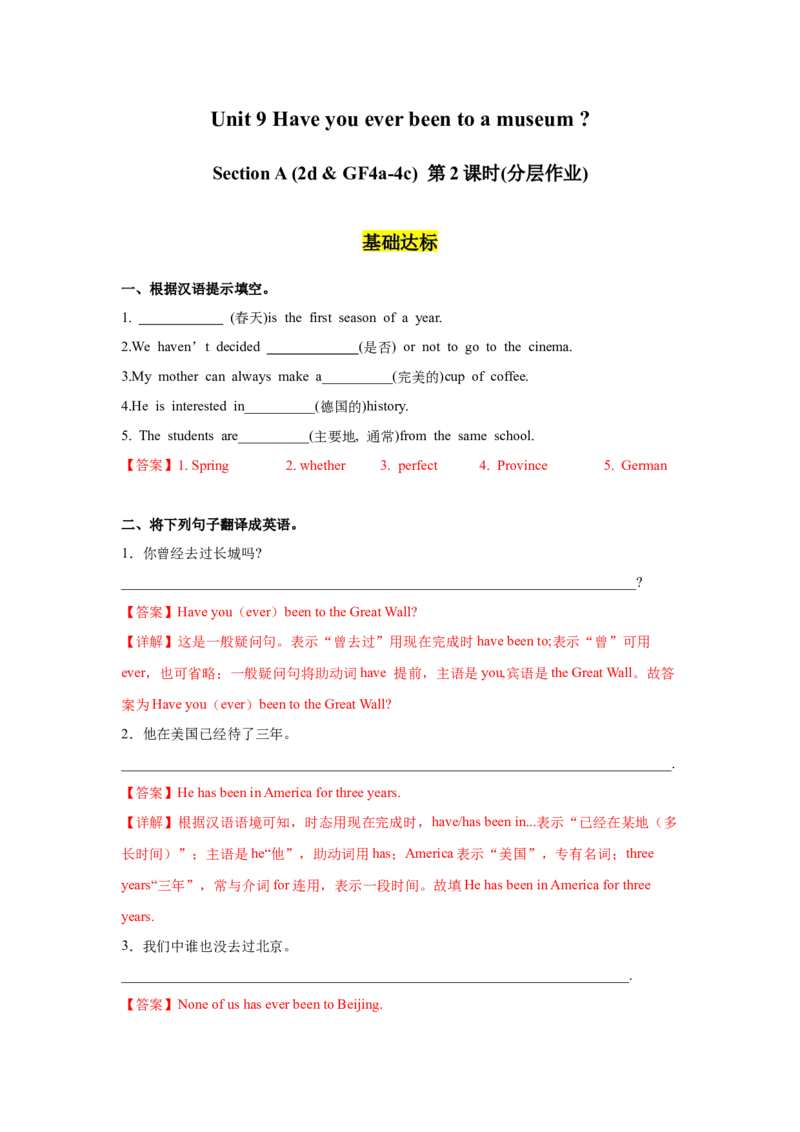
基础达标
一、根据汉语提示填空。
1. (春天)is the first season of a year.
2.We haven’t decided (是否) or not to go to the cinema.
3.My mother can always make a__________(完美的)cup of coffee.
4.He is interested in__________(德国的)history.
5. The students are__________(主要地, 通常)from the same school.
【答案】1. Spring 2. whether 3. perfect 4. Province 5. German
二、将下列句子翻译成英语。
1.你曾经去过长城吗?
_________________________________________________________________________?
【答案】Have you(ever)been to the Great Wall?
【详解】这是一般疑问句。表示“曾去过”用现在完成时have been to;表示“曾”可用
ever,也可省略;一般疑问句将助动词have 提前,主语是you,宾语是the Great Wall。故答
案为Have you(ever)been to the Great Wall?
2.他在美国已经待了三年。
______________________________________________________________________________.
【答案】He has been in America for three years.
【详解】根据汉语语境可知,时态用现在完成时,have/has been in...表示“已经在某地(多
长时间)”;主语是he“他”,助动词用has;America表示“美国”,专有名词;three
years“三年”,常与介词for连用,表示一段时间。故填He has been in America for three
years.
3.我们中谁也没去过北京。
________________________________________________________________________.
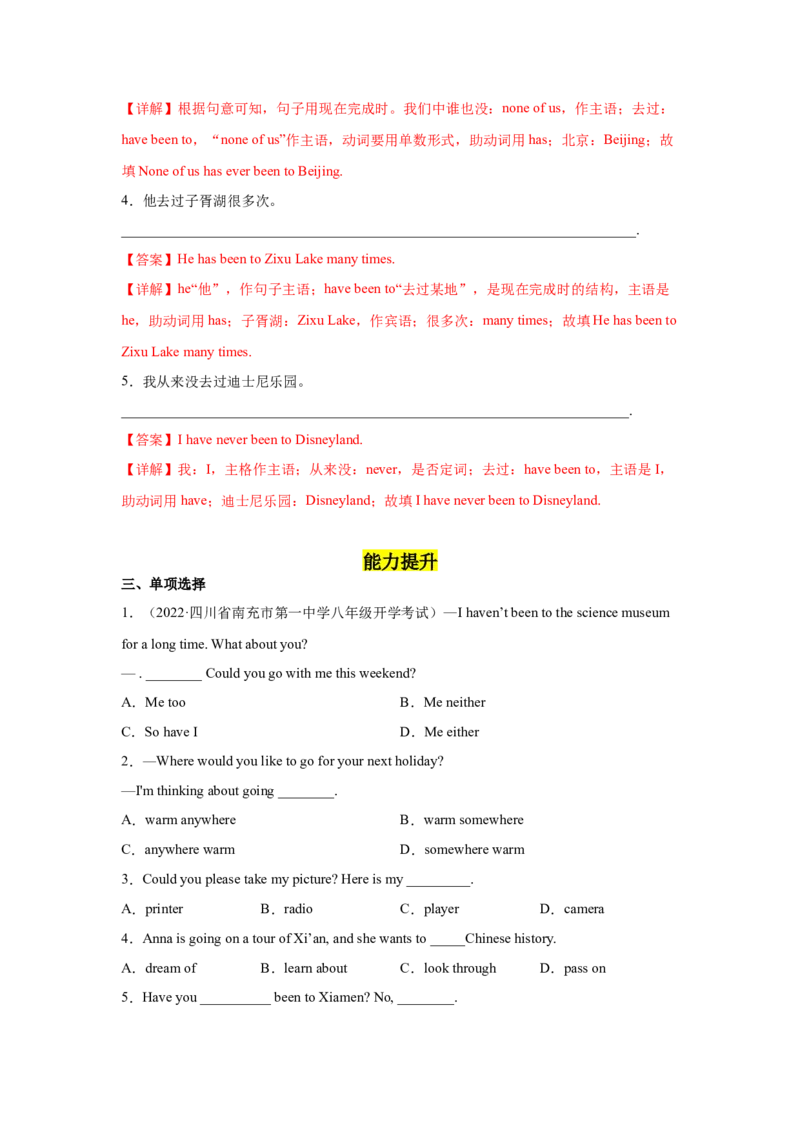
【答案】None of us has ever been to Beijing.【详解】根据句意可知,句子用现在完成时。我们中谁也没:none of us,作主语;去过:
have been to,“none of us”作主语,动词要用单数形式,助动词用has;北京:Beijing;故
填None of us has ever been to Beijing.
4.他去过子胥湖很多次。
_________________________________________________________________________.
【答案】He has been to Zixu Lake many times.
【详解】he“他”,作句子主语;have been to“去过某地”,是现在完成时的结构,主语是
he,助动词用has;子胥湖:Zixu Lake,作宾语;很多次:many times;故填He has been to
Zixu Lake many times.
5.我从来没去过迪士尼乐园。
________________________________________________________________________.
【答案】I have never been to Disneyland.
【详解】我:I,主格作主语;从来没:never,是否定词;去过:have been to,主语是I,
助动词用have;迪士尼乐园:Disneyland;故填I have never been to Disneyland.
能力提升
三、单项选择
1.(2022·四川省南充市第一中学八年级开学考试)—I haven’t been to the science museum
for a long time. What about you?
— . ________ Could you go with me this weekend?
A.Me too B.Me neither
C.So have I D.Me either
2.—Where would you like to go for your next holiday?
—I'm thinking about going ________.
A.warm anywhere B.warm somewhere
C.anywhere warm D.somewhere warm
3.Could you please take my picture? Here is my _________.
A.printer B.radio C.player D.camera
4.Anna is going on a tour of Xi’an, and she wants to _____Chinese history.
A.dream of B.learn about C.look through D.pass on
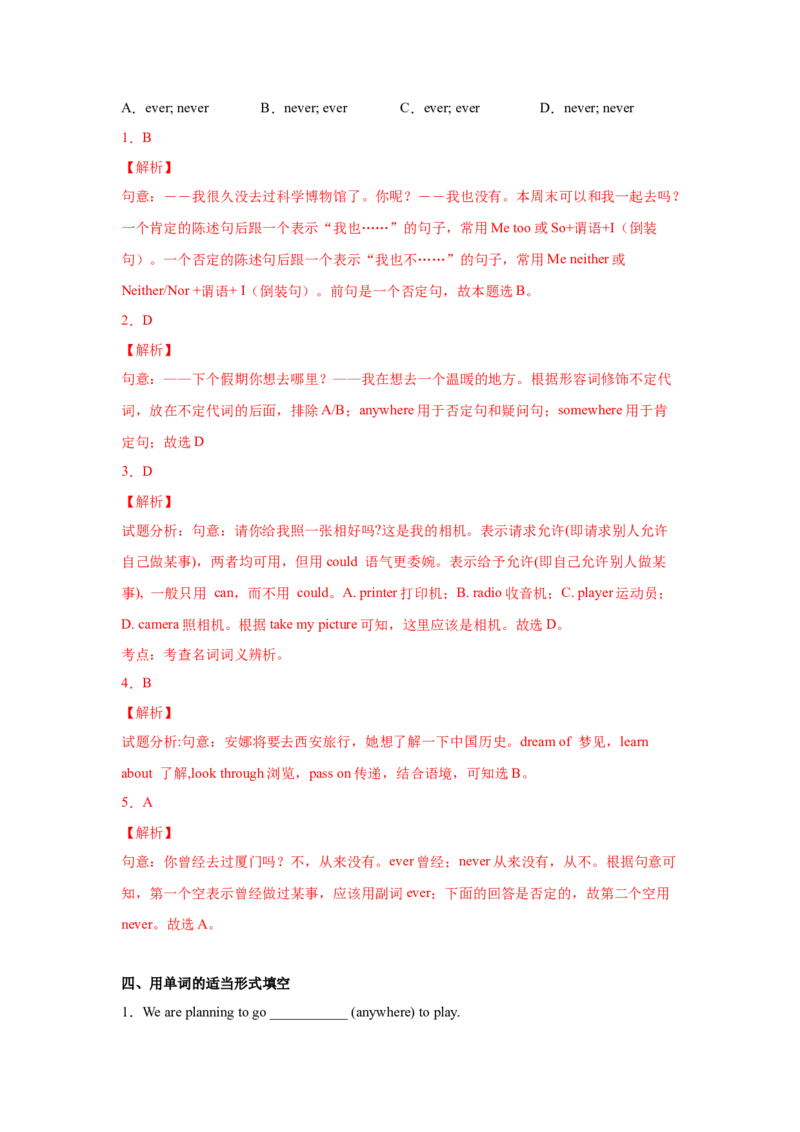
5.Have you __________ been to Xiamen? No, ________.A.ever; never B.never; ever C.ever; ever D.never; never
1.B
【解析】
句意:――我很久没去过科学博物馆了。你呢?――我也没有。本周末可以和我一起去吗?
一个肯定的陈述句后跟一个表示“我也……”的句子,常用Me too或So+谓语+I(倒装
句)。一个否定的陈述句后跟一个表示“我也不……”的句子,常用Me neither或
Neither/Nor +谓语+ I(倒装句)。前句是一个否定句,故本题选B。
2.D
【解析】
句意:——下个假期你想去哪里?——我在想去一个温暖的地方。根据形容词修饰不定代
词,放在不定代词的后面,排除A/B;anywhere用于否定句和疑问句;somewhere用于肯
定句;故选D
3.D
【解析】
试题分析:句意:请你给我照一张相好吗?这是我的相机。表示请求允许(即请求别人允许
自己做某事),两者均可用,但用could 语气更委婉。表示给予允许(即自己允许别人做某
事), 一般只用 can,而不用 could。A. printer打印机;B. radio收音机;C. player运动员;
D. camera照相机。根据take my picture可知,这里应该是相机。故选D。
考点:考查名词词义辨析。
4.B
【解析】
试题分析:句意:安娜将要去西安旅行,她想了解一下中国历史。dream of 梦见,learn
about 了解,look through浏览,pass on传递,结合语境,可知选B。
5.A
【解析】
句意:你曾经去过厦门吗?不,从来没有。ever曾经;never从来没有,从不。根据句意可
知,第一个空表示曾经做过某事,应该用副词ever;下面的回答是否定的,故第二个空用
never。故选A。
四、用单词的适当形式填空
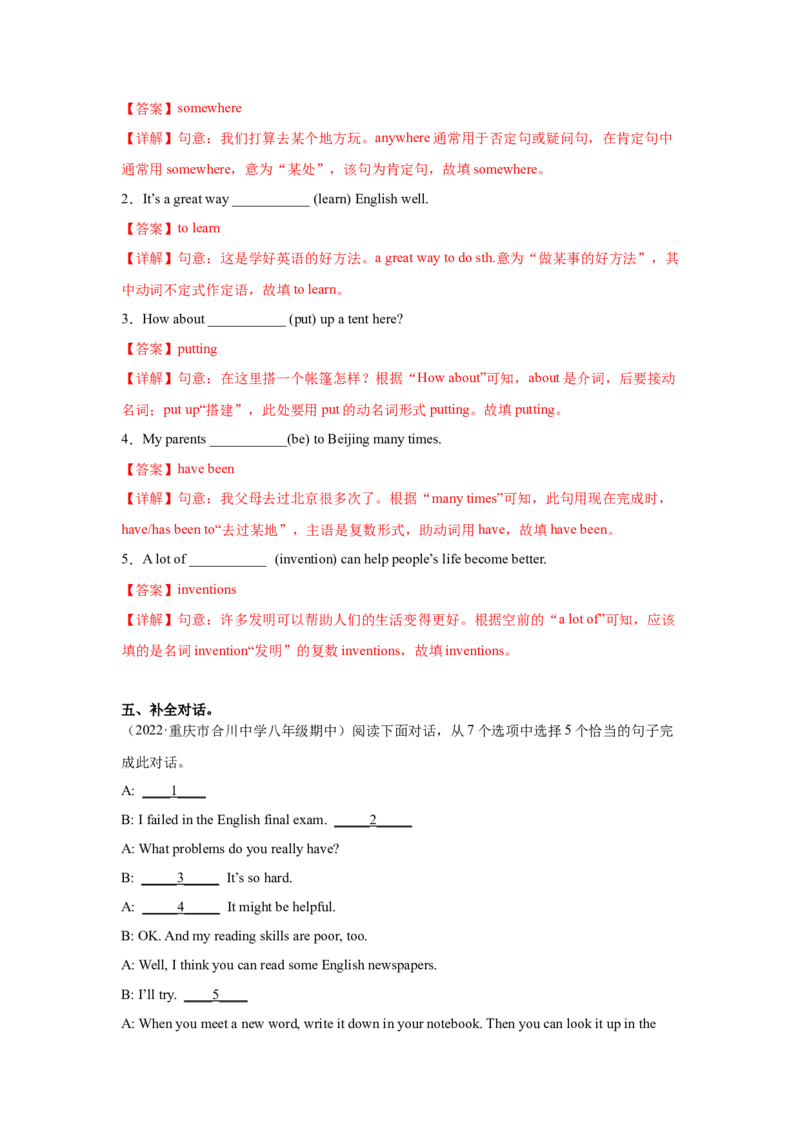
1.We are planning to go ___________ (anywhere) to play.【答案】somewhere
【详解】句意:我们打算去某个地方玩。anywhere通常用于否定句或疑问句,在肯定句中
通常用somewhere,意为“某处”,该句为肯定句,故填somewhere。
2.It’s a great way ___________ (learn) English well.
【答案】to learn
【详解】句意:这是学好英语的好方法。a great way to do sth.意为“做某事的好方法”,其
中动词不定式作定语,故填to learn。
3.How about ___________ (put) up a tent here?
【答案】putting
【详解】句意:在这里搭一个帐篷怎样?根据“How about”可知,about是介词,后要接动
名词;put up“搭建”,此处要用put的动名词形式putting。故填putting。
4.My parents ___________(be) to Beijing many times.
【答案】have been
【详解】句意:我父母去过北京很多次了。根据“many times”可知,此句用现在完成时,
have/has been to“去过某地”,主语是复数形式,助动词用have,故填have been。
5.A lot of ___________ (invention) can help people’s life become better.
【答案】inventions
【详解】句意:许多发明可以帮助人们的生活变得更好。根据空前的“a lot of”可知,应该
填的是名词invention“发明”的复数inventions,故填inventions。
五、补全对话。
(2022·重庆市合川中学八年级期中)阅读下面对话,从7个选项中选择5个恰当的句子完
成此对话。
A: ____1____
B: I failed in the English final exam. _____2_____
A: What problems do you really have?
B: _____3_____ It’s so hard.
A: _____4_____ It might be helpful.
B: OK. And my reading skills are poor, too.
A: Well, I think you can read some English newspapers.
B: I’ll try. ____5____
A: When you meet a new word, write it down in your notebook. Then you can look it up in thedictionary.
B: All right. Thanks a lot. I hope I can do better next time.
A.But my vocabulary (词汇) is not enough.
B.I don’t think so.
C.Why don’t you buy a good grammar book?
D.What’s the matter?
E.What about you?
F.Could you give me some advice?
G.I can’t catch the grammar.
【答案】DFGCA
【解析】
【导语】
本文是两个人之间的对话,其中一人让另一个人给些提高英语成绩的建议。
1.
根据“I failed in the English final exam.”可知,这里说我英语期末考试不及格,可推断此处
是说怎么了,因此D项“怎么了?”符合语境。故选D。
2.
根据下文“What problems do you really have?”可知,你真正的问题是什么,可推断此处是
说你能给我一些建议吗,因此F项“你能给我一些建议吗?”符合语境。故选F。
3.
根据“What problems do you really have?”以及“It’s so hard”可知,此处应该描述的是遇到
的问题是什么,因此G项“我听不懂语法。”符合语境。故选G。
4.
根据“It might be helpful.”可知,这里应该是提到了具体的方法,因此C项“为什么不买一
本好的语法书呢?”符合语境。故选C。
5.
根据“When you meet a new word, write it down in your notebook.”可知,这里应该是与单词
有关,因此A项“但是我的词汇量不够。”符合语境。故选A。
拓展训练
六、语法填空。(2022·河北·石家庄市第二十七中学八年级期中)I used to see a young man on my bus to
work every morning. He always sat in ____ 1 ____ (silent) and never spoke to anyone.
Two months ago, I noticed he was doing a video call with a friend ____ 2 ____ using sign
language. After he ended the call, he looked so sad, I ____ 3 ____ (think) I should say something
to comfort him, but we couldn’t understand each other.
From that day on, I started staying up ____4____ (hour) after work to learn sign language
from online videos. ____5____ it was hard, every time I thought of the man’s sad face, I told
myself that I must keep on ____ 6 ____ (learn).
Then one morning, I said hello to him and asked ____ 7 ____ (he) how he was by using sign
language. He was ____ 8 ____ (complete) shocked at first, but then he smiled happily. His happy
face made all the late nights worthwhile. He got his phone out, typed a message and gave it to me.
It just said, “thank you”.
It was ____ 9 ____ last time we had met on the bus. However, I really thank him for helping
me become a ____ 10 ____ (good) person. I hope I can help more people.
1.Silence 2.By 3.Thought 4.Hours 5.Although##Though 6.learning
7.Him 8.Completely 9.The 10.better
【解析】
【导语】
本文讲述了作者坐车上班的途中遇到了一个人,并试图学习手语与这个人沟通,最后作者
感谢这个人帮助他成为一个更好的人。
1.
句意:他总是静静地坐着,从不与任何人说话。in silence“静静地”,固定短语,故填
silence。
2.
句意:两个月前,我注意到他在用手语和一个朋友打视频电话。结合“using sign language”
可知,此处指的是“通过”使用手语,应用介词by表示,故填by。
3.
句意:在他结束通话后,他看起来很伤心,我想我应该说点什么来安慰他。根据“looked”
可知,动作发生在过去,应用一般过去时,动词用过去式,故填thought。
4.
句意:从那天起,我开始在下班后熬夜学习在线视频中的手语。空前无限定词,名词应用复数形式,故填hours。
5.
句意:虽然这很难,但每当我想起那个人悲伤的脸,我就告诉自己,我必须继续学习。此
处缺少连词,分析句子“it was hard, every time I though of the man’s sad face, I told myself
that I must keep on”可知,此处应用although.though引导让步状语从句,故
填Although/Though。
6.
句意:虽然这很难,但每当我想起那个人悲伤的脸,我就告诉自己,我必须继续学习。
keep on doing sth“继续做某事”,是固定短语,故填learning。
7.
句意:然后有一天早上,我向他打招呼,并用手语问他怎么样。空处作动词的宾语,应用
宾格形式,故填him。
8.
句意:起初他完全震惊了,但后来他高兴地笑了。空处修饰句中的形容词,应用副词形式,
故填completely。
9.
句意:这是我们最后一次在公共汽车上见面。the last time“最后一次”,此处应用定冠词
the修饰,故填the。
10.
句意:然而,我真的很感谢他帮助我成为一个更好的人。此处暗含着与之前的比较,应用
比较级形式,故填better。
七、阅读答题。
My name’s Zhang Tao. I live in Yiyang. lt’s a very beautiful city.
There is a river near my house. I often go swimming there in summer. There is a supermarket
in the center of the city. You can buy many beautiful clothes and delicious food there. Zishan Lake
Park is across from the supermarket. Many people exercise in the park in the morning because
they love the clean air and sunshine. My favorite place is my school. There are lots of trees and
flowers(花) around it. Next to the school is a library. I enjoy reading there on weekends. When I
read books, time goes quickly!
Do you like my city? There are two train stations and many bus stations in Yiyang. So youcan get here easily.
1.Is there a river near Zhang Tao’s house?
___________________________________________________________
2.What can you buy in the supermarket?
___________________________________________________________
3.Where is Zishan Lake Park?
___________________________________________________________
4.Why do people exercise in the park in the morning?
___________________________________________________________
5.How can you get to Yiyang?
___________________________________________________________
1.Yes, there is.
2.Many beautiful clothes and delicious food.
3.It’s across from the supermarket.
4.Because they love the clean air and sunshine.
5.By train or by bus./You can take a train or a bus.
【解析】本文是一篇说明文。主要介绍了张涛居住的城市——益阳。
1.根据“There is a river near my house.”可知,张涛家附近有一条河。故填Yes, there is.
2.根据“You can buy many beautiful clothes and delicious food there.”可知,可以在那里买到
很多漂亮的衣服和美味的食物。故填Many beautiful clothes and delicious food.
3.根据“Zishan Lake Park is across from the supermarket”可知,子山湖公园在超市的对面。
故填It’s across from the supermarket.
4.根据“Many people exercise in the park in the morning because they love the clean air and
sunshine.”可知,许多人早上在公园里锻炼,因为他们喜欢干净的空气和阳光。故填
Because they love the clean air and sunshine.
5.根据“There are two train stations and many bus stations in Yiyang.”可知,益阳有两个火车
站和许多汽车站,因此可以乘火车或者乘汽车到那里。故填By train or by bus./You can take
a train or a bus.