文档文本内容
Unit 5 Topic 3 小结
一.重点单词。
1. hang v. 悬挂,吊
2. description n. 形容;说明
3. Australian n. 澳大利亚人
4. below adv. & prep. 在……下面
5. harbor n. 港口,港湾
6. leader n. 领袖,领导人
7. exhibition n. 展览;展出
8. lean v. 倾斜
9. private adj. 私人的,私有的;个人的
10. president n. (共和国的)总统,国家主席;(学会的)会长;(学院的)院长
11. ring out 发出清脆的响声
12. radium n. 鐳
13. prize n. 奖,奖励,奖品
14. lifetime n. 一生,有生之年
15. telegraph n. 电报
16. photographic adj. 摄影的
17. duty n. 责任,义务;职责
18. neither pron. 两者都不 adv. 也不
19. nor conj. 也不
20. neither…nor… 既不……也不……
21. remarry v. 再婚
22. stepmother n. 继母
23. license n. 执照,许可证
24. lawyer n. 律师
25. trust v. & n. 信任,信赖,相信
26. highly adv. 很,非常
27. politician n. 从政者;政治家
28. elect v. 选举;推选
29. Civil War 内战
30. break out 爆发
1 / 1031. shoot v. 开(枪或其他武器),射击
32. break up 拆开,解散;粉碎
33. unit n. 单元;单位
34. walker n. 步行者
35. backwards adv. 向后;朝反方向
36. concern n. 担心,忧虑v. 与……有关;让(某人)担忧
37. content n. 满意的,满足的 n. 内容
38. failure n. 失败
39. brief adj. 简单的;短暂的
40. achievement n. 功绩,成就
41. Egyptian adj. 埃及的;埃及人的 n. 埃及人(语)
42. pyramid n. (古埃及的)金字塔
43. tomb n. 坟墓;冢
44. complete v. 结束,完成 adj. 完整的;彻底的
45. A.D. abbr. 公元
46. scientific adj. 科学的;关于科学的
47. ton n. 吨
48. fix v. 安装;修理
49. tool n. 工具
50. mystery n. 不可理解的事;奥秘
51. completion n. 完成;竣工
Review of Unit 5
52. graze v. 放牧;吃青草
53. make fun of 嘲弄,取笑,拿……开玩笑
54. wolf n. 狼
55. iron adj. 坚强的;强硬坚定的
56. glory n. 荣誉,光荣;赞美
57. peasant n. 农民
58. battle n. 战斗,战役
59. battlefield n. 战场
60. memory n. 记忆力,记性;回忆
61. in memory of 纪念
62. romantic adj. 浪漫的;空想的
2 / 1063. tale n. 故事
64. home and abroad 国内外
65. scenery n. 风景;景色
【典例分析】
1. below adv. & prep. 在下面; under prep. & adv. 在下面;在下方;
below 表示“在下方或位置低于……”,不一定有垂 直在下之意;它的反义词是above。
e.g. Write your name below the line.在线下写上你的名字。
【技巧总结】
under表示“在……正下方”;有时可与below通用,但它指处于某物的正下方,其反义词是over。
e.g. He stood under a tree. 他站在树下。
【典例分析】
2. leader (n.) 领导者,领袖
lead (v.) 率领,领导,引领
【典例分析】
3. neither pron.“两者都不,双方均不”。
e.g. He answered neither of the letters. 他两封信都没回。
She bought two toys, but neither can please the child. 她买了两个玩具,却没有一个能让小孩高兴。
--Which one would you like? 你喜欢哪一个?
--Neither. 两个都不喜欢。
2) neither用作副词,作“也不”解释,放在句首,表示前面否定的内容也适用于另一个人或物,句子须采用部分倒装。
此时也可用nor替换neither使用。
e.g.—I don't like this dress. 我不喜欢这件连衣裙。
—Neither / Nor do I. 我也不喜欢。
e.g. If you don't suppose the plan, neither / nor will I. 如果你不支持那项计划,我也不支持。
注意:neither之后的主语要置于助动词或系动词之后。
【典例分析】
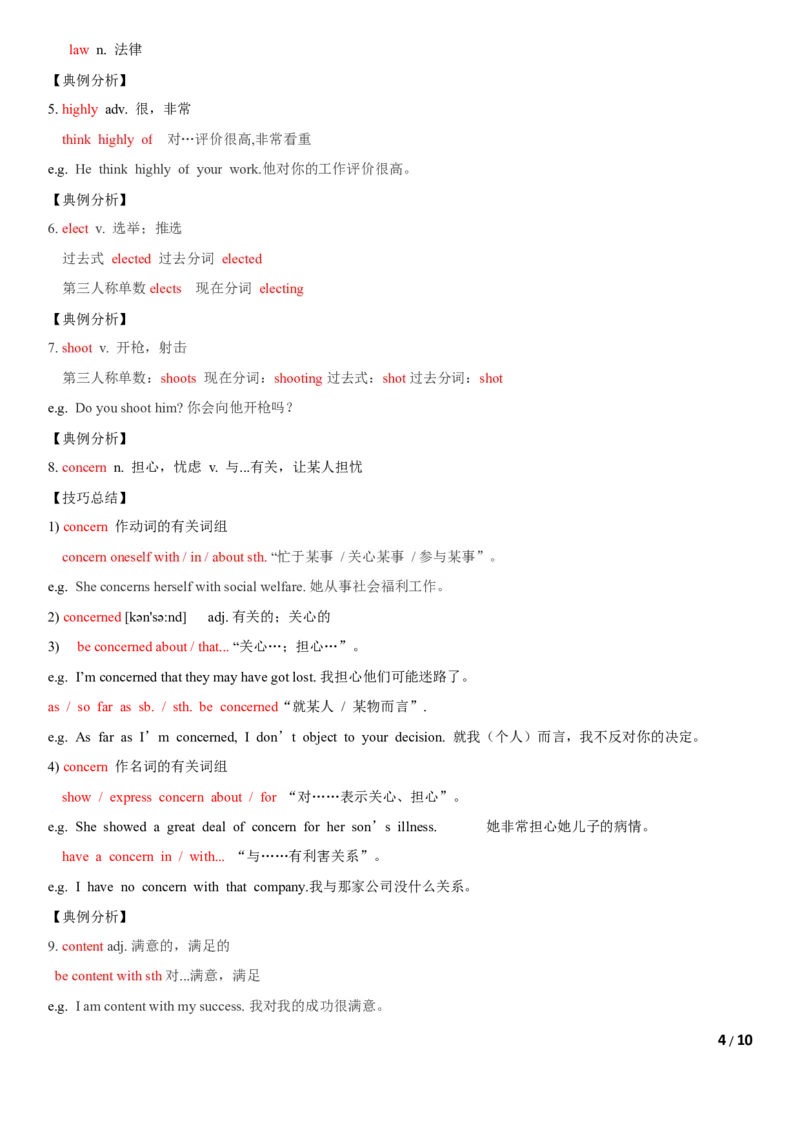
4. lawyer n. 律师
3 / 10law n. 法律
【典例分析】
5. highly adv. 很,非常
think highly of 对…评价很高,非常看重
e.g. He think highly of your work.他对你的工作评价很高。
【典例分析】
6. elect v. 选举;推选
过去式 elected 过去分词 elected
第三人称单数elects 现在分词 electing
【典例分析】
7. shoot v. 开枪,射击
第三人称单数:shoots 现在分词:shooting 过去式:shot过去分词:shot
e.g. Do you shoot him? 你会向他开枪吗?
【典例分析】
8. concern n. 担心,忧虑 v. 与...有关,让某人担忧
【技巧总结】
1) concern 作动词的有关词组
concern oneself with / in / about sth. “忙于某事 / 关心某事 / 参与某事”。
e.g. She concerns herself with social welfare. 她从事社会福利工作。
2) concerned [kən'sə:nd] adj. 有关的;关心的
3) be concerned about / that... “关心…;担心…”。
e.g. I’m concerned that they may have got lost. 我担心他们可能迷路了。
as / so far as sb. / sth. be concerned“就某人 / 某物而言”.
e.g. As far as I’m concerned, I don’t object to your decision. 就我(个人)而言,我不反对你的决定。
4) concern 作名词的有关词组
show / express concern about / for “对……表示关心、担心”。
e.g. She showed a great deal of concern for her son’s illness. 她非常担心她儿子的病情。
have a concern in / with... “与……有利害关系”。
e.g. I have no concern with that company.我与那家公司没什么关系。
【典例分析】
9. content adj. 满意的,满足的
be content with sth 对...满意,满足
e.g. I am content with my success. 我对我的成功很满意。
4 / 10【典例分析】
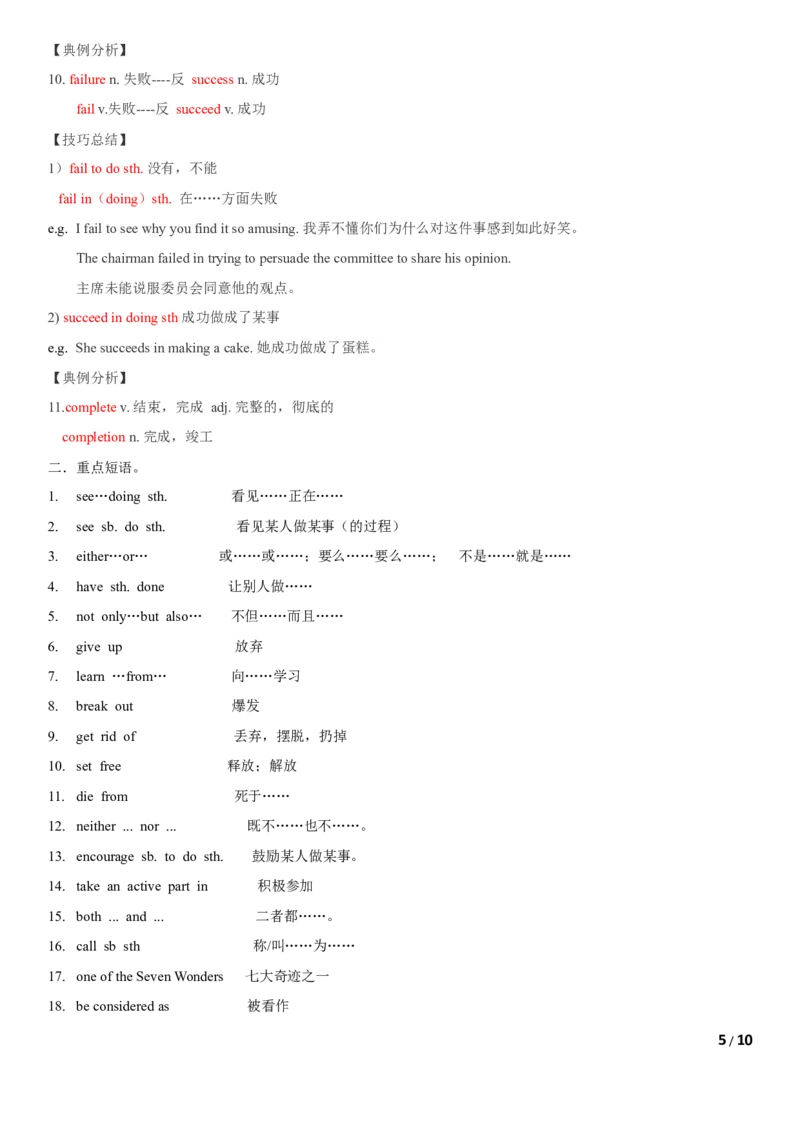
10. failure n. 失败----反 success n. 成功
fail v.失败----反 succeed v. 成功
【技巧总结】
1)fail to do sth. 没有,不能
fail in(doing)sth. 在……方面失败
e.g. I fail to see why you find it so amusing. 我弄不懂你们为什么对这件事感到如此好笑。
The chairman failed in trying to persuade the committee to share his opinion.
主席未能说服委员会同意他的观点。
2) succeed in doing sth 成功做成了某事
e.g. She succeeds in making a cake. 她成功做成了蛋糕。
【典例分析】
11.complete v. 结束,完成 adj. 完整的,彻底的
completion n. 完成,竣工
二.重点短语。
1. see…doing sth. 看见……正在……
2. see sb. do sth. 看见某人做某事(的过程)
3. either…or… 或……或……;要么……要么……; 不是……就是……
4. have sth. done 让别人做……
5. not only…but also… 不但……而且……
6. give up 放弃
7. learn …from… 向……学习
8. break out 爆发
9. get rid of 丢弃,摆脱,扔掉
10. set free 释放;解放
11. die from 死于……
12. neither ... nor ... 既不……也不……。
13. encourage sb. to do sth. 鼓励某人做某事。
14. take an active part in 积极参加
15. both ... and ... 二者都……。
16. call sb sth 称/叫……为……
17. one of the Seven Wonders 七大奇迹之一
18. be considered as 被看作
5 / 1019. according to 根据
20. order sb to do sth 命令某人做某事
21. scientific research 科学研究
22. as much as 和 一样多
23. continue to do sth 继续做某事
【典例分析】
1. see sb. doing sth. 看见某人正在做某事。
e.g. I saw him playing basketball when I went across the playground.
当我路过操场时,我看见他正在打篮球。
see sb. do sth. 看见某人做某事(的过程)
e.g. I saw him walk into a bank. 我看见他走进一家银行。
【技巧总结】
常见的感官动词有:see, watch, hear, smell(嗅觉), feel 等。后可接①动词ing形式,表此动作正在发生。
②动词原形,不表此动作正在发生, 表此动作已完成或存在的事实。
【典例分析】
2. either ... or ... 或者……或者……。
e.g. These shoes are either too big or too small. None of them fit me.
这些鞋或者太大或者太小。没有适合我的。
【典例分析】
3. have sth. done 请或让某人做某事。
e.g. I will have my hair cut. 我将剪头发。
【典例分析】
4. not only ... but also ...不但……而且……,also可以省略。
e.g. He likes not only maths but also physics. 他不但喜欢数学而且喜欢物理。
【技巧总结】
1) not only ... but also连接并列主语时,谓语动词使用就近原则。
e.g. Not only he but also I am a volunteer.不但他而且我都是志愿者。
2) not only ... but (also) 不但……而且……当not only提前时,前一分句用倒装句式,后一分句用陈述语序。
e.g. Not only is he clever, but also she is kind-hearted.她不仅聪明,而且心地善良。
【典例分析】
5. give up sth/doing sth 放弃(做)某事
e.g. You should give up smoking and drinking. 你应该戒烟戒酒。
I can't give up learning English. 我不能放弃学英语。
6 / 10【典例分析】
6. learn …from… 向……学习
e.g. We should learn kindness and good manners from Confucius.
【典例分析】
7. neither ... nor ... 既不……也不……。
e.g. He likes neither apples nor bananas. 他既不喜欢苹果也不喜欢香蕉。
neither ... nor ...连接并主语时,谓语动词使用就近原则。
e.g. Neither you nor he is right. 你和他都不对。
【典例分析】
8.encourage sb. to do sth. 鼓励某人做某事。
e.g. I encourage him to learn by himself. 我鼓励他自学。
【典例分析】
9. get rid of 丢弃,摆脱,扔掉
e.g. The owner needs to get rid of the car for financial reasons 因为经济原因,车主必须把汽车处理掉。
【典例分析】
10. set free 释放,解放。
e.g. In the absence of definite evidence the prisoner was set free. 因缺乏确凿证据,囚犯被释放了。
【典例分析】
11. die from 死于……
e.g. In a severe winter, wild animals can die from lack of food.
在寒冷的冬天, 野兽可能因为缺乏食物而饿死.
【典例分析】
12. order sb. to do sth. 命令某人去做某事
e.g. The boss ordered him to wash the dishes. 老板命令他刷这些盘子
【典例分析】
13.continue to do sth. 继续做另一件事
e.g. After he finished his homework, he continued to play games with his friends.
他做完家庭作业之后跟朋友们继续玩游戏
【技巧总结】
continue doing sth. 继续做同一件事
e.g. After a rest,he continued his reading. 休息后,他继续看书。
三.重难点详解
1. Kangkang has come to Susanna’s house and seen some beautiful pictures hanging on the wall.
7 / 10康康来到苏珊娜家里,看到一些美丽的图片挂在墙上。
hang on the wall 挂在墙上;
on the wall & in the wall 区别:
图画、黑板、风筝等"在墙上",是因为它们在墙的表面上,故用on the wall;
窗、钉子、洞、孔等"在墙上",是因为它们在墙的里面,故用in the wall.
【技巧总结】
类似的还有on the tree/in the tree都译为"……在树上".
on the tree表示树上本身所长着的叶子、花、果实等;
in the tree表示某物或某人在树上.
2. although虽然,尽管。引导让步状语从句,不与but同时出现在句子中。
e.g. Although he is ninety years old, he still can look after himself. 尽管他九十岁了,但是他仍然
能自理。
3. She stopped serving the patients as a nurse after the war. 战后她不再当护士照顾病人。
1) stop doing sth. 停止做某事;
e.g. Stop talking,the teacher is coming。别说了,老师来了。
2) stop to do sth. 停下来做别的事;
e.g. We are tired, let’s stop to have a rest. 我们累了停下来休息会儿。
4. During the following years,he took a more active part in politics.在以后的几年里,他积极参加政治活动。
1) the following years 在以后几年;
2) take an active part in 积极参加;
e.g. He often takes an active part in outdoor activities. 他积极参加户外活动。
5. According to scientific research, the ancient King, Khufu, ordered his men to build the Great Pyramid stone by
stone. 根据科学研究,古代的国王胡夫,命令他的臣民用一块一块的石头修建金字塔。
1) according to 依照,据……所说;
e.g. According to your explanation, I understand the text.
2) order sb. to do sth. 命令某人做某事;有此用法的常用动词有ask, want, tell。
e.g. The boss ordered him to wash the dishes. 老板命令他刷这些盘子。
四.重点语法-----------连词:
1. both...and.... 两者都;既……又……;不仅……而且……;
1) 连接主语,谓语用复数形式。Both you and I are good students.你和我都是好学生。
2) 连接谓语。I can both speak and write English.我既会说英语又会写英语。
注意:both...and.......的否定用 neither ......nor ......
e.g. He can speak both English and French. 他既会说英语也会说法语。
8 / 10He can speak neither English nor French. 他既不会说英语也不会说法语。
2. neither...nor.. 既不……也不……;两者都不;
1)连接主语,谓语动词与邻近的主语单复数保持一致。Neither he nor I am from China.他和我都不是中国人。
2)连接谓语。I neither like playing computer games nor like watching TV.我既不喜欢玩电脑游戏也不喜欢看电视。
3. ether...or... 或……或……;要么……要么……;不是……就是……;
1) 连接主语,谓语动词与邻近的主语单复数保持一致。Either you or he goes to school by bike.
2)连接谓语。You can either go to school or stay at home.你要么去上学,要么待在家里。
4. not only…but also......不但……而且……;
1)连接主语,谓语动词与邻近的主语单复数保持一致。
e.g. Not only you but also he speaks Japanese in our class.
2)连接谓语。
e.g. Tom not only speaks English but also speaks Japanese at school.
3)连接宾语。
e.g. The problem for the recipient(接受者) was trying to guess not only who the sender was, but also what his secret
feelings might be. 收信人不仅要尽力猜出是谁的,还要推测寄信人内心有什么想法。
4)连接宾语补足语。
e.g. Light and bright colors make people not only happier but more active.
5)连接表语。
e.g. Shakespeare was not only a writer but (also) an actor 莎士比亚不仅是一位剧作家,而且是一位演员。
9 / 1010 / 10