►第 08 讲 精彩纷呈动作描写之“说”
(讲义)
目录
目标1 精彩纷呈的不同的“说”
目标2 不同位置的“说”
目标3 掌握不同修饰法的“说”
目标4 避免易错、易丢分的“说”
目标5 经典赏析
目标6 真题感悟
精彩纷呈的不同的“说”
【多种表达】
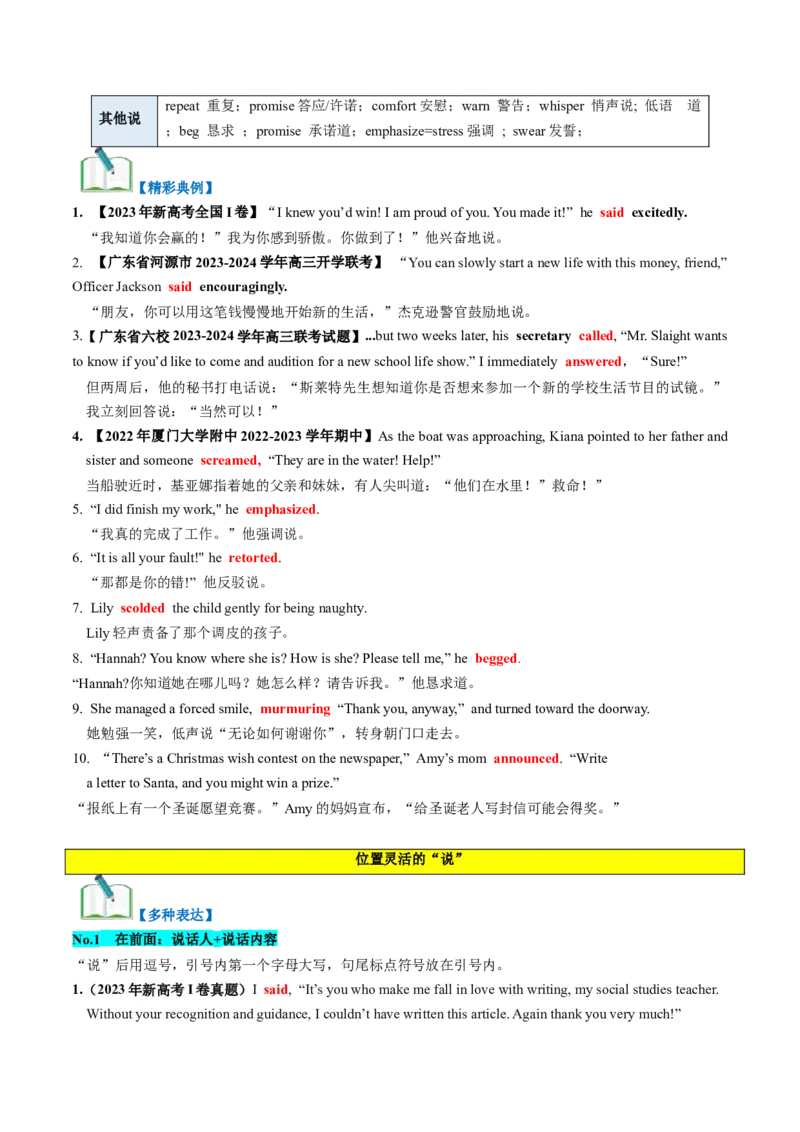
一般说 say说; speak说;tell告诉;add补充说;insist坚持说;chat (聊天)
哭着说 cry哭叫;大声说;sob呜咽着说; weep out哭着说出
笑着说 smile 微笑着说; laugh 笑着说;say with a smile ; chuckle(轻笑着说)
call 喊,叫; yell喊叫(因激动,恐惧); shout 高喊;大声喊叫;scream 惊呼,高声叫道;
音调说 scream (尖叫),roar (吼叫),, let out a loud voice (大叫/大声呼喊),
whisper(小声/低语),murmur (低语/嘀咕/低声抱怨)
褒贬说 praise 称赞; complain 抱怨;sigh叹息;mutter低声抱怨;murmur嘟囔
ask问;explain解释说; reply=respond 答复,回答; answer 回答
问答说
demand 质问; inquire (询问); tell告诉
反对说 disagree不同意;deny否认;scold责备;contradict反驳说;argue争论;protest抗议
声明说 state声明;declare宣布;announce宣布;claim声明;point out指出
评论说 comment; observe; remark;hint(暗示);add (补充说)
admit 承认;agree 同意; advise 劝告,建议 ;suggest 建议;argue 主张
观点说
acknowledge承认;repeat 重复;promise答应/许诺;comfort安慰;warn 警告;whisper 悄声说; 低语 道
其他说
;beg 恳求 ;promise 承诺道;emphasize=stress强调 ; swear发誓;
【精彩典例】
1. 【2023年新高考全国I卷】“I knew you’d win! I am proud of you. You made it!” he said excitedly.
“我知道你会赢的!”我为你感到骄傲。你做到了!”他兴奋地说。
2. 【广东省河源市2023-2024学年高三开学联考】 “You can slowly start a new life with this money, friend,”
Officer Jackson said encouragingly.
“朋友,你可以用这笔钱慢慢地开始新的生活,”杰克逊警官鼓励地说。
3.【广东省六校2023-2024学年高三联考试题】...but two weeks later, his secretary called, “Mr. Slaight wants
to know if you’d like to come and audition for a new school life show.” I immediately answered,“Sure!”
但两周后,他的秘书打电话说:“斯莱特先生想知道你是否想来参加一个新的学校生活节目的试镜。”
我立刻回答说:“当然可以!”
4. 【2022年厦门大学附中2022-2023学年期中】As the boat was approaching, Kiana pointed to her father and
sister and someone screamed, “They are in the water! Help!”
当船驶近时,基亚娜指着她的父亲和妹妹,有人尖叫道:“他们在水里!”救命!”
5. “I did finish my work," he emphasized.
“我真的完成了工作。”他强调说。
6. “It is all your fault!" he retorted.
“那都是你的错!” 他反驳说。
7. Lily scolded the child gently for being naughty.
Lily轻声责备了那个调皮的孩子。
8. “Hannah? You know where she is? How is she? Please tell me,” he begged.
“Hannah?你知道她在哪儿吗?她怎么样?请告诉我。”他恳求道。
9. She managed a forced smile, murmuring “Thank you, anyway,” and turned toward the doorway.
她勉强一笑,低声说“无论如何谢谢你”,转身朝门口走去。
10. “There’s a Christmas wish contest on the newspaper,” Amy’s mom announced. “Write
a letter to Santa, and you might win a prize.”
“报纸上有一个圣诞愿望竞赛。”Amy的妈妈宣布,“给圣诞老人写封信可能会得奖。”
位置灵活的“说”
【多种表达】
No.1 在前面:说话人+说话内容
“说”后用逗号,引号内第一个字母大写,句尾标点符号放在引号内。
1.(2023年新高考I卷真题)I said, “It’s you who make me fall in love with writing, my social studies teacher.
Without your recognition and guidance, I couldn’t have written this article. Again thank you very much!”我说:“是你让我爱上了写作,我的社会研究老师。如果没有你的认可和指导,我就不可能写这篇文
章。再次非常感谢你!
2.He added softly “I miss you.”
他又温柔的说了一句:“我想念你。”
No.2 在句中:说话内容+说话人+说话内容
“某人说”可以写作“sb. said”也可以写作“said sb.”;“某人说”前面引号内用逗号,引号外第一个字
母小写。“某人说”后面如果用句号,则后面引号内第一个字母大写;“某人说”后面如果用逗号,则后
面引号内第一个字母小写。
1.“I can’t get it out!” I shouted, my voice sounding unnaturally loud in the enclosed space.
“我拿不出来!”我喊道,我的声音在封闭的空间里听起来很奇响。
2.His son smiled somewhat shyly, and replied softly,“Me,too,Dad!”
他的儿子有些腼腆地笑了笑,轻声答道:“我也是,爸爸!”
3.“Very clever,” said the teacher, nodding his head as if pleased.
“很聪明,”老师高兴地点了点头说。
4.“我的答案是对”汤姆争辩道,“你的答案是错的。”
“My answer is right," argued Tom, “and yours is wrong.”
5. “Did you go skating a lot last year?” I asked, blurting out the first thing that came to my mind.
“你去年经常溜冰吗?”我问,脱口说出出现在我脑海里的第一件事。
6.“To your health!” said Mr. White, who also emptied his glass, and wiped his mouth with his
handkerchief.
“祝你健康!”White先生说,他也把杯子倒空了,用手帕擦了擦嘴。
No. 3 在后面:说话内容+说话人
陈述句引号内用逗号,引号外第一个字母小写;疑问句或感叹句引号内用问号或感叹号,引号外第一
个字母小写。可以写作“sb. said”也可以写作“said sb.”。
1. “ I would like to go with you, but I haven’t finished my homework.” She said.
她说:“我想和你一起去,但我还没有做完成作业。”
2..“He is a fine young man," observed Stephen.
“他是一位优秀的年轻人,”斯蒂芬评论道。
3. “You're crazy!" she laughed.
“你疯啦!”她哈哈大笑起来。
4. “Help, help!” he cried/screamed.
“救命啊,救命啊!” 他高声喊道。
多种修饰的“说”
【1被副词修饰】1.【2022年新高考全国I卷】The children said loudly, “Happy Mother’s Day!”
孩子们大声说:“母亲节快乐!”
2.“I won’t let you down,” he replied confidently.
他信心十足地回答道,“我不会让你失望的。”
3.“My best friend is leaving, ”she said sadly.
“我最好的朋友要走了,” 她难过地说。
4.“That's impossible," she thought aloud.
“那不可能,”她自言自语地说。
【2被介词短语修饰】
1.“Do you know the answer ?” he said with eagerness.
“你知道答案吗?”他急切地说。
2. “Of course,” Nancy replied with a smile.
“当然,”南希笑着回答。
3.The house got really noisy at that time, with everybody hollering and shouting at the top of his voice.
那栋房子真是很吵闹,每个人都在用最大的嗓门大喊大叫。
4.“Christine! Take care of your young brother!” Mother shouted at the top of her voice.
“Christine!照顾好你弟弟!”母亲高声喊道。
【3被非谓语短语修饰】
1.“I didn’t get an ideal score in the math exam, ”said Lily, disappointed.
“我在数学考试中没有得到理想的分数,”莉莉失望地说。
2. “Time to go.” I whispered to the girl, wishing she could follow me right away.
“该出发了。”我轻声对小女孩说,希望她能立马跟上。
3.“ He turned me out of the room this morning, ”said James, stamping his foot with excitement.
早上他把我赶出了房间,”詹姆斯激动的跺着脚说。
4.“I didn't know what I was doing,”she said, laughing.
“我不知道我在做什么,”她笑着说。
5. “I'll get us some coffee,” she said, heading for the kitchen.
“我去给我们拿点咖啡,”她说着朝厨房走去。
【4被状语从句修饰】
say后接状语从句,增加了细节描写。即:“...”sb said,as/when/before/as if...
1.“What a beauty!” said the nurse when she came to the door.
“多美啊!”护士走到门口时说道。
2.“Watch out!” she shouted, as the car started to move.
“当心!”当汽车开始移动时,她喊道。【5被并列句修饰】
say后接并列谓语或接并列句,增加了动作描写。即:“...”sb said, and (then he) did....
1.“I was attacked by a wolf and I thought I would never see you again.” Mac hugged them and
burst out crying.
“我被狼袭击了,我以为再也见不到你了。”麦克抱着他们,大哭起来。
【6被...+动作描写来修饰】
1. Frank quickly told Belle Ringer and the other two drivers about Stevie's surgery, and then sighed.
弗兰克快速地告诉Belle Ringer和其他两名司机 Stevie手术的事,说完之后叹了口气。
2.“I don't believe you any more”He turned around, slammed the door and stormed out.
“我再也不相信你了。”他转过身,砰的一声关上门,冲了出去。
3. James murmured a thank you and ran home all the way.
James 轻轻地说了声“谢谢”后一路跑回了家。
4. He paused, looked straight into her eyes, and said in a quiet voice, “That's true.
他停下来,直视着她的眼睛,平静地说:“那是真的。”
5. The Queen, quite out of breath from yelling and screaming, went up to Alice and
asked,“Have you met him yet?”
女王因为大声喊叫而气喘吁吁地向爱丽丝走过来并且问道:“你见过他吗?”
6.“Drive safely," he said, and waved goodbye.
“小心开车,”他说着挥手告别。
7.“Come here,” said the little man, and took her to one of the corners of the building.
【7不出现“说”,...+动作描写来修饰 】
1.“I was attacked by a wolf and I thought I would never see you again.”Mac hugged them and
burst out crying.
“我被狼袭击了,我以为再也见不到你了。”麦克抱着他们,大哭起来。
2.He interrupted the silence with an announcement: “The deadline to enter for the Competition is tomorrow.”
他用一则通知打断了沉默:“报名参加比赛的截止日期是明天。”
3.She suggested a walk in the open air and he readily agreed.
她提议去户外走走,他欣然同意了。
4.He went along, stopping his friends beginning endlessly his statement.
他走过去拦住他的朋友们,开始了他无休止的陈述。
低分的“说”
错误一 滥用修饰词【典例1】“How can you do this?"she said very angrily, looking at me furiously.
【点睛】 此句使用了大量副调。并且套用了分词作伴随的句型。过度使用副词让阅卷老师觉得你词汇
贫乏。废话连篇,对情节发展和刻画人物性格没有帮助。
【典例2】“That is fantastic news,”he said happily.
【点睛】 此句中完全没有必要加上一个happily来表达说的方式,因为句中的fantastic一词足以说明说
话人的表情,过度强调对话标签会让读者的注意力集中在“说话的方式”而不是“说话的内容”。
错误二 追求花哨,过度使用“对话标签”
【典例】“Hey,how are you?”“I’m fine, how are you?”
“How is the weather?”“Terrific! Nice day for a walk isn't it?”
【点睛】 这样的对话在现实生活中很真实,但是小说毕竟是艺术加工,无助情节推动的,不能刻画人
物性格的日常寒暄和偏离文章主线的对话绝对不用。
错误三 用词不当,逻辑混淆
【典例】“I can't believe it,” Emma gasped.“That's hilarious,” Henry chuckled.
【点睛】这里把动作描写逻辑混淆了,gasp(喘息)不能.chuckle(轻笑)出一句话。
“I can't believe it” Emma said with a gasp.(Dialogue tag+with介词短语)
错误四 重复使用,废话堆积
【典例】“I told you already,”I said, glaring.
【点睛】 此句对话中的主语“1”已经清晰地说明了说话者,完全没有必要用 dialogue tag“I said”
来说明说话对象。可以加上一点动作描写就可以避免这种错误,并且提升语言的生动性。I glared at
him,“I told you already.”
经典赏析
【模拟速递】
【广东省执信中学2023-2024学年高三开学试题】
When my dad arrived, he went as usual, straight to the balcony and saw his flowers lying on the
floor like dead animals. In no time, he got annoyed and stormed into our room, questioning us in glare who it
was that made such a mess of his flowers. Instead of crying, brave Maria held out the flowers and explained what
we meant to do and how it ended up this way. She was afraid that dad might punish her, but at the same time she
hoped that dad would smile at our warm actions. Deeply touched, dad held the flowers tightly and gently, and
immediately gathered us into his arms, saying , “You are my best flowers!”
当我爸爸到达时,他像往常一样,径直走到阳台上,看到他的花像死动物一样躺在地板上。很快,他
就怒气冲冲地冲进了我们的房间,怒不可遏地问我们,是谁把他的花弄得一团糟。勇敢的玛丽亚没有哭,
而是拿出花,解释我们打算做什么,以及它是如何这样结束的。她担心爸爸会惩罚她,但同时她也希望爸
爸会对我们温暖的行为微笑。爸爸深深地感动,紧紧而温柔地握着花,立刻把我们抱在怀里,说:“你们
是我最好的花!”【2022年新高考II卷】
阅读下面材料,根据其内容和所给段落开头语续写两段,使之构成一篇完整的短文。
It was the day of the big cross-country run. Students from seven different primary schools in and around the
small town were warming up and walking the route(路线)through thick evergreen forest.
I looked around and finally spotted David, who was standing by himself off to the side by a fence. He was
small for ten years old. His usual big toothy smile was absent today. I walked over and asked him why he wasn’t
with the other children. He hesitated and then said he had decided not to run.
What was wrong? He had worked so hard for this event!
I quickly searched the crowd for the school’s coach and asked him what had happened. “I was afraid that kids
from other schools would laugh at him,” he explained uncomfortably. “I gave him the choice to run or not, and let
him decide.”
I bit back my frustration(懊恼). I knew the coach meant well—he thought he was doing the right thing. After
making sure that David could run if he wanted, I turned to find him coming towards me, his small body rocking
from side to side as he swung his feet forward.
David had a brain disease which prevented him from walking or running like other children, but at school his
classmates thought of him as a regular kid. He always participated to the best of his ability in whatever they were
doing. That was why none of the children thought it unusual that David had decided to join the cross-country team.
It just took him longer—that’s all. David had not missed a single practice, and although he always finished his run
long after the other children, he did always finish. As a special education teacher at the school, I was familiar with
the challenges David faced and was proud of his strong determination.
注意:
1. 续写词数应为150左右;
2. 请按如下格式在答题卡的相应位置作答.
We sat down next to each other, but David wouldn’t look at me.
____________________________________________________________________________________________
____________________________________________________________________________________________
______
I watched as David moved up to the starting line with the other runners.
【答案】
We sat down next to each other, but David wouldn’t look at me. I said gently and quietly, “No one can
change your mind, except yourself. If you desire to challenge yourself, there is nothing to do with others’ thoughts.”
He sat still with a deep breath. “You have a full preparation before this event, which is the most important reason
why you show up here”, I added with a sincere tone. Hearing my words, David turned to me tremblingly withtears spilling out of his eyes and expressed he had made a firm determination to finish the cross-country run. His
coach heard what David said and gave me a look—the kind that was more determined than anyone else’s.
I watched as David moved up to the starting line with the other runners. The race started. It seemed that the
runway was extremely long for young children, not to mention a child with a brain disease. David insisted on
running as if he had forgotten all his weaknesses, though he was tripped over within the a few kilometers. It didn’t
take long before he picked himself up again and continued his mission. Classmates all appeared on the racing track,
cheering for him. “Come on! You can make it! We are proud of you!” they shouted enthusiastically. To
everyone’s joy, he reached the final line and ranked the 20th. It was no more important whether he won the first
place or not. It was his brave heart and strong faith that could make something unusual happen finally.
【导语】本文以人物为线索展开,讲述了作者是一名特殊教育教师,在大型越野赛跑那天,发现患有大脑
疾病的大卫独自站在一旁。作者问其原因,他说准备放弃比赛。从教练口中得知,因为担心同学们会嘲笑
大卫,所以教练想让大卫自己去决定是否参加赛跑。作者让大卫追寻自己的内心,不理会别人的看法,大
卫最终参赛,尽管遇到困难,他战胜了自己,这已经无关名次,而是他的勇敢和坚定让这一切成为可能。
【详解】1.段落续写:
①由第一段首句内容“我们挨着坐着,但大卫不愿看我一眼。”可知,第一段可描写作者鼓励大卫继续完
成比赛,大卫经过强烈的心理斗争,最终决定参加比赛。
②由第二段首句内容“我看着大卫和其他选手一起走到起跑线上。”可知,第二段可描写大卫开始参赛,
虽然中途遇到困难,仍然坚持到最后,完成比赛。
3. 续写线索:鼓励大卫——心理变化——决定参赛——克服困难——加油助威——完成比赛——感悟
词汇激活:
行动类:
①深呼吸:with a deep breath/breathe deeply
②坚持做:insisted on doing/be stick to doing
情绪类:
①热情:enthusiastically /with great passion
②骄傲:be proud of/take pride in
[高分句型1]You have a full preparation before this event, which is the most important reason why you show up
here. (由which引导的非限制性定语从句和why引导的限制性定语从句)
[高分句型2]Hearing my words, David turned to me tremblingly with tears spilling out of his eyes and expressed
he had made a firm determination to finish the cross-country run. (现在分词作状语和省略that的宾语从句)
[高分句型3]It was his brave heart and strong faith that could make something unusual happen finally. (由It
was...that结构引导的强调句型)