必修5 Unit 1 第一单元 伟大的科学家
JOHN

   SHOW

   DEFEATS

   "KING

   CHOLERA"

   约翰

 · 斯洛击败

 “
  霍乱王

 ”

         John Snow was a famous doctor in London - so expert, indeed, that he attended
Queen Victoria as her personal physician. But he became inspired when he thought
about helping ordinary people exposed to cholera. This was the deadly disease of its
day. Neither its cause nor its cure was understood. So many thousands of terrified
people died every time there was an outbreak. John Snow wanted to face the
challenge and solve this problem. He knew that cholera would never be controlled
until its cause was found.
         He became interested in two theories that possibly explained how cholera killed
people. The first suggested that cholera multiplied in the air. A cloud of dangerous
gas floated around until it found its victims. The second suggested that people
absorbed this disease into their bodies with their meals. From the stomach the
disease quickly attacked the body and soon the affected person died.
         John Snow suspected that the second theory was correct but he needed
evidence. So when another outbreak hit London in 1854, he was ready to begin his
enquiry. As the disease spread quickly through poor neighbourhoods, he began to
gather information. In two particular streets, the cholera outbreak was so severe that
more than 500 people died in ten days. He was determined to find out why.
          First he marked on a map the exact places where all the dead people had lived.
This gave him a valuable clue about the cause of the disease. Many of the deaths
were near the water pump in Broad Street (especially numbers 16, 37, 38 and 40). He
also noticed that some houses (such as 20 and 21 Broad Street and 8 and 9
Cambridge Street) had had no deaths. He had not foreseen this, so he made further
investigations. He discovered that these people worked in the pub at 7 Cambridge
Street. They had been given free beer and so had not drunk the water from the
pump. It seemed that the water was to blame.
         Next, John Snow looked into the source of the water for these two streets. He
found that it came from the river polluted by the dirty water from London. He
immediately told the astonished people in Broad Street to remove the handle from
the pump so that it could not be used. Soon afterwards the disease slowed down. He
had shown that cholera was spread by germs and not in a cloud of gas.
          In another part of London, he found supporting evidence from two other
deaths that were linked to the Broad Street outbreak. A woman, who had moved
away from Broad Street, liked the water from the pump so much that she had it
delivered to her house every day. Both she and her daughter died of cholera after
drinking the water. With this extra evidence John Snow was able to announce with
certainty that polluted water carried the virus.
          To prevent this from happening again, John Snow suggested that the source of
all the water supplies be examined. The water companies were instructed not to
expose people to polluted water any more. Finally "King Cholera" was defeated.
约翰·斯洛是伦敦一位著名的医生——他的确医术精湛,因而成为照料维多
利亚女王的私人医生。但他一想到要帮助那些得了霍乱的普通百姓时,他就感到
很振奋。霍乱在当时是最致命的疾病,人们既不知道它的病源,也不了解它的治
疗方法。每次霍乱暴发时,就有大批惊恐的老百姓死去。约翰·斯洛想面对这个挑
战,解决这个问题。他知道,在找到病源之前,霍乱疫情是无法控制的。
斯洛对霍乱致人死地的两种推测都很感兴趣。一种看法是霍乱病毒在空气中
繁殖着,像一股危险的气体到处漂浮,直到找到病毒的受害者为止。第二种看法
是人们在吃饭的时候把这种病毒引入体内的。病从胃里发作而迅速殃及全身,患
者就会很快地死去。
斯洛推测第二种说法是正确的,但他需要证据。因此,在1854 年伦敦再次暴
发霍乱的时候,约翰·斯洛着手准备对此进行调研。当霍乱在贫民区迅速蔓延的时
候,约翰·斯洛就开始收集资料。他发现特别在两条街道上霍乱流行的很严重,在
10 天之内就死去了500 多人。他决心要查明其原因。
首先,他在一张地图上标明了所有死者住过的地方。这提供了一条说明霍乱
起因的很有价值的线索。许多死者是住在宽街的水泵附近(特别是这条街上16、
37、38、40 号)。他发现有些住宅(如宽街上20 号和21 号以及剑桥街上的8 号和9
号)却无人死亡。他以前没预料到这种情况,所有他决定深入调查。他发现,这些
人都在剑桥街7 号的酒馆里打工,而酒馆为他们免费提供啤酒喝,因此他们没有
喝从宽街水泵抽上来的水。看来水是罪魁祸首。
接下来,约翰·斯洛调查了这两条街的水源情况。他发现,水是从河里来的,而
河水被伦敦排出的脏水污染了。他马上叫宽街上惊慌失措的老百姓拆掉水泵的把
手。这样,水泵就用不成了。不久,疫情就开始得到缓解。他证明了,他证明了霍乱
是由病菌而不是由气团传播的。
在伦敦的另一个地区,他从两个与宽街暴发的霍乱有关联的死亡病例中发现
了有力的证据。有一位妇女是从宽街搬过来的,她特别喜欢那里的水,每天都要
派人从水泵打水运到家里来。她和她的女儿喝了这种水,都得了霍乱而死去。有
了这个特别的证据,约翰·斯洛就能够肯定地宣布,这种被污染了的水携带着病菌。
为了防止这种情况的再度发生,约翰·斯洛建议所有水源都要经过检测。自来
水公司也接到指令,不能再让人们接触被污染的水了。最终,“霍乱王”被击败
了。
COPERNICUS

   '   REVOLUTIONARY


  THEORY

    哥白尼的革命性理论


        Nicolaus Copernicus was frightened and his mind was confused. Although he
had tried to ignore them, all his mathematical calculations led to the same
conclusion: that the earth was not the centre of the solar system. Only if you put the
sun there did the movements of the other planets in the sky make sense. Yet he
could not tell anyone about his theory as the powerful Christian Church would have
punished him for even suggesting such an idea. They believed God had made the
world and for that reason the earth was special and must be the centre of the solar
system.
        The problem arose because astronomers had noticed that some planets in the
sky seemed to stop, move backward and then go forward in a loop. Others appeared
brighter at times and less bright at others. This was very strange if the earth was the
centre of the solar system and all planets went round it.
        Copernicus had thought long and hard about these problems and tried to find an
answer. He had collected observations of the stars and used all his mathematical
knowledge to explain them. But only his new theory could do that. So between 1510
and 1514 he worked on it, gradually improving his theory until he felt it was
complete.
         In 1514 he showed it privately to his friends. The changes he made to the old
theory were revolutionary. He placed a fixed sun at the centre of the solar system
with the planets going round it and only the moon still going round the earth. He also
suggested that the earth was spinning as it went round the sun and this explained
changes in the movement of the planets and in the brightness of the stars. His
friends were enthusiastic and encouraged him to publish his ideas, but Copernicus
was cautious. He did not want to be attacked by the Christian Church, so he only
published it as he lay dying in 1543.
         Certainly he was right to be careful. The Christian Church rejected his theory,
saying it was against God's idea and people who supported it would be attacked. Yet
Copernicus' theory is now the basis on which all our ideas of the universe are built.
His theory replaced the Christian idea of gravity, which said things fell to earth
because God created the earth as the centre of the universe. Copernicus showed this
was obviously wrong. Now people can see that there is a direct link between his
theory and the work of Isaac Newton, Albert Einstein and Stephen Hawking.
尼古拉·哥白尼被吓得心烦意乱的。虽然他曾经试着不去理睬那些数字,然而
他所有的数学计算都得出了一个相同的结论:地球不是太阳系的中心。只有当你
把太阳放在中心位置上,天空中其他行星的运动才能说得清楚。他的这个理论可
不能告诉任何人,因为即使他只暗示有这种想法,他都会受到强大的基督教会势
力的惩罚。教会认为世界是上帝创造的,正因为如此,地球就具有特殊的意义,它
必定要成为太阳系的中心。
这样,问题就来了,因为天文学家以前发现过,天上有些行星停顿下来,往后
移动,然后再成环状向前移动,而其他行星看上去有时亮些,有时又不怎么亮。如
果地球是太阳系的中心,而所有行星环绕着地球转的话,那么这种现象就很奇怪
了。
哥白尼对这些问题曾经苦苦思索过很久,试图找出问题的答案。他曾经收集
过观察星球的数据,并且利用他的全部数学知识来解释这些数据。但是只有他的
新理论才能作出解释。于是,他在1510 至1514 年期间从事这项研究,逐步修改他
的理论,直到他感到完善时为止。
1514 年,他把他的新理论私下里给他的朋友们看。他对旧理论的修改是具有
革命性的。他把太阳固定在太阳系的中心位置上,而行星则围绕着太阳转,只有
月球仍然绕着地球转。他还提出地球在围绕太阳转的同时,它本身还自转,这样
就说明了行星运动的变化情况以及星球亮度问题。他的朋友都热情地鼓励他把他
的想法公之于世,而他却小心谨慎,他不想遭到基督教会的攻击,所以他直到
1543 年临终之前才公布了这一观点。
当然,他小心谨慎是对的。基督教会拒绝接受他的理论,说这种理论违背了上
帝的旨意,而支持这种理论的人都会受到打击。然而哥白尼的理论却是我们宇宙
观赖以建立的基础。他的理论还改变了基督教对地心引力的看法,他们认为物体
往地球上掉落是因为上帝创造了地球,而地球正是宇宙的中心。哥白尼表明这是
明显错误的。如今人们可以看到,他的这些想法与艾萨克·牛顿、阿尔伯特·爱因斯
坦以及斯蒂芬·霍金等人的研究都有着直接的联系。
必修5 Unit 2 第二单元  英国  THE  UNITED  KINGDOM
  POZZLES

  IN
   GEOGRAPHY

     地理之谜


        People may wonder why different words are used to describe these four
countries: England, Wales, Scotland and Northern Ireland. You can clarify this
question if you study British history.
        First there was England. Wales was linked to it in the thirteenth century. Now
when people refer to England you find Wales included as well. Next England and
Wales were joined to Scotland in the seventeenth century and the name was
changed to "Great Britain". Happily this was accomplished without conflict when
King James of Scotland became King of England and Wales as well. Finally the English
government tried in the early twentieth century to form the United Kingdom by
getting Ireland connected in the same peaceful way. However, the southern part of
Ireland was unwilling and broke away to form its own government. So only Northern
Ireland joined with England, Wales and Scotland to become the United Kingdom and
this was shown to the world in a new flag called the Union Jack.
        To their credit the four countries do work together in some areas (eg, the
currency and international relations), but they still have very different institutions.
For example, Northern Ireland, England and Scotland have different educational and
legal systems as well as different football teams for competitions like the World Cup!
          England is the largest of the four countries, and for convenience it is divided
roughly into three zones. The zone nearest France is called the South of England, the
middle zone is called the Midlands and the one nearest to Scotland is known as the
North. You find most of the population settled in the south, but most of the industrial
cities in the Midlands and the North of England. Although, nationwide, these cities
are not as large as those in China, they have world-famous football teams and some
of them even have two! It is a pity that the industrial cities built in the nineteenth
century do not attract visitors. For historical architecture you have to go to older but
smaller towns built by the Romans. There you will find out more about British history
and culture.
        The greatest historical treasure of all is London with its museums, art collections,
theatres, parks and buildings. It is the centre of national government and its
administration. It has the oldest port built by the Romans in the first century AD, the
oldest building begun by the Anglo-Saxons in the 1060s and the oldest castle
constructed by later Norman rulers in 1066. There has been four sets of invaders of
England. The first invaders, the Romans, left their towns and roads. The second, the
Anglo-Saxons, left their language and their government. The third, the Vikings,
influenced the vocabulary and place-names of the North of England, and the fourth,
the Normans, left castles and introduced new words for food.
         If you look around the British countryside you will find evidence of all these
invaders. You must keep your eyes open if you are going to make your trip to the
United Kingdom enjoyable and worthwhile.
人们也许觉得奇怪,为什么用来描述英格兰、威尔士、苏格兰和北爱尔兰这四
个国家的词语不太一样。但如果你学过英国历史,就能弄清楚这个问题。
首先是英格兰。威尔士于13 世纪同英格兰联合了起来。如今只要有人提起英
格兰,你就会发现威尔士总是包括在内的。接着,英格兰、威尔士同苏格兰于17
世纪联合了起来,名字就改成了“大不列颠”。令人庆幸的是,当苏格兰的詹姆
斯国王成为英格兰和威尔士的国王时,这三个国家和平地实现了联合。最后,英
国政府打算于20 世纪初把爱尔兰也同另外三个国家和平联合起来以形成联合王
国。然而,爱尔兰的南部却不愿组建联合王国,它分离出去,并建立了自己的政府
因此只有北爱尔兰同英格兰、威尔士、苏格兰联合起来,而组成了联合王国,这一
点从新的联合王国国旗上就可以看得出来。
值得赞扬的是,这四个国家的确在一些方面共同合作,例如在货币和国际关
系方面;但是有些制度仍然区别很大。例如,北爱尔兰、英格兰和苏格兰在教育体
制和立法体制上都存在着差异。在参加像世界杯之类的比赛时,它们有着各自的
足球队。
在这四个国家中,英格兰是最大的。为了方便起见,它大致可以划分为三个地
区。最靠近法国的那个地区叫做英格兰南部,中部地区叫做英格兰中部,最靠近
苏格兰的那个地区叫做英格兰北部。你可以看到英国的大部分人口聚居在南部,
而多数大工业城市都位于中部和北部。尽管,英国任何一个城市都不像中国的城
市那样大,但是他们都有着自己的享有威名的足球队,有的城市甚至还有两个队
很遗憾,这些建于19 世纪的工业城市对游客并没有吸引力。要找历史性建筑你得
去更古老的、比较小些的由古罗马人建造的城镇。在那儿你才可能找到更多的有
关英国历史和文化的东西。
最具历史意义的宝地是伦敦。那儿有博物馆,有艺术珍品、剧院、公园和各种
建筑物。它是全国的政治中心。它有公元一世纪由罗马人建造的最古老的港口,
有由盎格鲁——撒克逊人始建于11 世纪60 年代的最古老的建筑,还有公元
1066 年由后来的诺曼人统治者建造的最古老的城堡。曾经有四批侵略者到过英
国。第一批入侵者是古罗马人,留下了他们的城镇和道路。接着是盎格鲁——撒
克逊人,留下了他们的语言和政体。第三是斯堪的纳维亚人,他们对词汇和北部
的地名造成了一定影响;第四是诺曼人,他们留下了城堡和食物名称的新词语。
如果你到英国乡间去看看,你就会找到所有这些入侵者的痕迹。如果想使你的英
国之旅不虚此行又有意义,你就必须留心观察。
 SIGHTSEEING


  IN

  LONDON

   伦敦观光记


         Worried about the time available, Zhang Pingyu had made a list of the sites she
wanted to see in London. Her first delight was going to the Tower. It was built long
ago by the Norman invaders of AD 1066. Fancy! This solid stone, square tower had
remained standing for one thousand years.Although the buildings had expanded
around it, it remained part of a royal palace and prison combined. To her great
surprise, Zhang Pingyu found the Queen's jewels guarded by special royal soldiers
who, on special occasions, still wore the four-hundred-year-old uniform of the time
of Queen Elizabeth I.
         There followed St Paul's Cathedral built after the terrible fire of London in 1666.
It looked splendid when first built! Westminster Abbey, too, was very interesting. It
contained statues in memory of dead poets and writers, such as Shakespeare. Then
just as she came out of the abbey, Pingyu heard the famous sound of the clock, Big
Ben, ringing out the hour. She finished the day by looking at the outside of
Buckingham Palace, the Queen's house in London. Oh, she had so much to tell her
friends!
    The second day the girl visited Greenwich and saw its old ships and famous clock
that sets the world time. What interested her most was the longitude line. It is an
imaginary line dividing the eastern and western halves of the world and is very useful
for navigation. It passes through Greenwich, so Pingyu had a photo taken standing on
either side of the line.
         The last day she visited Karl Marx's statue in Highgate Cemetery. It seemed
strange that the man who had developed communism should have lived and died in
London. Not only that, but he had worked in the famous reading room of the Library
of the British Museum. Sadly the library had moved from its original place into
another building and the old reading room was gone. But she was thrilled by so many
wonderful treasures from different cultures displayed in the museum. When she saw
many visitors enjoying looking at the beautiful old Chinese pots and other objects on
show, she felt very proud of her country.
         The next day Pingyu was leaving London for Windsor Castle. "Perhaps I will see
the Queen?" she wondered as she fell asleep.
由于担心时间不够,张萍玉早就把她想要在伦敦参观的地点列了一张单子。
她最先想参观的地方是伦敦塔,它是很久以前由入侵的诺曼人在公元1066 年修
建的。真是太棒了!这个坚实的用石头砌的方形塔已经在那屹立一千年了。尽管
在塔的四周扩建了一些建筑,但它仍然是皇宫和监狱联合体的一个组成部分。让
张萍玉很惊讶的是,她发现女王的珠宝由皇家特别卫士守护着,而这些卫士在一
些特殊的日子仍然穿着400 年前伊丽莎白一世女王时代的制服。
接着参观的是圣保罗大教堂,它是公元1666 年伦敦大火以后建造的,刚建成
的时候,它看起来真是金碧辉煌。威斯敏斯特大教堂也是很有意思的地方,里面
珍藏着一些已故诗人和作家的雕像,例如莎士比亚的雕像。正当萍玉走出大教堂
的时候,她听到了著名的大本钟整点敲响的钟声。她参观了女王伦敦住所白金汉
宫的外景,以此结束了一天的观光。啊,她要同朋友们讲的实在太多了!
第二天,萍玉姑娘参观了格林尼治天文台,看到了古老的轮船和那座著名的
为时间定时的时钟。她最感兴趣的是那条通过天文台的经线。这是一条假想的线
它把世界分成东西两半球,从而有利于航海。这条线穿过格林尼治,萍玉就跨着
这条线拍了一张照片。
最后一天,她参观了伦敦海洛特公墓里的卡尔·马克思的雕像。这似乎是一件
怪事:这位发展了共产主义的人竟然在伦敦生活过,并且在伦敦去世。不仅如此,
他还在大英博物馆著名的图书阅览室工作过。遗憾的是,这个图书馆已经从原来
的地方搬到另一座大楼里去了,而原来的阅览室也没有了。但是她感到最为震惊
的却是博物馆里展出的那么多来自不同文化的奇妙宝物。当萍玉看到那么多参观
者用欣赏的目光注视着古老漂亮的中国陶瓷和其他展品时,心里充满了对祖国的
自豪感。
再过一天,萍玉就要离开伦敦去温莎城堡了。她边睡觉边想:“也许我能见到
女王呢?”
必修5 Unit 3 第三单元  未来的生活 LIFE  IN  THE  FUTURE
FIRST

   IMPRESSIONS

   第一印象


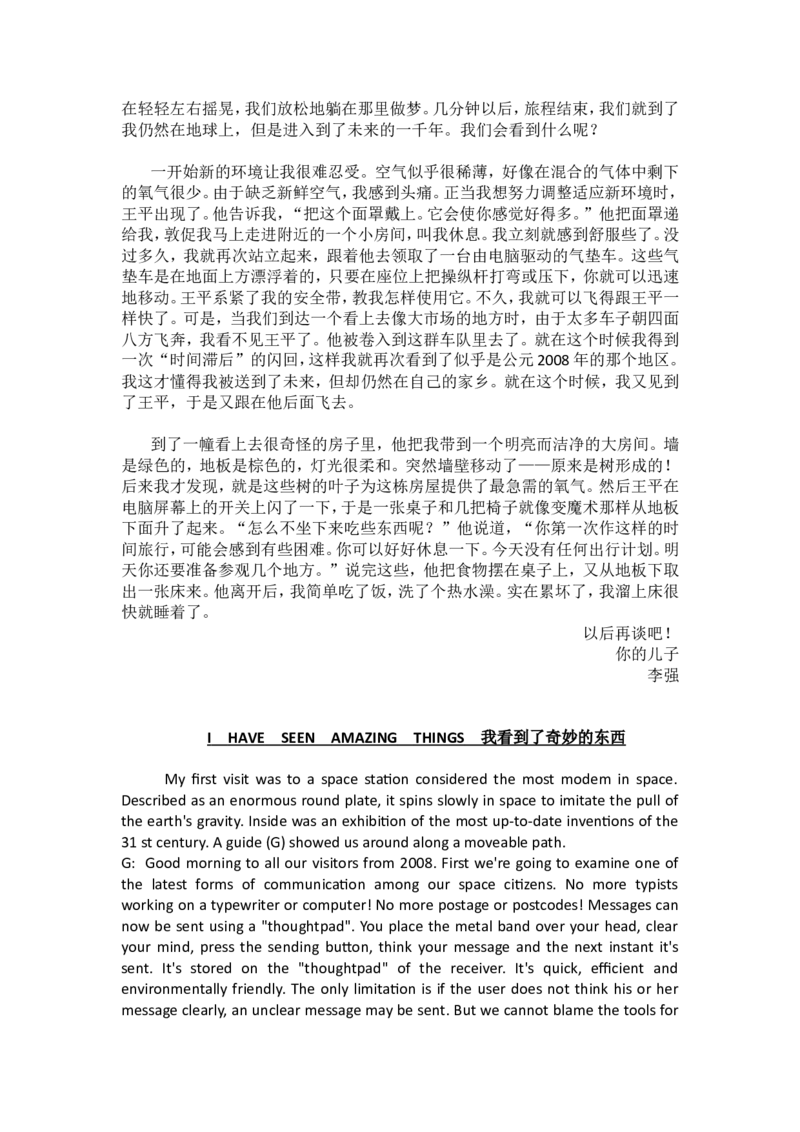
          Spacemall: liqiang299A@GreatAdventureSpaceStation.com   15/11/3008
(Earthtime)
          Dear Mum and Dad, I still cannot believe that I am taking up this prize that I
won last year. I have to remind myself constantly that I am really in AD 3008. Worried
about the journey, I was unsettled for the first few days. As a result, I suffered from
“Time lag”. This is similar to the “jet lag” you get from flying, but it seems you keep
getting flashbacks from your previous time period. So I was very nervous and
uncertain at first. However, my friend and guide, Wang Ping, was very understanding
and gave me some green tablets which helped a lot. Well-known for their expertise,
his parents' company, called "Future Tours", transported me safely into the future in
a time capsule.
          I can still remember the moment when the space stewardess called us all to the
capsule and we climbed in through a small opening. The seats were comfortable and
after a calming drink, we felt sleepy and closed our eyes. The capsule began swinging
gently sideways as we lay relaxed and dreaming. A few minutes later, the journey was
completed and we had arrived. I was still on the earth but one thousand years in the
future. What would I find?
          At first my new surroundings were difficult to tolerate. The air seemed thin, as
though its combination of gases had little oxygen left. Hit by a lack of fresh air, my
head ached. Just as I tried to make the necessary adjustment to this new situation,
Wang Ping appeared. "Put on this mask," he advised. "It'll make you feel much
better." He handed it to me and immediately hurried me through to a small room
nearby for a rest. I felt better in no time. Soon I was back on my feet again and
following him to collect a hovering carriage driven by computer. These carriages float
above the ground and by bending or pressing down in your seat, you can move
swiftly. Wang Ping fastened my safety belt and showed me how to use it. Soon I
could fly as fast as him. However, I lost sight of Wang Ping when we reached what
looked like a large market because of too many carriages flying by in all directions. He
was swept up into the centre of them. Just at that moment I had a "time lag"
flashback and saw the area again as it had been in the year AD 2008. I realized that I
had been transported into the future of what was still my hometown! Then I caught
sight of Wang Ping again and flew after him.
          Arriving at a strange-looking house, he showed me into a large, bright clean
room. It had a green wall, a brown floor and soft lighting. Suddenly the wall moved -
it was made of trees! I found later that their leaves provided the room with much-
needed oxygen. Then Wang Ping flashed a switch on a computer screen, and a table
and some chairs rose from under the floor as if by magic. "Why not sit down and eat
a little?" he said. "You may find this difficult as it is your first time travel trip. Just
relax, since there is nothing planned on the timetable today. Tomorrow you'll be
ready for some visits." Having said this, he spread some food on the table, and
produced a bed from the floor. After he left, I had a brief meal and a hot bath.
Exhausted, I slid into bed and fell fast asleep.
           More news later from your loving son,
           Li Qiang
太空邮件:liqiang 299A@greatAdventureSpaceStation.com
15/11/3008(地球时间)
亲爱的爸爸妈妈:
    我现在仍然无法相信我是在接受去年获得的这个奖励。我得不断提醒自
己,我真的已经进入到公元3008 年了。因为担心这次旅行,头几天我心里总是不
踏实,结果我得了时间滞后症。这就与你乘坐飞机会产生时差反应相似,所不同
的是,在你的脑子里似乎会不断闪现以前的时光。因此,我一开始就感到神经过
敏和心神不定。但是我的朋友兼导游王平很细心体贴,给了我几粒绿色药片,倒
是挺起作用的。他父母的公司叫做“未来之旅”,以其技术高超而闻名。他们把
我装在一个时间舱里,平安地把我送入了未来。
我仍旧记得我们被太空服务员一起叫到时间舱,爬上去进入一个小门。座位
是很舒适的,喝了点镇静剂后,我们的眼睛就闭上了,感到昏昏欲睡似的。时间舱
在轻轻左右摇晃,我们放松地躺在那里做梦。几分钟以后,旅程结束,我们就到了
我仍然在地球上,但是进入到了未来的一千年。我们会看到什么呢?
一开始新的环境让我很难忍受。空气似乎很稀薄,好像在混合的气体中剩下
的氧气很少。由于缺乏新鲜空气,我感到头痛。正当我想努力调整适应新环境时,
王平出现了。他告诉我,“把这个面罩戴上。它会使你感觉好得多。”他把面罩递
给我,敦促我马上走进附近的一个小房间,叫我休息。我立刻就感到舒服些了。没
过多久,我就再次站立起来,跟着他去领取了一台由电脑驱动的气垫车。这些气
垫车是在地面上方漂浮着的,只要在座位上把操纵杆打弯或压下,你就可以迅速
地移动。王平系紧了我的安全带,教我怎样使用它。不久,我就可以飞得跟王平一
样快了。可是,当我们到达一个看上去像大市场的地方时,由于太多车子朝四面
八方飞奔,我看不见王平了。他被卷入到这群车队里去了。就在这个时候我得到
一次“时间滞后”的闪回,这样我就再次看到了似乎是公元2008 年的那个地区。
我这才懂得我被送到了未来,但却仍然在自己的家乡。就在这个时候,我又见到
了王平,于是又跟在他后面飞去。
到了一幢看上去很奇怪的房子里,他把我带到一个明亮而洁净的大房间。墙
是绿色的,地板是棕色的,灯光很柔和。突然墙壁移动了——原来是树形成的!
后来我才发现,就是这些树的叶子为这栋房屋提供了最急需的氧气。然后王平在
电脑屏幕上的开关上闪了一下,于是一张桌子和几把椅子就像变魔术那样从地板
下面升了起来。“怎么不坐下来吃些东西呢?”他说道,“你第一次作这样的时
间旅行,可能会感到有些困难。你可以好好休息一下。今天没有任何出行计划。明
天你还要准备参观几个地方。”说完这些,他把食物摆在桌子上,又从地板下取
出一张床来。他离开后,我简单吃了饭,洗了个热水澡。实在累坏了,我溜上床很
快就睡着了。
以后再谈吧!
你的儿子
李强
 I
  HAVE


  SEEN


  AMAZING


  THINGS


  我看到了奇妙的东西


       My first visit was to a space station considered the most modem in space.
Described as an enormous round plate, it spins slowly in space to imitate the pull of
the earth's gravity. Inside was an exhibition of the most up-to-date inventions of the
31 st century. A guide (G) showed us around along a moveable path.
G:  Good morning to all our visitors from 2008. First we're going to examine one of
the latest forms of communication among our space citizens. No more typists
working on a typewriter or computer! No more postage or postcodes! Messages can
now be sent using a "thoughtpad". You place the metal band over your head, clear
your mind, press the sending button, think your message and the next instant it's
sent. It's stored on the "thoughtpad" of the receiver. It's quick, efficient and
environmentally friendly. The only limitation is if the user does not think his or her
message clearly, an unclear message may be sent. But we cannot blame the tools for
the faults of the user, can we?
       During the explanation I looked at the pair of small objects called "thoughtpads"
on a table. They just looked like metal ribbons. So ordinary but so powerful! While I
was observing them, the path moved us on.
G:   And now ladies and gentlemen, we are in the "environment area". People used
to collect waste in dustbins. Then the rubbish was sent to be buried or burned, am I
fight? (We nodded.) Well, now there's a system where the waste is disposed of using
the principles of ecology. A giant machine, always greedy for more, swallows all the
waste available. The rubbish is turned into several grades of useful material, such as
"fertilizer" for the fields and "soil" for deserts. Nothing is wasted, and everything,
even plastic bags, is recycled. A great idea, isn't' it?
        I stared at the moving model of the waste machine, absorbed by its efficiency.
But again we moved on.
G:   Our third stop shows the changes that have happened to work practices.
Manufacturing no longer takes place on the earth but on space stations like this one.
A group of engineers programme robots to perform tasks in space. The robots
produce goods such as drugs, clothes, furniture, hovering carriages, etc. There is no
waste, no pollution and no environmental damage! However, the companies have to
train their representatives to live and work in space settlements. They have to
monitor the robots and the production. When the goods are ready they're
transported by industrial spaceship back to earth.
         My mind began to wander. What job would I do? My motivation increased as I
thought of the wonderful world of the future.
我首先参观的是一个太空站,这个站被认为是太空中最现代化的地方。太空
站像一个巨大的圆盘,在太空中缓缓的旋转,以仿照出地球重心的引力。太空站
里展出了31 世纪一些最前沿的发明。有个导游带领我们站在一条移动的运送带
上,到各处参观。
导游:从2008 年来访的朋友们,早上好!首先,我们要查看一种我们太空居
民使用的最新的通讯方式。再也不需要打字员在打字机或电脑上工作了!再也不
需要邮费和邮政编码了!现在用一种“思想仪”就可以传递信息。你把金属带放
在头上,整理思路,按下发送键,集中精神想着你要发送的信息,片刻功夫信息就
发送出去了。这个信息会储存在接受者的“思想仪”里。它快捷有效,而且环保。
唯一的缺点是,如果使用者不能想清楚要传递的信息,发送出去的信息可能是模
糊不清的。但我们不能因为使用者的使用不当而责备仪器,是不是?
在导游解说的时候,我观看着桌上这副被称为“思想仪”的小东西。它们看
上去像金属带子。那么普通,但却那么神通广大!正当我还在观察时,运送带向
前移动了。
导游:女士们先生们,现在我们到了“环保地带”。以前人们习惯用垃圾箱收
集废弃物,然后这些垃圾被送走埋掉或烧掉,我说的对吧?(我们都点头。)可现
在我们有一种装置,能利用生态学原理来处理掉废弃物。一架巨大的机器,能把
所有能获得的废弃物都吞进去,而且总是贪得无厌。然后垃圾被分解成了几种有
用的物质,如庄稼地的“肥料”和沙漠中的“土壤”。什么都不浪费,所有的东
西,哪怕是塑料袋也被回收利用了。伟大的创意,对不对?
我注视着缓缓移动的垃圾分解机器模型,为它的成效所吸引。但是,我们又开
始向前移动了。
导游:第三站要展示给我们的是工作实践方面的一些变化。批量生产不再在
地球上进行,而是转移到了像这样的太空站里。在太空里,一组工程师给机器人
设计了程序让它们完成工作。机器人生产像药品、衣服、家具和气垫车等东西。没
有废弃物、没有污染,也没有环境破坏。但是,这些公司必须培训他们的代表能在
太空中生活和工作。他们必须在此监控机器人和生产过程。一旦货物齐备,就用
工用太空船运送到地球。
我的思绪开始漫游。我能从事什么工作呢?当我想到这个奇妙的未来世界时
我兴趣倍增、干劲十足.
必修5 Unit 4 Making the news-Reading 第四单元  撰写新闻
 MY

   FIRST

   WORK

   ASSIGNMENT"

   UNFORGETTABLE"

   ,SAYS

   NEW

   JOURNALIST


我的第一项工作任务

 “
  难以忘怀,

 ”
  新闻记者说


Never will Zhou Yang (ZY) forget his first assignment at the office of a popular English
newspaper. His discussion with his new boss, Hu Xin (HX), was to strongly influence
his life as a journalist.
HX: Welcome. We're delighted you're coming to work with us. Your first job here will
be an assistant journalist. Do you have any questions?
ZY:   Can I go out on a story immediately?
HX:  (laughing) That' s admirable, but I' m afraid it would be unusual ! Wait till you' re
more experienced. First we'll put you as an assistant  to  an experienced journalist.
Later you can cover a story and submit the article yourself.
ZY:   Wonderful. What do I need to take with me? I already have a notebook and
camera.
HX:  No need for a camera. You'll have a professional photographer with you to take
photographs. You'll find your colleagues very eager to assist you, so you may be able
to concentrate on photography later if you' re interested.
ZY:   Thank you. Not only am I interested in photography, but I took an amateur
course at university to update my skills.
HX:  Good.
ZY:   What do I need to remember when I go out to cover a story?
HX:  You need to be curious. Only if you ask many different questions will you acquire
all the information you need to know. We say a good journalist must have a good
"nose" for a story. That means you must be able to assess when people are not
telling the whole troth and then try to discover it. They must use research to inform
themselves of the missing parts of the story.
ZY:    What should I keep in mind?
HX:   Here comes my list of dos and don'ts: don't miss your deadline, don't be rode,
don't talk too much, but make sure you listen to the  interviewee carefully.
ZY:   Why is listening so important?
HX:  Well, you have to listen for detailed facts. Meanwhile you have to prepare the
next question depending on what the person says.
ZY:   But how can I listen carefully while taking notes?
HX:  This is a trick of the trade, If the interviewee agrees, you can use a recorder to
get the facts straight. It's also useful if a person wants to challenge you. You have the
evidence to support your story.
ZY:   I see! Have you ever had a case where someone accused your journalists of
getting the wrong end of the stick?
HX:  Yes, but it was a long time ago. This is how the story goes. A footballer was
accused of taking money for deliberately not scoring goals so as to let the other team
win. We went to interview him. He denied taking money but we were sceptical. So
we arranged an interview between the footballer and the man supposed to bribe
him. When we saw them together we guessed from the footballer's body language
that he was not telling the truth. So we wrote an article suggesting he was guilty. It
was a dilemma because the footballer could have demanded damages if we were
wrong. He tried to stop us publishing it but later we were proved right.
ZY:   Wow! That was a real "scoop". I'm looking forward to my first assignment now.
Perhaps I'll get a scoop too!
HX:   Perhaps you will. You never know.
周阳永远不会忘记他在一家畅销英文报纸的第一项工作任务。他同新上司胡
欣的讨论对他的记者生涯必将产生强烈的影响。
胡:欢迎你,非常高兴你来参加我们的工作,你来这里首先就是当助理记者。
有什么问题吗?
周:我可以马上去采访吗?
胡:(笑)真是勇气可嘉!不过恐怕这不太合乎常规,还是等到你比较有经验
以后吧。我们先要派你给有经验的记者作助理。以后,你才能独自去进行新闻采
访并提交自己的新闻稿。
周:太好了!我需要随身带些什么?我已经带了笔记本和照相机。
胡:不需要照相机!你们将带上一名专业摄影师去拍照。你将发现你的同事
们会热情地帮助你。如果你对摄影感兴趣,以后你可以集中精力去钻研。
周:谢谢你。对摄影我不仅只是感兴趣,在大学里我还专修过业余摄影课来更
新我的技术。
胡:那很好啊。
周:我出去采访时还需要记住些什么事呢?
胡:你需要有好奇心。你只有提出了许多不同的问题之后才有可能获得你需
要知道的信息。我们说,一个好的记者必须有一个对新闻非常敏感的“嗅觉“。
那就是说,在人们没有说出全部真相时,你必须能够判断出,并努力发现真理。记
者必须通过调查研究,来使自己了解到被遗漏的那部分情况。
周:我应该注意些什么呢?
胡:下面是我的行为准则:不要延误任务规定的期限,不可对人粗鲁,不可自
己说得太多,务必认真倾听被采访人回答问题。
周:为什么听人家讲话这样重要呢?
胡:你得听清楚事实的细节。同时,你还要根据被采访人所说的话准备提出下
一个问题。
周:在我记笔记的同时,怎么能仔细倾听对方的答话呢?
胡:这就是我们职业的诀窍了。如果被采访人允许,你可以使用录音机,录下
全部事实。如果有人提出质疑,这也有用,你就有证据来支持自己的报道了。
周:我明白了!你有没有过这样的情况:别人控告你的记者,说他的报道失实
胡:有的。不过这是很久以前的事了。事情是这样的:一位足球运动员被指挥
受贿,故意不进球,好让对方球队赢球。我们去采访了他。他否认收了钱,但我们
对此表示怀疑。于是,我们安排这名球员和被认为行贿的人一起接受采访,而当
我们看到他们在一起时,我们就从足球运动员的体态语上猜到他没有说真话。我
们写了一篇文章,暗示足球队员有罪。这事有些为难,因为如果我们错了,他就可
以向我们索要赔偿。他竭力阻止我们发表这篇文章,但后来证实我们是正确的。
周:哇!那才是真正的独家新闻哩!我期盼着即将到来的首次任务。说不定
我也会搞到独家新闻呢!
胡:也许你会的,谁知道呢。
GETTING

   THE

   "SCOOP"

     抢发独家新闻


         "Quick," said the editor. "Get that story ready. We need it in this edition to be
ahead of the other newspapers. This is a scoop." Zhou Yang had just come back into
the office after an interview with a famous film star. "Did he really do that?" asked
someone from the International News Department. "Yes, I' m afraid he did," Zhou
Yang answered. He set to work.
          His first task was to write his story, but he had to do it carefully. Although he
realized the man had been lying, Zhou Yang knew he must not accuse him directly.
He would have to be accurate. Concise too! He knew how to do that. Months of
training had taught him to write with no wasted words or phrases. He sat down at his
computer and began to work.
          The first person who saw his article was a senior editor from his department.
He checked the evidence, read the article and passed it on to the copy-editor. She
began to edit the piece and design the main headline and smaller heading. “This will
look very good on the page,” she said. "Where is a good picture of this man?" Then
as the article was going to be written in English Zhou Yang also took a copy to the
native speaker employed by the newspaper to polish the style. She was also very
happy with Zhou Yang's story. "You are really able to write a good front page article,"
she said. Zhou Yang smiled with happiness. Last of all, the chief editor read it and
approved it. "Well done," he said to Zhou Yang. "But please show me your evidence
so we're sure we've got our facts straight.” “I’ll bring it to you immediately," said
Zhou Yang excitedly.
          The news desk editor took the story and began to work on all the stories and
photos until all the pages were set. All the information was then ready to be
processed into film negatives. This was the first stage of the printing process. They
needed four negatives, as several colours were going to be used on the story. Each of
the main colours had one negative sheet and when they were combined they made a
coloured page for the newspaper. After one last check the page was ready to be
printed. Zhou Yang waited excitedly for the first copies to be ready. "Wait 611
tonight," his friend whispered. "I expect there will be something about this on the
television news. A real scoop!"
周阳刚刚采访了一位著名影星回到办公室,编辑就说:“快点把那篇报道准
备好,  我们这一版就要用,这样我们就抢在其他报纸的前面了,这就是抢先的
独家新闻。“国际新闻编辑部有人提出问题:“他真的干了那种事吗?”周阳回
答说:“是的,恐怕是这样的。”接着他便着手准备报道了。
他的第一件事就是写报道稿,他必须认认真真地写。尽管他认为那个人一直
在说谎话,但周阳懂得,他决不能直接指责那个人。他必须做到准确无误,还要简
明扼要。他知道该如何做。经过几个月的培训,他已经学会了写文章,全然没有废
话。他在电脑前坐下就开始工作了。
第一个看到这篇文章的人的他们部里的一位编审。他核查了文中的证据,阅
读了整篇报道,然后递给技术编辑。她就开始了编辑工作,设计了主标题和副标
题。她说:“在版面上这会很好看。这个人的照片该放在哪儿好呢?”因为这篇
文章要用英文来写,所有周阳拿了一份稿子给一位母语为英语的外国雇员,请她
对语言风格进行润饰。这位雇员对周阳的报道也很满意。她评价说:“你确实能
写很好的头版新闻了。”周阳高兴地笑了。最后主编审读了这篇稿子,并且批准
发表了。他对周阳说:“文章写得很好,不过你还得拿出证据来表明事实确凿。”
周阳激动地说:“我马上拿来。”
新闻文字编辑取走这篇报道,开始对所有的报道和图片进行编排,直至把各
版面全部编定。此后,所有的报道材料就要被制成胶片。这是印制过程的第一道
工序。由于这篇报道要用好几种颜色,因此需要四张胶片。每一种主色要用一张
底片,四张底片结合起来就制成一张报纸的彩页。经过最后一次校对后,这个版
面就可以准备印制了。周阳兴奋地等待着第一批报纸的印出。“要等到今天晚
上。”他的朋友轻声地告诉他说。“我期望电视新闻会对这件事作一点报道。真
是独家新闻了!”
必修5 Unit 5 First aid-Reading 第五单元  急救
FIRST

   AID

   FOR

   BURNS

  —— 烧伤的急救


The skin is an essential part of your body and its largest organ. You have three layers
of skin which act as a barrier against disease, poisons and the sun's harmful rays. The
functions of your skin are also very complex: it keeps you warm or cool; it prevents
your body from losing too much water; it is where you feel cold, heat or pain and it
gives you your sense of touch. So as you can imagine, if your skin gets burned it can
be very serious. First aid is a very important first step in the treatment of bums.
Causes of burns
         You can get burned by a variety of things: hot liquids, steam, fire, radiation (by
being close to high heat or fire, etc), the sun, electricity or chemicals.
Types of burns
         There are three types of burns. Burns are called first, second or third degree
burns, depending on
which layers of the skin are burned.
◎ First degree burns    These affect only the top layer of the skin. These
burns are not serious and should feel better within a day or two. Examples
include mild sunburn and burns caused by touching a hot pan, stove or iron
for a mordent.
◎ Second degree burns  These affect both the top and the second layer of
the skin. These bums are serious and take a few weeks to heal. Examples
include severe sunburn and bums caused by hot liquids.
◎ Third degree burns   These affect all three layers of the skin and any
tissue and organs under the skin. Examples include burns caused by electric
shocks, burning clothes, or severe petrol fires. These burns cause very severe
injuries and the victim must go to hospital at once.
Characteristics of burns
First degree burns
                             ◎ dry, red and mildly swollen
                             ◎ mildly painful
                             ◎ turn white when pressed
Second degree burns
                             ◎ rough, red and swollen
                             ◎ blisters
                             ◎ watery surface
                             ◎ extremely painful
Third degree burns
                             ◎ black and white and charred
                             ◎ swollen; often tissue under them can be
seen
                             ◎ little or no pain if nerves are damaged;
may be pain around edge of injured area.
First aid treatment
1    Remove clothing using scissors if necessary unless it is stuck to the burn. Take off
other clothing and jewellery near the burn.
2    Cool burns immediately with cool but not icy water. It is best to place burns under
gently running water for about 10 minutes. (The cool water stops the burning
process, prevents the pain becoming unbearable and reduces swelling.) Do not put
cold water on third degree burns.
3    For first degree burns, place cool, clean, wet cloths on them until the pain is not
so bad. For second degree burns, keep cloths cool by  putting them back in a basin of
cold water, squeezing them out and placing them on the burned area over and over
again for about an hour until the pain is not so bad.
4   Dry the burned area gently. Do not rob, as this may break any blisters and the
wound may get infected.
5   Cover the burned area with a dry, clean bandage that will not stick to the skin.
Hold the bandage in place with tape. Never put butter, oil or ointment on bums as
they keep the heat in the wounds and may cause infection.
6   If bums are on arms or legs, keep them higher than the heart, if possible. If bums
are on the face, the victim should sit up.
7   If the injuries are second or third degree bums, it is vital to get the victim to the
doctor or hospital at once.

皮肤是身体必不可少的部分,也是身体的最大器官。皮肤有三层,它们是防病
防毒、抵御太阳有害光线侵害的一道屏障。皮肤的功能十分复杂。皮肤可以保暖
或御寒,保持体内水分。正是皮肤使你感到冷热、疼痛,它还使你有触觉。因此,你
可以想象到,如果你的皮肤烧伤了,就可能非常严重。在治疗烧伤的过程中,紧急
处理是非常重要的第一步。
烧伤的原因:
你可能由于各种原因而烧伤:灼热的液体、水蒸气、火、辐射(由于靠近高温
或大火)、阳光、电和化学物品。
烧伤的种类:
烧伤有三类。根据皮肤烧伤的层次分为一度烧伤、二度烧伤和三度烧伤。
一度烧伤:只损伤皮层的最上层。这些烧伤并不严重,应当在一两天内就有好
转。例如轻度的晒伤,由于短暂接触热锅、火炉或熨斗而导致的烫伤。
二度烧伤:既损伤了皮肤的最上层,又损伤了皮质的第二层。这些烧伤属于严
重的烧伤,需几星期才能痊愈。例如严重的晒伤和灼热的液体所造成的烧伤。
三度烧伤:所有三层皮质以及皮下的组织和器官都受到损害。例如由电击引
起的烧伤,因衣服起火引起的烧伤,或因汽油起火引起的烧伤。这些烧伤都属于
非常严重的烧伤,受伤者必须立即送往医院。
烧伤的特性:
一度烧伤: · 干燥、发红、微肿
           · 微痛
           · 受压时变白
二度烧伤: · 粗糙、发红、肿胀
           · 起水泡
           · 表层渗液
           · 极其疼痛
三度烧伤: · 黑、白和焦炭色相间
           · 肿胀,可看到皮下组织
           · 若损害了神经,则没有疼痛或轻微疼痛,或者在创面四周有疼感
急救处理:
1、除非衣服粘贴在烧伤面上,否则都要把它脱掉(必要时可用剪刀帮助)。靠
近创面的其他衣物和首饰也都要取掉。
2、马上用凉水给伤口冲凉,但不能用冰水。最好是把烧伤的部位放在慢速流
动的自来水下冲洗大约10 分钟。(凉水可以阻止烧伤的进程,可以防止无法
忍受的疼痛,还可以减轻肿胀程度)。三度烧伤不可用冷水冲。
3、对于一度烧伤的患者,要把清凉干净的湿布放在烧伤面上,直到疼痛感较
轻时为止。对于二度烧伤,要保持湿布清凉,需把湿布放回冷水盆中,拧出水
后再放在烧伤面上,这样要反反复复地做一个小时左右,直到不太痛时为止。
4、轻轻地把烧伤面弄干,但不要擦拭,因为这样做可能会擦破水泡,伤口会
感染。
5、用干而清洁又不粘皮肤的绷带盖住烧伤面,用胶布把绷带固定。千万不要
在烧伤处涂黄油、油或软膏,因为这会使里面的热散不出去,而且还可能导致
感染。
6、如果烧伤的部位在臂部和腿部,尽可能把手臂或腿脚抬高到高于心脏的位
置。如果是面部烧伤,伤者则应该坐起来。
7、如果属于二度或三度烧伤,就必须立即把患者送往医院或送去看医生。
HEROIC


  REENAGER


  RECEIVES


  AWARD

   英雄青年获奖记


        Seventeen-year-old teenager, John Janson, was honoured at the Lifesaver
Awards last night in Rivertown for giving lifesaving first aid on his neighbour after a
shocking knife attack.
        John was presented with his award at a ceremony which recognized the bravery
of ten people who had saved the life of another.
        John was studying in his room when he heard screaming. When he and his
father rushed outside, a man ran from the scene. They discovered that Anne Slade,
mother of three, had been stabbed repeatedly with a knife. She was lying in her front
garden bleeding very heavily. Her hands had almost been cut off.
        It was John's quick action and knowledge of first aid that saved Ms Slade's life.
He immediately asked a number of nearby people for bandages, but when nobody
could put their hands on any, his father got some tea towels and tape from their
house. John used these to treat the most severe injuries to Ms Slade's hands. He
slowed the bleeding by applying pressure to the wounds until the police and
ambulance arrived.
       "I'm proud of what I did but I was just doing what I'd been taught," John said.
       John had taken part in the Young Lifesaver Scheme at his high school. When
congratulating John, Mr Alan Southerton, Director of the Young Lifesaver Scheme
said, "There is no doubt that John's quick thinking and the first aid skills he learned at
school saved Ms Slade's life. It shows that a knowledge of first aid can make a real
difference."
       Before receiving their awards last night, John and the nine other Life Savers
attended a special reception yesterday hosted by the Prime Minister.
17 岁的青年约翰·詹森昨晚在弗镇的救生员颁奖大会上领奖,因为他在一次
骇人听闻的持刀袭击案件发生后,为邻居实施了紧急救援。
在颁奖大会上,约翰被授予奖赏。大会共表彰了抢救他人生命的十个人的勇
敢行为。
(那天)约翰正在房里学习,突然听到一声尖叫,他和父亲赶紧冲出去,发现一
名男子从现场逃跑,而三个孩子的母亲安·斯莱德被人连捅了数刀。她躺在前花园
的地上,流血不止。她的双手几乎被砍断了。
正是约翰快捷的动作和急救知识救了斯莱德女士的命。他立即向附近的一些
人要绷带,当他们都找不到绷带的时候,他的父亲从屋里拿出一些擦杯盘的布和
胶带来。约翰就用这些东西把斯莱德手上最严重的伤口包扎起来。他使劲地按住
伤口,使血流得慢些,一直等到警察和救护车的到来。
约翰说:“我为自己所做的事感到自豪,不过,我所做的都是以前别人教会我
做的事。”
约翰在读高中时就参加了青年救生员组织。该组织的主任艾伦·萨瑟顿先生在
向约翰表示祝贺时说:“毫无疑问,是约翰敏捷的思维和在学校学到的急救技术,
挽救了斯莱德女士的生命。这表明懂得急救知识的确能发挥重要作用。”
约翰和其他九位救生员在昨晚领奖时,还出席了由首相主持的特殊的招待会