高中英语知识点总结归纳
高中英语知识点总结归纳
总结是指社会团体、企业单位和个人对某一阶段的学习、工作或
其完成情况加以回顾和分析,得出教训和一些规律性认识的一种书面
材料,它能够使头脑更加清醒,目标更加明确,让我们一起来学习写
总结吧。那么总结有什么格式呢?以下是小编整理的高中英语知识点
总结归纳,供大家参考借鉴,希望可以帮助到有需要的朋友。
高中英语知识点总结归纳1
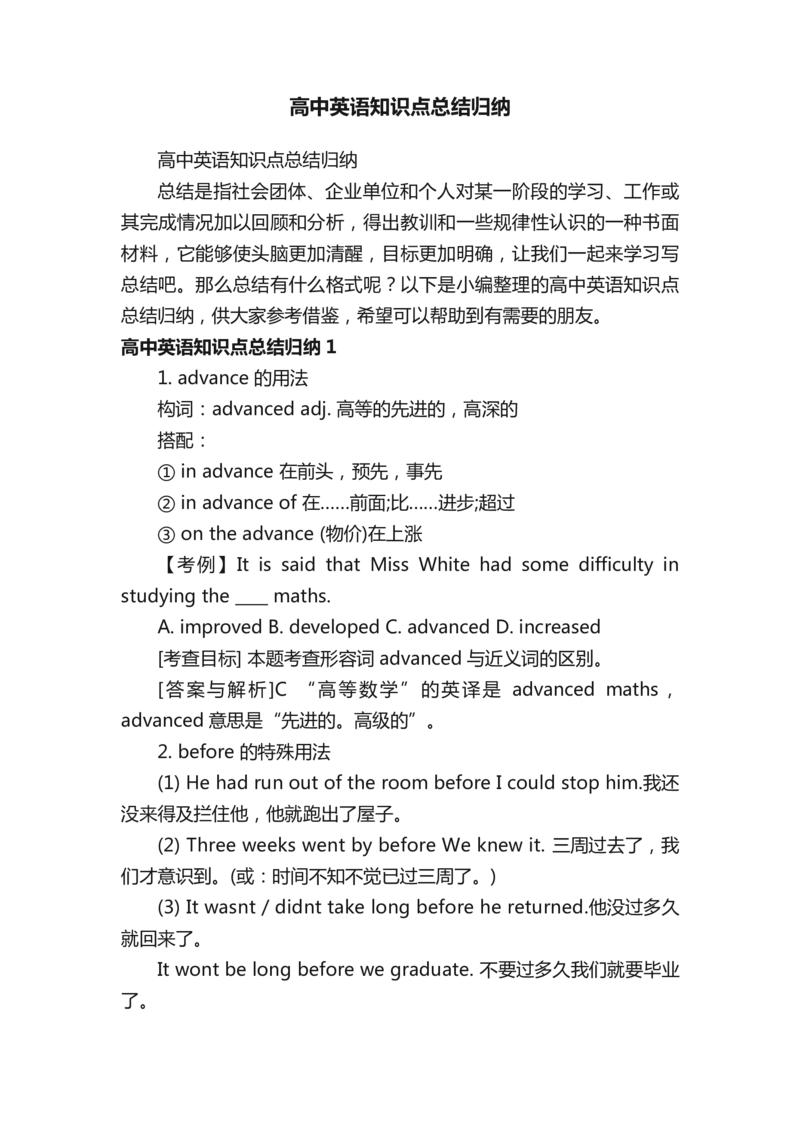
1. advance 的用法
构词:advanced adj. 高等的先进的,高深的
搭配:
① in advance 在前头,预先,事先
② in advance of 在……前面;比……进步;超过
③ on the advance (物价)在上涨
【考例】It is said that Miss White had some difficulty in
studying the ____ maths.
A. improved B. developed C. advanced D. increased
[考查目标] 本题考查形容词advanced 与近义词的区别。
[答案与解析]C “高等数学”的英译是advanced maths,
advanced 意思是“先进的。高级的”。
2. before 的特殊用法
(1) He had run out of the room before I could stop him.我还
没来得及拦住他,他就跑出了屋子。
(2) Three weeks went by before We knew it. 三周过去了,我
们才意识到。(或:时间不知不觉已过三周了。)
(3) It wasnt / didnt take long before he returned.他没过多久
就回来了。
It wont be long before we graduate. 不要过多久我们就要毕业
了。
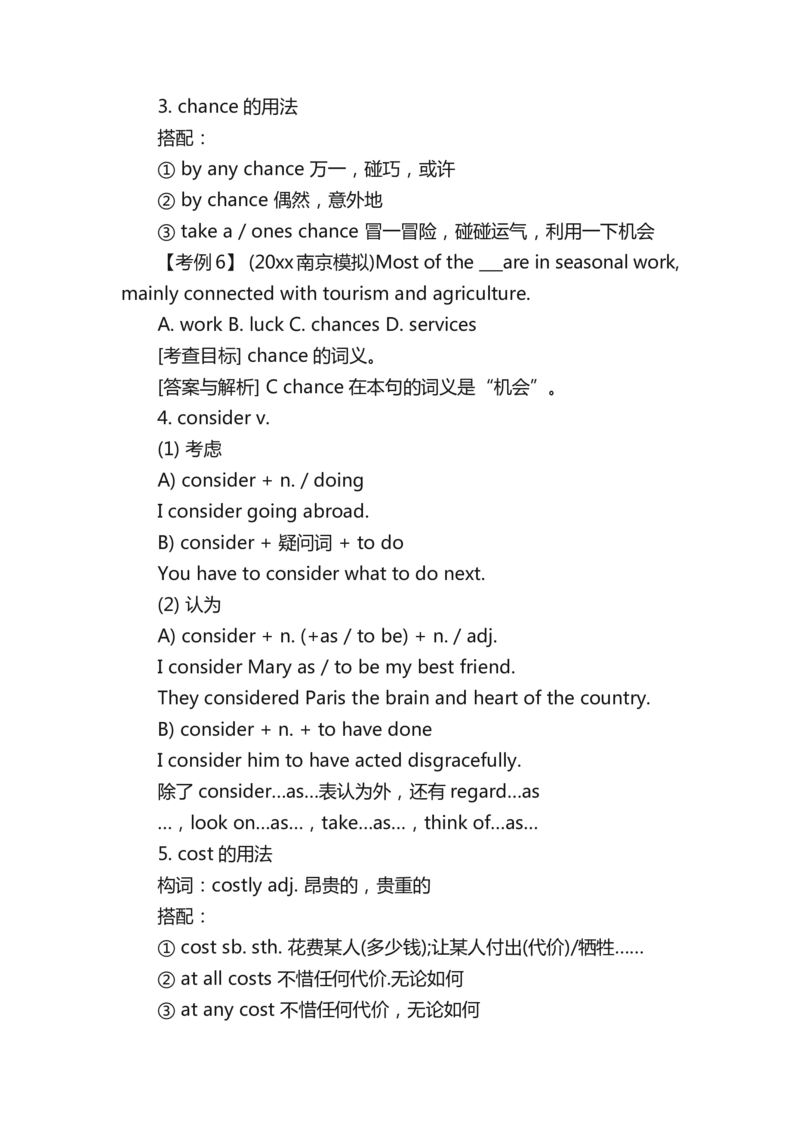
3. chance 的用法
搭配:
① by any chance 万一,碰巧,或许
② by chance 偶然,意外地
③ take a / ones chance 冒一冒险,碰碰运气,利用一下机会
【考例6】 (20xx 南京模拟)Most of the ___are in seasonal work,
mainly connected with tourism and agriculture.
A. work B. luck C. chances D. services
[考查目标] chance 的词义。
[答案与解析] C chance 在本句的词义是“机会”。
4. consider v.
(1) 考虑
A) consider + n. / doing
I consider going abroad.
B) consider + 疑问词 + to do
You have to consider what to do next.
(2) 认为
A) consider + n. (+as / to be) + n. / adj.
I consider Mary as / to be my best friend.
They considered Paris the brain and heart of the country.
B) consider + n. + to have done
I consider him to have acted disgracefully.
除了consider…as…表认为外,还有regard…as
…,look on…as…,take…as…,think of…as…
5. cost 的用法
构词:costly adj. 昂贵的,贵重的
搭配:
① cost sb. sth. 花费某人(多少钱);让某人付出(代价)/牺牲……
② at all costs 不惜任何代价.无论如何
③ at any cost 不惜任何代价,无论如何
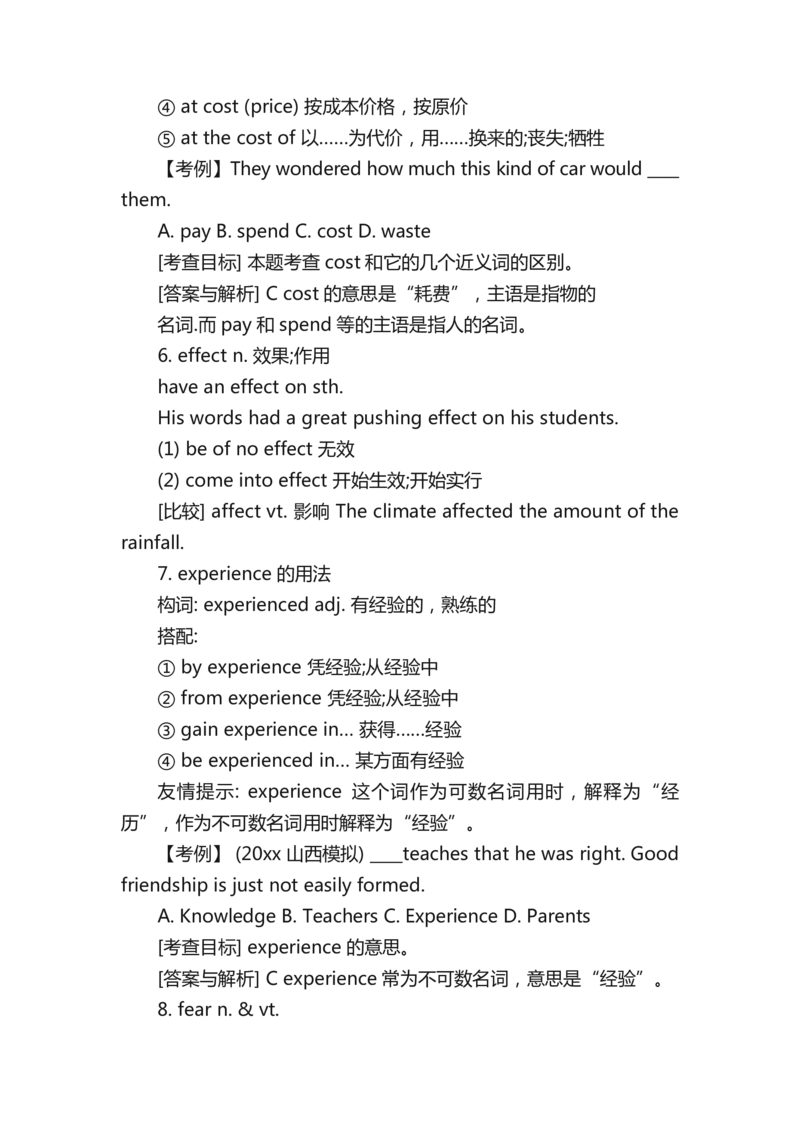
④ at cost (price) 按成本价格,按原价
⑤ at the cost of 以……为代价,用……换来的;丧失;牺牲
【考例】They wondered how much this kind of car would ____
them.
A. pay B. spend C. cost D. waste
[考查目标] 本题考查cost 和它的几个近义词的区别。
[答案与解析] C cost 的意思是“耗费”,主语是指物的
名词.而pay 和spend 等的主语是指人的名词。
6. effect n. 效果;作用
have an effect on sth.
His words had a great pushing effect on his students.
(1) be of no effect 无效
(2) come into effect 开始生效;开始实行
[比较] affect vt. 影响 The climate affected the amount of the
rainfall.
7. experience 的用法
构词: experienced adj. 有经验的,熟练的
搭配:
① by experience 凭经验;从经验中
② from experience 凭经验;从经验中
③ gain experience in… 获得……经验
④ be experienced in… 某方面有经验
友情提示: experience 这个词作为可数名词用时,解释为“经
历”,作为不可数名词用时解释为“经验”。
【考例】 (20xx 山西模拟) ____teaches that he was right. Good
friendship is just not easily formed.
A. Knowledge B. Teachers C. Experience D. Parents
[考查目标] experience 的意思。
[答案与解析] C experience 常为不可数名词,意思是“经验”。
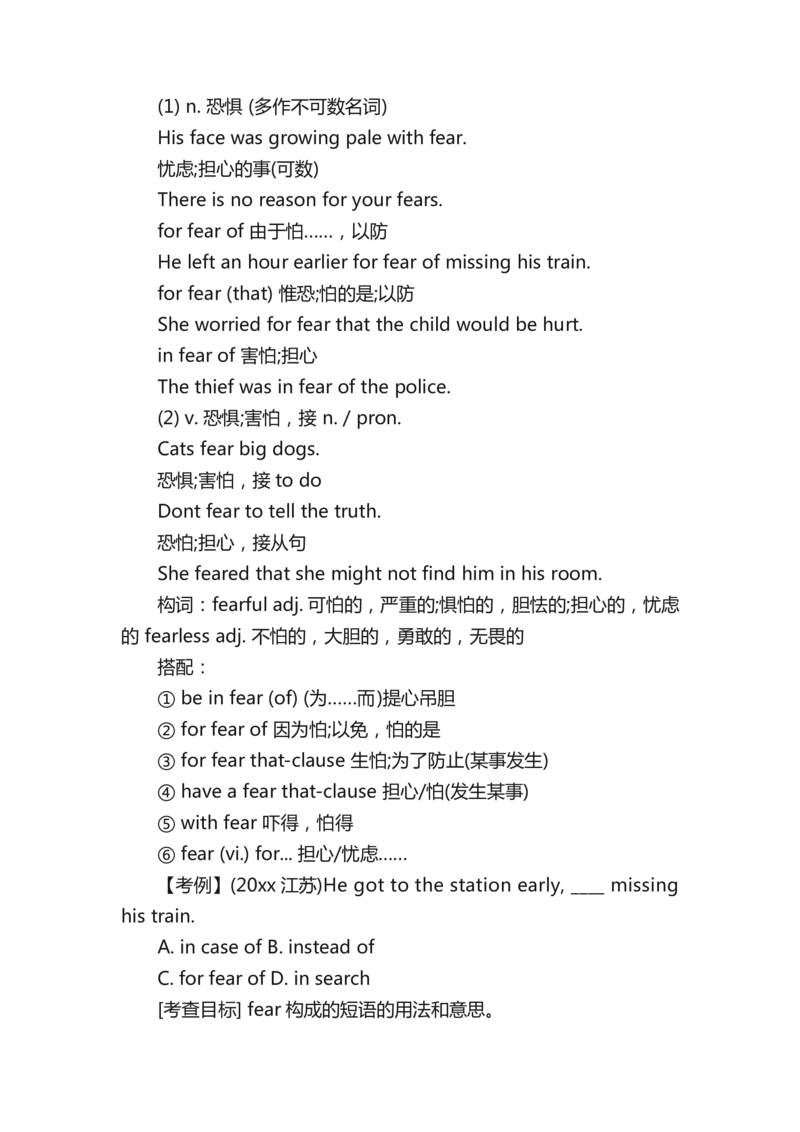
8. fear n. & vt.
(1) n. 恐惧 (多作不可数名词)
His face was growing pale with fear.
忧虑;担心的事(可数)
There is no reason for your fears.
for fear of 由于怕……,以防
He left an hour earlier for fear of missing his train.
for fear (that) 惟恐;怕的是;以防
She worried for fear that the child would be hurt.
in fear of 害怕;担心
The thief was in fear of the police.
(2) v. 恐惧;害怕,接 n. / pron.
Cats fear big dogs.
恐惧;害怕,接to do
Dont fear to tell the truth.
恐怕;担心,接从句
She feared that she might not find him in his room.
构词:fearful adj. 可怕的,严重的;惧怕的,胆怯的;担心的,忧虑
的 fearless adj. 不怕的,大胆的,勇敢的,无畏的
搭配:
① be in fear (of) (为……而)提心吊胆
② for fear of 因为怕;以免,怕的是
③ for fear that-clause 生怕;为了防止(某事发生)
④ have a fear that-clause 担心/怕(发生某事)
⑤ with fear 吓得,怕得
⑥ fear (vi.) for... 担心/忧虑……
【考例】(20xx 江苏)He got to the station early, ____ missing
his train.
A. in case of B. instead of
C. for fear of D. in search
[考查目标] fear 构成的短语的用法和意思。
[答案与解析]C for fear of 常在句中作状语,意思是 “怕的是……。
担心……”。
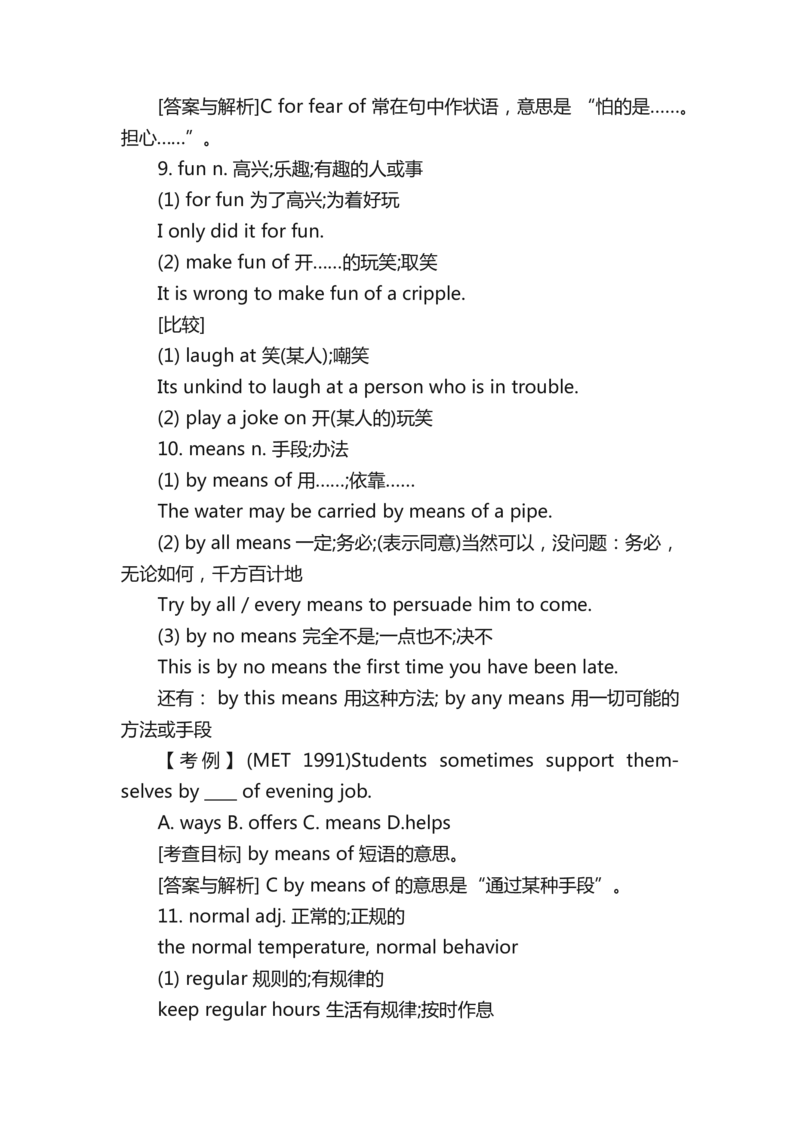
9. fun n. 高兴;乐趣;有趣的人或事
(1) for fun 为了高兴;为着好玩
I only did it for fun.
(2) make fun of 开……的玩笑;取笑
It is wrong to make fun of a cripple.
[比较]
(1) laugh at 笑(某人);嘲笑
Its unkind to laugh at a person who is in trouble.
(2) play a joke on 开(某人的)玩笑
10. means n. 手段;办法
(1) by means of 用……;依靠……
The water may be carried by means of a pipe.
(2) by all means 一定;务必;(表示同意)当然可以,没问题:务必,
无论如何,千方百计地
Try by all / every means to persuade him to come.
(3) by no means 完全不是;一点也不;决不
This is by no means the first time you have been late.
还有: by this means 用这种方法; by any means 用一切可能的
方法或手段
【考例】(MET 1991)Students sometimes support them-
selves by ____ of evening job.
A. ways B. offers C. means D.helps
[考查目标] by means of 短语的意思。
[答案与解析] C by means of 的意思是“通过某种手段”。
11. normal adj. 正常的;正规的
the normal temperature, normal behavior
(1) regular 规则的;有规律的
keep regular hours 生活有规律;按时作息
(2) common 普通的;常见的
Tom is a common name in Britain. 共有的;共同的
have a common interest 有着共同爱好
(3) usual 惯常的;惯例的
Its usual with him to go to the office on foot.
(4) ordinary 平凡的;普通的 in ordinary dress
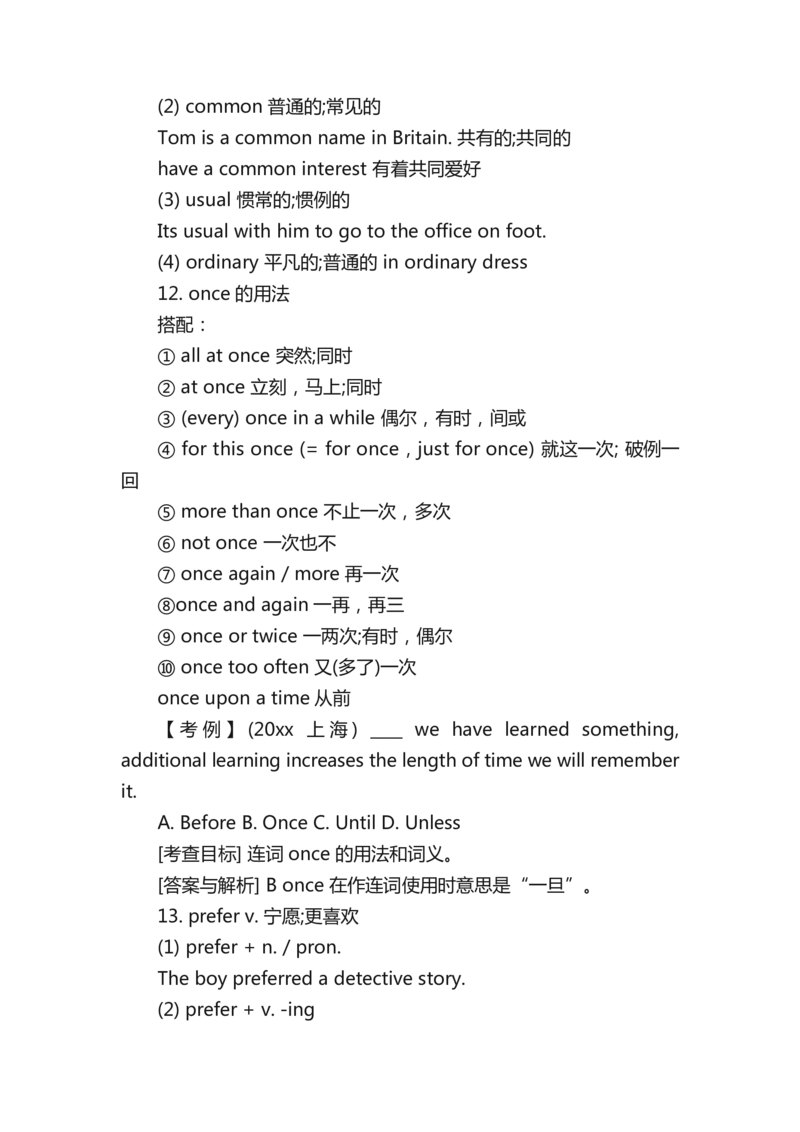
12. once 的用法
搭配:
① all at once 突然;同时
② at once 立刻,马上;同时
③ (every) once in a while 偶尔,有时,间或
④ for this once (= for once,just for once) 就这一次; 破例一
回
⑤ more than once 不止一次,多次
⑥ not once 一次也不
⑦ once again / more 再一次
⑧once and again 一再,再三
⑨ once or twice 一两次;有时,偶尔
⑩ once too often 又(多了)一次
once upon a time 从前
【考例】(20xx 上海) ____ we have learned something,
additional learning increases the length of time we will remember
it.
A. Before B. Once C. Until D. Unless
[考查目标] 连词once 的用法和词义。
[答案与解析] B once 在作连词使用时意思是“一旦”。
13. prefer v. 宁愿;更喜欢
(1) prefer + n. / pron.
The boy preferred a detective story.
(2) prefer + v. -ing
Do you prefer living abroad?
(3) prefer + to do
She prefers to live among the working people.
(4) prefer sb. to do sth.
She preferred him to stay at home.
(5) prefer + n. / pron. / doing + to + n. / pron. / doing 喜
欢……而不喜欢 I prefer the town to the country. / While he was in
the office he preferred doing something to doing nothing.
(6) prefer to do...rather than do = would rather do ... than do...
宁愿……而不愿 I prefer to walk there rather than go by bus.
(7) prefer + 从句(谓语动词用should do,should 可省略) She
preferred that he should do it in the kitchen.
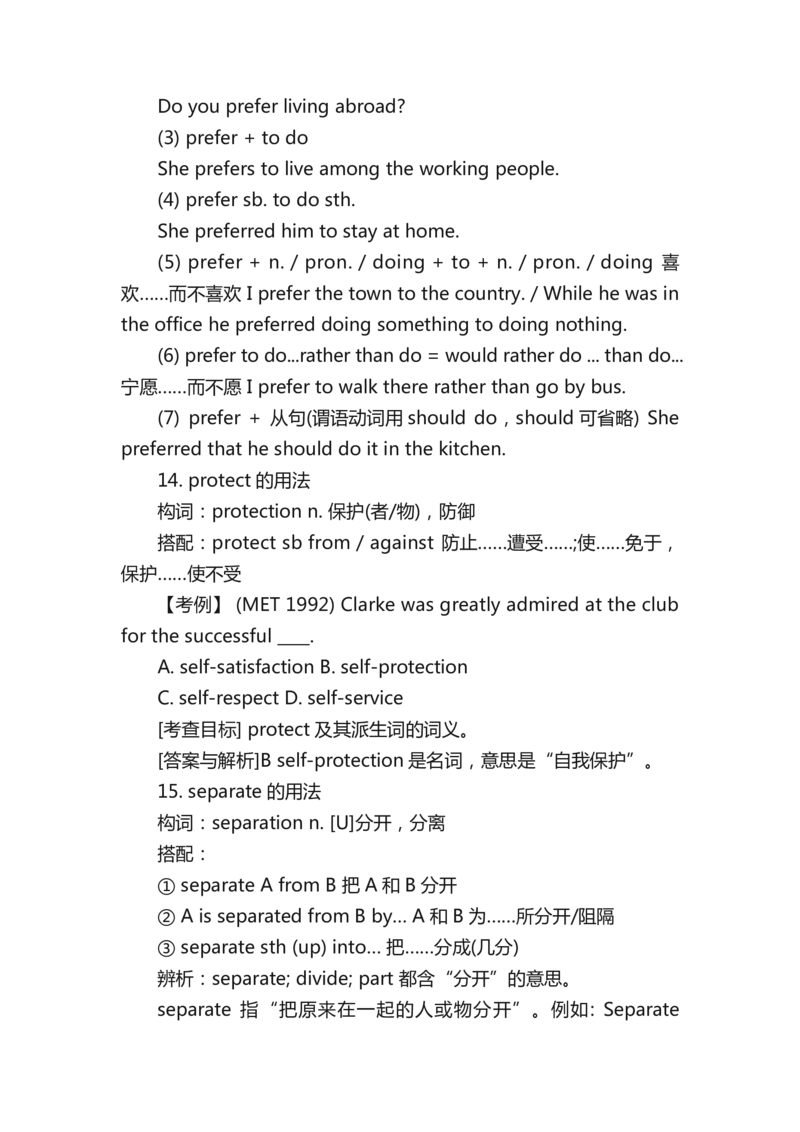
14. protect 的用法
构词:protection n. 保护(者/物),防御
搭配:protect sb from / against 防止……遭受……;使……免于,
保护……使不受
【考例】 (MET 1992) Clarke was greatly admired at the club
for the successful ____.
A. self-satisfaction B. self-protection
C. self-respect D. self-service
[考查目标] protect 及其派生词的词义。
[答案与解析]B self-protection 是名词,意思是“自我保护”。
15. separate 的用法
构词:separation n. [U]分开,分离
搭配:
① separate A from B 把A 和B 分开
② A is separated from B by… A 和B 为……所分开/阻隔
③ separate sth (up) into… 把……分成(几分)
辨析:separate; divide; part 都含“分开”的意思。
separate 指“把原来在一起的人或物分开”。例如: Separate
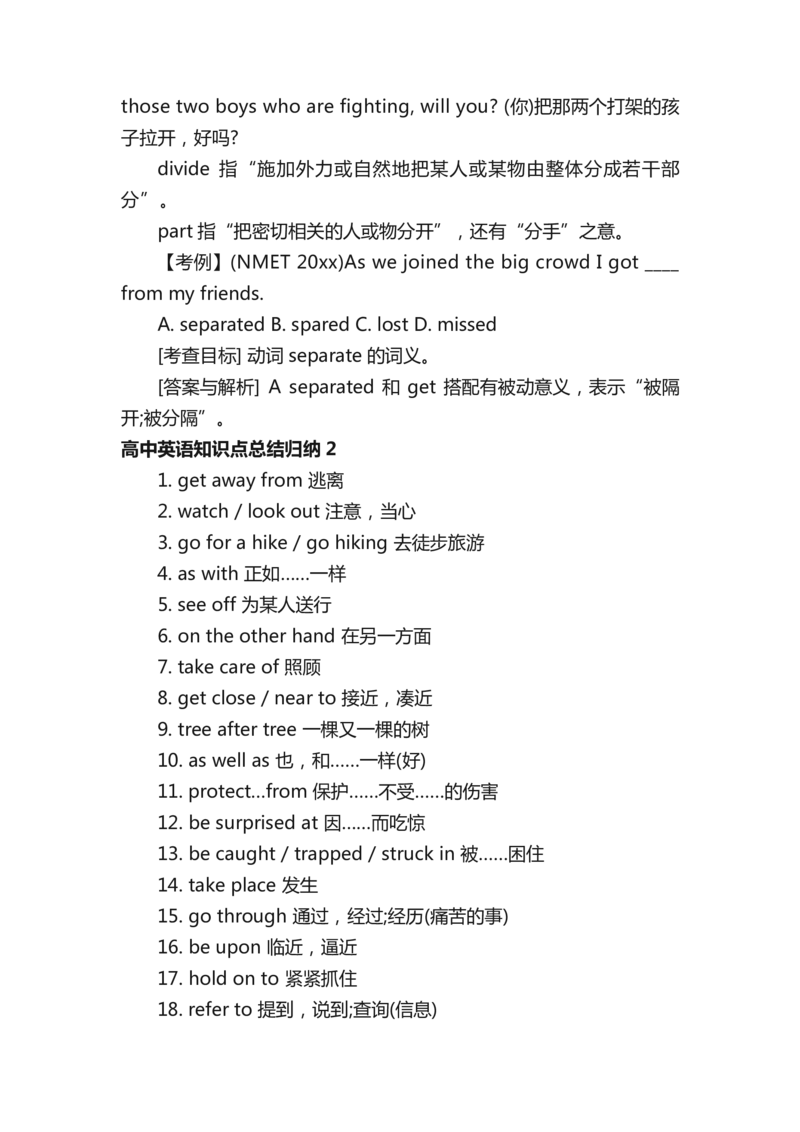
those two boys who are fighting, will you? (你)把那两个打架的孩
子拉开,好吗?
divide 指“施加外力或自然地把某人或某物由整体分成若干部
分”。
part 指“把密切相关的人或物分开”,还有“分手”之意。
【考例】(NMET 20xx)As we joined the big crowd I got ____
from my friends.
A. separated B. spared C. lost D. missed
[考查目标] 动词separate 的词义。
[答案与解析] A separated 和get 搭配有被动意义,表示“被隔
开;被分隔”。
高中英语知识点总结归纳2
1. get away from 逃离
2. watch / look out 注意,当心
3. go for a hike / go hiking 去徒步旅游
4. as with 正如……一样
5. see off 为某人送行
6. on the other hand 在另一方面
7. take care of 照顾
8. get close / near to 接近,凑近
9. tree after tree 一棵又一棵的树
10. as well as 也,和……一样(好)
11. protect…from 保护……不受……的伤害
12. be surprised at 因……而吃惊
13. be caught / trapped / struck in 被……困住
14. take place 发生
15. go through 通过,经过;经历(痛苦的事)
16. be upon 临近,逼近
17. hold on to 紧紧抓住
18. refer to 提到,说到;查询(信息)
19. look into 注视……的内部;检查,调查
20. for fear of (doing) sth. 惟恐……
高中英语知识点总结归纳3
1. means n. 方法;途径
2. experience n. 经验
3. equipment n. 设备
4. successful adj. 成功的
5. protect v. 保护
6. handle v. 处理
7. consider v. 考虑
8. benefit n. 利益
9. particular adj. 特别的
10. effect n. 效果
11. combine v. 合并
12. unforgettable adj. 不会忘记的
13. advance v. 前进
14. seize v. 抓住
15. struggle v. 奋斗
16. fear v. & n. 害怕
17. strike v. 敲打
18. destroy v. 毁掉
19. publish v. 出版
20. naughty adj. 调皮的
高中英语知识点总结归纳4
(一)时间状语从句
表示时间的状语从句可由when, as, while, whenever, after,
before, till (until), since, once, as soon as (或the moment ), by the
time, no sooner … than, hardly (scarcely) … when, every time 等
引导。
e.g. When I came into the office, the teachers were having a
meeting.
He started as soon as he received the news.
Once you see him, you will never forget him.
No sooner had I gone to bed than I went to sleep.
(二)原因状语从句
原因状语从句是表示原因或理由的,引导这类从句的最常用的连
词是because, since, as , now that(既然)等,for 表示因果关系时(它
引导的不是从句)为并列连词,语气不如because 强。
e.g. He is disappointed because he didn't get the position.
As it is raining, I will not go out.
Now that you mention it, I do remember.
(三)地点状语从句
引导地点状语从句的连词是where 和wherever 等。
e.g. Sit wherever you like.
Make a mark where you have a question.
(四)目的状语从句
引导目的状语从句最常用的词(组)是so, so that(从句谓语常有情
态动词), in order that, in case(以防,以免)等。
e.g. Speak clearly, so that they may understand you.
She has bought the book in order that she could follow the
TV lessons.
He left early in case he should miss the train.
(五)结果状语从句
结果状语从句是表示事态结果的从句,通常主句是原因,从句是
结果。由so that (从句谓语一般没有情态动词), so … that, such …
that 等引导。
e.g. She was ill, so that she didn’t attend the meeting.
He was so excited that he could not say a word.
She is such a good teacher that everyone admires her.
(六)条件状语从句
条件状语从句分真实性(有可能实现的事情)与非真实性(条件与事
实相反或者在说话者看来不大可能实现的事情)条件句。引导条件状语
从句的词(组)主要有if, unless, so (as) long as, on condition that, so
(as) far as, if only ( = if )。注意:条件从句中的if 不能用whether 替
换。
e.g. If he is not in the office, he must be out for lunch.
You may borrow the book so long as you keep it clean.
So far as I know(据我所知), he will be away for three months.
You can go swimming on condition that ( = if ) you don’t
go too far away from the river bank.
If he had come a few minutes earlier, he could have seen her.
高中英语知识点总结归纳5
1.同位语从句:同位语从句在句中作A 同位语,对被修饰名词的
内容予以解释说明。同位语的特点是:抽象名词在前,表达具体内容
的从句在后。
常见的名词包括: assumption 假定/belief 看法/ conclusion 结
论/ doubt 怀疑等。 例句:The suggestion that we should develop
the natural resources in the region has been discussed. 关于我们
应该开发本地区资源的建议已经讨论过了。
2.现在完成时:表示过去延续到现在的动作或状态。具体来说,
这种用法是表示开始于过去的动作一直持续到现在,而且还可能继续
持续下去。谓语动词一般为延续性动词。
例句:An old woman walked out into the middle of the street.
The policeman yelled to her, “Don’t you know what it means
when I hold up my hand?” The lady said, “Sure I do. I have been
a schoolteacher for 28 years now.” 一个老妇人走到了马路中央,
这时,一位交警朝着她嚷道:“我都把手举起来了,你难道还不知道
什么意思吗?”老太太说:“我当然知道,我都做了28 年的`老师了。”
3. 时间状从:not…until… 用法。例句:The students didn’t
stop talking until the teacher came in.
4. it 做形式主语,句子做逻辑主语:如果主语太长,常用代词 it
作形式主语,将真正的主语从句置于句尾,以保持句式的平衡。
例句:It makes no difference what you read or study if you
can’t remember it. 如果你记不住,那么你读什么或者学什么都不重
要了。
5. 现在分词短语作状语:
(1)现在分词作时间状语。例句:There are several things to
consider when buying fresh foods. 当购买新鲜食品时,有几个事情
要考虑。
(2) 现在分词作条件状语。例句:Working hard, you will
succeed. 如果努力工作,你将会成功。
(3)现在分词作伴随状语。例句:All night long he lay awake,
thinking of the problem. 他整夜躺在床上睡不着,思考着那个问题。
(4)现在分词作方式状语。例句:Please answer the question
using another way. 请用另一种方法回答问题。
(5)现在分词作原因状语。例句:Not knowing her address, I
can’t write to her.由于不知道她的地址,我没法给她写信。
(6)现在分词作结果状语。
例句:Possessing a car gives a much greater degree of
mobility, enabling the driver to move around freely. 拥有汽车使机
动程度更高,使司机能自由自在地往来各地。
(7)现在分词作让步状语。
例句:Although working from morning till night his father
didn’t get enough food.虽然他父亲从早到晚拼命干,但是还是挣
不够吃的。
高中英语知识点总结归纳6
1. grow plants 种植作物
2. know about farming 了解农业耕种
3. a main food 主要食物
4. Asian countries 亚洲国家
5. have the chance to do sth 有机会做…
6. end hunger 结束饥饿
7. for that’s how he regards himself 因为那就是他如何看待自
己的
8. work the land 耕种土地
9. a sunburnt face 晒黑的脸
10. in many ways 从许多方面来说
11. struggle for 为…而战/挣扎
12. the past five decades 在过去的五十年
13. a high output 高产量
14. make it possible to…使…成为可能
15. graduate from…从…毕业
16. see the great need for 看到了对…的需求
17. a serious problem 一个严重的问题
18. search for 寻找
19. without expanding the area of fields 不扩大农田面积
20. circulate his knowledge 传播知识
21. less developed countries 欠发达国家
22. thanks to 幸亏,由于
23. rid …of…使…摆脱…
24. twice as large as before 是以前的两倍大
25. be satisfied with 对…满意
26. care little about 对…很少关心
27. lead a comfortable life 过着舒适的生活
28. equip…with…用…装备…
29. give him less freedom to do sth 给他更少的自由…
30. would rather 宁愿
31. no longer 不再
32. play the violin 拉小提琴
33. prefer to 更喜欢…
34. ride his motorcycle 骑摩托
35. awake from 从…中醒来
36. with the hope of 带着…的希望
37. export rice 出口大米
38. as Dr Yuan proves 正如Dr Yuan 所证明的那样
39. be suitable for 对…合适
40. for sale 卖…
41. chemical fertilizers 化肥
42. get confused 感到困惑
43. take turns 轮流
44. be prepared to 准备…
45. no matter how 无论怎样
46. refer to 指的是…参考…查阅…
47. be rich in 富含…
48. be good for 对…有好处
49. reduce diseases 减少疾病
50. the water supply 水的供应
51. year after year 一年又一年
52. as a result 结果
53. get exhausted 感到筋疲力尽
54. insist on 坚持
55. every two or three years 每两三年
56. write a summary of…写…的总结
57. exchange…with…与…交换…
58. give each other comments 互相评论
59. be free of 远离…
60. that is to say 那就是说
高中英语知识点总结归纳7
1、情态动词与助动词
1、can 能,可以,表说话人同意,许可还可表客观条件许可,
如:You can go now.
提建议或请求时可用can I, can you 表客气,如Can I buy you a
drink?
can 和be able to 表能力时的区别。
can 表一般具有的能力,be able to 表在特定条件下的能力,
如:Although the driver was badly hurt,he wasable to explain what
had happened.
2、may
(1)可以,表说话人同意,许可或请求对方许可。You may go.
(2)(现在和将来)可能,也许,只用于肯定句和否定句中,如He
may not be right.
3、must,have to
must 表主观上的必须,have to 表客观上的必须,如:It's getting
late. I have to go. -Must I go now.-Yes,you must.(No, you
needn't./ No, you don't have to.)
4、need,dare 这二词有实意动词和情态动词两种词性,如用作实
意动词后接动词不定式to do,如用作情态动词后接动词原形。Need
I go now? --Yes, you must./No, you needn't.)
5、shall 用于第一人称疑问句中表说话人征求对方的意见或向对
方请求,如,Shall we begin our lesson?用于二、三人称陈述句,表
说话人命令、警告、允诺、威胁等口吻,如: You shall fail if you
don't workharder.
6、should 表应该,意为有责任,有义务。如:We should try our
best to make our country more beautiful.
7、will 表有做某事的意志、意愿、安心、打算,如"Will you
lend me your book?" "Yes, I will."
8、should have done 表应该做而未做
must have done 表对过去事实的肯定推测
could have done 表本可以做某事
9 、判断句:肯定句用must, 否定句用can't, 不太肯定用
may,might
He must be in the office now.
He must have gone to bed, for the light is out.
He can't be in the office. He is at home.
He couldn't have cleaned the classroom, because he didn't
come here today.
He might be in the office, I am not sure.
He might have cleaned the room, I suppose.
2 让步状语从句1、though,although,as 的区别
A、Though,although 的主句中可以用yet, still, nevertheless,但
不可使用but。
B、though 引导的从句可以倒装,也可以不倒装;as 引导的从句必
须倒装;although 引导的从句不能倒装。其结构为:形容词/分词/副词
/动词原形/名词(无冠词)+as/though+主语+谓语……
2、though 可用作副词,放在句末,意为“不过,但是”。
Although 无此用法。
3、某些短语也引导让步的从句或短语,意为“尽管”,如:in
spite of the fact that, despite the fact that,regardless of(the fact
that)
句子种类
1、陈述句的否定
(1)在含有宾语从句的主从复合句中,当主句的谓语动词是think,
expect, believe, suppose, guess, fancy,imagine 等,且主句主语是
第一人称时,宾语从句谓语的否定习惯上要移到主句谓语上,如: I
don't think he is right.
(2)含有否定意义的副词never, seldom, hardly, scarcely, rarely,
barely 的句子应视为否定句,如: I have never been there before.
2、反意疑问句
(1)need 和dare 既可作情态动词,又可作实意动词,在反问部分
须加以区别,如We needn't leave, need we? We don't need to
leave, do we?
(2)陈述部分出现否定意义的副词或代词如never, seldom, few,
hardly, little 等时,反问部分须用肯定形式,如:He seldom comes,
does he?
(3)陈述部分用不定代词作主语时,反问部分的主语用it,如:
Nothing can stop me, can it?
陈述部分用everybody, everyone, somebody, someone,等作
主语时,反问部分常用it,有时也用they,如:Everybody knows that,
don't they?
(4)陈述部分包括used to 时,反问部分可有两种形式,如: You
used to get up early, usedn't (didn't) you?
(5) 陈述部分是"there + be" 结构时,反问部分用there ,
如:There's something wrong with you, isn't there?
(6)陈述部分是含有宾语从句的主从复合句时,反问部分的主语和
谓语应和主句保持一致,如: He never told others what he thought,
did he?
但,如果是I think , I believe 等+宾语从句时,反问部分须和从
句的动词保持一致,如,I don't think he is right, is he? I don't
believe he does that, does he?
3、感叹句
用what 或how,
What a beautiful park it is.
How beautiful a park it is.
How beautiful the park is.
How we worked!
4、祈使句
Take care!
Don't stand there.
Please open the door for the old lady.
3 不定式的构成1、不定式的一般式:不定式的一般式所表示的动
作通常与主要谓语的动作同时或几乎同时发生,或是在它之后发生。
如:They invited us to go there this summer.他们邀请我们今
年夏天去那儿。He stood aside for me to pass.他站到一边让我通过。
2、不定式的完成式:不定式的完成式所表示的动作在谓语所表示
的动作之后发生,它在句中可作表语、状语、宾语,有时也可作主语、
定语等。
如:She seemed to have heard about this matter.她似乎已听
说过这件事。
I am sorry to have kept you waiting so long.我很抱歉让你等了
这么久。
I meant to have told you about it,but I happened to have an
important thing to do.我本来想告诉你这件事的,但我碰巧有一件重
要的事要做。
It has been an honor for me to have traveled so much in your
country.对我来说,在你们国家旅行这么多地方是一件很荣幸的事情。
3、不定式的进行式:不定式的进行式表示正在进行的与谓语动词
同时发生的动作。它在句中可以用作除谓语以外的所有成分。
如:It’s nice of you to be helping us these days.你真好,这
些天一直帮我们。
He pretended to be listening to the teacher carefully.他假装
在认真地听老师讲课。We didn’t expect you to be waiting for us
here.我们没料到你一直在这儿等我们。
4、不定式的完成进行式:如果不定式表示的动作是谓语所表示
5、动词不定式的否定形式是由not 或never 加不定式构成。如:
Try not to be late again next time.尽量下次不要再迟到。He wished
us never to meet her again.他希望我们永远不要再见到她。
6 、疑问词+ 动词不定式:不定式和疑问词
whether,what,which,whom,where,when,how,why 等连用可以在句
中
起
名
词
的
作
用
,
通
常
跟
在
tell,know,show,decide,learn,wonder,explain,advise,teach,discuss,f
ind out 等动词后面作宾语,有时也可以充当主语、表语等。
如:On hearing the news,he didn't know whether to laugh or
to cry.听到这个消息,他不知道该哭还是该笑。
When to hold the meeting has not decided.什么时候开会还没
有决定。
The most important problem is how to get so much money.
最重要的事情是如何搞到这么多钱。
介词后一般不直接接不定式,但可以接疑问词+不定式短语作宾语。
如:Mary gave some advice on how to learn English.玛丽提
了一些如何学习英语的建议。
I have no idea of how to do it.我不知道该怎么做。
高中英语知识点总结归纳8
1、什么是状语从句状语从句(Adverbial Clause)状语从句指句子
用作状语时,起副词作用的句子。它可以修饰谓语、非谓语动词、定
语、状语或整个句子。根据其作用可分为时间、地点、原因、条件、
目的、结果、让步、方式和比较等从句。状语从句一般由连词(从属连
词)引导,也可以由词组引起。从句位于句首或句中时通常用逗号与主
句隔开,位于句尾时可以不用逗号隔开。
2、状语从句考点分析:
1.状语从句虽然有完整的主谓结构,却是不能独立的从句。
2.状语从句它由从属连词引导成为整个句子一个不可缺少的部分。
3.考查的热点有条件、时间、地点、让步等状语从句的连接词词
义辨析.
4.动词的时态呼应、状语从句的省略等。
5.题干结构呈交叉和综合特征,选项设计多从定语从句和名词性
从句的角度进行思维干扰。
3、状语从句时态特点一般情况下,时间和条件状语从句的谓语动
词一般用“一般现在时”表示“一般将来时”,用“现在完成时”表
示“将来完成时”。例如:
I will call you as soon as I arrive in Beijing.我到北京就将给你打
电话。
(这是由as soon as 引导的时间状语从句,从句中的谓语动词
arrive 是一般现在时,表示一般将来时,绝不可用will arrive)
As soon as I have finished this work, I will have gone home.
我一完成此工作,就回家。
(从句中的谓语动词用现在完成时have finished,表示将来完成时,
绝不可用will have finished)
If he comes back, please let me know.如果他回来了,请通知
我。
(从句中的谓语动词用comes back,表示一般将来时,绝不可用
will come back)