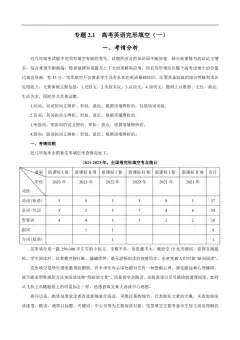
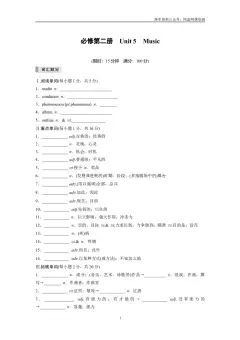
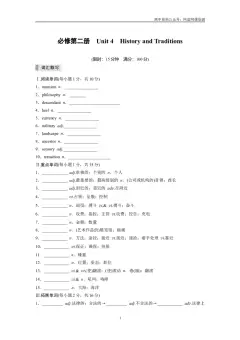
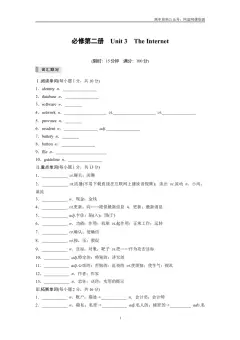
核心词汇
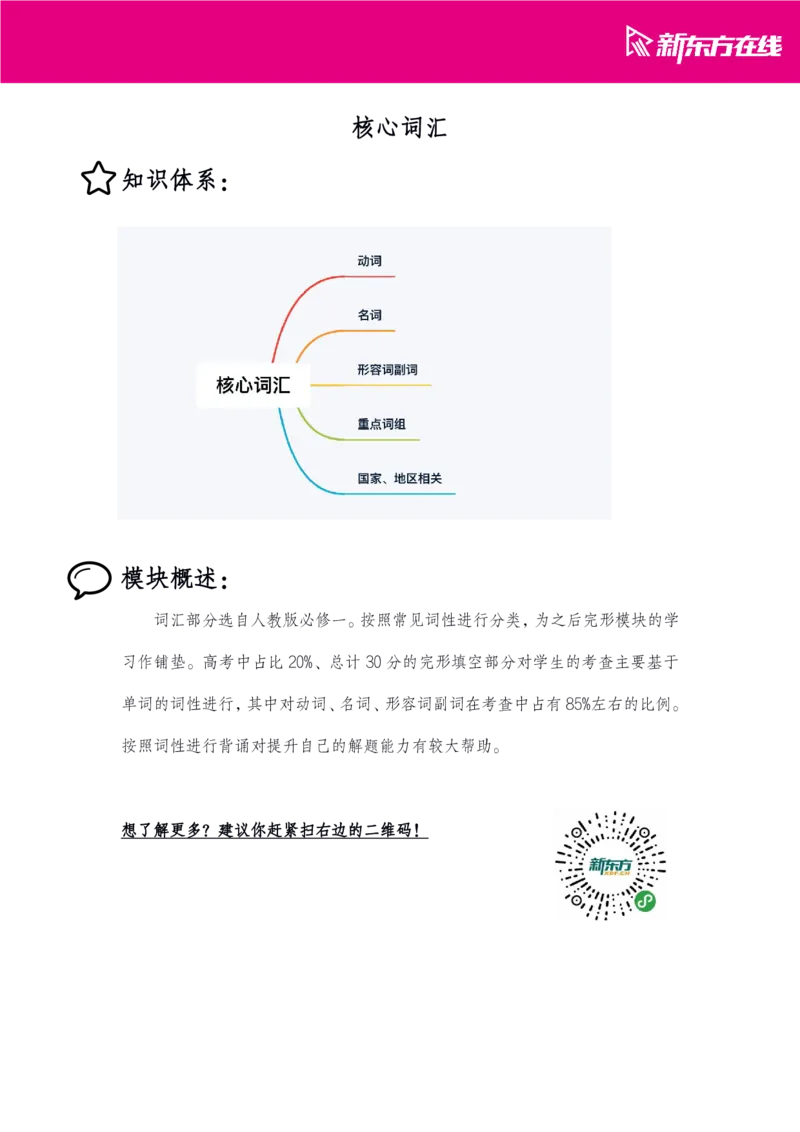
知识体系:
模块概述:
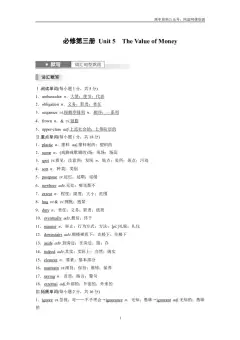
词汇部分选自人教版必修一。按照常见词性进行分类,为之后完形模块的学
习作铺垫。高考中占比20%、总计30 分的完形填空部分对学生的考查主要基于
单词的词性进行,其中对动词、名词、形容词副词在考查中占有85%左右的比例。
按照词性进行背诵对提升自己的解题能力有较大帮助。
想了解更多?建议你赶紧扫右边的二维码!
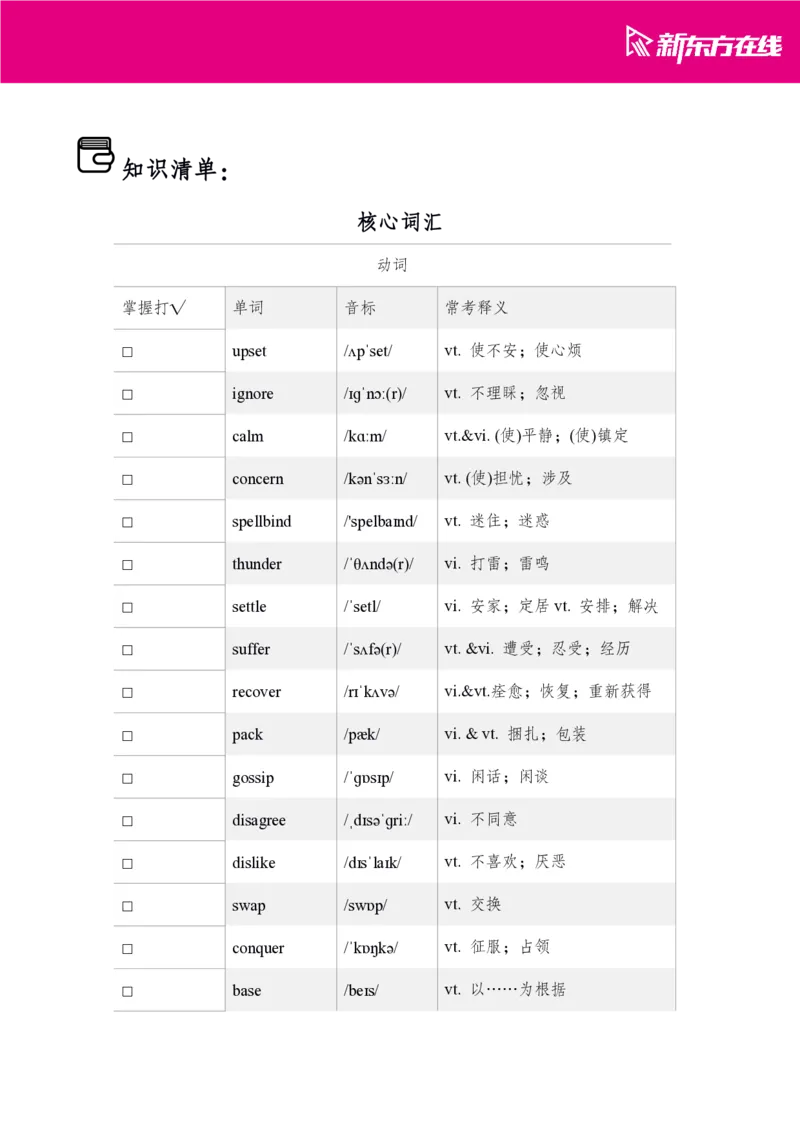
知识清单:
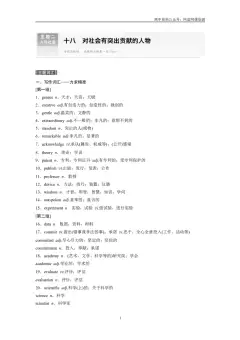
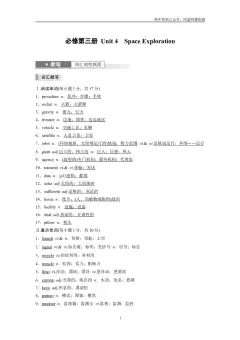
核心词汇
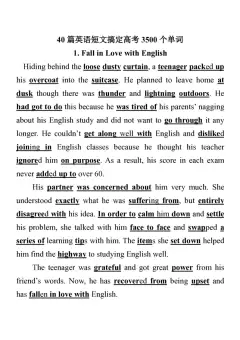
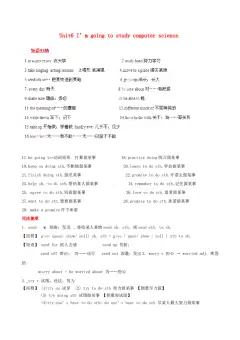
动词
掌握打√
单词
音标
常考释义
☐
upset
/ʌpˈset/
vt. 使不安;使心烦
☐
ignore
/ɪɡˈnɔː(r)/
vt. 不理睬;忽视
☐
calm
/kɑːm/
vt.&vi. (使)平静;(使)镇定
☐
concern
/kənˈsɜːn/
vt. (使)担忧;涉及
☐
spellbind
/'spelbaɪnd/
vt. 迷住;迷惑
☐
thunder
/ˈθʌndə(r)/
vi. 打雷;雷鸣
☐
settle
/ˈsetl/
vi. 安家;定居vt. 安排;解决
☐
suffer
/ˈsʌfə(r)/
vt. &vi. 遭受;忍受;经历
☐
recover
/rɪˈkʌvə/
vi.&vt.痊愈;恢复;重新获得
☐
pack
/pæk/
vi. & vt. 捆扎;包装
☐
gossip
/ˈɡɒsɪp/
vi. 闲话;闲谈
☐
disagree
/ˌdɪsəˈɡriː/
vi. 不同意
☐
dislike
/dɪsˈlaɪk/
vt. 不喜欢;厌恶
☐
swap
/swɒp/
vt. 交换
☐
conquer
/ˈkɒŋkə/
vt. 征服;占领
☐
base
/beɪs/
vt. 以……为根据
☐
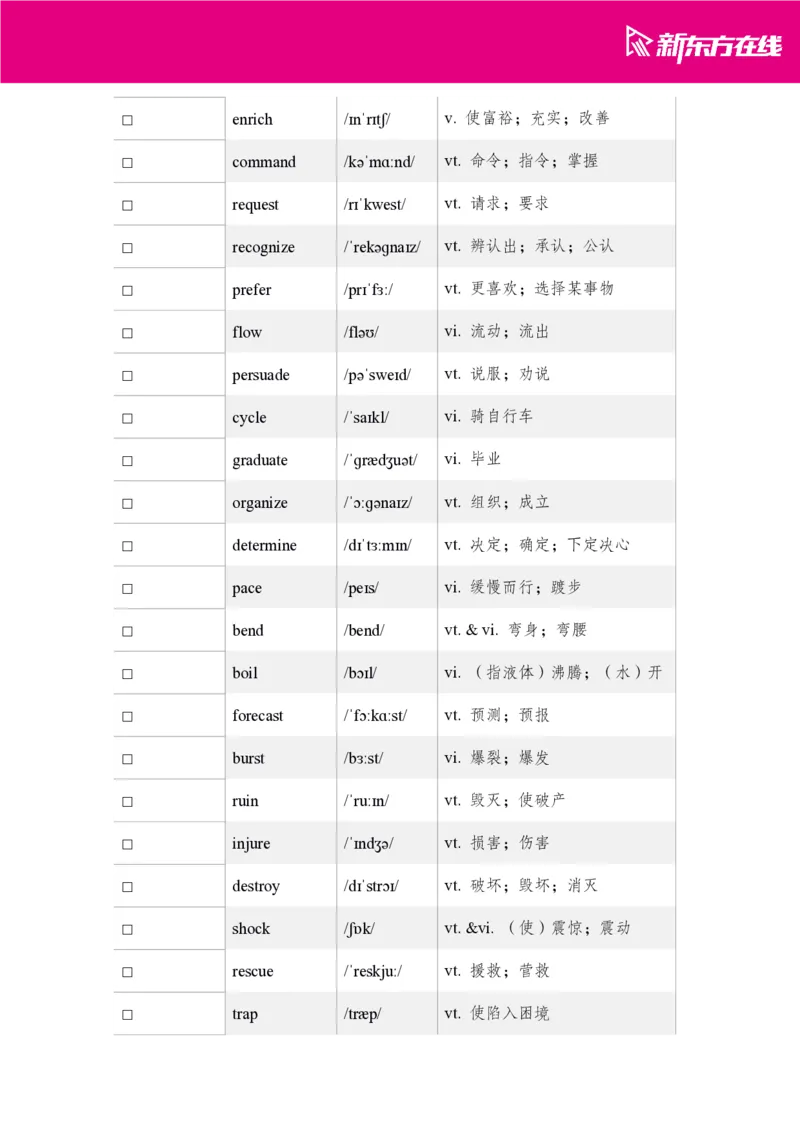
enrich
/ɪnˈrɪtʃ/
v. 使富裕;充实;改善
☐
command
/kəˈmɑːnd/
vt. 命令;指令;掌握
☐
request
/rɪˈkwest/
vt. 请求;要求
☐
recognize
/ˈrekəɡnaɪz/
vt. 辨认出;承认;公认
☐
prefer
/prɪˈfɜː/
vt. 更喜欢;选择某事物
☐
flow
/fləʊ/
vi. 流动;流出
☐
persuade
/pəˈsweɪd/
vt. 说服;劝说
☐
cycle
/ˈsaɪkl/
vi. 骑自行车
☐
graduate
/ˈɡrædʒuət/
vi. 毕业
☐
organize
/ˈɔːɡənaɪz/
vt. 组织;成立
☐
determine
/dɪˈtɜːmɪn/
vt. 决定;确定;下定决心
☐
pace
/peɪs/
vi. 缓慢而行;踱步
☐
bend
/bend/
vt. & vi. 弯身;弯腰
☐
boil
/bɔɪl/
vi. (指液体)沸腾;(水)开
☐
forecast
/ˈfɔːkɑːst/
vt. 预测;预报
☐
burst
/bɜːst/
vi. 爆裂;爆发
☐
ruin
/ˈruːɪn/
vt. 毁灭;使破产
☐
injure
/ˈɪndʒə/
vt. 损害;伤害
☐
destroy
/dɪˈstrɔɪ/
vt. 破坏;毁坏;消灭
☐
shock
/ʃɒk/
vt. &vi. (使)震惊;震动
☐
rescue
/ˈreskjuː/
vt. 援救;营救
☐
trap
/træp/
vt. 使陷入困境
☐
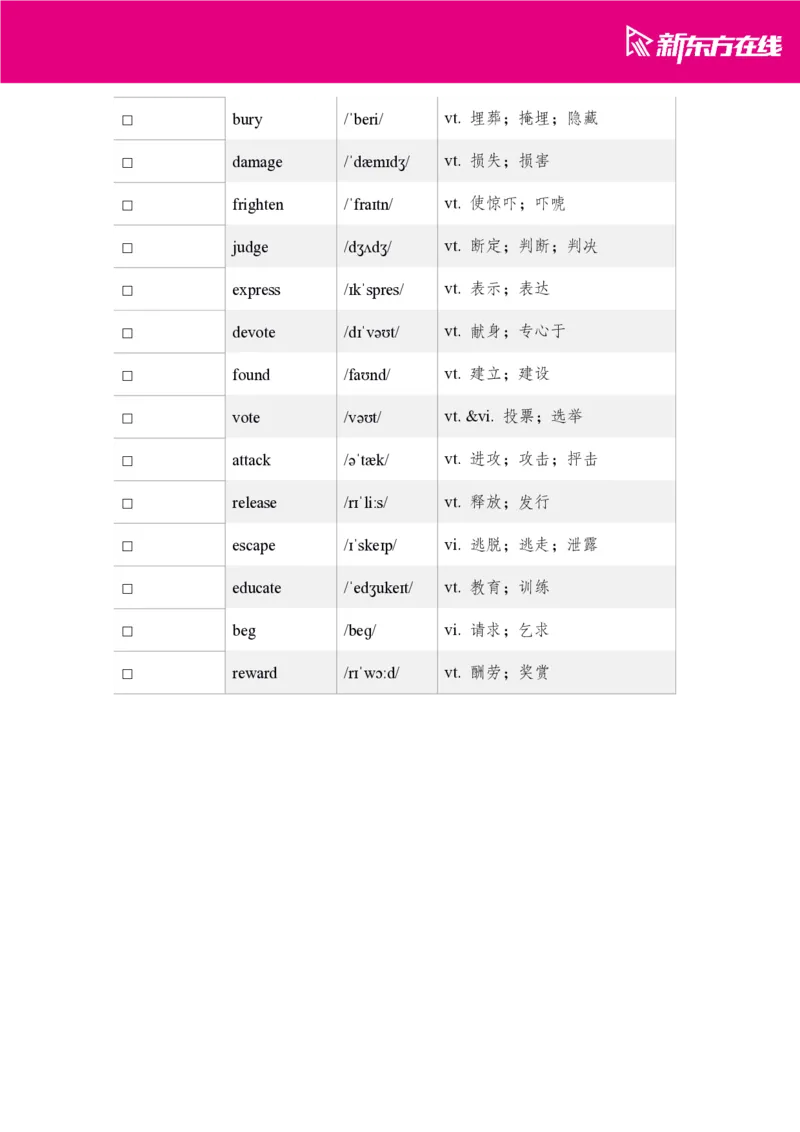
bury
/ˈberi/
vt. 埋葬;掩埋;隐藏
☐
damage
/ˈdæmɪdʒ/
vt. 损失;损害
☐
frighten
/ˈfraɪtn/
vt. 使惊吓;吓唬
☐
judge
/dʒʌdʒ/
vt. 断定;判断;判决
☐
express
/ɪkˈspres/
vt. 表示;表达
☐
devote
/dɪˈvəʊt/
vt. 献身;专心于
☐
found
/faʊnd/
vt. 建立;建设
☐
vote
/vəʊt/
vt. &vi. 投票;选举
☐
attack
/əˈtæk/
vt. 进攻;攻击;抨击
☐
release
/rɪˈliːs/
vt. 释放;发行
☐
escape
/ɪˈskeɪp/
vi. 逃脱;逃走;泄露
☐
educate
/ˈedʒukeɪt/
vt. 教育;训练
☐
beg
/beɡ/
vi. 请求;乞求
☐
reward
/rɪˈwɔːd/
vt. 酬劳;奖赏
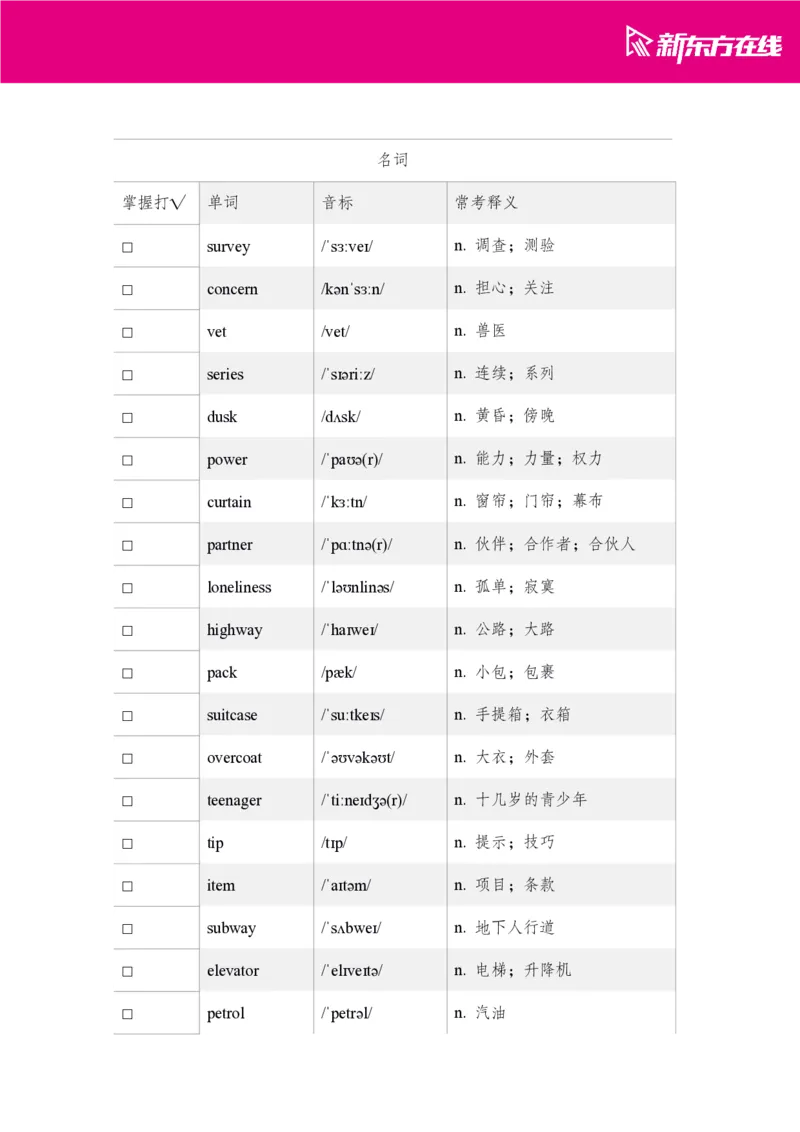
名词
掌握打√
单词
音标
常考释义
☐
survey
/ˈsɜːveɪ/
n. 调查;测验
☐
concern
/kənˈsɜːn/
n. 担心;关注
☐
vet
/vet/
n. 兽医
☐
series
/ˈsɪəriːz/
n. 连续;系列
☐
dusk
/dʌsk/
n. 黄昏;傍晚
☐
power
/ˈpaʊə(r)/
n. 能力;力量;权力
☐
curtain
/ˈkɜːtn/
n. 窗帘;门帘;幕布
☐
partner
/ˈpɑːtnə(r)/
n. 伙伴;合作者;合伙人
☐
loneliness
/ˈləʊnlinəs/
n. 孤单;寂寞
☐
highway
/ˈhaɪweɪ/
n. 公路;大路
☐
pack
/pæk/
n. 小包;包裹
☐
suitcase
/ˈsuːtkeɪs/
n. 手提箱;衣箱
☐
overcoat
/ˈəʊvəkəʊt/
n. 大衣;外套
☐
teenager
/ˈtiːneɪdʒə(r)/
n. 十几岁的青少年
☐
tip
/tɪp/
n. 提示;技巧
☐
item
/ˈaɪtəm/
n. 项目;条款
☐
subway
/ˈsʌbweɪ/
n. 地下人行道
☐
elevator
/ˈelɪveɪtə/
n. 电梯;升降机
☐
petrol
/ˈpetrəl/
n. 汽油
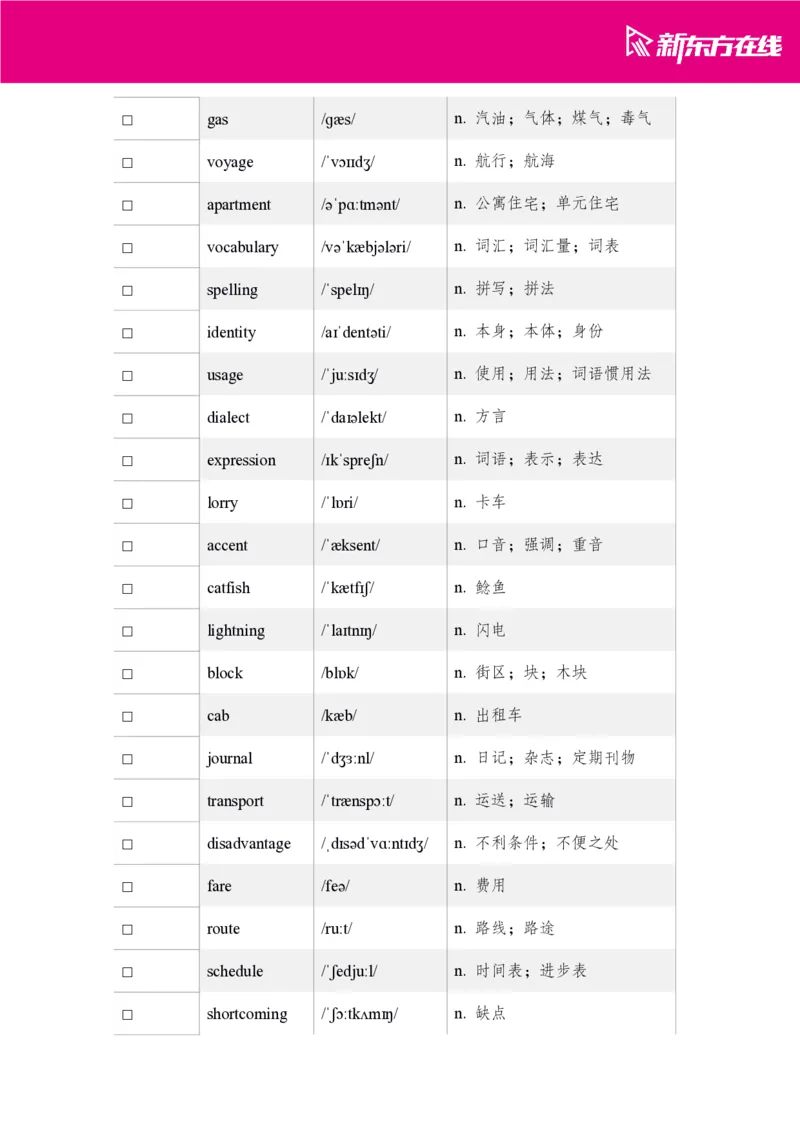
☐
gas
/ɡæs/
n. 汽油;气体;煤气;毒气
☐
voyage
/ˈvɔɪɪdʒ/
n. 航行;航海
☐
apartment
/əˈpɑːtmənt/
n. 公寓住宅;单元住宅
☐
vocabulary
/vəˈkæbjələri/
n. 词汇;词汇量;词表
☐
spelling
/ˈspelɪŋ/
n. 拼写;拼法
☐
identity
/aɪˈdentəti/
n. 本身;本体;身份
☐
usage
/ˈjuːsɪdʒ/
n. 使用;用法;词语惯用法
☐
dialect
/ˈdaɪəlekt/
n. 方言
☐
expression
/ɪkˈspreʃn/
n. 词语;表示;表达
☐
lorry
/ˈlɒri/
n. 卡车
☐
accent
/ˈæksent/
n. 口音;强调;重音
☐
catfish
/ˈkætfɪʃ/
n. 鲶鱼
☐
lightning
/ˈlaɪtnɪŋ/
n. 闪电
☐
block
/blɒk/
n. 街区;块;木块
☐
cab
/kæb/
n. 出租车
☐
journal
/ˈdʒɜːnl/
n. 日记;杂志;定期刊物
☐
transport
/ˈtrænspɔːt/
n. 运送;运输
☐
disadvantage
/ˌdɪsədˈvɑːntɪdʒ/
n. 不利条件;不便之处
☐
fare
/feə/
n. 费用
☐
route
/ruːt/
n. 路线;路途
☐
schedule
/ˈʃedjuːl/
n. 时间表;进步表
☐
shortcoming
/ˈʃɔːtkʌmɪŋ/
n. 缺点
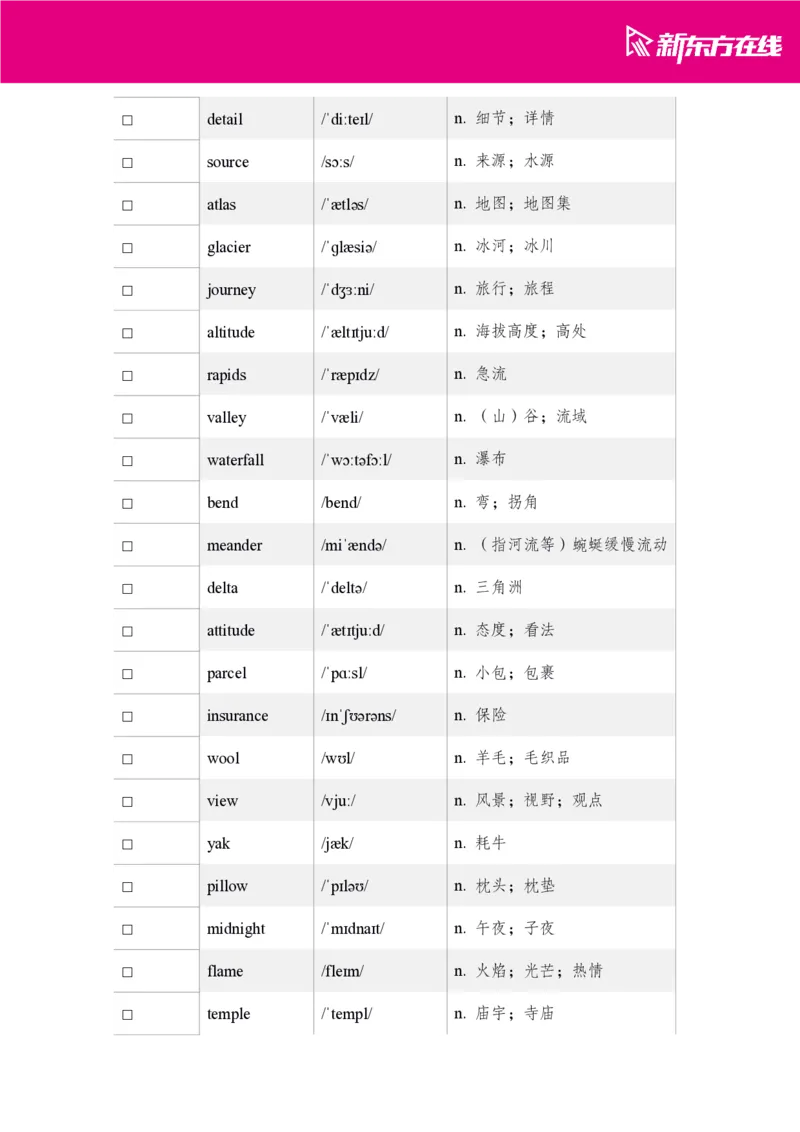
☐
detail
/ˈdiːteɪl/
n. 细节;详情
☐
source
/sɔːs/
n. 来源;水源
☐
atlas
/ˈætləs/
n. 地图;地图集
☐
glacier
/ˈɡlæsiə/
n. 冰河;冰川
☐
journey
/ˈdʒɜːni/
n. 旅行;旅程
☐
altitude
/ˈæltɪtjuːd/
n. 海拔高度;高处
☐
rapids
/ˈræpɪdz/
n. 急流
☐
valley
/ˈvæli/
n. (山)谷;流域
☐
waterfall
/ˈwɔːtəfɔːl/
n. 瀑布
☐
bend
/bend/
n. 弯;拐角
☐
meander
/miˈændə/
n. (指河流等)蜿蜒缓慢流动
☐
delta
/ˈdeltə/
n. 三角洲
☐
attitude
/ˈætɪtjuːd/
n. 态度;看法
☐
parcel
/ˈpɑːsl/
n. 小包;包裹
☐
insurance
/ɪnˈʃʊərəns/
n. 保险
☐
wool
/wʊl/
n. 羊毛;毛织品
☐
view
/vjuː/
n. 风景;视野;观点
☐
yak
/jæk/
n. 耗牛
☐
pillow
/ˈpɪləʊ/
n. 枕头;枕垫
☐
midnight
/ˈmɪdnaɪt/
n. 午夜;子夜
☐
flame
/fleɪm/
n. 火焰;光芒;热情
☐
temple
/ˈtempl/
n. 庙宇;寺庙
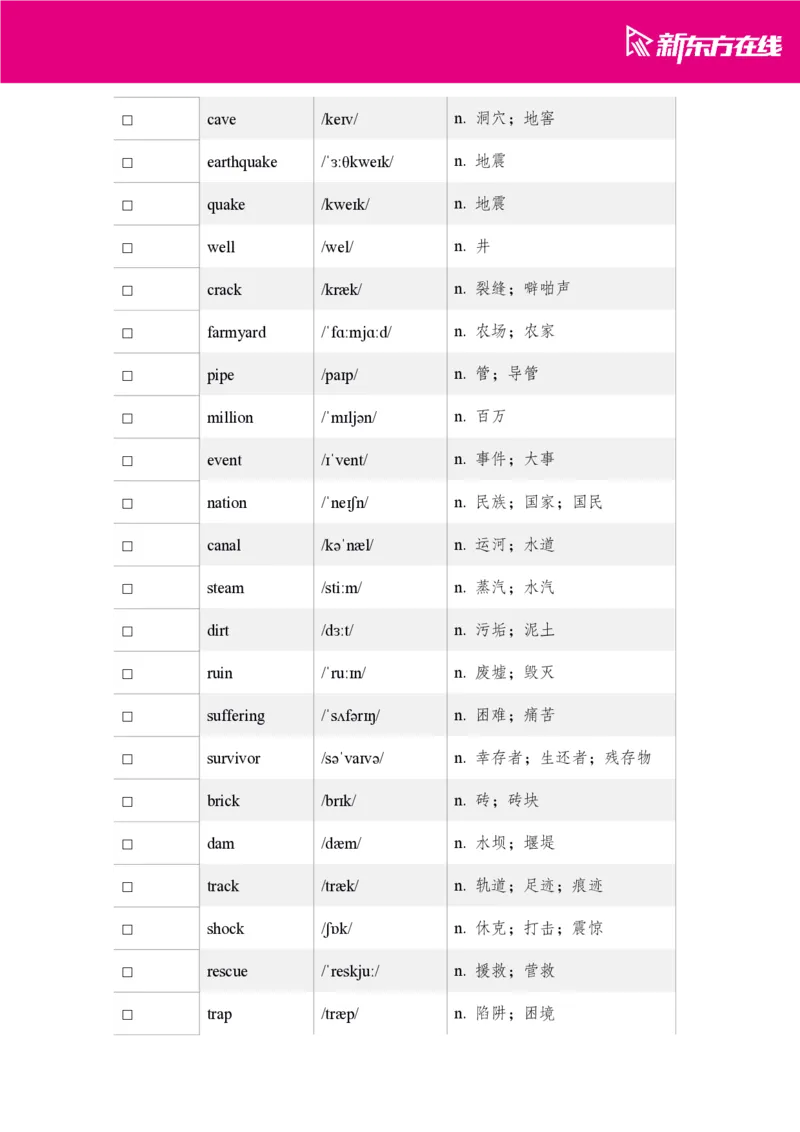
☐
cave
/keɪv/
n. 洞穴;地窖
☐
earthquake
/ˈɜːθkweɪk/
n. 地震
☐
quake
/kweɪk/
n. 地震
☐
well
/wel/
n. 井
☐
crack
/kræk/
n. 裂缝;噼啪声
☐
farmyard
/ˈfɑːmjɑːd/
n. 农场;农家
☐
pipe
/paɪp/
n. 管;导管
☐
million
/ˈmɪljən/
n. 百万
☐
event
/ɪˈvent/
n. 事件;大事
☐
nation
/ˈneɪʃn/
n. 民族;国家;国民
☐
canal
/kəˈnæl/
n. 运河;水道
☐
steam
/stiːm/
n. 蒸汽;水汽
☐
dirt
/dɜːt/
n. 污垢;泥土
☐
ruin
/ˈruːɪn/
n. 废墟;毁灭
☐
suffering
/ˈsʌfərɪŋ/
n. 困难;痛苦
☐
survivor
/səˈvaɪvə/
n. 幸存者;生还者;残存物
☐
brick
/brɪk/
n. 砖;砖块
☐
dam
/dæm/
n. 水坝;堰堤
☐
track
/træk/
n. 轨道;足迹;痕迹
☐
shock
/ʃɒk/
n. 休克;打击;震惊
☐
rescue
/ˈreskjuː/
n. 援救;营救
☐
trap
/træp/
n. 陷阱;困境
☐
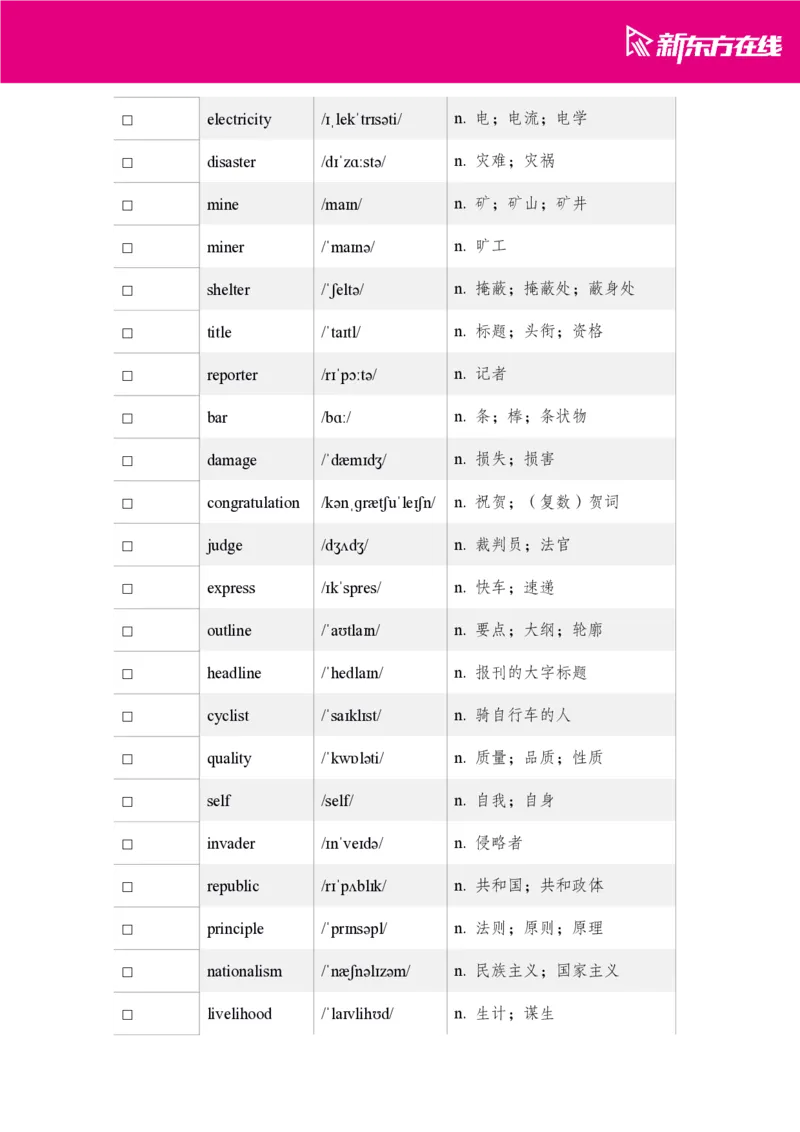
electricity
/ɪˌlekˈtrɪsəti/
n. 电;电流;电学
☐
disaster
/dɪˈzɑːstə/
n. 灾难;灾祸
☐
mine
/maɪn/
n. 矿;矿山;矿井
☐
miner
/ˈmaɪnə/
n. 旷工
☐
shelter
/ˈʃeltə/
n. 掩蔽;掩蔽处;蔽身处
☐
title
/ˈtaɪtl/
n. 标题;头衔;资格
☐
reporter
/rɪˈpɔːtə/
n. 记者
☐
bar
/bɑː/
n. 条;棒;条状物
☐
damage
/ˈdæmɪdʒ/
n. 损失;损害
☐
congratulation
/kənˌɡrætʃuˈleɪʃn/
n. 祝贺;(复数)贺词
☐
judge
/dʒʌdʒ/
n. 裁判员;法官
☐
express
/ɪkˈspres/
n. 快车;速递
☐
outline
/ˈaʊtlaɪn/
n. 要点;大纲;轮廓
☐
headline
/ˈhedlaɪn/
n. 报刊的大字标题
☐
cyclist
/ˈsaɪklɪst/
n. 骑自行车的人
☐
quality
/ˈkwɒləti/
n. 质量;品质;性质
☐
self
/self/
n. 自我;自身
☐
invader
/ɪnˈveɪdə/
n. 侵略者
☐
republic
/rɪˈpʌblɪk/
n. 共和国;共和政体
☐
principle
/ˈprɪnsəpl/
n. 法则;原则;原理
☐
nationalism
/ˈnæʃnəlɪzəm/
n. 民族主义;国家主义
☐
livelihood
/ˈlaɪvlihʊd/
n. 生计;谋生
☐
leap
/liːp/
n. 飞跃;跳跃
☐
mankind
/mænˈkaɪnd/
n. 人类
☐
lawyer
/ˈlɔːjə/
n. 律师
☐
guidance
/ˈɡaɪdns/
n. 指导;领导
☐
fee
/fiː/
n. 费(会费、学费等);酬金
☐
youth
/juːθ/
n. 青年;青年时期
☐
league
/liːɡ/
n. 同盟;联盟;联合会
☐
stage
/steɪdʒ/
n. 舞台;阶段;时期
☐
vote
/vəʊt/
n. 投票;选票;表决
☐
violence
/ˈvaɪələns/
n. 暴力;暴行
☐
quote
/kwəʊt/
n. 引用语;语录
☐
blanket
/ˈblæŋkɪt/
n. 毛毯;毯子
☐
relative
/ˈrelətɪv/
n. 亲戚;亲属
☐
terror
/ˈterə/
n. 恐怖;可怕的人
☐
cruelty
/ˈkruːəlti/
n. 残忍;残酷
☐
reward
/rɪˈwɔːd/
n. 报酬;奖金
☐
opinion
/əˈpɪnjən/
n. 意见;看法;主张
形容词副词
掌握打√
单词
音标
常考释义
☐
upset
/ʌpˈset/
adj. 心烦意乱的;不安的
☐
loose
/luːs/
adj. 松的;松开的
☐
outdoors
/ˌaʊtˈdɔːz/
adv. 在户外;在野外
☐
entire
/ɪnˈtaɪə(r)/
adj. 整个的;完全的;全部的
☐
entirely
/ɪnˈtaɪəli/
adv. 完全地;全然地
☐
dusty
/ˈdʌsti/
adj. 积满灰尘的
☐
exactly
/ɪɡˈzæktli/
adv. 确实如此;正是;确切地
☐
grateful
/ˈɡreɪtfl/
adj. 感激的;表示谢意的
☐
secondly
/ˈsekəndli/
adv. 第二;其次
☐
official
/əˈfɪʃl/
adj. 官方的;正式的;公务的
☐
native
/ˈneɪtɪv/
adj. 本国的;本地的
☐
actually
/ˈæktʃuəli/
adv. 实际上;事实上
☐
gradual
/ˈɡrædʒuəl/
adj. 逐渐的;逐步的
☐
gradually
/ˈɡrædʒuəli/
adv. 逐渐地;逐步地
☐
latter
/ˈlætə(r)/
adj. 较后的;后半的
☐
fluent
/ˈfluːənt/
adj. 流利的;流畅的
☐
fluently
/ˈfluːəntli/
adv. 流利地;流畅地
☐
frequent
/'friːkw(ə)nt/
adj. 流利的;流畅的
☐
frequently
/ˈfriːkwəntli/
adv. 常常;频繁地
☐
midwestern
/ˌmɪdˈwestən/
adj. 中西部的;有中西部特性
的
☐
eastern
/ˈiːstən/
adj. 东方的;东部的
☐
southeastern
/ˌsaʊθ'iːstən/
adj. 东南方的;来自东南的
☐
northeastern
/ˌnɔ:θ'i:stən/
adj. 西北方的;来自西北的
☐
straight
/streɪt/
adv. 直接;挺直
adj. 直的;笔直的;正直的
☐
finally
/ˈfaɪnəli/
adv. 最后;终于
☐
fond
/fɒnd/
adj. 喜爱的;慈爱的
☐
stubborn
/ˈstʌbən/
adj. 顽固的;固执的
☐
determined
/dɪˈtɜːmɪnd/
adj. 坚决的;有决心的
☐
reliable
/rɪˈlaɪəbl/
adj. 可信赖的;可靠的
☐
smelly
/ˈsmeli/
adj. 发臭的;有臭味的
☐
extreme
/ɪkˈstriːm/
adj. 极度的
☐
useless
/ˈjuːsləs/
adj. 无用的;无效的;无益的
☐
frightened
/ˈfraɪtnd/
adj. 受惊的;受恐吓的
☐
frightening
/ˈfraɪtnɪŋ/
adj. 令人恐惧的
☐
sincerely
/sɪnˈsɪəli/
adv. 真诚地;真挚地
☐
warm-hearted
/ˌwɔ:m 'ha:tid/
adj. 热心肠的
☐
mean
/miːn/
adj. 吝啬的;自私的;卑鄙的
☐
active
/ˈæktɪv/
adj. 积极的;活跃的
☐
generous
/ˈdʒenərəs/
adj. 慷慨的;大方的
☐
easy-going
/ˌiːzi ˈɡoʊɪŋ/
adj. 随和的;温和宽容的
☐
selfish
/ˈselfɪʃ/
adj. 自私的
☐
selfless
/ˈselfləs/
adj. 无私的;忘我的
☐
selflessly
/ˈselfləsli/
adv. 无私地;忘我地
☐
devoted
/dɪˈvəʊtɪd/
adj. 忠实的;深爱的
☐
peaceful
/ˈpiːsfl/
adj. 和平的;平静的;安宁的
☐
giant
/ˈdʒaɪənt/
adj. 巨大的;庞大的
☐
legal
/ˈliːɡl/
adj. 法律的;依照法律的
☐
hopeful
/ˈhəʊpfl/
adj. 怀有希望的;有希望的
☐
equal
/ˈiːkwəl/
adj. 相等的;平等的
☐
willing
/ˈwɪlɪŋ/
adj. 乐意的;自愿的
☐
unfair
/ˌʌnˈfeə/
adj. 不公正的;不公平的
☐
educated
/ˈedʒukeɪtɪd/
adj. 受过教育的;有教养的
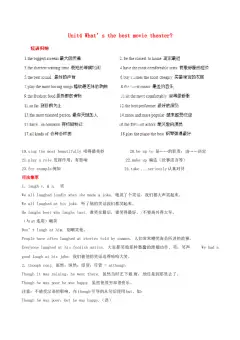
词组
掌握打√
单词
常考释义
☐
add up
合计
☐
calm down
(使)平静;(使)镇定
☐
have got to
不得不;必须
☐
be concerned about
关心;挂念
☐
walk the dog
遛狗
☐
go through
经历;经受
☐
set down
记下;放下;登记
☐
a series of
一连串的;一系列的
☐
on purpose
故意
☐
in order to
为了……
☐
at dusk
在黄昏时刻
☐
face to face
面对面地
☐
no longer/not…any longer
不在……
☐
suffer from
遭受;患病
☐
get/be tired of
对……厌烦
☐
pack (sth) up
将(东西)装箱打包
☐
get along with
与……相处;进展
☐
fall in love
相爱;爱上
☐
join in
参加;加入
☐
because of
因为;由于
☐
come up
走近;上来;提出
☐
at present
现在;目前
☐
make use of
利用;使用
☐
such as
例如……;像这种的
☐
play a part (in)
扮演一个角色;参与
☐
ever since
从那以后
☐
be fond of
喜爱;喜欢
☐
care about
关心;忧虑;惦念
☐
change one’s mind
改变主意
☐
make up one’s mind
下决心;决定
☐
give in
投降;屈服;让步
☐
as usual
照常
☐
at midnight
在午夜
☐
right away
立刻;马上
☐
as if
仿佛;好像
☐
at an end
结束;终结
☐
in ruins
严重受损;破败不堪
☐
dig out
掘出;发现
☐
a (great) number of
许多;大量的
☐
out of work
失业
☐
Youth League
青年团
☐
as a matter of fact
事实上
☐
blow up
使充气;爆炸
☐
in trouble
在危险、受罚、痛苦等的处境中
☐
turn to
求助于;致力于
☐
lose heart
丧失勇气或信心
☐
come to power
当权;上台
☐
set up
设立;建立
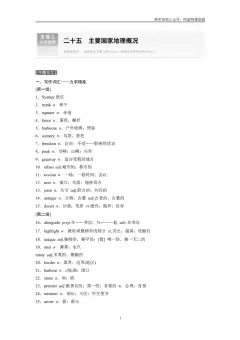
国家、地区相关
掌握打√
单词
音标
常考释义
☐
Amsterdam
/ˈæmstəˈdæm/
n. 阿姆斯特丹(荷兰首都)
☐
Netherlands
/'neðələndz/
n. 荷兰(西欧国家)
☐
Jewish
/ˈdʒuːɪʃ/
adj. 犹太人的;犹太族的
☐
German
/ˈdʒɜːmən/
adj. 德国的;德国人的
n. 德国人;德语
☐
Nazi
/ˈnɑːtsi/
n. 纳粹党人
adj. 纳粹党的
☐
Danish
/ˈdeɪnɪʃ/
n. 丹麦语
☐
Singapore
/ˌsɪŋgə'pɔ:/
n. 新加坡(东南亚国家)
☐
Malaysia
/məˈleɪʒə/
n. 马来西亚;马来群岛
☐
African
/ˈæfrɪkən/
adj. 非洲的;非洲人的
☐
Spanish
/ˈspænɪʃ/
adj. 西班牙的;西班牙人的
☐
Houston
/'hju:stən/
n. 休斯顿
☐
Texas
/'teksəs/
n. 德克萨斯州(美国州名)
☐
Mekong
/'meɪ'kɔŋ/
n. 湄公河
☐
Tibetan
/ti'betən/
n. 西藏人;藏族人
adj. 西藏的;藏族的
☐
Qomolangma
/ˈtʃəʊməʊˌlɑːŋmə/
n. 珠穆朗玛峰
☐
Laos
/laʊs/
n. 老挝(东南亚国家)
☐
Laotian
/ˈlaʊʃn/
n. 老挝人adj. 老挝(人)的
☐
Cape Town
开普敦(南非立法首都)
重点语法
知识体系:
模块概述:
语法部分主要选取高一年级重点语法内容,句子成分、五大基本句型、时态
中的一般式、进行式以及定语从句。句子成分和基本句型为学生搭建完整的语法
体系框架打基础。时态一般式和进行式旨在让学生了解初高中语法的内容差异点
及难度差异点,为更好的度过衔接阶段打基础。并且高考语法填空中对动词形式
的考查占比达到40%左右,是所有词性中考查最多的部分,其中很重要的一部分
考点都是围绕时态进行考查的。定语从句作为高一的重点内容,了解相关语法点
有助于学生更好的适应高中学习。
想了解更多?建议你赶紧扫右边的二维码!
知识清单:
重点语法
一、句子成分:
1. 主语:
(1) 主语的概念:执行句子的行为或动作的主体。
(2) 常用作主语的结构:主语一般由名词、代词、名词短语或相当于名词的结构
来充当,一般常用作主语的结构有名词代词、名词短语、to do 不定式、doing 动
名词短语及从句等。
【例】Youth is not a time of life; it is a state of mind. (名词/代词)
【例】Such an attitude would emphasize sharply the values of life. (名词词组)
【例】To see is to believe. (to do 不定式)
【例】Chatting on the Internet brings me a lot of fun. (动名词短语)
(3) 特殊情况:
①祈使句:祈使句以动词原形开头,但并非没有主语,祈使句默认的主语为you。
【例】Remember to turn off the light.
②it 作形式主语:it 作句子的形式主语时,真正的主语是后面的to do 不定式。
常见结构为:it + be + adj./n. +(for/of sb) + to do sth。
【例】It is not difficult to imagine a world short of ambition.
③倒装句:句子主语在谓语动词或助动词/情态动词之后。
【例】Only in this way can we improve our spoken English.
④There be 句型:主语为be 动词之后第一个名词/代词。
【例】There is no doubt that Syrian people have the wisdom to find a development
path suitable for their national condition.
2. 谓语:
(1) 谓语的概念:表示主语动作的词语和词组。
注意:
1)谓语一定是动词,但是句子中的动词不一定是谓语。
2)一句话中只有一个谓语动词。(此处一句话指一个简单句)
(2) 常用作谓语的结构:
1)用于表达句子的时态语态,例如:一般现在时为do/does,一般过去时为did,
现在完成时为have / has done 等。
【例】Frozen bananas will last several weeks, depending on their ripeness and the
temperature of the freezer.
2)情态动词+ do / have done 构成句子的谓语动词。
【例】He must drink a lot of milk. 他得多喝牛奶。
(3) 谓语动词的分类:
1)系动词
①be 动词:am/is/are; was/were
【例】The problems of your past are your business.
②感官动词:情态动词+ do / have done 构成句子的谓语动词。
【例】The iron feels hot. 这块铁摸起来很热。
③表示“保持”的动词:continue、keep、stay、remain、sit、stand、lie 等。
【例句】The weather continued fine for several days. 天气连续几天都很晴朗。
④表示“变成”的动词:become,grow,get,turn,fall,go,come 等。表示主
语由一种状态变为另一种状态。
【例句】Our supplies of sugar and rice fell short. 我们的糖、米供应不足。
2)及物动词:可以直接接宾语的动词。
【例句】Just like instant coffee, they want instant happiness.
3)不及物动词:不能直接接宾语、需要加介词后才能接宾语的动词为不及物动
词。
【例句】The benefit of the world matters before personal benefit.
4) 双宾语动词:其后需要接两个宾语,直接宾语和间接宾语。双宾语中既有人
又有物,一般“人”表示动作的接受者,为间接宾语,“物”表示动作作用的对象,
是动作的承受者,为直接宾语。常见的双宾语动词有give,borrow,lend,send,
bring,pass,buy,tell,ask,teach,show 等。
【例句】Her work in genetics won Barbara McClintock the Nobel Prize in 1983.
5) 常见的宾补动词:
①使役动词:make,keep,leave,let,have,help,get。
【例】You won't be able to keep it secret forever.
你不可能永远保密下去。
②感官动词:see,notice,observe,watch,hear,listen to,feel,find,smell
【例】Officers observed him driving at 90 miles per hour.
警察发现他以90 英里的时速驾车。
③其它动词:want,wish,expect,allow,permit,forbid,ask,order,advise,
etc.
【例】I didn't expect him to stay so long. 我没有料到他会待那么久。
3. 宾语
(1) 宾语的概念:动作的承受者。一般在谓语或介词之后,由非谓语to do,doing,
名词代词或从句充当。
(2) 常用作宾语的结构:
跟主语类似,名词代词或名词性成分皆可作宾语,常用结构有名词代词、to do 不
定式,doing 动名词词组及从句。
1)名词代词
【例句】They have had no need to create a figure to protect themselves from the
world or to impress it.
2)to do 不定式
【例句】This company refused to cooperate with us.
3)doing 动名词
【例句】Putting in a new window will involve cutting away part of the roof.
(3) 宾语的常见位置:
1)动词后:
【例句】Fears, even the most basic ones, can totally destroy our ambitions.
2)介词后:
【例句】Abundance is a life style, a way of living your life.
4. 表语
(1) 表语的概念:位于系动词之后,用来说明主语的身份、性质、品质、特征和
状态。
(2) 常见系动词(见谓语部分)
(3) 常用作表语的结构:
通常名词、形容词、副词、介词短语、不定式、现在分词、过去分词和从句
皆可在句子中充当表语成分。
1)名词或名词短语
【例句】A good book is the most patient and cheerful of companions.
2)形容词副词
【例句】Half the time things are better than normal; the other half, they are worse.
3)to do 不定式
【例句】The only effect of time has been to sift out the bad products; for nothing in
literature can long survive but what is really good.
4)doing 现在分词
【例句】You are taking control of your life.
5)done 过去分词
【例句】Rome wasn't built in a day.
6)介词短语
【例句】Time is of no account with great thoughts, which are as fresh today as when
they first passed through their author's minds, ages ago.
5. 定语
(1) 定语的概念:定语是用来修饰、限定、说明名词或代词的品质与特征的。
(2) 定语的位置:定语分为前置定语和后置定语。前置定语指定语的位置在所修
饰词之前,后置定语指定语的位置在所修饰词之后。一般单个词作定语通常放在
所修饰的名词或代词之前,短语或从句作定语时,通常放在所修饰词之后。
(3) 常用作定语的结构:
通常形容词、名词、副词、介词短语、to do 不定式、现在分词doing、过
去分词done 和从句都可在句子中充当定语成分。
1)形容词
【例句】High levels of lead could damage the intellectual development of children.
2)名词
【例句】It is inevitable for the old to have generation gap with their children.
3)副词
【例句】The buildings around are mostly of modern construction.
4)介词短语
【例句】He stared at the portrait on the wall.
5)to do 不定式
【例句】I have several letters to write today.
6)分词
1
现在分词和过去分词作前置定语:分词作前置定语的时候可以理解为它的词
性已经变为形容词词性。
【例句】It's a very convincing example.
2
现在分词/过去分词词组作后置定语
【例句】People wishing to visit the caves may sign up here.
6. 状语
(1) 状语的概念:状语是谓语里的另一个附加成分,从情况、时间、处所、方式、
条件、对象、肯定、否定、范围和程度等方面对谓语中心词进行修饰、限制。
(2) 常用作状语的结构:通常可以用来在句子中充当状语的有副词、介词短语、
不定式、分词、形容词、复合结构和从句。
1)副词:副词最主要的作用就是作状语,可用于修饰动词、形容词、副词或整
个句子。
【例句】They secretly decide to leave the town.
2)介词短语
【例句】Farmers are going bankrupt on account of the crisis in agriculture.
3)不定式:不定式最常见的是在句子中作目的状语表示动作的目的。也可修饰
整个句子。
【例句】We can send a car over to fetch you.
4)分词
【例句】Not having enough hands, they couldn't finish the work in time.
5)形容词
【例句】The boy nodded, pale and scared.
6)复合结构
①独立主格
【例句】Spring coming on, the tree turned green.
②with 短语
【例句】I won't be able to go on holiday with my mother being ill.
③其它复合结构:可包含形容词、介词短语或副词
【例句】He entered the room, his face pale.
7. 补语
(1) 补语的概念:补语是句子中起补充说明作用的成分。
(2) 常见的宾补动词(见谓语部分)
(3) 常用作补语的结构:
1)名词/代词
【例句】Like the good older son in the Biblical parable, they resent how voters are
willing to take Gingrich back and even make him their leader.
2)形容词
【例句】He found it easy to escape from the cage.
3)副词
【例句】Please call the students back at once.
4)非谓语
【例句】The compromise will allow him to continue his free market reforms.
8. 同位语
(1) 同位语的概念:一个名词(或其它形式)对另一个名词或代词进行解释或补
充说明,这个名词(或其它形式)就是同位语。
(2) 常用作同位语的结构:常用作同位语的结构有名词、代词、形容词或形容词
词组及从句。
1)名词代词
【例句】The celebrated mathematician, Edmund Stone, would never have published
a mathematical dictionary, never have found the key to science of mathematics, if he
had given his spare moments to idleness.
2)形容词:形容词作同位语时,作用接近定语,但放在所同位名词的后面,且
有逗号把它们分开。
【例句】Full of youthful vigour, he was diligent and modest.
9. 插入语
(1) 插入语的概念:插入语(Parenthesis)是插在句子中的一个词,短语或从句,
通常被逗号、破折号或句子的其他部分隔开,它与句子的其他部分之间没有语法
上的关系。删掉插入语之后,句子结构依然完整。
(2) 常用作插入语的结构:形容词及形容词短语、副词及副词短语、介词短语、
现在分词短语、过去分词短语、动词不定式、代词词组、从句等都可以作插入语。
1)形容词或形容词短语作插入语(通常位于句首)
【例句】Worse still, mental stress is known to cause physical fatigue and illness.
2)副词或副词短语作插入语(可位于句首、句中或句末)
【例句】Most of us, however, take life for granted.
3)介词短语作插入语
【例句】I speak, of course, of free men who have a choice, not condemned criminals
whose sphere of activities is strictly delimited.
4)现在分词短语作插入语
【例句】Generally speaking, the ideal approach for businesses is probably a blend of
generalists and specialists.
5)过去分词短语作插入语
【例句】Given his health condition, we had better not let him go there.
6)动词不定式作插入语
【例句】To tell you the truth, I never really do much search engine optimization.
7)代词词组作插入语
【例句】All in all, it was a great movie, probably the greatest superhero movie ever
made.
二、五大基本句型:
动词的分类产生五大基本句型五大基本句型中的动词可分为不及物动词、及
物动词(普通及物动词、宾宾及物动词和宾补及物动词)和系动词。
1. 主谓结构:
(1) 主谓结构:主谓结构主要由主语加不及物动词构成。
(2) 不及物动词的共同点:动词后不能直接加宾语。
1)此类动词只能用在基本句型:主+谓
2)如果要接宾语,必须加上介词。
【例】
S
Vi. (不及物动词)
1. Time
flies.
2. The moon
rose.
3. The man
cooked.
4. Everybody
laughed.
2. 主谓宾结构:
(1) 主谓宾结构:主谓宾结构主要由主语加普通及物动词加宾语构成。
(2) 普通及物动词的共同点:动词后可以直接加宾语。
【例】
S
Vt.
O
1. Who
knows
the answer?
2. She
laughs at
me.
3. He
made
a cake.
4. I
bought
a car.
3. 主谓双宾结构:
(1) 主谓双宾结构:主谓双宾结构主要由主语加双宾及物动词加间接宾语加直接
宾语构成。
(2) 双宾及物动词的共同点:动词后必须加两个宾语。
(3) 常见双宾及物动词:
Give 类:give, send, bring, pass, buy
Tell 类:tell, ask, teach, show
【例】
S
V
IO(间接宾语)
DO(直接宾语)
1. She
passed
him
a new dress.
2. He
brought
his husband
a picture.
3. I
gave
him
a book.
4. My mother
showed
me
a photo.
4. 主谓宾宾补结构:
(1) 主谓宾宾补结构:主谓宾宾补结构主要由主语加宾补及物动词加宾语加宾补
构成。
(2) 宾补及物动词的共同点:动词后必须加宾语和补语。
(3) 常见宾补及物动词:
使役类:make, keep, leave, let, have, help
感官类:call, hear, see,watch, notice, feel
【例】
S
Vt
O(宾语)
C(宾补)
1. We
keep
the table
clean.
2. They
painted
the door
green.
3. They
call
him
Peter.
4. What
makes
him
sad?
5. 主系表结构:
(1) 主系表结构:主系表结构主要由主语加系动词加表语构成。
(2) 系动词的共同点:词义不完整,起到联系作用。
(3) 常见系动词:
静止:be, keep, remain, stay
变化:get, become, grow, fall, turn, go, become, come
感官:look, smell, sound, feel, taste
判定:seem, appear, prove
【例】
S
Linking-V 系动词
P(表语)
1.This
is
an English dictionary.
2.The dinner
smells
good.
3.He
feels
happy.
4.The weather
became
warmer.
三、动词时态之一般式:
1. 一般现在时
(1) 定义:表示经常发生的动作或状态。
(2) 形式:
主动:主语+am/is/are(系动词)do/does(实义动词)
被动:am/is/are done
(3) 用法:
1)经常或习惯性动作:
【例句】Every few years, the coal workers have their lungs X-rayed to ensure their
health.
2)客观事实、真理;名人名言
【例句】Barbara is easy to recognize as she′s the only one of the women who wears
evening dress.
3)列车时刻表/课时安排等
【例句】Jane is in a hurry because the train to the airport leaves in half an hour.
4)主将从现:主句将来时从句一般现在时。
【例句】When the new school is completed next year, it will be open to the students
from villages.
2. 一般过去时
(1) 定义:一般过去时表示过去发生的事情。
(2) 形式:
主动:主语+was/were(系动词)did(实义动词)
被动:主语+was/were done
(3) 用法:一般过去时表示的是短暂性、经常性、延续性三种动作。
【例句】
①I went to the Great Wall last month.
②My father always took me to the Great Wall when I was a kid.
③My family lived in Beijing for 10 years, but we never regret having moved.
3. 一般将来时
(1) 定义:一般将来时表示将来某一时段的动作或状态,或将来某一段时间内经
常发生的动作或状态。
(2) 形式:
1)will + 动词原形
【例句】Without a common understanding, the challenges of “controlling” science in
this century will be really tough.
2)be going to +动词原形
【例句】And all the members should realize the value and significance of what
they are going to do.
3)be about to +动词原形
【例句】When my trip was about to complete, I chose to rest my legs in Liverpool’s
famous Philharmonic pub.
4)be to +动词原形
【例句】If you are to continue to live on the earth, you may well read and act on the
ideas.
(3) 用法:
1)表预测will do; am/is/are going to do
【例句】As Canada's Prime Minister has announced recently, two Chinese pandas
will spend the following 10 years in two Canadian zoos.
2)表计划性be going to do
【例句】Not only the parents but also their child is going to visit the Bird's Nest next
week.
3)现在进行时、一般现在时表将来
【例句】He will ring you up when he arrives at Fantawild tomorrow.
4)祈使句
【例句】Please give Jim the schedule for tomorrow's conference when he comes
back.
4. 过去将来时
(1) 定义:表示从过去的某一时间来看将来要发生的动作或呈现的状态。
(2) 形式:
主动:主语+would do;主语+was/were going to do
主语+was/were to do;主语+was/were about to do
主语+was/were doing
被动:主语+would be done;主语+was/were going to be done
主语+was/were to be done;主语+was/were about to be done
主语+was/were being done
(3) 用法
1)was/were doing 表示将来用法
【例句】I didn′t know that Bob was leaving for Canberra.
2)would do 表示过去将来用法
【例句】They made up their mind that they would buy a new house once Larry
changed jobs.
3)was/were about to do…when
【例句】I was about to sleep when the doorbell rang.
四、动词时态之进行式:
1. 现在进行时
(1) 定义:现在正在进行的动作。
(2) 形式:
主动:主语+be doing
被动:主语+be being done
(3) 用法:
1)表示此刻正在进行或发生的动作,通常和时间状语now、at the moment 或
look、listen 等表示正在发生的事情连用。
【例句】Look! The train is just getting into the station.
2)表示现阶段正在进行,但说话时未必正在进行的动作,常用的时间状语是
these days,this week,this month,this term 等。
【例句】We’re looking for a house to rent for the summer these days.
3)表示将要发生的动作,用于go,come,leave,fly,move,start,begin,finish,
arrive,stay,return (位移动词)。
【例句】Christmas is coming soon.
4)当其与always,forever,continually,constantly 等副词连用时表示重复的
动作,有着极大的感情色彩,表示不满或满意。
【例句】The little boy is forever asking questions.
5)通常与year by year 等时间连用时,表随着时间逐渐变化,意为“越来越……”。
【例句】Chinese people’s spending on overseas trips is rising year by year.
2. 过去进行时
(1) 定义:表示过去在某一时间段或某一段时间内正在发生或进行的动作。
(2) 形式:
主动:主语+was/were doing
被动:主语+was/were being done
(3) 用法:
1)表示过去某个时刻或某一阶段正在进行的动作。
常和表示过去时间的状语如then(那时),at this (that) time(在这时/那时),
yesterday(昨天),last year(去年)等连用。
【例句】We were expecting you yesterday.
2)与when 和while 引导的状语从句连用,表示动作同时发生。when 之后通
常接一般过去时,也可以接过去进行时,while 一般只跟过去进行时连用。
【例句】Mrs. Jones was still cleaning the house when her husband came back from
work.
3)表示过去将来的动作,过去进行时亦可表示从过去某时间看将要发生的动作。
【例句】She was leaving early the next morning.
4)表示婉转语气,用以提出请求,只限于want,hope,wonder 等动词。
【例句】I was wondering if you could help me.
3. 将来进行时
(1) 定义:将来进行时主要表示将来某一时间正在进行的动作,或表示要在将来
某一时间开始,并继续下去的动作。
(2) 形式:
主动:主语+shall/will be doing
被动:主语+shall/will be being done
(3) 用法:表示在将来某一时刻正在进行的动作或将来某个时间段一直在做的动
作。
【例句】I will be lying on a beach in Sanya this time tomorrow.
五、定语从句:
1. 定义:一个句子跟在一个名词或代词(先行词)后进行修饰限定(对词句进
行补充、修饰、限定,进而使原句内容更完整),就叫做定语从句。
2. 形式:定语从句=先行词+关系词+从句
【名词解释】
①先行词:指被定语从句修饰的名词、代词或句子。一般先行词出现在定语从
句的前面。
②关系词:位于先行词和从句之间。
【例句】Harry Potter is a boy(先行词)who(关系词)has magic power.
3. 定语从句关系词
(1) 关系代词:which、who、that、whom、whose、as
1)当关系词指物时,关系代词用which 或that
【例句】We found a shop which/ that sold old records.
2)当先行词指人时,关系代词用who(在从句中做主语或宾语)、whom(在
从句中作宾语或表语)或that
【例句】I’ve just seen the woman who/ that lives upstairs.
3)当先行词指“人+物”时,关系代词用that
【例句】Wow! Look at the man and his horse that are running down the road.
4)as 即可引导限定性定语从句也可以引导非限定性定语从句
①as 引导限定性定语从句常用结构:such…as;the same…as;so…as
【例句】Such books as I have read are classical works.
【例句】I’d like to use the same tool as is used here.
【例句】I am not so strong a man as I was.
②as 引导非限定性定语从句,常用来指代整个主句。as 引导的从句位置比较灵
活,可以位于主句前面、中间或后面,一般用逗号与主句隔开,通常译为“正如……
一样”等。
【例句】He stayed up late into the night, as is often the case.
5)whose 指人或物,在从句中做定语,表前后名词(人、物)的所属关系。
【例句】She’s the woman whose car Tom crashed into.
注意事项:
1)关系代词只能用that 不能用which/who 的情况:
①先行词被all,every,some,any,(a)few,(a)little,no 等不定代词、
最高级形容词或序数词修饰时,关系代词只能用that 不能用which/who;
②先行词是指物的不定代词时,例如:all,much,none,anything,something,
nothing 等,关系代词只能用that 不能用which;
③先行词被the very,the only,the right 修饰时,关系代词只能用that 不能用
which/who。
2)非限定性定语从句中关系代词只能用which/who 不能用that。
【例句】My gardener, who is very pessimistic, says that there will be no apples this
year.
3)当关系代词在从句中充当宾语时,可省略关系代词
【例句】The person (whom/that) you met wasn’t Michael.
(2) 关系副词:when,where,why
1)where, 指地点,在从句中做地点状语或相当于地点的抽象状语
【例句】Many countries are now setting up national parks where animals and plants
can be protected.
2)when , 指时间,在从句中做时间状语
【例句】Do you remember the day when we moved the piano upstairs?
3)why, 指原因,在从句中做原因状语
【例句】The reason why Nick came was that he wanted to see Rita.
4. 限定性定语从句与非限定性定语从句的区别
两者的区别在于:
形式上,非限定性定语从句前面有逗号。
意义上,非限定性定语从句起补充说明的作用,不起限定作用
用法上,关系词that/why 不用于非限定从,且关系词即使在从句中作宾语也不
能省略;同时which 在非限定从中可以指前面的一整句话不一定只指前面的名词。
【例句】There are certain historic occasions that are likely to remind people of what
happened in the past and set people reflecting on them.
【例句】China Today attracts a worldwide readership, which shows that more and
more people all over the world want to learn about China.
建议信
知识体系:
模块概述:
高中的书面表达比初中所要求的更高。除了表达清楚、没有语法错误、不遗
漏要点等基础要求之外,还需要学生可以熟练运用高级句型和词汇。因此对于高
中写作来说,了解文章的写作整体架构、提升自己高级词汇、句型的运用能力就
尤为关键。
想了解更多?建议你赶紧扫右边的二维码!
知识清单:
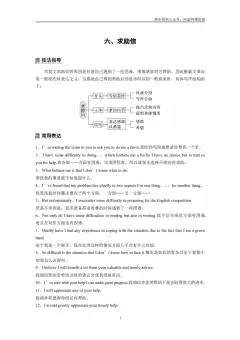
建议信
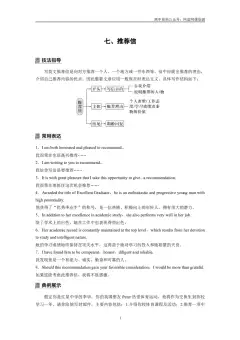
一、常用词汇:
序号
中文表达
你会的英文表达
高分英文表达
1
遇到了关于……的
问题
be faced with / experience /
get stuck on some problems / a
problem about sth.
2
不知道该如何
去……
be at a loss to do sth.
3
两难困境/ 挑战
dilemma / challenge
4
我看得出来
I can tell that
5
给你一些建议
offer you some suggestions
6
急需帮助
be in (urgent / desperate) need
of assistance
7
首先
to begin / start with
8
此外
besides / additionally / apart
from that
9
最重要的是
above all / what matters most
is
10
最好
be better off doing
11
一定要
it is a must for you to
12
强烈建议
it is strongly recommended
that you do sth.
13
做某事很明智
it is wise / advisable for you to
do sth.
二、开头:
1. 开头结构:建议信的开头部分主要需要两方面的内容,分别是提及对方的来
信以及交待自己的写作目的。
2. 提及来信功能句:
(1) 给非熟人:从你的来信中,我了解到你遇到了关于xxx 的问题,并且由于
不知道如何解决而感到不知所措,我完全理解你的焦虑。
Knowing from your letter that you are stuck on a problem about xxx and feel at a loss
as to how to overcome it, I fully understand your anxiety.
(2) 给熟人:收到了你的来信,我看得出来你最近过的很不好,因为不知道如何
解决关于xxx 的问题而感到不知所措。
Having received your letter, I can tell that you are having a tough time when you feel
at a loss as to how to overcome the problem about xxx.
3. 写作目的
因此,我写信给你,基于我个人的经验,给你一些建议。
Thus, I am writing to offer you some suggestions based on my own experience.
三、正文:
1. 正文结构:鼓励(安慰、理解)+提出建议+给出理由
2. 鼓励类例句:
(1) 要积极,压力一定会消失的
Be positive. Most stress is temporary. Remember stress does go away, especially
when you figure out the problem and start working on solving it.
(2) 要自信,困难只是垫脚石
Once you are confident about your power over bad situations, problems are just
stepping stones for success.
(3) 要乐观,挑战和困难是生活必备品
Our dance with each sacred moment of life is a gift and that storms are a natural part
of life which can bring the rain needed for emotional and spiritual growth.
3. 建议类例句
(1) 你最好多参加团体活动。
You are better off getting involved in group exercise more frequently.
(2) 你一定要坚持锻炼身体。
It is a must for you to work out as a routine.
(3) 我强烈建议你去英语角练习口语。
It is strongly recommended that you practice your spoken English in the English
corner.
(4) 远离危险地区是明智的。
It is wise / advisable for you to keep away from dangerous area.
4. 理由类句型
(1) 建议句,这样你就可以……
You are better off doing sth. so as to do sth.
(2) 建议句,这么做的话,你一定会……
…, by doing so, you are bound to …
(3) 因为…,建议句
Owing to the fact that …, …
(4) 建议句,这有利于……
…, which is of great benefit to you in (doing) sth.
5. 常见逻辑连接词
因果关系:… and thus…;as a consequence / result;consequently;for the reason that;
hence;in consequence;owing to;thus
并列关系:as well as;both … and …;either… or …;in the same way
递进关系:furthermore;in addition;in the first place…,in the second place…;in
this way;meanwhile;moreover;for one thing…,for another…
转折关系:yet;unless;despite that;in spite of;even though;regardless of
条件关系:as long as;if it necessary;if possible;if so;provided that;unless
重复关系:in brief;as is mentioned above
对比关系:contrary to;different from this;however;in contrast;on the contrary;
whereas
总结关系:accordingly;as a result;consequently;hence;in one word / brief / short
/ summary;on the whole;in conclusion;overall;all in all
四、结尾:
1. 结尾段结构:希望建议有用+随时联系
2. 希望建议有用相关例句
(1) 我希望你觉得这些建议有用。
I hope you will find these suggestions /proposals helpful/practical/useful.
(2) 我希望这些建议满足你的需求。
I hope the suggestions above will suit your need.
(3) 我希望这些建议对你……有帮助
I hope the suggestions above will be of assistance to you in doing sth.
3. 有问题欢迎随时联系
(1) 如果你依然困惑,并且因此需要更多的帮助,随时联系我
Please feel free to write to me / contact me if you are still confused and thus need
further assistance.
(2) 祝你好运,如果还需要更多的帮助,随时找我
Good luck to you, and please feel free to contact me if further assistance / additional
information is needed.
(3) 如果你想进一步讨论这个问题,不要犹豫给我写信。
If you would like to discuss any of these issues further, don't hesitate to contact me.